


by Tiwari Academy Team
NCERT Solutions for Class 9 Physical Education Khel Praveen Chapter 1 Physical Education and Well-being – Exercises and Practice Question Answers for 2026-27 Exam. The chapter introduces physical literacy and the three types of movement skills – locomotor, non-locomotor and manipulative – that form the building blocks of all physical activities. Whether you play Kabaddi, practise yoga or enjoy cricket, this chapter helps you understand the deeper purpose behind every move you make.
Quick Links:
- Chapter 1 Exercises Solutions
- Very Short Answer Type Questions
- Short Answer Type Questions
- Long Answer Type Questions
Download Tiwari Academy Learning App to study Class 9 Physical Education in phone.
Chapter 1 of Class 9 Khel Praveen, Physical Education and Well-being, is a great starting point for understanding why staying active matters for your whole life. This chapter is not just about sports or gym class – it shows how physical education shapes your body, mind and character together. You will learn what physical education really means, what experts and organisations like UNESCO and NCF-SE 2023 say about it and why the government has made it a compulsory subject under NEP 2020.
NCERT Class 9 Physical Education Chapter 1 Solutions
Class 9 Khel Praveen Chapter 1 Question Answer
Page 4 – Let Us Think
In your previous classes, you learnt to develop friendships, mental tenacity, emotional resilience, learning to handle losses and looking beyond the victories through play. How have these been helping you in your everyday life?
Answer:
The qualities I learnt through games and physical activities help me a lot in my everyday life:
- Friendship and teamwork help me cooperate with my classmates and make good relationships with others.
- Mental tenacity helps me stay focused and not give up when studies or other tasks become difficult.
- Emotional resilience helps me stay calm during stressful situations and handle failures positively.
- Learning to handle losses has taught me to accept mistakes and improve myself instead of feeling discouraged.
Looking beyond victories teaches me the importance of participation, effort, discipline and self-improvement. These qualities help me become more confident, responsible and balanced in my daily life.
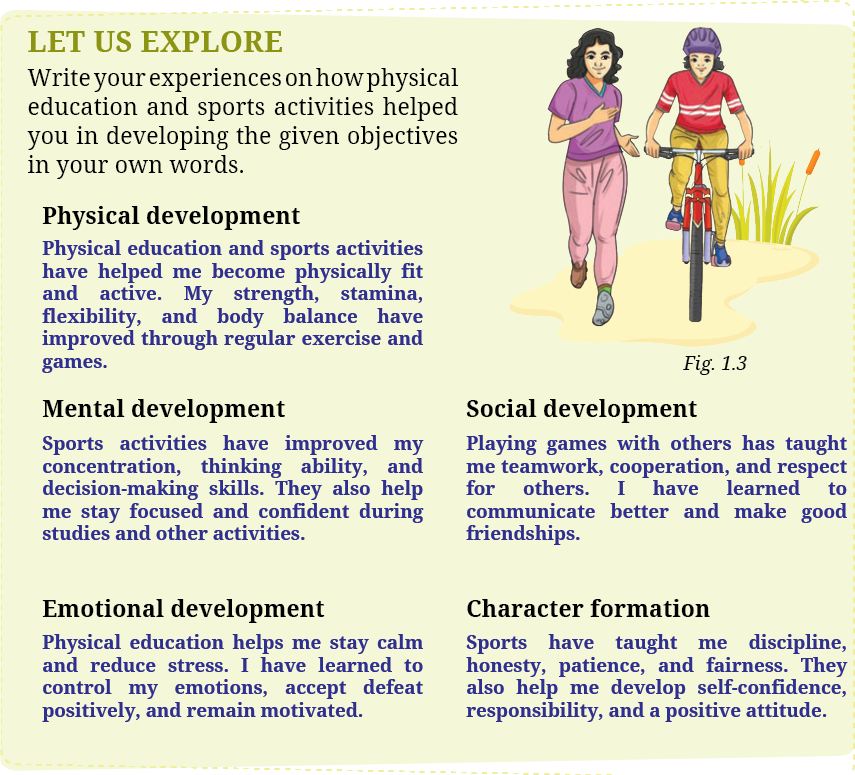
Page No 5 – Let Us Explore
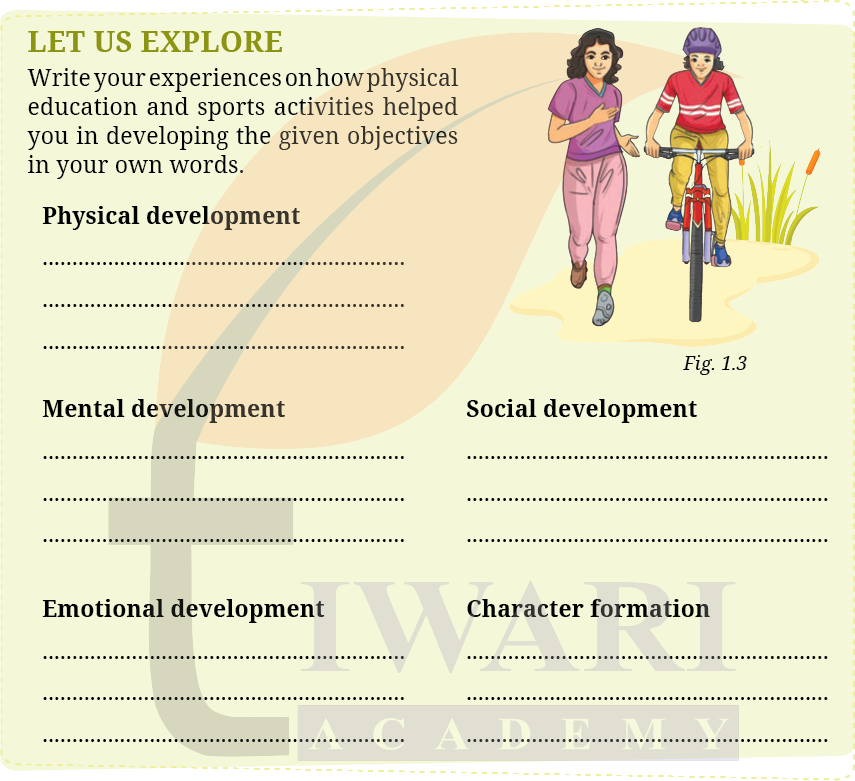
Answer:
Page No 6 – Read and Reflect
1. Which two objectives of physical education helped Richa improve her concentration and confidence?
Answer:
The two objectives of physical education that helped Richa improve her concentration and confidence are mental development and emotional development.
2. How did participation in team games help Richa in her social development?
Answer:
Participation in team games helped Richa learn teamwork, cooperation, communication and respect for others. It also helped her make friends and work well with teammates.
3. If Richa continues to play regularly and maintains healthy habits, which long-term benefit of physical education will she achieve?
Answer:
If Richa continues to play regularly and maintains healthy habits, she will achieve good physical fitness, better health, confidence, emotional balance and an active lifestyle in the long term.
Physical Literacy
How did you learn movements like throwing a ball, running, or balancing on one leg? Did you learn everything at once? What helped you to finally do them correctly?
Answer:
I did not learn these movements all at once. In the beginning, I made many mistakes while throwing, running and balancing. With regular practice, guidance from my teachers and repeated participation in games and activities, I slowly improved my skills. Physical education classes, exercise and sports activities helped me gain confidence, balance, coordination and proper body movement. Practice and patience helped me finally perform these movements correctly.
Page 9 – Exercise
1. At the Middle and Preparatory stages, you have played traditional games. Discuss how these games helped you to attain the objectives of physical education.
Answer:
Traditional games helped me improve my physical fitness, strength, balance, and coordination. They also taught me teamwork, discipline, cooperation, patience and respect for rules. These games improved my confidence, concentration and social skills. They also helped me stay active, healthy and emotionally balanced.
2. From the given options, circle the word which you think is appropriate for physical literacy, and discuss with your peers.
Answer:
The words appropriate for physical literacy are:
Movement, skills, fitness, confidence, motivation and knowledge of health.
3. A student is skilled in football but avoids trying any new sport. According to you, which component of physical literacy might they need to develop? Discuss with your peer, parents and teachers.
Answer:
The student needs to develop confidence and motivation. These components of physical literacy help a person try new activities, learn different skills and participate actively in various sports.
Class 9 Physical Education Chapter 1 Extra Questions for Practice
NCERT Class 9 Khel Praveen Chapter 1 Very Short Answer Type Questions with Explanation.
Short Answer Type Questions
- What is the meaning of Physical Education according to NCF-SE 2023?
Answer:
Physical Education includes movements, drills, yoga, games and sports that promote mind-body wellness and develop knowledge of the body. - What does the Sanskrit śloka from Charaka Saṁhitā say about physical exercise?
Answer:
It states that exercise promotes lightness, enhances work capacity, improves stability, boosts immunity and supports healthy metabolism. - Why is physical education called an important part of our lives?
Answer:
It teaches us to take care of our health, stay active and balance studies with physical fitness effectively. - What values does physical education nurture in students?
Answer:
It nurtures respect for others, fairness, honesty, co-operation, confidence, emotional balance and mental calmness. - What did the Central Advisory Board of Physical Education and Recreation (1959) say?
Answer:
It defined physical education as a process developing the total personality of a child in body, mind and spirit. - What did UNESCO say about physical education in 1978?
Answer:
UNESCO called physical education a fundamental right and an essential element of lifelong learning contributing to holistic development and quality of life. - What is physical literacy?
Answer:
Physical literacy means having the ability, confidence and motivation to participate in various physical activities throughout one’s life. - Name the three types of movement skills covered in Chapter 1.
Answer:
The three types are Locomotor Skills, Non-locomotor Skills and Manipulative Skills. - What are locomotor skills? Give two examples.
Answer:
Locomotor skills involve moving the body from one place to another. Examples include running, jumping, hopping and leaping. - What are non-locomotor skills? Give two examples.
Answer:
Non-locomotor skills are movements without changing location, such as bending, stretching, twisting, turning and balancing. - What are manipulative skills? Give two examples.
Answer:
Manipulative skills involve controlling objects with hands or feet. Examples include throwing, catching, kicking and dribbling. - Which Indian games depend heavily on locomotor skills?
Answer:
Kabaddi and Kho-Kho depend heavily on locomotor skills like chasing, dodging and changing direction quickly. - Which sports or activities mainly use manipulative skills?
Answer:
Gillī-Daṇḍā, cricket, football and volleyball are games that primarily depend on manipulative skills. - What does NEP 2020 say about physical education?
Answer:
NEP 2020 mandates Physical Education and Well-being as a compulsory and core subject in school education. - How does yoga connect with non-locomotor skills?
Answer:
Yoga āsanas like Tāḍāsana and Vṛikṣhāsana require balancing and staying focused without moving – which are non-locomotor skills.
NCERT Class 9 Khel Praveen Chapter 1 Short Answer Type Questions with Explanation.
Short Answer Type Questions
- What does the chapter say about the relationship between body and mind in education?
Answer:
The chapter explains that real education covers both body and mind. If the body is weak, the mind cannot focus, and if the mind is unwell, even a strong body feels tired and drained. - How did Sri Aurobindo define the aim of physical culture?
Answer:
Sri Aurobindo believed the ultimate aim of physical culture is the perfection of the body, just as perfection is the goal of all other forms of culture – spiritual, mental and vital. - What are the five benefits of developing physical literacy listed in Chapter 1?
Answer:
The five benefits are: improves overall health and physical fitness, builds confidence and self-esteem, helps prevent lifestyle diseases, develops teamwork, leadership skills and reduces anxiety while improving focus in studies. - What does Charles A. Bucher say about the aim of physical education?
Answer:
Bucher (1979) described physical education as an integral part of total education, aimed at developing physically, mentally, emotionally and socially fit citizens through physical activities. - What does J.P. Thomas (1963) say about physical education?
Answer:
J.P. Thomas defined physical education as education through physical activities for the development of the total overall personality of the child – its fulfilment and perfection in body, mind and spirit. - How does physical education build character and social values in students?
Answer:
When students play together, they learn to respect rules, accept victory humbly and face defeat with courage. They also develop co-operation, equality and respect for diversity while sharing responsibilities in teams. - What is the role of indigenous games and yoga in physical literacy?
Answer:
Indigenous games like Āṭyā-Pāṭyā and Anding Oka develop speed, agility, and coordination, while yoga āsanas build balance, stability and body awareness. Together they reflect India’s cultural heritage and support holistic student development. - What happens to the body and mind when a student becomes physically inactive?
Answer:
When students are inactive for long hours — scrolling phones or watching videos – the body becomes stiff, muscles grow weaker and the mind feels tired and stressed, reducing overall energy and focus. - What four components make up physical literacy according to Chapter 1?
Answer:
Physical literacy includes physical ability (running, throwing, balancing), confidence in one’s movement, motivation to stay active and an understanding of why physical activity is important for health and well-being. - What broader aim of physical education does NCF-SE 2023 highlight?
Answer:
NCF-SE 2023 highlights that physical education should go beyond fitness to nurture mind-body wellness, resilience, empathy, co-operation and fair play – enabling students to become socially responsible and emotionally balanced citizens.
NCERT Class 9 Khel Praveen Chapter 1 Long Answer Type Questions with Explanation.
Long Answer Type Questions
- Explain the meaning and importance of Physical Education as described in Chapter 1.
Answer:
Physical Education is far more than just playing sports or doing exercises in school. It is a process of learning through the body, training the body and mind together. Every sprint builds endurance, every yoga posture develops balance and self-control and every game teaches teamwork, strategy and discipline. According to NCF-SE 2023, it includes movements, drills, yoga, games and sports that promote mind-body wellness. UNESCO (1978) called it a fundamental right for all. It promotes happiness, confidence, emotional balance and mental calmness and nurtures values like honesty, fairness and co-operation — making it an essential part of complete education. - What are the aims and objectives of Physical Education? Discuss in detail.
Answer:
The aim of Physical Education is not just to make students physically fit, but to develop them as complete, balanced individuals. NCF-SE 2023 emphasises that it should nurture mind-body wellness, resilience, empathy, co-operation and fair play. When students train together, they learn to accept victory with humility and face defeat with courage – qualities that build strong character. The objectives cover five areas: physical development (strength, stamina, agility), mental development (focus, decision-making), emotional development (self-control, confidence), social development (teamwork, respect) and character formation (honesty, fairness, discipline). Together, these prepare students to live responsibly and contribute positively to society and the nation. - What is Physical Literacy? Explain its components and benefits for Class 9 students.
Answer:
Physical literacy refers to the ability, confidence, and motivation to participate in various physical activities throughout life. Just as reading and writing develop language literacy, moving confidently through physical activities develops physical literacy. It includes four key components: physical ability (running, throwing, balancing, jumping), confidence in one’s own movement, motivation to stay active and understanding the importance of physical activity for health. The benefits of developing physical literacy are significant for Class 9 students – it improves overall health and fitness, builds self-esteem, prevents lifestyle diseases, develops leadership and teamwork and reduces anxiety while improving concentration in studies. It builds healthy habits that last a lifetime. - Describe the three types of movement skills with examples from Indian games and sports.
Answer:
Movement skills are the foundation of all physical activities and are classified into three types. Locomotor skills involve moving the body from place to place – walking, running, jumping, and hopping. These are central to games like Kabaddi and Kho-Kho, which require chasing and dodging. Non-locomotor skills are movements done without changing location — bending, stretching, twisting, and balancing. Yoga āsanas like Tāḍāsana and Vṛikṣhāsana are excellent examples. Manipulative skills involve controlling objects using hands or feet – throwing, catching, kicking, and dribbling. Games like Gillī-Daṇḍā, cricket, football and volleyball depend on these. All three categories work together to build well-rounded physical literacy in students. - Analyse the story of Richa from the “Read and Reflect” section. What does it teach about the role of physical education in a student’s life?
Answer:
Richa, a Grade 9 student, spent most of her time on mobile games and avoided outdoor activities. As a result, she felt constantly tired, struggled to concentrate in class, and got stressed before exams. When her friends encouraged her to join a team game on Sports Day, she hesitated at first but slowly began to enjoy it. With regular participation in sports, her energy improved, her focus in studies increased and she learned to co-operate with teammates. Her teachers noticed she became calmer and more confident, even while making mistakes. Richa’s story powerfully illustrates that physical education develops mental focus (mental development), builds confidence (emotional development), and teaches teamwork and communication (social development) – proving that physical activity is as important as academic study for a student’s overall growth.
FAQs – Class 9 Physical Education Khel Praveen Chapter 1
Is Class 9 Physical Education Khel Praveen Chapter 1 easy?
Yes, Chapter 1 is considered one of the easier chapters in Khel Praveen for Class 9. The language is simple and the concepts are relatable to everyday life. Topics like physical literacy, movement skills and the aims of physical education are straightforward once you read the chapter carefully.
The only part that needs a little extra attention is remembering the definitions given by different scholars and organisations like UNESCO, NCF-SE 2023, Sri Aurobindo and Charles A. Bucher. If you read the chapter twice and make short notes of key points, you will find it very manageable.
How to prepare Class 9 Physical Education Khel Praveen Chapter 1 in one day?
Yes, Chapter 1 can be covered in one day if you follow a focused plan. Start by reading the full chapter once without stopping. Then make a quick list of all definitions, aims, objectives and types of movement skills. Give extra time to memorising the scholars’ definitions as these are commonly asked in exams. Next, go through the “Let Us Think” and “Read and Reflect” sections — they are great for understanding application-based questions.
Finally, practise writing answers to 2–3 short questions and 1 long answer without looking at the book. That single revision cycle is enough for a solid one-day preparation.
What are the main points of Class 9 Khel Praveen Chapter 1?
The main points of Chapter 1 are as follows:
- Physical education trains both the body and mind together, not just the body.
- The Sanskrit śloka from Charaka Saṁhitā highlights the ancient Indian understanding of exercise and health.
- Key definitions are given by Sri Aurobindo, J.P. Thomas, UNESCO (1978), Charles A. Bucher (1979) and NCF-SE 2023.
- The aims of physical education go beyond fitness – they include character building, emotional balance, and social responsibility.
- The five objectives cover physical, mental, emotional, social development and character formation.
- Physical literacy is the ability, confidence and motivation to stay physically active throughout life.
- Movement skills are of three types – Locomotor, Non-locomotor and Manipulative.
- NEP 2020 has made Physical Education and Well-being a compulsory core subject.
How to revise Class 9 Khel Praveen Chapter 1 quickly before an exam?
For quick revision before your exam, follow these steps.
- First, go through your short notes or the key points list instead of re-reading the full chapter.
- Second, revise all definitions – especially the ones by UNESCO, NCF-SE 2023 and Charles A. Bucher – as they are the most commonly tested.
- Third, quickly recall the three types of movement skills with one or two examples each.
- Fourth, re-read the Richa story from the “Read and Reflect” section as it covers multiple objectives and is often used for application-based questions.
- Finally, read the Charaka Saṁhitā śloka and its meaning once – it is a frequent one-mark or two-mark question in exams.
Which definitions in Chapter 1 are most important for the Class 9 exam?
There are five definitions you must learn for the exam. The definition by NCF-SE 2023 is the most important as it is from the current curriculum framework and is highly likely to be asked. The UNESCO (1978) definition is important because it calls physical education a fundamental right.
The Central Advisory Board of Physical Education and Recreation (1959) definition is commonly asked in Indian school exams. The definitions by J.P. Thomas (1963) and Charles A. Bucher (1979) are also important for longer answer questions. Sri Aurobindo’s quote on the perfection of the body is often asked as a one-liner or fill-in-the-blank question.
What are the three types of movement skills in Chapter 1 and how to remember them?
The three types are Locomotor Skills, Non-locomotor Skills and Manipulative Skills. A simple way to remember them is by using the word LNM – L for Locomotor (body moves from place to place, like running and jumping), N for Non-locomotor (body stays in place, like bending and balancing) and M for Manipulative (hands or feet control an object, like throwing and catching).
Link each type to a sport or game you know – Kabaddi for locomotor, yoga for non-locomotor and cricket or football for manipulative. This connection makes it much easier to recall during exams.
What are the objectives of physical education asked in Class 9 exams?
The five objectives of physical education most commonly tested in Class 9 exams are Physical Development (building strength, stamina, speed, and agility), Mental Development (improving focus, confidence and decision-making), Emotional Development (developing self-control, resilience and the ability to handle wins and losses), Social Development (learning teamwork, co-operation, equality and respect for others), and Character Formation (nurturing honesty, fairness, patience and discipline). These objectives are often asked as short answer or table-fill questions. The story of Richa in the chapter is a good way to understand how these objectives apply in real life.
How many marks does Chapter 1 of Khel Praveen carry in the Class 9 exam?
The exact marks distribution depends on your school’s internal examination pattern and your state board’s guidelines, as Khel Praveen is assessed differently across schools. However, Chapter 1 being the foundational chapter of the book, questions from it are almost always included in exams.
You can expect 1-mark questions (definitions, fill-in-the-blanks), 2–3 mark short answers (types of movement skills, objectives) and 5-mark long answers (meaning of physical education, physical literacy, aims and objectives). Always check your school’s latest sample paper or ask your teacher for the exact weightage.
Is the Charaka Saṁhitā śloka important for the Class 9 Khel Praveen exam?
Yes, the śloka from Charaka Saṁhitā (Sūtra-sthānam, 7.32) given at the beginning of Chapter 1 is important. You may not be asked to write the full Sanskrit text, but its meaning is definitely important – “Physical exercise promotes a sense of lightness, enhances work capacity, improves stability, boosts immunity against illnesses, helps eliminate health issues and supports a healthy metabolism.”
This can be asked as a one-mark or two-mark question about the ancient Indian perspective on physical exercise. Learn the meaning clearly and also remember that it comes from the Charaka Saṁhitā, which is a classical Indian text on medicine and health.
What is the difference between the aims and objectives of physical education in Chapter 1?
The aim is the broader, long-term goal – the overall direction in which physical education takes a student. In Chapter 1, the aim is to develop students into physically fit, emotionally balanced, socially responsible and morally grounded individuals.
The objectives, on the other hand, are the specific, measurable outcomes through which that aim is achieved. The five objectives – physical development, mental development, emotional development, social development and character formation – are the practical steps that lead towards the broader aim. Think of the aim as the destination and the objectives as the route you take to reach it.
What is the best way to answer long questions from Class 9 PE Chapter 1 in the exam?
For long answers from Chapter 1, always start with a clear one-line definition or introduction of the topic. Then expand with 3–4 key points, using headings if the question has multiple parts (like listing objectives or types of skills). Where possible, include the name of the scholar or organisation with their definition — this shows depth of understanding and earns extra marks.
End with a concluding sentence that connects the topic to everyday life or holistic development. Avoid writing in bullet points for long answers unless the question specifically asks for a list. Write in complete sentences and keep your handwriting neat and readable.
Can questions from the “Read and Reflect” and “Let Us Explore” sections of Chapter 1 come in exams?
Yes, they can. The “Read and Reflect” section featuring Richa’s story is particularly important because it tests your understanding of how physical education objectives apply in real life. Questions from this section may appear as case-study or application-based questions, which are becoming more common in the new NCF-based exam format. The “Let Us Explore” section on the five development objectives (physical, mental, emotional, social and character formation) may come as a short activity-based question. It is always a good idea to prepare answers for these sections along with your regular exercise questions.