
Here are the NCERT Solutions for Class 8 Social Science Part 2 Chapter 4, The Role of the Judiciary in Our Society, prepared from the Part 2 textbook for the 2026-27 session. It connects law with justice, explains why the judiciary stands apart from the other organs of government, and walks through the Supreme Court, High Courts, subordinate courts, tribunals, technology in courts and Lok Adalats. Its activities include writing a model letter to a court and staging moot court cases on equal pay and river pollution. After the answers come a court-structure guide, key facts and a table of articles.
The Role of the Judiciary in Our Society Class 8 Question Answers (Part 2, Chapter 4)
Class 8 Social Science Part 2 Question-Answers of Page 125
Page 125 – The Big Questions
1. What is the concept of justice?
Answer:
Justice means treating people fairly and doing what we can to put a wrong right. For example, if two students disagree about what happened in a game, I would let them both explain before deciding what to do. Giving each person a fair hearing is procedural justice. Reaching a fair decision is substantive justice.
2. Why is it important for a just and harmonious Society?
Answer:
Justice helps people live together with dignity and trust. When rules are applied fairly and people have somewhere to go if they are wronged, they can sort out disagreements peacefully. It also protects people who may have less power or whose voices are often ignored.
3. What is the structure and role of the judiciary in India?
Answer:
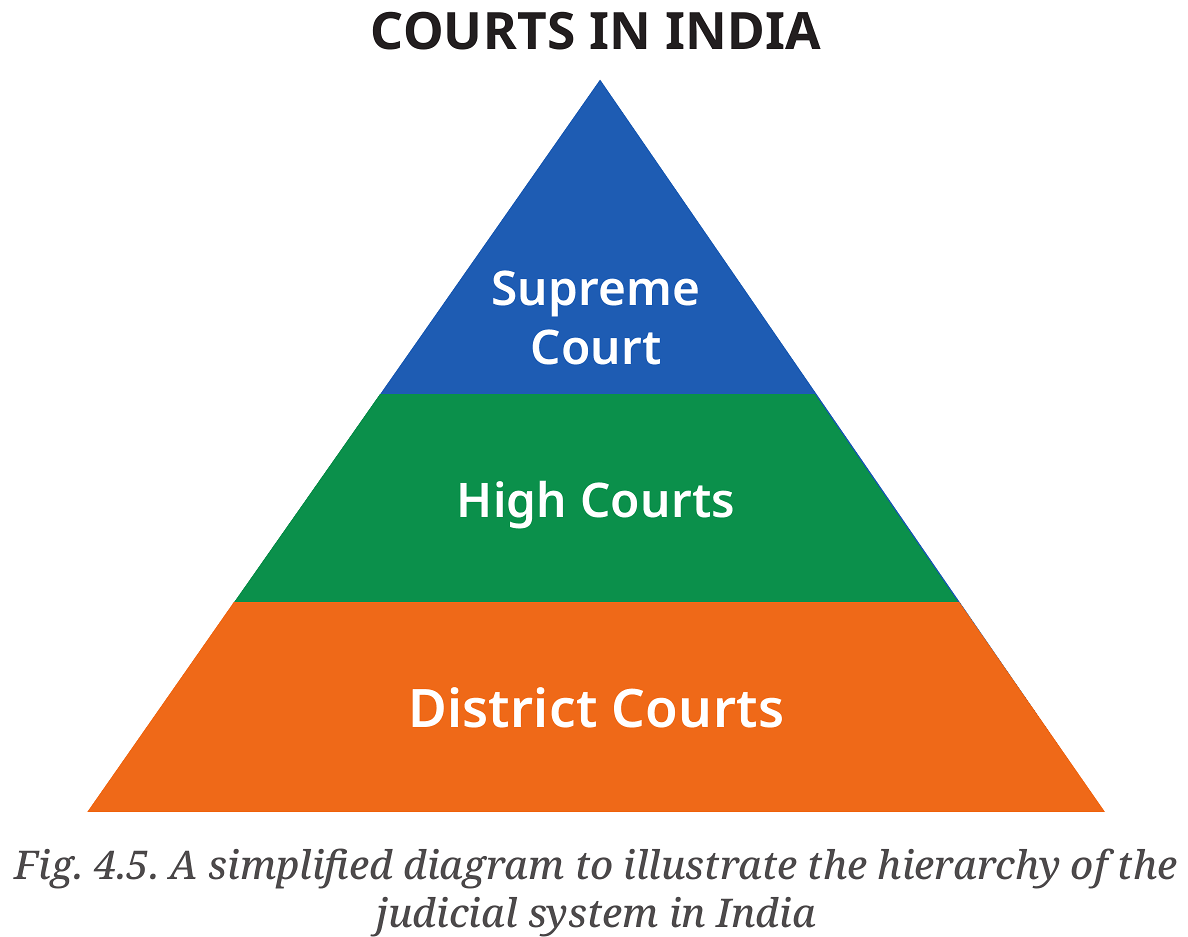
India has one connected system of courts. The Supreme Court is at the top. High Courts work at the state level and some serve more than one state or union territory. District and other subordinate courts hear many local cases. The courts settle disputes, protect Fundamental Rights and interpret laws. They also check whether laws and government actions follow the Constitution.
4. What are the alternative modes of dispute resolution?
Answer:
In negotiation, the people involved talk directly and try to reach an agreement. In mediation or conciliation, a neutral person helps them find a settlement. In arbitration, an independent person or panel hears both sides and gives a binding decision. Lok Adalats help parties settle suitable disputes by agreement. Gram Nyayalayas are village-level courts that use simpler procedures for certain local disputes.
Class 8 Social Science Part 2 Question-Answers of Page 127
Page 127 – LET’S EXPLORE
1. Think of a time when you felt that someone had not been fair to you. How did you feel? What did you think needed to be done to make the situation right? Who could have made things right? What would you do in such a situation? Share in small groups.
Answer:
During a group project at Tiwari Academy, one group member got all the credit for a poster three of us had made. I felt hurt because I had drawn its main diagram. I thought we should add everyone’s name and explain who did each part. My group could have fixed it, and our teacher could have helped if we still disagreed. I would speak to my group quietly first and give them a chance to explain. That is what I would share in our discussion.
Class 8 Social Science Part 2 Question-Answers of Page 135
Page 135 – LET’S EXPLORE
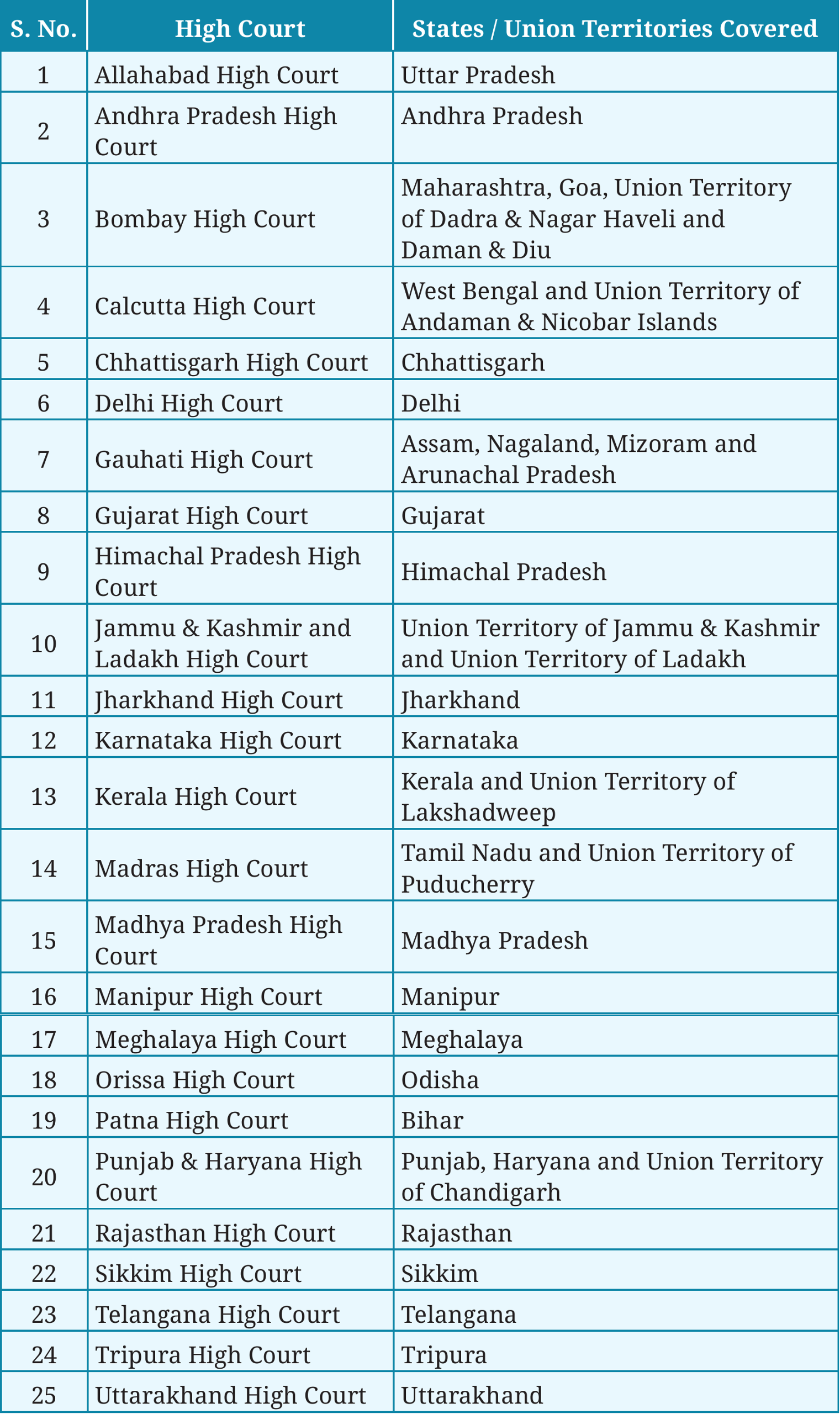
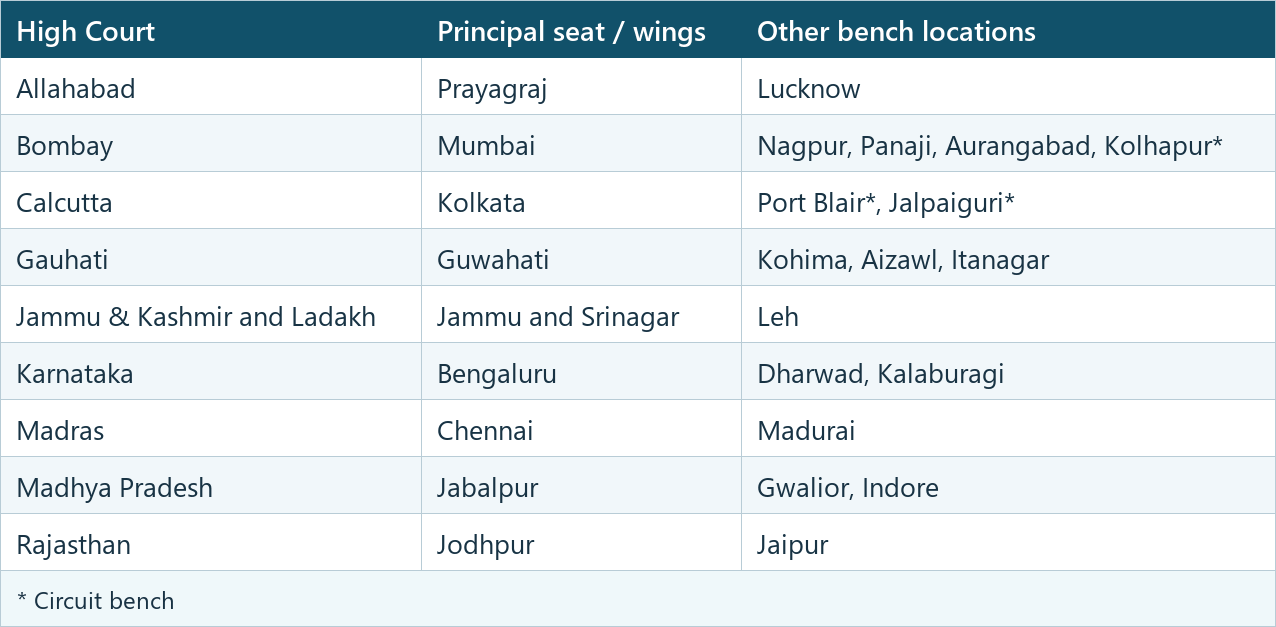
1. Several High Courts mentioned in the table have more than one bench. Explore which High Courts have more than one bench with the help of your teachers.
Answer:
I made a chart of the High Courts that sit in more than one place. The main location is called the principal seat. Some courts also have circuit benches that sit in another place. The High Court of Jammu & Kashmir and Ladakh has two wings, at Jammu and Srinagar, and its Ladakh Bench sits at Leh.
Class 8 Social Science Part 2 Question-Answers of Page 136
Page 136 – LET’S EXPLORE
1. Which Subordinate Court is closest to where you live?
Answer:
I live in Saket, South Delhi. The nearest subordinate court to me is the District Court at the Saket Courts Complex. The complex hears civil and criminal cases from the South and South-East districts of Delhi.
Class 8 Social Science Part 2 Question-Answers of Page 141
Page 141 – Questions and Activities
1. Write a model letter to the High Court or Supreme Court about a current social issue you have observed to bring it to the notice of the judiciary.
Answer:
To
The Registrar General
High Court of Delhi, New Delhi
Subject – Rubbish blocking access to a public park
Respected Sir or Madam,
I am a Class 8 student at Tiwari Academy. Near my home in South Delhi, rubbish keeps piling up at the entrance to the public park. Children and older people use that entrance every day. The waste smells, and part of the path gets blocked.
I request the Court to bring this concern to the attention of the local authorities and ask them to arrange regular waste collection and keep the path clear. A few covered bins near the entrance would also give people a place to put their rubbish.
Yours faithfully,
A Class 8 student
Tiwari Academy
2. Imagine that you are part of the legislature or executive. Given the large number of cases in the judicial system, what are some innovative solutions that you can devise to address the issue?
Answer:
I would set up help desks at district courts so people can file papers correctly and get SMS reminders about hearings. I would also support video hearings for routine steps, with an in-person option for people who need it. Suitable disputes could go to mediation or a Lok Adalat if both sides are willing. Finally, I would use case statistics to direct more staff and courtrooms to places where people wait the longest.
3. Create a moot court and enact the following cases. What are the considerations that the judge might need to take into account to arrive at a just outcome?
i. Anita and Sameer worked in a factory that produced different types of screws. They had both completed an Industrial Training Institute diploma and joined the factory together. One day, Anita discovered that she was getting paid less than Sameer for the same job. After many appeals to her boss and no change in her salary, she decided to go to court. Enact this scene from the litigants’ perspective, showcasing their respective points of view. What might be the outcome of the case?
ii. The people of a village living next to a river used its water for drinking and irrigation purposes. Gradually, they began to notice that the clear water was turning a brownish colour and had begun to smell too. Many people were falling sick. They figured that this was due to the effluents that were being discharged by a factory upstream. What are the steps that the residents of the village could take to ensure that the water is clean again?
Answer:
i. Anita and the factory
Anita: Sameer and I joined together with the same diploma. We do the same work, but I am paid less. Here are our job descriptions and payslips.
Factory manager: We should compare the duties, hours and allowances before deciding if the difference is unfair. I can bring the payroll and shift records.
Judge: I will hear both sides and check the records. If the work is the same and there is no fair reason for the difference, Anita could receive equal pay and the amount she was underpaid.
ii. The village and the factory
Village representative: The water has changed colour and people are falling ill. We are asking for safe drinking water and an investigation of the factory’s discharge.
Factory representative: We will provide our records. The water should be tested upstream and downstream to find out where the pollution is coming from.
Judge: I would consider test results, inspection findings and medical records. If the factory is found responsible, it could be ordered to stop releasing untreated waste and help clean up the river. The water should be tested regularly to check that it is safe again.
Before the hearing, the residents could report the problem to the local authorities and the pollution control board. If the problem continued, they could seek help from the National Green Tribunal. While the water is being tested, the village needs a safe supply for drinking.
4. Many eminent individuals from across India have served as Supreme Court or High Court judges. Write an essay about one such individual from your state or district, talking about their contributions as a judge of the Supreme Court or High Court.
Answer:
Justice Sanjiv Khanna
I chose Justice Sanjiv Khanna because he went to school in Delhi, studied law at Delhi University and worked in the courts in my city. He became a judge of the Delhi High Court in 2005 and joined the Supreme Court in 2019. In 2024, he became the 51st Chief Justice of India.
At the Delhi High Court, he helped oversee the Delhi Judicial Academy and the district courts’ mediation centres. Mediation gives people a chance to settle a disagreement with the help of a neutral person. As a Supreme Court judge, he was part of the bench that struck down the Electoral Bond Scheme in 2024. He agreed with the decision and wrote a separate opinion explaining his reasons. I chose this example because voters need information about who funds political parties to make informed choices.
5. Have an interaction with anyone you know who is a part of the judicial system. Try to understand their work, the challenges they face, and what gives them satisfaction. Create a small presentation and share it with the class.
You can do this in small groups.
Answer:
I would ask a district court lawyer to speak with our group and put together this short presentation for Tiwari Academy.
- Slide 1: A lawyer’s work. Lawyers listen to the people they represent, read documents and explain their side in court. I would ask, “What do you do to prepare before a hearing?”
- Slide 2: Challenges. We would ask, “What is hardest when a case goes on for a long time?” We could discuss how delays and unfamiliar legal words can make things difficult for the people involved.
- Slide 3: What makes the work worthwhile? I would ask, “Which part of helping someone gives you the most satisfaction?” One of us would share the lawyer’s answer and explain how an agreement or a fair hearing can help people move forward.
Class 8 SST Part 2 Ch: 4 Extra Question-Answers for Practice
Very Short Answer Type Questions
1. What three kinds of justice does the Preamble to India’s Constitution promise its citizens?
See AnswerThe Preamble promises social, economic and political justice.
2. Who decides whether to accept a settlement in mediation?
See AnswerThe parties decide whether to accept a settlement. The mediator helps them discuss it.
3. What does a court presume about an accused person before their guilt is proved?
See AnswerThe court presumes the accused person is innocent until proved guilty.
4. On what date did the Supreme Court of India come into existence?
See AnswerIt came into existence on 26 January 1950, when the Constitution came into effect.
5. Which article provides for the establishment of the Supreme Court of India?
See AnswerArticle 124 of the Constitution provides for its establishment.
6. Who appoints judges of the Supreme Court of India?
See AnswerThe President of India appoints Supreme Court judges.
7. At what ages do Supreme Court and High Court judges retire?
See AnswerSupreme Court judges retire at 65, and High Court judges retire at 62.
8. What does PIL stand for?
See AnswerPIL stands for Public Interest Litigation.
9. Under Article 141, which courts must follow the law declared by the Supreme Court?
See AnswerThe law declared by the Supreme Court is binding on all courts in India.
10. Which tribunal deals with appeals in electricity disputes?
See AnswerThe Appellate Tribunal for Electricity, or APTEL, deals with these appeals.
11. Which tribunal decides disputes about the service matters of government employees?
See AnswerThe Central Administrative Tribunal decides these disputes.
12. Who is called a litigant?
See AnswerA litigant is a person involved in a legal case, such as someone who sues or is sued.
13. Which law replaced the Indian Penal Code of 1860?
See AnswerThe Bharatiya Nyaya Sanhita, 2023, replaced the Indian Penal Code.
14. Which Act gives legal recognition to Lok Adalats?
See AnswerThe Legal Services Authorities Act, 1987, gives legal recognition to Lok Adalats.
15. Who appoints district judges, and whom must they consult?
See AnswerThe Governor appoints district judges in consultation with the High Court.
Short Answer Type Questions
1. Why was the Criminal Tribes Act of 1871 considered unjust?
See AnswerThe Act labelled people from certain communities as criminals by birth. It judged them by the community they belonged to, without proof of individual wrongdoing. This went against the idea that people should be treated fairly and equally.
2. How did the Jim Crow laws affect access to public facilities in parts of the United States?
See AnswerThe Jim Crow laws excluded African Americans and other people of colour from facilities reserved for white people. These included drinking fountains, swimming pools and restaurants. The rules turned ordinary activities into reminders of racial discrimination.
3. What is the purpose of the Virtual Justice Clock at the Supreme Court?
See AnswerThe display at the Supreme Court’s entrance gives the public access to current information about the courts. It helps visitors see how the justice system is working and makes that information easier to find.
4. What disputes between governments can begin directly in the Supreme Court under Article 131?
See AnswerArticle 131 covers certain legal disputes between the Union and a State, between States, or between the Union and a State on one side and another State on the other. These cases begin in the Supreme Court.
5. How can the President seek the Supreme Court’s opinion on a question of public importance?
See AnswerUnder Article 143, the President can refer an important question of law or fact to the Supreme Court. A Constitution Bench of at least five judges hears the matter. The Court may then give its opinion to the President.
6. When may the Supreme Court hear an appeal from a final decision of a High Court?
See AnswerThe Supreme Court may hear an appeal if the High Court certifies that a constitutional interpretation or a substantial question of law is involved. Certain criminal cases, including cases involving a death sentence, can also reach it on appeal.
7. How can one High Court serve more than one State? Give an example.
See AnswerStates can share a High Court, so one court can cover several territories. For instance, the Gauhati High Court serves Assam, Nagaland, Mizoram and Arunachal Pradesh. It exercises its authority within the areas assigned to it.
8. What is the purpose of a High Court’s supervisory power under Article 227?
See AnswerArticle 227 allows a High Court to supervise courts and tribunals within its territory. The High Court uses this power sparingly to make sure these bodies stay within the limits of the authority they have been given.
9. How can online court services help a litigant follow their case?
See AnswerA litigant can look up case details on the court’s website without having to ask a lawyer each time. Court orders and judgments can also be read online, and translations in Indian languages help more people understand them.
10. What improvements do the three criminal laws introduced in 2023 aim to bring?
See AnswerThe three laws aim to help cases move faster and make court procedures clearer. They support the use of digital evidence and give victims better protection. Together, these changes seek to make the justice system more effective.
Long Answer Type Questions
1. What do South Africa’s former apartheid laws show about the link between law and justice?
Answer:
During apartheid, South African laws separated people by race and restricted access to public facilities for many people of colour. These restrictions harmed people’s dignity and denied them the same opportunities as others. The example shows that a rule enforced by the government can still be unfair. Judging whether a law brings justice means looking at how it treats people in everyday life.
2. How did Kapila Hingorani use a petition to help people who had spent too long in jail awaiting trial?
Answer:
Kapila Hingorani read that some prisoners in Bihar had already spent longer in jail awaiting trial than the sentence they could have received if found guilty. She filed a writ petition to seek their release. The Supreme Court ordered the release of such prisoners and issued guidelines that helped undertrial prisoners across India. The case showed how one petition could improve the lives of many people facing the same problem.
3. How did the Vishaka case lead to stronger protection against sexual harassment at work?
Answer:
In the Vishaka case, the Supreme Court examined the problem of sexual harassment in workplaces. In 1997, it laid down guidelines to address the problem. In 2013, a law was enacted to prevent and prohibit sexual harassment of women at work and to provide a way to deal with complaints. The case shows how a court’s guidelines can protect people while a law is being developed.
4. What happened when a family took its complaint about an unfinished flat to the National Consumer Commission?
Answer:
The family paid the builder an advance of nearly ₹65 lakh for a flat. Four years later, construction had still not begun, so they complained to the National Consumer Commission. The Commission listened to both sides and then ordered the builder to return the money with interest and pay the cost of the case. Hearing both sides gave the Commission a fair way to examine the agreement before deciding what the builder owed.
5. How can a Special Leave Petition bring an important case before the Supreme Court under Article 136?
Answer:
A Special Leave Petition asks the Supreme Court for permission to appeal against a decision of a court or tribunal. The Supreme Court decides whether to grant that permission. It may consider whether the case raises a question of law that matters to many people or whether hearing it would help achieve a fair outcome for the parties. If it grants permission, the appeal can go ahead.
How India’s Courts Are Arranged, from the Top Down
- The Supreme Court of India in New Delhi is the highest court; it has the Chief Justice of India and 33 other judges.
- The High Courts come next. There are 25 of them, because some states and union territories share one and each one oversees all courts and tribunals within its territory.
- Subordinate courts, such as District Courts, Sessions Courts, Revenue Courts and Small Causes Courts, work below the High Court in each state; the Governor appoints District Judges in consultation with the High Court.
- Tribunals are quasi-judicial bodies set up to decide specific kinds of disputes, such as the National Green Tribunal; appeals from some of them go to the Supreme Court.
- Alternative modes, namely arbitration, mediation or conciliation, negotiation and Lok Adalats, help settle disputes and reduce the burden on courts.
- Check what you have learnt with our MCQs on the Role of the Judiciary.
The Role of the Judiciary: Key Facts to Remember
- The judiciary is one of the three pillars of government and the Constitution keeps it independent of the legislature and the executive.
- Public Interest Litigation (PIL), filed under Articles 32 and 226, was introduced by the Supreme Court to take up issues of public concern and give meaning to the Right to Life under Article 21.
- The first reported PIL was a complaint made by a lawyer, Kapila Hingorani.
- Lok Adalats settle disputes amicably; they can resolve cases already pending in court, and people can sometimes approach them before going to court.
- Technology now supports the courts through e-filing, hybrid hearings, live streaming of proceedings, translation of judgments into many Indian languages and the National Judicial Data Grid.
- Since 2024–25, a large ‘Virtual Justice Clock’ screen at the main entrance of the Supreme Court has shared real-time judicial data with the public.
- For other classes and subjects, visit the NCERT Solutions home page.
Articles of the Constitution in The Role of the Judiciary in Our Society
| Article | What it provides |
|---|---|
| Article 21 | The Right to Life, to which PIL gives practical meaning |
| Article 32 | Writ petitions filed directly before the Supreme Court to enforce Fundamental Rights |
| Articles 132, 133 and 134A | Appeals from a final order of a High Court when the High Court certifies that the case involves interpreting the Constitution or a substantial question of law |
| Article 136 | Special leave to appeal against any judgment, decree or order of a court or tribunal in India where a question of law of general public importance arises or to do substantive justice |
| Article 143 | Advisory jurisdiction: the President can seek the Supreme Court’s opinion and such cases are heard by at least five judges |
| Article 226 | Writ jurisdiction of the High Courts |
| Article 227 | Superintendence of each High Court over the courts and tribunals in its area |
| Article 233 | Appointment of District Judges by the Governor in consultation with the High Court |
Solutions for every other chapter are on our Class 8 Social Science solutions, Part 1 and Part 2 page.
FAQs on Class 8 SST Part 2 Chapter 4
What is Class 8 Social Science Part 2 Chapter 4 about?
It explains what justice means, why it is essential for peace and harmony in society, and how India’s judicial system delivers it. The chapter covers the Supreme Court and its jurisdictions, the High Courts, subordinate courts and tribunals, the use of technology in courts, alternative ways of settling disputes and the part citizens can play in bringing social concerns to the courts.
What is the difference between Article 32 and Article 226?
Both let a person file a writ petition to enforce Fundamental Rights. Under Article 32, the petition goes directly to the Supreme Court, where the issue has all-India ramifications. Under Article 226, it goes to the High Court and concerns rights violated within the territorial limits of that state.
What is Public Interest Litigation?
Public Interest Litigation, or PIL, is an innovation of the Supreme Court that allows issues of public concern to be brought before the courts. It is filed under Articles 32 and 226 and gives practical meaning to the Right to Life under Article 21. Cases taken up this way include M.C. Mehta v. Union of India, on cleaning the River Ganga and protecting the Taj Mahal and Vishaka v. State of Rajasthan, in which the Supreme Court laid down guidelines against sexual harassment at the workplace in 1997.
What is a Lok Adalat?
A Lok Adalat is a special forum where disputes are settled amicably. It can resolve cases that are already pending in the courts, and in some cases the parties can approach it even before going to court. With arbitration, mediation or conciliation and negotiation, it is one of the alternative modes of dispute resolution that reduce the burden on the courts.
What is the advisory jurisdiction of the Supreme Court?
Article 143 lets the President of India refer an important question of law or fact to the Supreme Court and ask for its view, which the Court may give. Such a reference has to be heard by a Constitution Bench of no fewer than five judges.
Why is an independent judiciary important?
Because the judiciary must decide disputes in a fair and just manner, it is kept separate from the legislature and the executive, the other two pillars of government. This independence also means that citizens can approach the courts when their rights are violated, even by the government itself.