
The last chapter of Part 2, Cultural Currents: 13th to 17th Centuries, is the subject of these NCERT Solutions for Class 8 Social Science Part 2 Chapter 8, based on the 2026-27 textbook Exploring Society: India and Beyond. Indian culture, it shows, kept growing through bhakti and Sufi traditions, music, miniature painting, gardens, learning, science, literature, architecture, food and clothing, despite invasions and political instability. Its questions range from the path to moksha and Kabir’s doha to a project on culture in your region. Below the answers you will find the period’s main trends, bhakti saints by region and a table of key people.
On this page:
- The Big Questions: Page 215
- LET’S EXPLORE: Page 220
- LET’S EXPLORE: Page 224
- LET’S EXPLORE: Page 228
- LET’S EXPLORE: Page 230
- LET’S EXPLORE: Page 232
- LET’S EXPLORE: Page 233
- LET’S EXPLORE: Page 238
- LET’S EXPLORE: Page 246
- LET’S EXPLORE: Page 247
- Questions and activities: Page 148
- Very Short Answer Type Questions
- Short Answer Type Questions
- Long Answer Type Questions
- FAQs
Cultural Currents: 13th to 17th Centuries Class 8 Question Answers (Part 2, Chapter 8)
Class 8 Social Science Part 2 Question-Answers of Page 215
Page 215 – The Big Questions
1. How did Indian culture endure and continue to grow richer during this period despite invasions and an unstable political context?
Answer:
Families, artisans, teachers and religious communities kept their traditions alive in daily life. Village schools and workshops continued to pass on knowledge and skills. Rulers supported writers, musicians and painters, and people rebuilt temples such as the Sri Ranganathaswamy Temple at Srirangam. People also adapted ideas and techniques they came across. This gave Indian culture new forms of painting, music and architecture.
2. What were the major cultural trends and movements of the time?
Answer:
Bhakti and Sufi traditions brought people together through devotion, poetry and music. Hindustani and Carnatic music developed in the North and South. Rajput and Mughal miniature painting flourished. Writers created works in regional languages and translated texts between Sanskrit and Persian. There were also new developments in gardens, architecture, mathematics and medicine.
3. How did the various cultural currents of this period interact and mingle?
Answer:
Musicians, painters and writers exchanged ideas at courts and in towns. Qawwali blended Indian, Persian and Arabic singing traditions. Mughal painters illustrated the Razmnama, a Persian translation of the Mahābhārata. Rajput and Mughal painters borrowed techniques and subjects from each other. In kitchens, cooks adapted Persian dishes such as sambūseh, which became the samosa we know today.
Class 8 Social Science Part 2 Question-Answers of Page 220
Page 220 – LET’S EXPLORE
kābā phir kāsī bhayā, Ram bhayā re Rahīm
moṭ chūn maida bhayā baiṭhi Kabīrā jīm
When wheat is ground into flour, all distinctions between individual grains disappear; they become one substance.
Similarly, when one realises the divine, all differences between Ram and Rahim dissolve.
For Kabir, once everything becomes one (like flour), he peacefully “sits to eat”. What is the message of this dohā or couplet?
Answer:
Kabir says that Ram and Rahim are different names for the same God. He compares people’s religious differences to separate grains of wheat. Once the wheat becomes flour, it all blends together. In the same way, when we see what our faiths have in common, we can live peacefully and treat one another as equals.
Class 8 Social Science Part 2 Question-Answers of Page 224
Page 224 – LET’S EXPLORE
What are the traditions of story-telling in your region? Explore, with your teachers and parents, the possibility of inviting practitioners to your school for a talk and demonstration.
Answer:
In Delhi, we have Ramlila performances around Dussehra, including one near the Red Fort. Actors use dialogue, music and costumes to tell the story of Rama. Delhi also has dastangoi, in which performers tell stories aloud in Urdu. A performance in Delhi even told the story of the Mahabharata in this style.
I would ask my teacher and parents to help invite a dastangoi performer or a member of a local Ramlila group to Tiwari Academy. We could ask the guest to tell one short story twice using a different voice and pace each time. Then we could try retelling the scene ourselves and ask how the performers prepare.
Class 8 Social Science Part 2 Question-Answers of Page 228
Page 228 – LET’S EXPLORE
Observe all the miniature paintings featured here. What are the similarities and differences you notice? What are the features that have changed, and which have been retained?
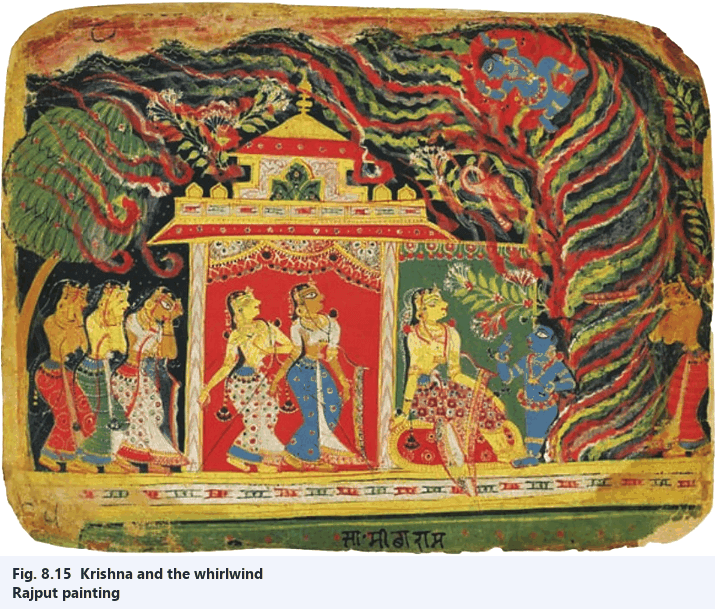
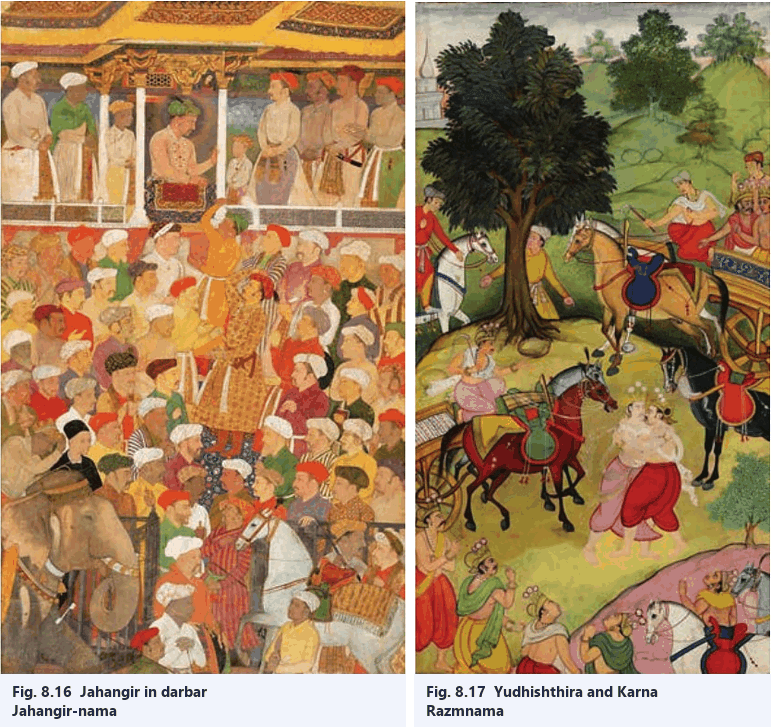
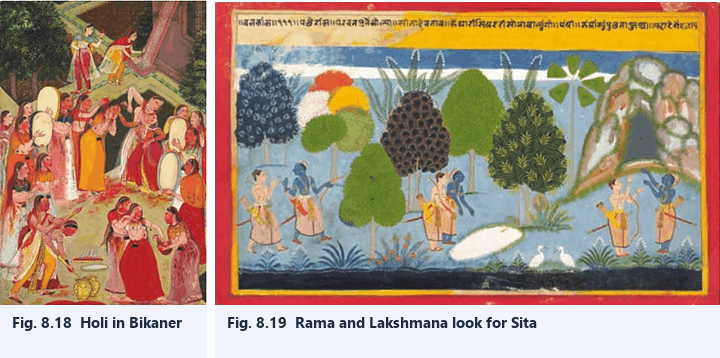
Answer:
All five paintings tell a story through colour, gestures and details such as clothing and plants. The painting of Krishna uses bold, swirling lines to show the whirlwind. Jahangir’s court scene uses rows of people and careful details to show the court. The wrestling scene from the Razmnama sets an Indian epic in a painting made for a Persian manuscript. The Bikaner Holi scene shows a lively celebration, while the Ramayana painting shows Rama and Lakshmana several times in one picture as they look for Sita.
The subjects and settings widened to include courts, festivals and carefully drawn landscapes. Painters borrowed ways of drawing people, animals and plants from each other. Bright colours, detailed patterns and stories from Indian epics continued to be popular.
Class 8 Social Science Part 2 Question-Answers of Page 230
Page 230 – LET’S EXPLORE
Take up a group project. Identify the local forms of art and craft in your area. Are they being continued? How are the knowledge and skills in these being transferred from generation to generation?
Answer:
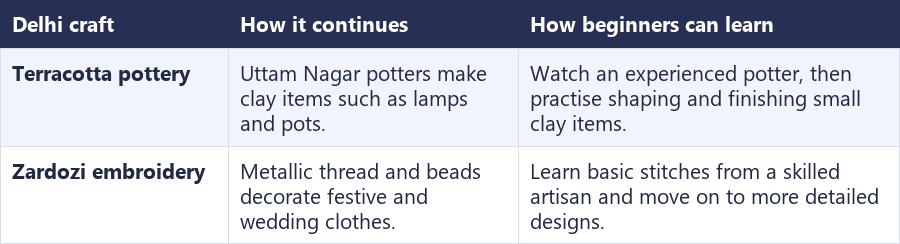
Our project focuses on two Delhi crafts, terracotta pottery in Uttam Nagar and zardozi embroidery around Kinari Bazaar. Potters shape clay into items such as lamps and pots. Zardozi workers create patterns with metallic thread and beads for wedding and festive clothes. Both crafts are still in use today. Beginners can learn by watching skilled relatives or artisans and practising simple tasks before trying more detailed work. Craft demonstrations also let young people see how a finished piece is made.
Class 8 Social Science Part 2 Question-Answers of Page 232
Page 232 – LET’S EXPLORE
From the chronicle of the Portuguese traveller to India, Fernão Nunes, who visited the Vijayanagar Empire: “He [the King] has also women who wrestle, and others who are astrologers and soothsayers; and he has women who write all the accounts of expenses that are incurred inside the gates, and others whose duty it is to write all the affairs of the kingdom and compare their books with those of the writers outside; he has women also for music, who play instruments and sing.”
What are the different vocations women were involved in as a part of the King’s staff?
Answer:
Women worked as wrestlers, astrologers, soothsayers, accountants and record-keepers. Some kept track of palace expenses. Others recorded the kingdom’s affairs and checked their books against records kept outside the palace. Some women also sang and played musical instruments.
Class 8 Social Science Part 2 Question-Answers of Page 233
Page 233 – LET’S EXPLORE
What conclusions can we draw from such acts about the economic and social status of these women?
Answer:
Queens and some wealthy women had enough resources to donate land or part of its produce to temples. By arranging for wells and community halls to be built, they helped meet public needs. This shows that they could make important decisions and exercise influence in their communities. Those opportunities depended partly on their wealth and position in society.
Imagine that you are a historian in the 22nd century looking at the lives and status of girls and women in 21st-century society. What are the different aspects you would write about? Exchange your thoughts with your classmates. How similar or different are they?
Answer:
I would write about schooling, jobs, pay, work at home, safety in public places, and the opportunities women had to lead in politics and sports. I would also compare how access to transport and the internet shaped life in different places. In a class discussion, we might agree that education and safety matter to everyone. I might focus on whether household work was shared fairly, while a classmate might want to study why some girls had fewer chances to play sports.
Class 8 Social Science Part 2 Question-Answers of Page 238
Page 238 – LET’S EXPLORE
Over this period loan words from Persian also began to enter regional languages and literature. Today we can hardly identify them as having Persian roots. Create a list of words in your regional language that might have Persian roots. You may be surprised by your findings!
Answer:
In the Hindi I speak in Delhi, I use several words of Persian origin. Some examples are बाज़ार (bazaar, market), दरवाज़ा (darwaza, door), दीवार (deewar, wall), ख़ुशबू (khushboo, fragrance) and गुलाब (gulab, rose). I use these words in ordinary conversations, like when I say that I bought roses at the bazaar.
Class 8 Social Science Part 2 Question-Answers of Page 246
Page 246 – LET’S EXPLORE
Make a list of popular dishes in your region. Explore their origins and discover various cross-cultural influences.
Answer:
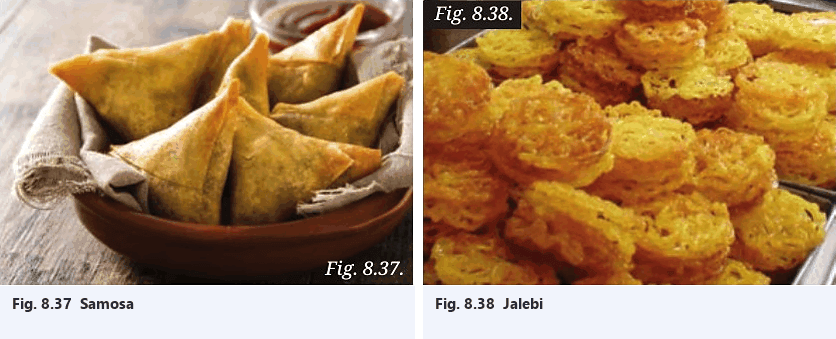
- Samosa – It developed from the Persian sambūseh, brought by West Asian cooks to the courts of the Delhi Sultanate. Potato and pea filling became popular here in place of meat and nuts.
- Jalebi – It developed from Persian zalabiyeh. The jalebi I know has round coils and is soaked in sugar syrup. The Persian version used honey and rose water syrup.
- Naan – This bread shows Persian influence. Cooking it in a clay oven is still common in North India.
- Khichri – This Indian meal of rice and lentils has been cooked for many centuries. The basic combination stayed popular as cooks tried new flavours.
Class 8 Social Science Part 2 Question-Answers of Page 247
Page 247 – LET’S EXPLORE
What are your observations about continuity and change in clothing styles today? What might be the reasons for the changes we see?
Answer:
In Delhi, I see saris, kurtas and dupattas at weddings and festivals. Many people also wear them in everyday life. Jeans, shirts and T-shirts are common, and people often combine styles, such as wearing a kurta with jeans. Comfort, the weather, school or workplace rules and trends we see online can affect what we wear. Families also keep traditional clothes and styles alive by wearing them on special occasions.
Class 8 Social Science Part 2 Question-Answers of Page 248
Page 248 – Questions and activities
1. What is the path to mokṣha that became popular in the period from the 13th to 17th centuries?
Answer:
The path of bhakti or loving devotion to God, became popular. People expressed their devotion through prayer, singing bhajans and remembering God. Saints often taught in local languages so more people could understand and join in.
2. Name three bhakti saints from different regions of India and identify the key messages they promoted.
Answer:
- Kabir, from present-day Uttar Pradesh, taught that God is one. He questioned rituals that divided Hindus and Muslims.
- Guru Nanak, from the Punjab region, taught belief in one God and the equality of all people.
- Chaitanya Mahaprabhu, from eastern India, encouraged loving devotion to Krishna, which people could express by singing and dancing together.
3. Kabir’s doha compares wheat being ground into flour with the unity of Ram and Rahim. Why do you think he used this everyday example?
Answer:
People knew how separate grains of wheat became one mass of flour at the mill. Kabir used this familiar sight to help them imagine how different names for God could point to one divine being. A simple image from daily life also made the couplet easy to remember and share.
4. The chapter mentions that while major universities like Nalanda were destroyed, education continued through decentralised systems like gurukulas, temple schools, and apprenticeships. What advantages might these smaller, local systems have had in surviving political turmoil?
Answer:
These centres were spread across many places. If fighting disrupted one centre, teachers elsewhere could carry on. Students could learn close to home and villages and temples could support their own teachers. Artisans could keep passing on a craft in workshops by showing apprentices how to do the work.
5. Women’s roles changed differently across regions during this period. What factors mentioned in the chapter might explain why the same historical events affected women differently in different regions?
Answer:
The effects depended on local customs, the impact of warfare and a woman’s position in society. In parts of North India, invasions and the fear of capture made public life more dangerous for women. Veiling spread in some areas and was also associated with elite households. Older customs continued in much of South India. At Vijayanagara, some women served at court and wealthy women could make donations or influence public decisions. Wealth and links to the court gave some women more opportunities than others.
6. The chapter describes how Indian culture sometimes “adopted or adapted” external influences. Why do you think adaptation (changing something to fit local tastes) might be more successful for cultural survival than simply copying or completely rejecting new ideas?
Answer:
When people adapt an idea, they can use parts they like and fit them to the materials, needs or tastes they already have. For example, cooks kept the idea of a filled pastry from the Persian sambūseh and made samosas with fillings such as potatoes and peas. The new version suited local tastes and became a familiar part of everyday food.
7 What are some examples of cultural interactions that led to the creation of new art forms?
Answer:
Qawwali combined Indian, Persian and Arabic singing traditions. Mughal miniature painting brought Persian painting techniques into Indian workshops, where artists illustrated works such as the Persian translation of the Mahābhārata. Some Mughal painters later moved to Bikaner, where their methods blended with Rajput painting. Tastes in garden design also mingled, as gardens at Amer Fort adopted geometrical layouts and water channels from the Mughal style.
8. Research one bhakti or Sufi saint mentioned in the chapter (Kabir, Mirabai, Ravidas, Tukaram, Chishti or others). Find one of their poems or bhajans in translation, and prepare a three-minute presentation where you:
(a) Share the poem/song,
(b) Explain its main message,
(c) Describe why it might have appealed to common people during that time, and
(d) Discuss whether its message is still relevant today.
Answer:
Good morning, everyone. I’m going to share a couplet by Kabir, who lived in the fifteenth century in what is now Uttar Pradesh. He is believed to have grown up in a family of weavers. He spoke about devotion in words that ordinary people could understand.
Here is the couplet in my own English translation.
“The Kaaba became Kashi, and Ram became Rahim.
The coarse meal became fine flour, and Kabir sat down to eat.”
Let’s picture a handful of wheat. We can see every grain. Once we grind the wheat, we have flour and we can no longer pick out the separate grains. Why did Kabir choose this picture? I think he wanted us to see that different names and places of worship can lead people to the same God. Ram and Rahim are names from different faiths. When Kabir sits down to eat, he seems to be at peace with that idea.
Think about who would have heard him. A shopkeeper, a weaver or someone cooking a meal at home would immediately know what flour looked like. They could understand the image without studying difficult books. Kabir’s short couplets were easy to remember, repeat and share. His message would also have appealed to people who felt left out because of their background or religious customs.
I think we can use his message today. In Delhi, my classmates and neighbours may celebrate different festivals or pray in different ways. We can ask about each other’s customs and listen with respect. Kabir’s image of the flour reminds me that differences in names or customs needn’t get in the way of friendship. Thank you.
9. Choose one aspect of culture from the chapter (architecture, clothing, food, music, education, or gardens) and create a group project to study how it appears in your region. Try to enquire into:
▪ What has changed and what has remained the same over time?
▪ What are your thoughts on why certain elements continued while others changed?
You can present your report in any form — as an illustrated report, or digital presentation, or in any other creative way.
Answer:
From the Sultan’s Kitchen to Delhi’s Snack Shops
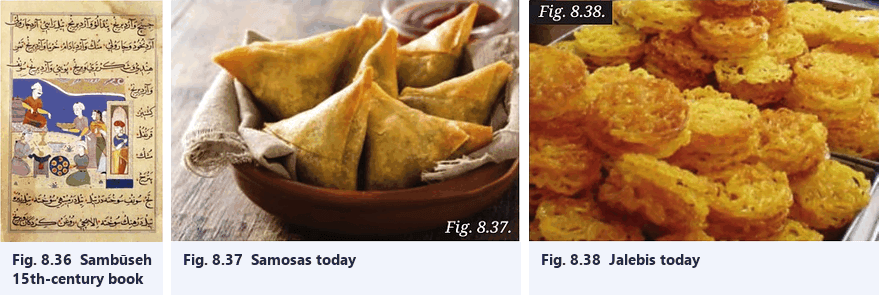
Our group chose to study samosas and jalebis:
We compared what went into them in the past with the versions we see in Delhi today.
What stayed the same:
Both are still fried. Samosas still have a pastry shell and a filling. Jalebi still has a coiled shape and is soaked in a sweet syrup. Both are easy to share, which I think helps explain why they are still popular as snacks and festival treats.
What changed:
The Persian sambūseh was filled with meat and nuts. A familiar Delhi samosa has potatoes and peas inside. Persian zalabiyeh was made in a looser pattern and used honey and rose water syrup. The jalebi we see today has round coils and is often soaked in simple sugar syrup. We think cooks kept the parts people liked and changed the ingredients and shapes to suit local tastes and what was available.
Class 8 SST Part 2 Ch: 8 Extra Question-Answers for Practice
Very Short Answer Type Questions
1. What is zikr in the Sufi tradition?
See AnswerZikr is remembering God by repeating divine names aloud or silently.
2. Which sacred text preserves Guru Nanak’s teachings and the hymns of several other saints?
See AnswerThe Guru Granth Sahib preserves these teachings and hymns.
3. What do the two parts of the word dhrupad mean?
See AnswerDhruva means fixed, and pada means verse.
4. Which older Indian instrument helped shape the musical repertoire of the tabla?
See AnswerThe pakhawaj helped shape the rhythms played on the tabla.
5. What is an atelier?
See AnswerAn atelier is an artist’s studio or workshop.
6. Who painted the court scene of Jahangir in the Jahangir-nama?
See AnswerJahangir’s court painter Abu al-Hasan painted it.
7. Which city in Kashmir is home to Nishat Bagh?
See AnswerNishat Bagh is in Srinagar.
8. What did the Kannada term purvamaryade mean in Vijayanagara?
See AnswerIt meant following established practices of dharma and social customs.
9. What makes brocade different from a plain woven fabric?
See AnswerBrocade has a raised woven pattern, often made with gold or silver thread.
10. What kind of wool is used to weave pashmina shawls?
See AnswerThey are woven from cashmere, a soft wool from goats of Ladakh and Kashmir.
11. What event did Tirumalamba write about in Varadambika Parinaya?
See AnswerShe wrote about the wedding of Achyutadevaraya and Princess Varadambika.
12. Who made the first Persian translation of Bhaskaracharya’s Lilavati?
See AnswerFaizi, whose full name was Abu al-Faiz ibn Mubarak, made the first Persian translation.
13. Which mathematical work did Narayana Pandita write in the 14th century?
See AnswerHe wrote Gaṇitakaumudī.
14. Which flower was used to make the perfume called Itr Jahangir?
See AnswerRoses were used to make Itr Jahangir.
15. How many carved stone wheels does the Surya Mandir at Konark have?
See AnswerThe temple has 24 carved stone wheels.
Short Answer Type Questions
1. Which works by the Alvars and Nayanars were recited in Tamil Nadu, and where were they recited?
See AnswerPeople recited the Divya Prabandham of the Alvars and the Tiruvachakam of the Nayanars in homes and temples. The hymns praise Vishnu and Shiva respectively. Reciting them kept the devotional works in everyday use.
2. How did travelling storytellers use pattachitra to bring epic stories to village gatherings?
See AnswerTravelling storytellers used pictures painted on cloth to show scenes from epics such as the Ramayana and Mahabharata. They sang as they told the story, so people could follow what was happening through pictures and words.
3. How did Raja Mansingh Tomar and Emperor Akbar support music at their courts?
See AnswerRaja Mansingh Tomar of Gwalior was a composer who helped dhrupad develop. Akbar brought the singer Tansen to his court, where Tansen became one of his nine ratnas. Both rulers gave music an important place at court.
4. How did painters in Akbar’s workshop share the work on a single miniature?
See AnswerOne artist might draw the outlines. Another added the colours and a third worked on the finer details and finishing touches. The painting brought together the skills of several artists working on different stages.
5. How did waterways in Mughal gardens reflect a religious idea and serve a practical purpose?
See AnswerWaterways in charbagh gardens recalled the rivers of Paradise described in the Quran. The channels also helped carry water to plants, while fountains and moving water added beauty to the carefully arranged gardens.
6. What signs show that Nur Jahan took an active part in governing the Mughal Empire?
See AnswerNur Jahan attended court meetings and issued royal orders during Jahangir’s reign. Coins were also minted in her name. These were visible signs of her political influence and the authority she exercised in court.
7. What do Pietro Della Valle’s letters tell us about schooling in coastal Karnataka in 1623?
See AnswerHis letters describe children learning reading, writing and arithmetic in coastal Karnataka. A class could gather in a familiar place such as a priest’s house or a temple hall. It needed little space to get started.
8. What does the Geographical Indication tag protect in the case of Banarasi brocade?
See AnswerThe tag protects the link between Banarasi brocade and the area where it is traditionally made. Only brocade made in certain districts can use the name. This helps protect the identity of the local weaving tradition.
9. How did Jain and Hindu traditions influence Akbar’s approach to food?
See AnswerAkbar is said to have tried to eat less meat under the influence of Jain and Hindu traditions of the time. He also encouraged members of his court to reduce how much meat they ate.
10. How could a single lamp create a starry effect inside the Sheesh Mahal at Amer Fort?
See AnswerThe walls and ceilings are set with many tiny curved mirrors. Each mirror catches and reflects light from the lamp. This creates many little points of light that make the room look as if it is filled with stars.
Long Answer Type Questions
1. How did translation projects by Kavindra Paramesvara and Dara Shikoh bring Indian works to different readers?
Answer:
Kavindra Paramesvara translated the Mahabharata into Bengali, so readers and listeners who knew Bengali could follow the epic. Dara Shikoh worked with scholars in Varanasi to translate Upanishads from Sanskrit into Persian. This gave Persian readers access to ideas that had been written in Sanskrit. Those translations travelled further and reached thinkers in Europe. The two translators helped texts find new audiences in different places and languages.
2. How did Urdu develop in the Ganga–Yamuna plains, and what gave Dakhini its regional character?
Answer:
Urdu grew from Hindi or Hindavi spoken in the Ganga–Yamuna plains. It kept a base in local speech while taking in vocabulary from Persian and Arabic. As the language developed in the south, Dakhini absorbed words from languages spoken there, including Telugu and Marathi. Someone who knows the Urdu of Lucknow might therefore hear words and expressions in Hyderabad that sound unfamiliar, even though the varieties are closely related.
3. What did Madhava and Nilakantha Somayaji each contribute to the Kerala School of Astronomy and Mathematics?
Answer:
Madhava studied how to express certain mathematical values as sums that go on forever. He used this approach to write an infinite series for pi. Nilakantha Somayaji studied how planets move. In his model, Mercury and Venus went around the Sun. One scholar worked out new ways to calculate values, while the other built a model to explain the motion of planets.
4. Which medical traditions were practised in this period, and how did knowledge of remedies reach later generations?
Answer:
Ayurveda was practised widely, while Unani, which came from West Asia, was often used in northern India. Siddha was especially important in Tamil Nadu. People handed down knowledge about remedies made with plants and minerals by explaining them aloud and writing them in records such as palm-leaf manuscripts. Written records could preserve a remedy for later readers, while oral teaching helped people learn how it was used.
5. What different purposes did temple building at Hampi and temple restoration at Srirangam serve?
Answer:
Under Krishnadevaraya, new temples at Hampi supported worship and showed the Vijayanagara rulers’ wealth and engineering skill. At Srirangam, rebuilding the damaged Sri Ranganathaswamy Temple helped restore a sacred place people already knew. The temple complex also gained new buildings later. One example shows rulers creating grand new places of worship. The other shows how rebuilding could help a community continue worship at an old site.
Major Cultural Trends of the 13th to 17th Centuries
- Bhakti grew stronger and became a unifying force in unstable times; its saints taught equality and the oneness of God.
- Sufi saints formed a bridge between cultures through devotion and music.
- Classical music grew along two related lines: Hindustani music in the north and Carnatic music in the south.
- Miniature painting saw exchanges of style, technique and colours between Rajput and Mughal painters.
- Art and architecture blended tradition with innovation and some destroyed temples, such as the Sri Ranganathaswamy Temple at Srirangam, were rebuilt.
- Education continued in gurukulas, mathas, temple schools and apprenticeships after universities like Nalanda were destroyed.
- Science and translation flourished: the Kerala School laid the seeds of infinite series and calculus and scholars translated texts between Sanskrit and Persian.
- Daily life absorbed new influences, as in the samosa, an Indian adaptation of the Persian sambuseh.
All other chapters are listed with our Class 8 Exploring Society solutions.
Bhakti Saints and Their Regions
- Kabir (15th century, present-day Uttar Pradesh): taught the unity of Ram and Rahim, famously through a doha about wheat ground into flour.
- Ravidas (early 16th century, born in a family of leather-workers): wrote poetry on equality and the oneness of all, breaking down rigid walls of varna and jati.
- Mirabai: a bhakti saint of Rajasthan.
- Chaitanya Mahaprabhu: a bhakti saint of the east.
- Tukaram, Dnyaneshwar and Namdev: bhakti saints of the west.
- Purandaradasa and Kanakadasa: bhakti saints of the south; Purandaradasa is called the father of Carnatic music.
- Guru Nanak: travelled across regions spreading the message of one God and the equality of all people.
- Test yourself with the Cultural Currents chapter MCQs.
People to Remember from Cultural Currents: 13th to 17th Centuries
| Person | Field | Remembered for |
|---|---|---|
| Amir Khusrau | Poetry and music | Indo-Persian Sufi poet and singer of the mid-13th to early 14th century |
| Khwaja Moinuddin Chishti | Sufism | Encouraging music as a way to connect with God |
| Tansen (Ramtanu Pandey) | Music | Becoming one of the nine ratnas of Akbar’s court |
| Purandaradasa | Music | Called the father of Carnatic music; lived in the 15th–16th centuries |
| Madhava | Mathematics | Pioneering work on calculus, including series expansions for trigonometric functions |
| Dara Shikoh | Scholarship | Translating 52 Upanishads from Sanskrit into Persian with scholars in Varanasi |
| Krishnadevaraya | Patronage | A golden age of art, architecture and cultural revival in the Vijayanagara Empire |
| Kavindra Paramesvara | Literature | Translating the Mahabharata into Bengali in the early 16th century |
For more subjects, go to our NCERT Solutions section.
FAQs on Class 8 SST Part 2 Chapter 8
What is Class 8 Social Science Part 2 Chapter 8 about?
It shows how Indian culture endured and grew richer between the 13th and 17th centuries despite invasions and political instability. The chapter covers bhakti and Sufi traditions, music, miniature painting, gardens, the role of women, education, literature and language, science and technology, architecture and everyday life through food and clothing.
What is a qawwali and who developed it?
A qawwali is a Sufi devotional song. Sufi saints sang qawwalis to bring people closer to the divine, fusing local classical music with their own styles, and saints such as Khwaja Moinuddin Chishti and Nizamuddin Auliya encouraged music as a way to connect with God. Amir Khusrau, an Indo-Persian Sufi poet and singer, is credited with developing the form.
How did gardens change in this period?
Gardens had a long history in India: words such as udyana, vatika and nandana appear in the Rigveda, Mahabharata and Ramayana, and gardens were often laid out around temples with a pond or tank. The Mughals added the Persian charbagh design, with four parts, water channels, fountains and terraces, around forts, tombs and mosques. Nishat Bagh in Srinagar dates from the early 17th century.
How did food in India change during this period?
Indian cooks adapted dishes that came from elsewhere. The samosa is an Indian adaptation of the Persian sambuseh, brought to the courts of the Delhi Sultanate by chefs from West Asia; its stuffing of meat, pistachios, almonds and walnuts was replaced with potatoes and peas. Jalebi, likewise, is the Indian version of the Persian zalabiyeh.