
Class 9 Maths: What's New in the Syllabus and How to Study It
Post Date:

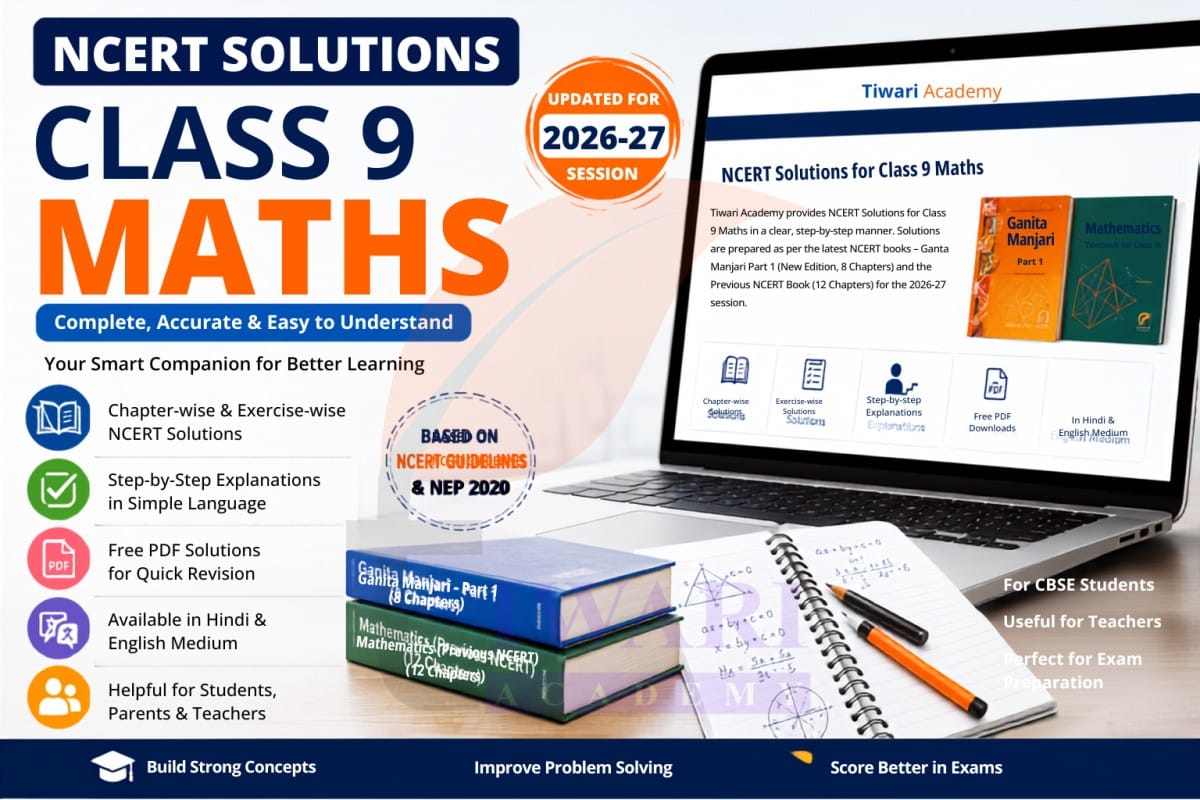
If your child came home this year talking about “Ganita Manjari” instead of the usual Class 9 Maths textbook, you’re not imagining things – CBSE has actually replaced the old NCERT Maths book for Class 9 with a brand-new one. And it’s not just a name change. The number of chapters, the way topics are taught, and even the order in which concepts are introduced have all shifted.

Here’s what’s actually different, and how to make sense of it before exams catch up with you.

Why NCERT Changed the Class 9 Maths Book

Under NEP 2020 and the NCF 2023 framework, NCERT has been steadily rewriting textbooks across classes to focus less on memorising formulas and more on understanding why those formulas work. Class 9 Maths is one of the latest subjects to get this treatment, with the new book called Ganita Manjari Part 1.

The previous book had 12 chapters. The new one has just 8 โ€” but don’t mistake fewer chapters for less content. Several old topics have been merged, reordered or taught through a completely different approach.

Old Syllabus vs New Syllabus – Side by Side

Old Textbook (12 Chapters)New Ganita Manjari (8 Chapters)
Number SystemsThe World of Numbers
Coordinate GeometryOrienting Yourself: Use of Coordinates
PolynomialsIntroduction to Linear Polynomials
Introduction to Euclid’s Geometry, Lines & AnglesNot covered as separate chapters in Part 1
Heron’s Formula, Surface Areas and VolumesMeasuring Space: Perimeter and Area
StatisticsStatistics (through Data Handling topics)
ProbabilityThe Mathematics of Maybe
Concepts from Class 11Predicting What Comes Next: Sequences & Progressions

Notice a few things: Euclid’s Geometry, Lines and Angles, Triangles, Quadrilaterals and Circles โ€” a big chunk of the old book โ€” don’t appear as standalone chapters in Ganita Manjari Part 1. This doesn’t mean geometry has vanished from Class 9 entirely; it means many schools are still transitioning and some continue teaching the older 12-chapter book for now.

This is exactly why knowing which book your school follows matters before you start studying – the two books test very different things.

Three New Concepts That Didn’t Exist Before in Class 9

  1. Slope and y-intercept of straight lines: Earlier this was purely a Class 10 topic; now it’s introduced in Class 9 itself through Chapter 2
  2. Brahmagupta’s formula for cyclic quadrilaterals: A classical Indian mathematics concept, taught alongside Heron’s Formula in Chapter 6
  3. Oscillatory and circular patterns in real life (Chapter 5): An entirely new chapter that didn’t exist in any form in the old book, laying groundwork for trigonometry later


How to Study the New Syllabus Effectively

Because Ganita Manjari leans heavily on why over what, cramming formulas the old way won’t work as well this year. A few adjustments that actually help:

  • Don’t skip the derivations: Chapter 6, for instance, expects you to understand why the area of a circle formula works, not just memorise ฯ€rยฒ.
  • Use the geometric models mentioned in Chapter 4 (algebra tiles) – visualising identities sticks better than memorising them.
  • Revise formulas separately from concepts: Keep a running formula sheet, but don’t rely on it until you’ve understood the proof at least once.
  • Practice previous-pattern questions too, since many CBSE schools are still blending old-style question patterns with the new book during this transition year.

Which Book Is Your School Actually Using?

If you’re still unsure whether your school has switched to Ganita Manjari or is continuing with the old textbook, the simplest way to check is your child’s class timetable or the chapter names being taught – if you’re hearing “Orienting Yourself” or “The Mathematics of Maybe”, that’s Ganita Manjari. If it’s “Euclid’s Geometry” or “Quadrilaterals”, that’s the older book.

Either way, having step-by-step solutions for both is genuinely useful during this transition period, since some schools may test from both sets of material.

For complete chapter-wise, exercise-wise solutions covering both the new Ganita Manjari book and the previous NCERT textbook โ€” in English and Hindi medium – visit the Class 9 Maths NCERT Solutions page.

You’ll also find a formula sheet, important questions by chapter and free downloadable PDFs for offline study.

Looking for other classes and subjects too? Browse the full NCERT Solutions library.


Frequently Asked Questions

Is the old NCERT Class 9 Maths book still valid for 2026-27?

Yes. Many schools are still using the previous 12-chapter NCERT Maths textbook this session, especially outside CBSE or in State Boards that haven’t updated their curriculum yet. Both the old and new (Ganita Manjari) books remain valid depending on what your specific school has adopted.

How do I know which Maths book my school follows?

The easiest way is to check the chapter names in your child’s class notebook or timetable. If chapters are titled things like “Orienting Yourself” or “The Mathematics of Maybe”, your school has switched to Ganita Manjari. If you’re seeing familiar names like “Euclid’s Geometry” or “Quadrilaterals”, your school is still on the older textbook.

Is Ganita Manjari harder than the old NCERT book?

Not necessarily harder, but different in approach. Ganita Manjari focuses more on understanding proofs and derivations rather than direct formula application, which can feel more demanding initially but usually builds a stronger long-term grasp of the subject.

Will Class 9 Maths change again next year?

NCERT typically phases in new textbooks gradually across states and boards, so some variation between schools is expected to continue for at least another session or two before the transition is complete nationwide.

Do both books cover the same total topics by the end of Class 9?

Broadly yes, though the sequencing differs. Some topics from the old book, like Euclid’s Geometry and Quadrilaterals, are either merged into other chapters or shifted to a later part of the new curriculum rather than dropped entirely.