
Tiwari Academy  – Free CBSE NCERT Books and Solutions
  • Apps
    • CBSE Apps
    • Hast Rekha App
  • NCERT Solutions
    • NCERT Solutions for Class 12
      • NCERT Solutions for Class 12 Maths
      • NCERT Solutions for Class 12 Physics
      • NCERT Solutions for Class 12 Chemistry
      • NCERT Solutions for Class 12 Biology
      • NCERT Solutions for Class 12 English
      • NCERT Solutions for Class 12 Accounts
      • NCERT Solutions for Class 12 Business Studies
      • NCERT Solutions for Class 12 Economics
      • NCERT Solutions for Class 12 Geography
      • NCERT Solutions for Class 12 Physical Education
      • NCERT Solutions for Class 12 Political Science
      • NCERT Solutions for Class 12 Psychology
      • NCERT Solutions for Class 12 Sociology
    • NCERT Solutions for Class 11
      • NCERT Solutions for Class 11 Maths
      • NCERT Solutions for Class 11 Physics
      • NCERT Solutions for Class 11 Chemistry
      • NCERT Solutions for Class 11 Biology
      • NCERT Solutions for Class 11 English
      • NCERT Solutions for Class 11 Business Studies
      • NCERT Solutions for Class 11 Sociology
      • NCERT Solutions for Class 11 Political Science
      • NCERT Solutions for Class 11 Psychology
      • NCERT Solutions for Class 11 Physical Education
    • NCERT Solutions for Class 10
      • NCERT Solutions for Class 10 Maths
      • NCERT Solutions for Class 10 Science
      • NCERT Solutions for Class 10 English
      • NCERT Solutions for Class 10 Hindi 2026-27 Updated Course A and B
      • NCERT Solutions for Class 10 Sanskrit
      • NCERT Solutions for Class 10 Social Science
    • NCERT Solutions for Class 9
      • NCERT Solutions for Class 9 Maths
      • NCERT Solutions for Class 9 Science
      • NCERT Solutions for Class 9 English
      • NCERT Solutions for Class 9 Hindi
      • NCERT Solutions for Class 9 Sanskrit
      • NCERT Solutions for Class 9 Social Science
    • NCERT Solutions for Class 8
      • NCERT Solutions for Class 8 Maths
      • NCERT Solutions for Class 8 Science
      • NCERT Solutions for Class 8 English
      • NCERT Solutions for Class 8 Hindi
      • NCERT Solutions for Class 8 Sanskrit
      • NCERT Solutions for Class 8 Social Science
      • NCERT Solutions for Class 8 Computer
    • NCERT Solutions for Class 7
      • NCERT Solutions for Class 7 Maths
      • NCERT Solutions for Class 7 Science
      • NCERT Solutions for Class 7 English
      • NCERT Solutions for Class 7 Hindi
      • NCERT Solutions for Class 7 Sanskrit
      • NCERT Solutions for Class 7 Social Science
      • NCERT Solutions for Class 7 Computer
    • NCERT Solutions for Class 6
      • NCERT Solutions for Class 6 Maths
      • NCERT Solutions for Class 6 Science
      • NCERT Solutions for Class 6 English
      • NCERT Solutions for Class 6 Hindi
      • NCERT Solutions for Class 6 Sanskrit Deepakam 2026-27 Updated
      • NCERT Solutions for Class 6 Social Science
      • NCERT Solutions for Class 6 Computer
    • NCERT Solutions for Class 5
      • NCERT Solutions for Class 5 Hindi
      • NCERT Solutions for Class 5 English
      • NCERT Solutions for Class 5 Maths
      • NCERT Solutions for Class 5 EVS
      • NCERT Solutions for Class 5 Computer
      • NCERT Solutions for Class 5 GK
    • NCERT Solutions for Class 4
      • NCERT Solutions for Class 4 Hindi
      • NCERT Solutions for Class 4 English
      • NCERT Solutions for Class 4 Maths
      • NCERT Solutions for Class 4 EVS
      • NCERT Solutions for Class 4 Computer
      • NCERT Solutions for Class 4 GK
    • NCERT Solutions for Class 3
      • NCERT Solutions for Class 3 Hindi
      • NCERT Solutions for Class 3 English
      • NCERT Solutions for Class 3 Maths
      • NCERT Solutions for Class 3 EVS
      • NCERT Solutions for Class 3 Science
      • NCERT Solutions for Class 3 Computer
      • NCERT Solutions for Class 3 GK
    • NCERT Solutions for Class 2
      • NCERT Solutions for Class 2 Hindi
      • NCERT Solutions for Class 2 English
      • NCERT Solutions for Class 2 Maths
      • NCERT Solutions for Class 2 EVS
      • NCERT Solutions for Class 2 Science
      • NCERT Solutions for Class 2 Computer
      • NCERT Solutions for Class 2 GK
    • NCERT Solutions for Class 1
      • NCERT Solutions for Class 1 Hindi
      • NCERT Solutions for Class 1 English
      • NCERT Solutions for Class 1 Maths
      • NCERT Solutions for Class 1 EVS
      • NCERT Solutions for Class 1 Computer
      • NCERT Solutions for Class 1 Science
      • NCERT Solutions for Class 1 GK
    • Study Material for KG
      • Study Material for KG English
      • Study Material for KG Hindi
      • Study Material for KG Maths
    • Study Material for Nursery
      • Study Material for Nursery Maths
      • Study Material for Nursery English
      • Study Material for Nursery Hindi
  • NEWS
    • Educational NEWS
    • MCQ
    • Explore More
  • Grammar
    • Class 1 English Grammar
      • Class 1 Hindi Vyakaran
    • Class 2 English Grammar
      • Class 2 Hindi Vyakaran
    • Class 3 English Grammar
      • Class 3 Hindi Vyakaran
    • Class 4 English Grammar
      • Class 4 Hindi Vyakaran
    • Class 5 English Grammar
      • Class 5 Hindi Vyakaran
    • Class 6 English Grammar
      • Class 6 Hindi Vyakaran
    • Class 7 English Grammar
      • Class 7 Hindi Vyakaran
    • Class 8 English Grammar
      • Class 8 Hindi Vyakaran
  • Sample Papers
    • CBSE Sample Papers for Class 4
    • CBSE Sample Papers for Class 5
    • CBSE Sample Papers for Class 6
    • CBSE Sample Papers for Class 7
    • CBSE Sample Papers for Class 8
    • CBSE Sample Papers for Class 9
    • CBSE Sample Papers for Class 10
    • CBSE Sample Papers for Class 11
    • CBSE Sample Papers for Class 12
  • Syllabus
    • CBSE Syllabus
    • NCERT Books
    • NCERT Exemplar
    • What is NIOS?
    • NIOS Online Admission
    • Career Options
  • Contact
    • Contact Us
    • About Us
    • Authors
    • Online Tutors
  • Apps
    • CBSE Apps
    • Hast Rekha App
  • NCERT Solutions
    • NCERT Solutions for Class 12
      • NCERT Solutions for Class 12 Maths
      • NCERT Solutions for Class 12 Physics
      • NCERT Solutions for Class 12 Chemistry
      • NCERT Solutions for Class 12 Biology
      • NCERT Solutions for Class 12 English
      • NCERT Solutions for Class 12 Accounts
      • NCERT Solutions for Class 12 Business Studies
      • NCERT Solutions for Class 12 Economics
      • NCERT Solutions for Class 12 Geography
      • NCERT Solutions for Class 12 Physical Education
      • NCERT Solutions for Class 12 Political Science
      • NCERT Solutions for Class 12 Psychology
      • NCERT Solutions for Class 12 Sociology
    • NCERT Solutions for Class 11
      • NCERT Solutions for Class 11 Maths
      • NCERT Solutions for Class 11 Physics
      • NCERT Solutions for Class 11 Chemistry
      • NCERT Solutions for Class 11 Biology
      • NCERT Solutions for Class 11 English
      • NCERT Solutions for Class 11 Business Studies
      • NCERT Solutions for Class 11 Sociology
      • NCERT Solutions for Class 11 Political Science
      • NCERT Solutions for Class 11 Psychology
      • NCERT Solutions for Class 11 Physical Education
    • NCERT Solutions for Class 10
      • NCERT Solutions for Class 10 Maths
      • NCERT Solutions for Class 10 Science
      • NCERT Solutions for Class 10 English
      • NCERT Solutions for Class 10 Hindi 2026-27 Updated Course A and B
      • NCERT Solutions for Class 10 Sanskrit
      • NCERT Solutions for Class 10 Social Science
    • NCERT Solutions for Class 9
      • NCERT Solutions for Class 9 Maths
      • NCERT Solutions for Class 9 Science
      • NCERT Solutions for Class 9 English
      • NCERT Solutions for Class 9 Hindi
      • NCERT Solutions for Class 9 Sanskrit
      • NCERT Solutions for Class 9 Social Science
    • NCERT Solutions for Class 8
      • NCERT Solutions for Class 8 Maths
      • NCERT Solutions for Class 8 Science
      • NCERT Solutions for Class 8 English
      • NCERT Solutions for Class 8 Hindi
      • NCERT Solutions for Class 8 Sanskrit
      • NCERT Solutions for Class 8 Social Science
      • NCERT Solutions for Class 8 Computer
    • NCERT Solutions for Class 7
      • NCERT Solutions for Class 7 Maths
      • NCERT Solutions for Class 7 Science
      • NCERT Solutions for Class 7 English
      • NCERT Solutions for Class 7 Hindi
      • NCERT Solutions for Class 7 Sanskrit
      • NCERT Solutions for Class 7 Social Science
      • NCERT Solutions for Class 7 Computer
    • NCERT Solutions for Class 6
      • NCERT Solutions for Class 6 Maths
      • NCERT Solutions for Class 6 Science
      • NCERT Solutions for Class 6 English
      • NCERT Solutions for Class 6 Hindi
      • NCERT Solutions for Class 6 Sanskrit Deepakam 2026-27 Updated
      • NCERT Solutions for Class 6 Social Science
      • NCERT Solutions for Class 6 Computer
    • NCERT Solutions for Class 5
      • NCERT Solutions for Class 5 Hindi
      • NCERT Solutions for Class 5 English
      • NCERT Solutions for Class 5 Maths
      • NCERT Solutions for Class 5 EVS
      • NCERT Solutions for Class 5 Computer
      • NCERT Solutions for Class 5 GK
    • NCERT Solutions for Class 4
      • NCERT Solutions for Class 4 Hindi
      • NCERT Solutions for Class 4 English
      • NCERT Solutions for Class 4 Maths
      • NCERT Solutions for Class 4 EVS
      • NCERT Solutions for Class 4 Computer
      • NCERT Solutions for Class 4 GK
    • NCERT Solutions for Class 3
      • NCERT Solutions for Class 3 Hindi
      • NCERT Solutions for Class 3 English
      • NCERT Solutions for Class 3 Maths
      • NCERT Solutions for Class 3 EVS
      • NCERT Solutions for Class 3 Science
      • NCERT Solutions for Class 3 Computer
      • NCERT Solutions for Class 3 GK
    • NCERT Solutions for Class 2
      • NCERT Solutions for Class 2 Hindi
      • NCERT Solutions for Class 2 English
      • NCERT Solutions for Class 2 Maths
      • NCERT Solutions for Class 2 EVS
      • NCERT Solutions for Class 2 Science
      • NCERT Solutions for Class 2 Computer
      • NCERT Solutions for Class 2 GK
    • NCERT Solutions for Class 1
      • NCERT Solutions for Class 1 Hindi
      • NCERT Solutions for Class 1 English
      • NCERT Solutions for Class 1 Maths
      • NCERT Solutions for Class 1 EVS
      • NCERT Solutions for Class 1 Computer
      • NCERT Solutions for Class 1 Science
      • NCERT Solutions for Class 1 GK
    • Study Material for KG
      • Study Material for KG English
      • Study Material for KG Hindi
      • Study Material for KG Maths
    • Study Material for Nursery
      • Study Material for Nursery Maths
      • Study Material for Nursery English
      • Study Material for Nursery Hindi
  • NEWS
    • Educational NEWS
    • MCQ
    • Explore More
  • Grammar
    • Class 1 English Grammar
      • Class 1 Hindi Vyakaran
    • Class 2 English Grammar
      • Class 2 Hindi Vyakaran
    • Class 3 English Grammar
      • Class 3 Hindi Vyakaran
    • Class 4 English Grammar
      • Class 4 Hindi Vyakaran
    • Class 5 English Grammar
      • Class 5 Hindi Vyakaran
    • Class 6 English Grammar
      • Class 6 Hindi Vyakaran
    • Class 7 English Grammar
      • Class 7 Hindi Vyakaran
    • Class 8 English Grammar
      • Class 8 Hindi Vyakaran
  • Sample Papers
    • CBSE Sample Papers for Class 4
    • CBSE Sample Papers for Class 5
    • CBSE Sample Papers for Class 6
    • CBSE Sample Papers for Class 7
    • CBSE Sample Papers for Class 8
    • CBSE Sample Papers for Class 9
    • CBSE Sample Papers for Class 10
    • CBSE Sample Papers for Class 11
    • CBSE Sample Papers for Class 12
  • Syllabus
    • CBSE Syllabus
    • NCERT Books
    • NCERT Exemplar
    • What is NIOS?
    • NIOS Online Admission
    • Career Options
  • Contact
    • Contact Us
    • About Us
    • Authors
    • Online Tutors
เคนเคฟเค‚เคฆเฅ€ เคฎเฅ€เคกเคฟเคฏเคฎเคนเคฟเค‚เคฆเฅ€ เคฎเฅ€เคกเคฟเคฏเคฎ Latest BlogsLatest Blogs Ask QuestionsAsk Questions
Tiwari Academy  /  Latest News  /  Class 6 Social Science Sample Papers for Half Yearly Exam (2026โ€“27) - Chapters 1 to 7

Class 6 Social Science Sample Papers for Half Yearly Exam (2026โ€“27) – Chapters 1 to 7

Class 6 Social Science Sample Papers for Half Yearly Exam
Post Date: September 3, 2026

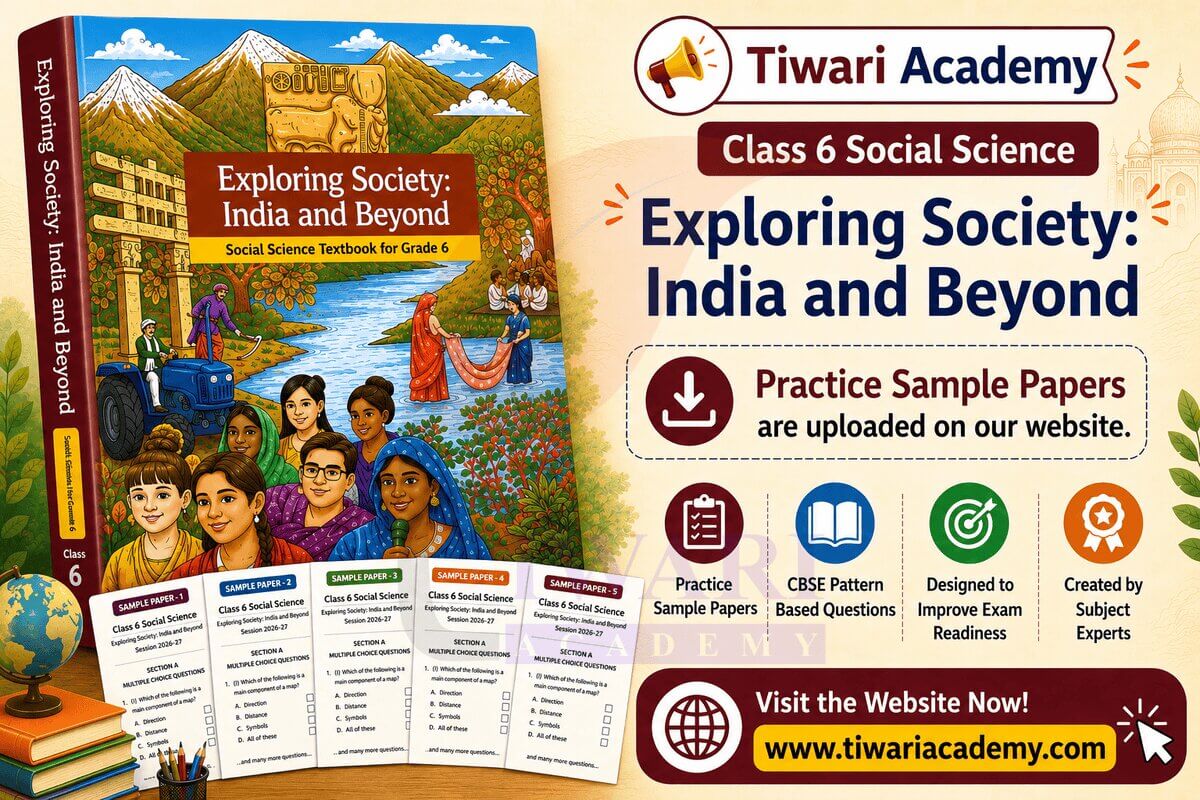
The half-yearly exam (also called the Term 1 or first-term exam) is the first major test for Class 6 students studying from the new NCERT textbook, Exploring Society: India and Beyond. To help students revise with confidence, Tiwari Academy has prepared five Class 6 Social Science Practice Sample Papers covering Chapters 1 to 7 of the book – from locating places on the Earth all the way to India’s cultural roots. Every sample paper follows the exact CBSE exam pattern used in schools, with the same sections, marking scheme, time duration and difficulty level as the real paper, so students can practise under exam-like conditions before facing the actual half-yearly Social Science exam.

Class 6 Social Science Sample Papers – Quick Overview

All five practice papers listed below follow the same 60-mark blueprint and cover Chapters 1 to 7 of Exploring Society: India and Beyond, but each one contains a fresh set of questions, passages and map exercises for varied practice:

  • Class 6 Social Science Sample Paper 1
  • Class 6 Social Science Sample Paper 2
  • Class 6 Social Science Sample Paper 3
  • Class 6 Social Science Sample Paper 4
  • Class 6 Social Science Sample Paper 5

Class 6 Social Science Half Yearly Exam Pattern 2026-27

Before solving the sample papers, it helps to know exactly how the paper is structured. Every one of the five papers is built on this same blueprint, which mirrors the pattern followed by CBSE schools for the Class 6 Social Science half-yearly exam.

SectionQuestion TypeTotal Marks
A [Q1 (iโ€“xv)]Multiple Choice Questions15
B [Q2โ€“Q5]Very Short Answer (min. 20 words)08
C [Q6โ€“Q7]Short Answer (40โ€“60 words)06
D [Q8โ€“Q9]Long Answer (80โ€“100 words)10
E [Q10โ€“Q13]Source/Case-Based Questions16
F [Q14]Map-Based Question05
Total14 Questions60 Marks

Exam duration: 2 hours 30 minutes

A few important points students should keep in mind before attempting the paper:

  • Internal choices (marked “OR”) are given in several questions; only one option should be attempted in each case.
  • Section F, the map-based question, has a separate alternative descriptive question for visually impaired students in place of the map exercise.
  • Neat, correctly labelled diagrams and maps fetch extra credit in the descriptive and map sections.

Chapters Covered in the Half Yearly Syllabus (Chapters 1 to 7)

All five Class 6 Social Science sample papers are based on the first seven chapters of Exploring Society: India and Beyond – the portion of the syllabus usually completed before the half-yearly exam. Here’s a quick look at what each chapter covers and the kind of questions students can expect.

ChapterChapter NameKey Topics for the Exam
1Locating Places on the EarthComponents of a map, latitude and longitude, the equator, hemispheres, cardinal and intermediate directions
2Oceans and ContinentsThe world’s oceans and continents, their distribution, the Indian Ocean and neighbouring water bodies
3Landforms and LifeMountains, plateaus, plains, valleys and how each landform shapes farming, settlement and ways of life
4Timeline and Sources of HistoryUnits of time (decade, century, millennium), archaeological and literary sources, oral traditions, drawing timelines
5India, That Is BharatThe term ‘Sapta Sindhava’ and how names derived from ‘Sindhu’ evolved into ‘Hindu’, ‘India’ and ‘Bharat’
6The Beginnings of Indian CivilisationHarappan town planning, the underground drainage system, crafts like bead-making, trade and sites such as Dholavira and Rakhigarhi
7India’s Cultural RootsThe four Vedas, oral tradition, schools of thought such as Yoga, Buddhism, Jainism, Charvaka and shared ideas like dharma and karma

Since geography and history topics are woven together in this textbook, students should revise both strands chapter by chapter rather than treating them as separate subjects.


What You Will Find Inside Each Sample Paper

Each of the five Practice Sample Papers is divided into six sections, exactly like the format above. Here’s what students can expect in every paper:

  1. Section A – Multiple Choice Questions (15 marks): Fifteen one-mark MCQs covering facts, definitions and picture-based questions (such as identifying a landform from a diagram), along with Assertion-Reason and Statement-based questions.
  2. Section B – Very Short Answers (8 marks): Four questions on core concepts like latitude-longitude, plains and farming, historical sources and Harappan town planning or the Vedas, each answerable in about 20 words.
  3. Section C – Short Answers (6 marks): Two questions requiring 40โ€“60 word explanations, such as the link between latitude, longitude and location, or how oceans influence human life.
  4. Section D – Long Answers (10 marks): Two descriptive questions of 80โ€“100 words each, such as describing the three major landforms or tracing how India got its name.
  5. Section E – Source/Case-Based Questions (16 marks): Four passages or picture-based sets – a locality map, a paragraph on maps, a passage on Harappan cities and a passage on Indian cultural traditions – each followed by short questions.
  6. Section F – Map Work (5 marks): Marking Harappan sites like Dholavira and Rakhigarhi on the political map of India and labelling oceans and continents on the world map.

While the overall pattern stays the same across all five sample papers, the actual questions, passages and picture-based items differ in each one, giving students fresh practice material every time.

Why Solve All 5 Class 6 Social Science Sample Papers?

  • Complete chapter coverage: Together, the five papers touch every important topic from Chapters 1โ€“7, so nothing gets left out of revision.
  • Different question styles: Assertion-Reason, Statement-based, source-based and map-based questions appear in varying combinations, helping students get comfortable with every format used in the real exam.
  • Better time management: Repeated practice under the 2-hour-30-minute time limit trains students to pace themselves across all six sections.
  • Stronger map skills: Since Section F is compulsory and based on physical/political maps, solving multiple map-based questions builds confidence in locating and labelling places correctly.
  • Reduced exam anxiety: Familiarity with the exact pattern, word limits and marking scheme makes the actual half-yearly paper feel far less intimidating.


Word Limit Guide for Descriptive Answers

Sticking to the prescribed word limit matters in Social Science – answers that are too short lose marks for incomplete points, while overly long answers waste exam time. Use this quick reference while practising:

SectionAnswer TypeRecommended Word Limit
BVery Short AnswerAt least 20 words
CShort Answer40โ€“60 words
DLong Answer80โ€“100 words
ECase-Based AnswerRoughly 1โ€“2 sentences per mark

How to Use These Sample Papers Effectively

  1. Attempt one paper at a time under timed conditions – set a timer for 2 hours 30 minutes and avoid looking at the textbook while solving.
  2. Start with Section A to build momentum, then move through Sections B to F in order.
  3. Practise map work separately by tracing the outline map of India and the world a few times before attempting Section F.
  4. Check answers against the NCERT textbook solutions after finishing, and note down any topic where marks were lost.
  5. Revise the weak chapter identified from each paper before moving to the next one.
  6. Repeat difficult question types, such as source-based or Assertion-Reason items, across more than one paper for extra practice.

Quick Preparation Tips for the Half Yearly Exam

  • Read each of the seven chapters from the NCERT textbook and NCERT Solutions for Class 6 Social Science at least twice, underlining key terms such as Sapta Sindhava, Harappan drainage and the four Vedas.
  • Make a one-page revision chart of the three landforms (mountains, plateaus, plains) with their features and effect on human life.
  • Practise locating Dholavira, Rakhigarhi, the Indian Ocean, and the continents on outline maps regularly, not just before the exam.
  • Learn key definitions by heart – century, decade, millennium, latitude, longitude, equator – since these are common in Section A.
  • Solve all five Class 6 Social Science sample papers, then attempt them a second time to measure improvement.

Solving these five sample papers regularly, alongside the NCERT textbook, gives Class 6 students a clear, practical understanding of what to expect in the Social Science half-yearly exam – and the practice needed to manage every section confidently within the time limit.


Frequently Asked Questions

What is the Class 6 Social Science Sample Paper?

A Class 6 Social Science Sample Paper is a practice question paper designed on the same blueprint as the actual CBSE half-yearly exam for the textbook Exploring Society: India and Beyond. It carries 60 marks and is divided into six sections (Multiple Choice Questions, Very Short Answers, Short Answers, Long Answers, Source or Case-Based Questions and a Map-Based Question) to be completed in two hours thirty minutes. Solving a Class 6 Social Science Sample Paper regularly helps students understand the exact exam format, practise writing answers within the prescribed word limits, revise Chapters 1 to 7 thoroughly and build the confidence needed to perform well in the real half-yearly examination.

How many sample papers are provided for the Class 6 Social Science half yearly exam?

Tiwari Academy provides five Social Science Practice Sample Papers for Class 6 students preparing for the half-yearly or first-term exam. Every paper follows the same 60-mark, six-section format and covers Chapters 1 to 7 of Exploring Society: India and Beyond, but the individual questions, passages, pictures and map exercises differ in each set. Attempting all five papers gives students wider exposure to possible question variations, reinforces weaker topics through repeated practice and closely simulates the real exam experience, so the pattern, timing and difficulty level feel completely familiar by the time the actual half-yearly paper is held in school.

Which chapters are included in the Class 6 Social Science half yearly syllabus?

The half-yearly exam for Class 6 Social Science generally covers the first seven chapters of Exploring Society: India and Beyond: Locating Places on the Earth, Oceans and Continents, Landforms and Life, Timeline and Sources of History, India That Is Bharat, The Beginnings of Indian Civilisation and India’s Cultural Roots. These chapters blend geography topics like maps, landforms and oceans with history topics like historical sources, the Harappan civilisation and the Vedic period, so students need to revise both strands together rather than focusing on only one part of the book before the exam.

What is the marking scheme of the Class 6 Social Science half yearly paper?

The Class 6 Social Science half-yearly paper is worth 60 marks and must be completed in two hours thirty minutes. It is divided into six sections: Section A has 15 one-mark MCQs, Section B has four very short answer questions worth 2 marks each, Section C has two short answer questions worth 3 marks each, Section D has two long answer questions worth 5 marks each, Section E has four source or case-based questions worth 4 marks each and Section F is a 5-mark map-based question, with an alternative descriptive question provided for visually impaired students in place of the map work.

How should Class 6 students prepare for the Social Science exam?

Students should begin by reading all seven chapters carefully from the NCERT textbook, making short notes on key terms, dates and place names such as Dholavira, Rakhigarhi and Sapta Sindhava. Practising outline maps of India and the world regularly builds the skill needed for the compulsory map-based question. Learning core definitions like latitude, longitude, century and millennium strengthens the MCQ section, while writing answers within the specified word limits improves scoring in the descriptive sections. Finally, solving all five Class 6 Social Science sample papers under timed conditions is one of the most effective ways to revise the entire syllabus before the exam.

Recent Posts
  • Class 9 Science Exploration Notes: 5 Methods That Actually Help You Remember
  • Class 9 Social Science Notes: The Complete Guide
  • Class 9 Maths 2026-27: What’s New in the Syllabus and How to Study It
  • CBSE 3-Language Rule: Will Hindi Become Compulsory Subject?
  • NCERT Solutions for Class 10 Maths 2026-27 – Welcome to Your New Session


Important Links
  • What is NCERT?
  • Important Questions
  • Vedic Maths Tricks
  • Link Study Materials
  • Useful Resources & Formulae
  • Holiday Homework Solutions


Buy NCERT Books Online

NCERT Books for 2026-27

NCERT Solutions
  • NCERT Solutions for Class 6 Maths
  • NCERT Solutions for Class 7 Maths
  • NCERT Solutions for Class 8 Maths
  • NCERT Solutions for Class 11 Maths
  • NCERT Solutions for Class 12 Maths
  • NCERT Solutions for Class 11 Physics
  • NCERT Solutions for Class 12 Physics


High School
  • Class 9 NCERT Maths Solutions
  • Class 9 NCERT Science Solutions
  • Class 9 NCERT English Solutions
  • Class 10 NCERT Maths Solutions
  • Class 10 NCERT Science Solutions
  • Class 10 NCERT English Solutions
  • Class 10 NCERT Social Solutions

Quick Links
  • NCERT Books
  • NCERT Solutions
  • CBSE Syllabus
  • Home Tutors
  • NIOS Admissions
  • CBSE Sample Papers
  • Vedic Maths Tricks
Help & Support
  • About Us
  • Contact Us
  • Advertise With Us
  • Discussion
  • Latest Blogs
  • Holiday Homework
  • Useful Resources
Copyright 2026 by Tiwari Academy | A step towards Free Education
facebook
twitter
linkedin
youtube
instagram
pinterest
google-news