Tiwari Academy  – Free CBSE NCERT Books and Solutions
  • Apps
    • CBSE Apps
    • Hast Rekha App
  • NCERT Solutions
    • NCERT Solutions for Class 12
      • NCERT Solutions for Class 12 Maths
      • NCERT Solutions for Class 12 Physics
      • NCERT Solutions for Class 12 Chemistry
      • NCERT Solutions for Class 12 Biology
      • NCERT Solutions for Class 12 English
      • NCERT Solutions for Class 12 Accounts
      • NCERT Solutions for Class 12 Business Studies
      • NCERT Solutions for Class 12 Economics
      • NCERT Solutions for Class 12 Geography
      • NCERT Solutions for Class 12 Physical Education
      • NCERT Solutions for Class 12 Political Science
      • NCERT Solutions for Class 12 Psychology
      • NCERT Solutions for Class 12 Sociology
    • NCERT Solutions for Class 11
      • NCERT Solutions for Class 11 Maths
      • NCERT Solutions for Class 11 Physics
      • NCERT Solutions for Class 11 Chemistry
      • NCERT Solutions for Class 11 Biology
      • NCERT Solutions for Class 11 English
      • NCERT Solutions for Class 11 Business Studies
      • NCERT Solutions for Class 11 Sociology
      • NCERT Solutions for Class 11 Political Science
      • NCERT Solutions for Class 11 Psychology
      • NCERT Solutions for Class 11 Physical Education
    • NCERT Solutions for Class 10
      • NCERT Solutions for Class 10 Maths
      • NCERT Solutions for Class 10 Science
      • NCERT Solutions for Class 10 English
      • NCERT Solutions for Class 10 Hindi 2026-27 Updated Course A and B
      • NCERT Solutions for Class 10 Sanskrit
      • NCERT Solutions for Class 10 Social Science
    • NCERT Solutions for Class 9
      • NCERT Solutions for Class 9 Maths
      • NCERT Solutions for Class 9 Science
      • NCERT Solutions for Class 9 English
      • NCERT Solutions for Class 9 Hindi
      • NCERT Solutions for Class 9 Sanskrit
      • NCERT Solutions for Class 9 Social Science
    • NCERT Solutions for Class 8
      • NCERT Solutions for Class 8 Maths
      • NCERT Solutions for Class 8 Science
      • NCERT Solutions for Class 8 English
      • NCERT Solutions for Class 8 Hindi
      • NCERT Solutions for Class 8 Sanskrit
      • NCERT Solutions for Class 8 Social Science
      • NCERT Solutions for Class 8 Computer
    • NCERT Solutions for Class 7
      • NCERT Solutions for Class 7 Maths
      • NCERT Solutions for Class 7 Science
      • NCERT Solutions for Class 7 English
      • NCERT Solutions for Class 7 Hindi
      • NCERT Solutions for Class 7 Sanskrit
      • NCERT Solutions for Class 7 Social Science
      • NCERT Solutions for Class 7 Computer
    • NCERT Solutions for Class 6
      • NCERT Solutions for Class 6 Maths
      • NCERT Solutions for Class 6 Science
      • NCERT Solutions for Class 6 English
      • NCERT Solutions for Class 6 Hindi
      • NCERT Solutions for Class 6 Sanskrit Deepakam 2026-27 Updated
      • NCERT Solutions for Class 6 Social Science
      • NCERT Solutions for Class 6 Computer
    • NCERT Solutions for Class 5
      • NCERT Solutions for Class 5 Hindi
      • NCERT Solutions for Class 5 English
      • NCERT Solutions for Class 5 Maths
      • NCERT Solutions for Class 5 EVS
      • NCERT Solutions for Class 5 Computer
      • NCERT Solutions for Class 5 GK
    • NCERT Solutions for Class 4
      • NCERT Solutions for Class 4 Hindi
      • NCERT Solutions for Class 4 English
      • NCERT Solutions for Class 4 Maths
      • NCERT Solutions for Class 4 EVS
      • NCERT Solutions for Class 4 Computer
      • NCERT Solutions for Class 4 GK
    • NCERT Solutions for Class 3
      • NCERT Solutions for Class 3 Hindi
      • NCERT Solutions for Class 3 English
      • NCERT Solutions for Class 3 Maths
      • NCERT Solutions for Class 3 EVS
      • NCERT Solutions for Class 3 Science
      • NCERT Solutions for Class 3 Computer
      • NCERT Solutions for Class 3 GK
    • NCERT Solutions for Class 2
      • NCERT Solutions for Class 2 Hindi
      • NCERT Solutions for Class 2 English
      • NCERT Solutions for Class 2 Maths
      • NCERT Solutions for Class 2 EVS
      • NCERT Solutions for Class 2 Science
      • NCERT Solutions for Class 2 Computer
      • NCERT Solutions for Class 2 GK
    • NCERT Solutions for Class 1
      • NCERT Solutions for Class 1 Hindi
      • NCERT Solutions for Class 1 English
      • NCERT Solutions for Class 1 Maths
      • NCERT Solutions for Class 1 EVS
      • NCERT Solutions for Class 1 Computer
      • NCERT Solutions for Class 1 Science
      • NCERT Solutions for Class 1 GK
    • Study Material for KG
      • Study Material for KG English
      • Study Material for KG Hindi
      • Study Material for KG Maths
    • Study Material for Nursery
      • Study Material for Nursery Maths
      • Study Material for Nursery English
      • Study Material for Nursery Hindi
  • NEWS
    • Educational NEWS
    • MCQ
    • Explore More
  • Grammar
    • Class 1 English Grammar
      • Class 1 Hindi Vyakaran
    • Class 2 English Grammar
      • Class 2 Hindi Vyakaran
    • Class 3 English Grammar
      • Class 3 Hindi Vyakaran
    • Class 4 English Grammar
      • Class 4 Hindi Vyakaran
    • Class 5 English Grammar
      • Class 5 Hindi Vyakaran
    • Class 6 English Grammar
      • Class 6 Hindi Vyakaran
    • Class 7 English Grammar
      • Class 7 Hindi Vyakaran
    • Class 8 English Grammar
      • Class 8 Hindi Vyakaran
  • Sample Papers
    • CBSE Sample Papers for Class 4
    • CBSE Sample Papers for Class 5
    • CBSE Sample Papers for Class 6
    • CBSE Sample Papers for Class 7
    • CBSE Sample Papers for Class 8
    • CBSE Sample Papers for Class 9
    • CBSE Sample Papers for Class 10
    • CBSE Sample Papers for Class 11
    • CBSE Sample Papers for Class 12
  • Syllabus
    • CBSE Syllabus
    • NCERT Books
    • NCERT Exemplar
    • What is NIOS?
    • NIOS Online Admission
    • Career Options
  • Contact
    • Contact Us
    • About Us
    • Authors
    • Online Tutors
  • Apps
    • CBSE Apps
    • Hast Rekha App
  • NCERT Solutions
    • NCERT Solutions for Class 12
      • NCERT Solutions for Class 12 Maths
      • NCERT Solutions for Class 12 Physics
      • NCERT Solutions for Class 12 Chemistry
      • NCERT Solutions for Class 12 Biology
      • NCERT Solutions for Class 12 English
      • NCERT Solutions for Class 12 Accounts
      • NCERT Solutions for Class 12 Business Studies
      • NCERT Solutions for Class 12 Economics
      • NCERT Solutions for Class 12 Geography
      • NCERT Solutions for Class 12 Physical Education
      • NCERT Solutions for Class 12 Political Science
      • NCERT Solutions for Class 12 Psychology
      • NCERT Solutions for Class 12 Sociology
    • NCERT Solutions for Class 11
      • NCERT Solutions for Class 11 Maths
      • NCERT Solutions for Class 11 Physics
      • NCERT Solutions for Class 11 Chemistry
      • NCERT Solutions for Class 11 Biology
      • NCERT Solutions for Class 11 English
      • NCERT Solutions for Class 11 Business Studies
      • NCERT Solutions for Class 11 Sociology
      • NCERT Solutions for Class 11 Political Science
      • NCERT Solutions for Class 11 Psychology
      • NCERT Solutions for Class 11 Physical Education
    • NCERT Solutions for Class 10
      • NCERT Solutions for Class 10 Maths
      • NCERT Solutions for Class 10 Science
      • NCERT Solutions for Class 10 English
      • NCERT Solutions for Class 10 Hindi 2026-27 Updated Course A and B
      • NCERT Solutions for Class 10 Sanskrit
      • NCERT Solutions for Class 10 Social Science
    • NCERT Solutions for Class 9
      • NCERT Solutions for Class 9 Maths
      • NCERT Solutions for Class 9 Science
      • NCERT Solutions for Class 9 English
      • NCERT Solutions for Class 9 Hindi
      • NCERT Solutions for Class 9 Sanskrit
      • NCERT Solutions for Class 9 Social Science
    • NCERT Solutions for Class 8
      • NCERT Solutions for Class 8 Maths
      • NCERT Solutions for Class 8 Science
      • NCERT Solutions for Class 8 English
      • NCERT Solutions for Class 8 Hindi
      • NCERT Solutions for Class 8 Sanskrit
      • NCERT Solutions for Class 8 Social Science
      • NCERT Solutions for Class 8 Computer
    • NCERT Solutions for Class 7
      • NCERT Solutions for Class 7 Maths
      • NCERT Solutions for Class 7 Science
      • NCERT Solutions for Class 7 English
      • NCERT Solutions for Class 7 Hindi
      • NCERT Solutions for Class 7 Sanskrit
      • NCERT Solutions for Class 7 Social Science
      • NCERT Solutions for Class 7 Computer
    • NCERT Solutions for Class 6
      • NCERT Solutions for Class 6 Maths
      • NCERT Solutions for Class 6 Science
      • NCERT Solutions for Class 6 English
      • NCERT Solutions for Class 6 Hindi
      • NCERT Solutions for Class 6 Sanskrit Deepakam 2026-27 Updated
      • NCERT Solutions for Class 6 Social Science
      • NCERT Solutions for Class 6 Computer
    • NCERT Solutions for Class 5
      • NCERT Solutions for Class 5 Hindi
      • NCERT Solutions for Class 5 English
      • NCERT Solutions for Class 5 Maths
      • NCERT Solutions for Class 5 EVS
      • NCERT Solutions for Class 5 Computer
      • NCERT Solutions for Class 5 GK
    • NCERT Solutions for Class 4
      • NCERT Solutions for Class 4 Hindi
      • NCERT Solutions for Class 4 English
      • NCERT Solutions for Class 4 Maths
      • NCERT Solutions for Class 4 EVS
      • NCERT Solutions for Class 4 Computer
      • NCERT Solutions for Class 4 GK
    • NCERT Solutions for Class 3
      • NCERT Solutions for Class 3 Hindi
      • NCERT Solutions for Class 3 English
      • NCERT Solutions for Class 3 Maths
      • NCERT Solutions for Class 3 EVS
      • NCERT Solutions for Class 3 Science
      • NCERT Solutions for Class 3 Computer
      • NCERT Solutions for Class 3 GK
    • NCERT Solutions for Class 2
      • NCERT Solutions for Class 2 Hindi
      • NCERT Solutions for Class 2 English
      • NCERT Solutions for Class 2 Maths
      • NCERT Solutions for Class 2 EVS
      • NCERT Solutions for Class 2 Science
      • NCERT Solutions for Class 2 Computer
      • NCERT Solutions for Class 2 GK
    • NCERT Solutions for Class 1
      • NCERT Solutions for Class 1 Hindi
      • NCERT Solutions for Class 1 English
      • NCERT Solutions for Class 1 Maths
      • NCERT Solutions for Class 1 EVS
      • NCERT Solutions for Class 1 Computer
      • NCERT Solutions for Class 1 Science
      • NCERT Solutions for Class 1 GK
    • Study Material for KG
      • Study Material for KG English
      • Study Material for KG Hindi
      • Study Material for KG Maths
    • Study Material for Nursery
      • Study Material for Nursery Maths
      • Study Material for Nursery English
      • Study Material for Nursery Hindi
  • NEWS
    • Educational NEWS
    • MCQ
    • Explore More
  • Grammar
    • Class 1 English Grammar
      • Class 1 Hindi Vyakaran
    • Class 2 English Grammar
      • Class 2 Hindi Vyakaran
    • Class 3 English Grammar
      • Class 3 Hindi Vyakaran
    • Class 4 English Grammar
      • Class 4 Hindi Vyakaran
    • Class 5 English Grammar
      • Class 5 Hindi Vyakaran
    • Class 6 English Grammar
      • Class 6 Hindi Vyakaran
    • Class 7 English Grammar
      • Class 7 Hindi Vyakaran
    • Class 8 English Grammar
      • Class 8 Hindi Vyakaran
  • Sample Papers
    • CBSE Sample Papers for Class 4
    • CBSE Sample Papers for Class 5
    • CBSE Sample Papers for Class 6
    • CBSE Sample Papers for Class 7
    • CBSE Sample Papers for Class 8
    • CBSE Sample Papers for Class 9
    • CBSE Sample Papers for Class 10
    • CBSE Sample Papers for Class 11
    • CBSE Sample Papers for Class 12
  • Syllabus
    • CBSE Syllabus
    • NCERT Books
    • NCERT Exemplar
    • What is NIOS?
    • NIOS Online Admission
    • Career Options
  • Contact
    • Contact Us
    • About Us
    • Authors
    • Online Tutors
เคนเคฟเค‚เคฆเฅ€ เคฎเฅ€เคกเคฟเคฏเคฎเคนเคฟเค‚เคฆเฅ€ เคฎเฅ€เคกเคฟเคฏเคฎ Latest BlogsLatest Blogs Ask QuestionsAsk Questions
Tiwari Academy  /  Latest News  /  Class 7 Science Sample Papers for Half Yearly Exam 2026-27 (Chapters 1-6)

Class 7 Science Sample Papers for Half Yearly Exam 2026-27 (Chapters 1-6)

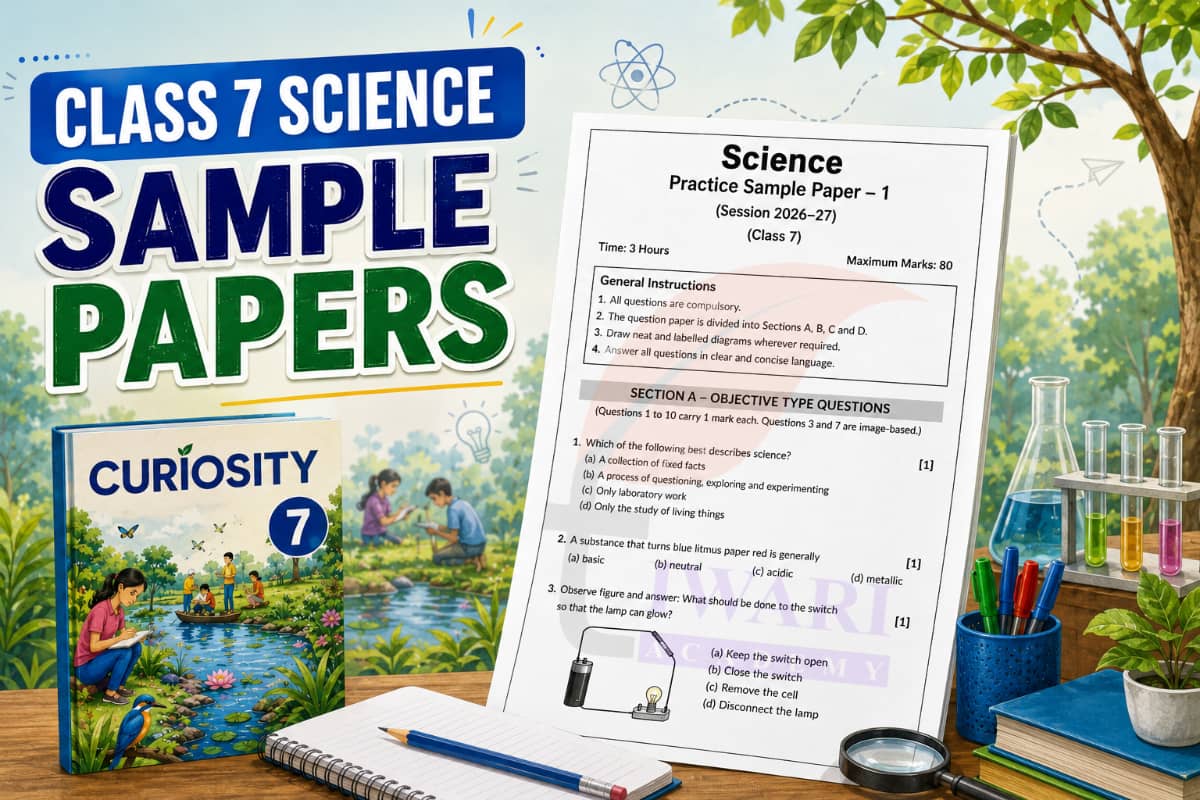
Class 7 Science Sample Papers Curiosity in PDF
Post Date: August 21, 2026

Preparing for the Class 7 Science half yearly exam (Term 1) becomes much easier when you know exactly what kind of questions to expect. That is exactly what these Class 7 Sample Papers are built for. All five papers below are based strictly on the first six chapters of the NCERT Curiosity textbook for Class 7 Science, prescribed for the 2026-27 academic session – from The Ever-Evolving World of Science to Adolescence: A Stage of Growth and Change. Each paper follows a consistent, CBSE-style blueprint with objective and subjective questions, so you get realistic exam practice instead of random revision notes.

Whether you are a student building confidence before Term 1, a parent looking for reliable practice material, or a teacher who needs ready-to-use question sets, this collection of half yearly sample papers for the 2026-27 session will help you revise faster, manage exam time better and identify weak chapters before the real test.


Why Class 7 Science Sample Papers Are Important for the Half Yearly Exam

  • Exam pattern familiarity:ย Students see exactly how questions from Chapters 1โ€“6 are framed as MCQs, short answers and long answers, instead of guessing on exam day.
  • Better time management:ย Solving a full paper within the suggested time trains students to divide 90 minutes wisely across every section.
  • Complete chapter-wise revision:ย Because every paper touches all six chapters, solving all five automatically revises the entire Term 1 syllabus.
  • Confidence building:ย Repeated practice with realistic questions reduces exam anxiety before the actual half yearly paper.
  • Easy self-assessment:ย Comparing scores across the five sets helps students and parents spot chapters that need extra attention.
  • Aligned to the new syllabus:ย These papers follow the updated Class 7 Science Curiosity textbook for 2026-27, not the older, discontinued NCERT Science book.

Chapters Covered in Sample Papers

ChapterNameKey Topics Covered
1The Ever-Evolving World of ScienceScientific method, observation vs inference, hypothesis, scientific temper
2Exploring Substances: Acidic, Basic and NeutralAcids, bases, neutral substances, natural and synthetic indicators, neutralisation
3Electricity: Circuits and Their ComponentsElectric circuits, conductors, insulators, cells, switches, circuit symbols
4The World of Metals and Non-MetalsPhysical properties, malleability, ductility, reactivity, uses, alloys
5Changes Around Us: Physical and Chemical ChangesReversible/irreversible changes, signs of chemical change, rusting
6Adolescence: A Stage of Growth and ChangePuberty, hormones, secondary sexual characteristics, nutrition, hygiene

Class 7 Science Half Yearly Exam Pattern (Term 1)

Each sample paper below follows this blueprint, which mirrors the structure most CBSE-affiliated schools use for Class 7 half yearly assessments:

SectionQuestion TypeQuestions (Marks)
AMultiple Choice Questions10 (10 Marks)
BVery Short Answer Questions5 (10 Marks)
CShort Answer Questions4 (12 Marks)
DLong Answer Questions2 (8 Marks)

Chapter-wise Weightage for Class 7 Science Half Yearly Exam

ChapterApproximate MarksWeightage
1. The Ever-Evolving World of Science4 (or 8)10%
2. Exploring Substances: Acidic, Basic and Neutral7 (or 14)17.5%
3. Electricity: Circuits and Their Components7 (or 14)17.5%
4. The World of Metals and Non-Metals6 (or 12)15%
5. Changes Around Us: Physical and Chemical Changes7 (or 14)17.5%
6. Adolescence: A Stage of Growth and Change9 (or 18)22.5%
Total40 (or 80)100%

Note: Actual weightage may vary slightly by school. Use this table as a general revision guide.


Class 7 Science Sample Paper 1 (Half Yearly Exam 2026-27)

Time: 1.5 Hours | Maximum Marks: 40

Section A โ€“ Multiple Choice Questions (1 ร— 10 = 10 Marks)

  1. The first step of the scientific method is:
    (a) Drawing a conclusion
    (b) Testing a hypothesis
    (c) Making an observation
    (d) Publishing a report
  2. Turmeric paper turns reddish-brown when dipped into:
    (a) A basic solution
    (b) An acidic solution
    (c) Distilled water
    (d) A neutral solution
  3. Which of the following is the best conductor of electricity?
    (a) Rubber
    (b) Copper
    (c) Plastic
    (d) Wood
  4. The property of metals due to which they can be beaten into thin sheets is called:
    (a) Ductility
    (b) Sonorousness
    (c) Malleability
    (d) Lustre
  5. Rusting of an iron gate left out in the rain is an example of a:
    (a) Physical change
    (b) Reversible change
    (c) Temporary change
    (d) Chemical change
  6. Adolescence in humans generally lasts between the ages of:
    (a) 0โ€“5 years
    (b) 20โ€“25 years
    (c) 5โ€“10 years
    (d) 10โ€“19 years
  7. Which of the following substances is neutral in nature?
    (a) Common salt solution
    (b) Lemon juice
    (c) Vinegar
    (d) Soap solution
  8. A circuit in which current cannot flow because the path is broken is called a/an:
    (a) Open circuit
    (b) Closed circuit
    (c) Parallel circuit
    (d) Short circuit
  9. Which of these is a non-metal that can conduct electricity?
    (a) Sulphur
    (b) Sodium
    (c) Phosphorus
    (d) Graphite
  10. The hormone mainly responsible for physical changes in adolescent boys is:
    (a) Testosterone
    (b) Estrogen
    (c) Insulin
    (d) Adrenaline

Answer Key (Section A): 1-c, 2-a, 3-b, 4-c, 5-d, 6-d, 7-a, 8-a, 9-d, 10-a

Section B โ€“ Very Short Answer Questions (2 ร— 5 = 10 Marks)

  • 11. What is the difference between an observation and an inference? Give one example.
  • 12. Name any two natural indicators used to test acidic and basic substances.
  • 13. Define an electric circuit in your own words.
  • 14. Give one example each of a reversible and an irreversible change.
  • 15. Why is a balanced diet especially important during adolescence?

Section C โ€“ Short Answer Questions (3 ร— 4 = 12 Marks)

  • 16. Explain why scientific knowledge is considered “ever-evolving”. Support your answer with one example.
  • 17. List three examples each of acidic and basic substances commonly found at home.
  • 18. Differentiate between a conductor and an insulator, giving two examples of each.
  • 19. Why should we never taste or touch unknown substances in the laboratory to check if they are acidic or basic?

Section D โ€“ Long Answer Questions (4 ร— 2 = 8 Marks)

  • 20. Classify the following changes as physical or chemical and justify each answer: (i) Melting of ice (ii) Burning of a candle wick (iii) Dissolving sugar in water (iv) Rusting of an iron nail.
  • 21. Explain any four physical and emotional changes that take place during adolescence, and suggest two healthy habits adolescents should follow.

If you need a Class 7 Science Sample Paper 1 in 80 Marks and 3 hours, download from the link given below:

  • Class 7 Science Sample Papers 1


Class 7 Science Sample Paper 2 (Half Yearly Exam 2026-27)

Time: 1.5 Hours | Maximum Marks: 40

Section A โ€“ Multiple Choice Questions (1 ร— 10 = 10 Marks)

  1. A hypothesis in science is best described as:
    (a) A testable possible explanation
    (b) A final proven law
    (c) A random guess with no basis
    (d) An unchangeable fact
  2. Litmus, a natural indicator, is obtained from a type of:
    (a) Flower
    (b) Fruit
    (c) Lichen
    (d) Fungus
  3. Which gas is usually produced when a metal reacts with a dilute acid?
    (a) Oxygen
    (b) Nitrogen
    (c) Carbon dioxide
    (d) Hydrogen
  4. Sodium metal is stored in kerosene because it is highly:
    (a) Reactive
    (b) Malleable
    (c) Ductile
    (d) Sonorous
  5. Which of these is an example of a physical change?
    (a) Digestion of food
    (b) Cooking of rice
    (c) Stretching of a rubber band
    (d) Burning of paper
  6. The stage of life that comes immediately after childhood is:
    (a) Infancy
    (b) Old age
    (c) Adulthood
    (d) Adolescence
  7. A solution of baking soda turns red litmus paper:
    (a) Red
    (b) Colourless
    (c) Blue
    (d) Green
  8. The device used to open or close an electric circuit is called a:
    (a) Cell
    (b) Switch
    (c) Wire
    (d) Bulb
  9. Which property allows gold to be drawn into thin wires?
    (a) Malleability
    (b) Lustre
    (c) Sonorousness
    (d) Ductility
  10. Voice deepening in adolescent boys occurs mainly due to the growth of the:
    (a) Thyroid gland
    (b) Voice box (larynx)
    (c) Pituitary gland
    (d) Adrenal gland

Answer Key (Section A): 1-a, 2-c, 3-d, 4-a, 5-c, 6-d, 7-c, 8-b, 9-d, 10-b

Section B โ€“ Very Short Answer Questions (2 ร— 5 = 10 Marks)

  • 11. What do you understand by the term “scientific temper”?
  • 12. Name two examples of neutral substances.
  • 13. Name any two good insulators of electricity used in daily life.
  • 14. State two signs that indicate a chemical change has taken place.
  • 15. Name any two hormones that bring about changes during adolescence.

Section C โ€“ Short Answer Questions (3 ร— 4 = 12 Marks)

  • 16. Explain, with one example, how a scientific idea can change as new evidence is discovered.
  • 17. Describe a simple activity to show that a soap solution is basic in nature.
  • 18. Explain why aluminium is used to make cooking utensils while wood or plastic is used for their handles.
  • 19. Why is cutting an apple considered a physical change while the cut apple turning brown afterwards is a chemical change?

Section D โ€“ Long Answer Questions (4 ร— 2 = 8 Marks)

  • 20. Compare metals and non-metals on the basis of five physical properties: lustre, hardness, conductivity, malleability and sonorousness.
  • 21. What is puberty? Explain any three physical changes seen in girls and any three seen in boys during this stage.

If you need a Class 7 Science Sample Paper 2 in 80 Marks and 3 hours, download from the link given below:

  • Class 7 Science Sample Papers 2


Class 7 Science Sample Paper 3 (Half Yearly Exam 2026-27)

Time: 1.5 Hours | Maximum Marks: 40

Section A โ€“ Multiple Choice Questions (1 ร— 10 = 10 Marks)

  1. Which of the following best describes an “experiment” in science?
    (a) An opinion shared without testing
    (b) A final scientific law
    (c) A controlled test to check a hypothesis
    (d) A random guess
  2. Litmus paper is commonly available in:
    (a) Only red colour
    (b) Red and blue colours
    (c) Yellow and green colours
    (d) Only blue colour
  3. Which of the following is a good conductor of electricity, commonly used for wiring?
    (a) Rubber
    (b) Wood
    (c) Copper
    (d) Plastic
  4. Which non-metal is commonly used in the manufacture of match sticks?
    (a) Nitrogen
    (b) Oxygen
    (c) Carbon
    (d) Sulphur
  5. Boiling of water to form steam is an example of a:
    (a) Physical change
    (b) Chemical change
    (c) Irreversible change
    (d) Both physical and chemical change
  6. Physical features that distinguish males from females but are not directly involved in reproduction are called:
    (a) Primary sexual characteristics
    (b) Genetic characteristics
    (c) Hormonal characteristics
    (d) Secondary sexual characteristics
  7. Vinegar is an example of a/an:
    (a) Basic substance
    (b) Neutral substance
    (c) Indicator
    (d) Acidic substance
  8. In a circuit diagram, a symbol made of two parallel lines of different lengths represents a:
    (a) Switch
    (b) Bulb
    (c) Cell
    (d) Wire
  9. Which of the following metals is highly malleable and is used to make jewellery?
    (a) Gold
    (b) Zinc
    (c) Sulphur
    (d) Iron
  10. Which food group should adolescents especially include in their diet to prevent anaemia?
    (a) Sugary foods
    (b) Iron-rich foods
    (c) Fatty foods
    (d) Only fruits

Answer Key (Section A): 1-c, 2-b, 3-c, 4-d, 5-a, 6-d, 7-d, 8-c, 9-a, 10-b

Section B โ€“ Very Short Answer Questions (2 ร— 5 = 10 Marks)

  • 11. What is meant by a “controlled experiment”?
  • 12. Name one natural indicator, other than litmus, used to test acids and bases.
  • 13. Why are electric wires usually covered with plastic or rubber?
  • 14. Give one example of a change that is useful to us even though it is irreversible.
  • 15. What is menstruation, and why is menstrual hygiene important during adolescence?

Section C โ€“ Short Answer Questions (3 ร— 4 = 12 Marks)

  • 16. “Not every guess is a hypothesis”. Justify this statement with the help of an example.
  • 17. A shopkeeper wants to check whether a powder is acidic, basic, or neutral without tasting it. Suggest a safe method.
  • 18. Explain, with reasons, why iron is used to make bridges while rubber or plastic is used to make plug covers.
  • 19. State any three differences between physical and chemical changes.

Section D โ€“ Long Answer Questions (4 ร— 2 = 8 Marks)

  • 20. Explain the working of a simple electric torch. Name its main components and state the function of each.
  • 21. Describe the emotional and behavioural changes commonly seen in adolescents and suggest three healthy ways to manage mood swings.

If you need a Class 7 Science Sample Paper 3 in 80 Marks and 3 hours, download from the link given below:

  • Class 7 Science Sample Papers 3


Class 7 Science Sample Paper 4 (Half Yearly Exam 2026-27)

Time: 1.5 Hours | Maximum Marks: 40

Section A โ€“ Multiple Choice Questions (1 ร— 10 = 10 Marks)

  1. Which of the following is NOT a step of the scientific method?
    (a) Observation
    (b) Guessing without any basis
    (c) Hypothesis
    (d) Experimentation
  2. A solution that does not change the colour of either red or blue litmus is called:
    (a) Acidic
    (b) Basic
    (c) Synthetic
    (d) Neutral
  3. In a dry cell, the positive terminal is usually marked with a:
    (a) Minus sign
    (b) Plus sign
    (c) Zig-zag line
    (d) Circle
  4. Which of the following metals is the most malleable and ductile, commonly used in jewellery?
    (a) Iron
    (b) Zinc
    (c) Gold
    (d) Carbon
  5. Which of these changes produces a new substance?
    (a) Tearing of paper
    (b) Freezing of water
    (c) Melting of butter
    (d) Burning of a magnesium ribbon
  6. The gland often called the “master gland,” which controls other hormone-secreting glands, is the:
    (a) Thyroid
    (b) Pancreas
    (c) Pituitary gland
    (d) Adrenal gland
  7. Which of the following will turn blue litmus paper red?
    (a) Baking soda solution
    (b) Lemon juice
    (c) Soap solution
    (d) Lime water
  8. Two bulbs connected end-to-end in a single loop with a cell form a:
    (a) Parallel circuit
    (b) Open circuit
    (c) Broken circuit
    (d) Series circuit
  9. Non-metals are generally:
    (a) Poor conductors of heat and electricity
    (b) Good conductors of heat and electricity
    (c) Malleable
    (d) Sonorous
  10. The first noticeable sign of approaching adolescence in most children is usually a:
    (a) Growth spurt in height
    (b) Sudden weight loss
    (c) Loss of appetite
    (d) Reduction in height

Answer Key (Section A): 1-b, 2-d, 3-b, 4-c, 5-d, 6-c, 7-b, 8-d, 9-a, 10-a

Section B โ€“ Very Short Answer Questions (2 ร— 5 = 10 Marks)

  • 11. Why do scientists repeat their experiments before accepting a result as reliable?
  • 12. Name any one synthetic indicator used to test acids and bases.
  • 13. What is the function of a switch in an electric circuit?
  • 14. Why is milk turning into curd considered a chemical change?
  • 15. List two personal hygiene habits that are important during adolescence.

Section C โ€“ Short Answer Questions (3 ร— 4 = 12 Marks)

  • 16. Give two examples of how curiosity and questioning have led to important scientific discoveries.
  • 17. Explain the reaction between an acid and a base with the help of one everyday example.
  • 18. Why do we prefer copper or aluminium for electric wires rather than iron or steel?
  • 19. With an example, explain how the same material can undergo a physical change in one situation and a chemical change in another.

Section D โ€“ Long Answer Questions (4 ร— 2 = 8 Marks)

  • 20. What are alloys? Explain, with two examples, why alloys are often more useful than pure metals.
  • 21. “Adolescence is a stage of both opportunities and challenges.” Explain this statement with reference to physical, emotional and social changes.

If you need a Class 7 Science Sample Paper 4 in 80 Marks and 3 hours, download from the link given below:

  • Class 7 Science Sample Papers 4


Class 7 Science Sample Paper 5 (Half Yearly Exam 2026-27)

Time: 1.5 Hours | Maximum Marks: 40

Section A โ€“ Multiple Choice Questions (1 ร— 10 = 10 Marks)

  1. Which of these statements is a scientific observation rather than an inference?
    (a) The plant has yellow leaves
    (b) The plant is dying due to lack of water
    (c) The soil seems infertile
    (d) The sky looks cloudy, so it might rain
  2. Which of the following is a synthetic indicator used in laboratories to test acids and bases?
    (a) Turmeric
    (b) Phenolphthalein
    (c) Litmus
    (d) China rose extract
  3. In a circuit diagram, a straight line usually represents a:
    (a) Bulb
    (b) Cell
    (c) Connecting wire
    (d) Switch
  4. Coating iron objects with a layer of zinc to protect them from rusting is called:
    (a) Painting
    (b) Alloying
    (c) Oiling
    (d) Galvanisation
  5. Which of the following is an irreversible change?
    (a) Burning of wood
    (b) Melting of ice
    (c) Dissolving of salt in water
    (d) Boiling of water
  6. Breast development in girls during adolescence is triggered mainly by the hormone:
    (a) Testosterone
    (b) Estrogen
    (c) Insulin
    (d) Adrenaline
  7. Which of these is commonly applied at home to relieve the irritation caused by an ant bite, due to its basic nature?
    (a) Lemon juice
    (b) Vinegar
    (c) Baking soda paste
    (d) Sugar solution
  8. A bulb does not glow in a circuit with a broken wire because the circuit is:
    (a) Closed
    (b) Parallel
    (c) Short
    (d) Open
  9. Sonorousness is the property of metals due to which they:
    (a) Produce a ringing sound when struck
    (b) Can be beaten into sheets
    (c) Can be drawn into wires
    (d) Conduct heat well
  10. Which stage of life comes immediately after adolescence?
    (a) Childhood
    (b) Adulthood
    (c) Infancy
    (d) Old age

Answer Key (Section A): 1-a, 2-b, 3-c, 4-d, 5-a, 6-b, 7-c, 8-d, 9-a, 10-b

Section B โ€“ Very Short Answer Questions (2 ร— 5 = 10 Marks)

  • 11. Why is it important to record observations carefully during a scientific investigation?
  • 12. What is a neutralisation reaction?
  • 13. Name two devices in your home that work using electric circuits.
  • 14. Give one example of a chemical change that is harmful to us.
  • 15. Why do adolescents need more calcium and protein in their diet?

Section C โ€“ Short Answer Questions (3 ร— 4 = 12 Marks)

  • 16. Explain with an example how scientists use both observation and experimentation together to reach a conclusion.
  • 17. Describe the steps you would follow to test an unknown colourless liquid to find out whether it is acidic, basic or neutral using litmus paper.
  • 18. Give three reasons why non-metals like sulphur and carbon are important in daily life despite being poor conductors.
  • 19. Rahul left a cut apple and a cut potato on a plate for an hour and both turned brown. Is this a physical or a chemical change? Justify your answer.

Section D โ€“ Long Answer Questions (4 ร— 2 = 8 Marks)

  • 20. Design a simple activity using a cell, a bulb, connecting wires and a switch to demonstrate a closed circuit and an open circuit. Explain your observations in both cases.
  • 21. List five healthy habits related to diet, hygiene, exercise and emotional well-being that you would recommend to a friend going through adolescence, with a brief reason for each.

If you need a Class 7 Science Sample Paper 5 in 80 Marks and 3 hours, download from the link given below:

  • Class 7 Science Sample Papers 5


Tips to Score Well in Class 7 Science Half Yearly Exam Using These Sample Papers

  1. Solve one paper at a time under exam conditions: Use a timer and complete each set in 90 minutes without opening the textbook, just like the real half yearly exam.
  2. Revise chapter-wise before each attempt: Skim Chapters 1โ€“6 for definitions, examples and diagrams before solving the corresponding sample paper.
  3. Prioritise high-weightage chapters: Based on the weightage table above, give extra attention to Chapter 6 (Adolescence) and Chapters 2, 3 and 5.
  4. Practice writing, not just reading, answers: Actually writing Short and Long Answer responses builds recall and improves handwriting speed for the real exam.
  5. Cross-check with the answer key: After the MCQs, tally answers with the given key and note down every concept you got wrong.
  6. Repeat weak sections: If a chapter keeps tripping you up across multiple papers, go back to the NCERT Curiosity textbook and revise it again.
  7. Keep a diagram and definitions sheet handy: Chapters like Electricity and Metals & Non-metals often need precise definitions and labelled diagrams, so maintain a quick-revision sheet for these.

Frequently Asked Questions

Which chapters of the Class 7 Science Curiosity textbook are covered in these half yearly sample papers?

These five sample papers are based on the first six chapters of the Class 7 Science Curiosity textbook prescribed for the 2026-27 academic session. This includes Chapter 1 (The Ever-Evolving World of Science), Chapter 2 (Exploring Substances: Acidic, Basic and Neutral), Chapter 3 (Electricity: Circuits and Their Components), Chapter 4 (The World of Metals and Non-Metals), Chapter 5 (Changes Around Us: Physical and Chemical Changes), and Chapter 6 (Adolescence: A Stage of Growth and Change). Together, these chapters usually form the Term 1 or half yearly syllabus in most CBSE-affiliated schools, so practising all six thoroughly ensures complete syllabus coverage before the exam.

What is the exam pattern followed in these Class 7 Science sample papers?

Each sample paper carries 40 marks and is designed to be completed in 1.5 hours, similar to a typical half yearly question paper. The paper is divided into four sections: Section A has 10 multiple choice questions worth 1 mark each, Section B has 5 very short answer questions worth 2 marks each, Section C has 4 short answer questions worth 3 marks each, and Section D has 2 long answer questions worth 4 marks each. This structure mirrors the pattern most CBSE-affiliated schools use for periodic and half yearly assessments in middle school.

Are five sample papers enough to prepare for the Class 7 Science half yearly exam?

Five sample papers covering all six chapters give students a strong, well-rounded practice base, especially when combined with regular NCERT textbook study and chapter-wise revision notes. Since each paper tests the same syllabus with differently framed questions, solving all five reinforces concepts from multiple angles instead of memorising a single set of answers. For best results, students should also revise theory from the textbook, attempt in-text and end-of-chapter questions, and use these papers as a final practice round one to two weeks before the actual half yearly exam.

How should a Class 7 student use these sample papers effectively before the exam?

Students should attempt one full sample paper at a time under timed, exam-like conditions rather than solving questions randomly. After completing a paper, they should check the MCQ answer key, identify chapters where mistakes were made and revisit those topics in the Curiosity textbook before attempting the next set. Spacing the five papers over one or two weeks, instead of solving them all in a single day, allows better retention. Reviewing Short and Long Answer responses with a teacher or parent can also improve answer-writing style for the final exam.

Are these Class 7 Science sample papers based on the latest NCERT syllabus?

Yes, all five sample papers are based on the updated NCERT Curiosity textbook for Class 7 Science, introduced under the National Education Policy 2020 and National Curriculum Framework 2023 for the 2026-27 academic session. The topics, terminology and question types used in these papers align with Chapters 1 to 6 of this new textbook, replacing the older Class 7 Science book. However, since individual schools may adjust their own half yearly syllabus slightly, students are advised to confirm the exact chapters and exam pattern with their school before final preparation.

Recent Posts
  • Class 9 Science Exploration Notes: 5 Methods That Actually Help You Remember
  • Class 9 Social Science Notes: The Complete Guide
  • Class 9 Maths 2026-27: What’s New in the Syllabus and How to Study It
  • CBSE 3-Language Rule: Will Hindi Become Compulsory Subject?
  • NCERT Solutions for Class 10 Maths 2026-27 – Welcome to Your New Session


Important Links
  • What is NCERT?
  • Important Questions
  • Vedic Maths Tricks
  • Link Study Materials
  • Useful Resources & Formulae
  • Holiday Homework Solutions


Buy NCERT Books Online

NCERT Books for 2026-27

NCERT Solutions
  • NCERT Solutions for Class 6 Maths
  • NCERT Solutions for Class 7 Maths
  • NCERT Solutions for Class 8 Maths
  • NCERT Solutions for Class 11 Maths
  • NCERT Solutions for Class 12 Maths
  • NCERT Solutions for Class 11 Physics
  • NCERT Solutions for Class 12 Physics


High School
  • Class 9 NCERT Maths Solutions
  • Class 9 NCERT Science Solutions
  • Class 9 NCERT English Solutions
  • Class 10 NCERT Maths Solutions
  • Class 10 NCERT Science Solutions
  • Class 10 NCERT English Solutions
  • Class 10 NCERT Social Solutions

Quick Links
  • NCERT Books
  • NCERT Solutions
  • CBSE Syllabus
  • Home Tutors
  • NIOS Admissions
  • CBSE Sample Papers
  • Vedic Maths Tricks
Help & Support
  • About Us
  • Contact Us
  • Advertise With Us
  • Discussion
  • Latest Blogs
  • Holiday Homework
  • Useful Resources
Copyright 2026 by Tiwari Academy | A step towards Free Education
facebook
twitter
linkedin
youtube
instagram
pinterest
google-news