
Tiwari Academy  – Free CBSE NCERT Books and Solutions
  • Apps
    • CBSE Apps
    • Hast Rekha App
  • NCERT Solutions
    • NCERT Solutions for Class 12
      • NCERT Solutions for Class 12 Maths
      • NCERT Solutions for Class 12 Physics
      • NCERT Solutions for Class 12 Chemistry
      • NCERT Solutions for Class 12 Biology
      • NCERT Solutions for Class 12 English
      • NCERT Solutions for Class 12 Accounts
      • NCERT Solutions for Class 12 Business Studies
      • NCERT Solutions for Class 12 Economics
      • NCERT Solutions for Class 12 Geography
      • NCERT Solutions for Class 12 Physical Education
      • NCERT Solutions for Class 12 Political Science
      • NCERT Solutions for Class 12 Psychology
      • NCERT Solutions for Class 12 Sociology
    • NCERT Solutions for Class 11
      • NCERT Solutions for Class 11 Maths
      • NCERT Solutions for Class 11 Physics
      • NCERT Solutions for Class 11 Chemistry
      • NCERT Solutions for Class 11 Biology
      • NCERT Solutions for Class 11 English
      • NCERT Solutions for Class 11 Business Studies
      • NCERT Solutions for Class 11 Sociology
      • NCERT Solutions for Class 11 Political Science
      • NCERT Solutions for Class 11 Psychology
      • NCERT Solutions for Class 11 Physical Education
    • NCERT Solutions for Class 10
      • NCERT Solutions for Class 10 Maths
      • NCERT Solutions for Class 10 Science
      • NCERT Solutions for Class 10 English
      • NCERT Solutions for Class 10 Hindi 2026-27 Updated Course A and B
      • NCERT Solutions for Class 10 Sanskrit
      • NCERT Solutions for Class 10 Social Science
    • NCERT Solutions for Class 9
      • NCERT Solutions for Class 9 Maths
      • NCERT Solutions for Class 9 Science
      • NCERT Solutions for Class 9 English
      • NCERT Solutions for Class 9 Hindi
      • NCERT Solutions for Class 9 Sanskrit
      • NCERT Solutions for Class 9 Social Science
    • NCERT Solutions for Class 8
      • NCERT Solutions for Class 8 Maths
      • NCERT Solutions for Class 8 Science
      • NCERT Solutions for Class 8 English
      • NCERT Solutions for Class 8 Hindi
      • NCERT Solutions for Class 8 Sanskrit
      • NCERT Solutions for Class 8 Social Science
      • NCERT Solutions for Class 8 Computer
    • NCERT Solutions for Class 7
      • NCERT Solutions for Class 7 Maths
      • NCERT Solutions for Class 7 Science
      • NCERT Solutions for Class 7 English
      • NCERT Solutions for Class 7 Hindi
      • NCERT Solutions for Class 7 Sanskrit
      • NCERT Solutions for Class 7 Social Science
      • NCERT Solutions for Class 7 Computer
    • NCERT Solutions for Class 6
      • NCERT Solutions for Class 6 Maths
      • NCERT Solutions for Class 6 Science
      • NCERT Solutions for Class 6 English
      • NCERT Solutions for Class 6 Hindi
      • NCERT Solutions for Class 6 Sanskrit Deepakam 2026-27 Updated
      • NCERT Solutions for Class 6 Social Science
      • NCERT Solutions for Class 6 Computer
    • NCERT Solutions for Class 5
      • NCERT Solutions for Class 5 Hindi
      • NCERT Solutions for Class 5 English
      • NCERT Solutions for Class 5 Maths
      • NCERT Solutions for Class 5 EVS
      • NCERT Solutions for Class 5 Computer
      • NCERT Solutions for Class 5 GK
    • NCERT Solutions for Class 4
      • NCERT Solutions for Class 4 Hindi
      • NCERT Solutions for Class 4 English
      • NCERT Solutions for Class 4 Maths
      • NCERT Solutions for Class 4 EVS
      • NCERT Solutions for Class 4 Computer
      • NCERT Solutions for Class 4 GK
    • NCERT Solutions for Class 3
      • NCERT Solutions for Class 3 Hindi
      • NCERT Solutions for Class 3 English
      • NCERT Solutions for Class 3 Maths
      • NCERT Solutions for Class 3 EVS
      • NCERT Solutions for Class 3 Science
      • NCERT Solutions for Class 3 Computer
      • NCERT Solutions for Class 3 GK
    • NCERT Solutions for Class 2
      • NCERT Solutions for Class 2 Hindi
      • NCERT Solutions for Class 2 English
      • NCERT Solutions for Class 2 Maths
      • NCERT Solutions for Class 2 EVS
      • NCERT Solutions for Class 2 Science
      • NCERT Solutions for Class 2 Computer
      • NCERT Solutions for Class 2 GK
    • NCERT Solutions for Class 1
      • NCERT Solutions for Class 1 Hindi
      • NCERT Solutions for Class 1 English
      • NCERT Solutions for Class 1 Maths
      • NCERT Solutions for Class 1 EVS
      • NCERT Solutions for Class 1 Computer
      • NCERT Solutions for Class 1 Science
      • NCERT Solutions for Class 1 GK
    • Study Material for KG
      • Study Material for KG English
      • Study Material for KG Hindi
      • Study Material for KG Maths
    • Study Material for Nursery
      • Study Material for Nursery Maths
      • Study Material for Nursery English
      • Study Material for Nursery Hindi
  • NEWS
    • Educational NEWS
    • MCQ
    • Explore More
  • Grammar
    • Class 1 English Grammar
      • Class 1 Hindi Vyakaran
    • Class 2 English Grammar
      • Class 2 Hindi Vyakaran
    • Class 3 English Grammar
      • Class 3 Hindi Vyakaran
    • Class 4 English Grammar
      • Class 4 Hindi Vyakaran
    • Class 5 English Grammar
      • Class 5 Hindi Vyakaran
    • Class 6 English Grammar
      • Class 6 Hindi Vyakaran
    • Class 7 English Grammar
      • Class 7 Hindi Vyakaran
    • Class 8 English Grammar
      • Class 8 Hindi Vyakaran
  • Sample Papers
    • CBSE Sample Papers for Class 4
    • CBSE Sample Papers for Class 5
    • CBSE Sample Papers for Class 6
    • CBSE Sample Papers for Class 7
    • CBSE Sample Papers for Class 8
    • CBSE Sample Papers for Class 9
    • CBSE Sample Papers for Class 10
    • CBSE Sample Papers for Class 11
    • CBSE Sample Papers for Class 12
  • Syllabus
    • CBSE Syllabus
    • NCERT Books
    • NCERT Exemplar
    • What is NIOS?
    • NIOS Online Admission
    • Career Options
  • Contact
    • Contact Us
    • About Us
    • Authors
    • Online Tutors
  • Apps
    • CBSE Apps
    • Hast Rekha App
  • NCERT Solutions
    • NCERT Solutions for Class 12
      • NCERT Solutions for Class 12 Maths
      • NCERT Solutions for Class 12 Physics
      • NCERT Solutions for Class 12 Chemistry
      • NCERT Solutions for Class 12 Biology
      • NCERT Solutions for Class 12 English
      • NCERT Solutions for Class 12 Accounts
      • NCERT Solutions for Class 12 Business Studies
      • NCERT Solutions for Class 12 Economics
      • NCERT Solutions for Class 12 Geography
      • NCERT Solutions for Class 12 Physical Education
      • NCERT Solutions for Class 12 Political Science
      • NCERT Solutions for Class 12 Psychology
      • NCERT Solutions for Class 12 Sociology
    • NCERT Solutions for Class 11
      • NCERT Solutions for Class 11 Maths
      • NCERT Solutions for Class 11 Physics
      • NCERT Solutions for Class 11 Chemistry
      • NCERT Solutions for Class 11 Biology
      • NCERT Solutions for Class 11 English
      • NCERT Solutions for Class 11 Business Studies
      • NCERT Solutions for Class 11 Sociology
      • NCERT Solutions for Class 11 Political Science
      • NCERT Solutions for Class 11 Psychology
      • NCERT Solutions for Class 11 Physical Education
    • NCERT Solutions for Class 10
      • NCERT Solutions for Class 10 Maths
      • NCERT Solutions for Class 10 Science
      • NCERT Solutions for Class 10 English
      • NCERT Solutions for Class 10 Hindi 2026-27 Updated Course A and B
      • NCERT Solutions for Class 10 Sanskrit
      • NCERT Solutions for Class 10 Social Science
    • NCERT Solutions for Class 9
      • NCERT Solutions for Class 9 Maths
      • NCERT Solutions for Class 9 Science
      • NCERT Solutions for Class 9 English
      • NCERT Solutions for Class 9 Hindi
      • NCERT Solutions for Class 9 Sanskrit
      • NCERT Solutions for Class 9 Social Science
    • NCERT Solutions for Class 8
      • NCERT Solutions for Class 8 Maths
      • NCERT Solutions for Class 8 Science
      • NCERT Solutions for Class 8 English
      • NCERT Solutions for Class 8 Hindi
      • NCERT Solutions for Class 8 Sanskrit
      • NCERT Solutions for Class 8 Social Science
      • NCERT Solutions for Class 8 Computer
    • NCERT Solutions for Class 7
      • NCERT Solutions for Class 7 Maths
      • NCERT Solutions for Class 7 Science
      • NCERT Solutions for Class 7 English
      • NCERT Solutions for Class 7 Hindi
      • NCERT Solutions for Class 7 Sanskrit
      • NCERT Solutions for Class 7 Social Science
      • NCERT Solutions for Class 7 Computer
    • NCERT Solutions for Class 6
      • NCERT Solutions for Class 6 Maths
      • NCERT Solutions for Class 6 Science
      • NCERT Solutions for Class 6 English
      • NCERT Solutions for Class 6 Hindi
      • NCERT Solutions for Class 6 Sanskrit Deepakam 2026-27 Updated
      • NCERT Solutions for Class 6 Social Science
      • NCERT Solutions for Class 6 Computer
    • NCERT Solutions for Class 5
      • NCERT Solutions for Class 5 Hindi
      • NCERT Solutions for Class 5 English
      • NCERT Solutions for Class 5 Maths
      • NCERT Solutions for Class 5 EVS
      • NCERT Solutions for Class 5 Computer
      • NCERT Solutions for Class 5 GK
    • NCERT Solutions for Class 4
      • NCERT Solutions for Class 4 Hindi
      • NCERT Solutions for Class 4 English
      • NCERT Solutions for Class 4 Maths
      • NCERT Solutions for Class 4 EVS
      • NCERT Solutions for Class 4 Computer
      • NCERT Solutions for Class 4 GK
    • NCERT Solutions for Class 3
      • NCERT Solutions for Class 3 Hindi
      • NCERT Solutions for Class 3 English
      • NCERT Solutions for Class 3 Maths
      • NCERT Solutions for Class 3 EVS
      • NCERT Solutions for Class 3 Science
      • NCERT Solutions for Class 3 Computer
      • NCERT Solutions for Class 3 GK
    • NCERT Solutions for Class 2
      • NCERT Solutions for Class 2 Hindi
      • NCERT Solutions for Class 2 English
      • NCERT Solutions for Class 2 Maths
      • NCERT Solutions for Class 2 EVS
      • NCERT Solutions for Class 2 Science
      • NCERT Solutions for Class 2 Computer
      • NCERT Solutions for Class 2 GK
    • NCERT Solutions for Class 1
      • NCERT Solutions for Class 1 Hindi
      • NCERT Solutions for Class 1 English
      • NCERT Solutions for Class 1 Maths
      • NCERT Solutions for Class 1 EVS
      • NCERT Solutions for Class 1 Computer
      • NCERT Solutions for Class 1 Science
      • NCERT Solutions for Class 1 GK
    • Study Material for KG
      • Study Material for KG English
      • Study Material for KG Hindi
      • Study Material for KG Maths
    • Study Material for Nursery
      • Study Material for Nursery Maths
      • Study Material for Nursery English
      • Study Material for Nursery Hindi
  • NEWS
    • Educational NEWS
    • MCQ
    • Explore More
  • Grammar
    • Class 1 English Grammar
      • Class 1 Hindi Vyakaran
    • Class 2 English Grammar
      • Class 2 Hindi Vyakaran
    • Class 3 English Grammar
      • Class 3 Hindi Vyakaran
    • Class 4 English Grammar
      • Class 4 Hindi Vyakaran
    • Class 5 English Grammar
      • Class 5 Hindi Vyakaran
    • Class 6 English Grammar
      • Class 6 Hindi Vyakaran
    • Class 7 English Grammar
      • Class 7 Hindi Vyakaran
    • Class 8 English Grammar
      • Class 8 Hindi Vyakaran
  • Sample Papers
    • CBSE Sample Papers for Class 4
    • CBSE Sample Papers for Class 5
    • CBSE Sample Papers for Class 6
    • CBSE Sample Papers for Class 7
    • CBSE Sample Papers for Class 8
    • CBSE Sample Papers for Class 9
    • CBSE Sample Papers for Class 10
    • CBSE Sample Papers for Class 11
    • CBSE Sample Papers for Class 12
  • Syllabus
    • CBSE Syllabus
    • NCERT Books
    • NCERT Exemplar
    • What is NIOS?
    • NIOS Online Admission
    • Career Options
  • Contact
    • Contact Us
    • About Us
    • Authors
    • Online Tutors
เคนเคฟเค‚เคฆเฅ€ เคฎเฅ€เคกเคฟเคฏเคฎเคนเคฟเค‚เคฆเฅ€ เคฎเฅ€เคกเคฟเคฏเคฎ Latest BlogsLatest Blogs Ask QuestionsAsk Questions
Tiwari Academy  /  Latest News  /  Class 9 English Kaveri Chapter 1 Study Guide: How I Taught My Grandmother to Read

Class 9 English Kaveri Chapter 1 Study Guide: How I Taught My Grandmother to Read

Class 9 English Kaveri Chapter 1 Study Guide: Skills Practice
Post Date: September 22, 2026

Chapter 1 of Kaveri, the new Class 9 English textbook, pairs Sudha Murty’s well-known memoir “How I Taught My Grandmother to Read” with Subramania Bharati’s patriotic poem “Bharat Our Land” and uses them to build five distinct skills: reading comprehension, vocabulary in context, grammar (simple past versus past perfect), literary devices and formal letter writing. Complete answers to every comprehension question, a full Hindi translation and a model letter to the editor are already available at Tiwari Academy’s NCERT Solutions for Class 9 English Kaveri Chapter 1. This guide does something different: it teaches the underlying skill behind each exercise type using entirely fresh material – a method for backing up an inference with evidence, a literary-devices glossary with brand-new examples and a reusable checklist for the letter-writing task – so you can apply what you’ve learned to a passage you’ve never seen before, not just this one.
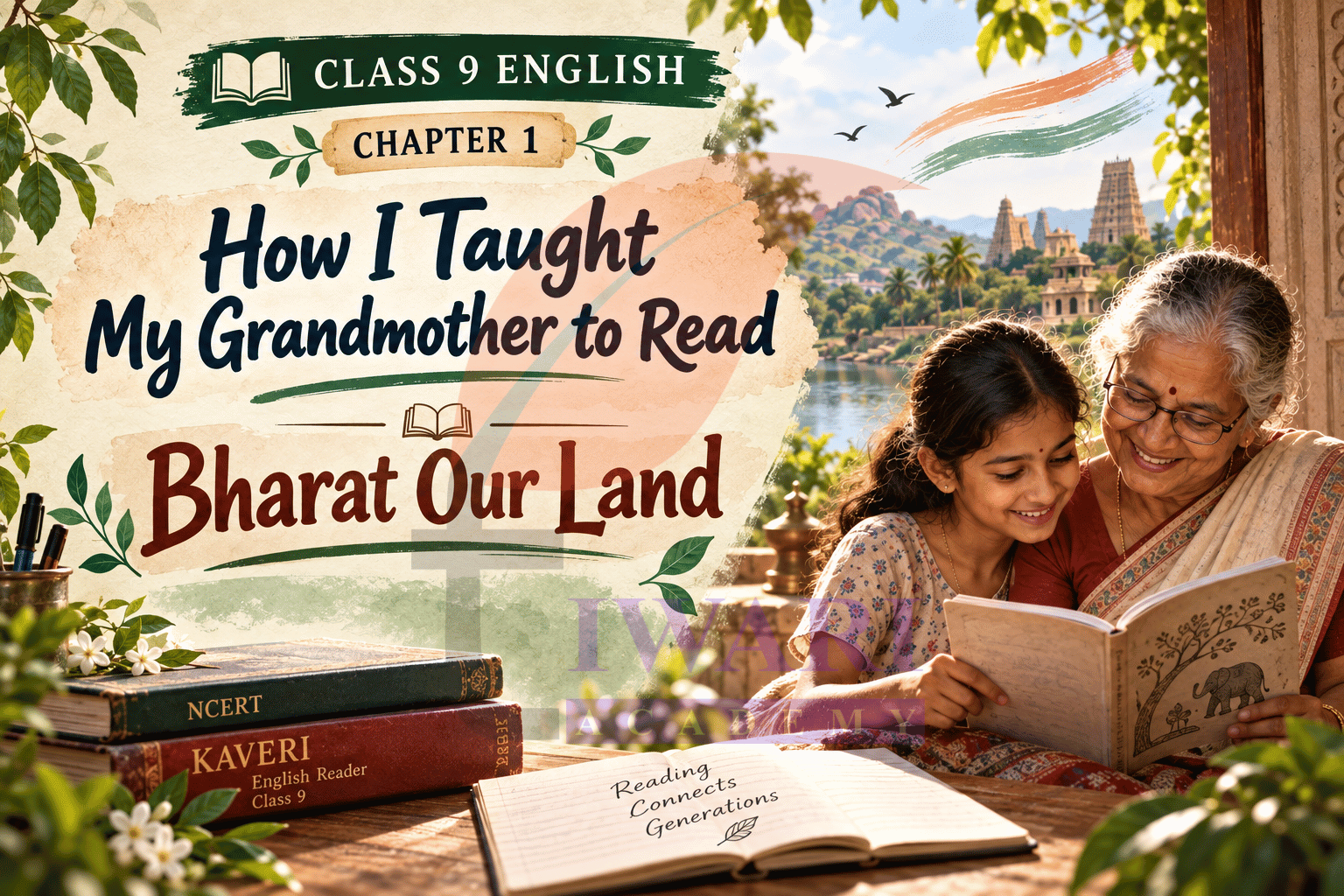

Class 9 English Kaveri Chapter 1 Study Guide: Build the Skills This Chapter Is Really Testing

A story about a grandmother learning to read and a poem in praise of India look, on the surface, like two unrelated pieces sharing a unit number. What actually connects them – and what the exam is really testing – is a set of five reading and writing skills that will resurface all year, long after the specific plot details are forgotten.

The Skill Map: What Each Section Is Really Testing

The chapter’s section headings can look like a random sequence of activities. They’re not – each one targets a specific skill:

Section in the BookWhat It’s Actually Testing
Reflect and RespondPersonal connection before reading โ€” there’s no wrong answer, it just activates what you already know
Reading for Meaning / word-matchingVocabulary in context
Check Your UnderstandingLiteral comprehension – the answer is stated directly in the text
Critical ReflectionInferential and evaluative comprehension – reading between the lines
Vocabulary and Structures in ContextWord-building (prefixes, idioms, binomials) and grammar (tense)
Listen and RespondListening comprehension
Speaking ActivityOral fluency and structured argument
Writing TaskFormat-based formal writing
Learning Beyond the TextResearch and real-world connection

Knowing which skill a question is testing changes how you should answer it – a “true or false” question wants a fact you can point to; a “how effectively does…” question wants your own reasoned judgment, backed up with detail.

The Most Important Skill: Backing Up an Inference With Evidence

The single biggest gap between a weak and a strong answer on “Critical Reflection” or evaluative questions is evidence. Here’s a simple three-step method – State it, Show it, Explain it:

  • State your point in one clear sentence.
  • Show a specific, paraphrased detail from the text that supports it.
  • Explain in one sentence why that detail proves your point.

Here’s the method demonstrated on a scenario that has nothing to do with this chapter, so you can see the shape of it clearly: imagine a character named Rohan slams his bedroom door and skips dinner after a phone call. Asked “What does this reveal about Rohan?”, a weak answer just says “he’s upset”. A strong answer: State – Rohan seems deeply hurt or angry. Show – he slams the door and skips a meal, both unusual and physical reactions for him. Explain – since isolating himself and refusing food aren’t normal behaviour, the phone call likely delivered upsetting news he isn’t ready to talk about yet.

That’s the exact structure to use on any question asking what a character’s actions or words reveal – including the ones in this chapter about the grandmother’s tears or her determination to learn. Practice the method here first; then apply it to the actual extract questions before checking your answer against the solutions page.


Vocabulary in Context: Guessing a Word You Don’t Know

Before reaching for a dictionary, check three things: the sentence right before and after the unfamiliar word (does it hint at a similar or opposite idea?), whether the word is doing a job you can guess from its position (is it describing something or an action?) and whether a footnote or glossary note is already given – this chapter footnotes several words for exactly this reason. Try this on a sentence of your own construction: “The usually chatty class fell into an eerie hush the moment the principal walked in”. Even without knowing “hush,” the words “chatty”, “eerie” and “the moment the principal walked in” all point toward a sudden, tense silence.

Word-Building Practice: Fresh Prefixes, Binomials and Idioms

The chapter teaches prefixes, binomials, and idioms using its own set of words. Here’s a fresh set using the same rules, to test whether you’ve actually learned the pattern rather than just memorised the book’s specific answers.

Prefixes (add un-, im-, dis-, in-, mis-, or extra- to each): agree, mature, adequate, kind, curricular, represent.
One way to check yourself: disagree, immature, inadequate, unkind, extracurricular, misrepresent.

Binomials (two words in a fixed order, usually with “and” or “or”): give and take, back and forth, touch and go, cut and dried, wear and tear. Try using three of these in sentences of your own before checking a dictionary for the ones you’re unsure of.

Idioms: a piece of cake, get cold feet, bite the bullet, once in a blue moon. Match each to a rough meaning first (something very easy; grow nervous before doing something; face a hard situation bravely; very rarely), then write one sentence with each.

Grammar Spotlight: Simple Past vs. Past Perfect

The rule: when two past actions are mentioned together, the one that happened earlier takes the past perfect (“had + past participle”) and the one that happened more recently stays in the simple past. Three fresh examples to test the rule on:

  • By the time the fire brigade arrived, the flames had already spread to the roof.
  • When Priya opened her lunchbox, she realised her brother had already eaten half of it.
  • The match had already started by the time we found our seats.

In each sentence, identify which action happened first (that’s your past perfect) before checking – this is a far more reliable way to get the tense right than trying to memorise which verb “sounds” correct.

Literary Devices Glossary (With Brand-New Examples)

The poem in this chapter introduces several literary devices. Rather than repeating the poem’s own lines, here’s each device defined with a fresh example – good practice for using the term correctly on a passage you haven’t seen before:

DeviceWhat It MeansFresh Example
PersonificationGiving human qualities to something non-human“The old clock groaned as the hour struck midnight”.
HyperboleExtreme exaggeration, not meant literally“I’ve told you a million times to close the door”.
AllusionAn indirect reference to a well-known person, place or event“She ran like Usain Bolt to catch the bus”.
ImageryDescriptive language that appeals to the senses“The wet earth smelled sweet after the first monsoon rain”.
SymbolismOne thing standing in for a deeper ideaA candle is often used in poetry to represent hope, or a single fragile source of light in darkness
RefrainA line or phrase repeated at set points in a poemMany patriotic poems repeat the same rallying line at the end of every stanza, to hammer home one central feeling
OdeA formal, admiring poem addressed directly to its subject, in grand, celebratory languageRecognisable by its elevated tone and its habit of praising the same subject again and again rather than telling a story


How to Identify a Poem’s Rhyme Scheme

Label the last word’s sound of each line with a letter, starting from A – lines that rhyme share a letter. A four-line stanza where lines 1 and 2 rhyme, then lines 3 and 4 rhyme with each other but not with 1 and 2, is AABB. If line 1 rhymes with line 3 and line 2 rhymes with line 4, it’s ABAB. Try this on the first four lines of any poem you have on hand โ€” it only takes a few seconds once you’ve done it twice.

Writing Task Checklist: Letter to the Editor

Beyond the format your textbook already gives you, here’s a condensed checklist and the mistakes that most often cost marks:

  • Recipient, date and a specific subject line – a vague subject (“About Education”) reads as unprepared; a specific one (“Need for Student Volunteers in Adult Literacy Camps”) signals you understood the task.
  • Open by naming the issue directly – avoid starting with “I want to say that…” or “I am writing to inform you…”; state the issue itself in your first line.
  • One paragraph of cause/effect, one of solution – don’t blend them into a single paragraph of general opinion.
  • A genuine call to action – a letter to the editor should ask for something specific (readers’ attention, a school policy, community volunteers), not just describe a problem.
  • Stay formal throughout – contractions (“don’t”, “it’s”) and casual phrasing tend to creep back in by the final paragraph; read your closing lines separately to check.

This exact skeleton will come back for any future letter-writing task in the book, so it’s worth getting comfortable with now rather than re-learning it each time.

What Ties the Story and the Poem Together

Both pieces are ultimately about valuing a language and a heritage enough to actively claim it. The memoir shows literacy as something the grandmother has to fight for personally, as a matter of dignity and independence; the poem celebrates a shared linguistic and spiritual inheritance at a national scale. The “Learning Beyond the Text” activities – on India’s many languages, digital literacy and financial literacy – extend that same thread outward from one household to the whole country.

Self-Test: Try These Before You Move On

  1. Apply State-Show-Explain to a paragraph from a news article or a different lesson, answering “what does this reveal about the writer’s attitude?”
  2. Without looking back, match each of these to a literary device: “The wind whispered through the trees”, “He was as brave as a lion”, “I’ve waited a lifetime for this bus”.
  3. Write two original sentences of your own, each correctly using one simple past and one past perfect verb.

If you can do all three without checking this guide again, you’ve learned the skill rather than the specific example it came wrapped in.

Where to Check Full Answers and Translations

For the complete answers to every comprehension question, the full Hindi translation of both the story and the poem and a model letter to the editor, see NCERT Solutions for Class 9 English Kaveri Chapter 1.

Continue Your Preparation
  • NCERT Solutions for Class 9 English – the full Class 9 English hub, for the next chapter once it’s published.


Frequently Asked Questions

Do I need to memorise lines from the story or the poem for the exam?

No – extract-based questions give you the passage to read on the spot. What you need is the skill to analyse an unfamiliar extract using the same tools (State-Show-Explain, literary device recognition), not a memorised script.

How long should my answer be for a “how effectively does…” type question?

Long enough to state a clear position and back it with two specific pieces of evidence, each briefly explained – usually four to six sentences. Padding with general statements that don’t reference the text specifically doesn’t add marks.

Is it a problem if my letter to the editor doesn’t match a model answer exactly?

No. Graders are checking the format (recipient, subject, paragraph structure, formal tone, sign-off) and clarity of argument, not whether your wording matches a sample letter. Two very differently worded letters can both score full marks if the structure and reasoning are sound.

How do I tell the difference between imagery and personification?

Imagery appeals to any of the five senses without necessarily making something act human (“the sweet smell of rain”); personification specifically gives a non-human thing a human action or feeling (“the rain sang against the window”). If the non-human subject is performing an action only a person or animal could do, it’s personification.

Will the past perfect tense be tested again outside Kaveri chapter 1?

Yes – tense accuracy is tested throughout the year in both grammar sections and your own writing tasks, so it’s worth treating this as a permanent skill rather than a one-chapter topic.

Recent Posts
  • Class 9 Science Exploration Notes: 5 Methods That Actually Help You Remember
  • Class 9 Social Science Notes: The Complete Guide
  • Class 9 Maths 2026-27: What’s New in the Syllabus and How to Study It
  • CBSE 3-Language Rule: Will Hindi Become Compulsory Subject?
  • NCERT Solutions for Class 10 Maths 2026-27 – Welcome to Your New Session


Important Links
  • What is NCERT?
  • Important Questions
  • Vedic Maths Tricks
  • Link Study Materials
  • Useful Resources & Formulae
  • Holiday Homework Solutions


Buy NCERT Books Online

NCERT Books for 2026-27

NCERT Solutions
  • NCERT Solutions for Class 6 Maths
  • NCERT Solutions for Class 7 Maths
  • NCERT Solutions for Class 8 Maths
  • NCERT Solutions for Class 11 Maths
  • NCERT Solutions for Class 12 Maths
  • NCERT Solutions for Class 11 Physics
  • NCERT Solutions for Class 12 Physics


High School
  • Class 9 NCERT Maths Solutions
  • Class 9 NCERT Science Solutions
  • Class 9 NCERT English Solutions
  • Class 10 NCERT Maths Solutions
  • Class 10 NCERT Science Solutions
  • Class 10 NCERT English Solutions
  • Class 10 NCERT Social Solutions

Quick Links
  • NCERT Books
  • NCERT Solutions
  • CBSE Syllabus
  • Home Tutors
  • NIOS Admissions
  • CBSE Sample Papers
  • Vedic Maths Tricks
Help & Support
  • About Us
  • Contact Us
  • Advertise With Us
  • Discussion
  • Latest Blogs
  • Holiday Homework
  • Useful Resources
Copyright 2026 by Tiwari Academy | A step towards Free Education
facebook
twitter
linkedin
youtube
instagram
pinterest
google-news