



by Tiwari Academy Team
Tiwari Academy provides NCERT Solutions for Class 9 English Kaveri Chapter 1 covering the prose How I Taught My Grandmother to Read by Sudha Murty and the poem Bharat Our Land by Subramania Bharati.
Solutions are available for every section of the unit — Reflect and Respond, Reading for Meaning, Check Your Understanding, Critical Reflection, Vocabulary and Structures in Context, Writing Task and Learning Beyond the Text — along with Hindi translation of the story, summary of chapter and poem in Hindi and English, word meanings of difficult words and grammar explanations. All content is free and requires no login.
| Detail | Information |
|---|---|
| Textbook | Kaveri – Class 9 English |
| Unit | 1 |
| Prose | How I Taught My Grandmother to Read |
| Author | Sudha Murty |
| Poem | Bharat Our Land |
| Poet | Subramania Bharati |
| Genre | Autobiographical Short Story + Patriotic Ode |
| Theme | Power of literacy, independence, intergenerational bonds, national pride |
| Key Grammar | Past Perfect Tense, Prefixes, Idioms, Binomials |
| Writing Task | Letter to the Editor |
About the Kaveri Chapter 1
Unit 1 of Kaveri opens with Sudha Murty’s well-known autobiographical story about a twelve-year-old girl who teaches her sixty-two-year-old grandmother, Krishtakka, to read Kannada. The story is set in a village in north Karnataka and revolves around the grandmother’s deep desire to read the serial novel Kashi Yatre on her own. It celebrates literacy as a path to independence and dignity and ends with a deeply moving gesture – the grandmother touching her granddaughter’s feet as a mark of respect for her teacher. The companion poem, Bharat Our Land by Subramania Bharati, is a patriotic ode celebrating India’s natural grandeur, spiritual heritage and timeless wisdom.
Kaveri Textbook Chapter 1 Question Answers:
NCERT for Class 9 English Kaveri Chapter 1 Solutions
Page 1 – Reflect and Respond
I. Complete the given word web.

Answer:

II. Read the questions given below and share your answers with your classmates and teacher.
1. Which language(s) do your grandparents or elderly relatives speak?
See AnswerMy grandparents speak Hindi and Bhojpuri. They are most comfortable conversing in their mother tongue, which connects them deeply to their roots and culture.
2. How do they spend their time? How do you spend time with them?
See AnswerMy grandparents spend their time praying, reading religious texts, gardening, and watching television. I spend time with them by listening to their stories, helping them with technology like video calls, and sharing meals together. These moments are truly precious.
3. What is your favourite experience with them?
See AnswerMy favourite experience is sitting with my grandmother during winter evenings when she narrates old folk tales and stories from her childhood. Those stories are full of wisdom and warmth that no book can ever replace.
4. What is something that the elderly in your family cannot do easily but enjoy watching you do?
See AnswerMy grandfather cannot use a smartphone easily, but he enjoys watching me video call our relatives abroad. He is always amazed and delighted to see technology connect us instantly across distances.
III. Read the following passage. Match the highlighted words with their meanings given in the box below.

The casting for the (i) protagonist of our school’s annual play was done after a lot of (ii) debate as many good actors had auditioned for the role. We had decided to present an (iii) episode from an inspirational story. It was a life story of a group of children who worked with the (iv) community to spread literacy. Every day, we reached school early to practise with (v) concentration. We waited (vi) eagerly for the final presentation. All of us played our roles in a very (vii) convincing manner as our theatre teacher had (viii) guided us well.
Answer:

Page 6 – Check Your Understanding
I. Complete the cause and effect table given below based on Part I of the story. Share your answers with your classmates and teacher.

Answer:

II. Do you think the narrator expected to see her grandmother in tears when she returned to the village? If yes, why? If no, why not?
See AnswerNo, the narrator did not expect to see her grandmother in tears when she returned to the village. The narrator herself says, “I was surprised, for I had never seen her cry even in the most difficult situations.” This clearly shows that the grandmother was known for her strength and resilience. She was someone who faced life’s hardships without breaking down. The narrator had gone away simply for a wedding and had no reason to anticipate any emotional disturbance at home. The sight of tears on her grandmother’s face was therefore completely unexpected and alarming for her.
III. How might the narrator help her grandmother to fulfil her desire to learn to read and write?
See AnswerThe narrator could help her grandmother fulfil her desire by teaching her the basic Kannada alphabet patiently, starting from simple letters and gradually moving to words and sentences. She could use picture books or simple texts to make learning more engaging. She could dedicate a fixed time each day for this purpose, maintaining consistency. She could use the very serial of Kashi Yatre as a reading practice tool, since the grandmother is already emotionally invested in that story. Encouragement, patience and affection would be the most important tools not just academic instruction.
Page 9 – Check Your Understanding
I. State whether the following sentences are true or false. Share your answers with your classmates and teacher.

Answer:

Page 10 – Critical Reflection
I. Read the extracts given below and answers the questions that follow.
1. When I came back to my village, I saw my grandmother in tears. I was surprised, for I had never seen her cry even in the most difficult situations.
What had happened? I was worried.
‘Avva, is everything all right? Are you okay?’
I used to call her Avva, which means mother in the Kannada spoken in north Karnataka.
She nodded but did not reply. I did not understand and forgot about it. In the night, after dinner, we were sleeping in the open terrace of our house. It was a summer night and there was a full moon. Avva came and sat next to me. Her affectionate hands touched my forehead.
(i) Complete the following sentence with the appropriate option.
The phrase ‘never seen her cry in the most difficult situations’ tells us that the grandmother was ______________________.
A. strong-willed
B. understanding
C. considerate
D. bold
See AnswerA. strong-willed
(ii). Complete the following with the correct option from those given in the brackets.
Grandmother did not reply when the narrator asked if she was alright because she might have been too______________________ (emotion/tired) to respond.
See AnswerGrandmother did not reply when the narrator asked if she was alright because she might have been too 𝗲𝗺𝗼𝘁𝗶𝗼𝗻𝗮𝗹 to respond.
(iii). Identify the clue from the extract that indicates a rural setting with traditional customs.
See AnswerThe clue from the extract that indicates a rural setting with traditional customs is: “We were sleeping in the open terrace of our house on a summer night.” This suggests a village home with an open terrace, which is a traditional practice in rural India where families sleep outdoors during hot summers.
(iv) Which lines of the extract establish a tender atmosphere?
See AnswerThe lines that establish a tender atmosphere are: “Avva came and sat next to me. Her affectionate hands touched my forehead.” These lines show the warmth, love and gentle care of the grandmother towards the narrator, creating a soft and emotional atmosphere.
(v) Which of the following aspect is NOT emphasised in the given extract?
A. the emotional turmoil of the grandmother
B. the affectionate bond between the narrator and her grandmother
C. the grandmother’s regret over her lack of education
D. the narrator’s concern for her grandmother
See AnswerC. the grandmother’s regret over her lack of education
2. ‘I have decided I want to learn the Kannada alphabet from tomorrow onwards. I will work very hard. I will keep Saraswati Puja day during Dassara as the deadline. That day I should be able to read a novel on my own. I want to be independent.’
I saw the determination on her face. Yet I laughed at her.
‘Avva, at this age of sixty-two you want to learn the alphabet? All your hair is grey, your hands are wrinkled, you wear spectacles and you work so much in the kitchen…’
Childishly I made fun of the old lady. But she just smiled.
‘For a good cause if you are determined, you can overcome any obstacle. I will work harder than anybody but I will do it. For learning there is no age bar.‘
(i) What does the grandmother’s statement, “I want to be independent,” reveal about her character?
A. She wanted to be literate.
B. She desires self-sufficiency.
C. She wants to prove her intelligence to others.
D. She feels pressured by society to learn.
See AnswerB. She desires self-sufficiency.
(ii) Fill in the blank with the appropriate option from those given in brackets.
The grandmother’s determination shows that learning has no __________________. (age limit/gender bias/cultural barriers)
See AnswerThe grandmother’s determination shows that learning has no 𝗮𝗴𝗲 𝗹𝗶𝗺𝗶𝘁.
(iii) Complete the following with a suitable reason.
The narrator laughs at her grandmother’s decision to learn the alphabet at the age of sixty-two because __________________.
See AnswerThe narrator laughs at her grandmother’s decision to learn the alphabet at the age of sixty-two because 𝘀𝗵𝗲 𝘁𝗵𝗼𝘂𝗴𝗵𝘁 𝗶𝘁 𝘄𝗮𝘀 𝘂𝗻𝗿𝗲𝗮𝗹𝗶𝘀𝘁𝗶𝗰 𝗮𝗻𝗱 𝗳𝗼𝗼𝗹𝗶𝘀𝗵 𝗳𝗼𝗿 𝗮𝗻 𝗼𝗹𝗱 𝘄𝗼𝗺𝗮𝗻 𝗼𝗳 𝘀𝗶𝘅𝘁𝘆-𝘁𝘄𝗼, 𝘄𝗶𝘁𝗵 𝗴𝗿𝗲𝘆 𝗵𝗮𝗶𝗿, 𝘄𝗿𝗶𝗻𝗸𝗹𝗲𝗱 𝗵𝗮𝗻𝗱𝘀 𝗮𝗻𝗱 𝘄𝗲𝗮𝗸 𝗲𝘆𝗲𝘀𝗶𝗴𝗵𝘁, 𝘁𝗼 𝘀𝘁𝗮𝗿𝘁 𝗹𝗲𝗮𝗿𝗻𝗶𝗻𝗴 𝘁𝗵𝗲 𝗮𝗹𝗽𝗵𝗮𝗯𝗲𝘁.
(iv) List any two qualities displayed by the grandmother.
See Answer(i) Determination / Strong willpower
(ii) Self-awareness and desire for independence
(v) How can we say that the narrator is making assumptions about her grandmother?
See AnswerThe narrator is making assumptions about her grandmother because she judged her only by her age and physical appearance (grey hair, wrinkled hands, spectacles) and assumed that old age is a barrier to learning, without considering her grandmother’s willpower and capability.
II. Answer the following questions.
1. Why do you think the grandmother felt embarrassed to ask someone else to read to her while the narrator was away?
See AnswerThe grandmother felt embarrassed because she belonged to a well-off family, and yet she could not perform the simple act of reading on her own. In a small village community where everyone knows each other, admitting this inability in front of neighbours would have felt deeply humiliating. It would have exposed her lifelong illiteracy publicly, which she found too difficult to bear. She preferred to wait painfully for the narrator rather than reveal her weakness to anyone else in the village.
2. Why does the narrator initially laugh at her grandmother’s determination to learn at the age of sixty-two?
See AnswerThe narrator, being only twelve years old, reacted with the innocence and thoughtlessness typical of a child. She looked at her grandmother’s physical appearance — grey hair, wrinkled hands, spectacles — and found it amusing and impractical that such a person would want to learn the alphabet.
She had not yet developed the maturity to understand that age is no barrier to learning and that inner determination is more powerful than any physical limitation. Her laughter was childish, not unkind.
3. What significance does the story of Kashi Yatre have in both the grandmother’s life and the story?
See AnswerKashi Yatre works at multiple levels of significance. Within the novel itself, it is the story of an old woman who sacrifices her lifelong dream of visiting Kashi in order to help an orphan girl — choosing human compassion over religious duty.
In the grandmother’s life, it becomes a mirror: she too had never gone to Kashi, and she identified completely with the protagonist’s unfulfilled longing.
More importantly, it was her desperate desire to read this very story on her own that became the catalyst for her decision to learn to read. The book that the narrator gifts on Dassara — Kashi Yatre — becomes the final proof of the grandmother’s success, making it the emotional heart of the entire story.
4. What does the grandmother’s desire to learn the Kannada alphabet reflect about her?
See AnswerThe grandmother’s desire reflects several admirable qualities: her self-awareness, her courage to confront her own limitations, her strong sense of self-respect, and her belief in personal independence. It shows that she did not accept her illiteracy as a permanent condition simply because of her age or circumstances.
Her decision reveals that she valued intellectual growth and freedom over comfort and convenience. It also reflects her emotional depth — her connection with literature and storytelling was so strong that being unable to access it independently became unbearable for her.
5. What lessons can we infer from the grandmother’s action of touching the narrator’s feet?
See AnswerSeveral important lessons can be drawn from this action. First, it teaches us that a teacher deserves respect regardless of age or gender — knowledge and the act of teaching are sacred in themselves. Second, it shows the grandmother’s humility and sincerity; she did not let pride prevent her from expressing gratitude.
Third, it reminds us that in Indian tradition, the guru-shishya relationship transcends social roles — the moment the narrator became her teacher, the grandmother saw her as a guru first. Finally, it conveys that gratitude expressed honestly and openly is one of the noblest human acts.
6. What does the following line tell us about the broader theme of the story? “For a good cause if you are determined, you can overcome any obstacle.
See AnswerThis line is the philosophical core of the entire story. It communicates that human willpower, when driven by a genuine and worthy purpose, can overcome barriers of age, physical limitation, social circumstance, or lack of opportunity.
The broader theme is that learning is a lifelong journey, and the human spirit’s desire for growth and independence cannot be — and should not be — suppressed by age or social conditioning. The grandmother’s journey from helplessness to confident reading is the living proof of this truth.
7. How effectively does the story highlight the value of education in supporting personal independence?
See AnswerThe story highlights this theme with great power and subtlety. Rather than making an abstract argument for education, it presents a deeply personal and emotional narrative. The grandmother’s tears, her confession of helplessness, her embarrassment at not being able to read, and her triumphant moment of reading the title Kashi Yatre independently — all these moments make the value of education viscerally real.
The story shows that education is not merely about acquiring knowledge; it is about dignity, self-reliance, and the freedom to access the world on one’s own terms. The grandmother’s declaration — “What use is money when I cannot be independent?” — is perhaps the most powerful statement about the true worth of literacy.
Page 13 – Vocabulary and Structures in Context
I. The expression ‘hide and seek’ is used in the text. This is called a binomial.
Binomials are expression consisting of two words, usually linked by a conjuction like ‘and’ or ‘or’, that are commonly used together in a fixed order.
For example: odds and ends, right or wrong.
Match the binomials in Column 1 with their meanings in Column 2. You may refer to a dictionary.

Now, use any five of the above binomials in sentences of your own.
See AnswerFive sentences using binomials:
1. Sink or swim — When I moved to a new city for college, I had to sink or swim — nobody was going to guide me through every challenge.
2. Leaps and bounds — Since joining the coaching class, Riya’s confidence in Mathematics has grown by leaps and bounds.
3. Sooner or later — If you keep avoiding revision, sooner or later the examinations will catch up with you.
4. Part and parcel — Facing failure and disappointment is part and parcel of any journey towards success.
5. On and off — My grandfather has been visiting the doctor on and off for the past few months due to his knee pain.

II. Read the following words from the text given in the box below.

Answer:

III Identify any five words with prefixes from the story and make sentences using each.
See Answer1. Unhappy — The grandmother’s face looked unhappy and her eyes were filled with tears when the narrator returned.
2. Unusual — It was unusual for an elder to touch the feet of a younger person, which is why the narrator was taken aback.
3. Unfortunately — Unfortunately for Kannada literature, Triveni died at a very young age.
4. Independent — The grandmother wanted to be independent so that she could read any novel on her own.
5. Irrespective — Our scriptures say that a teacher must be respected irrespective of their age or gender.
IV. In the sentence, “I knew, then that my student had passed with flying colours,” the phrase “passed with flying colours” is an idiom. It means outstanding performance.
Now, match the idioms related to ‘learning’ given in Column 1 with their meanings in Column 2. You may refer to a dictionary.

Now, use these idioms in sentences of your own.
See AnswerSentences using these idioms:
1. Hit the books — With the board examinations just two weeks away, it is time to hit the books and stop wasting time on social media.
2. Draw a blank — When the teacher asked me the capital of Australia, I completely drew a blank even though I had studied it.
3. Learn the ropes — It took Meera a few weeks to learn the ropes of her new job, but she soon became very efficient.
4. Rack one’s brain — I racked my brain trying to remember where I had kept my notebook, but I simply could not recall.
5. Learn by heart — The grandmother was so devoted to the story of Kashi Yatre that she could learn the entire episode by heart after hearing it just once.
6. Burn the midnight oil — Students who burn the midnight oil regularly before exams often end up exhausted rather than well-prepared.

V. Read the following sentences from the text and underline the verbs.
1. Secretly, I bought Kashi Yatre which had been published as a novel by that time.
2. I knew, then, that my student had passed with flying colours.
In sentence 1, verb ‘bought’ is in simple past tense.
In sentence 2, verb ‘had passed’ is in past perfect tense.

(i) Fill in the blanks with simple past and past perfect tense form of the verbs given in brackets.
A. When the delegates __________ (arrive) at the conference, the keynote speaker __________ (already begin) the session.
See AnswerA. When the delegates 𝗮𝗿𝗿𝗶𝘃𝗲𝗱 at the conference, the keynote speaker had already begun the session.
B. After the students ________ (learn) how to identify fake news online, they ________ (start) verifying information before sharing it.
See AnswerB. After the students had 𝗹𝗲𝗮𝗿𝗻𝗲𝗱 how to identify fake news online, they started verifying information before sharing it.
C. Before Kiran ________ (start) using digital payment platforms, she ________ (ensure) her understanding of online fraud prevention.
See AnswerC. Before Kiran 𝘀𝘁𝗮𝗿𝘁𝗲𝗱 using digital payment platforms, she had ensured her understanding of online fraud prevention.
D. By the time Varun ________ (recognise) the importance of budgeting, he ________ (exhaust) most of his savings.
See AnswerD. By the time Varun 𝗿𝗲𝗰𝗼𝗴𝗻𝗶𝘀𝗲𝗱 the importance of budgeting, he had exhausted most of his savings.
E. When Raghu ________ (log in) to the cybersecurity webinar, the instructor ________ (already discuss) the importance of strong passwords.
See AnswerE. When Raghu 𝗹𝗼𝗴𝗴𝗲𝗱 𝗶𝗻 to the cybersecurity webinar, the instructor had already discussed the importance of strong passwords.
(ii) Fill in the blanks with the correct form of verbs given in brackets.
Last year, my parents and I A. ________ (take) a financial planning course. When we B. ________ (review) our expenses, we realised we C. ________ (spend) too much on unnecessary purchases. After my parents D. ________ (discuss) ways to save, I E. ________ (open) a savings account.
By the time we F. ________ (set) our budget, the course G. ________ (already introduce) investment strategies. We H. ________ (hurry) to take notes, but many participants I. ________ (complete) their financial plans. Despite that, we J. ________ (enjoy) learning how to manage money wisely.
See AnswerLast year, my parents and I A. 𝘁𝗼𝗼𝗸 a financial planning course. When we B. 𝗿𝗲𝘃𝗶𝗲𝘄𝗲𝗱 our expenses, we realised we C. 𝗵𝗮𝗱 𝘀𝗽𝗲𝗻𝘁 too much on unnecessary purchases. After my parents D. discussed ways to save, I E. 𝗼𝗽𝗲𝗻𝗲𝗱 a savings account.
By the time we F. 𝘀𝗲𝘁 our budget, the course G. 𝗵𝗮𝗱 𝗮𝗹𝗿𝗲𝗮𝗱𝘆 𝗶𝗻𝘁𝗿𝗼𝗱𝘂𝗰𝗲𝗱 investment strategies. We H. 𝗵𝘂𝗿𝗿𝗶𝗲𝗱 to take notes, but many participants I. had already completed their financial plans. Despite that, we J. 𝗲𝗻𝗷𝗼𝘆𝗲𝗱 learning how to manage money wisely.
Page 17 – Listen and Respond
I. You will listen to a speaker talk about digital literacy. As you listen, complete the following sentences with one to three exact words that you hear.
1. Literacy these days includes the ability to use ____________.
2. Digital literacy is also about protecting ____________.
3. Digital literacy enables the elderly to ____________.
4. Digital literacy encourages using the internet safely by helping us recognise ____________ and ____________.
5. The National Digital Literacy Mission helps people across the country by imparting ____________.
See Answer1. Literacy these days includes the ability to use 𝗱𝗶𝗴𝗶𝘁𝗮𝗹 𝘁𝗼𝗼𝗹𝘀 𝗲𝗳𝗳𝗲𝗰𝘁𝗶𝘃𝗲𝗹𝘆 𝗮𝗻𝗱 𝗿𝗲𝘀𝗽𝗼𝗻𝘀𝗶𝗯𝗹𝘆.
2. Digital literacy is also about protecting 𝗽𝗲𝗿𝘀𝗼𝗻𝗮𝗹 𝗱𝗮𝘁𝗮.
3. Digital literacy enables the elderly to 𝘀𝘁𝗮𝘆 𝗰𝗼𝗻𝗻𝗲𝗰𝘁𝗲𝗱.
4. Digital literacy encourages using the internet safely by helping us recognise 𝗺𝗶𝘀𝗶𝗻𝗳𝗼𝗿𝗺𝗮𝘁𝗶𝗼𝗻, 𝘀𝗰𝗮𝗺𝘀 and 𝗰𝘆𝗯𝗲𝗿 𝘁𝗵𝗿𝗲𝗮𝘁𝘀.
5. The National Digital Literacy Mission helps people across the country by imparting 𝗜𝗧 𝘁𝗿𝗮𝗶𝗻𝗶𝗻𝗴.
Page 19 – Writing Task
I. As a socially responsible citizen, you strongly believe that students can contribute significantly in promoting adult literacy.
Write a letter to the Editor of a local newspaper emphasising the importance of student participation in adult literacy camps conducted by various organisations. Discuss the benefits of such initiatives for both students and society. Suggest effective ways to spread awareness and encourage
more students to volunteer for this noble cause. A letter to the editor is a formal letter in which the
writer gives suggestions and creates awareness on anissue of public interest or an issue already raised in an article/write-up/published letter.
See AnswerTo
The Editor
The Daily Times
New Delhi
Date: 1 Apr, 2026
Subject: Importance of Student Participation in Adult Literacy Camps
Sir/Madam,
I wish to draw attention to the importance of student participation in adult literacy camps. Even today, many adults in our country cannot read or write. This makes their daily life difficult and they have to depend on others.
Students can play an important role by volunteering in such camps. They can teach basic reading and writing skills to adults. This will help adults become independent and confident. At the same time, students also learn values like kindness, patience and responsibility.
To spread awareness, schools should encourage students to take part in such programmes. Posters, social media, and school campaigns can also help in motivating more students to join.
I hope more students will come forward and support this noble cause.
Thanking you,
Yours sincerely,
Bittu
Page 20 – Learning Beyond the Text
I. India has 22 major languages according to the Eighth Schedule of the Indian Constitution. Each language has its own unique identity.
Talk to your classmates and teacher and complete the given table with words from any five Indian languages.
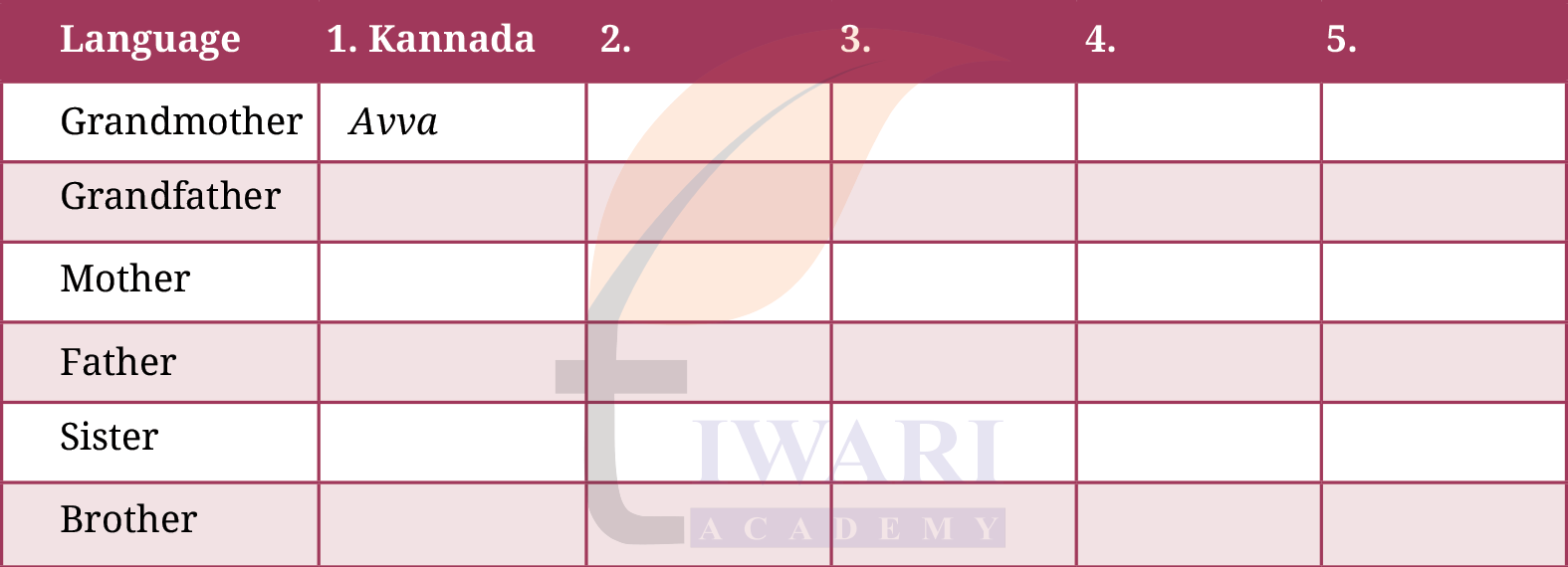
Answer:

III. Talk to your grandparents and find out which book or magazine they enjoy reading. Buy a copy of it and present it to them as a gift.
See AnswerI talked to my grandparents and found out that they enjoy reading religious and inspirational books. My grandmother likes reading stories from the Ramayana, while my grandfather enjoys reading newspapers and magazines.
I bought a book based on the Ramayana and gifted it to my grandmother. She was very happy and thanked me with a smile. My grandfather also appreciated the thoughtful gesture.
This activity helped me understand their interests better and made me feel closer to them.
Class 9 English Kaveri Poem 1 Question Answer
Page 23 – Reflect and Respond
I. Recall the lines of the National Anthem and complete the table given below with the names of the states, mountain ranges, and rivers mentioned in it.

Answer:

II. Work in pairs. Discuss what the words ‘जय हे’ (Jaya he) in the last two lines of the National Anthem convey. Share your answer with your classmates and teacher.
Answer:
The words ‘जय हे’ (Jaya he) mean victory to you or hail to you. In the National Anthem, they are used to express respect, praise, and pride for our nation.
These words convey a feeling of unity, patriotism, and admiration for India. They show that we honour our country and celebrate its greatness, culture, and strength. Repeating “जय हे” also creates a powerful and emotional impact, inspiring people to feel proud of their nation.
III. Read the underlined words in the given lines of the poem. Choose the odd one out that does not correspond with the meaning of the underlined word.
1. She’s p͟e͟e͟r͟l͟e͟s͟s͟, let’s praise her!
valuable, incomparable, unmatched
Answer:
valuable
2. Many a sage has s͟a͟n͟c͟t͟i͟f͟i͟e͟d͟ this land.
blessed , puried, applauded
Answer:
applauded
3. And here all a͟u͟s͟p͟i͟c͟i͟o͟u͟s͟ things are found.
fortunate, fantastic, favourable
Answer:
fantastic
4. Of h͟o͟a͟r͟y͟ ͟a͟n͟t͟i͟q͟u͟i͟t͟y͟ is Bharat,
ancient times, recent past, time immemorial
Answer:
recent past
Page 25 – Check Your Understanding
I. Fill in the blanks by choosing appropriate words from the box given below to complete the summary of the poem.

The poem is a tribute to India, celebrating its natural beauty, spiritual heritage, and 1. ________. The poet praises the 2. ________, describing it as mighty and unparalleled. The 3. ________ is depicted as generous and graceful, while the 4. ________ are honoured as sacred and unmatched. The poem highlights the contributions of 5. ________ and 6. ________ who have enriched the land with their bravery and wisdom. It also acknowledges the presence of 7. ________ and the teachings of 8. ________, highlighting India’s deep-rooted spiritual and philosophical traditions. The poet repeatedly asserts that India is 9. ________, urging everyone to 10. ________ her.
See AnswerThe poem is a tribute to India, celebrating its natural beauty, spiritual heritage, and 1. 𝗵𝗶𝘀𝘁𝗼𝗿𝗶𝗰𝗮𝗹 𝗴𝗿𝗲𝗮𝘁𝗻𝗲𝘀𝘀. The poet praises the 2. 𝗛𝗶𝗺𝗮𝘃𝗮𝗻𝘁, describing it as mighty and unparalleled. The 3. 𝗚𝗮𝗻𝗴𝗮 is depicted as generous and graceful, while the 4. 𝗨𝗽𝗮𝗻𝗶𝘀𝗵𝗮𝗱𝘀 are honoured as sacred and unmatched. The poem highlights the contributions of 5. 𝘄𝗮𝗿𝗿𝗶𝗼𝗿𝘀 and 6. 𝘀𝗮𝗴𝗲𝘀 who have enriched the land with their bravery and wisdom. It also acknowledges the presence of 7. 𝗕𝗿𝗮𝗵𝗺𝗮-𝗸𝗻𝗼𝘄𝗹𝗲𝗱𝗴𝗲 and the teachings of 8. 𝗕𝘂𝗱𝗱𝗵𝗮, highlighting India’s deep-rooted spiritual and philosophical traditions. The poet repeatedly asserts that India is 9. 𝗽𝗲𝗲𝗿𝗹𝗲𝘀𝘀, urging everyone to 10. 𝗽𝗿𝗮𝗶𝘀𝗲 her.
II. Complete the following features about the poem.
1. The impact on the readers (mood): __________
2. The poet’s attitude (tone): __________
3. The rhyme scheme: ___________
4. Examples of personication: _________
See Answer1. The impact on the readers (mood): Patriotic and proud
2. The poet’s attitude (tone): Admiring and respectful
3. The rhyme scheme: AABB
4. Examples of personification: “She’s peerless, let’s praise her!”
III. What is the impact of the refrain, ‘she’s peerless, let’s praise her!’?
See AnswerThe refrain creates a strong feeling of pride and admiration for India. Its repetition emphasizes that India is unique and unmatched and it inspires readers to respect and celebrate the greatness of their country.
IV. Complete the following sentence appropriately.
India is metaphorically described as ‘this sunny golden land,’ suggesting that____________________.
See AnswerIndia is metaphorically described as ‘this sunny golden land,’ suggesting that 𝗶𝘁 𝗶𝘀 𝗿𝗶𝗰𝗵, 𝗽𝗿𝗼𝘀𝗽𝗲𝗿𝗼𝘂𝘀, 𝗮𝗻𝗱 𝗳𝘂𝗹𝗹 𝗼𝗳 𝗻𝗮𝘁𝘂𝗿𝗮𝗹 𝗯𝗲𝗮𝘂𝘁𝘆.
V. The poet uses symbolism. Match the symbols in Column 1 to what they suggest in Column 2.

Answer:

VI. The poet uses imagery (descriptive language to create vivid mental pictures that appeal to the senses). Give any two examples from the poem.
See Answer1. “The mighty Himavant is ours – there’s no equal anywhere on earth.”
2. “The generous Ganga is ours – which other river can match her grace?”
VII. What is the impact of the use of hyphens in the first stanza? Select the options that are true.

Answer:

VIII. The poet uses hyperbole in the poem.
Hyperbole (hi-puh-buh-lee) is a figure of speech that involves extreme exaggeration to highlight a point or create a dramatic effect. It is not meant to be taken literally but is used to make something sound more impressive or intense.
For example:
• My luggage weighs a tonne. Does the luggage actually weigh a tonne?
• She was so happy that her smile was a mile wide. Can a smile be a mile wide?
See AnswerAn example of hyperbole from the poem is:
“The mighty Himavant is ours – there’s no equal anywhere on earth.”
IX. The poem is an ode.
An ode is a lyrical poem that expresses deep admiration, praise, or reverence for a person, place, object, or idea. It is often written in an elevated and formal style, celebrating the subject with enthusiasm and emotion.
An ode’s language is often grand and expressive; and it seeks to highlight the extraordinary qualities of its subject.
Now, identify examples from the poem that correspond to it being an ode.
See AnswerThe poem praises India’s greatness through lines like:
“She’s peerless, let’s praise her!” and
“This sunny golden land is ours.”
X. The poet uses allusion in the poem.
Allusion is a literary device where a writer makes an indirect reference to a well-known person, place, event, literary work, or cultural element without explicitly mentioning it. The reader is expected to recognise and understand the reference based on prior knowledge. Allusions can come from mythology, religion, literature, history, or popular culture.
For example: He is a real Einstein in the mathematics class. (This alludes to Albert Einstein, meaning the student is very intelligent, especially in mathematics or science.)
Now, read the explanations and identify the matching allusions from the poem for the following.
• An allusion to the ancient Indian scriptures that form the philosophical core and symbolise deep wisdom and enlightenment.
See Answer“The sacred Upanishads are ours.”
• An allusion to the concept of spiritual knowledge associated with self-realisation and ultimate truth.
See Answer“Brahma-knowledge has taken root.”
• An allusion to Gautama Buddha’s teachings, which include compassion, non-violence, and enlightenment.
See Answer“the Buddha preached his dhamma here.”
Page 28 – Critical Reflection
I. Read the extract given below and answer the questions that follow.
The mighty Himavant is ours-
there’s no equal anywhere on earth.
The generous Ganga is ours-
which other river can match her grace?
The sacred Upanishads are ours-
what scriptures else to name with them?
1. Complete the sentence.
The word ‘mighty’ refers to the _______________ of the Himavant.
See AnswerThe word ‘mighty’ refers to the 𝘀𝘁𝗿𝗲𝗻𝗴𝘁𝗵 of the Himavant.
2. Choose the correct option to complete the sentence given below.
The question mark at the end of the fourth and sixth line of the extract is used to ___________________.
(i) show doubt and uncertainty
(ii) emphasise a point
(iii) highlight confusion and hesitation
(iv) reveal inquiry and curiosity
See AnswerThe question mark at the end of the fourth and sixth line of the extract is used to 𝗲𝗺𝗽𝗵𝗮𝘀𝗶𝘀𝗲 𝗮 𝗽𝗼𝗶𝗻𝘁.
3. The poet uses the word ‘generous’ to describe the Ganga. Why?
See AnswerThe Ganga is called generous because it provides water, supports life, and nourishes the land and people selflessly.
4. Why has the movement of the river been described as graceful?
See AnswerThe river’s flow is smooth, calm, and beautiful, which makes it appear graceful.
5. Fill in the blank with the correct option from the words given in the brackets.
The poet is implying that the Upanishads are _______________ (unmatched/abundant) in their wisdom and spiritual depth.
See AnswerThe poet is implying that the Upanishads are 𝘂𝗻𝗺𝗮𝘁𝗰𝗵𝗲𝗱 in their wisdom and spiritual depth.
II. Answer the following questions.
1. How does the poem reflect a strong connection to cultural identity and heritage?
See AnswerThe poem highlights India’s cultural identity through references to the Himavant, Ganga, Upanishads, and the teachings of Buddha. These elements represent India’s rich history, traditions, and spiritual heritage.
2. What can you infer about the poet’s attitude towards India from the repeated phrase ‘she’s peerless, let’s praise her!’?
See AnswerThe repeated phrase shows that the poet feels deep pride, admiration, and respect for India. He believes that India is unique and unmatched.
3. What does the line ‘many a sage has sanctified this land’ suggest about India’s spiritual heritage?
See AnswerIt suggests that India has been blessed by great sages and saints, making it a land rich in spiritual wisdom and traditions.
4. How does the poet connect warriors and music to India’s greatness?
See AnswerThe poet mentions brave warriors and divine music to show that India is great both in courage and culture, highlighting its strength as well as its artistic richness.
5. How does this poem foster a sense of national pride?
See AnswerThe poem praises India’s natural beauty, culture, history, and spirituality, which makes readers feel proud of their country and its greatness.
Page 29 – Vocabulary in Context
I. Complete the table by choosing words from the poem.

Answer:

II. Complete the following table by adding a different suffix to form new words. Also, create a sentence using the created word. One example is done for you.

Answer:

Page 30 – Listen and Respond
I. You will listen to four people talk about the places they like to travel to. As you listen, write the speaker number for the two pictures given. (Transcript for teacher on page 260)

Answer:

II. You will once again listen to the four speakers. As you listen, match the given statements to the speaker. There are two statements that you do not need. (Transcript for teacher on page 260)

Answer:

Page 31 – Speaking Activity
I. In pairs, take turns to speak about the aspects of your village/town/city that you feel are an asset. It could be about geographical, cultural, traditional features, or even its history.
Use these cues to express your praise and admiration:
• One thing that I find truly wonderful about my village/town/city is…
• If I had to describe my village/town/city in one word, it would be…
• I have always been fascinated by the way the people of my village/town/city…
• What I want other people to know about my village/town/city is…
• When it comes to the scenery, my village/town/city truly shines because…
• I feel a deep sense of pride when I think about my village/town/city…
See Answer• One thing that I find truly wonderful about my city is 𝗶𝘁𝘀 𝗿𝗶𝗰𝗵 𝗰𝘂𝗹𝘁𝘂𝗿𝗲 𝗮𝗻𝗱 𝗳𝗿𝗶𝗲𝗻𝗱𝗹𝘆 𝗽𝗲𝗼𝗽𝗹𝗲.
• If I had to describe my city in one word, it would be “𝘃𝗶𝗯𝗿𝗮𝗻𝘁.”
• I have always been fascinated by the way the people of my city celebrate festivals together with joy and unity.
• What I want other people to know about my city is 𝘁𝗵𝗮𝘁 𝗶𝘁 𝗶𝘀 𝘄𝗲𝗹𝗰𝗼𝗺𝗶𝗻𝗴 𝗮𝗻𝗱 𝗳𝘂𝗹𝗹 𝗼𝗳 𝗼𝗽𝗽𝗼𝗿𝘁𝘂𝗻𝗶𝘁𝗶𝗲𝘀.
• When it comes to the scenery, city truly shines because 𝗼𝗳 𝗶𝘁𝘀 𝗯𝗲𝗮𝘂𝘁𝗶𝗳𝘂𝗹 𝗽𝗮𝗿𝗸𝘀, 𝗰𝗹𝗲𝗮𝗻 𝗿𝗼𝗮𝗱𝘀, 𝗮𝗻𝗱 𝗵𝗶𝘀𝘁𝗼𝗿𝗶𝗰𝗮𝗹 𝗽𝗹𝗮𝗰𝗲𝘀.
• I feel a deep sense of pride when I think about city 𝗯𝗲𝗰𝗮𝘂𝘀𝗲 𝗶𝘁 𝗿𝗲𝗽𝗿𝗲𝘀𝗲𝗻𝘁𝘀 𝗽𝗿𝗼𝗴𝗿𝗲𝘀𝘀 𝗮𝘀 𝘄𝗲𝗹𝗹 𝗮𝘀 𝘁𝗿𝗮𝗱𝗶𝘁𝗶𝗼𝗻.
Page 32 – Writing Task
I. Write a paragraph about a place that you have visited which has stayed in your memory.
Remember to mention the following:
• Why did you go there?
• Who did you travel with?
• How did you prepare for the travel?
• Where did you stay?
• What activities did you do there?
See AnswerLast year, I visited Manali, a beautiful hill station, with my family during my summer vacation. We went there to enjoy the cool weather and natural beauty. We prepared for the trip by packing warm clothes and booking our hotel in advance. We stayed in a comfortable hotel surrounded by mountains. During our stay, we enjoyed sightseeing, visited Solang Valley, played in the snow, and tried adventure activities like paragliding. The fresh air, scenic views, and peaceful environment made this trip unforgettable for me.
Learning Beyond the Text
I. Search for poems or songs dedicated to India, your motherland, in your regional language.
Share them with your classmates and explain their meaning too.
See AnswerA popular patriotic song in Hindi is “Maa Tujhe Salaam.” It praises India as a motherland and expresses deep love and respect for the country. The song highlights the beauty, strength, and unity of the nation. It creates a strong feeling of pride and inspires people to show devotion and patriotism towards India.
II. In groups of six, prepare an interdisciplinary project on India’s major geographical features.
For each feature, describe the region, explain its importance in the lives of the people living there and mention the languages spoken in that region. Include one example of each of the following.
• Mountains – Himalayas, Western Ghats, etc.
• Rivers – Ganga, Yamuna, Krishna, Kaveri, Godavari, etc.
• Deserts – Thar Desert, Rann of Kutch, etc.
• Valleys – Kangra Valley, Nubra Valley, etc.
• Islands – Andaman and Nicobar Islands, Lakshadweep, etc.
• Plateaus – Deccan, Malwa, Meghalaya, etc.
See Answer• Mountains – Himalayas: Located in the northern part of India, they protect the country from cold winds and are the source of many rivers. Languages spoken include Hindi, Nepali, and Tibetan.
• Rivers – Ganga: It flows through northern India and is important for agriculture, drinking water, and religious purposes. Languages spoken include Hindi and Bengali.
• Deserts – Thar Desert: Located in Rajasthan, it has a hot climate and sandy terrain. People depend on livestock and tourism. Languages spoken include Rajasthani and Hindi.
• Valleys – Kangra Valley: Located in Himachal Pradesh, it is known for its natural beauty and tea gardens. Languages spoken include Hindi and Pahari.
• Islands – Andaman and Nicobar Islands: Located in the Bay of Bengal, they are known for beaches and marine life. Languages spoken include Hindi, Tamil, and Bengali.
• Plateaus – Deccan Plateau: Located in central India, it is rich in minerals and supports agriculture. Languages spoken include Marathi, Telugu, and Kannada.
Kaveri Chapter 1 English to Hindi Translation:
Class 9 English Kaveri Chapter 1 Hindi Translation
भाग I
When I was a girl of about twelve, I used to stay in a village in north Karnataka with my grandparents. Those days, the transportTransport (noun)
Meanings:
A system for moving people or goods (परिवहन, लोगों या सामान को लाने-ले जाने की व्यवस्था)
Examples:
1. The village needs better transport. (गाँव को बेहतर परिवहन चाहिए।)
2. Buses provide cheap transport. (बसें सस्ता परिवहन देती हैं।)
3. Transport was slow during the rains. (बारिश में परिवहन धीमा था।) system was not very good, so we used to get the morning paper only in the afternoon. The weeklyWeekly (adjective)
Meanings:
Happening or published once a week (साप्ताहिक, हर सप्ताह होने वाला)
Examples:
1. I read a weekly magazine. (मैं साप्ताहिक पत्रिका पढ़ता हूँ।)
2. We have a weekly meeting. (हमारी साप्ताहिक बैठक होती है।)
3. She enjoys her weekly music lesson. (उसे संगीत की साप्ताहिक कक्षा पसंद है।) magazineMagazine (noun)
Meanings:
A publication containing articles, pictures, and stories (लेखों, चित्रों और कहानियों वाली पत्रिका)
Examples:
1. The magazine arrived today. (पत्रिका आज आई।)
2. She borrowed a science magazine. (उसने विज्ञान की पत्रिका उधार ली।)
3. My story appeared in a magazine. (मेरी कहानी पत्रिका में छपी।) used to come one day late. All of us would wait eagerlyEagerly (adverb)
Meanings:
With keen interest or excitement (उत्सुकता से, बेसब्री से)
Examples:
1. We eagerly awaited the bus. (हमने बेसब्री से बस की प्रतीक्षा की।)
2. She eagerly opened the book. (उसने उत्सुकता से पुस्तक खोली।)
3. The children listened eagerly. (बच्चों ने उत्सुकता से सुना।) for the bus, which used to come with the papers, weekly magazines and the post.
Hindi Translationजब मैं लगभग बारह साल की लड़की थी, तब मैं उत्तर कर्नाटक के एक गाँव में अपने दादा-दादी के साथ रहती थी। उन दिनों परिवहन व्यवस्था बहुत अच्छी नहीं थी, इसलिए हमें सुबह का अखबार दोपहर में ही मिलता था। साप्ताहिक पत्रिका एक दिन देर से आती थी। हम सभी उस बस का बेसब्री से इंतजार करते थे जो अखबार, साप्ताहिक पत्रिकाएँ और डाक लेकर आती थी।
Grammar AnalysisThe paragraph primarily uses the Simple Past Tense and the phrase “used to” to describe habitual actions in the past.
► Adjectives (Describing Words):
• Twelve: Describes the age (Numeral Adjective).
• North: Describes the part of Karnataka.
• Good: Describes the transport system.
• Morning/Weekly: Describes the type of paper/magazine.
• Late: Describes the arrival time.
► Verbs (Action/State Words):
• Was: State of being in the past.
• Used to stay / Used to get / Used to come: Indicates past habits.
• Wait: The action of the people.
► Adverbs (Describing Actions):
• Eagerly: Describes how they waited.
• Only: Used to show limitation of time (only in the afternoon).
• Very: Describes the degree of good (not very good).
At that time, Triveni was a very popular writer in the Kannada language. She was a wonderful writer. Her style was easy to read and very convincingConvincing (adjective)
Meanings:
Making someone believe something is true (विश्वसनीय, विश्वास दिलाने वाला)
Examples:
1. She gave a convincing explanation. (उसने विश्वास दिलाने वाली व्याख्या दी।)
2. His story was convincing. (उसकी कहानी विश्वसनीय थी।)
3. We need convincing evidence. (हमें ठोस प्रमाण चाहिए।). Her stories usually dealt with complexComplex (adjective)
Meanings:
Containing many connected parts; difficult to understand (जटिल, कई जुड़े हिस्सों वाला)
Examples:
1. The problem was complex. (समस्या जटिल थी।)
2. She explained a complex idea simply. (उसने जटिल विचार सरलता से समझाया।)
3. The machine has a complex design. (मशीन की बनावट जटिल है।) psychologicalPsychological (adjective)
Meanings:
Related to the mind, feelings, and behaviour (मन, भावनाओं और व्यवहार से संबंधित, मनोवैज्ञानिक)
Examples:
1. The story explores psychological problems. (कहानी मनोवैज्ञानिक समस्याओं को समझती है।)
2. Kindness can offer psychological support. (दयालुता मानसिक सहारा दे सकती है।)
3. They discussed the psychological effects of loneliness. (उन्होंने अकेलेपन के मनोवैज्ञानिक प्रभावों पर चर्चा की।) problems in the lives of ordinaryOrdinary (adjective)
Meanings:
Usual, common or not exceptional (साधारण, सामान्य)
Examples:
1. It seemed an ordinary day. (वह सामान्य दिन लग रहा था।)
2. The story describes ordinary people. (कहानी साधारण लोगों का वर्णन करती है।)
3. She made an ordinary meal special. (उसने सामान्य भोजन को विशेष बना दिया।) people and were always very interesting.
Unfortunately for Kannada literatureLiterature (noun)
Meanings:
Written works valued for their artistic or intellectual qualities (साहित्य, कलात्मक या वैचारिक महत्व की रचनाएँ)
Examples:
1. She enjoys Kannada literature. (उसे कन्नड़ साहित्य पसंद है।)
2. Stories are part of literature. (कहानियाँ साहित्य का हिस्सा हैं।)
3. Our library celebrates regional literature. (हमारा पुस्तकालय क्षेत्रीय साहित्य को सम्मान देता है।), she died very young. Even now, after forty years, people continue to appreciateAppreciate (verb)
Meanings:
Value something, recognise its worth, feel grateful for it (कद्र करना, महत्व समझना, आभारी होना)
Examples:
1. I appreciate your help with my homework. (गृहकार्य में आपकी मदद के लिए मैं आभारी हूँ।)
2. We appreciate the hard work of our teachers. (हम अपने शिक्षकों की कड़ी मेहनत की कद्र करते हैं।)
3. She learned to appreciate small acts of kindness. (उसने दयालुता के छोटे-छोटे कार्यों की कद्र करना सीखा।) her novelsNovels (plural noun)
Meanings:
Long fictional stories written in prose (उपन्यास, गद्य में लिखी लंबी कल्पित कहानियाँ)
Examples:
1. She reads novels every week. (वह हर सप्ताह उपन्यास पढ़ती है।)
2. The shelf holds many novels. (अलमारी में कई उपन्यास हैं।)
3. His novels describe village life. (उसके उपन्यास ग्रामीण जीवन का वर्णन करते हैं।).
Hindi Translationउस समय, त्रिवेणी कन्नड़ भाषा में एक बहुत लोकप्रिय लेखिका थीं। वे एक अद्भुत लेखिका थीं। उनकी शैली पढ़ने में आसान और बहुत विश्वसनीय थी। उनकी कहानियाँ आमतौर पर सामान्य लोगों के जीवन में जटिल मनोवैज्ञानिक समस्याओं से संबंधित होती थीं और हमेशा बहुत दिलचस्प होती थीं।
दुर्भाग्य से कन्नड़ साहित्य के लिए, उनकी बहुत कम उम्र में मृत्यु हो गई। आज भी, चालीस साल बाद, लोग उनके उपन्यासों की सराहना करते हैं।
Grammar AnalysisThe paragraph is in Simple Past Tense to describe the author’s life and Simple Present Tense at the end to describe her lasting legacy.
► Adjectives (Describing Words)
• Wonderful: Describes her talent.
• Easy: Describes her style.
• Convincing: Describes her writing style.
• Complex / Psychological: Describes the “problems” in her stories.
• Ordinary: Describes the “people.”
• Young: Describes the age she died.
• Forty: Numeral adjective for “years.”
► Verbs (Action/State Words)
• Was: Past state of being.
• Read: Action
• Dealt: Past tense of “deal”
• Died: The action of passing away.
• Continue Appreciate: Present actions
► Adverbs (Describing Verbs/Adjectives)
• Very: Enhances adjectives like “popular,” “wonderful,” “convincing,” and “interesting.”
• Usually: Describes how often she wrote about those topics.
• Always: Describes the consistency of her stories being interesting.
• Unfortunately: Sentence adverb used to express regret.
One of her novels, called Kashi Yatre, was appearing as a serialSerial (noun)
Meanings:
A story published or presented in separate parts (किस्तों में प्रकाशित या प्रस्तुत होने वाली कहानी, धारावाहिक)
Examples:
1. The serial appears every Wednesday. (धारावाहिक हर बुधवार आता है।)
2. We waited for the next part of the serial. (हमने धारावाहिक की अगली किस्त की प्रतीक्षा की।)
3. The novel first appeared as a serial. (उपन्यास पहले धारावाहिक के रूप में छपा।) in the Kannada weekly Karmaveera then. It is the story of an old lady and her ardentArdent (adjective)
Meanings:
Strongly enthusiastic or deeply felt (प्रबल, उत्साही, गहरा)
Examples:
1. She had an ardent wish to learn. (उसे सीखने की प्रबल इच्छा थी।)
2. He is an ardent reader. (वह उत्साही पाठक है।)
3. Her ardent support encouraged us. (उसके उत्साहपूर्ण समर्थन ने हमारा हौसला बढ़ाया।) desire to go to Kashi or Varanasi. Most Hindus believe that going to Kashi and worshippingWorshipping (verb)
Meanings:
Showing religious devotion and reverence (पूजा करना, श्रद्धा प्रकट करना)
Examples:
1. People were worshipping in the temple. (लोग मंदिर में पूजा कर रहे थे।)
2. She spent the morning worshipping. (उसने सुबह पूजा करते बिताई।)
3. They gathered for worshipping together. (वे साथ पूजा करने के लिए एकत्र हुए।) Lord Vishweshwara is the ultimateUltimate (adjective)
Meanings:
Highest, greatest, or final (सर्वोच्च, सबसे बड़ा, अंतिम)
Examples:
1. Her ultimate goal was independence. (उसका अंतिम लक्ष्य आत्मनिर्भरता था।)
2. He considered honesty the ultimate virtue. (उसने ईमानदारी को सर्वोच्च गुण माना।)
3. The ultimate decision was hers. (अंतिम निर्णय उसका था।) punya. This old lady also believed in this, and her struggle to go there was described in that novel. In the story there was also a young orphanOrphan (noun used attributively)
Meanings:
A child whose parents have died (अनाथ बच्चा)
Examples:
1. The family cared for an orphan. (परिवार ने अनाथ बच्चे की देखभाल की।)
2. The orphan girl found a loving home. (अनाथ लड़की को स्नेहपूर्ण घर मिला।)
3. He raised funds to help orphans. (उसने अनाथ बच्चों की सहायता के लिए धन जुटाया।) girl who falls in love but there was no money for the wedding. In the end, the old lady gives awayGives away (phrasal verb)
Meanings:
Gives something freely to others (बिना बदले में कुछ लिए दे देता या देती है)
Examples:
1. She gives away books after reading them. (वह किताबें पढ़ने के बाद दूसरों को दे देती है।)
2. He gives away his extra clothes. (वह अपने अतिरिक्त कपड़े बाँट देता है।)
3. The old woman gives away her savings. (वृद्ध महिला अपनी बचत दे देती है।) all her savingsSavings (plural noun)
Meanings:
Money kept instead of being spent (बचत, बचाया हुआ धन)
Examples:
1. She used her savings to buy books. (उसने अपनी बचत से किताबें खरीदीं।)
2. He keeps his savings in an account. (वह अपनी बचत खाते में रखता है।)
3. Small monthly savings can grow over time. (हर महीने की छोटी बचत समय के साथ बढ़ सकती है।) without going to Kashi. She says, ‘The happinessHappiness (noun)
Meanings:
A feeling of pleasure and contentment (खुशी, प्रसन्नता)
Examples:
1. Her success brought happiness. (उसकी सफलता से खुशी मिली।)
2. He finds happiness in helping others. (उसे दूसरों की मदद में खुशी मिलती है।)
3. The letter filled her with happiness. (पत्र ने उसे खुशी से भर दिया।) of this orphan girl is more important than worshipping Lord Vishweshwara at Kashi.’
Hindi Translationउनका एक उपन्यास, जिसका नाम काशी यात्रे था, उस समय कन्नड़ साप्ताहिक कर्मवीर में धारावाहिक के रूप में प्रकाशित हो रहा था। यह एक वृद्ध महिला और उसकी काशी या वाराणसी जाने की तीव्र इच्छा की कहानी है। अधिकांश हिंदू मानते हैं कि काशी जाकर भगवान विश्वेश्वर की पूजा करना परम पुण्य है। इस वृद्ध महिला को भी यही विश्वास था, और उस उपन्यास में वहाँ जाने के उसके संघर्ष का वर्णन था। इस कहानी में एक युवा अनाथ लड़की भी थी जो प्रेम में पड़ जाती है लेकिन शादी के लिए पैसे नहीं थे। अंत में, वृद्ध महिला काशी गए बिना अपनी सारी बचत दे देती है। वह कहती है, ‘इस अनाथ लड़की की खुशी काशी में भगवान विश्वेश्वर की पूजा करने से ज़्यादा महत्वपूर्ण है।’
Grammar AnalysisThe paragraph uses a mix of Past Tense (to describe the act of reading the novel) and Present Tense (to describe the plot/story of the book).
► Adjectives (Describing Words)
• Old: Describes the lady.
• Ardent: Describes her “desire.”
• Kannada / Weekly: Describes the “Karmaveera” magazine.
• Ultimate: Describes the “punya.”
• Young / Orphan: Describes the girl.
• Important: Compares happiness to worship.
► Verbs (Action/State Words)
• Appearing: The action of the story being published.
• Believe / Believed: The state of faith.
• Worshipping: The act of prayer.
• Described: How the struggle was written.
• Falls in love: The girl’s romantic action.
• Gives away: The act of donating the savings.
► Adverbs (Describing Verbs/Adjectives)
• Then: Indicates the time in the past.
• Also: Used to add more information about the lady or the girl.
• More: Used for comparison (more important).
My grandmother, Krishtakka, never went to school so she could not read. Every Wednesday the magazine would come and I would read the next episode of this story to her. During that time she would forget all her work and listen with the greatest concentrationConcentration (noun)
Meanings:
Close attention to one activity or subject (एकाग्रता, किसी काम पर पूरा ध्यान)
Examples:
1. Reading requires concentration. (पढ़ने में एकाग्रता चाहिए।)
2. She listened with deep concentration. (उसने पूरी एकाग्रता से सुना।)
3. Noise disturbed his concentration. (शोर ने उसकी एकाग्रता भंग की।). Later, she could repeat the entire text by heartBy heart (idiom)
Meanings:
From memory, without looking at the words (कंठस्थ, बिना देखे याद से)
Examples:
1. She knew the poem by heart. (उसे कविता कंठस्थ थी।)
2. He learned the song by heart. (उसने गीत याद कर लिया।)
3. I can repeat the lines by heart. (मैं पंक्तियाँ बिना देखे दोहरा सकता हूँ।). My grandmother too never went to Kashi, and she identified herself withIdentified herself with (phrase)
Meanings:
Felt a strong personal connection or similarity with someone (अपने आपको किसी से जुड़ा या उसके समान महसूस किया)
Examples:
1. She identified herself with the heroine. (उसने स्वयं को नायिका से जुड़ा महसूस किया।)
2. The reader identified herself with the brave girl. (पाठिका ने स्वयं को बहादुर लड़की के समान महसूस किया।)
3. She identified herself with others facing similar struggles. (उसने समान संघर्षों से गुजर रहे लोगों से अपना जुड़ाव महसूस किया।) the novel’s protagonistProtagonist (noun)
Meanings:
The main character in a story (कहानी का मुख्य पात्र, नायक या नायिका)
Examples:
1. The protagonist is a young teacher. (मुख्य पात्र युवा शिक्षक है।)
2. We admired the protagonist’s courage. (हमने मुख्य पात्र के साहस की प्रशंसा की।)
3. The novel follows its protagonist’s journey. (उपन्यास मुख्य पात्र की यात्रा का वर्णन करता है।). So more than anybody else she was the one most interested in knowing what happened next in the story and used to insist that I read the serial out to her.
Hindi Translationमेरी दादी, कृष्टक्का, कभी स्कूल नहीं गई थीं इसलिए वे पढ़ नहीं सकती थीं। हर बुधवार पत्रिका आती थी और मैं उन्हें इस कहानी का अगला भाग पढ़कर सुनाती थी। उस समय वे अपना सारा काम भूल जाती थीं और सबसे अधिक एकाग्रता के साथ सुनती थीं। बाद में, वे पूरा पाठ कंठस्थ दोहरा सकती थीं। मेरी दादी भी कभी काशी नहीं गई थीं, और उन्होंने खुद को उपन्यास की नायिका के साथ जोड़ लिया था। इसलिए किसी और की तुलना में, वह यह जानने में रुचि रखती थीं कि कहानी में आगे क्या होगा और मुझसे धारावाहिक पढ़कर सुनाने पर जोर देती थीं।
Grammar AnalysisThe paragraph uses Past Tense to describe habits and the phrase “would + verb” to show repeated actions in the past.
► Adjectives (Describing Words)
• Next: Describes which “episode.”
• Greatest: Superlative adjective describing “concentration.”
• Entire: Describes the “text.”
• Interested: Describes the grandmother’s state of mind.
• Most: Used to show the degree of interest.
► Verbs (Action/State Words)
• Went: Past tense of go.
• Read: Action of looking at words (Past habit).
• Forget / Listen: Actions the grandmother took.
• Repeat: Action of saying it again.
• Identified: The mental action of connecting with the character.
• Happened: Past action in the story.
► Adverbs (Describing Actions)
• Never: Adverb of frequency (shows she did not go to school at all).
• Every: Shows how often the magazine came (Every Wednesday).
• Later: Adverb of time.
• Next: Shows when things happened.
After hearing what happened next in Kashi Yatre, she would join her friends at the temple courtyardCourtyard (noun)
Meanings:
An open space enclosed by walls or buildings (आँगन, इमारतों से घिरा खुला स्थान)
Examples:
1. Children played in the courtyard. (बच्चे आँगन में खेले।)
2. A tree shaded the courtyard. (पेड़ ने आँगन को छाया दी।)
3. We gathered in the temple courtyard. (हम मंदिर के आँगन में इकट्ठा हुए।) where we children would also gatherGather (verb)
Meanings:
Come together or collect things (इकट्ठा होना, एकत्र करना)
Examples:
1. We gather after school. (हम विद्यालय के बाद इकट्ठा होते हैं।)
2. She gathered flowers in a basket. (उसने टोकरी में फूल इकट्ठे किए।)
3. Clouds began to gather. (बादल इकट्ठे होने लगे।) to play hide and seekHide and seek (noun phrase)
Meanings:
A game in which one player searches for others who are hiding (छुपन-छुपाई का खेल)
Examples:
1. We played hide and seek outside. (हमने बाहर छुपन-छुपाई खेली।)
2. The children enjoy hide and seek. (बच्चों को छुपन-छुपाई पसंद है।)
3. She found a safe place for hide and seek. (उसे छुपन-छुपाई के लिए सुरक्षित जगह मिली।).
She would discuss the latest episode with her friends. At that time, I never understood why there was so much of debate about the story.
Hindi Translationयह सुनने के बाद की काशी यात्रे में आगे क्या हुआ, वे मंदिर के आँगन में अपनी सहेलियों के पास जाती थीं जहाँ हम बच्चे भी छुपन-छुपाई खेलने के लिए इकट्ठा होते थे।
वे अपनी सहेलियों के साथ नवीनतम भाग पर चर्चा करती थीं। उस समय, मुझे कभी समझ नहीं आता था कि कहानी के बारे में इतनी बहस क्यों होती थी।
Grammar AnalysisThe paragraph continues to use Past Habitual structures to describe life in the village.
► Adjectives (Describing Words)
• Next: Describes what “happened” in the sequence.
• Latest: Describes the most recent “episode.”
• Much: Quantifier describing the amount of “debate.”
► Verbs (Action/State Words)
• Hearing: The act of listening.
• Join / Gather: Physical actions of coming together.
• Play: The action of the children.
• Discuss: The action of the friends talking.
• Understood: The mental state of the narrator.
► Adverbs (Describing Actions/Time)
• Next: Indicates sequence.
• Also: Shows that children were there in addition to the adults.
• Never: Adverb of frequency (shows total lack of understanding at that time).
• So: Used to emphasize “much” (so much).
Once I went for a wedding with my cousins to the neighbouringNeighbouring (adjective)
Meanings:
Nearby or next to another place (पड़ोसी, पास का)
Examples:
1. We visited a neighbouring village. (हम पास के गाँव गए।)
2. The neighbouring house is empty. (पड़ोस का घर खाली है।)
3. Students came from neighbouring schools. (विद्यार्थी पास के विद्यालयों से आए।) village. In those days, a wedding was a great event. We children enjoyed ourselves thoroughlyThoroughly (adverb)
Meanings:
Completely or very carefully (पूरी तरह, अच्छी तरह)
Examples:
1. We thoroughly enjoyed the trip. (हमने यात्रा का भरपूर आनंद लिया।)
2. Wash your hands thoroughly. (हाथ अच्छी तरह धोओ।)
3. She checked the work thoroughly. (उसने काम पूरी तरह जाँचा।). We would eat and play endlessly, savouringSavouring (verb)
Meanings:
Enjoying something slowly and fully (किसी चीज़ का पूरा आनंद लेना)
Examples:
1. She sat savouring her tea. (वह चाय का आनंद लेते हुए बैठी।)
2. We were savouring our freedom. (हम अपनी स्वतंत्रता का पूरा आनंद ले रहे थे।)
3. He smiled, savouring the happy moment. (वह सुखद पल का आनंद लेते हुए मुस्कराया।) the freedom because all the elders were busy. I went for a couple of days but ended upEnded up (phrasal verb)
Meanings:
Finally reached a situation, often unexpectedly (अंततः किसी स्थिति में पहुँच गया)
Examples:
1. We ended up staying a week. (आखिरकार हम एक सप्ताह रुक गए।)
2. He ended up choosing the blue bag. (अंततः उसने नीला बैग चुना।)
3. The short visit ended up becoming a holiday. (छोटी मुलाकात अंततः छुट्टी में बदल गई।) staying there for a week.
Hindi Translationएक बार मैं अपने चचेरे भाई-बहनों के साथ पड़ोसी गाँव में एक शादी में गई। उन दिनों, शादी एक बड़ा उत्सव हुआ करता था। हम बच्चे भरपूर आनंद लेते थे। हम खाते और खेलते रहते, उस स्वतंत्रता का पूरा लुत्फ़ उठाते क्योंकि सभी बड़े व्यस्त रहते थे। मैं कुछ दिनों के लिए गई थी लेकिन एक हफ्ते तक वहीं रह गई।
Grammar AnalysisThe paragraph uses Simple Past Tense to state facts and Past Habitual (“would”) to describe the activities during the wedding.
► Adjectives (Describing Words)
• Neighbouring: Describes the “village.”
• Great: Describes the “event.”
• Busy: Describes the state of the “elders.”
• A couple of: Quantifier for “days.”
► Verbs (Action/State Words)
• Went: Past tense of go.
• Enjoyed: Action of having fun.
• Would eat / Play: Actions done repeatedly during the stay.
• Savouring: A participle showing how they were playing (with enjoyment).
• Ended up: Phrasal verb meaning “to eventually reach a situation.”
• Staying: The act of living somewhere temporarily.
► Adverbs (Describing Actions)
• Once: Adverb of time (referring to a specific past occasion).
• Thoroughly: Describes how they enjoyed themselves.
• Endlessly: Describes how they played.
• There: Adverb of place (referring to the wedding village).
When I came back to my village, I saw my grandmother in tearsIn tears (phrase)
Meanings:
Crying (रोते हुए, आँखों में आँसू लिए)
Examples:
1. She was in tears. (वह रो रही थी।)
2. He found her in tears. (उसने उसे रोते हुए पाया।)
3. The sad story left us in tears. (दुखद कहानी सुनकर हमारी आँखों में आँसू आ गए।). I was surprisedSurprised (adjective)
Meanings:
Feeling wonder at something unexpected (आश्चर्यचकित, हैरान)
Examples:
1. I was surprised to see her. (उसे देखकर मैं हैरान हुआ।)
2. She looked surprised. (वह आश्चर्यचकित लगी।)
3. The gift made him surprised and happy. (उपहार से वह हैरान और खुश हुआ।), for I had never seen her cry even in the most difficult situationsSituations (plural noun)
Meanings:
Sets of conditions or circumstances (परिस्थितियाँ, हालात)
Examples:
1. We face different situations daily. (हम रोज अलग परिस्थितियों का सामना करते हैं।)
2. She stays calm in difficult situations. (वह कठिन परिस्थितियों में शांत रहती है।)
3. The two situations are similar. (दोनों परिस्थितियाँ समान हैं।). What had happened? I was worried.
“Avva, is everything all right? Are you okay?”
I used to call her Avva, which means mother in the Kannada spoken in north Karnataka.
Hindi Translationजब मैं अपने गाँव वापस आई, तो मैंने अपनी दादी को आँसुओं में देखा। मैं चौंक गई, क्योंकि मैंने उन्हें सबसे कठिन परिस्थितियों में भी कभी रोते नहीं देखा था। क्या हुआ था? मैं चिंतित थी।
“अव्वा, सब ठीक है? आप ठीक हैं?”
मैं उन्हें अव्वा कहती थी, जिसका अर्थ उत्तर कर्नाटक में बोली जाने वाली कन्नड़ में ‘माँ’ होता है।
Grammar Analysis► Adjectives (Describing Words)
• Surprised: Describes the narrator’s state.
• Never seen: (Participle used as adjective) describes her history.
• Difficult / Most difficult: Describes the “situations” (Superlative).
• Worried: Describes the narrator’s feeling.
• All right / Okay: Describes “everything” or “her.”
► Verbs (Action/State Words)
• Came back / Saw: The initial actions of the narrator.
• Had never seen / Had happened: Past Perfect Tense (used to describe things that happened before the narrator arrived).
• Cry: The action the grandmother was doing.
• Call / Means: Action and state of the name “Avva.”
► Adverbs (Describing Actions/Time)
• Back: Direction of the action.
• Never: Adverb of frequency.
• Even: Used for emphasis.
• All: Adverb of degree (all right).
She noddedNodded (verb)
Meanings:
Moved the head to show agreement or understanding (सहमति या समझ का संकेत देने के लिए सिर हिलाया)
Examples:
1. She nodded in agreement. (उसने सहमति में सिर हिलाया।)
2. He nodded and smiled. (उसने सिर हिलाया और मुस्कराया।)
3. The teacher nodded at my reply. (मेरे उत्तर पर शिक्षक ने सिर हिलाया।) but did not reply. I did not understand and forgot about it. In the night, after dinner, we were sleeping in the open terraceTerrace (noun)
Meanings:
A flat open area on or beside a building (छत या भवन के पास खुला समतल स्थान)
Examples:
1. We slept on the terrace. (हम छत पर सोए।)
2. Plants grow on our terrace. (हमारी छत पर पौधे उगते हैं।)
3. She watched the moon from the terrace. (उसने छत से चाँद देखा।) of our house. It was a summer night and there was a full moon. Avva came and sat next to me. Her affectionateAffectionate (adjective)
Meanings:
Showing love and warmth (स्नेहपूर्ण, प्यार भरा)
Examples:
1. She gave an affectionate smile. (उसने स्नेहपूर्ण मुस्कान दी।)
2. His grandmother was affectionate. (उसकी दादी स्नेही थीं।)
3. An affectionate touch comforted him. (प्यार भरे स्पर्श ने उसे सांत्वना दी।) hands touched my foreheadForehead (noun)
Meanings:
The part of the face above the eyebrows (माथा, ललाट)
Examples:
1. She touched his forehead. (उसने उसका माथा छुआ।)
2. Sweat covered his forehead. (उसका माथा पसीने से भीग गया।)
3. He wiped his forehead. (उसने अपना माथा पोंछा।). I realised she wanted to speak. I asked her,
“What is the matter?”
Hindi Translationउन्होंने सिर हिलाया लेकिन कुछ नहीं बोलीं। मुझे समझ नहीं आया और मैं इसे भूल गई। रात को, खाने के बाद, हम घर की खुली छत पर सो रहे थे। यह एक गर्मी की रात थी और पूर्ण चंद्रमा था। अव्वा आकर मेरे पास बैठ गईं। उनके प्रेम भरे हाथ हाथों ने मेरे माथे को छुआ। मुझे लगा वे कुछ कहना चाहती हैं। मैंने उनसे पूछा, “क्या बात है?”
Grammar AnalysisThe paragraph uses Simple Past Tense for the sequence of events and Past Continuous Tense to set the scene.
► Adjectives (Describing Words)
• Open: Describes the “terrace.”
• Summer: Describes the “night.”
• Full: Describes the “moon.”
• Affectionate: Describes her “hands.”
• Next to: Adjective/Preposition describing her position.
► Verbs (Action/State Words)
• Nodded / Reply / Understand / Forgot: Actions or lack of actions by the characters.
• Were sleeping: Past Continuous Tense (shows an ongoing action in the past).
• Came / Sat / Touched: Physical actions in sequence.
• Realised: A mental action (becoming aware).
• Wanted / Speak: The desire and the intended action.
• Asked: The act of questioning.
► Adverbs (Describing Actions/Time)
• Not: Negative adverb used with “did.”
• After: Adverb of time (after dinner).
• Next: Direction (next to me).
‘When I was a young girl, I lost my mother. There was nobody to look afterLook after (phrasal verb)
Meanings:
Take care of someone or something (देखभाल करना)
Examples:
1. I look after my plants. (मैं अपने पौधों की देखभाल करता हूँ।)
2. She looks after her grandfather. (वह अपने दादा की देखभाल करती है।)
3. Please look after this puppy. (कृपया इस पिल्ले की देखभाल करो।) and guideGuide (verb)
Meanings:
Help someone find a way or understand what to do (मार्गदर्शन करना, रास्ता दिखाना)
Examples:
1. Teachers guide their students. (शिक्षक विद्यार्थियों का मार्गदर्शन करते हैं।)
2. She guided us through the village. (उसने गाँव में हमें रास्ता दिखाया।)
3. His advice guided my choice. (उसकी सलाह ने मेरे चुनाव में मार्गदर्शन किया।) me. My father was a busy man and got married again. In those days people never considered education essentialEssential (adjective)
Meanings:
Absolutely necessary or very important (अनिवार्य, अत्यंत आवश्यक)
Examples:
1. Water is essential for life. (जीवन के लिए पानी आवश्यक है।)
2. Practice is essential for progress. (प्रगति के लिए अभ्यास आवश्यक है।)
3. Take only essential items. (केवल आवश्यक वस्तुएँ ले जाओ।) for girls, so I never went to school. I got married very young and had children. I became very busy. Later I had grandchildren and always felt so much happiness in cooking and feeding all of you. At times I used to regretRegret (verb)
Meanings:
Feel sorry about something done or missed (पछताना, अफसोस करना)
Examples:
1. I regret my harsh words. (मुझे अपने कठोर शब्दों पर पछतावा है।)
2. She regretted missing school. (उसे विद्यालय न जाने का अफसोस हुआ।)
3. Do not regret asking for help. (मदद माँगने पर अफसोस मत करो।) not going to school, so I made sureMade sure (phrase)
Meanings:
Checked or took action to ensure something (सुनिश्चित किया)
Examples:
1. She made sure we understood. (उसने सुनिश्चित किया कि हम समझ गए।)
2. He made sure the door was locked. (उसने सुनिश्चित किया कि दरवाज़ा बंद था।)
3. I made sure everyone ate. (मैंने सुनिश्चित किया कि सबने खाना खाया।) that my children and grandchildren studied well…’
Hindi Translationजब मैं एक युवा लड़की थी, तो मैंने अपनी माँ को खो दिया था। मेरी देखभाल करने और मार्गदर्शन देने वाला कोई नहीं था। मेरे पिता एक व्यस्त आदमी थे और उन्होंने दोबारा शादी कर ली। उन दिनों लोग लड़कियों के लिए शिक्षा को ज़रूरी नहीं मानते थे, इसलिए मैं कभी स्कूल नहीं गई। मेरी बहुत कम उम्र में शादी हो गई और बच्चे हुए। मैं बहुत व्यस्त हो गई। बाद में मेरे पोते-पोतियाँ हुए और मुझे हमेशा आप सबको खाना बनाने और खिलाने में बहुत खुशी मिली। कभी-कभी मुझे स्कूल न जाने का अफसोस होता था, इसलिए मैंने यह सुनिश्चित किया कि मेरे बच्चे और पोते-पोतियाँ अच्छी तरह पढ़ें…
Grammar AnalysisThis paragraph uses the Simple Past Tense to narrate a life story and Gerunds (Verb + ing acting as nouns) to describe her activities.
► Adjectives (Describing Words)
• Young: Describes her age as a girl and when she married.
• Busy: Describes her father and later, her own life.
• Essential: Describes “education.”
• So much: Quantifier for “happiness.”
► Verbs (Action/State Words)
• Was / Were: Past state of being.
• Lost / Got married / Went: Specific completed actions in the past.
• Considered: Mental action (to have an opinion).
• Felt: Emotional state.
• Cooking / Feeding: Gerunds (verbs acting as nouns) describing her joy.
• Regret: The action of feeling sorry.
► Adverbs (Describing Actions/Time)
• Again: Shows the father married a second time.
• Never: Shows the total absence of school or the lack of importance given to girls’ education.
• Very: Enhances “young” and “busy.”
• Later: Shows a jump in the timeline of her life.
• Always: Shows a constant feeling.
• Well: Describes how the children studied.
भाग II
I could not understand why my sixty-two-year-old grandmother was telling me, a twelve-year-old, the story of her life in the middle of the night. But I knew I loved her immenselyImmensely (adverb)
Meanings:
Very much, to a great degree (बहुत अधिक, अत्यंत)
Examples:
1. I enjoyed the book immensely. (मैंने पुस्तक का बहुत आनंद लिया।)
2. She loved her family immensely. (वह अपने परिवार से बहुत प्रेम करती थी।)
3. Your help mattered immensely. (तुम्हारी मदद बहुत महत्वपूर्ण थी।) and there had to be some reasonReason (noun)
Meanings:
A cause or explanation for something (कारण, वजह)
Examples:
1. What is the reason? (इसका कारण क्या है?)
2. She explained her reason. (उसने अपना कारण बताया।)
3. There was a good reason to wait. (प्रतीक्षा करने का उचित कारण था।) why she was talking to me. I looked at her face. It was unhappy and her eyes were filled with tears. She was a good-looking lady who was usually always smiling. Even today, I cannot forget the worried expressionExpression (noun)
Meanings:
A look that shows a feeling; the act of communicating an idea (चेहरे का भाव; अभिव्यक्ति)
Examples:
1. Her expression showed worry. (उसके चेहरे पर चिंता थी।)
2. He wore a cheerful expression. (उसके चेहरे पर खुशी का भाव था।)
3. Art allows personal expression. (कला निजी अभिव्यक्ति का अवसर देती है।) on her face. I leanedLeaned (verb)
Meanings:
Bent or moved the body in a direction (शरीर झुकाया)
Examples:
1. She leaned towards me. (वह मेरी ओर झुकी।)
2. He leaned against the wall. (वह दीवार के सहारे झुका।)
3. I leaned forward to listen. (मैं सुनने के लिए आगे झुका।) forward and held her hand.
‘Avva, don’t cry. What is the matter? Can I help you in any way?’
Hindi Translationमुझे समझ नहीं आया कि मेरी बासठ साल की दादी मुझे, एक बारह साल की बच्ची को, आधी रात में अपनी जीवन कहानी क्यों सुना रही थीं। लेकिन मुझे पता था कि मैं उनसे बहुत प्यार करती हूँ और उनके मुझसे बात करने का कोई कारण जरूर होगा। मैंने उनका चेहरा देखा। वह दुखी था और उनकी आँखें आँसुओं से भरी थीं। वे एक सुंदर महिला थीं जो आमतौर पर हमेशा मुस्कुराती रहती थीं। आज भी, मैं उनके चेहरे पर चिंतित भाव नहीं भूल सकती। मैं आगे झुकी और उनका हाथ थाम लिया।
‘अव्वा, रोओ मत। क्या बात है? क्या मैं किसी तरह आपकी मदद कर सकती हूँ?’
Grammar AnalysisThe paragraph uses a mix of Simple Past (narrating the event) and Simple Present (the narrator’s reflection “Even today, I cannot forget”).
► Adjectives (Describing Words)
• Sixty-two-year-old/Twelve-year-old: Compound adjectives describing age.
• Immensely: (Adverb acting on the verb “loved”).
• Unhappy: Describes her “face.”
• Good-looking: Describes the “lady.”
• Smiling / Worried: Participle adjectives describing her usual state vs. her current state.
► Verbs (Action/State Words)
• Understand/Knew/Forget: Mental actions.
• Was telling/Was talking: Past Continuous Tense (ongoing actions at that specific moment).
• Loved: Past state of emotion.
• Looked/Leaned/Held: Physical actions in the past.
• Cry/Help: Actions in the direct speech.
► Adverbs (Describing Actions/Frequency)
• Why: Interrogative adverb.
• Usually/Always: Adverbs of frequency.
• Forward: Direction of the action “leaned.”
• Not: Negative adverb (cannot, don’t).
‘Yes, I need your help. You know when you were away, Karmaveera came as usual. I opened the magazine. I saw the picture that accompaniesAccompanies (verb)
Meanings:
Goes with or appears alongside something (साथ जाता है या जुड़ा होता है)
Examples:
1. A picture accompanies the story. (कहानी के साथ एक चित्र है।)
2. She accompanies her mother to school. (वह अपनी माँ के साथ विद्यालय जाती है।)
3. Music accompanies the dance. (नृत्य के साथ संगीत बजता है।) the story of Kashi Yatre and I could not understand anything that was written. Many times I rubbedRubbed (verb)
Meanings:
Moved the hand or another surface back and forth over something (रगड़ा, हाथ फेरा)
Examples:
1. She rubbed her eyes. (उसने अपनी आँखें मलीं।)
2. He rubbed the dusty table. (उसने धूल भरी मेज रगड़ी।)
3. I rubbed my hands together. (मैंने अपने हाथ आपस में रगड़े।) my hands over the pages wishingWishing (verb)
Meanings:
Hoping or wanting something (इच्छा करना, कामना करना)
Examples:
1. She sat wishing for a letter. (वह पत्र आने की कामना करती बैठी थी।)
2. He kept wishing to return home. (वह घर लौटने की इच्छा करता रहा।)
3. We are wishing you success. (हम तुम्हारी सफलता की कामना कर रहे हैं।) they could understand what was written. But I knew it was not possible. If only I was educatedEducated (adjective)
Meanings:
Having received education or learning (शिक्षित, पढ़ा-लिखा)
Examples:
1. She became an educated woman. (वह शिक्षित महिला बनी।)
2. An educated person keeps learning. (शिक्षित व्यक्ति सीखता रहता है।)
3. The educated worker helped read the notice. (पढ़े-लिखे कर्मचारी ने सूचना पढ़ने में मदद की।) enough. I waited eagerly for you to return. I felt you would come early and read for me. I even thought of going to the village and asking you to read for me. I could have asked somebody in this village but I was too embarrassedEmbarrassed (adjective)
Meanings:
Feeling awkward, shy, or ashamed (संकोचग्रस्त, शर्मिंदा)
Examples:
1. I felt embarrassed by my mistake. (मुझे अपनी गलती पर शर्म आई।)
2. She was embarrassed to ask. (उसे पूछने में संकोच हुआ।)
3. He gave an embarrassed smile. (वह संकोच से मुस्कराया।) to do so. I felt very dependentDependent (adjective)
Meanings:
Needing someone or something for support (निर्भर, दूसरों के सहारे रहने वाला)
Examples:
1. The child is dependent on adults. (बच्चा बड़ों पर निर्भर है।)
2. Farmers are dependent on rain. (किसान बारिश पर निर्भर हैं।)
3. She disliked being dependent on others. (उसे दूसरों पर निर्भर रहना पसंद नहीं था।) and helplessHelpless (adjective)
Meanings:
Unable to act or help oneself (असहाय, बेबस)
Examples:
1. He felt helpless without directions. (रास्ता न जानकर वह बेबस महसूस हुआ।)
2. The helpless kitten needed care. (असहाय बिल्ली के बच्चे को देखभाल चाहिए थी।)
3. She refused to remain helpless. (उसने बेबस बने रहने से इनकार किया।). We are well-offWell-off (adjective)
Meanings:
Having enough money to live comfortably (संपन्न, आर्थिक रूप से सुखी)
Examples:
1. They belong to a well-off family. (वे संपन्न परिवार से हैं।)
2. The well-off merchant helped the school. (संपन्न व्यापारी ने विद्यालय की मदद की।)
3. Being well-off does not remove every difficulty. (संपन्न होने से हर कठिनाई नहीं मिटती।), but what use is money when I cannot be independent?’
Hindi Translation‘हाँ, मुझे तुम्हारी मदद चाहिए। तुम जानती हो जब तुम नहीं थीं, कर्मवीर हमेशा की तरह आई। मैंने पत्रिका खोली। मैंने *काशी यात्रे* की कहानी के साथ जो चित्र था वह देखा और मैं कुछ भी नहीं समझ सकी जो लिखा था। कई बार मैंने पृष्ठों पर हाथ फेरा, यह चाहते हुए कि वे समझ सकें कि क्या लिखा है। लेकिन मुझे पता था यह संभव नहीं था। काश मैं इतनी पढ़ी-लिखी होती। मैं बेसब्री से तुम्हारे लौटने का इंतजार करती रही। मुझे लगा तुम जल्दी आओगी और मुझे पढ़कर सुनाओगी। मैंने तो यहाँ तक सोचा कि गाँव जाकर तुमसे पढ़वाने को कहूँगी। मैं यहाँ किसी से पूछ सकती थी लेकिन मुझे बहुत शर्म आ रही थी। मुझे बहुत निर्भर और असहाय महसूस हुआ। हम संपन्न हैं, लेकिन पैसे का क्या फायदा जब मैं आत्मनिर्भर नहीं हो सकती?’
Grammar AnalysisThe paragraph uses a mix of Simple Past (narrating the event) and Simple Present (the grandmother’s current reflection “what use is money”).
► Adjectives (Describing Words)
• Away: Describes the narrator’s state of being elsewhere.
• Educated: Describes the state of having knowledge.
• Embarrassed: Describes the grandmother’s internal feeling.
• Dependent / Helpless: Describes her emotional state.
• Well-off / Independent: Describes her financial status vs her goal.
► Verbs (Action/State Words)
• Opened / Saw / Rubbed: Simple Past used for narration.
• Could have asked: Modal perfect used for a past possibility.
• Are / Is / Cannot be: Simple Present used for current facts and feelings.
• Wishing / Asking: Present participles describing intent.
► Adverbs (Describing Actions/Frequency)
• As usual: Shows a repeating pattern.
• Many times: Adverb of frequency.
• Eagerly: Describes how she waited.
• Too: Adverb of degree showing intensity.
• Very: Enhances the feeling of being helpless.
I did not know what to answer. Avva continued. ‘I have decided I want to learn the Kannada alphabetAlphabet (noun)
Meanings:
The set of letters used in a language (वर्णमाला)
Examples:
1. She learned the Kannada alphabet. (उसने कन्नड़ वर्णमाला सीखी।)
2. Write the alphabet neatly. (वर्णमाला साफ लिखो।)
3. The child recognised every letter of the alphabet. (बच्चे ने वर्णमाला का हर अक्षर पहचाना।) from tomorrow onwardsOnwards (adverb)
Meanings:
Continuing forward from a stated time or place (से आगे, उसके बाद लगातार)
Examples:
1. Classes will run from tomorrow onwards. (कल से कक्षाएँ शुरू होती हैं।)
2. From that day onwards, she practised. (उस दिन से आगे वह अभ्यास करती रही।)
3. The travellers moved onwards. (यात्री आगे बढ़े।). I will work very hard. I will keep Saraswati Puja day during Dassara as the deadlineDeadline (noun)
Meanings:
The latest time by which a task must be completed (काम पूरा करने की अंतिम समय-सीमा)
Examples:
1. Friday is the deadline. (शुक्रवार अंतिम समय-सीमा है।)
2. She met the deadline. (उसने समय-सीमा में काम पूरा किया।)
3. Set a realistic deadline. (व्यावहारिक समय-सीमा तय करो।). That day I should be able to read a novel on my ownOn my own (phrase)
Meanings:
Without help, independently (अपने दम पर, बिना सहायता)
Examples:
1. I can read on my own. (मैं अपने दम पर पढ़ सकता हूँ।)
2. I finished it on my own. (मैंने इसे स्वयं पूरा किया।)
3. I travelled on my own. (मैंने अकेले यात्रा की।). I want to be independent.’
I saw the determination on her face. Yet I laughed at her.
Hindi Translationमुझे समझ नहीं आया क्या जवाब दूँ। अव्वा ने आगे कहा।
‘मैंने तय कर लिया है कि मैं कल से कन्नड़ वर्णमाला सीखना चाहती हूँ। मैं बहुत मेहनत करूँगी। मैं दशहरे में सरस्वती पूजा के दिन को अपनी अंतिम सीमा रखूँगी। उस दिन मुझे खुद से कोई भी उपन्यास पढ़ने में सक्षम होना चाहिए। मैं आत्मनिर्भर होना चाहती हूँ।’
मुझे उनके चेहरे पर दृढ़ संकल्प दिखा। फिर भी मैं उन पर हँस पड़ी।
Grammar AnalysisThe paragraph uses a mix of Simple Past (narrating the interaction) and Simple Future (the grandmother’s plan/promise).
► Adjectives (Describing Words)
• Very: Adverb/Adjective used to describe the intensity of “hard.”
• Independent: Describes the state of being she wants to achieve.
• Own: Describes the novel as being read by herself alone.
• Determination: (Noun used to describe the quality on her face).
► Verbs (Action/State Words)
• Know / Answer / Laughed: Simple Past used for the narrator’s actions.
• Want / Have decided: Simple Present/Present Perfect for her current desire.
• Will learn / Will work / Will keep: Simple Future used for her future goals.
• Should be able to: Modal verb used to show a future capability.
► Adverbs (Describing Actions/Frequency)
• Tomorrow onwards: Phrase describing the starting time of the action.
• Very hard: Describes how she will work.
• Yet: Used to show a contrast (despite her face, I laughed).
• Independent: Describes how she wants to exist.
‘Avva, at this age of sixty-two you want to learn the alphabet? All your hair is grey, your hands are wrinkledWrinkled (adjective)
Meanings:
Covered with small lines or folds (झुर्रियों या सिलवटों वाला)
Examples:
1. Her hands were wrinkled. (उसके हाथों में झुर्रियाँ थीं।)
2. He ironed the wrinkled shirt. (उसने सिलवटों वाली कमीज़ पर इस्त्री की।)
3. The old face was wrinkled but cheerful. (बूढ़े चेहरे पर झुर्रियाँ थीं, पर वह प्रसन्न था।), you wear spectaclesSpectacles (plural noun)
Meanings:
Glasses worn to improve sight (चश्मा)
Examples:
1. She put on her spectacles. (उसने अपना चश्मा पहना।)
2. His spectacles lay on the table. (उसका चश्मा मेज पर था।)
3. I cleaned my spectacles. (मैंने अपना चश्मा साफ किया।) and you work so much in the kitchen…’
Childishly I made fun of the old lady. But she just smiled.
‘For a good cause if you are determined, you can overcome any obstacle. I will work harder than anybody but I will do it. For learning there is no age bar.’
Hindi Translation‘अव्वा, बासठ साल की उम्र में आप वर्णमाला सीखना चाहती हैं? आपके सारे बाल सफेद हो गए हैं, आपके हाथ झुर्रीदार हैं, आप चश्मा पहनती हैं और रसोई में इतना काम करती हैं…’
बचकाने ढंग से मैंने बूढ़ी महिला का मज़ाक उड़ाया। लेकिन वे बस मुस्कुराईं।
‘अच्छे काम के लिए अगर आप दृढ़ निश्चयी हैं, तो आप किसी भी बाधा को पार कर सकते हैं। मैं किसी से भी ज़्यादा मेहनत करूँगी लेकिन यह करके रहूँगी। सीखने के लिए कोई आयु सीमा नहीं होती।’
Grammar AnalysisThe paragraph uses a mix of Simple Present (describing her current physical state) and Simple Future (her promise to work hard).
► Adjectives (Describing Words)
• Sixty-two: Describes her current age.
• Grey: Describes the color of her hair.
• Wrinkled: Describes the state of her hands.
• Childishly: (Adverb describing the narrator’s action).
• Determined: Describes the person’s mental state.
• Any: Describes the type of obstacle.
► Verbs (Action/State Words)
• Want / Learn / Wear / Work: Simple Present used for current actions/state.
• Made fun / Smiled: Simple Past used for the narrator’s reaction.
• Can overcome: Modal verb showing current possibility/ability.
• Will work / Will do: Simple Future used for her upcoming efforts.
• Harder: Comparative verb/adjective showing more effort.
► Adverbs (Describing Actions/Frequency)
• So much: Describes the intensity of work in the kitchen.
• Childishly: Describes how the narrator behaved.
• Just: Shows that she only smiled and did nothing else.
• Harder: Describes how she will work compared to others.
The next day onwards I started my tuitionTuition (noun)
Meanings:
Teaching or instruction, often individual (शिक्षण, विशेष पढ़ाई या मार्गदर्शन)
Examples:
1. Her tuition began the next day. (उसकी पढ़ाई अगले दिन शुरू हुई।)
2. He receives tuition in mathematics. (उसे गणित में विशेष शिक्षण मिलता है।)
3. Patient tuition helped her progress. (धैर्यपूर्ण शिक्षण से उसे प्रगति मिली।). Avva was a wonderful student. The amount of homework she did was amazingAmazing (adjective)
Meanings:
Wonderful, very impressive or surprising (अद्भुत, बहुत प्रभावशाली, आश्चर्यजनक)
Examples:
1. The concert was amazing. (संगीत कार्यक्रम अद्भुत था।)
2. She showed amazing skill. (उसने अद्भुत कौशल दिखाया।)
3. We saw an amazing dance performance. (हमने एक बहुत प्रभावशाली नृत्य प्रस्तुति देखी।). She would read, repeat, write, and reciteRecite (verb)
Meanings:
Say a poem or passage aloud, often from memory (कविता या अंश सुनाना, पाठ करना)
Examples:
1. She can recite the poem. (वह कविता सुना सकती है।)
2. He recited a short verse. (उसने छोटा पद सुनाया।)
3. We recite together each morning. (हम हर सुबह साथ पाठ करते हैं।). I was her only teacher and she was my first student. Little did I knowLittle did I know (phrase)
Meanings:
I did not realise or expect something at that time (मुझे तब ज़रा भी अंदाज़ा नहीं था)
Examples:
1. Little did I know that we would become friends. (मुझे तब ज़रा भी अंदाज़ा नहीं था कि हम मित्र बन जाएँगे।)
2. Little did I know how useful that lesson would be. (मुझे तब अंदाज़ा नहीं था कि वह पाठ कितना उपयोगी होगा।)
3. Little did I know that the letter would change my plans. (मुझे तब अंदाज़ा नहीं था कि पत्र मेरी योजनाएँ बदल देगा।) then that one day I would become a teacher in Computer Science and teach hundreds of students.
Hindi Translationअगले दिन से मैंने ट्यूशन शुरू की। अव्वा एक अद्भुत छात्रा थीं। उन्होंने जितना होमवर्क किया वह अद्भुत था। वे पढ़तीं, दोहरातीं, लिखतीं और याद करतीं। मैं उनकी एकमात्र शिक्षिका थी और वे मेरी पहली छात्रा थीं। मुझे तब थोड़ा सा भी अंदाजा नहीं था कि एक दिन मैं कंप्यूटर विज्ञान में शिक्षिका बनूँगी और सैकड़ों छात्रों को पढ़ाऊँगी।
Grammar AnalysisThe paragraph uses a mix of Simple Past (narrating the start of the tuition) and Past habitual/Future in the past (to describe her study habits and the narrator’s future).
► Adjectives (Describing Words)
• Next: Describes the day.
• Wonderful / First: Describes the “student.”
• Amazing: Describes the amount of “homework.”
• Only: Describes the “teacher.”
• Hundreds of: Quantifier for “students.”
► Verbs (Action/State Words)
• Started / Was / Did: Simple Past used for the main narration.
• Would read / Repeat / Write / Recite: Past habitual used for her regular study actions.
• Know: Mental action.
• Would become / Teach: Future in the past (describing what was going to happen later).
► Adverbs (Describing Actions/Frequency)
• Onwards: Describes the starting point in time.
• Little: Describes the extent of the narrator’s knowledge (“Little did I know”).
• Then: Points to that specific time in the past.
• One day: Adverbial phrase showing a future point in time.
The Dassara festival came as usual. SecretlySecretly (adverb)
Meanings:
Without others knowing (चुपके से, गुप्त रूप से)
Examples:
1. She secretly bought a gift. (उसने चुपके से उपहार खरीदा।)
2. He secretly planned a surprise. (उसने गुप्त रूप से सरप्राइज़ की योजना बनाई।)
3. They met secretly. (वे चुपके से मिले।) I bought Kashi Yatre which had been publishedPublished (verb)
Meanings:
Made a written work available to the public (प्रकाशित किया)
Examples:
1. Her story was published. (उसकी कहानी प्रकाशित हुई।)
2. They published a magazine. (उन्होंने पत्रिका प्रकाशित की।)
3. The book was published last year. (पुस्तक पिछले साल छपी।) as a novel by that time. My grandmother called me to the puja place and made me sit down on a stool. She gave me a gift of frock material. Then she did something unusualUnusual (adjective)
Meanings:
Not common or expected (असामान्य, अनोखा)
Examples:
1. She received an unusual gift. (उसे अनोखा उपहार मिला।)
2. His silence was unusual. (उसकी चुप्पी असामान्य थी।)
3. We noticed an unusual pattern. (हमने अनोखा नमूना देखा।). She bent down and touched my feet. I was surprised and taken abackTaken aback (idiom)
Meanings:
Greatly surprised by something unexpected (चकित, आश्चर्य से ठिठका हुआ)
Examples:
1. I was taken aback by her reply. (उसके उत्तर से मैं चकित हुआ।)
2. He looked taken aback. (वह हैरान दिखाई दिया।)
3. We were taken aback by the news. (खबर से हम आश्चर्यचकित हुए।). Elders never touch the feet of youngsters. We have always touched the feet of God, elders, and teachers. We consider that as a mark of respectMark of respect (noun phrase)
Meanings:
An action showing honour or regard (सम्मान का प्रतीक)
Examples:
1. We stood as a mark of respect. (हम सम्मान दिखाने के लिए खड़े हुए।)
2. The greeting was a mark of respect. (अभिवादन सम्मान का प्रतीक था।)
3. She bowed as a mark of respect. (वह सम्मान में झुकी।). It is a great tradition but today the reverse had happened. It was not correct.
Hindi Translationदशहरा उत्सव हमेशा की तरह आया। चुपके से मैंने काशी यात्रे खरीदी जो तब तक उपन्यास के रूप में प्रकाशित हो चुकी थी। मेरी दादी ने मुझे पूजा स्थान पर बुलाया और मुझे एक स्टूल पर बैठाया। उन्होंने मुझे फ्रॉक के कपड़े का उपहार दिया। फिर उन्होंने कुछ असामान्य किया। वे झुकीं और उन्होंने मेरे पैर छुए। मैं हैरान और अचंभित रह गई। बड़े-बुजुर्ग कभी छोटों के पैर नहीं छूते। हम हमेशा भगवान, बड़ों और शिक्षकों के पैर छूते हैं। हम इसे सम्मान का प्रतीक मानते हैं। यह एक महान परंपरा है लेकिन आज इसका उल्टा हो गया था। यह सही नहीं था।
Grammar AnalysisThe paragraph uses a mix of Simple Past (narrating the specific events of the festival) and Present/Past Perfect (describing traditions and unusual occurrences).
► Adjectives (Describing Words)
• Usual: Describes how the festival arrived.
• Unusual: Describes the grandmother’s specific action.
• Surprised / Taken aback: Describes the narrator’s emotional state.
• Great: Describes the quality of the tradition.
• Correct: Describes the narrator’s judgment of the situation.
► Verbs (Action/State Words)
• Came / Bought / Called / Made: Simple Past used for the sequence of events.
• Had been published / Had happened: Past Perfect used for actions completed before the main story time.
• Bent down / Touched: Physical actions performed by the grandmother.
• Consider: Simple Present used to state a general belief or rule.
► Adverbs (Describing Actions/Frequency)
• Secretly: Describes how the book was purchased.
• Never: Adverb of frequency showing that elders usually do not touch feet.
• Always: Adverb of frequency showing the consistency of the tradition.
• Today: Adverb of time pointing to the specific day of the change.
She said, ‘I am touching the feet of a teacher, not my granddaughter; a teacher who taught me so well, with so much of affectionAffection (noun)
Meanings:
Warm love and care (स्नेह, प्यार)
Examples:
1. She showed great affection. (उसने बहुत स्नेह दिखाया।)
2. His voice was full of affection. (उसकी आवाज़ स्नेह से भरी थी।)
3. I remember her with affection. (मैं उसे प्यार से याद करता हूँ।) that I can read any novel confidentlyConfidently (adverb)
Meanings:
With assurance and self-belief (आत्मविश्वास से)
Examples:
1. She read confidently. (उसने आत्मविश्वास से पढ़ा।)
2. He answered confidently. (उसने विश्वास से उत्तर दिया।)
3. They walked confidently onto the stage. (वे आत्मविश्वास से मंच पर आए।) in such a short period. Now I am independent. It is my duty to respect a teacher. Is it not written in our scripturesScriptures (plural noun)
Meanings:
Sacred religious writings (धार्मिक ग्रंथ, पवित्र लेख)
Examples:
1. He studied ancient scriptures. (उसने प्राचीन धर्मग्रंथ पढ़े।)
2. Different religions have their own scriptures. (अलग धर्मों के अपने धर्मग्रंथ हैं।)
3. The teacher explained a passage from the scriptures. (शिक्षक ने धर्मग्रंथों का एक अंश समझाया।) that a teacher should be respected, irrespectiveIrrespective (adjective, used with “of”)
Meanings:
Without considering or being affected by something (की परवाह किए बिना, भेदभाव किए बिना)
Examples:
1. Respect everyone irrespective of age. (उम्र की परवाह किए बिना सबका सम्मान करो।)
2. The library welcomes readers irrespective of background. (पुस्तकालय पृष्ठभूमि का भेद किए बिना पाठकों का स्वागत करता है।)
3. She helps others irrespective of their wealth. (वह लोगों की संपत्ति की परवाह किए बिना उनकी मदद करती है।) of the genderGender (noun)
Meanings:
Being male, female, or another gender identity (लिंग, लैंगिक पहचान)
Examples:
1. Everyone deserves respect regardless of gender. (लिंग की परवाह किए बिना हर व्यक्ति सम्मान का पात्र है।)
2. Gender should not limit learning opportunities. (लिंग के कारण सीखने के अवसर सीमित नहीं होने चाहिए।)
3. The teacher treats students equally, whatever their gender. (शिक्षक सभी विद्यार्थियों के साथ समान व्यवहार करता है, चाहे उनका लिंग कुछ भी हो।) and age?
Hindi Translationउन्होंने कहा, ‘मैं एक शिक्षिका के पैर छू रही हूँ, अपनी पोती के नहीं; एक शिक्षिका जिसने मुझे इतने प्यार के साथ इतना अच्छा पढ़ाया कि मैं इतने कम समय में आत्मविश्वास के साथ कोई भी उपन्यास पढ़ सकती हूँ। अब मैं आत्मनिर्भर हूँ। एक शिक्षक का सम्मान करना मेरा कर्तव्य है। क्या हमारे शास्त्रों में नहीं लिखा है कि एक शिक्षक का सम्मान किया जाना चाहिए, चाहे लिंग और उम्र कुछ भी हो?’
Grammar AnalysisThe paragraph uses a mix of Simple Present (stating her current identity/status) and Simple Past (describing the teaching process that just finished).
► Adjectives (Describing Words)
• Independent: Describes the grandmother’s new state.
• Short: Describes the period of time.
• Confidently: (Adverb describing how she can read).
• Irrespective: Describes the nature of the rule/respect.
• Any: Describes the type of novel.
► Verbs (Action/State Words)
• Am / Is: Simple Present used for current identity and facts.
• Taught: Simple Past used for the completed action of teaching.
• Can read: Modal verb showing her newly acquired ability.
• Is written: Passive voice used to refer to the scriptures.
• Should be respected: Modal passive expressing an obligation.
► Adverbs (Describing Actions/Frequency)
• Well: Describes how the teacher taught.
• So much: Describes the amount of affection.
• Now: Adverb of time showing her current situation.
• Confidently: Describes the manner of her reading.
I did return her namaskara to her by touching her feet and gave my gift to my first student. She opened it and read immediatelyImmediately (adverb)
Meanings:
At once, without delay (तुरंत, बिना देर किए)
Examples:
1. She replied immediately. (उसने तुरंत उत्तर दिया।)
2. Come here immediately. (तुरंत यहाँ आओ।)
3. He recognised the title immediately. (उसने शीर्षक तुरंत पहचान लिया।) the titleTitle (noun)
Meanings:
The name of a book, poem, or other work (रचना का नाम, शीर्षक)
Examples:
1. Read the title first. (पहले शीर्षक पढ़ो।)
2. She chose a suitable title. (उसने उचित शीर्षक चुना।)
3. The title caught my attention. (शीर्षक ने मेरा ध्यान खींचा।) Kashi Yatre by Triveni and the publisherPublisher (noun)
Meanings:
A person or organisation that produces books or other written works (पुस्तक या रचना प्रकाशित करने वाला, प्रकाशक)
Examples:
1. The publisher printed the novel. (प्रकाशक ने उपन्यास छापा।)
2. She contacted a publisher. (उसने प्रकाशक से संपर्क किया।)
3. The publisher’s name is on the cover. (प्रकाशक का नाम आवरण पर है।)’s name. I knew then that my student had passed with flying coloursWith flying colours (idiom)
Meanings:
With great success (बड़ी सफलता के साथ)
Examples:
1. She passed with flying colours. (वह शानदार सफलता से उत्तीर्ण हुई।)
2. He completed the challenge with flying colours. (उसने चुनौती बड़ी सफलता से पूरी की।)
3. Our team passed the test with flying colours. (हमारी टीम परीक्षा में शानदार सफल रही।).
Hindi Translationमैंने उनके नमस्कार का प्रत्युत्तर उनके पैर छूकर दिया और अपना उपहार अपनी पहली छात्रा को दिया। उन्होंने इसे खोला और तुरंत त्रिवेणी द्वारा लिखित काशी यात्रे और प्रकाशक का नाम पढ़ा। तब मुझे पता चला कि मेरी छात्रा ने शानदार अंकों के साथ पास कर लिया है।
Grammar AnalysisThe paragraph uses a mix of Simple Past (narrating the final actions of the story) and Past Perfect (describing the successful completion of the goal).
► Adjectives (Describing Words)
• First: Describes the “student.”
• Flying: Participle used in the idiom “flying colours” (meaning bright/successful).
• Immediately: (Adverb describing the action of reading).
► Verbs (Action/State Words)
• Return / Touching / Gave: Simple Past used for the narrator’s actions.
• Opened / Read: Simple Past used for the grandmother’s actions.
• Knew: Mental action in the past.
• Had passed: Past Perfect used to show she had already achieved success by that moment.
► Adverbs (Describing Actions/Frequency)
• Immediately: Describes how quickly she read the book.
• Then: Points to that specific moment of realization.
• With flying colours: Adverbial phrase describing the manner of her success.
Kaveri Chapter 1 Poem – Hindi Translation
Class 9 English Kaveri Poem 1 Hindi Translation
Poem: Bharat Our Land
The mightyMighty (adjective)
Meanings:
Very powerful, large, or impressive (शक्तिशाली, विशाल, प्रभावशाली)
Examples:
1. A mighty river flowed nearby. (पास में विशाल नदी बहती थी।)
2. We admired the mighty mountains. (हमने विशाल पर्वतों को सराहा।)
3. The team made a mighty effort. (टीम ने प्रबल प्रयास किया।) HimavantHimavant (proper noun)
Meanings:
A poetic name for the Himalayas (हिमालय का काव्यात्मक नाम, हिमवंत)
Examples:
1. The poet praises Himavant. (कवि हिमवंत की प्रशंसा करता है।)
2. Himavant stands for the mighty Himalayas. (हिमवंत विशाल हिमालय का नाम है।)
3. The verse celebrates the grandeur of Himavant. (पद हिमवंत की भव्यता का गौरवगान करता है।) is ours-
there’s no equal anywhere on earth.
The generousGenerous (adjective)
Meanings:
Giving freely and abundantly (उदार, भरपूर देने वाला)
Examples:
1. She is generous with her time. (वह दूसरों को समय देने में उदार है।)
2. The generous man shared his food. (उदार व्यक्ति ने अपना भोजन बाँटा।)
3. The river provides a generous supply of water. (नदी भरपूर पानी देती है।) Ganga is ours-
which other river can match her graceGrace (noun)
Meanings:
Beauty, elegance, or a blessing (सुंदरता, सौम्यता, अनुग्रह)
Examples:
1. The river flows with grace. (नदी सौंदर्य के साथ बहती है।)
2. She danced with grace. (उसने सुंदरता से नृत्य किया।)
3. He accepted praise with grace. (उसने प्रशंसा शालीनता से स्वीकार की।)?
Hindi Translationकविता – भारत हमारी भूमि
शक्तिशाली हिमवंत हमारा है-
धरती पर कहीं इसके समान नहीं।
उदार गंगा हमारी है-
उसकी गरिमा से कौन सी नदी मेल खा सकती है?
Grammar AnalysisThe paragraph uses a mix of Simple Present (stating facts about possession) and Interrogative (asking a rhetorical question).
► Adjectives (Describing Words)
• Mighty: Describes the power of the Himalayas.
• Ours: Possessive adjective showing ownership/belonging.
• Equal: Describes the lack of anything similar.
• Generous: Describes the nature of the river Ganga.
• Other: Describes a different river.
► Verbs (Action/State Words)
• Is: Simple Present used for a state of being.
• Is (no equal): Shows the current status of the mountain.
• Can match: Modal verb used to ask about a possibility.
► Adverbs (Describing Actions/Frequency)
• Anywhere: Adverb of place.
• On earth: Adverbial phrase showing location.
The sacredSacred (adjective)
Meanings:
Holy or deeply respected in religion (पवित्र, श्रद्धेय)
Examples:
1. They visited a sacred place. (वे पवित्र स्थान पर गए।)
2. The book is sacred to many people. (कई लोगों के लिए पुस्तक पवित्र है।)
3. We respected the sacred ceremony. (हमने पवित्र अनुष्ठान का सम्मान किया।) UpanishadsUpanishads (proper noun)
Meanings:
Ancient Indian philosophical texts exploring the self and ultimate reality (आत्मा और परम सत्य पर विचार करने वाले प्राचीन भारतीय ग्रंथ, उपनिषद)
Examples:
1. She reads the Upanishads. (वह उपनिषद पढ़ती है।)
2. The Upanishads discuss deep questions. (उपनिषद गहरे प्रश्नों पर विचार करते हैं।)
3. Our teacher introduced the Upanishads. (हमारे शिक्षक ने उपनिषदों का परिचय दिया।) are ours-
what scripturesScriptures (plural noun)
Meanings:
Sacred religious writings (धार्मिक ग्रंथ, पवित्र लेख)
Examples:
1. He studied ancient scriptures. (उसने प्राचीन धर्मग्रंथ पढ़े।)
2. Different religions have their own scriptures. (अलग धर्मों के अपने धर्मग्रंथ हैं।)
3. The teacher explained a passage from the scriptures. (शिक्षक ने धर्मग्रंथों का एक अंश समझाया।) else to name with them?
This sunny golden land is ours-
she’s peerlessPeerless (adjective)
Meanings:
Without an equal, unmatched (अतुलनीय, बेजोड़)
Examples:
1. Her skill was peerless. (उसका कौशल बेजोड़ था।)
2. The poet calls the land peerless. (कवि भूमि को अतुलनीय कहता है।)
3. They admired the peerless beauty of the valley. (उन्होंने घाटी के अतुलनीय सौंदर्य को सराहा।), let’s praisePraise (verb)
Meanings:
Express admiration or approval (प्रशंसा करना, सराहना)
Examples:
1. We praise honest effort. (हम ईमानदार प्रयास की प्रशंसा करते हैं।)
2. She praised his courage. (उसने उसके साहस को सराहा।)
3. The poem praises the homeland. (कविता मातृभूमि की प्रशंसा करती है।) her!
Hindi Translationपवित्र उपनिषद हमारे हैं-
उनके समान कौन से ग्रंथ हैं?
यह धूप सी चमकती सुनहरी भूमि हमारी है-
वह अद्वितीय है, आओ उसकी प्रशंसा करें!
Grammar AnalysisThe paragraph uses a mix of Simple Present (stating a fact of belonging) and Imperative (giving a call to action).
► Adjectives (Describing Words)
• Sacred: Describes the nature of the Upanishads.
• Ours: Possessive adjective showing belonging.
• Else: Describes other possible scriptures.
• Sunny / Golden: Describes the quality and beauty of the land.
• Peerless: Describes the land as having no match.
► Verbs (Action/State Words)
• Are / Is / She’s: Simple Present used for states of being and identity.
• Name: Mental or verbal action of identifying.
• Let’s praise: Imperative/Suggestion used to encourage an action.
► Adverbs (Describing Actions/Frequency)
• Else: Used to refer to something different or additional.
• Peerless: (Adjective used as a complement to the subject).
GallantGallant (adjective)
Meanings:
Brave and heroic (वीर, साहसी)
Examples:
1. The gallant soldier stood firm. (वीर सैनिक डटा रहा।)
2. She made a gallant attempt. (उसने साहसी प्रयास किया।)
3. We honoured the gallant rescuers. (हमने बहादुर बचावकर्मियों का सम्मान किया।) warriorsWarriors (plural noun)
Meanings:
People trained or experienced in fighting (योद्धा, वीर सैनिक)
Examples:
1. The warriors defended their land. (योद्धाओं ने अपनी भूमि की रक्षा की।)
2. The story celebrates brave warriors. (कहानी वीर योद्धाओं का सम्मान करती है।)
3. The painting shows ancient warriors. (चित्र में प्राचीन योद्धा हैं।) have lived here,
many a sageSage (noun)
Meanings:
A wise person, especially a spiritual teacher (ऋषि, ज्ञानी व्यक्ति)
Examples:
1. The sage spoke gently. (ऋषि ने कोमलता से बात की।)
2. People sought the sage’s advice. (लोगों ने ज्ञानी की सलाह माँगी।)
3. The sage taught compassion. (ऋषि ने करुणा सिखाई।) has sanctifiedSanctified (verb)
Meanings:
Made holy or spiritually honoured (पवित्र किया, आध्यात्मिक गरिमा दी)
Examples:
1. The ceremony sanctified the place. (अनुष्ठान ने स्थान को पवित्र किया।)
2. The poet says sages sanctified the land. (कवि कहता है कि ऋषियों ने भूमि को पवित्र किया।)
3. Devotees regarded the shrine as sanctified. (भक्तों ने तीर्थस्थल को पवित्र माना।) this land.
The divinestDivinest (superlative adjective)
Meanings:
Most heavenly, sacred, or wonderfully beautiful (सबसे दिव्य, अत्यंत अलौकिक)
Examples:
1. The poet recalls the divinest music. (कवि अत्यंत दिव्य संगीत को याद करता है।)
2. She described the melody as the divinest sound. (उसने धुन को सबसे दिव्य ध्वनि कहा।)
3. The verse celebrates the divinest beauty. (पद सबसे दिव्य सौंदर्य का गौरवगान करता है।) music has been heard here,
and here all auspiciousAuspicious (adjective)
Meanings:
Favourable or suggesting good fortune (शुभ, मंगलकारी)
Examples:
1. They chose an auspicious day. (उन्होंने शुभ दिन चुना।)
2. The project had an auspicious beginning. (परियोजना की शुभ शुरुआत हुई।)
3. The family welcomed the auspicious occasion. (परिवार ने शुभ अवसर का स्वागत किया।) things are found.
Hindi Translationयहाँ वीर योद्धा रहे हैं,
कई ऋषियों ने इस भूमि को पवित्र किया है।
यहाँ सबसे दिव्य संगीत सुना गया है,
और यहाँ सभी शुभ चीजें पाई जाती हैं।
Grammar AnalysisThe paragraph uses a mix of Present Perfect (actions completed in the past with a connection to now) and Passive Voice (describing what is heard or found).
► Adjectives (Describing Words)
• Gallant: Describes the nature of the warriors.
• Many: Quantifier for the number of sages.
• Divinest: Superlative adjective describing the music.
• Auspicious: Describes the quality of “things.”
• All: Quantifier for the things found.
► Verbs (Action/State Words)
• Have lived: Present Perfect used for a past action in this location.
• Has sanctified: Present Perfect showing the effect of the sages.
• Has been heard: Present Perfect Passive showing that music was played.
• Are found: Simple Present Passive showing a general truth.
► Adverbs (Describing Actions/Frequency)
• Here: Adverb of place used repeatedly for emphasis.
• Sanctified: (Verb used to describe a holy action).
Here Brahma-knowledgeBrahma-knowledge (noun)
Meanings:
Spiritual knowledge of Brahman, the ultimate reality in Hindu philosophy (हिंदू दर्शन में परम सत्य ब्रह्म का ज्ञान, ब्रह्मज्ञान)
Examples:
1. The sage sought Brahma-knowledge. (ऋषि ने ब्रह्मज्ञान की खोज की।)
2. The verse honours Brahma-knowledge. (पद ब्रह्मज्ञान का सम्मान करता है।)
3. They discussed Brahma-knowledge as a spiritual ideal. (उन्होंने ब्रह्मज्ञान पर आध्यात्मिक आदर्श के रूप में चर्चा की।) has taken rootTaken root (idiom)
Meanings:
Become established and begun to grow (जड़ पकड़ ली, स्थापित हो गया)
Examples:
1. The idea has taken root. (विचार ने जड़ पकड़ ली है।)
2. Trust had taken root among them. (उनके बीच विश्वास स्थापित हो गया था।)
3. The new plant has taken root. (नए पौधे ने जड़ पकड़ ली है।),
and the Buddha preachedPreached (verb)
Meanings:
Taught or spoke publicly about religious or moral beliefs (धार्मिक या नैतिक उपदेश दिए)
Examples:
1. The teacher preached kindness. (शिक्षक ने दयालुता का उपदेश दिया।)
2. He preached peace among people. (उसने लोगों में शांति का संदेश दिया।)
3. The Buddha preached his teachings to others. (बुद्ध ने दूसरों को अपनी शिक्षाओं का उपदेश दिया।) his dhammaDhamma (noun)
Meanings:
The Buddha’s teachings and the path of right conduct (बुद्ध की शिक्षाएँ और सदाचार का मार्ग, धम्म)
Examples:
1. The Buddha taught the dhamma. (बुद्ध ने धम्म की शिक्षा दी।)
2. She studied the dhamma with care. (उसने ध्यान से धम्म का अध्ययन किया।)
3. The dhamma encourages compassionate conduct. (धम्म करुणापूर्ण आचरण को प्रोत्साहित करता है।) here.
Of hoaryHoary (adjective)
Meanings:
Very old or ancient; literally, grey or white with age (अत्यंत प्राचीन; उम्र से सफेद)
Examples:
1. The tale belongs to hoary antiquity. (कथा अत्यंत प्राचीन काल की है।)
2. We heard a hoary legend. (हमने बहुत पुरानी कथा सुनी।)
3. The old man had a hoary beard. (बुज़ुर्ग की दाढ़ी सफेद थी।) antiquityAntiquity (noun)
Meanings:
Ancient times or great age (प्राचीन काल, प्राचीनता)
Examples:
1. The monument dates from antiquity. (स्मारक प्राचीन काल का है।)
2. We admired the craft’s antiquity. (हमने शिल्प की प्राचीनता को सराहा।)
3. The museum preserves objects from antiquity. (संग्रहालय प्राचीन काल की वस्तुएँ सँभालता है।) is Bharat,
she’s peerless, let’s praise her! …
Hindi Translationयहाँ ब्रह्म-ज्ञान की जड़ें जमी हैं,
और यहाँ बुद्ध ने अपना धम्म प्रचारित किया।
भारत अत्यंत प्राचीन है,
वह अद्वितीय है, आओ उसकी प्रशंसा करें!…
Grammar AnalysisThe paragraph uses a mix of Present Perfect (established knowledge) and Simple Past (historical actions of the Buddha).
► Adjectives (Describing Words)
• Brahma: Describes the specific type of “knowledge.”
• Hoary / Ancient: Describes the age of Bharat.
• Peerless: Describes the land as incomparable.
• His: Possessive adjective for Buddha’s “dhamma.”
► Verbs (Action/State Words)
• Has taken root: Present Perfect showing a past action with a lasting result.
• Preached: Simple Past used for the Buddha’s historical action.
• Is: Simple Present used for a state of being (antiquity).
• Let’s praise: Imperative/Suggestion for a collective action.
► Adverbs (Describing Actions/Frequency)
• Here: Adverb of place used for emphasis.
• Peerless: (Adjective used to complement the subject).
Kaveri Chapter 1 Summary in English and Hindi:
Kaveri Chapter 1 Summary – How I Taught My Grandmother to Read
How I Taught My Grandmother to Read is an autobiographical story by Sudha Murty. The narrator, a twelve-year-old girl, lives with her grandparents in a village in north Karnataka. At that time, a popular Kannada writer named Triveni was publishing a serial novel called Kashi Yatre in the weekly magazine Karmaveera. The story follows an old lady who sacrifices her lifelong dream of going to Kashi for the sake of a young orphan girl. The narrator’s grandmother, Krishtakka, who never went to school and cannot read, is deeply moved by the story. Every Wednesday, she waits eagerly for her granddaughter to read the latest episode to her.
One week, the narrator goes to a neighbouring village for a wedding and stays for a week longer than planned. When she returns, she finds her grandmother in tears — something she has never seen before. That night, under a full moon, Krishtakka tells her granddaughter that when the magazine arrived while she was away, she could only look at the pictures but could not understand a single word. She felt helpless and dependent and decided that she must learn to read.
At sixty-two, Krishtakka sets herself a firm deadline — she will learn to read Kannada by Saraswati Puja during Dassara. The narrator laughs at first, thinking the idea is impossible for someone so old. But the grandmother replies with quiet determination: “For a good cause if you are determined, you can overcome any obstacle. For learning there is no age bar.”
The narrator becomes her grandmother’s only teacher. Krishtakka proves to be a dedicated student — reading, writing, repeating and reciting every day without fail. By Dassara, she achieves her goal. The narrator secretly buys a copy of Kashi Yatre, which has now been published as a novel. On Saraswati Puja day, the grandmother calls her granddaughter, offers her a gift, and then does something extraordinary — she bends down and touches the young girl’s feet. She explains that she is touching the feet of her teacher, not her granddaughter, because a teacher deserves respect regardless of age or gender. The narrator is deeply moved, returns the gesture and gives her grandmother the copy of Kashi Yatre. The grandmother opens it and reads the title aloud, proving she has truly passed with flying colours.
Theme: The power of literacy, the courage to learn at any age and the deep respect between a student and a teacher.
Summary in Hindiहाउ आई टॉट माय ग्रैंडमदर टु रीड — सारांश
हाउ आई टॉट माय ग्रैंडमदर टु रीड सुधा मूर्ति द्वारा लिखी गई एक आत्मकथात्मक कहानी है। कहानी की लेखिका बचपन में उत्तरी कर्नाटक के एक गाँव में अपने दादा-दादी के साथ रहती थी। उन दिनों कन्नड़ की प्रसिद्ध लेखिका त्रिवेणी का एक धारावाहिक उपन्यास काशी यात्रे साप्ताहिक पत्रिका कर्मवीर में छपता था। लेखिका की दादी कृष्टक्का कभी स्कूल नहीं गई थीं इसलिए वे पढ़ नहीं सकती थीं। हर बुधवार वे अपनी पोती से उपन्यास का नया अध्याय सुनती थीं और उस कहानी से खुद को जोड़ लेती थीं।
एक बार लेखिका एक शादी में जाकर एक हफ्ते के लिए रुक गई। जब वह वापस लौटी तो उसने दादी को रोते हुए पाया। रात को दादी ने बताया कि जब पत्रिका आई तो वे बस तस्वीरें देख सकती थीं, एक शब्द भी नहीं पढ़ सकती थीं। उन्हें खुद पर बहुत निराशा हुई और उन्होंने तय किया कि वे अब कन्नड़ पढ़ना सीखेंगी।
बासठ साल की उम्र में दादी ने दशहरे के दौरान सरस्वती पूजा को अपनी समय-सीमा तय किया। पहले पोती को यह असंभव लगा, लेकिन दादी ने कहा — “अगर आप दृढ़ हैं तो कोई भी बाधा आपको रोक नहीं सकती। सीखने की कोई उम्र नहीं होती।”
पोती ने अपनी दादी को पढ़ना सिखाया। दादी ने बहुत मेहनत की और सरस्वती पूजा तक उन्होंने पढ़ना सीख लिया। उस दिन दादी ने पोती को उपहार दिया और फिर उसके पैर छुए। उन्होंने कहा कि वे अपनी पोती नहीं बल्कि अपनी गुरु के पैर छू रही हैं। पोती भी भावुक हो गई और उन्हें काशी यात्रे उपन्यास भेंट किया। दादी ने उसका शीर्षक जोर से पढ़ा — यही उनकी सफलता का प्रमाण था।
मुख्य विषय: साक्षरता की शक्ति, किसी भी उम्र में सीखने का साहस, और गुरु-शिष्य के बीच का सम्मान।
Kaveri Poem 1 Summary – Bharat Our Land
Bharat Our Land is a patriotic poem by Subramania Bharati, one of the greatest Tamil poets. The poem is a passionate and proud tribute to India — her natural beauty, spiritual heritage and timeless wisdom. The poet celebrates the mighty Himavant (Himalayas), the generous Ganga and the sacred Upanishads, declaring that nothing on earth can equal them. He speaks of the gallant warriors and sages who have lived on this land, the divine music that has been heard here, and the deep-rooted traditions of Brahma-knowledge and Buddha’s dhamma that have shaped India’s civilisation.
Throughout the poem, the refrain “she’s peerless, let’s praise her!” is repeated, urging every reader to take pride in India’s unmatched legacy. The poem is written in the form of an ode — a lyrical expression of deep admiration — and uses personification, symbolism, allusion and hyperbole to convey the poet’s reverence for his homeland. It ends by calling India ancient beyond measure and worthy of eternal praise.
Theme: National pride, India’s cultural and spiritual heritage and the call to honour one’s homeland.
Summary in Hindiभारत अवर लैंड — सारांश (Hindi)
भारत अवर लैंड सुब्रमण्य भारती द्वारा लिखी गई एक देशभक्तिपूर्ण कविता है। कवि इस कविता में भारत की प्राकृतिक सुंदरता, आध्यात्मिक विरासत और प्राचीन ज्ञान की भावपूर्ण प्रशंसा करते हैं।
कवि कहते हैं कि हिमवंत (हिमालय) जैसा पर्वत पूरी पृथ्वी पर कहीं नहीं है, गंगा जैसी उदार नदी कोई और नहीं, और उपनिषदों जैसे पवित्र ग्रंथ किसी अन्य भाषा में नहीं मिलते। इस भूमि पर वीर योद्धाओं और महान ऋषियों ने जन्म लिया है, दिव्य संगीत गूँजा है, और ब्रह्मज्ञान तथा बुद्ध के धम्म ने यहाँ की सभ्यता को आकार दिया है।
पूरी कविता में “she’s peerless, let’s praise her!” की पंक्ति बार-बार दोहराई जाती है, जो भारत की अतुलनीय महानता को रेखांकित करती है और हर पाठक को अपनी मातृभूमि पर गर्व करने के लिए प्रेरित करती है। कविता एक ओड के रूप में लिखी गई है जिसमें व्यक्तिीकरण, प्रतीकात्मकता और अलंकारों का सुंदर प्रयोग हुआ है।
मुख्य विषय: राष्ट्रीय गौरव, भारत की सांस्कृतिक और आध्यात्मिक विरासत और मातृभूमि के प्रति सम्मान।
Frequently Asked Questions — Kaveri Chapter 1
What is the story How I Taught My Grandmother to Read about?
It is an autobiographical story by Sudha Murty about a twelve-year-old girl who teaches her sixty-two-year-old grandmother, Krishtakka, to read Kannada. The grandmother’s desire to independently read the serial novel Kashi Yatre motivates her to learn the alphabet. The story ends with the grandmother touching her granddaughter’s feet as a mark of respect — reversing the traditional gesture — to honour her as a teacher.
Who wrote How I Taught My Grandmother to Read?
The story is written by Sudha Murty, an acclaimed Indian author and educationist. She has been awarded the Padma Shri and the Padma Bhushan for her contributions to literature and social work. The story is drawn from her own childhood experiences in a village in north Karnataka.
What is the significance of Kashi Yatre in the story?
Kashi Yatre is a Kannada novel by Triveni that was appearing as a serial in the weekly magazine Karmaveera. The grandmother identifies deeply with its protagonist — an old lady who sacrifices her dream of going to Kashi for the sake of others. Unable to read the serial independently, the grandmother is moved to learn Kannada so she can one day read it on her own. The novel thus becomes the catalyst for her transformation.
Why does the grandmother touch the narrator’s feet at the end?
The grandmother touches the narrator’s feet not as a grandchild but as a teacher who taught her to read with affection and patience. She explains that their scriptures say a teacher must be respected regardless of age or gender. It is a powerful role reversal — the elder honouring the younger — and one of the most memorable moments in the story.
What is the theme of Bharat Our Land?
Bharat Our Land is a patriotic ode by Subramania Bharati that celebrates India’s natural grandeur (the Himavant, the Ganga), spiritual heritage (the Upanishads, Brahma-knowledge), and historical greatness (gallant warriors, sages and Buddha’s dhamma). The recurring refrain “she’s peerless, let’s praise her!” expresses deep admiration and national pride.
What literary devices are used in Bharat Our Land?
The poem uses personification (Ganga described as generous and graceful), hyperbole (there’s no equal anywhere on earth), allusion (Upanishads, Buddha, Brahma-knowledge), imagery (the sunny golden land, the mighty Himavant), symbolism and the ode form. The use of hyphens in the first stanza creates deliberate pauses that reinforce admiration and give the poem a chant-like rhythm.
What is a binomial and which binomials are used in Chapter 1?
A binomial is an expression of two words linked by ‘and’ or ‘or’ used in a fixed order. The chapter teaches eight binomials through exercises: sink or swim, on and off, mix and match, all or nothing, part and parcel, pick and choose, sooner or later and leaps and bounds. The expression hide and seek from the story itself introduces this concept.
What is past perfect tense and how is it used in this chapter?
Past perfect tense is used to describe an action that was completed before another past action. The formula is had + past participle. In the story, “I knew then that my student had passed with flying colours” is an example — the passing happened before the narrator knew about it. The chapter includes structured exercises on distinguishing past perfect from simple past tense.
What is the Writing Task in Kaveri Chapter 1?
Students are asked to write a formal Letter to the Editor of a local newspaper, emphasising the importance of student participation in adult literacy camps.
The letter should cover: a statement of the problem (Paragraph 1), causes and consequences (Paragraph 2) and suggestions for action (Paragraph 3), written in formal language with proper format including date, subject line, salutation and complimentary close.
Where can I find complete solutions for Kaveri Chapter 1?
Complete solutions for all sections of Kaveri Chapter 1 — including Reflect and Respond, Check Your Understanding, Critical Reflection, Vocabulary exercises, grammar tasks and the Writing Task — along with Hindi translation and word meanings, are available free at Tiwari Academy: https://www.tiwariacademy.com/ncert-solutions/class-9/english/