



by Tiwari Academy Team
Tiwari Academy provides NCERT Solutions for Class 9 English Kaveri Chapter 3 covering the expository article Winds of Change and the poem Canvas of Soil by Maya Anthony. Get here chapter end exercises along with along with Hindi translation, word meanings of difficult words and grammar explanations.
Solutions are available for every section of the unit — Reflect and Respond, Reading for Meaning, Check Your Understanding, Critical Reflection, Vocabulary and Structures in Context, Writing Task and Learning Beyond the Text. All content is free, available summary in Hindi and English medium and requires no login.
| Detail | Information |
|---|---|
| Textbook | Kaveri — Class 9 English |
| Unit | 3 |
| Prose | Winds of Change |
| Type | Expository Article |
| Poem | Canvas of Soil |
| Poet | Maya Anthony |
| Theme | Cultural heritage of the Indian pankha, art in nature, preservation of traditional crafts |
| Key Grammar | Collocations, Fixed Expressions, Present Perfect Tense |
| Writing Task | Factual Description of an Artefact |
| Additional Reading | The Last Leaf by O. Henry |
About the Chapter 3 – Class 9 English Kaveri
Unit 3 of Kaveri is built around the theme of cultural heritage, traditional craftsmanship and the relationship between art and everyday life. The prose piece Winds of Change is an expository article that traces the rich history of the Indian pankha — from its origins in ancient India to its diverse regional forms and its current struggle for survival in the age of technology.
It covers pankhas from Rajasthan, Gujarat, West Bengal, Uttar Pradesh, Bihar and several tribal communities, showing how each region has developed its own distinct style. The companion poem, Canvas of Soil by Maya Anthony, draws a beautiful extended metaphor between a garden and a painting — comparing seeds to brushstrokes, soil to a painter’s palette and each garden plot to a canvas wide.
NCERT Class 9 English Kaveri Chapter 3 Question Answers
Class 9 English Kaveri Chapter 3 Winds of Change Solutions
Page 69 – Reflect and Respond
I. Does anyone in your family use a hand fan? What do you call it in your language? What is it made of?
Answer:
Yes, my grandmother uses a hand fan. We call it “pankha” in Hindi. It is made of palm leaves and bamboo.
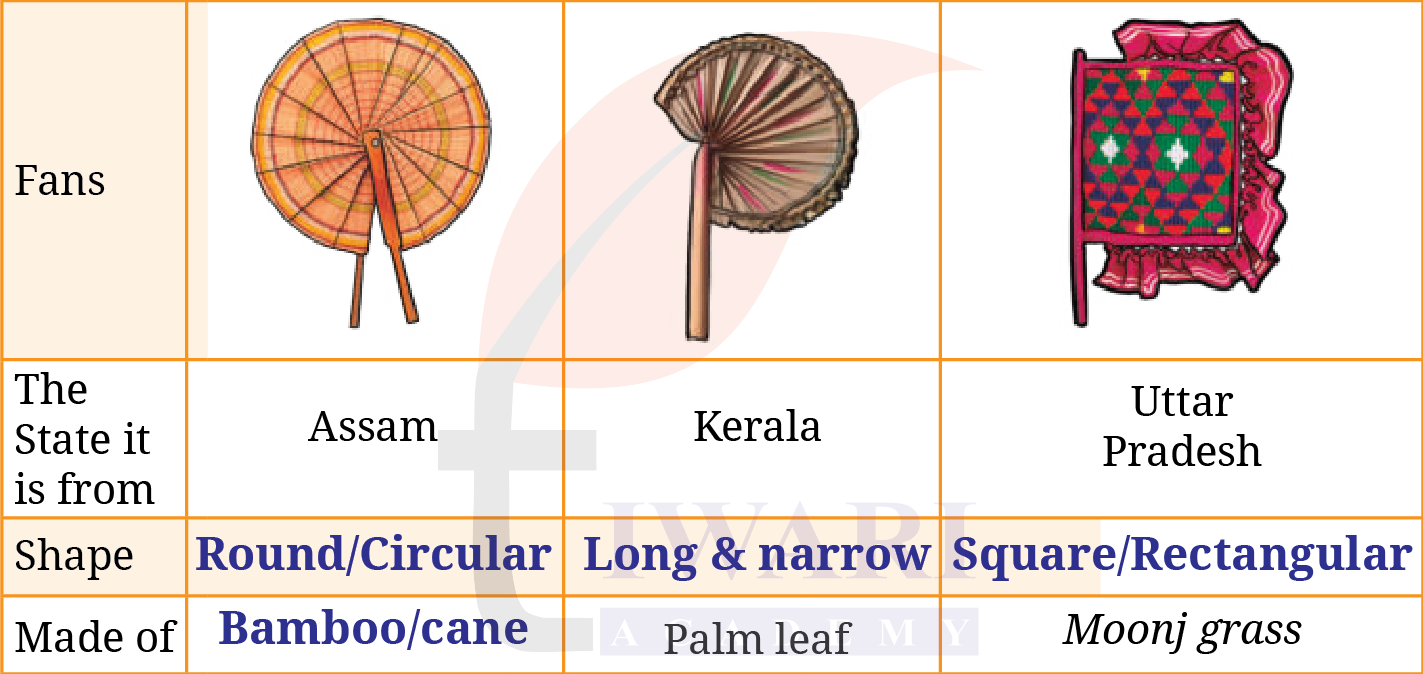
II. Work in pairs. Study the pictures given below carefully and complete the information. Discuss your answers with your classmates and teacher.
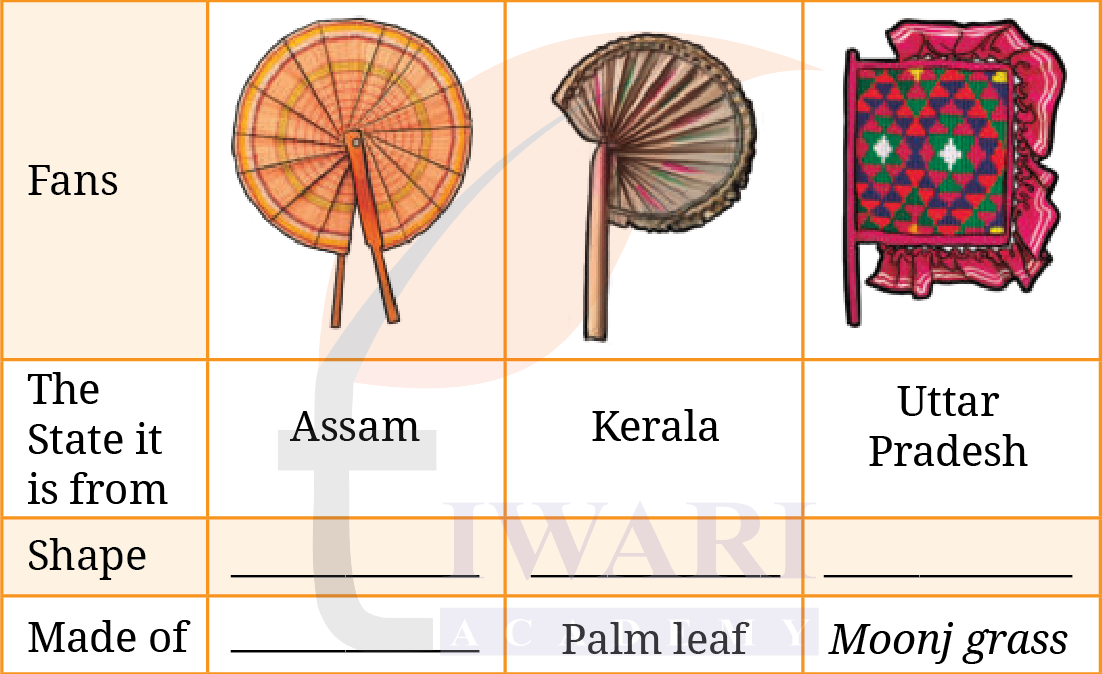
Answer:
Shape: Round/Circular , Long and narrow , Square/Rectangular
Made of : Bamboo/cane, Palm leaf, Moonj grass
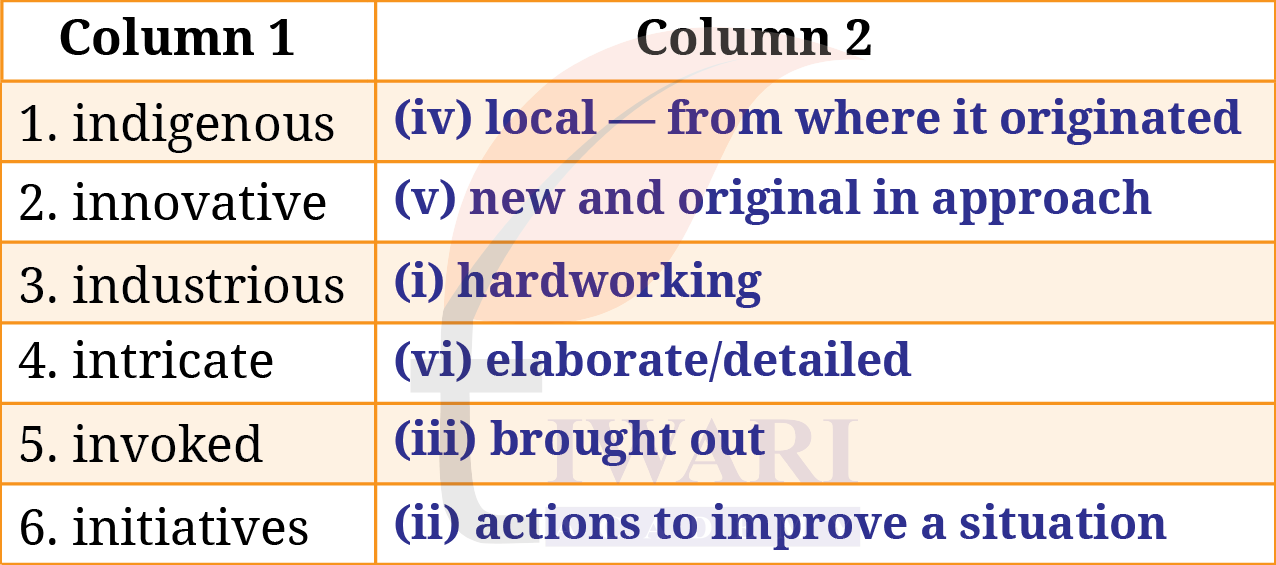
III. Work in pairs. Match the underlined words in Column 1 with their meanings in Column 2 given on the next page. Share your answers with your classmates and teacher.
I visited the crafts fair yesterday. It was a wonderful experience. Each indigenous artefact was an innovative creation of industrious craftspersons with its intricate design. It invoked a sense of respect for the initiatives taken by the government to showcase them.
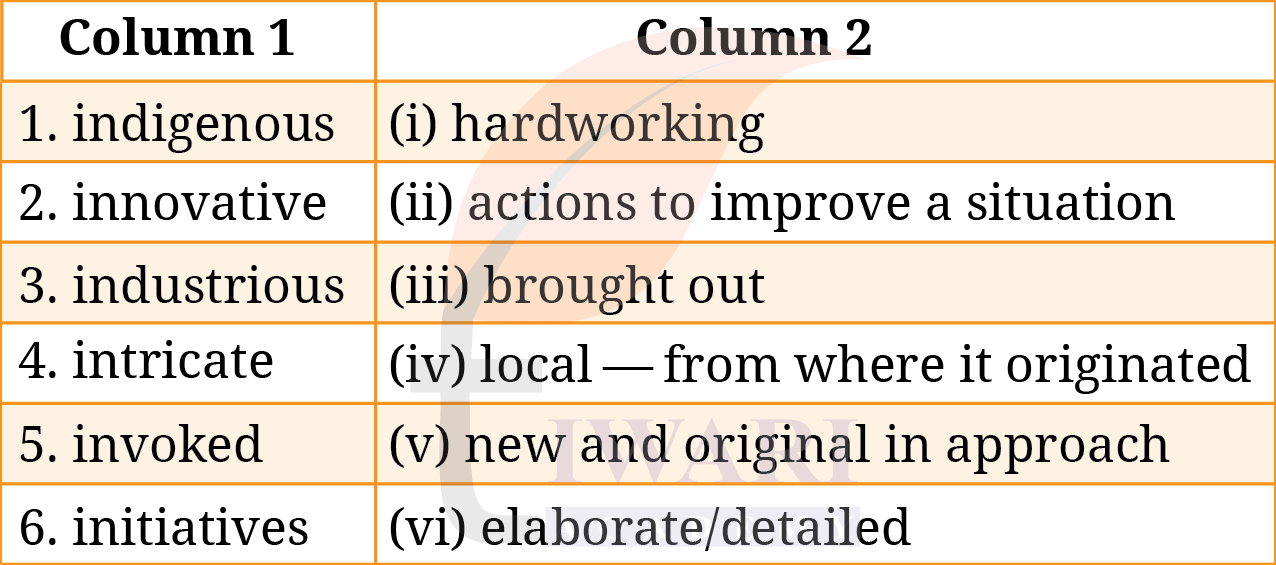
Answer:
Page 73 – Check Your Understanding
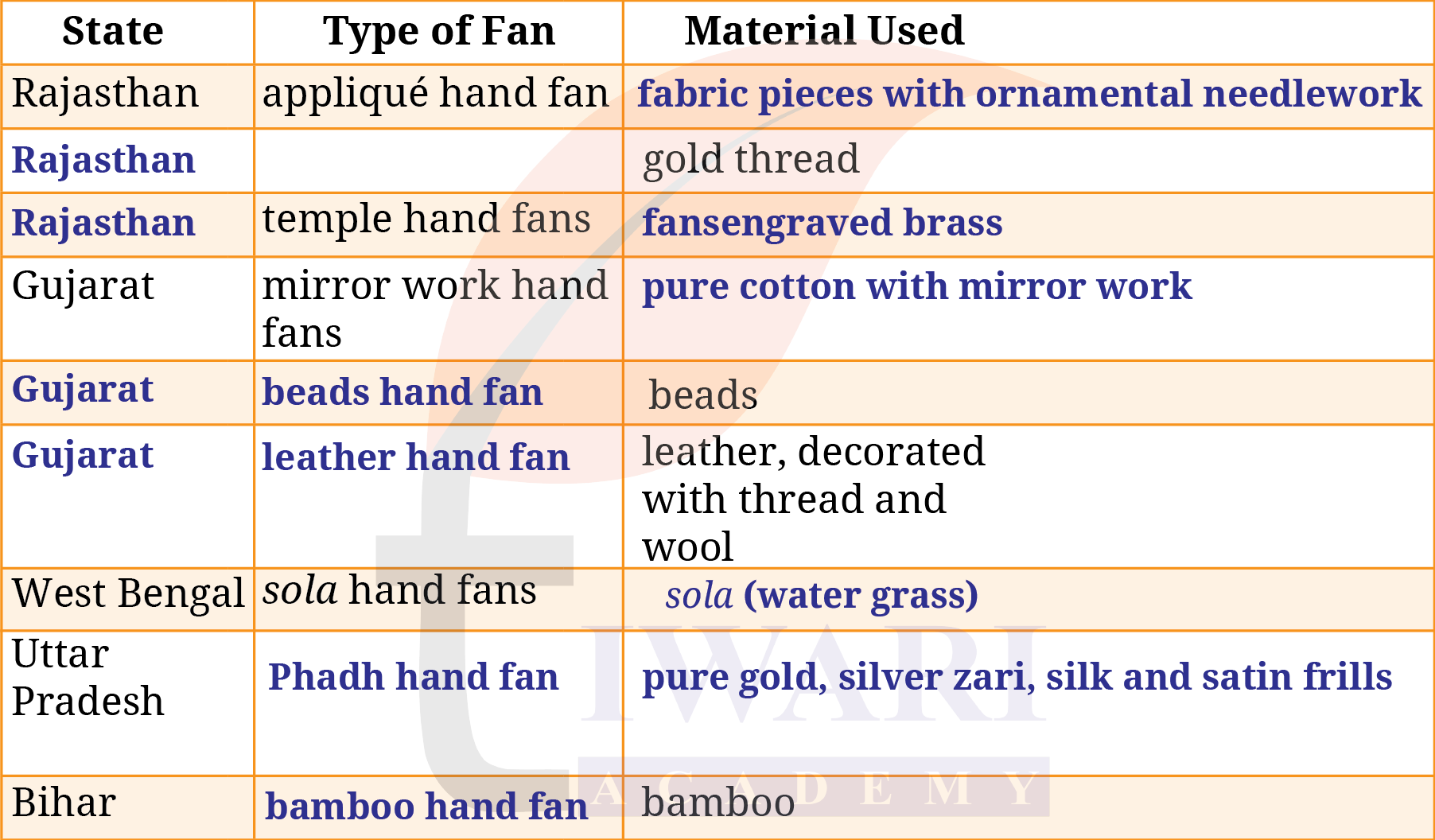
I. Work in pairs to complete the table on pankha. Share your answers with your classmates and teacher.
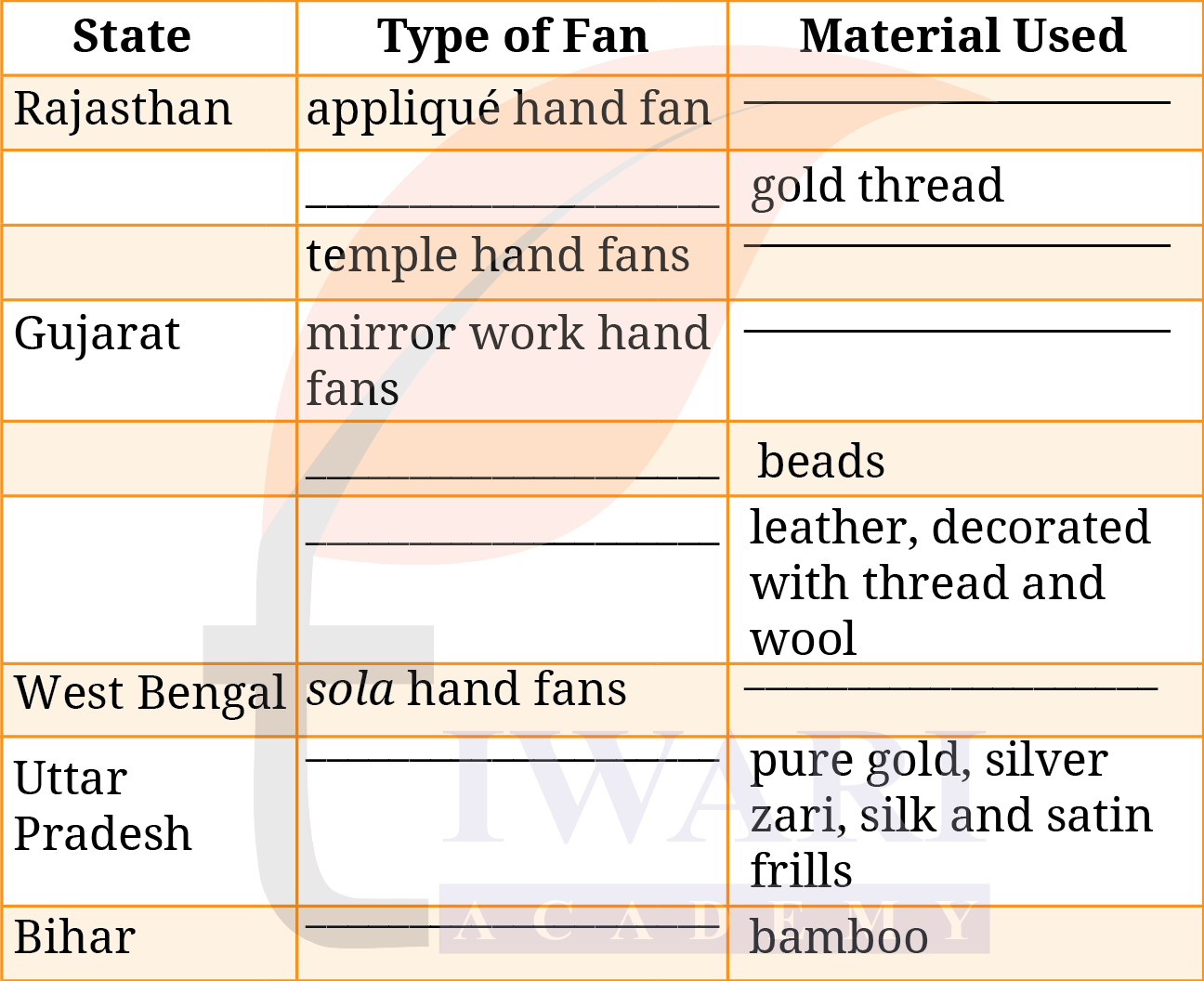
Answer:
Page 74 – Critical Reflection
I. Read the extracts given below and answer the questions that follow.
1. Over time, pankhas became significant cultural goods distributed through trade routes. They were considered exotic and stylish. Although there was substantial commonality in their use across India, different villages and towns developed their own varieties of traditional pankhas. Each place developed pankhas with distinct materials or a variety of intricate designs, that set them apart from one another.
(i) State whether the following sentences is true or false.
Pankhas were one of the most popular items of commerce.
See Answer(i) True. Pankhas became significant cultural goods distributed through trade routes and were considered exotic and stylish.
(ii) Why has the word ‘traditional’ been used to describe pankhas?
See AnswerThe word ‘traditional’ has been used to describe pankhas because they have been made and used in India for centuries, passed down through generations. Each region developed its own unique variety, making them deeply rooted in local customs and culture.
(iii) Complete the following statement. The sentence ‘They were considered exotic and stylish’ is an opinion and not a fact because ______.
See AnswerThe sentence ‘They were considered exotic and stylish’ is an opinion and not a fact because it reflects the personal perception and judgment of people rather than a verifiable or measurable truth. Different people may have different views about what is exotic or stylish.
(iv) Infer one reason for commonality in the use of pankhas across India.
See AnswerOne reason for the commonality in the use of pankhas across India is that before the invention of electric fans, pankhas were the only means of getting relief from heat. Since the entire country experiences hot weather, the need for hand fans was universal across all regions.
(v) Select which one of the two statements is the correct assertion for the given reason.
Reason: Pankhas were made of indigenous materials, unique to the region, with elaborate designs.
A. Each kind of pankha could be distinguished from the other.
B. Pankhas were used be many people.
See AnswerA. Each kind of pankha could be distinguished from the other.
2. With time and the advent of technology and innovative creations, the beautiful culture of pankhas runs the risk of slowly losing its presence among Indians. Once made for personal use, over time this handicraft has transformed into a commercial business and now provides some form of livelihood to India’s artisans. The slight increase in popularity and demand is significantly factored by the different versions of the pankha being crafted.
(i) Infer one negative impact of technological advancement on pankha.
See AnswerOne negative impact of technological advancement on pankha is that with the arrival of electric fans and air conditioners, people stopped using traditional hand fans for practical purposes. This led to a decline in demand, which threatened the livelihoods of artisans and put the traditional craft at risk of disappearing.
(ii) Complete the statement with an appropriate reason. The writer refers to ‘pankhas’ not just as an object but as a ‘culture’ because __________.
See AnswerThe writer refers to ‘pankhas’ not just as an object but as a ‘culture’ because pankhas carry with them the history, artistry, traditions, and identity of the region they come from. Each pankha reflects the cultural values, materials and craftsmanship of its community, making it much more than just a functional object.
(iii) Select a line from the extract which depicts how the role of the pankha has changed over the years.
See Answer“Once made for personal use, over time this handicraft has transformed into a commercial business and now provides some form of livelihood to India’s artisans.”
(iv) List one way in which the increase in demand of pankhas might benefit artisans.
See AnswerThe increase in demand of pankhas can benefit artisans by providing them with a sustainable source of income. As more people buy pankhas, artisans can earn better wages and continue practising their traditional craft without financial difficulties.
(v) Select the factor that has contributed to the commercialisation of pankhas.
A. cultural preservation
B. economic demand
C. technological advancements
D. artisan initiative
See AnswerB. economic demand
II. Answer the following questions.
1. How does the tittle ‘Winds of Change’ capture the essence of the chapter?
See AnswerThe title ‘Winds of Change’ is very apt and meaningful. On a literal level, it refers to the pankha which creates a breeze or wind. On a deeper level, it represents the changes that have occurred in the culture of pankha-making over time. Just as wind brings change, the chapter talks about how pankhas have changed from being personal utility items to decorative and commercial craft products. The title also hints at the need for change in attitudes to preserve this dying art form.
2. Support the following statement with any two relevant example from the chapter.
“The structure and design of pankhas are testimony to the cultural identify of the region.’
See AnswerThe statement is well supported by examples from the chapter.
First, the zardozi hand fan of Rajasthan uses glittering gold threadwork which reflects the rich and royal heritage of Rajasthan, known for its opulence and grandeur.
Second, the beads hand fan of Gujarat is covered with colourful beads and has a silver handle, which reflects Gujarat’s identity as the centre of bead craft in India and the artistic skills of its home-based women workers.
Both examples show how the design and material of each pankha clearly represent the culture and tradition of its region.
3. The chapter mentions pankhas running the risk of slowly losing their presence among Indians. Evaluate how the balance between preserving traditional craftmanship and incorporating innovative design in the creation of pankhas wil help in this regard.
See AnswerBalancing traditional craftsmanship with innovative designs is a very effective way to save the pankha culture. If artisans stick only to traditional methods, they may struggle to attract modern buyers who prefer contemporary aesthetics. On the other hand, if they completely abandon tradition, the cultural value of the pankha will be lost.
By combining both — keeping the traditional materials and techniques while adding new patterns or modern designs — artisans can appeal to a wider audience. This approach makes pankhas relevant in today’s world while also preserving their cultural roots. It creates a bridge between the past and the present, ensuring the craft survives and thrives.
4. How might initiatives such as pankha-making workshops contribute to the preservation of this traditional craft?
See AnswerPankha-making workshops can contribute to preservation in several ways. First, they spread awareness about the history, cultural significance, and artistry of pankhas among people who may not know about this craft. Second, they provide a platform for artisans to showcase their skills and connect with potential buyers, helping them earn a livelihood. Third, workshops teach younger generations the techniques of pankha-making, ensuring the knowledge is not lost. Finally, by generating public interest, these workshops can increase the commercial demand for pankhas, making the craft economically viable.
5. The writer mentions celebrating pankhas in the concluding part of the chapter. Assess how this could be beneficial to artisans and the craft.
See AnswerCelebrating pankhas is extremely beneficial both for artisans and the craft itself. When people celebrate and appreciate pankhas, they are more likely to buy them, which directly increases the income of artisans. This gives artisans a commercial platform and a sustainable livelihood. Additionally, when the craft is celebrated publicly through exhibitions and events, it gains visibility and recognition, encouraging more artisans to continue making pankhas. It also creates pride in the community about their cultural heritage. Overall, celebration leads to preservation, both economically and culturally.
6. How does the restriction of the use of pankha for decorative purposes reflect the changing cultural role of these traditional fans in modern India?
See AnswerThe shift of pankhas from functional objects to decorative items reflects how modernisation has changed Indian lifestyle and culture. With the widespread use of electric fans and air conditioners, the practical need for hand fans has reduced significantly. However, the fact that pankhas are still kept as decorative items shows that people still value them for their aesthetic and cultural significance. It reflects a bittersweet change — while pankhas are no longer a daily necessity, they are still respected as symbols of Indian heritage and craftsmanship. This shift also shows how traditional crafts often find new roles in society in order to survive.
Page 76 – Vocabulary and Structures in Context
I. Read the following pairs of words from the text.
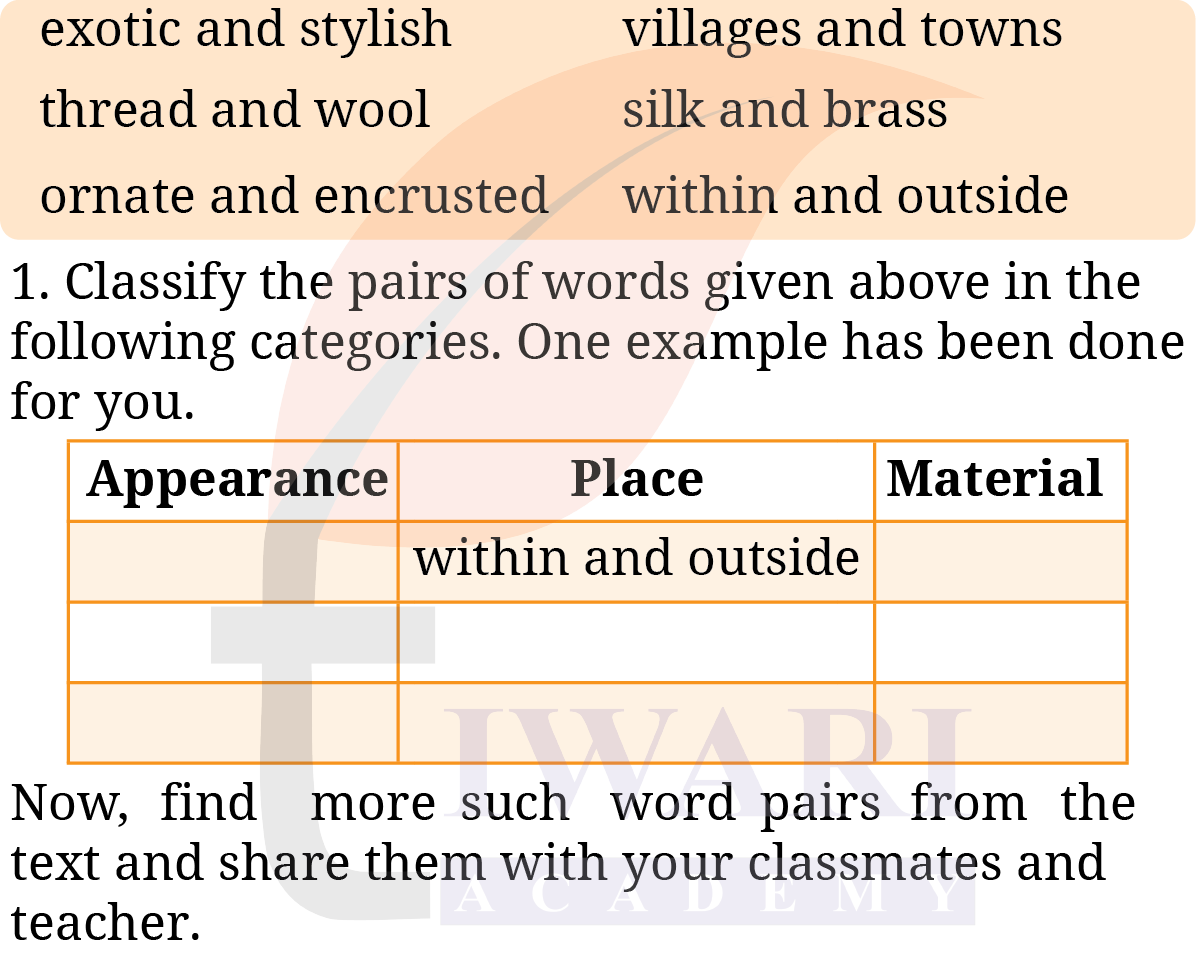
Answer:

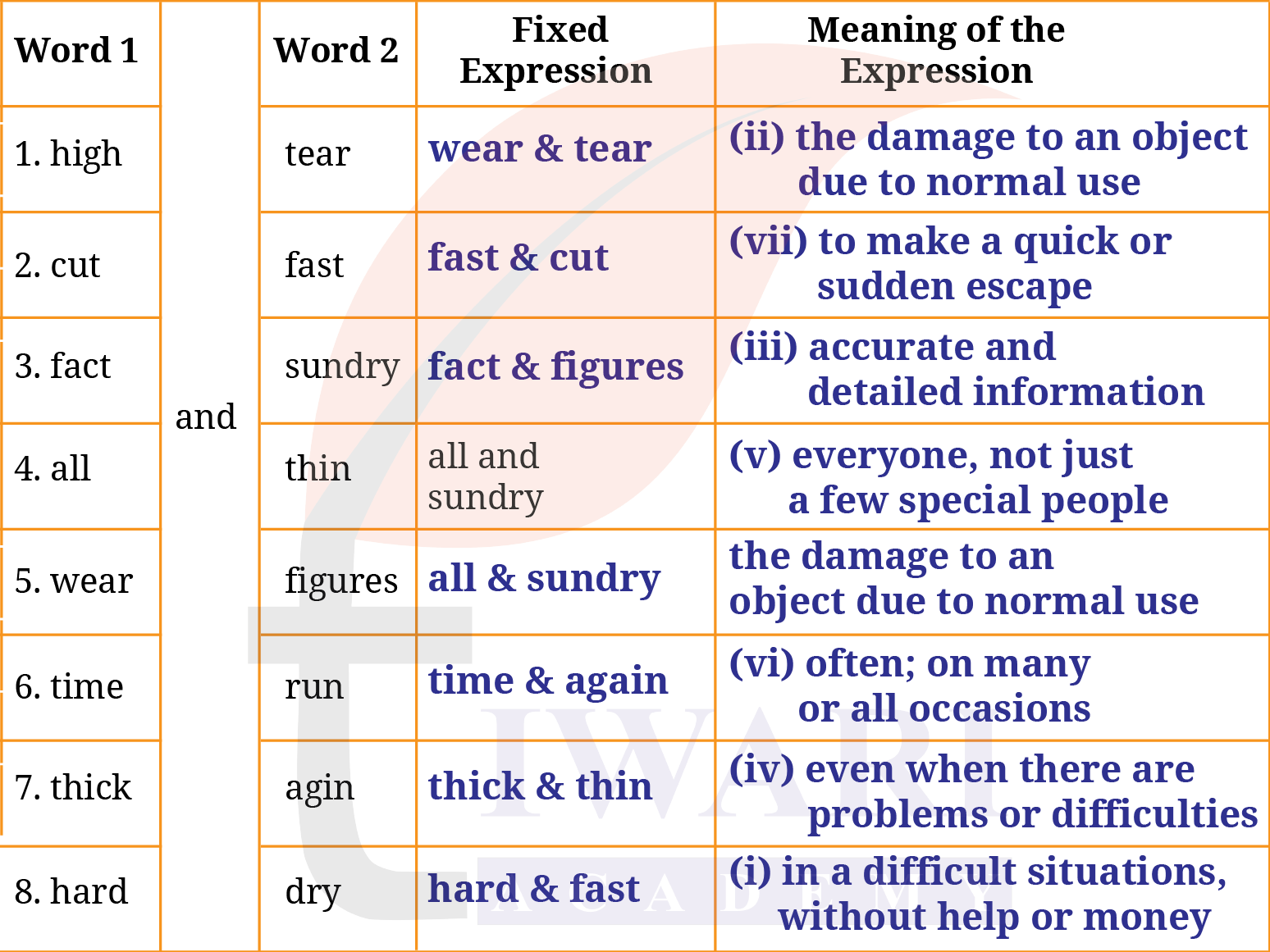
II. Find the word pairs for the following fixed expressions. Write the meanings of these expressions by selecting them from the box given below. One example has been done for you.
Some common expressions with ‘and’ have a fixed order which cannot be changed. The shortest expression comes first. For example, bread and butter (*not butter and bread)
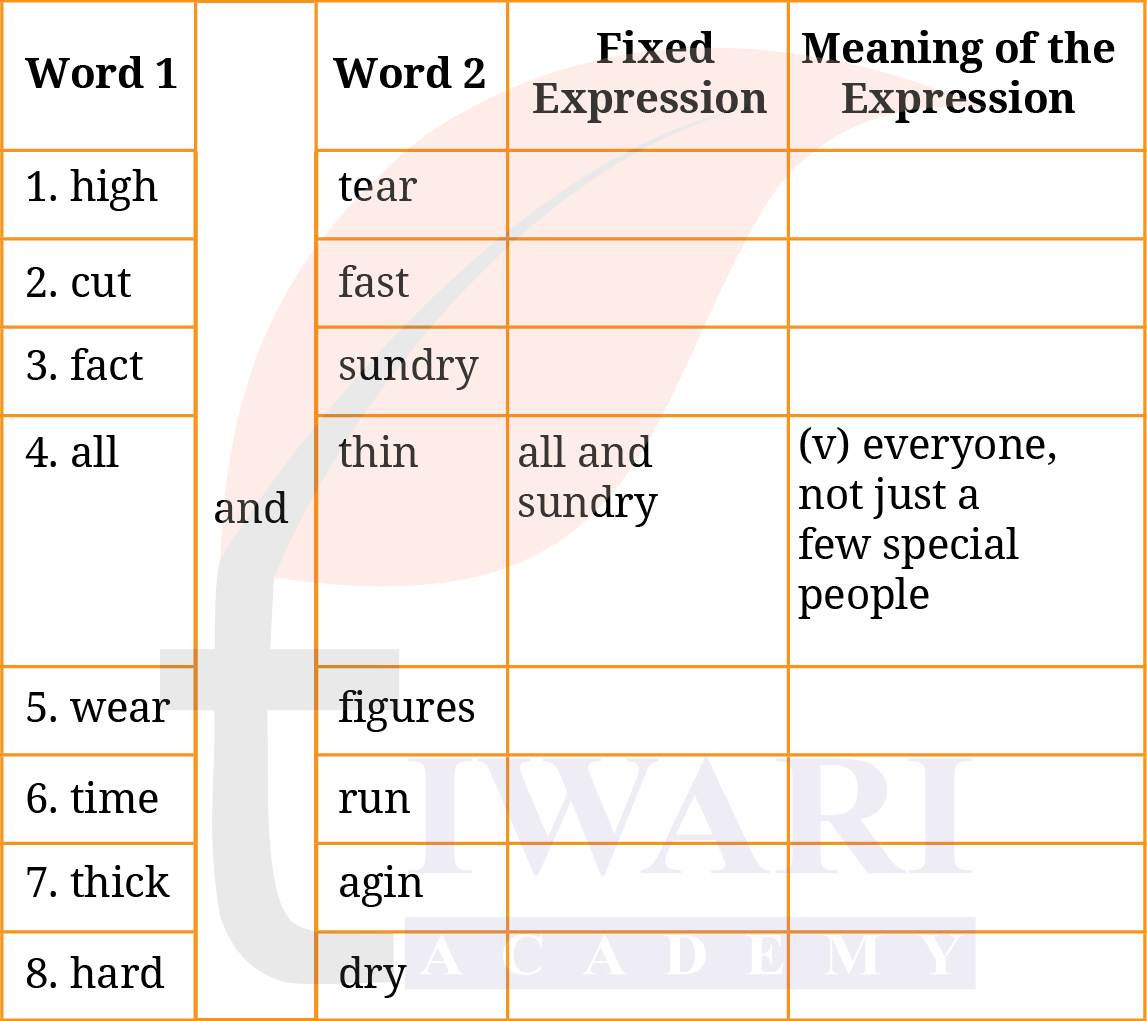
Now, match the following meanings with the correct word pairs created above.
(i) in a difficult situation, without help or money —
(ii) the damage to object due to normal use —
(iii) accurate and detailed information —
(iv) even when there are problems or difficulties —
(v) everyone, not just a few special people —
(vi) often; on many or all occasions —
(vii) To make a quick or sudden escape —
Answer:
III. Read the following word combinations from the text.
- sustainable livelihood
- aesthetically pleasing
- appreciating the culture
The given phrases are conventional combinations just like fixed expressions. Such combinations are called collocations.
1. Choose the appropriate word collections from the following sentences.
(i) The students have to (take/give) the English exam tomorrow.
(ii) The interviewer asked the candidate to (take/have) a seat.
(iii) My scooter (dashed against/ran into) a car.
(iv) I must (take/own) responsibility for my success.
(v) I would like to (tone up/improve) my grammar.
See Answer(i) The students have to 𝘁𝗮𝗸𝗲 the English exam tomorrow.
(ii) The interviewer asked the candidate to 𝗵𝗮𝘃𝗲 a seat.
(iii) My scooter 𝗿𝗮𝗻 𝗶𝗻𝘁𝗼 a car.
(iv) I must 𝘁𝗮𝗸𝗲 responsibility for my success.
(v) I would like to 𝗶𝗺𝗽𝗿𝗼𝘃𝗲 my grammar.
IV. Read the following sentences. Underline the verbs.
1. In modern times, pankhas have become traditional craft items in India.
2. Gujarat’s industrious home-based women workers have worked tirelessly in the handicraft of pankha-making.
3. Many tribes in India have adopted this handicraft.
4. Once made for personal use, this handicraft has transformed into a commercial business.
See Answer1. In modern times, pankhas 𝗵𝗮𝘃𝗲 𝗯𝗲𝗰𝗼𝗺𝗲 traditional craft items in India.
2. Gujarat’s industrious home-based women workers 𝗵𝗮𝘃𝗲 𝘄𝗼𝗿𝗸𝗲𝗱 tirelessly in the handicraft of pankha-making.
3. Many tribes in India 𝗵𝗮𝘃𝗲 𝗮𝗱𝗼𝗽𝘁𝗲𝗱 this handicraft.
4. Once for personal use, this handicraft 𝗵𝗮𝘀 𝘁𝗿𝗮𝗻𝘀𝗳𝗼𝗿𝗺𝗲𝗱 into a commercial business.
Now, fill in the blanks with the present perfect form of verbs in the following paragraph. One example has been done for you.
Puppets have long fascinated (fascinate) audiences worldwide. Puppeteers (i) _________ (create) intricate characters and captivating stories with their skillful artistry. They (ii) _________ (master) the delicate movements that bring these lifeless figures to life, entertaining both children and adults. Over the years, puppetry (iii) _________(evolve), using modern technology while preserving traditional techniques. Many puppeteers (iv) _________ (pass) down their craft through generations, ensuring its continuity. They (v) _________ (perform) in theatres, on television, and at festivals, conveying important cultural narratives.
See AnswerPuppets have long fascinated audiences worldwide. Puppeteers (i) 𝗵𝗮𝘃𝗲 𝗰𝗿𝗲𝗮𝘁𝗲𝗱 intricate characters and captivating stories with their skillful artistry. They (ii) 𝗵𝗮𝘃𝗲 𝗺𝗮𝘀𝘁𝗲𝗿𝗲𝗱 the delicate movements that bring these lifeless figures to life, entertaining both children and adults. Over the years, puppetry (iii) 𝗵𝗮𝘀 𝗲𝘃𝗼𝗹𝘃𝗲𝗱, using modern technology while preserving traditional techniques. Many puppeteers (iv) 𝗵𝗮𝘃𝗲 𝗽𝗮𝘀𝘀𝗲𝗱 down their craft through generations, ensuring its continuity. They (v) 𝗵𝗮𝘃𝗲 𝗽𝗲𝗿𝗳𝗼𝗿𝗺𝗲𝗱 in theatres, on television, and at festivals, conveying important cultural narratives.
Page 79 – Listen and Respond
I. You will listen to a dialogue between a boy and a girl discussing which type of pankha they should choose as a gift. As you listen, choose four statements out of seven that are true from 1–7 given below.
(Transcript for teacher on page 263)
1. Rohan thinks Grandma prefers heavier items because they feel more substantial.
2. Priya suggests getting a pankha that can be easily moved around.
3. Rohan believes Grandma enjoys siting in the verandah during the evenings.
4. Priya knows Grandma likes to keep special items close to her.
5. Rohan thinks a pankha with intricate designs would be too delicate for Grandma’s liking.
6. Priya suggests choosing between a bamboo pankha with beadwork or an embroidered pankha with mirror work.
7. Rohan decided they should buy the pankha without consulting their mom.
See Answer3. Rohan believes Grandma enjoys sitting in the verandah during the evenings.
4. Priya knows Grandma likes to keep special items close to her.
5. Rohan thinks a pankha with intricate designs would be too delicate for Grandma’s liking.
6. Priya suggests choosing between a bamboo pankha with beadwork or an embroidered pankha with mirror work.
Page 80 – Writing Task
I. Describe an artefact you have made in your craft class or learnt from someone.
Begin with collection and organisation of the facts with the help of the pointers given above. Do not include your opinion in the factual description.
See AnswerA Paper Hand Fan
A paper hand fan is a simple yet beautiful artefact that I made in my craft class. It is circular in shape and approximately 20 centimetres in diameter. It is made of colourful sheets of paper and two wooden sticks which act as its handle. The fan has multiple folds, similar to a pleated design, giving it an attractive appearance.
To make it, we first took a rectangular sheet of coloured paper and folded it back and forth like a zigzag pattern. Then we tied one end tightly with a rubber band and attached two ice cream sticks on both sides of the tied end to form the handle. Finally, we spread the other end open to form the fan shape.
This type of hand fan is commonly made across India using waste or recycled paper. It is an eco-friendly and cost-effective craft that can be used on hot days or as a decorative item. Making this fan taught me the importance of traditional crafts and how simple materials can be transformed into something both useful and beautiful.
Page 80 – Learning Beyond the Text
I. Identify any art or craft item from your region and make a presentation describing its features, materials and process involved in making it, its usage, etc.
You may refer to the points given on the next page.
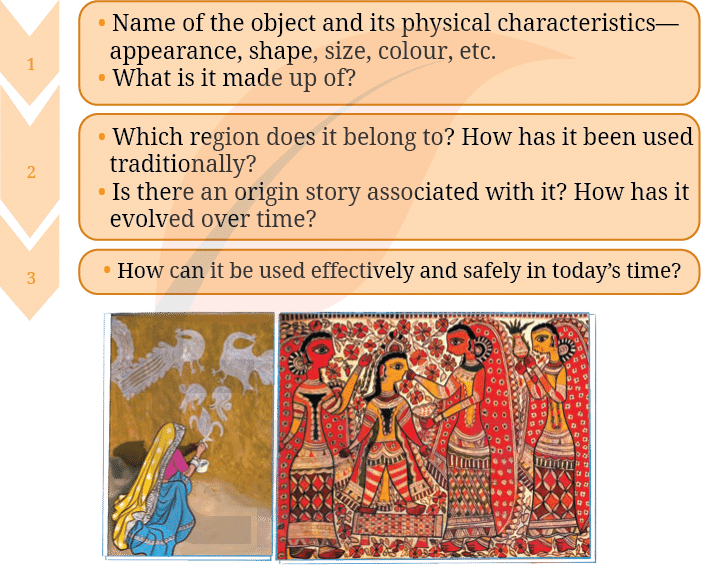
Answer:
Craft Item: Pottery (Mitti ke Bartan)
- Pottery is one of the oldest and most well-known craft forms in India. Pots made from clay are usually round or oval in shape. They come in various sizes — from small decorative pots to large water storage vessels. Their colour is generally reddish-brown or earthy brown, and the surface can be smooth or textured depending on the design.
- Pottery is made from natural clay or mitti. The clay is mixed with water to make it soft and pliable. Sometimes sand or straw is added to strengthen it. Natural colours and paints are used to decorate the finished product.
- Pottery is practised across India, but Khurja in Uttar Pradesh, Jaipur in Rajasthan, and Manipur are especially famous for it. Traditionally, clay pots were used for storing water, cooking food, and carrying grains. Clay lamps called diyas are still used during festivals like Diwali.
- Pottery is one of mankind’s oldest crafts, dating back to the Indus Valley Civilisation. Over thousands of years, it has evolved from basic utility ware to decorative art. Today, potters use both traditional hand wheels and modern electric wheels to create their pieces.
- Today pottery is used as decorative items, flower pots, kulhad chai cups, and artistic showpieces. Using clay products is also eco-friendly as they are biodegradable. Many people are now buying handmade pottery to support local artisans and promote sustainable living.
NCERT Class 9 English Kaveri Poem 3 Solutions – Canvas of Soil
Page 86 – Reflect and Respond
I. Work in pairs. Discuss what all you see in a garden. Think of the colours you see and where you see them. Share your responses with your teacher.
Answer:
In a garden, we can see a variety of things. There are colourful flowers like roses, marigolds and sunflowers. We can see green grass, tall trees, small shrubs and creepers. Birds and butterflies are also commonly seen in gardens. We can see benches, pathways and sometimes small ponds too.
Colours we see green in the leaves and grass, red and yellow in flowers, brown in the tree trunks and soil, white and pink in certain blossoms and blue in the sky reflecting on the water.
II. Look at the picture of a garden and a painting given below. Speak about any similarities between the garden and the painting.

Speak using the following:
- Just as a garden ____________, similarly, a painting ____________
- A garden and a painting, both ____________.
- ____________ is common to both a garden and a painting.
- Like a garden, a painting too ____________.
Answer:
- Just as a garden has different colours and textures, similarly, a painting uses different colours and brush strokes to create beauty.
- A garden and a painting, both express creativity and bring joy to the viewer.
- Colour is common to both a garden and a painting.
- Like a garden, a painting too captures the beauty of nature and life in a vivid and colourful way.
III. Let us acquaint ourselves with the meanings of palette, hue, and canvas.
1. Palette: a thin oval or rectangular board or tablet that painter holds and mixes colours on.
2. Hue: shade of a colour
3. Canvas: (here) painting
Now, look at the painting given above and identify palette, canvas, and select a hue.
Answer:
Looking at the given picture:
Palette:
The palette is shown on the left side of the image. It is the rectangular board containing different colours (pink, blue, red, yellow, green, black, etc.) along with paintbrushes.
Canvas:
The canvas refers to the paintings displayed in the center and right side of the image. These are the surfaces where the artwork (landscape and garden scene) is painted.
Hue (example):
One hue you can select is green, which appears in the trees, grass, and plants. (You could also choose other hues like blue, yellow, or red depending on your choice.)
Page 87 – Check Your Understanding
I. Read the poem again and complete the summary of each stanza by filling in the blanks.
1. The _____________ is portrayed as a rich palette where gardeners’s _ _ _ a _ s flourish in the form of _____________, awaiting spring.
Answer:
The earth/soil is portrayed as a rich palette where gardeners’ dreams flourish in the form of seeds, awaiting spring.
2. The garden flowers __________ into a beautiful display of different b __ __ __ __ __ m s, resembling a __________ by Mother Nature, in the light of morning.
Answer:
The garden flowers bloom into a beautiful display of different blossoms, resembling a painting/artwork by Mother Nature, in the light of morning.
3. Each garden is likened to a wide __ __ n __ __ s, integrating art and __________. Through the efforts of gardeners, gardens transform into still-life __________.
Answer:
Each garden is likened to a wide canvas, integrating art and life. Through the efforts of gardeners, gardens transform into still-life paintings.
II. Select the appropriate title for each stanza from those given below. There are two extra titles.
1. Nature’s Work of Art
2. Sweet-smelling Blossoms
3. Gardens as Living Canvas
4. Earth and Possibilities
5. The Painter’s Canvas
Answer:
Stanza 1 — 4. Earth and Possibilities
Stanza 2 — 1. Nature’s Work of Art
Stanza 3 — 3. Gardens as Living Canvases
III. Match the poetic devices in Column 1 to the examples in Column 2.
Discuss your responses in pairs. Then share the responses with your classmates and teacher.

Answer:

Page 89 – Critical Reflection
I. Read the given extracts from the poem and answer the questions that follow.
1. Brushstrokes of seeds, planted true,
Awaiting spring’s vibrant hue.
(i) The poet has used a metaphor in ‘Brushstrokes of seeds’. Which option from those given below uses a mataphor?
A. Her mother’s heart heard her heartfelt request with kindness.
B. She has a heart of gold.
C. Her heart did a dance of joy on seeing the new doll.
D. She has very kind heart.
Answer:
B. She has a heart of gold.
(ii) Complete the sentence appropriately.
The phrases ‘planted true’ is significant because it implies ____________.
Answer:
The phrase ‘planted true’ is significant because it implies that the seeds are planted with care, dedication, and sincerity. It suggests that gardeners put their genuine effort and hope into planting, just like an artist who works with full commitment on a painting.
(iii) Why has the poet used the word ‘ hue’ instead of ‘colours’ in the extract?
Answer:
The poet has used the word ‘hue’ instead of ‘colours’ because ‘hue’ is a more poetic and artistic term that refers to shades and tones of colour. It also fits the overall theme of the poem which compares gardening to painting. Using ‘hue’ maintains the artistic imagery of the poem and also helps complete the rhyme scheme with the word ‘true’.
(iv) Complete the following analogy correctly with a word from the extract.
Summer: hot: :: Spring : ___________
Answer:
Summer: hot :: Spring : vibrant
(v) Read the Assertion (A) and the Reason (R) and selecting the option that is correctly suited.
(A): Gardeners wait for Spring.
(R): Gardens are worth painting in Spring.
A. Both (A) and (R) are true and (R) is the correct explanation of (A).
B. Both (A) and (R) are rue but (R) is not the correct explanation of (A).
C. (A) is true but (R) is false.
D. (A) is false but (R) is true.
Answer:
B. Both (A) and (R) are true but (R) is not the correct explanation of (A).
2. Each plot, a canvas wide,
Where art and life coincide.
(i) What does ‘Each plot’ refer to in this extract?
Answer:
‘Each plot’ refers to each individual section or portion of a garden. The poet compares every small piece of garden land to a wide canvas, suggesting that each part of the garden is like a unique painting created by the gardener.
(ii) Select which option imitates the rhyme scheme of the extract.
A. beautiful and clear
laughter and cheer
B. beautiful and clear
laughter and tears
Answer:
A. beautiful and clear
laughter and cheer
(iii) Select the line from the extract that conveys that gardening blends aesthetic beauty with natural growth.
Answer:
“Where art and life coincide.”
This line conveys that gardening is a blend of artistic beauty (art) and natural growth (life), showing that the two exist together in a garden.
(iv) Complete the following sentence appropriately.
The plot is likened to a canvas suggesting that ___________.
Answer:
The plot is likened to a canvas suggesting that a garden, like a painting, is a creative space where a gardener expresses their artistic vision through nature. Just as a painter fills a canvas with colours and designs, a gardener fills the plot with plants, flowers and patterns, making it a living work of art.
(v) Why has the poet most likely used the word ‘wide’ instead of ‘long’ in ‘canvas wide’?
Answer:
The poet has used ‘wide’ instead of ‘long’ because ‘wide’ suggests openness, space, and limitless possibilities. A wide canvas gives a sense of freedom and expanse, just like a garden that spreads out in all directions. ‘Wide’ also conveys the idea that a garden, like art, has no boundaries. Additionally, ‘wide’ rhymes better with the overall flow of the poem.
II. Give reason for the comparisons made by the poet in the poem.
1. A painter is compared to a gardener because ___________.
2. A palette is like earth as ___________.
3. The brushstrokes are like seeds because ___________.
4. A canvas is similar to a garden plot as ___________.
Answer:
1. A painter is compared to a gardener because both use their creativity and skill to create something beautiful.
2. A palette is like earth as both hold a variety of colours and serve as the base from which a beautiful creation emerges.
3. The brushstrokes are like seeds because both are the starting points of a creative process.
4. A canvas is similar to a garden plot as both are open spaces where creativity is expressed.
III. Answer the following questions.
1. How does the metaphor ‘Brushstrokes of seed’, enhance the understanding of gardening as an art form?
Answer:
The metaphor ‘Brushstrokes of seeds’ enhances the understanding of gardening as an art form by drawing a direct parallel between the act of planting seeds and the act of painting. Just as each brushstroke on a canvas is deliberate and contributes to the overall beauty of a painting, each seed planted in the soil is intentional and contributes to the beauty of the garden. This metaphor makes the reader see gardening not as a mere agricultural activity but as a creative and artistic process that requires skill, vision and patience.
2. What can you infer about the poet’s perspective on the relationship between nature and creativity from the following lines? ‘Each plot, a canvas wide,/Where art and life coincide.’
Answer:
From these lines, we can infer that the poet believes nature and creativity are deeply interconnected and inseparable. The poet sees the garden as a space where artistic expression and natural life come together harmoniously. This suggests that the poet views creativity not as something limited to human-made art but as something that exists in nature itself. The poet feels that when humans work with nature — like a gardener tending a plot — they are in fact creating art, and thus art and life coincide beautifully.
3. Do you think the imagery in the poem successfully paints a vivid picture in the reader’s mind? If yes, why?
Answer:
Yes, the imagery in the poem successfully paints a vivid picture in the reader’s mind. The poet uses rich and colourful images such as “shades of green, red, and blue”, “blossoms bloom” and “brushstrokes of seeds” which help the reader visualise a beautiful and vibrant garden. The comparison of a garden to a painting with a palette, canvas and brushstrokes makes the imagery very concrete and relatable. The reader can almost see and feel the garden coming to life through these descriptions.
4. Support the view that the poet’s mention of the colour yellow, besides red, blue and green, would have lent effectively to the imagery.
Answer:
The mention of yellow would have added significantly to the imagery of the poem. Yellow is one of the most commonly found colours in gardens — sunflowers, marigolds and daffodils are all yellow. It is also the colour of sunlight which plays a vital role in a garden’s growth. Adding yellow would have made the colour palette of the poem more complete and realistic. It would have enhanced the visual richness of the poem and made the comparison between a garden and a painting even more vivid and convincing since painters frequently use yellow to depict warmth and light.
5. Considering the line ‘Gardens become paintings still’, what can you interpret about the poet’s view on the timelessness of nature’s beauty?
Answer:
From the line ‘Gardens become paintings still’, we can interpret that the poet believes nature’s beauty is timeless and eternal. The word ‘still’ here means both ‘motionless’ like a still-life painting and also ‘even now’ or ‘always’. The poet suggests that just as a painting preserves beauty forever on a canvas, a garden captures the eternal beauty of nature. This reflects the poet’s view that nature’s beauty does not fade with time it remains as fresh and inspiring as a painting, continuing to move and inspire people across generations.
6. Justify the title of the poem, ‘Canvas of Soil’.
Answer:
The title ‘Canvas of Soil’ is very appropriate and meaningful. In art, a canvas is the surface on which a painter creates their masterpiece. In this poem, the poet compares the soil of a garden to a canvas. Just as a canvas holds the colours and brushstrokes of a painting, the soil holds the seeds, plants, and flowers that make up the beauty of a garden. The title immediately establishes the central theme of the poem — that gardening is an art form and nature is the artist. It beautifully captures the idea that the earth itself is a creative space where life and art come together. Thus the title perfectly justifies the content and message of the poem.
Page 92 – Vocabulary in Context
I. The poet refers to the shades of green, red, and blue in the poem. Let us read some of the names of different shades of these colours.

Now, Discuss in pairs, any two things that you can associate with these colour.
Answer:
Shades of Red:
- Rusty red — old iron gates, autumn leaves
- Salmon — evening sky, certain flowers
- Scarlet — roses, ripe tomatoes
- Crimson — deep red roses, pomegranate seeds
- Blood red — hibiscus flowers, chillies
- Vermilion — sindoor, certain sunsets
Shades of Green:
- Pine green — pine trees, dark forest leaves
- India green — fresh grass, spinach leaves
- Apple green — raw mangoes, fresh apples
- Jade — precious stones, certain cacti
- Olive — olive fruit, dried leaves
- Pistachio — pistachio nuts, light coloured plants
Shades of Blue:
- Navy blue — school uniforms, night sky
- Indigo — deep ocean water, indigo plant flowers
- Cobalt blue — bright summer sky, certain butterflies
- Denim — jeans, light blue morning sky
- Sky blue — clear daytime sky, forget-me-not flowers
- Ice blue — glaciers, frozen water
II. You have studied painting-related words like palette, brushstrokes, shades hue, colours, and canvas.
Now, read the following paragraph and discuss in pairs what the underlined painting-related might mean. Discuss this way:
I think __________ means __________ because the passage talks about __________.
Example: I think p͟o͟r͟t͟r͟a͟i͟t͟ means a p͟i͟c͟t͟u͟r͟e͟ o͟f͟ s͟o͟m͟e͟o͟n͟e͟’͟s͟ f͟a͟c͟e͟ because the passage talks about c̲a̲p̲t̲u̲r̲i̲n̲g̲ a̲ f̲r̲i̲e̲n̲d̲’̲s̲ f̲e̲a̲t̲u̲r̲e̲s̲.
In the art studio , young painters eagerly approached their e͟a͟s͟e͟l͟s͟, each framing a canvas that they had to work on. The teacher encouraged them to experiment with a diverse t͟o͟n͟a͟l͟ r͟a͟n͟g͟e͟, playing with shades and hue to bring their paintings to life. One student focused on a detailed p͟o͟r͟t͟r͟a͟i͟t͟, capturing his friends’s features, first with careful u͟n͟d͟e͟r͟p͟a͟i͟n͟t͟i͟n͟g͟ and then filling the final colours. Another student worked on a m͟u͟r͟a͟l͟, depicitng a Spring Day on the right wall of the classroom. The room continued to buzz with artistc energy.
Answer:
1. Easels:
I think easel means a wooden stand or frame that holds a canvas because the passage talks about young painters approaching their easels to frame a canvas that they had to work on.
2. Tonal range:
I think tonal range means the variety of light and dark shades used in a painting because the passage talks about the teacher encouraging students to experiment with different shades and hues to bring their paintings to life.
3. Portrait:
I think portrait means a picture of someone’s face or figure because the passage talks about capturing a friend’s features in detail.
4. Underpainting:
I think underpainting means the first layer of paint applied on a canvas as a base because the passage talks about a student first doing careful underpainting and then filling in the final colours on top of it.
5. Mural:
I think mural means a large painting made directly on a wall because the passage talks about a student depicting a Spring Day on the right wall of the classroom.
Page 93 – Listen and Respond
I. You will listen to a young girl describe her school gardens. As you listen identify which of the following 1-3, she does not like about. (Transcript for teacher on page 264)

Answer:
The girl does NOT talk about:
- Bench
- Water pipe/hose
II. You will once again listen to the young girl. As you listen, circle the correct answer from the options given below.

Answer:

Page 94 – Speaking Activity
I. People wish to have a garden at home. Some like a flower garden and some a vegetable garden. Think and note some advantages of both these types, as gardens from homes.
Answer:
Advantages of a Flower Garden: A flower garden beautifies the surroundings and makes the home look attractive and colourful. It attracts butterflies, bees and birds which help in maintaining the ecological balance. Flowers can be used for decoration, worship, gifting and making perfumes. A flower garden also improves mental health and reduces stress as being around colourful blooms creates a feeling of happiness and peace.
Advantages of a Vegetable Garden: A vegetable garden provides fresh, organic and chemical-free vegetables for daily use. It helps the family save money on grocery bills. Growing vegetables at home teaches children responsibility, patience and the value of hard work. It is also an eco-friendly practice as it reduces the carbon footprint caused by transporting vegetables from farms to markets.
II. Would you like to have a flower garden or a vegetable garden at home? Why?
Take turns with your partner the given sentence prompts to express your preference, with reasons.
- I prefer ___________ to ___________ because…
- For me, it is a ___________ instead of a ___________ due to…
- If I had a choice I’d rather have a ___________ than a ___________ as…
- I would prefer ___________ rather than ___________ since …
Answer:
- I prefer a vegetable garden to a flower garden because it is both useful and rewarding.
- For me, it is a necessity instead of a luxury due to the fact that fresh homegrown vegetables are healthier, tastier and completely free from harmful pesticides and chemicals.
- If I had a choice I’d rather have a vegetable garden than a flower garden as it not only provides food for the family but also teaches important life skills like patience, hard work and responsibility.
- I would prefer a vegetable garden rather than a flower garden since it gives immense satisfaction and joy when you grow your own food and see it on your dining table every day.
Page 94 – Writing Task
I. Write a descriptive piece of two to three paragraphs describing the details and colours in the garden you have visited.
- Focus on how different shades of blue, red and green, interact, create contrast, and bring the garden to life.
- Pay attention to details like the texture of petals, the varying greens of leaves, and the way light affects the colours.
Answer:
A Garden in Full Bloom
Last Sunday morning, I visited the beautiful Lodhi Garden near our home. As I stepped through the entrance, I was instantly welcomed by a burst of colours that seemed to come alive in the soft golden light of the morning sun. The first thing that caught my eye was a long row of bright crimson roses, their velvety red petals glistening with dew drops. Right beside them were clusters of sky blue morning glories, their delicate petals curling gently at the edges. The sharp contrast between the deep red and the cool blue created a stunning visual effect, as if nature itself had carefully chosen these colours to complement each other.
As I walked deeper into the garden, the shades of green around me became richer and more varied. The tall trees had deep pine green leaves that rustled softly in the breeze, while the low shrubs and hedges showed off a lighter, apple green shade. The grass beneath my feet was a fresh, dewy green that felt soft and cool to touch. Here and there, splashes of yellow from sunflowers and golden marigolds broke through the green like little flames, adding warmth and energy to the scene. The texture of the petals was remarkable too — some were as smooth as silk, others had tiny ridges and folds that caught the light in different ways.
The most magical moment was when the morning sunlight filtered through the leaves and fell on a small pond in the centre of the garden. The water reflected the pale blue sky above, and white lotus flowers floated gently on its surface, their pure whiteness a striking contrast against the deep green of the lily pads. The way the light played with the colours — turning the greens golden, making the reds deeper and giving the whites a silvery glow — made the entire garden look like a living, breathing painting. I left the garden feeling refreshed, inspired, and deeply grateful for the quiet beauty that nature so generously offers.
Page 95 – Learning Beyond the Text
I. Mini-Project
Objective: Explore the multifaceted world of gardens-their design, cultural significance, artistic inspiration, and the art of gardening itself.
Duration: This project can span over a few weeks, allowing students adequate time for research and creative processes.
Select any Two assignments. Any one from 1 or 2, and any one from 3 or 4
(1)
Do research and collect information on any FIVE famous gardens of India, such as Amrit Udyan, Brindavan Gardens, and many others.
Focus on history, design elements, and cultural significance.
Prepare a short report and make a presentation
(2)
Explore various art forms (painting, sculpture) inspired by gardens. Select an art piece and analyse how the garden is represented.
Create a visual or written response inspired by the garden.
(3) Design your own garden
Design a garden on paper or using digital tools.
Incorporate elements and artistic inspirations learned from parts (1)/(2).
Present your choices in design and artistic influences to the class.
(4)
Interview with a Gardener or Landscaping Expert
Approach a local gardener or a landscaping expert for an interview.
Prepare questions focussed on understanding the practical aspects of gardening/landscaping.
Write a summary of your experience.
Answer:
Short Report on Five Famous Gardens of India
1. Amrit Udyan, New Delhi Amrit Udyan, formerly known as Mughal Gardens, is located within the Rashtrapati Bhavan complex in New Delhi. It was designed by Sir Edwin Lutyens and is inspired by Mughal, Persian and English garden styles. It is famous for its rectangular and circular gardens, rose beds, and seasonal flowers. It holds great cultural significance as it is opened to the public once a year during spring and showcases hundreds of varieties of flowers.
2. Brindavan Gardens, Mysuru Brindavan Gardens is located near the Krishnaraja Sagar dam in Mysuru, Karnataka. It was designed in 1927 and is one of the most beautiful terraced gardens in India. It is famous for its illuminated musical fountains, neatly trimmed hedges, colourful flower beds, and cypress trees. It represents the blend of Mughal and English garden design and is a symbol of Karnataka’s cultural and horticultural heritage.
3. Shalimar Bagh, Srinagar Shalimar Bagh is a Mughal garden built by Emperor Jahangir for his wife Nur Jahan on the banks of Dal Lake in Srinagar, Jammu and Kashmir. It is one of the finest examples of Mughal garden architecture featuring terraced lawns, flowing water channels, chinar trees and colourful flower beds. It holds immense historical and cultural significance as a UNESCO World Heritage Site.
4. Hanging Gardens, Mumbai The Hanging Gardens, also known as Pherozeshah Mehta Gardens, are located on the top of Malabar Hill in Mumbai. They are terraced gardens built over a reservoir and are famous for their animal-shaped hedges and beautiful flowering plants. They offer a stunning view of the Arabian Sea and are an important part of Mumbai’s green heritage.
5. Rock Garden, Chandigarh The Rock Garden of Chandigarh was created by Nek Chand Saini and is a unique open air exhibition hall spread over 40 acres. It is made entirely from industrial and urban waste and broken ceramics. It features thousands of sculptures made from waste materials set amidst waterfalls and winding paths. It holds immense cultural significance as a symbol of creativity, sustainability and artistic vision.
My Dream Garden Design
My dream garden would be a medium-sized rectangular garden divided into three sections.
The first section near the entrance would be a flower garden with rows of colourful roses, marigolds and jasmine. The flowers would be arranged by colour — red roses in the first row, yellow marigolds in the second and white jasmine in the third, creating a beautiful gradient effect.
The second section in the middle would have a small circular pond with lotus flowers and a stone bench beside it for sitting and relaxing. Around the pond I would plant tall ornamental grasses and ferns to create a natural, peaceful atmosphere.
The third section at the back would be a small vegetable and herb garden with tomatoes, spinach, mint and coriander planted in neat rows. This section would be practical and eco-friendly, providing fresh produce for the family.
The entire garden would be bordered with small white and red painted bricks, inspired by the school garden described in the chapter. A banyan sapling would be planted in one corner to provide shade as it grows. The design combines beauty, nature and utility — making it a true canvas of soil.
Summary of Interview with a Local Gardener
I recently had the opportunity to interview Mr. Ramesh, a gardener who has been maintaining the park in our colony for the past fifteen years. It was a very enriching experience that taught me a great deal about the practical aspects of gardening.
When I asked him about the most important aspect of gardening, he said that understanding the soil is the most fundamental step. He explained that different plants need different types of soil — some need sandy soil while others thrive in clay-rich earth. He also emphasised the importance of regular watering, especially during summers, and said that the best time to water plants is early morning or late evening to prevent evaporation.
I asked him about the challenges he faces. He mentioned that dealing with pests and diseases is the biggest challenge. He prefers using organic methods like neem spray rather than chemical pesticides to keep the garden healthy and safe for children and birds. He also told me that seasonal changes greatly affect a garden and a good gardener must plan which plants to grow in which season.
When I asked what he loves most about his work, his face lit up with a warm smile. He said that seeing flowers bloom after weeks of care gives him a joy that no other work can match. He believes that a garden is a living, breathing canvas and every gardener is an artist in their own right. This interview not only increased my knowledge about gardening but also gave me a deep respect for the patience, skill and dedication that goes into creating and maintaining a beautiful garden.
Kaveri Chapter 3 English to Hindi Translation:
Winds of Change | Class 9 English Kaveri Chapter 3 Hindi Translation
The word punkha or pankha originatesOriginates (verb)
Meanings:
Begins or comes from a source (उत्पन्न होता है, से आता है)
Examples:
1. The word originates in Sanskrit. (शब्द संस्कृत से आता है।)
2. The river originates in the hills. (नदी पहाड़ियों से निकलती है।)
3. The idea originates from experience. (विचार अनुभव से उत्पन्न होता है।) from the word ‘pankh’, which means feather of a bird. Pankha is used to refer to all fans, whereas the word pankhi denotesDenotes (verb)
Meanings:
Means or represents (अर्थ बताता है, दर्शाता है)
Examples:
1. Red denotes danger here. (यहाँ लाल रंग खतरा दर्शाता है।)
2. The word denotes a small fan. (इस शब्द का अर्थ छोटा पंखा है।)
3. This mark denotes a pause. (यह चिह्न विराम बताता है।) a small plumedPlumed (adjective)
Meanings:
Decorated with feathers (पंखों से सजा हुआ)
Examples:
1. She held a plumed fan. (उसने पंखों वाला पंखा पकड़ा।)
2. The dancer wore a plumed hat. (नर्तक ने पंखों वाली टोपी पहनी।)
3. We admired the plumed ornament. (हमने पंखों वाला आभूषण सराहा।) fan used in ancient India. EvidenceEvidence (noun)
Meanings:
Facts or signs supporting a belief (प्रमाण, साक्ष्य)
Examples:
1. The paintings provide evidence. (चित्र प्रमाण देते हैं।)
2. We need clear evidence. (हमें स्पष्ट प्रमाण चाहिए।)
3. She examined the evidence carefully. (उसने प्रमाण ध्यान से जाँचे।) of the existence and use of pankhi in India can be found in Buddhist wall paintings at Ajanta. These wall paintings date back to the 2nd century CE. Other representations of the punkha can be found in embroidery work, sculpturesSculptures (plural noun)
Meanings:
Works of art made by carving or shaping solid materials (मूर्तियाँ, तराशी हुई कलाकृतियाँ)
Examples:
1. Stone sculptures decorated the temple. (पत्थर की मूर्तियों से मंदिर सजा था।)
2. The museum displayed ancient sculptures. (संग्रहालय में प्राचीन मूर्तियाँ प्रदर्शित थीं।)
3. She makes sculptures from clay. (वह मिट्टी से मूर्तियाँ बनाती है।), and carvings. In ancientAncient (adjective)
Meanings:
Belonging to the distant past (प्राचीन)
Examples:
1. We visited an ancient temple. (हम प्राचीन मंदिर गए।)
2. The custom is ancient. (प्रथा प्राचीन है।)
3. She studies ancient history. (वह प्राचीन इतिहास पढ़ती है।) times, pankhas were used in temples to fan deitiesDeities (plural noun)
Meanings:
Gods or goddesses (देवी-देवता)
Examples:
1. The paintings show deities. (चित्रों में देवी-देवता हैं।)
2. People worshipped the deities. (लोगों ने देवी-देवताओं की पूजा की।)
3. The temple contains images of deities. (मंदिर में देवी-देवताओं की प्रतिमाएँ हैं।). They were also used in royal courtsRoyal courts (noun phrase)
Meanings:
The households and assemblies surrounding rulers (राजदरबार)
Examples:
1. Musicians performed in royal courts. (संगीतकार राजदरबारों में प्रस्तुति देते थे।)
2. The craft served royal courts. (शिल्प का उपयोग राजदरबारों में होता था।)
3. Stories describe ancient royal courts. (कथाएँ प्राचीन राजदरबारों का वर्णन करती हैं।) to fan kings. Pankhas varied in size from a tiny two inch one to large ones requiring a person’s full arm strength to move them.
Hindi Translation‘पुंखा’ या ‘पंखा’ शब्द ‘पंख’ शब्द से उत्पन्न हुआ है, जिसका अर्थ है पक्षी का पंख। ‘पंखा’ शब्द का उपयोग सभी प्रकार के पंखों के लिए किया जाता है, जबकि ‘पंखी’ शब्द प्राचीन भारत में उपयोग होने वाले छोटे पंखदार पंखे को दर्शाता है। भारत में पंखी के अस्तित्व और उपयोग के प्रमाण अजंता की बौद्ध भित्ति चित्रों में मिलते हैं। ये भित्ति चित्र दूसरी शताब्दी ईसवी के हैं। पुंखा के अन्य चित्रण कढ़ाई कार्य, मूर्तियों और नक्काशियों में भी देखे जा सकते हैं। प्राचीन काल में, पंखों का उपयोग मंदिरों में देवी-देवताओं को हवा करने के लिए किया जाता था। इनका उपयोग राजदरबारों में राजाओं को हवा करने के लिए भी होता था। पंखे दो इंच के छोटे आकार से लेकर इतने बड़े आकार तक होते थे जिन्हें हिलाने के लिए पूरी भुजाओं की शक्ति लगानी पड़ती थी।
Grammar AnalysisThe paragraph primarily uses the Simple Present to define terms and the Simple Past to provide historical context and evidence.
► Adjectives (Describing Words)
• Small / Tiny: Describes the size of the pankhi or small fans.
• Plumed: Describes a fan decorated with feathers.
• Ancient: Describes the time period of India and its temples.
• Buddhist: Relates the wall paintings to the specific religion/culture.
• Two inch / Large: Quantitative adjectives describing the physical scale of the fans.
► Verbs (Action/State Words)
• Originates / Means: Simple Present used for definitions and etymology.
• Denotes / Refers: Simple Present used to explain how words are used today.
• Can be found: Modal verb showing possibility/availability of evidence.
• Date back: Phrasal verb used to indicate the age of the paintings.
• Were used: Passive voice in the Simple Past, showing the historical function of the fans.
► Adverbs (How/When/Where)
• Back: Describes how far in time the paintings go.
• Also: Used to add an additional fact about usage in courts.
• Usually: Describes the frequency or commonality of their use (inferred).
Over time, pankhas became significant cultural goods distributed through trade routes. They were considered exoticExotic (adjective)
Meanings:
Unusual and attractive because it seems unfamiliar (अनोखा और आकर्षक)
Examples:
1. The fan looked exotic. (पंखा अनोखा और आकर्षक लगा।)
2. The garden has exotic plants. (बगीचे में अनोखे पौधे हैं।)
3. They admired the exotic design. (उन्होंने अनोखा डिज़ाइन सराहा।) and stylish. Although there was substantialSubstantial (adjective)
Meanings:
Large or considerable (पर्याप्त, काफी अधिक)
Examples:
1. The work required substantial effort. (काम में काफी मेहनत लगी।)
2. They found substantial similarities. (उन्हें काफी समानताएँ मिलीं।)
3. She made substantial improvements. (उसने काफी सुधार किए।) commonalityCommonality (noun)
Meanings:
A shared feature or similarity (समानता, साझा विशेषता)
Examples:
1. The designs showed commonality. (डिज़ाइनों में समानता थी।)
2. We found commonality in their customs. (हमें उनकी प्रथाओं में समानता मिली।)
3. The discussion revealed a commonality of interests. (चर्चा से रुचियों की समानता सामने आई।) in their use across India, different villages and towns developed their own varieties of traditional pankhas. Each place developed pankhas with distinctDistinct (adjective)
Meanings:
Clearly different or easy to recognise (अलग, विशिष्ट, स्पष्ट)
Examples:
1. Each village has a distinct style. (हर गाँव की अपनी विशिष्ट शैली है।)
2. The two sounds are distinct. (दोनों आवाज़ें स्पष्ट रूप से अलग हैं।)
3. The flower has a distinct scent. (फूल की एक विशिष्ट सुगंध है।) materials or a variety of intricateIntricate (adjective)
Meanings:
Having many small, detailed, interconnected parts (जटिल, बारीक और विस्तृत)
Examples:
1. The cloth had an intricate pattern. (कपड़े पर बारीक और जटिल डिज़ाइन थी।)
2. She admired the intricate carving. (उसने बारीक नक्काशी की प्रशंसा की।)
3. The artisan made an intricate fan. (कारीगर ने बारीक डिज़ाइन वाला पंखा बनाया।) designs, that set them apart from one another. Bamboo, caneCane (noun)
Meanings:
Strong flexible plant stems used in weaving (बेंत, बुनाई में प्रयुक्त लचीला तना)
Examples:
1. The basket is made of cane. (टोकरी बेंत की बनी है।)
2. She wove strips of cane. (उसने बेंत की पट्टियाँ बुनीं।)
3. Cane bends without breaking easily. (बेंत आसानी से टूटे बिना मुड़ता है।), palm leaf, silk, brassBrass (noun)
Meanings:
A yellow metal alloy mainly of copper and zinc (पीतल, ताँबे और जस्ते की मिश्रधातु)
Examples:
1. The handle was brass. (हत्था पीतल का था।)
2. He polished the brass lamp. (उसने पीतल का दीपक चमकाया।)
3. They engraved a brass plate. (उन्होंने पीतल की पट्टिका पर नक्काशी की।), leather, and silver pankhas, with decorative beads and stones were used depending on geographies, cultures, and traditional ritualsRituals (plural noun)
Meanings:
Traditional or religious actions carried out in a set way (अनुष्ठान, पारंपरिक विधियाँ)
Examples:
1. The family followed the wedding rituals. (परिवार ने विवाह की रस्में निभाईं।)
2. Flowers were used in the temple rituals. (मंदिर के अनुष्ठानों में फूल इस्तेमाल हुए।)
3. Different communities have different rituals. (अलग-अलग समुदायों के अलग-अलग अनुष्ठान होते हैं।).
Hindi Translationसमय के साथ, पंखे महत्वपूर्ण सांस्कृतिक वस्तुएँ बन गए और व्यापार मार्गों के माध्यम से वितरित होने लगे। उन्हें विदेशी और फैशनेबल माना जाता था। हालाँकि पूरे भारत में उनके उपयोग में काफी समानता थी, फिर भी विभिन्न गाँवों और कस्बों ने अपनी-अपनी परंपरागत पंखों की किस्में विकसित कर लीं। प्रत्येक स्थान ने अलग-अलग सामग्री या विभिन्न प्रकार के जटिल डिज़ाइनों वाले पंखे विकसित किए, जो उन्हें एक-दूसरे से अलग बनाते थे। बाँस, बेंत, ताड़ के पत्ते, रेशम, पीतल, चमड़े और चाँदी के पंखे, सजावटी मनकों और पत्थरों के साथ, भूगोल, संस्कृतियों और पारंपरिक अनुष्ठानों के अनुसार उपयोग किए जाते थे।
Grammar AnalysisThe paragraph uses the Simple Past to describe historical trends and the Present Participle to show how specific factors influenced the variety of fans.
► Adjectives (Describing Words)
• Significant / Cultural: Describes the status of pankhas in society.
• Exotic / Stylish: Describes how they were perceived by people.
• Traditional: Describes the long-standing nature of the fans.
• Intricate / Distinct: Describes the unique and detailed designs.
• Decorative: Describes the beads and stones used for embellishment.
► Verbs (Action/State Words)
• Became: Simple Past showing a change in status over time.
• Distributed: Passive voice showing how they moved through trade routes.
• Developed: Simple Past showing the creative growth in different regions.
• Set apart: Phrasal verb meaning to make something different or special.
• Used: Passive voice showing the application of different materials.
► Adverbs (How/When/Where)
• Over time: Adverbial phrase showing when the change happened.
• Across: Describes the geographic extent of their common use.
• Apart: Describes the state of being separate or distinct.
In modern times, the use of pankhas has been restrictedRestricted (verb)
Meanings:
Limited to particular uses or conditions (सीमित किया गया)
Examples:
1. Entry was restricted. (प्रवेश सीमित था।)
2. The fan’s use was restricted to decoration. (पंखे का उपयोग सजावट तक सीमित था।)
3. They restricted the number of visitors. (उन्होंने आगंतुकों की संख्या सीमित की।) to decorative purposes, and they have become traditional craft items in India. The structure of each fan reflects the cultural coreCore (noun)
Meanings:
The deepest or central part of something (केंद्र, सबसे गहरा हिस्सा, अंतर्मन)
Examples:
1. The song moved me to the core. (गीत ने मेरे अंतर्मन को छू लिया।)
2. Trust is at the core of friendship. (विश्वास मित्रता के केंद्र में है।)
3. Remove the apple’s core carefully. (सेब का बीच वाला हिस्सा सावधानी से निकालो।) of the region that crafts it. For instance, the appliquéAppliqué (noun)
Meanings:
Decoration made by sewing fabric shapes onto another fabric (एक कपड़े पर कपड़े के टुकड़े सिलकर की गई सजावट)
Examples:
1. The fan has appliqué work. (पंखे पर कपड़े के टुकड़ों की सजावट है।)
2. She learned appliqué at the workshop. (उसने कार्यशाला में एप्लीके सीखा।)
3. Appliqué adds colourful patterns. (एप्लीके से रंगीन नमूने बनते हैं।) hand fan of Rajasthan is an antiqueAntique (adjective/noun)
Meanings:
Old and valued for age or craftsmanship; an object of this kind (प्राचीन, पुरानी मूल्यवान वस्तु)
Examples:
1. The museum displayed an antique fan. (संग्रहालय में प्राचीन पंखा प्रदर्शित था।)
2. She carefully cleaned the antique clock. (उसने पुरानी मूल्यवान घड़ी सावधानी से साफ़ की।)
3. The shop sells antique furniture. (दुकान में पुराना मूल्यवान फ़र्नीचर बिकता है।) pankha made of pieces of fabric in different shapes and patterns sewn onto another cloth with the use of ornamentalOrnamental (adjective)
Meanings:
Used mainly for decoration (सजावटी)
Examples:
1. The gate had ornamental metalwork. (फाटक पर सजावटी धातु का काम था।)
2. She grew ornamental plants. (उसने सजावटी पौधे उगाए।)
3. Ornamental stitching decorated the fan. (सजावटी सिलाई से पंखा सजा था।) needlework. Furthermore, the zardoziZardozi (noun)
Meanings:
Decorative embroidery using metallic threads (धातु के धागों की सजावटी कढ़ाई, ज़रदोज़ी)
Examples:
1. The fan displayed zardozi work. (पंखे पर ज़रदोज़ी थी।)
2. She admired the zardozi border. (उसने ज़रदोज़ी की किनारी सराही।)
3. Artisans practise zardozi carefully. (कारीगर सावधानी से ज़रदोज़ी करते हैं।) hand fan of Rajasthan differs in its use of glittering ornateOrnate (adjective)
Meanings:
Richly and elaborately decorated (अत्यधिक अलंकृत, सजावटी)
Examples:
1. The frame was ornate. (चौखटा बहुत सजावटी था।)
2. We admired the ornate doorway. (हमने अलंकृत दरवाज़ा सराहा।)
3. She chose an ornate fan. (उसने सजावटी पंखा चुना।) and encrustedEncrusted (adjective)
Meanings:
Covered with a firmly attached decorative layer (जड़ा हुआ, सजावटी परत से ढका)
Examples:
1. The box was encrusted with beads. (डिब्बे पर मोती जड़े थे।)
2. Gold-encrusted designs decorated the fan. (सोने की जड़ाई ने पंखा सजाया।)
3. The crown was jewel-encrusted. (मुकुट में रत्न जड़े थे।) gold threadwork. In Rajasthan, temple hand fans are popular too. These are made by engravingEngraving (noun/verb)
Meanings:
A design cut into a hard surface; the process of making such a design (नक्काशी, खोदकर आकृति बनाना)
Examples:
1. The silver fan had delicate engraving. (चाँदी के पंखे पर बारीक नक्काशी थी।)
2. He learned engraving from his father. (उसने अपने पिता से नक्काशी सीखी।)
3. The engraving showed a pair of birds. (नक्काशी में पक्षियों का एक जोड़ा बना था।) brass and have a long handle. The painted hand fan, a cardboard pankha featuring various images, is usually offered to gods.
Hindi Translationआधुनिक समय में, पंखों का उपयोग केवल सजावटी उद्देश्यों तक सीमित हो गया है, और वे भारत में पारंपरिक शिल्प वस्तुएँ बन गई हैं। प्रत्येक पंखे की संरचना उस क्षेत्र के सांस्कृतिक मूल को दर्शाती है जो उसे बनाता है। उदाहरण के लिए, राजस्थान का ‘अप्लिक’ हस्त पंखा एक पुरातन पंखा है जो विभिन्न आकृतियों और पैटर्न के कपड़े के टुकड़ों को दूसरे कपड़े पर सजावटी कढ़ाई से सिलकर बनाया जाता है। इसके अलावा, राजस्थान का ‘जरदोजी’ हस्त पंखा चमकीली, अलंकृत और जड़ी हुई सोने की धागे की कारीगरी के उपयोग में भिन्न है। राजस्थान में मंदिर के हस्त पंखे भी लोकप्रिय हैं। ये पीतल पर नक्काशी करके बनाए जाते हैं और इनका हत्था लंबा होता है। चित्रित हस्त पंखा, जो विभिन्न छवियों वाला एक गत्ते का पंखा है, आमतौर पर देवताओं को अर्पित किया जाता है।
Grammar AnalysisThe paragraph uses the Present Perfect to describe a change in status and the Simple Present to describe the current characteristics of various fans.
► Adjectives (Describing Words)
• Modern / Traditional: Describes the time period and nature of the craft.
• Cultural: Describes the core or essence of the region.
• Antique / Appliqué: Describes the style and age of the Rajasthan fan.
• Ornamental / Glittering / Ornate: Describes the visual quality of the needlework and thread.
• Popular / Long / Painted: Describes the fame, physical size and type of temple fans.
► Verbs (Action/State Words)
• Has been restricted: Present Perfect Passive showing a completed change in usage.
• Reflects / Crafts: Simple Present showing a general fact about the fans and regions.
• Sewn: Past participle used to describe the assembly of the fabric.
• Differs: Simple Present used to compare the Zardozi fan to others.
• Featuring / Offered: Present and Past participles used to describe the fans’ appearance and use.
► Adverbs (How/When/Where)
• Furthermore: Used to introduce an additional related point.
• Usually: Describes the common frequency with which cardboard fans are offered.
• Too: Used to indicate that temple fans are also popular in addition to others.
The adjoiningAdjoining (adjective)
Meanings:
Next to or sharing a boundary (सटा हुआ, पड़ोसी)
Examples:
1. We visited the adjoining room. (हम साथ वाले कमरे में गए।)
2. The adjoining state has similar crafts. (पड़ोसी राज्य में ऐसे शिल्प हैं।)
3. They bought the adjoining land. (उन्होंने साथ की ज़मीन खरीदी।) state of Gujarat has its own indigenousIndigenous (adjective)
Meanings:
Native to a particular place (स्थानीय, देशज)
Examples:
1. The craft uses indigenous materials. (शिल्प में स्थानीय सामग्री लगती है।)
2. She studies indigenous traditions. (वह देशज परंपराएँ पढ़ती है।)
3. Indigenous plants suit this climate. (स्थानीय पौधे इस जलवायु के अनुकूल हैं।) take on pankhas. These hand fans are elegant pure cotton-based fans embellishedEmbellished (verb)
Meanings:
Decorated with added details (सजाया, अलंकृत किया)
Examples:
1. She embellished the cloth with beads. (उसने कपड़ा मोतियों से सजाया।)
2. The fan was embellished with mirrors. (पंखा शीशों से सजाया गया।)
3. He embellished the frame carefully. (उसने चौखटा सावधानी से सजाया।) with mirror work. The beads hand fan is covered with colourful beads and has a silver handle. Gujarat is the centre for bead craft in India and these daintyDainty (adjective)
Meanings:
Small, delicate, and attractive (नाज़ुक, छोटा और सुंदर)
Examples:
1. She carried a dainty fan. (उसने एक नाज़ुक सुंदर पंखा लिया हुआ था।)
2. The cup had a dainty floral design. (कप पर फूलों की नाज़ुक सुंदर डिज़ाइन थी।)
3. A dainty necklace lay in the box. (डिब्बे में एक नाज़ुक सुंदर हार रखा था।) pankhas are commonly used as wall decorations. Kutch is recognised for its hand-stitched leather hand fans decorated with thread and wool at its seamsSeams (plural noun)
Meanings:
Lines where pieces of material are joined together (जोड़ की सिलाइयाँ, सीवनें)
Examples:
1. She checked the seams of the bag. (उसने बैग की सीवनें जाँचीं।)
2. The seams were neatly stitched. (जोड़ की सिलाइयाँ करीने से की गई थीं।)
3. Strong seams help the cloth last longer. (मज़बूत सिलाइयों से कपड़ा अधिक समय तक टिकता है।). Gujarat’s industriousIndustrious (adjective)
Meanings:
Hard-working and diligent (परिश्रमी, मेहनती)
Examples:
1. She is an industrious worker. (वह मेहनती कर्मचारी है।)
2. The industrious students finished early. (मेहनती विद्यार्थियों ने जल्दी पूरा किया।)
3. His industrious nature earned respect. (उसके परिश्रम से सम्मान मिला।) home-based women workers have worked tirelesslyTirelessly (adverb)
Meanings:
With continuing effort and energy (अथक रूप से)
Examples:
1. They worked tirelessly. (उन्होंने अथक मेहनत की।)
2. She practised tirelessly. (उसने अथक अभ्यास किया।)
3. He tirelessly helped the villagers. (उसने बिना थके ग्रामीणों की मदद की।) in the handicraftHandicraft (noun)
Meanings:
The making of decorative or useful objects by hand (हस्तशिल्प)
Examples:
1. Pottery is a handicraft. (मिट्टी के बर्तन बनाना हस्तशिल्प है।)
2. She learned a traditional handicraft. (उसने पारंपरिक हस्तशिल्प सीखा।)
3. The exhibition celebrates handicraft. (प्रदर्शनी हस्तशिल्प का सम्मान करती है।) of pankha-making to produce embroidered hand fans with traditional mirror work and cross-stitch embroidery in different shapes and sizes.
Hindi Translationपड़ोसी राज्य गुजरात का पंखों पर अपना स्थानीय दृष्टिकोण है। ये हस्त पंखे शीशे के काम से सजे हुए शुद्ध सूती कपड़े से बने सुंदर पंखे हैं। मनके वाला हस्त पंखा रंगीन मनकों से ढका होता है और इसका हत्था चाँदी का होता है। गुजरात भारत में मनके शिल्प का केंद्र है और ये नाजुक पंखे आमतौर पर दीवार की सजावट के रूप में उपयोग किए जाते हैं। कच्छ अपने हाथ से सिले हुए चमड़े के हस्त पंखों के लिए जाना जाता है जो अपनी सिलाई पर धागे और ऊन से सजे होते हैं। गुजरात की परिश्रमी घर-आधारित महिला कारीगरों ने पंखा बनाने के हस्तशिल्प में अथक परिश्रम करके विभिन्न आकारों और आकृतियों में पारंपरिक शीशे के काम और क्रॉस-स्टिच कढ़ाई वाले हस्त पंखे बनाए हैं।
Grammar AnalysisThe paragraph uses the Simple Present to describe current facts and the Present Perfect to highlight the ongoing contribution of workers.
► Adjectives (Describing Words)
• Adjoining / Indigenous: Describes the location and origin of the state’s style.
• Elegant / Pure cotton-based: Describes the quality and material of the fans.
• Colourful / Silver: Describes the beads and the handle.
• Dainty / Hand-stitched: Describes the delicate nature and the method of making.
• Industrious / Home-based: Describes the characteristics of the women workers.
► Verbs (Action/State Words)
• Has: Simple Present showing a state of possession or characteristic.
• Embellished: Past participle used as an adjective to describe the fan’s decoration.
• Is / Are: Simple Present used for general truths and facts.
• Recognised: Passive voice showing how Kutch is known by others.
• Have worked: Present Perfect showing an action that started in the past and continues.
► Adverbs (How/When/Where)
• Commonly: Describes how frequently the fans are used as wall decor.
• Tirelessly: Describes the intense manner in which the women work.
• Different: Describes the variety in shapes and sizes.
ArtisansArtisans (plural noun)
Meanings:
Skilled workers who make things by hand (कुशल कारीगर, शिल्पकार)
Examples:
1. Artisans made the fans. (कारीगरों ने पंखे बनाए।)
2. We met local artisans. (हम स्थानीय शिल्पकारों से मिले।)
3. The fair supports artisans. (मेला कारीगरों को सहारा देता है।) in Bengal make delicate pankhas from the beautiful milky-white spongySpongy (adjective)
Meanings:
Soft and springy like a sponge (स्पंज जैसा नरम)
Examples:
1. The stem has a spongy centre. (तने का केंद्र स्पंज जैसा है।)
2. The ground felt spongy. (ज़मीन नरम लगी।)
3. We touched the spongy material. (हमने नरम सामग्री छुई।) centre of the solaSola (noun)
Meanings:
A plant with a light, soft pith used in traditional crafts (हल्के नरम गूदे वाला शिल्प में प्रयुक्त पौधा, शोला)
Examples:
1. Artisans use sola for decorations. (कारीगर सजावट में शोले का उपयोग करते हैं।)
2. The fan was made from sola. (पंखा शोले से बना था।)
3. Sola pith is easy to shape. (शोले के गूदे को गढ़ना आसान है।). The palm leaf hand fans are locally referred to as Tal Patar Pankha. They are easy to carry and are perpetuallyPerpetually (adverb)
Meanings:
Always, continually, or for a very long time (हमेशा, लगातार)
Examples:
1. The old clock seemed perpetually slow. (पुरानी घड़ी हमेशा धीमी लगती थी।)
2. A fan was perpetually kept near his chair. (उसकी कुर्सी के पास हमेशा एक पंखा रखा रहता था।)
3. She seemed perpetually busy in the workshop. (वह कार्यशाला में हमेशा व्यस्त दिखाई देती थी।) kept as an article of possession in Bengali households.
Other states in India have their own variationsVariations (plural noun)
Meanings:
Different forms of the same thing (विभिन्न रूप, भिन्नताएँ)
Examples:
1. We saw many variations of fans. (हमने पंखों के कई रूप देखे।)
2. The designs have small variations. (डिज़ाइनों में छोटे अंतर हैं।)
3. She tried several variations. (उसने कई रूप आजमाए।) of fans as well. The Phadh hand fans of Uttar Pradesh are adornedAdorned (verb)
Meanings:
Decorated or made beautiful (सजाया)
Examples:
1. Flowers adorned the doorway. (फूलों ने दरवाज़ा सजाया।)
2. The fan was adorned with silk. (पंखा रेशम से सजाया गया।)
3. She adorned the room with paintings. (उसने कमरा चित्रों से सजाया।) with pure gold, silver zari, silk, and satin frillsFrills (plural noun)
Meanings:
Gathered strips of fabric used as decoration (सजावटी कपड़े की झालरें)
Examples:
1. The fan had satin frills. (पंखे में साटन की झालरें थीं।)
2. She stitched frills onto the dress. (उसने पोशाक पर झालरें सिलीं।)
3. The frills moved in the breeze. (हवा में झालरें हिलीं।). The large palm leaf fans of Odisha as well as Bihar’s colourful and sturdySturdy (adjective)
Meanings:
Strong and well built (मजबूत, टिकाऊ)
Examples:
1. The bamboo fan was sturdy. (बाँस का पंखा मजबूत था।)
2. He carried a sturdy basket. (उसने मजबूत टोकरी उठाई।)
3. The chair has sturdy legs. (कुर्सी के पाए मजबूत हैं।) bamboo hand fans, are all recognised across India due to their antiquity and rarity.
Hindi Translationबंगाल के कारीगर ‘सोला’ के सुंदर दूधिया-सफ़ेद स्पंजी केंद्र से नाजुक पंखे बनाते हैं। ताड़ के पत्ते के हस्त पंखों को स्थानीय रूप से ‘ताल पातर पंखा’ कहा जाता है। वे ले जाने में आसान होते हैं और बंगाली परिवारों में हमेशा एक संपत्ति की वस्तु के रूप में रखे जाते हैं।
भारत के अन्य राज्यों की भी अपनी पंखों की किस्में हैं। उत्तर प्रदेश के ‘फड़’ हस्त पंखे शुद्ध सोने, चाँदी की जरी, रेशम और साटन की झालरों से सजे होते हैं। ओडिशा के बड़े ताड़ के पत्ते के पंखे और बिहार के रंगीन और मजबूत बाँस के हस्त पंखे, अपनी प्राचीनता और दुर्लभता के कारण पूरे भारत में पहचाने जाते हैं।
Grammar AnalysisThe paragraph uses the Simple Present to describe the current state and cultural significance of various regional fans.
► Adjectives (Describing Words)
• Delicate / Beautiful: Describes the fine quality of the Bengal fans.
• Milky-white / Spongy: Describes the physical properties of the sola material.
• Easy: Describes the convenience of carrying palm leaf fans.
• Pure / Gold / Silver: Describes the high-quality materials used in Uttar Pradesh.
• Large / Colourful / Sturdy: Describes the physical scale and durability of fans in Odisha and Bihar.
► Verbs (Action/State Words)
• Make: Simple Present showing the habitual activity of artisans.
• Referred: (Passive voice) Shows how the fans are commonly named.
• Are / Have: Simple Present used for establishing facts and ownership.
• Kept: (Passive voice) Shows the status of the fans as a household item.
• Adorned / Recognised: Past participles used as adjectives to describe decoration and status.
► Adverbs (How/When/Where)
• Locally: Describes where the name “Tal Patar Pankha” is used.
• Perpetually: Describes how long the fans are kept in households.
• Well: Used to indicate that other states also have their own versions.
Many tribesTribes (plural noun)
Meanings:
Communities sharing cultural traditions and social ties (जनजातियाँ)
Examples:
1. Different tribes make distinctive crafts. (अलग जनजातियाँ विशिष्ट शिल्प बनाती हैं।)
2. We studied the tribes’ traditions. (हमने जनजातियों की परंपराएँ पढ़ीं।)
3. The festival brought tribes together. (उत्सव ने जनजातियों को मिलाया।) in India have adoptedAdopted (verb)
Meanings:
Accepted and began using (अपनाया)
Examples:
1. They adopted a new method. (उन्होंने नया तरीका अपनाया।)
2. The community adopted the craft. (समुदाय ने शिल्प अपनाया।)
3. She adopted his suggestion. (उसने उसका सुझाव अपनाया।) this handicraft to make their own versions of the handheld fan. Materials such as grass and metal are embeddedEmbedded (verb)
Meanings:
Fixed firmly within something (भीतर जड़ा हुआ)
Examples:
1. Beads were embedded in the design. (डिज़ाइन में मोती जड़े थे।)
2. A stone was embedded in the soil. (मिट्टी में पत्थर धँसा था।)
3. The memory stayed embedded in her mind. (याद उसके मन में बसी रही।) into the fans using bamboo sticks and grass. Cane and palm leaves are used, with silk and brass being reservedReserved (verb)
Meanings:
Kept for a particular use (विशेष उपयोग के लिए रखा)
Examples:
1. Silk was reserved for special fans. (रेशम विशेष पंखों के लिए रखा गया।)
2. She reserved a seat. (उसने सीट आरक्षित की।)
3. This room is reserved for guests. (यह कमरा अतिथियों के लिए है।) for antique pieces of these hand fans. The use of geometrical patterns and the white ink and red background combinations have helped the tribes create multiple beautifully designed pankhas.
Hindi Translationभारत में कई जनजातियों ने इस हस्तशिल्प को अपनाकर हाथ से पकड़े जाने वाले पंखे के अपने संस्करण बनाए हैं। बाँस की लाठियों और घास का उपयोग करके पंखों में घास और धातु जैसी सामग्री जड़ी जाती है। बेंत और ताड़ के पत्तों का उपयोग किया जाता है, जबकि रेशम और पीतल को इन हस्त पंखों के पुरातन नमूनों के लिए सुरक्षित रखा जाता है। ज्यामितीय पैटर्न और सफेद स्याही तथा लाल पृष्ठभूमि के संयोजन ने जनजातियों को अनेक सुंदर डिज़ाइन वाले पंखे बनाने में मदद की है।
Grammar AnalysisThe paragraph uses the Present Perfect to show the adoption of the craft and the Simple Present/Passive Voice to describe the construction.
► Adjectives (Describing Words)
• Many: Describes the large number of tribes involved.
• Handheld: Describes the physical nature of the fan.
• Antique: Describes the old and valuable nature of silk and brass pieces.
• Geometrical: Describes the type of patterns used.
• Multiple / Beautifully designed: Describes the variety and quality of the tribal fans.
► Verbs (Action/State Words)
• Have adopted: Present Perfect showing an action completed in the past with current relevance.
• Embedded / Used / Reserved: Passive voice showing how materials are treated or designated.
• Create: Simple Present showing the habitual creative output of the tribes.
• Have helped: Present Perfect showing the influence of patterns and colors on the final product.
► Adverbs (How/When/Where)
• Beautifully: Describes how the pankhas were designed.
• Multiple: (Used here as an adjective, but implies the frequency/extent of creation).
With time and the adventAdvent (noun)
Meanings:
The arrival or beginning of something important (आगमन, शुरुआत)
Examples:
1. The advent of machines changed work. (मशीनों के आगमन ने काम बदला।)
2. Spring’s advent brought flowers. (वसंत के आने से फूल आए।)
3. The advent of printing spread knowledge. (मुद्रण के आगमन से ज्ञान फैला।) of technology and innovativeInnovative (adjective)
Meanings:
Introducing new ideas or methods (नवाचारी, नया विचार लाने वाला)
Examples:
1. She proposed an innovative design. (उसने नया डिज़ाइन सुझाया।)
2. The method was innovative. (तरीका नवाचारी था।)
3. Innovative ideas can improve crafts. (नए विचार शिल्प सुधार सकते हैं।) creations, the beautiful culture of pankhas runs the riskRuns the risk (phrase)
Meanings:
Faces the possibility of something harmful (खतरा उठाता है, आशंका होती है)
Examples:
1. The craft runs the risk of disappearing. (शिल्प के लुप्त होने का खतरा है।)
2. He runs the risk of missing the bus. (उसकी बस छूटने का खतरा है।)
3. A careless worker runs the risk of injury. (लापरवाह कर्मचारी को चोट का खतरा होता है।) of slowly losing its presence among Indians. Once made for personal use, over time this handicraft has transformed into a commercialCommercial (adjective)
Meanings:
Related to trade or earning money (व्यावसायिक, व्यापार संबंधी)
Examples:
1. The craft gained commercial value. (शिल्प का व्यावसायिक मूल्य बढ़ा।)
2. They opened a commercial centre. (उन्होंने व्यापार केंद्र खोला।)
3. The product achieved commercial success. (उत्पाद को व्यावसायिक सफलता मिली।) business and now provides some form of livelihoodLivelihood (noun)
Meanings:
A way of earning the money needed to live (आजीविका, जीविका का साधन)
Examples:
1. Farming is their main livelihood. (खेती उनकी मुख्य आजीविका है।)
2. The job provides a steady livelihood. (नौकरी नियमित जीविका देती है।)
3. Floods threatened the villagers’ livelihood. (बाढ़ से ग्रामीणों की आजीविका को खतरा हुआ।) to India’s artisans. The slight increase in popularity and demand is significantly factored by the different versions of the pankha being crafted.
Hindi Translationसमय के साथ और प्रौद्योगिकी तथा नवीन रचनाओं के आगमन से, पंखों की सुंदर संस्कृति धीरे-धीरे भारतीयों के बीच अपनी उपस्थिति खोने का जोखिम उठा रही है। कभी व्यक्तिगत उपयोग के लिए बनाया जाने वाला यह हस्तशिल्प, समय के साथ एक व्यावसायिक उद्योग में बदल गया है और अब भारत के कारीगरों को किसी न किसी रूप में आजीविका प्रदान करता है। लोकप्रियता और माँग में थोड़ी वृद्धि मुख्य रूप से बनाए जा रहे पंखे के विभिन्न संस्करणों के कारण है।
Grammar AnalysisThe paragraph uses the Simple Present to describe a current risk and the Present Perfect to show how the craft has changed over the years.
► Adjectives (Describing Words)
• Beautiful: Describes the cultural value of the pankhas.
• Innovative: Describes the modern types of creations.
• Personal: Describes the original, private use of the fans.
• Commercial: Describes the current business-oriented nature of the craft.
• Slight / Significant: Describes the scale of increase in demand and the impact of the factors.
► Verbs (Action/State Words)
• Runs: Simple Present used in the phrase “runs the risk” to show a current danger.
• Losing: Present participle showing an ongoing process of disappearance.
• Has transformed: Present Perfect showing a completed change from the past to now.
• Provides: Simple Present showing the current function of the craft for artisans.
• Is factored: Passive voice showing how the demand is influenced by new versions.
► Adverbs (How/When/Where)
• Slowly: Describes the speed at which the culture is losing its presence.
• Now: Describes the current state of the handicraft as a business.
• Significantly: Describes the high degree to which the demand is influenced.
One of the first steps to preservePreserve (verb)
Meanings:
Protect and keep something in existence (संरक्षित करना, बनाए रखना)
Examples:
1. We must preserve traditional skills. (हमें पारंपरिक कौशल बचाने चाहिए।)
2. She preserved the old letters. (उसने पुराने पत्र सँभाले।)
3. Trees help preserve the soil. (पेड़ मिट्टी बचाने में मदद करते हैं।) the essence of the craft is by celebrating pankhas, and appreciating the culture, stories, and artistryArtistry (noun)
Meanings:
Creative artistic skill (कलात्मक कौशल)
Examples:
1. Her artistry impressed visitors. (उसकी कलाकारी ने आगंतुकों को प्रभावित किया।)
2. The fan shows fine artistry. (पंखे में उत्कृष्ट कलाकारी है।)
3. Practice develops artistry. (अभ्यास कलात्मक कौशल बढ़ाता है।) that this handicraft invokes. This allows contemporaryContemporary (adjective)
Meanings:
Belonging to the present time (समकालीन, वर्तमान)
Examples:
1. Contemporary artists use new materials. (समकालीन कलाकार नई सामग्री का उपयोग करते हैं।)
2. She enjoys contemporary music. (उसे आधुनिक संगीत पसंद है।)
3. The exhibition shows contemporary crafts. (प्रदर्शनी में वर्तमान शिल्प हैं।) pankha makers to demonstrate their craft and regain its popularity. It also helps provide them with a commercial platform to create a sustainableSustainable (adjective)
Meanings:
Able to continue over time without using up essential resources (टिकाऊ, लंबे समय तक चल सकने वाला)
Examples:
1. The craft can provide a sustainable livelihood. (शिल्प आजीविका का टिकाऊ साधन बन सकता है।)
2. We need sustainable ways to use water. (हमें पानी इस्तेमाल करने के टिकाऊ तरीके चाहिए।)
3. The project created sustainable jobs. (परियोजना से लंबे समय तक चलने वाले रोज़गार बने।) livelihood. InitiativesInitiatives (plural noun)
Meanings:
New plans or actions intended to improve something (नई पहल, सुधार के प्रयास)
Examples:
1. The school launched new initiatives. (विद्यालय ने नई पहल शुरू कीं।)
2. These initiatives support artisans. (ये पहल कारीगरों को सहारा देती हैं।)
3. Local initiatives saved the garden. (स्थानीय प्रयासों ने बगीचा बचाया।) such as pankha-making workshopsWorkshops (plural noun)
Meanings:
Practical learning sessions; places where things are made (व्यावहारिक प्रशिक्षण सत्र; कार्यशालाएँ)
Examples:
1. She attended craft workshops. (वह शिल्प कार्यशालाओं में गई।)
2. The workshops taught new skills. (कार्यशालाओं ने नए कौशल सिखाए।)
3. Artisans worked in small workshops. (कारीगर छोटी कार्यशालाओं में काम करते थे।), both within and outside the handicraft exhibitionsExhibitions (plural noun)
Meanings:
Public displays of art or other objects (प्रदर्शनियाँ)
Examples:
1. We visited two exhibitions. (हम दो प्रदर्शनियों में गए।)
2. The exhibitions displayed local crafts. (प्रदर्शनियों में स्थानीय शिल्प थे।)
3. She sells work at exhibitions. (वह प्रदर्शनियों में अपनी कला बेचती है।) help spread awareness about the beauty and importance of this craft in India’s culture.
Hindi Translationइस शिल्प के सार को संरक्षित करने के पहले कदमों में से एक है पंखों का उत्सव मनाना और उस संस्कृति, कहानियों और कलात्मकता की सराहना करना जो यह हस्तशिल्प जागृत करता है। इससे समकालीन पंखा निर्माताओं को अपना शिल्प प्रदर्शित करने और उसकी लोकप्रियता पुनः प्राप्त करने का अवसर मिलता है। यह उन्हें एक स्थायी आजीविका बनाने के लिए एक व्यावसायिक मंच प्रदान करने में भी मदद करता है। पंखा बनाने की कार्यशालाओं जैसी पहलें, हस्तशिल्प प्रदर्शनियों के भीतर और बाहर दोनों जगह, भारत की संस्कृति में इस शिल्प की सुंदरता और महत्व के बारे में जागरूकता फैलाने में मदद करती हैं।
Grammar AnalysisThe paragraph uses the Simple Present and the Present Continuous to discuss current solutions and ongoing benefits for the craft.
► Adjectives (Describing Words)
• First: Ordinal adjective showing the sequence of steps.
• Contemporary: Describes the modern-day makers of the fans.
• Sustainable: Describes the type of income or livelihood needed.
• Commercial: Describes the type of platform being created.
• Handicraft: Describes the nature of the exhibitions.
► Verbs (Action/State Words)
• Preserve / Celebrate: Infinitives showing the purpose of the action.
• Allows: Simple Present showing the result of the appreciation.
• Demonstrate / Regain: Infinitives showing what the makers are able to do.
• Helps: Simple Present showing the positive effect of initiatives.
• Create: Infinitive showing the goal of the commercial platform.
• Spread: Infinitive showing the goal of the workshops.
► Adverbs (How/When/Where)
• Both: Used to include two different settings (within and outside).
• Within / Outside: Adverbs of place showing where the workshops occur.
• Also: Used to add an additional benefit of the process.
The Last Leaf | Class 9 Kaveri Chapter 3 Hindi Translation
Sue and Johnsy, two young artists, shared a small flatFlat (noun)
Meanings:
A set of rooms forming a home in a building (फ्लैट, इमारत में रहने की अलग इकाई)
Examples:
1. They shared a small flat. (वे छोटे फ्लैट में रहते थे।)
2. Her flat is upstairs. (उसका फ्लैट ऊपर है।)
3. We visited their flat. (हम उनके फ्लैट गए।). The flat was on the third storeyStorey (noun)
Meanings:
A level of a building (इमारत की मंज़िल)
Examples:
1. The flat is on the third storey. (फ्लैट तीसरी मंज़िल पर है।)
2. The house has one storey. (घर की एक मंज़िल है।)
3. Each storey has a balcony. (हर मंज़िल पर बालकनी है।) of an old house.
Johnsy fell very seriously ill in November. She had pneumoniaPneumonia (noun)
Meanings:
An infection that inflames the lungs (फेफड़ों में संक्रमण से होने वाली बीमारी, निमोनिया)
Examples:
1. The doctor diagnosed pneumonia. (चिकित्सक ने निमोनिया पहचाना।)
2. She was treated for pneumonia. (उसका निमोनिया का उपचार हुआ।)
3. Pneumonia made the character very ill. (निमोनिया से पात्र बहुत बीमार हुआ।). She would lie in her bed without moving, just gazingGazing (verb)
Meanings:
Looking steadily for some time (टकटकी लगाकर देखना)
Examples:
1. She was gazing outside. (वह बाहर टकटकी लगाए थी।)
2. He stood gazing at the hills. (वह पहाड़ों को निहारता खड़ा था।)
3. We enjoyed gazing at stars. (हमें तारे देखना अच्छा लगा।) out of the window. Sue, her friend, became very worried. She sent forSent for (phrasal verb)
Meanings:
Asked someone to come (बुलवाया)
Examples:
1. She sent for the doctor. (उसने चिकित्सक बुलवाया।)
2. They sent for a carpenter. (उन्होंने बढ़ई बुलवाया।)
3. He sent for his friend. (उसने मित्र को बुलाया।) the doctor. Although he came every day there was no change in Johnsy’s conditionCondition (noun)
Meanings:
The state of someone or something (दशा, स्थिति)
Examples:
1. Her condition improved. (उसकी हालत सुधरी।)
2. The house is in good condition. (घर अच्छी स्थिति में है।)
3. He asked about her condition. (उसने उसकी हालत पूछी।).
Hindi Translationसू और जॉन्सी, दो युवा कलाकार, एक छोटे से फ्लैट में साथ रहती थीं। यह फ्लैट एक पुराने मकान की तीसरी मंजिल पर था।
जॉन्सी नवंबर में बहुत गंभीर रूप से बीमार पड़ गई। उसे निमोनिया हो गया था। वह बिना हिले-डुले बिस्तर पर लेटी रहती और केवल खिड़की से बाहर देखती रहती। उसकी सहेली सू बहुत चिंतित हो गई। उसने डॉक्टर को बुलावा भेजा। हालाँकि डॉक्टर रोज़ आते थे, लेकिन जॉन्सी की हालत में कोई बदलाव नहीं आ रहा था।
Grammar AnalysisThe paragraph uses the Simple Past to narrate the background story and the Past Continuous to describe ongoing actions during that time.
► Adjectives (Describing Words)
• Young: Describes the age of the artists.
• Small / Old: Describes the size and age of the flat and the house.
• Third: Ordinal adjective showing the specific floor.
• Ill / Serious: Describes the severity of Johnsy’s health.
• Worried: Describes Sue’s emotional state.
► Verbs (Action/State Words)
• Shared / Fell / Became: Simple Past showing completed actions in the story.
• Was: Simple Past linking verb showing the location of the flat.
• Had: Simple Past showing the possession of a disease.
• Would lie: “Would” used here to show a repeated or habitual action in the past.
• Gazing: Present participle describing an action happening while she lay in bed.
• Came: Simple Past showing the doctor’s regular visits.
► Adverbs (How/When/Where)
• Very: Describes the intensity of how ill or worried someone was.
• Seriously: Describes how ill Johnsy was.
• Every day: Describes the frequency of the doctor’s visits.
• Just: Used to show that Johnsy did nothing else but look out.
One day the doctor took Sue asideAside (adverb)
Meanings:
To one side or away from other people (एक ओर, अलग)
Examples:
1. The doctor took her aside to speak privately. (डॉक्टर उसे निजी बात करने के लिए अलग ले गया।)
2. She stepped aside to let him pass. (वह उसे जाने देने के लिए एक ओर हट गई।)
3. He put the book aside. (उसने किताब एक ओर रख दी।) and asked her, “Is anything worrying Johnsy?”
“No,” replied Sue. “But why do you ask?”
The doctor said “Johnsy, it seems, has made up her mindMade up her mind (idiom)
Meanings:
Reached a firm decision (पक्का निर्णय लिया)
Examples:
1. She made up her mind to learn. (उसने सीखने का पक्का निर्णय लिया।)
2. She had made up her mind already. (वह पहले ही निर्णय ले चुकी थी।)
3. After thinking, she made up her mind. (सोचकर उसने निर्णय लिया।) that she is not going to get wellGet well (phrase)
Meanings:
Recover from illness (स्वस्थ होना)
Examples:
1. I hope you get well soon. (आशा है तुम जल्दी स्वस्थ होगे।)
2. She wanted her friend to get well. (वह मित्र को स्वस्थ देखना चाहती थी।)
3. He needed time to get well. (उसे स्वस्थ होने के लिए समय चाहिए था।). If she doesn’t want to live, medicines will not help her.”
Hindi Translationएक दिन डॉक्टर ने सू को एक तरफ ले जाकर पूछा, “क्या जॉन्सी को कोई बात परेशान कर रही है?”
“नहीं,” सू ने जवाब दिया। “लेकिन आप यह क्यों पूछ रहे हैं?”
डॉक्टर ने कहा, “जॉन्सी ने, ऐसा लगता है, यह मन बना लिया है कि वह ठीक नहीं होगी। अगर वह जीना नहीं चाहती, तो दवाइयाँ भी उसकी मदद नहीं कर सकतीं।”
Grammar AnalysisThe passage uses Direct Speech to show a conversation between the doctor and Sue, utilizing both the Simple Past and the Present Continuous.
► Adjectives (Describing Words)
• Worrying: (Participial adjective) Describes the nature of something causing stress.
• Well: Describes the state of health Johnsy hopes to achieve.
► Verbs (Action/State Words)
• Took / Asked / Replied / Said: Simple Past showing completed actions in the narration.
• Is worrying: Present Continuous used in the question about a current state.
• Seems / Has made up: Simple Present and Present Perfect to describe Johnsy’s current mental state.
• Is not going to get: Future intentional form showing her lack of will to recover.
• Doesn’t want: Simple Present showing her current lack of desire to live.
• Will not help: Simple Future showing the predicted result of the medicines.
► Adverbs (How/When/Where)
• Aside: Adverb of place showing where the doctor took Sue.
• No: Negative adverb used for a direct reply.
• Not: Used to negate the verbs “going” and “help.”
• Why: Interrogative adverb used to ask for a reason.
Sue tried her best to make Johnsy take an interest in things around her. She talked about clothes and fashionsFashions (plural noun)
Meanings:
Popular styles of clothes or behaviour (प्रचलित शैलियाँ, फैशन)
Examples:
1. They discussed new fashions. (उन्होंने नए फैशन पर चर्चा की।)
2. Fashions change over time. (समय के साथ फैशन बदलते हैं।)
3. She drew different fashions. (उसने विभिन्न पोशाक-शैलियाँ बनाईं।), but Johnsy did not respondRespond (verb)
Meanings:
Reply or react (उत्तर देना, प्रतिक्रिया करना)
Examples:
1. She did not respond. (उसने उत्तर नहीं दिया।)
2. Please respond to the question. (कृपया प्रश्न का उत्तर दो।)
3. He responded with a smile. (उसने मुस्कराकर प्रतिक्रिया दी।). Johnsy continued to lie still on her bed. Sue brought her drawing-board into Johnsy’s room and started painting. To take Johnsy’s mind offTake Johnsy’s mind off (idiomatic phrase)
Meanings:
Distract Johnsy from something troubling her (जॉन्सी का ध्यान परेशानी से हटाना)
Examples:
1. Sue tried to take Johnsy’s mind off her illness. (सू ने बीमारी से जॉन्सी का ध्यान हटाने की कोशिश की।)
2. A story might take Johnsy’s mind off her worries. (कहानी जॉन्सी का ध्यान चिंता से हटा सकती थी।)
3. Painting helped take Johnsy’s mind off her fear. (चित्रकारी ने जॉन्सी का ध्यान डर से हटाने में मदद की।) her illnessIllness (noun)
Meanings:
A state of being unwell (बीमारी, अस्वस्थता)
Examples:
1. Her illness worried us. (उसकी बीमारी ने हमें चिंतित किया।)
2. He recovered after his illness. (वह बीमारी के बाद स्वस्थ हुआ।)
3. The illness kept her home. (बीमारी के कारण वह घर रही।), she whistled while working.
Hindi Translationसू ने अपनी पूरी कोशिश की कि जॉन्सी अपने आसपास की चीज़ों में रुचि ले। उसने कपड़ों और फैशन की बातें कीं, लेकिन जॉन्सी ने कोई प्रतिक्रिया नहीं दी। जॉन्सी अपने बिस्तर पर चुपचाप लेटी रही। सू अपना ड्राइंग-बोर्ड जॉन्सी के कमरे में ले आई और चित्र बनाने लगी। जॉन्सी का ध्यान उसकी बीमारी से हटाने के लिए, वह काम करते हुए सीटी बजाती रही।
Grammar AnalysisThe paragraph uses the Simple Past to narrate a sequence of completed actions and the Past Continuous to describe actions happening at that time.
► Adjectives (Describing Words)
• Best: Superlative adjective describing the level of effort.
• Still: Describes Johnsy’s physical state of motionlessness.
• Drawing: (Participial adjective) Describes the type of board.
► Verbs (Action/State Words)
• Tried / Talked / Brought / Started: Simple Past showing specific completed actions in the past.
• Respond: (Infinitive used with ‘did not’) Showing the lack of action.
• To lie: Infinitive used to show what Johnsy continued to do.
• Painting / Working: Present participles used to show the activity Sue was doing.
• Whistled: Simple Past showing an action Sue did to cheer her friend.
► Adverbs (How/When/Where)
• Around: Describes the location of the “things” Sue wanted Johnsy to notice.
• Not: Negative adverb used to show the absence of a response.
• Off: Describes the direction of moving Johnsy’s mind away from the illness.
• While: Shows two actions happening at the same time.
Suddenly Sue heard Johnsy whisper something. She quickly rushed to the bed and heard Johnsy counting backwards. She was looking out of the window and was saying, “Twelve!” After sometime she whispered “eleven”, then “ten”, then “nine”, “eight”, “seven”. Sue anxiouslyAnxiously (adverb)
Meanings:
With worry or nervousness (चिंतापूर्वक, घबराकर)
Examples:
1. She waited anxiously. (उसने चिंता से प्रतीक्षा की।)
2. He looked outside anxiously. (उसने घबराकर बाहर देखा।)
3. They listened anxiously for news. (वे चिंता से खबर सुनने को प्रतीक्षा करते रहे।) looked out of the window. She saw an old ivyIvy (noun)
Meanings:
A climbing plant that grows on walls or trees (दीवार या पेड़ पर चढ़ने वाली आइवी लता)
Examples:
1. Ivy covered the wall. (दीवार पर आइवी लता थी।)
2. An ivy leaf remained. (आइवी का पत्ता बचा रहा।)
3. She painted the ivy. (उसने आइवी लता बनाई।) creeperCreeper (noun)
Meanings:
A plant growing along the ground or climbing supports (लता, बेल)
Examples:
1. The creeper climbed the wall. (बेल दीवार पर चढ़ी।)
2. Leaves covered the creeper. (बेल पत्तों से ढकी थी।)
3. We supported the creeper with a stick. (हमने डंडी से बेल को सहारा दिया।) climbing half-way up the brick wall opposite their window. In the strong wind outside, the creeper was sheddingShedding (verb)
Meanings:
Losing or dropping leaves, hair, or another covering (झाड़ना, गिराना)
Examples:
1. The tree was shedding its leaves. (पेड़ अपने पत्ते झाड़ रहा था।)
2. The dog is shedding its winter coat. (कुत्ते के सर्दियों वाले रोएँ झड़ रहे हैं।)
3. Dry plants were shedding seeds. (सूखे पौधों से बीज गिर रहे थे।) its leaves. “What is it, dear?” Sue asked.
Hindi Translationअचानक सू ने जॉन्सी को कुछ फुसफुसाते हुए सुना। वह जल्दी से बिस्तर के पास दौड़ी और उसने सुना कि जॉन्सी उल्टी गिनती गिन रही थी। वह खिड़की से बाहर देख रही थी और कह रही थी, “बारह!” कुछ देर बाद उसने फुसफुसाया “ग्यारह”, फिर “दस”, फिर “नौ”, “आठ”, “सात”। सू ने बेचैनी से खिड़की से बाहर देखा। उसने देखा कि उनकी खिड़की के सामने एक पुरानी आइवी बेल ईंट की दीवार पर आधी ऊँचाई तक चढ़ी हुई थी। बाहर तेज़ हवा में, बेल अपने पत्ते गिरा रही थी। “क्या हो रहा है, प्रिय?” सू ने पूछा।
Grammar AnalysisThe passage uses the Simple Past for sudden actions and the Past Continuous to describe ongoing observations and states.
► Adjectives (Describing Words)
• Quickly: (Adverb) Describes the speed of Sue’s movement.
• Old: Describes the age of the ivy plant.
• Brick: Describes the material of the wall.
• Strong: Describes the intensity of the wind.
• Anxiously: (Adverb) Describes Sue’s emotional state while looking.
► Verbs (Action/State Words)
• Heard / Rushed / Whispered / Looked / Saw / Asked: Simple Past used to narrate the sequence of events.
• Counting / Looking / Saying / Climbing / Shedding: Present participles used with “was/were” to form the Past Continuous, showing actions in progress.
• Whisper / Count: Infinitives used after verbs of perception (heard).
► Adverbs (How/When/Where)
• Suddenly: Describes the unexpected timing of the whisper.
• Quickly: Describes the speed of Sue’s movement to the bed.
• Backwards: Describes the direction or order of the counting.
• Anxiously: Describes the worried manner in which Sue looked out.
• Outside: Adverb of place showing where the wind and creeper were.
“Six,” whisperedWhispered (verb)
Meanings:
Spoke very softly (फुसफुसाया)
Examples:
1. She whispered the answer to her friend. (उसने अपने मित्र को फुसफुसाकर उत्तर बताया।)
2. He whispered so that the baby would not wake. (वह फुसफुसाया ताकि शिशु जाग न जाए।)
3. The child whispered a secret. (बच्चे ने फुसफुसाकर एक रहस्य बताया।) Johnsy. “They are falling faster now. Three days ago there were almostAlmost (adverb)
Meanings:
Nearly, but not completely (लगभग)
Examples:
1. The work was almost finished. (काम लगभग पूरा था।)
2. Almost everyone came. (लगभग सभी आए।)
3. She almost smiled. (वह मुस्कराने ही वाली थी।) a hundred leaves. There are only five left now.”
“It is autumn,” said Sue, “and the leaves will fall.”
“When the last leaf falls, I will die,” said Johnsy with finalityFinality (noun)
Meanings:
A sense that something is settled and cannot be changed (अंतिमता, बात पूरी तरह तय होने का भाव)
Examples:
1. She spoke with finality. (उसने अंतिम निर्णय के भाव से कहा।)
2. His tone carried finality. (उसके स्वर में अंतिमता थी।)
3. The answer had a sense of finality. (उत्तर से बात तय होने का भाव मिला।). “I have known this for the last three days.”
Hindi Translation“छह,” जॉन्सी ने फुसफुसाया। “वे अब तेज़ी से गिर रहे हैं। तीन दिन पहले लगभग सौ पत्ते थे। अब केवल पाँच बचे हैं।”
“यह पतझड़ है,” सू ने कहा, “और पत्ते गिरेंगे।”
“जब आखिरी पत्ता गिरेगा, मैं मर जाऊँगी,” जॉन्सी ने दृढ़ता से कहा। “मुझे यह पिछले तीन दिनों से पता है।”
Grammar AnalysisThe passage uses the Present Continuous to describe current actions and the Future Simple to express Johnsy’s grim predictions.
► Adjectives (Describing Words)
• Faster: (Comparative adverb/adjective) Describes the increasing speed of the falling leaves.
• Hundred / Five: Number adjectives showing the quantity of leaves.
• Autumn: (Noun used as an adjective) Describes the current season.
• Last: Describes the final leaf and the duration of Johnsy’s thought.
► Verbs (Action/State Words)
• Whispered / Said: Simple Past used to narrate the dialogue.
• Are falling: Present Continuous showing the action happening right now.
• Were: Simple Past showing the state of the tree three days ago.
• Will fall / Will die: Future Simple used to state a natural fact and a personal prediction.
• Have known: Present Perfect showing an state that started three days ago and continues now.
► Adverbs (How/When/Where)
• Now: Describes the current moment.
• Ago: Used to show how far back in time something happened.
• Almost: Describes the approximate number of leaves.
• Only: Used to emphasize the small number of leaves remaining.
“Oh, that’s nonsenseNonsense (noun)
Meanings:
An unreasonable or meaningless idea (बेतुकी बात, निरर्थक बात)
Examples:
1. That rumour is nonsense. (वह अफवाह बेतुकी है।)
2. She refused to believe nonsense. (उसने बेतुकी बात मानने से इनकार किया।)
3. Do not repeat such nonsense. (ऐसी निरर्थक बात मत दोहराओ।),” replied Sue. “What have old ivy leaves to do with your getting well? The doctor is confidentConfident (adjective)
Meanings:
Sure of something or one’s ability (आश्वस्त, आत्मविश्वासी)
Examples:
1. She felt confident. (वह आश्वस्त थी।)
2. He was confident of success. (उसे सफलता का विश्वास था।)
3. The doctor sounded confident. (चिकित्सक आश्वस्त लग रहा था।) that you will get better.”
Johnsy did not say anything. Sue went and brought her a bowlBowl (noun)
Meanings:
A deep round container (कटोरा)
Examples:
1. She brought a bowl of soup. (वह सूप का कटोरा लाई।)
2. The bowl was empty. (कटोरा खाली था।)
3. He washed the bowl. (उसने कटोरा धोया।) of soup.
“I don’t want any soup,” said Johnsy. “I am not hungryHungry (adjective)
Meanings:
Needing or wanting food (भूखा)
Examples:
1. The child was hungry. (बच्चा भूखा था।)
2. I felt hungry after walking. (चलने के बाद मुझे भूख लगी।)
3. She fed a hungry bird. (उसने भूखे पक्षी को खिलाया।) … Now there are only four leaves left. I want to see the last one fall before it gets dark. Then I will sleep foreverForever (adverb)
Meanings:
For all time (हमेशा के लिए)
Examples:
1. I will remember this forever. (मुझे यह हमेशा याद रहेगा।)
2. Nothing stays unchanged forever. (कुछ भी हमेशा एक जैसा नहीं रहता।)
3. They hoped to remain friends forever. (वे हमेशा मित्र रहना चाहते थे।).”
Hindi Translation“ओह, यह सब बकवास है,” सू ने जवाब दिया। “पुराने आइवी के पत्तों का आपके ठीक होने से क्या संबंध है? डॉक्टर को विश्वास है कि आप ठीक हो जाएँगी।”
जॉन्सी ने कुछ नहीं कहा। सू गई और उसके लिए सूप का एक कटोरा लेकर आई।
“मुझे कोई सूप नहीं चाहिए,” जॉन्सी ने कहा। “मुझे भूख नहीं है… अब केवल चार पत्ते बचे हैं। मैं अँधेरा होने से पहले आखिरी पत्ते को गिरते देखना चाहती हूँ। फिर मैं हमेशा के लिए सो जाऊँगी।”
Grammar AnalysisThe passage uses the Simple Present to express current opinions and the Simple Future to describe Johnsy’s dark expectations.
► Adjectives (Describing Words)
• Old: Describes the ivy leaves.
• Confident: Describes the doctor’s state of mind.
• Better: Comparative adjective describing Johnsy’s potential health.
• Hungry: Describes Johnsy’s lack of appetite.
• Four / Last: Number and order adjectives describing the leaves.
• Dark: Describes the time of day Johnsy is waiting for.
► Verbs (Action/State Words)
• Replied / Went / Brought / Said: Simple Past used to narrate the actions and speech.
• Have to do with: Phrasal verb used to question the connection between two things.
• Will get: Future Simple used to express a prediction of recovery.
• Don’t want / Am not: Simple Present used to express current feelings.
• To see / Fall: Infinitives used to show Johnsy’s desire.
• Will sleep: Future Simple used by Johnsy as a metaphor for dying.
► Adverbs (How/When/Where)
• Anything: Used to show Johnsy remained completely silent.
• Now: Refers to the current moment when four leaves are left.
• Only: Emphasizes the very small number of leaves.
• Before: Shows the time relationship between seeing the leaf fall and it getting dark.
• Forever: Describes the duration or manner of the “sleep” Johnsy mentions.
Sue sat on Johnsy’s bed, kissed her and said, “You are not going to die. I can’t draw the curtainCurtain (noun)
Meanings:
Cloth covering a window or opening (परदा)
Examples:
1. She opened the curtain. (उसने परदा खोला।)
2. The curtain blocked the light. (परदे ने रोशनी रोकी।)
3. He drew the curtain aside. (उसने परदा एक ओर किया।) for I need the light. I want to finish the paintingPainting (verb/noun)
Meanings:
Making pictures with paint; a picture so made (चित्र बनाना; चित्रकला)
Examples:
1. She enjoyed painting flowers. (उसे फूलों के चित्र बनाना पसंद था।)
2. His painting hung on the wall. (उसका चित्र दीवार पर था।)
3. Painting helped her relax. (चित्रकारी से उसे आराम मिला।) and get some money for us. Please, my dear friend,” she beggedBegged (verb)
Meanings:
Asked very earnestly (विनती की, गिड़गिड़ाया)
Examples:
1. She begged him to stay. (उसने उससे रुकने की विनती की।)
2. He begged for another chance. (उसने एक और मौका माँगा।)
3. The child begged for help. (बच्चे ने सहायता की विनती की।) Johnsy, “promisePromise (verb)
Meanings:
Say firmly that you will do or not do something (वादा करना, वचन देना)
Examples:
1. I promise to tell the truth. (मैं सच बोलने का वादा करता हूँ।)
2. She promised to arrive on time. (उसने समय पर आने का वादा किया।)
3. Please promise that you will listen. (कृपया वादा करो कि तुम सुनोगे।) not to look out of the window while I paint.”
“All right,” said Johnsy. “Finish your painting soon for I want to see the last leaf fall. I’m tiredTired (adjective)
Meanings:
Needing rest or weary of something (थका हुआ, ऊबा हुआ)
Examples:
1. She felt tired. (वह थकी थी।)
2. He was tired of waiting. (वह प्रतीक्षा से ऊब गया था।)
3. The tired workers rested. (थके कर्मचारियों ने आराम किया।) of waiting. I have to die, so let me go away peacefullyPeacefully (adverb)
Meanings:
Calmly, without disturbance (शांतिपूर्वक)
Examples:
1. The child slept peacefully. (बच्चा शांति से सोया।)
2. They settled it peacefully. (उन्होंने इसे शांति से सुलझाया।)
3. She sat peacefully outside. (वह बाहर शांति से बैठी।) like one of those poor, tired leaves.”
Hindi Translationसू जॉन्सी के बिस्तर पर बैठ गई, उसे चूमा और कहा, “तुम मरने वाली नहीं हो। मैं पर्दा नहीं खींच सकती क्योंकि मुझे रोशनी चाहिए। मैं चित्र खत्म करना चाहती हूँ और हमारे लिए कुछ पैसे लाना चाहती हूँ। कृपया, मेरी प्रिय सहेली,” उसने जॉन्सी से विनती की, “वादा करो कि जब मैं चित्र बनाऊँ तो खिड़की से बाहर नहीं देखोगी।”
“ठीक है,” जॉन्सी ने कहा। “जल्दी से चित्र खत्म करो क्योंकि मैं आखिरी पत्ते को गिरते देखना चाहती हूँ। मैं प्रतीक्षा करते-करते थक गई हूँ। मुझे मरना ही है, इसलिए मुझे उन बेचारे, मुरझाए पत्तों की तरह शांति से विदा होने दो।”
Grammar AnalysisThe passage uses the Simple Past for narration and the Present Continuous/Simple Present in the dialogue to show urgency and despair.
► Adjectives (Describing Words)
• Dear: Describes the close friendship between Sue and Johnsy.
• Right: Describes Johnsy’s agreement.
• Last: Describes the final leaf Johnsy is obsessed with.
• Tired: Describes Johnsy’s mental and physical exhaustion.
• Poor: Describes the leaves, showing Johnsy’s empathy for them.
► Verbs (Action/State Words)
• Sat / Kissed / Said / Begged: Simple Past used to describe the actions in the room.
• Are not going to die: Present Continuous used for a future intention or certainty.
• Can’t draw / Want to finish: Modal and Simple Present showing Sue’s needs.
• To look / To see: Infinitives used to express the actions related to the window.
• Have to die: Modal of necessity used by Johnsy to show her belief.
• Let me go: Imperative used as a request for release.
► Adverbs (How/When/Where)
• Not: Negative adverb used to deny the possibility of dying.
• Soon: Describes the time by which Sue should finish her work.
• Away: Describes the direction of Johnsy’s imagined departure.
• Peacefully: Describes the calm manner in which Johnsy wishes to die.
“Try to sleep,” said Sue. “I have to paint an old minerMiner (noun)
Meanings:
A person who works in a mine (खदान में काम करने वाला, खनिक)
Examples:
1. The miner carried a lamp. (खनिक ने दीपक उठाया।)
2. She painted an old miner. (उसने बूढ़े खनिक का चित्र बनाया।)
3. The miner returned home. (खनिक घर लौटा।). I will call Behrman up to be my modelModel (noun)
Meanings:
A person who poses for an artist (चित्रकार के सामने मुद्रा बनाकर बैठने वाला व्यक्ति)
Examples:
1. He posed as her model. (वह उसके चित्र के लिए बैठा।)
2. The model remained still. (चित्र का मॉडल स्थिर रहा।)
3. She asked her friend to be a model. (उसने मित्र से चित्र के लिए बैठने को कहा।).”
Sue rushedRushed (verb)
Meanings:
Moved quickly and urgently (तेज़ी से दौड़ा या गया)
Examples:
1. She rushed downstairs. (वह तेज़ी से नीचे गई।)
2. He rushed to help. (वह मदद के लिए दौड़ा।)
3. They rushed home. (वे जल्दी घर गए।) down. Behrman lived on the ground floor.
He was a sixty-year-old painter. His lifelongLifelong (adjective)
Meanings:
Lasting throughout life (जीवन भर का)
Examples:
1. It was his lifelong dream. (वह उसका जीवन भर का सपना था।)
2. They formed a lifelong friendship. (उनकी जीवन भर की मित्रता बनी।)
3. She had a lifelong love of art. (उसे जीवन भर कला से प्रेम रहा।) dream was to paint a masterpieceMasterpiece (noun)
Meanings:
An outstanding work of art or skill (उत्कृष्ट कृति, श्रेष्ठ रचना)
Examples:
1. The painting was a masterpiece. (चित्र उत्कृष्ट कृति था।)
2. He dreamed of creating a masterpiece. (वह श्रेष्ठ रचना बनाना चाहता था।)
3. We admired the artist’s masterpiece. (हमने कलाकार की उत्कृष्ट कृति सराही।) but that had remained a dream. Sue poured outPoured out (phrasal verb)
Meanings:
Expressed feelings freely and fully (मन की बातें खुलकर कहीं)
Examples:
1. She poured out her worries. (उसने चिंताएँ खुलकर कहीं।)
2. He poured out his feelings. (उसने भावनाएँ व्यक्त कीं।)
3. They poured out their thanks. (उन्होंने भरपूर धन्यवाद दिया।) her worries to Behrman. She told him how Johnsy was convinced that she would die when the last leaf fell.
Hindi Translation“सोने की कोशिश करो,” सू ने कहा। “मुझे एक बूढ़े खनिक का चित्र बनाना है। मैं बेहरमन को ऊपर बुलाऊँगी ताकि वह मेरे लिए मॉडल बन सके।”
सू तेज़ी से नीचे गई। बेहरमन भूतल पर रहता था।
वह साठ साल का एक चित्रकार था। उसके जीवन भर का सपना था कि वह एक उत्कृष्ट कृति बनाए, लेकिन यह सपना ही रह गया था। सू ने बेहरमन के सामने अपनी सारी चिंताएँ उड़ेल दीं। उसने बताया कि जॉन्सी को विश्वास हो गया था कि जब आखिरी पत्ता गिरेगा तो वह मर जाएगी।
Grammar AnalysisThe passage uses the Simple Past to narrate the meeting with Behrman and the Past Perfect to describe his unfulfilled dreams.
► Adjectives (Describing Words)
• Old: Describes the miner Sue needs to paint.
• Sixty-year-old: Describes Behrman’s specific age.
• Lifelong: Describes the duration of Behrman’s dream.
• Last: Describes the final leaf in Johnsy’s mind.
► Verbs (Action/State Words)
• Try / Sleep / Paint / Call: Imperatives and Infinitives used in Sue’s dialogue.
• Rushed / Lived / Poured / Told: Simple Past used to show the sequence of Sue’s actions.
• Was: Linking verb in the Simple Past describing Behrman.
• Had remained: Past Perfect used to show a state that continued up to the past point of the story.
• Would die / Fell: Future in the past and Simple Past used to report Johnsy’s belief.
► Adverbs (How/When/Where)
• Down: Adverb of place showing the direction in which Sue moved.
• Up: Adverb of place showing where Sue intended to call Behrman.
• How: Used to introduce the explanation of Johnsy’s conviction.
“Is she stupid?” asked Behrman. “How can she be so foolishFoolish (adjective)
Meanings:
Lacking good judgement (मूर्खतापूर्ण, नासमझ)
Examples:
1. That was a foolish mistake. (वह नासमझी की गलती थी।)
2. He felt foolish. (उसे अपनी नासमझी महसूस हुई।)
3. Avoid foolish risks. (मूर्खतापूर्ण खतरे मत उठाओ।)?”
“She is running a high temperatureRunning a high temperature (phrase)
Meanings:
Having a high fever (तेज़ बुखार होना)
Examples:
1. She was running a high temperature. (उसे तेज़ बुखार था।)
2. The child was running a high temperature yesterday. (बच्चे को कल तेज़ बुखार था।)
3. He told the doctor he was running a high temperature. (उसने चिकित्सक को बताया कि उसे तेज़ बुखार था।),” complained Sue. “She refusesRefuses (verb)
Meanings:
Declines or says no (इनकार करता या करती है)
Examples:
1. She refuses to give up. (वह हार मानने से इनकार करती है।)
2. He refuses the unfair offer. (वह अनुचित प्रस्ताव ठुकराता है।)
3. The child refuses to eat. (बच्चा खाने से इनकार करता है।) to eat or drink and that worries me a lot.”
“I will come withCome with (phrase)
Meanings:
Accompany someone (साथ आना)
Examples:
1. Please come with me. (कृपया मेरे साथ आओ।)
2. She will come with her sister. (वह अपनी बहन के साथ आएगी।)
3. Can you come with us? (क्या तुम हमारे साथ आ सकते हो?) you and see Johnsy,” Behrman said.
Hindi Translation“क्या वह मूर्ख है?” बेहरमन ने पूछा। “वह इतनी बेवकूफ कैसे हो सकती है?”
“उसे तेज़ बुखार है,” सू ने शिकायत की। “वह खाने-पीने से इनकार कर रही है और यह मुझे बहुत चिंतित करता है।”
“मैं आपके साथ चलूँगा और जॉन्सी को देखूँगा,” बेहरमन ने कहा।
Grammar AnalysisThe passage uses Direct Speech to show the interaction between Behrman and Sue, utilizing both the Simple Present and the Simple Future.
► Adjectives (Describing Words)
• Stupid / Foolish: Describes Behrman’s initial reaction to Johnsy’s belief.
• High: Describes the severity of the fever.
► Verbs (Action/State Words)
• Asked / Complained / Said: Simple Past used to narrate the dialogue.
• Is running: Present Continuous showing an ongoing physical state.
• Refuses: Simple Present showing a current habit or decision.
• Worries: Simple Present showing the current effect of the situation on Sue.
• Will come / See: Simple Future showing Behrman’s immediate intention to help.
► Adverbs (How/When/Where)
• How: Interrogative adverb used to ask about the manner or degree of foolishness.
• So: Used to emphasize the degree of being foolish.
• A lot: Adverbial phrase describing the intensity of Sue’s worry.
They tiptoedTiptoed (verb)
Meanings:
Walked quietly on the toes (दबे पाँव चला)
Examples:
1. They tiptoed into the room. (वे दबे पाँव कमरे में गए।)
2. She tiptoed past the baby. (वह बच्चे के पास से चुपचाप गई।)
3. He tiptoed upstairs. (वह दबे पाँव ऊपर गया।) into the room. Johnsy was sleeping. Sue drew the curtains together and they went to the next room. She peepedPeeped (verb)
Meanings:
Looked briefly or through a small opening (झाँका)
Examples:
1. She peeped through the window. (उसने खिड़की से झाँका।)
2. He peeped around the door. (उसने दरवाज़े से झाँका।)
3. The child peeped into the box. (बच्चे ने डिब्बे में झाँका।) out through the window. There was only one leaf on the creeper. It was raining heavilyHeavily (adverb)
Meanings:
With great force, amount, or weight (ज़ोर से, बहुत अधिक)
Examples:
1. It rained heavily. (ज़ोरदार बारिश हुई।)
2. He breathed heavily. (उसने भारी साँस ली।)
3. The branch was heavily loaded. (शाखा पर बहुत भार था।) and an icy-coldIcy-cold (adjective)
Meanings:
Extremely cold (बर्फ जैसा ठंडा)
Examples:
1. An icy-cold wind blew. (बर्फ जैसी ठंडी हवा चली।)
2. The water was icy-cold. (पानी अत्यंत ठंडा था।)
3. His hands felt icy-cold. (उसके हाथ बर्फ जैसे ठंडे लगे।) wind was blowing. It seemed as though the leaf would fall any minute now. Behrman did not say a word. He went back to his room.
Hindi Translationवे धीरे-धीरे कदम रखते हुए कमरे में दाखिल हुए। जॉन्सी सो रही थी। सू ने पर्दे खींच दिए और वे दोनों अगले कमरे में चले गए। उसने खिड़की से झाँककर देखा। बेल पर केवल एक पत्ता था। बाहर भारी बारिश हो रही थी और बर्फीली ठंडी हवा चल रही थी। ऐसा लग रहा था जैसे पत्ता अब किसी भी पल गिर जाएगा। बेहरमन ने एक शब्द नहीं कहा। वह अपने कमरे में वापस चला गया।
Grammar AnalysisThe paragraph uses the Past Continuous tense (“was sleeping,” “was raining,” “was blowing”) to describe the background atmosphere and the Simple Past for the specific actions that took place.
► Adjectives (Describing Words)
• Sleeping: Describes Johnsy’s current state.
• Next: Describes the room adjacent to where Johnsy was.
• One: Numerical adjective describing the single remaining leaf.
• Icy-cold: Compound adjective describing the quality of the wind.
► Verbs (Action/State Words)
• Tiptoed / Drew / Went / Peeped: Simple Past used to narrate a series of quiet actions.
• Was sleeping / Was blowing: Past Continuous showing actions that were ongoing at that moment.
• Seemed: Simple Past showing the impression created by the situation.
• Would fall: Future-in-the-past showing a likely upcoming event.
• Did not say: Simple Past (Negative) showing Behrman’s silence.
► Adverbs (How/When/Where)
• Together: Describes how the curtains were pulled to meet each other.
• Through: Describes the way Sue looked out of the window.
• Heavily: Describes the intensity of the rain.
• Now / Any minute: Describes the immediate timeframe of the expected fall.
Johnsy woke up next morning. In a feebleFeeble (adjective)
Meanings:
Weak and lacking strength (कमज़ोर, दुर्बल)
Examples:
1. She spoke in a feeble voice. (वह कमज़ोर आवाज़ में बोली।)
2. The lamp gave feeble light. (दीपक से मंद रोशनी निकली।)
3. He made a feeble attempt. (उसने कमज़ोर प्रयास किया।) voice she asked Sue to draw the curtains. Sue was nervousNervous (adjective)
Meanings:
Worried or uneasy (घबराया हुआ)
Examples:
1. She felt nervous. (वह घबराई हुई थी।)
2. He gave a nervous smile. (वह घबराकर मुस्कराया।)
3. The waiting made us nervous. (प्रतीक्षा ने हमें बेचैन किया।). She drew back the curtains very reluctantlyReluctantly (adverb)
Meanings:
Unwillingly or with hesitation (अनिच्छा से, हिचकिचाते हुए)
Examples:
1. She reluctantly began the work. (उसने अनिच्छा से काम शुरू किया।)
2. He reluctantly agreed. (वह हिचकिचाते हुए माना।)
3. They left reluctantly. (वे अनिच्छा से चले गए।).
“Oh!” Sue exclaimedExclaimed (verb)
Meanings:
Spoke suddenly with strong feeling (भावावेश में बोल उठा)
Examples:
1. She exclaimed with joy. (वह खुशी से बोल उठी।)
2. “Look!” he exclaimed. (“देखो!” वह बोल उठा।)
3. They exclaimed in surprise. (वे आश्चर्य से बोल उठे।) as she looked at the vine creeper. “Look, there is still one leaf on the creeper. It looks quite green and healthy. In spite ofIn spite of (phrase)
Meanings:
Despite, regardless of a difficulty (के बावजूद)
Examples:
1. She came in spite of rain. (वह बारिश के बावजूद आई।)
2. He smiled in spite of pain. (वह दर्द के बावजूद मुस्कराया।)
3. We continued in spite of setbacks. (हम बाधाओं के बावजूद चलते रहे।) the storm and the fierceFierce (adjective)
Meanings:
Very strong, intense, or violent (प्रचंड, तीव्र)
Examples:
1. Fierce winds shook the trees. (प्रचंड हवा ने पेड़ हिलाए।)
2. The match saw fierce competition. (मैच में तीव्र प्रतिस्पर्धा हुई।)
3. He faced fierce opposition. (उसे प्रबल विरोध मिला।) winds, it didn’t fall.”
Hindi Translationअगली सुबह जॉन्सी जाग गई। एक कमज़ोर आवाज़ में उसने सू से पर्दे हटाने को कहा। सू घबराई हुई थी। उसने बड़ी अनिच्छा से पर्दे हटाए।
“ओह!” सू चिल्लाई जब उसने बेल की तरफ देखा। “देखो, बेल पर अभी भी एक पत्ता है। यह बिल्कुल हरा और स्वस्थ दिखता है। तूफान और तेज़ हवाओं के बावजूद, यह नहीं गिरा।”
Grammar AnalysisThe paragraph uses a mix of the Simple Past for the narrative and the Simple Present within the dialogue to describe the current state of the leaf.
► Adjectives (Describing Words)
• Feeble: Describes the weak quality of Johnsy’s voice.
• Nervous: Describes Sue’s emotional state of worry.
• One: Numerical adjective for the single remaining leaf.
• Green / Healthy: Describes the surprisingly good appearance of the leaf.
• Fierce: Describes the violent nature of the winds.
► Verbs (Action/State Words)
• Woke / Asked / Exclaimed / Looked: Simple Past used for the main narrative actions.
• To draw: Infinitive expressing Johnsy’s request.
• Drew back: Phrasal verb in the past tense meaning to pull something open.
• Looks: Simple Present showing a state that is currently visible.
• Did not fall: Simple Past (Negative) showing the unexpected survival of the leaf.
► Adverbs (How/When/Where)
• Next morning: Adverbial phrase of time.
• Very / Quite: Adverbs of degree used to emphasize “reluctantly” and “green.”
• Reluctantly: Describes the hesitant manner in which Sue opened the curtains.
• Still: Indicates that the leaf continues to be there despite expectations.
“I heard the wind last night,” said Johnsy. “I thought it would have fallen. It will surelySurely (adverb)
Meanings:
Certainly or very probably (निश्चित रूप से, अवश्य)
Examples:
1. She will surely improve. (वह अवश्य बेहतर होगी।)
2. Surely we can help. (निश्चित रूप से हम मदद कर सकते हैं।)
3. He surely remembers us. (उसे हम अवश्य याद होंगे।) fall today. Then I’ll die.”
“You won’t die,” said Sue energeticallyEnergetically (adverb)
Meanings:
With much energy and enthusiasm (जोश से, स्फूर्ति से)
Examples:
1. She spoke energetically. (वह जोश से बोली।)
2. They worked energetically. (उन्होंने स्फूर्ति से काम किया।)
3. The children danced energetically. (बच्चों ने उत्साह से नृत्य किया।). “You have to live for your friends. What would happen to me if you die?”
Hindi Translation“मैंने रात को हवा सुनी थी,” जॉन्सी ने कहा। “मुझे लगा था कि यह गिर गया होगा। यह आज ज़रूर गिरेगा। फिर मैं मर जाऊँगी।”
“तुम नहीं मरोगी,” सू ने जोश से कहा। “तुम्हें अपने दोस्तों के लिए जीना है। अगर तुम मर गई तो मेरा क्या होगा?”
Grammar AnalysisThe paragraph uses the Simple Past for the narrative “said,” while the dialogue contains the Future Tense (“will fall,” “I’ll die,” “won’t die”) to show predictions and the Present Tense (“have to live”) for necessity.
► Adjectives (Describing Words)
• Last: Describes the night that has just passed.
• Sure: (Used as an adverb ‘surely’ here) Describes the certainty of the action.
• Energetic: (Used as an adverb ‘energetically’ here) Describes Sue’s forceful way of speaking.
► Verbs (Action/State Words)
• Heard / Said / Thought: Simple Past used to narrate the dialogue and thoughts.
• Would have fallen: Past conditional used to describe an event that was expected but did not happen.
• Will fall / Will die: Future Simple used to express Johnsy’s prediction.
• Won’t die: Future Simple (Negative) used for Sue’s strong denial.
• To live: Infinitive showing the purpose or necessity for Johnsy’s existence.
• Would happen: Conditional verb used to ask about a hypothetical situation.
► Adverbs (How/When/Where)
• Last night: Adverbial phrase of time.
• Surely / Today: Adverbs of certainty and time.
• Energetically: Describes the spirited manner in which Sue spoke.
Johnsy smiled weaklyWeakly (adverb)
Meanings:
Without much strength (कमज़ोरी से, धीमे)
Examples:
1. She smiled weakly. (वह हल्के से मुस्कराई।)
2. He called weakly for help. (उसने धीमे स्वर में मदद के लिए पुकारा।)
3. The candle flickered weakly. (मोमबत्ती हल्के से टिमटिमाई।) and closed her eyes. After every hour or so she would look out of the window and find the leaf still there. It seemed to be clingingClinging (verb)
Meanings:
Holding on tightly (कसकर चिपकना या पकड़े रहना)
Examples:
1. The leaf was clinging to the stem. (पत्ता डंठल से चिपका था।)
2. The child was clinging to her hand. (बच्चा उसका हाथ कसकर पकड़े था।)
3. Wet clothes were clinging to him. (गीले कपड़े उससे चिपके थे।) to the creeper.
In the evening, there was another stormStorm (noun)
Meanings:
Severe weather with strong winds and often rain (तूफान)
Examples:
1. A storm began at night. (रात में तूफान आया।)
2. The storm damaged the roof. (तूफान ने छत को नुकसान दिया।)
3. We waited for the storm to pass. (हमने तूफान रुकने की प्रतीक्षा की।) but the leaf did not fall. Johnsy lay for a long time looking at the leaf. Then she called outCalled out (phrasal verb)
Meanings:
Spoke loudly to attract attention (पुकारा)
Examples:
1. She called out his name. (उसने उसका नाम पुकारा।)
2. He called out for help. (उसने मदद के लिए पुकारा।)
3. The teacher called out to us. (शिक्षक ने हमें आवाज़ दी।) to Sue.
Hindi Translationजॉन्सी ने कमज़ोरी से मुस्कुराई और अपनी आँखें बंद कर लीं। हर एक घंटे या उससे कुछ अंतराल पर वह खिड़की से बाहर देखती और पत्ते को अभी भी वहाँ पाती। ऐसा लगता था जैसे वह बेल से चिपका हुआ है।
शाम को एक और तूफान आया, लेकिन पत्ता नहीं गिरा। जॉन्सी काफी देर तक पत्ते को देखते हुए लेटी रही। फिर उसने सू को बुलाया।
Grammar AnalysisThe paragraph uses the Simple Past for the main events and the Modal “would” to describe a repeated action in the past (“she would look out”).
► Adjectives (Describing Words)
• Weak: (Used as an adverb ‘weakly’) Describes the manner of Johnsy’s smile.
• Another: Describes an additional storm following the previous one.
• Long: Describes the duration of time Johnsy spent looking.
• Still: Describes the leaf remaining in its position.
► Verbs (Action/State Words)
• Smiled / Closed / Lay / Called: Simple Past used to narrate the main actions.
• Would look / Would find: Used to describe a repeated or habitual action in the past.
• To be clinging: Continuous infinitive showing the state of the leaf.
• Did not fall: Simple Past (Negative) showing the leaf’s persistence.
• Looking: Present participle describing what Johnsy was doing while lying down.
► Adverbs (How/When/Where)
• Weakly: Describes how Johnsy smiled.
• Every hour or so: Adverbial phrase showing frequency.
• Still: Shows the leaf remained despite the time passing.
• Out: Describes the direction Johnsy looked.
“I have been a bad girl. You have looked after me so lovingly and I have not cooperatedCooperated (verb)
Meanings:
Worked together or willingly helped (सहयोग किया)
Examples:
1. She cooperated with her friend. (उसने मित्र का सहयोग किया।)
2. The teams cooperated well. (टीमों ने अच्छा सहयोग किया।)
3. He cooperated with the teacher. (उसने शिक्षक का सहयोग किया।) with you. I have been depressedDepressed (adjective)
Meanings:
Feeling very low or sad (उदास, मन से हताश)
Examples:
1. She felt depressed after the loss. (हानि के बाद वह हताश थी।)
2. He looked depressed today. (वह आज उदास लगा।)
3. The gloomy news left them depressed. (दुखद खबर से वे उदास हुए।) and gloomyGloomy (adjective)
Meanings:
Sad, without hope, or dark (उदास, निराश, अँधेरा)
Examples:
1. She had gloomy thoughts. (उसके मन में उदास विचार थे।)
2. The room looked gloomy. (कमरा अँधेरा-उदास लगा।)
3. It was a gloomy morning. (सुबह उदास थी।). The last leaf has shown me how wickedWicked (adjective)
Meanings:
Morally wrong, cruel, or very bad (दुष्ट, बुरा)
Examples:
1. The wicked ruler mistreated the people. (दुष्ट शासक ने लोगों के साथ बुरा व्यवहार किया।)
2. She regretted her wicked remark. (उसे अपनी बुरी टिप्पणी पर पछतावा हुआ।)
3. The fairy tale has a wicked character. (परी कथा में एक दुष्ट पात्र है।) I have been. I have realised that it is a sinSin (noun)
Meanings:
An action considered morally or religiously wrong (पाप, नैतिक रूप से गलत काम)
Examples:
1. He believed that lying was a sin. (वह मानता था कि झूठ बोलना पाप है।)
2. The character regretted her sin. (पात्र को अपने पाप पर पछतावा हुआ।)
3. The story asks readers to reflect on sin and forgiveness. (कहानी पाठकों को पाप और क्षमा पर विचार करने के लिए प्रेरित करती है।) to want to die.”
Sue huggedHugged (verb)
Meanings:
Held someone closely with the arms (गले लगाया)
Examples:
1. She hugged her friend. (उसने मित्र को गले लगाया।)
2. The child hugged his mother. (बच्चे ने माँ को गले लगाया।)
3. They hugged after meeting. (मिलने पर उन्होंने गले लगाया।) Johnsy. Then she gave her lots of hot soup and a mirror. Johnsy combedCombed (verb)
Meanings:
Arranged hair with a comb (कंघी की)
Examples:
1. She combed her hair. (उसने बालों में कंघी की।)
2. He combed the child’s hair. (उसने बच्चे के बाल सँवारे।)
3. Her hair was neatly combed. (उसके बाल साफ सँवरे थे।) her hair and smiled brightly.
Hindi Translation“मैं एक बुरी लड़की रही हूँ। तुमने मेरी इतने प्यार से देखभाल की और मैंने तुम्हारा सहयोग नहीं किया। मैं उदास और निराश रही हूँ। आखिरी पत्ते ने मुझे दिखाया है कि मैं कितनी गलत थी। मुझे एहसास हो गया है कि मरना चाहना एक पाप है।”
सू ने जॉन्सी को गले लगाया। फिर उसे खूब सारा गरम सूप और एक आईना दिया। जॉन्सी ने अपने बाल सँवारे और खुशी से मुस्कुराई।
Grammar AnalysisThe paragraph uses the Present Perfect tense (“have been,” “have looked,” “have not cooperated”) to connect past behavior to the present realization, and the Simple Past for the actions that follow.
► Adjectives (Describing Words)
• Bad / Wicked: Describes Johnsy’s self-judgment of her past behavior.
• Depressed / Gloomy: Describes Johnsy’s previous emotional state.
• Last: Describes the final leaf that changed her perspective.
• Hot: Describes the temperature of the soup.
► Verbs (Action/State Words)
• Have been: Present Perfect showing a state that existed up until now.
• Looked after: Phrasal verb meaning to take care of someone.
• Have not cooperated: Present Perfect (Negative) showing a past lack of support.
• Has shown / Have realised: Present Perfect showing recent discoveries or actions.
• Hugged / Gave / Combed / Smiled: Simple Past used to narrate the change in the room.
• To want / To die: Infinitives expressing the desire Johnsy now considers a “sin.”
► Adverbs (How/When/Where)
• Lovingly: Describes the kind manner in which Sue cared for Johnsy.
• Not: Negates the cooperation and the goodness of her past state.
• How: Used to emphasize the extent of being “wicked.”
• Brightly: Describes the happy and healthy way Johnsy finally smiled.
In the afternoon the doctor came. After examiningExamining (verb)
Meanings:
Looking at something carefully (जाँच करना, ध्यान से देखना)
Examples:
1. The doctor was examining her. (चिकित्सक उसकी जाँच कर रहा था।)
2. She was examining the drawing. (वह चित्र ध्यान से देख रही थी।)
3. He spent time examining the facts. (उसने तथ्य जाँचने में समय दिया।) his patientPatient (noun)
Meanings:
A person receiving medical care (रोगी, मरीज़)
Examples:
1. The patient needed rest. (रोगी को आराम चाहिए था।)
2. The doctor visited the patient. (चिकित्सक रोगी से मिला।)
3. She brought soup for the patient. (वह रोगी के लिए सूप लाई।), he told Sue, “Johnsy now has the willWill (noun)
Meanings:
Determination or desire to act (इच्छाशक्ति, संकल्प)
Examples:
1. She had the will to improve. (उसमें बेहतर होने का संकल्प था।)
2. His strong will helped him. (उसकी दृढ़ इच्छाशक्ति ने मदद की।)
3. The story celebrates the will to live. (कहानी जीने की इच्छाशक्ति को महत्व देती है।) to live. I am confident she’ll recoverRecover (verb)
Meanings:
Become well again or regain something (स्वस्थ होना, फिर प्राप्त करना)
Examples:
1. She began to recover. (वह स्वस्थ होने लगी।)
2. He recovered his lost bag. (उसे खोया थैला मिल गया।)
3. The plants recovered after rain. (बारिश के बाद पौधे सँभल गए।) soon. Now I must go downstairs and see Behrman. He is also suffering from pneumonia. But I am afraid, there is no hope for him.”
The next morning Sue came and sat on Johnsy’s bed. Taking Johnsy’s hand in hers she said, “I have something to tell you. Mr Behrman died of pneumonia this morning. He was ill for only two days. The first day the janitorJanitor (noun)
Meanings:
A person who cleans and maintains a building (भवन की सफाई और देखभाल करने वाला कर्मचारी)
Examples:
1. The janitor opened the door. (देखभाल कर्मचारी ने दरवाज़ा खोला।)
2. She thanked the janitor. (उसने सफाई कर्मचारी को धन्यवाद दिया।)
3. The janitor found the lost bag. (देखभाल कर्मचारी को खोया थैला मिला।) found him on his bed. His clothes and shoes were wet and he was shiveringShivering (verb)
Meanings:
Trembling from cold or fear (ठंड या डर से काँपना)
Examples:
1. He was shivering in the rain. (वह बारिश में काँप रहा था।)
2. She wrapped the shivering child. (उसने काँपते बच्चे को ढका।)
3. We started shivering in the wind. (हवा में हम काँपने लगे।). He had been out in that stormyStormy (adjective)
Meanings:
Having strong winds, rain, or violent weather (तूफानी)
Examples:
1. It was a stormy night. (वह तूफानी रात थी।)
2. The stormy weather delayed us. (तूफानी मौसम ने हमें रोका।)
3. They crossed the stormy sea. (उन्होंने तूफानी समुद्र पार किया।) night.”
Hindi Translationदोपहर को डॉक्टर आए। अपनी मरीज़ की जाँच करने के बाद, उन्होंने सू से कहा, “जॉन्सी में अब जीने की इच्छाशक्ति है। मुझे विश्वास है कि वह जल्द ठीक हो जाएगी। अब मुझे नीचे जाकर बेहरमन को देखना है। उसे भी निमोनिया है। लेकिन मुझे डर है, उसके लिए कोई उम्मीद नहीं है।”
अगली सुबह सू आई और जॉन्सी के बिस्तर पर बैठ गई। जॉन्सी का हाथ अपने हाथ में लेकर उसने कहा, “मुझे तुम्हें कुछ बताना है। मिस्टर बेहरमन की आज सुबह निमोनिया से मृत्यु हो गई। वह केवल दो दिन बीमार थे। पहले दिन चौकीदार ने उन्हें उनके बिस्तर पर पाया। उनके कपड़े और जूते गीले थे और वह काँप रहे थे। वह उस तूफानी रात में बाहर रहे थे।”
Grammar AnalysisThe paragraph uses the Present Continuous (“is suffering”) for current events, the Future Tense (“she’ll recover”) for predictions, and the Past Perfect (“had been out”) to explain what happened before the janitor found Behrman.
► Adjectives (Describing Words)
• Confident: Describes the doctor’s certainty about Johnsy.
• Soon: (Adverb used here) Describes the timing of recovery.
• Wet: Describes the state of Behrman’s clothes and shoes.
• Stormy: Describes the weather on the night Behrman went out.
• First: Describes the sequence of the days of illness.
► Verbs (Action/State Words)
• Came / Told / Sat / Said: Simple Past used to narrate the doctor’s visit and Sue’s news.
• Has: Simple Present showing Johnsy’s current mental state.
• ‘ll recover: Future Simple expressing the doctor’s prediction.
• Is suffering: Present Continuous showing Behrman’s ongoing condition.
• Died: Simple Past showing the completed action of Behrman passing away.
• Had been: Past Perfect showing Behrman’s location prior to being found.
► Adverbs (How/When/Where)
• Now: Describes the current moment of change in Johnsy.
• Downstairs: Adverb of place showing where the doctor is going.
• Only: Emphasizes the short duration of the illness.
• Out: Describes where Behrman was during the storm.
Then they found a ladderLadder (noun)
Meanings:
A frame with steps used for climbing (चढ़ने की सीढ़ी)
Examples:
1. He climbed the ladder. (वह सीढ़ी पर चढ़ा।)
2. Hold the ladder steady. (सीढ़ी स्थिर पकड़ो।)
3. The ladder leaned against the wall. (सीढ़ी दीवार से टिकी थी।) and a lanternLantern (noun)
Meanings:
A portable lamp with a protective covering (लालटेन)
Examples:
1. He carried a lantern. (उसने लालटेन उठाई।)
2. The lantern lit the path. (लालटेन ने रास्ता रोशन किया।)
3. She placed the lantern nearby. (उसने लालटेन पास रखी।) still lighted lying near his bed. There were also some brushes and green and yellow paints on the floor near the ladder. “Johnsy dear,” said Sue, “look out of the window. Look at that ivy leaf. Haven’t you wondered why it doesn’t flutterFlutter (verb)
Meanings:
Move with quick light movements (फड़फड़ाना, हल्के से हिलना)
Examples:
1. Leaves flutter in the wind. (पत्ते हवा में फड़फड़ाते हैं।)
2. The bird fluttered its wings. (पक्षी ने पंख फड़फड़ाए।)
3. Flags flutter above the gate. (द्वार पर झंडे लहराते हैं।) when the wind blows? That’s Behrman’s masterpieceMasterpiece (noun)
Meanings:
An outstanding work of art or skill (उत्कृष्ट कृति, श्रेष्ठ रचना)
Examples:
1. The painting was a masterpiece. (चित्र उत्कृष्ट कृति था।)
2. He dreamed of creating a masterpiece. (वह श्रेष्ठ रचना बनाना चाहता था।)
3. We admired the artist’s masterpiece. (हमने कलाकार की उत्कृष्ट कृति सराही।). He painted it the night the last leaf fell.”
Hindi Translationफिर उन्हें उनके बिस्तर के पास एक सीढ़ी और एक अभी भी जली हुई लालटेन मिली। सीढ़ी के पास फर्श पर कुछ ब्रश और हरे और पीले रंग भी थे। “जॉन्सी प्रिय,” सू ने कहा, “खिड़की से बाहर देखो। उस आइवी के पत्ते को देखो। क्या तुमने कभी सोचा कि हवा चलने पर भी यह फड़फड़ाता क्यों नहीं? यह बेहरमन की उत्कृष्ट कृति है। उन्होंने इसे उस रात चित्रित किया था जब आखिरी पत्ता गिरा था।”
Grammar AnalysisThe paragraph uses the Simple Past for the discovery of the items and the Present Tense (“doesn’t flutter,” “That’s”) to explain the current reality of the painted leaf.
► Adjectives (Describing Words)
• Lighted: Describes the state of the lantern.
• Green / Yellow: Describes the colors of the paints found on the floor.
• Last: Describes the night the real leaf fell.
• Behrman’s: Possessive adjective showing ownership of the masterpiece.
► Verbs (Action/State Words)
• Found / Said / Painted / Fell: Simple Past used to conclude the story’s events.
• Lying: Present participle describing the position of the tools.
• Look: Imperative verb used by Sue to direct Johnsy’s attention.
• Haven’t you wondered: Present Perfect (Negative Interrogative) asking about a past curiosity.
• Doesn’t flutter: Simple Present (Negative) describing the permanent state of the painted leaf.
• Blows: Simple Present describing the action of the wind.
► Adverbs (How/When/Where)
• Still: Indicates the lantern was remarkably still burning.
• Near: Adverb of place showing where the items were located.
• Why: Interrogative adverb asking for the reason behind the leaf’s stillness.
• When: Conjunction of time showing when the wind moves.
Kaveri Chapter 3 Poem – Hindi Translation
Canvas of Soil | Class 9 Kaveri Poem 3 Hindi Translation
PalettePalette (noun)
Meanings:
An artist’s range of colours or a board for mixing paint (रंगों का समूह या रंग मिलाने की तख्ती)
Examples:
1. The garden offered a rich palette. (बगीचे में समृद्ध रंगसमूह था।)
2. She mixed colours on her palette. (उसने रंग-पट पर रंग मिलाए।)
3. Autumn changed nature’s palette. (शरद ने प्रकृति के रंग बदले।) of earth, rich and deep,
Where dreams of gardeners seepSeep (verb)
Meanings:
Pass slowly through small spaces; spread gradually (धीरे-धीरे रिसना, समाना)
Examples:
1. Water can seep into soil. (पानी मिट्टी में रिस सकता है।)
2. Light began to seep through the curtains. (परदों से रोशनी आने लगी।)
3. Hope seemed to seep into her thoughts. (उसके विचारों में आशा समाने लगी।).
BrushstrokesBrushstrokes (plural noun)
Meanings:
Marks made by a paintbrush (कूची के आघात से बनी रेखाएँ)
Examples:
1. Bold brushstrokes filled the canvas. (चित्रपट पर स्पष्ट कूची-रेखाएँ थीं।)
2. Her brushstrokes were delicate. (उसकी कूची की रेखाएँ कोमल थीं।)
3. The poet imagines seeds as brushstrokes. (कवि बीजों को कूची की रेखाएँ मानता है।) of seeds, planted true,
AwaitingAwaiting (verb)
Meanings:
Waiting for something (प्रतीक्षा करना)
Examples:
1. The seeds lay awaiting rain. (बीज बारिश की प्रतीक्षा में थे।)
2. She was awaiting a reply. (वह उत्तर की प्रतीक्षा कर रही थी।)
3. We are awaiting your arrival. (हम तुम्हारे आगमन की प्रतीक्षा कर रहे हैं।) spring’s vibrantVibrant (adjective)
Meanings:
Bright, lively, and full of energy (चमकीला, सजीव)
Examples:
1. The flowers had vibrant colours. (फूलों के रंग चमकीले थे।)
2. The market was vibrant. (बाज़ार सजीव था।)
3. She created a vibrant painting. (उसने सजीव चित्र बनाया।) hueHue (noun)
Meanings:
A colour or shade (रंग, रंगत)
Examples:
1. The sky had a golden hue. (आकाश में सुनहरी रंगत थी।)
2. Each flower had a different hue. (हर फूल का रंग अलग था।)
3. She chose a soft blue hue. (उसने हल्की नीली रंगत चुनी।).
Hindi Translationधरती का वह रंग, गहरा और समृद्ध,
जहाँ बागवानों के सपने बसते हैं।
बीजों की वे बारीक लकीरें, जो सच में बोई गई हैं,
बस वसंत के जीवंत रंगों की प्रतीक्षा में हैं।
Grammar AnalysisThe paragraph uses descriptive metaphors to compare gardening to painting. It uses the Present Tense to describe the current state of the earth and the seeds.
► Adjectives (Describing Words)
• Rich / Deep: Describes the quality and intensity of the “earth” (soil).
• Planted: (Past participle used as an adjective) Describes the state of the seeds.
• True: Describes the manner or accuracy of the planting.
• Vibrant: Describes the energetic quality of the colors in spring.
► Verbs (Action/State Words)
• Seep: Simple Present showing a slow, continuous movement of dreams.
• Planted: Past participle showing an action performed on the seeds.
• Awaiting: Present participle showing a state of waiting for the future.
► Adverbs (How/When/Where)
• Where: Relative adverb used to introduce the place where dreams seep.
BlossomsBlossoms (plural noun)
Meanings:
Flowers, especially on trees (फूल, पुष्प)
Examples:
1. Pink blossoms covered the tree. (पेड़ गुलाबी फूलों से ढका था।)
2. The blossoms scented the air. (फूलों ने हवा महकाई।)
3. We watched the blossoms fall. (हमने फूल गिरते देखे।) bloomBloom (verb)
Meanings:
Produce or open into flowers (खिलना)
Examples:
1. Roses bloom in our garden. (हमारे बगीचे में गुलाब खिलते हैं।)
2. The plants will bloom soon. (पौधे जल्दी खिलेंगे।)
3. Her talent began to bloom. (उसकी प्रतिभा निखरने लगी।), a painted sight,
Dancing in the morning light.
ShadesShades (plural noun)
Meanings:
Different variations of colour (रंगों की अलग छटाएँ)
Examples:
1. She used shades of green. (उसने हरे रंग की छटाएँ प्रयोग कीं।)
2. The leaves showed many shades. (पत्तों में कई रंगतें थीं।)
3. Choose two lighter shades. (दो हल्की रंगतें चुनो।) of green, red, and blue,
Nature’s artworkArtwork (noun)
Meanings:
A creative work such as a painting (कलाकृति)
Examples:
1. Her artwork won praise. (उसकी कलाकृति की प्रशंसा हुई।)
2. The wall displayed local artwork. (दीवार पर स्थानीय कलाकृतियाँ थीं।)
3. Nature inspired his artwork. (प्रकृति ने उसकी कला को प्रेरित किया।), ever new.
Hindi Translationखिले हुए फूल, एक चित्रित नज़ारा,
सुबह की रोशनी में थिरकते हुए।
हरे, लाल और नीले रंग की छटाएँ,
प्रकृति की कलाकृति, जो हमेशा नई है।
Grammar AnalysisThe paragraph uses the Simple Present tense to describe the beauty of nature. It also uses a Present Participle (“Dancing”) to give a sense of movement to the flowers.
► Adjectives (Describing Words)
• Painted: Describes the blossoms as if they were part of a painting.
• Morning: Describes the type of light.
• Green / Red / Blue: Colors describing the different shades in nature.
• New: Describes the fresh and changing state of nature’s artwork.
► Verbs (Action/State Words)
• Bloom: Simple Present showing a natural, recurring action.
• Dancing: (Present Participle) Describes the lively movement of flowers in the wind.
► Adverbs (How/When/Where)
• Ever: Describes the frequency or duration of nature being “new.”
Each plotPlot (noun)
Meanings:
A small piece of land (ज़मीन का छोटा टुकड़ा, क्यारी)
Examples:
1. She planted a small plot. (उसने छोटी क्यारी में पौधे लगाए।)
2. The plot was full of flowers. (क्यारी फूलों से भरी थी।)
3. We prepared the plot for seeds. (हमने बीजों के लिए ज़मीन तैयार की।), a canvasCanvas (noun)
Meanings:
A surface used for painting, usually strong cloth (चित्र बनाने का कपड़ा या सतह, चित्रपट)
Examples:
1. She painted on canvas. (उसने चित्रपट पर चित्र बनाया।)
2. The garden became his canvas. (बगीचा उसका चित्रपट बना।)
3. He stretched a fresh canvas. (उसने नया चित्रपट ताना।) wide,
Where art and life coincideCoincide (verb)
Meanings:
Come together or happen at the same time (एक साथ मिलना या होना)
Examples:
1. Art and nature coincide here. (यहाँ कला और प्रकृति मिलती हैं।)
2. The two holidays coincide. (दोनों छुट्टियाँ एक दिन पड़ती हैं।)
3. Our ideas coincide on this point. (इस बात पर हमारे विचार मिलते हैं।).
In the hands of those who tillTill (verb)
Meanings:
Prepare soil for planting (मिट्टी जोतना)
Examples:
1. Farmers till the fields. (किसान खेत जोतते हैं।)
2. We must till this soil. (हमें यह मिट्टी जोतनी चाहिए।)
3. He tilled the small plot. (उसने छोटा खेत जोता।),
Gardens become paintings still.
Hindi Translationप्रत्येक भूखंड, एक विस्तृत कैनवास है,
जहाँ कला और जीवन का मिलन होता है।
उन हाथों में जो मिट्टी को जोतते हैं,
बगीचे एक स्थिर चित्र बन जाते हैं।
Grammar AnalysisThe paragraph uses metaphorical comparisons to link the physical work of farming/gardening with the creative work of an artist.
► Adjectives (Describing Words)
• Wide: Describes the extent of the “canvas” or garden plot.
• Those: Demonstrative adjective referring to the people who work the land.
• Still: Describes the state of the gardens as being like permanent, quiet paintings.
► Verbs (Action/State Words)
• Coincide: Simple Present showing the meeting of art and life.
• Till: Simple Present describing the action of the gardeners.
• Become: Simple Present showing the transformation of gardens into art.
► Adverbs (How/When/Where)
• Where: Relative adverb used to link the “canvas” to the action happening on it.
A Sea of Foliage Girds Our Garden Round
A sea of foliageFoliage (noun)
Meanings:
The leaves of plants collectively (पेड़-पौधों की पत्तियाँ, पर्णसमूह)
Examples:
1. Dense foliage shaded the path. (घनी पत्तियों ने रास्ते को छाया दी।)
2. The foliage was bright green. (पत्तियाँ चमकीली हरी थीं।)
3. Birds hid in the foliage. (पक्षी पत्तियों में छिपे।) girdsGirds (verb)
Meanings:
Surrounds or encircles (घेरता है)
Examples:
1. A wall girds the garden. (दीवार बगीचे को घेरती है।)
2. Green foliage girds the house. (हरी पत्तियाँ घर को घेरती हैं।)
3. A belt of trees girds the field. (पेड़ों की पट्टी खेत को घेरती है।) our garden round,
But not a sea of dull unvariedUnvaried (adjective)
Meanings:
Remaining the same, without variety (एकरस, बिना विविधता)
Examples:
1. The wall had an unvaried colour. (दीवार का रंग एकरस था।)
2. His routine remained unvaried. (उसकी दिनचर्या एक जैसी रही।)
3. The field was covered in unvaried green. (खेत एक जैसी हरी रंगत से ढका था।) green,
Sharp contrastsContrasts (plural noun)
Meanings:
Noticeable differences (स्पष्ट अंतर, विरोधाभास)
Examples:
1. The colours create sharp contrasts. (रंग स्पष्ट अंतर पैदा करते हैं।)
2. We noticed contrasts in texture. (हमने बनावट के अंतर देखे।)
3. The poem celebrates these contrasts. (कविता इन भिन्नताओं को सराहती है।) of all colours here are seen;
The light-green graceful tamarindsTamarinds (plural noun)
Meanings:
Tamarind trees, bearing sour pods (इमली के पेड़)
Examples:
1. Tamarinds shaded the path. (इमली के पेड़ों ने रास्ते को छाया दी।)
2. The garden has graceful tamarinds. (बगीचे में सुंदर इमली के पेड़ हैं।)
3. Birds rested in the tamarinds. (पक्षियों ने इमली के पेड़ों में आराम किया।) aboundAbound (verb)
Meanings:
Exist in large numbers (बहुतायत में होना)
Examples:
1. Flowers abound here. (यहाँ फूल बहुत हैं।)
2. Tamarinds abound in the garden. (बगीचे में इमली के पेड़ बहुत हैं।)
3. Opportunities abound for learners. (सीखने वालों के लिए अवसर बहुत हैं।)
Hindi Translationपत्तियों का एक सागर हमारे बगीचे को चारों ओर से घेरे है,
लेकिन यह नीरस और एकसमान हरे रंग का सागर नहीं है,
यहाँ सभी रंगों का तीव्र विरोधाभास देखा जाता है;
हल्के-हरे सुंदर इमली के पेड़ प्रचुर मात्रा में हैं
Grammar AnalysisThe paragraph uses the Simple Present tense to describe a permanent scene. It uses metaphors, comparing the surrounding leaves to a “sea,” and emphasizes variety through contrasting adjectives.
► Adjectives (Describing Words)
• Dull / Unvaried: Describes the type of green that the garden is not.
• Sharp: Describes the intensity of the differences between colors.
• Light-green: Describes the specific shade of the tamarind leaves.
• Graceful: Describes the elegant appearance of the tamarind trees.
► Verbs (Action/State Words)
• Girds: Simple Present describing how the foliage surrounds the garden.
• Are seen: Passive voice in the Simple Present showing what is visible.
• Abound: Simple Present showing the plentiful nature of the trees.
► Adverbs (How/When/Where)
• Round: Describes the spatial arrangement (surrounding the garden).
• Not: A negative adverb used to contrast the “sea” with “dull green.”
• Here: Adverb of place indicating the specific location in the garden.
AmidAmid (preposition)
Meanings:
In the middle of or surrounded by (के बीच)
Examples:
1. A hut stood amid trees. (पेड़ों के बीच झोपड़ी थी।)
2. She stayed calm amid noise. (वह शोर के बीच शांत रही।)
3. Red flowers grew amid green leaves. (हरी पत्तियों के बीच लाल फूल उगे।) the mango clumpsClumps (plural noun)
Meanings:
Close groups of plants or other objects (गुच्छे, घने समूह)
Examples:
1. Clumps of bamboo grew nearby. (पास में बाँस के झुरमुट थे।)
2. The grass formed thick clumps. (घास के घने गुच्छे बने।)
3. Birds hid among tree clumps. (पक्षी पेड़ों के झुरमुट में छिपे।) of green profoundProfound (adjective)
Meanings:
Very deep or intense; here, describing a rich shade of green (अत्यंत गहरा, सघन)
Examples:
1. The leaves were a profound green. (पत्ते गहरे हरे रंग के थे।)
2. The forest's profound green contrasted with the pale sky. (जंगल का गहरा हरा रंग हल्के आकाश से अलग दिखाई देता था।)
3. The painter chose a profound shade of green. (चित्रकार ने हरे रंग की बहुत गहरी छटा चुनी।),
And palms arise, like pillarsPillars (plural noun)
Meanings:
Tall upright supports; column-like objects (स्तंभ, खंभे)
Examples:
1. Tall pillars supported the roof. (ऊँचे स्तंभ छत सँभालते थे।)
2. The palms looked like pillars. (ताड़ के पेड़ खंभों जैसे लगे।)
3. Carvings decorated the pillars. (स्तंभों पर नक्काशी थी।) gray, between;
And o’erO’er (poetic preposition)
Meanings:
Over (ऊपर; “over” का काव्यात्मक रूप)
Examples:
1. Branches leaned o’er the pool. (शाखाएँ ताल के ऊपर झुकीं।)
2. Birds flew o’er the fields. (पक्षी खेतों के ऊपर उड़े।)
3. Moonlight spread o’er the garden. (चाँदनी बगीचे पर फैली।) the quiet pools the seemulsSeemuls (plural noun)
Meanings:
Silk-cotton trees, known for striking red flowers (लाल फूलों वाले सेमल के पेड़)
Examples:
1. Seemuls grew beside the pool. (ताल के पास सेमल उगे।)
2. The seemuls bore red flowers. (सेमल पर लाल फूल आए।)
3. We admired the flowering seemuls. (हमने फूलों वाले सेमल सराहे।) lean,
Red-red, and startling like a trumpet’s sound.
Hindi Translationगहरे हरे आम के झुरमुटों के बीच में,
और ताड़ के पेड़ बीच-बीच में स्तंभों की तरह ऊपर उठते हैं;
और शांत तालाबों के ऊपर सेमल के पेड़ झुके हैं,
लाल-लाल, और किसी तुरही की आवाज़ की तरह चौंकाने वाले।
Grammar AnalysisThe paragraph uses vivid imagery and similes (“like pillars,” “like a trumpet’s sound”) to create a strong visual and auditory impression of the garden.
► Adjectives (Describing Words)
• Green / Profound: Describes the deep, intense color of the mango groves.
• Gray: Describes the color of the palm tree trunks.
• Quiet: Describes the still and peaceful nature of the pools (water bodies).
• Red-red: A repetitive adjective used to emphasize the intense crimson color of the seemul flowers.
• Startling: Describes the sudden, dramatic impact of the red flowers on the viewer.
► Verbs (Action/State Words)
• Arise: Simple Present showing the tall, vertical growth of the palms.
• Lean: Simple Present showing the physical position of the seemul trees over the water.
► Adverbs (How/When/Where)
• Between: Describes the position of the palms relative to the mango clumps.
• Like: (Preposition used for comparison) Used to compare palms to pillars and the red color to a trumpet’s sound.
But nothing can be lovelier than the rangesRanges (plural noun)
Meanings:
Rows, groups, or stretches (कतारें, समूह, विस्तार)
Examples:
1. Ranges of bamboo stood eastward. (पूर्व में बाँस की कतारें थीं।)
2. We saw distant mountain ranges. (हमने दूर पर्वत-शृंखलाएँ देखीं।)
3. The garden had ranges of tall plants. (बगीचे में ऊँचे पौधों की कतारें थीं।)
Of bamboos to the eastwardEastward (adverb)
Meanings:
Towards the east (पूर्व की ओर)
Examples:
1. The birds flew eastward. (पक्षी पूर्व की ओर उड़े।)
2. We looked eastward at sunrise. (सूर्योदय में हमने पूर्व की ओर देखा।)
3. The path led eastward. (रास्ता पूर्व की ओर जाता था।), when the moon
Looks through their gaps, and the white lotusLotus (noun)
Meanings:
A water plant with large flowers (कमल)
Examples:
1. A white lotus bloomed. (सफेद कमल खिला।)
2. The lotus rose above its broad leaves. (कमल अपनी चौड़ी पत्तियों के ऊपर खिला था।)
3. She painted a lotus. (उसने कमल बनाया।) changes
Into a cup of silver. One might swoonSwoon (verb)
Meanings:
Faint or feel overwhelmed by emotion (मूर्छित होना, भावविभोर होना)
Examples:
1. The beauty made her almost swoon. (सुंदरता से वह भावविभोर हुई।)
2. The poet imagines one might swoon. (कवि मूर्छित हो जाने की कल्पना करता है।)
3. He felt he would swoon with delight. (उसे लगा कि आनंद से वह सुध खो देगा।)
Drunken with beauty then, or gaze and gaze
On a primevalPrimeval (adjective)
Meanings:
Belonging to the earliest ages (आदिकालीन, अत्यंत प्राचीन)
Examples:
1. They imagined a primeval forest. (उन्होंने आदिकालीन वन की कल्पना की।)
2. The place had primeval beauty. (स्थान में आदिम सुंदरता थी।)
3. The poem evokes a primeval world. (कविता आदिकालीन दुनिया का भाव जगाती है।) EdenEden (proper noun)
Meanings:
The biblical garden of paradise; a place of perfect beauty (बाइबिल का स्वर्गिक उद्यान; अत्यंत सुंदर स्थान)
Examples:
1. The garden seemed like Eden. (बगीचा ईडन जैसा लगा।)
2. The poet compares the scene to Eden. (कवि दृश्य की तुलना ईडन से करता है।)
3. The painting imagines a peaceful Eden. (चित्र शांत स्वर्गिक उद्यान दिखाता है।), in amaze.
Hindi Translationलेकिन पूर्व की ओर बाँस की पंक्तियों से अधिक सुंदर कुछ नहीं हो सकता,
जब चाँद उनकी दरारों से झाँकता है,
और सफेद कमल चाँदी के प्याले में बदल जाता है।
कोई तब सौंदर्य में डूबकर बेहोश हो सकता है,
या किसी आदिम स्वर्ग को अचंभे से निहार सकता है।
Grammar AnalysisThe paragraph uses the Comparative degree (“lovelier than”) to show that this specific scene is the best. It also uses Subjunctive-style phrasing (“One might”) to describe a possible reaction to such beauty.
► Adjectives (Describing Words)
• Lovelier: Comparative adjective showing that the bamboo ranges are the most beautiful.
• White: Describes the natural color of the lotus flower.
• Silver: Describes the appearance of the lotus under moonlight.
• Drunken: Describes the state of being overwhelmed by beauty.
• Primeval: Describes the ancient, untouched quality of the “Eden.”
► Verbs (Action/State Words)
• Looks: Simple Present describing the moon shining through the trees.
• Changes: Simple Present showing the transformation of the flower’s appearance.
• Might swoon: Modal verb expressing a possibility of being overwhelmed.
• Gaze: To look steadily and intently, especially in admiration.
► Adverbs (How/When/Where)
• Eastward: Describes the direction of the bamboo ranges.
• When: Conjunction of time showing the moon’s effect.
• Then: Refers to the specific time when the moon is out.
Kaveri Chapter 3 Summary in English and Hindi:
Class 9 English Kaveri Chapter 3 Summary
Summary — Winds of Change (English)
Winds of Change is an expository article that explores the rich history and cultural significance of the Indian pankha — the traditional hand fan. The word pankha comes from ‘pankh’, meaning the feather of a bird. Evidence of pankhas in India dates back to the 2nd century CE, found in Buddhist wall paintings at the Ajanta caves. In ancient times, pankhas were used in temples to fan deities and in royal courts to fan kings. Over time they became significant trade goods, considered exotic and stylish.
Different regions of India developed their own distinctive styles. Rajasthan is known for the appliqué fan made with ornamental needlework, the glittering zardozi fan with gold threadwork, temple fans made of engraved brass, and painted cardboard fans offered to gods. Gujarat has elegant cotton fans with mirror work, colourful bead fans with silver handles, and Kutch’s unique hand-stitched leather fans. Bengal’s artisans make delicate fans from the spongy centre of the sola plant, locally called Tal Patar Pankha. Uttar Pradesh has the richly decorated Phadh fan, Bihar is known for its sturdy bamboo fans, and various tribes across India create their own versions using grass, cane, metal and palm leaves with geometric patterns.
In modern times, electric fans and air conditioners have pushed pankhas out of daily use. They now exist mainly as decorative craft items. However, the article argues that celebrating pankhas — through workshops and handicraft exhibitions — can help preserve this art form, give artisans a commercial platform, and keep India’s cultural heritage alive.
Theme: Preservation of traditional crafts, cultural identity, and the impact of modernisation on India’s artistic heritage.
Summary in Hindiविंड्स ऑफ चेंज — सारांश
विंड्स ऑफ चेंज एक विवरणात्मक लेख है जो भारत के पारंपरिक हाथ के पंखे — पंखा — के इतिहास और सांस्कृतिक महत्त्व पर प्रकाश डालता है। ‘पंखा’ शब्द ‘पंख’ से बना है जिसका अर्थ है पक्षी का पर। भारत में पंखे के प्रमाण दूसरी शताब्दी ईस्वी के अजंता गुफा चित्रों में मिलते हैं। प्राचीन काल में पंखों का उपयोग मंदिरों में देवी-देवताओं को हवा करने और राजदरबारों में राजाओं की सेवा के लिए होता था। धीरे-धीरे ये व्यापार मार्गों के जरिए फैले और विदेशी तथा फैशनेबल वस्तु बन गए।
भारत के अलग-अलग राज्यों ने अपनी-अपनी शैली के पंखे विकसित किए। राजस्थान में अपलीक, जरदोजी, पीतल के मंदिर पंखे और रंगे हुए गत्ते के पंखे प्रसिद्ध हैं। गुजरात में शीशे के काम वाले, मनकों से सजे और कच्छ के चमड़े के पंखे जाने-माने हैं। बंगाल में सोला घास से बने नाजुक पंखे बनाए जाते हैं जिन्हें तालपात्र पंखा कहते हैं। उत्तर प्रदेश में फड़ पंखे सोने की जरी और रेशम से सजाए जाते हैं जबकि बिहार के बांस के पंखे अपनी मजबूती के लिए जाने जाते हैं। भारत की आदिवासी जनजातियां भी घास, धातु, बेंत और ताड़ के पत्तों से अपने पंखे बनाती हैं।
आज के समय में बिजली के पंखों और एयर कंडीशनर के आने से पंखा संस्कृति खतरे में है। अब पंखे मुख्यतः सजावटी वस्तु बन गए हैं। लेख का निष्कर्ष है कि पंखा महोत्सव, कार्यशालाओं और हस्तशिल्प प्रदर्शनियों के माध्यम से इस परंपरा को बचाया जा सकता है।
मुख्य विषय: पारंपरिक शिल्प का संरक्षण, सांस्कृतिक पहचान, और आधुनिकता का भारतीय कला विरासत पर प्रभाव।
Summary — Canvas of Soil (English)
Canvas of Soil is a short lyrical poem by Maya Anthony that draws a beautiful comparison between a garden and a painting. The poet uses an extended metaphor throughout the poem — the soil of the garden is compared to a painter’s palette, seeds planted in the earth are like brushstrokes on a canvas, and the blooming flowers become nature’s own artwork.
In the first stanza, the poet describes the earth as rich and deep, full of possibilities, where gardeners plant seeds and wait for spring to bring colour and life. The second stanza celebrates the beauty of the garden in full bloom — flowers dancing in morning light, displaying shades of green, red, and blue, all of which the poet calls nature’s ever-new artwork. The final stanza draws the comparison most directly — each garden plot is called a canvas wide, where art and life coincide. In the hands of those who till the soil, gardens become still-life paintings.
The poem can also be read as an allegory — the garden representing life’s journey, with its seasons of growth, colour, and quiet beauty and the gardener representing every person who creates something meaningful with their hands and heart.
Theme: Nature as art, the beauty of everyday life and the creative spirit in all human work.
Summary in Hindiकैनवास ऑफ सॉइल — सारांश
कैनवास ऑफ सॉइल Maya Anthony द्वारा लिखी गई एक सुंदर कविता है जो एक बगीचे की तुलना एक चित्र से करती है। कवयित्री पूरी कविता में एक विस्तृत रूपक का उपयोग करती हैं — मिट्टी को चित्रकार की पैलेट से, बीजों को붓ों के स्ट्रोक से, फूलों को प्रकृति की कलाकृति से और बगीचे की क्यारी को एक विशाल कैनवास से तुलना की गई है।
पहले पद में कवयित्री धरती को एक समृद्ध पैलेट के रूप में चित्रित करती हैं जहाँ बागवान अपने सपनों को बीज के रूप में बोते हैं और वसंत के आने का इंतजार करते हैं। दूसरे पद में खिले हुए फूलों की सुंदरता का वर्णन है — सुबह की धूप में नाचते फूल, हरे, लाल और नीले रंगों में बिखरे हुए, प्रकृति की सदा नई कलाकृति के रूप में। तीसरे और अंतिम पद में कवयित्री कहती हैं कि हर क्यारी एक विशाल कैनवास है जहाँ कला और जीवन एक साथ मिलते हैं। जो लोग मिट्टी को जोतते हैं, वे दरअसल एक जीवंत चित्र बना रहे होते हैं।
इस कविता को एक रूपकथा के रूप में भी देखा जा सकता है — बगीचा जीवन की यात्रा का प्रतीक है, ऋतुएं जीवन के बदलते पलों का, और बागवान हर उस इंसान का जो अपने हाथों और दिल से कुछ सुंदर बनाता है।
मुख्य विषय: प्रकृति में कला, रोजमर्रा के जीवन की सुंदरता, और हर रचनात्मक कार्य में छिपी कलात्मकता।
Frequently Asked Questions – Kaveri Chapter 3
What is the chapter 3 Winds of Change about?
Winds of Change is an expository article that traces the history, cultural significance, and regional diversity of the Indian pankha (hand fan). The word pankha comes from ‘pankh’ meaning bird’s feather. The article covers ancient evidence of pankhas in Ajanta cave paintings, their royal and religious uses, and their varied forms across states — from Rajasthan’s zardozi and appliqué fans to Gujarat’s mirror-work and beadwork fans, Bengal’s sola fans, and tribal pankhas. It concludes by discussing the threat of technology to this craft and the importance of celebrating and preserving it.
What is the meaning of the title ‘Winds of Change’?
The title works on two levels. Literally, a pankha creates a breeze — a wind of relief. Metaphorically, ‘winds of change’ refers to the transformation that has taken place in the role of pankhas — from essential personal items to decorative craft objects — as modern technology has brought electric fans and air conditioners. It also hints at the need for a fresh wind of awareness and appreciation to save this traditional craft from disappearing.
Which states are mentioned in Winds of Change and what type of pankha does each have?
The article describes pankhas from several states. Rajasthan is known for its appliqué, zardozi, temple brass, and painted cardboard fans. Gujarat has mirror-work cotton fans, beadwork fans with silver handles, and Kutch’s leather fans with thread and wool. West Bengal is famous for the sola-based Tal Patar Pankha. Uttar Pradesh has the Phadh fan adorned with gold zari and silk frills. Bihar has colourful and sturdy bamboo fans. Various Indian tribes also make their own versions using grass, metal, cane and palm leaves with geometric patterns.
How has the role of the pankha changed over time?
In ancient times, pankhas were used in temples to fan deities and in royal courts to fan kings. Over time they became cultural goods traded through trade routes. In modern times, with the arrival of electric fans and air conditioners, the use of pankhas has shifted almost entirely to decorative purposes. The article notes that while this shift poses a threat to the craft’s survival, it has also created a commercial opportunity for artisans who now sell pankhas as craft items.
What is the poem Canvas of Soil about?
Canvas of Soil by Maya Anthony is a short lyrical poem that compares a garden to a painting. The poet uses an extended metaphor throughout — soil is a rich palette, seeds are brushstrokes, blossoms are a painted sight and each garden plot is a canvas. The poem celebrates the beauty of nature and suggests that gardening is itself a form of art. The poem can also be read as an allegory for life’s journey, growth, and the harmony of diversity.
What literary devices are used in Canvas of Soil?
The poem uses several literary devices. The central device is an extended metaphor — the garden is compared to a painting throughout all three stanzas. Imagery creates vivid visual pictures through colours, brushstrokes, and blossoms. Alliteration appears in “Blossoms bloom.” The rhyme scheme is AABB — pairs of lines rhyme with each other. The tone is appreciative and joyful. The poem can also be read as an allegory representing life’s journey and the beauty of harmony and diversity.
What is present perfect tense and how is it used in this chapter?
Present perfect tense is used for actions that happened in the past but have relevance to the present. It is formed using have/has + past participle. In Winds of Change, examples include “pankhas have become traditional craft items” and “Many tribes in India have adopted this handicraft.” The tense signals that these changes, which began in the past, continue to matter today. The chapter includes a fill-in-the-blank exercise on present perfect tense based on a passage about puppetry.
What are collocations and how are they taught in Chapter 3?
Collocations are conventional word combinations that native speakers naturally use together. Unlike fixed expressions, collocations are more flexible but still follow natural usage patterns. Examples from the chapter include “sustainable livelihood,” “aesthetically pleasing” and “appreciating the culture.” The exercise asks students to choose the correct collocation in sentences — such as “take the exam” (not “give the exam”) and “have a seat” (not “take a seat”).
What is the Writing Task in Kaveri Chapter 3?
The Writing Task asks students to write a factual description of an artefact they have made in craft class or learnt to make from someone. The description must cover: name and physical characteristics (shape, size, colour), materials used, which region it belongs to, how it has been traditionally used, any origin story associated with it, and how it can be used today. The key instruction is to include only facts — not personal opinions.
Where can I find complete solutions for Kaveri Chapter 3?
Complete solutions for all sections of Kaveri Chapter 3 – Winds of Change and Canvas of Soil – including Hindi translation, word meanings, grammar exercises on collocations and present perfect tense, the factual description writing task and the additional reading The Last Leaf by O. Henry, are available free at Tiwari Academy:
https://www.tiwariacademy.com/ncert-solutions/class-9/english/