



by Tiwari Academy Team
NCERT Solutions for Class 9 English Kaveri Chapter 4 Vitamin-M Summary, Hindi Translation, Word-meaning and Grammar Section updated for Session 2026-27. Class 9 English Kaveri Chapter 4 – Vitamin-M, a heartwarming and humorous story written by Asha Nehemiah that explores the relationship between an elderly grandfather and his grandson Ravi.
Quick links:
- Kaveri Chapter 4 Question Answers
- Kaveri Chapter 4 Poem Answers
- Chapter 4 English to Hindi Translation
- Poem 4 English to Hindi Translation
- Kaveri Chapter 4 Summary in Hindi and English
Download Class 9 English Kaveri App to study Class 9 English offline.
Class 9 English Kaveri chapter includes the touching poem “I Cannot Remember My Mother” by the Nobel laureate Rabindranath Tagore. Together, the story and the poem beautifully highlight the themes of love, memory, family bonds and respect for the elderly. This chapter is an important part of the Karnataka Board Class 9 English syllabus for session 2026-27 and is frequently tested in school examinations. Here, you will find a crisp and student-friendly summary of both the story and the poem in English and Hindi.
Kaveri Chapter 4 Brief Info
| Detail | Information |
|---|---|
| Board | Karnataka School Examination |
| Class | 9 |
| Subject | English |
| Textbook Name | Kaveri |
| Chapter Number | Chapter 4 |
| Chapter Title | Vitamin-M |
| Story Author | Asha Nehemiah |
| Story Genre | Humorous Fiction / Family Drama |
| Supplementary Story | The Lost Child |
| Supplementary Story Author | Mulk Raj Anand |
| Poem Title | I Cannot Remember My Mother |
| Poem Poet | Rabindranath Tagore |
| Poem Source | The Crescent Moon (1903) |
| Central Theme | Family Bonds, Memory, Care for the Elderly |
| Grammar Topics | Prepositions, Reported Speech, Intonation |
| Literary Devices in Poem | Refrain, Imagery, Symbolism, Alliteration |
| Writing Task | Article Writing & Diary Entry |
| Academic Session | 2026-27 |
About 9th English Kaveri Chapter 4
Chapter 4 of the Class 9 English Kaveri textbook is titled “Vitamin-M” and is one of the most engaging and thought-provoking chapters of the entire book. It brings together a humorous short story, a supplementary story and a deeply emotional poem – all revolving around the central themes of family, memory, love and intergenerational relationships. The main story, written by Asha Nehemiah, uses gentle humour to explore how elderly people are often underestimated by their own families, while quietly proving that wisdom and wit do not fade with age.
The supplementary story “The Lost Child” by Mulk Raj Anand beautifully highlights a young child’s unconditional attachment to his parents. The chapter concludes with the timeless poem “I Cannot Remember My Mother” by Rabindranath Tagore, which captures how a mother’s love lingers in sensory memories long after she is gone. Together, these three literary pieces make Chapter 4 one of the most emotionally rich and academically important chapters in the Class 9 Kaveri English curriculum for session 2026-27.
NCERT Class 9 English Kaveri Chapter 4 Question Answer
Kaveri Textbook Chapter 4 Question Answers:
Page 97 – Reflect and Respond
I. From your experience with an elderly person at home or in your neighbourhood, complete the following graphic organiser.
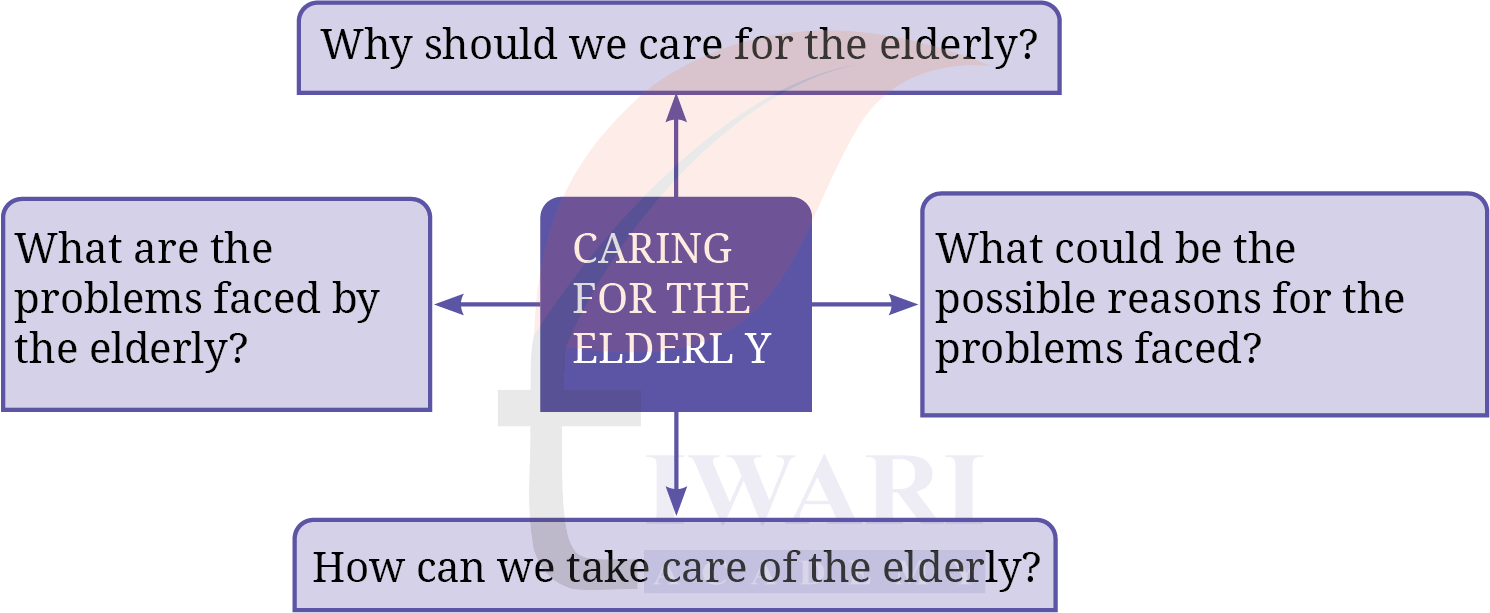
Now, discuss the points written in the organiser with your classmates and teacher.
See AnswerWhy should we care for the elderly?
They have spent their lives caring for us. They carry wisdom, experience and love. It is our moral and social responsibility to return their care and ensure their dignity in old age.
What are the problems faced by the elderly?
‣ Failing memory, weak eyesight and hearing
‣ Physical weakness and risk of falls
‣ Loneliness and feeling of being a burden
‣ Dependence on others for daily needs
‣ Health issues requiring regular medicines
What could be the possible reasons for the problems faced?
‣ Old age causing natural physical and mental decline
‣ Nuclear family system leaving elders alone
‣ Children being busy with work and their own lives
‣ Shift from hometown to city, causing displacement and stress
How can we take care of the elderly?
‣ Spend quality time with them
‣ Help with medicines and doctor visits
‣ Listen to their stories and experiences
‣ Make them feel loved, respected and included.
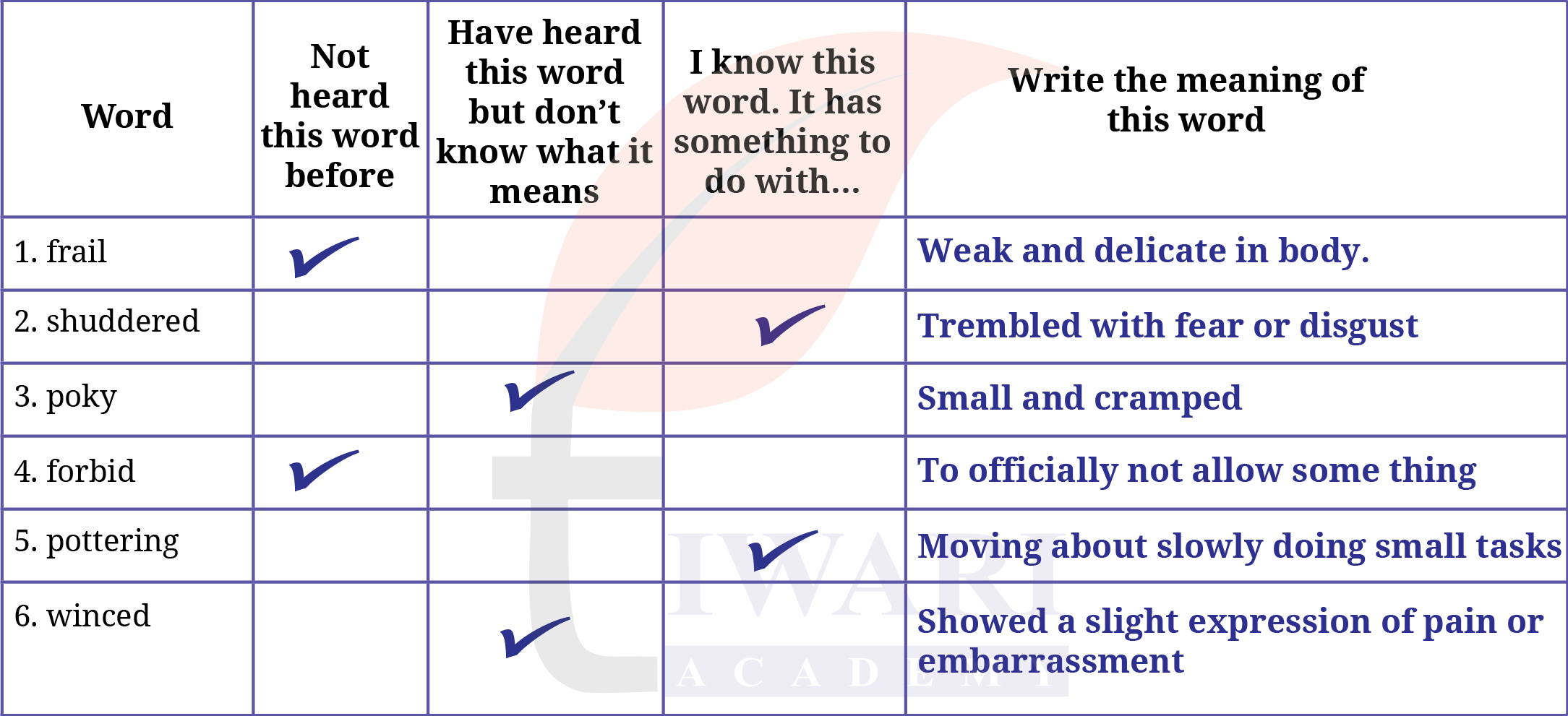
II. Fill in the table given below. You may check your answers with the help of dictionary.
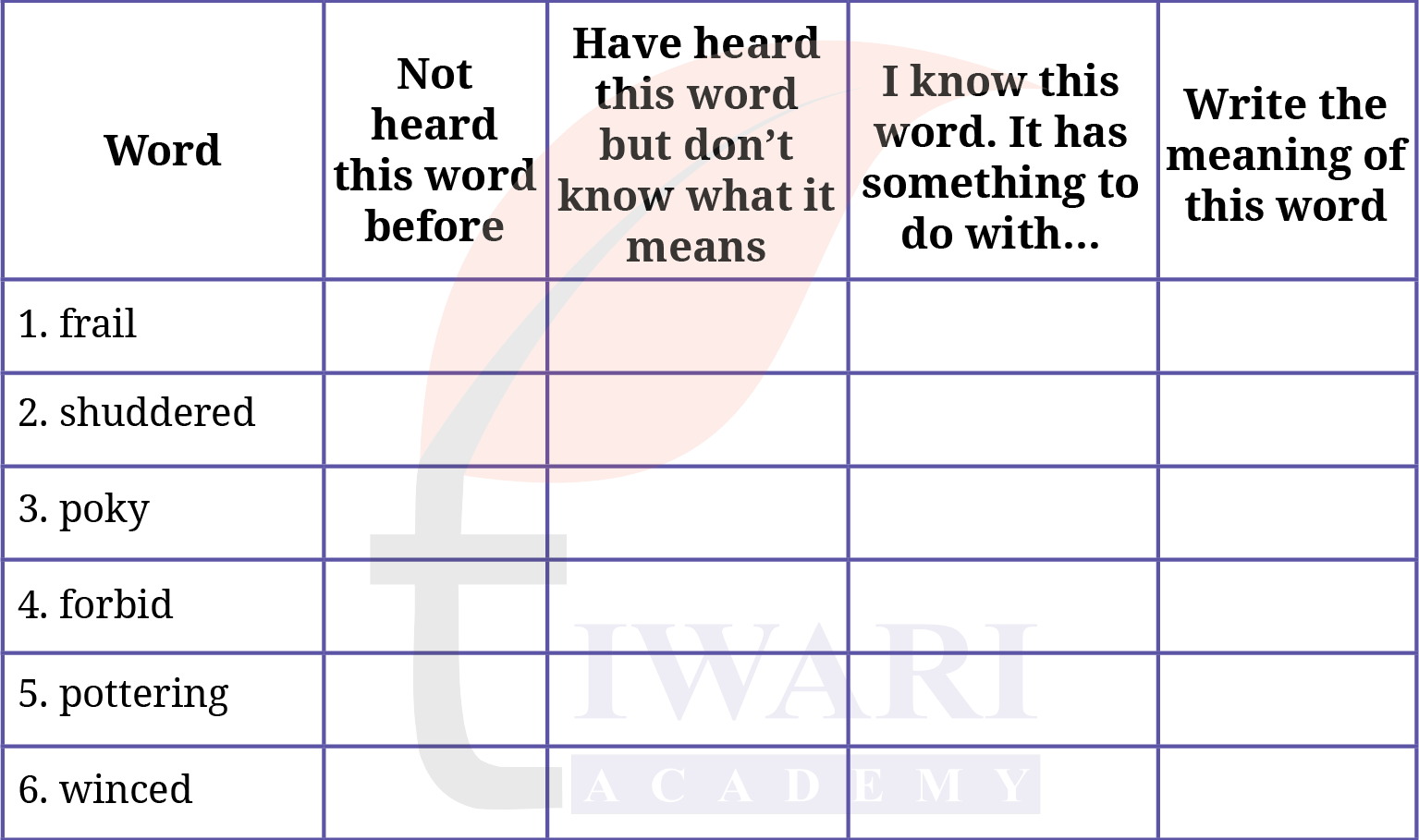
Answer:
III. Think of a tradition, story, or recipe passed down by grandparents or an elderly relative in your family. What does it mean to you? How does it connect you to your growing-up years? Share with your classmates and teacher.
See AnswerA Tradition Passed Down by My Grandparents
In my family, my grandmother has passed down a very special tradition – the recipe of making homemade pickle (achaar) every summer. Every year when mangoes arrive in the market, my grandmother would gather the whole family together and we would all sit in the courtyard, cutting raw mangoes, mixing spices and filling big clay jars with this homemade pickle.
This tradition means a great deal to me because it is not just about the pickle itself – it is about the togetherness and love that goes into making it. My grandmother would tell us stories of how her own mother taught her this recipe and how the same recipe has been passed down through generations in our family. Every spice had a specific measurement that she knew by heart and she never needed to write it down.
This connects me deeply to my growing-up years because the smell of mustard oil and spices instantly takes me back to those sunny summer afternoons in my grandmother’s home. It reminds me of the sound of her bangles clinking as she stirred the masala, the laughter of family members sitting together and the warmth of belonging to something bigger than myself.
Even today, whenever I taste that pickle, I do not just taste the food – I taste the memories, love, and wisdom of my grandmother. It teaches me that some of the most precious things in life are not bought from stores but are made with patience, care and tradition. This recipe is not just food for the body – it is food for the soul and I hope to pass it on to the next generation just as lovingly as it was passed on to me.
Page 102 – Check Your Understanding
I. Why did Grandpa dislike living in the city with his daughter?
See AnswerGrandpa disliked city life because he was used to the peace and quiet of his small brick house in town. He hated the noise and bustle of the city. He missed his large garden with a mango tree, where it was so quiet that at dusk one could even hear a leaf fall. The flat in the city felt “poky” and cramped to him. He also felt his freedom was taken away as he was not allowed to go out alone.
II. Why did Vidya not want her father to go out alone?
See AnswerVidya did not want her father to go out alone because of two frightening incidents that had already occurred. First, Grandpa had absent-mindedly taken a double dose of his medicines and had to be hospitalised. Second, he had gone for a walk once and forgotten his way back home, causing the whole family great anxiety. She feared for his safety and did not want any further accidents.
III. Was Ravi in favour of his mother treating Grandpa like a child? How can you say so?
See AnswerNo, Ravi was not in favour of it. We can tell this because Ravi winced when his mother spoke to Grandpa in an over-loud tone, as though speaking to a child who could not hear or understand properly. The word “winced” shows that Ravi felt uncomfortable and embarrassed by his mother’s behaviour. He felt it was disrespectful to treat an elderly person that way.
IV. Would Ravi be able to keep up his promise to his mother?
See AnswerNo, Ravi was not fully able to keep his promise. He had promised his mother that Grandpa would be fine at home with him, but when Grandpa decided to go out, Ravi found himself in a dilemma. He could not stop Grandpa without hurting his feelings, so instead he followed Grandpa secretly. Thus, he could not literally keep Grandpa at home as instructed.
Page 106 – Check Your Understanding
I. Complete the flow chart by describing Grandpa’s day out.
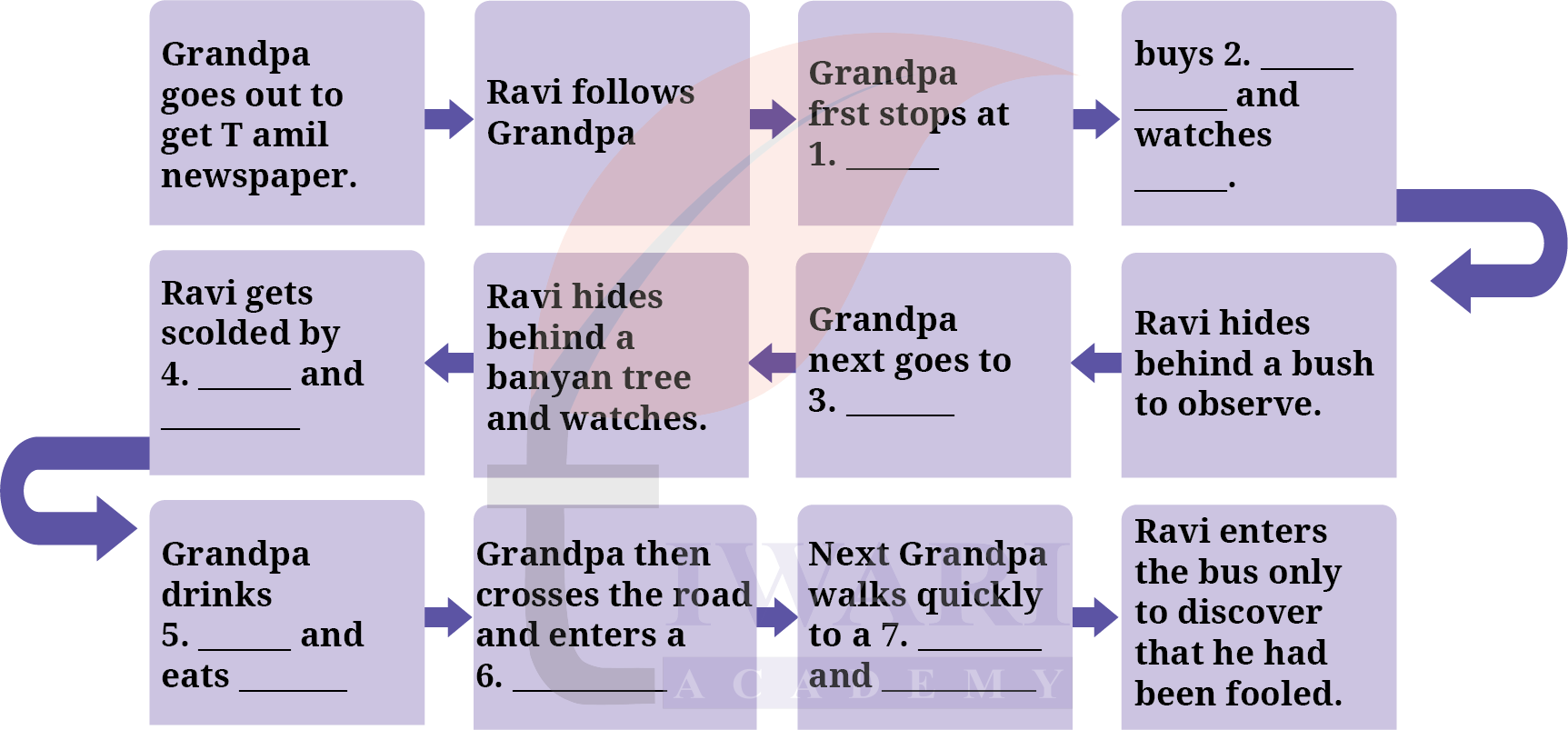
See Answer1. Grandpa first stops at the children’s park
2. buys a paper-cone of peanuts and watches children play
3. Grandpa next goes to the tea stall
4. Ravi gets scolded by a little boy’s mother and the vendor ladies
5. Grandpa drinks sugary tea and eats two bananas and an ice cream
6. Grandpa then crosses the road and enters a barber shop
7. Next Grandpa walks quickly to a bus stop and boards a bus.
II. Was Grandpa lost as feared by Ravi’s mother?
See AnswerNo, Grandpa was not lost. When Ravi returned home in a panic after losing track of Grandpa, he found Grandpa already back home, snoring peacefully in his bedroom. Grandpa had found his way back safely on his own.
III. How would Ravi feel after seeing Grandpa?
See AnswerRavi would feel immense relief and joy after seeing Grandpa safe at home. He had been frantic with worry and had even tried calling his parents. When he found Grandpa sleeping soundly, he knelt beside the bed and was suddenly overcome with deep affection for his grandfather. He gave him a hug, showing how much he cared.
IV. Do you think Ravi’s mother will get to know about what had happened?
See AnswerIt is unlikely that Ravi’s mother would come to know the full truth. Grandpa cleverly deflected by saying he had a quiet morning and that Ravi had “disappeared.” This put Ravi in an embarrassing spot rather than revealing that Grandpa had gone out alone. Grandpa’s gift of a detective story book was a subtle hint that he knew everything, but he chose not to expose Ravi or himself.
Page 109 – Check Your Understanding
I. Describe how Ravi’s emotional reaction upon finding Grandpa safe at home reveals his feelings towards his grandfather.
See AnswerWhen Ravi found Grandpa asleep at home, he was overcome with deep affection and relief. He knelt beside the bed, placed his cheek against the old man’s wrinkled face and hugged him even though Grandpa only grunted in his sleep. This tender, spontaneous act reveals that beneath the surface of daily caregiving, Ravi genuinely loves his grandfather. He had been sick with worry while searching for him, which shows the depth of his emotional bond with Grandpa.
II. What might be the significance of Grandpa’s habit of giving gifts to everyone on his birthday rather than receiving them?
See AnswerThis habit reveals Grandpa’s generous and loving nature. Even in old age, he thinks of bringing joy to others rather than expecting attention for himself. It also shows his sharp memory for what truly matters – relationships and love – even when he may seem forgetful in other ways. This tradition reflects his dignity and his desire to remain a giver rather than become someone who only receives care.
III. Why do you think Grandpa gave Ravi a detective story book as a gift? What might this suggest about Grandpa’s awareness of Ravi’s actions earlier in the day?
See AnswerThe gift of “The Best Detective Stories” is very significant. Grandpa even said it would help Ravi learn “how to avoid getting fooled when trailing a suspect”. This strongly suggests that Grandpa was fully aware that Ravi had been following him secretly throughout the day. He had noticed his young detective but chose to say nothing directly, instead giving the gift as a playful, humorous acknowledgement. The twinkle in Grandpa’s eye at the end also hints at this. It shows that Grandpa’s mind was far sharper than anyone gave him credit for.
Page 109 – Critical Reflection
I. Read the extracts given below and answer the questions that follow.
1. Grandpa hated the noise and bustle of city life and when they were on their own, he often spoke longingly of his small brick house in town. ‘Such a wonderful place…! With that big mango tree in the garden! It is so quiet that at dusky you can even hear a leaf fall!” But then Grandpa has slipped and fallen in the garden last one evening while he was pottering around and lain outside all night because there was no one at home to help him up.
(i) Choose the emotion displayed by the Grandfather.
A. regretful
B. apologetic
C. nostalgic
D. wistful
See AnswerC. nostalgic
(ii) Complete the following sentences with a reason.
Grandpa hated the busy and noisy city life because ________.
See AnswerGrandpa hated the busy and noisy city life because he was used to the quiet, peaceful surroundings of his small town home with a large garden, where the atmosphere was calm and he had his independence.
(iii) Why did Grandpa come to the city despite his dislike for city life?
See AnswerGrandpa came to live in the city because he had slipped and fallen in his garden one evening while pottering around and had lain outside all night as there was no one to help him. This incident showed he could no longer live alone safely, so his daughter Vidya locked up the house and brought him to live with the family.
(iv) Choose an expression similar in meaning to, ‘you can even hear a leaf fall”,
A. end of one’s life
B. arrival of autumn
C. sign of good luck
D. pin drop silence
See AnswerD. pin drop silence
(v) State one advantage and one disadvantage of the Grandfather living in the house in town.
See AnswerAdvantage:
He had his own space, independence, a peaceful garden, and was emotionally comfortable in familiar surroundings.
Disadvantage:
He lived alone with no one to help him in an emergency, which led to the dangerous accident when he fell and lay outside all night.
2. “I had a quiet morning, but I don’t know about Ravi, He just disappeared instead of staying at home at look after me like you told him to,” answered Grandpa coolly, while Ravi just looked confused and embarrassed.
Grandpa has another surprise for Ravi. A gift-wrapped parcel!
“But, Papa, Ravi’s birthday was three months ago. Have you forgotten?” exclaimed Ravi’s mother, impatiently.
(i) Choose the option that displays the tone of the Grandfather’s response.
A. apologetic
B. hurtful
C. calm
D. puzzled
See AnswerC. calm
(ii) Why was Ravi confused and embarrassed?
See AnswerRavi was confused and embarrassed because Grandpa coolly told Ravi’s mother that Ravi had “disappeared” instead of staying home to look after him. Ravi knew the truth – that he had been secretly following Grandpa – but could not explain himself without revealing that he had let Grandpa go out alone. He was caught between guilt and the impossibility of defending himself.
(iii) Complete the sentence with a suitable reason.
Ravi’s mother was impatient because ____________.
See AnswerRavi’s mother was impatient because she thought Grandpa had forgotten Ravi’s birthday and was confused about why he was giving a gift at the wrong time, as she had reminded herself of his birthday by marking it on the calendar.
(iv) State whether the following sentences is true or false.
Grandfather forgot the Ravi’s birthday was three months ago.
See AnswerFalse
(v) Why did Grandpa say he didn’t know what kind of morning Ravi might have had?
See AnswerGrandpa said this cleverly to highlight that Ravi had been out of the house instead of staying home to care for him as instructed. It was Grandpa’s witty and indirect way of protecting his own secret (that he had gone out) while gently putting Ravi in an awkward position. It also subtly showed that Grandpa was fully aware of Ravi’s absence.
II. Answer the following questions.
1. Grandpa is portrayed as a person with failing memory in the beginning of the story. Give two evidences to disprove the statement.
See AnswerEvidence 1: Grandpa remembered detailed chess games – he would cite the exact moves of grandmasters like Karpov and Bobby Fischer, showing a remarkably sharp and detailed long-term memory.
Evidence 2: Grandpa remembered his own tradition of giving gifts to everyone on his birthday and even had gifts ready for his daughter, son in law, and Ravi – while his daughter, who had marked the date in red on the calender, had still forgotten it was his birthday. This proves Grandpa’s memory was functioning well for meaningful things.
2. Give two characteristic traits of each of the following characters.
(i) Grandfather
(ii) Ravi
(iii) Ravi’s mother
See Answer(i) Grandfather:
• Dignified and independent: He resisted being treated like a child and insisted on his right to go out alone, showing pride in his self-sufficiency.
• Generous and loving: He gave gifts to everyone on his own birthday and even gave his cap to a stranger on a hot day.
(ii) Ravi:
• Caring and responsible: He secretly followed Grandpa to ensure his safety, going through great embarrassment to protect him.
• Sensitive and empathetic: He winced when his mother spoke to Grandpa condescendingly, showing emotional maturity and respect for his grandfather’s dignity.
(iii) Ravi’s mother (Vidya):
• Anxious and protective: She was constantly worried about Grandpa’s safety and gave Ravi detailed instructions before leaving for work.
• Somewhat insensitive: She spoke to Grandpa in an over-loud tone as though he were a child, not realising this hurt his dignity.
3. Why was Ravi worried about what Grandfather had at the tea stall?
See AnswerRavi was worried because Grandpa was consuming things that were strictly forbidden at home for health reasons – sugary tea (sugar was banned), two bananas (another prohibited item) and an ice cream. Ravi was aware that these were restricted because of Grandpa’s age and health condition. He imagined his mother’s horrified reaction, thinking “Mother would faint if she saw this!” He was helpless to intervene without revealing he had been following Grandpa.
4. Do you think it was easy for Ravi to follow his Grandfather? If yes, why? If no, why not?
See AnswerNo, it was not easy for Ravi to follow Grandpa at all. He faced several embarrassing and difficult situations throughout. He was scolded by a little boy’s mother while hiding behind a bush, was mistaken for a vendor by the ladies near the banyan tree and was surrounded by them, was thrown out of a Ladies’ Hairdressing Salon and finally boarded a bus only to discover he had been following the wrong person. He was exhausted, hot and humiliated throughout the ordeal.
5. ‘Ravi is a good detective’. Give one argument in favour of and against the given statement.
See AnswerIn favour: Ravi showed commitment and persistence by following Grandpa through multiple locations – the park, the tea stall, across the road and even onto a bus – all while trying to remain unseen. His intention to protect Grandpa was sincere and well-motivated.
Against: Ravi was repeatedly discovered and embarrassed at every hiding spot. He ultimately lost track of Grandpa and ended up following a complete stranger onto a bus. As Grandpa’s gift of the detective book humorously implied, Ravi still had a great deal to learn about the art of trailing a suspect without being noticed.
6. Was Grandfather aware that Ravi was following him? How do you know?
See AnswerYes, Grandpa was almost certainly aware that Ravi had been following him. The clearest evidence is the gift he gave Ravi – “The Best Detective Stories” – with the remark that it would teach him “how to avoid getting fooled when one is trailing a suspect”. This is a direct, playful reference to Ravi’s failed attempt at surveillance. The “twinkle” in Grandpa’s eye at the end further confirms that he knew exactly what had happened, but chose to handle it with humour rather than confrontation.
7. In your opinion, who needs Vitamin-M? And why?
See AnswerIn this story, ironically, it is Ravi’s mother Vidya who needs Vitamin-M the most. While she worried about Grandpa’s memory, she herself had forgotten Grandpa’s important tradition of giving gifts on his own birthday – even though she had marked the date on the calendar! Grandpa even turned this around beautifully by telling Ravi’s father that his daughter needed Vitamin-M for her memory. The story cleverly shows that memory loss is not limited to the elderly alone.
8. Some people believe society shows bias based on age (being young or old). Give an example where you might have experienced or observed such discrimination, when opinions were disregarded because of age.
See AnswerOne common example of age-based discrimination is when elderly people’s opinions are dismissed in family decisions. For instance, when an old grandparent suggests a traditional remedy or advises caution about something, younger family members often ignore it saying “times have changed” or “you don’t understand modern life.” Similarly, young people’s ideas are sometimes rejected in professional settings simply because they “lack experience.” In both cases, the person’s actual wisdom or capability is overlooked simply because of their age.
Page 111 – Vacabulary and Structures in Context
I. Classify the words given in the box on the next page into movement words in Column 1 and sound words in Column 2. One example has been done for you.
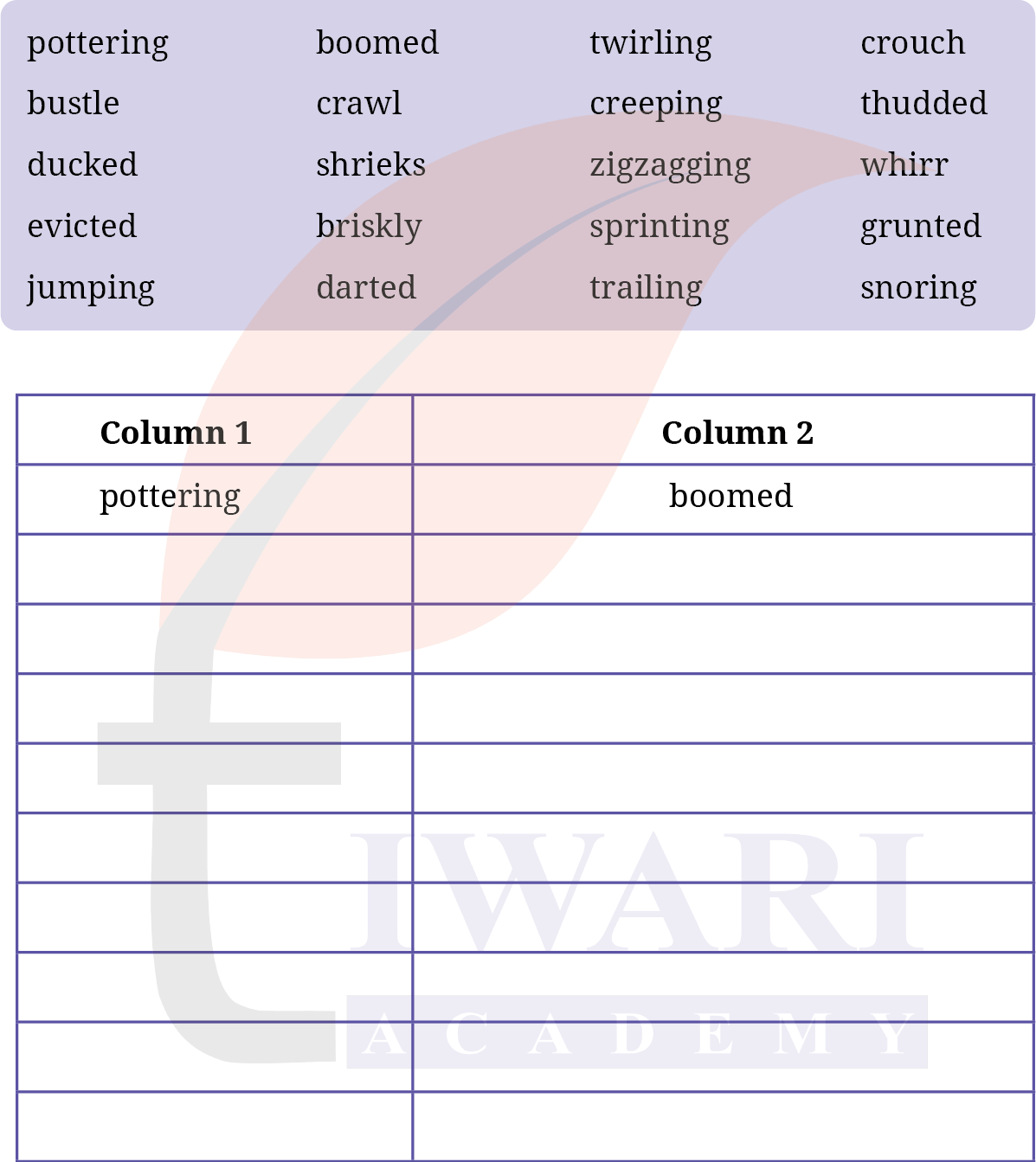
Now, fill in the blanks with appropriate words from Column 1 or Column 2.
Detective Shankar, 1. _____________ the mysterious suspect through the dimly lit side lanes, away from the 2. _____________ of the city, quickened his pace 3. _____________. The suspect’s heavy footsteps 4. _____________ across the street, unaware of the pursuit. Shankar 5. _____________ his magnifying glass had to 6. _____________ behind the market stalls, 7. _____________ through the lanes to avoid being seen. Shankar 8. _____________ when he hit himself against a pole. This alarmed the suspect and he 9. _____________ into the might leaving only the distant 10. _____________ of the sleeping city behind.
Answer:
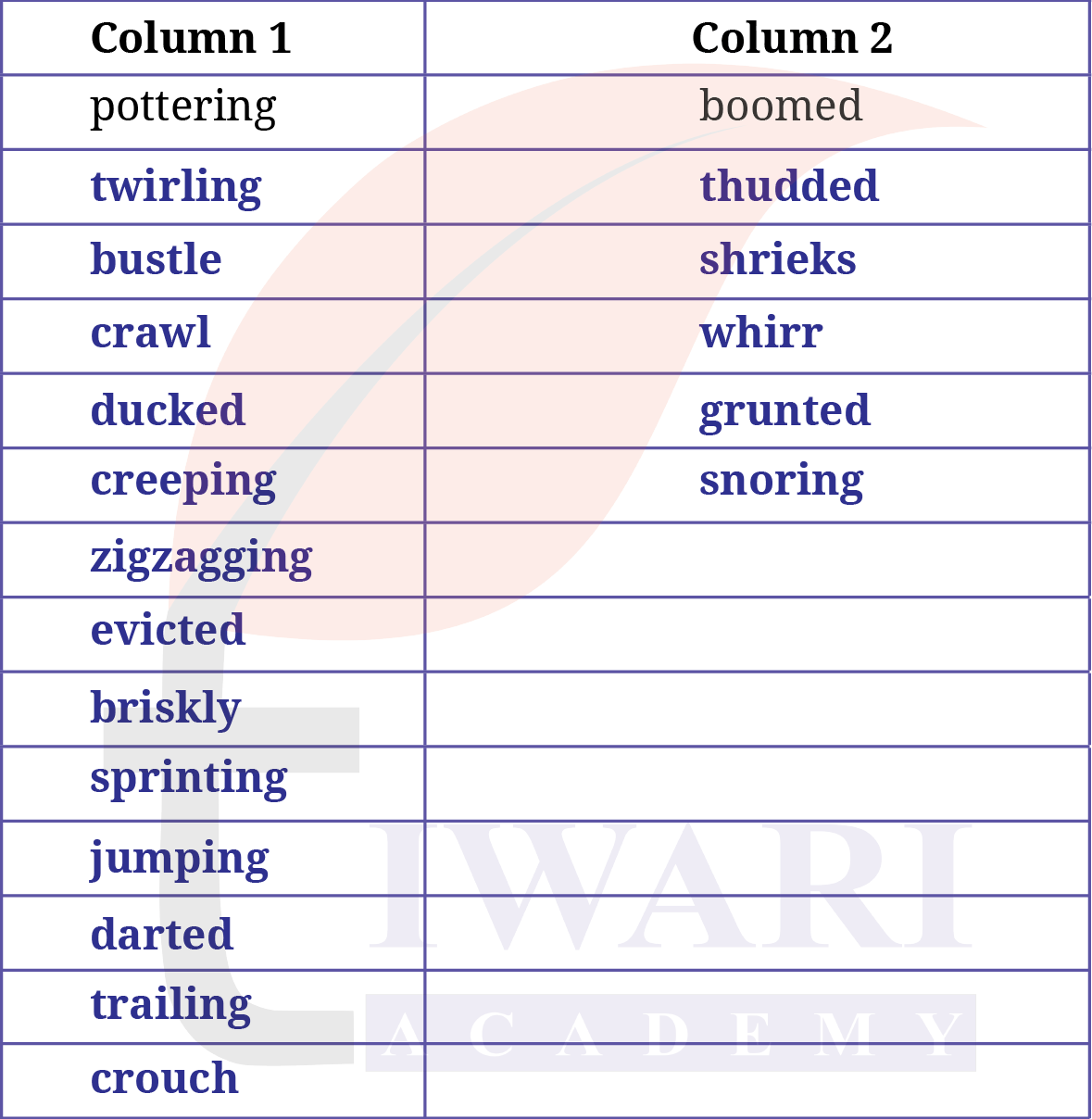
Detective Shankar, 1. trailing the mysterious suspect through the dimly lit side lanes, away from the 2. bustle of the city, quickened his pace 3. briskly. The suspect’s heavy footsteps 4. thudded across the street, unaware of the pursuit. Shankar 5. darted his magnifying glass had to 6. crouch behind the market stalls, 7. creeping through the lanes to avoid being seen. Shankar 8. grunted when he hit himself against a pole. This alarmed the suspect and he 9. sprinting/ducked into the might leaving only the distant 10. whirr/snoring of the sleeping city behind.
II. Study the highlighted word in the given sentence from the text and fill in the boxes with synonymous words You may refer to a dictionary.
Off he went, twirling his walking stick jauntily, leaving Ravi in a dilemma.

Answer:

III. Fill in the table given below. Check your answers with the help of a dictionary.
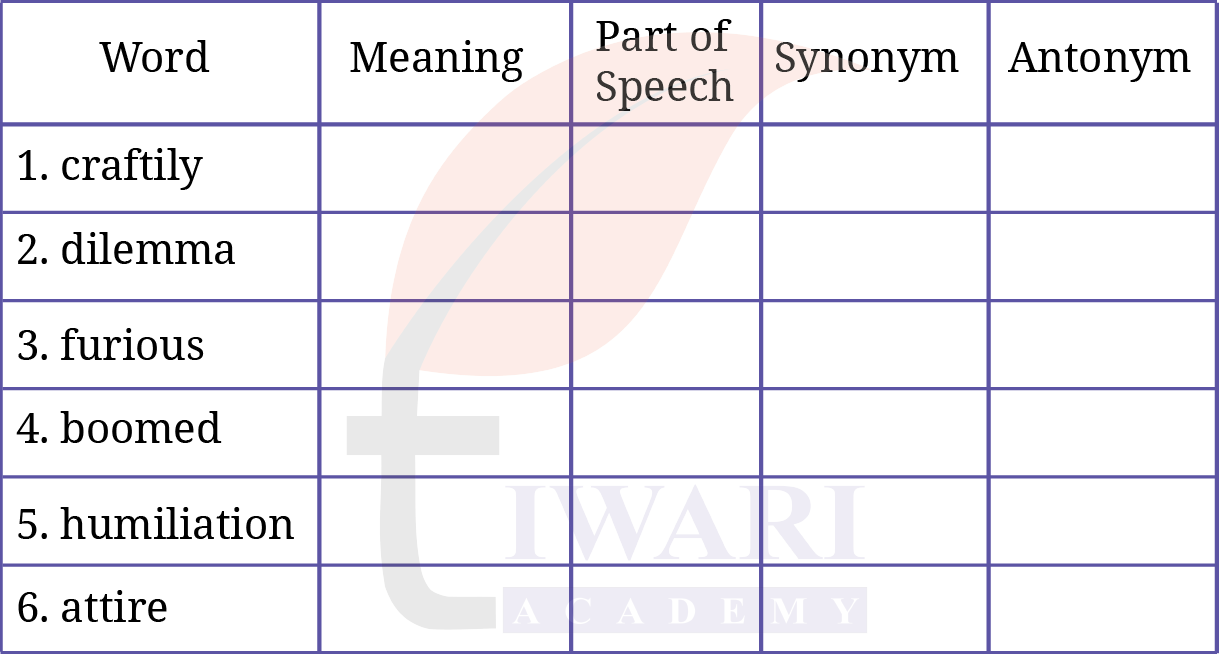
Answer:
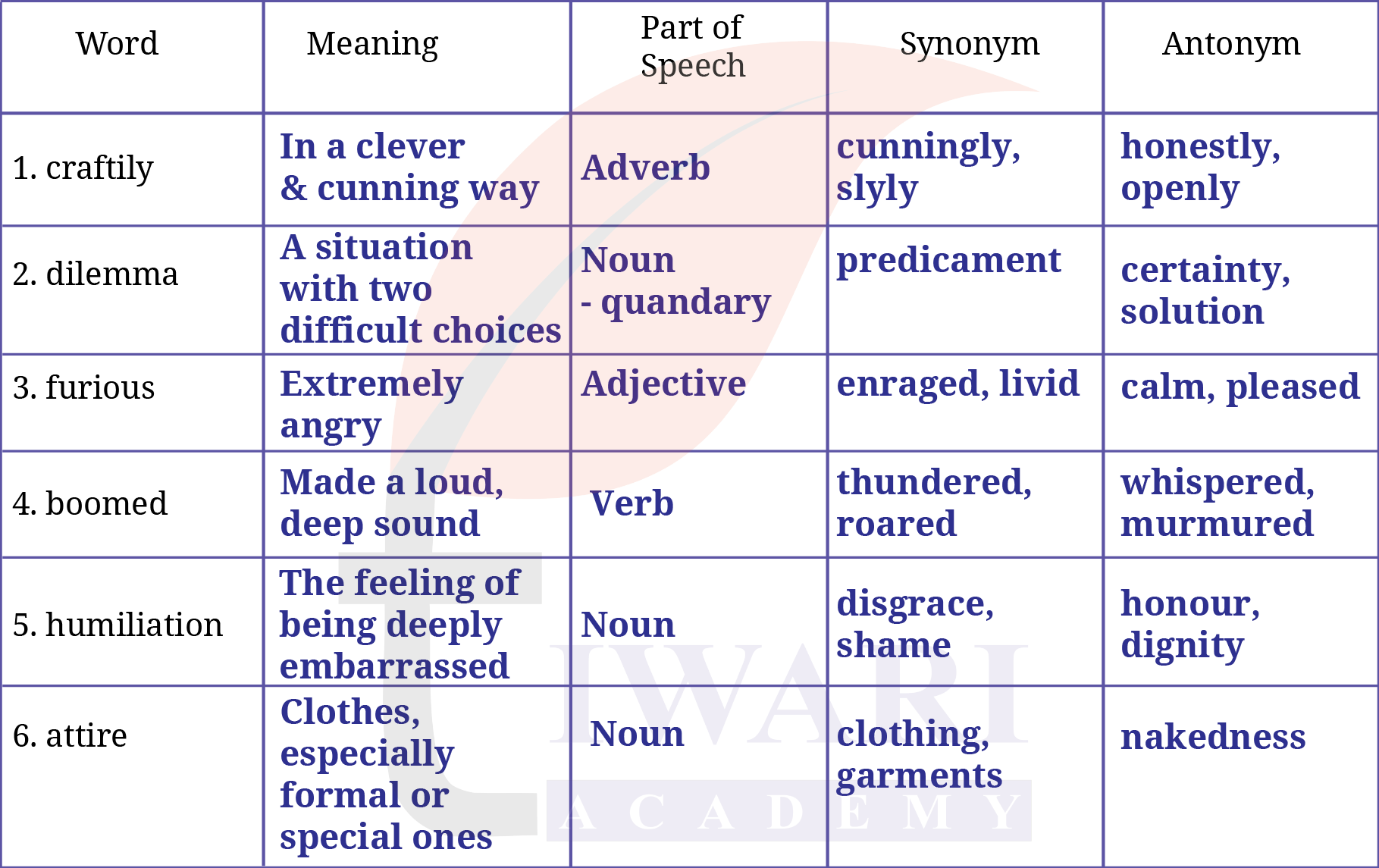
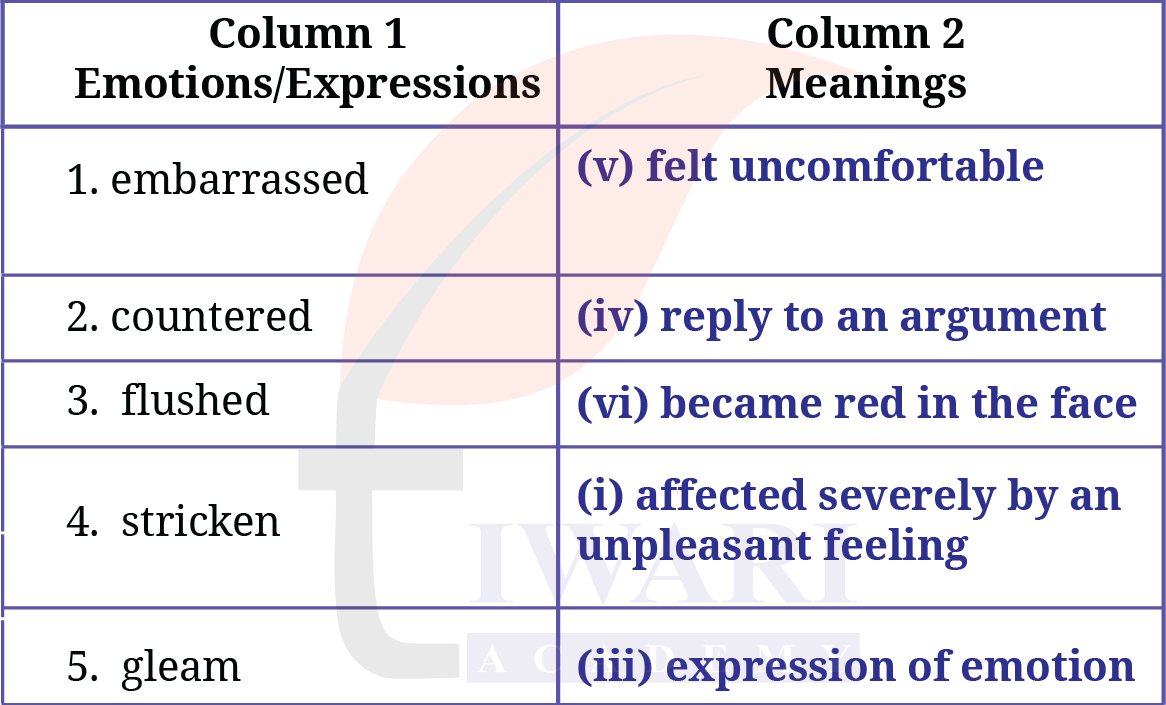
IV. Match the emotions/expressions in Column 1 with their meanings in Column 2. One meaning is extra.
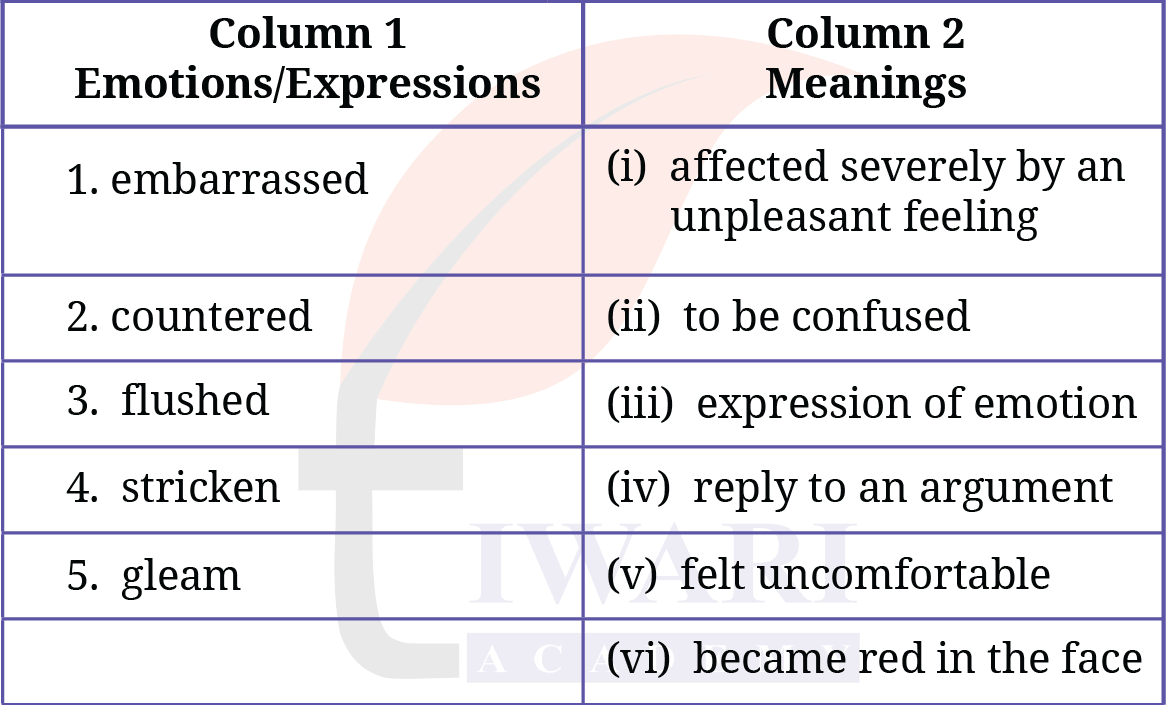
Answer:
V. Read the highlighted words in the following phrases from the story. Now revisit the story and underline the prepositions.
- I’ll just walk across to the corner shop…
- …he felt a shadow fall over him…
- …the vendors sitting under the tree…
- Ravi took position behind a big banyan…
time or manner.
Now, fill in the blanks with appropriate prepositions.
I walked (i) ___________ (through, between, against) the village, crossed a bridge (ii) ___________ (over, under, beside) a brook, and found a quiet garden (iii) ___________ (among, near, across) a cottage. Sitting on a bench (iv) ___________ (on, at, in) the garden, I enjoyed the peaceful surroundings. Later, I strolled (v) ___________ (beside, through along) a riverbank, exploring the forest and heading (vi) ___________ (into, towards, beyond) the unknown.
See AnswerI walked (i) through (through, between, against) the village, crossed a bridge (ii) over (over, under, beside) a brook, and found a quiet garden (iii) near (among, near, across) a cottage. Sitting on a bench (iv) in (on, at, in) the garden, I enjoyed the peaceful surroundings. Later, I strolled (v) along (beside, through along) a riverbank, exploring the forest and heading (vi) towards (into, towards, beyond) the unknown.
VI. Read the following dialogues from the story.
- “Shall we play chess or watch the cricket match on TV, Grandpa”? asked Ravi,
- “Who are you?” said the little boy’s mother.
- “What did you both do today?” asked Ravi’s mother
- “Have you forgotten?” countered Grandpa
- A small child came up to him and asked, “Are you playing hide and seek?”
Now choose the correct answer.
A. The words in the quotes are (i) _________________ (exclamatory/interrogative) sentences.
B. Sentences 1, 4 and 5 are (ii) _________________ (Wh-/Yes, No type) interrogative sentences.
C. Sentences 2 and 3 are (iii) _________________ (Wh-/Yes, No type) interrogative sentences.
So there are (iv) _________________ (two/three) types of interrogative sentences.
See AnswerA. The words in the quotes are (i) interrogative sentences.
B. Sentences 1, 4 and 5 are (ii) Yes, No type interrogative sentences.
C. Sentences 2 and 3 are (iii) Wh- type interrogative sentences.
So there are (iv) two types of interrogative sentences.
D. Let us have a quick glance at a few guidelines to remind you of the changes while transforming from direct form of speech to indirect. You can ask your teacher for more inputs.
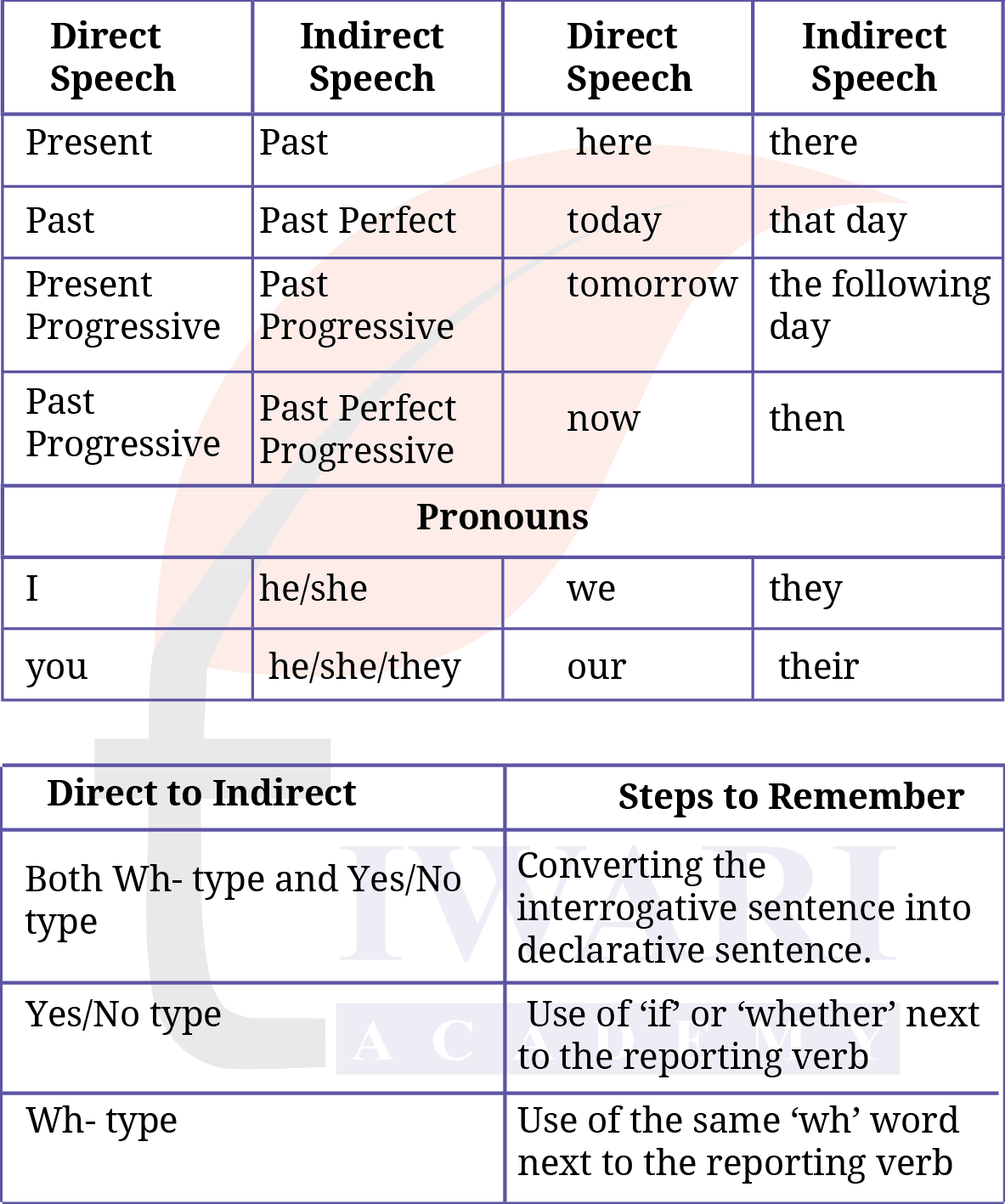
VII Read the following conversation.
ARVIND: Do you help in taking care of your grandparents at home?
PRIYA: Yes, I do. We take turns making sure they’re alright. Do you have grandparents living with you?
ARVIND: No. My parents and I visit my grandpa every weekend. How do you manage your grandparent’s medical needs?
PRIYA: We have a schedule for giving medications and visits to the doctor.
Now, complete the following sentences in reported speech.
Arvind asked Priya if she 1. ________________ for which Priya replied in the affirmative and said that they 2. ________________. Priya further asked Arvind 3. ________________ . Arvind replied in the negative and said that 4. ________________ every weekend. He further enquired 5. ________________ . Priya responded by saying that they 6. ________________
See AnswerArvind asked Priya if she 1. 𝗵𝗲𝗹𝗽𝗲𝗱 𝗶𝗻 𝘁𝗮𝗸𝗶𝗻𝗴 𝗰𝗮𝗿𝗲 𝗼𝗳 𝗵𝗲𝗿 𝗴𝗿𝗮𝗻𝗱𝗽𝗮𝗿𝗲𝗻𝘁𝘀 𝗮𝘁 𝗵𝗼𝗺𝗲, for which Priya replied in the affirmative and said that they 2. 𝘁𝗼𝗼𝗸 𝘁𝘂𝗿𝗻𝘀 𝗺𝗮𝗸𝗶𝗻𝗴 𝘀𝘂𝗿𝗲 𝘁𝗵𝗲𝘆 𝘄𝗲𝗿𝗲 𝗮𝗹𝗿𝗶𝗴𝗵𝘁.
Priya further asked Arvind 3. 𝗶𝗳 𝗵𝗲 𝗵𝗮𝗱 𝗴𝗿𝗮𝗻𝗱𝗽𝗮𝗿𝗲𝗻𝘁𝘀 𝗹𝗶𝘃𝗶𝗻𝗴 𝘄𝗶𝘁𝗵 𝗵𝗶𝗺.
Arvind replied in the negative and said that 4. 𝗵𝗶𝘀 𝗽𝗮𝗿𝗲𝗻𝘁𝘀 𝗮𝗻𝗱 𝗵𝗲 𝘃𝗶𝘀𝗶𝘁𝗲𝗱 𝗵𝗶𝘀 𝗴𝗿𝗮𝗻𝗱𝗽𝗮 every weekend.
He further enquired 5. 𝗵𝗼𝘄 𝘀𝗵𝗲 𝗺𝗮𝗻𝗮𝗴𝗲𝗱 𝗵𝗲𝗿 𝗴𝗿𝗮𝗻𝗱𝗽𝗮𝗿𝗲𝗻𝘁𝘀’ 𝗺𝗲𝗱𝗶𝗰𝗮𝗹 𝗻𝗲𝗲𝗱𝘀.
Priya responded by saying that they 6. 𝗵𝗮𝗱 𝗮 𝘀𝗰𝗵𝗲𝗱𝘂𝗹𝗲 𝗳𝗼𝗿 𝗴𝗶𝘃𝗶𝗻𝗴 𝗺𝗲𝗱𝗶𝗰𝗮𝘁𝗶𝗼𝗻𝘀 𝗮𝗻𝗱 𝘃𝗶𝘀𝗶𝘁𝘀 𝘁𝗼 𝘁𝗵𝗲 𝗱𝗼𝗰𝘁𝗼𝗿.
Page 116 – Listen and Respond
I You will listen to a podcast on meditation. As you listen complete the sentences with not more than three exact words that you hear.
(Transcript for teacher on page 266)
1. Meditation is a form of yoga that usually refreshes the mind and helps with _____________.
2. Meditation leads to a better health condition both _____________.
3. Meditation also aids in lessening undesirable feelings and improving _____________.
4. It is advised that we meditate everyday so that it becomes a _____________.
5. Meditating on a daily basis is beneficial in comfortably tackling _____________.
See Answer1. Meditation is a form of yoga that usually refreshes the mind and helps with 𝘀𝘁𝗿𝗲𝘀𝘀 𝗺𝗮𝗻𝗮𝗴𝗲𝗺𝗲𝗻𝘁.
2. Meditation leads to a better health condition both 𝗽𝗵𝘆𝘀𝗶𝗰𝗮𝗹𝗹𝘆 𝗮𝗻𝗱 𝗲𝗺𝗼𝘁𝗶𝗼𝗻𝗮𝗹𝗹𝘆.
3. Meditation also aids in lessening undesirable feelings and improving 𝘀𝗲𝗹𝗳-𝗮𝘄𝗮𝗿𝗲𝗻𝗲𝘀𝘀.
4. It is advised that we meditate every day so that it becomes a 𝗿𝗲𝗴𝘂𝗹𝗮𝗿 𝗿𝗼𝘂𝘁𝗶𝗻𝗲.
5. Meditating on a daily basis is beneficial in comfortably tackling 𝗲𝘅𝗮𝗺-𝗿𝗲𝗹𝗮𝘁𝗲𝗱 𝗽𝗿𝗲𝘀𝘀𝘂𝗿𝗲.
Page 119 – Writing Task
I. As you read in the story, we have a lot of learn from our elderly. Based on the lessons learned from them, write an article for your school magazine on the topic ‘Our Inspiring Elderly’
Organise the article in the manner given below.
Follow the steps given below to write an article about your skills and passions
Write the title at the top and your name and grade below it.
Paragraph 1: Give a brief introduction to the topic. Focus on the main idea, but do not give any details.
Paragraph 2: Give details to support the main idea – how the elderly inspire, Include examples, facts and quotations.
Paragraph 3: Elaborate on how they overcame challenges and the inspiring impact on you.
Paragraph 4: Conclude with a final comment on the topic and leave the reader with the most important ideas to think about.
Answer:
Article: Our Inspiring Elderly
Our Inspiring Elderly By Mohit, Class IX
In every family, there lives a treasure that money cannot buy — our elderly. They are our grandparents, great-uncles and aunts, neighbours, and teachers who have lived through decades of change, struggle and growth. They carry within them a wealth of wisdom, patience and love that the modern world is in danger of forgetting.
The elderly inspire us in countless ways. Grandpa in the story “Vitamin-M” remembered thousands of chess games in perfect detail and gave thoughtful, meaningful gifts to every member of his family on his own birthday — showing that true intelligence and love do not diminish with age. Many elderly people have built careers, raised families and survived hardships that today’s generation cannot imagine. Their stories of resilience, sacrifice and quiet courage are living lessons that no textbook can offer.
What makes the elderly truly inspiring is how they overcame the challenges of their time with very limited resources. They did not have smartphones or the internet, yet they solved complex problems, preserved relationships, and built communities with patience and hard work. In my own life, my grandfather’s stories of his struggles have taught me to be grateful, to persevere and never to give up when things get difficult. His calm strength in the face of adversity has shaped my character more than any formal lesson.
The elderly are not a burden – they are a blessing. In a world that is racing forward at breathtaking speed, they remind us to slow down, to value what truly matters, and to never lose sight of our roots. Let us honour them not just with care, but with genuine respect, time, and love. After all, we too will grow old one day – and how we treat our elderly today is the example we set for the generations that follow us.
Learning Beyond the Text
I. Revisit the story and choose the image that correctly displays Grandpa’s walking stick.

Answer:

Kaveri Chapter 4 Poem Question Answers
Class 9 English Chapter 4 Poem – Quesiton Answers and Solutions
Page 126 – Reflect and Respond
I. Work in pairs. Discuss the memories from your childhood that you remember. List them and share with your classmates and teacher.
See AnswerSome memorable childhood memories include:
• Playing in the rain with friends in the neighbourhood
• Listening to bedtime stories told by grandparents
• The smell of freshly cooked food when coming home from school
• Celebrating festivals with the whole family gathered together
• Flying kites on the terrace during summer holidays
• The excitement of the first day of a new school year.
II. Discuss how children’s relationship with their mother can influence their emotions and memories.
See AnswerA mother’s presence leaves the deepest impressions on a child’s mind and heart. Her voice, her touch, her smell, and even the songs she hums become permanently embedded in a child’s memory. These sensory memories often resurface unexpectedly – triggered by a familiar scent, a tune, or a sight – even years later. A mother’s love provides a child with emotional security and warmth, and when she is absent, that emptiness shapes the child’s emotional world profoundly. The poem “I Cannot Remember My Mother” is a perfect example of how a mother’s presence, even when forgotten consciously, lives on through the senses.
III. Match the words given in Column 1 with their meanings in Column 2.
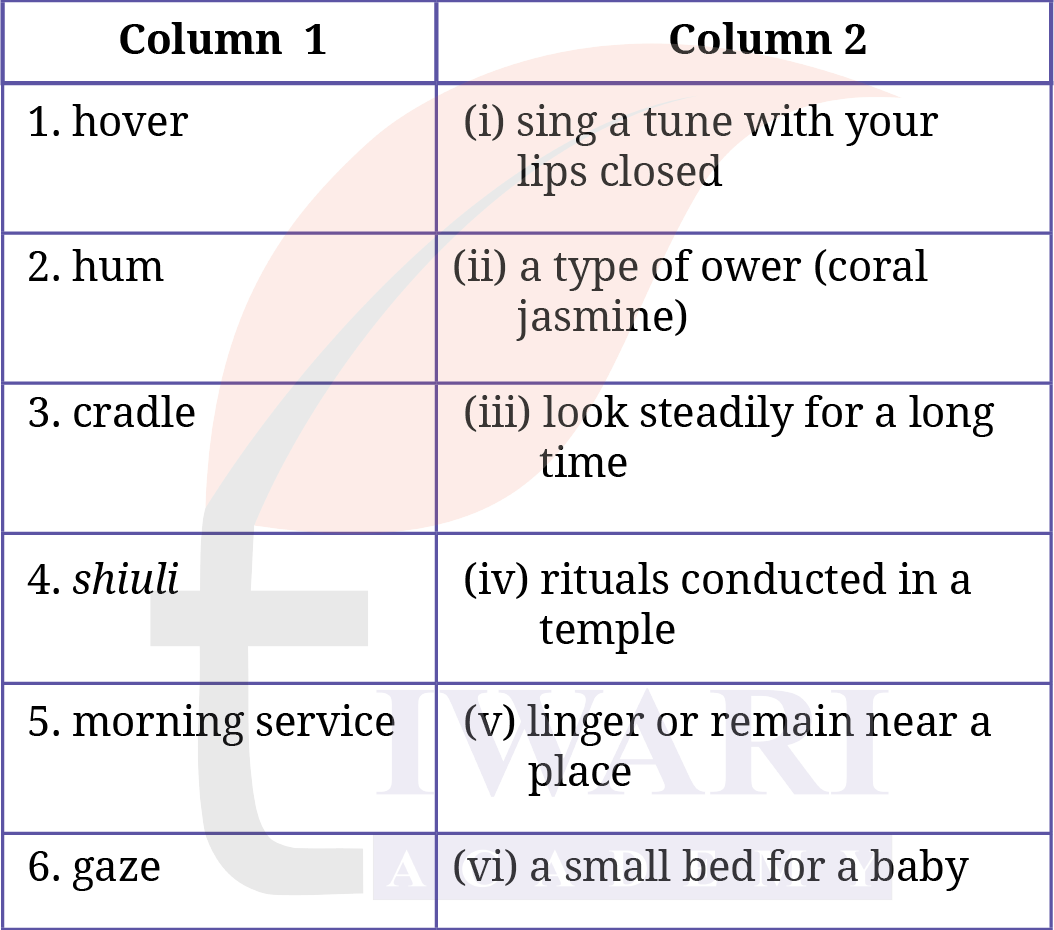
Answer:
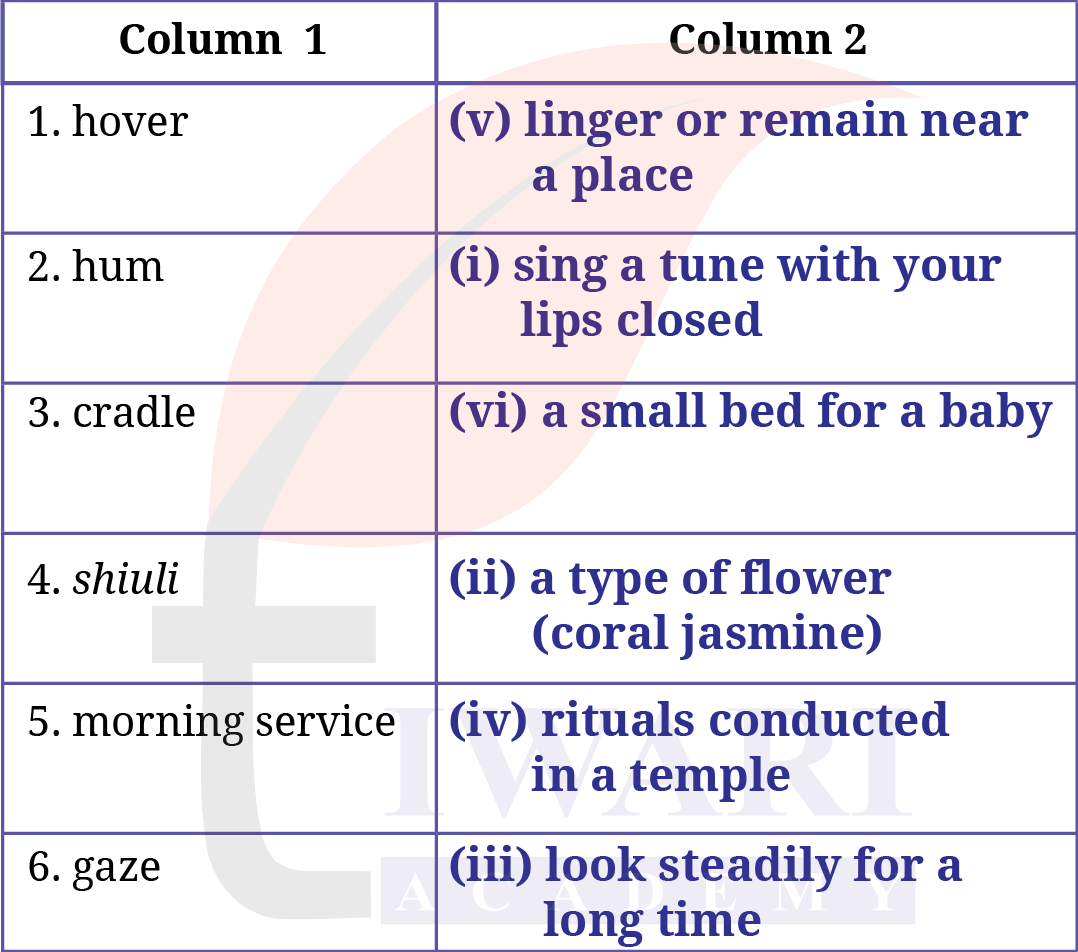
Page 127 – Check Your Understanding
I. Fill in the blanks with appropriate words
Stanza 1
1. The poet remembers his mother while the ____________.
2. The poet remembers the ____________ but not the ____________.
Setting: ____________ (outdoor/indoor)
Stanza 2
1. The poet remembers his mother in the ____________ season.
2. The poet remembers his mother by the smell of ____________.
Setting: ____________(outdoor/indoor)
Stanza 3
1. The poet feels that his mother ____________ at him from the ____________.
Setting: ____________ (outdoor/indoor)
See AnswerStanza 1:
1. The poet remembers his mother while he 𝗶𝘀 𝗶𝗻 𝘁𝗵𝗲 𝗺𝗶𝗱𝘀𝘁 𝗼𝗳 𝗽𝗹𝗮𝘆.
2. The poet remembers the 𝘁𝘂𝗻𝗲 but not the 𝘄𝗼𝗿𝗱𝘀 𝗼𝗳 𝘁𝗵𝗲 𝘀𝗼𝗻𝗴 / 𝗹𝘆𝗿𝗶𝗰𝘀.
Setting: 𝗶𝗻𝗱𝗼𝗼𝗿
Stanza 2:
1. The poet remembers his mother in the 𝗮𝘂𝘁𝘂𝗺𝗻 season.
2. The poet remembers his mother by the smell of 𝘀𝗵𝗶𝘂𝗹𝗶 𝗳𝗹𝗼𝘄𝗲𝗿𝘀.
Setting: 𝗼𝘂𝘁𝗱𝗼𝗼𝗿
Stanza 3:
1. The poet feels that his mother 𝗴𝗮𝘇𝗲𝘀 at him from the 𝘀𝗸𝘆.
Setting: 𝗶𝗻𝗱𝗼𝗼𝗿
II. The senses of olfactory (smell), auditory (hearing), and visuals (sight), are three of the five basic senses in humans. Give examples of reference to senses from the poem. Complete the table given below.
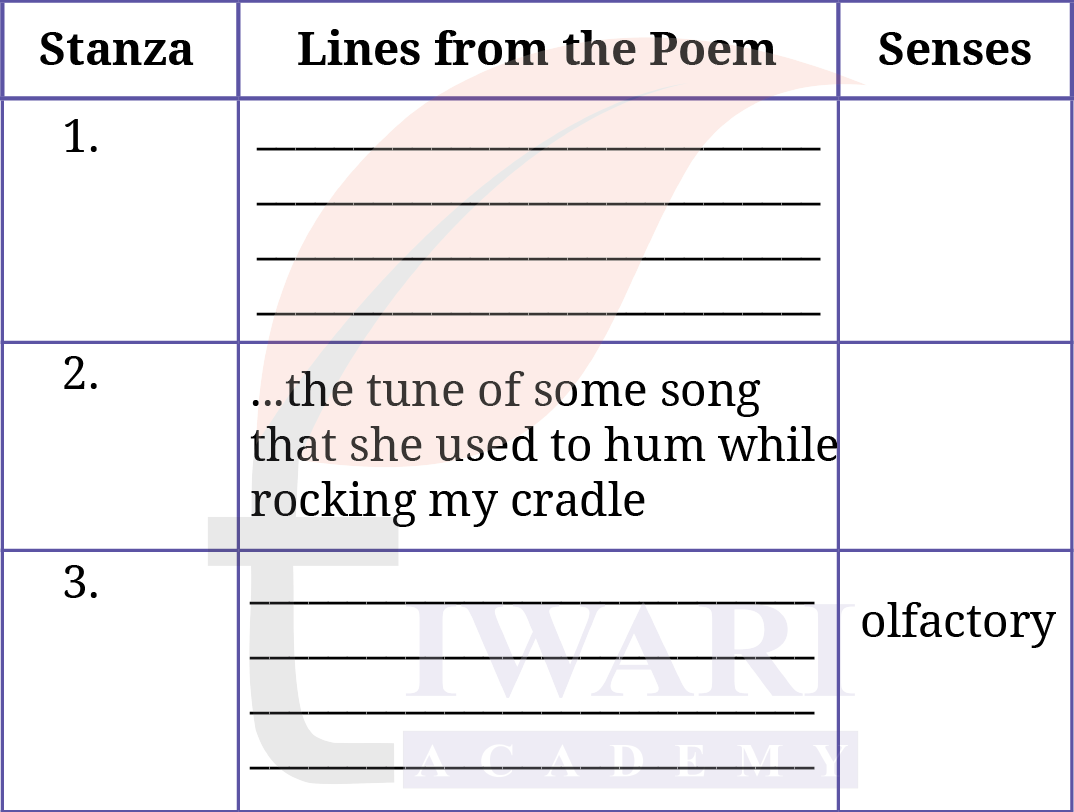
Answer:
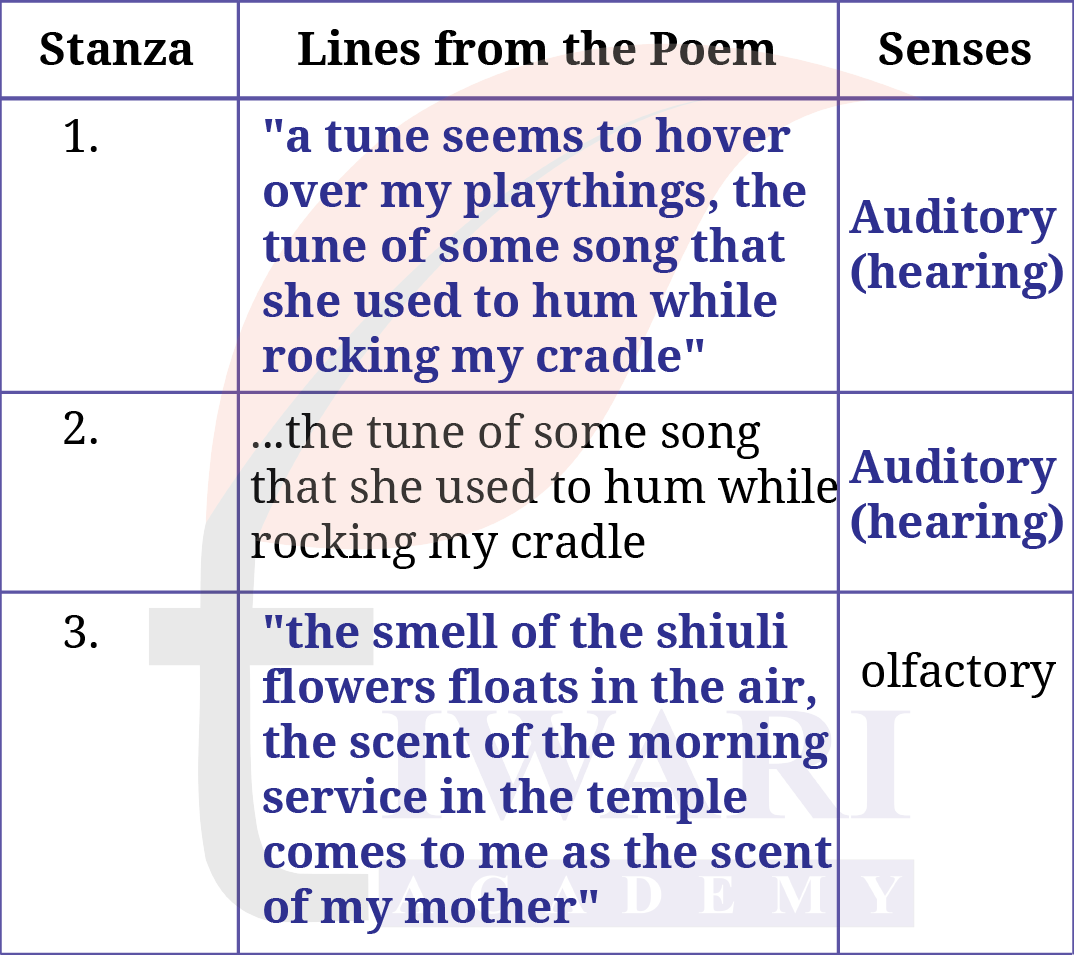
III. Read the poem silently once again and complete the following.
1. Two examples of alliteration from the poem are (i) ___________ and (ii) ___________.
See AnswerTwo examples of alliteration from the poem are (𝗶) 𝘀𝘁𝗶𝗹𝗹𝗻𝗲𝘀𝘀… 𝘀𝗸𝘆 and (𝗶𝗶) 𝘀𝗺𝗲𝗹𝗹 𝗼𝗳 𝘁𝗵𝗲 𝘀𝗵𝗶𝘂𝗹𝗶.
2. An example of onomatopoeia is ___________.
See AnswerAn example of onomatopoeia is 𝗵𝘂𝗺.
3. The poem users imagery extensively. Explain.
See AnswerThe poem uses rich imagery to bring the mother’s memory to life through all three stanzas. In the first stanza, the image of a tune hovering over playthings creates a beautiful auditory picture of the mother humming while rocking the cradle. In the second stanza, the visual and olfactory image of shiuli flowers floating their fragrance in the early autumn morning air connects the scent of flowers to the scent of the mother during morning prayers. In the third stanza, the visual image of the vast, still blue sky spreading across the horizon is used to convey the gentle, limitless quality of the mother’s loving gaze. Each stanza paints a vivid picture using a different sense, making the reader feel the mother’s presence even in her absence.
4. Although the poem does not have a rhyme scheme, it is enjoyable because _____________.
See AnswerAlthough the poem does not have a rhyme scheme, it is enjoyable because it flows naturally and beautifully like spoken thought. The free verse form gives the poem an honest, gentle, and deeply personal quality. The emotions expressed are so universal and tender that the reader connects with them immediately. The use of sensory images – sound, smell and sight – makes the poem vivid and memorable, and the repetition of the refrain gives it a musical, meditative rhythm even without a formal rhyme scheme.
5. What is the tone of the poet? Why do you say so?
See AnswerThe tone of the poet is nostalgic, gentle, and melancholic. The poet speaks softly and wistfully about memories he cannot fully recall, yet deeply feels. The repeated refrain “I cannot remember my mother” carries a quiet sadness – not of grief, but of longing. The poet does not weep openly but expresses a deep, tender yearning for a presence he barely knew. This gentle, reflective tone makes the poem deeply moving.
6. What impact does the title of the poem have on the overall mood of the poem?
See AnswerThe title “I Cannot Remember My Mother” immediately sets a mood of quiet sadness and longing. It prepares the reader for a deeply personal and emotional poem. The word “cannot” is significant – it suggests not unwillingness but inability, which makes it more poignant. The title creates a sense of loss from the very beginning, and as the poem progresses, this loss is beautifully balanced by the subtle presence of the mother in every sense – her hum, her scent, her gaze. The title thus creates an emotional tension between forgetting and remembering that runs through the entire poem.
7. The poet uses ‘I cannot remember my mother’ as a refrain because _____________.
See AnswerThe poet uses ‘I cannot remember my mother’ as a refrain because he wants to emphasise the central emotion of the poem – the inability to consciously remember his mother, who must have passed away when he was very young. The repetition of this line at the beginning of each stanza creates a rhythmic, meditative quality, like a quiet prayer or a deeply felt sigh. It also serves as a contrast — each time the poet says he cannot remember, he goes on to describe a vivid sensory memory that proves her presence is still deeply felt. The refrain thus highlights the paradox of forgetting yet remembering.
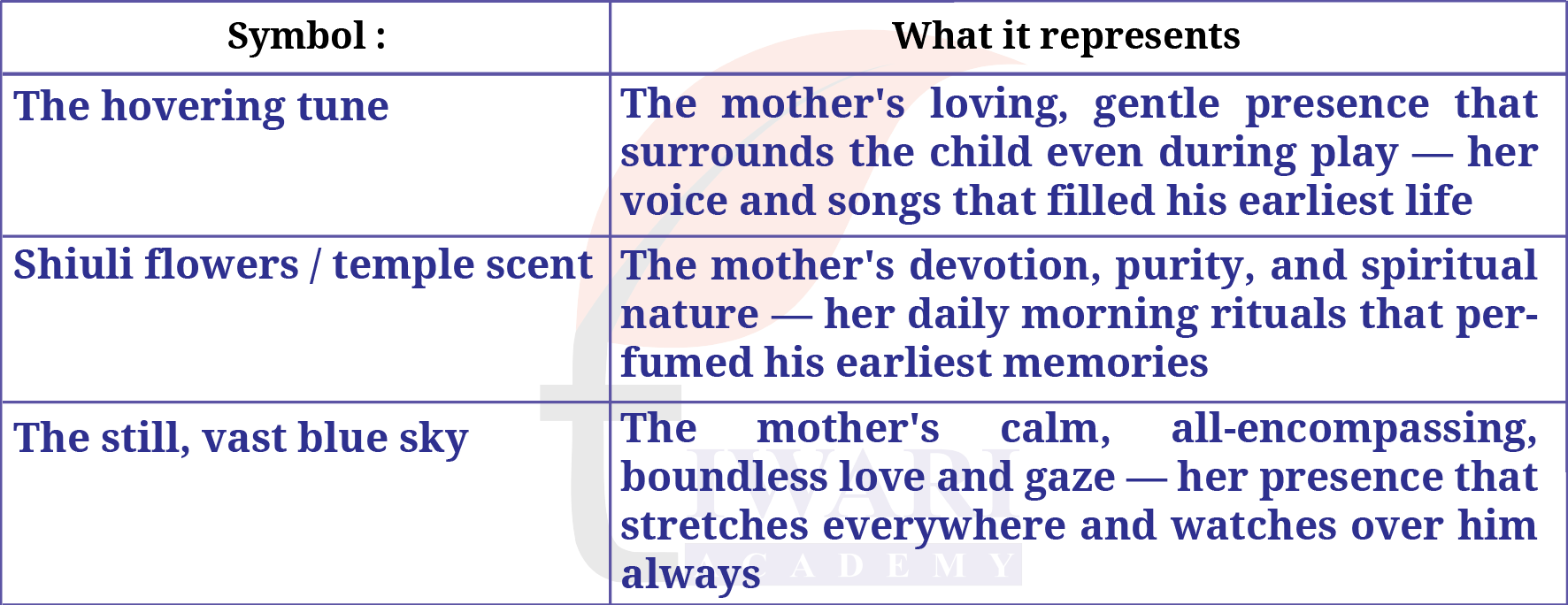
8. The poet uses symbolism to indicate the memory of his mother’s presence. Identify the symbols used in the poem.
Answer:
Page 129 – Critical Reflection
I. Read the extracts given below and answer the questions that follow.
1. I cannot remember my mother
only sometimes in the midst of my play
a tune seems to hover over my playthings,
(i) Complete the following sentences appropriately.
The port is reminded of his mother during his ___________.
See AnswerThe poet is reminded of his mother during his playtime.
(ii) What is the primary emotion conveyed by the line ‘ a tune seems to hover over my playthings?
A. It enhances the joy of play.
B. It disrupts the playtime atmosphere.
C. It activates memories of the mother.
D. It symbolises the carefree nature of childhood.
See AnswerC. It activates memories of the mother.
(iii) In the context of the poem, what role does the hovering tune play during the speaker’s playtime?
See AnswerThe hovering tune acts as a bridge between the present and the distant past. During the innocent activity of play, the tune suddenly drifts into the child’s consciousness like a ghost of memory. It connects the child to the mother he cannot consciously recall – her voice, her warmth, her presence while rocking his cradle. The tune does not interrupt his play but gently reminds him of a love he once knew.
(iv) State whether the following sentence is true or false. The poet experiences the tune lingering over playthings only occasionally during playtime.
See AnswerTrue
(v) How could the poet feel his mother’s presence, even though she isn’t there?
See AnswerThe poet feels his mother’s presence through sensory memories – the tune she used to hum, the fragrance of shiuli flowers that reminds him of her morning prayers and the stillness of the sky that reminds him of her gentle, loving gaze. Though she is physically absent, these sensory triggers – sound, smell and sight – keep her presence alive in his heart and mind. Memory works through the senses and the poet beautifully shows how a mother’s love leaves impressions that last a lifetime.
2. I feel that the stillness of
my mother’s gaze on my face
has spread all over the sky.
(i) What does the poet suggest about the stillness of his mother ‘s gaze spreading over the sky?
A. The mother’s gaze in physically present in the sky.
B. The sky is a symbolic extension of the mother’s presence.
C. The sky mirrors the mother’s emotions
D. The stillness is fleeting and unrelated to the mother.
See AnswerB. The sky is a symbolic extension of the mother’s presence.
(ii) What emotion does the poet associate with the ‘stillness’ of his mother’s gaze?
A. a sense of grief
B. a sense of anticipation
C. a sense of nostalgia
D. a sense of serenity
See AnswerD. a sense of serenity
(iii) State whether the following sentence is true or false.
The poet suggests that the mother’s graze has a tangible and visual effect on the sky.
See AnswerFalse
(iv) What is the purpose of likening the mother’s gaze to the sky?
See AnswerThe sky is vast, still, calm, and ever-present – it is everywhere and covers everything. By comparing his mother’s gaze to the sky, the poet suggests that her love was similarly boundless, gentle and all-encompassing. Just as the sky watches over everything silently, so did his mother’s gaze watch over him with quiet, infinite love. The comparison elevates the mother’s love to something universal and eternal.
(v) Complete the sentence appropriately.
The tone of the poet in the given extract is __________ because __________
See AnswerThe tone of the poet in the given extract is 𝘀𝗲𝗿𝗲𝗻𝗲 𝗮𝗻𝗱 𝘄𝗶𝘀𝘁𝗳𝘂𝗹 because 𝗵𝗲 𝗮𝘀𝘀𝗼𝗰𝗶𝗮𝘁𝗲𝘀 𝗵𝗶𝘀 𝗺𝗼𝘁𝗵𝗲𝗿’𝘀 𝗴𝗮𝘇𝗲 𝘄𝗶𝘁𝗵 𝘁𝗵𝗲 𝘃𝗮𝘀𝘁, 𝗰𝗮𝗹𝗺 𝘀𝗸𝘆, 𝘀𝘂𝗴𝗴𝗲𝘀𝘁𝗶𝗻𝗴 𝗮 𝘀𝗲𝗻𝘀𝗲 𝗼𝗳 𝗽𝗲𝗮𝗰𝗲 𝗮𝗻𝗱 𝗾𝘂𝗶𝗲𝘁 𝗹𝗼𝗻𝗴𝗶𝗻𝗴 𝗿𝗮𝘁𝗵𝗲𝗿 𝘁𝗵𝗮𝗻 𝘀𝗵𝗮𝗿𝗽 𝗴𝗿𝗶𝗲𝗳. 𝗧𝗵𝗲 𝗶𝗺𝗮𝗴𝗲 𝗶𝘀 𝗴𝗲𝗻𝘁𝗹𝗲 𝗮𝗻𝗱 𝗲𝘅𝗽𝗮𝗻𝘀𝗶𝘃𝗲, 𝗿𝗲𝗳𝗹𝗲𝗰𝘁𝗶𝗻𝗴 𝘁𝗵𝗲 𝗽𝗼𝗲𝘁’𝘀 𝘁𝗲𝗻𝗱𝗲𝗿 𝗮𝗻𝗱 𝗿𝗲𝗳𝗹𝗲𝗰𝘁𝗶𝘃𝗲 𝗲𝗺𝗼𝘁𝗶𝗼𝗻𝗮𝗹 𝘀𝘁𝗮𝘁𝗲.
II. Answer the following questions
1. What is the emotional impact of the refrain, “I cannot remember my mother”?
See AnswerThe refrain creates a deep and lingering sense of sadness and longing in the reader. Each time it is repeated, it reminds us of the irreplaceable loss the poet has experienced – losing his mother at a very young age. Yet paradoxically, the refrain also becomes a doorway to memory, because after each repetition, the poet describes a beautiful, vivid sensory recollection of her. This contrast between stated forgetting and actual remembering makes the emotional impact even more powerful. The reader feels both the pain of loss and the beauty of love that survives even absence and time.
2. Interpret the connection between the poet’s mother and the following: (i) shiuli flowers (ii) humming tune
See Answer(i) Shiuli flowers: The shiuli flowers bloom at night and shed their petals in the early morning, filling the autumn air with a sweet, delicate fragrance. This scent mingles with the fragrance of incense and flowers from the morning temple service and together they bring back the memory of the mother’s devotion and her daily rituals. The mother is connected to purity, spirituality and the quiet beauty of dawn – just like the shiuli flower itself.
(ii) Humming tune: The humming tune represents the earliest and most intimate memory of the mother – her voice gently singing while rocking the cradle. It is the first sound a baby knows, and even though the poet cannot remember the words or consciously recall his mother’s face, this tune drifts back to him during play as a subconscious, deeply embedded memory of her love and comfort.
3. What role does nature play in the poet’s description of the memory of his mother?
See AnswerNature plays a central and beautiful role in the poem. The poet uses three elements of nature – sound (the tune hovering like a breeze), fragrance (the scent of shiuli flowers in the autumn morning air) and sight (the vast, still blue sky) – to evoke his mother’s memory. Nature becomes a medium through which the mother’s presence is felt and remembered. The autumn flowers carry her scent, the sky holds her gaze and the air carries her tune. Nature, in this poem, is not just a backdrop but an active carrier of memory and love.
4. What can be inferred about the poet’s perception of the mother-child relationship?
See AnswerThe poet perceives the mother-child relationship as the most fundamental, tender and enduring bond in human life. Even though he lost his mother when he was too young to form conscious memories, her presence has woven itself into his very senses – his hearing, his smell, his sight. This suggests that a mother’s love operates at a level deeper than conscious memory. It becomes a part of the child’s identity and sensory world. The poet also suggests that this bond is not broken by death or absence – it lives on in nature, in music, in fragrance and in the sky, eternal and boundless.
Page 131 – Vocabulary in Context
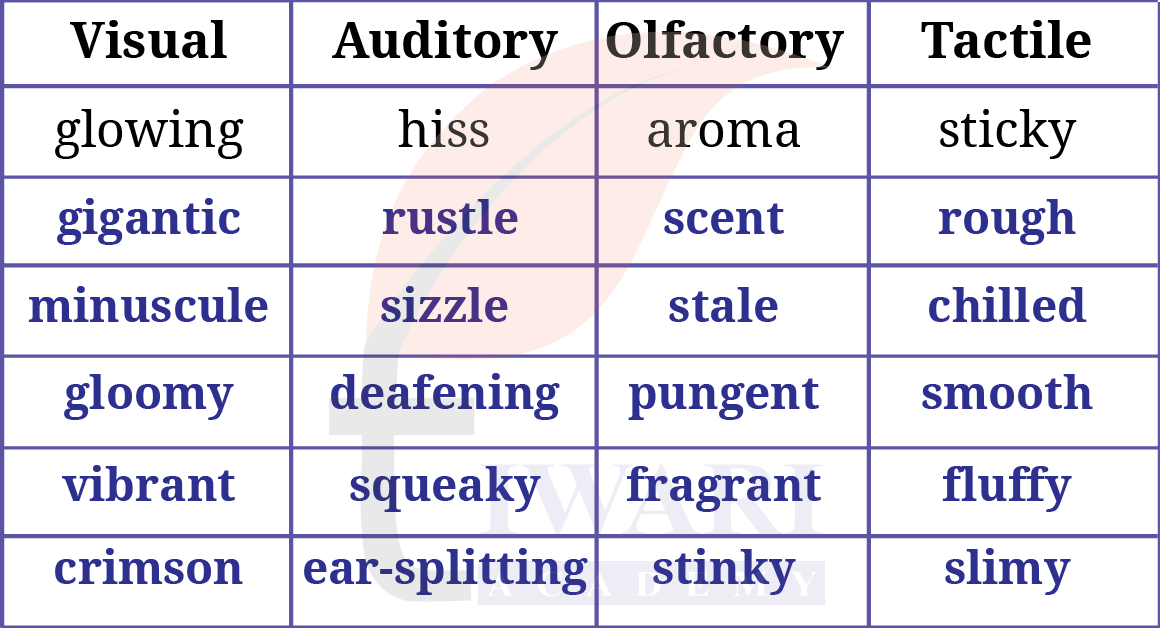
I. Work in pairs to classify the sensory words given in the box below. One example has been done for you.
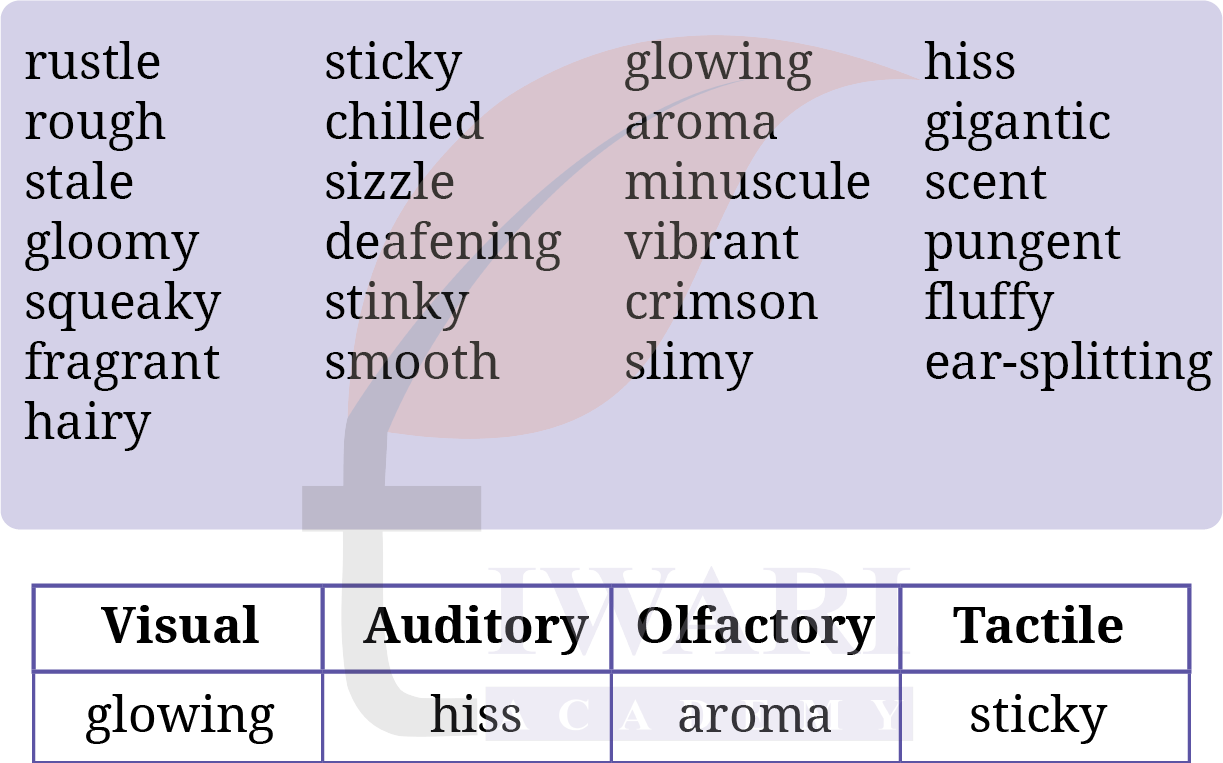
Answer:
II. Fill in the blanks with sensory words in the box for the following passage written by Sarojini Naidu. There are two extra words.
flaming scents sweetness essence
smooth
Come and share my exquisite March morning with me: this sumptuous blaze of gold and sapphire sky; these
1. _____________ lilies that adorn the sunshine; the voluptuous 2. _____________ of neem and champak and serisha that beat upon the languid air with their implacable 3. _____________; the thousand little gold and blue and silver breasted birds bursting with the 4. _____________ ecstasy of life in nesting time. And do you know thatthe scarlet lilies are woven petal by petal from my heart’s blood these little quivering birds are my soul made incarnate music, these heavy 5. _____________ are my emotions dissolved into aerial 6. _____________ this 7. _____________ blue and gold sky in the ‘very me’…
See Answer1. 𝙨𝙘𝙖𝙧𝙡𝙚𝙩 lilies that adorn the sunshine; the voluptuous 2. 𝗽𝗲𝗿𝗳𝘂𝗺𝗲𝘀 of neem and champak and serisha that beat upon the languid air with their implacable 3. 𝘀𝘄𝗲𝗲𝘁𝗻𝗲𝘀𝘀 the thousand little gold and blue and silver breasted birds bursting with the 4. 𝗳𝗹𝗮𝗺𝗶𝗻𝗴 ecstasy of life in nesting time. And do you know thatthe scarlet lilies are woven petal by petal from my heart’s blood these little quivering birds are my soul made incarnate music, these heavy 5. 𝘀𝗰𝗲𝗻𝘁𝘀 are my emotions dissolved into aerial 6. 𝗲𝘀𝘀𝗲𝗻𝗰𝗲 this 7. 𝘀𝗺𝗼𝗼𝘁𝗵 blue and gold sky in the ‘very me’…
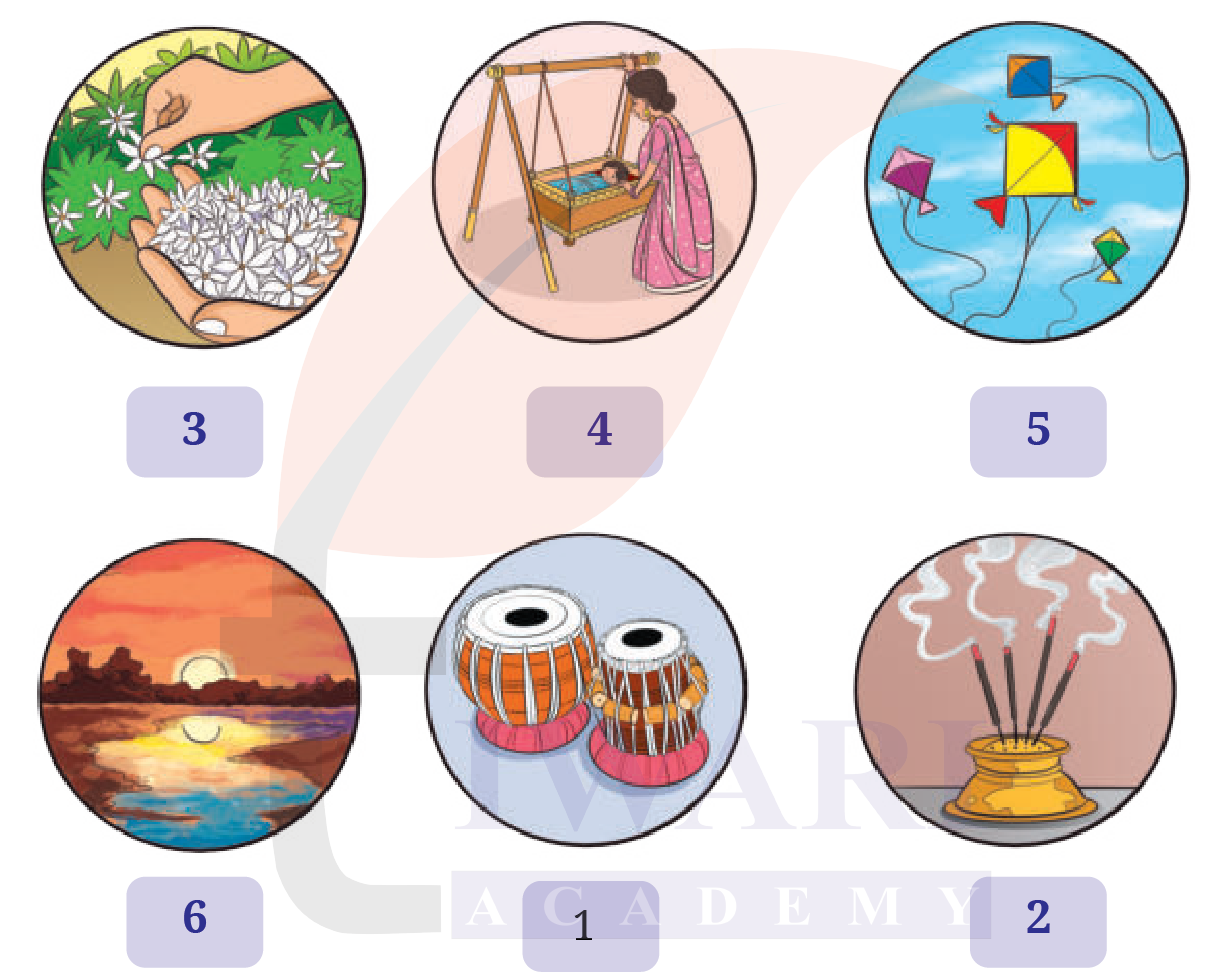
III. Write numbers against each picture with the phrases that describe them with their sensorial associations. One example has been done for you.
1. beasts of music echos in air
2. melody of soothing scent, dancing in the air
3. fragrant breeze of blooming buds
4. gentle lullaby, a soft melody
5. colourful sky, painting a lively sight
6. attractive canvas painting the horizon

Answer:
Page 133 – Listen and Respond
I You will listen to four short extracts of people expressing their childhood memories. As you listen, match each statement 1-6 to each speaker (i) -(iv). There are two statements that you do not need. (Transcript for teacher on page 266)
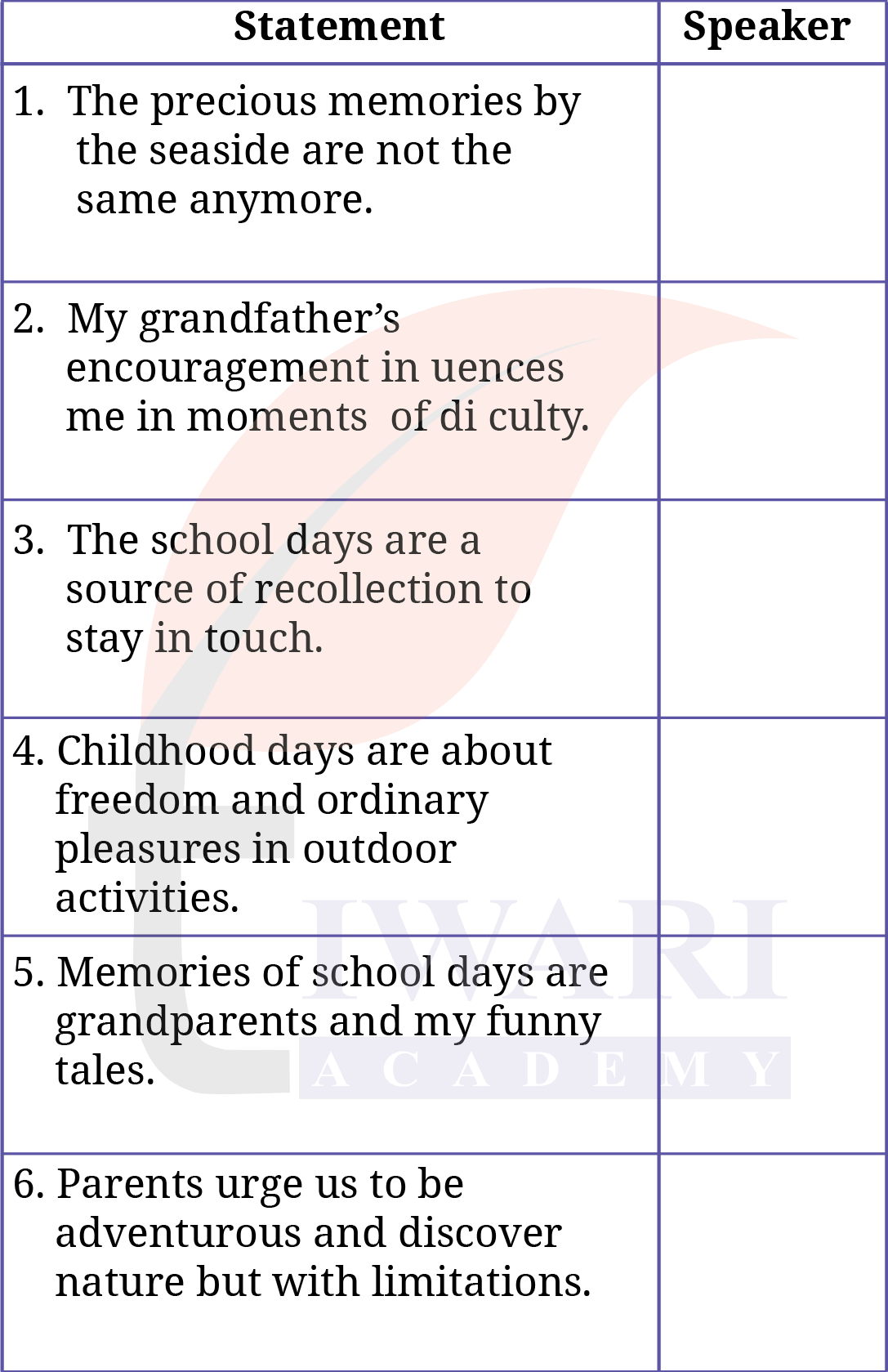
Answer:
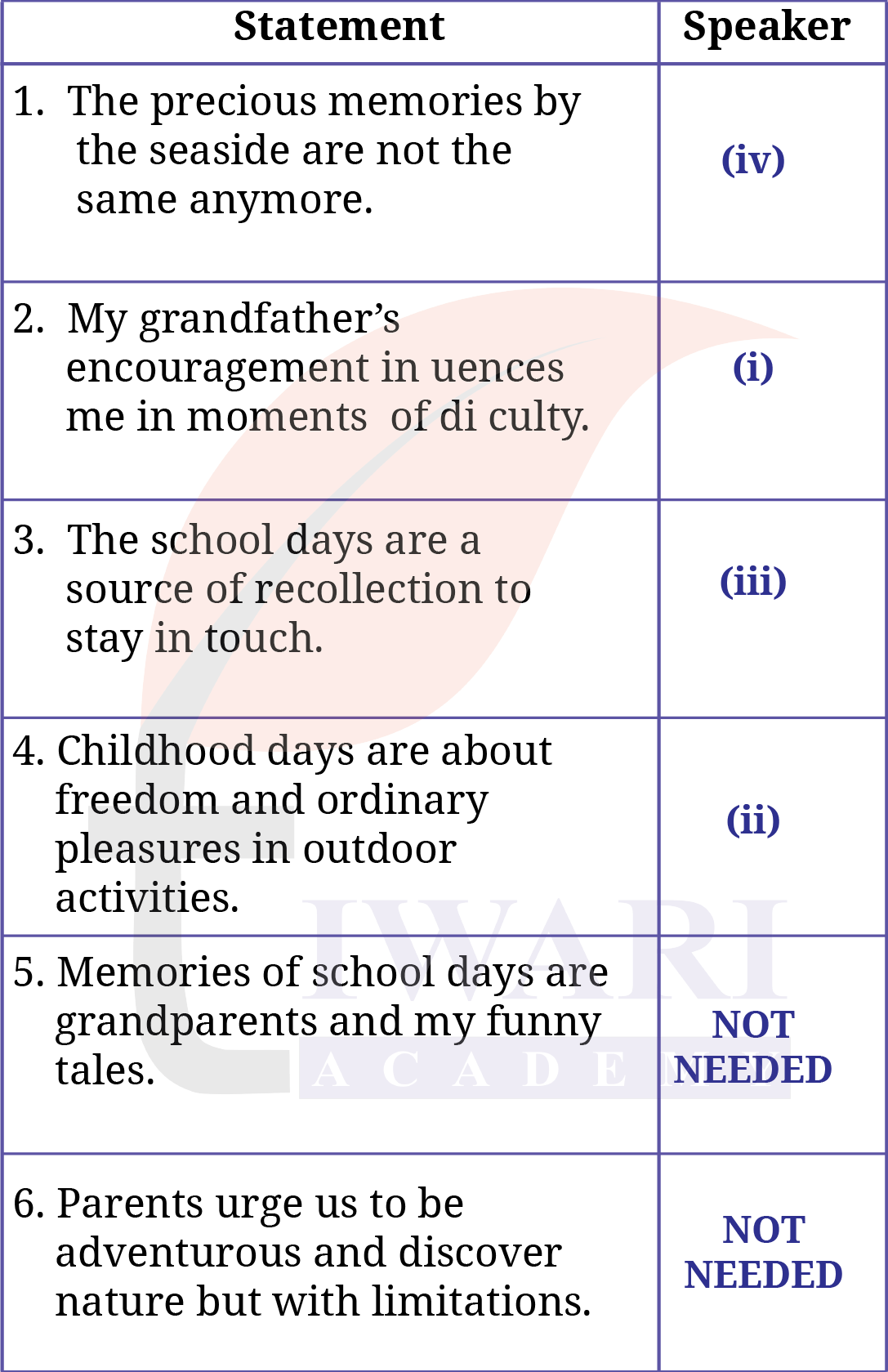
Page 135 – Writing Task
I. Imagine you had been on a school trip to a scenic place which appeal to all your senses. Write a diary entry describing the place ans why it was a memorable experience.
Content of the diary entry:
- begin with day, date, and time
- use only first person (I, my)
- capture sensory details
- express emotions
- focus on significant moments and expreriences
- conclude with reflection
Answer:
Diary Entry – A Memorable School Trip
Wednesday, 15th October 2025 8:30 PM
Dear Diary,
Today was one of the most beautiful days of my entire school life. Our class went on a trip to Coorg — a place I had only seen in photographs — and I cannot find words enough to describe what I experienced.
The moment our bus entered the hills, the air changed. It became cool, fresh and fragrant — carrying the rich earthy smell of wet soil and the sweet scent of coffee blossoms. I closed my eyes and breathed deeply, feeling as though the world had slowed down just for us.
When we reached the viewpoint, I stood at the edge and looked out at a sea of green – endless forests rolling over hills, with soft white mist curling between the trees like a gentle secret. The silence was so complete that I could hear the distant sound of a waterfall and birds calling to each other across the valley. I reached out and touched the cool, damp moss on a rock beside me and for one perfect moment I felt completely at peace.
We walked through a spice garden where our guide broke open a cardamom pod and held it under our noses — the sharp, sweet fragrance was overwhelming and wonderful. I tasted fresh pepper straight from the vine and its heat spread slowly across my tongue.
The most significant moment of the day was when we sat together on the grass at sunset, watching the sky turn from gold to deep orange to purple. In that quiet, I thought about how rare and precious such moments are -moments when you are completely present, your senses alive, your heart full.
I will carry this day with me for a long time. It taught me that the most beautiful classroom is the world itself.
Goodnight, [Yogesh]
Kaveri Chapter 4 English to Hindi Translation:
Class 9 English Kaveri Chapter 4 English to Hindi Translation
Part – I
“I wish,” said Ravi’s mother, hurriedlyHurriedly (adverb)
Meanings:
Quickly because there is little time (जल्दी-जल्दी, हड़बड़ी में)
Examples:
1. She hurriedly packed her bag. (उसने जल्दी-जल्दी अपना बैग रखा।)
2. He hurriedly finished his breakfast. (उसने जल्दी-जल्दी नाश्ता समाप्त किया।)
3. We hurriedly closed the windows before the rain. (हमने बारिश से पहले जल्दी-जल्दी खिड़कियाँ बंद कीं।) putting some green, red and orange tabletsTablets (plural noun)
Meanings:
Small solid pieces of medicine (दवा की गोलियाँ)
Examples:
1. The tablets were kept in a labelled box. (दवा की गोलियाँ नाम लिखे डिब्बे में रखी थीं।)
2. She checked the packet of tablets. (उसने दवा की गोलियों का पैकेट जाँचा।)
3. The doctor explained how to take the tablets. (डॉक्टर ने समझाया कि गोलियाँ कैसे लेनी हैं।) on a saucerSaucer (noun)
Meanings:
A small, shallow dish, usually placed under a cup (तश्तरी)
Examples:
1. She placed the cup on a saucer. (उसने कप तश्तरी पर रखा।)
2. A spoon lay on the saucer. (तश्तरी पर चम्मच रखा था।)
3. The kitten drank milk from a saucer. (बिल्ली के बच्चे ने तश्तरी से दूध पिया।), “that somebody would invent a memory — Vitamin-M, they could call it, and we could give it to old people to help them improve their memories.”
“Shh … Grandpa’ll hear you,” said Ravi, pointing to the frailFrail (adjective)
Meanings:
Physically weak or delicate (दुर्बल, कमज़ोर)
Examples:
1. The frail old man needed support. (दुर्बल वृद्ध को सहारे की ज़रूरत थी।)
2. She looked frail after her illness. (बीमारी के बाद वह कमज़ोर दिख रही थी।)
3. The frail puppy rested in a basket. (कमज़ोर पिल्ला टोकरी में आराम कर रहा था।) old figureFigure (noun)
Meanings:
The visible shape of a person’s body (आकृति, शरीर का रूप)
Examples:
1. A tall figure stood at the gate. (फाटक पर एक लंबी आकृति खड़ी थी।)
2. His frail figure moved slowly. (उसका कमज़ोर शरीर धीरे-धीरे आगे बढ़ा।)
3. I recognised her figure in the distance. (मैंने दूर से उसकी आकृति पहचान ली।) sitting in the rocking chairRocking chair (noun)
Meanings:
A chair with curved supports that let it move backwards and forwards (झूलने वाली कुर्सी)
Examples:
1. Grandfather rested in his rocking chair. (दादाजी अपनी झूलने वाली कुर्सी पर आराम कर रहे थे।)
2. The wooden rocking chair stood by the window. (लकड़ी की झूलने वाली कुर्सी खिड़की के पास थी।)
3. She read a book in the rocking chair. (उसने झूलने वाली कुर्सी पर बैठकर किताब पढ़ी।), holding the newspaper inches from his nose to read it.
Hindi Translationरवि की माँ ने एक तश्तरी पर जल्दी-जल्दी कुछ हरी, लाल और नारंगी गोलियाँ रखते हुए कहा, “काश, कोई एक याददाश्त बढ़ाने की दवा बना देता — विटामिन-M, उसे यह नाम दे सकते हैं, और हम उसे बुजुर्गों को उनकी याददाश्त सुधारने में मदद के लिए दे सकते थे।” “श्श… दादाजी सुन लेंगे,” रवि ने कहा, और रॉकिंग चेयर पर बैठे उस दुर्बल बुजुर्ग की ओर इशारा किया जो अखबार को नाक के बिल्कुल पास लाकर पढ़ रहे थे।
Grammar AnalysisThe paragraph uses the Simple Past for narration and the Present Continuous for background actions, while Modal Verbs express a wish or hypothetical possibility.
► Adjectives (Describing Words)
• Green / Red / Orange: Colors describing the different tablets.
• Old: Describes the people who would need the “Vitamin-M.”
• Frail / Old: Describes the delicate physical state of the Grandpa.
• Rocking: Describes the type of chair.
► Verbs (Action/State Words)
• Said / Pointing: Simple Past and Present Participle used for narration.
• Putting: Present Participle showing the action of placing the tablets.
• Would invent / Could call / Could give: Modal verbs expressing a wish or a hypothetical possibility.
• To help / To improve: Infinitives showing the purpose of the medicine.
• Will hear: Future Simple expressing Ravi’s concern.
• Sitting / Holding: Present Participles describing Grandpa’s current actions.
► Adverbs (How/When/Where)
• Hurriedly: Describes the fast manner in which the mother is working.
• Inches from: Adverbial phrase of place showing how close the paper is to his face.
“Don’t worry, I doubtDoubt (noun/verb)
Meanings:
Uncertainty; to question whether something is true (संदेह, शक करना)
Examples:
1. I have no doubt about her honesty. (मुझे उसकी ईमानदारी पर कोई संदेह नहीं है।)
2. Do you doubt his story? (क्या तुम्हें उसकी कहानी पर शक है?)
3. Her explanation removed my doubt. (उसकी व्याख्या से मेरा संदेह दूर हो गया।) whether Grandpa can hear me. He doesn’t hear too well, or see too well, or even remember too well these days. I’m glad that your holidays have started from today. Now you can look afterLook after (phrasal verb)
Meanings:
Take care of someone or something (देखभाल करना)
Examples:
1. I look after my plants. (मैं अपने पौधों की देखभाल करता हूँ।)
2. She looks after her grandfather. (वह अपने दादा की देखभाल करती है।)
3. Please look after this puppy. (कृपया इस पिल्ले की देखभाल करो।) him. Last month was…” she stopped and shudderedShuddered (verb)
Meanings:
Shook suddenly because of fear, disgust, or cold (सिहर उठा, काँप गया)
Examples:
1. She shuddered at the frightening thought. (डरावना विचार आते ही वह सिहर उठी।)
2. He shuddered in the cold wind. (ठंडी हवा में वह काँप गया।)
3. I shuddered when I heard the noise. (आवाज़ सुनकर मैं सिहर उठा।) at the memory.
It was only last month that Ravi’s Grandpa had come to live with them because he was getting too old to live on his own. It had been a difficult month with Grandpa having to be admittedAdmitted (verb)
Meanings:
Allowed someone to enter; accepted someone into a hospital for treatment (प्रवेश दिया, अस्पताल में भर्ती किया)
Examples:
1. The hospital admitted the injured man. (अस्पताल ने घायल व्यक्ति को भर्ती किया।)
2. She was admitted to hospital yesterday. (उसे कल अस्पताल में भर्ती किया गया।)
3. Only ticket holders were admitted to the hall. (केवल टिकट वालों को सभागार में प्रवेश दिया गया।) to the hospital because he absent-mindedlyAbsent-mindedly (adverb)
Meanings:
Without paying attention (बेखयाली में)
Examples:
1. He absent-mindedly took my pen. (उसने बेखयाली में मेरी कलम ली।)
2. She nodded absent-mindedly. (उसने बेखयाली में सिर हिलाया।)
3. I absent-mindedly missed the turn. (मैं बेखयाली में मोड़ भूल गया।) took a double doseDouble dose (noun phrase)
Meanings:
Twice the usual or stated amount of a medicine (दोगुनी खुराक)
Examples:
1. The label warned against taking a double dose. (लेबल पर दोगुनी खुराक लेने के विरुद्ध चेतावनी थी।)
2. She checked whether the patient had received a double dose. (उसने जाँचा कि रोगी को दोगुनी खुराक तो नहीं मिली थी।)
3. He told the doctor about the accidental double dose. (उसने डॉक्टर को गलती से ली गई दोगुनी खुराक के बारे में बताया।) of his medicines, and then gave them several anxiousAnxious (adjective)
Meanings:
Worried or nervous about what may happen (चिंतित, व्याकुल)
Examples:
1. She was anxious about her missing dog. (वह अपने खोए हुए कुत्ते को लेकर चिंतित थी।)
2. The anxious parents waited outside. (चिंतित माता-पिता बाहर प्रतीक्षा करते रहे।)
3. I felt anxious before the result was announced. (परिणाम घोषित होने से पहले मैं घबरा रहा था।) moments when he got lost on one occasion he went for a walk and forgot the way back home.
Hindi Translation“चिंता मत करो, मुझे संदेह है कि दादाजी मुझे सुन भी सकते हैं। आजकल वे न ठीक से सुन पाते हैं, न ठीक से देख पाते हैं, और न ही ठीक से याद रख पाते हैं। मुझे खुशी है कि आज से तुम्हारी छुट्टियाँ शुरू हो गई हैं। अब तुम उनकी देखभाल कर सकते हो। पिछला महीना तो…” वह रुक गई और उस याद से काँप उठी।
पिछले महीने ही रवि के दादाजी उनके साथ रहने आए थे क्योंकि वे अकेले रहने के लिए बहुत बूढ़े हो गए थे। यह एक कठिन महीना था जिसमें दादाजी को अस्पताल में भर्ती करना पड़ा क्योंकि उन्होंने भूलवश अपनी दवाइयों की दोहरी खुराक ले ली थी, और फिर उन्होंने कई चिंताजनक क्षण दिए जब वे एक बार सैर के लिए गए और घर का रास्ता भूल गए।
Grammar AnalysisThe paragraph uses the Simple Present to describe current conditions, the Present Perfect for a recent start, and the Simple Past along with the Past Perfect to recount specific past incidents.
► Adjectives (Describing Words)
• Glad: Describes the mother’s feeling of happiness about the holidays.
• Old: Describes the reason Grandpa could no longer live alone.
• Difficult: Describes the nature of the past month.
• Double: Describes the amount of medicine taken (two doses instead of one).
• Anxious: Describes the type of moments/feelings the family experienced.
► Verbs (Action/State Words)
• Doubt / Doesn’t hear / Doesn’t remember: Simple Present used to describe Grandpa’s current condition.
• Have started: Present Perfect showing an action that just happened.
• Stopped / Shuddered: Simple Past used for the mother’s physical reactions.
• Had come: Past Perfect showing an event that happened before the current timeline.
• Took / Got lost / Forgot: Simple Past describing the specific incidents of the previous month.
► Adverbs (How/When/Where)
• Too well: Describes the poor degree of Grandpa’s hearing and memory.
• Today: Adverb of time.
• Absent-mindedly: Describes the careless manner in which the medicine was taken.
• Back home: Adverbial phrase of direction.
Grandpa had got very upset when his daughter, Ravi’s mother, insistedInsisted (verb)
Meanings:
Said firmly that something must happen or is true (ज़ोर दिया, आग्रह किया)
Examples:
1. He insisted on carrying his own bag. (उसने अपना बैग स्वयं उठाने पर ज़ोर दिया।)
2. Mother insisted that we eat breakfast. (माँ ने आग्रह किया कि हम नाश्ता करें।)
3. She insisted that her answer was correct. (उसने ज़ोर देकर कहा कि उसका उत्तर सही था।) that he shouldn’t go out alone again. “I’ll have you know, Vidya, my dear,” he had told his daughter with a traceTrace (noun)
Meanings:
A very small amount or sign of something (हल्का अंश, नाममात्र संकेत)
Examples:
1. There was a trace of anger in his voice. (उसकी आवाज़ में क्रोध का हल्का अंश था।)
2. She spoke without a trace of fear. (उसने बिना ज़रा भी डर के बात की।)
3. We found no trace of the missing bag. (हमें खोए हुए बैग का कोई निशान नहीं मिला।) of the firmnessFirmness (noun)
Meanings:
Strength and confidence in a decision or manner (दृढ़ता)
Examples:
1. She spoke with quiet firmness. (उसने शांत दृढ़ता के साथ बात की।)
2. His firmness showed that he would not change his mind. (उसकी दृढ़ता से स्पष्ट था कि वह अपना विचार नहीं बदलेगा।)
3. The teacher combined kindness with firmness. (शिक्षक के व्यवहार में दयालुता के साथ दृढ़ता भी थी।) that had been a natural part of his job as a lawyerLawyer (noun)
Meanings:
A person trained to advise on law or represent people in legal matters (वकील)
Examples:
1. The lawyer explained the document. (वकील ने दस्तावेज़ समझाया।)
2. She wants to become a lawyer. (वह वकील बनना चाहती है।)
3. The lawyer spoke for his client. (वकील ने अपने मुवक्किल की ओर से बात की।), “that I’ve been looking after myself for the better part of my seventy-five years. After your mother died ten years ago, I took over her duties as well and have been cooking, shopping and keeping house too. First you force me to come and live with you in this pokyPoky (adjective)
Meanings:
Uncomfortably small and cramped (बहुत छोटा और तंग)
Examples:
1. They lived in a poky room. (वे बहुत छोटे और तंग कमरे में रहते थे।)
2. The poky kitchen had one window. (तंग रसोई में एक खिड़की थी।)
3. He disliked the poky office. (उसे छोटा और तंग दफ़्तर पसंद नहीं था।) little flat, in this horribleHorrible (adjective)
Meanings:
Very unpleasant, frightening, or bad (भयानक, बहुत बुरा, अप्रिय)
Examples:
1. A horrible smell filled the room. (कमरे में बहुत बुरी गंध भर गई।)
2. He had a horrible dream. (उसे भयानक सपना आया।)
3. The weather was horrible all day. (पूरे दिन मौसम बहुत खराब रहा।), crowdedCrowded (adjective)
Meanings:
Full of people or things, with little free space (भीड़भाड़ वाला, ठसाठस भरा)
Examples:
1. The bus was crowded. (बस भीड़ से भरी थी।)
2. They lived in a crowded flat. (वे एक ऐसे फ़्लैट में रहते थे जहाँ जगह बहुत कम थी।)
3. We walked through the crowded street. (हम भीड़भाड़ वाली सड़क से गुज़रे।) city and then you think you have the right to forbidForbid (verb)
Meanings:
Order someone not to do something; refuse permission (मना करना, निषेध करना)
Examples:
1. The rules forbid running in the corridor. (नियम गलियारे में दौड़ने से मना करते हैं।)
2. They forbid entry after dark. (वे अँधेरा होने के बाद प्रवेश की अनुमति नहीं देते।)
3. His parents forbid him to swim alone. (उसके माता-पिता उसे अकेले तैरने से मना करते हैं।) me to go out on my own!”
Hindi Translationदादाजी बहुत नाराज़ हो गए थे जब उनकी बेटी, रवि की माँ ने इस बात पर ज़ोर दिया कि वे फिर कभी अकेले बाहर नहीं जाएंगे। “मैं तुम्हें बता दूँ, विद्या बेटा,” उन्होंने अपनी बेटी से अपनी आवाज़ में उस दृढ़ता के साथ कहा जो एक वकील के तौर पर उनके स्वभाव का हिस्सा रही थी, “कि मैंने अपने पचहत्तर साल के जीवन के एक बड़े हिस्से में अपना ख्याल खुद ही रखा है। “दस साल पहले तुम्हारी माँ के गुज़रने के बाद, मैंने उनकी ज़िम्मेदारियाँ भी संभाल ली थीं और मैं खुद ही खाना बनाने, खरीदारी करने और घर के सारे काम भी करता रहा हूँ। पहले तो तुमने मुझे इस भयानक, भीड़भाड़ वाले शहर के इस छोटे से तंग फ्लैट में आकर रहने के लिए मजबूर किया और अब तुम्हें लगता है कि तुम्हें मुझे अकेले बाहर जाने से रोकने का हक है!”
Grammar AnalysisThe paragraph uses the Past Perfect to establish the background of the argument, the Simple Past for historical events like his wife’s passing, and the Simple Present for Grandpa’s current frustrations and perceived loss of rights.
► Adjectives (Describing Words)
• Upset: Describes Grandpa’s emotional state.
• Natural: Describes the firmness that was typical of his personality.
• Better: Used to emphasize a large part of his life (75 years).
• Poky / Little: Describes the small size of the flat.
• Horrible / Crowded: Describes Grandpa’s negative view of the city.
► Verbs (Action/State Words)
• Had got / Had told: Past Perfect used to narrate the background of the argument.
• Shouldn’t go: Modal verb (Negative) used for advice or a rule.
• Have been looking after: Present Perfect Continuous showing an action starting in the past and continuing.
• Took over / Died: Simple Past describing events from ten years ago.
• Force / Think: Simple Present used by Grandpa to describe current reality.
• To forbid / To go: Infinitives expressing the act of stopping someone from moving.
► Adverbs (How/When/Where)
• Again: Describes the repetition of going out.
• Alone: Describes the manner of going out.
• Too: Used for emphasis to show he did multiple chores.
• Then: Used to show the sequence of events (first moved, then forbidden).
Grandpa hated the noise and bustleBustle (noun)
Meanings:
Busy, lively activity and movement (चहल-पहल, भाग-दौड़)
Examples:
1. The market was full of bustle. (बाज़ार चहल-पहल से भरा था।)
2. I enjoy the bustle of a fair. (मुझे मेले की चहल-पहल अच्छी लगती है।)
3. We left the bustle of the city behind. (हम शहर की भाग-दौड़ पीछे छोड़ आए।) of city life and when they were on their own, he often spoke, longinglyLongingly (adverb)
Meanings:
With a strong wish or desire (लालसा से, बड़ी चाह से)
Examples:
1. He looked longingly at the sweets. (उसने मिठाइयों को लालसा से देखा।)
2. She gazed longingly towards her village. (उसने बड़ी चाह से अपने गाँव की ओर देखा।)
3. The dog stared longingly at the food. (कुत्ते ने खाने को ललचाई नज़रों से देखा।), of his small brick house in town. “Such a wonderful place…! With that big mango tree in the garden! It is so quietQuiet (adjective)
Meanings:
Making little or no noise; calm (शांत, चुप)
Examples:
1. The baby was finally quiet. (शिशु आखिरकार शांत हो गया।)
2. Please be quiet in the library. (कृपया पुस्तकालय में शांत रहो।)
3. We enjoyed a quiet evening. (हमने शांत शाम का आनंद लिया।) that at duskDusk (noun)
Meanings:
The time in the evening when daylight is fading (साँझ, गोधूलि)
Examples:
1. We returned home at dusk. (हम साँझ को घर लौटे।)
2. The birds settled in their nests at dusk. (पक्षी साँझ के समय घोंसलों में बैठ गए।)
3. The hills looked purple in the dusk. (गोधूलि में पहाड़ियाँ बैंगनी दिखाई दीं।) you can even hear a leaf fall!”
But then Grandpa had slippedSlipped (verb)
Meanings:
Moved quietly or unnoticed; slid out of place (चुपके से चला गया, फिसला)
Examples:
1. He slipped out through the back door. (वह पिछले दरवाज़े से चुपके से निकल गया।)
2. She slipped into the room quietly. (वह चुपचाप कमरे में आ गई।)
3. The book slipped from my hand. (किताब मेरे हाथ से फिसल गई।) and fallen in the garden late one evening while he was pottering aroundPottering around (phrasal verb)
Meanings:
Moving about doing small tasks in a relaxed way (आराम से छोटे-मोटे काम करते घूमना)
Examples:
1. Grandfather was pottering around the garden. (दादाजी बगीचे में आराम से छोटे-मोटे काम कर रहे थे।)
2. She spent Sunday pottering around the house. (उसने रविवार घर में आराम से छोटे-मोटे काम करते बिताया।)
3. I enjoy pottering around in the kitchen. (मुझे रसोई में आराम से छोटे-मोटे काम करना अच्छा लगता है।) and lainLain (verb; past participle of lie)
Meanings:
Rested or remained in a lying position (लेटा या पड़ा रहा)
Examples:
1. He had lain awake for hours. (वह घंटों जागते हुए लेटा रहा था।)
2. The book had lain on the shelf for years. (किताब वर्षों से शेल्फ़ पर पड़ी थी।)
3. She had lain down to rest. (वह आराम करने के लिए लेट गई थी।) outside all night because there was no one at home to help him up. That was a month ago and it made Ravi’s mother lock upLock up (phrasal verb)
Meanings:
Secure a place by locking its doors (ताला लगाना, बंद करना)
Examples:
1. Please lock up before leaving. (जाने से पहले ताला लगा देना।)
2. We lock up the shop at night. (हम रात में दुकान बंद कर देते हैं।)
3. She stayed behind to lock up the house. (वह घर में ताला लगाने के लिए पीछे रुकी।) the tiny brick house and bring Grandpa to live with them.
Hindi Translationदादाजी को शहर की शोरगुल और हलचल से नफरत थी और जब वे अकेले होते थे, तो वे अक्सर अपने छोटे से ईंट के घर की लालसापूर्ण बातें करते थे। “कितनी अद्भुत जगह है…! बगीचे में वह बड़ा आम का पेड़! इतनी शांति है कि शाम के समय पत्ते के गिरने की आवाज़ भी सुनाई देती है!”
लेकिन फिर एक शाम को जब दादाजी बगीचे में इधर-उधर घूम रहे थे, तब वे फिसल कर गिर गए और पूरी रात बाहर पड़े रहे क्योंकि उन्हें उठाने के लिए घर पर कोई नहीं था। यह एक महीने पहले की बात थी और इसी वजह से रवि की माँ ने वह छोटा-सा ईंट का घर बंद करके दादाजी को अपने साथ रहने लाई थी।
Grammar AnalysisThe paragraph uses the Simple Past to describe Grandpa’s past habits and feelings, the Past Continuous to describe the action he was doing when he fell, and the Past Perfect to show the specific accident that led to his move.
► Adjectives (Describing Words)
• Small / Brick: Describes the construction and size of the house.
• Wonderful: Expresses Grandpa’s positive opinion of his home.
• Big: Describes the size of the mango tree.
• Quiet: Describes the silent atmosphere of the town.
• Tiny: Describes the small size of the brick house.
► Verbs (Action/State Words)
• Hated / Spoke: Simple Past used to describe Grandpa’s feelings and habits.
• Were: Simple Past describing their state when they were alone.
• Can hear: Modal verb showing ability.
• Had slipped / Had fallen: Past Perfect describing the accident that happened before he moved.
• Was pottering: Past Continuous showing the action Grandpa was doing when he fell.
• Made: Simple Past showing the cause and effect (the accident caused the move).
• To live: Infinitive showing the purpose of bringing Grandpa.
► Adverbs (How/When/Where)
• Longingly: Describes the emotional manner in which he spoke.
• Often: Describes the frequency of his talking about the house.
• Outside: Adverb of place showing where he remained all night.
• Late: Describes the timing of the evening.
“Whatever happens, Ravi, you’re not to let Grandpa go out on his own. It’s too dangerousDangerous (adjective)
Meanings:
Likely to cause harm or injury (खतरनाक, जोखिम भरा)
Examples:
1. Swimming here is dangerous. (यहाँ तैरना खतरनाक है।)
2. The road becomes dangerous in heavy rain. (तेज़ बारिश में सड़क खतरनाक हो जाती है।)
3. Playing with matches is dangerous. (माचिस से खेलना खतरनाक है।),” she instructedInstructed (verb)
Meanings:
Told someone what to do; gave directions (निर्देश दिया, समझाया)
Examples:
1. The teacher instructed us to work quietly. (शिक्षक ने हमें शांत रहकर काम करने का निर्देश दिया।)
2. She instructed the driver to stop at the gate. (उसने चालक को फाटक पर रुकने को कहा।)
3. Father instructed me on using the tool. (पिताजी ने मुझे औज़ार इस्तेमाल करने का तरीका समझाया।), adding detailsDetails (plural noun)
Meanings:
Small or specific pieces of information (विवरण, छोटी-छोटी जानकारियाँ)
Examples:
1. Please write down the travel details. (कृपया यात्रा का विवरण लिख लो।)
2. The form asks for your contact details. (प्रपत्र में आपकी संपर्क संबंधी जानकारी माँगी गई है।)
3. The teacher explained the details of the task. (शिक्षक ने कार्य का विवरण समझाया।) of medicines to be given to Grandpa after lunch. Turning to her father she said, “I’m off to work, Papa, Ravi will be here to look afterLook after (phrasal verb)
Meanings:
Take care of someone or something (देखभाल करना)
Examples:
1. I look after my plants. (मैं अपने पौधों की देखभाल करता हूँ।)
2. She looks after her grandfather. (वह अपने दादा की देखभाल करती है।)
3. Please look after this puppy. (कृपया इस पिल्ले की देखभाल करो।) you. His holidays have begun from today.”
Ravi wincedWinced (verb)
Meanings:
Made a small facial or bodily movement because of pain or discomfort (दर्द या परेशानी से सिकुड़ गया)
Examples:
1. He winced at the loud noise. (तेज़ आवाज़ से वह असहज होकर सिकुड़ गया।)
2. She winced when she touched the bruise. (चोट को छूने पर वह दर्द से सिकुड़ गई।)
3. I winced at the harsh reply. (कठोर उत्तर सुनकर मैं असहज हो गया।) at the over-loud toneTone (noun)
Meanings:
The quality of a voice that shows a feeling or attitude (भाव या रवैया व्यक्त करने वाला स्वर)
Examples:
1. Her tone was gentle. (उसका स्वर कोमल था।)
2. He answered in an angry tone. (उसने गुस्से भरे स्वर में उत्तर दिया।)
3. The teacher’s tone reassured us. (शिक्षक के स्वर ने हमें आश्वस्त किया।) his mother used when speaking to Grandpa, as though she were speaking to a child who couldn’t hear or understand too well. Grandpa continued to rockRock (verb)
Meanings:
Move gently backwards and forwards or from side to side (झुलाना, आगे-पीछे हिलना)
Examples:
1. She began to rock the cradle. (उसने पालना झुलाना शुरू किया।)
2. The boat started to rock gently. (नाव धीरे-धीरे डोलने लगी।)
3. He liked to rock in his chair. (उसे अपनी कुर्सी पर झूलना अच्छा लगता था।) gently and gave no sign that he had heard her at all.
Hindi Translation“चाहे कुछ भी हो जाए, रवि, दादाजी को अकेले बाहर मत जाने देना। यह बहुत खतरनाक है,” उन्होंने निर्देश दिया और दोपहर के भोजन के बाद दादाजी को दी जाने वाली दवाइयों का विवरण भी बताया। फिर अपने पिता की ओर मुड़कर बोली, “मैं काम पर जा रही हूँ, पापा, रवि आपकी देखभाल के लिए यहाँ रहेगा। आज से उसकी छुट्टियाँ शुरू हो गई हैं।” रवि को अपनी माँ की वह बहुत ऊँची आवाज़ देखकर तकलीफ हुई जो वह दादाजी से बात करते समय इस्तेमाल करती थी, मानो वह किसी ऐसे बच्चे से बात कर रही हो जो ठीक से सुन या समझ न सके। दादाजी धीरे-धीरे झूलते रहे और उन्होंने कोई संकेत नहीं दिया कि उन्होंने उसकी बात सुनी भी।
Grammar AnalysisThe paragraph uses the Simple Present for immediate conditions, the Simple Past for the narration of actions and reactions, and the Past Subjunctive (“as though she were”) to describe an unreal or hypothetical comparison.
► Adjectives (Describing Words)
• Dangerous: Describes the risk of Grandpa going out alone.
• Over-loud: Describes the volume of the mother’s voice.
• Child: (Used as a noun for comparison) Suggests how the mother treated Grandpa.
• No: A negative adjective describing the lack of “sign.”
► Verbs (Action/State Words)
• Happens: Simple Present used in a conditional sense (no matter what occurs).
• Are not to let: A formal structure used to give a strict command.
• Instructed / Said / Winced / Used / Continued: Simple Past used for narration.
• Adding / Turning / Speaking: Present Participles showing simultaneous actions.
• Will be: Future Simple showing Ravi’s presence for the day.
• Were speaking: Past Subjunctive used for an imaginary or unreal comparison.
• Had heard: Past Perfect showing an action that might have happened before he sat still.
► Adverbs (How/When/Where)
• Too: Used for emphasis to show the high degree of danger.
• Today: Adverb of time.
• Gently: Describes how the chair was rocking.
• At all: Used for emphasis to show a complete lack of reaction.
“Don’t worry, Mamma,” Ravi promisedPromised (verb)
Meanings:
Said firmly that one would do something (वादा किया)
Examples:
1. She promised to return the book. (उसने किताब लौटाने का वादा किया।)
2. He promised that he would be careful. (उसने वादा किया कि वह सावधान रहेगा।)
3. We promised to help our neighbour. (हमने अपने पड़ोसी की मदद करने का वादा किया।), looking at his mother’s anxiousAnxious (adjective)
Meanings:
Worried or nervous about what may happen (चिंतित, व्याकुल)
Examples:
1. She was anxious about her missing dog. (वह अपने खोए हुए कुत्ते को लेकर चिंतित थी।)
2. The anxious parents waited outside. (चिंतित माता-पिता बाहर प्रतीक्षा करते रहे।)
3. I felt anxious before the result was announced. (परिणाम घोषित होने से पहले मैं घबरा रहा था।) face. He felt sorry forFelt sorry for (verb phrase)
Meanings:
Felt sympathy or pity for someone (के लिए दुख या सहानुभूति महसूस की)
Examples:
1. I felt sorry for the lonely child. (मुझे अकेले बच्चे के लिए दुख हुआ।)
2. She felt sorry for the injured bird. (उसे घायल पक्षी पर दया आई।)
3. We felt sorry for those who lost their homes. (हमें उन लोगों के लिए दुख हुआ जिनके घर उजड़ गए।) her. “You go to work. Grandpa’ll be fine at home with me.”
“Shall we play chess or watch the cricket match on TV, Grandpa?” Ravi asked after his mother left. Grandpa played a great game of chess, very cool and cunningCunning (adjective)
Meanings:
Clever at getting what one wants, sometimes by tricking others (चालाक, धूर्त)
Examples:
1. The cunning fox fooled the crow. (चालाक लोमड़ी ने कौए को मूर्ख बनाया।)
2. He gave a cunning smile. (वह चालाकी से मुस्कराया।)
3. She devised a cunning plan to win. (उसने जीतने के लिए एक चतुर योजना बनाई।), and Ravi found that his own game had improvedImproved (verb)
Meanings:
Became better; made something better (सुधरा, बेहतर हुआ)
Examples:
1. Her handwriting improved with practice. (अभ्यास से उसकी लिखावट सुधर गई।)
2. The patient’s health improved. (रोगी का स्वास्थ्य बेहतर हुआ।)
3. He improved his chess skills. (उसने शतरंज खेलने का कौशल बेहतर किया।) greatly ever since Grandpa had come to live with them. “That’s the opening moveOpening move (noun phrase)
Meanings:
The first action in a game or planned activity (शुरुआती चाल, पहला कदम)
Examples:
1. He considered his opening move in chess. (उसने शतरंज की शुरुआती चाल पर विचार किया।)
2. Her opening move surprised her opponent. (उसकी शुरुआती चाल से प्रतिद्वंद्वी चकित हुआ।)
3. The opening move set the pace of the game. (शुरुआती चाल ने खेल की गति तय की।) Karpov made when he played against the computer,” he would tell Ravi as he moved a piece, or, “You’re making the same mistake that Bobby Fischer made in his historicHistoric (adjective)
Meanings:
Important or memorable in history; used humorously for a special personal occasion (ऐतिहासिक, यादगार)
Examples:
1. We visited a historic fort. (हमने एक ऐतिहासिक किला देखा।)
2. The team celebrated its historic victory. (दल ने अपनी ऐतिहासिक जीत मनाई।)
3. He called his first win a historic moment. (उसने अपनी पहली जीत को यादगार क्षण कहा।) match against Spassky.”
Hindi Translationचिंता मत करो, मम्मी,” रवि ने अपनी माँ के चिंतित चेहरे को देखते हुए वादा किया। उसे उनके लिए बुरा लग रहा था। “आप काम पर जाओ। दादाजी मेरे साथ घर पर ठीक रहेंगे।”
“दादाजी, क्या हम शतरंज खेलें या टीवी पर क्रिकेट मैच देखें?” रवि ने माँ के जाने के बाद पूछा। दादाजी शतरंज बहुत अच्छा खेलते थे, बिल्कुल शांत और चतुराई से, और रवि ने पाया कि जब से दादाजी उनके साथ रहने आए थे, उसकी अपनी खेल भी काफी सुधर गई थी। “यह वही शुरुआती चाल है जो कार्पोव ने कंप्यूटर के खिलाफ खेलते हुए चली थी,” वे मोहरा चलते हुए रवि को बताते थे, या फिर, “तुम वही गलती कर रहे हो जो बॉबी फिशर ने स्पास्की के खिलाफ अपने ऐतिहासिक मैच में की थी।”
Grammar AnalysisThe paragraph uses the Simple Past for narration, the Future Simple for promises, and the Past Perfect to describe events that happened before the current scene, while “would” expresses a repeated habit in the past.
► Adjectives (Describing Words)
• Anxious: Describes the expression on the mother’s face.
• Fine: Describes Grandpa’s expected state at home.
• Great / Cool / Cunning: Describes the quality of Grandpa’s chess playing.
• Opening: Describes the specific type of move in chess.
• Historic: Describes the importance of the match between Fischer and Spassky.
► Verbs (Action/State Words)
• Promised / Felt / Asked / Left / Played / Found: Simple Past used to narrate the dialogue and Ravi’s observations.
• Looking / Making: Present Participles describing actions happening at the time.
• Shall we play / Watch: Modal verbs used to make a suggestion.
• Had improved / Had come: Past Perfect showing actions that happened before the current chess game.
• Would tell: Used to describe a habit or repeated action in the past.
• Played / Made: Simple Past referring to famous chess matches.
► Adverbs (How/When/Where)
• Greatly: Describes the significant extent of Ravi’s improvement.
• Ever since: Conjunction of time showing the starting point of the improvement.
“How can he remember all those thousands of chess games and still forget the names of people he meets often!” Ravi wonderedWondered (verb)
Meanings:
Thought about something with curiosity or uncertainty (सोचा, मन में प्रश्न उठा)
Examples:
1. She wondered where he had gone. (उसने सोचा कि वह कहाँ चला गया था।)
2. I wondered whether it would rain. (मेरे मन में प्रश्न उठा कि बारिश होगी या नहीं।)
3. He wondered how the machine worked. (उसने सोचा कि मशीन कैसे काम करती थी।).
“You set outSet out (phrasal verb)
Meanings:
Arranged or placed things ready for use (सजाकर रखा, इस्तेमाल के लिए जमाया)
Examples:
1. He set out the chess pieces. (उसने शतरंज के मोहरे सजाकर रखे।)
2. She set out the plates for dinner. (उसने भोजन के लिए प्लेटें लगाईं।)
3. We set out our tools before starting. (हमने शुरू करने से पहले औज़ार व्यवस्थित रखे।) the chessboard,” said Grandpa, putting his paper down, “I’ll just walk across to the corner shop to see if the Tamil newspaper has arrived.”
“Papa usually buys you the Tamil paper on his way home! But if you want it immediatelyImmediately (adverb)
Meanings:
At once, without delay (तुरंत, बिना देर किए)
Examples:
1. She replied immediately. (उसने तुरंत उत्तर दिया।)
2. Come here immediately. (तुरंत यहाँ आओ।)
3. He recognised the title immediately. (उसने शीर्षक तुरंत पहचान लिया।), I’ll go now and buy it for you,” Ravi offeredOffered (verb)
Meanings:
Presented something for acceptance; expressed willingness to help (पेशकश की, देने या मदद करने को कहा)
Examples:
1. She offered me a seat. (उसने मुझे बैठने के लिए जगह दी।)
2. He offered to carry the bags. (उसने बैग उठाने की पेशकश की।)
3. They offered food to the visitors. (उन्होंने आगंतुकों को भोजन दिया।).
Hindi Translation“वे शतरंज के हज़ारों खेलों को याद रख सकते हैं और फिर भी उन लोगों के नाम भूल जाते हैं जिनसे वे अक्सर मिलते हैं!” रवि ने सोचा।
“तुम शतरंज की बिसात लगाओ,” दादाजी ने अखबार नीचे रखते हुए कहा, “मैं बस कोने की दुकान तक चलकर देखता हूँ कि तमिल अखबार आया है या नहीं।”
“पापा आमतौर पर घर आते समय आपके लिए तमिल अखबार खरीद लाते हैं! लेकिन अगर आप अभी चाहते हैं, तो मैं अभी जाकर आपके लिए ले आता हूँ,” रवि ने प्रस्ताव किया।
Grammar AnalysisThe paragraph uses the Simple Present to describe Grandpa’s paradoxical memory, the Simple Past for narration, and the Future Simple for immediate intentions and offers.
► Adjectives (Describing Words)
• Those / Thousands: Describes the vast number of chess games Grandpa remembers.
• Tamil: Describes the language of the newspaper.
• Corner: Describes the location of the shop.
► Verbs (Action/State Words)
• Wondered / Said / Offered: Simple Past used for narration.
• Can remember / Meets: Simple Present used to describe Grandpa’s current abilities and habits.
• Set out: Imperative verb used by Grandpa to give Ravi a task.
• Putting: Present Participle describing Grandpa’s action while speaking.
• ‘ll walk / ‘ll go: Future Simple used to state an intention or a promise.
• Has arrived: Present Perfect showing an action that might have just happened.
• Buys: Simple Present showing Papa’s regular habit.
► Adverbs (How/When/Where)
• How: Interrogative adverb asking about the method or reason.
• Still: Used to show contrast between his strong memory for chess and poor memory for names.
• Often: Describes the frequency of meeting people.
• Across: Describes the direction of the walk.
• Immediately: Describes the timing of the action.
“I hope you’re not going to be as tiresomeTiresome (adjective)
Meanings:
Annoying, boring, or tiring (उबाऊ, परेशान करने वाला)
Examples:
1. The long wait was tiresome. (लंबी प्रतीक्षा उबाऊ थी।)
2. He found the repeated questions tiresome. (उसे बार-बार पूछे गए प्रश्न परेशान करने वाले लगे।)
3. Cleaning the muddy floor was tiresome work. (कीचड़ भरा फ़र्श साफ़ करना थकाने वाला काम था।) as your mother, Ravi. TreatingTreating (verb)
Meanings:
Behaving towards someone in a particular way (व्यवहार करना)
Examples:
1. She was treating him kindly. (वह उसके साथ दयालुता से व्यवहार कर रही थी।)
2. They were treating the visitor with respect. (वे आगंतुक से सम्मानपूर्वक व्यवहार कर रहे थे।)
3. Why are you treating me like a child? (तुम मेरे साथ बच्चे जैसा व्यवहार क्यों कर रहे हो?) me like a baby! Has she told you not to let me go out on my own? Told you to keep me a prisonerPrisoner (noun)
Meanings:
A person kept in confinement and not free to leave (कैदी, बंदी)
Examples:
1. The prisoner sat behind the bars. (कैदी सलाखों के पीछे बैठा था।)
2. He felt like a prisoner indoors. (घर के अंदर उसे कैदी जैसा महसूस हुआ।)
3. The story ends with the prisoner’s release. (कहानी कैदी की रिहाई के साथ समाप्त होती है।) here, has she?” Grandpa looked suspiciousSuspicious (adjective)
Meanings:
Feeling that something is wrong or that someone may be dishonest (संदेहपूर्ण, शंकालु)
Examples:
1. She gave him a suspicious look. (उसने उसे संदेहपूर्ण नज़र से देखा।)
2. The strange noise made me suspicious. (अजीब आवाज़ से मुझे शक हुआ।)
3. He became suspicious of the easy promise. (आसानी से किए गए वादे पर उसे संदेह होने लगा।) at this thought.
Ravi felt guiltyGuilty (adjective)
Meanings:
Feeling that one has done something wrong (दोषी महसूस करता हुआ, अपराधबोध से भरा)
Examples:
1. I felt guilty for breaking the cup. (कप तोड़ने पर मुझे अपराधबोध हुआ।)
2. She gave him a guilty look. (उसने अपराधबोध भरी नज़र से उसकी ओर देखा।)
3. He felt guilty about telling a lie. (झूठ बोलने पर उसे अपराधबोध हुआ।) for a moment, then quickly recoveredRecovered (verb)
Meanings:
Returned to a normal state after shock, illness, or difficulty (सँभल गया, स्वस्थ हो गया)
Examples:
1. He recovered quickly from his surprise. (वह आश्चर्य से जल्दी सँभल गया।)
2. She recovered after a week of rest. (एक सप्ताह के आराम के बाद वह स्वस्थ हो गई।)
3. The player recovered his balance. (खिलाड़ी ने अपना संतुलन फिर सँभाल लिया।) to say loyallyLoyally (adverb)
Meanings:
With faithfulness and support (निष्ठापूर्वक, वफ़ादारी से)
Examples:
1. She loyally defended her friend. (उसने निष्ठापूर्वक अपने मित्र का पक्ष लिया।)
2. The dog stayed loyally beside its owner. (कुत्ता वफ़ादारी से अपने मालिक के पास रहा।)
3. They loyally supported their team. (उन्होंने निष्ठापूर्वक अपने दल का समर्थन किया।), “Of course not, Grandpa. Mamma would never treat you like a baby … or a prisoner.”
“Good,” said Grandpa craftilyCraftily (adverb)
Meanings:
In a clever and sometimes deceptive way (चालाकी से, चतुराई से)
Examples:
1. He craftily changed the subject. (उसने चालाकी से विषय बदल दिया।)
2. The fox craftily approached the food. (लोमड़ी चालाकी से भोजन के पास पहुँची।)
3. She craftily avoided answering the question. (वह चतुराई से प्रश्न का उत्तर देने से बच गई।), “then you’ll have no objectionObjection (noun)
Meanings:
An expression of disagreement or opposition (आपत्ति, विरोध)
Examples:
1. He raised an objection to the plan. (उसने योजना पर आपत्ति जताई।)
2. She had no objection to our visit. (उसे हमारे आने पर कोई आपत्ति नहीं थी।)
3. The teacher listened to my objection. (शिक्षक ने मेरी आपत्ति सुनी।) to my going out.”
Hindi Translation“मुझे उम्मीद है कि तुम अपनी माँ की तरह तंग नहीं करोगे, रवि। मेरे साथ बच्चे की तरह व्यवहार करना! क्या उसने तुम्हें कहा है कि मुझे अकेले बाहर न जाने दो? क्या उसने तुम्हें यहाँ मुझे कैदी बनाकर रखने को कहा है?” यह सोचकर दादाजी को संदेह हुआ। रवि को एक पल के लिए दोषी महसूस हुआ, फिर उसने जल्दी से संभलते हुए वफादारी से कहा, “बिल्कुल नहीं, दादाजी। मम्मा आपके साथ कभी बच्चे जैसा… या कैदी जैसा व्यवहार नहीं करेंगी।”
“अच्छा,” दादाजी ने चालाकी से कहा, “तो फिर तुम्हें मेरे बाहर जाने पर कोई आपत्ति नहीं होगी।”
Grammar AnalysisThe paragraph uses the Present Continuous for immediate behavior, the Present Perfect to question past instructions, the Simple Past for narration, and the Future Simple for stating a consequence or lack of objection.
► Adjectives (Describing Words)
• Tiresome: Describes Grandpa’s view of Ravi’s potential behavior.
• Suspicious: Describes Grandpa’s facial expression or feeling.
• Guilty: Describes Ravi’s internal emotion.
• Craftily: (Adverb used here to describe manner) Shows Grandpa’s cleverness.
► Verbs (Action/State Words)
• Are going to be: “Going to” future used to express a prediction about Ravi’s behavior.
• Treating: Present Participle describing the manner of behavior.
• Has told: Present Perfect used by Grandpa to ask about previous events.
• Looked / Felt / Recovered / Said: Simple Past used for narrative actions.
• To say: Infinitive showing the purpose of Ravi recovering his composure.
• Would never treat: Modal verb used to express a hypothetical or conditional statement.
• ‘ll have: Future Simple used to state a logical conclusion.
► Adverbs (How/When/Where)
• Loyally: Describes how Ravi spoke to protect his mother’s image.
• Quickly: Describes the speed of Ravi’s recovery from guilt.
• Of course not: An adverbial phrase used for strong emphasis.
He picked up his beautiful shiny-black mahoganyMahogany (noun)
Meanings:
A tree whose hard, reddish-brown wood is used for furniture (महोगनी वृक्ष, उसकी लाल-भूरी कठोर लकड़ी)
Examples:
1. The table was made of mahogany. (मेज़ महोगनी की लकड़ी से बनी थी।)
2. He polished the mahogany chair. (उसने महोगनी की कुर्सी चमकाई।)
3. The walking stick had a mahogany handle. (छड़ी का हत्था महोगनी की लकड़ी का था।) walking stick with a brassBrass (noun)
Meanings:
A yellow metal alloy mainly of copper and zinc (पीतल, ताँबे और जस्ते की मिश्रधातु)
Examples:
1. The handle was brass. (हत्था पीतल का था।)
2. He polished the brass lamp. (उसने पीतल का दीपक चमकाया।)
3. They engraved a brass plate. (उन्होंने पीतल की पट्टिका पर नक्काशी की।) handle carvedCarved (verb/adjective)
Meanings:
Cut into a material to form a shape or design (तराशा, नक्काशी किया हुआ)
Examples:
1. He carved a bird from wood. (उसने लकड़ी को तराशकर एक पक्षी बनाया।)
2. The door had beautifully carved flowers. (दरवाज़े पर फूलों की सुंदर नक्काशी थी।)
3. She carved her name on the wooden board. (उसने लकड़ी के तख्ते पर अपना नाम उकेरा।) in the shape of an eagle’s head, put on his bright-yellow cap and declared, “I’ll be back home before you can set up the board, Ravi.”
Off he went, twirlingTwirling (verb)
Meanings:
Spinning or turning something around quickly (घुमाना, गोल घूमना)
Examples:
1. He walked along, twirling his stick. (वह अपनी छड़ी घुमाते हुए चला।)
2. The dancer was twirling gracefully. (नर्तकी सुंदर ढंग से गोल घूम रही थी।)
3. She was twirling a ribbon in the air. (वह हवा में फीता घुमा रही थी।) his walking stick jauntilyJauntily (adverb)
Meanings:
In a cheerful, lively, and confident manner (खुशमिज़ाजी और आत्मविश्वास से)
Examples:
1. He walked jauntily down the road. (वह खुशमिज़ाजी से सड़क पर चला।)
2. She wore her cap jauntily to one side. (उसने मस्ती भरे अंदाज़ में टोपी एक ओर झुकाकर पहनी।)
3. He waved his stick jauntily. (उसने खुशमिज़ाजी से अपनी छड़ी घुमाई।), leaving Ravi in a dilemmaDilemma (noun)
Meanings:
A difficult situation requiring a choice between options (दुविधा, कठिन चुनाव की स्थिति)
Examples:
1. She faced a dilemma about which team to join. (वह दुविधा में थी कि किस दल में जाए।)
2. He was in a dilemma between duty and friendship. (वह कर्तव्य और मित्रता के बीच दुविधा में था।)
3. Talking to my teacher helped resolve the dilemma. (शिक्षक से बात करने से मेरी दुविधा दूर हुई।). His grandfather would feel hurt if he insisted on accompanying him and his mother would be furiousFurious (adjective)
Meanings:
Extremely angry (अत्यंत क्रोधित)
Examples:
1. She was furious about the broken window. (टूटी खिड़की देखकर वह बहुत क्रोधित हुई।)
2. He gave a furious shout. (वह गुस्से से चिल्लाया।)
3. The unfair decision made them furious. (अनुचित निर्णय से वे अत्यंत क्रोधित हो गए।) if she knew Ravi had let him go out on his own.
Hindi Translationउन्होंने अपनी सुंदर चमकदार काली महोगनी लकड़ी की छड़ी उठाई जिसका पीतल का हत्था बाज़ के सिर के आकार में बना था, अपनी चमकदार पीली टोपी पहनी और घोषणा की, “रवि, तुम बिसात लगाओ उससे पहले ही मैं घर वापस आ जाऊँगा।”
वे खुशी और आत्मविश्वास से अपनी छड़ी घुमाते हुए चले गए, रवि को दुविधा में छोड़कर। उसके दादाजी को बुरा लगता अगर वह साथ चलने पर ज़ोर देता और उसकी माँ गुस्सा होती अगर उन्हें पता चलता कि रवि ने उन्हें अकेले जाने दिया।
Grammar AnalysisThe paragraph uses the Simple Past for narration, the Future Simple for Grandpa’s confident declaration, and the Modal Verbs “would” and “could” to describe the hypothetical consequences of the dilemma.
► Adjectives (Describing Words)
• Beautiful / Shiny-black / Mahogany: Multiple adjectives describing the walking stick.
• Brass: Describes the material of the handle.
• Bright-yellow: Describes the color of the cap.
• Hurt / Furious: Describes the potential emotional states of Grandpa and Mamma.
► Verbs (Action/State Words)
• Picked up / Put on / Declared / Went: Simple Past used to narrate the sequence of actions.
• Carved: Past Participle used as an adjective for the handle.
• ‘ll be: Future Simple used for Grandpa’s promise.
• Can set up: Modal verb showing Ravi’s ability to prepare the game.
• Twirling / Leaving / Accompanying: Present Participles used to show actions happening alongside the main narrative.
• Would feel / Would be: Modal verbs expressing hypothetical results.
► Adverbs (How/When/Where)
• Back home: Adverbial phrase of place and direction.
• Before: Adverb of time showing the sequence of events.
• Jauntily: Describes the cheerful manner of walking.
• On his own: Describes the state of being alone.
He heard the elevatorElevator (noun)
Meanings:
A lift that carries people between floors (लिफ़्ट)
Examples:
1. We took the elevator to the third floor. (हम लिफ़्ट से तीसरी मंज़िल पर गए।)
2. The elevator doors opened slowly. (लिफ़्ट के दरवाज़े धीरे से खुले।)
3. This building has two elevators. (इस इमारत में दो लिफ़्ट हैं।) door shut as Grandpa went down. Ravi decided he would follow Grandpa secretlySecretly (adverb)
Meanings:
Without others knowing (चुपके से, गुप्त रूप से)
Examples:
1. She secretly bought a gift. (उसने चुपके से उपहार खरीदा।)
2. He secretly planned a surprise. (उसने गुप्त रूप से सरप्राइज़ की योजना बनाई।)
3. They met secretly. (वे चुपके से मिले।), at a safe distanceDistance (noun)
Meanings:
The amount of space between two places or people (दूरी, फ़ासला)
Examples:
1. Keep a safe distance from the fire. (आग से सुरक्षित दूरी बनाए रखो।)
2. The distance to school is two kilometres. (स्कूल की दूरी दो किलोमीटर है।)
3. He followed them at a distance. (वह कुछ दूरी पर उनके पीछे चला।), to make sure he came to no harm.
Hindi Translationउसने लिफ्ट का दरवाज़ा बंद होने की आवाज़ सुनी जब दादाजी नीचे गए। रवि ने तय किया कि वह दादाजी का पीछा चुपचाप, सुरक्षित दूरी से करेगा ताकि यह सुनिश्चित कर सके कि उन्हें कोई नुकसान न हो।”
Grammar AnalysisThe paragraph uses the Simple Past for the sequence of events and decisions, and the Past Subjunctive “would” to show Ravi’s intention and future plan from a past perspective.
► Adjectives (Describing Words)
• Elevator: (Used as a noun adjunct) Describes the type of door.
• Secretly: (Adverb used here to describe behavior) Shows Ravi’s hidden approach.
• Safe: Describes the type of distance Ravi intends to keep.
► Verbs (Action/State Words)
• Heard / Shut / Went / Decided: Simple Past used to narrate the immediate actions.
• Would follow: Modal verb showing a future intention formed in the past.
• To make sure: Infinitive phrase expressing purpose.
• Came: Simple Past (within the “make sure” clause) used to discuss a potential outcome.
► Adverbs (How/When/Where)
• Down: Adverb of direction showing the movement of the elevator.
• Secretly: Describes the manner in which Ravi will follow.
• At a safe distance: Adverbial phrase describing the spatial relationship Ravi wants to maintain.
Part – II
Ravi ran out of the building just in time to see Grandpa’s yellow cap disappearingDisappearing (verb)
Meanings:
Going out of sight or becoming impossible to see (ओझल होता हुआ, गायब होता हुआ)
Examples:
1. We watched the train disappearing into the tunnel. (हमने रेलगाड़ी को सुरंग में ओझल होते देखा।)
2. The path was disappearing under the snow. (रास्ता बर्फ़ के नीचे छिपता जा रहा था।)
3. The boat was slowly disappearing from view. (नाव धीरे-धीरे नज़र से ओझल हो रही थी।) round the corner. Grandpa’s first stop was the children’s park where he bought himself a paper-conePaper-cone (noun)
Meanings:
Paper rolled into a pointed container (कागज़ का शंक्वाकार पुड़ा)
Examples:
1. He bought peanuts in a paper-cone. (उसने कागज़ के पुड़े में मूँगफली खरीदी।)
2. The vendor filled a paper-cone with snacks. (विक्रेता ने कागज़ का पुड़ा नमकीन से भरा।)
3. She folded the paper-cone carefully. (उसने कागज़ का पुड़ा सावधानी से मोड़ा।) of peanuts and settledSettled (verb)
Meanings:
Sat down or made oneself comfortable in a place (बैठ गया, आराम से टिक गया)
Examples:
1. He settled on the bench. (वह बेंच पर बैठ गया।)
2. The cat settled beside the fire. (बिल्ली आग के पास आराम से बैठ गई।)
3. She settled into a chair with a book. (वह किताब लेकर कुर्सी पर आराम से बैठ गई।) on a bench, watching the children play.
Ravi, feeling very foolishFoolish (adjective)
Meanings:
Lacking good judgement (मूर्खतापूर्ण, नासमझ)
Examples:
1. That was a foolish mistake. (वह नासमझी की गलती थी।)
2. He felt foolish. (उसे अपनी नासमझी महसूस हुई।)
3. Avoid foolish risks. (मूर्खतापूर्ण खतरे मत उठाओ।), had to crouchCrouch (verb)
Meanings:
Bend the knees and lower the body close to the ground (झुककर बैठना, दुबकना)
Examples:
1. Crouch down behind the wall. (दीवार के पीछे दुबककर बैठो।)
2. The player had to crouch to catch the ball. (गेंद पकड़ने के लिए खिलाड़ी को झुकना पड़ा।)
3. The low doorway made us crouch. (नीचे दरवाज़े के कारण हमें झुकना पड़ा।) behind a bush trimmedTrimmed (verb/adjective)
Meanings:
Cut neatly by removing small amounts (कतरकर सँवारा हुआ)
Examples:
1. He had a neatly trimmed beard. (उसकी दाढ़ी करीने से कटी हुई थी।)
2. She trimmed the hedge. (उसने बाड़ की झाड़ियों को काटकर सँवारा।)
3. The trimmed branches lay on the ground. (काटी गई शाखाएँ ज़मीन पर पड़ी थीं।) in the shape of an elephant to avoidAvoid (verb)
Meanings:
Keep away from something; prevent an unwanted action or result (बचना, टालना)
Examples:
1. Avoid walking on the wet floor. (गीले फ़र्श पर चलने से बचो।)
2. We left early to avoid the traffic. (हम यातायात की भीड़ से बचने के लिए जल्दी निकले।)
3. Read carefully to avoid mistakes. (गलतियों से बचने के लिए ध्यान से पढ़ो।) being seen. He felt even more foolish when a small child came up to him and asked, “Are you playing hide and seek? I can show you a better place to hide.”
Hindi Translationरवि इमारत से बाहर भागा और ठीक उसी समय पर उसने दादाजी की पीली टोपी को कोने से ओझल होते देखा। दादाजी का पहला पड़ाव बच्चों का पार्क था जहाँ उन्होंने अपने लिए एक कागज़ की पुड़िया में मूँगफली खरीदी और एक बेंच पर बैठकर बच्चों को खेलते देखने लगे। रवि ने खुद को बहुत मूर्ख महसूस किया और उसे देखे जाने से बचने के लिए हाथी के आकार में तराशी गई एक झाड़ी के पीछे छिपना पड़ा। उसे और भी बेवकूफी लगी जब एक छोटा बच्चा उसके पास आया और पूछा, “क्या आप आँख-मिचौली खेल रहे हो? मैं आपको छिपने की बेहतर जगह दिखा सकता हूँ।”
Grammar AnalysisThe paragraph uses the Simple Past to narrate the sequence of actions and the Past Perfect to describe Ravi’s feeling of silliness, while the Present Continuous describes the visual of the cap vanishing.
► Adjectives (Describing Words)
• Yellow: Describes the color of Grandpa’s cap.
• Children’s: Describes the type of park.
• Paper-cone: Describes the shape of the peanut container.
• Foolish: Describes Ravi’s internal state.
• Small: Describes the size of the child who approached Ravi.
• Better: Comparative adjective describing a superior hiding spot.
► Verbs (Action/State Words)
• Ran / Bought / Settled / Came / Asked: Simple Past used to narrate the main events.
• Disappearing / Watching / Feeling / Being seen: Present Participles used to show continuous or simultaneous actions.
• Had to crouch: Modal-like structure used to show necessity in the past.
• To avoid / To hide: Infinitives expressing purpose.
• Are playing: Present Continuous used in the child’s direct speech.
► Adverbs (How/When/Where)
• Just in time: Adverbial phrase showing the exactness of the moment.
• Round the corner: Adverbial phrase of place showing direction.
• Behind a bush: Prepositional phrase of place.
“Shhh, shhh,” was all Ravi could say before he felt a shadow fall over him and a loud voice boomedBoomed (verb)
Meanings:
Spoke or sounded in a very loud, deep voice (गूँजती हुई भारी आवाज़ में बोला)
Examples:
1. The guard’s voice boomed across the yard. (पहरेदार की भारी आवाज़ आँगन में गूँज उठी।)
2. “Stop!” he boomed. (वह भारी आवाज़ में चिल्लाया, “रुको!”)
3. Thunder boomed over the hills. (पहाड़ियों के ऊपर बादल ज़ोर से गरजे।), “How dareDare (verb)
Meanings:
Have the courage or boldness to do something (साहस करना, हिम्मत करना)
Examples:
1. I did not dare to enter alone. (मुझमें अकेले अंदर जाने की हिम्मत नहीं हुई।)
2. How dare you speak so rudely? (तुम्हारी इतनी बदतमीज़ी से बोलने की हिम्मत कैसे हुई?)
3. Few people dare to question him. (बहुत कम लोग उससे प्रश्न करने का साहस करते हैं।) you shooShoo (interjection/verb)
Meanings:
A sound or action used to make a person or animal go away (हटाने की आवाज़, भगाना)
Examples:
1. “Shoo!” she said to the crow. (उसने कौए को भगाते हुए कहा, “हट!”)
2. He tried to shoo the flies away. (उसने मक्खियों को भगाने की कोशिश की।)
3. Do not shoo the puppy into the road. (पिल्ले को भगाकर सड़क पर मत भेजो।) my child? Who are you?” It was the little boy’s mother.
“Shhh, shhh,” Ravi repeated to the lady.
Hindi Translation“श्श, श्श,” रवि बस इतना ही कह पाया था कि उसे अपने ऊपर एक परछाईं पड़ती महसूस हुई और एक ज़ोरदार आवाज़ गूँजी, “मेरे बच्चे को चुप कराने की हिम्मत कैसे हुई तुम्हें? तुम कौन हो?” वह उस छोटे लड़के की माँ थी।
“श्श, श्श,” रवि ने उस महिला के सामने फिर वही दोहराया।
Grammar AnalysisThe paragraph uses the Simple Past to narrate the sudden encounter and the dialogue, and the Modal Verb “could” to show Ravi’s limited ability to speak in that moment.
► Adjectives (Describing Words)
• Shadow: (Used as a noun) Indicates the dark shape over Ravi.
• Loud: Describes the volume of the mother’s voice.
• Little: Describes the size of the boy.
► Verbs (Action/State Words)
• Was / Felt / Boomed / Was / Repeated: Simple Past used to narrate the events as they happened.
• Could say: Modal verb used to describe a past ability or possibility.
• Fall: Base form of the verb used after “felt… shadow.”
• How dare you: A phrase used to express indignation or shock at someone’s actions.
• Shoo: Verb used to describe the act of chasing someone away.
► Adverbs (How/When/Where)
• Before: Conjunction of time used to show the sequence of events.
• How: Interrogative adverb used to express strong emotion or questioning.
“I’ll shh you, you rude boy!” said the lady, picking up her umbrella threateninglyThreateningly (adverb)
Meanings:
In a way that suggests possible harm or punishment (धमकी भरे ढंग से)
Examples:
1. He raised his stick threateningly. (उसने धमकी भरे ढंग से छड़ी उठाई।)
2. The man stepped forward threateningly. (आदमी धमकी भरे ढंग से आगे बढ़ा।)
3. The dog growled threateningly. (कुत्ता डराने वाले ढंग से गुर्राया।). The ultimate humiliationHumiliation (noun)
Meanings:
A strong feeling of shame or embarrassment (अपमान, शर्मिंदगी)
Examples:
1. He felt humiliation after being mocked. (मज़ाक उड़ाए जाने पर उसने अपमान महसूस किया।)
2. She struggled to hide her humiliation. (उसने अपनी शर्मिंदगी छिपाने की कोशिश की।)
3. Public humiliation can hurt deeply. (सार्वजनिक अपमान से गहरी चोट पहुँच सकती है।) was when Ravi had to crawl out of the park on all foursOn all fours (idiom)
Meanings:
With both hands and both knees on the ground (हाथों और घुटनों के बल)
Examples:
1. He crawled on all fours under the table. (वह हाथों और घुटनों के बल मेज़ के नीचे गया।)
2. The baby moved on all fours. (शिशु हाथों और घुटनों के बल चला।)
3. She searched for the coin on all fours. (उसने हाथों और घुटनों के बल झुककर सिक्का खोजा।), duckingDucking (verb)
Meanings:
Lowering the head or body quickly to avoid something (जल्दी से झुकना)
Examples:
1. He escaped by ducking behind a wall. (वह दीवार के पीछे झुककर बच गया।)
2. She entered the low doorway, ducking her head. (वह सिर झुकाकर नीचे दरवाज़े से अंदर गई।)
3. The players kept ducking to avoid the ball. (खिलाड़ी गेंद से बचने के लिए बार-बार झुकते रहे।) behind the benches, creeping behind the bushes, thanking his lucky starsThanking his lucky stars (idiom)
Meanings:
Feeling grateful for good luck or for escaping trouble (अपने सौभाग्य का शुक्र मनाना)
Examples:
1. He was thanking his lucky stars after finding his wallet. (बटुआ मिलने के बाद वह अपने सौभाग्य का शुक्र मना रहा था।)
2. She found him thanking his lucky stars that he had caught the train. (उसने उसे रेलगाड़ी पकड़ लेने पर अपने सौभाग्य का शुक्र मनाते पाया।)
3. The boy went home, thanking his lucky stars that he was safe. (लड़का सुरक्षित होने पर अपने भाग्य का शुक्र मनाते हुए घर गया।) that Grandpa hadn’t heard the noise and spotted him.
Grandpa’s next stop was the tea stallStall (noun)
Meanings:
A small open shop or stand in a market or fair (छोटी दुकान, ठेला)
Examples:
1. We bought fruit from a stall. (हमने एक छोटी दुकान से फल खरीदे।)
2. The toy stall attracted children. (खिलौनों की दुकान ने बच्चों को आकर्षित किया।)
3. She stopped at a tea stall. (वह चाय की दुकान पर रुकी।), and this time Ravi took position behind a big banyan tree to watch him, feeling most embarrassedEmbarrassed (adjective)
Meanings:
Feeling awkward, shy, or ashamed (संकोचग्रस्त, शर्मिंदा)
Examples:
1. I felt embarrassed by my mistake. (मुझे अपनी गलती पर शर्म आई।)
2. She was embarrassed to ask. (उसे पूछने में संकोच हुआ।)
3. He gave an embarrassed smile. (वह संकोच से मुस्कराया।) when the vendorsVendors (plural noun)
Meanings:
People who sell goods, often in streets or markets (विक्रेता, सामान बेचने वाले)
Examples:
1. Vendors lined the busy street. (व्यस्त सड़क के किनारे विक्रेता खड़े थे।)
2. The vendors displayed colourful toys. (विक्रेताओं ने रंग-बिरंगे खिलौने सजाए।)
3. We bought snacks from the vendors. (हमने विक्रेताओं से नाश्ता खरीदा।) sitting under the tree gave him quizzicalQuizzical (adjective)
Meanings:
Showing puzzlement, curiosity, or mild amusement (जिज्ञासु, उलझन भरा, प्रश्नसूचक)
Examples:
1. She gave him a quizzical look. (उसने उसे प्रश्नसूचक नज़र से देखा।)
2. His quizzical expression made me explain. (उसके उलझन भरे भाव देखकर मैंने बात समझाई।)
3. The teacher raised a quizzical eyebrow. (शिक्षक ने जिज्ञासा से भौंह उठाई।) looks.
Hindi Translation“मैं तुम्हें चुप कराती हूँ, बदतमीज़ लड़के!” महिला ने धमकी भरे अंदाज़ में अपना छाता उठाते हुए कहा। सबसे बड़ी बेइज्जती तब हुई जब रवि को चारों हाथ-पैर के बल रेंगते हुए पार्क से बाहर निकलना पड़ा, बेंचों के पीछे झुकते हुए, झाड़ियों के पीछे सरकते हुए, और यह सोचकर खुश होते हुए कि दादाजी ने यह शोर नहीं सुना और उसे देख नहीं पाए।
दादाजी का अगला पड़ाव चाय की दुकान था, और इस बार रवि ने उन्हें देखने के लिए एक बड़े बरगद के पेड़ के पीछे जगह ले ली, उसे तब बहुत शर्मिंदगी हुई जब पेड़ के नीचे बैठे फेरीवालों ने उसे अजीब नज़रों से देखा।
Grammar AnalysisThe paragraph uses the Simple Past for the main narration, the Past Perfect to highlight the peak of Ravi’s shame and Present Participles to describe the continuous, sneaky movements Ravi made to stay hidden.
► Adjectives (Describing Words)
• Rude: Describes the lady’s opinion of Ravi.
• Ultimate: Describes the high level of humiliation.
• Lucky: Describes the “stars” (fate) Ravi is thanking.
• Big / Banyan: Describes the size and species of the tree.
• Quizzical: Describes the confused looks from the vendors.
• Embarrassed: Describes Ravi’s internal state.
► Verbs (Action/State Words)
• Said / Took / Gave: Simple Past used to narrate the sequence of events.
• Picking / Ducking / Creeping / Thanking / Sitting: Present Participles used to show actions happening at the same time as the main verb.
• Had to crawl: Modal-like structure expressing a forced necessity in the past.
• Hadn’t heard / Spotted: Past Perfect used to show actions that fortunately did not happen.
• To watch: Infinitive expressing Ravi’s purpose for hiding.
► Adverbs (How/When/Where)
• Threateningly: Describes the scary way the lady held her umbrella.
• On all fours: Adverbial phrase describing the manner of crawling.
• Under the tree: Prepositional phrase of place.
“This area is bookedBooked (verb)
Meanings:
Reserved a place, ticket, or service in advance (पहले से आरक्षित किया)
Examples:
1. We booked two train tickets. (हमने रेल के दो टिकट आरक्षित किए।)
2. She booked a room near the station. (उसने स्टेशन के पास एक कमरा आरक्षित किया।)
3. Father booked a taxi for the morning. (पिताजी ने सुबह के लिए टैक्सी बुक की।) by us,” said one lady who was selling plastic combs, in the same tone she might use were she asked to addressAddress (verb)
Meanings:
Speak to a person or group (संबोधित करना)
Examples:
1. She was asked to address the gathering. (उसे सभा को संबोधित करने के लिए कहा गया।)
2. The principal will address the students. (प्रधानाचार्य विद्यार्थियों को संबोधित करेंगे।)
3. He stood up to address the crowd. (वह भीड़ को संबोधित करने के लिए खड़ा हुआ।) a gatheringGathering (noun)
Meanings:
A group of people who have come together (जमावड़ा, सभा)
Examples:
1. A small gathering formed near the shop. (दुकान के पास लोगों का छोटा जमावड़ा हो गया।)
2. The speaker addressed the gathering. (वक्ता ने सभा को संबोधित किया।)
3. We enjoyed the family gathering. (हमने पारिवारिक मिलन का आनंद लिया।) without being given a loudspeaker, “There’s no room for any new vendors.”
“Shhh, Don’t talk so loudly. Do I look as though I’m selling anything?” Ravi asked her.
Hindi Translation“यह जगह हमने बुक कर रखी है,” एक महिला जो प्लास्टिक की कंघियाँ बेच रही थी, उसी लहजे में बोली जैसे उसे बिना लाउडस्पीकर के किसी सभा को संबोधित करने के लिए कहा गया हो, “यहाँ किसी नए विक्रेता के लिए जगह नहीं है।”
“श्श, इतने ज़ोर से मत बोलिए। क्या मैं ऐसा लग रहा हूँ जैसे मैं कुछ बेच रहा हूँ?” रवि ने उससे पूछा।
Grammar AnalysisThe paragraph uses the Simple Past for the dialogue tags, the Present Continuous for immediate actions, and the Past Subjunctive (“might use” and “were she asked”) to describe a hypothetical or imagined situation.
► Adjectives (Describing Words)
• Plastic: Describes the material of the combs.
• Same: Compares the lady’s tone to another situation.
• New: Describes the type of vendors the lady is excluding.
► Verbs (Action/State Words)
• Said / Asked: Simple Past used to narrate the conversation.
• Was selling: Past Continuous describing the lady’s activity at the time.
• Might use / Were asked: Modal and Subjunctive forms used for a hypothetical comparison.
• To address: Infinitive expressing the purpose of speaking.
• Am selling: Present Continuous used in Ravi’s question about his current action.
• Do look: Simple Present used for an inquiry about his appearance.
► Adverbs (How/When/Where)
• Loudly: Describes the manner of the lady’s speech.
• So: An intensifier used to emphasize the loudness.
“Who’s talking loudly?” said the old lady, raisingRaising (verb)
Meanings:
Lifting something or increasing its level (उठाना, बढ़ाना)
Examples:
1. She was raising her hand to answer. (वह उत्तर देने के लिए हाथ उठा रही थी।)
2. He spoke without raising his voice. (उसने आवाज़ ऊँची किए बिना बात की।)
3. They were raising the flag. (वे झंडा ऊपर उठा रहे थे।) her voice just enough for Ravi to hear her, as though she was talking to him from across the city.
“Who are you accusingAccusing (adjective)
Meanings:
Showing that someone is thought to have done something wrong (दोष लगाने वाला, आरोपपूर्ण)
Examples:
1. She gave me an accusing look. (उसने मुझे दोष लगाने वाली नज़र से देखा।)
2. His accusing voice made the boy nervous. (उसकी आरोपपूर्ण आवाज़ ने लड़के को घबरा दिया।)
3. There was an accusing tone in her question. (उसके प्रश्न में आरोप लगाने का भाव था।) of talking loudly? … and that too from behind the tree. Who are you hiding from?” another vendorVendor (noun)
Meanings:
A person who sells goods, often from a stall or in the street (विक्रेता, सामान बेचने वाला)
Examples:
1. The vendor sold fresh fruit. (विक्रेता ने ताज़े फल बेचे।)
2. A toy vendor called to the children. (खिलौने बेचने वाले ने बच्चों को पुकारा।)
3. She paid the vendor for the flowers. (उसने विक्रेता को फूलों के पैसे दिए।) selling ribbons and clips asked. She too was one of those lucky ones who would never ever requireRequire (verb)
Meanings:
Need or make necessary (ज़रूरत होना, आवश्यक होना)
Examples:
1. Plants require water and sunlight. (पौधों को पानी और धूप की ज़रूरत होती है।)
2. This task will require patience. (इस कार्य में धैर्य की आवश्यकता होगी।)
3. Do you require any help? (क्या आपको किसी मदद की ज़रूरत है?) a megaphoneMegaphone (noun)
Meanings:
A cone-shaped device used to make a voice louder (आवाज़ तेज़ करने वाला भोंपू)
Examples:
1. The guide spoke through a megaphone. (मार्गदर्शक ने भोंपू से बात की।)
2. Her loud voice needed no megaphone. (उसकी ऊँची आवाज़ को भोंपू की ज़रूरत नहीं थी।)
3. The coach used a megaphone on the field. (प्रशिक्षक ने मैदान में भोंपू इस्तेमाल किया।).
Hindi Translation“कौन ज़ोर से बोल रहा है?” बुजुर्ग महिला ने अपनी आवाज़ बस इतनी ऊँची की कि रवि उसे सुन सके, मानो वह शहर के दूसरे छोर से उससे बात कर रही हो।
तुम किस पर ज़ोर से बोलने का इल्ज़ाम लगा रहे हो?… और वह भी पेड़ के पीछे से। तुम किससे छिप रहे हो?” रिबन और क्लिप बेचने वाली एक और फेरीवाली ने पूछा। वह भी उन भाग्यशाली लोगों में से एक थी जिन्हें कभी मेगाफोन (भोंपू) की ज़रूरत नहीं पड़ती।
Grammar AnalysisThe paragraph uses the Simple Past for narration, the Present Continuous for immediate actions like accusing and selling, and the Future Simple (with “would”) to describe a permanent characteristic or tendency.
► Adjectives (Describing Words)
• Old: Describes the lady selling combs.
• Loudly: (Adverb used as an adjective phrase) Describes the manner of talking.
• Lucky: Describes the vendors who naturally have loud voices.
► Verbs (Action/State Words)
• Said / Heard / Asked / Was: Simple Past used to narrate the sequence of events.
• Raising / Talking / Hiding / Selling: Present Participles used to show continuous background actions.
• Are accusing: Present Continuous used in the vendor’s question.
• Would never require: Modal verb used to describe a certain quality of the vendors.
• To hear / To address: Infinitives expressing the purpose of an action.
► Adverbs (How/When/Where)
• Just enough: Adverbial phrase showing the precise degree of volume.
• Across the city: Adverbial phrase of place showing a great distance.
• Too: Used for emphasis regarding the location behind the tree.
• Never ever: Strong negative adverbial phrase for emphasis.
“Are you talking about one of us?” asked another vendor. A group of them surrounded Ravi.
“Oh, all right!” Ravi concededConceded (verb)
Meanings:
Admitted or accepted something, often unwillingly (स्वीकार किया, मान लिया)
Examples:
1. He conceded that he had made a mistake. (उसने मान लिया कि उससे गलती हुई थी।)
2. She conceded that the plan was useful. (उसने स्वीकार किया कि योजना उपयोगी थी।)
3. The captain conceded defeat. (कप्तान ने हार स्वीकार कर ली।) defeat and moved to duck behind a shiny silver car, peeringPeering (verb)
Meanings:
Looking closely or with difficulty (गौर से देखना, झाँकना)
Examples:
1. She was peering through the window. (वह खिड़की से झाँक रही थी।)
2. He kept peering at the small print. (वह छोटे अक्षरों को गौर से देखता रहा।)
3. We stood peering into the dark room. (हम अँधेरे कमरे में झाँकते हुए खड़े रहे।) through the windows to keep an eye onKeep an eye on (idiom)
Meanings:
Watch or look after someone or something (नज़र रखना, ध्यान रखना)
Examples:
1. Please keep an eye on my bag. (कृपया मेरे बैग पर नज़र रखना।)
2. She stayed to keep an eye on the children. (वह बच्चों का ध्यान रखने के लिए रुकी।)
3. Keep an eye on the boiling milk. (उबलते दूध पर नज़र रखो।) his grandfather. Grandpa took his time sippingSipping (verb)
Meanings:
Drinking in small amounts (घूँट-घूँट पीना)
Examples:
1. She was sipping warm milk. (वह गर्म दूध घूँट-घूँट पी रही थी।)
2. He sat sipping tea by the window. (वह खिड़की के पास चाय की चुस्कियाँ लेते हुए बैठा था।)
3. They were sipping water after the walk. (वे सैर के बाद थोड़ा-थोड़ा पानी पी रहे थे।) a sugary cup of tea (he was forbidden sugar at home), then ate two bananas (another banned item), then tucked into an ice cream bought from the cart. (Mother would faint if she saw this!)
Hindi Translation“क्या तुम हम में से किसी के बारे में बात कर रहे हो?” एक और फेरीवाले ने पूछा। उन लोगों ने मिलकर रवि को घेर लिया।
“ओह, ठीक है!” रवि ने हार मान ली और एक चमकदार चाँदी (सिल्वर) रंग की कार के पीछे छिपने के लिए चला गया, अपने दादाजी पर नज़र रखने के लिए खिड़कियों में से झाँकता रहा। दादाजी ने आराम से मीठी चाय की चुस्की ली (घर पर उन्हें चीनी खाने की मनाही थी), फिर दो केले खाए (यह भी एक मना की हुई चीज़ थी), फिर ठेले से खरीदी हुई आइसक्रीम खाई। (अगर माँ यह देख लेती तो बेहोश हो जाती!)
Grammar AnalysisThe paragraph uses the Simple Past for the main narrative actions and the background descriptions, while the Past Subjunctive (“if she saw”) and the Modal Verb (“would”) are used to describe an imagined reaction.
► Adjectives (Describing Words)
• Shiny / Silver: Describes the appearance and color of the car.
• Sugary: Describes the tea, emphasizing the high sugar content.
• Forbidden / Banned: Describes the status of the food items in Grandpa’s diet.
• Another: Indicates an additional item on the prohibited list.
► Verbs (Action/State Words)
• Asked / Surrounded / Conceded / Moved / Took / Ate: Simple Past used to narrate the sequence of events.
• Talking: Present Participle describing the subject of the vendor’s question.
• Peering / Sipping: Present Participles used to show continuous actions.
• To duck / To keep: Infinitives expressing Ravi’s purpose.
• Tucked into: Phrasal verb in the past tense meaning to eat heartily.
• Would faint / Saw: Modal and Past tense used for a hypothetical conditional situation.
► Adverbs (How/When/Where)
• All right: Adverbial phrase used to show agreement or acceptance.
• Through: Preposition showing the medium Ravi looked through.
• Then: Adverb of sequence used to list Grandpa’s treats.
Ravi himself felt hot, bothered and close to fainting by the time Grandpa finished his snack. His heart thuddedThudded (verb)
Meanings:
Made a heavy, dull sound; beat heavily (धमक हुई, ज़ोर से धड़का)
Examples:
1. His heart thudded with fear. (डर से उसका दिल ज़ोर से धड़का।)
2. The bag thudded onto the floor. (बैग फ़र्श पर धम से गिरा।)
3. Heavy footsteps thudded in the corridor. (गलियारे में भारी कदमों की धमक सुनाई दी।) anxiouslyAnxiously (adverb)
Meanings:
With worry or nervousness (चिंतापूर्वक, घबराकर)
Examples:
1. She waited anxiously. (उसने चिंता से प्रतीक्षा की।)
2. He looked outside anxiously. (उसने घबराकर बाहर देखा।)
3. They listened anxiously for news. (वे चिंता से खबर सुनने को प्रतीक्षा करते रहे।) when he saw Grandpa zigzaggingZigzagging (verb)
Meanings:
Moving with repeated sharp turns in different directions (टेढ़े-मेढ़े रास्ते से चलना)
Examples:
1. He was zigzagging through the crowd. (वह भीड़ के बीच टेढ़े-मेढ़े रास्ते से चल रहा था।)
2. The rabbit escaped by zigzagging. (खरगोश इधर-उधर मुड़ते हुए भाग निकला।)
3. We watched the path zigzagging up the hill. (हमने पहाड़ी पर टेढ़े-मेढ़े चढ़ते रास्ते को देखा।) through the traffic as he crossed the road. He shut his eyes in panic when he heard the screechScreech (noun)
Meanings:
A loud, sharp, unpleasant sound (तीखी कर्कश आवाज़)
Examples:
1. We heard the screech of brakes. (हमने ब्रेक की तीखी आवाज़ सुनी।)
2. The bird gave a loud screech. (पक्षी ने तेज़ कर्कश आवाज़ निकाली।)
3. A sudden screech startled us. (अचानक तीखी आवाज़ से हम चौंक गए।) of brakes and opened them just in time to see Grandpa entering the barber shop.
Hindi Translationदादाजी के नाश्ता खत्म होने तक रवि खुद गर्मी और परेशानी से बेहोश होने के करीब था। जब उसने दादाजी को सड़क पार करते हुए ट्रैफिक में टेढ़े-मेढ़े निकलते देखा तो उसका दिल चिंता से धड़कने लगा। जब उसने ब्रेक की तीखी आवाज़ सुनी तो उसने घबराहट में आँखें बंद कर लीं और ठीक समय पर खोलीं जब दादाजी नाई की दुकान में प्रवेश कर रहे थे।
Grammar AnalysisThe paragraph uses the Simple Past to narrate a series of high-tension events and the Present Participle to describe continuous, simultaneous movements and physical states.
► Adjectives (Describing Words)
• Hot / Bothered: Describes Ravi’s physical and mental discomfort.
• Anxiously: (Adverb used as a modifier) Describes the manner of his heartbeat.
• Sharp / Loud: (Implied) Describes the nature of the screeching brakes.
► Verbs (Action/State Words)
• Felt / Finished / Saw / Crossed / Shut / Heard / Opened / Entering: Simple Past used to narrate the rapid sequence of actions.
• Fainting / Zigzagging / Entering: Present Participles showing continuous movement or an approaching state.
• Thudded: Simple Past verb describing the sound and action of the heart.
• To see: Infinitive showing the outcome of opening his eyes.
► Adverbs (How/When/Where)
• By the time: Adverbial phrase showing when Ravi’s state reached its limit.
• Through: Preposition showing the path Grandpa took through the cars.
• In panic: Adverbial phrase describing Ravi’s emotional state when closing his eyes.
• Just in time: Adverbial phrase showing the precision of the moment.
Now Grandpa was as baldBald (adjective)
Meanings:
Having little or no hair on the head (गंजा, जिसके सिर पर बाल बहुत कम हों)
Examples:
1. The bald man wore a hat. (गंजे आदमी ने टोपी पहनी थी।)
2. My uncle is almost bald. (मेरे चाचा लगभग गंजे हैं।)
3. The actor played a bald king. (अभिनेता ने एक गंजे राजा की भूमिका निभाई।) as a table tennis ball, so Ravi decided that a closer look was in order. He crossed the road, first looking dramaticallyDramatically (adverb)
Meanings:
In an exaggerated, striking, or theatrical way (नाटकीय ढंग से, प्रभावशाली ढंग से)
Examples:
1. He pointed dramatically at the door. (उसने नाटकीय ढंग से दरवाज़े की ओर इशारा किया।)
2. She dramatically announced her decision. (उसने नाटकीय ढंग से अपना निर्णय सुनाया।)
3. The actor raised his arms dramatically. (अभिनेता ने नाटकीय ढंग से अपनी बाँहें उठाईं।) left and then right and then hurriedly ducked into the shop next to the barber shop … only to be evictedEvicted (verb)
Meanings:
Forced someone to leave a place (निकाल दिया, बेदखल किया)
Examples:
1. The noisy visitors were evicted from the hall. (शोर करने वाले आगंतुकों को सभागार से निकाल दिया गया।)
2. The landlord evicted the tenant. (मकान मालिक ने किरायेदार को बेदखल किया।)
3. He felt as if he had been evicted from his own seat. (उसे लगा मानो उसे अपनी ही सीट से निकाल दिया गया हो।) a moment later amidst a volleyVolley (noun)
Meanings:
A quick series of sounds, words, or actions (एक के बाद एक आने वाली बौछार)
Examples:
1. He faced a volley of questions. (उसे प्रश्नों की बौछार का सामना करना पड़ा।)
2. A volley of laughter filled the room. (कमरा एक के बाद एक उठते ठहाकों से भर गया।)
3. The announcement brought a volley of complaints. (घोषणा के बाद शिकायतों की बौछार हो गई।) of feminine shrieks because it happened to be a Ladies’ Hairdressing Salon.
“Just as wellJust as well (idiom)
Meanings:
Fortunate or a good thing in the circumstances (अच्छा ही हुआ, सौभाग्य से)
Examples:
1. It is just as well that we brought water. (अच्छा ही हुआ कि हम पानी ले आए।)
2. It was just as well that she arrived early. (अच्छा ही हुआ कि वह जल्दी पहुँच गई।)
3. The shop was closed, so it was just as well we had food. (दुकान बंद थी, इसलिए अच्छा ही हुआ कि हमारे पास खाना था।) I was thrown out,” thought Ravi because he spottedSpotted (verb)
Meanings:
Noticed or saw someone or something (देख लिया, पहचान लिया)
Examples:
1. I spotted my friend in the crowd. (मैंने भीड़ में अपने मित्र को देख लिया।)
2. She spotted a bird on the roof. (उसने छत पर एक पक्षी देखा।)
3. He spotted an error in the answer. (उसने उत्तर में एक गलती पहचान ली।) Grandpa making his way brisklyBriskly (adverb)
Meanings:
Quickly and energetically (तेज़ी से, फुर्ती से)
Examples:
1. She walked briskly to school. (वह तेज़ी से स्कूल गई।)
2. The nurse moved briskly around the room. (नर्स कमरे में फुर्ती से घूम रही थी।)
3. He rubbed his hands briskly to warm them. (उसने हाथ गर्म करने के लिए उन्हें तेज़ी से रगड़ा।) towards the bus stop, and, oh no, boarding the first bus that stopped there.
Hindi Translationअब दादाजी टेबल टेनिस की गेंद की तरह गंजे थे, इसलिए रवि ने सोचा कि करीब से देखना उचित होगा। उसने सड़क पार की, पहले नाटकीय अंदाज़ से बाईं ओर और फिर दाईं ओर देखा और फिर जल्दी से नाई की दुकान के बगल वाली दुकान में घुस गया… लेकिन एक पल बाद ही महिलाओं की चीखों की बौछार के बीच बाहर निकाल दिया गया क्योंकि वह एक महिला हेयर ड्रेसिंग सैलून निकला। “अच्छा ही हुआ कि मुझे बाहर निकाल दिया,” रवि ने सोचा क्योंकि उसने दादाजी को तेज़ी से बस स्टॉप की ओर जाते और, अरे नहीं—वहाँ रुकने वाली पहली ही बस में चढ़ते देखा।
Grammar AnalysisThe paragraph uses the Simple Past for the main sequence of events and the Past Perfect to explain the nature of the shop, while the Present Participle describes continuous actions like looking and boarding.
► Adjectives (Describing Words)
• Bald: Describes Grandpa’s lack of hair.
• Table tennis: (Noun adjunct) Describes the type of ball used for comparison.
• Closer: Comparative adjective describing the type of look Ravi wanted.
• Feminine: Describes the nature of the shrieks.
• First: Ordinal adjective describing which bus Grandpa took.
► Verbs (Action/State Words)
• Was / Decided / Crossed / Ducked / Spotted / Stopped: Simple Past used to narrate the action sequence.
• To be evicted: Passive infinitive showing what happened to Ravi.
• Happened to be: Phrasal verb in the past used to describe a coincidence.
• Looking / Making / Boarding: Present Participles used to show continuous movement.
• Was thrown out: Passive voice in the Simple Past.
► Adverbs (How/When/Where)
• Dramatically: Describes the exaggerated way Ravi looked for traffic.
• Hurriedly: Describes the speed of Ravi’s movement into the shop.
• Briskly: Describes the quick manner of Grandpa’s walking.
• There: Adverb of place.
SprintingSprinting (verb)
Meanings:
Running as fast as possible for a short distance (तेज़ दौड़ना)
Examples:
1. He was sprinting towards the bus. (वह बस की ओर तेज़ी से दौड़ रहा था।)
2. We saw the players sprinting across the field. (हमने खिलाड़ियों को मैदान में तेज़ दौड़ते देखा।)
3. Sprinting up the steps left her breathless. (सीढ़ियों पर तेज़ दौड़ने से उसकी साँस फूल गई।) for the bus and jumping on to it seconds before it started would have deterredDeterred (verb)
Meanings:
Discouraged or prevented someone from doing something (रोक दिया, हतोत्साहित किया)
Examples:
1. The rain deterred us from going out. (बारिश ने हमें बाहर जाने से रोक दिया।)
2. She was not deterred by failure. (असफलता ने उसका हौसला नहीं तोड़ा।)
3. The steep path deterred some visitors. (खड़ी चढ़ाई ने कुछ पर्यटकों को आगे जाने से रोक दिया।) a lesser detectiveDetective (noun)
Meanings:
A person who investigates crimes or solves mysteries (जासूस)
Examples:
1. The detective examined the footprints. (जासूस ने पैरों के निशानों की जाँच की।)
2. She enjoys stories about a clever detective. (उसे चतुर जासूस की कहानियाँ पसंद हैं।)
3. The detective found an important clue. (जासूस को एक महत्त्वपूर्ण सुराग मिला।), but not Ravi, who was pantingPanting (verb)
Meanings:
Breathing quickly and heavily (हाँफना)
Examples:
1. He arrived panting after the race. (वह दौड़ के बाद हाँफता हुआ पहुँचा।)
2. The dog was panting in the heat. (गर्मी में कुत्ता हाँफ रहा था।)
3. She paused, panting after the climb. (चढ़ाई के बाद वह हाँफते हुए रुकी।) as he struggled for a place in the bus. He could see Grandpa’s yellow cap somewhere in the front. It was warm inside the bus so Grandpa took off his cap to reveal … a full head of grey hair! Ravi was startled. Surely Grandpa couldn’t have bought a wig at the barber shop, he thought, pushing his way to the front of the bus to confrontConfront (verb)
Meanings:
Face someone or something directly, often to question or challenge (सामना करना, सीधे प्रश्न करना)
Examples:
1. She decided to confront him about the lie. (उसने झूठ के बारे में उससे सीधे पूछने का निश्चय किया।)
2. We must confront the problem. (हमें समस्या का सामना करना चाहिए।)
3. He did not want to confront the angry man. (वह क्रोधित आदमी का सामना नहीं करना चाहता था।) the cap-wearer.
It was a total strangerStranger (noun)
Meanings:
A person one does not know (अजनबी, अपरिचित)
Examples:
1. A stranger asked me the way. (एक अजनबी ने मुझसे रास्ता पूछा।)
2. She thanked the stranger for his help. (उसने अजनबी को उसकी मदद के लिए धन्यवाद दिया।)
3. The child looked at the stranger nervously. (बच्चे ने घबराकर अजनबी को देखा।)! He was wearing a white pyjama and shirt, which was Grandpa’s standard attireAttire (noun)
Meanings:
Clothes, especially a particular style of clothing (पहनावा, वस्त्र)
Examples:
1. The dancers wore colourful attire. (नर्तकों ने रंग-बिरंगे वस्त्र पहने।)
2. His formal attire suited the occasion. (उसका औपचारिक पहनावा अवसर के अनुकूल था।)
3. Traditional attire varies across India. (भारत में पारंपरिक पहनावा अलग-अलग क्षेत्रों में भिन्न होता है।), and a yellow cap exactly like Grandpa’s. But wait, the cap had a coffee-stain on its rimRim (noun)
Meanings:
The outer edge of a round object (गोल वस्तु का किनारा)
Examples:
1. The cup had a golden rim. (कप का किनारा सुनहरा था।)
2. He looked over the rim of his glasses. (उसने अपने चश्मे के किनारे के ऊपर से देखा।)
3. She wiped the rim of the bowl. (उसने कटोरे का किनारा पोंछा।) just like Grandpa’s!
Hindi Translationबस की ओर तेज़ी से दौड़ना और उसके चलने से कुछ ही सेकंड पहले उस पर कूदकर चढ़ जाना किसी मामूली जासूस की हिम्मत तोड़ देता, लेकिन रवि को नहीं, जो हाँफते हुए बस में जगह पाने के लिए संघर्ष कर रहा था। वह आगे कहीं दादाजी की पीली टोपी देख सकता था। बस के अंदर गर्मी थी इसलिए दादाजी ने अपनी टोपी उतारी और… पूरे भूरे बालों का सिर दिखा! रवि चौंक गया। उसने सोचा कि दादाजी नाई की दुकान से विग तो नहीं खरीद सकते और वह उस टोपी पहनने वाले का सामना करने के लिए धक्का-मुक्की करते हुए बस में आगे की ओर बढ़ा। वह तो कोई बिल्कुल अजनबी व्यक्ति निकला! वह सफेद पाजामा और कमीज़ पहने हुए था, जो दादाजी का सामान्य पहनावा था, और एकदम दादाजी जैसी पीली टोपी पहने था। लेकिन रुको, टोपी के किनारे पर कॉफी का दाग था बिल्कुल दादाजी की टोपी जैसा!
Grammar AnalysisThe paragraph uses the Past Perfect (“would have deterred”) to describe a hypothetical situation, the Simple Past for the main narrative, and the Past Continuous to describe the ongoing state of the characters.
► Adjectives (Describing Words)
• Lesser: Comparative adjective used to describe a less determined person.
• Warm: Describes the temperature inside the bus.
• Full / Grey: Describes the hair of the stranger.
• Startled: Describes Ravi’s emotional reaction.
• Total: Emphasizes that the person was a complete stranger.
• Standard: Describes Grandpa’s usual choice of clothing.
► Verbs (Action/State Words)
• Sprinting / Jumping / Panting / Pushing / Wearing: Present Participles showing continuous or simultaneous physical actions.
• Would have deterred: Modal perfect used for a hypothetical result in the past.
• Struggled / Took off / Was / Thought: Simple Past used to narrate the sequence of events.
• To reveal / To confront: Infinitives expressing the result or purpose of an action.
• Could have bought: Modal perfect expressing a past possibility.
• Had: Simple Past used to describe the features of the cap.
► Adverbs (How/When/Where)
• Seconds before: Adverbial phrase showing the timing of the bus starting.
• Somewhere: Adverb of place showing the indefinite location of the cap.
• Inside: Adverb of place.
• Exactly: Used for emphasis to show the perfect likeness of the cap.
“Grandpa’s cap!” Ravi couldn’t help exclaimingExclaiming (verb)
Meanings:
Speaking suddenly and strongly because of surprise or emotion (आश्चर्य या भावना से बोल उठना)
Examples:
1. She ran in, exclaiming with joy. (वह खुशी से बोलती हुई दौड़कर अंदर आई।)
2. The children were exclaiming over the fireworks. (बच्चे आतिशबाज़ी देखकर आश्चर्य से बोल उठ रहे थे।)
3. He greeted us, exclaiming how much we had grown. (उसने हमें देखकर आश्चर्य से कहा कि हम कितने बड़े हो गए हैं।). The stranger grinnedGrinned (verb)
Meanings:
Smiled broadly (खुलकर मुस्कराया)
Examples:
1. He grinned when he saw the surprise. (आश्चर्यजनक उपहार देखकर वह खुलकर मुस्कराया।)
2. She grinned at her friend. (वह अपने मित्र को देखकर मुस्कराई।)
3. The child grinned with delight. (बच्चा खुशी से खिलखिलाकर मुस्कराया।) pleasantlyPleasantly (adverb)
Meanings:
In a friendly or agreeable way (खुशी से, सौहार्दपूर्ण ढंग से)
Examples:
1. She smiled pleasantly at us. (उसने हमारी ओर सौहार्दपूर्ण ढंग से मुस्कराकर देखा।)
2. He greeted the visitor pleasantly. (उसने आगंतुक का प्रसन्नता से स्वागत किया।)
3. The clerk answered pleasantly. (कर्मचारी ने विनम्रता से उत्तर दिया।) and told Ravi that a kind old gentleman in the barber shop had insisted that he take his cap because it was such a hot day. That was typicalTypical (adjective)
Meanings:
Showing the usual qualities of a person or thing (सामान्य, स्वभाव के अनुसार)
Examples:
1. That helpful reply was typical of her. (वह सहायक उत्तर उसके स्वभाव के अनुसार था।)
2. We described a typical school day. (हमने स्कूल के एक सामान्य दिन का वर्णन किया।)
3. His cheerful greeting was typical. (उसका प्रसन्न अभिवादन उसके स्वभाव के अनुसार था।) of Grandpa, always generous. But where was Grandpa?
Hindi Translation“दादाजी की टोपी!” रवि के मुँह से अचानक निकल गया। अजनबी ने प्यार से मुस्कुराते हुए रवि को बताया कि नाई की दुकान में एक दयालु बुजुर्ग सज्जन ने ज़ोर देकर कहा था कि वह उनकी टोपी ले ले क्योंकि बहुत गर्मी थी। यह दादाजी के स्वभाव के अनुसार था, हमेशा उदार। लेकिन दादाजी कहाँ थे?
Grammar AnalysisThe paragraph uses the Simple Past for narration and dialogue tags, the Past Perfect (“had insisted”) to describe the action that took place before Ravi arrived, and the Simple Present in the final question to show Ravi’s current confusion.
► Adjectives (Describing Words)
• Kind / Old: Describes the character of the “gentleman” (Grandpa).
• Hot: Describes the weather conditions.
• Typical: Describes a characteristic behavior of Grandpa.
• Generous: Describes Grandpa’s personality.
► Verbs (Action/State Words)
• Could not help: Modal phrase used to show an uncontrollable action.
• Grinned / Told / Was: Simple Past used to narrate the interaction on the bus.
• Had insisted: Past Perfect showing that the interaction in the barber shop happened earlier.
• Take: Base form used after the verb “insisted that he…” (Subjunctive mood).
• Was: Simple Present used at the end for an immediate, pressing question.
► Adverbs (How/When/Where)
• Pleasantly: Describes the manner in which the stranger smiled.
• Always: Adverb of frequency describing Grandpa’s consistent nature.
• Where: Interrogative adverb used to ask about a location.
Part – III
Ravi went back to the barber shop. Grandpa wasn’t there. He wasn’t at the park either. Ravi was franticFrantic (adjective)
Meanings:
Extremely worried and acting in a hurried, uncontrolled way (बेहद व्याकुल, घबराया हुआ)
Examples:
1. The frantic mother searched for her child. (व्याकुल माँ ने अपने बच्चे को खोजा।)
2. We made a frantic search for the keys. (हमने घबराहट में चाबियाँ खोजीं।)
3. His frantic calls brought help. (उसकी व्याकुल पुकार सुनकर मदद पहुँची।). After all, his mother had left him in chargeIn charge (adjective phrase)
Meanings:
Responsible for looking after someone or managing something (ज़िम्मेदार, प्रभारी)
Examples:
1. She was in charge of the class. (वह कक्षा की प्रभारी थी।)
2. Who is in charge of the luggage? (सामान की ज़िम्मेदारी किसकी है?)
3. The teacher put me in charge of the team. (शिक्षक ने मुझे दल की ज़िम्मेदारी दी।) of Grandpa. He tried calling first his mother and then his father from a telephone boothTelephone booth (noun)
Meanings:
A small enclosed place containing a public telephone (सार्वजनिक टेलीफ़ोन का छोटा केबिन)
Examples:
1. He called home from a telephone booth. (उसने सार्वजनिक टेलीफ़ोन केबिन से घर फ़ोन किया।)
2. A telephone booth stood near the station. (स्टेशन के पास एक टेलीफ़ोन बूथ था।)
3. She waited outside the telephone booth. (उसने टेलीफ़ोन बूथ के बाहर प्रतीक्षा की।) but both numbers were busy. Sick with worrySick with worry (idiom)
Meanings:
So worried that one feels deeply distressed or physically unwell (चिंता से बेहद व्याकुल)
Examples:
1. His mother was sick with worry. (उसकी माँ चिंता से बेहद व्याकुल थी।)
2. We were sick with worry until the child returned. (बच्चे के लौटने तक हम चिंता से व्याकुल रहे।)
3. She felt sick with worry when no one answered. (किसी ने उत्तर नहीं दिया तो वह चिंता से बेहद व्याकुल हो गई।), Ravi went home wondering whether Grandpa would be able to find his way back.
Hindi Translationरवि नाई की दुकान में वापस गया। दादाजी वहाँ नहीं थे। वे पार्क में भी नहीं थे। रवि बहुत घबरा गया था। आखिरकार, उसकी माँ ने उसे दादाजी की ज़िम्मेदारी सौंपी थी। उसने पहले एक टेलीफोन बूथ से माँ को और फिर पिता को फोन करने की कोशिश की लेकिन दोनों नंबर व्यस्त थे। चिंता के मारे रवि का बुरा हाल था, वह यह सोचते हुए घर की ओर चल दिया कि क्या दादाजी वापस आने का रास्ता ढूँढ पाएँगे।
Grammar AnalysisThe paragraph uses the Simple Past for the majority of the narration, while the Past Perfect (“had left”) establishes the responsibility given earlier, and the Present Participle (“wondering”) shows the ongoing thought process.
► Adjectives (Describing Words)
• Frantic: Describes Ravi’s intense state of panic.
• Busy: Describes the status of the telephone lines.
• Sick: Used metaphorically to describe the physical effect of Ravi’s worry.
► Verbs (Action/State Words)
• Went / Wasn’t / Was / Tried / Were: Simple Past used to narrate the sequence of events and states.
• Had left: Past Perfect showing an action that happened before the current search.
• Calling: Present Participle used to describe the action Ravi was attempting.
• Wondering: Present Participle describing Ravi’s mental state as he walked home.
• Would be able / To find: Modal and Infinitive used to express the potential future ability of Grandpa to return.
► Adverbs (How/When/Where)
• Back: Adverb of direction showing Ravi’s return to the shop and home.
• Either: Used with a negative to show that Grandpa was missing from both places.
• First / Then: Adverbs of sequence describing the order of Ravi’s phone calls.
To his great delight and reliefRelief (noun)
Meanings:
A feeling of comfort when worry or pain ends (राहत, चैन)
Examples:
1. She sighed with relief. (उसने राहत की साँस ली।)
2. Finding the child brought great relief. (बच्चे के मिलने से बहुत राहत मिली।)
3. I felt relief when the test ended. (परीक्षा समाप्त होने पर मुझे राहत मिली।), the first thing he heard when he opened the front door was the gentle whirrWhirr (noun/verb)
Meanings:
A continuous low buzzing sound made by something spinning (घरघराहट, घूमने की लगातार आवाज़)
Examples:
1. We heard the whirr of the fan. (हमने पंखे की घरघराहट सुनी।)
2. The machine started with a soft whirr. (मशीन हल्की घरघराहट के साथ शुरू हुई।)
3. The wheels began to whirr. (पहिए घरघराने लगे।) of Grandpa snoringSnoring (verb/noun)
Meanings:
Making a noisy breathing sound while asleep (खर्राटे लेना)
Examples:
1. He was snoring in the chair. (वह कुर्सी पर खर्राटे ले रहा था।)
2. Her snoring could be heard outside. (उसके खर्राटे बाहर तक सुनाई दे रहे थे।)
3. The dog’s snoring made the child laugh. (कुत्ते के खर्राटे सुनकर बच्चा हँस पड़ा।) in his bedroom. He knelt down near the bed and put his cheek against the old man’s face. Grandpa’s wrinkled skin had more creasesCreases (plural noun)
Meanings:
Lines formed by folding, pressing, or wrinkling (सिलवटें, झुर्रियाँ)
Examples:
1. The shirt had deep creases. (कमीज़ में गहरी सिलवटें थीं।)
2. Creases appeared on his worried forehead. (चिंता के कारण उसके माथे पर लकीरें पड़ गईं।)
3. She smoothed the creases in the paper. (उसने कागज़ की सिलवटें सीधी कीं।) than lines on a map. Grandpa smelt of eucalyptus ointmentOintment (noun)
Meanings:
A thick medicinal cream applied to the skin (मरहम)
Examples:
1. The nurse applied ointment to the cut. (नर्स ने कटे स्थान पर मरहम लगाया।)
2. A small tube of ointment lay on the table. (मेज़ पर मरहम की छोटी ट्यूब रखी थी।)
3. He opened the jar of ointment. (उसने मरहम की डिब्बी खोली।) and shaving cream. Ravi was suddenly overcome with affection for his grandfather and gave him a hug, but Grandpa only grunted in his sleep.
He decided not to question Grandpa because then he would have to reveal that he had been following him.
Hindi Translationरवि को अत्यंत प्रसन्नता और राहत मिली जब उसने सामने का दरवाजा खोलते ही सबसे पहले दादाजी के खर्राटों की हल्की सी आवाज सुनी। वह बिस्तर के पास घुटने टेककर बैठ गया और बुजुर्ग के चेहरे पर अपना गाल रख दिया। दादाजी की झुर्रीदार त्वचा पर नक्शे की रेखाओं से भी ज़्यादा लकीरें थीं। दादाजी से नीलगिरी के मरहम और शेविंग क्रीम की महक आ रही थी। रवि अचानक अपने दादाजी के लिए स्नेह से भर गया और उन्हें गले लगा लिया, लेकिन दादाजी नींद में केवल एक गुनगुनाहट-सी आवाज़ निकाले। उसने दादाजी से कुछ न पूछने का फैसला किया क्योंकि तब उसे यह बताना पड़ता कि वह उनका पीछा कर रहा था।
Grammar AnalysisThe paragraph uses the Simple Past for the main narrative, while the Past Perfect (“had been following”) describes the action that was happening continuously before the current moment.
► Adjectives (Describing Words)
• Great: Describes the high level of Ravi’s happiness.
• First: Describes the very first thing Ravi noticed.
• Front: Describes which door Ravi opened.
• Gentle: Describes the soft sound of the snoring.
• Old: Describes Grandpa’s age.
• Wrinkled: Describes the texture of Grandpa’s skin.
► Verbs (Action/State Words)
• Heard: Simple Past action of noticing the sound.
• Opened: Simple Past showing the action of entering.
• Snoring: Present Participle describing the ongoing sound.
• Knelt: Simple Past showing Ravi’s physical position.
• Put: Simple Past showing the action of touching.
• Had: Simple Past describing the state of Grandpa’s skin.
• Smelt: Simple Past describing the scent.
• Gave: Simple Past showing the action of hugging.
• Grunted: Simple Past describing the sound Grandpa made.
• Decided: Simple Past showing Ravi’s choice.
• Had been following: Past Perfect Continuous showing a long-term action.
► Adverbs (How/When/Where)
• Down: Adverb of direction showing where Ravi knelt.
• Suddenly: Adverb of time showing a quick change in emotion.
• Then: Adverb used to show the logical result.
“What did you both do today?” asked Ravi’s mother when she got back from office.
“I had a quiet morning, but I don’t know about Ravi. He just disappearedDisappeared (verb)
Meanings:
Went out of sight; could no longer be seen or found (गायब हो गया, ओझल हो गया)
Examples:
1. The bird disappeared behind the tree. (पक्षी पेड़ के पीछे ओझल हो गया।)
2. My pencil disappeared from the desk. (मेरी पेंसिल मेज़ से गायब हो गई।)
3. The sun disappeared behind the clouds. (सूरज बादलों के पीछे छिप गया।) instead ofInstead of (preposition phrase)
Meanings:
In place of; as an alternative to (के बजाय, की जगह)
Examples:
1. I drank water instead of juice. (मैंने रस के बजाय पानी पिया।)
2. She walked instead of taking a bus. (वह बस लेने के बजाय पैदल गई।)
3. We played indoors instead of outside. (हम बाहर के बजाय घर के अंदर खेले।) staying at home to look after me like you told him to,” answered Grandpa coollyCoolly (adverb)
Meanings:
Calmly, without showing worry or excitement (शांत भाव से, बिना घबराए)
Examples:
1. She answered the question coolly. (उसने शांत भाव से प्रश्न का उत्तर दिया।)
2. He coolly explained what had happened. (उसने बिना घबराए बताया कि क्या हुआ था।)
3. The captain coolly handled the problem. (कप्तान ने शांत रहकर समस्या सुलझाई।), while Ravi just looked confused and embarrassed.
Hindi Translation“आज तुम दोनों ने क्या किया?” रवि की माँ ने दफ्तर से वापस आने पर पूछा।
“मेरी सुबह तो शांत रही, लेकिन रवि के बारे में मुझे नहीं पता। वह घर पर रहने और मेरी देखभाल करने की बजाय, जैसा तुमने उसे कहा था, बस गायब हो गया,” दादाजी ने शांति से जवाब दिया, जबकि रवि बस उलझन और शर्मिंदगी के साथ उन्हें देखता रह गया।
Grammar AnalysisThe paragraph uses the Simple Past for the dialogue tags and the narrative description, while the dialogue itself uses the Simple Present and the Past Participle to describe recent events.
► Adjectives (Describing Words)
• Quiet: Describes the type of morning Grandpa claimed to have.
• Confused: Describes Ravi’s mental state.
• Embarrassed: Describes Ravi’s feeling of shame or awkwardness.
► Verbs (Action/State Words)
• Asked: Simple Past used for the mother’s question.
• Got back: Phrasal verb in the Simple Past showing her arrival.
• Had: Simple Past describing Grandpa’s morning.
• Do not know: Negative Simple Present expressing a lack of information.
• Disappeared: Simple Past showing Ravi’s sudden absence.
• Staying: Gerund used after the preposition “instead of.”
• To look after: Infinitive phrase expressing purpose or responsibility.
• Told: Simple Past describing the mother’s previous instruction.
• Answered: Simple Past showing Grandpa’s response.
• Looked: Simple Past describing Ravi’s appearance.
► Adverbs (How/When/Where)
• Today: Adverb of time showing the period being discussed.
• Instead: Used to show a substitute for the expected action.
• Coolly: Describes the calm manner in which Grandpa spoke.
• Just: Adverb used to emphasize Ravi’s reaction.
Grandpa had another surprise for Ravi. A gift-wrapped parcel!
“But, Papa, Ravi’s birthday was three months ago. Have you forgotten?” exclaimedExclaimed (verb)
Meanings:
Spoke suddenly with strong feeling (भावावेश में बोल उठा)
Examples:
1. She exclaimed with joy. (वह खुशी से बोल उठी।)
2. “Look!” he exclaimed. (“देखो!” वह बोल उठा।)
3. They exclaimed in surprise. (वे आश्चर्य से बोल उठे।) Ravi’s mother, impatientlyImpatiently (adverb)
Meanings:
With annoyance at having to wait (अधीरता से, बेसब्री से)
Examples:
1. He waited impatiently for the bus. (उसने अधीरता से बस की प्रतीक्षा की।)
2. She tapped the table impatiently. (उसने अधीरता से मेज़ थपथपाई।)
3. “Hurry up,” he said impatiently. (उसने अधीरता से कहा, “जल्दी करो।”).
Hindi Translationदादाजी के पास रवि के लिए एक और आश्चर्य था। तोहफे की तरह पैक किया हुआ एक पार्सल!
“लेकिन पापा, रवि का जन्मदिन तीन महीने पहले था। क्या आप भूल गए?” रवि की माँ ने अधीरता से कहा।
Grammar AnalysisThe paragraph uses the Past Perfect to describe the duration of time since the birthday and the Present Perfect in the dialogue to ask about Grandpa’s current state of memory.
► Adjectives (Describing Words)
• Another: Describes that this was one more surprise in a series.
• Gift-wrapped: Describes the appearance of the parcel.
• Three: A number used as an adjective to describe the months.
• Impatiently: (Used here as an adverb, but describes the mother’s manner).
► Verbs (Action/State Words)
• Had: Simple Past showing possession.
• Was: Simple Past describing the time of the birthday.
• Have forgotten: Present Perfect used in a question about Grandpa’s memory.
• Exclaimed: Simple Past used to show the mother’s sudden speech.
► Adverbs (How/When/Where)
• Ago: Adverb of time used to show how far back the birthday was.
• Impatiently: Describes the manner in which the mother spoke.
“No. But you know I always give a gift to every child in the house on my birthday. Have you forgotten?” counteredCountered (verb)
Meanings:
Replied with an opposing statement or argument (जवाब में विरोध किया, पलटकर कहा)
Examples:
1. She countered his claim with facts. (उसने तथ्यों से उसके दावे का जवाब दिया।)
2. “That is not true,” he countered. (उसने पलटकर कहा, “यह सच नहीं है।”)
3. The student countered the argument politely. (विद्यार्थी ने विनम्रता से तर्क का विरोध किया।) Grandpa, very seriously. Ravi’s mother flushedFlushed (verb/adjective)
Meanings:
Became red in the face because of emotion or heat (चेहरा लाल हो गया, लाल पड़ा हुआ)
Examples:
1. She flushed with embarrassment. (शर्मिंदगी से उसका चेहरा लाल हो गया।)
2. His flushed face showed his excitement. (उसका लाल चेहरा उसका उत्साह दिखा रहा था।)
3. The child flushed when everyone praised him. (सबके प्रशंसा करने पर बच्चे का चेहरा लाल हो गया।) and dartedDarted (verb)
Meanings:
Moved suddenly and quickly (झट से भागा, तेज़ी से लपका)
Examples:
1. The rabbit darted into the bushes. (खरगोश झट से झाड़ियों में भाग गया।)
2. She darted across the room. (वह तेज़ी से कमरे के दूसरे छोर पर गई।)
3. His eyes darted towards the door. (उसकी नज़र झट से दरवाज़े की ओर गई।) a strickenStricken (adjective)
Meanings:
Deeply affected by shock, fear, or distress (स्तब्ध, व्यथित)
Examples:
1. He looked stricken when he heard the news. (समाचार सुनकर वह स्तब्ध दिखा।)
2. Her stricken face showed her worry. (उसका व्यथित चेहरा उसकी चिंता दिखा रहा था।)
3. The child stood silent and stricken. (बच्चा चुप और स्तब्ध खड़ा रहा।) look at the calendar on which she had, at the beginning of the year circled the date in red and written ‘Papa’s birthday’. There was a gift for her too, and for Ravi’s father as well, for Grandpa still considered them his ‘babies’.
Hindi Translation“नहीं। लेकिन तुम्हें तो पता है कि मैं अपने जन्मदिन पर घर के हर बच्चे को तोहफा देता हूँ। क्या तुम भूल गई?” दादाजी ने बड़ी गंभीरता से पलटकर पूछा। रवि की माँ का चेहरा लाल हो गया और उन्होंने सहमी हुई नज़रों से कैलेंडर की ओर देखा, जिस पर उन्होंने साल की शुरुआत में ही एक तारीख पर लाल गोला लगाकर ‘पापा का जन्मदिन’ लिखा था। उनके लिए भी एक उपहार था, और रवि के पिता के लिए भी, क्योंकि दादाजी अभी भी उन्हें अपने ‘बच्चे’ मानते थे।
Grammar AnalysisThe paragraph uses the Simple Past for the main narrative actions, while the Past Perfect (“had circled”) refers to an action she completed at the very start of the year.
► Adjectives (Describing Words)
• Serious: (Used as an adverb here) Describes Grandpa’s tone.
• Stricken: Describes the mother’s pained or worried look.
• Red: Describes the color used on the calendar.
• Gift-wrapped: (Implied) Describes the presents for the family.
► Verbs (Action/State Words)
• Know: Simple Present used to state a fact in dialogue.
• Give: Simple Present describing a habitual action.
• Have forgotten: Present Perfect used to question the mother’s memory.
• Countered: Simple Past showing Grandpa’s reply.
• Flushed: Simple Past describing the mother’s physical reaction.
• Darted: Simple Past describing her quick glance.
• Had circled: Past Perfect showing an action done earlier in the year.
• Written: Past Participle used with “had” to show the earlier action.
• Was: Simple Past describing the existence of the gifts.
• Considered: Simple Past describing Grandpa’s opinion.
► Adverbs (How/When/Where)
• Always: Adverb of frequency showing the gift-giving habit.
• Very: Describes the degree of Grandpa’s seriousness.
• Seriously: Describes the manner in which Grandpa spoke.
• Still: Adverb showing that Grandpa’s view of them has not changed.
• Too / As well: Adverbs used to show that others also received gifts.
Grandpa turned to Ravi’s father who had just walked into the room, “My daughter needs some Vitamin-M, I think—for her memory.” Ravi’s mother flushedFlushed (verb/adjective)
Meanings:
Became red in the face because of emotion or heat (चेहरा लाल हो गया, लाल पड़ा हुआ)
Examples:
1. She flushed with embarrassment. (शर्मिंदगी से उसका चेहरा लाल हो गया।)
2. His flushed face showed his excitement. (उसका लाल चेहरा उसका उत्साह दिखा रहा था।)
3. The child flushed when everyone praised him. (सबके प्रशंसा करने पर बच्चे का चेहरा लाल हो गया।) a darker shadeShade (noun)
Meanings:
Shelter from direct sunlight; a particular degree of a colour (छाया, रंग का हल्का या गहरा रूप)
Examples:
1. We rested in the shade of a tree. (हमने पेड़ की छाया में आराम किया।)
2. Her face turned a darker shade of red. (उसके चेहरे का लाल रंग और गहरा हो गया।)
3. She chose a pale shade of blue. (उसने नीले रंग की हल्की छटा चुनी।) of red and Ravi’s father looked confusedConfused (adjective)
Meanings:
Unable to understand clearly; uncertain (उलझन में, भ्रमित)
Examples:
1. I felt confused by the directions. (निर्देश पढ़कर मैं उलझन में पड़ गया।)
2. The confused child looked around. (उलझन में पड़े बच्चे ने चारों ओर देखा।)
3. She was confused about which bus to take. (वह उलझन में थी कि कौन-सी बस ले।).
Ravi unwrappedUnwrapped (verb)
Meanings:
Removed the covering from something (लपेटा हुआ कागज़ या आवरण हटाया)
Examples:
1. She unwrapped the present carefully. (उसने उपहार का कागज़ सावधानी से हटाया।)
2. He unwrapped the book. (उसने किताब का आवरण हटाया।)
3. The children unwrapped their parcels. (बच्चों ने अपने पैकेट खोले।) his gift to find a thick, hardcoverHardcover (adjective/noun)
Meanings:
Having a stiff, firm cover; a book with such a cover (सख्त जिल्द वाला, सख्त जिल्द की किताब)
Examples:
1. She bought a hardcover dictionary. (उसने सख्त जिल्द वाला शब्दकोश खरीदा।)
2. The hardcover edition lasted many years. (सख्त जिल्द वाला संस्करण कई साल चला।)
3. I borrowed a hardcover from the library. (मैंने पुस्तकालय से सख्त जिल्द वाली किताब उधार ली।) book, The Best Detective Stories. “Great stories, Ravi. You can pick upPick up (phrasal verb)
Meanings:
Learn or acquire something, often informally (सीख लेना, ग्रहण करना)
Examples:
1. You can pick up useful tips from this book. (तुम इस किताब से उपयोगी सुझाव सीख सकते हो।)
2. Children pick up new words quickly. (बच्चे नए शब्द जल्दी सीख लेते हैं।)
3. I hope to pick up some cooking skills. (मैं खाना बनाने के कुछ कौशल सीखना चाहता हूँ।) some really good tipsTips (plural noun)
Meanings:
Small pieces of useful advice (उपयोगी सुझाव, नुस्खे)
Examples:
1. The coach gave us helpful tips. (प्रशिक्षक ने हमें उपयोगी सुझाव दिए।)
2. She read tips on improving her writing. (उसने लेखन सुधारने के सुझाव पढ़े।)
3. These tips make the task easier. (इन सुझावों से काम आसान हो जाता है।) on how to be a detective.
Hindi Translationदादाजी रवि के पिता की ओर मुड़े जो अभी-अभी कमरे में आए थे, “मुझे लगता है मेरी बेटी को कुछ विटामिन-M की ज़रूरत है — अपनी याददाश्त के लिए।” रवि की माँ का चेहरा शर्म से और भी गहरा लाल हो गया और रवि के पिता उलझन में दिखे।
रवि ने अपना उपहार खोला तो पाया कि वह एक मोटी, कड़े आवरण वाली किताब थी, द बेस्ट डिटेक्टिव स्टोरीज़। “बेहतरीन कहानियाँ हैं, रवि। “तुम जासूस बनने के लिए इसमें से कुछ वाकई बेहतरीन नुस्खे सीख सकते हो।”
Grammar AnalysisThe paragraph uses the Simple Past for the main narration, while the Past Perfect (“had just walked”) describes an action that happened exactly at the moment of the dialogue.
► Adjectives (Describing Words)
• Darker: Comparative adjective describing the mother’s embarrassment.
• Confused: Describes the father’s facial expression.
• Thick: Describes the physical size of the book.
• Hardcover: Describes the type of book binding.
• Best: Superlative adjective describing the quality of the stories.
• Great: Describes Ravi’s excitement about the gift.
► Verbs (Action/State Words)
• Turned: Simple Past showing Grandpa’s movement.
• Had walked: Past Perfect showing the father’s arrival.
• Needs: Simple Present expressing a current requirement.
• Think: Simple Present expressing an opinion.
• Flushed: Simple Past showing the mother’s reaction.
• Looked: Simple Past showing the father’s appearance.
• Unwrapped: Simple Past showing Ravi’s action.
• To find: Infinitive showing the result of unwrapping.
• Can pick up: Modal verb showing ability or possibility.
► Adverbs (How/When/Where)
• Just: Adverb of time showing the father had only recently arrived.
• Really: Describes the degree of how good the tips are.
How to avoid getting fooled when one is trailing a suspect, for instance,” Grandpa said solemnly.
“I don’t think he wants to be a detectiveDetective (noun)
Meanings:
A person who investigates crimes or solves mysteries (जासूस)
Examples:
1. The detective examined the footprints. (जासूस ने पैरों के निशानों की जाँच की।)
2. She enjoys stories about a clever detective. (उसे चतुर जासूस की कहानियाँ पसंद हैं।)
3. The detective found an important clue. (जासूस को एक महत्त्वपूर्ण सुराग मिला।), do you, Ravi?” asked his father looking even more confused.
“I haven’t decided yet,” answered Ravi, because he was too busy trying to decide whether the twinkleTwinkle (noun)
Meanings:
A small sparkle, especially showing amusement in the eyes (चमक, आँखों की शरारती चमक)
Examples:
1. A twinkle appeared in his eyes. (उसकी आँखों में चमक आ गई।)
2. She spoke with a mischievous twinkle. (उसने आँखों में शरारती चमक के साथ बात की।)
3. We watched the twinkle of distant stars. (हमने दूर के तारों की झिलमिलाहट देखी।) in Grandpa’s eye was an innocentInnocent (adjective)
Meanings:
Free from wrongdoing; appearing harmless or unaware (निर्दोष, मासूम)
Examples:
1. The child gave an innocent smile. (बच्चे ने मासूम मुस्कान दी।)
2. She asked an innocent question. (उसने एक मासूम प्रश्न पूछा।)
3. The innocent man was allowed to leave. (निर्दोष व्यक्ति को जाने दिया गया।) gleamGleam (noun)
Meanings:
A small flash of light or an expression shining in the eyes (चमक, आँखों की चमक)
Examples:
1. A gleam of amusement appeared in his eyes. (उसकी आँखों में हँसी की चमक आ गई।)
2. We saw a gleam of light under the door. (हमें दरवाज़े के नीचे से रोशनी की झलक दिखी।)
3. There was a hopeful gleam in her eyes. (उसकी आँखों में आशा की चमक थी।) or a mischievousMischievous (adjective)
Meanings:
Playfully naughty; fond of harmless tricks (शरारती, नटखट)
Examples:
1. A mischievous smile crossed his face. (उसके चेहरे पर शरारती मुस्कान आई।)
2. The mischievous puppy hid my shoe. (शरारती पिल्ले ने मेरा जूता छिपा दिया।)
3. Her eyes had a mischievous sparkle. (उसकी आँखों में शरारती चमक थी।) one.
Hindi Translationउदाहरण के लिए, किसी संदिग्ध का पीछा करते समय बेवकूफ बनने से कैसे बचें,” दादाजी ने गंभीरता से कहा।
“मुझे नहीं लगता कि वह जासूस बनना चाहता है, है ना रवि?” उसके पिता ने और भी भ्रमित होकर पूछा।
“मैंने अभी तय नहीं किया,” रवि ने जवाब दिया, क्योंकि वह यह तय करने में बहुत व्यस्त था कि दादाजी की आँखों में जो चमक थी वह मासूमियत की थी या शरारत की।
Grammar AnalysisThe paragraph uses the Simple Past for the narration and the Present Perfect (“haven’t decided”) in the dialogue to show an ongoing state of indecision.
► Adjectives (Describing Words)
• Solemn: (Used as an adverb here) Describes Grandpa’s serious tone.
• Confused: Describes the father’s increased state of puzzlement.
• Busy: Describes Ravi’s intense focus on Grandpa’s eyes.
• Innocent: Describes one possible nature of the glint in the eye.
• Mischievous: Describes the other possible nature of the glint.
► Verbs (Action/State Words)
• Avoid: Base form used to show the purpose of the lesson.
• Getting fooled: Gerund phrase describing a negative outcome.
• Trailing: Present Participle describing the act of following.
• Said: Simple Past used as a dialogue tag.
• Do think: Simple Present used in a question.
• Asked: Simple Past showing the father’s speech.
• Have not decided: Present Perfect showing an action not yet completed.
• Answered: Simple Past showing Ravi’s reply.
• Was: Simple Past describing Ravi’s state.
• Trying to decide: Present Participle phrase showing Ravi’s mental effort.
► Adverbs (How/When/Where)
• Solemnly: Describes the serious manner in which Grandpa spoke.
• Even more: Used to show the increase in the father’s confusion.
• Yet: Adverb of time used with a negative to show something hasn’t happened.
• Too: Adverb of degree describing how busy Ravi was.
The Lost Child
It was the festival of spring. From the wintryWintry (adjective)
Meanings:
Cold or like winter (शीतकालीन, सर्द)
Examples:
1. A wintry wind blew through the trees. (पेड़ों के बीच से सर्द हवा बही।)
2. We woke to a wintry morning. (हम एक सर्द सुबह जागे।)
3. The wintry shade felt cold. (ठंडी छाया में सर्दी महसूस हुई।) shades of narrow lanes and alleysAlleys (plural noun)
Meanings:
Narrow lanes between buildings (सँकरी गलियाँ)
Examples:
1. The children ran through the alleys. (बच्चे सँकरी गलियों से होकर दौड़े।)
2. Small shops lined the old alleys. (पुरानी गलियों के किनारे छोटी दुकानें थीं।)
3. We explored the quiet alleys of the town. (हमने कस्बे की शांत गलियाँ देखीं।) emergedEmerged (verb)
Meanings:
Came out or became visible (बाहर आया, प्रकट हुआ)
Examples:
1. The sun emerged from behind the clouds. (सूरज बादलों के पीछे से निकला।)
2. People emerged from the narrow lanes. (लोग सँकरी गलियों से बाहर आए।)
3. A butterfly emerged from its chrysalis. (एक तितली अपने प्यूपा से बाहर निकली।) a gaily cladGaily clad (adjective phrase)
Meanings:
Dressed in bright, cheerful clothes (रंग-बिरंगे कपड़े पहने हुए)
Examples:
1. Gaily clad children arrived at the fair. (रंग-बिरंगे कपड़े पहने बच्चे मेले में आए।)
2. The gaily clad dancers entered the stage. (रंग-बिरंगे वस्त्र पहने नर्तक मंच पर आए।)
3. A group of gaily clad visitors crossed the square. (चमकीले कपड़े पहने आगंतुकों का दल चौक से गुज़रा।) humanity. Some walked, some rode on horses, others sat, being carried in bamboo and bullock carts. One little boy ran between his father’s legs, brimming overBrimming over (phrasal verb)
Meanings:
Overflowing or full of strong feeling (उमड़ना, भरपूर होना)
Examples:
1. The child was brimming over with joy. (बच्चा खुशी से भरपूर था।)
2. She was brimming over with excitement. (उसमें उत्साह उमड़ रहा था।)
3. The cup was brimming over with water. (कप से पानी छलक रहा था।) with life and laughter.
“Come, child, come,” called his parents, as he lagged behindLagged behind (phrasal verb)
Meanings:
Moved more slowly and fell behind others (पीछे रह गया)
Examples:
1. The tired child lagged behind his parents. (थका हुआ बच्चा अपने माता-पिता से पीछे रह गया।)
2. We stopped because one walker lagged behind. (हम रुके क्योंकि एक यात्री पीछे रह गया था।)
3. His progress lagged behind that of his classmates. (उसकी प्रगति उसके सहपाठियों से पीछे रह गई।), fascinatedFascinated (adjective)
Meanings:
Very interested or delighted by something (मंत्रमुग्ध, अत्यंत आकर्षित)
Examples:
1. The child was fascinated by the toys. (बच्चा खिलौनों से मंत्रमुग्ध था।)
2. We were fascinated by the magician. (हम जादूगर से अत्यंत प्रभावित थे।)
3. She watched the stars with fascinated eyes. (उसने मंत्रमुग्ध आँखों से तारों को देखा।) by the toys in the shops that lined the way.
Hindi Translationयह वसंत का त्योहार था। संकरी गलियों और रास्तों की सर्दियों वाली छाया से रंग-बिरंगे कपड़े पहने लोग निकल रहे थे। कुछ चल रहे थे, कुछ घोड़ों पर सवार थे, और कुछ बाँस और बैलगाड़ियों में बैठकर जा रहे थे। एक छोटा लड़का अपने पिता के पैरों के बीच दौड़ रहा था, जो उमंग और हँसी से सराबोर था।
“आओ, बच्चे, आओ,” उसके माता-पिता ने पुकारा, जब वह रास्ते में लगी दुकानों के खिलौनों से मोहित होकर पीछे रह गया।
Grammar AnalysisThe paragraph uses the Simple Past to set the scene and narrate the movement of the crowd, while the Present Participle (“brimming,” “being carried”) describes the state of the people and the boy.
► Adjectives (Describing Words)
• Wintry: Describes the cold feeling of the lanes.
• Narrow: Describes the width of the alleys.
• Gaily clad: Describes the brightly dressed people.
• Little: Describes the size of the boy.
• Fascinated: Describes the boy’s state of interest.
► Verbs (Action/State Words)
• Was: Simple Past describing the time/festival.
• Emerged: Simple Past showing the people coming out.
• Walked / Rode / Sat: Simple Past describing the various ways people moved.
• Being carried: Passive Continuous form describing the people in carts.
• Ran: Simple Past showing the boy’s movement.
• Brimming over: Present Participle showing the boy’s high energy.
• Called: Simple Past showing the parents’ action.
• Lagged: Simple Past showing the boy falling behind.
• Lined: Simple Past describing the position of the shops.
► Adverbs (How/When/Where)
• Out: (Implied in emerged) Showing direction.
• Between: Prepositional adverb showing the boy’s path.
• Behind: Adverb of place showing the boy’s position.
He hurried towards his parents, his feet obedientObedient (adjective)
Meanings:
Willing to follow instructions or rules (आज्ञाकारी)
Examples:
1. The obedient child returned at once. (आज्ञाकारी बच्चा तुरंत लौट आया।)
2. Our dog is gentle and obedient. (हमारा कुत्ता शांत और आज्ञाकारी है।)
3. She was obedient to her parents. (वह अपने माता-पिता की आज्ञा मानती थी।) to their call, his eyes still lingeringLingering (adjective/verb)
Meanings:
Remaining longer; slow to leave (देर तक ठहरा हुआ, जाने में अनिच्छुक)
Examples:
1. She gave the garden a lingering look. (उसने बगीचे को देर तक निहारा।)
2. The lingering smell of flowers filled the room. (फूलों की देर तक रहने वाली सुगंध कमरे में भरी थी।)
3. He was lingering near the toy shop. (वह खिलौनों की दुकान के पास देर तक रुका रहा।) on the recedingReceding (verb/adjective)
Meanings:
Moving farther away; becoming more distant (दूर जाता हुआ, पीछे हटता हुआ)
Examples:
1. He watched the receding train. (उसने दूर जाती रेलगाड़ी को देखा।)
2. The sound of receding footsteps faded. (दूर जाते कदमों की आवाज़ धीमी पड़ गई।)
3. The floodwater was slowly receding. (बाढ़ का पानी धीरे-धीरे उतर रहा था।) toys. As he came to where they had stopped to wait for him, he could not suppressSuppress (verb)
Meanings:
Hold back a feeling, sound, or expression (दबाना, रोकना)
Examples:
1. She tried to suppress a laugh. (उसने हँसी रोकने की कोशिश की।)
2. He could not suppress his excitement. (वह अपना उत्साह नहीं दबा सका।)
3. The child tried to suppress his tears. (बच्चे ने अपने आँसू रोकने की कोशिश की।) the desire of his heart, even though he well knew the old, cold stare of refusal in their eyes.
Hindi Translationवह अपने माता-पिता की ओर तेजी से बढ़ा, उसके पैर उनकी पुकार के प्रति आज्ञाकारी थे, लेकिन उसकी आँखें अभी भी पीछे छूटते खिलौनों पर टिकी थीं। जब वह उस जगह आया जहाँ वे उसका इंतज़ार करने के लिए रुके थे, तो वह अपने दिल की इच्छा को दबा न सका, भले ही वह उनकी आँखों में इनकार की उस पुरानी और रूखी नज़रों को अच्छी तरह जानता था।
Grammar AnalysisThe paragraph uses the Simple Past for the main actions and the Past Perfect (“had stopped”) to show an action completed just before the boy reached his parents.
► Adjectives (Describing Words)
• Obedient: Describes the boy’s feet following the parents’ call.
• Receding: Describes the toys as they became more distant.
• Old: Describes the familiar nature of the parents’ look.
• Cold: Describes the unfriendly or unemotional nature of the stare.
► Verbs (Action/State Words)
• Hurried: Simple Past showing quick movement.
• Lingering: Present Participle describing the eyes staying on the toys.
• Came: Simple Past showing the boy’s arrival.
• Had stopped: Past Perfect showing the parents were already waiting.
• To wait: Infinitive expressing the purpose of stopping.
• Could not suppress: Modal verb in the negative showing inability.
• Knew: Simple Past showing the boy’s awareness.
► Adverbs (How/When/Where)
• Towards: Adverbial preposition showing direction.
• Still: Adverb showing the continuation of the action.
• Where: Relative adverb indicating the place.
• Even though: Conjunctional adverb used to show contrast.
• Well: Adverb of degree showing how clearly he knew the look.
“I want that toy,” he pleadedPleaded (verb)
Meanings:
Asked earnestly or emotionally (विनती की, गिड़गिड़ाया)
Examples:
1. He pleaded for his mother’s help. (उसने अपनी माँ से मदद की विनती की।)
2. “Please stay,” she pleaded. (उसने विनती की, “कृपया रुकिए।”)
3. The child pleaded to ride the swing. (बच्चे ने झूले पर बैठने की विनती की।).
His father looked at him red-eyed, in his familiar tyrantTyrant (noun)
Meanings:
A cruel or unfair person who uses power to control others (अत्याचारी, कठोर शासक)
Examples:
1. The king ruled like a tyrant. (राजा ने अत्याचारी की तरह शासन किया।)
2. The child thought the strict man was a tyrant. (बच्चे को लगा कि कठोर आदमी अत्याचारी था।)
3. The story’s tyrant frightened everyone. (कहानी के अत्याचारी ने सबको डरा दिया।)‘s way. His mother, melted by the free spirit of the day was tenderTender (adjective)
Meanings:
Gentle, kind, and loving (कोमल, स्नेहपूर्ण)
Examples:
1. She gave the child a tender smile. (उसने बच्चे को स्नेहपूर्ण मुस्कान दी।)
2. His mother spoke in a tender voice. (उसकी माँ ने कोमल स्वर में बात की।)
3. The injured bird needed tender care. (घायल पक्षी को स्नेहपूर्ण देखभाल की ज़रूरत थी।) and, giving him her finger to hold, said, “Look, child, what is before you!” It was a flowering mustard-fieldMustard-field (noun)
Meanings:
A field in which mustard plants grow (सरसों का खेत)
Examples:
1. The mustard-field was bright yellow. (सरसों का खेत चमकीला पीला था।)
2. We walked beside a mustard-field. (हम सरसों के खेत के किनारे चले।)
3. Butterflies flew over the mustard-field. (सरसों के खेत के ऊपर तितलियाँ उड़ रही थीं।), palePale (adjective)
Meanings:
Light in colour; having less colour than usual (फीका, हल्के रंग का)
Examples:
1. The flowers were pale yellow. (फूल हल्के पीले रंग के थे।)
2. She looked pale after her illness. (बीमारी के बाद उसका चेहरा पीला दिख रहा था।)
3. A pale moon shone above the trees. (पेड़ों के ऊपर फीका चाँद चमक रहा था।) like melting gold as it swept across miles and miles of even land.
Hindi Translation“मुझे वह खिलौना चाहिए,” उसने विनती की।
उसके पिता ने उसे लाल आँखों से देखा, अपने परिचित तानाशाही तरीके से। उसकी माँ, दिन के उस खुशनुमा माहौल से भावुक होकर कोमल हो गई और उसे अपनी उँगली पकड़ाते हुए बोली, “देखो, बच्चे, तुम्हारे सामने क्या है!” वह सरसों का लहलहाता खेत था, जो पिघले हुए सोने की तरह पीला था और मीलों तक समतल भूमि पर फैला हुआ था।
Grammar AnalysisThe paragraph uses the Simple Past for the interaction between the family and the Present Participle (“giving,” “flowering,” “melting”) to describe the actions and the scenery.
► Adjectives (Describing Words)
• Red-eyed: Describes the father’s angry or stern appearance.
• Familiar: Describes the well-known behavior of the father.
• Free: Describes the spirit of the festive day.
• Tender: Describes the mother’s gentle mood.
• Flowering: Describes the state of the mustard plants.
• Pale: Describes the light yellow color of the field.
• Even: Describes the flat and level nature of the land.
► Verbs (Action/State Words)
• Pleaded: Simple Past showing the boy’s request.
• Looked: Simple Past showing the father’s reaction.
• Melted: Past Participle used as an adjective for the mother’s mood.
• Was: Simple Past describing the mother and the field.
• Giving: Present Participle showing the mother’s action.
• Said: Simple Past used as a dialogue tag.
• Look: Imperative verb used to give a command.
• Is: Simple Present describing what is in front of the boy.
• Swept: Simple Past showing how the field extended.
► Adverbs (How/When/Where)
• In his familiar tyrant’s way: Adverbial phrase of manner.
• Before: Adverb of place showing location.
• Across: Adverbial preposition showing the extent of the field.
A group of dragon-flies were bustlingBustling (verb)
Meanings:
Moving about busily and energetically (फुर्ती से इधर-उधर घूमना, भाग-दौड़ करना)
Examples:
1. Insects were bustling among the flowers. (कीट फूलों के बीच फुर्ती से घूम रहे थे।)
2. She was bustling about the kitchen. (वह रसोई में व्यस्तता से इधर-उधर घूम रही थी।)
3. Workers were bustling around the stage. (कर्मचारी मंच के आसपास भाग-दौड़ कर रहे थे।) about on their gaudyGaudy (adjective)
Meanings:
Too brightly decorated or showy (भड़कीला, दिखावटी)
Examples:
1. The stage had gaudy decorations. (मंच पर भड़कीली सजावट थी।)
2. She preferred plain clothes to gaudy ones. (उसे भड़कीले कपड़ों से सादे कपड़े अधिक पसंद थे।)
3. The poster’s gaudy colours caught our attention. (पोस्टर के भड़कीले रंगों ने हमारा ध्यान खींचा।) purple wings, interceptingIntercepting (verb)
Meanings:
Stopping, catching, or coming in the way of something moving (बीच में रोकना, रास्ते में पकड़ना)
Examples:
1. The player was intercepting the ball. (खिलाड़ी बीच में गेंद रोक रहा था।)
2. The child ran about, intercepting the butterflies’ path. (बच्चा तितलियों के रास्ते में आता हुआ इधर-उधर दौड़ा।)
3. A guard was intercepting visitors at the entrance. (पहरेदार प्रवेश द्वार पर आगंतुकों को रोक रहा था।) the flight of a lone black bee or butterfly in search of sweetness from the flowers. The child followed them in the air with his gazeGaze (noun/verb)
Meanings:
A steady look; to look steadily and attentively (टकटकी, एकटक देखना)
Examples:
1. Her gaze rested on the distant hills. (उसकी नज़र दूर की पहाड़ियों पर टिकी थी।)
2. The baby met his mother’s loving gaze. (शिशु ने अपनी माँ की प्रेमभरी नज़र की ओर देखा।)
3. We like to gaze at the stars. (हमें तारों को निहारना अच्छा लगता है।), till one of them would still its wings and rest, and he would try to catch it. But it would go fluttering, flapping, up into the air, when he had almost caught it in his hands. Then his mother gave a cautionaryCautionary (adjective)
Meanings:
Giving a warning to be careful (चेतावनी देने वाला, सावधान करने वाला)
Examples:
1. Mother gave a cautionary call. (माँ ने सावधान करने वाली पुकार लगाई।)
2. The teacher told a cautionary story. (शिक्षक ने चेतावनी देने वाली कहानी सुनाई।)
3. He raised a cautionary hand. (उसने सावधान करने के लिए हाथ उठाया।) call: “Come, child, come, come on to the footpath.”
Hindi Translationड्रैगनफ्लाइज़ का एक समूह अपने भड़कीले बैंगनी पंखों के साथ इधर-उधर मंडरा रहा था, जो फूलों से मिठास की तलाश में निकली किसी अकेली काली मधुमक्खी या तितली की उड़ान में बाधा डाल रहे थे। बच्चा अपनी नज़रों से हवा में उनका पीछा करता रहा, जब तक कि उनमें से कोई एक अपने पंख स्थिर नहीं कर लेता और विश्राम नहीं कर लेता, और वह उसे पकड़ने की कोशिश करता। लेकिन जब वह उसे लगभग अपने हाथों में पकड़ ही लेता, तो वह फड़फड़ाते हुए, हवा में ऊपर उड़ जाता। फिर उसकी माँ ने सतर्क करने वाली आवाज़ लगाई: “आओ, बच्चे, आओ, पगडंडी पर आ जाओ।”
Grammar AnalysisThe paragraph uses the Past Continuous (“were bustling”) to describe the background action and the Modal “would” to describe habitual actions in the past.
► Adjectives (Describing Words)
• Gaudy: Describes the bright, showy color of the wings.
• Purple: Describes the specific color of the dragon-flies.
• Lone: Describes the single black bee.
• Black: Describes the color of the bee.
• Cautionary: Describes the warning nature of the mother’s call.
► Verbs (Action/State Words)
• Were bustling: Past Continuous showing the ongoing movement of the insects.
• Intercepting: Present Participle showing the action of the dragon-flies.
• Followed: Simple Past showing the child’s action.
• Would still: Modal used to show a past habit or repeated action.
• Rest: Base form used with “would.”
• Try: Base form used with “would.”
• Go: Base form used with “would.”
• Fluttering / Flapping: Present Participles describing the movement of the wings.
• Had caught: Past Perfect showing an action almost completed in the past.
• Gave: Simple Past showing the mother’s action.
► Adverbs (How/When/Where)
• About: Adverb of direction showing movement in various ways.
• Till: Adverbial conjunction of time.
• Almost: Adverb of degree showing how close he was to catching it.
• Up: Adverb of direction showing the flight of the insect.
• Then: Adverb of time showing the sequence of events.
He ran towards his parents gailyGaily (adverb)
Meanings:
Happily or in bright, cheerful colours (खुशी-खुशी, रंग-बिरंगे ढंग से)
Examples:
1. The children laughed gaily. (बच्चे खुशी से हँसे।)
2. Flags fluttered gaily above the stalls. (रंग-बिरंगे झंडे दुकानों के ऊपर लहरा रहे थे।)
3. She waved gaily to her friends. (उसने खुशी से अपने मित्रों की ओर हाथ हिलाया।) and walked abreastAbreast (adverb)
Meanings:
Side by side; alongside (साथ-साथ, बगल में)
Examples:
1. The two friends walked abreast. (दोनों मित्र साथ-साथ चले।)
2. Three runners came abreast of us. (तीन धावक हमारे बराबर आ गए।)
3. The narrow path was too small for us to walk abreast. (सँकरा रास्ता हमारे साथ-साथ चलने के लिए बहुत छोटा था।) of them for a while, being, however, soon left behind, attractedAttracted (verb)
Meanings:
Drew someone’s interest or attention (आकर्षित किया, ध्यान खींचा)
Examples:
1. The flowers attracted many butterflies. (फूलों ने अनेक तितलियों को आकर्षित किया।)
2. The music attracted a crowd. (संगीत ने भीड़ को आकर्षित किया।)
3. The colourful toys attracted the child. (रंग-बिरंगे खिलौनों ने बच्चे का ध्यान खींचा।) by the little insects and worms along the footpath that were teemingTeeming (verb)
Meanings:
Moving or coming out in large numbers (बड़ी संख्या में उमड़ना, बाहर आना)
Examples:
1. Insects were teeming out of their hiding places. (कीट अपने छिपने के स्थानों से बड़ी संख्या में निकल रहे थे।)
2. People were teeming into the square. (लोग बड़ी संख्या में चौक में आ रहे थे।)
3. Children came teeming out of the classrooms. (बच्चे कक्षाओं से बड़ी संख्या में निकल आए।) out from their hiding places to enjoy the sunshine.He ran towards his parents gailyGaily (adverb)
Meanings:
Happily or in bright, cheerful colours (खुशी-खुशी, रंग-बिरंगे ढंग से)
Examples:
1. The children laughed gaily. (बच्चे खुशी से हँसे।)
2. Flags fluttered gaily above the stalls. (रंग-बिरंगे झंडे दुकानों के ऊपर लहरा रहे थे।)
3. She waved gaily to her friends. (उसने खुशी से अपने मित्रों की ओर हाथ हिलाया।) and walked abreastAbreast (adverb)
Meanings:
Side by side; alongside (साथ-साथ, बगल में)
Examples:
1. The two friends walked abreast. (दोनों मित्र साथ-साथ चले।)
2. Three runners came abreast of us. (तीन धावक हमारे बराबर आ गए।)
3. The narrow path was too small for us to walk abreast. (सँकरा रास्ता हमारे साथ-साथ चलने के लिए बहुत छोटा था।) of them for a while, being, however, soon left behind, attractedAttracted (verb)
Meanings:
Drew someone’s interest or attention (आकर्षित किया, ध्यान खींचा)
Examples:
1. The flowers attracted many butterflies. (फूलों ने अनेक तितलियों को आकर्षित किया।)
2. The music attracted a crowd. (संगीत ने भीड़ को आकर्षित किया।)
3. The colourful toys attracted the child. (रंग-बिरंगे खिलौनों ने बच्चे का ध्यान खींचा।) by the little insects and worms along the footpath that were teemingTeeming (verb)
Meanings:
Moving or coming out in large numbers (बड़ी संख्या में उमड़ना, बाहर आना)
Examples:
1. Insects were teeming out of their hiding places. (कीट अपने छिपने के स्थानों से बड़ी संख्या में निकल रहे थे।)
2. People were teeming into the square. (लोग बड़ी संख्या में चौक में आ रहे थे।)
3. Children came teeming out of the classrooms. (बच्चे कक्षाओं से बड़ी संख्या में निकल आए।) out from their hiding places to enjoy the sunshine.
“Come, child, come!” his parents called from the shadeShade (noun)
Meanings:
Shelter from direct sunlight; a particular degree of a colour (छाया, रंग का हल्का या गहरा रूप)
Examples:
1. We rested in the shade of a tree. (हमने पेड़ की छाया में आराम किया।)
2. Her face turned a darker shade of red. (उसके चेहरे का लाल रंग और गहरा हो गया।)
3. She chose a pale shade of blue. (उसने नीले रंग की हल्की छटा चुनी।) of a groveGrove (noun)
Meanings:
A small group of trees (पेड़ों का छोटा झुरमुट, उपवन)
Examples:
1. We rested in a mango grove. (हमने आम के उपवन में आराम किया।)
2. Birds sang in the shady grove. (छायादार झुरमुट में पक्षी गा रहे थे।)
3. A path led through the grove. (एक रास्ता पेड़ों के झुरमुट से होकर जाता था।) where they had seated themselves on the edgeEdge (noun)
Meanings:
The outer boundary or side of something (किनारा, छोर)
Examples:
1. He sat on the edge of the chair. (वह कुर्सी के किनारे पर बैठा।)
2. Stay away from the edge of the roof. (छत के किनारे से दूर रहो।)
3. Trees grew along the edge of the field. (खेत के किनारे पेड़ उगे थे।) of a well. He ran towards them.
Hindi Translationवह खुशी से अपने माता-पिता की ओर दौड़ा और कुछ देर उनके साथ-साथ चला, लेकिन जल्द ही पगडंडी के साथ छोटे कीट-पतंगों और कीड़ों से आकर्षित होकर पीछे रह गया जो धूप का आनंद लेने के लिए अपनी छिपने की जगहों से झुंड में निकल रहे थे।
“आओ, बच्चे, आओ!” उसके माता-पिता ने एक बाग की छाया से पुकारा जहाँ वे एक कुएँ के किनारे बैठे थे। वह उनकी ओर दौड़ा।
Grammar AnalysisThe paragraph uses the Simple Past for the main actions and the Past Perfect (“had seated”) to describe an action the parents completed before the boy arrived.
► Adjectives (Describing Words)
• Left: Describes the state of the boy being behind his parents.
• Little: Describes the size of the insects and worms.
► Verbs (Action/State Words)
• Ran: Simple Past showing the boy’s quick movement.
• Walked: Simple Past showing him moving alongside his parents.
• Being: Present Participle used to show the state of being left behind.
• Attracted: Past Participle used to describe why he stopped.
• Were teeming: Past Continuous showing the ongoing movement of insects.
• To enjoy: Infinitive expressing the purpose of the insects’ movement.
• Called: Simple Past showing the parents’ action.
• Had seated: Past Perfect showing they were already sitting.
► Adverbs (How/When/Where)
• Towards: Adverbial preposition showing direction.
• Gaily: Describes the happy manner of the boy’s running.
• Abreast: Describes the position of walking side by side.
• However: Adverb used to show a contrast in the situation.
• Soon: Adverb of time showing how quickly he was left behind.
• Behind: Adverb of place showing the boy’s position.
• Along: Prepositional adverb showing the location of the insects.
• Out: Adverb of direction for the insects’ movement.
A showerShower (noun)
Meanings:
A large number of small things falling together (वर्षा, बौछार)
Examples:
1. A shower of petals fell on us. (हम पर पंखुड़ियों की वर्षा हुई।)
2. The wind brought a shower of leaves. (हवा से पत्तों की बौछार हुई।)
3. A brief shower cooled the afternoon. (थोड़ी देर की बारिश ने दोपहर को ठंडा कर दिया।) of young flowers fell upon the child as he entered the grove, and, forgetting his parents, he began to gather the raining petalsPetals (plural noun)
Meanings:
The soft, often colourful parts of a flower (पंखुड़ियाँ)
Examples:
1. Rose petals covered the path. (रास्ते पर गुलाब की पंखुड़ियाँ बिछी थीं।)
2. The petals opened in the sunlight. (धूप में पंखुड़ियाँ खिल गईं।)
3. She collected fallen petals in a bowl. (उसने गिरी हुई पंखुड़ियाँ कटोरे में इकट्ठी कीं।) in his hands. But loLo (interjection)
Meanings:
Look; see; an old-fashioned word drawing attention to something (देखो, लो)
Examples:
1. Lo, a rainbow has appeared! (देखो, इंद्रधनुष निकल आया है!)
2. Lo, the missing bird has returned! (देखो, खोया हुआ पक्षी लौट आया है!)
3. Lo, the door is open! (देखो, दरवाज़ा खुला है!)! he heard the cooingCooing (noun/verb)
Meanings:
Making a soft, low sound like a dove (गुटरगूँ करना, कोमल ध्वनि निकालना)
Examples:
1. We heard the cooing of pigeons. (हमने कबूतरों की गुटरगूँ सुनी।)
2. A dove was cooing on the roof. (एक फाख्ता छत पर गुटरगूँ कर रही थी।)
3. The baby’s gentle cooing made her mother smile. (शिशु की कोमल आवाज़ें सुनकर उसकी माँ मुस्कराई।) of doves and ran towards his parents, shouting, “The dove! The dove!” The raining petals dropped from his forgotten hands.
“Come, child, come!” they called to the child, who had now gone running in wild capersCapers (plural noun)
Meanings:
Playful jumps or lively movements (उछल-कूद, चंचल हरकतें)
Examples:
1. The puppy’s capers made us laugh. (पिल्ले की उछल-कूद ने हमें हँसा दिया।)
2. The children watched the monkey’s capers. (बच्चों ने बंदर की चंचल हरकतें देखीं।)
3. Her little brother’s capers amused everyone. (उसके छोटे भाई की उछल-कूद से सबका मनोरंजन हुआ।) round the banyan tree, and gathering him upGathering him up (verb phrase)
Meanings:
Lifting him into one’s arms (उसे गोद में उठाना)
Examples:
1. His mother comforted him by gathering him up. (उसकी माँ ने उसे गोद में उठाकर सांत्वना दी।)
2. Gathering him up, the man carried the boy home. (आदमी लड़के को गोद में उठाकर घर ले गया।)
3. She stopped the toddler from falling by gathering him up. (उसने छोटे बच्चे को गोद में उठाकर गिरने से बचाया।) they took the narrow, windingWinding (adjective)
Meanings:
Having many curves and turns (घुमावदार)
Examples:
1. A winding path led to the village. (घुमावदार रास्ता गाँव तक जाता था।)
2. We followed the winding river. (हम घुमावदार नदी के किनारे चले।)
3. The bus climbed the winding road. (बस घुमावदार सड़क पर ऊपर चढ़ी।) footpath which led to the fair through the mustard fields.
Hindi Translationजब बच्चा बाग में घुसा तो युवा फूलों की बौछार उस पर पड़ी, और माता-पिता को भूलकर वह बरसती पंखुड़ियों को अपने हाथों में इकट्ठा करने लगा। लेकिन अरे! उसने कबूतरों की गुटर-गूँ सुनी और अपने माता-पिता की ओर चिल्लाते हुए दौड़ा, “कबूतर! कबूतर!” उसके भूले हुए हाथों से गिरती हुई पंखुड़ियां बिखर गईं।
“आओ, बच्चे, आओ!” उन्होंने बच्चे को पुकारा, जो अब बरगद के पेड़ के चारों ओर उछल-कूद करते हुए दौड़ रहा था, और उसे उठाकर वे सरसों के खेतों के बीच से मेले की ओर जाने वाली संकरी, घुमावदार पगडंडी पर चल पड़े।
Grammar AnalysisThe paragraph uses the Simple Past for the sequence of events and the Present Participle (“forgetting,” “shouting,” “running”) to describe simultaneous actions.
► Adjectives (Describing Words)
• Young: Describes the fresh status of the flowers.
• Raining: Describes the falling state of the petals.
• Forgotten: Describes the state of the boy’s hands and the petals he let go.
• Wild: Describes the nature of the boy’s jumps and movements.
• Narrow: Describes the width of the path.
• Winding: Describes the twisting shape of the path.
► Verbs (Action/State Words)
• Fell: Simple Past showing the action of the flowers dropping.
• Entered: Simple Past showing the boy’s arrival at the grove.
• Forgetting: Present Participle showing the boy’s state of mind.
• Began: Simple Past showing the start of an action.
• To gather: Infinitive expressing the action started.
• Heard: Simple Past action of noticing the sound.
• Ran: Simple Past showing movement toward the parents.
• Shouting: Present Participle describing the boy’s voice.
• Dropped: Simple Past showing the petals falling.
• Had gone: Past Perfect showing he had already started running.
• Gathering: Present Participle showing how the parents picked him up.
• Led: Simple Past describing the destination of the path.
► Adverbs (How/When/Where)
• Upon: Adverbial preposition showing the location of the falling flowers.
• Towards: Adverbial preposition showing direction.
• Now: Adverb of time showing the current moment.
• Round: Adverbial preposition showing the path around the tree.
• Up: Adverb of direction showing the parents picking him up.
• Through: Adverbial preposition showing the path through the fields.
As they neared the village the child could see many other footpaths full of throngsThrongs (plural noun)
Meanings:
Large, closely packed crowds (भीड़, जनसमूह)
Examples:
1. Throngs of visitors entered the fair. (आगंतुकों की भीड़ मेले में पहुँची।)
2. We passed through throngs of shoppers. (हम ख़रीदारों की भीड़ से होकर गुज़रे।)
3. Throngs gathered to watch the parade. (परेड देखने के लिए लोगों की भीड़ एकत्र हुई।), convergingConverging (verb)
Meanings:
Moving towards the same place from different directions (अलग-अलग दिशाओं से एक जगह इकट्ठा होना)
Examples:
1. People were converging on the fairground. (लोग अलग-अलग दिशाओं से मेला मैदान की ओर आ रहे थे।)
2. Two paths were converging near the bridge. (दो रास्ते पुल के पास मिल रहे थे।)
3. The children were converging at the school gate. (बच्चे स्कूल के फाटक पर एकत्र हो रहे थे।) to the whirlpoolWhirlpool (noun)
Meanings:
Water moving rapidly in a circle; a swirling mass used as a comparison (भँवर, गोल घूमता समूह)
Examples:
1. A whirlpool formed near the rocks. (चट्टानों के पास भँवर बन गया।)
2. The crowd moved like a whirlpool. (भीड़ भँवर की तरह घूम रही थी।)
3. Leaves spun in the little whirlpool. (पत्ते छोटे भँवर में घूम रहे थे।) of the fair, and felt at once repelled and fascinated by the confusion of the world he was entering.
Hindi Translationजैसे ही वे गाँव के करीब पहुँचे, बच्चे को भीड़ से भरी कई अन्य पगडंडियाँ दिखीं जो मेले के भँवर में समा रही थीं।, और उसने उस दुनिया की अव्यवस्था से एक साथ अरुचि और आकर्षण महसूस किया जिसमें वह प्रवेश कर रहा था।
Grammar AnalysisThe paragraph uses the Simple Past for the main narration, while the Present Participle (“converging,” “entering”) describes the ongoing movements as the child observes the scene.
► Adjectives (Describing Words)
• Many: Describes the large number of footpaths.
• Full: Describes the state of the paths being crowded.
• Repelled: Describes the child’s feeling of being pushed away.
• Fascinated: Describes the child’s feeling of being pulled in.
► Verbs (Action/State Words)
• Neared: Simple Past showing the movement toward the village.
• Could see: Modal verb showing the child’s ability to observe.
• Converging: Present Participle showing the paths meeting at one point.
• Felt: Simple Past describing the child’s internal emotion.
• Was entering: Past Continuous describing the action of moving into the fair.
► Adverbs (How/When/Where)
• At once: Adverbial phrase meaning immediately or at the same time.
A sweetmeatSweetmeat (noun)
Meanings:
A sweet food made mainly with sugar (मिठाई)
Examples:
1. He bought a sweetmeat at the fair. (उसने मेले में मिठाई खरीदी।)
2. The shop displayed many kinds of sweetmeat. (दुकान में कई तरह की मिठाइयाँ सजी थीं।)
3. She offered each guest a sweetmeat. (उसने हर अतिथि को एक मिठाई दी।) seller hawkedHawked (verb)
Meanings:
Offered goods for sale by calling out in public (आवाज़ लगाकर सामान बेचा)
Examples:
1. The vendor hawked fruit near the station. (विक्रेता ने स्टेशन के पास आवाज़ लगाकर फल बेचे।)
2. He hawked toys at the fair. (उसने मेले में आवाज़ लगाकर खिलौने बेचे।)
3. They hawked newspapers in the street. (उन्होंने सड़क पर आवाज़ लगाकर अखबार बेचे।), “gulab-jamun, rasagulla, burfi, jalebi,” at the corner of the entrance and a crowd pressed round his counter at the foot of an architecture of many coloured sweets, decorated with leaves of silver and gold. The child stared open-eyed and his mouth wateredMouth watered (idiom)
Meanings:
Felt a strong desire to eat something appetising (मुँह में पानी आ गया)
Examples:
1. My mouth watered at the smell of pakoras. (पकौड़ों की महक से मेरे मुँह में पानी आ गया।)
2. Her mouth watered when she saw the mangoes. (आम देखकर उसके मुँह में पानी आ गया।)
3. His mouth watered at the thought of jalebis. (जलेबियों के बारे में सोचकर उसके मुँह में पानी आ गया।) for the burfi that was his favourite sweet. “I want that burfi,” he slowly murmured. But he half knew as he begged that his pleaPlea (noun)
Meanings:
An earnest or emotional request (विनती, गुहार)
Examples:
1. The child made a plea for help. (बच्चे ने मदद की गुहार लगाई।)
2. She listened to his plea. (उसने उसकी विनती सुनी।)
3. His plea for one more chance was accepted. (एक और अवसर देने की उसकी विनती स्वीकार कर ली गई।) would not be heeded because his parents would say he was greedy.
So without waiting for an answer he moved on.
Hindi Translationप्रवेश द्वार के कोने पर एक मिठाई वाला आवाज़ लगा रहा था, “गुलाब-जामुन, रसगुल्ला, बर्फी, जलेबी,” और उसके काउंटर के चारों ओर सोने-चाँदी के पत्तों से सजी रंग-बिरंगी मिठाइयों के ढेर के पास भीड़ जमा थी। बच्चे ने खुली आँखों से देखा और उसके मुँह में बर्फी के लिए पानी आ गया जो उसकी पसंदीदा मिठाई थी। “मुझे वह बर्फी चाहिए,” उसने धीरे से बुदबुदाया। लेकिन जब वह माँग रहा था तो उसे मन ही मन पता था कि उसकी विनती नहीं मानी जाएगी क्योंकि उसके माता-पिता कहेंगे कि वह लालची है। इसलिए जवाब का इंतज़ार किए बिना वह आगे बढ़ गया।
Grammar AnalysisThe paragraph uses the Simple Past for the main actions, while the Modal “would” is used to express “Future in the Past”—describing what the boy expected to happen next.
► Adjectives (Describing Words)
• Sweetmeat: Describes the type of seller (one who sells sweets).
• Coloured: Describes the appearance of the sweets.
• Silver / Gold: Describes the decorative foils used on the food.
• Open-eyed: Describes the child’s expression of awe.
• Favourite: Describes the child’s preference for the specific sweet.
• Greedy: Describes the character trait the parents might assign to the boy.
► Verbs (Action/State Words)
• Hawked: Simple Past showing the seller calling out.
• Pressed: Simple Past describing the crowd moving close.
• Stared: Simple Past showing the child looking intently.
• Watered: Simple Past describing the mouth’s physical reaction.
• Murmured: Simple Past describing a low, soft voice.
• Begged: Simple Past showing the child’s request.
• Would not be heeded: Future in the past (Passive) showing the expected rejection.
• Moved on: Phrasal verb in Simple Past showing the action of leaving.
► Adverbs (How/When/Where)
• Round: Describes the location of the crowd around the counter.
• Slowly: Describes the manner in which he spoke.
• Half: Describes the extent to which he knew the outcome.
A flower-seller hawked, “A garlandGarland (noun)
Meanings:
A string or circle of flowers or leaves used for decoration (माला, फूलों का हार)
Examples:
1. She made a garland of roses. (उसने गुलाब के फूलों की माला बनाई।)
2. A garland hung above the door. (दरवाज़े के ऊपर एक माला लटकी थी।)
3. They welcomed the guest with a garland. (उन्होंने अतिथि का माला से स्वागत किया।) of gulmohur, a garland of gulmohur!” The child seemed irresistiblyIrresistibly (adverb)
Meanings:
So strongly or attractively that one cannot easily resist (जिसका विरोध न किया जा सके, अत्यंत आकर्षक ढंग से)
Examples:
1. The flowers drew her irresistibly. (फूलों ने उसे इतना आकर्षित किया कि वह खिंची चली गई।)
2. The puppy was irresistibly cute. (पिल्ला बेहद प्यारा था।)
3. He was irresistibly attracted to the colourful display. (वह रंग-बिरंगी सजावट की ओर अनायास खिंच गया।) drawnDrawn (verb)
Meanings:
Attracted or pulled towards something (आकर्षित हुआ, खिंचा)
Examples:
1. The child was drawn to the bright toys. (बच्चा चमकीले खिलौनों की ओर आकर्षित हुआ।)
2. I was drawn by the sound of music. (मैं संगीत की आवाज़ से खिंचा चला आया।)
3. She felt drawn to the peaceful garden. (उसे शांत बगीचे के प्रति आकर्षण महसूस हुआ।). He went towards the basket where the flowers lay heapedHeaped (verb/adjective)
Meanings:
Piled up in a large amount (ढेर लगाया, ढेर में रखा हुआ)
Examples:
1. Flowers were heaped in the basket. (टोकरी में फूलों का ढेर लगा था।)
2. He heaped sand beside the wall. (उसने दीवार के पास रेत का ढेर लगाया।)
3. The table was heaped with books. (मेज़ पर किताबों का ढेर था।) and half murmured, “I want that garland.” But he well knew his parents would refuse to buy him those flowers because they would say that they were cheap. So, without waiting for an answer, he moved on.
Hindi Translationएक फूलवाला “गुलमोहर की माला, गुलमोहर की माला!” पुकार रहा था। बच्चा अनजाने में खिंचा चला गया। वह उस टोकरी की ओर गया जहाँ फूल ढेर लगे थे और आधे स्वर में बोला, “मुझे वह माला चाहिए।” लेकिन उसे अच्छी तरह पता था कि उसके माता-पिता उसके लिए वे फूल खरीदने से मना करेंगे क्योंकि वे कहेंगे कि वे सस्ते हैं। इसलिए, जवाब का इंतज़ार किए बिना वह आगे बढ़ गया।
Grammar AnalysisThe paragraph uses the Simple Past for the narrative flow and “Future in the Past” (would) to describe the child’s internal prediction of his parents’ reaction.
► Adjectives (Describing Words)
• Flower: Describes the type of seller.
• Gulmohur: Describes the specific type of orange-red flower.
• Irresistibly: (Used here as an adverb, but describes the child’s state of attraction).
• Drawn: Describes the child’s feeling of being pulled towards the cart.
• Heaped: Describes the state of the flowers in the basket.
• Cheap: Describes the low quality or value the parents would assign to the flowers.
► Verbs (Action/State Words)
• Hawked: Simple Past showing the seller calling out his goods.
• Seemed: Simple Past describing the child’s appearance/state.
• Went: Simple Past showing movement toward the basket.
• Lay: Simple Past describing the position of the flowers.
• Murmured: Simple Past showing the low volume of his voice.
• Knew: Simple Past showing the child’s awareness.
• Would refuse: Future in the past showing an expected action.
• To buy: Infinitive showing the action of the parents.
• Were: Simple Past used to describe the parents’ opinion of the flowers.
► Adverbs (How/When/Where)
• Towards: Adverbial preposition showing the direction of the child’s movement.
• Half: Adverb of degree showing he only partially spoke out loud.
• Well: Adverb of degree showing he knew the outcome very clearly.
• Without: Prepositional adverb showing the lack of an answer.
A man stood holding a pole with yellow, red, green and purple balloons flying from it. The child was simply carried awayCarried away (verb phrase)
Meanings:
Made so excited or absorbed that one forgets other things (भावनाओं में बह गया, अत्यंत मग्न हो गया)
Examples:
1. He was carried away by the music. (वह संगीत में अत्यंत मग्न हो गया।)
2. She got carried away while describing the trip. (यात्रा का वर्णन करते समय वह उत्साह में बह गई।)
3. Do not get carried away by praise. (प्रशंसा सुनकर भावनाओं में मत बहो।) by the rainbow gloryGlory (noun)
Meanings:
Great beauty, brightness, or splendour (भव्यता, शोभा, वैभव)
Examples:
1. The garden shone in all its glory. (बगीचा अपनी पूरी शोभा के साथ चमक रहा था।)
2. We admired the glory of the sunrise. (हमने सूर्योदय की भव्यता को निहारा।)
3. The palace displayed its former glory. (महल अपने पुराने वैभव को दर्शाता था।) of their silkenSilken (adjective)
Meanings:
Made of silk or soft and smooth like silk (रेशमी, रेशम जैसा मुलायम)
Examples:
1. She wore a silken scarf. (उसने रेशमी दुपट्टा पहना।)
2. The balloons had a silken shine. (गुब्बारों में रेशमी चमक थी।)
3. The cat had soft, silken fur. (बिल्ली के रोएँ मुलायम और रेशमी थे।) colours and he was filled with an overwhelmingOverwhelming (adjective)
Meanings:
So strong or great that it is difficult to resist or manage (अत्यंत प्रबल, अभिभूत करने वाला)
Examples:
1. She felt an overwhelming desire to go home. (उसे घर जाने की अत्यंत प्रबल इच्छा हुई।)
2. The crowd’s noise was overwhelming. (भीड़ का शोर बहुत अधिक था।)
3. He received overwhelming support. (उसे भारी समर्थन मिला।) desire to possess them all. But he well knew his parents would never buy him the balloons because they would say he was too old to play with such toys. So he walked on farther.
Hindi Translationएक आदमी एक खंभे को थामे खड़ा था जिससे पीले, लाल, हरे और बैंगनी गुब्बारे उड़ रहे थे। बच्चा उनके रेशमी रंगों की इंद्रधनुषी शोभा से बस मुग्ध हो गया और उन सभी को पाने की प्रबल इच्छा से भर गया। लेकिन उसे अच्छी तरह पता था कि उसके माता-पिता उसे गुब्बारे कभी नहीं खरीदेंगे क्योंकि वे कहेंगे कि वह ऐसे खिलौनों से खेलने के लिए बहुत बड़ा हो गया है। इसलिए वह और आगे चला गया।
Grammar AnalysisThe paragraph uses the Passive Voice (“was carried away,” “was filled”) to show how strongly the child was affected by what he saw, and the Simple Past for the main narrative.
► Adjectives (Describing Words)
• Yellow, red, green, purple: Describe the various colors of the balloons.
• Rainbow: Describes the multi-colored beauty of the scene.
• Silken: Describes the texture and shine of the balloon material.
• Overwhelming: Describes the intensity of the child’s desire.
• Old: Describes the reason the parents would give for refusing.
► Verbs (Action/State Words)
• Stood: Simple Past showing the man’s position.
• Holding: Present Participle describing the man’s action.
• Flying: Present Participle describing the movement of the balloons.
• Was carried away: Passive Voice showing the child was captivated.
• Was filled: Passive Voice showing the child’s emotion.
• To possess: Infinitive showing the goal of his desire.
• Knew: Simple Past showing awareness.
• Would never buy: Future in the past showing a certain rejection.
• To play: Infinitive showing the purpose of the toys.
• Walked on: Phrasal verb in Simple Past showing continued movement.
► Adverbs (How/When/Where)
• Simply: Adverb of degree used for emphasis.
• Well: Adverb of degree showing he knew the situation clearly.
• Never: Adverb of frequency showing the parents’ strictness.
• Too: Adverb of degree modifying the adjective “old.”
• Farther: Adverb of place showing the distance moved.
A snake-charmerSnake-charmer (noun)
Meanings:
A performer who displays snakes, often while playing a pipe (सपेरा)
Examples:
1. A snake-charmer sat near the fair. (मेले के पास एक सपेरा बैठा था।)
2. The snake-charmer played his pipe. (सपेरे ने अपनी बीन बजाई।)
3. The crowd watched the snake-charmer’s basket. (भीड़ ने सपेरे की टोकरी को देखा।) stood playing a flute to a snake which coiledCoiled (verb/adjective)
Meanings:
Wound into a series of circles or loops (कुंडली मारी, लपेटा हुआ)
Examples:
1. The snake lay coiled in the basket. (साँप टोकरी में कुंडली मारकर पड़ा था।)
2. She coiled the rope neatly. (उसने रस्सी को करीने से गोल लपेटा।)
3. A coiled hose lay near the tap. (नल के पास गोल लपेटा हुआ पाइप पड़ा था।) itself in a basket, its head raised in a gracefulGraceful (adjective)
Meanings:
Moving smoothly and beautifully; elegant (सुंदर और लयपूर्ण, सुघड़)
Examples:
1. The dancer made a graceful turn. (नर्तकी ने सुंदर और लयपूर्ण ढंग से घूमकर मुद्रा बदली।)
2. The swan’s movement was graceful. (हंस की चाल सुंदर थी।)
3. She has a graceful way of walking. (उसकी चाल सुघड़ है।) bend like the neck of a swan, while the music stole into its invisible ears like the gentle ripplingRippling (adjective/verb)
Meanings:
Moving in small, smooth waves (लहराता हुआ, छोटी लहरें बनाता हुआ)
Examples:
1. Sunlight shone on the rippling water. (लहराते पानी पर धूप चमक रही थी।)
2. The snake made rippling movements. (साँप ने लहराती हुई हरकतें कीं।)
3. A breeze sent the curtain rippling. (हवा से पर्दा लहराने लगा।) of an invisible waterfall. The child went towards the snake-charmer. But, knowing his parents had forbidden him to hear such coarseCoarse (adjective)
Meanings:
Rough, crude, or lacking refinement; used disapprovingly of sound (खुरदरा, भद्दा, अपरिष्कृत)
Examples:
1. The bag was made of coarse cloth. (बैग खुरदरे कपड़े का बना था।)
2. He disliked the coarse sound of the music. (उसे संगीत की भद्दी आवाज़ पसंद नहीं थी।)
3. The wall felt coarse to the touch. (छूने पर दीवार खुरदरी लगी।) music as the snake-charmer played, he proceeded farther.
Hindi Translationएक सँपेरा एक टोकरी में कुंडली मारकर बैठे साँप के सामने बीन बजा रहा था, उसका सिर हंस की गर्दन की तरह एक सुंदर मोड़ में उठा हुआ था, जबकि संगीत उसके अदृश्य कानों में एक अदृश्य झरने की हल्की कलकल की तरह घुस रहा था। बच्चा सपेरे की ओर गया। लेकिन, यह जानते हुए कि उसके माता-पिता ने उसे सँपेरे द्वारा बजाए जाने वाले ऐसे भद्दे संगीत को सुनने से मना किया था, वह आगे बढ़ गया।
Grammar AnalysisThe paragraph uses vivid Similes (“like the neck of a swan,” “like the gentle rippling”) to create a poetic description, alongside the Past Perfect (“had forbidden”) to show a rule established before the current moment.
► Adjectives (Describing Words)
• Coiled: Describes the shape of the snake in the basket.
• Raised: Describes the position of the snake’s head.
• Graceful: Describes the elegant bend of the snake.
• Invisible: Describes the ears and the metaphorical waterfall.
• Gentle / Rippling: Describe the nature of the music.
• Forbidden: Describes the state of the action not being allowed.
• Coarse: Describes the rough quality of the music.
► Verbs (Action/State Words)
• Stood: Simple Past showing the man’s position.
• Playing: Present Participle describing the ongoing action.
• Coiled: Simple Past describing the snake’s position.
• Raised: Past Participle used as an adjective.
• Stole: Simple Past showing how the music moved into the ears.
• Went: Simple Past showing the child’s movement.
• Knowing: Present Participle showing the child’s awareness.
• Had forbidden: Past Perfect showing a previous command.
• Played: Simple Past referring to the music performed.
• Proceeded: Simple Past showing the continuation of his walk.
► Adverbs (How/When/Where)
• Towards: Adverbial preposition showing direction.
• Farther: Adverb of place showing the distance moved.
There was a roundaboutRoundabout (noun)
Meanings:
A rotating fairground ride with seats or wooden animals (गोल घूमने वाला झूला)
Examples:
1. The child wanted a ride on the roundabout. (बच्चा गोल घूमने वाले झूले पर बैठना चाहता था।)
2. The roundabout turned slowly. (गोल झूला धीरे-धीरे घूम रहा था।)
3. Children laughed on the colourful roundabout. (बच्चे रंग-बिरंगे गोल झूले पर हँसे।) in full swingIn full swing (idiom)
Meanings:
At the busiest or most active stage (पूरे ज़ोरों पर)
Examples:
1. The fair was in full swing. (मेला पूरे ज़ोरों पर था।)
2. Preparations were in full swing by noon. (दोपहर तक तैयारियाँ पूरे ज़ोरों पर थीं।)
3. The celebrations were in full swing when we arrived. (जब हम पहुँचे, तब उत्सव पूरे ज़ोरों पर था।). Men, women and children, carried away in a whirlingWhirling (verb/adjective)
Meanings:
Spinning around rapidly (तेज़ी से गोल घूमता हुआ)
Examples:
1. The wheel was whirling rapidly. (पहिया तेज़ी से घूम रहा था।)
2. Whirling leaves filled the air. (हवा में गोल घूमते पत्ते भर गए।)
3. The children watched the whirling ride. (बच्चों ने तेज़ी से घूमता झूला देखा।) motion, shrieked and cried with dizzyDizzy (adjective)
Meanings:
Feeling that everything is spinning and balance is uncertain (चक्कर आने वाला, सिर घूमता हुआ)
Examples:
1. The fast ride made me dizzy. (तेज़ झूले से मुझे चक्कर आ गए।)
2. She felt dizzy after spinning around. (गोल घूमने के बाद उसे चक्कर आए।)
3. He sat down because he was dizzy. (वह बैठ गया क्योंकि उसे चक्कर आ रहे थे।) laughter. The child watched them intently and then he made a bold request: “I want to go on the roundabout, please, Father, Mother.”
There was no replyReply (noun/verb)
Meanings:
An answer; to answer someone (उत्तर, जवाब देना)
Examples:
1. There was no reply to his question. (उसके प्रश्न का कोई उत्तर नहीं मिला।)
2. Please reply to my letter. (कृपया मेरे पत्र का उत्तर दो।)
3. Her reply was clear and polite. (उसका उत्तर स्पष्ट और विनम्र था।). He turned to look at his parents. They were not there, aheadAhead (adverb)
Meanings:
In front; further forward (आगे, सामने)
Examples:
1. Our teacher walked ahead of us. (हमारे शिक्षक हमसे आगे चले।)
2. There is a bridge ahead. (आगे एक पुल है।)
3. Go ahead and wait near the gate. (आगे जाओ और फाटक के पास प्रतीक्षा करो।) of him. He turned to look on either side. They were not there. He looked behind. There was no signSign (noun)
Meanings:
An indication or trace that someone or something is present (संकेत, निशान, पता)
Examples:
1. There was no sign of his parents. (उसके माता-पिता का कोई पता नहीं था।)
2. Dark clouds are a sign of possible rain. (काले बादल वर्षा की संभावना का संकेत हैं।)
3. We found signs of animals near the stream. (हमें झरने के पास जानवरों के निशान मिले।) of them.
Hindi Translationवहाँ एक गोल झूला अपनी पूरी रफ़्तार में था। पुरुष, महिलाएँ और बच्चे, एक घूमती हुई गति में बह जाते हुए, चक्कर आती हँसी से चिल्लाते और रोते थे। बच्चे ने उन्हें ध्यान से देखा और फिर उसने एक साहसी अनुरोध किया: “मुझे झूले पर जाना है, कृपया पिताजी, माँ।”
कोई जवाब नहीं मिला। उसने अपने माता-पिता को देखने के लिए मुड़ा। वे आगे नहीं थे। उसने दोनों तरफ देखा। वे वहाँ नहीं थे। उसने पीछे देखा। उनका कोई निशान नहीं था।
Grammar AnalysisThe paragraph uses the Simple Past for the main actions and the Past Participle (“carried away”) to describe the state of the people on the ride.
► Adjectives (Describing Words)
• Full: Describes the state of the roundabout (in motion).
• Whirling: Describes the circular motion of the ride.
• Dizzy: Describes the type of laughter caused by the spinning.
• Bold: Describes the child’s courageous request.
• Either: Describes the two sides the child checked.
► Verbs (Action/State Words)
• Was: Simple Past describing the presence of the roundabout.
• Carried away: Past Participle showing how the people were moved.
• Shrieked / Cried: Simple Past showing the sounds made by people.
• Watched: Simple Past showing the child’s observation.
• Made: Simple Past showing the act of requesting.
• Turned: Simple Past showing the child’s physical movement.
• Were: Simple Past describing the absence of the parents.
• Looked: Simple Past showing the search action.
► Adverbs (How/When/Where)
• Intently: Describes how the child watched the ride.
• Then: Adverb of time showing the sequence of events.
• Ahead: Adverb of place showing the direction in front.
• Behind: Adverb of place showing the direction in the back.
A full, deep cry rose within his dry throat and with a sudden jerkJerk (noun)
Meanings:
A sudden, sharp movement (झटका)
Examples:
1. The bus stopped with a jerk. (बस एक झटके से रुकी।)
2. He turned his head with a jerk. (उसने झटके से अपना सिर घुमाया।)
3. A jerk of the rope rang the bell. (रस्सी को झटका देने से घंटी बजी।) of his body he ran from where he stood, crying in real fear, “Mother, Father.” Tears rolled down from his eyes, hot and fierce; his flushed face was convulsedConvulsed (verb)
Meanings:
Shook violently and uncontrollably, often because of strong emotion (ज़ोर से काँप उठा, ऐंठ गया)
Examples:
1. His body was convulsed with sobs. (सिसकियों से उसका शरीर काँप उठा।)
2. The frightened child was convulsed with crying. (डरा हुआ बच्चा रोते-रोते काँप रहा था।)
3. The audience was convulsed with laughter. (दर्शक ज़ोर-ज़ोर से हँसते हुए हिल रहे थे।) with fear. Panic-strickenPanic-stricken (adjective)
Meanings:
Filled with sudden, extreme fear (घबराहट से व्याकुल, भयभीत)
Examples:
1. The panic-stricken child cried for help. (भयभीत बच्चे ने मदद के लिए पुकारा।)
2. She searched with panic-stricken eyes. (उसने घबराई हुई आँखों से खोजा।)
3. The loud crash left him panic-stricken. (तेज़ धमाके से वह भयभीत हो गया।), he ran to one side first, then to the other, hither and thitherHither and thither (adverb phrase)
Meanings:
Here and there; in different directions (इधर-उधर)
Examples:
1. The child ran hither and thither. (बच्चा इधर-उधर दौड़ा।)
2. Leaves blew hither and thither in the wind. (हवा में पत्ते इधर-उधर उड़ गए।)
3. We searched hither and thither for the key. (हमने चाबी के लिए इधर-उधर खोज की।) in all directions, knowing not where to go. “Mother, Father,” he wailed. His yellow turban came untied and his clothes became muddy.
Hindi Translationउसके सूखे गले से एक भरपूर, गहरी चीख निकली और शरीर में अचानक झटके के साथ वह जहाँ खड़ा था ववहाँ से वास्तविक डर में चिल्लाते हुए दौड़ा, “माँ, पिताजी।” उसकी आँखों से गर्म और तेज़ आँसू बह रहे थे; उसका लाल चेहरा डर से काँप गया था। घबराहट में वह पहले एक तरफ, फिर दूसरी तरफ, इधर-उधर सभी दिशाओं में दौड़ा, नहीं जानता था कहाँ जाए। “माँ, पिताजी,” वह रोया। उसकी पीला पगड़ी खुल गई और उसके कपड़े मिट्टी से सन गए।
Grammar AnalysisThe paragraph uses vivid Adjectives and the Past Participle (“flushed,” “convulsed,” “panic-stricken”) to show the child’s extreme emotional and physical state.
► Adjectives (Describing Words)
• Full / Deep: Describes the intensity of the child’s cry.
• Dry: Describes the state of his throat.
• Sudden: Describes the movement of his body.
• Real: Describes the nature of his fear.
• Hot / Fierce: Describe the intensity of the tears.
• Flushed: Describes his red, heated face.
• Panic-stricken: Describes his mental state of terror.
• Yellow: Describes the color of his turban.
• Muddy: Describes the dirty state of his clothes.
► Verbs (Action/State Words)
• Rose: Simple Past showing the cry coming up.
• Ran: Simple Past showing his panicked movement.
• Crying / Knowing: Present Participles showing simultaneous actions.
• Rolled: Simple Past showing the movement of tears.
• Was convulsed: Passive voice showing his face was overtaken by fear.
• Wailed: Simple Past showing his crying sound.
• Came untied: Phrasal verb in Simple Past.
• Became: Simple Past showing the change in his clothes’ condition.
► Adverbs (How/When/Where)
• First: Adverb of order.
• Then: Adverb of time/sequence.
• Hither and thither: Adverbial phrase of place meaning here and there.
Having run to and fro in a rageRage (noun)
Meanings:
Very strong anger (प्रचंड क्रोध)
Examples:
1. He shook with rage. (वह क्रोध से काँप उठा।)
2. She struggled to control her rage. (उसने अपना क्रोध नियंत्रित करने की कोशिश की।)
3. The broken toy filled him with rage. (टूटा खिलौना देखकर वह क्रोध से भर गया।) of running for a while, he stood defeatedDefeated (adjective)
Meanings:
Feeling helpless or unable to succeed (पराजित, हताश)
Examples:
1. He looked defeated after the long search. (लंबी खोज के बाद वह हताश दिखाई दिया।)
2. The defeated child sat down and cried. (हताश बच्चा बैठकर रोने लगा।)
3. She felt defeated when every plan failed. (हर योजना विफल होने पर वह हताश हो गई।), his cries suppressedSuppressed (verb/adjective)
Meanings:
Held back or kept from being expressed (दबाया, रोका हुआ)
Examples:
1. She suppressed a cry of surprise. (उसने आश्चर्य की चीख रोक ली।)
2. His suppressed anger finally appeared. (उसका दबा हुआ क्रोध आखिर सामने आया।)
3. The child suppressed his desire for the toy. (बच्चे ने खिलौने की अपनी इच्छा दबा ली।) into sobsSobs (plural noun)
Meanings:
Short, broken sounds made while crying (सिसकियाँ)
Examples:
1. Her sobs filled the quiet room. (शांत कमरे में उसकी सिसकियाँ गूँज उठीं।)
2. He spoke between sobs. (उसने सिसकियों के बीच बात की।)
3. The child’s sobs slowly became softer. (बच्चे की सिसकियाँ धीरे-धीरे हल्की हो गईं।). At little distances on the green grass he could see, through his filmy eyes, men and women talking. He tried to look intently among the patches of bright yellow clothes, but there was no sign of his father and mother among these people, who seemed to laugh and talk just for the sake of laughing and talking.
Hindi Translationकुछ देर गुस्से में इधर-उधर दौड़ने के बाद, वह हार मानकर खड़ा हो गया, उसकी चीखें दब कर सिसकियों में बदल गईं। हरी घास पर थोड़ी-थोड़ी दूरी पर वह अपनी धुंधली आँखों से पुरुषों और महिलाओं को बातें करते देख सकता था। उसने चमकीले पीले कपड़ों के बीच ध्यान से देखने की कोशिश की, लेकिन इन लोगों में उसके पिता और माँ का कोई निशान नहीं था, जो लोग मानो केवल हँसने और बातें करने के लिए ही हँस-बोल रहे थे।
Grammar AnalysisThe paragraph uses the Past Participle (“defeated,” “suppressed”) to describe the child’s exhausted state and the Present Participle (“laughing,” “talking”) to describe the background actions of the crowd.
► Adjectives (Describing Words)
• Defeated: Describes the child’s state of giving up.
• Suppressed: Describes the change from loud cries to quiet sobs.
• Little: Describes the distance between the child and the people.
• Green: Describes the color of the grass.
• Filmy: Describes the state of the child’s eyes filled with tears.
• Bright / Yellow: Describe the color and appearance of the clothes.
► Verbs (Action/State Words)
• Having run: Perfect Participle showing an action completed before the next one.
• Stood: Simple Past showing the child’s position.
• Could see: Modal verb showing ability in the past.
• Talking / Laughing: Present Participles used to describe the crowd’s actions.
• Tried: Simple Past showing the boy’s effort to find his parents.
• To look: Infinitive expressing the purpose of his effort.
• Seemed: Simple Past showing how the people appeared to him.
► Adverbs (How/When/Where)
• To and fro: Adverbial phrase of place.
• Intently: Describes how he tried to look through the crowd.
• Just: Adverb of degree emphasizing the reason for the talk.
He ran quickly again, this time to a shrineShrine (noun)
Meanings:
A holy place used for worship (धार्मिक स्थल, देवस्थान)
Examples:
1. People gathered near the shrine. (लोग देवस्थान के पास एकत्र हुए।)
2. She placed flowers at the shrine. (उसने धार्मिक स्थल पर फूल चढ़ाए।)
3. A small shrine stood beneath the tree. (पेड़ के नीचे एक छोटा देवस्थान था।) to which people seemed to be crowding. Every little inch of space here was congestedCongested (adjective)
Meanings:
So crowded that movement is difficult (भीड़ से भरा, अवरुद्ध)
Examples:
1. The narrow road was congested. (सँकरी सड़क भीड़ से भरी थी।)
2. We avoided the congested market. (हम भीड़ से भरे बाज़ार से बचकर निकले।)
3. The entrance became congested after the show. (कार्यक्रम के बाद प्रवेश द्वार पर भीड़ लग गई।) with men, but he ran through people’s legs, his little sob lingering: “Mother, Father!” Near the entrance to the temple, however, the crowd became very thick: men jostledJostled (verb)
Meanings:
Pushed or knocked against others in a crowd (भीड़ में धक्का दिया, धक्का खाया)
Examples:
1. People jostled one another near the gate. (फाटक के पास लोगों ने एक-दूसरे को धक्का दिया।)
2. We were jostled by the moving crowd. (चलती भीड़ में हमें धक्के लगे।)
3. Passengers jostled for space on the bus. (यात्रियों ने बस में जगह के लिए धक्का-मुक्की की।) each other, heavy men, with flashing, murderousMurderous (adjective)
Meanings:
Extremely dangerous or violent; capable of causing death (जानलेवा, हिंसक)
Examples:
1. The crushing crowd felt murderous. (दबाती हुई भीड़ जानलेवा लग रही थी।)
2. They escaped the murderous attack. (वे जानलेवा हमले से बच निकले।)
3. The story describes a murderous gang. (कहानी में एक हिंसक गिरोह का वर्णन है।) eyes and heftyHefty (adjective)
Meanings:
Large, heavy, and strong (भारी-भरकम, हृष्ट-पुष्ट)
Examples:
1. A hefty man stood at the gate. (फाटक पर एक भारी-भरकम आदमी खड़ा था।)
2. He lifted the hefty bag. (उसने भारी बैग उठाया।)
3. The hefty log blocked the path. (भारी लकड़ी के लट्ठे ने रास्ता रोक रखा था।) shoulders.
The poor child struggled to thrustThrust (verb)
Meanings:
Pushed suddenly or forcefully (ज़ोर से धकेला, ठेला)
Examples:
1. He thrust the door open. (उसने दरवाज़े को ज़ोर से धक्का देकर खोला।)
2. She thrust her hand into the bag. (उसने झट से बैग में हाथ डाला।)
3. The crowd thrust him towards the gate. (भीड़ ने उसे फाटक की ओर धकेल दिया।) a way between their feet but, knocked to and fro by their brutalBrutal (adjective)
Meanings:
Very cruel, violent, or harsh (क्रूर, निर्दयी, कठोर)
Examples:
1. The prisoner suffered brutal treatment. (कैदी के साथ क्रूर व्यवहार हुआ।)
2. The brutal attack shocked the village. (निर्दयी हमले से गाँव स्तब्ध रह गया।)
3. The story describes a brutal ruler. (कहानी में एक क्रूर शासक का वर्णन है।) movements, he might have been trampledTrampled (verb)
Meanings:
Stepped heavily on something or someone, causing harm (पैरों से कुचला)
Examples:
1. The crowd trampled the fallen flowers. (भीड़ ने गिरे हुए फूलों को पैरों से कुचल दिया।)
2. The child feared being trampled. (बच्चे को पैरों तले कुचले जाने का डर था।)
3. Heavy boots trampled the soft grass. (भारी जूतों ने कोमल घास कुचल दी।) underfoot, had he not shrieked at the highest pitch of his voice, “Father, Mother!”
Hindi Translationवह फिर से जल्दी से दौड़ा, इस बार एक मंदिर की ओर जहाँ लोगों की भीड़ उमड़ती दिख रही थी। यहाँ हर छोटी-सी जगह लोगों से भरी हुई थी, लेकिन वह लोगों के पैरों के बीच से दौड़ा, उसकी छोटी सिसकी जारी रही: “माँ, पिताजी!” हालाँकि मंदिर के प्रवेश द्वार के पास भीड़ बहुत घनी हो गई: पुरुष एक-दूसरे से धक्का-मुक्की कर रहे थे, भारी-भरकम पुरुष, चमकती हिंसक आँखों और मज़बूत कंधों वाले। बेचारा बच्चा उनके पैरों के बीच रास्ता बनाने के लिए संघर्ष करता रहा था, लेकिन उनकी क्रूर हलचल से इधर-उधर टकराते हुए, वह पैरों तले कुचल गया होता, यदि उसने अपनी पूरी ताकत लगाकर चीख न मारी होती, “पिताजी, माँ!”
Grammar AnalysisThe paragraph uses the Past Perfect Conditional (might have been… had he not) to describe a dangerous possibility that was narrowly avoided.
► Adjectives (Describing Words)
• Quickly: (Used here as an adverb, describing his run).
• Little: Describes the small space and the child’s sob.
• Congested: Describes the packed state of the shrine area.
• Thick: Describes the density of the crowd.
• Heavy: Describes the physical size of the men.
• Flashing / Murderous: Describe the intense and scary look in the men’s eyes.
• Hefty: Describes the strong shoulders of the men.
• Poor: Describes the child’s pitiable condition.
• Brutal: Describes the rough and violent movements of the crowd.
► Verbs (Action/State Words)
• Ran: Simple Past showing the child’s movement.
• Crowding: Present Participle describing the people’s action.
• Lingering: Present Participle showing the sound of the sob continuing.
• Became: Simple Past showing the change in the crowd’s density.
• Jostled: Simple Past showing the men pushing each other.
• Struggled: Simple Past showing the boy’s difficult effort.
• To thrust: Infinitive showing the purpose of his struggle.
• Knocked: Past Participle showing the child being pushed around.
• Might have been trampled: Modal Passive showing a past possibility.
• Shrieked: Simple Past showing the loud cry for help.
► Adverbs (How/When/Where)
• Quickly: Describes how he ran.
• Again: Adverb of frequency.
• However: Adverbial conjunction showing a contrast in the situation.
• Underfoot: Adverb of place showing the location of potential danger
A man in the surgingSurging (verb/adjective)
Meanings:
Moving forward strongly in a large, wave-like group (तेज़ी से उमड़ता हुआ)
Examples:
1. The surging crowd filled the street. (उमड़ती भीड़ सड़क पर भर गई।)
2. Water was surging over the rocks. (पानी चट्टानों के ऊपर तेज़ी से उमड़ रहा था।)
3. People were surging towards the entrance. (लोग प्रवेश द्वार की ओर उमड़ रहे थे।) crowd heard his cry and, stoopingStooping (verb)
Meanings:
Bending the upper body forwards and downwards (आगे झुकना)
Examples:
1. She was stooping to pick up a coin. (वह सिक्का उठाने के लिए झुक रही थी।)
2. The man helped the child by stooping down. (आदमी ने नीचे झुककर बच्चे की मदद की।)
3. Stooping under the branch, he entered the path. (डाली के नीचे झुककर वह रास्ते में गया।) with great difficulty, lifted him up in his arms.
“How did you get here, child? Whose baby are you?” the man asked as he steered clearSteered clear (verb phrase)
Meanings:
Guided someone away from something; avoided it (बचाकर ले गया, दूर रहा)
Examples:
1. He steered clear of the busy road. (वह भीड़भाड़ वाली सड़क से दूर रहा।)
2. The driver steered clear of the fallen tree. (चालक ने गिरे पेड़ से बचाकर गाड़ी निकाली।)
3. She steered clear of trouble. (वह मुसीबत से दूर रही।) of the massMass (noun)
Meanings:
A large number of people or things gathered together (भीड़, बड़ा समूह)
Examples:
1. A mass of people filled the square. (लोगों की भीड़ से चौक भर गया।)
2. We saw a mass of clouds above us. (हमने अपने ऊपर बादलों का बड़ा समूह देखा।)
3. The path vanished beneath a mass of leaves. (पत्तों के ढेर के नीचे रास्ता छिप गया।). The child wept more bitterlyBitterly (adverb)
Meanings:
With deep sorrow, anger, or resentment (गहरे दुख या कड़वाहट से)
Examples:
1. He complained bitterly. (उसने कड़वाहट से शिकायत की।)
2. She cried bitterly. (वह फूट-फूटकर रोई।)
3. They regretted the loss bitterly. (उन्हें हानि का गहरा दुख हुआ।) than ever now and only cried, “I want my mother, I want my father!”
Hindi Translationउमड़ती भीड़ में एक आदमी ने उसकी चीख सुनी और बड़ी मुश्किल से झुककर उसे अपनी गोद में उठा लिया।
“तुम यहाँ कैसे आ गए, बच्चे? तुम किसके बच्चे हो?” उस व्यक्ति ने भीड़ से बचकर निकलते हुए पूछा। बच्चा अब पहले से भी ज़्यादा बुरी तरह रोने लगा और बस चिल्लाया, “मुझे मेरी माँ चाहिए, मुझे मेरे पिताजी चाहिए!”
Grammar AnalysisThe paragraph uses the Simple Past for the sequence of actions and the Comparative Adverb (“more bitterly than ever”) to show the increasing intensity of the child’s sorrow.
► Adjectives (Describing Words)
• Surging: Describes the powerful, moving nature of the crowd.
• Great: Describes the high level of difficulty the man faced.
• Clear: Describes the state of being away from the dangerous mass of people.
• Bitterly: (Used here as an adverb, but describes the child’s state of crying).
► Verbs (Action/State Words)
• Heard: Simple Past showing the man noticing the cry.
• Stooping: Present Participle showing the man bending down.
• Lifted: Simple Past showing the action of picking up the child.
• Did get: Simple Past (interrogative) asking how the child arrived.
• Asked: Simple Past showing the man speaking.
• Steered: Simple Past showing the man navigating away from the crowd.
• Wept: Simple Past describing the child’s intense crying.
• Cried: Simple Past showing the child’s repeated plea.
► Adverbs (How/When/Where)
• Up: Adverb of direction showing where the child was lifted.
• How: Interrogative adverb asking about the manner of arrival.
• More bitterly: Comparative adverb showing the increased intensity of crying.
• Now: Adverb of time showing the current moment.
• Only: Adverb of degree showing that crying was his only action
The man tried to sootheSoothe (verb)
Meanings:
Calm or comfort someone who is upset (शांत करना, सांत्वना देना)
Examples:
1. Mother sang to soothe the baby. (माँ ने शिशु को शांत करने के लिए गीत गाया।)
2. Kind words can soothe a worried friend. (प्यार भरे शब्द चिंतित मित्र को सांत्वना दे सकते हैं।)
3. She tried to soothe the frightened child. (उसने डरे हुए बच्चे को शांत करने की कोशिश की।) him by taking him to the roundabout. “Will you have a ride on the horse?” he gently asked as he approachedApproached (verb)
Meanings:
Moved nearer to someone or something (पास आया, निकट पहुँचा)
Examples:
1. The child approached the teacher. (बच्चा शिक्षक के पास आया।)
2. We approached the village at sunset. (सूर्यास्त के समय हम गाँव के निकट पहुँचे।)
3. A stranger approached me for directions. (एक अजनबी रास्ता पूछने के लिए मेरे पास आया।) the ring. The child’s throat tore into a thousand shrillShrill (adjective)
Meanings:
High-pitched and piercing in sound (तीखा, कानों को चुभने वाला)
Examples:
1. A shrill whistle broke the silence. (तीखी सीटी ने शांति भंग कर दी।)
2. The child gave a shrill cry. (बच्चे ने तीखी चीख मारी।)
3. We heard the shrill ring of a bell. (हमने घंटी की तीखी आवाज़ सुनी।) sobsSobs (plural noun)
Meanings:
Short, broken sounds made while crying (सिसकियाँ)
Examples:
1. Her sobs filled the quiet room. (शांत कमरे में उसकी सिसकियाँ गूँज उठीं।)
2. He spoke between sobs. (उसने सिसकियों के बीच बात की।)
3. The child’s sobs slowly became softer. (बच्चे की सिसकियाँ धीरे-धीरे हल्की हो गईं।) and he only shouted, “I want my mother, I want my father!”
Hindi Translationउस आदमी ने उसे झूले पर ले जाकर शांत करने की कोशिश की। “क्या तुम घोड़े पर सवारी करोगे?” उसने धीरे से पूछा जब वह झूले के पास आया। बच्चे का गला हज़ारों तीखी सिसकियों से भर आया और वह बस चिल्लाया, “मुझे मेरी माँ चाहिए, मुझे मेरे पिताजी चाहिए!”
Grammar AnalysisThe paragraph uses the Simple Past for the main narrative and the Future Tense (“Will you have”) within the dialogue to show the man’s offer. The metaphor “throat tore” is used to show the intensity of the child’s pain.
► Adjectives (Describing Words)
• Gently: (Used here as an adverb, but describes the man’s kind nature).
• Thousand: Describes the overwhelming number/intensity of the sobs.
• Shrill: Describes the piercing, high-pitched sound of the crying.
► Verbs (Action/State Words)
• Tried: Simple Past showing the man’s attempt to help.
• To soothe: Infinitive expressing the purpose of the man’s action.
• Taking: (Present Participle used in a phrase showing the method).
• Will have: Future tense used in the man’s question.
• Asked: Simple Past showing the act of questioning.
• Approached: Simple Past showing the movement toward the ride.
• Tore: Simple Past describing the sudden, violent break in his voice.
• Shouted: Simple Past showing the child’s loud cry.
► Adverbs (How/When/Where)
• Gently: Describes the soft manner in which the man spoke.
• Only: Adverb of degree emphasizing that he did nothing else but shout.
The man headedHeaded (verb)
Meanings:
Moved or went towards a place (की ओर गया, चल पड़ा)
Examples:
1. We headed towards the river. (हम नदी की ओर गए।)
2. She headed home after school. (वह स्कूल के बाद घर की ओर चली।)
3. The man headed for the shop. (आदमी दुकान की ओर चल पड़ा।) towards the place where the snake-charmer still played on the flute to the swayingSwaying (verb)
Meanings:
Moving slowly from side to side (झूमना, इधर-उधर डोलना)
Examples:
1. The branches were swaying in the wind. (शाखाएँ हवा में झूम रही थीं।)
2. The child watched the swaying balloons. (बच्चे ने इधर-उधर डोलते गुब्बारों को देखा।)
3. She stood swaying gently to the music. (वह संगीत पर धीरे-धीरे झूमती हुई खड़ी थी।) cobra. “Listen to that nice music, child!” he pleadedPleaded (verb)
Meanings:
Asked earnestly or emotionally (विनती की, गिड़गिड़ाया)
Examples:
1. He pleaded for his mother’s help. (उसने अपनी माँ से मदद की विनती की।)
2. “Please stay,” she pleaded. (उसने विनती की, “कृपया रुकिए।”)
3. The child pleaded to ride the swing. (बच्चे ने झूले पर बैठने की विनती की।). But the child shut his ears with his fingers and shouted his double-pitched strainDouble-pitched strain (noun phrase)
Meanings:
A musical tune sounded at two pitches or levels of tone (दो सुरों में बजती धुन)
Examples:
1. The flute produced a double-pitched strain. (बाँसुरी से दो सुरों वाली धुन निकली।)
2. A double-pitched strain rose above the noise. (शोर के बीच दो सुरों वाली धुन सुनाई दी।)
3. The child listened to the double-pitched strain. (बच्चे ने दो सुरों में बजती धुन सुनी।): “I want my mother, I want my father!”
Hindi Translationवह आदमी उस ओर बढ़ा जहाँ सपेरा अब भी झूमते हुए कोबरे के सामने बीन बजा रहा था। “बच्चे, इस मधुर संगीत को तो सुनो!” उसने निवेदन की। लेकिन बच्चे ने अपनी उँगलियों से कान बंद कर लिए और और अपनी पूरी ताकत लगाकर चीखा: “मुझे मेरी माँ चाहिए, मुझे मेरे पिताजी चाहिए!”
Grammar AnalysisThe paragraph uses the Simple Past for the sequence of actions and the Present Participle (“swaying”) to describe the snake’s continuous movement.
► Adjectives (Describing Words)
• Swaying: Describes the rhythmic movement of the cobra.
• Nice: Describes the man’s positive opinion of the music.
• Double-pitched: Describes the increased intensity and high tone of the child’s cry.
► Verbs (Action/State Words)
• Headed: Simple Past showing the man’s movement.
• Played: Simple Past showing the snake-charmer’s action.
• Listen: Imperative verb used by the man to give a suggestion.
• Pleaded: Simple Past describing the man’s earnest request.
• Shut: Simple Past showing the child’s action of blocking his ears.
• Shouted: Simple Past showing the child’s loud voice.
► Adverbs (How/When/Where)
• Towards: Adverbial preposition showing the direction of movement.
• Still: Adverb of time showing the action was continuing from before.
The man took him near the balloons, thinking the bright colours of the balloons would distractDistract (verb)
Meanings:
Draw someone’s attention away from something (ध्यान हटाना, ध्यान भटकाना)
Examples:
1. Loud music can distract me from studying. (तेज संगीत पढ़ाई से मेरा ध्यान भटका सकता है।)
2. He told a joke to distract his worried friend. (अपने चिंतित मित्र का ध्यान हटाने के लिए उसने चुटकुला सुनाया।)
3. Please do not distract the performers. (कृपया कलाकारों का ध्यान मत भटकाइए।) the child’s attentionAttention (noun)
Meanings:
The act of noticing or concentrating on something (ध्यान)
Examples:
1. Pay attention to the instructions. (निर्देशों पर ध्यान दो।)
2. The bright bird caught my attention. (चमकीले पक्षी ने मेरा ध्यान खींचा।)
3. The baby wanted her mother’s attention. (शिशु अपनी माँ का ध्यान चाहता था।) and quietenQuieten (verb)
Meanings:
Make or become less noisy or upset (शांत करना, शांत होना)
Examples:
1. She tried to quieten the crying child. (उसने रोते हुए बच्चे को शांत करने की कोशिश की।)
2. The class began to quieten. (कक्षा शांत होने लगी।)
3. Soft music helped to quieten the baby. (मधुर संगीत ने शिशु को शांत करने में मदद की।) him. “Would you like a rainbow-coloured balloon?” he persuasivelyPersuasively (adverb)
Meanings:
In a way intended to convince someone (समझाने या मनाने वाले ढंग से)
Examples:
1. She spoke persuasively about the plan. (उसने योजना के बारे में समझाने वाले ढंग से बात की।)
2. He persuasively invited the child to join them. (उसने बच्चे को मनाते हुए साथ आने को कहा।)
3. The student argued persuasively for more books. (विद्यार्थी ने अधिक किताबों के लिए प्रभावशाली तर्क दिए।) asked. The child turned his eyes from the flying balloons and just sobbed, “I want my mother, I want my father!”
Hindi Translationउस आदमी ने उसे गुब्बारों के पास ले गया, यह सोचते हुए कि गुब्बारों के चमकीले रंग बच्चे का ध्यान भटकाएंगे और उसे शांत करेंगे। “क्या तुम्हें इंद्रधनुष रंग का गुब्बारा चाहिए?” उसने मनाते हुए पूछा। बच्चे ने उड़ते गुब्बारों से आँखें हटाईं और बस रोया, “मुझे मेरी माँ चाहिए, मुझे मेरे पिताजी चाहिए!”
Grammar AnalysisThe paragraph uses the Simple Past for the narrative and the Modal “would” to describe the man’s intention and his polite offer to the child.
► Adjectives (Describing Words)
• Bright: Describes the vividness of the colors.
• Rainbow-coloured: Describes the multi-colored appearance of the balloon.
• Flying: Describes the state of the balloons in the air.
► Verbs (Action/State Words)
• Took: Simple Past showing the man’s movement.
• Thinking: Present Participle showing the man’s internal thought process.
• Would distract / Would quieten: Future in the past showing the man’s hope.
• Would like: Modal verb used for a polite offer.
• Asked: Simple Past showing the man speaking.
• Turned: Simple Past showing the child’s physical reaction.
• Sobbed: Simple Past showing the child’s manner of crying.
► Adverbs (How/When/Where)
• Near: Adverb of place showing the location.
• Persuasively: Describes how the man asked the question.
• Just: Adverb of degree emphasizing that the child only sobbed and did nothing else.
The man, still trying to make the child happy, boreBore (verb; past tense of bear)
Meanings:
Carried or supported something (उठाकर ले गया, ढोया)
Examples:
1. The man bore the tired child home. (वह आदमी थके हुए बच्चे को उठाकर घर ले गया।)
2. The workers bore the heavy chest together. (मज़दूरों ने भारी संदूक मिलकर उठाया।)
3. She bore the basket on her head. (उसने टोकरी सिर पर उठाई।) him to the gate where the flower-seller sat. “Look! Can you smell those nice flowers, child! Would you like a garlandGarland (noun)
Meanings:
A string or circle of flowers or leaves used for decoration (माला, फूलों का हार)
Examples:
1. She made a garland of roses. (उसने गुलाब के फूलों की माला बनाई।)
2. A garland hung above the door. (दरवाज़े के ऊपर एक माला लटकी थी।)
3. They welcomed the guest with a garland. (उन्होंने अतिथि का माला से स्वागत किया।) to put round your neck?”
The child turned his nose away from the basket and reiteratedReiterated (verb)
Meanings:
Said something again, often for emphasis (दोहराया, फिर ज़ोर देकर कहा)
Examples:
1. She reiterated her request for help. (उसने मदद की अपनी विनती दोहराई।)
2. The teacher reiterated the rule. (शिक्षक ने नियम फिर दोहराया।)
3. He reiterated that he wanted to go home. (उसने फिर कहा कि वह घर जाना चाहता था।) his sobSob (noun/verb)
Meanings:
A short, broken sound of crying; to cry with such sounds (सिसकी, सिसकना)
Examples:
1. A sob escaped the child’s lips. (बच्चे के होंठों से सिसकी निकली।)
2. She began to sob quietly. (वह धीरे-धीरे सिसकने लगी।)
3. He answered with a sob. (उसने सिसकी भरते हुए उत्तर दिया।), “I want my mother, I want my father!”
Hindi Translationवह आदमी, अभी भी बच्चे को खुश करने की कोशिश करते हुए, उसे उस द्वार की ओर ले गया जहाँ फूलवाला बैठा था। “देखो! क्या तुम उन अच्छे फूलों की खुशबू सूँघ सकते हो, बच्चे! क्या तुम गले में पहनने के लिए एक माला चाहते हो?”
बच्चे ने टोकरी से अपनी नाक फेर ली और अपनी सिसकी दोहराई, “मुझे मेरी माँ चाहिए, मुझे मेरे पिताजी चाहिए!”
Grammar AnalysisThe paragraph uses the Simple Past for the sequence of actions. It also features an Imperative (“Look!”) and a Modal question (“Would you like”) as the man attempts to comfort the boy.
► Adjectives (Describing Words)
• Still: (Used here as an adverb, but describes the man’s persistent state of trying).
• Happy: Describes the intended state of the child.
• Nice: Describes the pleasant quality of the flowers.
• Round: Describes the position of the garland relative to the neck.
► Verbs (Action/State Words)
• Trying: Present Participle showing the man’s ongoing effort.
• Bore: Simple Past showing the man carrying the child.
• Sat: Simple Past showing the flower-seller’s position.
• Look / Smell: Imperative verbs used to draw the child’s attention.
• Can: Modal verb asking about the child’s ability to sense the flowers.
• Would like: Modal verb used to make a kind offer.
• Put: Infinitive showing the action of wearing the garland.
• Turned: Simple Past showing the child’s physical rejection.
• Reiterated: Simple Past showing the repetition of the child’s request.
► Adverbs (How/When/Where)
• Still: Describes the continuous nature of the man’s effort.
• Away: Describes the direction in which the child turned his nose.
Thinking to humourHumour (verb)
Meanings:
Try to please or calm someone by agreeing with their wishes (मन रखना, बहलाना)
Examples:
1. She tried to humour the upset child. (उसने दुखी बच्चे को बहलाने की कोशिश की।)
2. We decided to humour him for a while. (हमने कुछ समय उसका मन रखने का निश्चय किया।)
3. The nurse would humour the patient gently. (नर्स प्यार से रोगी का मन रखती थी।) his disconsolateDisconsolate (adjective)
Meanings:
Extremely sad and difficult to comfort (अत्यंत दुखी, जिसे सांत्वना देना कठिन हो)
Examples:
1. The disconsolate child cried for his mother. (अत्यंत दुखी बच्चा अपनी माँ के लिए रोया।)
2. She looked disconsolate after losing her pet. (पालतू जानवर खोने के बाद वह अत्यंत दुखी दिखी।)
3. No toy could cheer the disconsolate boy. (कोई खिलौना उस दुखी लड़के को खुश नहीं कर सका।) chargeCharge (noun)
Meanings:
A person placed in someone’s care (जिसकी देखभाल की ज़िम्मेदारी हो)
Examples:
1. The nurse kept her young charge safe. (नर्स ने अपनी देखभाल में आए बच्चे को सुरक्षित रखा।)
2. The teacher helped her frightened charge. (शिक्षिका ने अपनी देखरेख वाले डरे हुए बच्चे की मदद की।)
3. He watched his sleeping charge carefully. (उसने अपनी देखभाल में सो रहे बच्चे पर ध्यान रखा।) by a gift of sweets, the man took him to the counterCounter (noun)
Meanings:
A long surface where goods are shown, sold, or handed over (दुकान का काउंटर, सामान देने की मेज़)
Examples:
1. The sweets were displayed on the counter. (मिठाइयाँ काउंटर पर सजाई गई थीं।)
2. She placed the money on the counter. (उसने पैसे काउंटर पर रखे।)
3. The shopkeeper stood behind the counter. (दुकानदार काउंटर के पीछे खड़ा था।) of the sweet shop. “What sweets would you like, child?” he asked. The child turned his face from the sweet shop and only sobbed, “I want my mother, I want my father!”
Hindi Translationअपने उदास बच्चे को मिठाइयों के उपहार से खुश करने की सोचते हुए, वह आदमी उसे मिठाई की दुकान के काउंटर पर ले गया। “कौन-सी मिठाई चाहिए तुम्हें, बच्चे?” उसने पूछा। बच्चे ने मिठाई की दुकान से मुँह फेर लिया और बस रोया, “मुझे मेरी माँ चाहिए, मुझे मेरे पिताजी चाहिए!”
Grammar AnalysisThe paragraph uses the Present Participle (“Thinking”) to explain the man’s motivation, while the Simple Past (“took,” “asked,” “turned”) moves the story to its emotional conclusion.
► Adjectives (Describing Words)
• Disconsolate: Describes the child’s deep, inconsolable sadness.
• Sweets: (Used here as a noun, but refers to the type of gift).
► Verbs (Action/State Words)
• Thinking: Present Participle showing the man’s thought process.
• To humour: Infinitive expressing the purpose of the man’s plan.
• Took: Simple Past showing the man leading the child to the shop.
• Would like: Modal verb used to ask about the child’s preference.
• Asked: Simple Past showing the act of questioning.
• Turned: Simple Past showing the child’s physical rejection.
• Sobbed: Simple Past showing the child’s response.
► Adverbs (How/When/Where)
• From: Prepositional adverb showing the direction away from the shop.
• Only: Adverb of degree emphasizing that the child had no interest in anything but his parents.
Kaveri Chapter 4 Poem – Hindi Translation
Class 9 English Kaveri Poem 4 English to Hindi Translation
I cannot remember my mother
only sometimes in the midstMidst (noun)
Meanings:
The middle of a place, group, or activity (बीच, मध्य)
Examples:
1. She stood in the midst of the crowd. (वह भीड़ के बीच खड़ी थी।)
2. He called in the midst of our game. (उसने हमारे खेल के बीच पुकारा।)
3. A fountain stood in the midst of the garden. (बगीचे के बीच एक फव्वारा था।) of my play
a tune seems to hoverHover (verb)
Meanings:
Stay or move gently near a place; seem to remain in the air (मँडराना, आसपास बना रहना)
Examples:
1. Butterflies hover over the flowers. (तितलियाँ फूलों पर मँडराती हैं।)
2. A familiar tune seemed to hover in the room. (कमरे में कोई परिचित धुन तैरती हुई-सी लगी।)
3. Clouds hover above the hills. (बादल पहाड़ियों के ऊपर मँडराते हैं।) over my playthingsPlaythings (plural noun)
Meanings:
Objects used for playing; toys (खिलौने, खेलने की चीज़ें)
Examples:
1. The child’s playthings lay on the floor. (बच्चे के खिलौने फ़र्श पर पड़े थे।)
2. She put her playthings in a box. (उसने अपने खिलौने डिब्बे में रखे।)
3. Wooden blocks were his favourite playthings. (लकड़ी के गुटके उसके पसंदीदा खिलौने थे।),
the tune of some song that she used to
humHum (verb)
Meanings:
Sing a tune softly with closed lips (गुनगुनाना)
Examples:
1. Mother used to hum a lullaby. (माँ लोरी गुनगुनाया करती थी।)
2. I hum while doing my work. (मैं काम करते समय गुनगुनाता हूँ।)
3. Can you hum that tune again? (क्या तुम वह धुन फिर गुनगुना सकते हो?) while rockingRocking (verb)
Meanings:
Moving gently backwards and forwards; making something move that way (झुलाना, डोलना)
Examples:
1. Mother was rocking the cradle. (माँ पालना झुला रही थी।)
2. The rocking boat made him sleepy. (डोलती नाव से उसे नींद आने लगी।)
3. She sat rocking the baby in her arms. (वह शिशु को गोद में झुलाते हुए बैठी थी।) my cradleCradle (noun)
Meanings:
A small bed for a baby, often made to rock (पालना)
Examples:
1. The baby slept in the cradle. (शिशु पालने में सोया।)
2. Mother gently rocked the cradle. (माँ ने धीरे से पालना झुलाया।)
3. A wooden cradle stood beside the bed. (बिस्तर के पास लकड़ी का पालना रखा था।).
Hindi Translationमुझे अपनी माँ याद नहीं आती
बस कभी-कभी खेल के बीच में
एक धुन मेरे खिलौनों पर मँडराती-सी लगती है,
किसी गीत की वह धुन जिसे वह
मेरा पालना झुलाते हुए गुनगुनाया करती थीं।
Grammar AnalysisThe stanza uses the Simple Present tense for the current feeling (“cannot remember,” “seems”) and the phrase “used to” to describe a repeated action from the past.
► Adjectives (Describing Words)
• My: Possessive adjective showing the child’s toys and mother.
• Some: Describes an indefinite or specific song from memory.
► Verbs (Action/State Words)
• Cannot remember: Negative present tense showing the current state of memory.
• Play: (Used as a noun/activity here).
• Seems: Simple Present showing how the tune appears to the child now.
• To hover: Infinitive showing the action of the tune.
• Used to hum: Phrase used for a past habit or repeated action.
• Rocking: Present Participle describing the continuous action of the cradle moving.
► Adverbs (How/When/Where)
• Only: Adverb of degree/limitation.
• Sometimes: Adverb of frequency.
I cannot remember my mother
but when in the early autumnAutumn (noun)
Meanings:
The season between summer and winter (शरद ऋतु)
Examples:
1. Leaves fall in autumn. (शरद ऋतु में पत्ते गिरते हैं।)
2. We visited in early autumn. (हम शुरुआती शरद ऋतु में गए।)
3. The autumn air felt cool. (शरद की हवा ठंडी लगी।) morning
the smell of the shiuliShiuli (noun)
Meanings:
A fragrant night-flowering plant with white petals and orange centres; also its flowers (शिउली, हरसिंगार, पारिजात)
Examples:
1. Shiuli flowers fell under the tree. (हरसिंगार के फूल पेड़ के नीचे गिरे।)
2. She collected shiuli flowers for worship. (उसने पूजा के लिए हरसिंगार के फूल इकट्ठे किए।)
3. The scent of shiuli filled the morning air. (सुबह की हवा हरसिंगार की सुगंध से भर गई।) flowers floatsFloats (verb)
Meanings:
Moves gently through air or rests on water (तैरता है, धीरे-धीरे बहता है)
Examples:
1. The scent of flowers floats through the room. (फूलों की सुगंध कमरे में फैलती है।)
2. A leaf floats on the pond. (एक पत्ता तालाब पर तैरता है।)
3. Soft music floats through the open window. (खुली खिड़की से मधुर संगीत की आवाज़ आती है।) in the air
the scentScent (noun)
Meanings:
A smell, especially a pleasant one (सुगंध, महक)
Examples:
1. The scent of roses filled the room. (गुलाब की सुगंध कमरे में भर गई।)
2. I love the scent of wet earth. (मुझे गीली मिट्टी की महक पसंद है।)
3. A gentle breeze carried the flowers’ scent. (हल्की हवा फूलों की सुगंध लेकर आई।) of the morning serviceService (noun)
Meanings:
A ceremony of religious worship (प्रार्थना सभा, पूजा)
Examples:
1. They attended the morning service. (वे सुबह की प्रार्थना सभा में शामिल हुए।)
2. Flowers were offered during the service. (पूजा के दौरान फूल चढ़ाए गए।)
3. The service began with a prayer. (प्रार्थना सभा की शुरुआत एक प्रार्थना से हुई।) in the temple
comes to me as the scent of my mother.
Hindi Translationमुझे अपनी माँ याद नहीं आती
लेकिन जब शरद ऋतु की सुबह
शिउली के फूलों की महक हवा में तैरती है
मंदिर की प्रातःकालीन पूजा की सुगंध
मुझ तक मेरी माँ की महक बनकर आती है।
Grammar AnalysisThe stanza uses the Simple Present tense to show how a specific smell in the present moment triggers a memory of the past. It connects nature and spirituality to the image of the mother.
► Adjectives (Describing Words)
• Early: Describes the time of the morning.
• Autumn: Describes the season of the morning.
• Shiuli: Describes the specific type of flower.
• Morning: Describes the time of the temple service.
► Verbs (Action/State Words)
• Cannot remember: Negative present tense showing the speaker’s state of mind.
• Floats: Simple Present showing the continuous movement of the smell.
• Comes: Simple Present showing the arrival of the memory or scent.
► Adverbs (How/When/Where)
• When: Conjunction used to indicate the timing of the memory.
I cannot remember my mother
only when from my bedroom window I send
my eyes into the blue of the distantDistant (adjective)
Meanings:
Far away in space or time (दूर, सुदूर)
Examples:
1. We could see distant hills. (हमें दूर की पहाड़ियाँ दिखाई दे रही थीं।)
2. A distant bell rang softly. (दूर की घंटी हल्के स्वर में बजी।)
3. She gazed at the distant stars. (उसने दूर के तारों को निहारा।) sky,
I feel that the stillnessStillness (noun)
Meanings:
A state of quiet with little or no movement (निस्तब्धता, शांति)
Examples:
1. The stillness of dawn calmed me. (भोर की शांति ने मुझे सुकून दिया।)
2. A bird’s call broke the stillness. (पक्षी की पुकार ने निस्तब्धता भंग की।)
3. We sat in the stillness of the garden. (हम बगीचे की शांति में बैठे।) of
my mother’s gazeGaze (noun/verb)
Meanings:
A steady look; to look steadily and attentively (टकटकी, एकटक देखना)
Examples:
1. Her gaze rested on the distant hills. (उसकी नज़र दूर की पहाड़ियों पर टिकी थी।)
2. The baby met his mother’s loving gaze. (शिशु ने अपनी माँ की प्रेमभरी नज़र की ओर देखा।)
3. We like to gaze at the stars. (हमें तारों को निहारना अच्छा लगता है।) on my face
has spreadSpread (verb)
Meanings:
Extended over an area; opened or stretched out (फैला, फैलाया)
Examples:
1. Sunlight spread across the floor. (धूप फ़र्श पर फैल गई।)
2. The tree spread its branches widely. (पेड़ ने अपनी शाखाएँ दूर तक फैलाईं।)
3. She spread her arms to welcome him. (उसने उसका स्वागत करने के लिए बाँहें फैलाईं।) all over the sky.
Hindi Translationमुझे अपनी माँ याद नहीं आती
बस जब अपने शयनकक्ष की खिड़की से
मैं अपनी नज़रें दूर नीले आसमान की ओर ले जाता हूँ,
मुझे लगता है कि
मेरे चेहरे पर माँ की नज़र की वह स्थिरता
पूरे आकाश में फैल गई है।
Grammar AnalysisThis stanza uses the Simple Present tense and metaphors to connect the vastness of the sky to the mother’s watchful presence.
► Adjectives (Describing Words)
• Bedroom: Describes the specific window.
• Blue: Describes the color of the sky.
• Distant: Describes the far-off location of the sky.
• Mother’s: Possessive adjective showing the gaze belongs to the mother.
► Verbs (Action/State Words)
• Cannot remember: Negative present tense.
• Send: Simple Present describing the action of looking out.
• Feel: Simple Present describing the internal emotion.
• Has spread: Present Perfect showing an action that has been completed and still has an effect now.
► Adverbs (How/When/Where)
• Only: Adverb of degree/limitation.
• All over: Adverbial phrase of place showing the extent of the feeling.
Kaveri Chapter 4 Summary in English and Hindi:
Class 9 English Kaveri Chapter 4 Summary
Summary of the Story: “Vitamin-M”
“Vitamin-M” is a humorous and touching story about an old grandfather who comes to live with his daughter Vidya, son-in-law, and grandson Ravi in a busy city.
Grandpa, a 75-year-old retired lawyer, is sharp-minded but has some age-related problems — he once took a double dose of medicine and, on another occasion, got lost on a walk. These incidents worried his daughter deeply. When Ravi’s school holidays begin, his mother puts him in charge of looking after Grandpa and strictly instructs him not to let Grandpa go out alone.
One morning, Grandpa cleverly tricks Ravi into letting him go out — he says he just wants to walk to the corner shop to check for the Tamil newspaper. Ravi is caught in a dilemma but decides to secretly follow his grandfather at a safe distance to keep him safe.
What follows is a series of funny and embarrassing incidents. Ravi hides behind an elephant-shaped bush in the park, gets scolded by a woman, is surrounded by noisy vendors near a banyan tree and is even thrown out of a Ladies’ Hairdressing Salon by mistake. Meanwhile, Grandpa enjoys forbidden treats — sugary tea, two bananas and ice cream — before calmly walking to the barber shop and then boarding a bus.
Ravi panics and boards the same bus, only to discover that the person wearing Grandpa’s yellow cap is a total stranger. Grandpa had generously given away his cap at the barber shop. Ravi rushes back to search for Grandpa but cannot find him anywhere. He returns home — exhausted and worried – and is greatly relieved to find Grandpa sleeping peacefully in his room.
When Ravi’s mother returns from work and asks what they did, Grandpa coolly remarks that he had a quiet morning but that Ravi had “just disappeared.” This embarrasses Ravi completely. Then, on his own birthday, Grandpa surprises everyone with gifts — including a book of The Best Detective Stories for Ravi, with a meaningful hint: tips on how to avoid being fooled while trailing a suspect. This makes it clear that Grandpa was fully aware of Ravi following him throughout the day.
The story ends on a warm and witty note, with Ravi wondering whether the twinkle in Grandpa’s eye was innocent or mischievous — leaving the reader smiling.
Theme: The story beautifully conveys that the elderly deserve dignity, independence and love. It also shows that old age does not mean loss of wit or wisdom.
Summary in Hindiहिंदी में सारांश
“विटामिन-M” एक हास्यपूर्ण और भावनात्मक कहानी है जो आशा नेहेमिया द्वारा लिखी गई है। इसमें दादाजी और उनके पोते रवि के बीच के मधुर रिश्ते को दर्शाया गया है।
दादाजी एक 75 वर्षीय सेवानिवृत्त वकील हैं जो अपनी बेटी विद्या के पास शहर में रहने आते हैं। उनकी याददाश्त और स्वास्थ्य में कुछ कमज़ोरी आ गई है — एक बार उन्होंने दोहरी खुराक ले ली और एक बार सैर पर जाकर रास्ता भूल गए। इससे विद्या बहुत चिंतित हो जाती हैं।
रवि की छुट्टियाँ शुरू होते ही उसकी माँ उसे दादाजी की देखभाल का जिम्मा देती हैं और कहती हैं कि उन्हें अकेले बाहर न जाने दें। लेकिन दादाजी चालाकी से रवि को चकमा देकर अकेले निकल जाते हैं। रवि उन्हें चुपचाप पीछे से फॉलो करता है।
पीछे-पीछे जाते हुए रवि को कई हास्यास्पद स्थितियों का सामना करना पड़ता है — झाड़ी में छुपना, एक महिला द्वारा डाँटा जाना, दुकानदारों से घिर जाना और एक महिला सैलून से बाहर निकाला जाना। दादाजी इस बीच चाय, केले और आइसक्रीम का लुत्फ उठाते हैं — ये सब घर में उनके लिए “मना” हैं।
बाद में रवि यह सोचकर बस में चढ़ जाता है कि दादाजी उसमें हैं, लेकिन वह एक अनजान व्यक्ति निकलता है जिसे दादाजी ने नाई की दुकान पर अपनी पीली टोपी दे दी थी। रवि घबरा जाता है लेकिन घर लौटने पर दादाजी को चैन से सोते हुए पाता है।
माँ के आने पर दादाजी शांति से कहते हैं कि उन्होंने शांत सुबह बिताई, पर रवि कहाँ चला गया था, उन्हें नहीं पता। यह सुनकर रवि शर्मिंदा हो जाता है। सबसे बड़ा आश्चर्य तब होता है जब दादाजी अपने जन्मदिन पर सभी को उपहार देते हैं और रवि को “The Best Detective Stories” किताब देते हैं — यह इशारा करते हुए कि संदिग्ध का पीछा करते समय धोखा न खाएँ। इससे स्पष्ट होता है कि दादाजी पूरे दिन जानते थे कि रवि उनका पीछा कर रहा है।
मुख्य संदेश: बुजुर्गों का सम्मान करें और उन्हें गरिमा के साथ जीने दें। उम्र बढ़ने के साथ याददाश्त कमज़ोर हो सकती है, लेकिन बुद्धि और अनुभव कभी कमज़ोर नहीं होते।
Summary of the Poem: “I Cannot Remember My Mother”
By Rabindranath Tagore — In English
This is a short but deeply moving poem by Rabindranath Tagore. The poet lost his mother when he was very young and therefore has no clear memories of her. Yet, her presence lingers in his life through his senses — sound, smell, and sight.
Stanza 1: While playing, the poet sometimes hears a faint tune hovering over his toys. It is the tune of a lullaby his mother used to hum while rocking his cradle. He cannot see her, but he can feel her through music.
Stanza 2: In the early autumn mornings, when the fragrance of shiuli flowers floats in the air, it blends with the scent of a temple’s morning prayers. This combined smell reminds the poet of his mother — as if her very essence was the fragrance of flowers and devotion.
Stanza 3: When the poet looks out of his bedroom window at the vast, still, blue sky, he feels that his mother’s calm and loving gaze has spread all over the sky — watching over him silently.
The poem uses the refrain “I cannot remember my mother” in each stanza to emphasize absence, yet paradoxically, the poet feels her presence everywhere — in music, in nature, in the sky. The poem is rich in imagery, symbolism, and sensory language.
Theme: The poem explores the eternal bond between a mother and child, the power of sensory memory, and the way love transcends death and time.
Summary in Hindiहिंदी में सारांश
“I Cannot Remember My Mother” रवींद्रनाथ टैगोर द्वारा लिखी गई एक मार्मिक कविता है। कवि की माँ का निधन तब हो गया था जब वे बहुत छोटे थे, इसलिए उन्हें माँ की कोई स्पष्ट याद नहीं है। फिर भी, माँ की उपस्थिति उन्हें अपनी इंद्रियों के माध्यम से महसूस होती है।
पहले पद में: जब कवि खेलते हैं, तो उनके खिलौनों के ऊपर एक धुन तैरती-सी प्रतीत होती है — वही लोरी जो माँ झूला झुलाते समय गुनगुनाती थीं।
दूसरे पद में: शरद ऋतु की सुबह जब हवा में शिउली के फूलों की महक फैलती है, वह खुशबू मंदिर की सुबह की पूजा की सुगंध से मिलती है — और कवि को माँ की याद दिलाती है।
तीसरे पद में: जब कवि खिड़की से नीले आकाश की ओर देखते हैं, तो उन्हें लगता है कि माँ की शांत और प्रेमपूर्ण दृष्टि पूरे आकाश में फैली हुई है।
कविता में “I cannot remember my mother” पंक्ति को बार-बार दोहराया गया है (refrain), जो माँ की अनुपस्थिति को दर्शाती है — फिर भी माँ की उपस्थिति हर जगह महसूस होती है।
मुख्य संदेश: माँ और बच्चे का रिश्ता अमर होता है। यादें भले ही धुंधली हो जाएँ, लेकिन माँ का प्यार प्रकृति, संगीत और आकाश में हमेशा जीवित रहता है।
FAQs – Class 9 English Kaveri Chapter 4
The story “Vitamin-M” is written by Asha Nehemiah, a well-known Indian author who writes humorous and relatable fiction, especially for children and young adults.
Who wrote the poem “I Cannot Remember My Mother” and in which collection does it appear?
The poem is written by Rabindranath Tagore, India’s first Nobel laureate in Literature (1913). It is translated from his original Bengali work and is part of his celebrated collection “The Crescent Moon” (1903), a series of poems about childhood.
Is Chapter 4 of Class 9 Kaveri important for the annual examination?
Yes, Chapter 4 is considered important for the Karnataka Board Class 9 annual examination. Questions from this chapter frequently appear in the form of comprehension passages, character-based questions, grammar exercises (especially Reported Speech and Prepositions), and poem appreciation questions on literary devices like refrain, imagery and symbolism.
What is the difference between “Vitamin-M” the story and “I Cannot Remember My Mother” the poem — are they connected?
Both pieces appear in the same chapter and share the common theme of family bonds and memory. While the story deals humorously with an elderly grandfather’s memory lapses, the poem deals with a child’s deep, sensory memories of a lost mother. Together, they present two different dimensions of memory — forgetting and longing.
What grammar topics are covered in Class 9 Kaveri Chapter 4?
Chapter 4 covers the following grammar topics as part of “Vocabulary and Structures in Context”:
- Prepositions (across, over, under, behind, etc.)
- Direct and Indirect Speech / Reported Speech (both Wh-type and Yes/No type interrogative sentences)
- Intonation patterns in questions (rising, falling, and rise-fall)
- Movement words and Sound words (classification activity)
What is a “refrain” in poetry, as used in “I Cannot Remember My Mother”?
A refrain is a poetic device where a line or group of lines is repeated at regular intervals throughout a poem. In “I Cannot Remember My Mother”, the line “I cannot remember my mother” is repeated at the beginning of each stanza. It reinforces the poet’s sense of loss while paradoxically showing that the mother’s presence is felt everywhere through the senses.
What are the word meanings of difficult words in Vitamin-M, Class 9 Kaveri Chapter 4?
Some important word meanings from this chapter are:
- Frail – weak and delicate
- Shuddered – trembled with fear or disgust
- Poky – small and cramped
- Pottering – moving around slowly doing small tasks
- Winced – showed an expression of embarrassment or pain
- Bustle – busy, noisy activity
- Jauntily – happily and confidently
- Frantic – very frightened or anxious
- Deterred – prevented from doing something
- Solemnly – seriously and formally
How many sections does Class 9 Kaveri Chapter 4 have and what are they?
Chapter 4 is divided into three main literary sections and several activity sections:
- Story: “Vitamin-M” by Asha Nehemiah
- Supplementary Story: “The Lost Child” by Mulk Raj Anand
- Poem: “I Cannot Remember My Mother” by Rabindranath Tagore
Activity sections include Reflect and Respond, Reading for Meaning, Check Your Understanding, Critical Reflection, Vocabulary and Structures in Context, Listen and Respond, Speaking Activity, Writing Task and Learning Beyond the Text.
What type of writing task is asked in Class 9 Kaveri Chapter 4?
The writing task in Chapter 4 asks students to write an article for their school magazine on the topic “Our Inspiring Elderly”, based on lessons learned from elderly people as seen in the story. The article should be structured in four paragraphs: introduction, supporting details with examples, overcoming challenges and conclusion. Students are also asked to write a diary entry after reading the poem, describing a memorable school trip using sensory details.