



by Tiwari Academy Team
Tiwari Academy provides NCERT Solutions for Class 9 English Kaveri Chapter 2 – covering the prose The Pot Maker by Temsula Ao and the poem Gifts of Grace: Honouring Our Vocations (Anonymous).
Solutions are available for every section of the unit – Reflect and Respond, Reading for Meaning, Check Your Understanding, Critical Reflection, Vocabulary and Structures in Context, Writing Task and Learning Beyond the Text – along with Hindi translation of the story, word meanings of all difficult words and grammar explanations on noun clauses, relative clauses and determiners. All content is free, available in Hindi and English medium, and requires no login.
| Detail | Information |
|---|---|
| Textbook | Kaveri – Class 9 English |
| Unit | 2 |
| Prose | The Pot Maker |
| Author | Temsula Ao (Padma Shri and Sahitya Akademi Award) |
| Poem | Gifts of Grace: Honouring Our Vocations |
| Poet | Anonymous |
| Genre | Short Story + Free Verse Poem |
| Theme | Dignity of traditional crafts, perseverance, intergenerational skill transmission, honour in all vocations |
| Key Grammar | Noun Clauses, Relative/Adjectival Clauses, Determiners |
| Writing Task | Poster Writing (Career Mela) |
| Additional Reading | Quality by John Galsworthy |
About the Class 9 English Kaveri Chapter 2
Unit 2 of Kaveri tells the story of Sentila, a young Naga girl from Northeast India who dreams of becoming a pot maker like her mother and grandmother, despite her mother Arenla’s resistance. Set against a vivid backdrop of village life, traditional clay pottery and community customs, the story by Temsula Ao traces Sentila’s quiet determination — from secretly watching potters at work to finally making a full batch of pots on her own. The companion poem, Gifts of Grace: Honouring Our Vocations, is an anonymous free-verse poem that celebrates the dignity of skilled labour across India — from carpenters and electricians to boatmen, cooks and shoemakers — affirming that every vocation carries its own voice and identity.
Kaveri Textbook Chapter 2 Question Answers
NCERT Class 9 English Kaveri Chapter 2 Solutions
Page 33 – Reflect and Respond
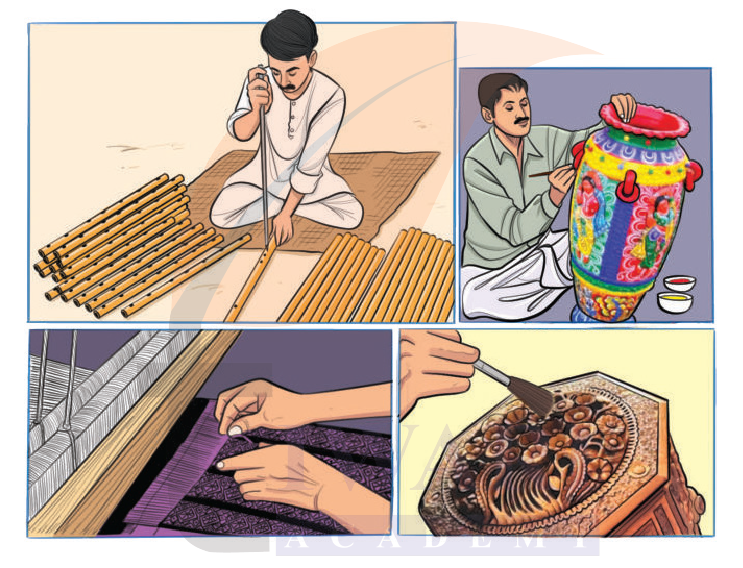
I. Look at the pictures given below and identify the vocations. Now, list at least five more vocations.

See AnswerThe vocations shown in the pictures are:
1. Basket maker
2. Potter
3. Weaver
4. Carpenter
Five more vocations:
1. Blacksmith
2. Farmer
3. Tailor
4. Painter
5. Mason

II. Work in pairs. Discuss the following questions and share your answers with your classmates and teacher.
1. What is common among these pictures?
See AnswerAll the pictures show people doing skill-based work using their hands. These are traditional occupations that require practice, patience and craftsmanship.
2. We refer to such skill-based work as v _ _ a _ _o _ s.
See AnswerWe refer to such skill-based work as “vocations”.
3. Mention a few differences between handmade and machine-made products.
See Answer
Handmade products:
– Made by hand using skills
– Unique and may have slight variations
– Take more time to produce
– Usually more artistic and creative
Machine-made products:
– Made using machines
– Look exactly the same (uniform)
– Produced quickly in large quantities
– Less personal touch and creativity
Page 37 – Check YOUR Understanding
I. Do you think pot making is easy? If yes, why? If no, why not?
See AnswerNo, pot making is not easy. It requires a lot of skill, practice and patience. The process is tiring and time-consuming, as the clay has to be collected, prepared, shaped carefully and then dried and fired properly. Even a small mistake can spoil the entire pot.
II. Would Sentila be able to fulfil her dream of becoming a pot maker? Explain.
See AnswerYes, Sentila would be able to fulfil her dream. She showed great passion and determination right from childhood. She secretly observed expert potters, practised persistently even after a year of failure with her mother, received guidance from Onula and finally, when left alone, made a full batch of pots equal to her mother’s count.
III. Do you think Mesoba and Arenla would support Sentila? Give a reason.
See AnswerMesoba supported very much strongly Sentila by speaking for her in front of the village council and promising she would become a great pot maker. At first, Arenla wanted her to learn weaving, but later taught her pottery. Her pretending to be ill was a test to encourage Sentila. Slowly, both parents supported her dream.
Page 41 – Check Your Understanding
I. Do you think Onula’s support helped Sentila? If yes, why? If no, why not?
See AnswerYes, Onula’s support helped Sentila a lot. Onula understood that Sentila was nervous and guided her patiently. She taught her the correct technique and boosted her confidence. Because of Onula’s encouragement and guidance, Sentila was able to improve her skills and finally make a perfect pot.
II. Sentila observes her mother making pots. What does this tell us about her?
See AnswerThis tells us that Sentila was a smart, curious and determined learner. Even when she could not learn directly from her mother, she did not give up. She carefully watched her mother making pots and learned step by step. This shows her strong interest in pottery and her willingness to learn by observing and understanding the process patiently.
III. Arrange the following events of the story in the correct sequence. Share your answer with your classmates and teachers.

Answer:
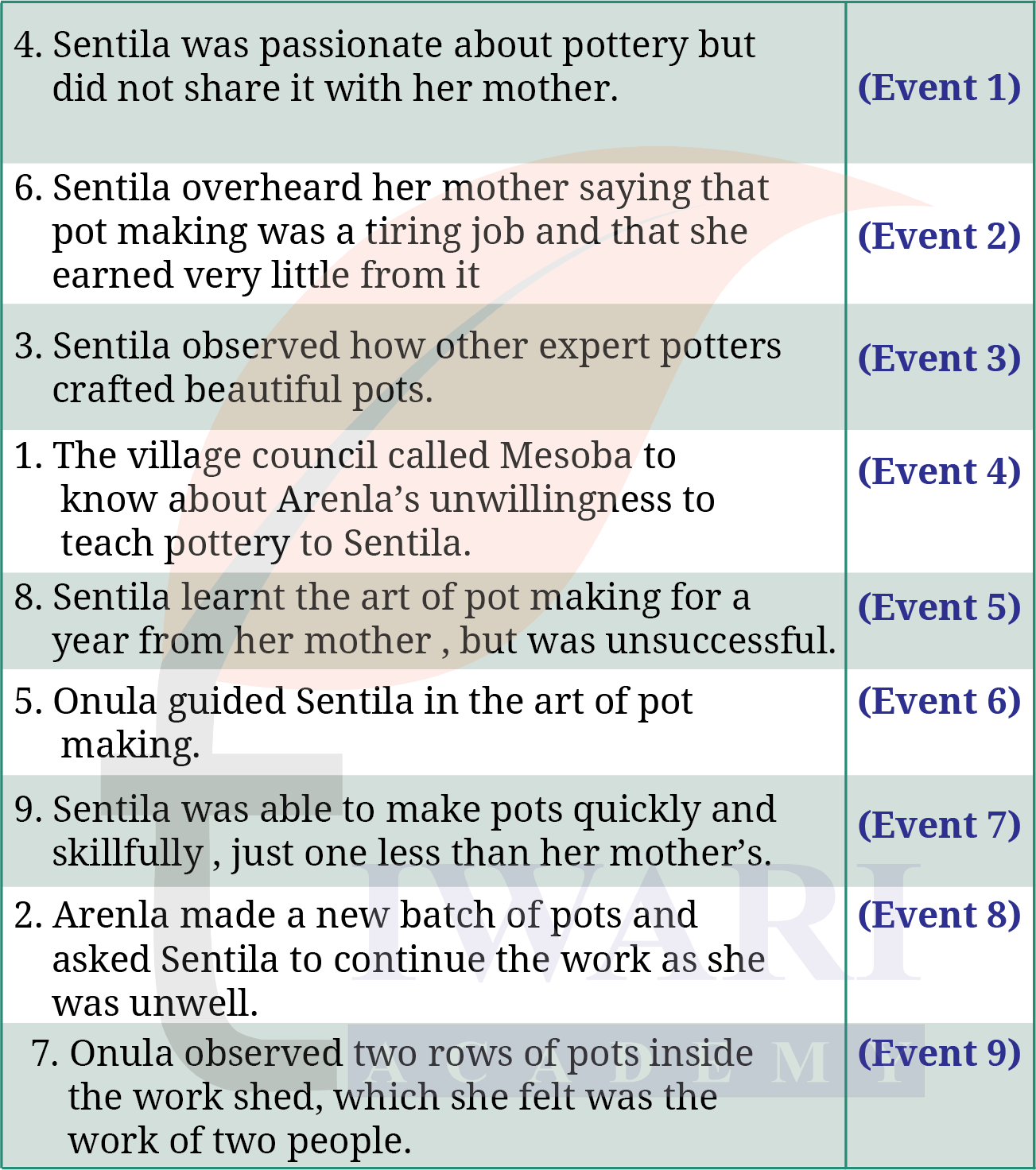
Page 42 – Critical Reflection
I. Read the extracts given below and answer the questions that follow.
1. Pounding the stubborn clay inside bamboo cylinders to soften it, is also tedious. So many times I’ve dropped the mould out of sheer exhaustion and have had to start all over again. It takes months to bring out a batch of pots after so much labour. And the reward? A few rupees. But if Senile learns weaving, she can make much more money besides providing enough cloth for the family. Weaving is not messy like pot making and can be done indoors in all seasons. Also, the time spent on weaving one shawl is much less and the return is handsome.
(i) Choose the correct reason for the given assertion.
(A): The effort in making pots is far greater than the returns.
A. The process of pot making is quite tiresome and long, and one hardly earns much.
B. The process of pot making is exhausting takes a long time, yet gives a sense of satisfaction.
See AnswerA. The process of pot making is quite tiresome and long, and one hardly earns much.
(ii) Why does Arenla want Sentila to learn weaving?
See AnswerArenla wants Sentila to learn weaving because it is easier and less messy than making pots. It can be done inside the house in any season and takes less time to finish one shawl. It also earns more money. She feels weaving will give Sentila a more comfortable and secure life.
(iii) State one advantage that weaving has over pot making, as per the extract.
See AnswerOne advantage of weaving over pot making: Weaving can be done indoors in all seasons, whereas pot making requires going outdoors to collect clay and dry pots in the sun. The time spent on making one shawl is much less than a batch of pots.
(iv) Choose the sentence that uses the word ‘handsome’ in the same way as in the extract.
A. My father is a handsome man.
B. They will make a handsome profit selling this property.
See AnswerB. They will make a handsome profit selling this property.
(v) ‘And the reward?’ What is the author’s purpose of using a question mark here?
See AnswerThe author uses a question mark to create an ironic effect. Arenla asks the question and then answers it herself with “a few rupees.” This shows that the reward is very small compared to the hard work she does. It helps the reader understand her frustration and the unfairness of her situation.
2. Onula saw her taking out some clay and the implements from her basket quietly. She watched Sentila’s clumsy efforts to make a pot and noticed that Sentila was too tense. As a result, the clay seemed unable or unwilling to yield the right shape. When Sentila wearily let the misshapen lump fall flat on the ground, Onula went to her and said, “Don’t worry, little one, I shall teach you how to make a perfect pot.” Sentila watched in amazement as Onula fashioned a beautiful pot and asked her to try again.
(i) Complete the sentence with an appropriate reason.
Onula feels Sentila’s effort at making a pot is clumsy because ________.
See AnswerOnula feels Sentila’s effort at making a pot is clumsy because Sentila was too tense and nervous while trying to shape the clay, which caused the clay to resist and remain misshapen instead of yielding to the right form.
(ii) Choose the correct option to complete the following sentence.
‘Don’t worry, little one, I shall teach you how to make a perfect pot’
This shows Onula was __________.
(A). sincere and generous
(B). forgiving and thoughtful
(C). thoughtful and generous
(D). forgiving and sincere
See Answer(A). sincere and generous
(iii) Which among the following is the effect of a cause?
A. As a result, the clay seemed unable or unwilling to yield the right shape.
B. Onula saw her taking out some clay and the implements from her basket quietly.
See AnswerA. As a result, the clay seemed unable or unwilling to yield the right shape.
(iv) ‘Onula fashioned a beautiful pot’ Here, the word ‘fashioned’ means _________ (created/styled).
See AnswerOnula fashioned a beautiful pot’ Here, the word ‘fashioned’ means created.
(v) How might Sentila have felt when she saw ‘the misshapen lump fall flat on the ground’?
See AnswerSentila must have felt deeply frustrated, embarrassed, and disheartened. The text confirms this: ‘Sentila hung her head in shame and frustration.’ After months of trying, watching her own creation collapse would have made her feel incompetent and hopeless about ever achieving her dream.
II. Answer the following questions
1. Describe the process of pot making followed by expert pot makers, as observed by Sentila.
See AnswerAs observed by Sentila, the pot-making process involves several stages: First, grey and red clay is collected from the riverbank and loaded in carrying baskets. The clay is soaked in a trough and then stuffed into bamboo cylinders where it is pounded to soften it. The potter pushes the left hand into a lump of softened clay on a rotating wheel and deftly shapes the clay using a spatula held in the right hand. After two or three days, pots are given a final touch-up to retain shape and test consistency. They are then dried in the sun, loaded on a bed of hay and dried bamboo in a uniform pattern, covered with the same materials, and the kiln is fired carefully to avoid over-firing or under-firing.
2. What warning was given to Mesoba by the village council?
See AnswerThe village council told Mesoba that it was Arenla’s duty to teach her daughter pot making, a skill passed down through generations. They warned him to remind Arenla that such skills do not belong to one person. Pot making is important because it meets people’s needs and represents their culture and history. They also said that skilled people must teach not only their children but anyone who wants to learn the craft.
3. How did Sentila feel when she failed at pot making even after a year of training with her mother?
See AnswerSentila felt deeply humiliated, frustrated, and helpless. The text describes her hanging her head ‘in shame and frustration’ after her repeated failures. Despite a whole year of sessions with her mother, she was unable to learn anything. She could not even hold the lump of dough properly. While her mother effortlessly transformed the same lump into a beautiful pot, Sentila could only watch in helpless despair. This made her feel inadequate and perhaps fear she would never achieve her dream.
4. ‘Onula stood there for a long time as if trying to absorb a new phenomenon.’ Explain.
See AnswerWhen Onula stepped into the work shed after Arenla’s death, she found two neat, indistinguishable rows of freshly made pots standing side by side. She could not tell one batch from the other. She was certain it was not the work of one person alone. This was remarkable because Sentila, who had struggled to make even a single pot just days before, had now produced an entire batch matching her mother’s output. For Onula, who knew exactly how far Sentila had come, this was a profound and almost miraculous transformation — a ‘new phenomenon’ she needed time to absorb and believe.
5. ‘The tradition and history of the people did not belong to any individual.’ What does this symbolise?
See AnswerThis statement symbolises the idea that cultural heritage and traditional skills are collective property — they belong to the entire community, not to any one person or family. No individual has the right to withhold or monopolise knowledge that has been passed down through generations for the benefit of all. It also suggests that a community’s identity is preserved through its traditional crafts, and it is every skilled person’s responsibility to ensure continuity of that knowledge by teaching others willingly. This is a powerful statement about cultural ownership, social responsibility, and the ethics of knowledge-sharing.
6. What is the significance of the concluding line of the story, ‘A new pot maker was born’?
See AnswerThe concluding line “A new pot maker was born” is very meaningful. It means that Sentila has finally learned the skill and become a good potter. It also shows that her hard work, passion, and determination helped her succeed despite many problems. This line also shows that the tradition of pot making will continue through her. The word “born” means she has a new identity now. She is not just a learner anymore but a skilled artist. The story comes full circle, as Sentila has finally become what she always dreamed of being.
7. What is the role of perseverance in pursuing one’s dreams? Elaborate with reference to Sentila.
See AnswerPerseverance, or the ability to keep trying even after failure, is the main theme of this story. Sentila shows this through her journey. Even when her mother did not support her, others laughed at her, and she failed again and again for a whole year, she did not give up. She felt hurt when she could not even make one proper pot, but she continued trying. She secretly watched potters, carried clay to practise, learned from Onula, and carefully observed her mother.
Finally, when she got a chance to work alone, she used everything she had learned to make many pots. Her hard work turned her passion into real skill. The story teaches that talent alone is not enough. Success comes from effort, learning from mistakes, and never giving up.
Page 45 – Vocabulary and Structures in Context
I. Read the highlighted words in the following sentences from the text.
1. She taught Sentila how to dig the 𝗰𝗹𝗮𝘆 with 𝗱𝗮𝗼, load it on to her 𝗰𝗮𝗿𝗿𝘆𝗶𝗻𝗴 𝗯𝗮𝘀𝗸𝗲𝘁…
2. Sentila was a quick learner and turned the clay into malleable 𝗱𝗼𝘂𝗴𝗵. Pounding the stubborn clay inside 𝗯𝗮𝗺𝗯𝗼𝗼 𝗰𝘆𝗹𝗶𝗻𝗱𝗲𝗿𝘀 to soften it …
The highlighted words describe the tools and materials required in the process of pot making.
Now classify the words/phrases given in the box as shown in the table below. One example for each category has been done for you.

Answer:
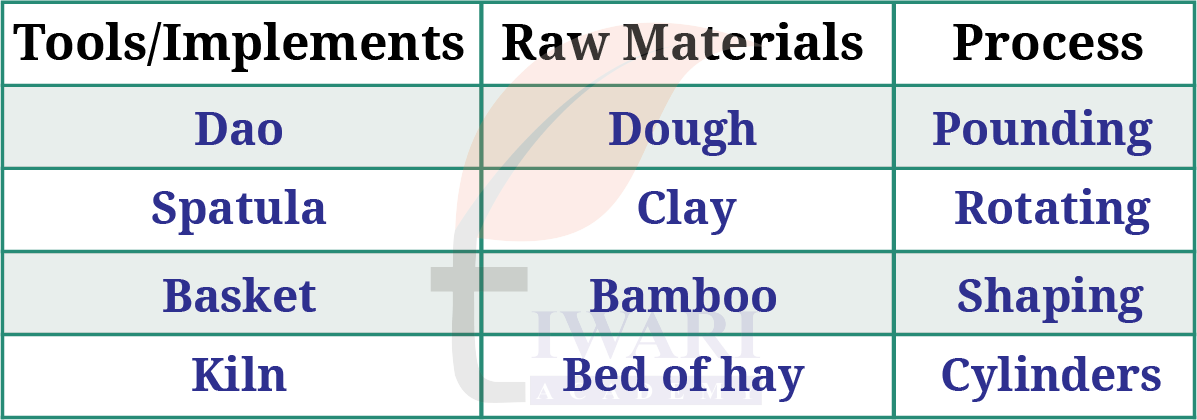
Notice the use of the following words in the text.
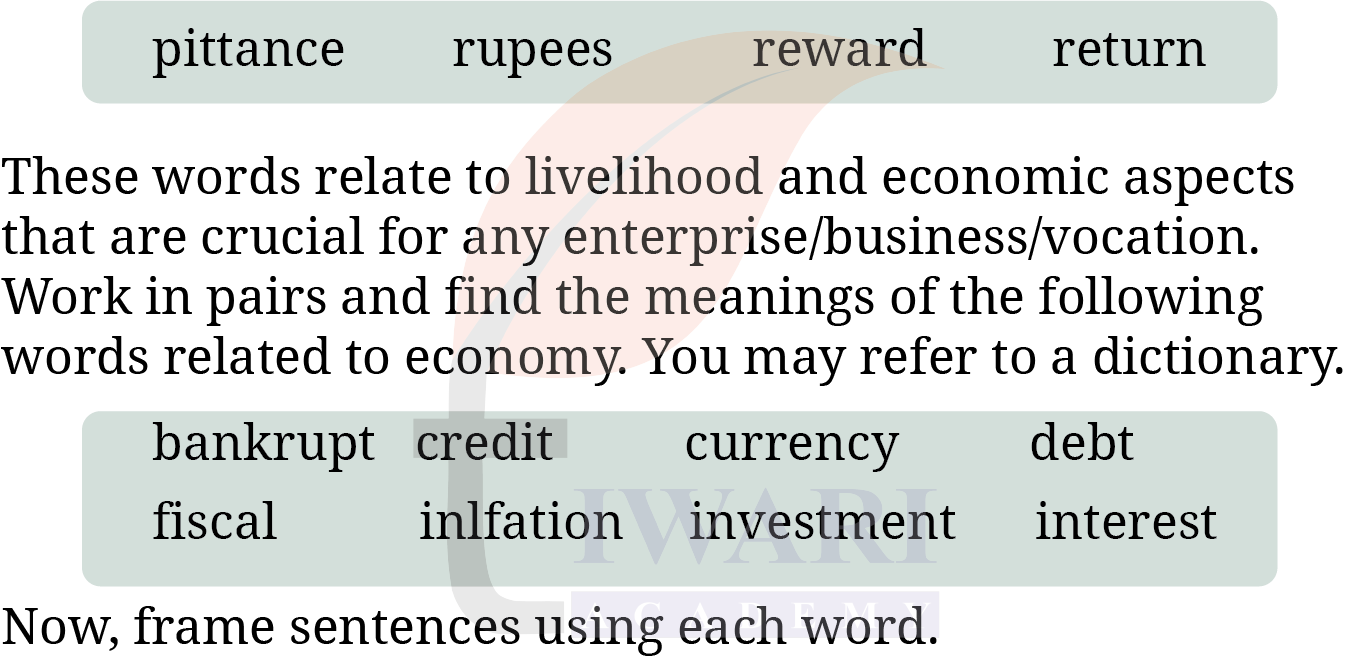
Answer:
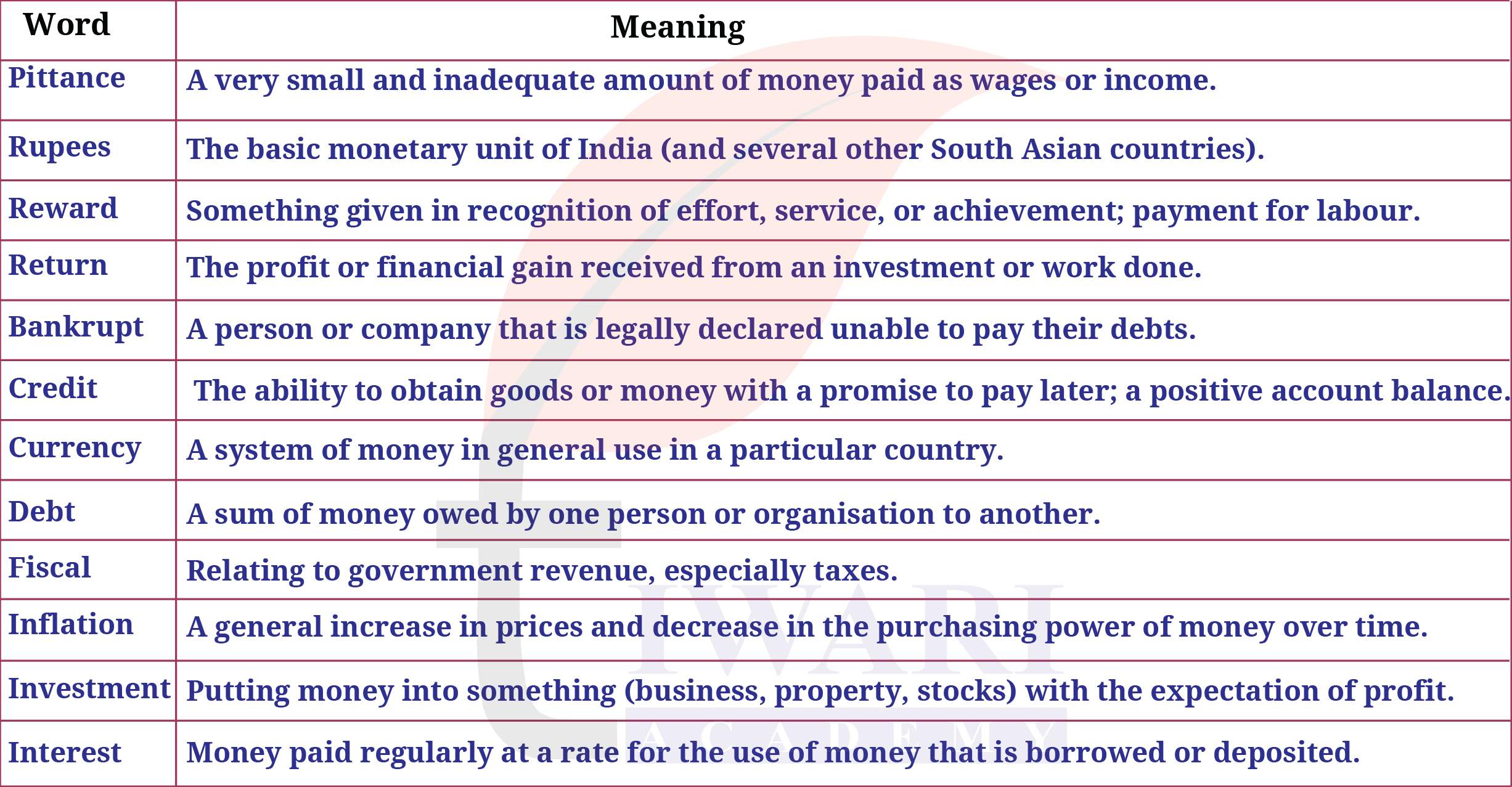
Simple sentences using each word:
- (a) bankrupt – The company went bankrupt after suffering huge losses.
- (b) credit – She used her credit card to buy a new phone.
- (c) currency – The currency of Japan is the yen.
- (d) debt – He is working hard to pay off his debt.
- (e) fiscal – The government announced a new fiscal policy this year.
- (f) inflation – Inflation has made basic goods more expensive.
- (g) investment – Buying property can be a good long-term investment.
- (h) interest – The bank charges high interest on loans.
III. Read the following sentences from the text. The main clauses has been underlined and the subordinate clause has been circled.
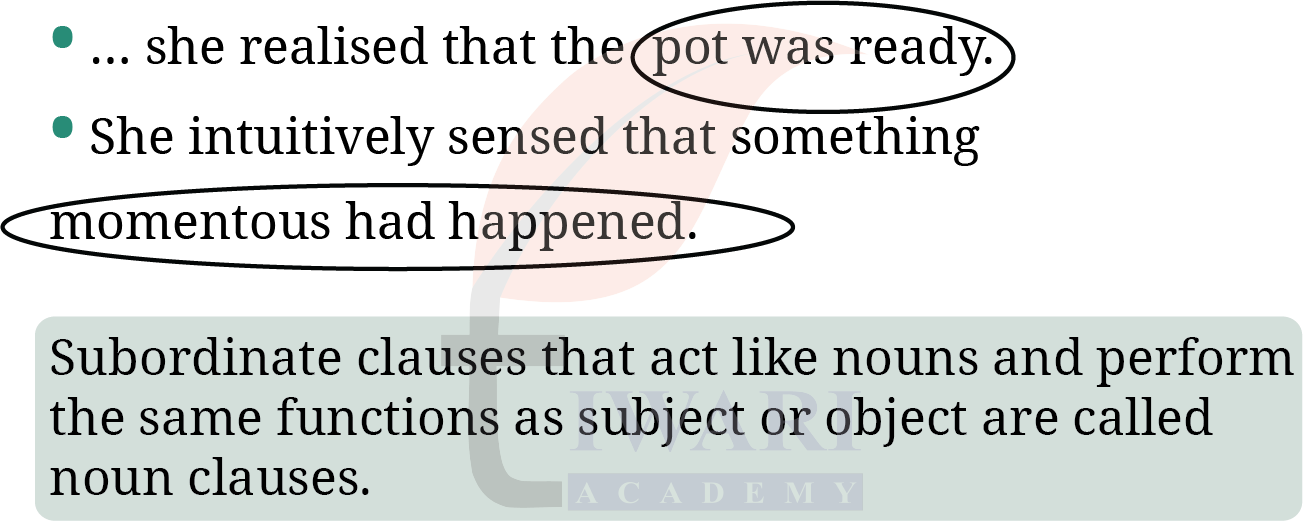
1. Complete the following sentences with suitable noun clauses.
(i) The elders emphasised that ____________.
(ii) Mesoba explained why ____________.
(iii) Onula’s promise was that ____________.
(iv) Sentila observed her mother carefully when she shaping the mouth of the pot, which ____________.
(v) The kiln, where ____________, required careful attention to prevent over-or-under firing.
See Answer(i) The elders emphasised that pot 𝗺𝗮𝗸𝗶𝗻𝗴 𝘄𝗮𝘀 𝗮 𝘀𝗸𝗶𝗹𝗹 𝗯𝗲𝗹𝗼𝗻𝗴𝗶𝗻𝗴 𝘁𝗼 𝘁𝗵𝗲 𝗲𝗻𝘁𝗶𝗿𝗲 𝗰𝗼𝗺𝗺𝘂𝗻𝗶𝘁𝘆 𝗮𝗻𝗱 𝗺𝘂𝘀𝘁 𝗯𝗲 𝗽𝗮𝘀𝘀𝗲𝗱 𝗼𝗻 𝘁𝗼 𝗮𝗹𝗹 𝘄𝗵𝗼 𝘄𝗶𝘀𝗵𝗲𝗱 𝘁𝗼 𝗹𝗲𝗮𝗿𝗻 𝗶𝘁.
(ii) Mesoba explained why 𝗔𝗿𝗲𝗻𝗹𝗮 𝗵𝗮𝗱 𝗻𝗼𝘁 𝘆𝗲𝘁 𝘁𝗮𝘂𝗴𝗵𝘁 𝗦𝗲𝗻𝘁𝗶𝗹𝗮 𝘁𝗵𝗲 𝗰𝗿𝗮𝗳𝘁, 𝘀𝗮𝘆𝗶𝗻𝗴 𝘀𝗵𝗲 𝗻𝗲𝗲𝗱𝗲𝗱 𝘁𝗶𝗺𝗲 𝘁𝗼 𝗿𝗲𝗰𝗼𝘃𝗲𝗿 𝗳𝗿𝗼𝗺 𝗵𝗲𝗿 𝗶𝗹𝗹𝗻𝗲𝘀𝘀.
(iii) Onula’s promise was that 𝘀𝗵𝗲 𝘄𝗼𝘂𝗹𝗱 𝘁𝗲𝗮𝗰𝗵 𝗦𝗲𝗻𝘁𝗶𝗹𝗮 𝗵𝗼𝘄 𝘁𝗼 𝗺𝗮𝗸𝗲 𝗮 𝗽𝗲𝗿𝗳𝗲𝗰𝘁 𝗽𝗼𝘁.
(iv) Sentila observed her mother carefully when she was shaping the mouth of the pot, which 𝗵𝗲𝗹𝗽𝗲𝗱 𝗵𝗲𝗿 𝘂𝗻𝗱𝗲𝗿𝘀𝘁𝗮𝗻𝗱 𝘁𝗵𝗲 𝗰𝗼𝗿𝗿𝗲𝗰𝘁 𝘁𝗲𝗰𝗵𝗻𝗶𝗾𝘂𝗲.
(v) The kiln, where 𝘁𝗵𝗲 𝗽𝗼𝘁𝘀 𝘄𝗲𝗿𝗲 𝗳𝗶𝗿𝗲𝗱, required careful attention to prevent over-or-under firing.
2. Read the following sentences from the text. Underline the main clause and circle the subordinate clause.
(i) Arenla took Sentile to the riverbank where the grey and red clay was found.
(ii) She started on the next one, and like a sprinter who had suddenly found momentum…
(iii) …skill such as pot making, which not only catered to the needs of the people…

See Answer(i) Main clause: Arenla took Sentila to the riverbank | Subordinate/Relative clause: (where the grey and red clay was found)
(ii) Main clause: She started on the next one | Subordinate/Relative clause: (like a sprinter who had suddenly found momentum)
(iii) Main clause: skills such as pot making | Relative clause: (which not only catered to the needs of the people…)
3. Complete the following sentences with suitable relative clauses.
(i) Sentile, whose _________, practiced the craft diligently.
(ii) The village council, where _________, sought an explanation for Arenla’s reluctance.
(iii) The potter’s hands, which _________, shaped the clay into beautiful creations.
(iv) Arenla, her mother, wanted to learn weaving, which _________.
(v) Mesoba went home and discussed the matter with Arenla, who _________.
See Answer(i) Sentila, whose 𝗽𝗮𝘀𝘀𝗶𝗼𝗻 𝗳𝗼𝗿 𝗽𝗼𝘁 𝗺𝗮𝗸𝗶𝗻𝗴 𝗵𝗮𝗱 𝗯𝗲𝗲𝗻 𝗮 𝗰𝗵𝗶𝗹𝗱𝗵𝗼𝗼𝗱 𝗱𝗿𝗲𝗮𝗺, practised the craft diligently.
(ii) The village council, where 𝘁𝗵𝗲 𝗲𝗹𝗱𝗲𝗿𝘀 𝗴𝗮𝘁𝗵𝗲𝗿𝗲𝗱 𝘁𝗼 𝗱𝗶𝘀𝗰𝘂𝘀𝘀 𝗰𝗼𝗺𝗺𝘂𝗻𝗶𝘁𝘆 𝗺𝗮𝘁𝘁𝗲𝗿𝘀, sought an explanation for Arenla’s reluctance.
(iii) The potter’s hands, which 𝗺𝗼𝘃𝗲𝗱 𝘄𝗶𝘁𝗵 𝗶𝗻𝗰𝗿𝗲𝗱𝗶𝗯𝗹𝗲 𝘀𝗸𝗶𝗹𝗹 𝗮𝗻𝗱 𝗱𝗲𝘅𝘁𝗲𝗿𝗶𝘁𝘆, shaped the clay into beautiful creations.
(iv) Arenla, her mother, wanted her to learn weaving, which𝘄𝗮𝘀 𝗰𝗼𝗻𝘀𝗶𝗱𝗲𝗿𝗲𝗱 𝗺𝗼𝗿𝗲 𝗽𝗿𝗼𝗳𝗶𝘁𝗮𝗯𝗹𝗲 𝗮𝗻𝗱 𝗹𝗲𝘀𝘀 𝗹𝗮𝗯𝗼𝗿𝗶𝗼𝘂𝘀.
(v) Mesoba went home and discussed the matter with Arenla, who 𝗳𝗶𝗻𝗮𝗹𝗹𝘆 𝗮𝗴𝗿𝗲𝗲𝗱 𝘁𝗼 𝘁𝗲𝗮𝗰𝗵 𝗦𝗲𝗻𝘁𝗶𝗹𝗮 𝘁𝗵𝗲 𝗮𝗿𝘁 𝗼𝗳 𝗽𝗼𝘁 𝗺𝗮𝗸𝗶𝗻𝗴.
4. Read the highlighted words in the following lines from the text.
Onula saw her taking out 𝘀𝗼𝗺𝗲 clay…
… make as 𝗺𝗮𝗻𝘆 pots as they could.
… did not belong to 𝗮𝗻𝘆 individual.
Slowly she walked away from 𝘁𝗵𝗶𝘀 place of wonder.
… they would not have 𝗲𝗻𝗼𝘂𝗴𝗵 days of sunshine.
Here is a list of the most frequently used determiners –
• a, an, the (Articles)
• this, that, these those (Demonstratives)
• my, our, your, his her, its, their, one’s (Possessives)
• one, two, three, etc. (Definite numerals)
• some, any, no, all both, much, many, few, less, several, little (Indefinite numerals)
• each, every, either, neither (Distributives)
(i) Find out some more determiners from the text.
See AnswerMore determiners found in the text: her, my, our, their, its (Possessives) | the, a, an (Articles) | those, this, that (Demonstratives) | no, all, much, few, several, both (Indefinite) | one, two, three (Definite numerals) | each, every (Distributives)
(ii) Fill in the blanks with suitable determiners.
The first two blanks have been done for you.
A. The florist arranged five bouquets for her clients, that were displayed in _________ elegant floral shop.
(B) The carpenter crafted _________ unique tables, and _________ became the centrepiece in _________ furniture collection.
(C) _________ of _________ apprentices in _________ culinary class demonstrated _________ knife skills during the intense cooking session.
(D) _________ of _________ sculptures were displayed at _________ art exhibition, showcasing _________ diverse artistic skills.
See Answer(A) The florist arranged five bouquets for her clients, that were displayed in 𝗮𝗻 elegant floral shop.
(B) The carpenter crafted 𝘀𝗲𝘃𝗲𝗿𝗮𝗹 unique tables, and 𝗼𝗻𝗲 became the centrepiece in 𝘁𝗵𝗲 furniture collection.
(C) 𝗔 𝗴𝗿𝗼𝘂𝗽 of 𝘀𝗼𝗺𝗲 apprentices in 𝘁𝗵𝗲 culinary class demonstrated 𝘁𝗵𝗲𝗶𝗿 knife skills during the intense cooking session.
(D) 𝗠𝗮𝗻𝘆 of 𝘁𝗵𝗲 sculptures were displayed at 𝗮𝗻 art exhibition, showcasing 𝘁𝗵𝗲𝗶𝗿 diverse artistic skills.
Page 48 – Listen and Respond
I. You will listen to a man speak about stone statues. As you listen, complete the given paragraph by filling in the blanks with the exact words you listen to.
(Transcript for teacher on page 261)
A status is carved to create a shape that is 1. __________. Among the many things stone is used for making stone 2. __________ is one of them. India has some of the most 3. __________ stone sculptures, as is obvious from its many stone monuments across the country.
See AnswerA statue is carved to create a shape that is 1. 𝘃𝗶𝘀𝘂𝗮𝗹𝗹𝘆 𝗶𝗻𝘁𝗲𝗿𝗲𝘀𝘁𝗶𝗻𝗴 𝘁𝗵𝗿𝗲𝗲-𝗱𝗶𝗺𝗲𝗻𝘀𝗶𝗼𝗻𝗮𝗹. Among the many things stone is used for, making stone 2. 𝘀𝗰𝘂𝗹𝗽𝘁𝘂𝗿𝗲𝘀 is one of them. India has some of the most 3. 𝗳𝗮𝘀𝗰𝗶𝗻𝗮𝘁𝗶𝗻𝗴 𝗮𝗻𝗱 𝗺𝗲𝘀𝗺𝗲𝗿𝗶𝘀𝗶𝗻𝗴 stone sculptures, as is obvious from its many stone monuments across the country.
II. You will now listen to the man speaking about some steps involved in making stone status. As you listen, select the six correct steps out of the nine given.
(Transcript for teacher on page 261)
1. crave to remove large unwanted portions of the stone
2. Set up the different tools
3. measure the weight and dimensions of the statue
4. leave the statue in water to firm up overnight
5. Refine the creation within the stone
6. Choose the stone
7. Begin carving from the centre
8. Detach the creation from the stone as the final statue
9. Work to bring out the imagined shape
See AnswerBased on the transcript, the six correct steps in making a stone statue are:
6. Choose the stone
3. Measure the weight and dimensions of the statue
1. Carve to remove large unwanted portions of the stone
9. Work to bring out the imagined shape
5. Refine the creation within the stone
8. Detach the creation from the stone as the final statue
Page 50 – Writing Task
Reflective Writing – Identifying Skills and Passion
Reflective writing encourages introspection and thoughtful exploration of personal experiences, skills, and aspirations. It helps individuals gain deeper insights into themselves and their goals through structured reflection.
I. Follow the steps given below to create a write-up about your skills and passions.
• Step 1: Introduction
Reflect on your passions and the skills you currently possess or are developing. Consider why these activities or interests are meaningful and enjoyable to you.
• Step 2: Describing skills
Describe specific activities or practices you engage in to nurture your skills. This could include hobbies, classes (art, music, coding, etc.), workshops, or personal projects.
• Step 3: Passion into profession
Identify which of these skills you believe have the potential to turn your passion into a profession. Explain why you think these skills are crucial or advantageous in your chosen field.
• Step 4: Examples and reflection
Provide examples or anecdotes that illustrate how your skills and passions complement each other. Reflect on how these experiences have shaped your career aspirations and personal growth.
• Step 5: Conclusion
Summarise your reflections. Discuss any insights gained about yourself, your skills, and your career ambitions through this exercise.
See Answer• Step 1: Introduction
I have always been drawn to writing and storytelling. From a young age, putting thoughts into words has felt natural to me — whether it was writing diary entries, crafting short stories, or simply describing what I observed around me. Writing is not just a skill I practice; it is something that brings me genuine joy and a sense of purpose.
• Step 2: Describing Skills
To nurture this passion, I regularly write short stories and essays in my free time. I participate in my school’s creative writing club, where we are given weekly prompts to respond to. I also read widely — fiction, non-fiction, newspapers — because I believe reading is the foundation of good writing. Occasionally, I attend writing workshops that help me understand structure, tone and vocabulary better.
• Step 3: Passion into Profession
I believe writing has strong potential as a profession. Careers in journalism, content creation, screenwriting, copywriting, and publishing all demand strong writing skills. In today’s digital world, the ability to communicate clearly and creatively is more valuable than ever. My skill gives me an edge in all fields that require effective communication.
• Step 4: Examples and Reflection
Last year, I wrote a short story for a school competition and won first place. That experience taught me that my words could move people and make them think. It also showed me that with consistent practice, I can improve significantly. This has shaped my aspiration of becoming a journalist or an author — someone who informs, inspires and entertains through the power of language.
• Step 5: Conclusion
Reflecting on my skills and passions has helped me understand myself better. I now see that writing is not just a hobby — it is a calling. This exercise has strengthened my resolve to pursue writing seriously and build a career around it. I am excited about the journey ahead and committed to honing my craft every single day.
Page 51 – Learning Beyond the Text
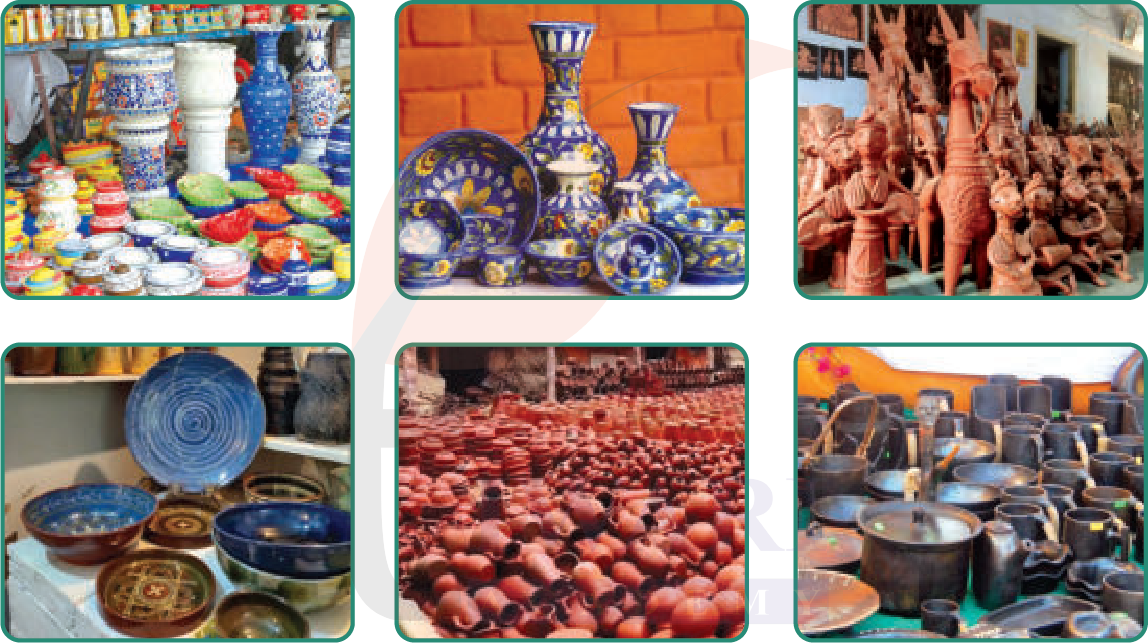
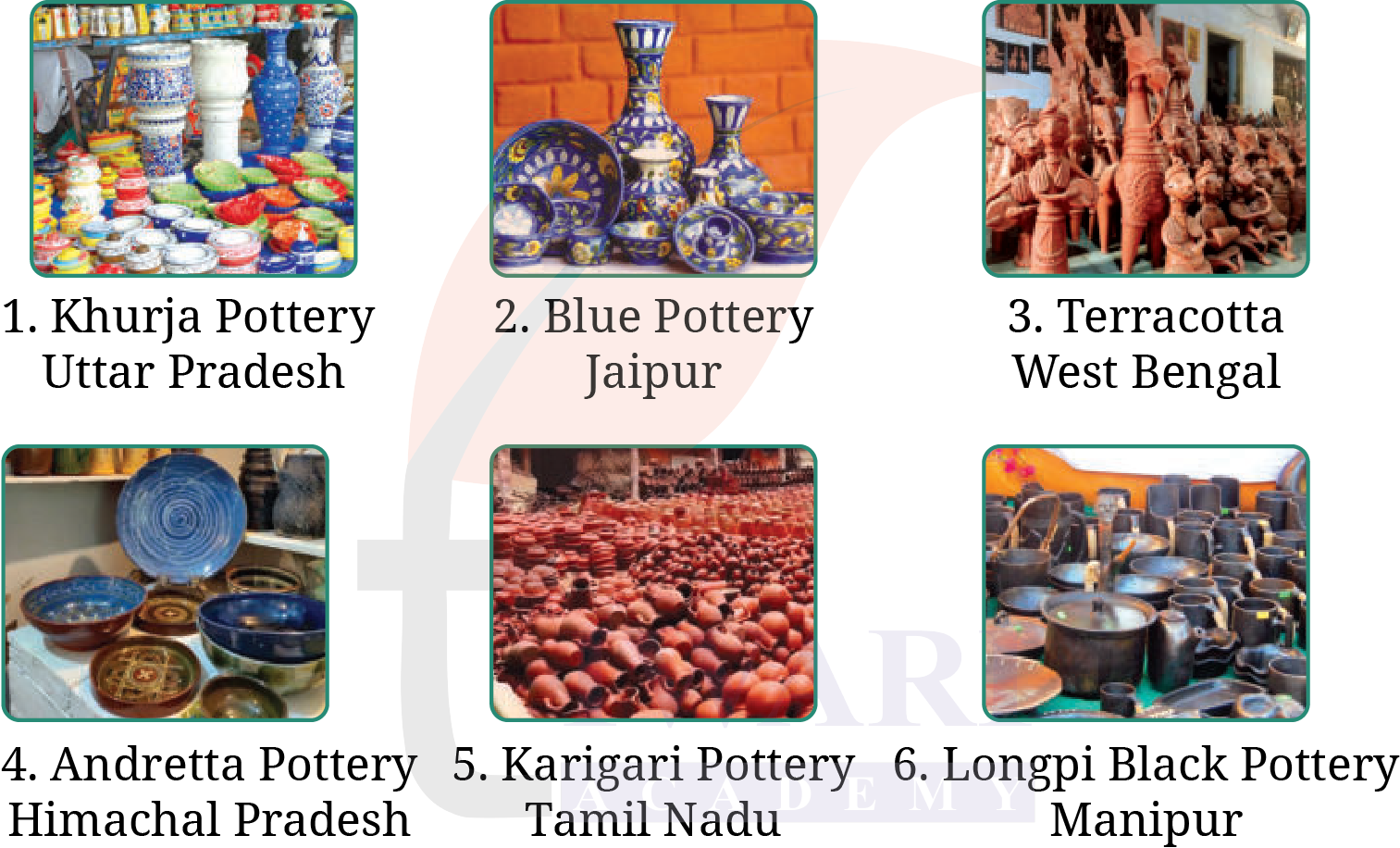
I. Pottery is practised in many parts of our country and each region has its unique style.
Find out about different styles of indigenous pottery of your region and other regions of our country. Some notable styles include:
• Khurja pottery from Uttar Pradesh
• Blue pottery from Jaipur
• Terracotta from West Bengal
• Andretta pottery from Himachal Pradesh
• Karigari pottery from Tamil Nadu
• Longpi Black pottery from Manipur
1. Match the pictures with the pottery it represents.
Answer:
II. You must have read stories in English and in your own language about the value of handicrafts and art.
Read the story ‘Quality by John Galsworthy. Write its review and make a presentation highlighting the decline of traditional crafts and skills vs industrialisation and mass-produced goods.
See AnswerPresentation Outline: Traditional Crafts vs. Industrialisation
Slide 1 – Title: Quality vs. Quantity: The Decline of Traditional Craftsmanship
Slide 2 – About the Story: Brief summary of Quality by John Galsworthy — the Gessler brothers and their handmade shoes.
Slide 3 – What is Traditional Craft? Skill passed down through generations; each item made with care, time, and artistry. Examples: handloom weaving, pottery, cobbling, woodcraft.
Slide 4 – Rise of Industrialisation: Mass production, machines replacing hands, lower cost, faster output — but loss of uniqueness and personal touch.
Slide 5 – What is Lost? Jobs for artisans, cultural heritage, quality of products, human connection in craft.
Slide 6 – Indian Context: Traditional crafts like Khurja pottery, Longpi Black pottery, Banarasi weaving — all facing similar threats today.
Slide 7 – The Moral of Quality: The Gessler brothers represent every craftsman who chose dignity over survival. Their story is a warning and a tribute.
Slide 8 – Conclusion: We must support traditional crafts — buy handmade, visit craft fairs, appreciate artisans. Quality should never be sacrificed at the altar of convenience.
NCERT Class 9 English Kaveri Poem 2 Solutions
Page 57 – Reflect and Respond
I. Given below are four riddles. Read and identify who these people are.
1. In furrows deep, secrets I sow, As time passes, I watch them grow.
Who am I? __________________
2. From wheel to kiln, my skill is born, Step by step, an art takes form .
Who am I? __________________
3. I lay foundations, bricks by bricks, To build a house, it’s me you pick.
Who am I? __________________
4. I work with pots, pans, and spice, Creating dishes that taste so nice.
Who am I? __________________
See Answer1. FARMER / AGRICULTURIST
2. POTTER / POT MAKER
3. MASON / BUILDER
4. COOK / CHEF
II. What is the role and relevance of the people you identified inn the riddles. How do they contribute to the society? Discuss with your classmates and teacher.
See AnswerEach of these vocations plays an essential role in society. The farmer produces the food that feeds entire communities — without farmers, no one would survive. The potter provides functional vessels for storing water, cooking, and preserving food, while also keeping alive a rich cultural tradition. The mason/builder constructs the homes, schools, temples and public buildings that give communities a place to live and gather. The cook transforms raw ingredients into nourishing, enjoyable meals that sustain health and bring people together. All these vocations may seem ordinary, but they form the invisible backbone of society. They remind us that every honest trade deserves respect and dignity.
Page 60 – Check Your Understanding
I. Based on your understanding of the poem, state whether the following statements are true or false. Also, rectify the false statements.
1. The poem highlights the skilled work of craftsperson.
2. The poet shares that musicians express emotions through their instruments.
3. The carpenters in the poem are admired for their logical work.
4. The electricians in the poem are recognised for their crucial role in lighting up lives.
5. The poem pays homage to shoemakers who manufacture quality footwear.
6. The poem celebrates the patriotism of the people of Bharat.
7. The poet feels that each vocation deserves to be respected.
See Answer1. The poem highlights the skilled work of craftspersons. : TRUE
2. The poet shares that musicians express emotions through their instruments. : TRUE
3. The carpenters in the poem are admired for their logical work. : FALSE
4. The electricians in the poem are recognised for their crucial role in lighting up lives. : TRUE
5. The poem pays homage to shoemakers who manufacture quality footwear. : TRUE
6. The poem celebrates the patriotism of the people of Bharat. : FALSE
7. The poet feels that each vocation deserves to be respected. : TRUE
II. Let us appreciate the poem.
1. Rhyme Schema and Lineation
(i) Does the poem strictly adhere to a rhyme scheme, or is in free verse?
See AnswerThe poem does not follow a strict rhyme scheme thoughout. It has some rhyming couplets (e.g., ‘hues/streets’, ‘precision/lives’) but overall flows as free verse, with irregular rhyme and no fixed metre. This free form allows the poet to include many different vocations without being forced into a rigid pattern.
(ii) What is the impact of the varying length of lines in the poem?
See AnswerThe varying line lengths create a sense of natural, conversational rhythm, mirroring the diversity and unpredictability of the different vocations described. It also gives the poem an organic, spontaneous feel — as though the poet is genuinely ‘hearing’ and celebrating each voice as it comes, without planning or restriction.
(iii) What is the pattern in the structure of most lines of the poem?
See AnswerMost lines begin by naming a particular vocation (e.g., ‘The carpenters celebrating…’, ‘The electricians humming…’, ‘The boatmen gathering…’) followed by a description of what that worker does or how they do it. This repetitive ‘The [vocation] + action’ pattern acts as a refrain-like structure that builds a cumulative celebration of all vocations.
2. Speaker
(i) Who appears to be the speaker and what is her/his role here?
See AnswerThe speaker appears to be an observer — perhaps a poet or a common citizen of Bharat — who walks through the country and ‘hears’ the sounds of different workers at their crafts. The speaker’s role is that of a celebrant and witness, drawing attention to the beauty and dignity of every vocation and declaring that each is worthy of pride and respect.
3. Tone and Mood
(i) Fill in the blanks with suitable options from the box given below.

A. The tone is _________________ and _________________, depicting a sense of admiration respect for the artisans and craftsperson.
B. There is a _________________ mood throughout the poem, capturing the vibrancy and richness of cultural traditions and skills.
See Answer(A) The tone is 𝗥𝗲𝘃𝗲𝗿𝗲𝗻𝘁𝗶𝗮𝗹 and 𝗖𝗲𝗹𝗲𝗯𝗿𝗮𝘁𝗼𝗿𝘆, depicting a sense of admiration and respect for the artisans and craftspersons.
(B) There is a 𝗝𝗼𝘆𝗳𝘂𝗹 mood throughout the poem, capturing the vibrancy and richness of cultural traditions and skills.
4. Imagery
(i) Select any two descriptions from the poem that evoke visual images.
See Answer1. ‘The carpenters celebrating; they create anything out of wood with mathematical precision’ — evokes the image of a skilled carpenter measuring and cutting wood with careful accuracy.
2. ‘The boatmen gathering their nets from the shore, sailing, and singing while at work’ — paints a vivid picture of fishermen hauling their nets at dawn on a sunlit shore.
(ii) Fill in the blanks with suitable phrases.
The poem includes auditory imagery through mentions of artisans with lutes, _________________ , and _________________ , emphasising the sounds associated with each vocation.
See AnswerThe poem includes auditory imagery through mentions of artisans with lutes, 𝘁𝗵𝗲 𝗲𝗹𝗲𝗰𝘁𝗿𝗶𝗰𝗶𝗮𝗻𝘀 𝗵𝘂𝗺𝗺𝗶𝗻𝗴, and 𝘁𝗵𝗲 𝗱𝗲𝗹𝗶𝗰𝗶𝗼𝘂𝘀 𝘀𝗶𝗻𝗴𝗶𝗻𝗴 𝗼𝗳 𝘁𝗵𝗲 𝗰𝗼𝗼𝗸, emphasising the sounds associated with each vocation.
5. Metaphor
(i) State whether the following sentence is true or false
The mention of ‘delicious singing’ of the cook is a metaphor because it implies that the quality of the singing is so enjoyable or pleasing that it can be equated to the experience of tasting something delicious.
See AnswerTRUE. ‘Delicious singing of the cook’ is a metaphor because it compares the cook’s singing (or the sounds of cooking — the sizzle of pans, the clatter of utensils) to something ‘delicious’, i.e., as pleasing to the ear as food is to the taste. It implies the cook’s work, even its sounds, is something to be savoured and enjoyed.
6. Personification
(i) Select the line that tells us that the poet personifies vocations by attributing human-like qualities to them.
See AnswerThe line: ‘The voice of their vocation is the voice of their identity.’ Here, ‘vocation’ is given a ‘voice’ — a human quality — suggesting that a person’s work speaks for who they are, as if the vocation itself could talk.
7. Repetition
(i) Why might the poet have begun and ended with the same line- ‘I hear Bharat celebrating, the varied vocations I hear!’?
See AnswerThe repetition of the opening and closing line creates a circular structure, giving the poem a sense of completeness and unity. It emphasises that the celebration of vocations is ongoing and all-encompassing — it was happening before the poem began and continues after it ends. The repetition also reinforces the central message: the diversity of vocations in Bharat is something constantly worth hearing, celebrating, and honouring.
8. Alliteration
(i) Identify two examples of alliteration from the poem.
See Answer1. ‘celebrating their craft’ — the repetition of the ‘c’ sound.
2. ‘craftsperson, each one celebrating’ — repetition of the ‘c’ sound.
(Also: ‘colours and…craft’ — ‘c’ sound; ‘cables and…come’ — ‘c’ sound)
9. Symbolism
(i) Each vocation in the poem symbolises something more than just a job. What does it symbolise?
See AnswerEach vocation in the poem symbolises the identity, dignity, and cultural heritage of the people of Bharat. The craftsperson’s weaving, the carpenter’s precise woodwork, the electrician’s cables, the boatman’s nets, and the cook’s singing all symbolise the idea that work is not merely a means of livelihood — it is an expression of who a person is, what community they belong to, and what traditions they carry forward. Collectively, these vocations symbolise the rich mosaic of Indian civilisation, where every form of honest labour contributes to the social fabric.
Page 62 – Critical Reflection
I. Read the extract given below and answer the questions that follow.
The shoemakers affirming the quality of their work, for the feet that walk, dance, run, jump, return home.
The delicious singing of the cook, or the rhyme of designer, mason, each celebrating what belongs to them and to none else,
1. The poet says that the shoemakers ‘affirm’ the quality of their work. What does ‘affirm’ refer to here?
(i) to make adjustments in
(ii) to declare with confidence
(iii) to label the goods
(iv) to justify the efforts
See Answer(ii) to declare with confidence
2. What do quality shoes help with, according to the poet?
See AnswerAccording to the poet, quality shoes help the feet ‘walk, dance, run, jump, return home.’ This suggests that good footwear supports all human movement and activity — from the mundane (walking) to the joyful (dancing), the energetic (running, jumping) and the comforting (returning home). The shoemakers thus support every aspect of human life and journey.
3. What does ‘return home’ symbolise besides the literal act of returning?
See Answer‘Return home’ symbolises safety, completion, and belonging. Beyond the literal act of coming back to one’s house, it represents the end of a journey, the feeling of being grounded, and the ability to find one’s way back to one’s roots and loved ones. It suggests that quality shoes — and by extension, skilled work — support not just physical travel but the entire human journey through life.
4. Identify the phrase that tells us that every worker’s contribution is distinct.
See AnswerThe phrase: ‘each celebrating what belongs to them and to none else’ — this tells us that every worker has a unique skill and contribution that is entirely their own. No two vocations are the same; each person’s craft is their own special gift to the world.
5. Complete the following with suitable words.
… for the feet that walk, dance, run, jump, return home refer to _________________.
See Answer… for the feet that walk, dance, run, jump, return home refer to the shoes.
II. Answer the following questions.
1. Why does the poet say, ‘I hear Bharat celebrating, the varied vocations I hear’?
See AnswerThe poet uses this line to celebrate the diverse workforce of India. ‘Hearing’ Bharat suggests that the nation is alive with the sounds and voices of countless workers, each contributing their unique skill. The poet is drawing attention to the fact that Bharat’s greatness lies not just in its monuments or rulers, but in the daily, dignified labour of its craftspersons, farmers, traders and artisans. By ‘hearing’ these voices, the poet honours them — declaring that they are the true song of the nation.
2. What does the electrician ‘humming’ while getting ready for work suggest?
See AnswerThe electrician humming while preparing for work suggests contentment, focus, and pride in their labour. Humming is associated with someone who is at ease and absorbed in what they are doing. It suggests that the electrician finds joy and purpose in their work — they are not merely going through the motions but are genuinely engaged. It also gives the electrician a personality, making them a living, breathing person rather than a nameless worker.
3. Explain the significance of the line, ‘The voice of their vocation is the voice of their identity.’
See AnswerThis line is the philosophical heart of the poem. It states that what a person does for their livelihood is inseparable from who they are. A potter is not merely someone who makes pots — pottery is their identity, their history, their pride. A boatman is not just someone who sails — the sea and the nets are part of his very being. The line suggests that vocations are not just economic activities; they are expressions of culture, heritage, and personal identity. It is a call to respect every worker, because in dismissing their work, we dismiss their identity.
4. Do you think the role of all the people belonging to different vocations is important in our daily lives? Support your answer with a reason.
See AnswerYes, absolutely. Every vocation mentioned in the poem — and countless others — plays an essential role in sustaining our daily lives. The farmer grows the food we eat; the carpenter builds the furniture we use; the electrician provides the power that lights our homes; the boatman supplies fish; the cook nourishes us; the shoemaker ensures we can walk comfortably. Without any one of these workers, our daily lives would be incomplete. Moreover, each vocation preserves a part of our cultural identity and tradition. When we honour and support these vocations, we are supporting the very foundation of our civilised existence.
5. Why is the poet celebrating all the vocations in the poem? Explain by giving examples from your context.
See AnswerThe poet celebrates all vocations to challenge the common tendency to rank professions — to consider some ‘respectable’ and others ‘ordinary.’ By placing the artisan, the electrician, the boatman, the cook, and the shoemaker side by side in the same poem, the poet declares that all honest work is equally worthy of celebration. In our own context, we see this every day: the dhobiwala who returns our clean clothes, the auto-driver who gets us to school safely, the vegetable vendor who ensures our kitchens are stocked — all of these people make our lives possible. The poet wants us to see the grace and dignity in every form of labour.
6. How does the poet use sensory imagery to bring out the beauty of everyday work?
See AnswerThe poet uses all the senses to make the vocations vivid and alive. Visual imagery: ‘craftsperson… woven with colours and myriad hues’ — we see the bright threads on a loom. Auditory imagery: ‘artisans with lutes hailing varied emotions’, ‘electricians humming’, ‘boatmen singing’, ‘delicious singing of the cook’ — we hear the sounds of labour. Tactile imagery: ‘create anything out of wood with mathematical precision’ — we feel the exactness of the carpenter’s hands. Taste/smell imagery: ‘delicious singing of the cook’ metaphorically evokes the aroma and taste of good food. By engaging multiple senses, the poet makes every vocation feel immediate, beautiful and worthy of celebration.
Page 63 – Vocabulary in Context
I People of different vocations are being described in the poem. Match the vocations given in the box below with the descriptions that follow.

1. A person who studies or grow garden plants: _______________.
2. A trained female community health worker: _______________.
3. A producer of raw silk: _______________.
4. A person whose job is making or selling sweets and chocolates: _______________.
5. A metalworker who specialises in working with precious metals: _______________.
6. A person who fuses materials together: _______________.
See Answer1. A person who studies or grows garden plants: 𝗛𝗼𝗿𝘁𝗶𝗰𝘂𝗹𝘁𝘂𝗿𝗶𝘀𝘁
2. A trained female community health worker: 𝗔𝗦𝗛𝗔 𝘄𝗼𝗿𝗸𝗲𝗿
3. A producer of raw silk: 𝗦𝗲𝗿𝗶𝗰𝘂𝗹𝘁𝘂𝗿𝗶𝘀𝘁
4. A person whose job is making or selling sweets and chocolates: 𝗖𝗼𝗻𝗳𝗲𝗰𝘁𝗶𝗼𝗻𝗲𝗿
5. A metalworker who specialises in working with precious metals: 𝗚𝗼𝗹𝗱𝘀𝗺𝗶𝘁𝗵
6. A person who fuses materials together: 𝗪𝗲𝗹𝗱𝗲𝗿
II. Identify the word from Column 2 that is not the synonyms of the words given in Column 1.
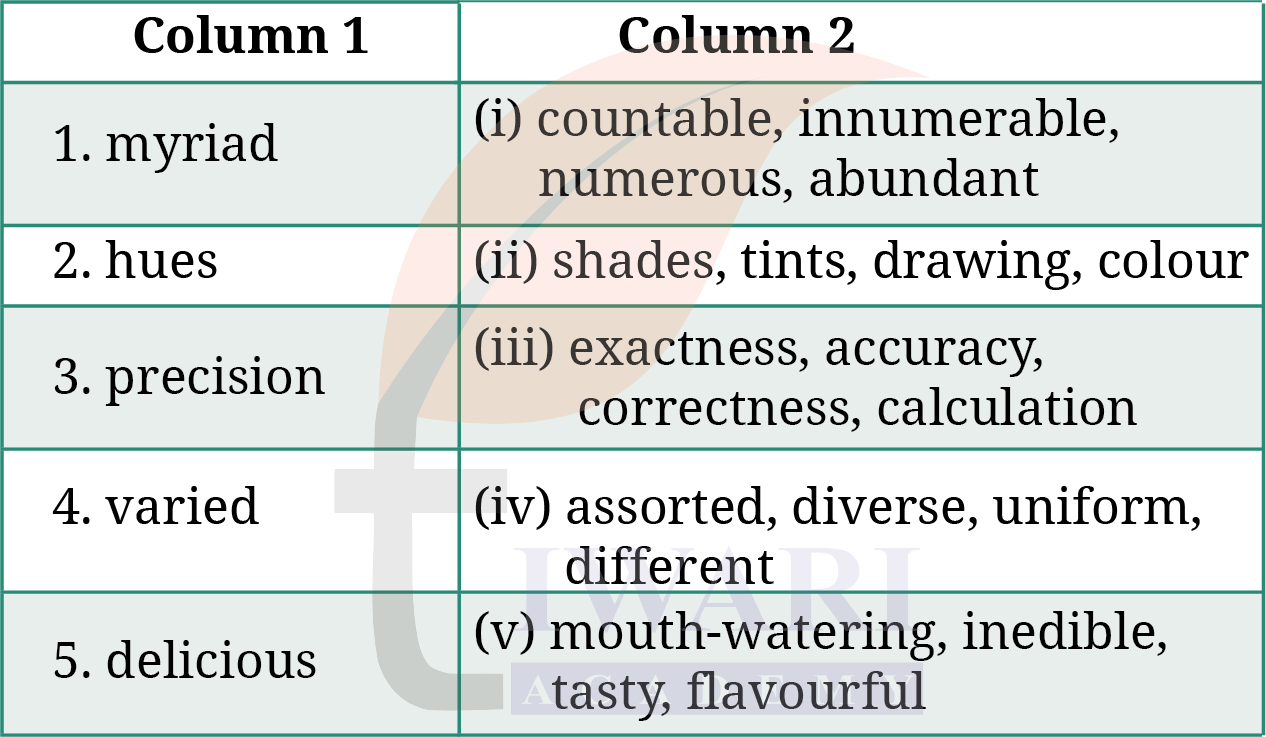
Answer:
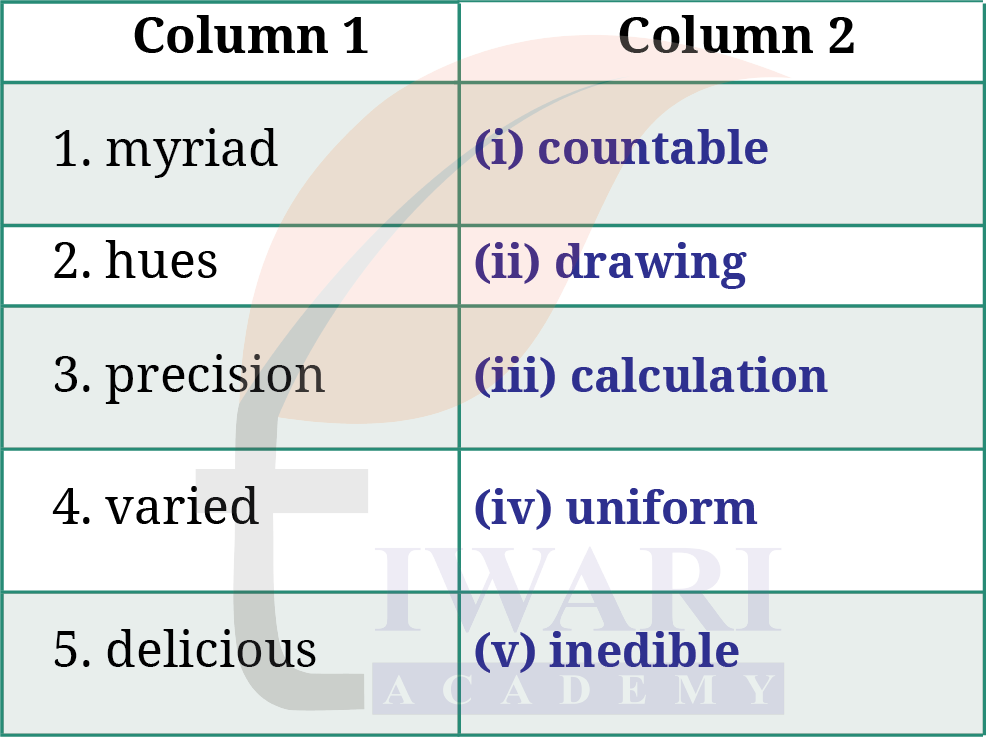
Page 64 – Listen and Respond
I. You will listen to two friends a boy and a girl discussing the occupations of their parent.
As you listen, answer the following questions in two to three words only. (Transcript for teacher on page 262)
What does the boy use to understand the details of the tools?
See AnswerToy cars
II. You will listen to the girl and the boy once again. As you listen, answer the questions by selecting the correct option.
1. The girl is __________ about taking food for her mother at the factory.
(i) happy
(ii) boastful
(iii) unsure
See Answer(i) happy
2. The boy thinks that the job of the girl’s mother carries a lot of __________.
(i) luck
(ii) risk
(iii) responsibility
See Answerresponsibility
3. The girl __________ why the boy is good at science exhibitions.
(i) wonders
(ii) questions
(iii) realises
See Answerrealises
4. The girl shares her __________ about joining the weekend discussion on tools.
(i) doubts
(ii) wish
(iii) ideas
See Answer(ii) wish
Page 66 – Writing Task
I Your school will be organising a ‘Career Mela’ in which students are to be made familiar with the different career options. Complete the poster for the event given below.

Answer:

Kaveri Chapter 2 English to Hindi Translation:
Class 9 English Kaveri Chapter 2 Hindi Translation
I
Ever since Sentila became old enough to accompanyAccompany (verb)
Meanings:
Go together with someone (साथ जाना)
Examples:
1. May I accompany you? (क्या मैं तुम्हारे साथ जाऊँ?)
2. She accompanied her mother. (वह अपनी माँ के साथ गई।)
3. A guide will accompany us. (मार्गदर्शक हमारे साथ जाएगा।) her mother to the fields and forests, she began to dream of becoming a pot maker like her mother and grandmother. However Arenla, her mother, wanted her to become a weaverWeaver (noun)
Meanings:
A person who makes cloth by interlacing threads (बुनकर, कपड़ा बुनने वाला)
Examples:
1. The weaver made a shawl. (बुनकर ने शाल बनाई।)
2. Her mother is a weaver. (उसकी माँ बुनकर है।)
3. We watched the weaver work. (हमने बुनकर को काम करते देखा।). On days when she managed to stay at home while her parents went to the fields, Sentila approached expert potters to learn the skill. They were at first amusedAmused (adjective)
Meanings:
Finding something funny or entertaining (मनोरंजन महसूस करने वाला, हँसी से प्रसन्न)
Examples:
1. They were amused by her joke. (उसके मज़ाक से उन्हें हँसी आई।)
2. He gave an amused smile. (वह मनोरंजित होकर मुस्कराया।)
3. The children looked amused. (बच्चे हँसी से प्रसन्न लगे।) by the little girl’s insistenceInsistence (noun)
Meanings:
A firm demand or repeated determination that something should happen (ज़िद, दृढ़ आग्रह)
Examples:
1. Her insistence showed how much she wanted to learn. (उसके दृढ़ आग्रह से पता चला कि वह कितना सीखना चाहती थी।)
2. At his insistence, we checked again. (उसके आग्रह पर हमने फिर जाँच की।)
3. The child's insistence surprised the potter. (बच्चे की ज़िद से कुम्हार चकित हुआ।) as they thought that she would soon outgrowOutgrow (verb)
Meanings:
Become too old, mature, or large for something (बड़े होने पर छोड़ देना, से बड़ा हो जाना)
Examples:
1. She may outgrow her fear of the dark. (बड़ी होने पर उसका अँधेरे का डर छूट सकता है।)
2. Children quickly outgrow their shoes. (बच्चों के पैर जल्दी जूतों से बड़े हो जाते हैं।)
3. They thought she would outgrow her interest in toys. (उन्हें लगा कि बड़ी होने पर खिलौनों में उसकी रुचि कम हो जाएगी।) her childish passion for the craft.
Hindi Translationजब से सेंतिला इतनी बड़ी हो गई कि अपनी माँ के साथ खेतों और जंगलों में जाने लगी, तब से उसने अपनी माँ और नानी की तरह एक कुम्हारिन बनने का सपना देखना शुरू कर दिया। लेकिन उसकी माँ अरेन्ला चाहती थी कि वह एक बुनकर बने। जिन दिनों सेंतिला घर पर रह पाती और उसके माता-पिता खेतों पर चले जाते, वह कुशल कुम्हारों के पास जाकर यह कला सीखने की कोशिश करती। पहले-पहल वे लोग उस छोटी लड़की की जिद पर हँसते थे, क्योंकि उन्हें लगता था कि वह जल्द ही इस बचपनी शौक से ऊब जाएगी।
Grammar AnalysisThe paragraph uses a mix of Simple Past (narrating the sequence of events) and Past Perfect (describing states that existed before).
► Adjectives (Describing Words)
• Old enough: Describes Sentila’s age/readiness.
• Expert: Describes the quality of the potters.
• Little: Describes the girl’s size/age.
• Childish: Describes the nature of her passion.
• Amused: Describes the reaction of the potters.
► Verbs (Action/State Words)
• Became / Began / Wanted: Simple Past used for the main story actions.
• Managed / Stayed / Went: Simple Past used for the routine actions.
• Approached / Learn: Physical and mental actions of seeking knowledge.
• Thought / Outgrow: Mental actions reflecting the potters’ opinions.
• Would: Used to show a future possibility from a past perspective.
► Adverbs (Describing Actions/Frequency)
• Ever since: Adverbial phrase showing the starting point in time.
• However: Used to show a contrast between Sentila and her mother.
• Soon: Adverb of time showing when they expected her to stop.
• At first: Describes the initial reaction.
Sentila did not discloseDisclose (verb)
Meanings:
Reveal information previously kept secret (खुलासा करना, गुप्त बात बताना)
Examples:
1. Do not disclose the surprise. (सरप्राइज़ का खुलासा मत करो।)
2. She disclosed her plan. (उसने अपनी योजना बताई।)
3. He refused to disclose the name. (उसने नाम बताने से इनकार किया।) her fascinationFascination (noun)
Meanings:
Strong interest and attraction (गहरा आकर्षण, तीव्र रुचि)
Examples:
1. She watched with fascination. (उसने गहरी रुचि से देखा।)
2. He has a fascination with pottery. (उसे मिट्टी के बर्तनों में गहरी रुचि है।)
3. The craft held her fascination. (शिल्प ने उसे आकर्षित रखा।) with pot making at home as she had overheardOverheard (verb)
Meanings:
Heard someone’s conversation without taking part (अनजाने में या अलग से किसी की बातचीत सुन ली)
Examples:
1. She overheard their conversation. (उसने उनकी बातचीत सुन ली।)
2. I overheard my name. (मुझे अपना नाम सुनाई दिया।)
3. He overheard a useful suggestion. (उसने एक उपयोगी सुझाव सुन लिया।) a conversation between her parents one night. Her mother was complaining about Sentila’s indifferenceIndifference (noun)
Meanings:
Lack of interest or concern (उदासीनता, रुचि का अभाव)
Examples:
1. Her indifference worried him. (उसकी उदासीनता से उसे चिंता हुई।)
2. He showed indifference to praise. (वह प्रशंसा के प्रति उदासीन रहा।)
3. Do not meet suffering with indifference. (दुख के प्रति उदासीन मत रहो।) to weaving. She said, “I shall not teach her pot making as it has brought no joy to me and only a pittancePittance (noun)
Meanings:
A very small amount of money, especially too little for the work done (बहुत थोड़ी कमाई, मामूली रकम)
Examples:
1. He earned a pittance for the hard work. (कठिन काम के बदले उसे बहुत थोड़ी कमाई हुई।)
2. The old tool was sold for a pittance. (पुराना औज़ार मामूली रकम में बेचा गया।)
3. She could barely live on that pittance. (वह उस मामूली कमाई से मुश्किल से गुज़ारा कर पाती थी।) for my troubles. The riverbank, where the grey and red clay required for making pots is found, is sixteen kilometres from here. I need to climb down a sheer dropSheer drop (noun phrase)
Meanings:
A very steep, almost vertical descent (बहुत खड़ी ढलान, सीधी उतराई)
Examples:
1. The path ended at a sheer drop. (रास्ता खड़ी ढलान पर समाप्त हुआ।)
2. They avoided the sheer drop. (उन्होंने सीधी उतराई से बचाव किया।)
3. A sheer drop led to the river. (खड़ी ढलान नदी तक जाती थी।) to the riverbank and my back aches from carrying the heavy load uphill all the way to the village. PoundingPounding (verb)
Meanings:
Hitting repeatedly with force (बार-बार ज़ोर से कूटना)
Examples:
1. She was pounding the clay. (वह मिट्टी कूट रही थी।)
2. He heard someone pounding the door. (उसने किसी को दरवाज़ा पीटते सुना।)
3. Pounding softened the hard lumps. (कूटने से कठोर ढेले नरम हुए।) the stubbornStubborn (adjective)
Meanings:
Difficult to change, move, or shape; unwilling to change one’s mind (कठिनाई से बदलने वाला, अड़ियल)
Examples:
1. The stubborn clay needed water. (कठोर मिट्टी को पानी चाहिए था।)
2. He removed a stubborn stain. (उसने जिद्दी दाग हटाया।)
3. She was stubborn about her choice. (वह अपने चुनाव पर अड़ी थी।) clay inside bamboo cylinders to soften it, is also tediousTedious (adjective)
Meanings:
Long, tiring, and repetitive (थकाऊ, उबाऊ, लंबा)
Examples:
1. The work was tedious. (काम थकाऊ था।)
2. Sorting stones felt tedious. (पत्थर छाँटना उबाऊ लगा।)
3. She patiently finished the tedious task. (उसने धैर्य से थकाऊ काम पूरा किया।). So many times, I’ve dropped the mouldMould (noun)
Meanings:
A shaped container used to give material a particular form (साँचा)
Examples:
1. She pressed the clay into a mould. (उसने मिट्टी को साँचे में दबाया।)
2. The potter cleaned the mould. (कुम्हार ने साँचा साफ़ किया।)
3. We used a mould to make the small figure. (हमने छोटी आकृति बनाने के लिए साँचा इस्तेमाल किया।) out of sheer exhaustionExhaustion (noun)
Meanings:
Extreme tiredness (अत्यधिक थकान)
Examples:
1. She fell asleep from exhaustion. (वह अत्यधिक थकान से सो गई।)
2. The long climb caused exhaustion. (लंबी चढ़ाई से बहुत थकान हुई।)
3. He rested after reaching the point of exhaustion. (बहुत अधिक थक जाने पर उसने आराम किया।) and have had to start all over again. It takes months to bring out a batch of pots after so much labour. And the reward? A few rupees. But if Sentila learns weaving, she can make much more money besides providingProviding (verb)
Meanings:
Giving or making something available (उपलब्ध कराना, प्रदान करना)
Examples:
1. They are providing warm clothes. (वे गर्म कपड़े उपलब्ध करा रहे हैं।)
2. She earns money by providing lessons. (वह पढ़ाकर पैसे कमाती है।)
3. Providing clean water is important. (स्वच्छ पानी देना महत्वपूर्ण है।) enough cloth for the family. Weaving is not messyMessy (adjective)
Meanings:
Untidy or likely to make things dirty (गंदा, बिखरा हुआ)
Examples:
1. Clay work can be messy. (मिट्टी का काम गंदगी वाला हो सकता है।)
2. His desk was messy. (उसकी मेज बिखरी थी।)
3. We cleaned the messy room. (हमने गंदा कमरा साफ किया।) like pot making and can be done indoors in all seasons. Also, the time spent on weaving one shawlShawl (noun)
Meanings:
A piece of cloth worn over the shoulders (कंधों पर ओढ़ा जाने वाला कपड़ा, शाल)
Examples:
1. She wore a warm shawl. (उसने गर्म शाल ओढ़ी।)
2. The weaver made a shawl. (बुनकर ने शाल बनाई।)
3. He folded the woollen shawl. (उसने ऊनी शाल मोड़ी।) is much less and the return is handsomeHandsome (adjective)
Meanings:
Large or generous in amount, especially money (काफ़ी अच्छा, बड़ी राशि वाला)
Examples:
1. The craft brought a handsome return. (शिल्प से अच्छी कमाई हुई।)
2. She earned a handsome profit. (उसने अच्छा मुनाफ़ा कमाया।)
3. He received a handsome reward. (उसे बड़ी राशि का इनाम मिला।).”
Hindi Translationसेंतिला ने घर पर मिट्टी के बर्तन बनाने की अपनी दीवानगी छुपाए रखी, क्योंकि उसने एक रात अपने माता-पिता की बातचीत सुन ली थी। उसकी माँ बुनाई के प्रति सेंतिला की उदासीनता की शिकायत कर रही थी। उसने कहा, “मैं उसे मिट्टी के बर्तन बनाना नहीं सिखाऊँगी क्योंकि इसने मुझे कोई खुशी नहीं दी और केवल मेरी परेशानियों के बदले में बहुत कम मुआवजा मिला। नदी का किनारा, जहाँ बर्तन बनाने के लिए ग्रे और लाल मिट्टी मिलती है, यहाँ से सोलह किलोमीटर दूर है। मुझे नदी किनारे तक सीधी ढलान उतरनी पड़ती है गांव तक भारी बोझ उठाकर पहाड़ी पर चढ़ने से मेरी पीठ में दर्द होता है। बाँस के बेलनों में जिद्दी मिट्टी को नरम करने के लिए कूटना भी थकाऊ काम है। कई बार तो अत्यधिक थकान के कारण मैंने सांचा गिरा दिया है और मुझे फिर से सब कुछ शुरू करना पड़ा है। इतनी मेहनत के बाद भी बर्तनों का एक बैच तैयार होने में महीनों लग जाते हैं। और इनाम? बस कुछ रुपये। लेकिन अगर सेंतिला बुनाई सीख ले, तो वह परिवार के लिए पर्याप्त कपड़ा देने के साथ-साथ कहीं अधिक पैसे कमा सकती है। बुनाई मिट्टी के बर्तन बनाने जैसी गंदी नहीं होती और हर मौसम में घर के अंदर की जा सकती है। इसके अलावा, एक शॉल बुनने में कम समय लगता है और आमदनी भी अच्छी होती है।”
Grammar AnalysisThe paragraph uses a mix of Past Perfect (background actions), Simple Present (describing current hardships), and Simple Future (predicting results).
► Adjectives (Describing Words)
• Grey / Red: Describes the color of the clay.
• Sixteen: Describes the distance in kilometres.
• Sheer: Describes the steepness of the drop and the intensity of exhaustion.
• Heavy: Describes the load.
• Stubborn: Describes the difficulty of the clay.
• Messy / Indoors: Describes the nature of the work.
• Handsome: Describes the financial return/profit.
► Verbs (Action/State Words)
• Disclose / Overheard: Simple Past/Past Perfect for the secret action.
• Complaining / Pounding: Continuous forms describing ongoing struggle.
• Shall not teach / Can make: Modal verbs showing future intent and ability.
• Aches / Takes / Is: Simple Present used for facts about the mother’s life.
• Have dropped / Have had: Present Perfect used for repeated past experiences.
► Adverbs (Describing Actions/Frequency)
• One night: Adverbial phrase of time.
• Only: Used to limit the amount of money/joy.
• All the way: Describes the extent of the journey.
• So many times: Adverb of frequency for the mother’s mistakes.
• All over again: Describes repeating the entire process.
Sentila continued her visits to watch the potters at work. She saw how the clay was mixed with water and pounded, how careful they were when they pushed their left hand into a lump of the softened clay and how deftlyDeftly (adverb)
Meanings:
Skilfully and neatly (कुशलता से, सफाई से)
Examples:
1. She deftly shaped the pot. (उसने कुशलता से बर्तन गढ़ा।)
2. He caught the ball deftly. (उसने सफाई से गेंद पकड़ी।)
3. The tailor deftly stitched the seam. (दर्जी ने कुशलता से सिलाई की।) they rotatedRotated (verb)
Meanings:
Turned around a centre or axis (घुमाया, चारों ओर घूमा)
Examples:
1. She rotated the clay. (उसने मिट्टी घुमाई।)
2. The wheel rotated slowly. (पहिया धीरे घूमा।)
3. He rotated the model carefully. (उसने मॉडल सावधानी से घुमाया।) the lump as they started giving shape to the rotating clay with a spatulaSpatula (noun)
Meanings:
A tool with a flat blade used for shaping, spreading, or lifting (चपटी पट्टी वाला औज़ार, चपटा आकार देने वाला उपकरण)
Examples:
1. She shaped clay with a spatula. (उसने चपटे औज़ार से मिट्टी गढ़ी।)
2. He cleaned the spatula. (उसने चपटा औज़ार साफ किया।)
3. Use a spatula to spread the paste. (लेप फैलाने के लिए चपटा औज़ार लो।) held in the right hand. The regular tap, tap of the spatula on the clay was music to her ears as she watched in fascinationFascination (noun)
Meanings:
Strong interest and attraction (गहरा आकर्षण, तीव्र रुचि)
Examples:
1. She watched with fascination. (उसने गहरी रुचि से देखा।)
2. He has a fascination with pottery. (उसे मिट्टी के बर्तनों में गहरी रुचि है।)
3. The craft held her fascination. (शिल्प ने उसे आकर्षित रखा।) the pot emergingEmerging (verb)
Meanings:
Coming into view or taking shape (उभरना, दिखाई देने लगना)
Examples:
1. A pot was emerging from the clay. (मिट्टी से बर्तन उभर रहा था।)
2. The sun was emerging from clouds. (बादलों से सूरज निकल रहा था।)
3. A clear pattern was emerging. (स्पष्ट नमूना उभर रहा था।) out of a shapeless lump right in front of her eyes. After two or three days, the pots would be given a final touch up to retain the required shape and to test the consistencyConsistency (noun)
Meanings:
The thickness, firmness, or even texture of a material (गाढ़ापन, दृढ़ता, बनावट की एकरूपता)
Examples:
1. Check the clay’s consistency. (मिट्टी की बनावट जाँचो।)
2. The dough had the right consistency. (गूँधी मिट्टी का गाढ़ापन सही था।)
3. Water changed the paste’s consistency. (पानी से लेप का गाढ़ापन बदला।). Only then would the pots be taken out to dry in the sun before being loaded on to a kilnKiln (noun)
Meanings:
A special oven for firing pottery or bricks (बर्तन या ईंट पकाने की भट्ठी)
Examples:
1. The pots entered the kiln. (बर्तन भट्ठी में रखे गए।)
2. The kiln was very hot. (भट्ठी बहुत गर्म थी।)
3. Workers prepared the kiln carefully. (कर्मचारियों ने भट्ठी सावधानी से तैयार की।) in a uniformUniform (adjective)
Meanings:
Even or the same throughout (एकसमान, समरूप)
Examples:
1. Arrange them in a uniform pattern. (उन्हें एकसमान नमूने में सजाओ।)
2. The pots had a uniform colour. (बर्तनों का रंग एकसमान था।)
3. Keep the layer uniform. (परत एकसमान रखो।) pattern on a bed of hay and dried bamboo and covered with another layer of the same materials, and then the kiln would be fired. One had to tendTend (verb)
Meanings:
Look after or manage something carefully (देखभाल करना, ध्यान रखना)
Examples:
1. He stayed to tend the fire. (वह आग का ध्यान रखने के लिए रुका।)
2. She helps tend the garden. (वह बगीचे की देखभाल में मदद करती है।)
3. The farmer must tend the young plants. (किसान को छोटे पौधों की देखभाल करनी चाहिए।) the fire carefully as over firing or under firing would ruinRuin (verb)
Meanings:
Spoil or damage something completely (बर्बाद करना, पूरी तरह बिगाड़ना)
Examples:
1. Too much heat can ruin the pot. (बहुत अधिक गर्मी से बर्तन खराब हो सकता है।)
2. Heavy rain may ruin the outdoor decorations. (भारी वर्षा बाहर की सजावट बिगाड़ सकती है।)
3. One careless action can ruin hours of work. (एक लापरवाह काम से घंटों की मेहनत बर्बाद हो सकती है।) the entire batch.
Hindi Translationसेंतिला कुम्हारों को काम करते देखने के लिए जाती रही। उसने देखा कि मिट्टी को पानी के साथ कैसे मिलाया और कूटा जाता है, वे नरम मिट्टी के ढेर में बाईं हाथ की उँगलियाँ कितनी सावधानी से घुसाते हैं और दाहिने हाथ में पकड़े स्पैटुला से घूमती हुई मिट्टी को आकार देते हुए उसे कितनी कुशलता से घुमाते हैं। स्पैटुला की नियमित थपथपाहट उसके कानों को संगीत जैसी लगती थी, जब वह मोहित होकर देखती थी कि उसकी आँखों के सामने ही एक बेडौल मिट्टी के ढेर से बर्तन का आकार उभरता है। दो-तीन दिन बाद बर्तनों को आवश्यक आकार बनाए रखने और उनकी मजबूती जाँचने के लिए अंतिम रूप दिया जाता था। तभी बर्तनों को धूप में सुखाने के लिए निकाला जाता और फिर उन्हें भट्टी में घास और सूखे बाँस की परत पर एक समान तरीके से रखकर उसी सामग्री की एक और परत से ढका जाता था, और फिर भट्टी जलाई जाती थी। आग का ध्यान रखना बहुत जरूरी था क्योंकि ज्यादा या कम आँच से पूरा बैच खराब हो जाता था।
Grammar AnalysisThe paragraph uses a mix of Simple Past (narrating Sentila’s observations) and “Would” (describing the habitual process of pottery making).
► Adjectives (Describing Words)
• Softened: Describes the state of the clay.
• Rotating: Describes the movement of the clay.
• Shapeless: Describes the initial form of the lump.
• Final: Describes the last touch-up.
• Required: Describes the specific shape needed.
• Uniform: Describes the pattern in the kiln.
• Entire: Describes the whole batch of pots.
► Verbs (Action/State Words)
• Saw / Pushed / Rotated: Simple Past used for Sentila’s observations.
• Was mixed / Was pounded: Past Passive used to describe the process.
• Would be given / Would be taken: Modal “would” used for habitual past actions.
• Giving / Emerging / Firing: Participles used to describe ongoing actions.
• Tend / Ruin: Actions involved in managing the fire.
► Adverbs (Describing Actions/Frequency)
• Deftly: Describes how the potters rotated the clay.
• Carefully: Describes how they pushed their hands and tended the fire.
• Right in front: Describes the exact location of the action.
• Only then: Adverbial phrase showing the necessary sequence.
Arenla heard of her daughter’s visits but pretendedPretended (verb)
Meanings:
Acted as if something untrue was true (दिखावा किया, बहाना किया)
Examples:
1. She pretended to be asleep. (उसने सोने का बहाना किया।)
2. He pretended not to notice. (उसने अनदेखा करने का दिखावा किया।)
3. The children pretended to be pilots. (बच्चों ने पायलट बनने का अभिनय किया।) to be ignorantIgnorant (adjective)
Meanings:
Not knowing about something (अनजान, जानकारी से रहित)
Examples:
1. He was ignorant of the rule. (वह नियम से अनजान था।)
2. She remained ignorant of their plan. (वह उनकी योजना नहीं जानती थी।)
3. Do not remain ignorant; ask questions. (अनजान मत रहो; प्रश्न पूछो।) of them. By late afternoon, Sentila had to return home quickly, so that when her mother came back from the fields, she would be there. Gradually, Sentila’s visits became a topic of village gossipGossip (noun)
Meanings:
Informal talk about other people, sometimes unverified (दूसरों के बारे में गपशप)
Examples:
1. The visit became village gossip. (मुलाकात गाँव की गपशप बन गई।)
2. Do not spread gossip. (गपशप मत फैलाओ।)
3. She ignored the gossip. (उसने गपशप पर ध्यान नहीं दिया।). People wondered why Arenla was refusing to teach the skill to her daughter. They were worried that if all pot makers followed suitFollowed suit (idiom)
Meanings:
Did the same thing as someone else (दूसरे के जैसा किया, अनुसरण किया)
Examples:
1. She stood up, and we followed suit. (वह खड़ी हुई और हम भी खड़े हो गए।)
2. One shop closed, and the others followed suit. (एक दुकान बंद हुई और बाकी भी बंद हो गईं।)
3. He began to clap, and the audience followed suit. (उसने ताली बजानी शुरू की और दर्शकों ने भी ऐसा किया।), then there would be no expert potters to take their place.
Hindi Translationअरेन्ला को अपनी बेटी के जाने की खबर मिली लेकिन उसने अनजान बने रहने का नाटक किया। शाम ढलने से पहले सेंतिला को जल्दी घर लौटना पड़ता था ताकि जब माँ खेतों से वापस आए तो वह घर पर हो। धीरे-धीरे सेंतिला का जाना गाँव में चर्चा का विषय बन गया। लोग हैरान थे कि अरेन्ला अपनी बेटी को यह कला क्यों नहीं सिखाना चाहती। उन्हें डर था कि अगर सभी कुम्हार ऐसा ही करने लगे तो उनकी जगह लेने के लिए कोई कुशल कुम्हार नहीं बचेगा।
Grammar AnalysisThe paragraph uses a mix of Simple Past (narrating the events) and Past Perfect (describing completed conditions).
► Adjectives (Describing Words)
• Ignorant: Describes Arenla’s pretended state.
• Late: Describes the time of the afternoon.
• Quick: (Adverb “quickly” used to describe the return).
• Expert: Describes the quality of the potters.
► Verbs (Action/State Words)
• Heard / Pretended / Became: Simple Past used for the main story actions.
• Had to return: Modal verb showing a past necessity or obligation.
• Had to be / Would be: Future in the past used for Sentila’s plan.
• Wondered / Were worried: Mental states of the village people.
• Followed suit: Phrasal verb used for a potential action.
► Adverbs (Describing Actions/Frequency)
• Quickly: Describes how Sentila returned home.
• Gradually: Describes how the gossip grew over time.
• Why: Interrogative adverb used to show the people’s curiosity.
One day, Sentila’s father, Mesoba was summonedSummoned (verb)
Meanings:
Called to appear or be present, especially for a purpose (किसी उद्देश्य से बुलाया गया)
Examples:
1. The students were summoned to the hall. (विद्यार्थियों को हॉल में बुलाया गया।)
2. She summoned help immediately. (उसने तुरंत सहायता बुलाई।)
3. The witness was summoned to speak. (गवाह को बोलने के लिए बुलाया गया।) by the village councilCouncil (noun)
Meanings:
A group that discusses and makes decisions for a community (निर्णय करने वाली परिषद)
Examples:
1. The village council met today. (ग्राम परिषद आज मिली।)
2. He addressed the council. (उसने परिषद को संबोधित किया।)
3. The council discussed the problem. (परिषद ने समस्या पर चर्चा की।) and asked to explain why Arenla was refusing to pass on the skill to her daughter. He replied in a humbleHumble (adjective)
Meanings:
Modest and respectful, without arrogance (विनम्र, अहंकार रहित)
Examples:
1. He gave a humble reply. (उसने विनम्र उत्तर दिया।)
2. She remained humble after success. (सफलता के बाद भी वह विनम्र रही।)
3. His humble manner pleased everyone. (उसका विनम्र व्यवहार सबको अच्छा लगा।) toneTone (noun)
Meanings:
The quality of a voice that shows a feeling or attitude (भाव या रवैया व्यक्त करने वाला स्वर)
Examples:
1. Her tone was gentle. (उसका स्वर कोमल था।)
2. He answered in an angry tone. (उसने गुस्से भरे स्वर में उत्तर दिया।)
3. The teacher’s tone reassured us. (शिक्षक के स्वर ने हमें आश्वस्त किया।), “Uncles and elder brothers, Arenla has never said that she will not teach our daughter pot making; it is only that we wanted her to grow stronger after her illness. You will soon see Sentila making the best pots in the village.” After listening to Mesoba’s explanation, the elders decided to let him go, cautioningCautioning (verb)
Meanings:
Warning someone to be careful (सावधान करना, चेतावनी देना)
Examples:
1. She was cautioning us about the road. (वह रास्ते के बारे में हमें सावधान कर रही थी।)
2. The elders left after cautioning him. (बुज़ुर्ग उसे चेतावनी देकर चले गए।)
3. He kept cautioning the children. (वह बच्चों को सावधान करता रहा।) him to remind Arenla that it was her duty to teach her daughter the skill that was handed down from generationGeneration (noun)
Meanings:
People born around the same time; one stage in a family line (पीढ़ी)
Examples:
1. Each generation learns from elders. (हर पीढ़ी बड़ों से सीखती है।)
2. The skill passed to another generation. (कौशल अगली पीढ़ी तक पहुँचा।)
3. Our generation must protect nature. (हमारी पीढ़ी को प्रकृति बचानी चाहिए।) to generation. They also told him that skills such as pot making, which not only catered toCatered to (phrasal verb)
Meanings:
Provided what someone needed (आवश्यकताएँ पूरी कीं)
Examples:
1. The shop catered to village needs. (दुकान ने गाँव की आवश्यकताएँ पूरी कीं।)
2. The course catered to beginners. (पाठ्यक्रम नए सीखने वालों के अनुकूल था।)
3. Her designs catered to different tastes. (उसके डिज़ाइन अलग रुचियों के अनुकूल थे।) the needs of the people but also symbolisedSymbolised (verb)
Meanings:
Represented an idea or quality (प्रतीक बना, दर्शाया)
Examples:
1. The lamp symbolised hope. (दीपक आशा का प्रतीक था।)
2. The craft symbolised their heritage. (शिल्प उनकी विरासत दर्शाता था।)
3. The joined hands symbolised unity. (जुड़े हाथ एकता के प्रतीक थे।) the tradition and history of the people, did not ‘belong’ to any individual. And expertsExperts (plural noun)
Meanings:
People with great knowledge or skill in a subject or activity (विशेषज्ञ, निपुण लोग)
Examples:
1. The experts examined the old painting. (विशेषज्ञों ने पुराने चित्र की जाँच की।)
2. We asked the experts for advice. (हमने विशेषज्ञों से सलाह माँगी।)
3. Local experts taught the craft to children. (स्थानीय विशेषज्ञों ने बच्चों को शिल्प सिखाया।) were obligedObliged (adjective)
Meanings:
Required by duty or rules (बाध्य, कर्तव्य से बँधा)
Examples:
1. They were obliged to help. (वे मदद करने के लिए बाध्य थे।)
2. We are obliged to follow rules. (हम नियम मानने के लिए बाध्य हैं।)
3. She felt obliged to share her skill. (उसने अपना कौशल साझा करना कर्तव्य माना।) to pass onPass on (phrasal verb)
Meanings:
Give knowledge, skills, or possessions to others (आगे सौंपना, दूसरों को देना)
Examples:
1. Pass on this message. (यह संदेश आगे पहुँचाओ।)
2. She will pass on her skills. (वह अपने कौशल दूसरों को सिखाएगी।)
3. We pass on traditions to children. (हम बच्चों को परंपराएँ सौंपते हैं।) their skills not only to their own children but also to anyone who wished to learn. Mesoba went home and discussed the matter with Arenla.
Hindi Translationएक दिन सेंतिला के पिता मेसोबा को गाँव की पंचायत ने बुलाया और पूछा कि अरेन्ला बेटी को यह कला क्यों नहीं सिखा रही। उन्होंने विनम्र स्वर में उत्तर दिया, “चाचाओं और बड़े भाइयों, अरेन्ला ने कभी नहीं कहा कि वह हमारी बेटी को बर्तन बनाना नहीं सिखाएगी; बस हम चाहते थे कि बीमारी के बाद वह पहले थोड़ी और मजबूत हो जाए। आप जल्द ही सेंतिला को गाँव के सबसे अच्छे बर्तन बनाते देखेंगे।” मेसोबा की बात सुनकर बुजुर्गों ने उसे जाने दिया, लेकिन चेतावनी दी कि वह अरेन्ला को याद दिलाए कि पीढ़ी-दर-पीढ़ी चली आ रही इस कला को अपनी बेटी को सिखाना उसका कर्तव्य है। उन्होंने यह भी कहा कि मिट्टी के बर्तन बनाने जैसी कला, जो न केवल लोगों की जरूरतें पूरी करती है बल्कि उनकी परंपरा और इतिहास का प्रतीक भी है, किसी एक व्यक्ति की ‘संपत्ति’ नहीं है। और जो लोग इस कला में निपुण हैं, उनका दायित्व है कि वे इसे न केवल अपने बच्चों को बल्कि हर उस व्यक्ति को सिखाएँ जो सीखना चाहे। मेसोबा घर गया और अरेन्ला से इस बारे में बात की।
Grammar AnalysisThe paragraph uses a mix of Passive Voice (the summoning) and Direct/Indirect speech to convey the council’s message.
► Adjectives (Describing Words)
• Humble: Describes Mesoba’s tone.
• Elder: Describes the brothers/uncles in the council.
• Stronger: Comparative adjective describing Sentila’s health.
• Best: Superlative adjective for the pots.
• Own: Describes the relationship to children.
► Verbs (Action/State Words)
• Was summoned / Was asked: Past Passive used for the council’s action.
• Refusing / Passing on: Present participles showing the conflict.
• Replied / Listened / Decided: Simple Past used for the sequence of the meeting.
• Will teach / Will see: Simple Future used in Mesoba’s promise.
• Handed down: Phrasal verb (Past Participle) for tradition.
• Belong: Simple Present used for a general rule or truth.
► Adverbs (Describing Actions/Frequency)
• Never: Adverb of frequency.
• Only: Used to limit the reason to “illness.”
• Soon: Adverb of time.
• Not only… but also: Correlative conjunctions used to add information.
II
The following year, Arenla took Sentila to the riverbank where the grey and red clay was found. She taught Sentila how to dig the clay with a daoDao (noun)
Meanings:
A broad-bladed cutting tool used in parts of northeast India (पूर्वोत्तर भारत में प्रयुक्त चौड़े फल वाला काटने का औज़ार, दाओ)
Examples:
1. She dug clay with a dao. (उसने दाओ से मिट्टी खोदी।)
2. The worker carried a dao. (कर्मचारी ने दाओ उठाया।)
3. Keep the sharp dao safely. (तेज़ दाओ सुरक्षित रखो।), load it on to her carrying basket and soak it in the troughTrough (noun)
Meanings:
A long open container for holding water or materials (लंबा खुला पात्र, नाँद)
Examples:
1. Clay soaked in the trough. (मिट्टी नाँद में भीगी।)
2. Fill the trough with water. (नाँद में पानी भरो।)
3. The animals drank from a trough. (जानवरों ने नाँद से पानी पिया।) in the work shed before stuffing it into the bamboo cylinder in the right proportionProportion (noun)
Meanings:
The relative amount of one thing compared with another (अनुपात, सापेक्ष मात्रा)
Examples:
1. Mix water in the right proportion. (पानी सही अनुपात में मिलाओ।)
2. The proportion of clay was too high. (मिट्टी का अनुपात बहुत अधिक था।)
3. She measured each proportion carefully. (उसने हर मात्रा का अनुपात सावधानी से नापा।) to pound it. Sentila was a quick learner and turned the clay into malleableMalleable (adjective)
Meanings:
Easy to shape without breaking (बिना टूटे आकार देने योग्य, लचीला)
Examples:
1. The clay became malleable. (मिट्टी आकार देने योग्य हो गई।)
2. Warm wax is malleable. (गर्म मोम आसानी से ढलता है।)
3. She shaped the malleable material. (उसने लचीली सामग्री को आकार दिया।) doughDough (noun)
Meanings:
A soft workable mixture; here, softened clay (गूँधा हुआ नरम मिश्रण; यहाँ मुलायम मिट्टी)
Examples:
1. She kneaded the dough. (उसने मिश्रण गूँधा।)
2. The clay dough was smooth. (गूँधी मिट्टी चिकनी थी।)
3. He shaped the dough into a ball. (उसने गूँधे मिश्रण का गोला बनाया।). But when she tried her hand at the shaping of the lump into a pot, she could not even hold the lump of dough properly. The mother simply sat in a corner and watched the girl try again and again. While Sentila hung her head in shame and frustrationFrustration (noun)
Meanings:
Annoyance or disappointment when progress or success is blocked (काम न बन पाने से होने वाली झुँझलाहट या निराशा)
Examples:
1. He felt frustration when he could not solve the puzzle. (पहेली हल न कर पाने पर उसे झुँझलाहट हुई।)
2. The runner cried out in frustration after falling. (गिरने के बाद धावक निराशा में चिल्ला पड़ा।)
3. She took a short break to calm her frustration. (अपनी झुँझलाहट शांत करने के लिए उसने थोड़ा विराम लिया।), Arenla took overTook over (phrasal verb)
Meanings:
Began doing a task or holding responsibility instead of someone else (काम या जिम्मेदारी सँभाली)
Examples:
1. Her mother took over the task. (उसकी माँ ने काम सँभाला।)
2. He took over after lunch. (दोपहर के भोजन के बाद उसने काम सँभाला।)
3. The new captain took over. (नए कप्तान ने जिम्मेदारी सँभाली।) the job, and transformedTransformed (verb)
Meanings:
Changed greatly in form or appearance (रूप बदल दिया, परिवर्तित किया)
Examples:
1. She transformed clay into a pot. (उसने मिट्टी को बर्तन में बदल दिया।)
2. Rain transformed the dry field. (बारिश ने सूखे खेत का रूप बदल दिया।)
3. Education transformed his life. (शिक्षा ने उसका जीवन बदल दिया।) the lump into a beautiful pot. These sessionsSessions (plural noun)
Meanings:
Periods of time set aside for an activity (किसी गतिविधि के लिए निर्धारित समय, सत्र)
Examples:
1. Our practice sessions last an hour. (हमारे अभ्यास सत्र एक घंटे के होते हैं।)
2. The workshop has three sessions. (कार्यशाला में तीन सत्र हैं।)
3. She attended all the training sessions. (वह सभी प्रशिक्षण सत्रों में उपस्थित हुई।) continued for almost a year but Sentila was unable to learn anything from her mother.
Hindi Translationअगले साल, अरेन्ला सेंतिला को उस नदी के किनारे ले गई जहाँ ग्रे और लाल मिट्टी मिलती थी। उसने सेंतिला को दाव से मिट्टी खोदना, उसे टोकरी में भरकर लाना, काम के शेड में नाँद में भिगोना और फिर उसे बाँस के बेलन में सही मात्रा में भरकर कूटना सिखाया। सेंतिला जल्दी सीखने वाली थी और उसने मिट्टी को नरम आटे जैसा बना लिया। लेकिन जब उसने मिट्टी के ढेर को बर्तन का आकार देने की कोशिश की, तो वह ठीक से मिट्टी के ढेर को पकड़ भी नहीं पाई। माँ बस एक कोने में बैठकर उसे बार-बार कोशिश करते देखती रही। जब सेंतिला शर्म और निराशा से सिर झुका लेती तो अरेन्ला काम अपने हाथ में लेती और उस मिट्टी के ढेर से एक सुंदर बर्तन बना देती। ये सत्र लगभग एक साल तक चले लेकिन सेंतिला अपनी माँ से कुछ भी नहीं सीख पाई।
Grammar AnalysisThe paragraph uses a mix of Simple Past (narrating the teaching sessions) and “Could/Unable to” (expressing the struggle to gain a skill).
► Adjectives (Describing Words)
• Grey / Red: Describes the clay.
• Right: Describes the proportion needed.
• Quick: Describes Sentila as a “learner.”
• Malleable: Describes the state of the clay dough.
• Proper: (Adverb “properly” used to describe the grip).
• Beautiful: Describes the finished pot.
► Verbs (Action/State Words)
• Took / Taught / Dig / Load: Simple Past used for the mother’s actions.
• Soak / Stuff / Pound: Verbs describing the steps of the pottery process.
• Turned: Simple Past used for Sentila’s successful preparation of clay.
• Could not hold / Was unable: Modal and state verbs showing lack of ability.
• Sat / Watched: Simple Past used for the mother’s observation.
• Hung: Simple Past used for Sentila’s emotional reaction (shame).
► Adverbs (Describing Actions/Frequency)
• Properly: Describes how she failed to hold the dough.
• Simply: Describes the mother’s quiet observation.
• Again and again: Adverbial phrase showing repetition.
• Almost: Describes the duration (nearly a year).
The next year, when Sentila maturedMatured (verb)
Meanings:
Grew older and more developed (परिपक्व हुआ, बड़ा हुआ)
Examples:
1. She matured with experience. (अनुभव से वह परिपक्व हुई।)
2. The fruit matured slowly. (फल धीरे-धीरे पका।)
3. His thinking matured over time. (समय के साथ उसकी सोच परिपक्व हुई।), according to customCustom (noun)
Meanings:
A traditional practice followed by a community (रीति, प्रथा)
Examples:
1. This is an old custom. (यह पुरानी प्रथा है।)
2. They respected the village custom. (उन्होंने गाँव की रीति का सम्मान किया।)
3. The festival follows a local custom. (उत्सव स्थानीय परंपरा के अनुसार होता है।), she was sent to stay for some nights in one of the girls’ dormitoriesDormitories (plural noun)
Meanings:
Large sleeping rooms shared by several people (सामूहिक शयनकक्ष)
Examples:
1. Students stayed in dormitories. (विद्यार्थी सामूहिक शयनकक्षों में रहे।)
2. The dormitories were clean. (सामूहिक शयनकक्ष साफ थे।)
3. She supervised the dormitories. (उसने सामूहिक शयनकक्षों की देखरेख की।) supervised by a kind, middle-aged widow whom the girls called ‘Onula’ or Aunty. She had heard of the discordDiscord (noun)
Meanings:
Disagreement or lack of harmony (अनबन, मतभेद)
Examples:
1. Their argument caused discord in the family. (उनकी बहस से परिवार में अनबन हुई।)
2. The teacher helped end the discord. (शिक्षक ने मतभेद समाप्त करने में मदद की।)
3. There was discord between the two friends. (दोनों मित्रों में अनबन थी।) in Sentila’s family and resolved to help the girl in every possible way. One evening, when everyone except Sentila went to attend a musical evening, Onula saw her taking out some clay and the implementsImplements (plural noun)
Meanings:
Tools used for a particular kind of work (औज़ार, उपकरण)
Examples:
1. The farmer cleaned his implements. (किसान ने अपने औज़ार साफ़ किए।)
2. Potters use simple implements to shape clay. (कुम्हार मिट्टी को आकार देने के लिए साधारण औज़ार इस्तेमाल करते हैं।)
3. The wooden implements hung on the wall. (लकड़ी के औज़ार दीवार पर लटके थे।) from her basket quietly. She watched Sentila’s clumsyClumsy (adjective)
Meanings:
Awkward in movement or lacking skill (अनाड़ी, बेढंगा)
Examples:
1. His clumsy hands dropped the cup. (उसके अनाड़ी हाथों से प्याला गिर गया।)
2. Her first attempts were clumsy. (उसके शुरुआती प्रयास बेढंगे थे।)
3. The clumsy movement upset the clay. (बेढंगी हरकत से मिट्टी बिगड़ गई।) efforts to make a pot and noticed that Sentila was too tenseTense (adjective)
Meanings:
Nervous and unable to relax (तनावग्रस्त, घबराया हुआ)
Examples:
1. She felt tense before practice. (अभ्यास से पहले वह तनाव में थी।)
2. His shoulders were tense. (उसके कंधों में तनाव था।)
3. The room became tense. (कमरे का माहौल तनावपूर्ण हो गया।). As a result, the clay seemed unable or unwilling to yieldYield (verb)
Meanings:
Produce or give a result; give way (परिणाम देना, झुकना)
Examples:
1. The clay would not yield the shape. (मिट्टी मनचाहा आकार नहीं दे रही थी।)
2. Hard work can yield results. (मेहनत परिणाम दे सकती है।)
3. The branch yielded under pressure. (दबाव से शाखा झुक गई।) the right shape.
Hindi Translationअगले साल, जब सेंतिला बड़ी हुई, तो रीति-रिवाज के अनुसार उसे कुछ रातों के लिए लड़कियों की एक छात्रावास में रहने भेजा गया, जिसकी देखरेख एक दयालु, अधेड़ उम्र की विधवा करती थीं जिन्हें लड़कियाँ ‘ओनुला’ या आंटी कहती थीं। उन्हें सेंतिला के परिवार के मतभेद की बात पता थी और उन्होंने हर संभव तरीके से उस लड़की की मदद करने का निश्चय किया था। एक शाम जब सेंतिला को छोड़कर बाकी सभी एक संगीत समारोह में चले गए, तो ओनुला ने उसे चुपचाप अपनी टोकरी से मिट्टी और औजार निकालते देखा। उन्होंने सेंतिला की अनाड़ी कोशिशें देखीं और पाया कि सेंतिला बहुत तनावग्रस्त थी। इस वजह से मिट्टी मानो सही आकार लेने में असमर्थ या अनिच्छुक लग रही थी।
Grammar AnalysisThe paragraph uses a mix of Simple Past (narrating the specific events) and Past Perfect (describing prior events/states).
► Adjectives (Describing Words)
• Kind / Middle-aged: Describes the character of the widow (Onula).
• Possible: Describes the way Onula wanted to help.
• Musical: Describes the type of evening the girls attended.
• Quiet: (Adverb “quietly” used for Sentila’s actions).
• Clumsy: Describes Sentila’s initial efforts with the clay.
• Tense: Describes Sentila’s emotional/physical state.
• Right: Describes the shape she was trying to achieve.
► Verbs (Action/State Words)
• Matured / Was sent: Simple Past and Passive used for the custom.
• Had heard / Resolved: Past Perfect and Simple Past for Onula’s intention.
• Went / Saw / Taking out: Simple Past and Participle for the evening’s events.
• Watched / Noticed: Simple Past showing Onula’s observation.
• Seemed: Linking verb describing the appearance of the clay.
• To yield: Infinitive used to show the result of the shaping.
► Adverbs (Describing Actions/Frequency)
• According to: Prepositional phrase showing the reason (custom).
• Quietly: Describes the manner in which she took the tools.
• Too: Adverb of degree showing she was excessively tense.
When Sentila wearilyWearily (adverb)
Meanings:
In a tired way (थककर, थके ढंग से)
Examples:
1. She sat down wearily. (वह थककर बैठ गई।)
2. He smiled wearily. (वह थके हुए ढंग से मुस्कराया।)
3. They walked home wearily. (वे थके हुए घर चले।) let the misshapenMisshapen (adjective)
Meanings:
Having an uneven or badly formed shape (बेडौल, बिगड़े आकार का)
Examples:
1. The pot was misshapen. (बर्तन बेडौल था।)
2. She reshaped the misshapen lump. (उसने बेडौल ढेले को फिर गढ़ा।)
3. He noticed a misshapen handle. (उसने टेढ़ा बना हत्था देखा।) lump fall flat on the ground, Onula went to her and said, “Don’t worry, little one, I shall teach you how to make a perfect pot.” Sentila watched in amazementAmazement (noun)
Meanings:
Great surprise or wonder (विस्मय, आश्चर्य)
Examples:
1. She watched in amazement. (उसने आश्चर्य से देखा।)
2. His skill filled us with amazement. (उसका कौशल देखकर हम चकित हुए।)
3. I could not hide my amazement. (मैं अपना आश्चर्य नहीं छिपा पाया।) as Onula fashionedFashioned (verb)
Meanings:
Made or shaped skilfully (गढ़ा, आकार दिया)
Examples:
1. She fashioned a clay bowl. (उसने मिट्टी का कटोरा गढ़ा।)
2. He fashioned a toy from wood. (उसने लकड़ी से खिलौना बनाया।)
3. They fashioned a simple shelter. (उन्होंने साधारण आश्रय बनाया।) a beautiful pot and asked her to try again. Sentila took another lump of clay and with a confidence she had never felt before, started the process all over again following the instructions she had just received. She created a beautiful pot! When it was done, she sat there admiringAdmiring (verb)
Meanings:
Looking at something with pleasure and respect (प्रशंसा या संतोष से निहारना)
Examples:
1. She sat admiring her pot. (वह अपना बर्तन निहारती बैठी।)
2. We were admiring the painting. (हम चित्र को सराह रहे थे।)
3. He kept admiring the workmanship. (वह कारीगरी को निहारता रहा।) her work but Onula said, “The mouth of the pot is all wrong.” Sentila looked at Onula in frustrationFrustration (noun)
Meanings:
Annoyance or disappointment when progress or success is blocked (काम न बन पाने से होने वाली झुँझलाहट या निराशा)
Examples:
1. He felt frustration when he could not solve the puzzle. (पहेली हल न कर पाने पर उसे झुँझलाहट हुई।)
2. The runner cried out in frustration after falling. (गिरने के बाद धावक निराशा में चिल्ला पड़ा।)
3. She took a short break to calm her frustration. (अपनी झुँझलाहट शांत करने के लिए उसने थोड़ा विराम लिया।) who smiled and said, “When you work with your mother next time, watch her carefully when she is shapingShaping (verb)
Meanings:
Giving something a form (आकार देना)
Examples:
1. She is shaping the clay. (वह मिट्टी को आकार दे रही है।)
2. Practice is shaping his skill. (अभ्यास उसका कौशल सँवार रहा है।)
3. They enjoyed shaping small toys. (उन्हें छोटे खिलौने गढ़ना अच्छा लगा।) the mouth of the pot. You are a quick learnerLearner (noun)
Meanings:
Someone acquiring knowledge or skill (सीखने वाला, शिक्षार्थी)
Examples:
1. She is a quick learner. (वह जल्दी सीखती है।)
2. Every learner needs practice. (हर शिक्षार्थी को अभ्यास चाहिए।)
3. He helped a new learner. (उसने नए शिक्षार्थी की मदद की।) and you will do well.”
Hindi Translationजब सेंतिला ने थककर बेडौल मिट्टी के ढेर को जमीन पर गिरा दिया, तो ओनुला उसके पास आई और बोलीं, “चिंता मत करो, बच्ची, मैं तुम्हें सिखाऊँगी कि एक सुंदर बर्तन कैसे बनाया जाता है।” सेंतिला हैरान होकर देखती रही जब ओनुला ने एक सुंदर बर्तन बनाया और उसे फिर से कोशिश करने को कहा। सेंतिला ने एक मिट्टी के ढेर उठाया और जो आत्मविश्वास उसने पहले कभी महसूस नहीं किया था उसके साथ, अभी-अभी मिले निर्देशों का पालन करते हुए फिर से शुरुआत की। उसने एक सुंदर बर्तन बना दिया! जब बर्तन तैयार हो गया तो वह वहीं बैठकर अपना काम निहारने लगी, लेकिन ओनुला ने कहा, “बर्तन का मुँह बिल्कुल गलत है।” सेंतिला ने निराशा से ओनुला की ओर देखा जो मुस्कुराई और बोलीं, “अगली बार जब तुम अपनी माँ के साथ काम करो, तो ध्यान से देखना कि वह बर्तन का मुँह कैसे बनाती है। तुम जल्दी सीखने वाली हो और तुम अच्छा करोगी।”
Grammar AnalysisThe paragraph uses a mix of Simple Past (the interaction) and Simple Future (Onula’s encouragement).
► Adjectives (Describing Words)
• Wearily: (Adverb describing Sentila’s state).
• Misshapen: Describes the lump of clay.
• Little: Describes Sentila.
• Perfect / Beautiful: Describes the quality of the pots.
• Another: Describes the second lump of clay.
• All wrong: Describes the state of the pot’s mouth.
• Quick: Describes Sentila as a learner.
► Verbs (Action/State Words)
• Let / Went / Said: Simple Past used for the sequence of actions.
• Shall teach / Will do: Simple Future used for promises and predictions.
• Watched / Fashioned / Asked: Simple Past for the teaching moment.
• Had never felt / Had just received: Past Perfect for background feelings and actions.
• Looked / Smiled: Simple Past for the reaction.
► Adverbs (Describing Actions/Frequency)
• Flat: Describes how the clay fell.
• All over again: Describes the repetition of the process.
• Just: Describes how recently she received instructions.
• Carefully: Describes how she should watch her mother.
• Well: Describes how she will perform in the future.
During the next pot making session, Sentila observedObserved (verb)
Meanings:
Watched or noticed carefully (ध्यान से देखा)
Examples:
1. She observed her mother’s hands. (उसने माँ के हाथ ध्यान से देखे।)
2. We observed the birds quietly. (हमने चुपचाप पक्षियों को देखा।)
3. He observed a small change. (उसने छोटा बदलाव देखा।) how her mother held the left hand and the spatula, how she slackenedSlackened (verb)
Meanings:
Made or became slower or less tight (गति धीमी की या हुई, ढीला किया या हुआ)
Examples:
1. She slackened her pace. (उसने अपनी चाल धीमी की।)
2. The wind slackened at dusk. (शाम को हवा धीमी हुई।)
3. He slackened the rope. (उसने रस्सी ढीली की।) the rhythm when fashioning the mouth of the pots and how a strip of elongatedElongated (adjective)
Meanings:
Made longer or stretched out (लंबा किया हुआ, खिंचा हुआ)
Examples:
1. She added an elongated strip. (उसने लंबी पट्टी लगाई।)
2. The shadow looked elongated. (परछाईं लंबी खिंची लगी।)
3. The pot had an elongated neck. (बर्तन की गर्दन लंबी थी।) dough was added to the mouth to make the rimRim (noun)
Meanings:
The outer edge of a round object (गोल वस्तु का किनारा)
Examples:
1. The cup had a golden rim. (कप का किनारा सुनहरा था।)
2. He looked over the rim of his glasses. (उसने अपने चश्मे के किनारे के ऊपर से देखा।)
3. She wiped the rim of the bowl. (उसने कटोरे का किनारा पोंछा।). Then, on a bright sunny day, Arenla told Sentila that they should try to make as many pots as they could, otherwise they would not have enough days of sunshine to dry them. They went to the shed quite early to begin. As usual, Arenla completed a batchBatch (noun)
Meanings:
A group made or handled together (एक साथ बनाया या सँभाला गया समूह, खेप)
Examples:
1. She made a batch of pots. (उसने बर्तनों की एक खेप बनाई।)
2. The first batch dried quickly. (पहली खेप जल्दी सूख गई।)
3. We checked every batch. (हमने हर खेप जाँची।) quickly and asked Sentila to take overTake over (phrasal verb)
Meanings:
Begin doing a task or holding responsibility instead of someone else (काम या ज़िम्मेदारी सँभालना)
Examples:
1. Can you take over while I rest? (क्या मेरे आराम करने के दौरान तुम काम सँभाल सकते हो?)
2. She will take over the shop tomorrow. (वह कल दुकान की ज़िम्मेदारी सँभालेगी।)
3. The next player will take over now. (अगला खिलाड़ी अब खेल सँभालेगा।). Complaining that she had a headache and a backache, she went out telling Sentila to try and make as many pots as she could. Sentila was surprised and reluctantlyReluctantly (adverb)
Meanings:
Unwillingly or with hesitation (अनिच्छा से, हिचकिचाते हुए)
Examples:
1. She reluctantly began the work. (उसने अनिच्छा से काम शुरू किया।)
2. He reluctantly agreed. (वह हिचकिचाते हुए माना।)
3. They left reluctantly. (वे अनिच्छा से चले गए।) began to beat the dough in perfect coordinationCoordination (noun)
Meanings:
The ability to make movements or activities work together smoothly (तालमेल, समन्वय)
Examples:
1. Pottery requires hand coordination. (मिट्टी का काम हाथों का तालमेल चाहता है।)
2. Their coordination improved with practice. (अभ्यास से उनका तालमेल सुधरा।)
3. Good coordination helped the team. (अच्छे समन्वय से टीम को मदद मिली।) with her left hand.
Hindi Translationअगले बर्तन बनाने के सत्र में, सेंतिला ने गौर से देखा कि उसकी माँ बाईं हाथ और स्पैटुला को कैसे पकड़ती है, बर्तन का मुँह बनाते समय वह लय को कैसे धीमा करती है और मुँह पर किनारा बनाने के लिए लंबे आटे की एक पट्टी कैसे जोड़ी जाती है। फिर एक धूप भरे दिन, अरेन्ला ने सेंतिला से कहा कि उन्हें जितने हो सके उतने बर्तन बनाने की कोशिश करनी चाहिए, वरना उन्हें सुखाने के लिए पर्याप्त धूप के दिन नहीं मिलेंगे। वे काफी जल्दी शेड में पहुँच गईं। हमेशा की तरह अरेन्ला ने जल्दी से एक बैच पूरा किया और सेंतिला को काम संभालने को कहा। सिरदर्द और पीठदर्द की शिकायत करते हुए वह बाहर चली गई और सेंतिला से कहा कि जितने हो सकें उतने बर्तन बनाने की कोशिश करे। सेंतिला हैरान हुई और अनिच्छा से बाईं हाथ के साथ सही तालमेल बिठाकर आटा कूटने लगी।
Grammar AnalysisThe paragraph uses a mix of Simple Past (narrating the observations and events) and Modal Verbs (expressing conditions and possibilities).
► Adjectives (Describing Words)
• Next: Describes the session.
• Elongated: Describes the shape of the dough strip.
• Bright / Sunny: Describes the weather.
• Enough: Describes the amount of sunshine needed.
• Surprised / Reluctant: Describes Sentila’s emotional state.
• Perfect: Describes the quality of her coordination.
► Verbs (Action/State Words)
• Observed / Held / Added: Simple Past used for the learning process.
• Should try / Could make: Modal verbs showing suggestion and ability.
• Would not have: Future in the past showing a consequence.
• Completed / Asked / Went: Simple Past for the sequence of actions in the shed.
• Complaining / Telling: Present participles used to describe the mother’s exit.
• To beat: Infinitive used for the action of working the clay.
► Adverbs (Describing Actions/Frequency)
• Quite early: Describes the time they started.
• Quickly: Describes how the mother worked.
• As usual: Shows a repeating pattern.
• Reluctantly: Describes the manner in which Sentila began.
Before long, she realised that the pot was ready. She started on the next one, and like a sprinterSprinter (noun)
Meanings:
A runner in short, fast races (छोटी तेज दौड़ का धावक)
Examples:
1. The sprinter started quickly. (धावक ने तेज शुरुआत की।)
2. She trained as a sprinter. (उसने छोटी दौड़ के लिए प्रशिक्षण लिया।)
3. The sprinter crossed first. (धावक सबसे पहले पार पहुँचा।) who had suddenly found momentumMomentum (noun)
Meanings:
Increasing movement, energy, or progress (बढ़ती गति, रफ्तार, प्रगति का वेग)
Examples:
1. Her work gained momentum. (उसके काम ने रफ्तार पकड़ी।)
2. The bicycle gathered momentum downhill. (ढलान पर साइकिल की गति बढ़ी।)
3. Do not lose momentum now. (अब अपनी गति मत खोओ।), she continued making pot after pot with the same speed and dexterityDexterity (noun)
Meanings:
Skill and ease in using the hands (हाथों की कुशलता, निपुणता)
Examples:
1. Her dexterity impressed us. (उसके हाथों की कुशलता ने हमें प्रभावित किया।)
2. The craft requires dexterity. (शिल्प में हाथों की निपुणता चाहिए।)
3. Practice increased his dexterity. (अभ्यास से उसके हाथों का कौशल बढ़ा।) that she had noticed in her mother’s hands. Finally, when she looked at her row of pots, she saw that she had made just one short of her mother’s tallyTally (noun)
Meanings:
A count or total (गिनती, कुल संख्या)
Examples:
1. Her tally reached ten pots. (उसके बर्तनों की गिनती दस हुई।)
2. We checked the final tally. (हमने अंतिम कुल संख्या जाँची।)
3. Keep a tally of the books. (किताबों की गिनती रखो।). Exhausted from the labour, she decided to go into the house and join her mother for lunch. When she reached the thresholdThreshold (noun)
Meanings:
The entrance or doorway of a house or room (देहरी, दहलीज़)
Examples:
1. She waited at the threshold. (वह दहलीज़ पर रुकी।)
2. He stepped across the threshold. (उसने दहलीज़ पार की।)
3. The postman stood on the threshold with a letter. (डाकिया पत्र लेकर देहरी पर खड़ा था।), she found her mother lying on the floor. She was not breathingBreathing (verb)
Meanings:
Taking air into and out of the lungs (साँस लेना)
Examples:
1. The child was breathing quietly. (बच्चा चुपचाप साँस ले रहा था।)
2. He was breathing heavily. (वह तेज साँस ले रहा था।)
3. She checked whether he was breathing. (उसने देखा कि वह साँस ले रहा था या नहीं।). Sentila ran towards the common area in the village for help.
Hindi Translationथोड़ी ही देर में उसे लगा कि बर्तन तैयार हो गया है। उसने दूसरा शुरू किया, और जैसे किसी धावक को अचानक गति मिल जाए, वह उसी रफ्तार और कुशलता के साथ एक के बाद एक बर्तन बनाती रही जो उसने अपनी माँ के हाथों में देखी थी। अंत में, जब उसने अपने बर्तनों की कतार को देखा, तो पाया कि उसने अपनी माँ की गिनती से केवल एक कम बर्तन बनाए थे।
मेहनत से थककर उसने घर के अंदर जाने और माँ के साथ खाना खाने का फैसला किया। जब वह दरवाजे पर पहुँची तो उसने देखा कि माँ फर्श पर लेटी है। वह साँस नहीं ले रही थीं। सेंतिला मदद के लिए गाँव के आम इलाके की तरफ दौड़ी।
Grammar AnalysisThe paragraph uses a mix of Simple Past (the sequence of events) and Past Perfect (background comparisons).
► Adjectives (Describing Words)
• Ready: Describes the state of the pot.
• Sudden: (Adverb “suddenly” used for momentum).
• Same: Describes the speed and dexterity.
• Short: Describes the count compared to her mother.
• Exhausted: Describes Sentila’s physical state.
• Common: Describes the type of village area.
► Verbs (Action/State Words)
• Realised / Started / Continued: Simple Past used for the flow of work.
• Had found / Had noticed / Had made: Past Perfect used for actions that happened before the current moment in the story.
• Looked / Saw / Reached: Simple Past for the discovery at home.
• Was lying / Was not breathing: Past Continuous used for the mother’s state.
• Ran: Simple Past for the final urgent action.
► Adverbs (Describing Actions/Frequency)
• Before long: Adverbial phrase meaning “soon.”
• Suddenly: Describes how momentum was found.
• Finally: Describes the end of the work session.
• Just: Used to show how close the tally was.
The villagers raced to the house, and sent for Mesoba. When Arenla’s body was being carried out of the house the next morning, Sentila ran after it, shouting, “Mother, I did not wish it to happen this way; it simply came to me. Please forgiveForgive (verb)
Meanings:
Stop blaming someone for a mistake (माफ़ करना, क्षमा करना)
Examples:
1. Please forgive my mistake. (कृपया मेरी गलती माफ़ करें।)
2. She forgave her friend. (उसने मित्र को माफ़ किया।)
3. It can be hard to forgive. (माफ़ करना कठिन हो सकता है।) me.” Those who heard her, did not understand what she meant, except for Onula. She intuitivelyIntuitively (adverb)
Meanings:
Through instinctive understanding rather than deliberate reasoning (सहज बोध से, अंतर्ज्ञान से)
Examples:
1. She intuitively understood his worry. (उसने सहज बोध से उसकी चिंता समझी।)
2. He intuitively knew something was wrong. (उसे सहज लगा कि कुछ गलत था।)
3. Children sometimes respond intuitively. (बच्चे कभी-कभी सहज बोध से प्रतिक्रिया देते हैं।) sensed that something momentousMomentous (adjective)
Meanings:
Very important, with lasting effects (अत्यंत महत्वपूर्ण, दूरगामी प्रभाव वाला)
Examples:
1. It was a momentous day. (वह अत्यंत महत्वपूर्ण दिन था।)
2. She made a momentous decision. (उसने महत्वपूर्ण निर्णय लिया।)
3. The discovery was momentous. (खोज का महत्व बहुत बड़ा था।) had happened. On her way back, Onula noticed that the door to the work shed was slightly ajarAjar (adjective)
Meanings:
Slightly open (थोड़ा खुला हुआ)
Examples:
1. The door stood ajar. (दरवाज़ा थोड़ा खुला था।)
2. She left the window ajar. (उसने खिड़की थोड़ी खुली छोड़ी।)
3. Light entered through the door left ajar. (अधखुले दरवाज़े से रोशनी आई।). Out of curiosityCuriosity (noun)
Meanings:
A desire to know or learn (जिज्ञासा, जानने की इच्छा)
Examples:
1. Curiosity drew her inside. (जिज्ञासा उसे अंदर ले गई।)
2. He asked from curiosity. (उसने जिज्ञासा से पूछा।)
3. Books encourage curiosity. (किताबें जिज्ञासा बढ़ाती हैं।), she stepped inside and abruptlyAbruptly (adverb)
Meanings:
Suddenly and unexpectedly (अचानक, एकाएक)
Examples:
1. She stopped abruptly. (वह अचानक रुकी।)
2. The music ended abruptly. (संगीत अचानक बंद हुआ।)
3. He turned abruptly. (वह एकाएक मुड़ा।) stopped in her tracksStopped in her tracks (idiom)
Meanings:
Stopped moving suddenly because of surprise (आश्चर्य से अचानक ठिठक गई)
Examples:
1. She stopped in her tracks at the sight. (दृश्य देखकर वह ठिठक गई।)
2. The news made her stop in her tracks. (खबर सुनकर वह अचानक रुक गई।)
3. She stopped in her tracks when called. (पुकारे जाने पर वह अचानक रुकी।); two neat rows of newly-made pots stood side by side. She could find nothing to tell one batch from the other. She was sure that it was not the handiworkHandiwork (noun)
Meanings:
Something made by hand; the result of someone’s work (हाथ की कारीगरी, किसी का बनाया काम)
Examples:
1. The pot showed fine handiwork. (बर्तन में सुंदर कारीगरी थी।)
2. She admired her mother’s handiwork. (उसने माँ की कारीगरी सराही।)
3. We recognised his handiwork. (हमने उसका बनाया काम पहचाना।) of one person alone. Onula stood there for a long time as if trying to absorb a new phenomenonPhenomenon (noun)
Meanings:
An event or fact that can be observed, especially an unusual one (घटना, असाधारण बात)
Examples:
1. A rainbow is a natural phenomenon. (इंद्रधनुष एक प्राकृतिक घटना है।)
2. The unusual phenomenon amazed the villagers. (असाधारण घटना ने गाँववालों को चकित कर दिया।)
3. The teacher explained the phenomenon clearly. (शिक्षक ने उस घटना को स्पष्ट रूप से समझाया।). Slowly she walked away from this place of wonder, as she considered it to be, because she believed that she had just witnessedWitnessed (verb)
Meanings:
Saw an event happen; observed directly (प्रत्यक्ष देखा, साक्षी बना)
Examples:
1. We witnessed a beautiful sunrise. (हमने सुंदर सूर्योदय देखा।)
2. She witnessed the final match. (उसने अंतिम मुकाबला देखा।)
3. The village witnessed a remarkable change. (गाँव ने एक उल्लेखनीय परिवर्तन देखा।) a profoundProfound (adjective)
Meanings:
Very deep, serious, or meaningful (गहरा, गंभीर, अर्थपूर्ण)
Examples:
1. She felt profound joy. (उसे गहरी खुशी हुई।)
2. The story has a profound message. (कहानी में गहरा संदेश है।)
3. He spoke with profound respect. (उसने गहरे सम्मान से बात की।) revelationRevelation (noun)
Meanings:
A surprising discovery or new understanding (नई समझ, रहस्योद्घाटन)
Examples:
1. The discovery was a revelation. (खोज नई समझ लेकर आई।)
2. Her skill came as a revelation. (उसका कौशल आश्चर्यजनक रूप से सामने आया।)
3. The letter contained a surprising revelation. (पत्र में चौंकाने वाला खुलासा था।) in the two batches of still moist pots, standing side by side in perfect symmetrySymmetry (noun)
Meanings:
A balanced arrangement in which parts correspond in shape or position (सममिति, संतुलित समान बनावट)
Examples:
1. The two wings showed perfect symmetry. (दोनों पंखों में पूर्ण सममिति थी।)
2. She admired the symmetry of the pattern. (उसने नमूने की संतुलित बनावट को सराहा।)
3. The rows of pots created a pleasing symmetry. (बर्तनों की पंक्तियों से सुंदर सममिति बनी।) inside the shed.
A new pot maker was born.
Hindi Translationग्रामीण घर की ओर दौड़ पड़े और मेसोबा को बुलाया गया। अगली सुबह जब अरेन्ला का शव घर से बाहर ले जाया जा रहा था, सेंतिला उसके पीछे दौड़ते हुए चिल्लाई, “माँ, मैंने नहीं चाहा था कि यह इस तरह हो; यह बस मुझे मिल गया। कृपया मुझे माफ कर दो।” जिन्होंने यह सुना वे समझ नहीं पाए कि वह क्या कह रही है, सिवाय ओनुला के। उन्हें सहज ज्ञान से आभास हुआ कि कुछ महत्वपूर्ण घटित हुआ है। वापस जाते समय ओनुला ने देखा कि काम के शेड का दरवाजा थोड़ा खुला हुआ है। जिज्ञासावश वह अंदर गईं और अचानक ठिठककर रुक गईं; नए बने बर्तनों की दो साफ कतारें एक-दूसरे के पास खड़ी थीं। वह दोनों बैचों में कोई अंतर नहीं कर पाईं। उन्हें यकीन था कि यह किसी एक व्यक्ति का काम नहीं था। ओनुला वहाँ देर तक खड़ी रहीं मानो किसी नई घटना को आत्मसात करने की कोशिश कर रही हों। धीरे-धीरे वह इस अद्भुत जगह से चली गईं, जैसा उन्होंने इसे माना, क्योंकि उन्हें विश्वास था कि उन्होंने अभी-अभी शेड के अंदर एक साथ खड़े दो बैच के अभी भी नम बर्तनों में एक गहरा सत्य देखा है।
एक नई कुम्हारिन का जन्म हुआ।
Grammar AnalysisThe paragraph uses a mix of Simple Past (the action-filled sequence), Past Continuous (the funeral scene), and Past Perfect (actions completed just before the discovery).
► Adjectives (Describing Words)
• Momentous: Describes the nature of what happened.
• Ajar: Describes the state of the door.
• Neat: Describes the rows of pots.
• Newly-made / Moist: Describes the condition of the pots.
• Profound: Describes the revelation.
• Symmetry: (Noun used with “perfect” to describe the alignment).
► Verbs (Action/State Words)
• Raced / Sent / Ran: Simple Past used for the urgent reactions.
• Was being carried: Past Continuous Passive for the solemn scene.
• Sensed / Noticed / Stopped: Simple Past for Onula’s observations.
• Had happened / Had witnessed: Past Perfect used for background events.
• Could find: Modal verb showing ability/possibility.
• Was born: Passive voice used to show a new beginning.
► Adverbs (Describing Actions/Frequency)
• Intuitively: Describes how Onula sensed the change.
• Slightly: Describes how much the door was open.
• Abruptly: Describes the manner of stopping.
• Slowly: Describes how Onula walked away.
• Just: Describes the immediate past of the witnessing.
Quality
I knew him from the days of my extremeExtreme (adjective)
Meanings:
Very great or at the furthest limit (अत्यंत, चरम)
Examples:
1. He remembered his extreme youth. (उसे अपना बहुत छोटा बचपन याद था।)
2. The desert has extreme heat. (रेगिस्तान में अत्यधिक गर्मी होती है।)
3. Take extreme care here. (यहाँ अत्यधिक सावधानी रखो।) youth, because he made my father’s boots. He lived with his elder brother in his shop, which was in a small by-streetBy-street (noun)
Meanings:
A small side street away from a main road (छोटी बगल की गली)
Examples:
1. The shop was in a by-street. (दुकान छोटी गली में थी।)
2. We turned into a quiet by-street. (हम शांत बगल की गली में मुड़े।)
3. A café stood on the by-street. (छोटी गली में कैफ़े था।) in a fashionableFashionable (adjective)
Meanings:
Popular, stylish, or associated with current fashion (फैशनेबल, प्रचलित, आकर्षक)
Examples:
1. She wore fashionable shoes. (उसने फैशनेबल जूते पहने।)
2. The shop stood in a fashionable area. (दुकान आकर्षक क्षेत्र में थी।)
3. This style became fashionable. (यह शैली चलन में आई।) part of London. The shop had a certain quiet distinctionDistinction (noun)
Meanings:
A special quality of excellence; a difference (विशिष्टता, श्रेष्ठता; अंतर)
Examples:
1. The shop had quiet distinction. (दुकान में शांत विशिष्टता थी।)
2. He worked with distinction. (उसने उत्कृष्ट ढंग से काम किया।)
3. Notice the distinction between the designs. (डिज़ाइनों का अंतर देखो।). There was no sign upon it other than the name of Gessler Brothers; and in the window a few pairs of boots. He made only what was ordered, and what he made never failed to fit. To make boots – such boots as he made – seemed to me then, and still seems to me, mysteriousMysterious (adjective)
Meanings:
Difficult to understand or explain (रहस्यमय, समझना कठिन)
Examples:
1. The process seemed mysterious. (प्रक्रिया रहस्यमय लगी।)
2. We heard a mysterious sound. (हमने रहस्यमय आवाज़ सुनी।)
3. She received a mysterious letter. (उसे रहस्यमय पत्र मिला।) and wonderfulWonderful (adjective)
Meanings:
Very good, pleasing, or impressive (अद्भुत, बहुत अच्छा)
Examples:
1. She did wonderful work. (उसने अद्भुत काम किया।)
2. We had a wonderful visit. (हमारी मुलाकात बहुत अच्छी रही।)
3. The view was wonderful. (दृश्य अद्भुत था।).
Hindi Translationमैं उन्हें अपने बचपन के दिनों से जानता था, क्योंकि उन्होंने मेरे पिता के जूते बनाए थे। वह लंदन के एक फैशनेबल इलाके की एक छोटी गली में अपनी दुकान में अपने बड़े भाई के साथ रहते थे। दुकान में एक खास शांत विशिष्टता थी। उस पर गेसलर ब्रदर्स के नाम के अलावा कोई बोर्ड नहीं था; और खिड़की में जूतों के कुछ जोड़े। वह केवल वही बनाते थे जिसका ऑर्डर दिया जाता था, और जो बनाते थे वह हमेशा सही फिट होता था। जूते बनाना – जैसे जूते वह बनाते थे – मुझे तब भी और अब भी रहस्यमय और अद्भुत लगता है।
Grammar AnalysisThe paragraph uses a mix of Simple Past (narrating past memories) and Simple Present (expressing a current, lasting opinion).
► Adjectives (Describing Words)
• Extreme: Describes the level of “youth.”
• Elder: Describes the brother’s relation to him.
• Small / Fashionable: Describes the street and the area.
• Quiet: Describes the type of “distinction” the shop had.
• Mysterious / Wonderful: Describes the narrator’s view of boot-making.
► Verbs (Action/State Words)
• Knew / Lived / Was: Simple Past used for states and situations in the past.
• Made: Simple Past used for his professional habit.
• Never failed: Past tense showing a consistent quality of work.
• Seemed / Seems: Linking verbs comparing past and present feelings.
• Ordered: Past participle used to describe the type of boots.
► Adverbs (Describing Actions/Frequency)
• Only: Used to limit the production to specific orders.
• Never: Adverb of frequency used for his success in fitting.
• Then / Still: Adverbs of time showing the continuity of a belief.
I remember well my shy remarksRemarks (plural noun)
Meanings:
Spoken comments or observations (टिप्पणियाँ, कही गई बातें)
Examples:
1. His remarks were kind. (उसकी टिप्पणियाँ दयालु थीं।)
2. She listened to their remarks. (उसने उनकी बातें सुनीं।)
3. The teacher added useful remarks. (शिक्षक ने उपयोगी टिप्पणियाँ जोड़ीं।), one day, while stretchingStretching (verb)
Meanings:
Extending something or making it longer (फैलाना, खींचना)
Examples:
1. He was stretching his foot forward. (वह पैर आगे फैला रहा था।)
2. She practised stretching her arms. (उसने बाँहें फैलाने का अभ्यास किया।)
3. The cat was stretching lazily. (बिल्ली आलस से शरीर फैला रही थी।) out to him my youthful foot. “Isn’t it awfullyAwfully (adverb)
Meanings:
Very or extremely (बहुत, अत्यंत)
Examples:
1. The task is awfully difficult. (काम बहुत कठिन है।)
2. I am awfully sorry. (मुझे बहुत अफसोस है।)
3. She was awfully kind. (वह बहुत दयालु थी।) hard to do, Mr Gessler?” And his answer, given with a sudden smile from out of the redness of his beard: “Id is an ardt!”
Hindi Translationमुझे अच्छी तरह याद है एक दिन जब मैंने उनकी ओर अपना जवान पैर फैलाते हुए संकोच से कहा था, “क्या यह करना बहुत मुश्किल नहीं है, मिस्टर गेसलर?” और उनका जवाब, उनकी लाल दाढ़ी से अचानक मुस्कान के साथ: “यह एक कला है!”
Grammar AnalysisThe paragraph uses Simple Past (narrating a specific memory) and includes Direct Speech with a phonetic representation of a German accent (Gessler’s “Id is an ardt”).
► Adjectives (Describing Words)
• Shy: Describes the nature of the narrator’s remarks.
• Youthful: Describes the narrator’s foot at that time.
• Sudden: Describes the nature of the smile.
• Redness: (Noun used to describe the color of the beard).
► Verbs (Action/State Words)
• Remember: Simple Present showing a current mental state.
• Stretching out: Present participle describing a simultaneous action.
• Is: Simple Present used in the narrator’s question.
• Given: Past participle describing how the answer was delivered.
► Adverbs (Describing Actions/Frequency)
• Well: Describes how clearly the narrator remembers.
• Awfully: Describes the degree of difficulty.
• From out: Prepositional phrase describing the origin of the smile.
It was not possible to go to him very often – his boots lasted terribly, having something beyond the temporaryTemporary (adjective)
Meanings:
Lasting only a short time (अस्थायी, थोड़े समय का)
Examples:
1. We found temporary shelter. (हमें अस्थायी आश्रय मिला।)
2. The delay was temporary. (देरी थोड़े समय की थी।)
3. She accepted a temporary job. (उसने अस्थायी नौकरी ली।), some essenceEssence (noun)
Meanings:
The most important or defining quality (सार, मूल गुण)
Examples:
1. Trust is the essence of friendship. (विश्वास मित्रता का सार है।)
2. She understood the story’s essence. (उसने कहानी का सार समझा।)
3. The design captures the essence of simplicity. (डिज़ाइन सादगी का मूल भाव दिखाता है।) of the boot stitchedStitched (verb)
Meanings:
Joined or decorated using needle and thread (सिला, टाँके लगाए)
Examples:
1. He stitched the leather carefully. (उसने चमड़ा सावधानी से सिला।)
2. She stitched a pocket. (उसने जेब सिली।)
3. The torn bag was stitched. (फटा थैला सिल दिया गया।) into them. One went in, not as into most shops, but restfullyRestfully (adverb)
Meanings:
In a peaceful or relaxed way (आराम से, शांतिपूर्वक)
Examples:
1. She sat restfully by the window. (वह खिड़की के पास आराम से बैठी।)
2. He leaned restfully against the cushions. (वह तकियों के सहारे आराम से टिक गया।)
3. The cat lay restfully in the shade. (बिल्ली छाया में आराम से लेटी थी।), as one enters a church, and sitting on the single wooden chair, waited. A gutturalGuttural (adjective)
Meanings:
Produced deep in the throat, rough-sounding (गले की गहराई से निकला भारी स्वर)
Examples:
1. He made a guttural sound. (उसने गले से भारी आवाज़ निकाली।)
2. The guttural voice startled us. (भारी कंठ-स्वर से हम चौंके।)
3. We heard a guttural call. (हमने गले से निकली भारी पुकार सुनी।) sound, and the tip-tap of his slippers beating the narrow wooden stairs and he would stand before one without coat, a little bent, in leather apronApron (noun)
Meanings:
A covering worn over clothes to protect them (कपड़ों के ऊपर पहनने वाला सुरक्षा वस्त्र, एप्रन)
Examples:
1. The craftsman wore an apron. (कारीगर ने एप्रन पहना।)
2. She washed her apron. (उसने अपना एप्रन धोया।)
3. An apron kept his clothes clean. (एप्रन ने उसके कपड़े साफ रखे।), with sleevesSleeves (plural noun)
Meanings:
Parts of clothing that cover the arms (कपड़ों की आस्तीनें)
Examples:
1. He rolled up his sleeves. (उसने आस्तीनें चढ़ाईं।)
2. Her sleeves were too long. (उसकी आस्तीनें बहुत लंबी थीं।)
3. The sleeves became wet. (आस्तीनें गीली हो गईं।) turned back, blinking – as if awakened from some dream of boots.
Hindi Translationउनके पास अक्सर जाना संभव नहीं था – उनके जूते बेहद टिकाऊ होते थे, उनमें अस्थायी से परे कुछ था, जूते का कोई सार जो उनमें सिला हुआ था। आप वहाँ ज्यादातर दुकानों की तरह नहीं, बल्कि एक चर्च में प्रवेश करने जैसे शांति से जाते थे, और इकलौती लकड़ी की कुर्सी पर बैठकर प्रतीक्षा करते थे। एक गुनगुनाती आवाज, और उनकी चप्पलों की संकरी लकड़ी की सीढ़ियों पर थपथपाहट, और वह बिना कोट के, थोड़े झुके हुए, चमड़े के एप्रन में, आस्तीनें चढ़ाए, पलकें झपकाते सामने खड़े हो जाते – मानो जूतों के किसी सपने से जागे हों।
Grammar AnalysisThe paragraph uses a mix of Simple Past (narrating the visit) and “Would” to describe the habitual, repetitive actions of Mr. Gessler.
► Adjectives (Describing Words)
• Possible: Describes the feasibility of visiting.
• Temporary: Describes things that do not last (unlike his boots).
• Single / Wooden: Describes the chair in the shop.
• Guttural: Describes the sound of his voice.
• Narrow / Wooden: Describes the stairs.
• Bent: Describes Mr. Gessler’s physical posture.
• Leather: Describes the material of the apron.
► Verbs (Action/State Words)
• Lasted: Simple Past showing the durability of the boots.
• Stitched: Past Participle used to describe the “essence.”
• Enters / Sitting / Waited: A mix of Present and Past to describe the experience.
• Would stand: Modal “would” used for a past habit or routine.
• Blinking / Awakened: Participles describing his appearance and state.
► Adverbs (Describing Actions/Frequency)
• Very often: Adverb of frequency.
• Terribly: Adverb of degree (meaning “exceptionally” in this context).
• Restfully: Describes the manner of entering the shop.
• Back: Describes the position of the sleeves.
And I would say, “How do you do, Mr Gessler? Could you make me a pair of Russian-leather boots?” Without a word he would leave me retiringRetiring (verb)
Meanings:
Moving away or withdrawing to another place (पीछे हटना, दूसरी जगह जाना)
Examples:
1. He was retiring to his workroom. (वह अपने कार्यकक्ष में जा रहा था।)
2. She bowed before retiring from the room. (कमरे से जाने से पहले वह झुकी।)
3. The visitors were retiring quietly. (आगंतुक चुपचाप लौट रहे थे।) whenceWhence (adverb)
Meanings:
From where (जहाँ से, किस जगह से)
Examples:
1. He returned whence he came. (वह वहीं लौटा जहाँ से आया था।)
2. We asked whence the sound came. (हमने पूछा कि आवाज़ कहाँ से आई।)
3. The traveller remembered whence he had started. (यात्री को याद था कि वह कहाँ से चला था।) he came, or into the other portion of the shop, and I would continue to rest in the wooden chair inhalingInhaling (verb)
Meanings:
Breathing something in (साँस के साथ अंदर लेना)
Examples:
1. She was inhaling fresh air. (वह ताज़ी हवा साँस में ले रही थी।)
2. He stood inhaling the flowers’ scent. (वह फूलों की सुगंध लेता खड़ा था।)
3. Avoid inhaling dust. (धूल साँस में लेने से बचो।) the incenseIncense (noun)
Meanings:
A pleasant fragrant smell; literally, a substance burned for its fragrance (सुगंध; सुगंधित धूप)
Examples:
1. The incense filled the temple. (धूप की सुगंध से मंदिर भर गया।)
2. He described the leather's smell as the incense of the trade. (उसने चमड़े की गंध को उस व्यवसाय की सुगंध कहा।)
3. She lit incense before the morning prayer. (उसने सुबह की प्रार्थना से पहले धूप जलाई।) of his trade. Soon he would come back, holding in his hand a piece of gold-brown leather. With eyes fixed on it he would remark, “What a beaudiful biece!” When I too had admired it, he would speak again. “When do you wand dem?” And I would answer, “Oh! As soon as you convenientlyConveniently (adverb)
Meanings:
In a way that is easy or suitable (सुविधापूर्वक, अनुकूल समय या तरीके से)
Examples:
1. Come when you conveniently can. (जब सुविधापूर्वक आ सको, आओ।)
2. The shop is conveniently located. (दुकान सुविधाजनक स्थान पर है।)
3. We conveniently stored the tools nearby. (हमने औज़ार पास में सुविधापूर्वक रखे।) can.” And he would say, “Tomorrow fordnighd?” Or if he were his elder brother: “I will ask my brudder.” Then I would murmurMurmur (verb)
Meanings:
Speak softly and quietly (धीमे बोलना, बुदबुदाना)
Examples:
1. He murmured his thanks. (उसने धीमे स्वर में धन्यवाद दिया।)
2. Please do not murmur the answer. (उत्तर बुदबुदाकर मत दो।)
3. She murmured a short reply. (उसने धीमा सा उत्तर दिया।), “Thank you! Good morning, Mr Gessler.” “Good morning” he would replyReply (noun/verb)
Meanings:
An answer; to answer someone (उत्तर, जवाब देना)
Examples:
1. There was no reply to his question. (उसके प्रश्न का कोई उत्तर नहीं मिला।)
2. Please reply to my letter. (कृपया मेरे पत्र का उत्तर दो।)
3. Her reply was clear and polite. (उसका उत्तर स्पष्ट और विनम्र था।), still looking at the leather in his hand. And as I moved to the door, I would hear the tip-tap of his slippers going up the stairs: to his dream of boots.
Hindi Translationऔर मैं कहता, “नमस्ते, मिस्टर गेसलर? क्या आप मेरे लिए रशियन चमड़े के जूतों का एक जोड़ा बना सकते हैं?” बिना एक शब्द कहे वह वहाँ से चले जाते जहाँ से आए थे, या दुकान के दूसरे हिस्से में, और मैं लकड़ी की कुर्सी पर बैठकर उनके व्यापार की सुगंध सूँघता रहता। जल्दी ही वह सोने-भूरे रंग के चमड़े का एक टुकड़ा हाथ में लेकर लौट आते। उस पर नजरें टिकाए वह कहते, “क्या सुंदर टुकड़ा है!” जब मैं भी उसकी तारीफ कर लेता, वह फिर बोलते, “तुम्हे ये कब चाहिए?” और मैं जवाब देता, “जितनी जल्दी हो सके।” और वह कहते, “परसों पखवाड़े बाद?” या अगर उनके बड़े भाई होते: “मैं अपने भाई से पूछूँगा।” फिर मैं बुदबुदाता, “धन्यवाद! सुप्रभात, मिस्टर गेसलर।” “सुप्रभात” वह जवाब देते, अभी भी हाथ में चमड़े को देखते हुए। और जैसे ही मैं दरवाजे की ओर बढ़ता, मैं उनकी चप्पलों की थपथपाहट सुनता जो सीढ़ियाँ चढ़ रही होतीं: जूतों के उनके सपने की ओर।
Grammar AnalysisThe paragraph relies heavily on the modal “Would” to describe a habitual past action—a routine that happened every time the narrator visited.
► Adjectives (Describing Words)
• Russian: Describes the specific type of leather.
• Wooden: Describes the material of the chair.
• Gold-brown: Describes the color of the leather.
• Beautiful: (Spelled “beaudiful” to show accent) Describes the leather quality.
• Elder: Describes the relationship of the brother.
► Verbs (Action/State Words)
• Would say / Would leave / Would continue: Modal “would” used for repeated past habits.
• Inhaling: Present participle showing an action happening while resting.
• Holding: Present participle describing Gessler’s state upon return.
• Fixed: Past participle describing the state of his eyes.
• Had admired: Past Perfect showing an action completed before he spoke again.
• Murmur / Reply: Verbs for quiet or formal speaking.
► Adverbs (Describing Actions/Frequency)
• Whence: Adverb of place (from where).
• Soon: Adverb of time.
• Conveniently: Describes the manner of the request.
• Still: Describes the continuity of his gaze.
I cannot forget that day on which I had occasion to say to him, “Mr Gessler, that last pair of boots creakedCreaked (verb)
Meanings:
Made a harsh squeaking sound when moving (चरमराया)
Examples:
1. The old door creaked. (पुराना दरवाज़ा चरमराया।)
2. His leather boots creaked. (उसके चमड़े के जूते चरमराए।)
3. The stairs creaked underfoot. (पैर पड़ने पर सीढ़ियाँ चरमराईं।), you know.” He looked at me for a time without replying, as if expecting me to withdrawWithdraw (verb)
Meanings:
Take back a statement or move away (बात वापस लेना, पीछे हटना)
Examples:
1. He chose to withdraw his complaint. (उसने शिकायत वापस लेने का निर्णय लिया।)
2. She withdrew her hand. (उसने हाथ पीछे खींचा।)
3. They withdrew from the contest. (वे प्रतियोगिता से हट गए।) or qualifyQualify (verb)
Meanings:
Limit or modify a statement; meet requirements (कथन को सीमित या संशोधित करना; पात्र होना)
Examples:
1. She qualified her criticism with praise. (उसने प्रशंसा जोड़कर आलोचना को नरम किया।)
2. He qualified his claim with an explanation. (उसने स्पष्टीकरण देकर दावा सीमित किया।)
3. The team qualified for the final. (टीम फाइनल के लिए चुनी गई।) the statement, then said, “ld shouldn’d’ave greaked.” “It did, I’m afraid.” “You god dem wed before dey found demselves.” “I don’t think so.” At that he lowered his eyes, as if hunting for memory of those boots and I felt sorry I had mentioned this graveGrave (adjective)
Meanings:
Very serious or important (गंभीर)
Examples:
1. The mistake was a grave concern. (गलती गंभीर चिंता का विषय थी।)
2. She spoke in a grave voice. (उसने गंभीर स्वर में बात की।)
3. The travellers faced grave danger. (यात्रियों के सामने गंभीर खतरा था।) thing. “Zend dem back,” he said, “I will look at dem.” “Zome boods,” he continuedContinued (verb)
Meanings:
Kept going without stopping (जारी रखा, आगे बढ़ा)
Examples:
1. He continued his work. (उसने काम जारी रखा।)
2. The rain continued all night. (बारिश पूरी रात जारी रही।)
3. She continued speaking softly. (वह धीरे बोलती रही।) slowly, “are bad from birdt. If I can do noding wid dem I take dem off your billBill (noun)
Meanings:
A written statement of money owed (देय राशि का लिखित विवरण, बिल)
Examples:
1. He checked the bill. (उसने बिल जाँचा।)
2. She paid the bill. (उसने बिल चुकाया।)
3. The shoes were removed from the bill. (जूते की कीमत बिल से हटा दी गई।).”
Hindi Translationमैं वह दिन नहीं भूल सकता जब मुझे उनसे कहने का अवसर मिला, “मिस्टर गेसलर, जूतों का वह आखिरी जोड़ा चरमराता था, आप जानते हैं।” वह कुछ देर बिना जवाब दिए मुझे देखते रहे, मानो चाहते हों कि मैं अपनी बात वापस लूँ या संशोधित करूँ, फिर बोले, “चरमराना नहीं चाहिए था। मुझे डर है. “आपने उन्हें भीगने दिया होगा इससे पहले कि वे अपना रूप पकड़ लेते।” “मुझे नहीं लगता।” इस पर उन्होंने आँखें नीची कर लीं, मानो उन जूतों की याद खोज रहे हों और मुझे खेद हुआ कि मैंने यह गंभीर बात कही। “उन्हें वापस भेजो,” उन्होंने कहा, “मैं देखूँगा।” “कुछ जूते,” उन्होंने धीरे-धीरे जारी रखा, “जन्म से ही खराब होते हैं। अगर मैं उनके साथ कुछ नहीं कर सकता तो उन्हें आपके बिल से हटा दूँगा।”
Grammar AnalysisThe paragraph focuses on a specific past event and uses Gessler’s broken English (German-influenced) to show his professional integrity.
► Adjectives (Describing Words)
• Last: Describes the specific pair of boots.
• Grave: Describes the seriousness of the “creaking” issue to a craftsman.
• Sorry: Describes the narrator’s emotional state.
• Bad: Describes the quality of some boots.
• Newly-made: (Implicit) Describes the state of the boots “from birth.”
► Verbs (Action/State Words)
• Cannot forget: Modal showing a lasting memory.
• Had / Said / Creaked: Simple Past used for the specific encounter.
• Replying / Expecting: Present participles describing Gessler’s reaction.
• Shouldn’d’ave (Should not have): Modal Perfect showing an expectation that wasn’t met.
• Lowered / Hunting: Simple Past and Participle showing his search for memory.
• Zend (Send) / Look / Take: Imperative and Future verbs showing his solution.
► Adverbs (Describing Actions/Frequency)
• Without: Used to show the lack of a verbal reply.
• Slowly: Describes how Gessler continued to speak.
• Noding (Nothing): Used in his dialect to show a lack of options.
Once (once only) I went absent-mindedlyAbsent-mindedly (adverb)
Meanings:
Without paying attention (बेखयाली में)
Examples:
1. He absent-mindedly took my pen. (उसने बेखयाली में मेरी कलम ली।)
2. She nodded absent-mindedly. (उसने बेखयाली में सिर हिलाया।)
3. I absent-mindedly missed the turn. (मैं बेखयाली में मोड़ भूल गया।) into his shop in a pair of boots bought in an emergencyEmergency (noun)
Meanings:
An urgent, unexpected situation needing action (आपात स्थिति)
Examples:
1. Call for help in an emergency. (आपात स्थिति में सहायता बुलाओ।)
2. He bought shoes in an emergency. (उसने अचानक ज़रूरत में जूते खरीदे।)
3. The team handled the emergency. (टीम ने आपात स्थिति सँभाली।) at some large firm. He took my order without showing me any leather and I could feel his eyes penetratingPenetrating (verb)
Meanings:
Going deeply into or examining closely (अंदर तक जाना, गहराई से देखना)
Examples:
1. Light was penetrating the curtains. (रोशनी परदों के भीतर आ रही थी।)
2. His eyes seemed to be penetrating the disguise. (उसकी आँखें भेष के पीछे पहचान ढूँढ़ती लगीं।)
3. Rain was penetrating the roof. (बारिश छत के भीतर आ रही थी।) the inferiorInferior (adjective)
Meanings:
Lower in quality or value (घटिया, कम गुणवत्ता वाला)
Examples:
1. The leather was inferior. (चमड़ा घटिया था।)
2. They rejected inferior materials. (उन्होंने घटिया सामग्री ठुकराई।)
3. This copy is inferior to the original. (यह प्रति मूल से कम अच्छी है।) covering of my foot. At last he said, “Dose are nod my boods.” The tone was not one of anger, nor of sorrow, not even of contemptContempt (noun)
Meanings:
Strong disrespect or a feeling that something is worthless (तिरस्कार, अवमानना)
Examples:
1. He spoke with contempt. (उसने तिरस्कार से बात की।)
2. She rejected contempt for honest work. (उसने ईमानदार काम के तिरस्कार का विरोध किया।)
3. His look showed contempt. (उसकी नज़र में तिरस्कार था।), but there was in it something quiet that froze the blood. He put his hand down and pressed a finger on the place where the left boot was not quite comfortable. “Id ‘urds’ you dere,” he said, “Dose big virms ‘ave no self-respectSelf-respect (noun)
Meanings:
A sense of one’s own worth and dignity (आत्मसम्मान)
Examples:
1. Honesty preserves self-respect. (ईमानदारी आत्मसम्मान बनाए रखती है।)
2. She worked with self-respect. (उसने आत्मसम्मान से काम किया।)
3. Never damage someone’s self-respect. (किसी के आत्मसम्मान को चोट मत पहुँचाओ।).” And then, as if something had given way within him, he spoke long and bitterlyBitterly (adverb)
Meanings:
With deep sorrow, anger, or resentment (गहरे दुख या कड़वाहट से)
Examples:
1. He complained bitterly. (उसने कड़वाहट से शिकायत की।)
2. She cried bitterly. (वह फूट-फूटकर रोई।)
3. They regretted the loss bitterly. (उन्हें हानि का गहरा दुख हुआ।). It was the only time I ever heard him discuss the conditions and hardshipsHardships (plural noun)
Meanings:
Difficult conditions that cause suffering (कठिनाइयाँ, कष्ट)
Examples:
1. The family faced many hardships. (परिवार ने अनेक कठिनाइयों का सामना किया।)
2. She continued studying despite hardships. (उसने कठिनाइयों के बावजूद पढ़ाई जारी रखी।)
3. The story describes the workers hardships. (कहानी में श्रमिकों के कष्टों का वर्णन है।) of his trade.
Hindi Translationएक बार (केवल एक बार) मैं भूलवश उनकी दुकान में किसी बड़ी कंपनी से खरीदे हुए जूते पहनकर चला गया। उन्होंने मुझे कोई चमड़ा दिखाए बिना मेरा ऑर्डर लिया और मुझे लगा कि उनकी नजरें मेरे पैर की घटिया परत को भेद रही हैं। अंत में उन्होंने कहा, “ये मेरे जूते नहीं हैं।” यह गुस्से की आवाज नहीं थी, न दुख की, न तिरस्कार की, लेकिन इसमें एक ऐसी शांत बात थी जो खून जमा देती थी। उन्होंने हाथ नीचे किया और बाएँ जूते पर उस जगह उँगली दबाई जहाँ वह बिल्कुल आरामदायक नहीं था। “वहाँ दर्द होता है,” उन्होंने कहा, “इन बड़ी कंपनियों में कोई आत्म-सम्मान नहीं है।” और फिर, मानो उनके भीतर कुछ टूट गया हो, वह लंबे समय तक कड़वाहट से बोलते रहे। यह एकमात्र बार था जब मैंने उन्हें अपने व्यापार की स्थिति और कठिनाइयों पर बात करते सुना।
Grammar AnalysisThe paragraph uses the Simple Past to narrate a specific, tense encounter, contrasting it with the usual routine of the shop.
► Adjectives (Describing Words)
• Absent-minded: Describes the narrator’s state of mind.
• Large: Describes the “firm” where the boots were bought.
• Inferior: Describes the poor quality of the “covering” (the boots).
• Quiet: Describes the tone of Gessler’s voice.
• Comfortable: Describes the fit of the boot.
• Bitter: (Adverb “bitterly” used to describe his speech).
► Verbs (Action/State Words)
• Went / Took / Said: Simple Past used for the sequence of the visit.
• Could feel / Could find: Modal verbs showing perception and ability.
• Penetrating / Showing: Present participles describing simultaneous actions.
• Froze: Simple Past used for the dramatic effect of his voice.
• Pressed: Physical action showing Gessler’s expertise in finding the fault.
• Had given way / Had heard: Past Perfect used for internal feelings and past experiences.
► Adverbs (Describing Actions/Frequency)
• Once only: Emphasizes that this was a rare event.
• Absent-mindedly: Describes how the narrator entered.
• At last: Shows the passage of time before Gessler spoke.
• Quite: Describes the degree of comfort.
• Long and bitterly: Describes the manner and duration of Gessler’s talk.
“Dey get id all,” he said, “dey get id by advertisementAdvertisement (noun)
Meanings:
A public message promoting something (विज्ञापन)
Examples:
1. I saw a shoe advertisement. (मैंने जूतों का विज्ञापन देखा।)
2. The advertisement attracted customers. (विज्ञापन ने ग्राहक आकर्षित किए।)
3. She designed an advertisement. (उसने विज्ञापन बनाया।), nod by work. Dey take id away from us, who lofe our boods. Id gomes to dis – bresently I haf no work. Every year id gets less. You will see.” And looking at his linedLined (adjective)
Meanings:
Marked by lines or wrinkles (रेखाओं या झुर्रियों वाला)
Examples:
1. His face was lined. (उसके चेहरे पर झुर्रियाँ थीं।)
2. She held a lined hand. (उसने झुर्रियों वाला हाथ पकड़ा।)
3. The notebook had lined pages. (कॉपी में रेखाओं वाले पन्ने थे।) face I saw things I had never noticedNoticed (verb)
Meanings:
Saw or became aware of something (ध्यान दिया, देखा)
Examples:
1. She noticed his tiredness. (उसने उसकी थकान देखी।)
2. I noticed a small shop. (मैंने छोटी दुकान देखी।)
3. He noticed the mistake. (उसने गलती पहचान ली।) before, bitter things and bitter struggleStruggle (noun)
Meanings:
A difficult effort against problems (संघर्ष, कठिन प्रयास)
Examples:
1. Her struggle inspired the family. (उसके संघर्ष ने परिवार को प्रेरित किया।)
2. Learning was a struggle at first. (शुरू में सीखना कठिन संघर्ष था।)
3. He described his struggle for education. (उसने शिक्षा पाने के संघर्ष का वर्णन किया।) and what a lot of grey hairs there seemed suddenly in his red beard!
Hindi Translation“वे सब कुछ पा लेते हैं,” उन्होंने कहा, “वे इसे विज्ञापन से पाते हैं, काम से नहीं। वे हमसे छीन लेते हैं, जो अपने जूतों से प्यार करते हैं। यहाँ तक आ गया है – जल्दी ही मेरे पास कोई काम नहीं होगा। हर साल कम होता जा रहा है। आप देखेंगे।” और उनके झुर्रीदार चेहरे को देखते हुए मुझे ऐसी चीजें नजर आईं जो मैंने पहले कभी नहीं देखी थीं, कड़वी बातें और कड़वा संघर्ष और उनकी लाल दाढ़ी में अचानक कितने बाल सफेद दिख रहे थे!
Grammar AnalysisThe paragraph uses Simple Present for Gessler’s speech (reflecting his current reality) and Simple Past/Past Perfect for the narrator’s observations.
► Adjectives (Describing Words)
• Lined: Describes the texture of Gessler’s face.
• Bitter: Describes the nature of his struggle and the “things” the narrator sees.
• Grey: Describes the color of the hairs in his beard.
• Red: Describes the original color of his beard.
► Verbs (Action/State Words)
• Get / Take / Have: Simple Present used in Gessler’s dialect to show the ongoing loss of business.
• Will see: Simple Future used for his grim prediction.
• Looking / Saw: Simple Past used for the narrator’s sudden realization.
• Had never noticed: Past Perfect showing a lack of awareness until that specific moment.
• Seemed: Linking verb describing the appearance of his beard.
► Adverbs (Describing Actions/Frequency)
• Presently: Describes the current state of his lack of work.
• Every year: Adverbial phrase of frequency showing a declining trend.
• Suddenly: Describes the narrator’s immediate perception of the grey hairs.
As best I could, I explained the circumstancesCircumstances (plural noun)
Meanings:
Conditions or events affecting a situation (परिस्थितियाँ, हालात)
Examples:
1. Her circumstances changed after the move. (स्थान बदलने के बाद उसके हालात बदल गए।)
2. We should consider his circumstances. (हमें उसकी परिस्थितियों पर विचार करना चाहिए।)
3. Difficult circumstances did not stop her efforts. (कठिन परिस्थितियों ने उसके प्रयास नहीं रोके।) of those ill-omenedIll-omened (adjective)
Meanings:
Suggesting bad luck or trouble (अशुभ, अनिष्टसूचक)
Examples:
1. He recalled the ill-omened visit. (उसे अशुभ मुलाकात याद आई।)
2. They feared an ill-omened beginning. (उन्हें अशुभ शुरुआत का डर था।)
3. The writer calls the boots ill-omened. (लेखक जूतों को अशुभ कहता है।) boots. But his face and voice made so deep an impressionImpression (noun)
Meanings:
A mark left by pressure; also, an idea or feeling formed about something (दबाव से बना निशान; छाप या धारणा)
Examples:
1. His shoe left an impression in the sand. (उसके जूते ने रेत पर निशान छोड़ा।)
2. The heavy sack made a deep impression on the soft ground. (भारी बोरे ने नरम ज़मीन पर गहरा निशान बनाया।)
3. Her kindness left a good impression. (उसकी दयालुता ने अच्छी छाप छोड़ी।) that during the next few minutes I ordered many pairs. They lasted longer than ever. And I was not able to go to him for nearly two years. It was many months before my next visit to his shop. This time it appeared to be his elder brother, handling a piece of leather. “Well, Mr Gessler,” I said, “how are you?” He came close, and peeredPeered (verb)
Meanings:
Looked closely or with difficulty (गौर से देखा, झाँका)
Examples:
1. He peered at the tiny letters. (उसने छोटे अक्षरों को गौर से देखा।)
2. She peered through the window. (उसने खिड़की से झाँका।)
3. We peered into the dark cave. (हमने अँधेरी गुफा में झाँका।) at me. “I am breddy well,” he said slowly “but my elder brudder is dead.”
Hindi Translationजितना अच्छे से कर सका, मैंने उन अशुभ जूतों की परिस्थितियाँ समझाईं। लेकिन उनका चेहरा और आवाज इतनी गहरी छाप छोड़ गई कि अगले कुछ मिनटों में मैंने कई जोड़े जूतों का ऑर्डर दिया। वे पहले से भी ज्यादा टिके। और मैं लगभग दो साल तक उनके पास नहीं जा सका। मेरी अगली यात्रा से पहले कई महीने बीत गए। इस बार यह उनके बड़े भाई लग रहे थे, एक चमड़े का टुकड़ा संभाल रहे थे। “नमस्ते, मिस्टर गेसलर,” मैंने कहा, “आप कैसे हैं?” वह पास आए और मुझे ध्यान से देखा। “मैं ठीक हूँ,” उन्होंने धीरे से कहा “लेकिन मेरे बड़े भाई की मृत्यु हो गई।”
Grammar AnalysisThe paragraph uses the Simple Past to narrate the return to the shop and the Past Perfect to provide context for the long absence.
► Adjectives (Describing Words)
• Ill-omened: Describes the poor-quality boots from the large firm.
• Deep: Describes the impact Gessler’s face and voice had.
• Next / Few: Describes the time frame and the number of pairs.
• Longer: Comparative adjective describing the durability of the boots.
• Elder: Describes the specific brother present in the shop.
► Verbs (Action/State Words)
• Explained / Ordered / Lasted: Simple Past used for the narrator’s actions and the outcome.
• Was not able: Negative past state showing the long gap.
• Appeared: Linking verb describing the narrator’s first impression of the man.
• Handling / Peering: Present participles describing the brother’s actions.
• Is dead: Simple Present used by the younger brother to state a tragic fact.
► Adverbs (Describing Actions/Frequency)
• As best I could: Adverbial phrase showing the narrator’s effort.
• Longer than ever: Emphasizes the extreme durability.
• Nearly: Describes the duration of two years.
• Slowly: Describes the manner of Gessler’s speech.
And I saw that it was indeed himself but how agedAged (adjective)
Meanings:
Old or made to look older (वृद्ध, बूढ़ा दिखने वाला)
Examples:
1. The aged craftsman smiled. (बूढ़ा कारीगर मुस्कराया।)
2. He looked suddenly aged. (वह अचानक बूढ़ा लगा।)
3. We helped an aged traveller. (हमने वृद्ध यात्री की सहायता की।) and wanWan (adjective)
Meanings:
Pale and tired-looking (पीला और थका हुआ)
Examples:
1. His face looked wan. (उसका चेहरा पीला और थका लगा।)
2. She gave a wan smile. (उसने फीकी मुस्कान दी।)
3. The wan patient needed rest. (कमज़ोर दिखते रोगी को आराम चाहिए था।)! And never before had I heard him mention his brother. Much shocked, I murmuredMurmured (verb)
Meanings:
Spoke softly and quietly (धीमे स्वर में कहा, बुदबुदाया)
Examples:
1. She murmured a word of thanks. (उसने धीमे स्वर में धन्यवाद दिया।)
2. He murmured that he was sorry. (उसने धीमे स्वर में कहा कि उसे खेद था।)
3. The child murmured a sleepy reply. (बच्चे ने नींद में धीमा-सा उत्तर दिया।), “Oh! I am sorry!” “Yes,” he answered, “he was a good man, he made a good bood. But he is dead.” And he touched the top of his head, where the hair had suddenly gone as thin as it had been on that of his poor brother, to indicateIndicate (verb)
Meanings:
Show or point out (संकेत करना, दर्शाना)
Examples:
1. The arrow indicates the exit. (तीर बाहर जाने का रास्ता दिखाता है।)
2. She indicated the empty chair. (उसने खाली कुर्सी की ओर इशारा किया।)
3. Dark clouds indicate possible rain. (काले बादल बारिश की संभावना बताते हैं।), I suppose, the causeCause (noun)
Meanings:
A worthy aim or purpose; also, a reason (नेक उद्देश्य; कारण)
Examples:
1. She worked for a good cause. (उसने अच्छे उद्देश्य के लिए काम किया।)
2. Education is a worthy cause. (शिक्षा एक मूल्यवान उद्देश्य है।)
3. We found the cause of the delay. (हमें देरी का कारण पता चला।) of his death. “Do you wand any boods?” And he held up the leather in his hand. “ld’s a beaudiful biece.”
Hindi Translationऔर मैंने देखा कि यह वास्तव में वही थे लेकिन कितने बूढ़े और मुरझाए! और पहले कभी मैंने उन्हें अपने भाई का जिक्र करते नहीं सुना था। बहुत हैरान होकर मैंने बुदबुदाया, “ओह! मुझे बहुत खेद है!” “हाँ,” उन्होंने जवाब दिया, “वह एक अच्छे इंसान थे, उन्होंने अच्छे जूते बनाए। लेकिन वह चले गए।” और उन्होंने अपने सिर के ऊपरी हिस्से को छुआ, जहाँ बाल अचानक उतने ही पतले हो गए थे जितने उनके गरीब भाई के थे, शायद मृत्यु का कारण बताने के लिए। “क्या आप जूते चाहते हैं?” और उन्होंने हाथ में चमड़ा उठाया। “यह एक सुंदर टुकड़ा है।”
Grammar AnalysisThe paragraph uses the Simple Past for the narrator’s emotional reaction and the Present Perfect/Past Perfect to describe the physical changes in Mr. Gessler.
► Adjectives (Describing Words)
• Aged / Wan: Describes Mr. Gessler’s frail appearance.
• Shocked: Describes the narrator’s reaction to the news.
• Good: Describes the character and the work of the deceased brother.
• Thin: Describes the state of the hair on his head.
• Poor: Describes the unfortunate state of the brother.
• Beautiful: (Spelled “beaudiful”) Describes the quality of the leather.
► Verbs (Action/State Words)
• Saw / Murmured: Simple Past used for the narrator’s immediate actions.
• Had heard / Had been: Past Perfect used to compare the past to the current moment.
• Was / Made / Is: Simple Past and Present used by Gessler to talk about his brother.
• Touched / Held up: Physical actions in the Simple Past showing Gessler’s movements.
• To indicate: Infinitive showing the purpose of his gesture.
► Adverbs (Describing Actions/Frequency)
• Indeed: Emphasizes the certainty of the narrator’s observation.
• Never before: Emphasizes that this was a first-time occurrence.
• Suddenly: Describes the rapid change in his hair thickness.
I ordered several pairs. It was very long before they came – but they were better than ever. One simply could not wear them outWear them out (phrasal verb)
Meanings:
Damage objects through long use (लगातार उपयोग से घिसकर बेकार करना)
Examples:
1. These shoes last; you cannot easily wear them out. (ये जूते टिकते हैं; आसानी से घिसते नहीं।)
2. Daily use will wear them out. (रोज़ उपयोग उन्हें घिस देगा।)
3. Take care of the tools so you do not wear them out quickly. (औज़ार सँभालो ताकि जल्दी खराब न हों।). And soon after that I went abroadAbroad (adverb)
Meanings:
In or to another country (विदेश में या विदेश को)
Examples:
1. She went abroad to study. (वह पढ़ने विदेश गई।)
2. He returned from abroad. (वह विदेश से लौटा।)
3. My cousin works abroad. (मेरा चचेरा भाई विदेश में काम करता है।). It was over a year before I was again in London. And the first shop I went to was my old friend’s. I had left a man of sixty; I came back to one of seventy-five, pinchedPinched (adjective)
Meanings:
Thin and drawn from suffering or hunger (कष्ट या भूख से दुबला और मुरझाया)
Examples:
1. His face looked pinched. (उसका चेहरा दुबला-मुरझाया लगा।)
2. The pinched expression worried her. (मुरझाए चेहरे ने उसे चिंतित किया।)
3. He noticed her pinched cheeks. (उसने उसके धँसे गाल देखे।) and wornWorn (adjective)
Meanings:
Tired by hardship; damaged by use (थका-माँदा; घिसा हुआ)
Examples:
1. The worker looked worn. (कर्मचारी थका-माँदा लगा।)
2. His coat was worn. (उसका कोट घिसा हुआ था।)
3. She rested her worn hands. (उसने अपने थके हाथों को आराम दिया।), who genuinely, this time, did not at first know me. “Do you wand any boods?” he said. “I can make dem quickly; id is a zlack dime.” I answered, “Please, please! I want boots all around – every kind.”
Hindi Translationमैंने कई जोड़े ऑर्डर किए। वे आने में बहुत समय लगा – लेकिन वे पहले से भी बेहतर थे। उन्हें घिसना बस असंभव था। और उसके कुछ समय बाद मैं विदेश चला गया। लंदन वापस आने में एक साल से अधिक का समय बीत गया। और जिस पहली दुकान पर मैं गया वह मेरे पुराने मित्र की थी। मैं एक साठ साल के व्यक्ति को छोड़कर गया था; मैं पचहत्तर साल के एक दुबले-पतले और थके हुए व्यक्ति के पास लौटा, जो इस बार वास्तव में पहले मुझे पहचान नहीं पाया। “क्या आप जूते चाहते हैं?” उन्होंने कहा। “मैं जल्दी बना सकता हूँ; यह खाली समय है।” मैंने जवाब दिया, “कृपया, कृपया! मुझे हर तरह के जूते चाहिए।”
Grammar AnalysisThe paragraph uses a mix of Simple Past (narrating the trip and return) and Comparative Adjectives to show the passage of time and the decline of Mr. Gessler.
► Adjectives (Describing Words)
• Several: Describes the number of pairs ordered.
• Better: Comparative adjective describing the quality of the boots.
• Old: Describes the long-standing friendship.
• Sixty / Seventy-five: Numbers used to show the dramatic aging in just one year.
• Pinched / Worn: Describes the frail physical state of Mr. Gessler.
• Quickly: (Adverb “quickly” used to describe the production speed).
• Slack: Describes the slow business period.
► Verbs (Action/State Words)
• Ordered / Came / Went: Simple Past used for the sequence of events over the year.
• Could not wear out: Modal showing the extreme durability of the boots.
• Had left / Came back: Past Perfect and Simple Past used to compare the “before” and “after.”
• Did not know: Negative past state showing Gessler’s failing memory or sight.
• Can make / Want: Simple Present used in the dialogue for current needs.
► Adverbs (Describing Actions/Frequency)
• Very long: Describes the duration of the wait.
• Soon after: Adverbial phrase of time.
• Again: Describes the return to London.
• Genuinely: Emphasizes that he truly did not recognize the narrator.
• At first: Shows the initial reaction before recognition.
I had given those boots upGiven those boots up (phrase)
Meanings:
Stopped expecting those boots to arrive (उन जूतों के आने की आशा छोड़ दी)
Examples:
1. I had given those boots up before they arrived. (आने से पहले मैं उन जूतों की आशा छोड़ चुका था।)
2. He had nearly given those boots up. (वह उन जूतों के आने की आशा लगभग छोड़ चुका था।)
3. She had given those boots up after waiting for weeks. (हफ्तों प्रतीक्षा के बाद उसने उन जूतों की आशा छोड़ दी थी।) when one evening they came. One by one I tried them on. In shape and fit, in finishFinish (noun)
Meanings:
The quality of the final surface or appearance (अंतिम सतह की सफाई या बनावट, परिष्करण)
Examples:
1. The table has a smooth finish. (मेज की सतह चिकनी है।)
2. He admired the boots’ finish. (उसने जूतों की सफाईभरी बनावट सराही।)
3. The vase needed a better finish. (फूलदान को बेहतर अंतिम सफाई चाहिए थी।) and qualityQuality (noun)
Meanings:
The standard of excellence of something (गुणवत्ता, श्रेष्ठता का स्तर)
Examples:
1. The leather was of high quality. (चमड़ा अच्छी गुणवत्ता का था।)
2. Quality matters more than quantity. (मात्रा से गुणवत्ता अधिक महत्वपूर्ण है।)
3. We checked the cloth’s quality. (हमने कपड़े की गुणवत्ता जाँची।) of leather they were the best he had ever made. I flew downstairs, wrote a cheque and posted it at once with my own hand. A week later, passing the little street, I thought I would go in and tell him how splendidlySplendidly (adverb)
Meanings:
Extremely well (बहुत अच्छी तरह, शानदार ढंग से)
Examples:
1. The boots fitted splendidly. (जूते बहुत अच्छी तरह आए।)
2. She performed splendidly. (उसने शानदार प्रस्तुति दी।)
3. The plan worked splendidly. (योजना बहुत अच्छी चली।) the new boots fitted. But when I came to where his shop had been, his name was gone. I went in very much disturbedDisturbed (adjective)
Meanings:
Worried or upset (परेशान, व्यथित)
Examples:
1. He looked disturbed. (वह परेशान लगा।)
2. The news left her disturbed. (खबर से वह व्यथित हुई।)
3. I was disturbed by his silence. (उसकी चुप्पी से मुझे चिंता हुई।). In the shop, there was a young man with an English face.
Hindi Translationमैंने उन जूतों की उम्मीद छोड़ दी थी जब एक शाम वे आ गए। मैंने एक-एक करके उन्हें पहना। आकार और फिटिंग में, फिनिशिंग और चमड़े की गुणवत्ता में वे सबसे अच्छे जूते थे जो उन्होंने कभी बनाए थे। मैं दौड़कर नीचे गया, एक चेक लिखा और तुरंत खुद अपने हाथ से पोस्ट किया। एक हफ्ते बाद उस छोटी गली से गुजरते हुए मैंने सोचा कि मैं अंदर जाकर उन्हें बताऊँगा कि नए जूते कितने अच्छे लगते हैं। लेकिन जब मैं उनकी दुकान की जगह पहुँचा तो उनका नाम गायब था। मैं बहुत परेशान होकर अंदर गया। दुकान में एक अंग्रेजी चेहरे वाला युवक था।
Grammar AnalysisThe paragraph uses the Simple Past to narrate a sequence of actions and the Past Perfect to emphasize the peak quality of the craftsman’s work.
► Adjectives (Describing Words)
• Best: Superlative adjective describing the quality of the boots.
• Own: Emphasizes that the narrator posted the cheque himself.
• Little: Describes the street where the shop was located.
• Splendidly: (Adverb “splendidly” used to describe the fit).
• New: Describes the most recent pair of boots.
• Disturbed: Describes the narrator’s emotional state.
• Young / English: Describes the appearance of the new man in the shop.
► Verbs (Action/State Words)
• Had given up / Had ever made: Past Perfect used for feelings and actions that occurred before the current scene.
• Came / Tried on / Flew: Simple Past used for the immediate sequence of events.
• Wrote / Posted: Simple Past showing the narrator’s urgent gratitude.
• Passing / Thought: Simple Past and Participle showing the narrator’s movement a week later.
• Had been / Was gone: Past Perfect and Simple Past used to show a sudden, permanent change.
► Adverbs (Describing Actions/Frequency)
• One by one: Describes the careful manner of trying on the boots.
• At once: Emphasizes the speed of the narrator’s response.
• Very much: Adverbial phrase of degree showing the level of distress.
“Mr Gessler in?” I said. “No, sir,” he said. “No, but we can attend toAttend to (phrasal verb)
Meanings:
Deal with or take care of (ध्यान देना, सँभालना)
Examples:
1. Please attend to the customer. (कृपया ग्राहक का ध्यान रखें।)
2. She attended to his request. (उसने उसके अनुरोध पर ध्यान दिया।)
3. He must attend to his work. (उसे अपना काम सँभालना चाहिए।) anything with pleasurePleasure (noun)
Meanings:
Enjoyment, happiness, or satisfaction (आनंद, खुशी, संतोष)
Examples:
1. It was a pleasure to meet the young athletes. (युवा खिलाड़ियों से मिलकर खुशी हुई।)
2. She takes pleasure in helping others. (उसे दूसरों की मदद करने में आनंद मिलता है।)
3. Reading gives him great pleasure. (पढ़ने से उसे बहुत आनंद मिलता है।). We’ve taken the shop overTaken the shop over (phrase)
Meanings:
Assumed ownership or management of the shop (दुकान का स्वामित्व या प्रबंधन सँभाल लिया)
Examples:
1. They have taken the shop over. (उन्होंने दुकान सँभाल ली है।)
2. She had taken the shop over from her aunt. (उसने अपनी मौसी से दुकान का काम सँभाला था।)
3. He asked who had taken the shop over. (उसने पूछा कि दुकान किसने सँभाली थी।).” “Yes. yes,” I said, “but Mr Gessler?” “Oh!” he answered, “dead.” “Dead! But I only received these boots from him last Wednesday week.” “Ah!” he said, “poor old man starved himself. Slow starvationStarvation (noun)
Meanings:
Extreme suffering caused by lack of food (भुखमरी, भोजन के अभाव से कष्ट)
Examples:
1. The family faced starvation. (परिवार ने भुखमरी झेली।)
2. Food aid prevented starvation. (खाद्य सहायता ने भुखमरी रोकी।)
3. The story describes slow starvation. (कहानी धीरे-धीरे हुई भुखमरी बताती है।), the doctor called it! You see he went to work in such a way! Would keep the shop on; wouldn’t have a soul touch his boots except himself. When he got an order, it took him such a time. People won’t wait. He lost everybody. And there he’d sit, going on and on. I will say that for him – not a man in London made a better boot. But look at the competitionCompetition (noun)
Meanings:
Rivalry or a contest to succeed (प्रतिस्पर्धा, प्रतियोगिता)
Examples:
1. Competition between shops increased. (दुकानों में प्रतिस्पर्धा बढ़ी।)
2. She entered the competition. (उसने प्रतियोगिता में भाग लिया।)
3. Fair competition can improve quality. (निष्पक्ष प्रतिस्पर्धा गुणवत्ता बढ़ा सकती है।)! He never advertisedAdvertised (verb)
Meanings:
Publicly promoted a product or service (विज्ञापन दिया, प्रचार किया)
Examples:
1. They advertised the sale. (उन्होंने बिक्री का प्रचार किया।)
2. He never advertised his shop. (उसने दुकान का विज्ञापन कभी नहीं दिया।)
3. The school advertised the event. (विद्यालय ने कार्यक्रम का प्रचार किया।)! Would have the best leather too, and do it all himself. Well, there it is. What could you expectExpect (verb)
Meanings:
Think something will happen or ought to happen (उम्मीद करना, अपेक्षा करना)
Examples:
1. I expect him today. (मुझे आज उसके आने की उम्मीद है।)
2. We expect honest work. (हम ईमानदार काम की अपेक्षा करते हैं।)
3. She did not expect a gift. (उसे उपहार की उम्मीद नहीं थी।) with his ideasIdeas (plural noun)
Meanings:
Thoughts, plans, or beliefs (विचार, योजनाएँ)
Examples:
1. She shared useful ideas. (उसने उपयोगी विचार साझा किए।)
2. His ideas were unusual. (उसके विचार अनोखे थे।)
3. We discussed new ideas. (हमने नए विचारों पर चर्चा की।)?”
Hindi Translation“मिस्टर गेसलर अंदर हैं?” मैंने कहा। “नहीं, जनाब,” उसने कहा। “नहीं, लेकिन हम खुशी से कुछ भी कर सकते हैं। हमने दुकान ले ली है।” “हाँ, हाँ,” मैंने कहा, “लेकिन मिस्टर गेसलर?” “ओह!” उसने जवाब दिया, “चल बसे।” “चल बसे! लेकिन मुझे पिछले बुधवार को ही उनसे ये जूते मिले थे।” “अहा!” उसने कहा, “बेचारे बूढ़े ने खुद को भूखा रखा। धीरे-धीरे भूख से मरना, डॉक्टर ने इसे कहा! आप देखिए वह किस तरह काम करते थे! दुकान चलाते रहे; खुद के अलावा किसी को अपने जूते छूने नहीं देते थे। जब कोई ऑर्डर मिलता तो उन्हें इतना समय लगता था। लोग इंतजार नहीं करते। उन्होंने सबको खो दिया। और वह वहाँ बैठे रहते, लगातार काम करते। मैं यह जरूर कहूँगा – लंदन में कोई उनसे बेहतर जूता नहीं बनाता था। लेकिन प्रतिस्पर्धा देखिए! उन्होंने कभी विज्ञापन नहीं दिया! सबसे अच्छा चमड़ा लेते थे और सब खुद करते थे। बस, यही हुआ। उनके विचारों के साथ और क्या उम्मीद कर सकते थे?”
Grammar AnalysisThe paragraph uses the Simple Past to explain the tragic end of Mr. Gessler and “Would” to describe his stubborn, perfectionist habits.
► Adjectives (Describing Words)
• Poor / Old: Describes the sympathetic view of Mr. Gessler.
• Slow: Describes the type of starvation.
• Better: Comparative adjective used by the young man to praise Gessler’s skill.
• Best: Superlative adjective describing the leather he insisted on using.
► Verbs (Action/State Words)
• Taken over: Phrasal verb in the Present Perfect showing the change in ownership.
• Starved / Called: Simple Past used for the cause of death.
• Would keep / Wouldn’t have: Modal “would” used to describe his persistent past habits.
• Took / Lost / Sit: Simple Past used to narrate his business decline.
• Could expect: Modal showing the inevitability of the outcome.
► Adverbs (Describing Actions/Frequency)
• Only: Emphasizes how recently the narrator had seen the boots.
• On and on: Adverbial phrase showing continuous, tireless action.
• Never: Adverb of frequency showing his complete lack of marketing.
“But starvation!” “That may be a bit floweryFlowery (adjective)
Meanings:
Using elaborate or exaggerated language (अलंकारिक, बढ़ा-चढ़ाकर कही गई भाषा वाला)
Examples:
1. His speech was flowery. (उसका भाषण अलंकारिक था।)
2. She avoided flowery descriptions. (उसने बढ़ा-चढ़ाकर वर्णन करने से परहेज़ किया।)
3. The phrase seemed rather flowery. (वाक्यांश कुछ अतिरंजित लगा।), as the saying is – but I know myself he was sitting over his boots day and night, to the very last you see, I used to watch him. Never gave himself time to eat; never had a pennyPenny (noun)
Meanings:
A small unit of British money (ब्रिटिश मुद्रा की छोटी इकाई, पेनी)
Examples:
1. He saved every penny. (उसने हर पेनी बचाई।)
2. She had not a penny left. (उसके पास एक पेनी भी नहीं बची।)
3. The child found a penny. (बच्चे को एक पेनी मिली।) in the house. All went in rentRent (noun)
Meanings:
Money paid to use someone’s property (किराया)
Examples:
1. He paid the shop’s rent. (उसने दुकान का किराया दिया।)
2. The rent was high. (किराया अधिक था।)
3. She saved money for rent. (उसने किराए के लिए पैसे बचाए।) and leather. How he lived so long I don’t know. He regularly let his fire go out. He was a characterCharacter (noun)
Meanings:
A person with unusual or distinctive qualities (अनूठे स्वभाव वाला व्यक्ति)
Examples:
1. My uncle is quite a character. (मेरे चाचा बड़े अनूठे स्वभाव के व्यक्ति हैं।)
2. The cheerful shopkeeper was a real character. (वह हँसमुख दुकानदार सचमुच अनोखे स्वभाव का था।)
3. Everyone remembered him as an interesting character. (सब उसे एक दिलचस्प व्यक्ति के रूप में याद करते थे।). But he made good boots.” “Yes,” I said, “he made good boots.”
Hindi Translation“लेकिन भूख से!” “वह थोड़ा अतिशयोक्तिपूर्ण हो सकता है – लेकिन मैं खुद जानता हूँ कि वह अंत तक दिन-रात जूतों पर बैठे रहते थे, मैं उन्हें देखता था। खुद को खाने का समय नहीं देते थे; घर में कभी एक पैसा नहीं था। सब किराए और चमड़े में चला जाता था। वह इतने लंबे समय तक कैसे जिए यह मुझे नहीं पता। वह अक्सर अपनी आग बुझ जाने देते थे। वह एक अलग किस्म के इंसान थे। लेकिन उन्होंने अच्छे जूते बनाए।” “हाँ,” मैंने कहा, “उन्होंने अच्छे जूते बनाए।”
Grammar AnalysisThe paragraph concludes the story using a mix of Past Continuous (habitual watching) and Simple Past (the finality of his life and work).
► Adjectives (Describing Words)
• Flowery: Describes the description of “starvation.”
• Last: Describes the final period of his life.
• Good: Describes the quality of the boots, used as a final tribute.
► Verbs (Action/State Words)
• Was sitting / Used to watch: Past Continuous and “used to” showing long-term habits.
• Gave / Had / Went: Simple Past used to describe his extreme poverty and dedication.
• Lived / Know: Simple Past and Present used to express wonder at his survival.
• Let: Simple Past showing his neglect of personal comfort (letting the fire go out).
• Was / Made / Said: Simple Past used to summarize his life and the narrator’s agreement.
► Adverbs (Describing Actions/Frequency)
• Never: Emphasizes the total lack of self-care (eating or saving money).
• So long: Describes the duration of his survival against the odds.
• Regularly: Shows that neglecting the fire was a constant habit.
Kaveri Chapter 2 Poem – English to Hindi Translation
Class 9 English Kaveri Poem 2 Hindi Translation
I hear Bharat celebrating, the variedVaried (adjective/verb)
Meanings:
Of different kinds; differed or changed (विविध; अलग-अलग था या बदला)
Examples:
1. The shops offered varied designs. (दुकानों में विविध डिज़ाइन थे।)
2. The fans varied in size. (पंखों के आकार अलग थे।)
3. We heard varied opinions. (हमने अलग-अलग राय सुनीं।) vocationsVocations (plural noun)
Meanings:
Professions or occupations, especially those suited to people's abilities and interests (पेशे, व्यवसाय)
Examples:
1. People follow many different vocations. (लोग अनेक अलग-अलग पेशे अपनाते हैं।)
2. All useful vocations deserve respect. (सभी उपयोगी पेशे सम्मान के योग्य हैं।)
3. The poem celebrates the workers' vocations. (कविता काम करने वालों के व्यवसायों का सम्मान करती है।) I hear;
Those of craftspersonCraftsperson (noun)
Meanings:
A person skilled at making things by hand (कुशल हस्तशिल्पकार)
Examples:
1. The craftsperson carved a toy. (शिल्पकार ने खिलौना तराशा।)
2. She became a skilled craftsperson. (वह कुशल हस्तशिल्पकार बनी।)
3. We admired the craftsperson’s work. (हमने शिल्पकार का काम सराहा।), each one celebrating their craft, woven with colours and myriadMyriad (adjective)
Meanings:
Very many and varied (असंख्य, अनेक)
Examples:
1. The cloth had myriad colours. (कपड़े में असंख्य रंग थे।)
2. She imagined myriad possibilities. (उसने अनेक संभावनाएँ सोचीं।)
3. Myriad stars lit the sky. (असंख्य तारों ने आकाश चमकाया।) hues.
The artisansArtisans (plural noun)
Meanings:
Skilled workers who make things by hand (कुशल कारीगर, शिल्पकार)
Examples:
1. Artisans made the fans. (कारीगरों ने पंखे बनाए।)
2. We met local artisans. (हम स्थानीय शिल्पकारों से मिले।)
3. The fair supports artisans. (मेला कारीगरों को सहारा देता है।) with lutesLutes (plural noun)
Meanings:
Stringed instruments with rounded bodies, played by plucking (गोल आकार के तार छेड़कर बजाए जाने वाले वाद्ययंत्र)
Examples:
1. The musicians played lutes. (संगीतकारों ने ल्यूट बजाए।)
2. Old paintings show lutes. (पुराने चित्रों में ल्यूट दिखते हैं।)
3. The lutes produced gentle notes. (ल्यूट से कोमल स्वर निकले।), each hailing varied emotions and celebrating dreams, echoing in the streets.
Hindi Translationमैं भारत को उत्सव मनाते सुनता हूँ, मैं विविध व्यवसायों की आवाजें सुनता हूँ;
कारीगरों की आवाजें, हर एक अपने शिल्प का जश्न मनाते, रंगों और अनेक रंगों में बुने हुए।
वाद्ययंत्रों के साथ कलाकार, हर एक विभिन्न भावनाओं का स्वागत करते और सपनों का जश्न मनाते, गलियों में गूँजते।
Grammar AnalysisThe stanza uses the Simple Present to describe an ongoing, timeless celebration of culture and work.
► Adjectives (Describing Words)
• Varied: Describes the types of “vocations” and “emotions.”
• Woven: (Past participle used as an adjective) Describes the craft.
• Myriad: Describes the number of “hues.”
• Each: Distributive adjective referring to every individual craftsperson and artisan.
► Verbs (Action/State Words)
• Hear: Simple Present showing the narrator’s current perception.
• Celebrating: Present participle describing the continuous action of the people.
• Hailing: Present participle describing how the musicians express emotions.
• Echoing: Present participle describing how the sound fills the streets.
► Adverbs (Describing Actions/Frequency)
• Variedly: (Implicit) Describes how the emotions are hailed.
The carpentersCarpenters (plural noun)
Meanings:
Workers who make or repair wooden objects (बढ़ई)
Examples:
1. Carpenters built the shelves. (बढ़इयों ने अलमारियाँ बनाईं।)
2. The carpenters measured carefully. (बढ़इयों ने सावधानी से नापा।)
3. We watched the carpenters work. (हमने बढ़इयों को काम करते देखा।) celebrating; they create anything out of wood with mathematical precisionPrecision (noun)
Meanings:
Exactness and accuracy (सटीकता, शुद्धता)
Examples:
1. The work requires precision. (काम में सटीकता चाहिए।)
2. She measured with precision. (उसने सटीकता से नापा।)
3. His precision prevented mistakes. (उसकी सटीकता ने गलतियाँ रोकीं।),
The electriciansElectricians (plural noun)
Meanings:
Workers trained to install or repair electrical systems (बिजली का काम करने वाले प्रशिक्षित कर्मचारी)
Examples:
1. Electricians checked the wiring. (बिजली कर्मचारियों ने तार जाँचे।)
2. The electricians repaired the lights. (बिजली कर्मचारियों ने बत्तियाँ ठीक कीं।)
3. Trained electricians handle such repairs. (ऐसी मरम्मत प्रशिक्षित बिजली कर्मचारी करते हैं।) hummingHumming (verb)
Meanings:
Singing softly with closed lips (गुनगुनाना)
Examples:
1. She was humming a tune. (वह धुन गुनगुना रही थी।)
2. He worked while humming. (वह गुनगुनाते हुए काम करता था।)
3. We heard someone humming. (हमने किसी को गुनगुनाते सुना।); they get ready for work, work with cablesCables (plural noun)
Meanings:
Thick wires or groups of wires carrying electricity or signals (बिजली या संकेत ले जाने वाले मोटे तार)
Examples:
1. The cables ran underground. (केबल भूमिगत थे।)
2. Do not touch damaged cables. (खराब केबल मत छुओ।)
3. Workers replaced the cables. (कर्मचारियों ने केबल बदले।) and wires to brighten our lives,
Hindi Translationबढ़ई उत्सव मनाते हैं; वे गणितीय सटीकता के साथ लकड़ी से कुछ भी बनाते हैं,
बिजली मिस्त्री गुनगुनाते; वे काम के लिए तैयार होते हैं, केबल और तारों के साथ काम करके हमारी जिंदगी रोशन करते हैं,
Grammar AnalysisThe stanza uses the Simple Present and Present Participle to describe the ongoing actions and roles of these professionals.
► Adjectives (Describing Words)
• Mathematical: Describes the type of precision used by carpenters.
• Ready: Describes the state of the electricians.
• Electrical: (Implicit) Describes the nature of the wires and cables.
► Verbs (Action/State Words)
• Celebrating / Humming: Present participles describing the mood of the workers.
• Create: Simple Present showing the habitual action of carpenters.
• Get ready / Work: Simple Present showing the routine of electricians.
• To brighten: Infinitive showing the purpose or result of the work.
► Adverbs (Describing Actions/Frequency)
• Mathematically: Describes how the “precision” is applied.
The boatmen gathering their nets from the shoreShore (noun)
Meanings:
Land along the edge of a sea, lake, or other large body of water (समुद्र या झील का किनारा, तट)
Examples:
1. The boat reached the shore. (नाव किनारे पहुँची।)
2. We walked along the shore. (हम तट के किनारे चले।)
3. Waves washed against the shore. (लहरें किनारे से टकराईं।), sailingSailing (verb)
Meanings:
Travelling across water in a boat or ship (नाव या जहाज़ से यात्रा करना)
Examples:
1. The boat was sailing home. (नाव घर की ओर जा रही थी।)
2. They enjoy sailing together. (उन्हें साथ नौकायन पसंद है।)
3. We watched ships sailing away. (हमने जहाज़ों को जाते देखा।), and singing while at work, return to tell the talesTales (plural noun)
Meanings:
Stories, often about adventures or experiences (कथाएँ, कहानियाँ)
Examples:
1. He told tales of the sea. (उसने समुद्र की कथाएँ सुनाईं।)
2. Children enjoy old tales. (बच्चों को पुरानी कहानियाँ पसंद हैं।)
3. Her tales held our attention. (उसकी कथाओं ने हमारा ध्यान बाँधा।) of life at sea,
The shoemakers affirmingAffirming (verb)
Meanings:
Stating something confidently as true (दृढ़ता से पुष्टि करना)
Examples:
1. He was affirming his promise. (वह अपने वादे की पुष्टि कर रहा था।)
2. The workers were affirming their pride. (कर्मचारी अपना गर्व दृढ़ता से व्यक्त कर रहे थे।)
3. She kept affirming the value of honesty. (वह ईमानदारी का महत्व दृढ़ता से बताती रही।) the qualityQuality (noun)
Meanings:
The standard of excellence of something (गुणवत्ता, श्रेष्ठता का स्तर)
Examples:
1. The leather was of high quality. (चमड़ा अच्छी गुणवत्ता का था।)
2. Quality matters more than quantity. (मात्रा से गुणवत्ता अधिक महत्वपूर्ण है।)
3. We checked the cloth’s quality. (हमने कपड़े की गुणवत्ता जाँची।) of their work, for the feet that walk, dance, run, jump, return home.
Hindi Translationनाविक किनारे से जाल इकट्ठा करते, काम करते हुए नौकायन और गाना करते, समुद्री जीवन की कहानियाँ बताने लौटते हैं,
जूते बनाने वाले अपने काम की गुणवत्ता का दावा करते, उन पैरों के लिए जो चलते, नाचते, दौड़ते, कूदते, घर लौटते हैं।
Grammar AnalysisThis stanza uses Present Participles to depict a sense of continuous, rhythmic activity followed by Simple Present for the final result.
► Adjectives (Describing Words)
• Varied: (Implicit) Describes the different actions like walking, dancing, and running.
• Quality: (Noun used as a descriptor) Describes the high standard of the shoes.
► Verbs (Action/State Words)
• Gathering / Sailing / Singing: Present participles describing the active work of boatmen.
• Return / Tell: Simple Present used to show the completion of their daily cycle.
• Affirming: Present participle showing the pride shoemakers take in their craft.
• Walk / Dance / Run / Jump: Verbs showing the diverse functions of the feet.
► Adverbs (Describing Actions/Frequency)
• While at work: Adverbial phrase showing the timing of the singing.
The deliciousDelicious (adjective)
Meanings:
Very pleasant to taste; figuratively, delightful (स्वादिष्ट; लाक्षणिक रूप में आनंददायक)
Examples:
1. The meal was delicious. (भोजन स्वादिष्ट था।)
2. The poet imagines delicious singing. (कवि आनंददायक गायन की कल्पना करता है।)
3. A delicious smell filled the kitchen. (रसोई में लुभावनी सुगंध भर गई।) singing of the cook, or the rhythmRhythm (noun)
Meanings:
A regular pattern of beats or movements (ताल, लय, नियमित गति का क्रम)
Examples:
1. We clapped to the rhythm. (हमने लय के साथ तालियाँ बजाईं।)
2. The drum set the rhythm. (ढोल ने ताल निर्धारित की।)
3. She moved in rhythm with the music. (वह संगीत की लय पर चली।) of designer, masonMason (noun)
Meanings:
A skilled worker who builds with stone or brick (राजमिस्त्री)
Examples:
1. The mason built a wall. (राजमिस्त्री ने दीवार बनाई।)
2. She watched the mason work. (उसने राजमिस्त्री को काम करते देखा।)
3. The mason repaired the steps. (राजमिस्त्री ने सीढ़ियाँ ठीक कीं।), each celebrating what belongs to them and to none else,
The voice of their vocationVocation (noun)
Meanings:
A profession or occupation, especially one suited to a person (पेशा, व्यवसाय, रुचि के अनुरूप काम)
Examples:
1. Teaching is her vocation. (शिक्षण उसका पेशा है।)
2. He chose a creative vocation. (उसने रचनात्मक पेशा चुना।)
3. Every useful vocation deserves respect. (हर उपयोगी पेशा सम्मान योग्य है।) is the voice of their identityIdentity (noun)
Meanings:
The qualities that define who someone is (पहचान, विशिष्ट व्यक्तित्व)
Examples:
1. Her work shaped her identity. (उसके काम ने उसकी पहचान बनाई।)
2. Language is part of identity. (भाषा पहचान का हिस्सा है।)
3. He was proud of his identity. (उसे अपनी पहचान पर गर्व था।). I hear Bharat celebrating, the varied voices I hear!
Hindi Translationरसोइए का स्वादिष्ट गाना, या डिजाइनर, राजमिस्त्री की लय, हर एक उस चीज का जश्न मनाते जो केवल उनकी है और किसी की नहीं,
उनके व्यवसाय की आवाज उनकी पहचान की आवाज है। मैं भारत को मनाते सुनता हूँ, मैं विविध आवाजें सुनता हूँ!
Grammar AnalysisThe stanza uses Nouns and Present Participles to highlight the individual pride and unique connection each worker has with their craft.
► Adjectives (Describing Words)
• Delicious: Describes the pleasing quality of the cook’s singing.
• Varied: Describes the many different types of voices heard in the country.
• Own: (Implicit) Describes how the work belongs strictly to the creator.
► Verbs (Action/State Words)
• Singing / Celebrating: Present participles used to describe ongoing, joyful actions.
• Belongs: Simple Present showing a permanent state of ownership or connection.
• Is: Linking verb used to equate “vocation” with “identity.”
• Hear: Simple Present showing the narrator’s active perception of the environment.
► Adverbs (Describing Actions/Frequency)
• None else: Used to emphasize the exclusivity of the craft to the artisan.
The Lamplighter (by R.L. Stevenson)
My tea is nearlyNearly (adverb)
Meanings:
Almost (लगभग)
Examples:
1. Tea is nearly ready. (चाय लगभग तैयार है।)
2. He nearly missed the bus. (उसकी बस लगभग छूट गई थी।)
3. The work is nearly finished. (काम लगभग पूरा है।) ready and the sun has left the sky;
It’s time to take the window to see Leerie going byGoing by (phrasal verb)
Meanings:
Passing a place or person (पास से गुजरना)
Examples:
1. I saw him going by. (मैंने उसे गुजरते देखा।)
2. The bus was going by slowly. (बस धीरे गुजर रही थी।)
3. People going by stopped to listen. (गुजरते लोग सुनने के लिए रुके।);
Hindi Translationमेरी चाय लगभग तैयार है और सूरज आकाश से विदा हो चुका है;
लीरी को गुजरते देखने के लिए खिड़की पर जाने का समय आ गया है;
Grammar AnalysisThe couplet uses the Present Perfect and Simple Present to describe the transition from day to evening and the anticipation of a routine.
► Adjectives (Describing Words)
• Ready: Describes the state of the tea.
• Nearly: (Adverb “nearly” used to modify the adjective “ready”).
► Verbs (Action/State Words)
• Is: Simple Present showing a current state.
• Has left: Present Perfect showing an action that has just been completed (the sun setting).
• To take / To see: Infinitives showing the purpose of going to the window.
• Going by: Present participle describing the continuous movement of the lamplighter.
► Adverbs (Describing Actions/Frequency)
• Nearly: Describes the degree of readiness.
For every night at tea-time and before you take your seat;
With lanternLantern (noun)
Meanings:
A portable lamp with a protective covering (लालटेन)
Examples:
1. He carried a lantern. (उसने लालटेन उठाई।)
2. The lantern lit the path. (लालटेन ने रास्ता रोशन किया।)
3. She placed the lantern nearby. (उसने लालटेन पास रखी।) and with ladderLadder (noun)
Meanings:
A frame with steps used for climbing (चढ़ने की सीढ़ी)
Examples:
1. He climbed the ladder. (वह सीढ़ी पर चढ़ा।)
2. Hold the ladder steady. (सीढ़ी स्थिर पकड़ो।)
3. The ladder leaned against the wall. (सीढ़ी दीवार से टिकी थी।) he comes postingPosting (verb; old usage)
Meanings:
Travelling quickly or hurrying (तेज़ी से जाना, जल्दी बढ़ना)
Examples:
1. He came posting up the street. (वह गली में तेज़ी से आया।)
2. The rider was posting towards town. (सवार नगर की ओर तेज़ी से जा रहा था।)
3. The messenger went posting along the road. (संदेशवाहक सड़क पर तेज़ी से चला गया।) up the street.
Hindi Translationक्योंकि हर रात चाय के समय और बैठने से पहले;
लालटेन और सीढ़ी के साथ वह गली में आता है।
Grammar AnalysisThe couplet uses the Simple Present to describe a recurring, nightly routine that happens at a specific time.
► Adjectives (Describing Words)
• Every: Distributive adjective describing the frequency of the night.
• Your: Possessive adjective referring to the person about to sit.
► Verbs (Action/State Words)
• Take: Simple Present used for the habitual action of sitting down.
• Comes: Simple Present showing the lamplighter’s regular arrival.
• Posting: Present participle describing the manner of his movement (quickly).
► Adverbs (Describing Actions/Frequency)
• Every night: Adverbial phrase of frequency.
• Before: Adverb of time showing the sequence of events.
Now Tom would be a driverDriver (noun)
Meanings:
A person who controls a vehicle (वाहन चालक)
Examples:
1. The driver stopped safely. (चालक ने सुरक्षित रोका।)
2. She wants to be a driver. (वह चालक बनना चाहती है।)
3. The driver knew the route. (चालक रास्ता जानता था।) and Maria go to seaGo to sea (phrase)
Meanings:
Become a sailor or work on ships (नाविक बनना, समुद्री जहाज़ पर काम करना)
Examples:
1. He hoped to go to sea. (वह नाविक बनना चाहता था।)
2. She planned to go to sea after training. (उसने प्रशिक्षण के बाद समुद्री जहाज़ पर काम करने की योजना बनाई।)
3. His uncle encouraged him to go to sea. (चाचा ने उसे नाविक बनने को प्रोत्साहित किया।),
And my papa’s a bankerBanker (noun)
Meanings:
A person who manages or works professionally in banking (बैंक का अधिकारी या बैंकिंग व्यवसायी)
Examples:
1. Her father is a banker. (उसके पिता बैंक अधिकारी हैं।)
2. The banker explained the account. (बैंक अधिकारी ने खाता समझाया।)
3. She hopes to become a banker. (वह बैंक अधिकारी बनना चाहती है।) and as rich as he can be;
Hindi Translationअब टॉम ड्राइवर बनना चाहता है और मारिया समुद्र पर जाना चाहती है,
और मेरे पापा बैंकर हैं और जितने हो सकते हैं उतने अमीर हैं;
Grammar AnalysisThe couplet uses a mix of “Would” for future aspirations and Simple Present for current reality.
► Adjectives (Describing Words)
• Rich: Describes the financial status of the father.
• As rich as: Comparative structure showing the extent of his wealth.
► Verbs (Action/State Words)
• Would be: Modal “would” used here to express a wish or a future ambition.
• Go: (Subjunctive/Infinitive style) Expressing Maria’s desire or plan.
• Is: Linking verb in the Simple Present showing the father’s current profession.
• Can be: Modal showing the limit of possibility.
► Adverbs (Describing Actions/Frequency)
• Now: Adverb of time used to introduce the current thoughts or situation.
But I, when I am strongerStronger (comparative adjective)
Meanings:
Having more strength (अधिक मजबूत)
Examples:
1. Exercise made him stronger. (व्यायाम ने उसे अधिक मजबूत किया।)
2. The new rope is stronger. (नई रस्सी अधिक मजबूत है।)
3. She grew stronger with practice. (अभ्यास से वह मजबूत हुई।) and can chooseChoose (verb)
Meanings:
Select from available options (चुनना)
Examples:
1. Choose a suitable book. (उचित पुस्तक चुनो।)
2. She chose her profession carefully. (उसने अपना पेशा ध्यान से चुना।)
3. We can choose another path. (हम दूसरा रास्ता चुन सकते हैं।) what I’m to do,
O Leerie, I’ll go roundGo round (phrasal verb)
Meanings:
Visit several places in turn (घूम-घूमकर कई स्थानों पर जाना)
Examples:
1. We go round the village daily. (हम रोज गाँव में घूमते हैं।)
2. He will go round lighting lamps. (वह घूम-घूमकर दीपक जलाएगा।)
3. The nurse goes round the rooms. (नर्स कमरों में बारी-बारी जाती है।) at night and light the lamps with you!
Hindi Translationलेकिन मैं, जब मैं बड़ा हो जाऊँगा और चुन सकूँगा कि मुझे क्या करना है,
ओ लीरी, मैं रात को तुम्हारे साथ चलकर दीपक जलाऊँगा!
Grammar AnalysisThe couplet uses the Simple Present for the condition (when I am) and the Simple Future for the promise or desire.
► Adjectives (Describing Words)
• Stronger: Comparative adjective describing the child’s future state.
• To do: (Infinitive used as a noun) Refers to the choice of profession.
► Verbs (Action/State Words)
• Am: Simple Present showing a future condition (when I am).
• Can choose: Modal showing the ability to make a decision.
• ‘ll go (Will go): Simple Future showing a firm intention or wish.
• Light: Verb showing the action the child wants to perform.
► Adverbs (Describing Actions/Frequency)
• At night: Adverbial phrase of time.
• With you: Prepositional phrase showing companionship.
For we are very luckyLucky (adjective)
Meanings:
Having good fortune (भाग्यशाली)
Examples:
1. We were lucky today. (आज हम भाग्यशाली थे।)
2. She felt lucky to learn. (सीखने का अवसर पाकर उसने सौभाग्य माना।)
3. A lucky chance helped him. (सौभाग्यपूर्ण अवसर ने उसकी मदद की।), with a lampLamp (noun)
Meanings:
A device that produces light (दीपक, बत्ती)
Examples:
1. The lamp lit the room. (दीपक ने कमरा रोशन किया।)
2. She switched on the lamp. (उसने बत्ती जलाई।)
3. A lamp stood by the door. (दरवाज़े के पास दीपक था।) before the door,
And Leerie stops to light it as he lights so many more;
Hindi Translationक्योंकि हम बहुत भाग्यशाली हैं, दरवाजे के सामने एक दीपक के साथ,
और लीरी इसे जलाने के लिए रुकता है जैसे वह बहुत और जलाता है;
Grammar AnalysisThe couplet uses the Simple Present to express a current state of gratitude and a repetitive, reliable action.
► Adjectives (Describing Words)
• Lucky: Describes the feeling of the speaker.
• Very: Adverb of degree modifying the adjective “lucky.”
• Many: Describes the large number of lamps.
► Verbs (Action/State Words)
• Are: Simple Present showing a current state of being.
• Stops: Simple Present showing the habitual action of the lamplighter.
• To light: Infinitive showing the purpose of stopping.
• Lights: Simple Present showing his ongoing task throughout the street.
► Adverbs (Describing Actions/Frequency)
• Before: Preposition/Adverb of place showing the location of the lamp.
• So: Used to emphasize the quantity “many.”
And O! before you jurryJurry (printing error for “hurry”)
Meanings:
Hurry: move or act quickly (जल्दी करना; “hurry” की मुद्रण-त्रुटि)
Examples:
1. Do not hurry past me. (मेरे पास से जल्दी मत निकलो।)
2. We must hurry home. (हमें जल्दी घर पहुँचना चाहिए।)
3. She hurried along the street. (वह गली में तेज़ी से चली।) by with ladder and with light,
O Leerie, see a little child and nodNod (verb)
Meanings:
Move the head to greet or show agreement (अभिवादन या सहमति में सिर हिलाना)
Examples:
1. Please nod if you agree. (सहमत हो तो सिर हिलाओ।)
2. He nodded to the child. (उसने बच्चे को सिर हिलाकर अभिवादन किया।)
3. She gave a friendly nod. (उसने आत्मीयता से सिर हिलाया।) to him to-night!
Hindi Translationऔर ओ! सीढ़ी और रोशनी के साथ जल्दी से गुजरने से पहले,
ओ लीरी, एक छोटे बच्चे को देखो और आज रात उसे सिर हिलाओ!
Grammar AnalysisThe couplet uses a mix of the Imperative mood (giving a polite request) and the Simple Present to express a child’s wish for connection.
► Adjectives (Describing Words)
• Little: Describes the child, emphasizing their smallness and innocence.
• Your: (Implicit) Refers to Leerie’s ladder and light.
► Verbs (Action/State Words)
• Hurry: (Spelled “jurry” to reflect a child’s speech or old dialect) Simple Present used to describe Leerie’s usual fast pace.
• See: Imperative verb used as a request to be noticed.
• Nod: Imperative verb used to ask for a small gesture of recognition.
► Adverbs (Describing Actions/Frequency)
• Before: Preposition/Adverb of time showing the sequence (look at me before you leave).
• To-night: Adverb of time specifying when the child wants the nod.
Kaveri Chapter 2 Summary in English and Hindi:
Kaveri Chapter 2 Summary – The Pot Maker
The Pot Maker by Temsula Ao is the story of Sentila, a young Naga girl who dreams of becoming a potter like her mother Arenla and grandmother. Her mother refuses to teach her, believing pot making is too hard and poorly paid and prefers Sentila to learn weaving instead. Despite this, Sentila secretly watches expert potters at work, fascinated by the craft.
When the village council intervenes and reminds Sentila’s father that traditional skills belong to the community and must be passed on, Arenla reluctantly begins teaching her. But Sentila struggles to shape the clay and fails for nearly a year. A kind woman named Onula, who supervises the girls’ dormitory, notices Sentila practising alone one evening. She guides her with patience and encouragement, which gives Sentila the confidence she needs.
The turning point comes when Arenla, pretending to be unwell, leaves Sentila alone to complete a batch of pots. Sentila discovers her rhythm and works with speed and skill, making just one pot fewer than her mother’s count. When she goes inside to find her mother, she discovers that Arenla has passed away. Only Onula understands the depth of Sentila’s grief — and when she steps into the work shed, she finds two rows of pots, one made by each of them, standing in perfect symmetry, completely indistinguishable. The story ends with the quiet but powerful line: A new pot maker was born.
Theme: Perseverance, dignity of traditional crafts, and the intergenerational passing of skills.
Summary in Hindiद पॉट मेकर — सारांश
द पॉट मेकर Temsula Ao द्वारा लिखी गई कहानी है। इसकी मुख्य पात्र सेन्तिला है — एक नागा लड़की जो अपनी माँ अरेनला और दादी की तरह मिट्टी के बर्तन बनाना सीखना चाहती है। लेकिन उसकी माँ यह काम उसे सिखाने से मना करती है। अरेनला का मानना है कि बर्तन बनाना बहुत कठिन और कम आमदनी वाला काम है। वह चाहती है कि सेन्तिला बुनाई सीखे।
इसके बावजूद सेन्तिला चुपचाप गाँव के कुम्हारों के पास जाकर उनका काम देखती रहती है। जब गाँव की पंचायत को यह बात पता चलती है तो वह सेन्तिला के पिता मेसोबा को बुलाकर समझाती है कि पारंपरिक कला समाज की धरोहर है और इसे अगली पीढ़ी को सिखाना जरूरी है। इसके बाद अरेनला मजबूरी में सेन्तिला को सिखाना शुरू करती है, लेकिन सेन्तिला लगभग एक साल की कोशिश के बाद भी मिट्टी को सही आकार नहीं दे पाती।
छात्रावास में रहने के दौरान ओनुला नाम की एक दयालु महिला सेन्तिला को अकेले अभ्यास करते देखती है। वह उसे सही तकनीक सिखाती है और हौसला देती है। इसके बाद एक दिन अरेनला बीमारी का बहाना करके सेन्तिला को अकेले काम करने के लिए छोड़ देती है। सेन्तिला पूरे आत्मविश्वास के साथ काम करती है और लगभग उतने ही बर्तन बना लेती है जितने उसकी माँ बनाती थी।
जब वह माँ को ढूँढने जाती है तो देखती है कि अरेनला की मृत्यु हो चुकी है। ओनुला जब कार्यशाला में झाँकती है तो दोनों की बनाई बर्तनों की दो पंक्तियाँ एकदम एक जैसी दिखती हैं। कहानी इन शब्दों पर खत्म होती है: एक नई कुम्हारी का जन्म हुआ।
मुख्य विषय: लगन, पारंपरिक कला की गरिमा, और पीढ़ी-दर-पीढ़ी हुनर का हस्तांतरण।
Kaveri Poem 2 Summary – Gifts of Grace: Honouring Our Vocations
Gifts of Grace: Honouring Our Vocations is an anonymous free-verse poem that celebrates the dignity and beauty of skilled work across India. The speaker listens to the sounds of Bharat and hears craftspersons, artisans, carpenters, electricians, boatmen, shoemakers, cooks, designers and masons — each one celebrating their own craft with pride and joy.
The poem honours every vocation equally, suggesting that no work is small or unimportant. Each worker’s skill is their identity and their voice at work is the voice of who they truly are. The poem opens and closes with the same celebratory line — I hear Bharat celebrating, the varied vocations I hear — giving it a joyful, circular structure that feels like a song of praise for the entire nation’s working spirit.
Theme: Dignity of labour, cultural identity and the celebration of India’s diverse skilled workforce.
Summary in Hindiगिफ्ट्स ऑफ ग्रेस: ऑनरिंग अवर वोकेशन्स — सारांश
गिफ्ट्स ऑफ ग्रेस एक अज्ञात कवि द्वारा लिखी गई मुक्त छंद कविता है जो भारत के कुशल कारीगरों और मेहनतकश लोगों को श्रद्धांजलि देती है। कवि को पूरे भारत के कार्यक्षेत्रों की आवाजें सुनाई देती हैं — कारीगर, बढ़ई, बिजली मिस्त्री, नाविक, मोची, रसोइया, राजमिस्त्री — हर कोई अपने काम को उत्सव की तरह मना रहा है।
कविता यह संदेश देती है कि हर काम महत्त्वपूर्ण है और हर पेशे की अपनी एक पहचान और गरिमा होती है। जिस तरह कोई बढ़ई लकड़ी से सुंदर चीजें बनाता है, नाविक समुद्र में जाल फेंककर जीवन की कहानियाँ सुनाता है, और रसोइया अपने गाने से रसोई को जीवंत बनाता है — इन सबकी आवाज ही उनकी असली पहचान है।
कविता एक ही पंक्ति से शुरू और खत्म होती है — I hear Bharat celebrating, the varied vocations I hear — जो एक उत्सव जैसा प्रभाव पैदा करती है और भारत की कर्मठ आत्मा को सलाम करती है।
मुख्य विषय: श्रम की गरिमा, सांस्कृतिक पहचान, और भारत के विविध कार्यक्षेत्रों का सम्मान।
Frequently Asked Questions – Kaveri Chapter 2
What is the story The Pot Maker about?
The Pot Maker is a short story by Temsula Ao about a young Naga girl named Sentila who dreams of becoming a potter like her mother and grandmother. Despite her mother Arenla’s reluctance to teach her, Sentila secretly learns from village potters, receives guidance from a kind woman named Onula and eventually masters the craft on the very day her mother passes away. The story ends with two identical rows of pots — Arenla’s and Sentila’s — standing side by side and the powerful line: “A new pot maker was born.”
Who wrote The Pot Maker?
The story is written by Temsula Ao, a celebrated Naga author from Nagaland. She has received the Padma Shri and the Sahitya Akademi Award for her significant contributions to Indian literature. The story is an abridged version of the original and appears in the Kaveri textbook for Class 9.
Why did Arenla not want to teach Sentila pot making?
Arenla opposed teaching Sentila pot making because of the physically exhausting and poorly rewarded nature of the craft. She had to travel sixteen kilometres to a riverbank, carry heavy clay uphill, pound it in bamboo cylinders and tend the kiln carefully — all for very little money. She believed weaving would give Sentila better income, cleaner working conditions, and more financial security for the family.
What is the significance of the two rows of pots at the end?
When Onula enters the work shed after Arenla’s death, she finds two neat rows of pots — one made by Arenla and one by Sentila — standing in perfect symmetry, indistinguishable from each other. This is the story’s most powerful moment. It signals that Sentila has truly mastered her craft, that the skill has been passed on despite all resistance and that tradition lives on. The line “A new pot maker was born” captures this transition from one generation to the next.
What role does Onula play in the story?
Onula is a kind, middle-aged widow who supervises the girls’ dormitory. She recognises Sentila’s passion and struggle and one evening when the other girls are away, she watches Sentila’s tense and clumsy attempts to shape a pot. Onula demonstrates the technique with confidence and encourages Sentila to try again. Her guidance breaks Sentila’s mental block and gives her the confidence she needs. Without Onula’s intervention, Sentila may never have discovered her true capability.
What is the poem Gifts of Grace: Honouring Our Vocations about?
The poem is an anonymous free-verse poem that celebrates the skilled workers of India — craftspersons, artisans, carpenters, electricians, boatmen, shoemakers, cooks and masons. The speaker hears all of Bharat celebrating through the sounds of its workers. The central message is that every vocation carries its own voice and identity, and each one deserves honour and respect. The poem opens and closes with the same line, creating a circular, celebratory structure.
What are noun clauses and how are they taught in this chapter 2 of Kaveri?
A noun clause is a subordinate clause that acts like a noun and functions as either the subject or object of the main clause. In the chapter, examples from the story include “she realised that the pot was ready” and “She intuitively sensed that something momentous had happened.” The exercises ask students to complete sentences with suitable noun clauses and to identify main and subordinate clauses in given sentences.
What is a relative clause and how does it appear in this chapter 2 kaveri?
A relative clause is a subordinate clause that acts like an adjective and describes a noun in the main clause. Examples from the story include “Arenla took Sentila to the riverbank where the grey and red clay was found” and “skills such as pot making, which not only catered to the needs of the people…” The exercises ask students to complete sentences with suitable relative clauses using who, which, where, and whose.
What is the Writing Task in Kaveri Chapter 2?
The Writing Task requires students to complete a poster for a Career Mela — an event organised by their school to introduce students to various career options. The poster must follow proper format: organiser name, event name, purpose, date, time, venue, highlights, slogan, entry details and issuing authority — all within a word limit of 50, in a visually attractive box layout with varied fonts.
Where can I find complete solutions for Kaveri Chapter 2?
Complete solutions for all sections of Kaveri Chapter 2 – The Pot Maker and Gifts of Grace: Honouring Our Vocations — including Hindi translation, word meanings, grammar exercises, listening activities, the poster writing task and the additional reading Quality by John Galsworthy, are available free at Tiwari Academy:
https://www.tiwariacademy.com/ncert-solutions/class-9/english/