
Tiwari Academy  – Free CBSE NCERT Books and Solutions
  • Apps
    • CBSE Apps
    • Hast Rekha App
  • NCERT Solutions
    • NCERT Solutions for Class 12
      • NCERT Solutions for Class 12 Maths
      • NCERT Solutions for Class 12 Physics
      • NCERT Solutions for Class 12 Chemistry
      • NCERT Solutions for Class 12 Biology
      • NCERT Solutions for Class 12 English
      • NCERT Solutions for Class 12 Accounts
      • NCERT Solutions for Class 12 Business Studies
      • NCERT Solutions for Class 12 Economics
      • NCERT Solutions for Class 12 Geography
      • NCERT Solutions for Class 12 Physical Education
      • NCERT Solutions for Class 12 Political Science
      • NCERT Solutions for Class 12 Psychology
      • NCERT Solutions for Class 12 Sociology
    • NCERT Solutions for Class 11
      • NCERT Solutions for Class 11 Maths
      • NCERT Solutions for Class 11 Physics
      • NCERT Solutions for Class 11 Chemistry
      • NCERT Solutions for Class 11 Biology
      • NCERT Solutions for Class 11 English
      • NCERT Solutions for Class 11 Business Studies
      • NCERT Solutions for Class 11 Sociology
      • NCERT Solutions for Class 11 Political Science
      • NCERT Solutions for Class 11 Psychology
      • NCERT Solutions for Class 11 Physical Education
    • NCERT Solutions for Class 10
      • NCERT Solutions for Class 10 Maths
      • NCERT Solutions for Class 10 Science
      • NCERT Solutions for Class 10 English
      • NCERT Solutions for Class 10 Hindi 2026-27 Updated Course A and B
      • NCERT Solutions for Class 10 Sanskrit
      • NCERT Solutions for Class 10 Social Science
    • NCERT Solutions for Class 9
      • NCERT Solutions for Class 9 Maths
      • NCERT Solutions for Class 9 Science
      • NCERT Solutions for Class 9 English
      • NCERT Solutions for Class 9 Hindi
      • NCERT Solutions for Class 9 Sanskrit
      • NCERT Solutions for Class 9 Social Science
    • NCERT Solutions for Class 8
      • NCERT Solutions for Class 8 Maths
      • NCERT Solutions for Class 8 Science
      • NCERT Solutions for Class 8 English
      • NCERT Solutions for Class 8 Hindi
      • NCERT Solutions for Class 8 Sanskrit
      • NCERT Solutions for Class 8 Social Science
      • NCERT Solutions for Class 8 Computer
    • NCERT Solutions for Class 7
      • NCERT Solutions for Class 7 Maths
      • NCERT Solutions for Class 7 Science
      • NCERT Solutions for Class 7 English
      • NCERT Solutions for Class 7 Hindi
      • NCERT Solutions for Class 7 Sanskrit
      • NCERT Solutions for Class 7 Social Science
      • NCERT Solutions for Class 7 Computer
    • NCERT Solutions for Class 6
      • NCERT Solutions for Class 6 Maths
      • NCERT Solutions for Class 6 Science
      • NCERT Solutions for Class 6 English
      • NCERT Solutions for Class 6 Hindi
      • NCERT Solutions for Class 6 Sanskrit Deepakam 2026-27 Updated
      • NCERT Solutions for Class 6 Social Science
      • NCERT Solutions for Class 6 Computer
    • NCERT Solutions for Class 5
      • NCERT Solutions for Class 5 Hindi
      • NCERT Solutions for Class 5 English
      • NCERT Solutions for Class 5 Maths
      • NCERT Solutions for Class 5 EVS
      • NCERT Solutions for Class 5 Computer
      • NCERT Solutions for Class 5 GK
    • NCERT Solutions for Class 4
      • NCERT Solutions for Class 4 Hindi
      • NCERT Solutions for Class 4 English
      • NCERT Solutions for Class 4 Maths
      • NCERT Solutions for Class 4 EVS
      • NCERT Solutions for Class 4 Computer
      • NCERT Solutions for Class 4 GK
    • NCERT Solutions for Class 3
      • NCERT Solutions for Class 3 Hindi
      • NCERT Solutions for Class 3 English
      • NCERT Solutions for Class 3 Maths
      • NCERT Solutions for Class 3 EVS
      • NCERT Solutions for Class 3 Science
      • NCERT Solutions for Class 3 Computer
      • NCERT Solutions for Class 3 GK
    • NCERT Solutions for Class 2
      • NCERT Solutions for Class 2 Hindi
      • NCERT Solutions for Class 2 English
      • NCERT Solutions for Class 2 Maths
      • NCERT Solutions for Class 2 EVS
      • NCERT Solutions for Class 2 Science
      • NCERT Solutions for Class 2 Computer
      • NCERT Solutions for Class 2 GK
    • NCERT Solutions for Class 1
      • NCERT Solutions for Class 1 Hindi
      • NCERT Solutions for Class 1 English
      • NCERT Solutions for Class 1 Maths
      • NCERT Solutions for Class 1 EVS
      • NCERT Solutions for Class 1 Computer
      • NCERT Solutions for Class 1 Science
      • NCERT Solutions for Class 1 GK
    • Study Material for KG
      • Study Material for KG English
      • Study Material for KG Hindi
      • Study Material for KG Maths
    • Study Material for Nursery
      • Study Material for Nursery Maths
      • Study Material for Nursery English
      • Study Material for Nursery Hindi
  • NEWS
    • Educational NEWS
    • MCQ
    • Explore More
  • Grammar
    • Class 1 English Grammar
      • Class 1 Hindi Vyakaran
    • Class 2 English Grammar
      • Class 2 Hindi Vyakaran
    • Class 3 English Grammar
      • Class 3 Hindi Vyakaran
    • Class 4 English Grammar
      • Class 4 Hindi Vyakaran
    • Class 5 English Grammar
      • Class 5 Hindi Vyakaran
    • Class 6 English Grammar
      • Class 6 Hindi Vyakaran
    • Class 7 English Grammar
      • Class 7 Hindi Vyakaran
    • Class 8 English Grammar
      • Class 8 Hindi Vyakaran
  • Sample Papers
    • CBSE Sample Papers for Class 4
    • CBSE Sample Papers for Class 5
    • CBSE Sample Papers for Class 6
    • CBSE Sample Papers for Class 7
    • CBSE Sample Papers for Class 8
    • CBSE Sample Papers for Class 9
    • CBSE Sample Papers for Class 10
    • CBSE Sample Papers for Class 11
    • CBSE Sample Papers for Class 12
  • Syllabus
    • CBSE Syllabus
    • NCERT Books
    • NCERT Exemplar
    • What is NIOS?
    • NIOS Online Admission
    • Career Options
  • Contact
    • Contact Us
    • About Us
    • Authors
    • Online Tutors
  • Apps
    • CBSE Apps
    • Hast Rekha App
  • NCERT Solutions
    • NCERT Solutions for Class 12
      • NCERT Solutions for Class 12 Maths
      • NCERT Solutions for Class 12 Physics
      • NCERT Solutions for Class 12 Chemistry
      • NCERT Solutions for Class 12 Biology
      • NCERT Solutions for Class 12 English
      • NCERT Solutions for Class 12 Accounts
      • NCERT Solutions for Class 12 Business Studies
      • NCERT Solutions for Class 12 Economics
      • NCERT Solutions for Class 12 Geography
      • NCERT Solutions for Class 12 Physical Education
      • NCERT Solutions for Class 12 Political Science
      • NCERT Solutions for Class 12 Psychology
      • NCERT Solutions for Class 12 Sociology
    • NCERT Solutions for Class 11
      • NCERT Solutions for Class 11 Maths
      • NCERT Solutions for Class 11 Physics
      • NCERT Solutions for Class 11 Chemistry
      • NCERT Solutions for Class 11 Biology
      • NCERT Solutions for Class 11 English
      • NCERT Solutions for Class 11 Business Studies
      • NCERT Solutions for Class 11 Sociology
      • NCERT Solutions for Class 11 Political Science
      • NCERT Solutions for Class 11 Psychology
      • NCERT Solutions for Class 11 Physical Education
    • NCERT Solutions for Class 10
      • NCERT Solutions for Class 10 Maths
      • NCERT Solutions for Class 10 Science
      • NCERT Solutions for Class 10 English
      • NCERT Solutions for Class 10 Hindi 2026-27 Updated Course A and B
      • NCERT Solutions for Class 10 Sanskrit
      • NCERT Solutions for Class 10 Social Science
    • NCERT Solutions for Class 9
      • NCERT Solutions for Class 9 Maths
      • NCERT Solutions for Class 9 Science
      • NCERT Solutions for Class 9 English
      • NCERT Solutions for Class 9 Hindi
      • NCERT Solutions for Class 9 Sanskrit
      • NCERT Solutions for Class 9 Social Science
    • NCERT Solutions for Class 8
      • NCERT Solutions for Class 8 Maths
      • NCERT Solutions for Class 8 Science
      • NCERT Solutions for Class 8 English
      • NCERT Solutions for Class 8 Hindi
      • NCERT Solutions for Class 8 Sanskrit
      • NCERT Solutions for Class 8 Social Science
      • NCERT Solutions for Class 8 Computer
    • NCERT Solutions for Class 7
      • NCERT Solutions for Class 7 Maths
      • NCERT Solutions for Class 7 Science
      • NCERT Solutions for Class 7 English
      • NCERT Solutions for Class 7 Hindi
      • NCERT Solutions for Class 7 Sanskrit
      • NCERT Solutions for Class 7 Social Science
      • NCERT Solutions for Class 7 Computer
    • NCERT Solutions for Class 6
      • NCERT Solutions for Class 6 Maths
      • NCERT Solutions for Class 6 Science
      • NCERT Solutions for Class 6 English
      • NCERT Solutions for Class 6 Hindi
      • NCERT Solutions for Class 6 Sanskrit Deepakam 2026-27 Updated
      • NCERT Solutions for Class 6 Social Science
      • NCERT Solutions for Class 6 Computer
    • NCERT Solutions for Class 5
      • NCERT Solutions for Class 5 Hindi
      • NCERT Solutions for Class 5 English
      • NCERT Solutions for Class 5 Maths
      • NCERT Solutions for Class 5 EVS
      • NCERT Solutions for Class 5 Computer
      • NCERT Solutions for Class 5 GK
    • NCERT Solutions for Class 4
      • NCERT Solutions for Class 4 Hindi
      • NCERT Solutions for Class 4 English
      • NCERT Solutions for Class 4 Maths
      • NCERT Solutions for Class 4 EVS
      • NCERT Solutions for Class 4 Computer
      • NCERT Solutions for Class 4 GK
    • NCERT Solutions for Class 3
      • NCERT Solutions for Class 3 Hindi
      • NCERT Solutions for Class 3 English
      • NCERT Solutions for Class 3 Maths
      • NCERT Solutions for Class 3 EVS
      • NCERT Solutions for Class 3 Science
      • NCERT Solutions for Class 3 Computer
      • NCERT Solutions for Class 3 GK
    • NCERT Solutions for Class 2
      • NCERT Solutions for Class 2 Hindi
      • NCERT Solutions for Class 2 English
      • NCERT Solutions for Class 2 Maths
      • NCERT Solutions for Class 2 EVS
      • NCERT Solutions for Class 2 Science
      • NCERT Solutions for Class 2 Computer
      • NCERT Solutions for Class 2 GK
    • NCERT Solutions for Class 1
      • NCERT Solutions for Class 1 Hindi
      • NCERT Solutions for Class 1 English
      • NCERT Solutions for Class 1 Maths
      • NCERT Solutions for Class 1 EVS
      • NCERT Solutions for Class 1 Computer
      • NCERT Solutions for Class 1 Science
      • NCERT Solutions for Class 1 GK
    • Study Material for KG
      • Study Material for KG English
      • Study Material for KG Hindi
      • Study Material for KG Maths
    • Study Material for Nursery
      • Study Material for Nursery Maths
      • Study Material for Nursery English
      • Study Material for Nursery Hindi
  • NEWS
    • Educational NEWS
    • MCQ
    • Explore More
  • Grammar
    • Class 1 English Grammar
      • Class 1 Hindi Vyakaran
    • Class 2 English Grammar
      • Class 2 Hindi Vyakaran
    • Class 3 English Grammar
      • Class 3 Hindi Vyakaran
    • Class 4 English Grammar
      • Class 4 Hindi Vyakaran
    • Class 5 English Grammar
      • Class 5 Hindi Vyakaran
    • Class 6 English Grammar
      • Class 6 Hindi Vyakaran
    • Class 7 English Grammar
      • Class 7 Hindi Vyakaran
    • Class 8 English Grammar
      • Class 8 Hindi Vyakaran
  • Sample Papers
    • CBSE Sample Papers for Class 4
    • CBSE Sample Papers for Class 5
    • CBSE Sample Papers for Class 6
    • CBSE Sample Papers for Class 7
    • CBSE Sample Papers for Class 8
    • CBSE Sample Papers for Class 9
    • CBSE Sample Papers for Class 10
    • CBSE Sample Papers for Class 11
    • CBSE Sample Papers for Class 12
  • Syllabus
    • CBSE Syllabus
    • NCERT Books
    • NCERT Exemplar
    • What is NIOS?
    • NIOS Online Admission
    • Career Options
  • Contact
    • Contact Us
    • About Us
    • Authors
    • Online Tutors
เคนเคฟเค‚เคฆเฅ€ เคฎเฅ€เคกเคฟเคฏเคฎเคนเคฟเค‚เคฆเฅ€ เคฎเฅ€เคกเคฟเคฏเคฎ Latest BlogsLatest Blogs Ask QuestionsAsk Questions
Tiwari Academy  /  Latest News  /  Class 7 English Sample Papers 2026-27 Half Yearly Exam (Term 1)

Class 7 English Sample Papers 2026-27 Half Yearly Exam (Term 1)

Class 7 English Sample Papers 2026-27
Post Date: August 22, 2026

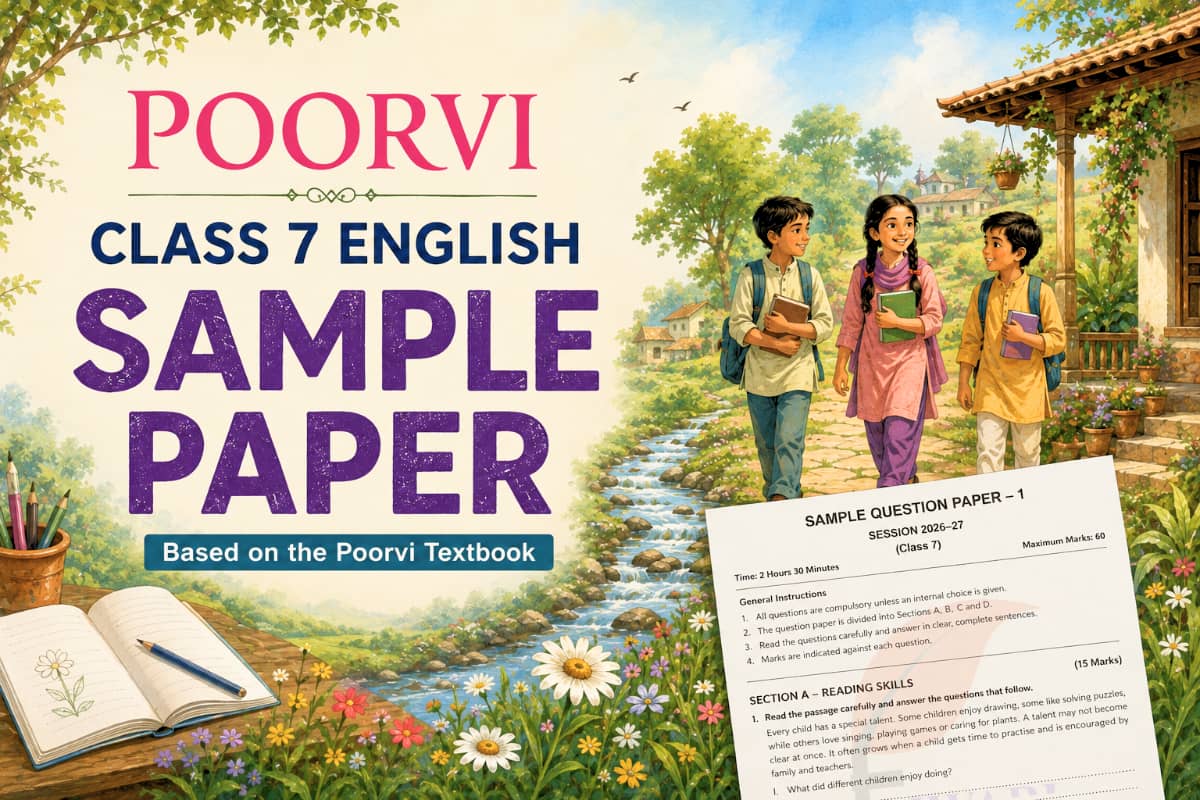
Preparing for the Class 7 English Half Yearly Exam becomes far easier when students have access to well-structured practice material. This page offers 5 Class 7 English Sample Papers created specifically for the Half Yearly Exam, also known as the First Term or Term 1 Exam, under the CBSE curriculum for the 2026-27 academic session. These sample papers are based on the new NCERT English textbook Poorvi and cover Unit 1: Learning Together and Unit 2: Wit and Humour – the first two units out of five in the Class 7 English syllabus.

Since most CBSE-affiliated schools restrict the Half Yearly syllabus to the portion completed in the first half of the academic session, these two units form the core of the exam. Practising with multiple sample papers before the exam helps students understand the question pattern, manage their time better and identify weak areas well in advance.


Quick Overview

DetailInformation
Class7
SubjectEnglish
TextbookPoorvi (NCERT)
Exam NameHalf Yearly Exam / Term 1 / First Term Exam
Units CoveredUnit 1 and Unit 2
Chapters CoveredChapter 1 to Chapter 6
Number of Sample Papers5
Academic Session2026-27
FormatFree PDF Download

Why Class 7 English Sample Papers Are Important for the Half Yearly Exam

Solving sample papers is one of the most effective ways to prepare for any school examination, and Class 7 English is no exception. Here is why these sample papers matter:

  • Familiarity with the exam pattern: Students get used to the actual sections, question types, and marks distribution before sitting for the real exam.
  • Better time management: Timed practice teaches students how much time to spend on reading, writing, grammar and literature sections.
  • Self-assessment: Solving a variety of question sets helps students and parents identify chapters or grammar topics that need more revision.
  • Reduced exam anxiety: Repeated practice builds confidence and removes the fear of unfamiliar question formats.
  • Complete syllabus coverage: Since these 5 sets are based on Unit 1 and Unit 2 of Poorvi, students get full practice on the Half Yearly syllabus without missing any chapter.
  • Improved writing and grammar skills: Regular practice of writing tasks and grammar exercises strengthens core language skills tested throughout Class 7 and beyond.

About the Poorvi Textbook: Unit 1 and Unit 2 Covered in These Sample Papers

NCERT introduced Poorvi as the new Class 7 English textbook under the National Education Policy (NEP) 2020 and the National Curriculum Framework (NCF) 2023, replacing the earlier Honeycomb and An Alien Hand books. The Poorvi textbook has 15 chapters organised into 5 thematic units, with 3 chapters in each unit. Since the Half Yearly Exam typically covers the first half of the syllabus, these sample papers focus on the first two units:

UnitUnit TitleChapters Included
1Learning Together1. The Day the River Spoke 2. Try Again 3. Three Days to See
2Wit and Humour4. Animals, Birds and Dr. Dolittle 5. A Funny Man 6. Say the Right Thing

Unit 1, “Learning Together”, focuses on cooperation, curiosity and lessons learnt through experience and community. Unit 2, “Wit and Humour”, brings in light-hearted stories and poems that build vocabulary and comprehension skills through humour and clever writing. Together, these two units, spanning 6 chapters, form the complete literature portion for the Half Yearly / Term 1 Exam.


CBSE Class 7 English Half Yearly (Term 1) Exam Pattern 2026-27

Most CBSE-affiliated schools follow a similar overall structure for the Class 7 English Half Yearly Exam, generally conducted for 80 marks (or 60 Marks) (theory), in addition to internal assessment marks. While the exact weightage of each section can vary slightly from school to school, the table below shows the pattern most commonly followed:

SectionArea TestedApproximate Marks
Section AReading Comprehension (Unseen Passage)15โ€“20
Section BWriting Skills (Diary Entry, Story, Paragraph, Message, Notice)15โ€“20
Section CGrammar (Tenses, Determiners, Reported Speech, Clauses, etc.)10-15
Section DLiterature (Poorvi โ€“ Unit 1 and Unit 220โ€“25
Total–60-80 Marks

Note: Schools may adjust these marks slightly as per their own internal blueprint. Students and parents should also check the official question paper design shared by their school before the exam.

Under the CBSE two-term assessment structure, this 80-mark Half Yearly Exam is combined with a 20-mark Periodic Test to make up 100 marks for Term 1, while Term 2 similarly combines a Periodic Test with the Annual Exam. This is why the Half Yearly Exam is also referred to as the Term 1 Exam or First Term Exam in many schools.

What’s Inside These 5 Class 7 English Sample Papers

To give students variety in their practice, this post offers 5 different sets of Class 7 English Sample Papers. Each set reflects the standard Half Yearly Exam pattern while covering different questions from the same Unit 1 and Unit 2 syllabus, so students do not repeatedly practise identical questions.
All five sample paper have duration 2 hours and 30 minutes each and each are of 60 marks.

Sample PaperSections CoveredSyllabus
Sample Paper 1Reading, Writing, Grammar, LiteratureUnit 1 & 2 (Poorvi)
Sample Paper 2Reading, Writing, Grammar, LiteratureUnit 1 & 2 (Poorvi)
Sample Paper 3Reading, Writing, Grammar, LiteratureUnit 1 & 2 (Poorvi)
Sample Paper 4Reading, Writing, Grammar, LiteratureUnit 1 & 2 (Poorvi)
Sample Paper 5Reading, Writing, Grammar, LiteratureUnit 1 & 2 (Poorvi)

Each sample paper includes:

  1. One or two unseen reading passages with comprehension-based and vocabulary-based questions.
  2. Writing tasks such as diary entries, short stories, paragraph writing, notices or informal messages.
  3. Grammar exercises covering topics typically taught in Class 7, such as tenses, determiners, clauses and reported speech.
  4. Literature questions from Chapters 1 to 6 of Poorvi, including short-answer, reference-to-context and value-based questions.

You can download all 5 sample papers from the links provided here.


Chapter-wise Important Topics from Unit 1 and Unit 2 (Poorvi)

ChapterTitleFocus Area for Exam Preparation
1The Day the River SpokeTheme of nature, personification, listening skills, moral value
2Try AgainPerseverance, poem-based questions, rhyme scheme, central idea
3Three Days to SeeReflective writing, vocabulary, inference-based questions
4Animals, Birds and Dr. DolittleHumour, character sketch, descriptive questions
5A Funny ManComic elements, dialogue-based questions, moral/message
6Say the Right ThingCommunication skills, situational questions, values

Focusing on these chapter-wise areas while solving the sample papers will help students revise Unit 1 and Unit 2 more effectively before the Half Yearly Exam.

How to Use These Sample Papers Effectively

  1. Complete the syllabus first: Read Chapters 1 to 6 of Poorvi (Unit 1 and Unit 2) thoroughly, along with the grammar topics taught in class, before attempting any sample paper.
  2. Simulate exam conditions: Set a timer for 2.5 to 3 hours, sit in a quiet place and attempt one full sample paper without looking at the textbook.
  3. Attempt one set at a time: Do not solve all 5 sample papers on the same day. Spread them across your revision schedule, ideally one every 2โ€“3 days.
  4. Self-check with answers: After attempting each set, compare your answers, note mistakes and revise the related chapter or grammar topic again.
  5. Focus on weak sections: If you consistently lose marks in grammar or writing, spend extra time practising only that section using the remaining papers.
  6. Revise a day before the exam: Use the last sample paper as a quick revision tool rather than a fresh test, just to boost confidence.


Preparation Tips for Class 7 English Half Yearly Exam

  • Read each chapter of Unit 1 and Unit 2 at least twice and note down difficult words with their meanings.
  • Practise writing answers within the word limits mentioned in the textbook exercises.
  • Revise grammar rules regularly instead of leaving them for the last moment.
  • Practise handwriting speed, as many students lose marks simply due to running out of time.
  • Read the entire question paper carefully before starting, and attempt the questions you are most confident about first.
  • Keep a separate notebook for new vocabulary and grammar rules picked up while solving these sample papers.

Benefits of Solving Class 7 English Sample Papers Regularly

  • Builds a strong foundation for Term 2 (Annual Exam) as well, since language skills are cumulative.
  • Improves reading speed and comprehension accuracy.
  • Strengthens grammar concepts that are tested throughout Class 7 and Class 8.
  • Helps students write more structured and scoring answers in the literature section.
  • Encourages independent learning and disciplined exam preparation habits from an early stage.


Frequently Asked Questions

Which units of the Poorvi textbook are covered in the Class 7 English Half Yearly Exam?

The Class 7 English Half Yearly Exam, also called the Term 1 Exam, generally covers the portion of the syllabus completed in the first half of the academic session. For most CBSE schools following the new NCERT textbook Poorvi, this means Unit 1 (Learning Together) and Unit 2 (Wit and Humour), which together include six chapters: The Day the River Spoke, Try Again, Three Days to See, Animals, Birds and Dr. Dolittle, A Funny Man and Say the Right Thing. Students should confirm the exact syllabus with their own school, as some schools may include a portion of Unit 3 as well.

What is the marking scheme for the Class 7 English Half Yearly Exam?

Most CBSE-affiliated schools conduct the Class 7 English Half Yearly Exam for 80 marks, divided broadly into four sections: Reading Comprehension, Writing Skills, Grammar and Literature, along with separate internal assessment marks recorded through periodic tests and classroom activities. The exact distribution of marks within each section can differ slightly from one school to another, so it is important to check the official question paper design shared by your own school. Practising with a range of sample papers, like the 5 sets provided here, prepares students for any minor variation in the pattern.

How many sample papers are provided, and are they enough for preparation?

This post provides 5 complete Class 7 English Sample Papers, each covering Unit 1 and Unit 2 of the Poorvi textbook along with reading, writing and grammar sections. Solving all 5 sets gives students wide exposure to different question formats and passage types, which is usually sufficient for thorough Half Yearly Exam preparation when combined with regular textbook revision. Students who want extra practice can revisit chapters they found difficult and attempt the same sample paper again after a few days to measure improvement in speed and accuracy.

What is the difference between the Half Yearly Exam and the Annual Exam for Class 7 English?

The Half Yearly Exam, also known as the Term 1 or First Term Exam, tests the syllabus covered in the first half of the academic session, which for English usually means Unit 1 and Unit 2 of the Poorvi textbook. The Annual Exam, or Term 2 Exam, is generally held later in the session and may cover either the remaining units (Unit 3, 4 and 5) or the entire year’s syllabus, depending on the school’s own policy. Students should always check with their teacher whether their Annual Exam syllabus is cumulative or restricted to the second half.

How should Class 7 students plan their revision using these sample papers?

Students should first complete reading and understanding all six chapters of Unit 1 and Unit 2, along with the grammar topics taught in class, before attempting these sample papers. It is best to solve one sample paper every two to three days under timed conditions, followed by careful self-checking and revision of weak areas. Spreading the 5 sample papers over one to two weeks, rather than solving them all at once, allows enough time to revise mistakes and reattempt similar questions, leading to steady improvement in reading, writing, grammar and literature scores.

These 5 Class 7 English Sample Papers, based on Unit 1: Learning Together and Unit 2: Wit and Humour of the Poorvi textbook, are designed to give students complete and structured practice for their Half Yearly / Term 1 Exam in the 2026-27 academic session. Regular practice with these sample papers, combined with thorough revision of the NCERT textbook Solutions and grammar topics, will help students approach their exam with confidence and score well.

Recent Posts
  • Class 9 Science Exploration Notes: 5 Methods That Actually Help You Remember
  • Class 9 Social Science Notes: The Complete Guide
  • Class 9 Maths 2026-27: What’s New in the Syllabus and How to Study It
  • CBSE 3-Language Rule: Will Hindi Become Compulsory Subject?
  • NCERT Solutions for Class 10 Maths 2026-27 – Welcome to Your New Session


Important Links
  • What is NCERT?
  • Important Questions
  • Vedic Maths Tricks
  • Link Study Materials
  • Useful Resources & Formulae
  • Holiday Homework Solutions


Buy NCERT Books Online

NCERT Books for 2026-27

NCERT Solutions
  • NCERT Solutions for Class 6 Maths
  • NCERT Solutions for Class 7 Maths
  • NCERT Solutions for Class 8 Maths
  • NCERT Solutions for Class 11 Maths
  • NCERT Solutions for Class 12 Maths
  • NCERT Solutions for Class 11 Physics
  • NCERT Solutions for Class 12 Physics


High School
  • Class 9 NCERT Maths Solutions
  • Class 9 NCERT Science Solutions
  • Class 9 NCERT English Solutions
  • Class 10 NCERT Maths Solutions
  • Class 10 NCERT Science Solutions
  • Class 10 NCERT English Solutions
  • Class 10 NCERT Social Solutions

Quick Links
  • NCERT Books
  • NCERT Solutions
  • CBSE Syllabus
  • Home Tutors
  • NIOS Admissions
  • CBSE Sample Papers
  • Vedic Maths Tricks
Help & Support
  • About Us
  • Contact Us
  • Advertise With Us
  • Discussion
  • Latest Blogs
  • Holiday Homework
  • Useful Resources
Copyright 2026 by Tiwari Academy | A step towards Free Education
facebook
twitter
linkedin
youtube
instagram
pinterest
google-news