



by Tiwari Academy Team
NCERT Solutions for Class 9 Social Science Part 2 Chapter 2 Life on Earth, help students understand how climate and landforms shape living things. The chapter explains terrestrial and aquatic biomes such as rainforests, grasslands, deserts and tundra, along with the biome pyramid and biodiversity hotspots. Students also learn about forest ecotourism, forest dwellers and their livelihoods, GI-tagged forest products, the Forest Rights Act and community conservation models like Mendha Lekha.
NCERT Class 9 Social Science Part 2 Chapter 2 Solutions
Class 9 Social Science Part 2 Chapter 2 Question Answer
Page 21 – The Big Questions
1. How do physiography and climate shape life on Earth?
Answer:
Landforms, altitude, temperature and rainfall determine the water, soil and growing conditions available to organisms. Warm, wet areas support dense forests, while dry areas support drought-resistant plants. These conditions also influence farming, houses, clothing and livelihoods.
2. How are humans and other lifeforms interconnected?
Answer:
Humans depend on plants for food, oxygen and materials, and on animals and microorganisms for pollination, food and nutrient recycling. Our farming, settlement and conservation choices affect their habitats. All are connected through food chains and natural cycles.
3. What is the importance of preserving various lifeforms, and how can we contribute to their conservation?
Answer:
Biodiversity maintains food webs, fertile soil, clean water and livelihoods. We can protect habitats, plant suitable native species, reduce waste, avoid wildlife products and support community conservation. Protecting many species helps ecosystems withstand disturbances.
Class 9 Social Science Part 2 Chapter 2 Exercises Question Answer
Page 43 – Questions and activities
1. Why does India have diverse biomes? How does the local geography connect to the diversity?
Answer:
India has wide variations in latitude, altitude, rainfall, temperature and distance from the sea. The Himalaya support mountain ecosystems, Rajasthan has dry habitats and the Western Ghats and Northeast support wetter forests. Rivers, coasts and islands add freshwater and marine habitats. Local relief and soil further affect vegetation and wildlife.
2. Make a list of economically valuable native plants in your region and comment on their abundance.
Answer:
Model Delhi list: neem—traditional products and shade, widely planted; ber—edible fruits, found in dry scrub and gardens; babul—gum and useful wood, found in some dry areas; dhak—flowers and traditional leaf products, locally present in Ridge habitats. Abundance varies by neighbourhood; these descriptions are not a field count. Record actual numbers during a supervised local survey.
3. Prepare a map of your state or Union Territory showing national parks and sanctuaries.
Answer:
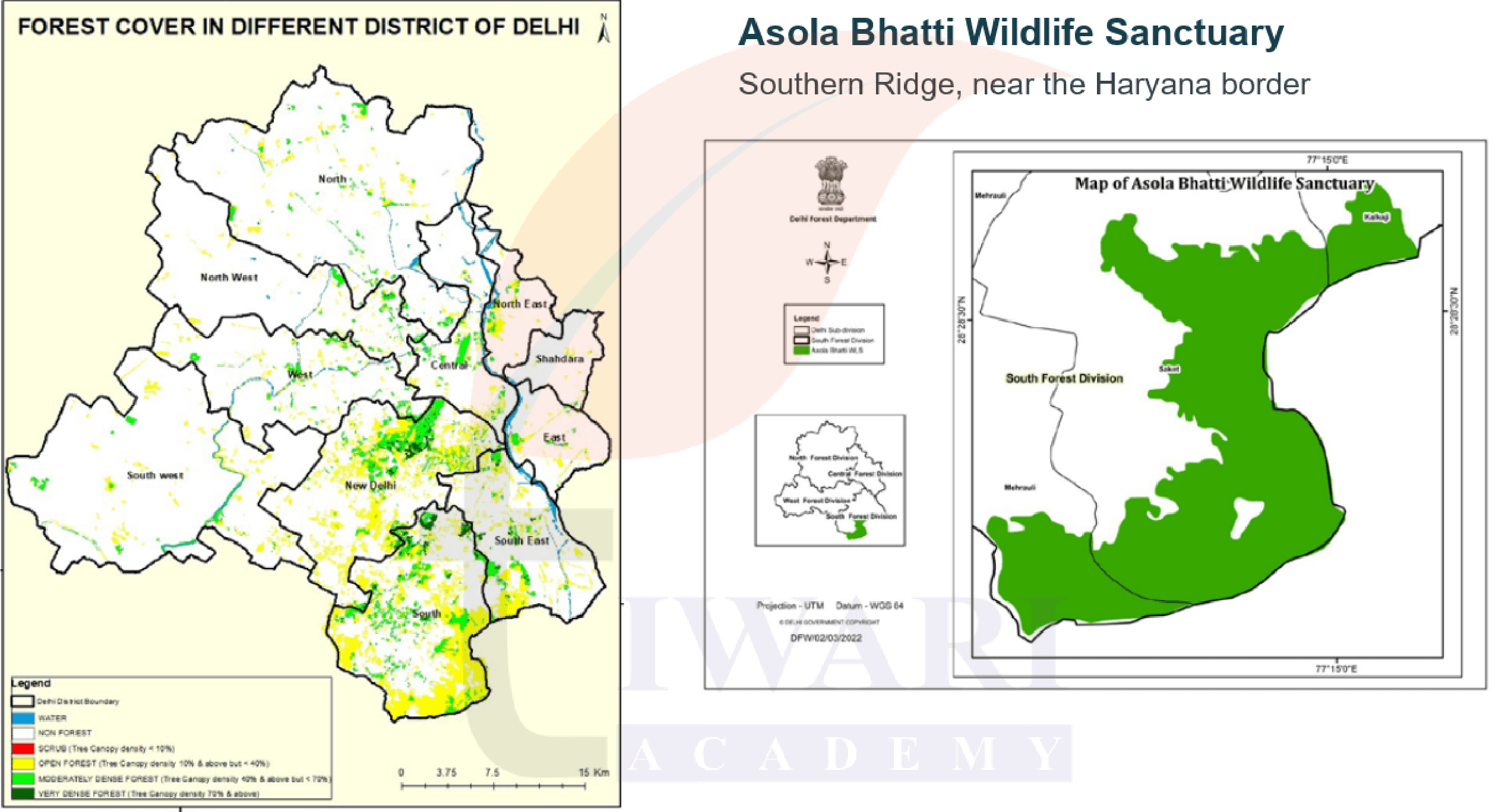
Delhi has Asola Bhatti Wildlife Sanctuary in its southern part, near the Haryana border. Mark it on the Delhi outline and add the Yamuna, north arrow and a legend. Delhi has no national park to mark; a zoo or biodiversity park is not automatically a national park.
4. Study the impact of forest fires on people dependent on forests. Try to include the causes, losses, and preventive measures.
Answer:
Forest fires may start through lightning, unattended flames, discarded burning materials or deliberate burning, and spread rapidly in dry weather. They destroy forest produce, fodder, wildlife and sometimes homes, reducing income and worsening smoke exposure. Preventive steps include public awareness, safe fire practices, monitored fire lines and early reporting. Communities need evacuation arrangements, relief and habitat restoration after fires.
5. Why are forests often called the ‘lungs of the Earth’?
Answer:
Forests absorb carbon dioxide and release oxygen during photosynthesis. They also store carbon, trap some airborne particles and influence moisture and temperature. The phrase highlights these benefits; forests also respire and ocean organisms contribute substantially to global oxygen production.
6. If large forest areas continue to be destroyed, what do you think would be its long-term effect on the global climate?
Answer:
Deforestation releases stored carbon and reduces future carbon absorption, contributing to global warming. It also disrupts moisture recycling and rainfall, increases soil erosion and can worsen local heat and drought. The loss of habitats further weakens ecosystems’ ability to cope with climatic change.
7. Discuss some traditional forest conservation methods with your grandparents or an elderly person.
Answer:
Model points for a discussion: communities protect sacred groves, avoid cutting certain trees, regulate grazing and harvest forest produce seasonally. Some maintain ponds and collectively prevent fires.
8. How do forest dwellers contribute to the protection and conservation of forests?
Answer:
Forest dwellers use detailed knowledge of seasons, plants and wildlife to manage resources. Communities protect sacred groves, regulate harvesting, detect fires and report illegal activities. Gram Sabhas and community forest management can combine recognised rights with conservation responsibilities, as illustrated by Mendha Lekha.
9. What is a forest fire? Prepare a plan for prevention and mitigation of forest fires.
Answer:
A forest fire is an uncontrolled fire spreading through forest vegetation.
- Prevention: identify vulnerable areas, educate visitors, prevent unattended burning and let trained teams maintain fire lines.
- Preparedness: arrange warning systems, contact lists, evacuation routes and community training.
- Response: report fires promptly, follow official evacuation directions and protect vulnerable people; students should not fight fires.
- Recovery: support affected families, assess damage and restore suitable native vegetation.
Extra Question Answers for Exam Preparation
Class 9 Social Science Part 2 Chapter 2 Very Short Answer Type Questions with Explanation.
Very Short Answer Type Questions
- How can altitude change vegetation on a mountain?
Answer:
Increasing altitude generally lowers temperature, so vegetation changes from warmer forests to conifers, alpine plants and sparse growth. - What is an ecosystem?
Answer:
An ecosystem includes living organisms and non-living surroundings interacting through food relationships, energy flow and nutrient cycles. - Why are pollinating insects important to people?
Answer:
Pollinating insects help many plants reproduce, supporting fruit and seed production, biodiversity, farming and human food supplies. - How does a forest canopy affect plants below it?
Answer:
The canopy intercepts sunlight, leaving lower plants in shade and influencing which species can survive beneath trees. - What makes temperate grasslands useful for farming?
Answer:
Many temperate grasslands have fertile soils that can support crops where water availability and other conditions are suitable. - Why should a desert not be described as lifeless?
Answer:
Deserts support specially adapted plants and animals that survive limited rainfall, extreme temperatures and scarce food resources. - What is permafrost?
Answer:
Permafrost is ground that remains frozen for at least two consecutive years, influencing drainage, roots and tundra vegetation. - Give two ways forests protect soil.
Answer:
Tree roots help bind soil, while vegetation cover reduces the direct impact of rainfall and slows surface runoff. - What does a wildlife corridor connect?
Answer:
A wildlife corridor connects separated habitats, helping animals move, find resources and maintain breeding links between populations. - Why should tourists avoid feeding wildlife?
Answer:
Feeding can alter natural behaviour, encourage dependence on people and increase dangerous encounters between animals and visitors. - What distinguishes a product’s GI origin from its market?
Answer:
GI origin identifies the place linked to a product’s qualities; its market is simply where people buy it. - How can women’s forest knowledge support conservation?
Answer:
Women’s knowledge of useful plants, seasonal availability and harvesting methods can guide sustainable use and community conservation decisions. - Why do communities need rules for shared ponds?
Answer:
Rules help prevent pollution and overuse, distribute water fairly and organise maintenance so shared ponds remain useful. - Name two freshwater habitats found in or near cities.
Answer:
Urban ponds and river stretches are freshwater habitats that can support organisms while providing environmental benefits to residents. - Why should Delhi’s Ridge vegetation be protected?
Answer:
The Ridge provides wildlife habitat, moderates local environmental conditions and preserves an important part of Delhi’s natural landscape.
Class 9 Social Science Part 2 Chapter 2 Short Answer Type Questions with Explanation.
Short Answer Type Questions
- How can rainfall produce different vegetation in equally warm places?
Answer:
Warm places with abundant rainfall can support dense forests, while equally warm but drier places support grasslands or desert vegetation. Water availability affects plant density, growth and the animals that can live there. - Explain one connection between plants, insects and human food.
Answer:
Many insects transfer pollen between flowers, allowing plants to produce fruits and seeds. Humans depend on several of these crops for food. Protecting pollinator habitats therefore supports both biodiversity and agricultural livelihoods. - Why is planting only one tree species insufficient for restoring a diverse forest?
Answer:
A diverse forest provides different food sources, nesting places and ecological functions. Planting one species may increase tree cover but cannot recreate all these relationships. Restoration should consider native diversity, soil, water and natural regeneration. - How can a forest-produce cooperative improve livelihoods?
Answer:
A cooperative can pool produce, improve processing, share transport and negotiate better prices. Transparent rules and sustainable harvesting help producers gain income without exhausting resources, while collective participation can strengthen bargaining power. - Why must conservation consider forest residents’ needs?
Answer:
Forest residents often depend on local resources and possess valuable ecological knowledge. Conservation is stronger when their rights and livelihoods are respected, and when communities participate in decisions, sustainable use and habitat protection. - How can a village distinguish sustainable harvesting from destructive extraction?
Answer:
Sustainable harvesting takes limited quantities, allows regeneration and avoids damaging breeding sites or whole plants unnecessarily. Destructive extraction removes resources faster than they recover, weakening habitats and threatening both future supplies and local livelihoods. - What can a Delhi school do to support nearby biodiversity?
Answer:
A school can grow suitable native plants, reduce litter, conserve water and observe birds or insects without disturbing them. Students can share findings, discourage wildlife feeding and cooperate with authorised local conservation activities. - Explain why water tanks are also social institutions.
Answer:
Tanks store water, but their maintenance and use require collective decisions. Communities must protect catchments, organise repairs and share supplies. These responsibilities connect water management with cooperation, fairness and local knowledge across generations. - How could a road through a forest affect wildlife?
Answer:
A road can divide habitats, disturb animals and increase collision risks. It may restrict movement between feeding or breeding areas. Careful planning, suitable crossings and protection of connecting habitats can reduce these effects. - Why should an uncoloured area on a biome map be interpreted carefully?
Answer:
A simplified map may omit oceans, ice-covered regions or transition zones. Lack of colour can reflect the map’s categories or scale rather than absence of life. Always read the legend before drawing conclusions.
Class 9 Social Science Part 2 Chapter 2 Long Answer Type Questions with Explanation.
Long Answer Type Questions
1. A village wants tourism income from a nearby forest. Suggest a balanced plan.
Answer:
The village should begin with the forest’s conservation needs and visitor capacity. Trained local guides can lead small groups along approved paths, while residents provide suitable services. Visitors should avoid feeding wildlife, collecting plants and leaving waste. Part of the income can support habitat protection and maintenance. Community participation, fair payment and regular review can connect livelihoods with long-term conservation.
2. Explain how damage to one part of an ecosystem can affect several other parts.
Answer:
An ecosystem contains linked food relationships and natural processes. If pollinating insects decline, some plants may produce fewer seeds and fruits. Animals depending on those plants may lose food, while farmers may experience lower yields. Changes in vegetation can then affect soil and water. This shows why conservation should protect ecological relationships and habitats, rather than focusing only on a few attractive species.
3. How would you investigate whether wildlife is visiting a neighbourhood because of human activities?
Answer:
I would conduct a supervised observation exercise without approaching animals. I would record the species, time, location and nearby food waste or water sources, and compare repeated visits. Residents and authorised wildlife staff could provide information about habitat changes. I would avoid claiming a cause from one sighting. Findings could guide better waste storage, reduced feeding and protection of nearby habitat.
4. Compare the value of sacred groves and formally protected areas.
Answer:
Sacred groves are protected through community traditions and beliefs, often conserving small forest patches and water sources. National parks and sanctuaries receive formal protection under public institutions and rules. Both can preserve habitats and biodiversity, but their management systems differ. Cooperation between communities and authorities can strengthen conservation, particularly when local knowledge, rights and ecological needs are considered together.
5. Explain why conserving biodiversity also protects future economic opportunities.
Answer:
Biodiversity supports agriculture, fisheries, forest produce, tourism and many materials used by people. Healthy ecosystems also maintain pollination, water quality and soil fertility, reducing damage and costs. Destroying habitats can remove useful species and undermine livelihoods that depend on them. Conservation keeps these resources and ecological functions available, allowing future generations to develop opportunities without inheriting exhausted or unstable ecosystems.