



by Tiwari Academy Team
NCERT Solutions for Class 9 Social Science Chapter 7 Elections – Exercises Question-answers and Practice Questions for Exam Preparation session 2026-27. Chapter 7, Elections, belongs to the Political Science section of Class 9 Social Science. It explores why elections are essential to democracy, covering direct and indirect elections, electoral systems like First-Past-The-Post (FPTP) and Proportional Representation and key laws such as the Representation of the People Acts of 1950 and 1951. The chapter examines the role of the Delimitation Commission and the Election Commission of India (ECI) in conducting free and fair elections, including electoral roll preparation, digital initiatives, and inclusivity measures for disabled and senior voters. It also covers political parties, the multi-party system, anti-defection law and challenges like misinformation and fake news facing Indian elections today.
Quick Links:
- Chapter’s Question Answers
- Exercises Question Answers
- Very Short Answer Type Questions
- Short Answer Type Questions
- Long Answer Type Questions
Download Class 9 Social Science App to study Class 9 Social Science Offline.
NCERT Class 9 Social Science Chapter 7 Solutions (Political Science)
Class 9 Social Science Chapter 7 Question Answer
Page 161 – The Big Questions
1. Why are elections essential to a democratic system?
Answer:
Elections are essential to democracy because they are the main way through which citizens choose the people who will govern them and make decisions on their behalf. Through regular and periodic elections, people get to elect their representatives to the Lok Sabha, Vidhan Sabha and local bodies. Elections also make sure that the government remains accountable to the people, because if a representative does not perform well, the citizens can vote them out and choose someone else in the next election. Without elections, there would be no real way for people to take part in decision-making or to control who runs the country, which is why elections are often called the soul of democracy.
2. How do electoral systems and rules shape political representation and fairness?
Answer:
Electoral systems decide how votes cast by people are converted into seats in the legislature, and this directly affects how fair and representative the result is. India follows the First-Past-The-Post (FPTP) system for the Lok Sabha and Vidhan Sabha, where the candidate getting the most votes wins, even if it is less than 50% of total votes. This system is simple and gives clear results but can sometimes mean that a party wins many seats with a vote share much lower than its rivals combined. On the other hand, the Proportional Representation (PR) system, used for the Rajya Sabha, President and Vice President elections, gives seats in proportion to the votes received, allowing smaller parties or groups to also get fair representation. Rules like delimitation (fixing equal-sized constituencies) and election laws (like the Representation of the People Acts) also play an important role in making sure votes carry equal value and seats are distributed fairly across the country.
3. What role do institutions and laws play in ensuring free and fair elections?
Answer:
Institutions and laws are very important for keeping elections free, fair and transparent. The Election Commission of India (ECI) is an independent constitutional body that supervises, directs and controls the entire election process, from preparing voter lists to declaring results. It also registers political parties, allocates election symbols and ensures inner-party democracy. Laws like the Representation of the People Act, 1950 and 1951 lay down rules for voter eligibility, candidate nomination, election campaigns and punishment for corrupt practices like bribery or appeals based on religion or caste. The Delimitation Commission ensures fair distribution of seats based on population. Together, these institutions and laws make sure that elections in India remain honest, organised, trustworthy and that the basic rights of voters and candidates are protected.
4. What challenges do elections face in practice, and how can these challenges affect democracy?
Answer:
In practice, conducting elections in a huge and diverse country like India faces many challenges, such as misinformation and fake news that can mislead voters, intimidation of voters or candidates, corrupt practices like bribery and the difficulty of managing elections for over 96 crore voters spread across different regions, languages and terrains. There can also be challenges in making sure that every eligible voter, including persons with disabilities, senior citizens and people in remote areas, is able to vote easily. If these challenges are not addressed, they can weaken public trust in the election process and reduce the true democratic value of elections, even if voting technically takes place. This is why the ECI uses tools like the Model Code of Conduct, EVMs with VVPAT and voter awareness campaigns, along with active citizen participation, to overcome these challenges and keep democracy strong and reliable.
Page 165 – LET’S EXPLORE
Different democracies use different electoral systems. Make groups of 5–6 students. Each group will select six countries from different continents. Prepare and present a case study on the type of electoral system(s) operating in those countries, and discuss their latest election results of those countries.
Answer:
- India (Asia) – Uses First-Past-The-Post system. In 2024, BJP-led NDA won and Narendra Modi became PM for the third time.
- USA (North America) – Uses the Electoral College system. In 2024, Donald Trump won and became President again.
- Brazil (South America) – Uses a runoff system (second round if no one gets 50% votes). In 2022, Lula da Silva won a close election.
- UK (Europe) – Uses First-Past-The-Post system. In 2024, the Labour Party led by Keir Starmer won a huge majority.
- South Africa (Africa) – Uses Proportional Representation (votes for party, not person). In 2024, the ANC remained largest party but had to form a coalition for the first time since 1994.
- Australia (Oceania) – Uses preferential voting (ranking candidates). In 2025, the Labor Party won its biggest-ever victory.
Page 168 – THINK ABOUT IT
You will turn in a few years. s a responsible citi en you should register yourself as a voter. Find out the various steps of the procedure for registration and the list of required documents for the same. Discuss, with anyone who has just turned 18 and has registered as a voter the ease or difficulty faced in the voter registration process.
Answer:
Steps for Voter Registration in India:
- Check eligibility – You must be an Indian citizen, at least 18 years old.
- Visit voters.eci.gov.in or the Voter Helpline App.
- Fill Form 6 (the new voter registration form) online or get a printed copy from your local election office.
- Upload required documents along with a passport-size photo.
- Submit the form online or give it to the Booth Level Officer (BLO).
- A BLO may visit your home to verify your details.
- Once approved, your name is added to the voter list and you get your Voter ID card (EPIC).
Documents Required:
- Age proof: Birth certificate, 10th marksheet or Aadhaar card
- Address proof: Aadhaar card, ration card or a utility bill
- A recent passport-size photo
Discussion:
My cousin, who turned 18 last year, said the process was easy since she registered online and already had her Aadhaar card and school certificate ready. The only difficulty was a short wait of a few weeks before her name appeared on the final voter list, as it took time for officials to verify her address.
Page 168 – LET’S EXPLORE
Find out who are classified as service voters and who can vote using ETPBS?
Answer:
Service voters are people who cannot vote at their home constituency because of their job, such as members of the Armed Forces (Army, Navy, Air Force), members of the Armed Police Forces of a State serving outside that state, government employees posted outside India and their spouses.
People who can vote using ETPBS (Electronically Transmitted Postal Ballot System) are these service voters. ETPBS allows them to receive their ballot paper electronically and cast their vote by postal ballot from wherever they are posted, without having to travel back to their home constituency to vote in person.
Page 173 – LET’S MAP
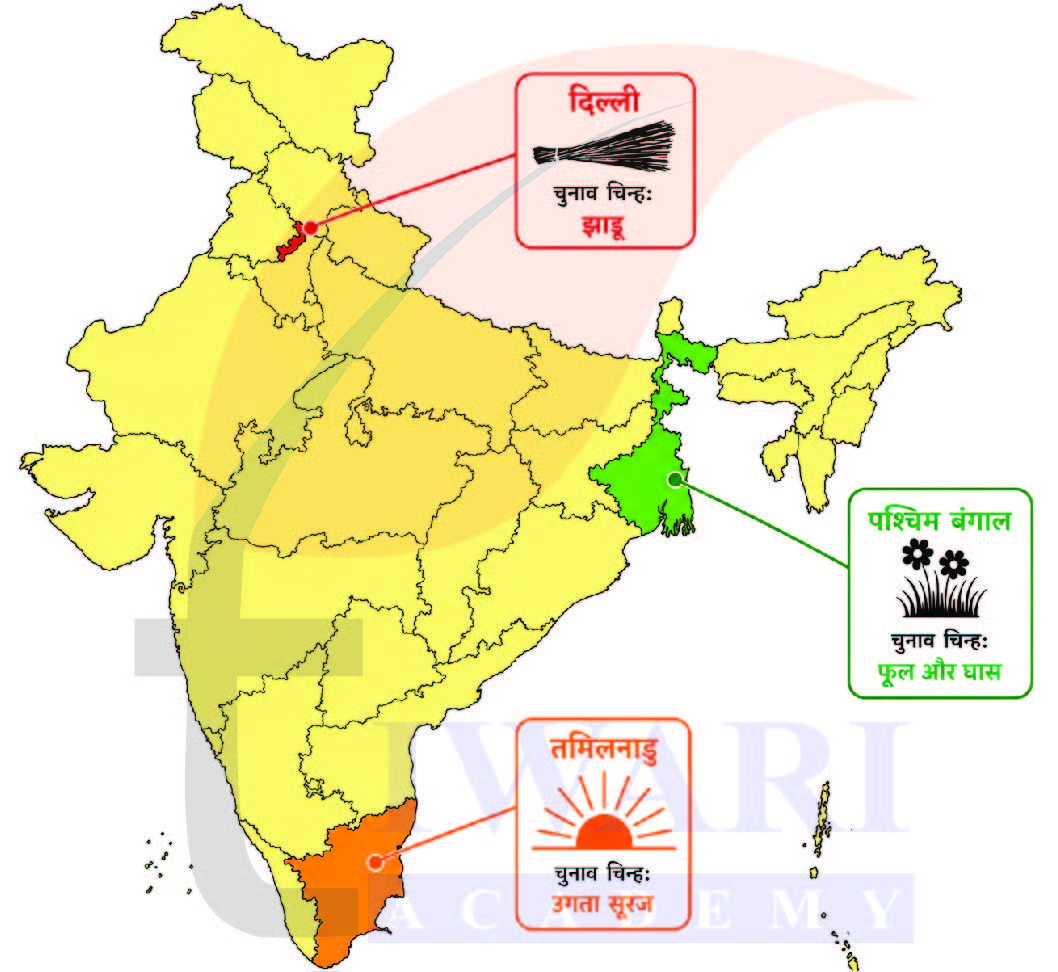
1. Choose any three states (including yours). Find the symbols of state parties belonging to those states and plot them on the given map of India. List down their major agenda, as mentioned in their manifesto in the latest Lok Sabha/Vidhan Sabha/Local Body Elections.
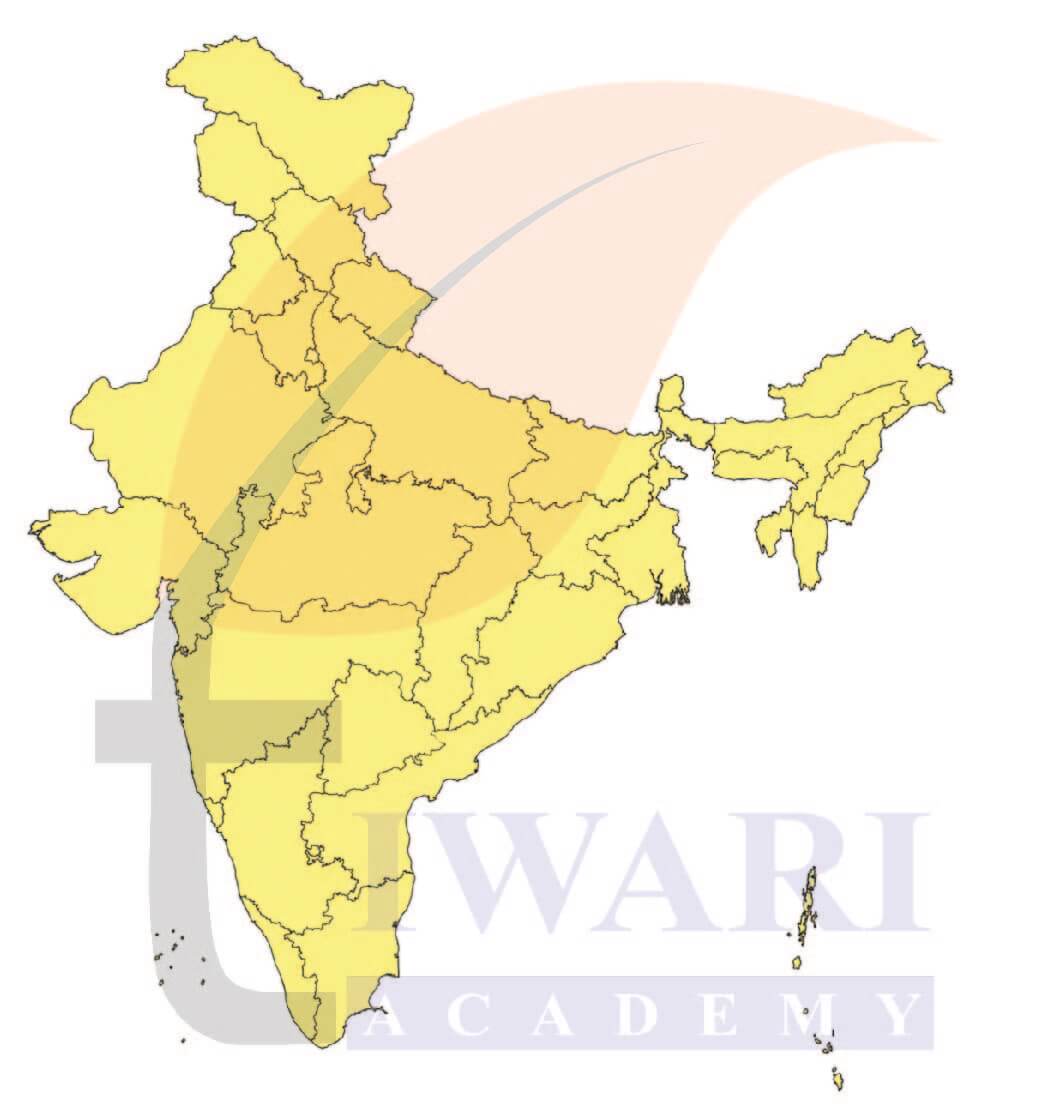
Answer:
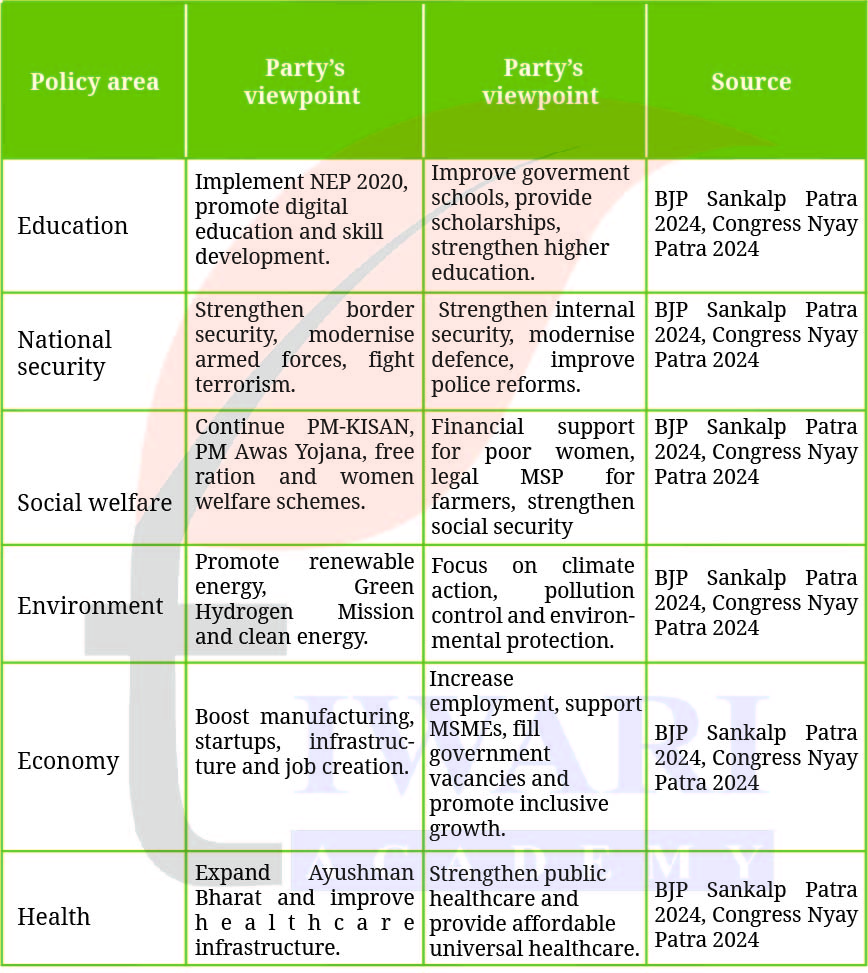
2. Form groups of 4–6 students. Identify and compare the policy preferences on the following parameters for two political parties in the last Lok Sabha Elections using credible sources like party manifestos, newspapers, etc. Present the points of comparison in a poster using bullet points, symbols, colour coding, etc.
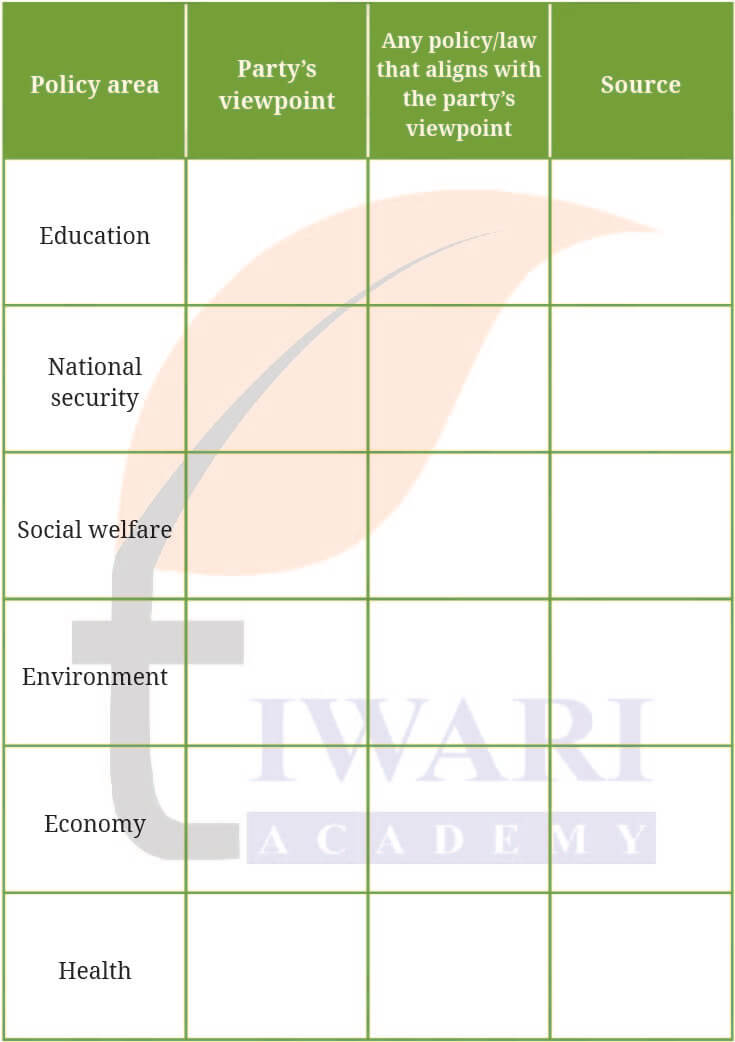
Answer:
Page 176 – LET’S EXPLORE
Find out the number of State parties and Registered Unrecognised Political Parties (RUPP). You may visit the website of ECI.
Answer:
According to the latest available data from the Election Commission of India (ECI), India has:
- 6 National Parties
- 67 Recognised State Parties
About 2,046 Registered Unrecognised Political Parties (RUPPs) (after the ECI’s clean-up drive in 2025, which removed inactive parties that had not contested elections or failed to comply with registration rules).
The number of political parties changes from time to time because the ECI regularly registers new political parties and removes inactive or non-compliant parties. Therefore, for the latest figures, students should refer to the Election Commission of India (ECI) website under the “Political Parties” section.
Page 177 – LET’S EXPLORE
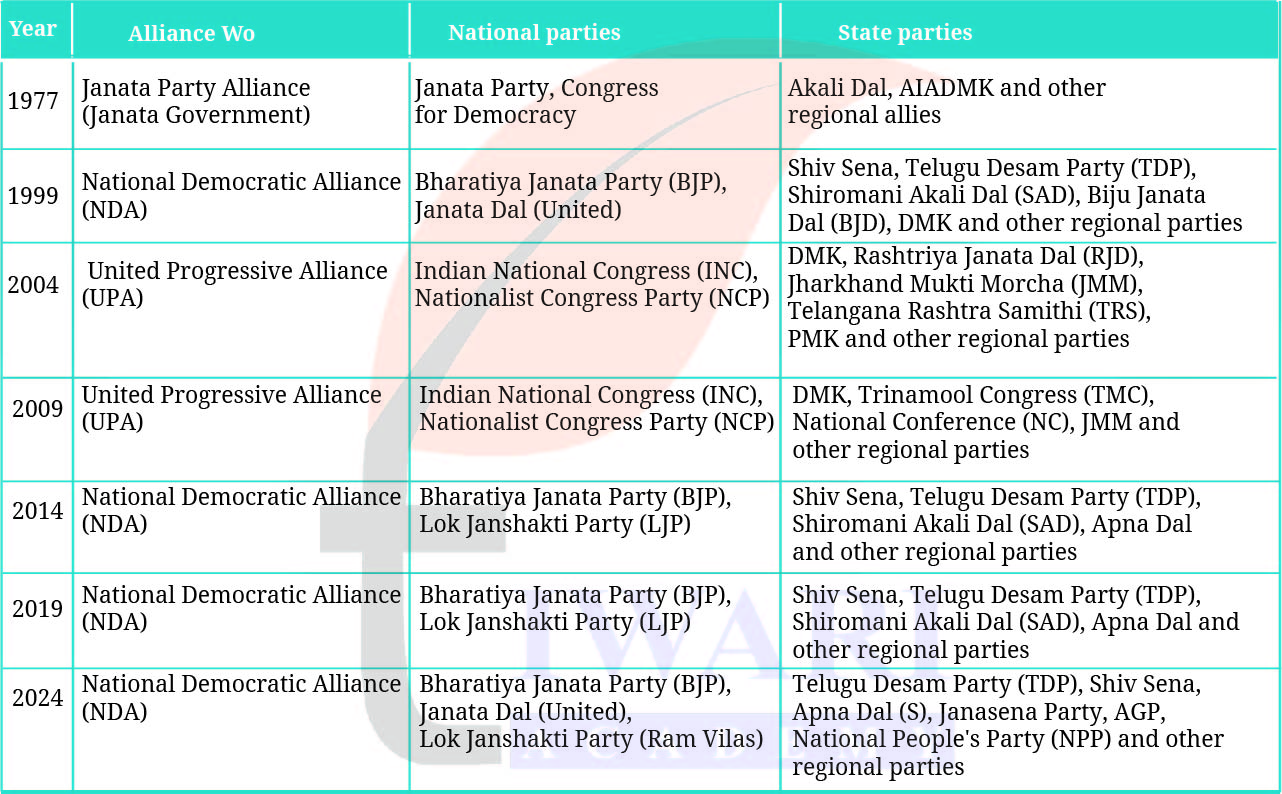
The year 1967 witnessed an end to the era of single-party dominated elections in India and an era of alliances began. Even though various states witnessed politics of alliance starting from 1967, it was in 1977 that various political parties formed an alliance as the Janata Party against the backdrop of the National Emergency ( ). The anata Party formed the first coalition government at the national level, which was popularly known as the Janata Government. Since the late 1990s, the National Democratic Alliance (NDA), led by the Bharatiya Janata Party (BJP), and the United Progressive Alliance (UPA), led by the Indian National Congress (INC) until its dissolution in 2023 and subsequent reconstitution as the Indian National Developmental Inclusive Alliance, have been the major political alliances in Indian elections.
Find out the name and the composition (number and name of the national and state parties) of the alliances that won in the following elections to the Lok Sabha.
Answer:
Page 178 – LET’S ANALYSE
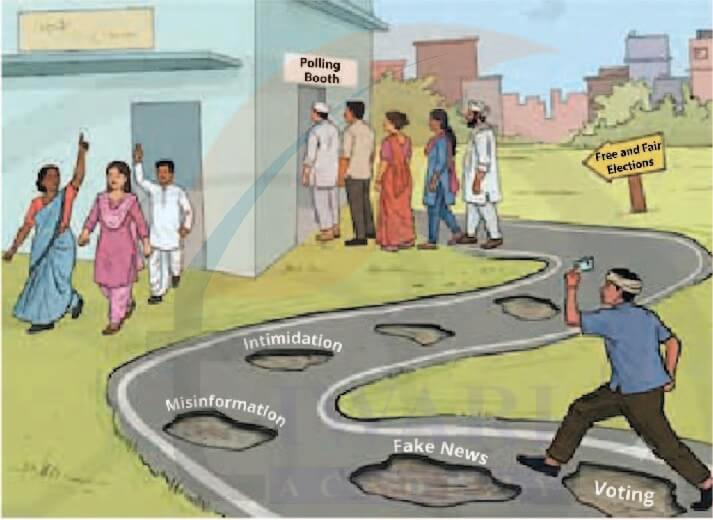
Look at the road to free and fair elections above (Fig. 7.13). Fill in the empty potholes with challenges after discussing them with your teachers and parents. How can we overcome these challenges?
Answer:
Some additional challenges to free and fair elections are:
- Bribery and vote buying – Giving money, gifts or other benefits to influence voters.
- Booth capturing – Illegally taking control of a polling booth to manipulate voting.
- Misuse of money and muscle power – Using wealth or force to influence election results.
- Hate speech and communal politics – Creating divisions among people based on religion, caste or language.
- Low voter awareness – Many eligible voters do not vote or are unaware of the importance of voting.
- Misuse of social media – Spreading rumours and false information to influence public opinion.
Steps to Overcome the Challenges:
- Strictly enforce election laws and the Model Code of Conduct.
- Take strict action against fake news, bribery, hate speech and vote buying.
- Conduct voter awareness campaigns to educate citizens about their voting rights and responsibilities.
- Ensure transparency in elections through the use of EVMs and VVPATs.
- Encourage responsible use of social media and verify information before sharing it.
- Report unfair election practices to the Election Commission of India.
Class 9 Social Science Chapter 7 Exercises Question Answer
Page 179 – Questions and activities
1. What reforms have been introduced by the ECI to make voting more inclusive for the following groups?
a. People with Disabilities
b. Service Voters
c. Senior Citizens (60 years and above; and 80 years and above)
d. Prisoners
e. Persons in preventive detention
Answer:
a. People with Disabilities (PwDs):
The ECI has introduced Braille-enabled EVMs, ramps, wheelchairs, accessible polling stations and the Saksham App to help persons with disabilities register, locate polling booths and vote independently.
b. Service Voters:
Service voters, such as members of the Armed Forces and government employees posted abroad, can vote through the Electronically Transmitted Postal Ballot System (ETPBS), which enables them to cast their votes by postal ballot.
c. Senior Citizens (60 years and above; and 80 years and above):
Senior citizens are provided priority assistance, such as wheelchairs and volunteers, at polling stations. Voters aged 85 years and above are also allowed to vote from home through the postal ballot facility.
d. Prisoners:
Under Indian law, convicted prisoners and undertrial prisoners are generally not allowed to vote while they are in prison.
e. Persons in Preventive Detention:
Persons in preventive detention retain their voting rights and can cast their vote through the postal ballot facility.
2. What are the various functions of the Election Commission of India? Which of these functions is most important for the conduct of free and fair elections? Explain.
Answer:
The main functions of the ECI are:
- Preparing and revising the electoral rolls through enumeration and Special Intensive Revision (SIR).
- Deciding the schedule and dates for elections.
- Registering political parties and allotting election symbols and classifying them as national, state or registered-unrecognised parties.
- Ensuring free and fair elections through measures like the Model Code of Conduct, EVMs, VVPAT, and voter awareness campaigns.
- Acting as a quasi-judicial body to resolve disputes related to party recognition and symbol allotment.
Of these, ensuring free and fair elections can be considered the most important function, because even if all other processes (rolls, schedules, registration) are completed correctly, elections lose their democratic meaning if they are not conducted fairly, transparently and without intimidation or malpractice. Free and fair elections are the foundation on which public trust in democracy depends.
3. Elections are the soul of a democracy. Do you agree? Why or why not?
Answer:
Yes, I agree that elections are the soul of democracy. Elections are the main process through which citizens choose their representatives and hold them accountable. They give every citizen, regardless of background, an equal voice in deciding who governs them. Without regular and fair elections, there would be no real way for the people to express their will, replace non-performing leaders or ensure that the government remains answerable to them. Elections give legitimacy to the government and keep the democratic system alive and functioning.
4. Explain at least three differences between the national and state/regional political parties.
Answer:
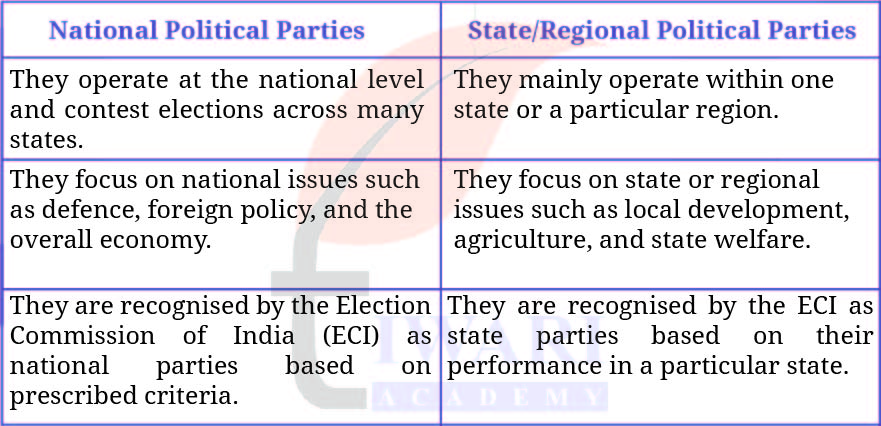
5. Why should you vote? Arrange the following in the descending order of your choice. Discuss the reasons for your choice.
a. Opportunity to choose my representative
b. Makes me a responsible person
c. Opportunity to change the non-performing representative
d. Strengthens democracy
Answer:
Descending order of my choice:
(a) Opportunity to choose my representative
(d) Strengthens democracy
(c) Opportunity to change the non-performing representative
(b) Makes me a responsible person
Reason:
Voting allows citizens to choose the right representative who will work for the country’s development. It strengthens democracy by ensuring that the government reflects the people’s choice. It also gives voters the power to replace representatives who do not perform well. Finally, voting is a responsible duty of every citizen and encourages active participation in the democratic process.
6. What is the Special Intensive Revision (SIR) initiative of the ECI? Explain the objectives and the necessity of conducting SIR.
Answer:
The Special Intensive Revision (SIR) is a special drive conducted by the Election Commission of India (ECI) to thoroughly verify and update the electoral rolls (voter lists). During this process, Booth Level Officers (BLOs) carry out house-to-house verification to ensure that every eligible citizen is included in the voter list and that the names of ineligible, duplicate, deceased or permanently shifted voters are removed.
Objectives of SIR:
- To ensure that no eligible voter is left out of the electoral roll.
- To remove duplicate, deceased or ineligible entries from the voter list.
- To make the electoral rolls accurate, updated and transparent.
- To strengthen the integrity of the electoral process.
Necessity of SIR:
- To correct errors that may have accumulated in electoral rolls over time.
- To update voter records after migration, deaths or changes in residence.
- To ensure that only eligible Indian citizens are registered as voters.
- To help conduct free, fair and credible elections with accurate voter lists.
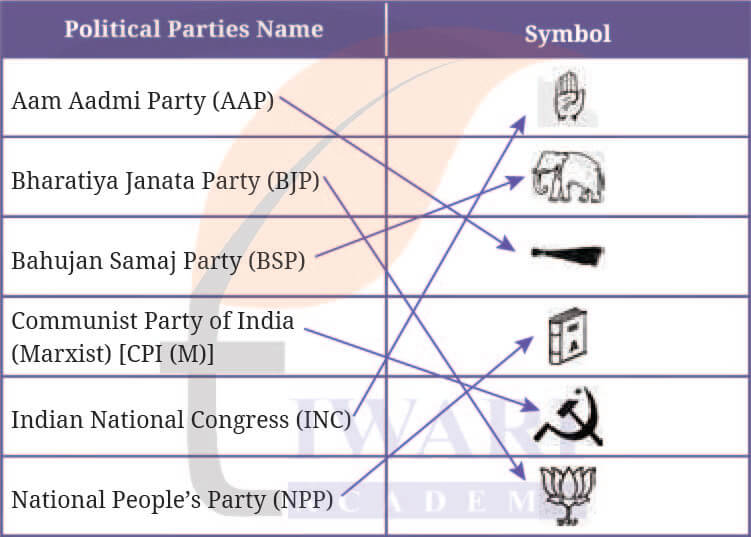
7. Match the political party name with its symbol.
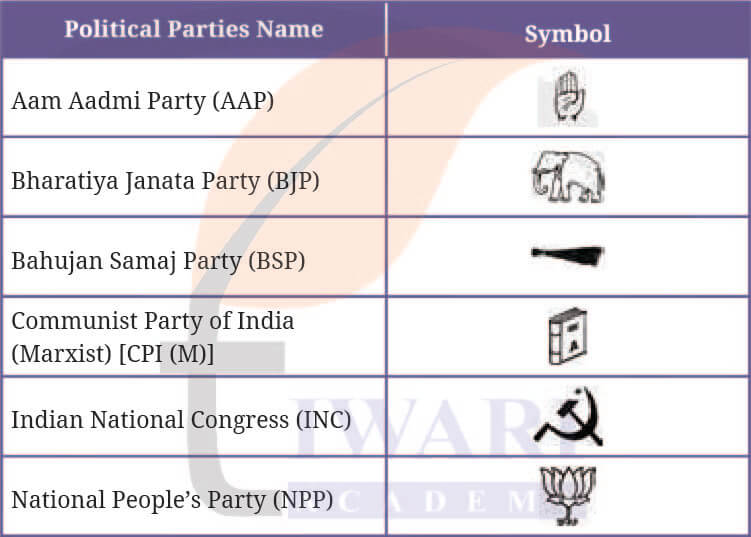
Answer:
8. Read the case study and answer the following questions.
Ishani and her mother were in the local market, day before the state assembly elections. She noticed wall writing and campaign posters pasted everywhere. Large groups of campaigners were distributing pamphlets and raising slogans in support of the respective candidates. Ishani has turned 18 and will be voting for the first time. he had registered to vote through the ECIs online portal. The next morning, she, along with her mother and her disabled elder brother, went to the polling station, which was well guarded by the police personnel. A wheelchair was made available to them, and volunteers guided them to the polling booth. Inside the polling booth, there were only three people who were performing all duties. Ishani had forgotten her voter ID card and Aadhaar card, but she was surprised as no one asked for them. After casting her vote, she was also able to see the VVPAT slip. While leaving, she wondered how the police personnel vote, as they must be on duty from early morning till late evening. When she went home, she narrated her entire experience to her 89-year-old grandmother, who cast her vote from home.
a. What initiatives were taken by the ECI to enable the voters to cast their vote?
Answer:
The ECI provided a wheelchair and volunteer assistance for Ishani’s disabled brother, allowed online voter registration through its portal, ensured VVPAT slips were visible for voter confidence, did not insist on physical ID documents when the voter’s identity could be confirmed in another way and provided a “vote from home” facility for senior citizens (used by Ishani’s 89-year-old grandmother).
b. If Ishani was allowed to vote even without carrying her Voter ID card or Aadhaar card, which other document might she be carrying that is valid for voting?
Answer:
She may have been carrying any other valid government-issued photo ID document accepted by the ECI, such as a Passport, Driving Licence, PAN Card or a printout of her e-EPIC (electronic Voter ID) downloaded from the ECI’s portal.
c. Cite the examples of violations of the Model Code of Conduct.
Answer:
From the passage, examples that could violate the Model Code of Conduct (if done improperly, e.g., too close to polling day or without permission) include: wall writing and pasting of campaign posters everywhere and large groups of campaigners distributing pamphlets and raising slogans near the time of voting.
d. Give a suitable title to the passage.
Answer:
“A First-Time Voter’s Experience” or “Ishani Casts Her First Vote”
e. Find out how the police and army personnel cast their votes.
Answer:
Police personnel and armed forces personnel who are on election duty or posted away from their home constituency are classified as “service voters”. They cast their votes through postal ballots, including the Electronically Transmitted Postal Ballot System (ETPBS), which allows them to receive and submit their ballots electronically from their location of duty.
9. A comparative chart of three countries is given. Based on the information, answer the following questions.
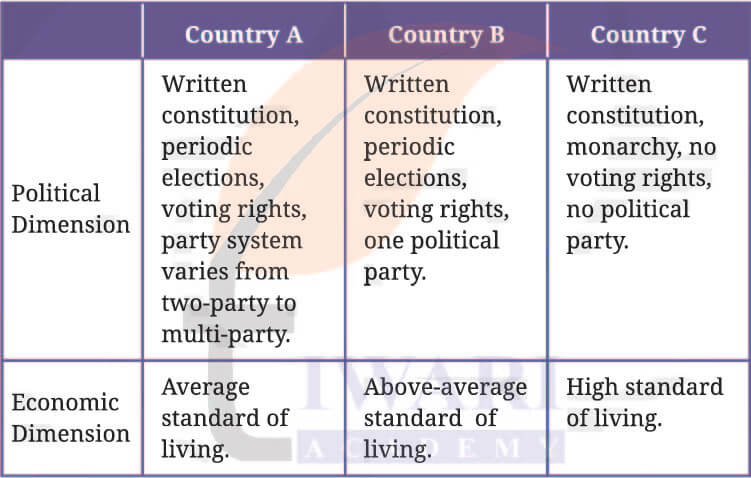
a. What is the difference between having a voting right in a country with a multi-party system and another with a single-party system?
b. In which of the above countries would you like to stay and why?
Answer:
a. In a multi-party system, citizens can choose from several political parties, giving them more options and better representation. In a single-party system, people have limited choice because only one political party is allowed to contest and govern, reducing political competition.
b. I would like to live in Country A because it has a written Constitution, regular elections, voting rights, and a multi-party system, which provide people with democratic rights and the freedom to choose their representatives. These features help ensure greater participation, accountability and protection of citizens’ rights.
10. What are the challenges to conducting free and fair elections?
Answer:
The major challenges to conducting free and fair elections include fake news, misinformation, intimidation of voters, bribery and vote buying, misuse of money and muscle power, hate speech, communal or caste-based campaigning and the misuse of social media to spread false information. These challenges can influence voters unfairly, reduce transparency and affect the fairness and credibility of the electoral process.
11. On the Stage. Elections are to be held in your school for the posts of Head Girl, Head Boy, and Sports Captain. Assume the roles of an Election Commissioner, Returning Officer, Polling Agent, Candidate, Campaigner, Polling Officer, Police Personnel, and a Journalist, and perform their roles while ensuring free, fair, and transparent elections.
Answer:
This is a role-play activity to be performed in the classroom. The roles and responsibilities can be assigned as follows:
- Election Commissioner: Announces the election schedule, ensures that election rules are followed and supervises the entire election process.
- Returning Officer: Receives and verifies nomination forms, prepares the final list of candidates and declares the election results.
- Polling Officer: Verifies the identity of voters, maintains the voter list and ensures that each student votes only once.
- Polling Agent: Observes the polling process on behalf of a candidate and ensures that voting is conducted fairly.
- Candidate: Campaigns for votes, presents ideas and plans for the school, and encourages students to vote.
- Campaigner: Helps the candidate by promoting their manifesto and requesting students to support them.
- Police Personnel: Maintains law and order at the polling station and prevents any unfair practices.
- Journalist: Covers the election process, interviews candidates and voters and reports whether the election was conducted in a free, fair and transparent manner.
12. Try and make videos or audios on topics like: My Vote My Nation; No Voter to be Left Behind; How to Eliminate the Ill of Money Power, etc.
Answer:
Script: “My Vote, My Nation”
Good morning everyone!
India is the world’s largest democracy and every citizen’s vote plays an important role in shaping the country’s future. A single vote may seem small, but together, millions of votes decide who will govern our nation.
Voting is not only our constitutional right but also our responsibility. By voting, we choose honest and capable leaders who work for the development of society and the country. Every vote matters and no voter should feel that their vote is unimportant.
When I turn 18, I will register myself as a voter and cast my vote in every election honestly and fearlessly. I encourage everyone to become responsible citizens and participate in the democratic process.
Remember: “My Vote, My Nation. Every Vote Counts!”
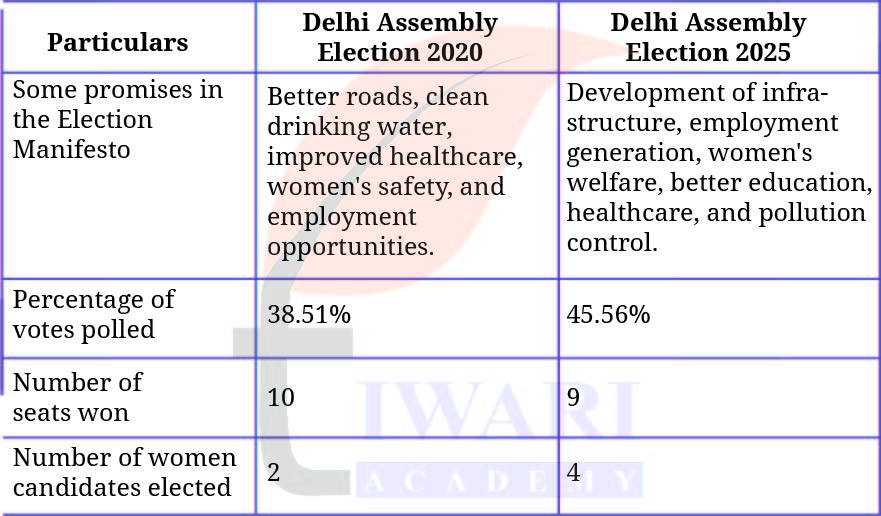
13. Select one national or state political party. Using authentic and reliable sources such as the Election Commision of India (ECI) website, the official website of the selected political party, and newspapers, Prepare a comparative chart of the last two State Legislative Assembly elections.
The chart should include the following details for the choosen party:
a. Some promises made in the Election manifesto
b. Percentage of votes poled
c. Number of seats won
d. Number of women who contested
e. Number of women candidates elected
Present the date for both elections in a clear and comparative format. citing all sources used.
Answer:
14. Do you think ‘One Nation, One Election’ can improve the efficiency of the electoral process Divide the class and discuss into two groups—one to examine its potential advantages and the other to analyse its limitations.
Answer:
Advantages of ‘One Nation, One Election’
- Reduces the cost of conducting elections.
- Saves time and administrative resources.
- Ensures smooth governance by reducing frequent election-related disruptions.
- Minimises the repeated enforcement of the Model Code of Conduct.
- Allows governments to focus more on development and policymaking.
Limitations of ‘One Nation, One Election’
- It may reduce the importance of state-specific and local issues.
- Conducting simultaneous elections across the country is logistically challenging.
- If a government falls before completing its term, fresh elections may create complications.
- It may require major constitutional and legal amendments.
- National issues may overshadow regional concerns during elections.
Conclusion:
‘One Nation, One Election’ has the potential to improve the efficiency of the electoral process by reducing costs and ensuring better governance. However, it also presents constitutional, administrative and political challenges. Therefore, its implementation requires careful planning and broad consensus among all stakeholders.
Revision Question for Practice in Exam Preparation
Class 9 Social Science Chapter 7 Very Short Answer Type Questions with Explanation.
Very Short Answer Type Questions
1. What is the FPTP electoral system?
See AnswerThe First-Past-The-Post system, where the candidate with the most votes in a constituency wins, even if it’s less than 50% of total votes.
2. When was the Election Commission of India established?
See AnswerThe ECI was established on 25 January 1950 as an autonomous permanent constitutional body.
3. What is Delimitation?
See AnswerThe process of determining the number of seats and fixing territorial boundaries in each state for elections to ensure equal representation.
4. Which Articles of the Constitution establish the ECI?
See AnswerArticles 324 to 329 provide for the establishment of the ECI and define its powers and duties.
5. What does ETPBS stand for?
See AnswerElectronically Transmitted Postal Ballot System, enabling service voters to cast votes electronically from outside their constituency.
6. What is the cVIGIL app used for?
See AnswerIt allows voters to report Model Code of Conduct violations and election misconduct within minutes of witnessing them.
7. When is National Voters’ Day celebrated?
See Answer25 January every year, marking the ECI’s foundation day.
8. What is defection?
See AnswerAbandoning or switching from the political party under whose banner a candidate was elected.
9. When was the Anti-Defection Law passed?
See AnswerIn 1985, through the 52nd Constitutional Amendment Act.
10. What is psephology?
See AnswerThe scientific study of elections, derived from the Greek words psēphos (pebble) and logy (systematic study).
11. Name the two Representation of the People Acts.
See AnswerThe Representation of the People Act, 1950 and the Representation of the People Act, 1951.
12. What is the Saksham App used for?
See AnswerIt helps ease voter identification and registration for Persons with Disabilities (PwDs), including finding polling stations.
13. What is a Registered Unrecognised Political Party (RUPP)?
See AnswerA party that has not secured enough votes for recognition or has never contested elections since registration.
14. When was “voting from home” for senior citizens first implemented nationwide?
See AnswerDuring the 2024 General Elections, for citizens above 85 years and PwDs with 40% benchmark disability.
15. How many Delimitation Commissions has India had?
See AnswerFour—in 1952, 1963, 1973 and 2002.
Class 9 Social Science Chapter 7 Short Answer Type Questions with Explanation.
Short Answer Type Questions
1. Differentiate between direct and indirect elections with examples.
See AnswerIn direct elections, citizens vote directly for representatives (e.g., Lok Sabha, Vidhan Sabha members); in indirect elections, elected representatives choose leaders on citizens’ behalf (e.g., President, Vice President, Rajya Sabha members).
2. How does the Single Transferable Vote system work?
See AnswerVoters mark preferences; candidates meeting the quota are declared elected; the lowest-scoring candidate is eliminated and their votes transfer to second preferences, continuing until all seats are filled.
3. What is the significance of Special Intensive Revision (SIR)?
See AnswerSIR updates, verifies and corrects electoral rolls, ensuring no eligible citizen—especially newly turned 18-year-olds—is left out, while deleting names of deceased, relocated or duplicate voters.
4. How does the ECI ensure political parties function democratically?
See AnswerThe ECI registers parties, insists on periodic organisational elections for inner-party democracy, classifies parties as national/state/RUPP and allots election symbols, acting as a quasi-judicial body for disputes.
5. What role do political parties play in a democracy?
See AnswerPolitical parties organise public opinion, campaign on specific issues, offer voters meaningful choices and enable informed decision-making, ensuring democracy functions through governance, accountability and representation.
6. Explain the Anti-Defection Law and its purpose.
See AnswerPassed in 1985 via the 52nd Amendment, it disqualifies MPs/MLAs who voluntarily give up party membership or vote against party whip, ensuring government stability and preventing political opportunism.
7. What criteria must a party fulfil for National Party recognition?
See AnswerA party must secure at least 6% valid votes in four states with four Lok Sabha seats OR win 2% of Lok Sabha seats from three states OR be recognised as a State Party in four states.
8. How has India’s electoral process become more inclusive?
See AnswerInitiatives like EVMs with Braille, home voting for senior citizens (85+) and PwDs, wheelchair access and apps like Saksham ensure infrastructure and technology-assisted inclusion for vulnerable groups.
9. What challenges does the ECI face in conducting elections?
See AnswerMisinformation, fake news and intimidation are major challenges; the ECI addresses these through RPA 1950/1951, Model Code of Conduct, EVMs, VVPAT and voter awareness campaigns.
10. Why is the Representation of the People Act, 1951 important?
See AnswerIt governs nomination of candidates, election campaigns, voting procedures, dispute resolution and lists electoral offences like bribery and appeals based on religion, caste or community.
Class 9 Social Science Chapter 7 Long Answer Type Questions with Explanation.
Long Answer Type Questions
1. Explain the different electoral systems used in India, citing examples.
See AnswerIndia uses the First-Past-The-Post (FPTP) system for Lok Sabha and Vidhan Sabha elections, where the candidate with the most votes wins. The Rajya Sabha, President and Vice President are elected through Proportional Representation via the Single Transferable Vote system, where voters rank preferences and candidates meeting a calculated quota are declared elected, with surplus/eliminated votes transferred based on second preferences, ensuring more balanced representation for indirect elections.
2. Describe the major functions of the Election Commission of India (ECI).
See AnswerThe ECI, established on 25 January 1950 under Articles 324-329, creates and revises electoral rolls through Special Intensive Revision (SIR), decides election schedules considering factors like weather and exams, registers political parties and allocates symbols and ensures free and fair elections through initiatives like EVMs, VVPAT and digital tools (Suvidha, ERONET, cVIGIL, Saksham) for candidates, officials and voters respectively.
3. How does the Delimitation Commission ensure equal political representation?
See AnswerThe Delimitation Commission, mandated under Article 82, determines the number of seats and fixes territorial boundaries for Lok Sabha and Vidhan Sabha constituencies based on population shifts. Without delimitation, representation would be unequal—one MP might represent five lakh people while another represents twenty-five lakh. India has had four such commissions (1952, 1963, 1973, 2002), ensuring the seat-to-population ratio remains as equal as possible across constituencies.
4. Discuss the role and classification of political parties in India’s multi-party system.
See AnswerIndia’s multi-party system reflects its diversity of languages, cultures and regions, with parties organising public opinion, contesting elections, and forming government or opposition. The ECI classifies parties as National Parties (meeting criteria like 6% votes in four states), State Parties (meeting state-specific vote/seat thresholds) or Registered Unrecognised Political Parties (RUPP). Parties must maintain inner-party democracy through periodic organisational elections and the Anti-Defection Law (1985) prevents elected members from switching parties, ensuring governmental stability.
5. What challenges threaten free and fair elections in India and how are they addressed?
See AnswerConducting elections for over 96.8 crore voters across diverse terrains presents challenges like misinformation, fake news and intimidation, which can weaken public confidence and reduce democratic value even when elections are technically held. The ECI addresses these through the Representation of the People Acts (1950, 1951), the Model Code of Conduct, EVMs with VVPAT for transparency, voter awareness campaigns, and inclusivity initiatives for PwDs, senior citizens and tribal groups, striving to keep the electoral process transparent, accountable and trustworthy despite these ongoing challenges.
Frequently Asked Questions
What topics are covered in Class 9 Political Science Chapter 7?
Chapter 7 covers direct and indirect elections, electoral systems (FPTP, Majority System, Proportional Representation), election laws, the Delimitation Commission, the Election Commission of India’s functions, political parties and challenges to free and fair elections.
Is Chapter 7 “Elections” important for Class 9 exams?
Yes, Chapter 7 covers key concepts like electoral systems, ECI functions and constitutional articles related to elections, which are frequently tested through short, long, case-study and comparative chart-based questions.
What are the important terms I should focus on in Class 9 Political Science Chapter 7?
Key terms in Chapter 7 include First-Past-The-Post (FPTP), Proportional Representation, Delimitation, Electoral Roll, Special Intensive Revision (SIR), defection and Model Code of Conduct—commonly tested in definition-based questions.
How should I prepare Class 9 Social Science Chapter 7 for exams?
For Chapter 7, Elections, focus on the functions of the ECI, differences between electoral systems, key election-related Acts and Articles (324-329, 82) and practice case-study and passage-based questions.
Does Class 9 Political Science Chapter 7 cover recent developments in Indian elections?
Yes, Chapter 7 includes updated information such as the 2024 General Elections data, home voting for senior citizens above 85 years, digital initiatives like cVIGIL and Saksham apps and the current status of political alliances (NDA, INC).