



by Tiwari Academy Team
Class 9 Social Science Chapter 4 Early Humans and Beginning of Civilisation NCERT Solutions – Question Answers and Extra Questions for 2026-27 Exam. Chapter 4 of Class 9 Social Science — Early Humans and Beginning of Civilisation – takes students on a journey through the earliest chapters of human history, long before writing was invented. The chapter explores how our ancestors evolved from Homo habilis to Homo sapiens, how they lived as hunter-gatherers and how they gradually shifted to agriculture during the Neolithic Revolution. It traces the development of tools across the Palaeolithic, Mesolithic, Neolithic, Chalcolithic, Bronze and Iron Ages. The chapter then examines four great Bronze Age civilisations – the Sindhu–Sarasvatī, Mesopotamian, Egyptian and Chinese – exploring their cities, writing systems, trade, social structures and lasting contributions to human culture.
Quick Links:
- Chapter’s Question Answers
- Exercises Question Answers
- Very Short Answer Type Questions
- Short Answer Type Questions
- Long Answer Type Questions
Download Class 9 Social Science App to study Class 9 Social Science Offline.
NCERT Class 9 Social Science Chapter 4 Solutions
Class 9 Social Science Chapter 4 Question Answer
Page 61 – The Big Questions
1. How did humans live on Earth before the beginning of civilisation?
Answer:
Before the beginning of civilisation, humans lived as hunter-gatherers. They hunted animals, collected fruits and plants, lived in caves or simple shelters and moved from one place to another in search of food and water.
2. How did humans communicate before writing was invented?
Answer:
Before writing was invented, humans communicated through speech, gestures, signs and cave paintings. They used pictures and symbols to express their ideas and share information.
3. How is archaeology helpful in understanding our past?
Answer:
Archaeology helps us understand our past by studying ancient tools, pottery, buildings, coins and bones. These remains provide information about the lifestyle, culture and activities of early humans.
4. How did early civilisations interact with each other?
Answer:
Early civilisations interacted with each other through trade, travel and the exchange of ideas, culture and technology. These interactions helped them grow and develop.
Page 62 – LET’S EXPLORE
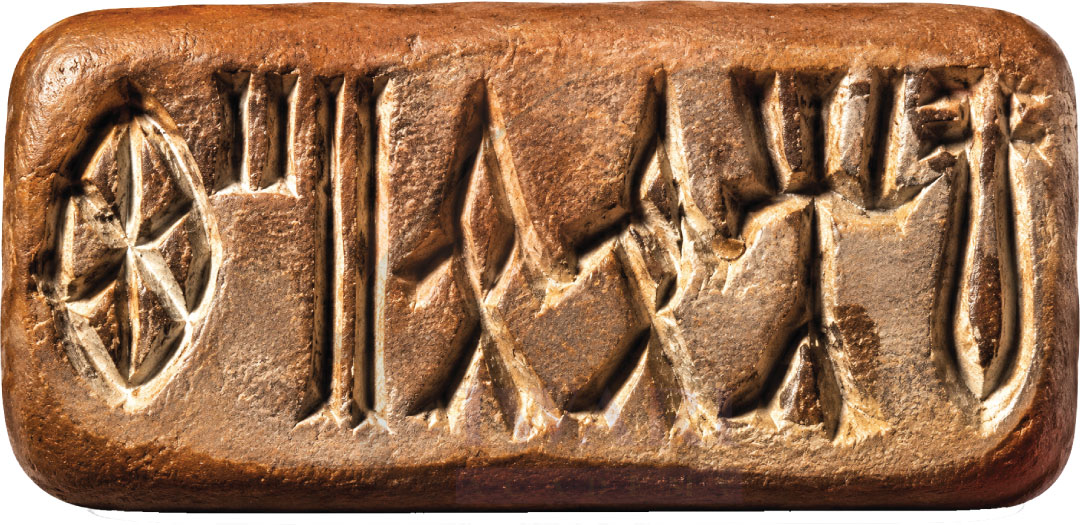
You have studied about the Harappan script in your previous grades. Observe this seal carefully and discuss why the script has not yet been deciphered. Also, find out what efforts have been made to decipher, it You can use your textbook, consult your teacher, or refer to online sources.
Answer:
The Harappan script has not been deciphered because:
- It is a pictographic script with no known bilingual inscription (like the Rosetta Stone for Egyptian) that could serve as a key.
- The language behind the script is unknown, so there is no reference language to compare it with.
- The inscriptions found are very short – mostly on seals – which gives very little text to analyse patterns.
- There is no continuous tradition linking it to any known later script.
Efforts made to decipher it:
Scholars from India and around the world have used computer analysis, pattern recognition and comparison with other ancient scripts like Proto-Dravidian languages. Some researchers like Asko Parpola have proposed it may be related to a Dravidian language, but no conclusion has been universally accepted yet.
Page 65 – THINK ABOUT IT
Why do you think early humans left Africa to migrate to other regions?
Answer:
Early humans likely left Africa due to several reasons:
- Search for food: As populations grew, food and resources in one area became scarce, pushing groups to explore new territories.
- Climate change: Shifts in climate altered vegetation and animal availability, forcing migration.
- Curiosity and exploration: Human beings are naturally inclined to explore new environments.
- Following prey: Hunter-gatherers may have followed animal herds that moved out of Africa naturally.
Page 66 – LET’S EXPLORE
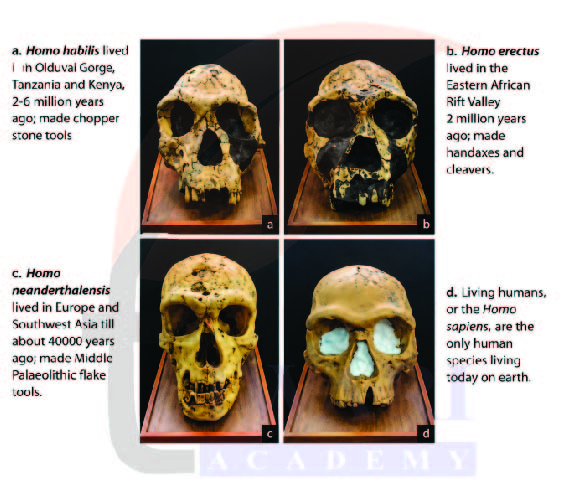
Let us observe the images given above and answer the following questions.
→ Do you notice any changes in the shape or features of the skulls across different ancestors?
→ Can you observe a gradual straightening of the face
Answer:
Changes in skull shape:
- From Homo habilis to Homo sapiens, the skull becomes progressively rounder and larger, indicating growth in brain size.
- The forehead becomes more vertical and prominent.
- The brow ridges (bone above the eyes) become less prominent.
- The jaw and face become smaller and less protruding.
Gradual straightening of the face:
Yes – Homo habilis had a very forward-jutting face (prognathism). By Homo neanderthalensis, the face is slightly straighter. In Homo sapiens, the face is nearly flat and vertical. This reflects both dietary changes (less need for powerful jaws) and increased cognitive development.
Page 67 – THINK ABOUT IT
Why do you think the shift to farming during the Neolithic period is called a revolution rather than a simple change? Discuss with your classmates.
Answer:
The shift to farming during the Neolithic period is called a revolution rather than a simple change because:
- It was a fundamental transformation in every aspect of human life – food, settlement, society and economy.
- It happened relatively quickly in historical terms after millions of years of hunting-gathering.
- It led to permanent settlements, surplus food production, population growth, division of labour and eventually the rise of civilisations – a chain of enormous consequences.
- Just like the Industrial Revolution changed modern society completely, the Neolithic Revolution changed ancient society at its root.
Page 71 – THINK ABOUT IT
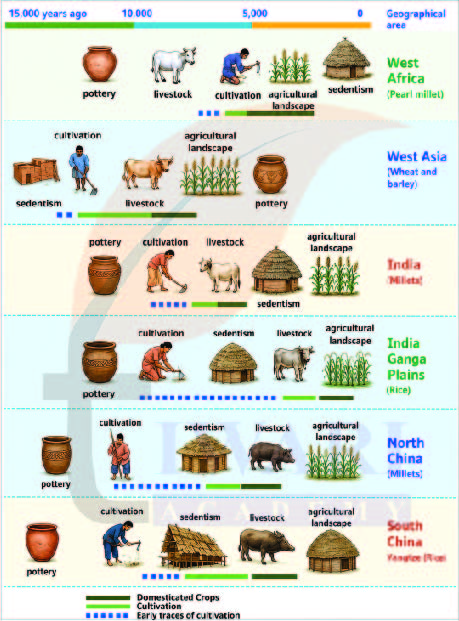
Observe the chart (Fig. 4.14) and identify the animals that were domesticated. Also try and identify the types of human habitats and objects that were used. Are any of these still used in present times?
Answer:
Animals domesticated: Cattle (zebu/humped bull), sheep, goats and pigs (visible in chart across regions).
Types of habitats and objects:
- Habitats: Round huts, thatched shelters, early village structures.
- Objects: Pottery vessels, ploughs, grinding stones, storage pots.
Yes – cattle, sheep and goats are still domesticated today. Pottery is still used, especially in rural India. The Rabi and Kharif cropping system (double crop cultivation) mentioned in the chapter continues to this day in India.
Page 76 – THINK ABOUT IT
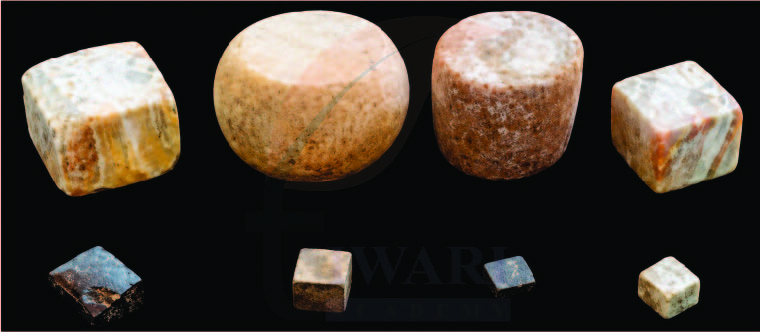
Harappans had their own standard systems of weight and measurement. This is evident from the meticulously planned settlements and efficient interregional trade practices of the Harappans. They followed a binary multiple (1,2, 4, 8, 16, etc.) system for weighting smaller units and used multiples of ten for larger denominations. Such cubical stone weights have been reported from several sites. Can you imagine how long distance trade would have been affected had the Harappans not followed a standard system of weights?
Answer:
If the Harappans had not followed a standard system of weights, long-distance trade would have been severely disrupted. There would be no common basis for measuring goods being exchanged. Traders from different regions would distrust each other, leading to disputes and breakdown of commerce. The efficiency and scale of Harappan trade with Mesopotamia and other regions would have been impossible without standardised weights.
Page 77 – THINK ABOUT IT
Why were the rivers important in the growth of early civilisation?
Answer:
Rivers were crucial because:
- They provided fresh water for drinking and irrigation.
- The annual flooding deposited fertile silt on the plains, making agriculture highly productive.
- They served as trade and transport routes connecting different settlements.
- The need to manage river water (build canals, dams) encouraged collective organisation and eventually led to the formation of governments and administrative systems.
- Dense populations could be sustained near rivers, which encouraged specialisation of labour and the growth of cities.
Page 79 – LET’S EXPLORE
Can you find out which countries constitute West Asia in present times?
Answer:
Countries that constitute West Asia today include: Iraq, Kuwait, Saudi Arabia, Iran, Turkey (partially), Syria, Jordan, Israel, Palestine, Lebanon, Yemen, Oman, UAE, Bahrain and Qatar.
Page 80 – LET’S EXPLORE
Do you find any similarities between the temple in India an those of the Sumerian civilisation as centres of socio-cultural and economical activity?
Answer:
Yes, there are interesting similarities:
- Both temples were centres of social, cultural and economic life in their communities.
- In India, temples historically controlled land, managed granaries and were hubs of trade and charity – similar to Sumerian ziggurats which controlled all economic activity.
- Both had restricted access to the holiest inner areas (only priests/priestesses in Sumer; similarly the garbhagriha in Hindu temples is restricted).
- Both served as community gathering points for festivals and rituals.
- Both were architecturally grand and built at the centre of settlements.
Page 82 – LET’S EXPLORE
The Epic of Gilgamesh, written during the Mesopotamian civilisation, is one of the earliest stories written. Try and find out more such stories and share them in class.
Answer:
Besides the Epic of Gilgamesh, several other ancient stories have been found from early civilisations:
- Enuma Elish (Babylon, ~1700 BCE) – A creation myth describing how the god Marduk created the world.
- The Story of Sinuhe (Egypt, ~1900 BCE) – An Egyptian official flees his country, lives among foreigners, but longs to return home. It deals with themes of exile and identity.
- Descent of Inanna (Sumer, ~2000 BCE) – The goddess Inanna travels to the underworld, exploring themes of death and rebirth.
- Hymn to the Nile (Egypt) – A poem praising the River Nile as a life-giving divine force.
- Nasadiya Sukta / Rigveda hymns (India, ~1500 BCE) – Among the oldest literary compositions from India, containing creation hymns and stories of gods.
These stories show that people across different civilisations shared the same deep questions about creation, death, gods and human life.
Page 85 – THINK ABOUT IT
Why do you think there is a scale with a heart on one side and a feather on the other (fig. 4.29)? What can this papyrus tell us about early Egyptian beliefs?
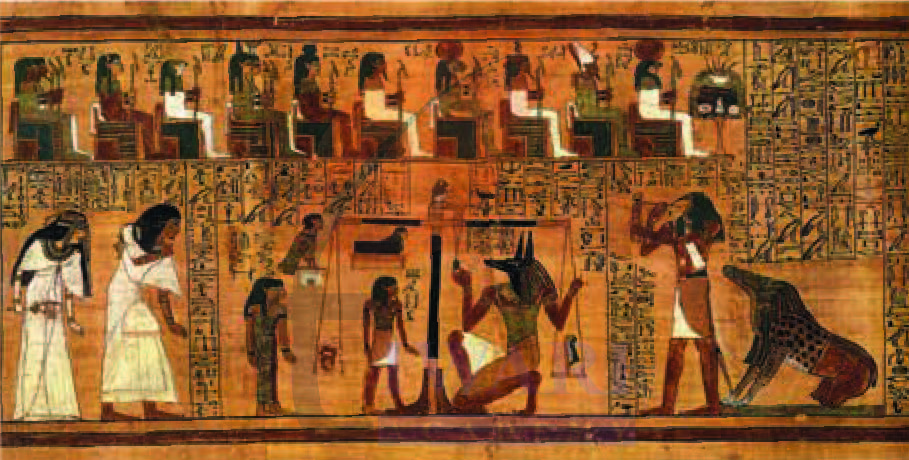
Answer:
The scale with a heart on one side and a feather on the other represents the Egyptian belief in the afterlife judgment. According to Egyptian belief, after death, the heart of the deceased was weighed against the feather of Ma’at (the goddess of truth and justice). If the heart was light (pure and good), the person entered the afterlife. If it was heavy with sin, it was devoured by the monster Ammit.
This papyrus tells us that:
- Egyptians had a strong belief in life after death.
- They believed in moral accountability – good deeds mattered.
- Religion deeply influenced their daily life and funerary practices.
- They had a complex belief system with multiple gods and a detailed concept of the soul.
Page 87 – LET’S EXPLORE
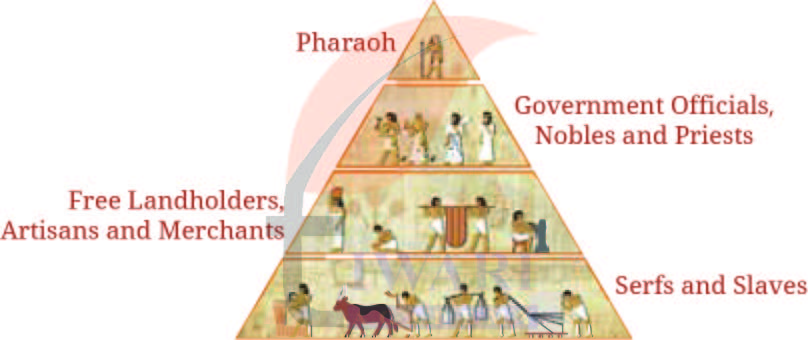
Look at the social hierarchy pyramid in the image. What were the social classes of early Egypt? What were the different kinds of occupations? What could have been a typical daily routine of the people from each class?
Answer:
The social classes of early Egypt were arranged in the form of a pyramid:
- Pharaoh – The ruler of Egypt and considered a divine king.
- Government Officials, Nobles and Priests – They helped govern the kingdom, collected taxes, managed administration and performed religious ceremonies.
- Free Landholders, Artisans and Merchants – Farmers owned land, artisans made goods such as pottery, jewellery, and tools, while merchants traded goods within and outside Egypt.
- Serfs and Slaves – They formed the largest group and worked in agriculture, construction and domestic service.
Different kinds of occupations:
- Pharaoh: Ruled the kingdom and made important decisions.
- Officials and Nobles: Managed administration and collected taxes.
- Priests: Conducted religious rituals and took care of temples.
- Landholders/Farmers: Cultivated crops and produced food.
- Artisans: Made pottery, jewellery, furniture, tools and clothes.
- Merchants: Bought and sold goods through trade.
- Serfs and Slaves: Worked on farms, built monuments and served wealthy families.
Typical daily routine:
- Pharaoh: Ruled the kingdom and made important decisions.
- Officials, Nobles and Priests: Managed government work and performed religious duties.
- Farmers, Artisans and Merchants: Farmed, made goods and traded in markets.
- Serfs and Slaves: Worked in fields, buildings and households.
Page 88 – THINK ABOUT IT
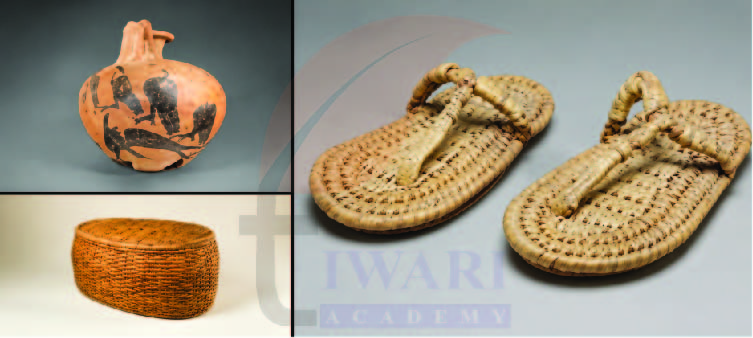
Observe the images given above. What do they tell you about Egyptian fashion?
- Which social classes do you think used these items?
- What clues in the images help you to make this guess?
Try to explain your reasoning based in the materials, designs or accessories shown in the pictures.
Answer:
The pictures show that ancient Egyptians used simple but useful daily items such as sandals, pottery and baskets. Their fashion was practical and suited to the hot climate.
Social classes used these items are:
- Farmers, artisans and merchants probably used the sandals, baskets and pottery in their daily lives.
- Nobles and wealthy people may have used similar items, but made with finer materials and better designs.
Clues that help to make this guess are:
- The sandals are made of woven material, showing they were simple and comfortable.
- The basket is useful for carrying goods, which suggests everyday use.
- The pottery was used for storing water, food or other household items.
These items are made from natural materials like reeds and clay. They are simple, practical and suitable for daily use, showing that Egyptians valued both usefulness and craftsmanship.
Page 90 – LET’S EXPLORE
The Chinese script is logographic, with characters representing entire words or morphemes (smallest meaningful units of language), rather than sounds. Person 🚶→人 Tree 🌳→木
Explore more examples of Chinese characters that resemble the objects or ideas they represent. Note down at least two such characters and explain how their shapes are connected to their meanings.
Answer:
The Chinese script is logographic, meaning each character represents a word or meaning, not a sound.
Examples:
- 人 (Rén) = Person – the character looks like a person standing with two legs spread apart.
- 木 (Mù) = Tree – the character shows a trunk with branches above and roots below.
- 山 (Shān) = Mountain – three peaks side by side, resembling mountain tops.
- 日 (Rì) = Sun – originally a circle with a dot in the centre, representing the sun.
These characters show how early Chinese writing directly depicted the physical world around people.
Page 92 – THINK ABOUT IT
What could have been the other reasons for building the Great Wall of China? Explore and share your findings on the Great Wall through a model or presentation.
Answer:
Beyond protection from nomadic raids, the Great Wall served other purposes:
- Border control: Regulated the movement of people and goods – essentially acting as a customs checkpoint.
- Communication: Watchtowers along the wall allowed soldiers to send smoke or fire signals across long distances quickly.
- Symbol of power: It projected the strength and authority of the Chinese emperor and state.
- Economic control: Helped control the Silk Route trade passing through the region.
- Military surveillance: Allowed early detection of enemy movements.
Class 9 Social Science Chapter 4 Exercises Question Answer
Page 93 – Question and activities
1. Do you think life became easier or more challenging after humans started farming? Give two reasons for your answer.
Answer:
Life became both easier and more challenging in different ways.
Easier:
- Farming provided a stable and predictable food supply, unlike hunting which depended on luck and availability of animals. People no longer needed to move constantly in search of food.
- Surplus food allowed people to store grain for lean seasons, reducing the risk of starvation.
More challenging:
- Farmers had to work longer and harder hours – ploughing, planting, weeding, harvesting – compared to the relatively flexible lifestyle of hunter-gatherers.
- Settled life brought new diseases (due to living close to animals and in larger groups) and dependence on a few crops meant that crop failure could cause famine.
2. The environment offers human societies both opportunities as well as challenges. Explain with reference to early farming communities and river-valley civilisations.
Answer:
Opportunities:
- Fertile river plains (like the Indus, Nile, Euphrates and Huang He) provided rich soil, water for irrigation and abundant crops – making it possible to feed large populations.
- Rivers served as trade routes, connecting distant communities and enabling exchange of goods and ideas.
- Forests and grasslands provided timber, animals for domestication and raw materials.
Challenges:
- Rivers flooded unpredictably, destroying crops and settlements.
- Managing water for irrigation required collective organisation and labour.
- Droughts and famines threatened communities dependent on a single river system.
- The need to defend fertile land from rival groups led to conflicts and wars.
So the environment shaped human societies – those who successfully managed its challenges built great civilisations.
3. Why do historians divide early human history into different ages such as Stone Age, Bronze Age, and Iron Age? What does this classification tell us about human progress?
Answer:
Historians divide early human history into different ages (Stone Age, Bronze Age, Iron Age) to organise the enormous span of human history into understandable periods, each defined by a major technological advancement.
What this classification tells us:
- It shows that human progress was gradual and cumulative – each age built upon the previous one.
- It highlights that technology drove social change – better tools meant better agriculture, more food, larger populations and more complex societies.
- It reveals that progress was uneven across regions – different parts of the world entered each age at different times.
- It reflects humanity’s growing ability to use natural resources – from stone to copper to bronze to iron, each material offered greater strength, versatility and efficiency.
4. Imagine you are a Neolithic farmer. Describe one day of your life. What challenges would you face that a hunter-gatherer would not?
Answer:
I wake up before sunrise in my small mud-brick house at the edge of the village. Today I must plough the eastern field before the rains come. I take my polished stone hoe and head out. My wife tends to the goats and collects milk, while my children carry water from the nearby stream. By midday, I am exhausted – the soil is hard. In the afternoon, I inspect the wheat stored in the granary for signs of rats or rot. Toward evening, the village headman calls a meeting – a neighbouring group has been eyeing our fields. We must decide whether to build a stronger boundary wall.
Challenges a hunter-gatherer would not face:
- Crop failure: A hunter-gatherer simply moved elsewhere if food was scarce. I cannot – I depend entirely on my crops.
- Property and defence: I must defend my land, crops and animals from rivals.
- Hard physical labour: Farming is backbreaking work daily, unlike the varied lifestyle of a hunter-gatherer.
- Disease: Living with animals and in a dense settlement meant more exposure to infections.
- Social conflict: Living in permanent settlements with others led to disputes over land, water and resources.
5. Imagine that the Harappan script gets deciphered tomorrow. What new types of information do you think historians might learn?
Answer:
If the Harappan script were deciphered, historians could potentially learn:
- The names of rulers, kings or governing authorities – we currently don’t know if the Harappans had kings or a different form of governance.
- The religion and mythology of the Harappans – their gods, rituals and beliefs.
- Trade records – what goods were traded, with whom and at what prices.
- The language spoken by the Harappans, which could help trace their ethnic and cultural origins.
- Laws and social customs – how disputes were resolved, what rules governed society.
- Personal names and literature – giving individuals from this civilisation a human identity for the first time.
6. Prepare a table with three columns—Palaeolithic, Mesolithic, and Neolithic — and fill in their distinctive features: tools, settlements, art and subsistence.
Answer:
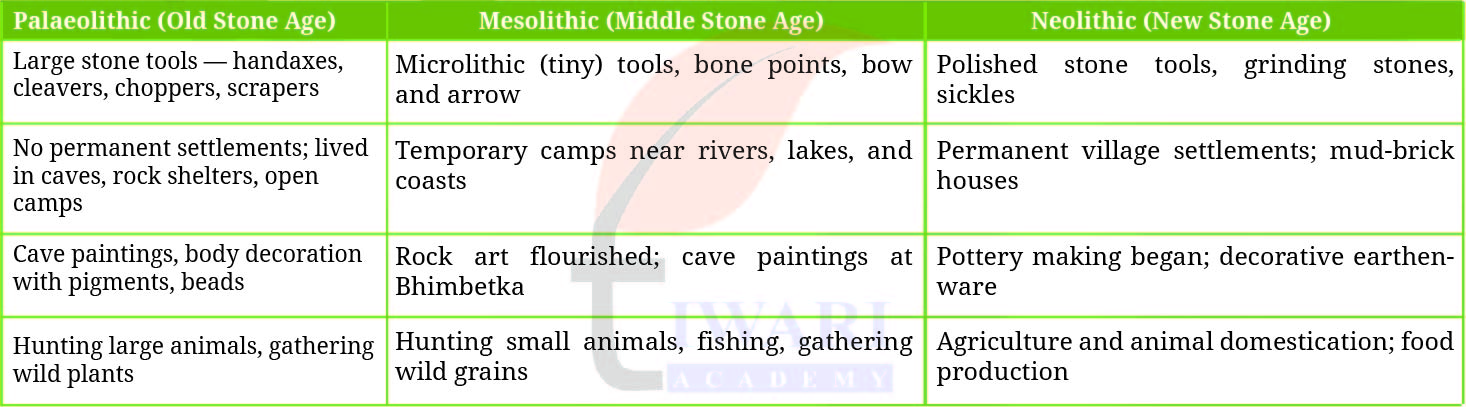
7. “Bronze Age civilisations develop independently but shared common features. ” Examines this statement with reference to the civilisations given in the chapter.
Answer:
This statement is largely true. The four major Bronze Age civilisations – Harappan, Mesopotamian, Egyptian and Chinese – developed in different parts of the world without direct contact with each other (except Harappan-Mesopotamian trade), yet they shared striking common features:
Independent development: Each arose in its own river valley, developed its own writing system, its own art styles, and its own religious traditions without copying from the others.
Common features:
- All emerged in fertile river plains – they all depended on river agriculture.
- All developed writing systems – cuneiform, hieroglyphics, Harappan script, Chinese oracle script.
- All built urban centres with planned streets, drainage and public buildings.
- All had social hierarchies – rulers/pharaohs/kings at the top, priests, merchants and labourers below.
- All developed standardised weights and measures for trade.
- All had religious institutions (ziggurats, temples, pyramids) at the centre of civic life.
This shows that when similar environmental conditions and challenges exist, human societies independently arrive at similar solutions.
8. Although rivers provided many benefits, they also created challenges for early societies. Discuss both the advantages and disadvantages of settling near rivers.
Answer:
Advantages:
- Fertile soil due to annual flooding and silt deposition – ideal for agriculture.
- Constant supply of fresh water for drinking, cooking and irrigation.
- Rivers served as transport and trade routes, promoting economic growth.
- Fish and aquatic resources supplemented the food supply.
- Dense vegetation along river banks provided building materials and fuel.
Disadvantages:
- Flooding could destroy crops, homes, and lives unpredictably.
- Waterborne diseases (like cholera) spread easily in dense river settlements.
- Droughts could reduce river flow, causing crop failure and famine.
- Fertile land attracted rival groups, leading to warfare and conflict.
- Building dams and canals required enormous collective labour and organisation.
9. With the help of your teacher, find out more about the Code of Hammurabi. Why was it is important? Do you think it was fair to all sections of society? Give reasons for your answer.
Answer:
The Code of Hammurabi was one of the world’s earliest written legal codes, compiled by King Hammurabi of Babylonia around 1754 BCE. It contained 282 laws carved on a tall stone stele, covering areas like trade, property, marriage, family and crime.
Why it was important:
- It established the principle that law applies to everyone in a kingdom.
- It created predictability and order in society – people knew what punishment to expect for what act.
- It served as a model for future legal systems across the world.
- It is one of the earliest examples of a ruler taking responsibility for justice and social welfare.
Not entirely. The Code followed a class-based system of justice – punishments differed depending on whether the victim or offender was a free person, a commoner or a slave. For example, injuring a nobleman carried a harsher penalty than injuring a slave. Women and slaves had far fewer rights than free men. So while it was a remarkable achievement for its time, by modern standards it was not equal or fair to all sections of society.
10. If you had to choose one major innovation from early civilisations that changed the world permanently, what would it be and why?
Answer:
The single most transformative innovation would be the invention of writing.
Writing changed the world permanently because:
• It allowed human knowledge, laws, stories and discoveries to be recorded and passed on across generations without depending on memory alone.
• It made complex administration of large states and empires possible.
• It enabled trade records and contracts, fuelling economic growth.
• It gave birth to literature, science, mathematics and philosophy – the entire intellectual heritage of humanity.
• Without writing, every generation would have to rediscover knowledge lost with the deaths of elders.
Every other great achievement of civilisation – from mathematics to medicine to history itself – was preserved and built upon because of writing.
11. Compare the social hierarchy an daily life of people in the Egyptian civilisation with those in Mesopotamia or China. What similarities and differences do you notice?
Answer:
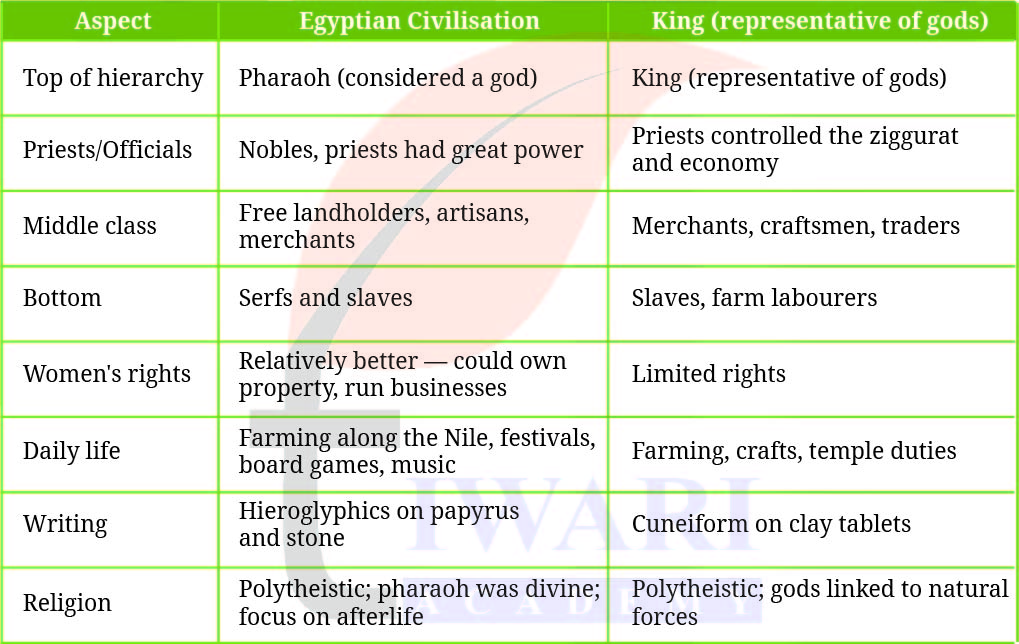
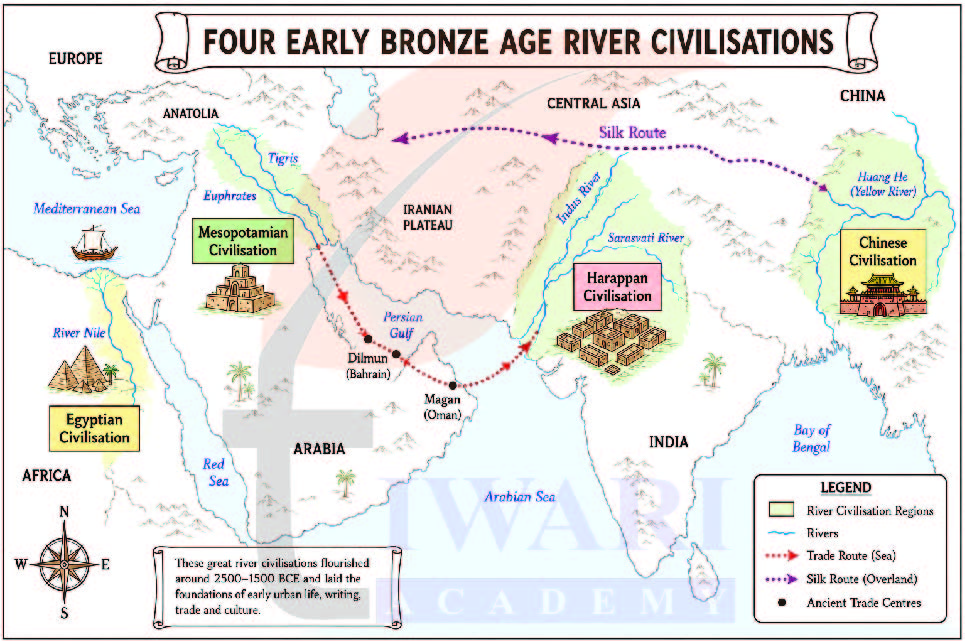
12. Activity: Using maps, locate the major rivers and civilisations of Mesopotamia, Egypt, China and the Sindhu-Sarasvati Valley. Mark the trade link between them.
Answer:
Locating and labeling the following on a world map:
Rivers & Civilisations:
- River Indus & Sarasvati → Harappan/Sindhu-Sarasvati Civilisation (present-day Pakistan & northwest India)
- River Euphrates & Tigris → Mesopotamian Civilisation (present-day Iraq)
- River Nile → Egyptian Civilisation (present-day Egypt)
- River Huang He (Yellow River) → Chinese Civilisation (present-day China)
Trade Links to mark:
- Harappan ↔ Mesopotamia – through Persian Gulf via Dilmun (Bahrain) and Magan (Oman). Goods traded: semi-precious stone beads, ivory, timber, gold dust, copper.
- Mesopotamia had trade links with Egypt through the Fertile Crescent region.
- China’s trade route (Silk Route) connected it to Central Asia and eventually to India and the West.
- Egypt and China had little to no direct contact with the Harappan civilisation.
13. Activity: Choose one early civilisation (Mesopotamia, Egypt, or China) and prepare a mini-scrapbook or a presentation showing their innovations in tools, writing, art and architecture. Include pictures, brief descriptions, and explain their significance.
Answer:
Mesopotamia, meaning “land between two rivers,” was one of the world’s earliest civilisations. It flourished between the Euphrates and Tigris rivers in present-day Iraq around 3500 BCE.
Tools & Technology:
• Sumerians invented the plough for farming and the wheeled cart for transport
• They built irrigation canals and dams to water their fields
• Bronze was used to make stronger weapons and tools
• They invented the sailboat for river trade
Writing — Cuneiform:
• World’s first writing system developed around 3300 BCE
• Wedge-shaped marks pressed onto clay tablets using a reed stylus
• Used for trade records, laws, myths and literature
• Famous texts: Epic of Gilgamesh, Code of Hammurabi
Art & Architecture:
• Ziggurats — massive stepped pyramid-shaped temples built at the centre of every city
• Decorated boxes and stone carvings showing daily life scenes
• Stone stelae with carved reliefs (Hammurabi’s law stele)
Administration & Law:
• Code of Hammurabi — one of world’s earliest written legal codes with 282 laws
• City-state system of governance
• Standard weights and measures used for fair trade
Mathematics & Science:
• Number system based on 60
• Invented the 60-minute hour, 60-second minute and 360-degree circle — still used today
• Used geometry for construction and measuring fields
Significance: Mesopotamia gave the world its first cities, first written laws, first literature and mathematical concepts we still use daily. It truly deserves to be called the “Cradle of Civilisation.”
Extra Questions for Exam Preparation
Class 9 Social Science Chapter 4 Very Short Answer Type Questions with Explanation.
Very Short Answer Type Questions
1. What is biological evolution?
See AnswerBiological evolution refers to the gradual physical and genetic changes through which early ancestors, known as australopithecines, evolved into modern humans called Homo sapiens.
2. Who was Homo habilis?
See AnswerHomo habilis, meaning ‘handy man’, lived in Africa, especially in the Olduvai Gorge in Tanzania and Kenya. They made chopper stone tools and lived 2–6 million years ago.
3. What was the first hominin to exit Africa?
See AnswerHomo erectus was the first hominin to exit Africa. Using stone tools like handaxes and cleavers, they spread into Europe and Asia between 2 and 0.5 million years ago.
4. What is a fossil?
See AnswerA fossil is the preserved remains, traces, or impressions of plants, animals, or humans from the distant past, formed when remains get buried under layers of earth and slowly turn to stone.
5. What does the word ‘Palaeolithic’ mean?
See AnswerThe word Palaeolithic comes from palaeo meaning ‘old’ and lithic meaning ‘stone’. It is also known as the Old Stone Age, when humans were hunter-gatherers using simple stone tools.
6. What is the Neolithic Revolution?
See AnswerThe Neolithic Revolution refers to the gradual shift from hunting-gathering to food production, involving the domestication of animals and plants, development of pottery and establishment of the first village settlements.
7. What is Mehrgarh and why is it significant?
See AnswerMehrgarh, on the Bolan River in present-day Pakistan, is the oldest Neolithic site in the Indian subcontinent, dating to about 7000 BCE. It is the earliest known agricultural village in the region.
8. What is the Harappan script also known as?
See AnswerThe Harappan script is also referred to as Sindhu lipi. Found on seals and pottery, it was a pictographic script that has not yet been deciphered by scholars.
9. What does the word ‘Mesopotamia’ mean?
See AnswerMesopotamia is a Greek word meaning ‘land in between’, referring to the land drained by the Euphrates and Tigris rivers in West Asia. This region includes modern-day Iraq and Kuwait.
10. What was cuneiform?
See AnswerCuneiform was the writing system developed by the Sumerians, created by pressing a wedge-shaped stylus into soft clay tablets. It is one of the earliest writing systems in the world.
11. What was the Code of Hammurabi?
See AnswerThe Code of Hammurabi was a compilation of rules and regulations for civil and social conduct created by the Babylonian king Hammurabi. It served as a foundational model for many future legal systems.
12. What was papyrus?
See AnswerPapyrus was an early form of paper made by cutting the inner trunk of the papyrus plant into strips, criss-crossing, pressing, drying and polishing them into sheets. It was widely used in ancient Egypt.
13. Who were the Pharaohs?
See AnswerPharaohs were powerful rulers of ancient Egypt. After their death, they were buried in elaborate structures. Mastabas were placed over burial chambers, which eventually evolved into pyramids.
14. What is mummification?
See AnswerMummification was the Egyptian process of preserving a dead body by removing internal organs, drying the body with natron, oiling it, wrapping it in linen strips and burying it with rituals.
15. What was the Silk Route?
See AnswerThe Silk Route was the ancient trade network along which silk from China was traded. During the Han dynasty (2nd century BCE), silk became such a major trade item that the entire route was named after it.
Class 9 Social Science Chapter 4 Short Answer Type Questions with Explanation.
Short Answer Type Questions
1. How do archaeologists know about early human history?
See AnswerArchaeologists explore early human sites to uncover tools, bones and other objects left behind by our ancestors. These artefacts and fossils help them reconstruct how people lived. They also experiment by making and using similar tools to understand how early humans created and depended on them.
2. What were the key features of Palaeolithic hunter-gatherers in India?
See AnswerIn the Indian subcontinent, the oldest human settlements date to about 2 million years ago. At sites like Attirampakkam in Tamil Nadu and Isampur in Karnataka, large stone cutting tools including handaxes, cleavers, choppers and scrapers made of quartzite and limestone have been found, used to cut meat and extract marrow.
3. How did the Mesolithic period differ from the Palaeolithic?
See AnswerAround 12000 years ago, Earth’s climate became warmer, leading to environmental changes. New landscapes offered wider food resources. Mesolithic humans used microlithic (tiny stone) tools, fished, gathered aquatic food and began occupying caves and rock shelters. Art flourished and Bhimbetka in Madhya Pradesh is a famous Mesolithic site.
4. What were the major contributions of the Sumerians to civilisation?
See AnswerThe Sumerians were the earliest city-based civilisation. They invented the cuneiform writing system, built the first dams and canals for irrigation, used mud and burnt bricks for construction, invented the wheeled cart and sailboat and developed a number system based on 60, giving us the 60-minute hour and 360-degree circle.
5. Why were all four major early civilisations located near rivers?
See AnswerRivers provided fertile alluvial soil for agriculture, water for drinking and irrigation and routes for trade and transport. The annual flooding of rivers like the Nile enriched farmland with nutrients. Rivers also supported dense populations and surplus food production, which were essential conditions for the growth of cities and civilisations.
6. Describe the main features of the Egyptian social hierarchy.
See AnswerEgyptian society was hierarchically organised. At the top was the Pharaoh, followed by government officials, nobles and priests. Below them were free landholders, artisans and merchants. At the bottom were serfs and slaves. Economic and religious activities were tightly controlled by the ruling class and social mobility was limited.
7. What was the significance of the Neolithic period in the Indian subcontinent?
See AnswerBy 2500 BCE, most of the Indian subcontinent was occupied by Neolithic agricultural communities. Cattle, sheep and goat herding, along with cultivation of cereals, millets and pulses, characterised their way of life. Mehrgarh, dating to 7000 BCE, was the earliest agricultural village and also the first site where copper objects were made.
8. How did the Chinese civilisation develop and what were its major dynasties?
See AnswerThe Chinese civilisation flourished along the Huang He and Yangtze rivers. Urban centres emerged around 1600 BCE. Major Bronze Age dynasties were the Shang (1600–1046 BCE) and Zhou (1046–256 BCE). The Qin dynasty (221–206 BCE) was the first imperial dynasty to unify China. The Han dynasty further expanded trade through the Silk Route.
9. How did the Sindhu–Sarasvatī civilisation interact with Mesopotamia?
See AnswerThe Sindhu–Sarasvatī civilisation, referred to as Meluhha in Mesopotamian records, traded with Mesopotamian city-states. Akkadian king Sargon’s tablets mention trade with Meluhha, Dilmun (Bahrain) and Magan (Oman). The Harappans traded semi-precious stone beads, ivory, timber, gold dust and probably copper with Mesopotamian merchants.
10. What is the importance of the Rosetta Stone in understanding Egyptian civilisation?
See AnswerThe Rosetta Stone, found by French engineer Pierre Bouchard in 1799, had the same text written in three scripts, including Greek. Since Greek could be read, it provided a key to understanding the Egyptian hieroglyphic script. French linguist Jean-François Champollion finally deciphered it in 1822, opening up the study of Egyptian history.
Class 9 Social Science Chapter 4 Long Answer Type Questions with Explanation.
Long Answer Type Questions
1. Trace the evolution of early humans from Homo habilis to Homo sapiens and explain how they spread across the world.
The story of human evolution spans millions of years and begins in Africa. The earliest identified human ancestor relevant to this chapter is Homo habilis, or ‘handy man’, who lived 2–6 million years ago in the Olduvai Gorge in Tanzania and Kenya. They made the earliest stone tools – chopper tools – marking the beginning of what scholars call ‘human behaviour’.
Their successors, Homo erectus, lived about 2 million years ago in the Eastern African Rift Valley. They invented handaxes and cleavers and were the first hominins to exit Africa, gradually spreading into Europe and Asia. Evidence of their tools has been found across India, at sites like Attirampakkam in Tamil Nadu (1.5–1.7 million years ago) and Isampur in Karnataka (1.2 million years ago).
Another early human ancestor, Homo neanderthalensis, lived in Europe and Southwest Asia until about 40,000 years ago, making Middle Palaeolithic flake tools. Finally, Homo sapiens – modern humans like us – evolved in Africa around 300,000 years ago. They developed complex technologies, symbolic communication, cave paintings, beads and blade tools. They gradually spread across the entire world, reaching Australia and the Americas between 50,000 and 12,000 years ago. Today, Homo sapiens is the only surviving human species.
Describe the different prehistoric periods of early human history and how each period marked progress in human development.
Early human history is divided into distinct periods based on technological progress, changes in lifestyle and settlement patterns.
The Palaeolithic or Old Stone Age was the longest period, spanning from about 3 million years ago to around 12,000 years ago. Humans were hunter-gatherers, using simple stone tools like handaxes, cleavers, choppers and scrapers. They lived in caves or open camps and had no permanent settlements.
The Mesolithic period began around 12,000 years ago when the climate became warmer. Forests and grasslands expanded and new food sources became available. Humans used tiny microlithic tools, fished, gathered aquatic food and lived near rivers and lakes. Art flourished and cave paintings, like those at Bhimbetka in Madhya Pradesh, are a remarkable legacy of this period.
The Neolithic or New Stone Age marked the most transformative shift – the domestication of animals and plants and the transition to food production. Humans made polished stone tools, developed earthenware pottery, established the first village settlements and began weaving. This is called the Neolithic Revolution.
The Chalcolithic period saw the introduction of copper tools alongside stone tools. Then came the Bronze Age, when copper and tin were mixed to make bronze, enabling the development of stronger tools, expansion of trade, growth of towns and emergence of early civilisations. Finally, the Iron Age brought widespread iron metallurgy, stronger weapons and more advanced societies. Each period built upon the previous one, steadily advancing human capability and social organisation.
Describe the Sindhu–Sarasvatī civilisation, tracing its origins from the Neolithic period to the Bronze Age.
The Sindhu–Sarasvatī civilisation, also known as the Indus Valley or Harappan Civilisation, has deep roots in the Neolithic period. Its origins can be traced to Mehrgarh on the Bolan River in present-day Pakistan, the oldest Neolithic site in the Indian subcontinent, dating to about 7000 BCE. The people of Mehrgarh built sun-dried brick houses, cultivated wheat and barley, raised zebu cattle, sheep and goats, and made ornaments from semi-precious stones. They were also the first to make copper objects, entering the metal age and becoming the Chalcolithic people by about 4000 BCE.
This laid the foundation for the Bronze Age Sindhu–Sarasvatī civilisation around 3500 BCE. The introduction of copper tools in the fertile alluvial plains of the Indus and Ghaggar-Sarasvatī basins increased agricultural productivity. This was also a period of large-scale pottery production showing diverse regional styles.
Radio-carbon dating suggests that at some Sarasvatī belt sites like Bhirrana and Kunal, the Pre-Harappan phase began between 7000 and 5500 BCE. By about 2500 BCE, these regional styles unified into the standard features of the mature Sindhu–Sarasvatī civilisation – well-planned cities, standard weights and measures, a pictographic script, inscribed seals, stone bead production, copper work and shell work. Harappan water management skills, such as the elaborate system at Dholavira and the dockyard at Lothal, are particularly impressive. The Harappans also had a sophisticated weight system following a binary multiple pattern, which enabled efficient long-distance trade.
4. Compare the Mesopotamian and Egyptian civilisations, discussing their geography, writing, social organisation and cultural achievements.
Both the Mesopotamian and Egyptian civilisations were contemporaneous Bronze Age civilisations that emerged in fertile river valleys, but they developed distinct characteristics.
Mesopotamia, meaning ‘land in between’ in Greek, developed along the Euphrates and Tigris rivers in West Asia. Egypt developed along the Nile River in northeast Africa. Both rivers were central to their agricultural success – Mesopotamia used irrigation canals, while Egypt benefited from the annual Nile floods that deposited rich silt called kemet on the banks.
In terms of writing, the Sumerians of Mesopotamia invented cuneiform around 3300 BCE, written by pressing wedge-shaped reeds into clay tablets. Egypt developed hieroglyphics, a pictographic script that was deciphered only in 1822 using the Rosetta Stone. Both scripts recorded economic records, laws, myths and literary works.
Social organisation in both civilisations was hierarchical. In Mesopotamia, the city grew around a ziggurat – a stepped pyramid temple and the ruling class comprised priests and kings. In Egypt, the Pharaoh was the supreme ruler, believed to be divine. Below them were nobles, priests, officials, artisans and at the bottom, serfs and slaves.
Culturally, the Sumerians invented the wheeled cart, sailboat, and a base-60 number system. The Egyptians built magnificent pyramids, developed a solar calendar of 365 days and produced remarkable medical and literary texts on papyrus. Egyptian women enjoyed relatively more rights, being able to own property and run businesses, as in the case of Cleopatra who became queen at eighteen.
5. Explain the significance of the Neolithic Revolution and discuss how it led to the emergence of early civilisations in different parts of the world.
The Neolithic Revolution was perhaps the most transformative event in human prehistory. It marked the shift from a nomadic hunting-gathering lifestyle to a settled food-producing one, fundamentally changing how humans lived, organised themselves and interacted with their environment.
As hunter-gatherers gained familiarity with seasons and food resources, they gradually began to domesticate plants and animals. This hallmark of the Neolithic Revolution – bringing animals and plants under human control – led to the development of new breeds through cultivation and husbandry. Neolithic farmers developed polished stone tools for food production and processing, earthenware pottery for storage and established the first permanent village settlements, laying the foundations for the urban revolution.
This transition did not happen at the same time everywhere. In West Asia, wheat and barley cultivation began around 10,000 years ago. In India, millets were cultivated in the Deccan and Ganga plains grew rice. West Africa cultivated pearl millet, while North and South China developed millets and rice cultivation respectively.
The ability to produce surplus food and material goods was the critical factor that enabled populations to grow and specialize. Not everyone needed to farm; some could become potters, merchants, metalworkers, priests or administrators. This division of labour, combined with surplus production, gave rise to trade, economic exchange and eventually urban centres.
In the Indian subcontinent, this process led directly to the emergence of the Sindhu–Sarasvatī civilisation. Similarly, in Mesopotamia, Egypt and China, Neolithic agricultural communities gradually transformed into Bronze Age civilisations with planned cities, writing systems, standardised trade and complex social and administrative structures. All four major civilisations emerged independently in fertile river valleys, proving that the combination of agriculture, water management and surplus production is the universal formula for the rise of civilisation.
Frequently Asked Questions
What is Class 9 Social Science Chapter 4 about?
Chapter 4, Early Humans and Beginning of Civilisation, is part of the History section of the NCERT textbook Understanding Society: India and Beyond – Grade 9, Part 1. It covers the evolution of early humans, prehistoric periods like the Stone Age, the Neolithic Revolution and the rise of four major Bronze Age civilisations – Sindhu–Sarasvatī, Mesopotamian, Egyptian and Chinese.
Which section does Chapter 4 belong to in Class 9 Social Science?
Chapter 4 belongs to the History section of the textbook. It deals with prehistory and early civilisations, covering a period from about 3 million years ago to approximately 5000 years ago, when writing first emerged and the historical period began.
What are the main prehistoric periods covered in Chapter 4?
The chapter covers six major periods: the Palaeolithic or Old Stone Age (hunting-gathering with simple stone tools), the Mesolithic (transitional phase with microlithic tools), the Neolithic (agriculture and settled life), the Chalcolithic (copper and stone tools), the Bronze Age (bronze metallurgy and early cities) and the Iron Age (widespread use of iron).
Which four early civilisations are discussed in Class 9 Chapter 4?
The chapter discusses the Sindhu–Sarasvatī civilisation (along the Indus and Ghaggar-Sarasvatī rivers), the Mesopotamian civilisation (along the Euphrates and Tigris rivers), the Egyptian civilisation (along the Nile River) and the Chinese civilisation (along the Huang He and Yangtze rivers). All four emerged independently in fertile river valleys.
Why is the Harappan script still important in Chapter 4?
The chapter highlights that the Harappan script, also called Sindhu lipi, found on seals and pottery, has not yet been deciphered. Unlike the Sumerian cuneiform or Egyptian hieroglyphics – which have been decoded – the Harappan script remains a mystery, limiting our understanding of Harappan society and making it a key area of ongoing historical research.