



by Tiwari Academy Team
Class 9 Social Science Chapter 3 Atmosphere and Climate – NCERT Solutions – Question Answers with Extra Questions for 2026-27 Exam preparation.Chapter 3 of Class 9 Social Science — Atmosphere and Climate — takes students into the invisible yet vital blanket of air that surrounds our planet. The chapter begins with the composition and layered structure of the atmosphere, covering the troposphere, stratosphere, mesosphere, thermosphere and exosphere. It then explores the key elements of weather and climate — temperature, humidity, precipitation, atmospheric pressure and wind — along with India’s four distinct seasons. The chapter explains the mechanism of the monsoon in depth and discusses climate change and carbon footprints. It concludes with a real-life case study of the Punjab Floods of 2025, connecting atmospheric phenomena to human life and disaster preparedness.
Quick Links:
- Chapter’s Question Answers
- Exercises Question Answers
- Very Short Answer Type Questions
- Short Answer Type Questions
- Long Answer Type Questions
Download Class 9 Social Science App to study Class 9 Social Science Offline.
NCERT Class 9 Social Science Chapter 3 Solutions
Class 9 Social Science Chapter 3 Question Answer
Page 39 – The Big Questions
1. What is the composition of the atmosphere?
Answer:
The atmosphere is a mixture of gases. Its main composition is:
- Nitrogen (78%)
- Oxygen (21%)
- Argon (0.93%)
- Carbon dioxide (0.04%)
Small amounts of other gases, water vapour and dust particles.
These gases make the Earth’s atmosphere suitable for life.
2. How do the different layers of the atmosphere affect the planet Earth?
Answer:
The different layers of the atmosphere protect and support life on Earth in different ways:
- Troposphere: Weather changes occur here and it supports life.
- Stratosphere: Contains the ozone layer, which absorbs harmful UV rays.
- Mesosphere: Burns up meteors before they reach Earth.
- Thermosphere: Absorbs harmful solar radiation and is where auroras occur.
- Exosphere: The outermost layer where many satellites orbit Earth.
3. What is the mechanism of the monsoon?
Answer:
The mechanism of the monsoon is the seasonal reversal of winds caused by the unequal heating of land and sea. In summer, low pressure develops over land and high pressure over the sea, so moisture-laden winds blow from the sea to the land, bringing rainfall.
4. How can we reduce our carbon footprint?
Answer:
We can reduce our carbon footprint by:
- Using public transport, cycling or walking.
- Saving electricity and using renewable energy.
- Planting more trees.
- Reducing, reusing, and recycling waste.
- Avoiding unnecessary use of fossil fuels.
Page 39 – THINK ABOUT IT
Can you imagine what would happen if there were no atmosphere? Discuss your thoughts with your friends and teacher.
Answer:
If there were no atmosphere, life on Earth would be impossible. There would be no air to breathe, no protection from the Sun’s harmful ultraviolet radiation and no regulation of temperature. Days would be extremely hot and nights extremely cold. There would be no weather, no rainfall and no water cycle. Meteorites would directly hit the Earth’s surface instead of burning up. In short, Earth would become a lifeless planet like the Moon.
Page 40 – LET’S RECALL
How is nitrogen useful for plants? Remember that you learnt this in the chapter ‘The Invisible Living World: Beyond Our Naked Eyes’, in your Grade 8 Science textbook.
Answer:
Nitrogen is essential for plants as it helps in the formation of proteins, chlorophyll and nucleic acids. Plants cannot directly absorb nitrogen from the air. Certain bacteria present in the soil, called nitrogen-fixing bacteria, convert atmospheric nitrogen into compounds like nitrates and ammonia that plants can absorb through their roots. This process is called nitrogen fixation. Nitrogen is important for the growth of leaves and overall plant development.
Page 45 – THINK ABOUT IT
You might have noticed that sometimes the wind is so strong that it is difficult to walk against it. Can you think from some other times when strong winds have caused problems for you?
Answer:
Yes, we have all experienced situations where strong winds have caused problems. Some examples are:
- During storms and cyclones: Strong winds uproot trees, damage roofs of houses, break electric poles and cause power cuts. In coastal areas, cyclonic winds cause massive destruction to homes, boats and crops.
- During dust storms (Aandhi): In North India, especially in summer, strong dusty winds called ‘aandhi’ reduce visibility, make it difficult to breathe and damage crops and property.
- While cycling or walking: Sometimes winds blow so strongly against us that it becomes very difficult to move forward. Cyclists find it especially hard to ride against strong headwinds.
- Drying of crops and soil: Very strong and dry winds like the ‘Loo’ that blow in North India during May–June are extremely hot and cause rapid evaporation, leading to dehydration in humans, animals and damage to standing crops.
- During kite flying: Strong and unpredictable winds make it difficult to control kites and can also cause accidents due to sharp kite strings.
- At airports: Very strong winds affect the take-off and landing of aeroplanes, causing delays and cancellations of flights.
- Damage to infrastructure: Strong winds during thunderstorms blow away temporary structures, hoardings and scaffolding, causing accidents in cities.
Page 46 – LET’S EXPLORE
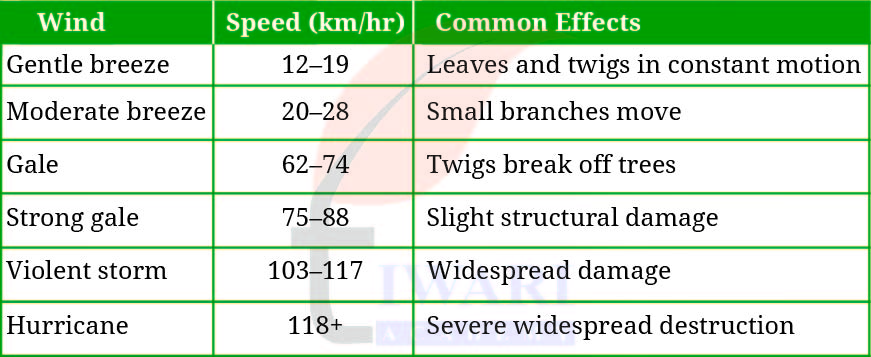
Find out other categories of wind based on speed and their common effects, and share your findings in class.
Answer:
Page 48 – THINK ABOUT IT
Hindustani Classical music associates certain ragas with specific seasons. Find out which ragas are connected to each season with the help of your elders and teachers.
Answer:
Ragas associated with seasons in Hindustani Classical Music:
- Vasanta (Spring) – Raga Bahar, Raga Basant
- Grīṣhma (Summer) – Raga Gaud Sarang, Raga Bhairav
- Varṣhā (Monsoon) – Raga Megh Malhar, Raga Miyan ki Malhar
- Śharad (Autumn) – Raga Bhimpalasi, Raga Kedar
- Hemanta (Late Autumn/Early Winter) – Raga Todi, Raga Marwa
- Śhiśhira (Winter) – Raga Bhairavi, Raga Darbari
Page 52 – LET’S EXPLORE
Describe in your own words how monsoon affects the lives the people around you.
Answer:
Monsoon affects our daily lives in many important ways. Farmers in our area eagerly wait for the monsoon as most crops like rice, wheat and vegetables depend on rainwater. When the monsoon arrives on time and brings sufficient rain, there is a good harvest, food prices remain stable and farmers earn well. In cities like Delhi, the monsoon brings relief from the intense summer heat. However, heavy rains also cause waterlogging, traffic jams and flooding in low-lying areas. Drains overflow and roads get damaged.
Festivals like Teej, Raksha Bandhan and Janmashtami are celebrated during the monsoon season, showing how deeply it is embedded in our culture. School children enjoy the cool weather, though sometimes schools are closed due to heavy rains. Water levels in rivers, lakes and reservoirs rise during monsoon, ensuring water supply for drinking and irrigation throughout the year. A weak monsoon, on the other hand, causes drought and water scarcity, raising food prices and affecting rural livelihoods greatly.
Page 53 – LET’S EXPLORE
My Carbon Footprint
Step 1: My Daily Habits
Tick the options that best describe you.
A. Transport
• I usually walk/use a cycle. (Low impact)
• I use public transport/carpool. (Medium impact)
• I travel by private cars even for short distances. (High impact).
• I take flights more than twice a year. (Very high impact)
B. Electricity Use
• I always switch off electrical appliances (light, fans, etc.) when not in use. (Low impact)
• I sometimes forgot to switch off electrical appliances (light, fans, etc.) (Medium impact)
• I leave electrical appliances (lights, fans, etc.) on frequently. (High impact)
C. Water Use
• I use water judiciously, for example, just one bucket of water for bathing. (Low impact)
• I sometimes waste water (leaving the tap running/more buckets of water for a bath/long showers). (Medium impact)
• I rarely think about saving water. (High impact)
D. Waste and Plastics
• I reuse, recycle, and avoid single-use plastics. (Low impact)
• I sometimes use disposable plastics (bottle/bags/straws). (Medium impact)
• I often throw away plastic and do not recycle. (High impact)
Step 2: Score Yourself
• Low impact choices = 1 points
• Medium impact choices = 2 points
• High impact choices = 3 points
• Very high impact choices = 4 points
Now add up your total score: _____________ points
Step 3: My Climate Action Pledge
Think about two simple changes you can make to reduce you score, and write them down below.
1. _______________________________________________
2. _______________________________________________
Answer:
Step 1: My Daily Habits
A. Transport – I use public transport/carpool. (Medium impact – 2 points)
B. Electricity Use – I sometimes forget to switch off electrical appliances. (Medium impact – 2 points)
C. Water Use – I use water judiciously. (Low impact – 1 point)
D. Waste and Plastics – I sometimes use disposable plastics. (Medium impact – 2 points)
Step 2: Total Score = 7 points
Step 3: My Climate Action Pledge
1. I will always switch off fans and lights when leaving a room to save electricity.
2. I will carry a cloth bag whenever I go shopping instead of using plastic bags.
Class 9 Social Science Chapter 3 Exercises Question Answer
Page 57 – Questions and activities
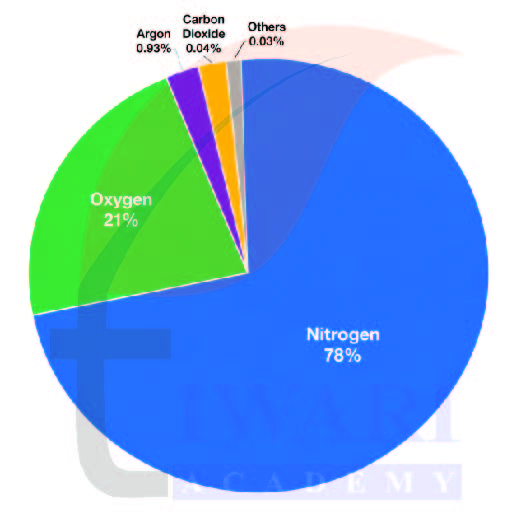
1. What is atmosphere? Explain its composition with the help of a pie diagram.
Answer:
The atmosphere is a blanket of air surrounding the Earth, held down by gravity. It is a mixture of gases, water vapour and tiny dust particles that is vital for the survival of all living beings. It shields us from the Sun’s harmful radiation, regulates the Earth’s temperature and is responsible for all weather phenomena.
Composition:
- Nitrogen – 78%
- Oxygen – 21%
- Argon – 0.93%
- Carbon Dioxide – 0.04%
- Others (helium, neon, ozone, hydrogen, water vapour, dust) – 0.03%
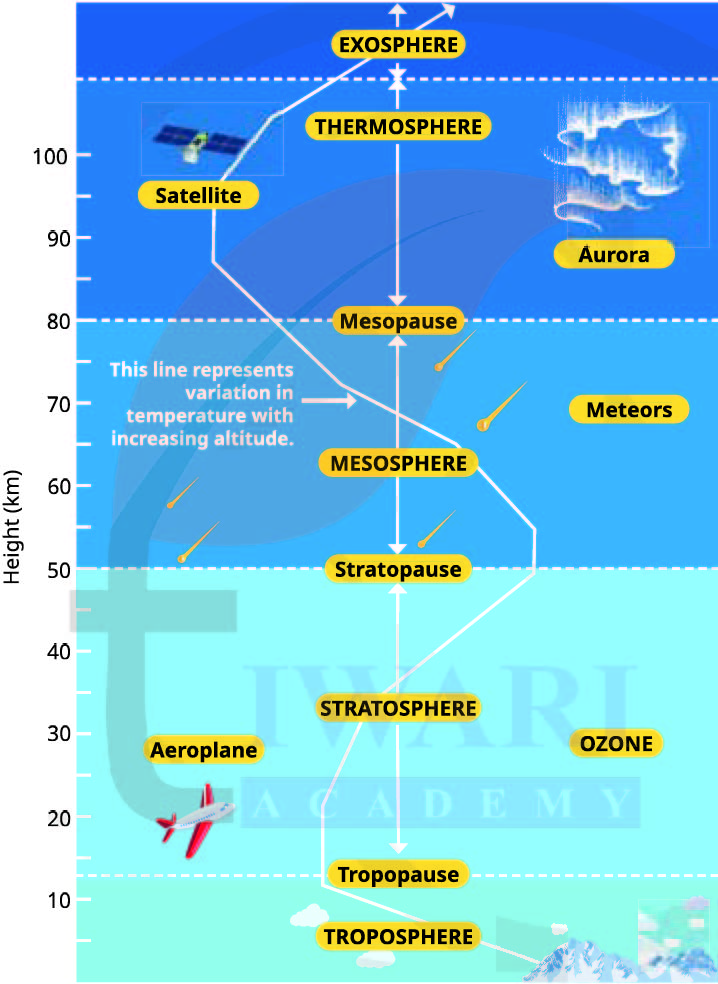
2. Draw a labelled diagram of the structure of atmosphere.
Answer:
3. Which are the four main seasons of India?
Answer:
The Indian Meteorological Department (IMD) recognises four main seasons in India:
- Winter – December to early April. Coldest months are December and January. Temperature in northwest India is around 10–15°C.
- Summer or Pre-monsoon – April to June (up to July in northwest India). Hottest season with temperatures ranging from 32–40°C in most inland areas.
- Monsoon or Rainy Season (Advancing Monsoon) – June to September. Dominated by the southwest monsoon bringing most of India’s annual rainfall.
- Post-monsoon (Retreating Monsoon) – October to December. Monsoon withdraws from north India; Tamil Nadu and Andhra Pradesh receive rain from the northeast monsoon.
4. Why do you not feel the pressure of the atmosphere?
Answer:
Although the atmosphere exerts a significant pressure on our bodies, we do not feel it because the air presses on us equally from all sides – from above, below and all around. Our bodies also exert a counter-pressure from inside that is equal to the atmospheric pressure outside. Since these two pressures cancel each other out, we do not feel any net pressure on our bodies.
5. In which layer of the atmosphere do aeroplanes fly and why?
Answer:
Aeroplanes fly in the Stratosphere, which extends from about 12 km to 50 km above the Earth’s surface.
Reasons:
- The stratosphere is free from clouds, storms and other weather disturbances that are found in the troposphere below. This makes flying smooth and safe.
- The air in the stratosphere is thinner and offers less resistance, which allows aircraft to fly more efficiently and use less fuel.
- Visibility is very high in the stratosphere, making navigation easier.
- The stratosphere is calm and stable, making it ideal for long-distance commercial flights.
6. Distinguish between the following: a. The troposphere and stratosphere b. The south-west monsoon and north-east monsoon
Answer:
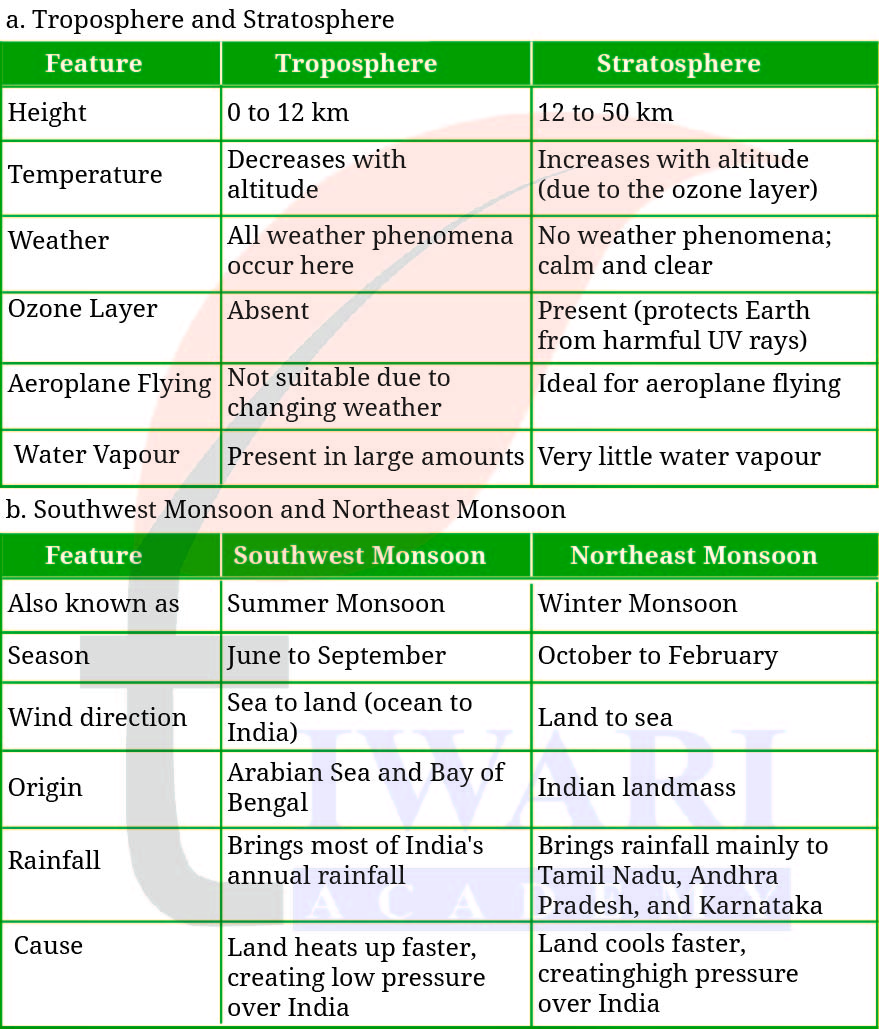
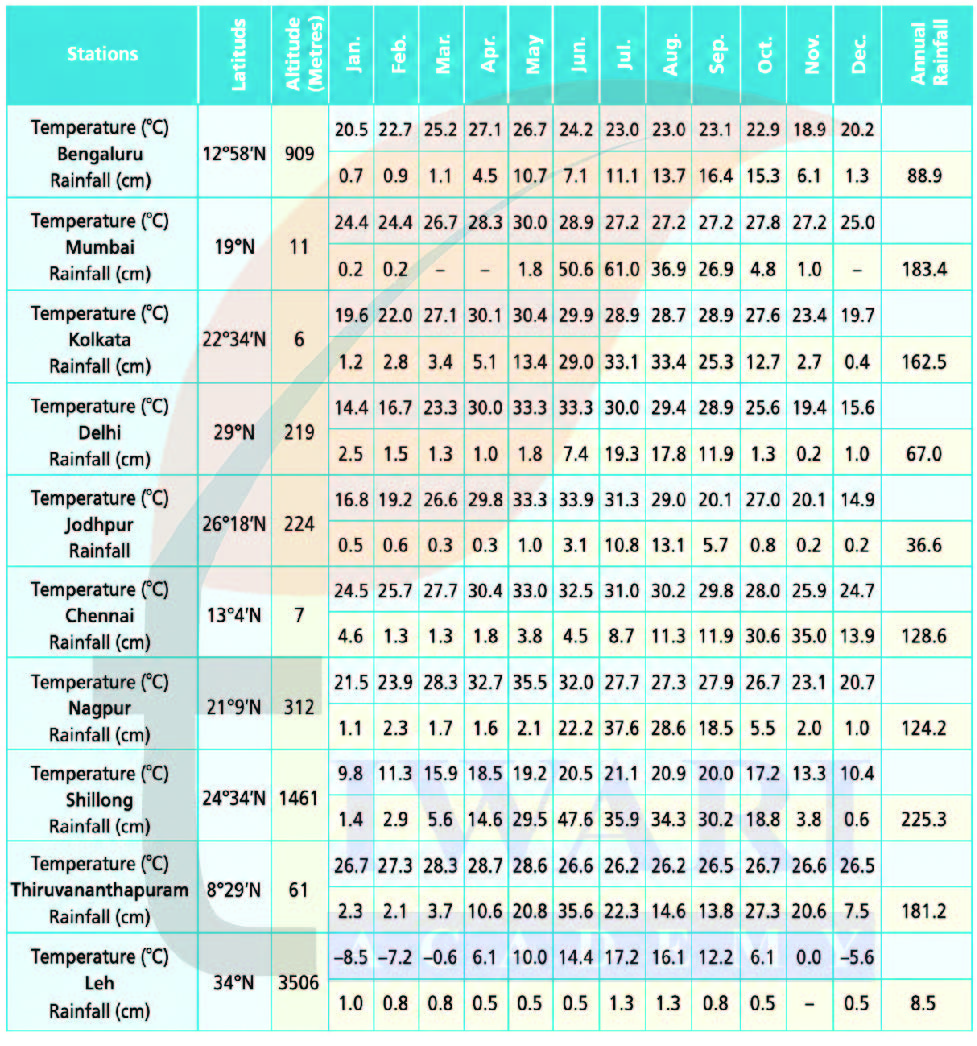
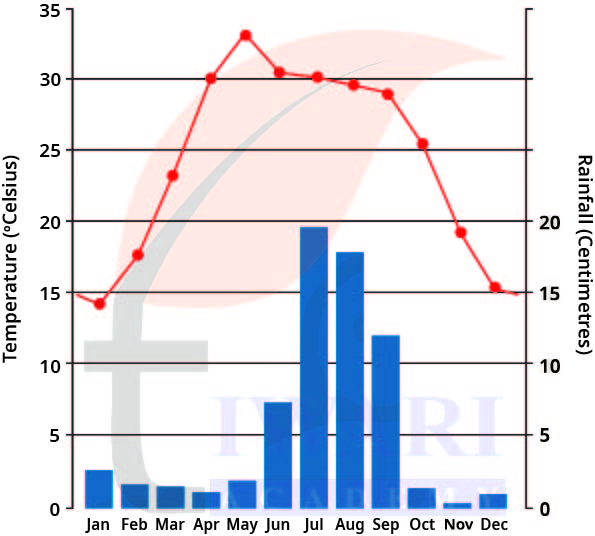
7. Do it yourself: Table 3.3 shows the average the monthly temperatures and rainfall amounts for 10 representatives stations. Study these figures on you own and convert them into ‘temperature and rainfall’ graphs. The visual representations will help you grasp their similarities and differences at a glance. One such graph (Fig. 3.14) is already prepared for you. See if you can arrive at some broad generalisations about our diverse climate conditions.
7.1 Now look at Table 3.3 again. Re-arrange the 10 stations according to their distance from the equator.
Answer:
Thiruvananthapuram (8°29’N) → Chennai (13°4’N) → Bengaluru (12°58’N) → Mumbai (19°N) → Nagpur (21°9’N) → Kolkata (22°34’N) → Shillong (24°34’N) → Jodhpur (26°18’N) → Delhi (29°N) → Leh (34°N)
7.2 Find out:
a. Two stations with the most extreme climate.
b. Two stations influenced by retreating monsoons.
c. The two hottest stations in the month of
(i) February
(ii) June
Answer:
a. Leh and Delhi show the most extreme climate. Leh has temperatures as low as –8.5°C in January and 17.2°C in July, and receives very little rainfall (8.5 cm annually). Delhi has very hot summers (33.3°C) and cold winters (14.4°C) with moderate rainfall.
b. Chennai and Thiruvananthapuram are influenced by the retreating northeast monsoon. Chennai receives its maximum rainfall in October–November (30.6 cm and 35 cm respectively) when the southwest monsoon has retreated.
c. (i) In February – Chennai (25.7°C) and Thiruvananthapuram (27.3°C) are the hottest.
(ii) In June – Jodhpur (33.9°C) and Nagpur (32.0°C) are the hottest.
7.3 Now find out:
a. Why does Shillong experience more rainfall than Kolkata?
b. Why does Delhi receive more rainfall than Jodhpur?
Answer:
a. Shillong is located in the Meghalaya hills at a high altitude of 1,461 metres. The southwest monsoon winds coming from the Bay of Bengal are forced to rise when they hit the hills of Meghalaya. As they rise, they cool and condense, causing very heavy orographic (relief) rainfall. Kolkata, though closer to the Bay of Bengal, is located on the flat plains and does not have hills to force the air upward, so it receives less rainfall than Shillong. Nearby Cherrapunji and Mawsynram, also in the Meghalaya hills, receive the highest rainfall in the world for the same reason.
b. Delhi receives more rainfall (67 cm annually) than Jodhpur (36.6 cm) because of its geographical position. The southwest monsoon winds that come from the Bay of Bengal travel across the Gangetic plain and reach Delhi, still carrying sufficient moisture. Jodhpur, located in the Thar Desert region of Rajasthan, is farther from the moisture-bearing winds, and the Aravalli mountain range does not effectively block or trap the Arabian Sea branch of the monsoon. The desert conditions also prevent moisture retention. As a result, Jodhpur receives much less rainfall than Delhi.
7.4 Now think why
a. Thiruvananthapuram has an equable climate?
b. Chennai has more rainfall only after the fury of the monsoon is over in most parts of the country?
c. Leh has moderate precipitation almost throughout the year?
Answer:
a. Thiruvananthapuram is located very close to the equator (8°29’N) and is surrounded by the sea on three sides (it is a coastal city on the Kerala coast). The sea has a moderating effect on temperature because water heats up and cools down slowly. As a result, there is very little difference between the temperatures in summer and winter. The annual temperature range is very small (26.2°C to 28.7°C), which is why it has an equable (moderate and uniform) climate throughout the year.
b. Chennai is located on the southeastern coast of India and is not significantly influenced by the southwest monsoon, which mostly affects the western and central parts of India. Chennai lies in the rain shadow area of the Western Ghats for the southwest monsoon. However, when the southwest monsoon retreats (post-monsoon season, October–December), the northeast monsoon picks up moisture from the Bay of Bengal and brings heavy rainfall to Tamil Nadu and Andhra Pradesh. This is why Chennai receives its maximum rainfall in October (30.6 cm) and November (35.0 cm), after the main monsoon season has ended elsewhere.
c. Leh is located at a very high altitude of 3,506 metres in the cold desert region of Ladakh. It lies in the rain shadow area of the Himalayas, which means the southwest monsoon winds lose most of their moisture before reaching Leh. Similarly, the northeast monsoon and western disturbances also bring only small amounts of moisture to this region. As a result, Leh receives very low and fairly uniform precipitation (mostly snowfall in winter) of about 8.5 cm annually, spread somewhat evenly throughout the year. No single month receives very high rainfall, giving it a pattern of moderate but consistent low precipitation.
7.5 Despite these differences across regions, can you observe any substantial evidence to conclude that the monsoons provide a very strong framework, lending overall climatic unity to the whole country?
Answer:
Yes, despite the great diversity in India’s climate from region to region, the monsoon provides an overall framework of climatic unity. The following observations from the data support this:
Most stations show a significant increase in rainfall between June and September, which is the southwest monsoon period. Whether it is Delhi, Mumbai, Kolkata, Nagpur or Bengaluru, all receive the bulk of their annual rainfall during these months.
Temperatures across most stations are high during April–June (pre-monsoon) and the arrival of monsoon in June–July brings temperatures down across the country simultaneously.
The retreating monsoon affects the southeastern coast (Chennai, Thiruvananthapuram) in October–November, completing a seasonal cycle that touches every part of India.
Even Leh in the far north and Thiruvananthapuram in the south, which are very different in climate, both experience their own monsoon-related patterns.
Thus, the monsoon acts as the most important unifying climatic force across India’s diverse geography.
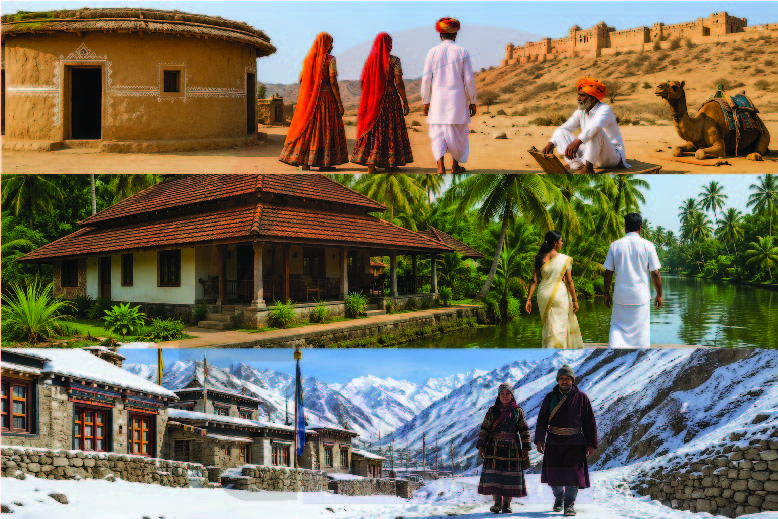
8. Collect picture of houses and clothing of people from different regions of India. Examine whether they reflect any relationship with the climatic conditions or the relief of those regions.
Answer:
Rajasthan (Desert climate): Houses have thick mud walls and small windows to keep the heat out. People wear light-coloured and loose cotton clothes to reflect heat. Women wear long skirts (ghaghra) and men wear turbans to protect from the Sun and dust.
Kerala (Tropical, high rainfall): Houses have sloping roofs to allow rainwater to drain quickly. They are built with verandahs and good ventilation. People wear light cotton clothes like mundu due to the hot and humid climate.
Himachal Pradesh/Ladakh (Cold, mountainous): Houses are made of stone and wood with flat or slightly sloping roofs. People wear heavy woollen clothes, shawls, and boots to protect from extreme cold and snow.
Conclusion: The houses and clothing of people across India clearly reflect their local climate and geography, showing how deeply human life is shaped by atmospheric conditions.
Chapter 3 Extra Question Answers for Exam Preparation
Class 9 Social Science Chapter 3 Very Short Answer Type Questions with Explanation.
Very Short Answer Type Questions
1. What is the atmosphere?
See AnswerThe atmosphere is a blanket of air surrounding the Earth, held by gravity. It is a mixture of gases vital for life, shields us from harmful radiation, and regulates Earth’s temperature.
2. Name the two most abundant gases in the atmosphere.
See AnswerNitrogen (78%) and oxygen (21%) are the two most abundant gases in the atmosphere. They are essential to life on Earth.
3. What is insolation?
See AnswerInsolation is the incoming solar energy from the Sun that is intercepted by the Earth. It decreases from the equator towards the poles, affecting temperature distribution.
4. What is the troposphere?
See AnswerThe troposphere is the most important layer of the atmosphere with an average height of about 12 kilometres. All weather phenomena like rainfall, fog and hail occur here.
5. Why is the stratosphere ideal for flying aeroplanes?
See AnswerThe stratosphere extends up to 50 kilometres and is free of clouds and weather disturbances, making it ideal and safe for aeroplane flights.
6. What is the ozone layer and where is it found?
See AnswerThe ozone layer is found in the stratosphere. It shields the Earth by filtering the Sun’s harmful ultraviolet radiation, protecting all living beings on the planet.
7. What happens to meteorites in the mesosphere?
See AnswerMost meteorites entering from space burn up in the mesosphere before reaching the Earth’s surface, protecting us from their impact.
8. What are auroras?
See AnswerAuroras are colourful displays of light seen near the poles, occurring in the thermosphere. They are called Aurora Borealis in the Northern Hemisphere and Aurora Australis in the Southern Hemisphere.
9. What is the difference between weather and climate?
See AnswerWeather refers to hour-to-hour and day-to-day atmospheric conditions. Climate refers to the average weather conditions of a place over a long period, usually thirty years or more.
10. What is humidity?
See AnswerHumidity refers to the presence of water vapour in the air, creating moisture. As air gets warmer, its capacity to hold water vapour increases, leading to higher humidity levels.
11. What is wind?
See AnswerWind is the movement of air from a high-pressure area to a low-pressure area. It can be gentle like a breeze or strong enough to uproot trees during a storm.
12. What is a sea breeze?
See AnswerA sea breeze is a local wind that blows from the sea to land during the day, when land becomes warmer than the sea, creating a low-pressure region over land.
13. What does the word ‘monsoon’ mean and where does it come from?
See AnswerThe word ‘monsoon’ is derived from the Arabic word mausim, meaning season. It refers to the seasonal reversal in the wind direction during a year.
14. What is a carbon footprint?
See AnswerA carbon footprint is the total amount of greenhouse gases released into the atmosphere as a result of human activities such as energy use, transportation, and production of goods and services.
15. Name the four seasons recognised by the Indian Meteorological Department (IMD).
See AnswerIMD recognises four seasons in India: Winter, Summer (Pre-monsoon), Monsoon or Rainy season (Advancing monsoon), and Post-monsoon (Retreating monsoon).
Class 9 Social Science Chapter 3 Short Answer Type Questions with Explanation.
Short Answer Type Questions
1. Describe the composition of the Earth’s atmosphere.
See AnswerThe atmosphere is composed mainly of nitrogen (78%) and oxygen (21%), with smaller amounts of carbon dioxide (0.04%), argon (0.93%), and other gases. It also contains water vapour (0.1–0.4%) and tiny dust particles, which play a significant role in cloud formation and precipitation.
2. How does atmospheric pressure affect weather conditions?
See AnswerAtmospheric pressure is highest at sea level and decreases with altitude. Areas with high temperatures develop low pressure, associated with cloudy and wet weather. Areas with low temperatures develop high pressure, associated with clear, sunny skies. Air always moves from high-pressure to low-pressure areas, causing wind.
3. Distinguish between the sea breeze and the land breeze.
See AnswerA sea breeze blows from sea to land during the day when land heats up faster, creating low pressure over land. A land breeze blows from land to sea at night when land cools faster than sea, creating high pressure over land. Both are local winds affecting coastal climates.
4. Explain the mechanism of the south-west monsoon.
See AnswerDuring summer, the Indian landmass heats up faster than the surrounding oceans, creating low pressure over the subcontinent. The cooler Indian Ocean has high pressure. Moist winds blow from ocean to land, bringing heavy rainfall between June and September, accounting for most of India’s annual rainfall.
5. What is climate change and what causes it?
See AnswerClimate change refers to long-term changes in weather patterns like temperature, rainfall and wind. It is mainly caused by human activities such as burning fossil fuels, deforestation and industrial pollution, which increase greenhouse gases like carbon dioxide and methane, trapping heat and raising global temperatures.
6. What are the effects of climate change mentioned in the chapter?
See AnswerClimate change has led to more frequent floods, droughts, melting of glaciers, rising sea levels and loss of biodiversity. It also threatens human health, agriculture and livelihoods, affecting almost all sections of the population, especially women, children, and those in rural areas.
7. What were the natural causes of the Punjab Floods of 2025?
See AnswerIn 2025, Punjab received very heavy monsoon rains intensified by western disturbances bringing additional moisture from Himachal Pradesh and Jammu & Kashmir. The major rivers — Satluj, Beas, Ravi and Ghaggar — were already flowing high and additional rainfall caused them to overflow, leading to severe flooding.
8. How does the north-east monsoon bring rainfall to south-eastern India?
See AnswerThe north-east or winter monsoon blows from October to February, when dry cold winds move from land to sea. When these winds pass over the Bay of Bengal, they pick up moisture and cause rainfall in Tamil Nadu, Andhra Pradesh and parts of Karnataka.
9. What is precipitation and what forms can it take?
See AnswerPrecipitation occurs when the atmosphere becomes saturated with water vapour, which condenses and falls to Earth due to gravity. It includes drizzle, rain, snow, sleet and hail. Rain is the most common form and is essential for groundwater recharge and agriculture.
10. How can individuals reduce their carbon footprint?
See AnswerIndividuals can reduce their carbon footprint by using public transport or cycling, switching off electrical appliances when not in use, conserving water, reusing and recycling materials, avoiding single-use plastics, using renewable energy sources, planting trees and adopting eco-friendly lifestyles in daily life.
Class 9 Social Science Chapter 3 Long Answer Type Questions with Explanation.
Long Answer Type Questions
1. Describe the five layers of the atmosphere and explain the significance of each.
Answer:
The atmosphere is divided into five distinct layers based on changes in temperature and density with increasing altitude.
The troposphere is the lowest and most important layer, extending to about 12 kilometres. All weather phenomena — rainfall, fog, hail and clouds — occur here. The air we breathe exists in this layer.
The stratosphere extends from the troposphere up to 50 kilometres. It contains the ozone layer, which filters the Sun’s harmful ultraviolet radiation. It is calm and free of weather disturbances, making it ideal for aeroplane travel.
The mesosphere extends up to 80 kilometres. Temperature decreases with altitude here and most meteorites entering from space burn up in this layer, protecting life on Earth.
The thermosphere extends from 80 to 700 kilometres. Temperature rises rapidly here as gas molecules absorb X-rays and short-wave ultraviolet radiation. It contains the ionosphere, which reflects radio waves and enables radio communication. The beautiful auroras also occur here.
The exosphere is the outermost layer, with very thin air. Light gases like helium and hydrogen escape into space from here. Together, all five layers regulate Earth’s temperature, protect life and support weather and climate systems.
2. Explain the mechanism of the monsoon in India, distinguishing between the south-west and north-east monsoon.
Answer:
The monsoon refers to the seasonal reversal of wind direction. The word itself comes from the Arabic mausim, meaning season, and was first named by Arab traders who noticed the wind reversal while sailing to India.
India experiences two types of monsoon. The south-west monsoon, also called the summer monsoon, occurs from June to September. During summer, the Indian landmass heats up much faster than the surrounding Indian Ocean, Arabian Sea, and Bay of Bengal. This creates a strong low-pressure area over the subcontinent. The relatively cooler oceans have high pressure. Moisture-laden winds blow from these high-pressure ocean areas towards the low-pressure land area, bringing heavy rainfall across the country. This monsoon accounts for the majority of India’s annual rainfall and is vital for agriculture.
The north-east monsoon, also known as the winter monsoon, occurs from October to February. During this period, the Indian landmass cools faster than the surrounding oceans, creating high pressure over land and low pressure over the seas. Cold, dry winds blow from land to sea. These winds generally do not bring rainfall. However, when they pass over the Bay of Bengal, they pick up moisture and cause significant rainfall in Tamil Nadu, Andhra Pradesh and parts of Karnataka, making the north-east monsoon crucial for the south-eastern regions of India.
3. What are the elements of weather and climate? Explain how each element affects human life.
Answer:
Weather and climate are determined by five major elements: temperature, humidity, precipitation, atmospheric pressure and wind.
Temperature varies between day and night and across seasons. It is influenced by insolation, which decreases from the equator to the poles. High temperatures affect water availability, crop choices, clothing and human comfort.
Humidity refers to water vapour in the air. High humidity makes us feel uncomfortable as sweat evaporates more slowly. It also influences cloud formation and rainfall, affecting agriculture and daily life.
Precipitation includes rain, snow, sleet, drizzle and hail. Rain is the most common form and is essential for agriculture, drinking water and groundwater recharge. Long absence of rain leads to droughts, while excessive rainfall causes floods.
Atmospheric pressure is the weight of air pressing on Earth’s surface. Low pressure brings wet, cloudy weather, while high pressure brings clear, sunny skies. Pressure differences drive winds, which influence climate across regions.
Wind is the movement of air from high-pressure to low-pressure areas. Local winds like the sea breeze and land breeze moderate temperatures in coastal areas. Winds also carry moisture and influence where rainfall occurs. Together, these elements shape the climate of a region and deeply influence agriculture, settlements, transport and human health.
4. Describe the four seasons of India as recognised by the Indian Meteorological Department. Also mention India’s traditional six-season system.
Answer:
The Indian Meteorological Department (IMD) recognises four main seasons in India based on the country’s tropical monsoon climate.
The Winter season lasts from December to early April. The coldest months are December and January, when temperatures in the north-west average 10–15°C. Temperatures increase toward the equator, reaching around 20–25°C in mainland India’s south-east.
The Summer or Pre-monsoon season spans from April to June and up to July in north-western India. The hottest month in western and southern India is April, while in northern regions it is May. Average temperatures across most of inland India range from 32–40°C.
The Monsoon or Rainy season generally runs from June to September. The humid south-west monsoon sweeps across the country from late May or early June. Monsoon rain begins to recede from north India in October, while South India receives more rainfall during this period.
The Post-monsoon or Retreating monsoon season lasts from October to December. North-western India experiences mostly cloudless weather during October and November. Himalayan states, being more temperate, also experience two additional seasons — autumn and spring.
Traditionally, India recognises six seasons or Ṛtus: Vasanta (spring, March–April), Grīṣhma (summer, May–June), Varṣhā (monsoon, July–August), Śharad (autumn, September–October), Hemanta (early winter, November–December) and Śhiśhira (winter, January–February). These are based on the astronomical division of the 12 months and are reflected in the traditional Indian calendar.
5. Discuss the Punjab Floods of 2025 as a case study. What were its causes and effects and what does it tell us about the relationship between climate and human life?
Answer:
In 2025, Punjab experienced devastating floods caused by heavy monsoon rains and the consecutive swelling of the rivers Satluj, Beas, and Ravi. The floods damaged vast areas of the state and highlighted the dangerous intersection of natural climate events and human negligence.
The natural causes included very heavy monsoon rains intensified by western disturbances that brought additional moisture from Himachal Pradesh and Jammu & Kashmir. The major rivers of Punjab were already flowing high before the heavy rains began. When additional rain fell, water from the hills combined with local rainfall caused the rivers to overflow severely.
The human-made causes further worsened the situation. Old and weak river embankments called dhūsī bāndh could not hold back the rising water. People had built houses and farms too close to riverbanks, reducing the natural space for floodwater to spread. Silt accumulation had reduced the capacity of rivers and dams. In many areas, flood warnings came late or were poorly communicated, leaving people unprepared.
The effects were widespread and devastating. Many people lost their lives and thousands moved to relief camps. Large areas of farmland were submerged and crops like paddy were severely damaged. Poultry and dairy farms suffered heavy losses. Roads, bridges, border fences and public buildings were damaged. Stagnant water caused health problems including waterborne diseases.
This case study shows that while monsoon is essential for India’s agriculture and water supply, excessive or poorly managed rainfall can become catastrophic. It underscores the urgent need for better flood management, early warning systems, stricter land-use policies along river banks and climate-aware disaster preparedness at both individual and government levels.
Frequently Asked Questions
What is Class 9 Social Science Chapter 3 about?
Chapter 3, Atmosphere and Climate, is part of the Geography section of the NCERT textbook Understanding Society: India and Beyond – Grade 9, Part 1. It covers the composition and layers of the atmosphere, elements of weather and climate, India’s seasons, the monsoon mechanism, climate change and a case study on the Punjab Floods of 2025.
How many layers does the atmosphere have according to Class 9 Chapter 3?
The atmosphere has five major layers – the Troposphere, Stratosphere, Mesosphere, Thermosphere and Exosphere. Each layer is defined by changes in temperature and air density with increasing altitude and each plays a distinct role in Earth’s atmospheric processes.
What are the four seasons of India mentioned in Chapter 3?
According to the Indian Meteorological Department (IMD), India has four main seasons: Winter (December to early April), Summer or Pre-monsoon (April to June), Monsoon or Rainy season (June to September) and Post-monsoon or Retreating monsoon (October to December).
What is a carbon footprint and why is it important in Chapter 3?
A carbon footprint is the total amount of greenhouse gases released into the atmosphere as a result of human activities like energy use, transportation or production of goods. Chapter 3 highlights its importance in the context of climate change and encourages students to reduce their carbon footprint through small everyday actions.
Is the Punjab Floods 2025 case study part of Class 9 Chapter 3?
Yes, Chapter 3 includes a detailed case study on the Punjab Floods of 2025, which were caused by heavy monsoon rains and the swelling of rivers Satluj, Beas and Ravi. It discusses both natural and human-made causes of the floods and their devastating effects on life, agriculture and infrastructure.