



by Tiwari Academy Team
NCERT Solutions for Class 9 Social Science Chapter 6 Democracy – Exercises Question Answers and Practice Questions for CBSE 2026-27 Exam. Chapter 6, “Democracy”, from the Political Science section of Class 9 Social Science, explores how democratic ideas evolved in India from ancient traditions to the modern Constitution. It traces democratic roots to Vedic assemblies (sabhā, samiti, vidhata) and Buddhist saṁghas, through the freedom struggle and the Constituent Assembly, to the Constitution adopted in 1949. The chapter examines core principles like popular sovereignty, rule of law, separation of powers and fundamental rights, along with different types of democracy practised worldwide. It also highlights India’s living democracy through grassroots participation, women’s representation, and challenges like the 1975 Emergency, misinformation and inequality.
Quick Links:
- Chapter’s Question Answers
- Exercises Question Answers
- Very Short Answer Type Questions
- Short Answer Type Questions
- Long Answer Type Questions
Download Class 9 Social Science App to study Class 9 Social Science Offline.
NCERT Class 9 Social Science Chapter 6 Solutions (Political Science)
Class 9 Social Science Chapter 6 Question Answer
Page 137 – The Big Questions
1. How has the idea of democracy evolved over time and shaped our understanding of it today?
Answer:
The idea of democracy has evolved from limited participation in ancient times to a system where all adult citizens have the right to vote. Today, democracy is based on equality, freedom, justice and people’s participation in government.
2. What are the different forms of democracy, and how are they practised in India and other parts of the world?
Answer:
The main forms of democracy are direct democracy and representative democracy. In India, people elect their representatives to govern the country, so it is a representative democracy. Some countries also use direct democracy for certain decisions through referendums.
3. What are the essential features of a democracy and how do they extend beyond government institutions?
Answer:
The essential features of a democracy are free and fair elections, equality, rule of law, protection of rights and people’s participation. These values extend beyond government institutions by promoting equality, respect, and participation in schools, families, workplaces and society.
4. What are the challenges faced by Indian democracy?
Answer:
Indian democracy faces challenges such as corruption, poverty, inequality, illiteracy, communalism and misuse of power. Overcoming these challenges requires active citizen participation, awareness and fair governance.
Page 140 – THINK ABOUT IT
Why is it important that the ultimate source of power rests with the people in a democracy?
Answer:
When power rests with the people, the government is forced to remain accountable and work in the interest of citizens. It prevents any individual or group from misusing authority for personal gain. A government that derives its power from the people must respect their rights, respond to their needs and face consequences through elections if it fails to do so.
How does people’s participation through voting strengthen popular sovereignty?
Answer:
Voting is the direct exercise of popular sovereignty. When citizens vote, they choose who governs them and can remove leaders who fail them. This regular democratic exercise ensures that power keeps returning to the people and that no government can claim permanent authority without public consent.
Page 141 – LET’S EXPLORE
→ The Constitution not only guarantees Fundamental Rights to citizens but also outlines their Fundamental Duties and the Directive Principles of State Policy. Discuss their significance and identify the differences among them.
Answer:
Fundamental Rights (Part III of the Constitution) are legally enforceable rights guaranteed to every citizen – such as the right to equality, freedom and constitutional remedies. They protect individuals from arbitrary state action. Fundamental Duties (Article 51A, added in 1976) are moral obligations on citizens – such as respecting the Constitution, protecting the environment and upholding national unity. They are not enforceable in court but serve as guidelines for responsible citizenship. Directive Principles of State Policy (Part IV) are instructions to the government to work towards social and economic justice – such as ensuring adequate livelihood, equal pay for equal work and free legal aid. They are also not enforceable in court but guide law-making and policy.
Key difference: Fundamental Rights are justiciable (enforceable in courts); Fundamental Duties and Directive Principles are non-justiciable but equally important for a healthy democracy.
→ The Right to Education (Article 21A) was added in 2009, ensuring free and compulsory education for children aged 6 to 14. Discuss its significance.
Answer:
Article 21A, inserted in 2002 and made effective in 2009 through the Right to Education Act, guarantees free and compulsory education for all children aged 6 to 14. Its significance is enormous – it treats education as a fundamental right rather than a privilege, ensures that poverty is not a barrier to schooling, reduces child labour by keeping children in school, promotes social equality and helps build an informed and capable citizenry which is essential for democracy to function well.
Page 142 – THINK ABOUT IT
What do you think would happen if the same organ of the government made laws, implemented them, and enforced them? Share your opinion with your classmates.
Answer:
If one organ held all three powers, it would lead to the dangerous concentration of authority. That organ could make laws that benefit itself, implement them selectively and punish those who question it – all without any check. This is essentially what happens in a dictatorship. There would be no accountability, justice would be compromised and citizens’ rights would be at serious risk. The separation of powers exists precisely to prevent this kind of unchecked authority.
Page 145 – LET’S EXPLORE
The first column of the table below lists some key features of democracy in India. Fill in the second column with suitable examples from your state, town or village. One row has been completed for you.
| Features of Democracy | Examples |
|---|---|
| Popular Sovereignty | – |
| Rule of Law | – |
| Separation of Powers | – |
| Fundamental Rights | – |
| Accountability and Transparency | Parliamentary procedures such as Question Hour and the auditing of government accounts ensure accountability. Laws like the Right to Information provide transparency. |
| Multi-Party System | – |
Answer:
| Features of Democracy | Examples |
|---|---|
| Popular Sovereignty | General elections held every five years where every citizen aged 18 and above votes to choose their representatives at the national and state level. Example: Lok Sabha elections. |
| Rule of Law | The Supreme Court and High Courts can strike down laws that violate the Constitution. No person, not even a Prime Minister or a judge, is above the law. Example: RTI Act allows citizens to question government actions. |
| Separation of Powers | Parliament makes laws; the Cabinet implements them; the Supreme Court interprets and can strike them down if unconstitutional. Example: The judiciary striking down amendments that violate the Basic Structure. |
| Fundamental Rights | Citizens can approach the High Court (Article 226) or the Supreme Court (Article 32) if their rights are violated. Example: PILs filed for the rights of disadvantaged communities. |
| Accountability and Transparency | Parliamentary procedures such as Question Hour and the auditing of government accounts ensure accountability. Laws like the Right to Information provide transparency. |
| Multi-Party System | India has over 2,800 registered political parties including national parties like the BJP, INC and regional parties like DMK, TMC, AAP etc., all contesting elections freely. |
Page 148 – LET’S EXPLORE
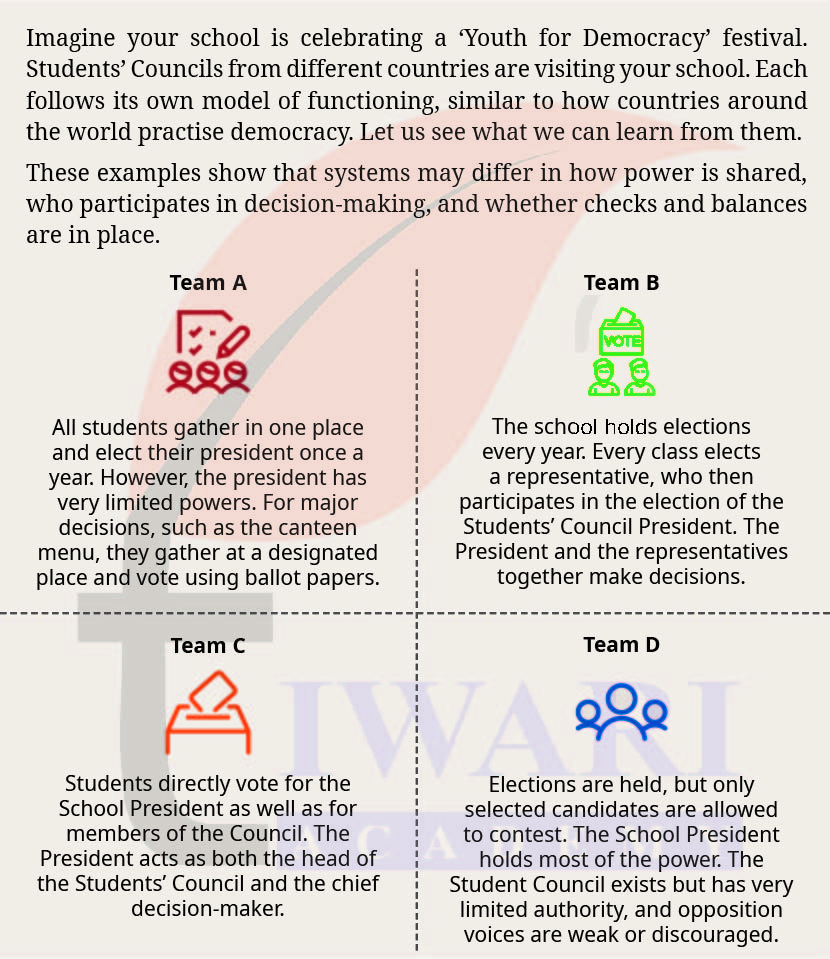
Select your ideal team from Fig. 6.5 and give reasons for your selection.
Answer:
Team B appears closest to an ideal democratic model. In Team B, every class elects a representative (ensuring proportional representation) and the President is elected through these representatives (indirect/parliamentary democracy). The President and the council make decisions together, which reflects checks and balances and collective governance. Team B reflects the model closest to India’s own parliamentary democracy – representative, accountable and collegial.
Page 149 – LET’S EXPLORE
Work in pairs or small groups. Choose any two of India’s neighbouring countries (Afghanistan, Bangladesh, Bhutan, China, Maldives, Myanmar, Nepal, Pakistan, or Sri Lanka) and find out the following:
→ Does the country hold regular elections?
→ Who chooses the Head of the Government?
→ Is there more than one political party
→ How much freedom do citizens have to express their opinions and criticise the government?
How would you describe this system? Give reasons for your answer.
→ Democratic or Partially democratic or Non-democratic
Answer:
Bangladesh:
- Holds regular elections, though fairness has been questioned at times.
- The Head of Government (Prime Minister) is chosen by the majority party in parliament.
- Multiple political parties exist Awami League, BNP, etc.
- Citizens have some freedom of expression, but press freedom and opposition space have faced restrictions.
- Classification: Partially Democratic elections exist but full democratic freedoms are not consistently upheld.
Nepal:
- Holds regular elections; became a federal democratic republic in 2008.
- The Prime Minister is chosen by the majority in parliament.
- Multiple political parties actively contest (CPN-UML, Nepali Congress, etc.).
- Citizens have reasonable freedom of expression.
- Classification: Democratic though political instability remains a challenge with frequent changes of government.
Page 152 – LET’S EXPLORE
A democratic system seeks to promote participation, ensure fairness, limit the concentration of power, and resolve disagreements peacefully. Identify examples from the above case study that reflect these features.
Answer:
Participation: Jethipura Gram Panchayat conducted Mahila Sabhas and ensured participation from Scheduled Castes, Scheduled Tribes and women in Gram Sabhas, going beyond minimum requirements. South Manubankul Panchayat actively promoted women’s involvement in decision-making.
Fairness: Both panchayats worked to ensure equitable access to schemes for welfare of women, children and marginalised groups, reflecting the principle of equal treatment.
Limiting concentration of power: Decisions were made collectively in Gram Sabhas – not by a single leader alone. The Gram Sabha itself acts as the primary decision-making body under the PESA Act, distributing power to the community.
Peaceful resolution of disagreements: Community issues related to education, sanitation, cleanliness and livelihoods were resolved through organised Gram Sabha discussions and government scheme implementation rather than through conflict.
Page 153 – LET’S EXPLORE
India continues to work towards more inclusive institutions. Discuss in class about the advantages of increased representation of women in the legislature.
Answer:
Increased women’s representation brings several important advantages.
- First, women constitute nearly half the population, so their representation ensures that their concerns related to health, safety, education and economic opportunity are genuinely heard and addressed in policy-making.
- Second, women legislators often champion legislation on issues like domestic violence, maternity benefits, child nutrition and gender pay equality.
- Third, greater diversity in decision-making leads to more balanced and inclusive policies.
- Fourth, it challenges social stereotypes and inspires younger generations of girls to take up public life.
- Fifth, research from India’s own Panchayati Raj experience shows that villages with women leaders often show better outcomes in water, sanitation and education.
Page 155 – LET’S EXPLORE
In small groups, identify two or three examples of information shared on social media that you believe may be misleading or false. Discuss what made you question their reliability and how such information can influence people’s opinions. Reflect on why access to accurate and authentic information is important in a democracy.
Answer:
Examples of potentially misleading information on social media include: doctored videos claiming to show a political leader saying something they never said; WhatsApp forwards claiming that a particular food or medicine cures a disease without scientific basis; false reports about riots or communal tensions that did not occur, designed to provoke fear.
What makes us question such information: the absence of credible sources, extreme emotional language designed to provoke anger, no date or context, the same image appearing in different unrelated stories.
Such misinformation can manipulate public opinion, damage the reputations of individuals or communities, cause panic and even lead to violence, as has happened in India with mob lynchings linked to false WhatsApp messages.
In a democracy, accurate information is the foundation of informed voting, rational public debate and effective citizen participation. When misinformation spreads, people make decisions based on falsehoods, and the very basis of democratic choice is corrupted. Media literacy and critical thinking are therefore essential democratic skills.
Page 156 – LET’S EXPLORE
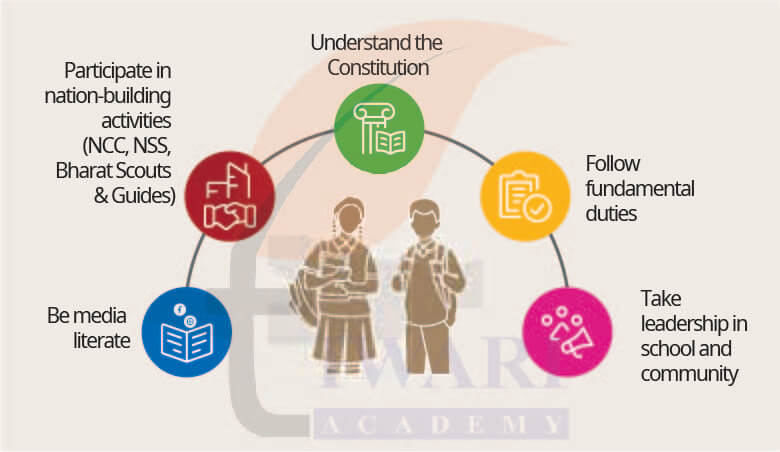
Observe Fig 6.9 and explore the various other digital and non digital ways through which you can participate in a democracy.
Answer:
Digital ways: Following credible news sources online; using social media to raise awareness about local issues responsibly; signing legitimate online petitions; participating in government portals for public feedback (like MyGov.in); reporting civic issues through apps like CPGRAMS.
Non-digital ways: Joining NCC, NSS or Bharat Scouts and Guides; participating in Gram Sabha meetings when eligible; helping elderly or disabled neighbours register to vote; taking part in cleanliness drives and community awareness campaigns; writing letters to elected representatives; organizing debates and mock parliaments in school.
Page 157 – THINK, DISCUSS, ACT
Think: How do you actions as a student contribute to your school community and to democracy in a larger context?
Answer:
As a student, small actions carry democratic meaning. Participating honestly in class elections, respecting majority decisions while also voicing dissent through proper channels, treating classmates equally regardless of background and refusing to spread rumours — all of these reflect democratic values. Being responsible with school property, being punctual and helping those who need support are forms of civic responsibility that, when practiced at scale, strengthen the fabric of society.
Discuss: Talk to your classmates about a social or community issue that you care about. How can you, as a students, make a difference?
Answer:
One relevant issue is the spread of misinformation in our neighbourhoods. As students, we can start fact-checking clubs at school, create awareness posters about identifying fake news or organize community awareness sessions. We can also take up issues like cleanliness, water conservation or road safety and engage local Panchayat or municipal ward members through petitions or community meetings.
Act: Choose one activity to fulfil your civic responsibility this month. Reflect on how your actions contribute to strengthening democracy and community spirit.
Answer:
A meaningful activity would be participating in an NSS camp or organizing a Cleanliness Drive in the neighbourhood, reflecting civic responsibility in a tangible way. Alternatively, one could attend a Gram Sabha or ward committee meeting as an observer to understand local democracy in action.
Class 9 Social Science Chapter 6 Exercises Question Answer
Page 158 – Questions and activities
1. Read the passage and answer the questions that follow:
A school cabinet was responsible for planning a Republic Day celebration, and members had different opinion on which activities to include. After a discussion, they decided to vote and the activities supported by the majority was selected.
a. Which democratic values are reflected in this situation?
b. How does voting help resolve differences of opinion?
c. Why is the majority decision important in a democracy?
d. Mention responsibilities of elected representatives after a decision is made.
Answer:
a. The situation reflects deliberation (members discussed different opinions), participation (everyone had a voice), majority rule and collective decision-making – all core democratic values.
b. Voting provides a fair, peaceful and accepted method of making a final decision when people disagree. It ensures everyone’s preference is counted equally and the majority outcome is binding – preventing prolonged conflict or the imposition of one person’s will.
c. Majority decisions ensure that the choice of the greatest number of people is implemented, which is the fairest way to govern in a diverse group. However, even in majority rule, the rights of the minority must be protected – the majority cannot override fundamental rights.
d. They must implement the chosen activities faithfully, communicate the plan clearly to all members, ensure fair resource distribution, remain open to feedback and be accountable for the outcome. They should not favor any group and must represent all members, including those who voted differently.
2. How would democracy be affected if citizens stopped following laws and civic responsibilities? Explain with an example.
Answer:
Democracy would steadily collapse. Laws and civic norms are the glue that holds democratic society together. If citizens stopped paying taxes, public services would fail. If they stopped voting, governments would lack legitimate mandates. If they spread misinformation or incited violence, public trust would erode. For example, if citizens routinely bribed officials, ignored traffic rules or dumped waste in public places, it would signal a breakdown of the shared commitment to collective wellbeing that democracy depends on. Democracy is not just a government structure – it is a daily practice.
3. Which situation best reflects the idea of popular sovereignty and why?
a. A law is passed without public discussion
b. Citizens vote to choose their representatives
c. A court gives a final judgment.
d. A minister takes an independent decision
Answer:
(b) Citizens vote to choose their representatives.
This best reflects popular sovereignty because it is the direct exercise of the people’s authority to determine who governs them. The other options a court judgment, a minister’s independent decision or a law passed without discussion are actions by institutions or officials, not expressions of the people’s sovereign will.
4. The Rule of Law is violated when:
a. Law are applied equally to all
b. Courts review government actions
c. Powerful individuals are treated above the law
d. Citizens challenge laws through legal means
Answer:
(c) Powerful individuals are treated above the law.
The Rule of Law means no one is exempt from the law. When powerful people politicians, businessmen or officials – can break the law without consequence, the principle of equality before the law is violated. Options (a), (b) and (d) all actually describe how the Rule of Law functions correctly.
5. Why is the Rule of Law essential for protecting democracy?
Answer:
The Rule of Law is essential for democracy for the following reasons:
- Prevents misuse of power – When no one is above the law, not even the government, political leaders cannot use their position to oppress citizens or act arbitrarily. This protects individual freedoms.
- Ensures equality – The Rule of Law guarantees that all citizens are treated equally before the law, regardless of caste, religion, gender or economic status. This is a foundational democratic principle.
- Builds trust in institutions – When people see that laws are applied fairly and consistently, they trust courts, police, and the government. This trust is essential for democracy to function smoothly.
- Protects Fundamental Rights – Courts enforce Fundamental Rights through the Rule of Law. Without it, rights would exist only on paper. Mechanisms like PIL (Public Interest Litigation) allow courts to protect citizens’ rights even when the state fails them.
- Ensures accountability – When government officials know they are subject to the law, they are more careful and responsible in exercising power. This accountability is central to democratic governance.
Without the Rule of Law, democracy becomes hollow – elections may be held, but without legal protection and equality, citizens cannot truly be free or equal.
6. Is voting alone enough to make a country democratic? Support your answer with examples from the chapter.
Answer:
No, voting alone is not sufficient. A country also needs free and fair elections, protection of fundamental rights, an independent judiciary, freedom of the press, rule of law, separation of powers and active citizen participation beyond elections.
For examples: India’s RTI Act empowers citizens year-round, not just at election time. The grassroots work of Jethipura and South Manubankul Panchayats shows democracy functioning through Gram Sabhas. The Emergency of 1975–77 showed that elections can be suspended but democracy survives through civil resistance and constitutional safeguards. A country could technically hold elections but still be undemocratic if opposition is suppressed, courts are controlled or press freedom is absent as seen in Team D of the school council example.
7. Social media allows people to express opinions freely.
a. How can this strengthen democracy?
b. How can it weaken democracy if used irresponsibly?
Answer:
a. Social media gives ordinary citizens a powerful platform to voice concerns, hold the powerful accountable, organize movements and access information quickly. It can amplify marginalized voices that mainstream media ignores, enable citizen journalism and mobilize public opinion on important issues – as seen in many campaigns for social justice. It also makes it easier for elected representatives to engage directly with constituents.
b. The spread of fake news, targeted misinformation and hate speech on social media can manipulate voters, inflame communal tensions and undermine public trust in institutions. Echo chambers – where people only see content that confirms their existing beliefs – reduce rational debate. Deepfakes and doctored videos can defame leaders or incite violence. Coordinated disinformation campaigns can even influence election outcomes. The chapter notes that fake news has emerged as one of India’s serious democratic challenges today.
8. Write a paragraph on what democracy means to you as a younger citizen.
Answer:
Democracy to me as a young citizen means having a voice in the decisions that shape my life not just when I grow up and vote, but right now, in the way I engage with my community, treat others with fairness and stand up for what is right. It means that no matter where I come from my caste, religion, gender or economic background I have equal worth and equal rights under the law. Democracy is not a destination but a practice. Every time I question misinformation, participate in a school election honestly, help a fellow student access their rights or refuse to discriminate, I am practising democracy. India’s Constitution is a living promise to all its citizens and as a young person, I have the responsibility to honour that promise by being informed, fair and active in building the society I wish to live in.
9. Conduct a model parliament session or Gram Sabha in class on local issues – cleanliness, responsibilities towards public property, or school safety.
Answer:
Topic: Cleanliness and Responsibilities towards Public Property in Our School
Roles
- Speaker – conducts the session
- Prime Minister/Sarpanch – leads the government side
- 2-3 Ministers – support the proposal
- Opposition Leader + 2 members – question and debate
- Secretary – records decisions
- Remaining students – general members/public
The Session
Speaker: “I call this Gram Sabha/Parliament session to order. Today’s topic is cleanliness and care of public property in our school. I request the Minister to present the proposal”.
Minister: “Honourable Speaker, our school faces problems of littering and damage to public property. We propose:
- Placing dustbins in every classroom
- A Cleanliness Drive every Friday
- A ‘Clean Classroom Trophy’ every month
- Posters on cleanliness across school
This is our civic duty as responsible citizens”.
Opposition Leader: “Honourable Speaker, we support the goal but have concerns. Who will monitor the Friday drive? We also suggest community service instead of fines for those who litter. This is fairer and more educational”.
Minister’s Response: “We accept the community service suggestion. A class monitor and teacher will supervise the Friday drive and report to the Principal”.
Speaker: “All in favour please raise hands”.
(Majority raises hands)
“The proposal is passed”.
Decisions Taken
- Dustbins in every classroom
- Weekly Cleanliness Drive on Fridays
- Community service for those who litter or damage property
- Monthly Clean Classroom Trophy
- Cleanliness posters displayed across school
Democratic Values Practised
- Everyone got a chance to speak – equality
- Both sides debated respectfully – discussion
- Final decision by vote – majority rule
- Opposition’s suggestions were accepted – accountability
What we learned: Democracy means participating, questioning and taking shared responsibility – not just voting.
10. Choose any one democratic institution in India (such as Parliament, Election Commission, Judiciary, or Panchayat). Prepare a short note explaining:
a. Its role in democracy
b. How it ensures accountability and participation.
Answer:
Note on a Democratic Institution – The Election Commission of India:
a. The Election Commission of India (ECI) is an independent constitutional body established under Article 324. It is responsible for superintending, directing and controlling the entire process of elections to Parliament, State Legislatures and the offices of President and Vice President. It announces election schedules, enforces the Model Code of Conduct, recognizes political parties, allots election symbols and oversees polling across the country.
b. The ECI ensures accountability by monitoring whether political parties and candidates follow the law during elections – banning hate speeches, tracking campaign expenditure, and taking action against violations. It promotes participation by establishing over one million polling stations, conducting elections in 22 languages, using EVMs and VVPAT machines for transparency, running voter awareness campaigns (SVEEP) and ensuring that even voters in the most remote areas can exercise their franchise. Its independence from the executive branch ensures that elections are genuinely free and fair.
11. What role does the Constitution play in strengthening democracy in India?
Answer:
The Constitution of India is the supreme law of the land and the backbone of Indian democracy. It plays multiple vital roles in strengthening democracy:
- Establishes democratic institutions – The Constitution creates Parliament, the Executive and the Judiciary as separate institutions with distinct powers, ensuring checks and balances so no single body can dominate.
- Guarantees Fundamental Rights – Articles 12–35 protect citizens’ rights to equality, freedom, religion and constitutional remedies. These rights ensure that the government cannot become authoritarian and citizens can challenge any violation in court.
- Provides for Universal Adult Franchise – Every citizen aged 18 and above has the right to vote, ensuring that democracy is truly participatory and inclusive.
- Ensures Rule of Law – The Constitution establishes that all persons and institutions, including the government, are subject to the law. No one is above it.
- Protects minority and vulnerable groups – Through provisions like reservations for SC/ST communities (Article 46), reservation for women in local bodies (Articles 243(d) and 243(t)) and Autonomous District Councils for tribal areas, the Constitution ensures that democracy is inclusive.
- Provides for amendments – Article 368 allows the Constitution to be amended to reflect changing social and political realities, ensuring that democracy remains dynamic and responsive without losing its core values.
- Safeguards during crises – Even while providing for Emergency provisions (Articles 352, 356, 360), the Constitution limits their misuse through parliamentary oversight and judicial review, as the post-Emergency period of 1977 demonstrated.
12. What challenge do you think democracy in India faces today?
Answer:
India’s democracy, despite being the world’s largest, faces several significant challenges:
- Misinformation and Fake News – The rapid spread of false information through social media platforms distorts public opinion, influences elections and can trigger communal violence. This is one of the most serious modern threats to democracy.
- Illiteracy and Lack of Awareness – A significant portion of the population, especially in rural areas, lacks adequate education and awareness about their rights, making them vulnerable to manipulation by political parties.
- Poverty and Inequality – Economic inequality affects political participation. Poor citizens may be influenced to vote in exchange for money or goods (vote-buying), which undermines the principle of free and fair elections.
- Gender Inequality – Despite constitutional guarantees and reservations in local bodies, women remain significantly underrepresented in Parliament and State Legislatures. Social prejudices continue to be barriers to their full political participation.
- Social Discrimination – Caste-based and religious discrimination continues to affect political representation and the equal participation of marginalised communities in democratic processes.
- Criminalisation of Politics – A growing number of candidates with criminal backgrounds contest and win elections, which undermines the integrity of democratic institutions.
- Regionalism – Strong regional identities and demands sometimes challenge national unity and the smooth functioning of the federal democratic system.
- Weakening of Democratic Institutions – When accountability institutions like the judiciary, free press or Election Commission face pressure or interference, the quality of democracy suffers.
- Low Voter Turnout among Youth and Urban Citizens – Despite a large voter base, apathy among certain sections reduces the representativeness of election outcomes.
Practice Question Answers for Revision in Exam
Class 9 Social Science Chapter 6 Very Short Answer Type Questions with Explanation.
Very Short Answer Type Questions
1. When did the Constitution of India come into force?
See AnswerThe Constitution of India came into force on 26 January 1950, after being adopted on 26 November 1949.
2. What is popular sovereignty?
See AnswerThe idea that the ultimate source of power lies with the people and the state derives its authority from them.
3. What is Universal Adult Franchise?
See AnswerThe right of every citizen aged 18 years and above to vote through a secret ballot, without discrimination.
4. Name the three organs of government under separation of powers.
See AnswerLegislature, Executive and Judiciary.
5. What is Public Interest Litigation (PIL)?
See AnswerA legal action initiated in a court of law for the enforcement of public interest, taken up by the judiciary.
6. Why is media called the ‘fourth pillar of democracy’?
See AnswerBecause it keeps people informed, serves as a voice of the masses and safeguards democratic principles.
7. Name any two types of democracy.
See AnswerDirect Democracy (e.g., Switzerland) and Representative Democracy (e.g., India).
8. What is Direct Democracy?
See AnswerA system where citizens directly participate in most decision-making processes, difficult to follow in large countries.
9. What is the Kudavolai or ballot-pot connection to this chapter?
See AnswerIt reflects early democratic traditions like the Bauddha Saṁghas, where members chose leaders and made decisions through voting.
10. Which Act allows citizens to seek information from government agencies?
See AnswerThe Right to Information (RTI) Act, 2005.
11. What percentage of seats are reserved for women in Panchayats under Article 243(d)?
See AnswerNot less than one-third (33%) of total seats, though many states provide 50% reservation.
12. When was the National Emergency imposed in India?
See AnswerThe National Emergency was imposed in June 1975 and lifted in 1977.
13. Who led mass movements against the Emergency?
See AnswerJayaprakash Narayan, popularly known as Lok Nayak, mobilised students and citizens, especially in Bihar and Gujarat.
14. What is Federalism?
See AnswerA system of government in which power and responsibilities are shared between the central and state governments.
15. Name two programmes that instil civic responsibility among youth.
See AnswerNational Service Scheme (NSS) and National Cadet Corps (NCC).
Class 9 Social Science Chapter 6 Short Answer Type Questions with Explanation.
Short Answer Type Questions
1. How does the Rule of Law protect democracy?
See AnswerThe Rule of Law ensures equality before the law and equal protection of the law, establishing that no one is above the law, with disputes resolved through legal procedures rather than force.
2. Explain the concept of separation of powers with an example.
See AnswerSeparation of powers divides responsibilities among the legislature (makes laws), executive (implements laws) and judiciary (interprets laws), preventing concentration of power-for instance, judiciary can review parliamentary amendments for constitutional consistency.
3. How do Vedic traditions reflect democratic ethos?
See AnswerAssemblies like sabhā, samiti and vidhata involved collective decision-making; the Aikyamatya Sūktam verse emphasises unity of purpose, showing that consultation and shared responsibility have deep roots in India’s traditions.
4. What role did the Bauddha Saṁghas play in reflecting democratic traditions?
See AnswerThe Saṁgha, a monastic community established by Gautama Buddha, encouraged debate and discussion, allowing members to choose their leader and make decisions through voting, demonstrating collective decision-making.
5. Differentiate between Parliamentary and Presidential democracy.
See AnswerIn Parliamentary democracy, the executive is part of the legislature and accountable to it (e.g., India); in Presidential democracy, the executive is independent of the legislature, with the president elected directly (e.g., USA).
6. What is the significance of the Right to Information Act, 2005?
See AnswerIt empowers citizens to seek information from government departments, strengthening accountability and transparency; it was enacted through democratic processes involving parliamentary debate and stakeholder consultations.
7. How does India ensure representation for vulnerable groups?
See AnswerArticle 46 mandates the state to promote educational and economic interests of weaker sections, especially Scheduled Castes and Scheduled Tribes, protecting them from social injustice and exploitation.
8. What made the 1975 Emergency a major challenge to Indian democracy?
See AnswerFundamental Rights were suspended, the press was censored and political leaders were arrested; however, its lifting in 1977 and subsequent elections demonstrated the resilience of Indian democracy.
9. How do guilds-wait, how does civil society strengthen democracy?
See AnswerCivil society organisations, NGOs and community associations act as bridges between citizens and the state, using tools like PILs and campaigns to make democracy more inclusive and responsive.
10. What challenges does misinformation pose to Indian democracy?
See AnswerFake news spread through social media can influence public opinion, create confusion and sometimes lead to conflict, making media literacy essential for informed citizen participation.
Class 9 Social Science Chapter 6 Long Answer Type Questions with Explanation.
Long Answer Type Questions
1. Trace the evolution of democratic traditions in India from ancient times to the modern Constitution.
See AnswerDemocratic ethos in India originated with Vedic assemblies (sabhā, samiti, vidhata) and republican states (gaṇas/saṁghas), where kings consulted councils rather than ruling independently. The Aikyamatya Sūktam and Bauddha Saṁghas further reflected consultation and voting practices. Colonial rule disrupted this participatory ethos, but the freedom struggle revived democratic aspirations, leading to the Constituent Assembly (1946–1949) drafting the Constitution, which came into force on 26 January 1950, blending indigenous traditions with global democratic values.
2. Explain the essential principles of democracy upheld by the Indian Constitution.
See AnswerIndian democracy rests on principles like popular sovereignty (power resting with people through Universal Adult Franchise), rule of law (equality before law, no one above it), separation of powers (checks and balances among legislature, executive, judiciary), fundamental rights (six rights safeguarding citizens’ dignity), accountability and transparency (RTI Act, CAG, CIC), multi-party system (diverse political representation) and safeguarding vulnerable groups (Article 46), collectively ensuring a just and inclusive governance system.
3. Discuss how India’s democracy functions as a “living democracy” through grassroots participation.
See AnswerIndia’s democracy extends beyond elections into everyday governance through Panchayati Raj institutions, municipalities, Autonomous District Councils and the PESA Act empowering Gram Sabhas. Case studies like Jethipura Gram Panchayat (Gujarat) and South Manubankul Gram Panchayat (Tripura) show active citizen participation, women’s involvement and effective implementation of welfare schemes at the local level, proving that democracy thrives through continuous civic engagement rather than periodic voting alone.
4. Describe the challenges faced by Indian democracy and how it has shown resilience.
See AnswerIndian democracy faces challenges like illiteracy, misinformation through social media, poverty, regionalism, gender inequality and gaps in law implementation. The 1975–77 Emergency tested democratic institutions severely, with suspended rights and press censorship, yet mass movements led by Jayaprakash Narayan and the subsequent 1977 elections demonstrated that citizens could reclaim democratic values through the ballot, showcasing both vulnerabilities and resilience of India’s democratic framework.
5. How do different countries practise democracy, and what makes India’s system unique?
See AnswerDemocracies vary globally—India and Canada follow Parliamentary systems with executive accountable to legislature; the USA follows a Presidential system with an independently elected president; Switzerland practises Direct Democracy; the UK combines Parliamentary Democracy with Constitutional Monarchy. India’s democracy is unique for its scale (96.8 crore voters), linguistic diversity (22 scheduled languages), over one million polling stations and 2,800+ political parties, reflecting an unparalleled, inclusive and socially diverse democratic exercise.
Frequently Asked Questions
Which class and subject does Chapter 6 belong to?
Chapter 6, “Democracy”, belongs to the Political Science section of Class 9 Social Science, based on the NCERT textbook “Understanding Society: India and Beyond, Grade 9 – Part 1”.
What topics are covered in Class 9 Political Science Chapter 6?
Chapter 6 covers the historical roots of democracy in India, principles of democracy (popular sovereignty, rule of law, separation of powers, fundamental rights), types of democracy, India’s electoral system, grassroots democracy, women’s participation and challenges like the Emergency and misinformation.
Is Chapter 6 “Democracy” important for Class 9 exams?
Yes, Chapter 6 covers key constitutional concepts, articles and principles that are frequently asked in board exams through short, long, case-study and application-based questions.
What are the important terms I should focus on in Class 9 Political Science Chapter 6?
Key terms in Chapter 6 include popular sovereignty, rule of law, separation of powers, universal adult franchise, federalism, civil society and quorum—commonly tested in definition-based questions.
Are the NCERT textbook questions of Chapter 6 included on this page?
Yes, along with the NCERT questions from Class 9 Social Science Chapter 6, additional practice questions (very short, short and long answer types) are provided to help with revision.
How should I prepare Class 9 Social Science Chapter 6 for exams?
For Chapter 6, “Democracy,” focus on the principles of democracy, important constitutional articles (like 368, 243(d), 352), types of democratic systems and practice case-study and passage-based questions.
Does Class 9 Political Science Chapter 6 cover current facts about Indian democracy?
Yes, Chapter 6 includes updated data such as India’s voter base (over 96.8 crore in 2024), number of registered political parties and women’s reservation statistics in Panchayati Raj Institutions.