



by Tiwari Academy Team
NCERT Solutions for Class 9 Social Science Chapter 5 State and Society up to 1000 CE – Question answers with practice questions for 2026-27 exam preparation. Chapter 5, State and Society up to 1000 CE, explores how political and social systems evolved in the Indian subcontinent from the Vedic period to the early medieval age. It traces the journey from kin-based janas and kulas to territorial janapadas and mahājanapadas and eventually to vast empires like the Mauryas, Guptas and Cholas. The chapter examines ideas of kingship, dharma and the chakravarti samrāṭ, alongside administrative structures, village assemblies, the varṇa-jāti system, the role of women, education, trade and guilds – highlighting both change and continuity in Indian civilisation over nearly three millennia.
Quick Links:
- Chapter’s Question Answers
- Exercises Question Answers
- Very Short Answer Type Questions
- Short Answer Type Questions
- Long Answer Type Questions
Download Class 9 Social Science App to study Class 9 Social Science Offline.
NCERT Class 9 Social Science Chapter 5 Solutions
Class 9 Social Science Chapter 5 Question Answer
Page 95 – The Big Questions
1. How did society and state organise themselves prior to 1000 CE?
Answer:
Before 1000 CE, society was mainly organised into villages and kingdoms. Kings ruled with the help of officials, while people were engaged in farming, trade and crafts. Society was also influenced by social groups and local customs.
2. How did states and societies emerge and spread to different parts of the Indian subcontinent?
Answer:
States and societies spread across the Indian subcontinent through agriculture, trade, migration and conquests. As people settled in new areas, they established villages, towns and kingdoms, leading to the growth of different states and cultures.
3. How did the ideas of dharma and chakravarti samrat help create unity in social values and governance, and promote the idea of the Indian subcontinent as one political entity?
Answer:
The ideas of dharma and Chakravarti Samrat promoted justice, good governance and moral values. They encouraged rulers to govern fairly and helped create a sense of unity and shared identity across different regions of the Indian subcontinent.
4. How did different social, administrative and occupational groups take shape over time and come together culturally?
Answer:
Different social, administrative, and occupational groups developed over time as people took up different roles such as farming, trade, crafts and administration. They came together through shared traditions, festivals, languages, trade and cultural exchanges, creating a rich and diverse culture.
Page 96 – LET’S EXPLORE
As you read chapter, follow the timeline at the bottom of each page. Notice the important events, changes, and connections across time. Think about which event interests you the most and why. By the end of the chapter, share on event you would like to explore further and document:
1. What happened?
2. When did it happen?
3. Why do you think it matters?
Answer:
The most interesting event to explore further is the foundation of the Mauryan Empire by Chandragupta Maurya in 321 BCE. Chandragupta Maurya overthrew the Nanda dynasty and established the Mauryan Empire, which became one of the largest and most powerful empires in Indian history, later expanded further by Ashoka.
It was established in 321 BCE.
This event marks a turning point in Indian history – for the first time, a large part of the subcontinent came under one centralized political authority. It demonstrates how Magadha’s strategic advantages, combined with the political genius of Chandragupta and his advisor Kautilya, transformed Indian governance. The administrative system, ethical ideals and pan-Indian vision that emerged from the Mauryan period shaped Indian political thought for centuries. Ashoka’s adoption of Dhamma and his inscriptions across the subcontinent are among the earliest examples of a ruler trying to govern through moral principles rather than force alone.
Page 101 – THINK ABOUT IT
In modern democracies, heads of government exercise power but are bound by constitutions and parliaments, which function as representative bodies that check the powers of elected leaders. Do the roles of the raja and the assemblies in Vedic times suggest a similar principle? Can we say that systems of governance in Indian history- since their early institutionalised forms were guided by the idea of ensuring people’s participation in the political process?
Answer:
Yes, there is a meaningful parallel. In modern democracies, the head of government exercises authority but is checked by representative institutions like Parliament. Similarly, in Vedic times, the rājā was not an absolute ruler – the sabhā (judicial body), samiti (policy assembly) and vidhata (community forum) all functioned as checks on royal power and ensured that important decisions were made collectively.
This suggests that the idea of people’s participation in governance has deep roots in Indian tradition. The rājā led and protected the jana, but worked in consultation with assemblies that represented different sections of the community. While these Vedic assemblies were not democratic in the modern sense – they were not based on universal suffrage or equality – they do reflect a long-standing Indian value that power should not be concentrated in one person and that collective decision-making matters. In this sense, yes, early Indian governance was guided by the principle of participation, even if its form was very different from what we practice today.
Page 108 – THINK ABOUT IT
Texts such as the Mahabharata and the Arthashastra describe the king’s duties are protecting people and ensuring justice. Why do you think it was important for rulers to protect people and ensure justice? What do these descriptions tell us about ideas of governance and the relationship between rulers and subjects during that period?
Answer:
Protection and justice were considered the two most fundamental obligations of a ruler because they formed the social contract between king and subjects. Without protection from external threats and internal disorder, the productive activities of farmers, traders and artisans would be impossible. Without justice, the strong would exploit the weak and social harmony would collapse. The king’s legitimacy depended entirely on his ability to fulfill these duties.
The descriptions in the Mahābhārata and Arthaśhāstra reveal that early Indian political thought understood governance as a moral and ethical responsibility, not merely an exercise of power. The king was not a sovereign above the law — he was bound by dharma, expected to judge impartially and accountable for the welfare of all his subjects. The Arthaśhāstra’s practical emphasis on trained administration and the Mahābhārata’s ethical guidance together show that Indian thinkers saw good governance as requiring both competence and virtue. This relationship between ruler and subject was built on mutual obligation — subjects paid taxes and obeyed laws; in return, the ruler protected them and delivered justice.
Page 111 – THINK ABOUT IT
Why do you think different rulers chose to record their inscriptions on the same stone instead of a new one? Discuss your answers with your classmates.
Answer:
Several reasons likely motivated this. First, the stone at Junagadh near Girnar was already a visible, prominent, and respected monument – by adding their inscriptions there, later rulers connected themselves to the prestige and authority of those who had come before. Ashoka’s presence on that rock gave it extraordinary symbolic weight. Second, adding to an existing record was also a statement of continuity and legitimacy – it said, in effect, “we too belong to this tradition of great rulers”. Third, the location itself – near the important site of Girnar – gave the stone strategic visibility. It was a place where people gathered, making it an ideal medium for public communication. Finally, for Skandagupta of the Gupta dynasty, recording the restoration of Sudarshana Lake on the same stone as Rudradaman’s earlier record of repairing it was a deliberate act of historical connection – linking his achievements to a recognized tradition of royal public works.
Page 112 – THINK ABOUT IT
How would dividing a kingdom into provinces, districts, and villages have helped rulers manager their empires? What villages have helped rulers manage their empires? What similarities can you identify between these administrative divisions and the system of governance in India today?
Answer:
Dividing a large empire into smaller administrative units solved the fundamental problem of governing vast territories without modern communication technology. By creating provinces (bhuktis/mandalas), districts, and villages, rulers ensured that each unit had officials responsible for local revenue collection, law and order and public welfare. Decision-making was decentralized enough for local conditions to be addressed promptly, while the hierarchy ensured that authority ultimately flowed from the king. Local knowledge of district officers who consulted bankers, artisans and traders made governance more effective than any centralized system could have been.
The parallels with modern India are striking. India today is divided into states (like provinces), districts, talukas/blocks and gram panchayats – essentially the same hierarchical structure. The District Collector today performs functions similar to the pradeśhika of early empires. The Panchayati Raj system mirrors the village assemblies of ancient India. The constitutional distribution of powers between the Union, States and local bodies reflects the same logic of multi-layered administration that governed the Mauryas, Guptas and Cholas.
Page 118 – LET’S EXPLORE
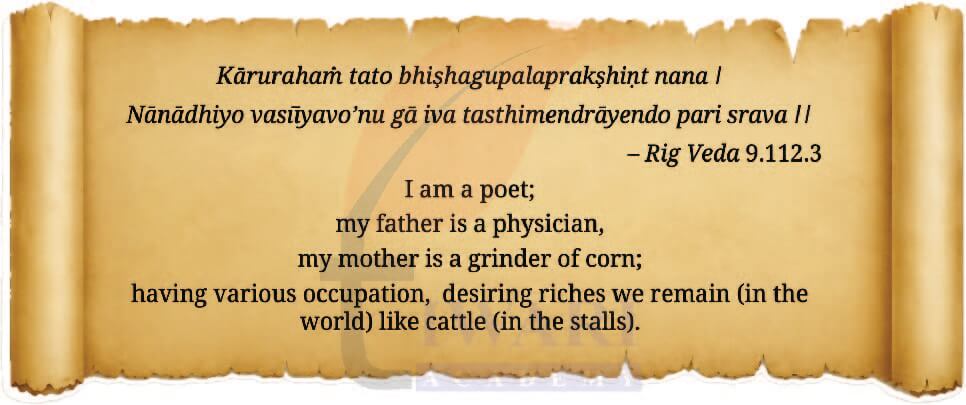
Read the verse given above and discuss it in groups. As you do so, think like historians look for clues in the source and use them to understand what life may have been like.
While discussing, keep these questions in mind:
→ What does the source tell us? (evidence)
→ What can we understand from it? (interpretation)
→ What might it not tell us? (limits of the source)
Now answer the following:
1. What occupations are mentioned in the family described in the verse? What does this indicate about the nature of occupations in Vedic society?
2. How does the above verse challenge the idea that social status and occupation were fixed by birth?
3. What different occupations do you find in contemporary society?
After the discussion, compare you group’s responses with those of another group and note the similarities and differences in interpretation. Did all groups interpret the source in the same way? What does this tell us about how historians use evidence to understand the past?
Answer:
1. The verse from Rig Veda 9.112.3 mentions three different occupations within a single family: the speaker is a poet, the father is a physician and the mother is a grinder of corn. This tells us that in early Vedic society, different members of the same family could practice different occupations without being bound by birth or family tradition. Occupational choice appears to have been based on individual inclination, skill, and economic need rather than hereditary obligation.
2. If occupation had been strictly hereditary in Vedic times, all three members of this family would have been expected to follow the same profession. Instead, we see a poet, a physician and a corn-grinder in one household — entirely different occupations across different social roles (intellectual, medical, agricultural). This is direct evidence from the Rig Veda itself that social identity and occupation in early Vedic society were fluid and not rigidly determined by birth. It challenges the notion that the varna system was always a birth-based, hereditary system from its very origins.
3. Contemporary society has a vastly more diverse range of occupations than early Vedic society – doctors, engineers, teachers, software developers, farmers, traders, lawyers, artists, musicians, journalists, politicians, scientists, chefs, drivers and countless others. Importantly, like the Vedic family in the verse, people today from the same family routinely practice different professions based on individual choice, education and opportunity. This shows a continuity with the early Vedic ideal of occupational flexibility, even as the types of occupations have multiplied enormously.
After-discussion reflection: Different groups likely interpreted the same source differently – some may have focused on the evidence of flexibility, others on what the verse cannot tell us (e.g., whether this was typical or exceptional, whether women’s occupations were equally free). This shows that historical evidence is always interpreted through the perspective of the reader, and historians must acknowledge both what a source reveals and its limits.
Page 126 – LET’S EXPLORE
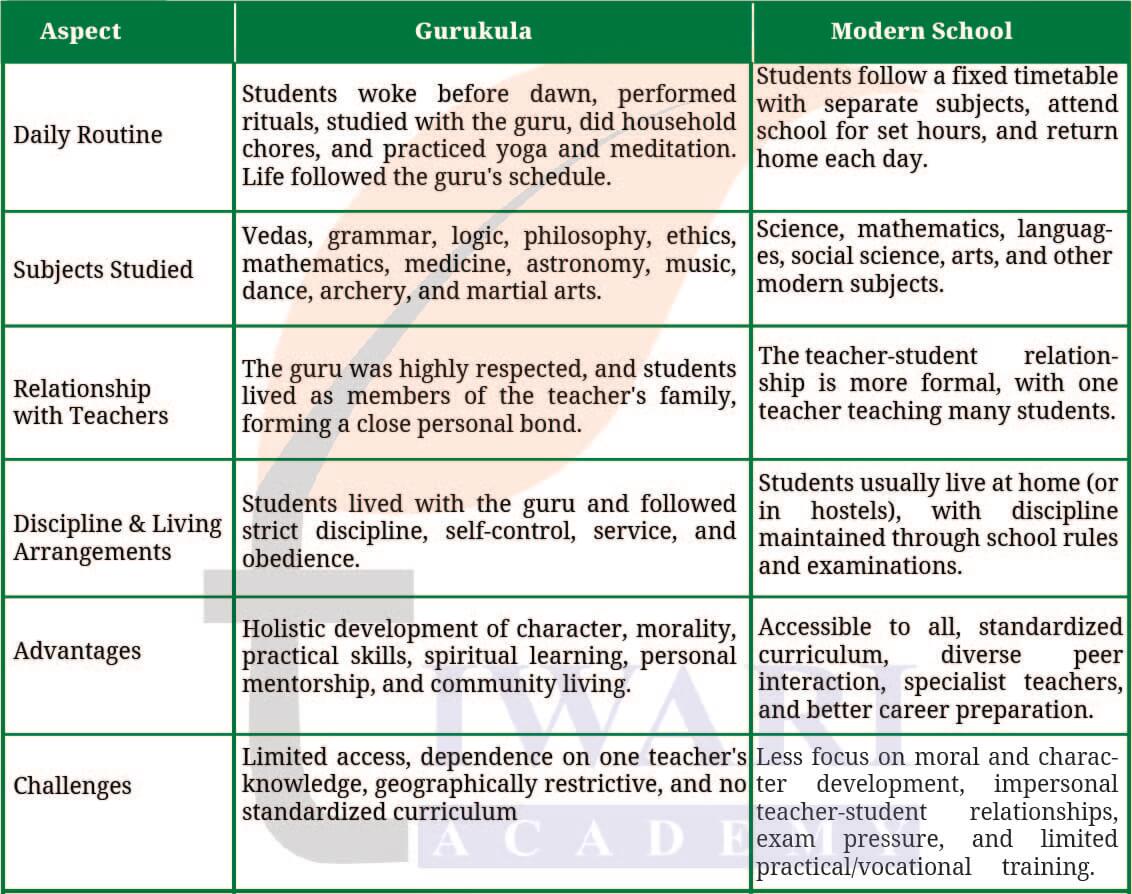
Compare you school life with the life of a student in a gurukula in early India. Think about aspects such as daily routine, subjects studied, relationship with teachers, discipline, and living arrangements. What advantages and challenges do you think each system of education might have for students?
Answer:
Page 129 – THINK ABOUT IT
Why do you think irrigational structures like dams and canals were considered so important that their construction was recorded in inscriptions?
Answer:
Irrigation was the lifeline of the agrarian economy, which was in turn the foundation of state revenue and public welfare. A dam or reservoir that could bring water to previously arid land could transform the economy of an entire region — enabling new settlements, increasing crop yields and expanding the tax base. For rulers, undertaking such public works was both a practical necessity and a powerful demonstration of their ability to benefit their subjects, which was central to their legitimacy.
Recording these works in inscriptions served multiple purposes: it publicized the ruler’s benevolence and capacity for public welfare, it established historical claims to credit for important infrastructure and it created a permanent public record that successor rulers as seen with Sudarshana Lake at Junagadh could reference and build upon. Inscriptions were also a medium of public communication in an era without newspapers or digital media, making major achievements known across the kingdom. In essence, irrigation works and their inscriptions were both practical governance and political communication.
Class 9 Social Science Chapter 5 Exercises Question Answer
Page 133 – Questions and activities
1. How did political organisation change from the Vedic period to the age of large empires such as the Mauryas and the Guptas? Explain the administrative system of the early Indian states.
Answer:
In the Vedic period, society was organized into janas (clans) led by a rājā who was essentially a clan chief. Power was personal and kinship-based, checked by assemblies like the sabhā, samiti and vidhata. Over time, these clans settled into fixed territories, giving rise to janapadas (roughly 1000–600 BCE), where territorial identity supplemented kinship identity. By around 600 BCE, more powerful units — the mahājanapadas – had emerged, with sixteen such entities mentioned in sources. Magadha, through its strategic location, iron resources and capable rulers, gradually absorbed the others and became the foundation for the Mauryan Empire (321 BCE), which spanned most of the subcontinent.
The administrative system evolved correspondingly. The Mauryan state was divided into provinces, each administered by a governor (often a royal prince), further subdivided into districts (with pradeśhikas) and villages (with village headmen). The king governed with a council of ministers (mantri-pariṣhad) and the seven constituents of the state (Saptāṁga) as identified by Kautilya. Later empires like the Guptas and Cholas maintained similar multi-tiered systems, with some decentralization especially in village governance, where assemblies managed local affairs with considerable autonomy.
2. Describe the role of the king, important officers, and the methods used to govern large territories.
Answer:
The king was the supreme head of state – protector of subjects, administrator of justice and commander of the military. He was expected to be energetically active, morally virtuous and impartial in judgment. He did not rule alone; the council of ministers (mantri-pariṣhad) – comprising the treasurer, chief tax collector, legal advisor and commander-in-chief – advised and supported him. At the provincial level, governors (often royal relatives) administered large regions. District officers (pradeśhikas) handled judicial and administrative functions and consulted prominent local figures like bankers and caravan leaders. Village headmen (grāmikas) managed the smallest units. Cities had their own governors for revenue and law enforcement.
Large territories were governed through this hierarchy of officials, combined with a system of inspectors and spies (as described in the Arthaśhāstra) who monitored administration and reported to the king. Land revenue, trade regulation and military organization were all centrally directed but locally executed. Village assemblies provided grassroots self-governance, reducing the burden on central authorities.
3. After studying this chapter what do you think were the most important features of the state and society in India before 1000 CE?
Answer:
After studying this chapter, I think the most important features of early Indian state and society were the following:
First, political organisation evolved gradually – from kinship-based clans (janas) led by a rājā, to territory-based janapadas and mahājanapadas, and finally to large empires like the Mauryas, Guptas and Cholas. This shows that Indian statehood developed step by step over a long period of time.
Second, the king never ruled alone. From the Vedic assemblies (sabhā, samiti, vidhata) to the council of ministers and self-governing village assemblies, there was always some system of consultation that balanced royal power.
Third, administration was well organised, with the empire divided into provinces, districts and villages, each managed by officials. The village remained the smallest unit and was largely self-reliant, managing its own irrigation, justice and tax collection, as seen in the Uttaramerur inscription.
Fourth, dharma formed the ethical foundation of both governance and society. Kings were expected to protect their subjects and ensure justice, not just rule by force.
Fifth, society was organised through the varṇa and jāti system, which began as flexible and occupation-based but gradually became more rigid over time.
Finally, the economy was based on agriculture, supported by irrigation works, while trade, ports and guilds added to its strength.
Overall, the most important feature is that despite the rise and fall of many dynasties, India showed remarkable continuity in its political ideas, social institutions and cultural traditions.
4. What do early texts such as the Rig Veda, Arthashastra, and the Mahabharata reveal about political and social life?
Answer:
The Rig Veda reveals that early Vedic society was organized into clans (janas) with assemblies (sabhā, samiti, vidhata) that checked the rājā’s power. It shows occupational flexibility in society and the importance of collective decision-making. It also reveals a world deeply connected to nature through ritual and worship.
The Arthaśhāstra reveals a sophisticated theory of statecraft – the Saptāṁga model of the state, the importance of trained administration, revenue systems, trade regulation and the moral duties of the king. It shows that governance in this period was both pragmatic and ethically grounded.
The Mahābhārata, through the Śhānti Parva and other sections, reveals the king’s moral duties — protection, justice, impartiality and the ethical framework (dharma) that was expected to guide all social relationships. It also shows awareness of social complexity through characters from all varṇas who uphold the principle of samatva.
5. What can we learn from early Indian society about varna and the role of women?
Answer:
Varṇa in its early form was a functional social classification brāhmaṇas (knowledge/teaching), kṣhatriyas (warfare/administration), vaiśhyas (trade/agriculture) and śhūdras (service) based more on occupation than birth. Early texts show considerable flexibility, with individuals from diverse backgrounds becoming rulers and professionals across categories. Over time this flexibility reduced and jāti became the more rigid social reality.
Regarding women: in the Vedic period, women participated in scholarly learning, attended the sabhā, performed rituals and some composed hymns of the Rig Veda. However, their status fluctuated over time. Sangam literature shows women as active in agriculture, trade and culture. Royal women like Prabhāvatī Gupta issued land grants and governed as regents. Yet social prejudices also grew over time, restricting women’s roles in many contexts. The picture is therefore complex significant participation and respect in certain periods and contexts, but also increasing restrictions over time.
6. Explain how assemblies like sabha and samiti limited the power of the raja. Which modern institutions perform similar functions today?
Answer:
The sabhā served as a judicial assembly of select elites, effectively limiting the king’s arbitrary authority in matters of law. The samiti was a larger policy assembly representing the broader population, which the king had to consult for major decisions. The vidhata was an open gathering for warfare and political discussion. Together, they ensured that royal authority was not absolute – the king needed the consent or advice of these bodies for important matters.
Modern equivalents: the Parliament of India performs functions similar to the samiti – it represents the people and checks executive power through debate, legislation and Question Hour. The Supreme Court and High Courts perform functions similar to the sabhā – they adjudicate disputes impartially and can even overrule the government. The Gram Sabha at the village level is a direct descendant of the Vedic vidhata tradition of community gatherings.
7. What do the terms varna and jati refer to in early Indian society? How were they different, and what factors may have contributed to the formation of various jatis?
Answer:
Varṇa referred to four broad social categories (brāhmaṇa, kṣhatriya, vaiśhya, śhūdra) based primarily on function and occupation. The number of varṇas was fixed at four and in early times the categories were relatively flexible. Jāti, on the other hand, emerged gradually as a more specific, endogamous social group – typically defined by hereditary occupation, regional identity and marriage practices. Unlike varṇa, jātis were unlimited in number and grew as new occupational groups, migrating communities, and regional variations developed.
Factors contributing to the formation of jātis included: intermarriage between varṇas creating mixed groups; migrating communities becoming endogamous (marrying only within their group) over time; territorial differences creating regional community identities; and the gradual hardening of occupational heredity as economic specialization deepened. As the chapter notes, Sangam literature from the Tamil region shows society organized more by occupation than by a rigid varṇa framework, suggesting that jāti formation was driven more by economic and social realities than by any theoretical scheme.
8. Why do you think education in early India emphasised both knowledge and moral values? How might this have benefited society?
Answer:
Early Indian thinkers understood that knowledge without ethics is dangerous – it can be used for exploitation or harm – while ethics without knowledge is ineffective. Education was seen as a preparation for life in its entirety, not just for a career. Dharma required individuals to fulfill duties towards family, teachers, society and the cosmic order. A student who had only technical knowledge but lacked moral character could not be a good member of society.
The benefits for society were enormous. Citizens educated in both knowledge and values were more likely to be honest, fair and public-spirited. Rulers trained in the Arthaśhāstra’s ethical statecraft were better administrators. The guru-śhiṣhya tradition also created networks of trust and knowledge transmission that sustained intellectual traditions across centuries and political changes. This integration of moral and intellectual education arguably contributed to the continuity of Indian civilization even through repeated political upheavals.
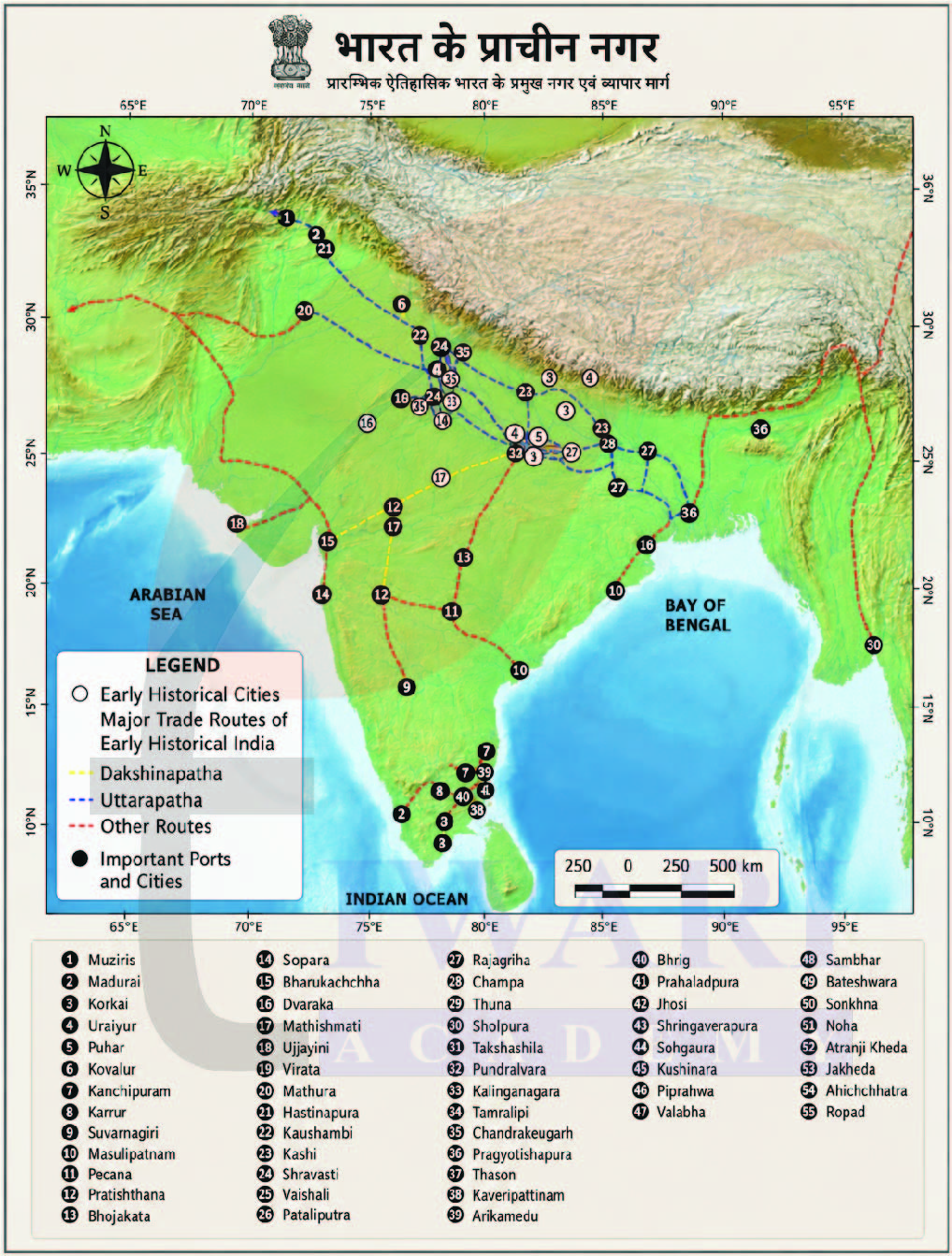
9. Look at the major trade routes of early India (Fig 5.12.). How do you think these routes helped people in the exchange of goods skills beliefs, and cultural practices.
Answer:
The major trade routes – Uttarāpatha (the northern route from the northwest to the east) and Dakṣhiṇāpatha (the southern route connecting the north to the Deccan and further south) – were not merely highways for goods. They were corridors of human interaction. Merchants, pilgrims, scholars and armies all moved along these routes, carrying with them not just commodities but ideas, religions, artistic styles, technologies and languages.
Buddhism spread along trade routes from Magadha to the northwest, Central Asia and Southeast Asia. Temple architecture styles, coinage designs and linguistic influences traveled along the same paths. The Sangam literature’s references to northern trade and the Silappadikāram’s description of routes linking Kanchipuram to Poompuhar and Kanyakumari show how southern India was integrated into these networks. Maritime routes further carried Indian cultural and religious influence to Southeast Asia. Trade routes thus functioned as the arteries of cultural integration across the diverse Indian subcontinent.
10. What might have been the advantages and challenges of ruling a large empire in the absence of modern communication systems?
Answer:
Advantages of the situation: rulers had to develop highly decentralized systems where local officials and village assemblies could function independently, making governance more responsive to local conditions. This also meant that the collapse of central authority did not automatically destroy local governance – villages remained self-reliant.
Challenges: messages and orders could take weeks or months to travel across the empire; rebellions could develop before the king could respond; tax revenue could be siphoned off by corrupt local officials without detection; and military mobilization was slow. Kautilya’s Arthaśhāstra addressed some of these challenges by recommending a network of spies and inspectors to monitor administration and report directly to the king. The standardization of administrative units – provinces, districts, villages – also helped create predictable governance structures that did not require constant central direction.
11. Many ideas about governance come from texts composed by scholars and advisors of the king. What might be some limitations of relying only on such sources?
Answer:
Such texts primarily reflect the perspectives and interests of educated elites – usually brāhmaṇas and court scholars – who were not representative of the entire population. They tell us what rulers and advisors thought governance should look like, not necessarily what it actually looked like in practice. The voices of farmers, artisans, women, lower-caste groups and tribal communities are largely absent. These texts also tended to justify existing hierarchies and present the social order as natural and dharmic, which may have served ideological purposes. Furthermore, the moral and administrative ideals described may have been aspirational rather than descriptive – the actual behavior of kings and officials may have often fallen short. Historians therefore need to use these texts critically, triangulating them with archaeological evidence, inscriptions and other literary sources to get a fuller picture.
12. Read the source and answer the questions:
The Nashik cave inscription (2nd century CE) of Ushavadata records:
“Ushavadata, son of Dinika, son-in law of king Nahapana […] has bestowed this cave on the Samgha generally; he has also given a prepetual endowment, three thousand – 300 kahapanas, which, for the members of the Samgha of any sect, and my origin dwelling in this cave, will serve as cloth money and money for outside life (kushana); and those kahapanas have been invested in guild dwelling at Govadhana – 2000 in a weaver’s guild, interest one pratika (monthly) for the hundred, (and) 1000 in another weaver’s guild interest three quarters of a padika (montly) for the hundred.”
a. What does this source tell us about the economic role of guilds?
b. Why were guilds trusted with money deposits?
c. Identify the donor and the donees from the given source.
Answer:
a. The inscription reveals that guilds (śhreṇīs) functioned as financial institutions – essentially banks – that accepted monetary deposits, invested them and paid regular interest. In this case, 3000 kāhāpaṇas were deposited with two weavers’ guilds at Govadhana at different interest rates. The guilds were trusted to manage these funds reliably over time and generate steady income from them. This shows that guilds were far more than just trade associations – they were sophisticated economic institutions capable of credit, investment and financial intermediation.
b. Guilds had established reputations, internal governance structures (including guild courts that enforced discipline), long-standing community ties and collective accountability. Unlike individual merchants who might default or die, a guild as an institution had continuity and collective resources. Their close ties to specific crafts and localities made them stable and trackable. The fact that a royal figure (Ushavadāta) and a religious community (the Buddhist Sangha) trusted guilds with significant sums reflects their high standing and proven reliability in the early Indian economy.
c. The donor is Ushavadāta (also spelled Uśhavadāta), son of Dinika and son-in-law of the Śhaka king Nahapāna. The donees are the Saṁgha (the Buddhist monastic community) generally – specifically the monks of any sect or origin dwelling in the cave. The two weavers’ guilds at Govadhana are the intermediate financial agents who hold and invest the endowment, with the interest going to support the monks’ needs (cloth money and living expenses).
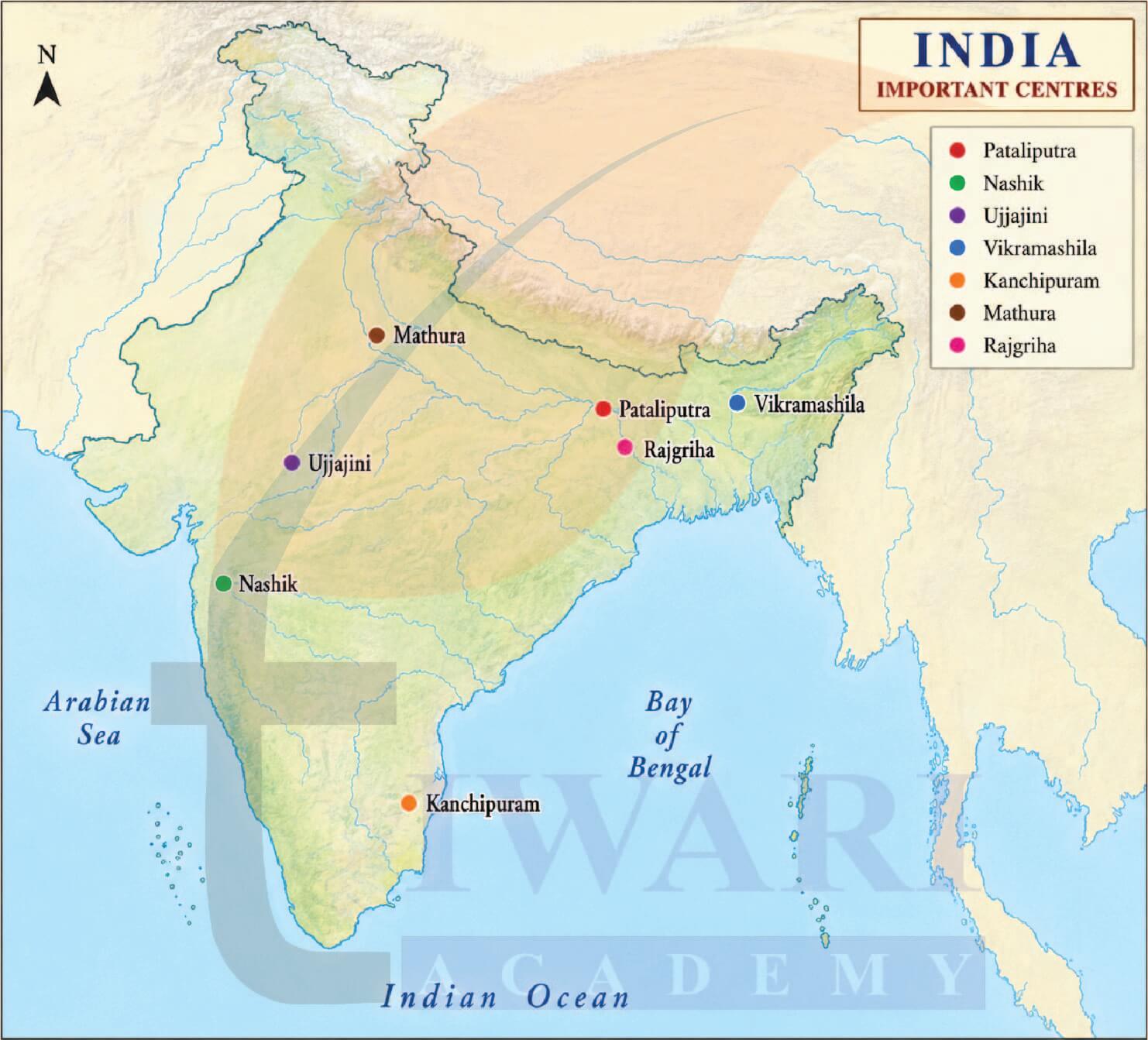
13. Mark and locate on the map of India the following important centres: Pataliputra, Nashik, Ujjajini, Vikramashila, Kanchipuram, Mathura, Rajgriha.
Answer:
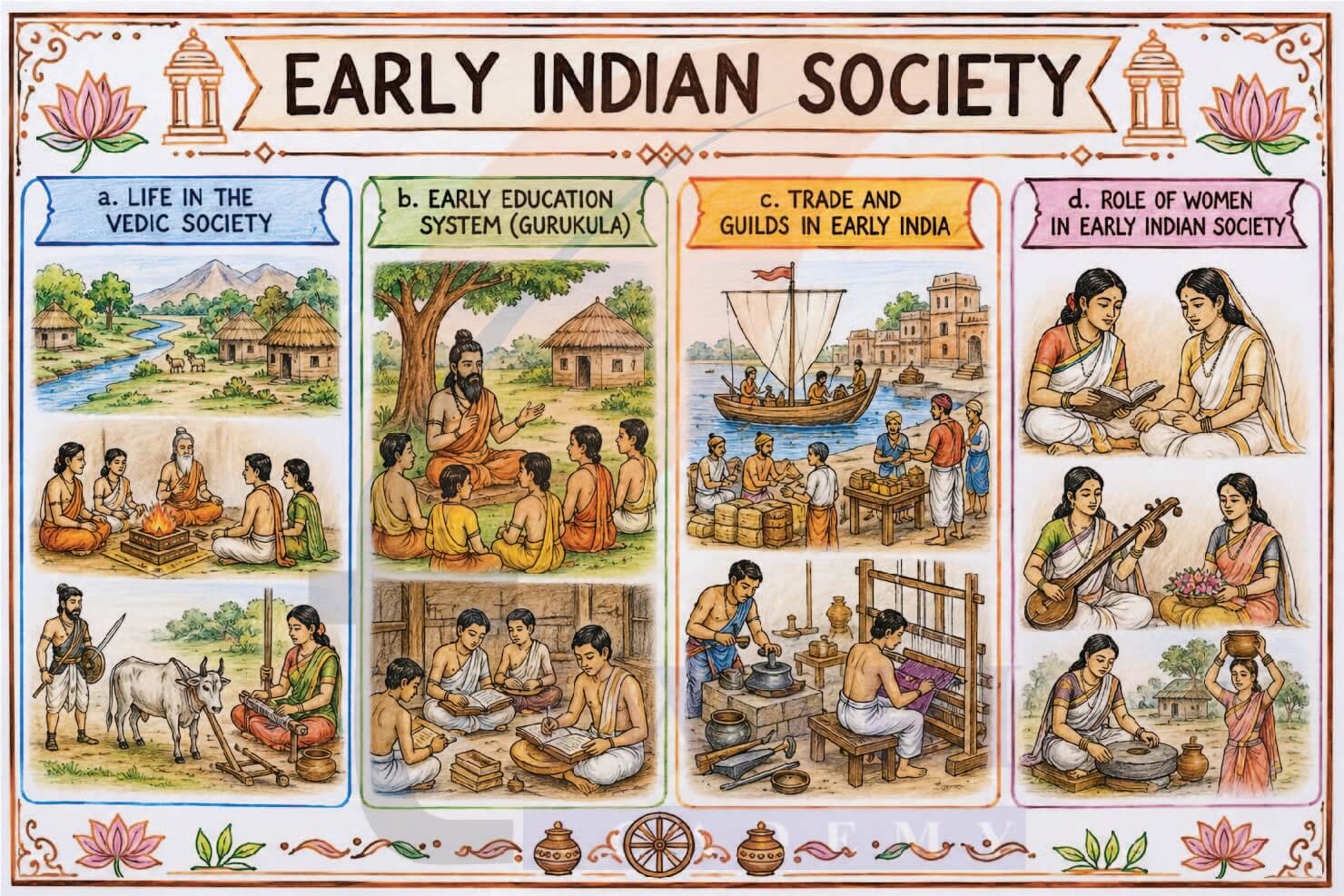
14. Preparation a short presentation or poster on one of the following
a. Life in the Vedic society
b. Early education system (gurukula)
c. Trade and guilds in early India
d. Role of women in early Indian society
Answer:
a. Clan-based organization; assemblies (sabhā, samiti); rājā as clan chief; nature worship and yajñas; flexible varṇa; role of women as scholars and ritual performers; guru-śhiṣhya tradition; āśhrama system.
b. Student lived with teacher; holistic curriculum (Vedas, arts, sciences, martial arts, yoga); sacred guru-śhiṣhya relationship; moral character as foundation; centres like Takṣhaśhilā, Nālandā, Vikramśhila.
c. Uttarāpatha and Dakṣhiṇāpatha routes; major ports (Muziris, Arikameḍu, Kāveripaṭṭinam); guilds as trade and banking institutions; Nāśhik inscription evidence; coins from silver punch-marked to gold; trade with Rome.
d. Vedic women scholars (Apālā, Lopāmudrā); sabhā attendance; chariot races; Sangam women in agriculture, trade, poetry (Avvaiyar); royal women as donors and regents (Prabhāvatī Gupta); Chola period temple patronage (Sembiyan Mahādevī); fluctuating status over time.
Practice Question Answers for Exam Preparation
Class 9 Social Science Chapter 5 Very Short Answer Type Questions with Explanation.
Very Short Answer Type Questions
1. What does the term janapada literally mean?
See AnswerWhere a people (jana) first set its feet—indicating a shift from kinship-based to territorial identity.
2. Name the three Vedic assemblies.
See AnswerSabhā, Samiti and Vidhata.
3. Who were the pañchajana?
See AnswerFive janas—Yadu, Turvasha, Puru, Anu and Druhyu—mentioned collectively in the Ṛig Veda.
4. What is chakravarti kśhetra?
See AnswerThe “domain of a universal paramount ruler”, equated with the area between the Himalayas and the sea.
5. Name the seven constituents of Kauṭilya’s Saptāṁga.
See AnswerKing, ministers, territory, forts, treasury, army and allies.
6. What were bhuktis and manḍalas?
See AnswerProvincial divisions of kingdoms in the north (bhuktis) and south (manḍalas) between 300–800 CE.
7. What is a Brahmadeya village?
See AnswerA tax-free land grant village given by the Pallava dynasty.
8. What were agrahārams?
See AnswerLand grants given by the Chālukyas to Brahmin settlements, some becoming centres of learning.
9. Name the four āśhramas of life.
See AnswerBrahmacharya, Gṛihastha, Vānaprastha and Saṁnyāsa.
10. What are the four puruṣhārthas?
See AnswerDharma, artha, kāma and mokṣha.
11. Who composed hymns among Vedic women sages?
See AnswerApālā, Vishvavārā, Ghoṣhā and Lopāmudrā.
12. What was the Kudavolai system used for?
See AnswerSelecting members for Chola village assemblies through a ballot-pot draw.
13. What were guilds called in early India?
See AnswerŚhreṇīs—associations of traders, artisans and merchants in the same profession.
14. Name two important early trade routes.
See AnswerDakṣhiṇāpatha and Uttarāpatha.
15. What does the Junagadh Rock Inscription record?
See AnswerInscriptions of three rulers—Ashoka, Rudradaman I and Skandagupta—across 700 years.
Class 9 Social Science Chapter 5 Short Answer Type Questions with Explanation.
Short Answer Type Questions
1. How did the role of the rājā change from the Vedic period onward?
See AnswerInitially a clan chief leading in warfare, the rājā later became a monarch with titles like mahārāja and samrāṭ, though texts still mention election or expulsion, showing authority wasn’t always absolute.
2. What was the significance of the Uttaramerur inscription?
See AnswerIt describes Chola village governance, detailing the Kudavolai ballot system for elections, candidate eligibility (honest earnings, purity of mind) and specialised committees (variyams) managing local functions.
3. How did trade develop in early India?
See AnswerTrade expanded through land routes (Dakṣhiṇāpatha, Uttarāpatha) and maritime networks connecting ports like Muziris and Kāveripaṭṭinam, facilitating exchange of textiles, gems and metals within India and abroad.
4. What functions did guilds perform beyond craft production?
See AnswerGuilds regulated quality and prices, supervised member conduct through guild courts and also functioned as banks, accepting deposits and paying interest, as seen in the Nashik cave inscription.
5. How did the varṇa system function according to early texts?
See AnswerVarṇa was based on values with knowledge at the top; roles were functional, not fixed by birth—texts like the Sutta Nipāta stress deeds, not birth, define a brāhmaṇa.
6. What role did women play in Vedic and Sangam society?
See AnswerVedic women participated in scholarly and ritual life, with some hymns attributed to them; Sangam women performed agrarian tasks and included notable poetesses like Avvaiyar.
7. How was the Mauryan economy organised around agriculture?
See AnswerLand was classified into categories, taxed at one-sixth of produce, with the state promoting expansion by clearing forests while protecting some, ensuring steady revenue.
8. What is the concept of dharma as explained in the chapter?
See AnswerDharma means duty, righteousness, and moral conduct rather than religion—it guides individuals to perform responsibilities according to their role in society for social harmony.
9. Describe the administrative structure under the Guptas.
See AnswerThe mantri headed civil administration; a new post, sāndhivigrahika (minister of peace and war), was added; amātyas evolved into kumārāmātyas at local/provincial levels.
10. What was the significance of village assemblies across kingdoms?
See AnswerVillage assemblies (like variyams) functioned independently of royal administration, managing irrigation, justice and taxation—seen across Pallava, Chālukya and Chola territories.
Class 9 Social Science Chapter 5 Long Answer Type Questions with Explanation.
Long Answer Type Questions
1. Trace the evolution of political organisation from the Vedic period to the age of empires.
See AnswerPolitical organisation began with kin-based janas led by a rājā, supported by assemblies (sabhā, samiti, vidhata). Over time, this evolved into territorial janapadas and larger mahājanapadas (600 BCE–300 CE), comprising monarchies and republics. This eventually led to pan-Indian empires like the Mauryas and Guptas, with complex administrative systems including provinces, districts and villages, while retaining ideals like the chakravarti samrāṭ.
2. Explain how empires were administered in early India, citing examples.
See AnswerEmpires divided kingdoms into provinces, districts and villages, with governors and officers at each level. The Satavāhanas had āhāras led by amātyas; Guptas retained Kauṭilya’s system with new posts like sāndhivigrahika; Pallavas and Chālukyas combined centralised monarchy with autonomous village assemblies (variyams); Cholas had efficient revenue systems with maṇḍalams, nāḍus and self-reliant village councils, ensuring decentralised yet cohesive governance.
3. Discuss the relationship between varṇa and jāti, and the factors behind social mobility in early India.
See AnswerVarṇa was originally a functional, fourfold classification based on occupation, not birth, as shown by the Ṛig Vedic verse of a poet’s diverse family. Over time, jāti emerged from intermarriage, migration, endogamy and regional factors, creating unlimited social groups. However, evidence like the Mandsaur inscription and rulers from diverse backgrounds (Nandas, Guptas) shows considerable social and occupational mobility persisted alongside these categories.
4. Describe the position and contribution of women in early Indian society across different periods.
See AnswerVedic women participated in scholarly life, rituals and assemblies, with hymns attributed to sages like Apālā and Lopāmudrā. Post-Vedic texts like Manu-smṛiti emphasised honouring women. Gupta-era women like Prabhāvatī Gupta ruled as regents; Sangam literature depicts women in agrarian and cultural roles (poetesses like Avvaiyar); Chola women like Sembiyan Mahādevī patronised temple building, showing sustained, though fluctuating, contributions.
5. Explain the significance of trade, guilds and irrigation in supporting the early Indian economy.
See AnswerAgriculture, aided by irrigation structures like the Grand Anicut and Sudarshana Lake dam, formed the economic backbone, taxed at one-sixth of produce. Trade flourished via land routes (Dakṣhiṇāpatha, Uttarāpatha) and maritime ports (Muziris, Kāveripaṭṭinam), connecting India to Rome and beyond. Guilds (śhreṇīs) organised craftspersons, regulated quality/prices and functioned as financial institutions, as shown in the Nashik cave inscription, sustaining commerce across centuries.
Frequently Asked Questions
What topics are covered in Class 9 Social Science Chapter 5?
Class 9 Social Science Chapter 5 covers the Vedic period, janapadas and mahājanapadas, the Mauryan and Gupta empires, southern kingdoms (Cholas, Cheras, Pandyas), administration, the varṇa-jāti system, role of women, education, trade and guilds.
Is Chapter 5 “State and Society up to 1000 CE” important for Class 9 exams?
Yes, Class 9 Social Science Chapter 5 covers key concepts like kingship, dharma and administrative systems, which are frequently asked in board exams through short, long, and source-based questions.
What are the important terms I should focus on in Class 9 History Chapter 5?
Key terms in Chapter 5, “State and Society up to 1000 CE”, include janapada, mahājanapada, varṇa, jāti, dharma, chakravarti samrāṭ, Saptāṁga and gotra—commonly tested in definition-based questions.
Are the NCERT textbook questions of Chapter 5 included on this page?
Yes, along with the NCERT questions from Class 9 Social Science Chapter 5, additional practice questions (very short, short and long answer types) are provided to help with revision.
How should I prepare Class 9 Social Science Chapter 5 for exams?
For Chapter 5, “State and Society up to 1000 CE”, focus on the timeline of political developments, understand key concepts (varṇa, dharma, administration) and practice source-based questions using the inscriptions mentioned in the chapter.
Does Class 9 History Chapter 5 have maps and inscriptions to study?
Yes, Chapter 5 includes several maps (mahājanapadas, trade routes, learning centres) and inscriptions (Junagadh, Nashik, Uttaramerur) that are important for map-based and source-based questions in Class 9 Social Science.