



by Tiwari Academy Team
NCERT Solutions for Class 9 Social Science Chapter 9 The Price Puzzle: What Drives the Market – Exercises Question Answers for CBSE 2026-27 Exam. Have you ever wondered why vegetable prices change from morning to evening or why flight tickets cost more on some days than others? Chapter 9, The Price Puzzle: What Drives the Market, explores the economic forces of demand and supply that determine prices in everyday markets. The chapter explains individual and market demand, the Law of Demand and factors like income, related goods, tastes and seasonality that influence buying behaviour. It also covers individual and market supply, the Law of Supply and how technology, input costs and future expectations affect production decisions. Finally, it introduces market equilibrium and the government’s role in regulating unfair practices, controlling prices and providing public goods for social welfare.
Quick Links:
- Chapter’s Question Answers
- Exercises Question Answers
- Very Short Answer Type Questions
- Short Answer Type Questions
- Long Answer Type Questions
Download Class 9 Social Science App to study Class 9 Social Science Offline.
NCERT Class 9 Social Science Chapter 9 Solutions
Class 9 Social Science Chapter 9 Question Answer
Page 195 – The Big Questions
1. What are the factors that influence the demand and supply of goods and services in a market?
Answer:
The demand for goods and services in a market is influenced by several factors, such as the price of the product, the prices of related goods (substitutes and complements), the income of consumers, their tastes and preferences, the size and composition of the population, seasonal changes and expectations about future prices.
2. How are prices of goods and services determined through demand and supply interactions?
Answer:
Prices in a market are determined by the interaction of demand and supply. According to the Law of Demand, when the price of a good increases, its demand decreases, and when the price decreases, its demand increases. According to the Law of Supply, higher prices encourage producers to supply more goods. The price at which the quantity demanded and the quantity supplied become equal is called the equilibrium price.
3. What is market equilibrium, and does it exist in the real world?
Answer:
Market equilibrium is the point where the quantity demanded equals the quantity supplied, meaning there is no shortage or surplus in the market and prices have no pressure to change further.
In theory, equilibrium is shown as the point where the demand and supply curves intersect on a graph.
However, in the real world, markets are dynamic and constantly affected by changing conditions such as new technology, wages, political events, pandemics and natural disasters. Because of this, real-world equilibrium is never permanently stable; the market keeps adjusting toward a new equilibrium every time conditions change.
4. How and why does the government intervene in the market?
Answer:
The government intervenes in the market to ensure fairness, protect consumers, workers and provide essential public goods. It regulates unfair practices by fixing price ceilings and minimum wages, prevents monopolies, provides public goods such as roads, parks and national defence and controls the prices of essential items during emergencies to protect vulnerable sections of society.
Page 200 – LET’S EXPLORE
Create your own demand schedule for buying notebooks at different prices. At what price would you buy the most? At what price would you stop buying altogether? What could be the reason behind your choices?
Answer:
Demand Schedule for Notebooks
| Price per Notebook (₹) | Quantity Demanded (Notebooks) |
|---|---|
| 20 | 6 |
| 30 | 5 |
| 40 | 4 |
| 50 | 3 |
| 60 | 2 |
| 70 | 1 |
| 80 | 0 |
I would buy the most notebooks at ₹20 because the price is affordable. I would stop buying notebooks at ₹80 because the price is too high compared to my budget. This shows that as the price of notebooks increases, the quantity demanded decreases, which follows the Law of Demand.
Ask your family members if they postponed or preponed buying any product because of future expectations of changes in price?
Answer:
Yes, my family has postponed and preponed purchases based on future price expectations. For example, we preponed buying a refrigerator during a festive sale because we expected its price to increase later. Similarly, we postponed buying a new mobile phone because we expected discounts during an upcoming online sale. This shows that people’s expectations about future prices influence their buying decisions.
Page 203 – LET’S EXPLORE
What happens to the supply of a product in case of a change in the cost of inputs for production, discovery or depletion of resources, weather, disaster, etc.? Discuss in class using examples of diverse goods and services.
Answer:
The supply of a product changes when the conditions of production change. If the cost of inputs such as raw materials, labour or fuel increases, the supply usually decreases because production becomes more expensive. The discovery of new resources increases supply, while the depletion of resources reduces it. Favourable weather increases the supply of agricultural products, whereas droughts, floods or unseasonal rains decrease it. Similarly, disasters such as earthquakes, floods or pandemics can disrupt production and transportation, leading to a fall in supply. Thus, factors that make production easier and cheaper increase supply, while those that make production difficult or costly reduce supply.
Page 204 – LET’S ANALYSE
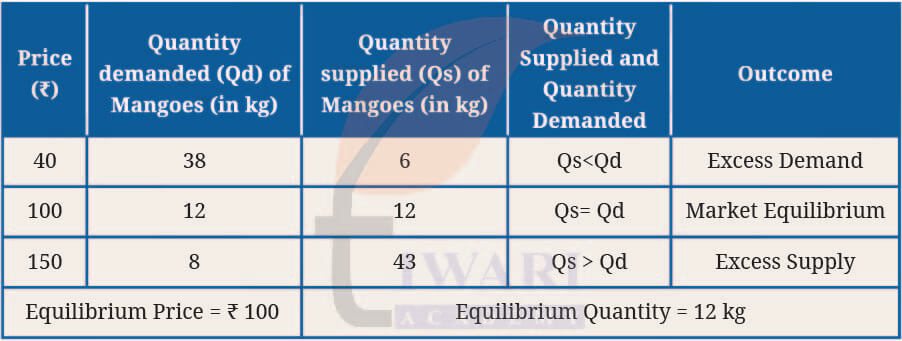
Using data from table 9.3, plot the demand and supply curve at the three prices, i.e., ₹40, ₹100 and ₹150. Identify and mark excess demand and supply on the graph. Think about how equilibrium could be reached in these scenarios.
Answer:
At ₹40, the quantity demanded is 38 kg, while the quantity supplied is only 6 kg, creating excess demand of 32 kg. At ₹100, the quantity demanded and quantity supplied are both 12 kg, so the market is in equilibrium. At ₹150, the quantity supplied is 43 kg, while the quantity demanded is only 8 kg, resulting in excess supply of 35 kg. The market reaches equilibrium at the price of ₹100 and the equilibrium quantity of 12 kg, where the quantity demanded equals the quantity supplied.
Page 205 – THINK ABOUT IT
Can you think of another real-life example (other than hotels) where prices change frequently? Explain why the prices keep changing.
Answer:
A good real-life example is online shopping websites, where the prices of products such as mobile phones, clothes, and electronics change frequently. Prices vary due to factors such as demand, festive sales, stock availability, competition, and special discounts. For example, the price of a mobile phone may be lower during a festival sale or when demand is low, but it may increase when demand is high or stocks are limited.
Our choices today affect future resources. For example, high demand for fast fashion, overfishing and overuse of groundwater can harm future supply. So, should we focus only on short-term gains, or also think about long-term sustainability? How could this affect the market equilibrium?
Answer:
We should not focus only on short-term gains, because overusing resources today, like overfishing or excessive use of groundwater, can lead to shortages in the future. If resources like fish or groundwater are used carelessly now, their supply will fall sharply later, since these resources take time to recover or may not recover at all. This would affect market equilibrium because, with lower supply in the future, prices of these goods would rise sharply, while it would also become harder to meet the same level of demand. Therefore, thinking about long-term sustainability – by using resources carefully and not overusing them – helps maintain a stable supply over time, keeping prices more balanced and avoiding sudden shortages or price spikes in the future.
Page 206 – THINK ABOUT IT
Have you ever seen or heard of the government fixing prices or wages (for example, bus fares, medicines, or minimum wages)? Share an example and why you think it was done.
Answer:
Yes, the government fixes the minimum wages for workers and also regulates the prices of certain essential medicines. These measures are taken to protect workers from exploitation and to ensure that essential goods and services remain affordable for everyone, especially low-income families. By fixing wages and controlling the prices of essential items, the government promotes fairness, protects consumers and improves the welfare of vulnerable sections of society.
Page 207 – LET’S EXPLORE
From your surroundings, list two goods or services that are provided by the government (for example: roads, street lights, parks, police). Choose one of the goods you listed and answer:
Who benefits from it?
Answer:
Two government-provided goods/services from my surroundings:
- Roads
- Street lights
Chosen example: Roads
Everyone in the community benefits from roads, including pedestrians, cyclists, vehicle owners, shopkeepers, students and emergency services such as ambulances and fire brigades.
Why would it be difficult for a private company to provide this service on its own?
Answer:
Roads are public goods that are used by everyone, and it is difficult to charge each person for using them. Since private companies cannot easily earn profits from providing roads, they are generally built and maintained by the government.
Imagine the government stops providing this good or service, what problems might people in your area face?
Answer:
If the government stopped maintaining roads, transportation would become difficult and unsafe. People would face traffic problems, delays in travel, more accidents and difficulties in transporting goods and accessing schools, hospitals and workplaces.
Page 208 – LET’S RECALL
In the chapter ‘Democracy’, you have read that a democratic government is accountable to the people and is expected to act in their interest.
According to you, how should a democratic government decide when and how much it should intervene in markets to protect people’s welfare?
Answer:
A democratic government should intervene in the market whenever it is necessary to protect people’s welfare and ensure fairness. It should act when essential goods become too expensive, when consumers or workers are exploited, or when unfair market practices affect the public. However, the government should avoid excessive interference, as it may discourage production and business growth. Before taking any decision, it should carefully analyse reliable data and act in a way that balances the interests of consumers, producers and the overall economy.
Whose voices should a democratic government consider while making such decisions – consumers, producers, workers, or others? Why?
Answer:
A democratic government should consider the views of consumers, producers, workers and other stakeholders while making market-related decisions. Consumers need fair prices and good-quality products, producers need reasonable profits to continue production, and workers need fair wages and safe working conditions. By considering the interests of all these groups, the government can make balanced decisions that promote fairness, economic growth and the welfare of society as a whole.
Class 9 Social Science Chapter 9 Exercises Question Answer
Page 210 – Questions and activities
1. An increase in income always leads to a rise in demand for goods. Defend or refute, giving reasons for the same.
Answer:
The statement “An increase in income always leads to a rise in demand for goods” is not always true. Although higher income generally increases the demand for normal goods, it does not increase the demand for every good. As people’s income rises, they may stop buying low-quality or inexpensive goods and prefer better-quality alternatives. Therefore, the demand for some goods may decrease even when income increases. Hence, the demand for goods depends not only on income but also on the nature of the goods and consumer preferences.
2. If petrol prices double, what happens to –
a) Demand for diesel cars
b) Demand for electric cars
c) Demand for car accessories
d) Demand for car accessories
Answer:
a) Demand for diesel cars – Since diesel is a substitute fuel, demand for diesel cars may increase, as people look for cheaper alternatives to petrol.
b) Demand for electric cars – Demand for electric cars may also increase, since they don’t use petrol at all and become a more affordable option in comparison.
c) Demand for car accessories – Since cars and accessories are complementary goods, if fewer people buy petrol cars due to rising costs, the demand for related accessories may decrease slightly, although this effect may be small.
d) Demand for public transport – Demand for public transport is likely to increase, as people look for cheaper ways to travel instead of using petrol vehicles.
3. A farmer traditionally irrigates fields manually (labour intensive). He installs drip irrigation (a technology upgrade) that reduces water use by 40% and increases yield by 30%. How does this affect –
a) His cost of production
b) His willingness to supply at different prices
c) The overall market supply if many farmers adopt this technology
Answer:
a) His cost of production will likely decrease, since drip irrigation uses less water and resources, making farming more efficient.
b) Since his cost of production falls and yield increases, he will be more willing to supply larger quantities even at lower prices, since his profit margin improves.
c) If many farmers adopt this technology, the overall market supply will increase, since more farmers can produce more output at lower costs, shifting the supply curve to the right.
4. During online festival sales, the prices of many products are very low. Use the concept of demand and supply to explain why the sellers sell at such a low price. What happens to the equilibrium when the price is lowered? Does this benefit only consumers or sellers as well? Explain.
Answer:
During online festival sales, sellers reduce prices to attract more customers. According to the Law of Demand, a lower price increases the quantity demanded. Although the profit on each item is lower, sellers can earn higher overall revenue by selling a larger quantity of goods and clearing old stock.
When the price is reduced below the original equilibrium price, quantity demanded becomes greater than quantity supplied, creating excess demand. To meet this increased demand, sellers often increase the supply of goods during the sale period.
This benefits both consumers and sellers. Consumers get products at lower prices, while sellers increase their sales, clear inventory and earn higher total revenue through a larger sales volume.
5. Suppose the government sets a maximum sale price for an essential vaccine below the market-driven price. What is likely to happen? Choose from the options below and elucidate your point.
a) Surplus
b) Shortage
c) No effect
d) Fall in demand
Answer:
(b) Shortage
Because:
- When the government fixes a price below the market equilibrium price, the quantity demanded by consumers becomes more than the quantity producers are willing to supply at that lower price.
- Since producers earn less profit at this price, they may reduce production, leading to a situation where demand exceeds supply – this is called a shortage.
6. The government levies higher taxes on products such as tobacco and alcohol to promote healthier choices among citizens. Can you find out other goods where price controls have been set in place? What are the reasons for the same?
Answer:
Some other goods for which the government has set price controls include essential medicines, LPG cooking gas cylinders and food grains such as wheat and rice sold through the Public Distribution System (PDS). The government fixes or regulates the prices of these goods to ensure they remain affordable, protect consumers from overpricing, support low-income families and promote public health and social welfare.
7. Can excessive government regulation hurt markets? Explain with suitable examples.
Answer:
Yes, excessive government regulation can hurt markets if it limits the freedom of producers and businesses. For example, if the government fixes the price of a product too low, producers may earn less profit and reduce production, leading to shortages. Similarly, too many rules, licenses and permits can make it difficult for small businesses to operate or start new ventures. Excessive regulation may also discourage innovation and investment. Therefore, while government regulation is necessary to protect consumers and ensure fairness, too much regulation can reduce efficiency and slow economic growth.
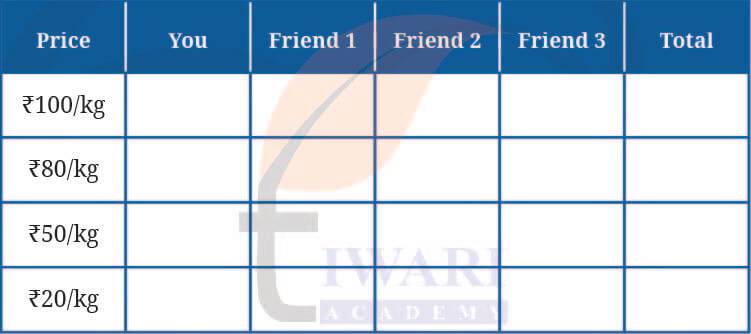
8. In the table below, different prices of guava are given.
a) Think and write how much guava you will buy at each price.
b) Ask the same question to three of your friends and fill in the table.
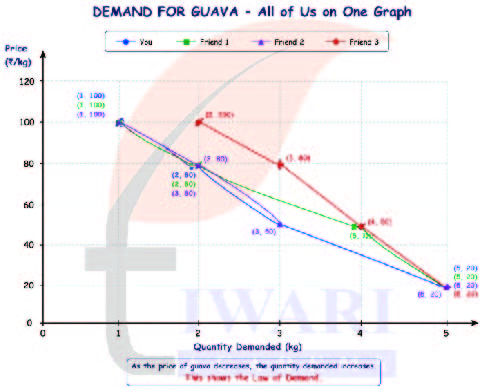
c) Also make a graph for each one of you and one final graph for the total quantity.
Answer:
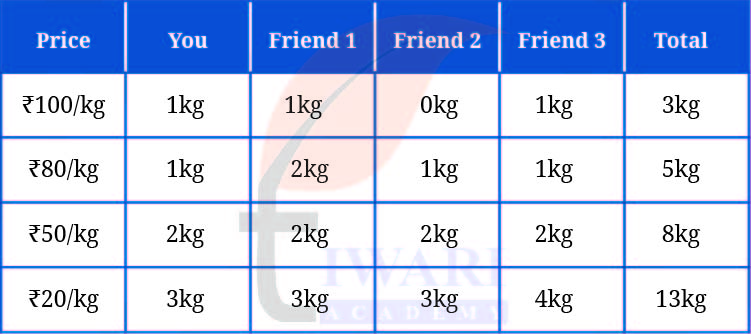
These graphs will slope downward from left to right, showing that as the price of guava decreases, the quantity demanded increases, which illustrates the Law of Demand.
9. Visit the nearby vegetable market and try to find answers to the following questions.
a) Who decides the prices of different vegetables in the market?
Answer:
Prices are mainly decided by the interaction of demand and supply in the market – that is, by the wholesalers, local traders and shopkeepers based on how much vegetables are available and how much buyers are willing to pay.
b) Why are prices of a few vegetables sometimes too high or too low?
Answer:
Prices change due to factors like seasonal availability, weather conditions, transportation costs, festivals and fluctuations in supply from farmers. When supply is low and demand is high, prices rise; when supply is high and demand is low, prices fall.
c) Why is the price of tomatoes high in the morning but lower by evening?
Answer:
In the morning, tomatoes are fresh, and there is high demand from customers buying for the day, so sellers charge higher prices.
By evening, sellers want to clear their unsold stock before it goes bad, so they lower prices to attract more buyers and avoid wastage. This shows supply pressure increasing as the day ends, pushing prices down.
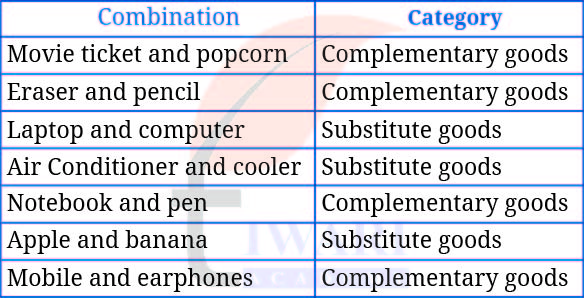
10. Categorise the following combination of goods into substitute goods and complementary goods.
i. Movie ticket in the cinema hall and popcorn
ii. Eraser and pencil
iii. Laptop and computer
iv. Air Conditioner and cooler
v. Notebook and pen
vi. Apple and banana
vii. Mobile and earphones
Answer:
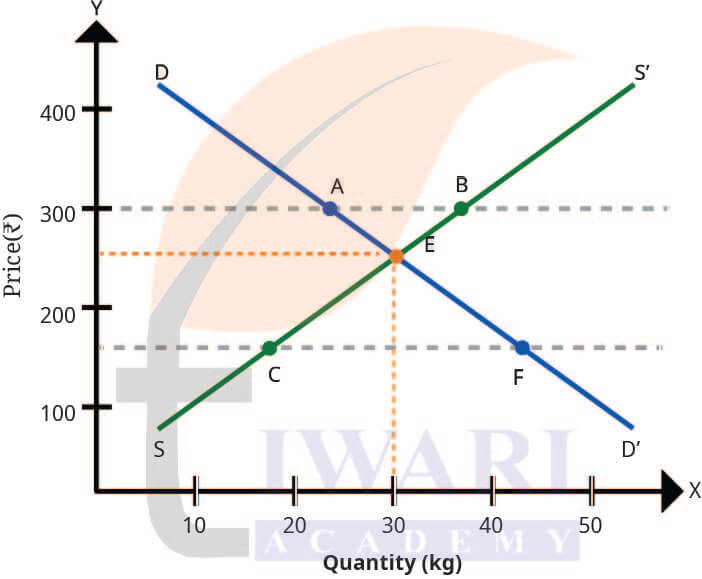
11. Figure 9.8 shows the demand curve DD’ and Supply curve SS’. Based on the figure, answer the following questions:
(i) What does point E represent in this market?
(ii) What is the equilibrium price and equilibrium quantity at point E?
(iii) Point A lies on DD’. Point B lies on SS’. What do the points A and B indicate about demand and supply? What does the gap between A and B (both on the upper dashed price line) represent?
(iv) Point F lies on DD’. Point C lies on SS’. What do the points F and C indicate about demand and supply? What does the gap between C and F (both on the lower dashed price line) represent?
(v) If the price stays at the lower dashed line, what could happen next in a free market?
Answer:
(i) Point E represents the market equilibrium, where the quantity demanded is equal to the quantity supplied.
(ii) The equilibrium price is ₹250, and the equilibrium quantity is 30 kg.
(iii) At the upper dashed price line (₹300), Point A on the demand curve shows the quantity demanded (about 25 kg), while Point B on the supply curve shows the quantity supplied (about 37 kg). Since supply is greater than demand, the gap between A and B represents excess supply (surplus).
(iv) At the lower dashed price line (about ₹170), Point F on the demand curve shows the quantity demanded (about 43 kg), while Point C on the supply curve shows the quantity supplied (about 18 kg). Since demand is greater than supply, the gap between C and F represents excess demand (shortage).
(v) If the price remains at the lower dashed line, there will be excess demand. As many buyers compete for the limited supply, sellers are likely to increase the price. The price will continue to rise until it reaches the equilibrium price of ₹250, where demand and supply become equal.
12. Draw a market equilibrium graph using the following demand schedule.
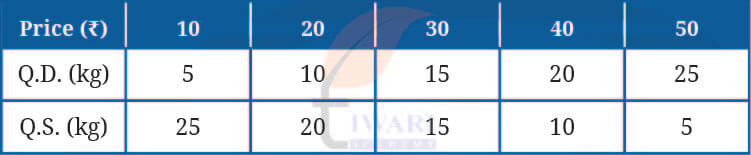
a) Plot the demand and supply curve using the above data.
b) Identify the equilibrium price and quantity.
c) Observe the above data and analyse what happens if the price is set at ₹20 or ₹40.
Answer:
(a) The demand and supply curves can be plotted using the given data. The two curves intersect at the point where Quantity Demanded = Quantity Supplied = 15 kg.
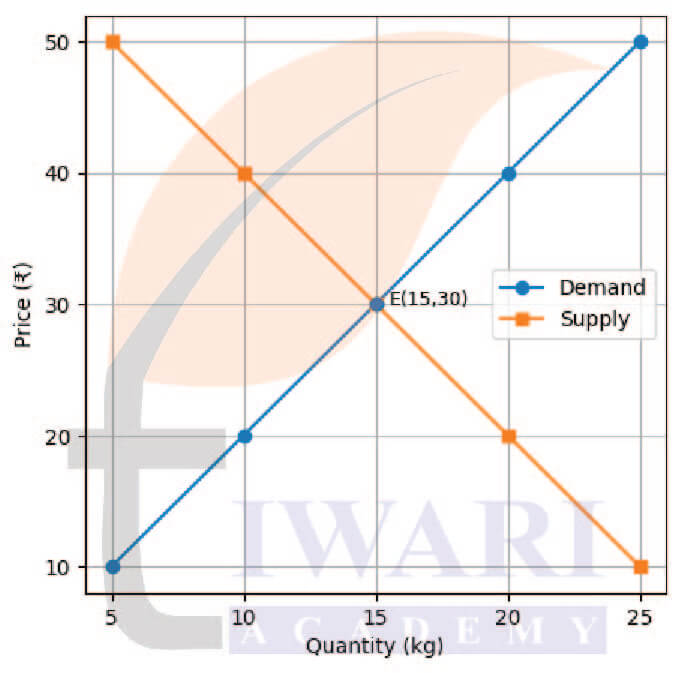
(b) The equilibrium price is ₹30, and the equilibrium quantity is 15 kg.
(c)
- At ₹20:
Quantity Demanded = 10 kg and Quantity Supplied = 20 kg. Since supply is greater than demand, there is excess supply (surplus) of 10 kg. Sellers may reduce the price to sell the excess stock and the market will move towards the equilibrium price of ₹30. - At ₹40:
Quantity Demanded = 20 kg and Quantity Supplied = 10 kg. Since demand is greater than supply, there is excess demand (shortage) of 10 kg. Buyers will compete to buy the product, causing the price to rise until it reaches the equilibrium price of ₹30.
Practice Question for Exam Preparation
Class 9 Social Science Chapter 9 Very Short Answer Type Questions with Explanation.
Very Short Answer Type Questions
1. What is demand?
See AnswerDemand is the quantity of a product people are willing and able to buy at a particular price, depending on needs, preferences and income.
2. What is the Law of Demand?
See AnswerIt shows the inverse relationship between price and quantity demanded – as price rises, quantity demanded falls and vice versa.
3. What is individual demand?
See AnswerIt is the quantity of a good a single consumer wants to buy at different prices, keeping other factors constant.
4. What is market demand?
See AnswerMarket demand is the total quantity of a good demanded by all buyers in a market at different prices; it is the sum of individual demands.
5. What is supply?
See AnswerSupply is the quantity of a product that sellers are willing and able to offer for sale at a particular price.
6. What is the Law of Supply?
See AnswerIt shows a direct relationship between price and quantity supplied – as price rises, quantity supplied increases and vice versa.
7. What are substitute goods?
See AnswerSubstitute goods are products that can replace each other, like tea and coffee; a rise in one’s price increases demand for the other.
8. What are complementary goods?
See AnswerComplementary goods are used together, like cars and petrol; a rise in demand for one raises demand for the other.
9. What is market equilibrium?
See AnswerIt is the point where quantity demanded equals quantity supplied, leaving no shortage or surplus in the market.
10. What is a price ceiling?
See AnswerA price ceiling is a government-imposed maximum price a seller can charge for a good or service.
11. What is a price floor?
See AnswerA price floor is a government-imposed minimum price below which a good or wage cannot be charged or paid.
12. What is a monopoly?
See AnswerA monopoly is a market with a single seller controlling the entire supply of a product, facing no close substitutes.
13. What is diminishing marginal utility?
See AnswerIt is the principle that additional satisfaction from consuming more units of a product decreases as consumption increases.
14. What is purchasing power?
See AnswerPurchasing power is a measure of how much one unit of currency can buy at a particular time.
15. What are public goods?
See AnswerPublic goods are goods and services provided by the government for the benefit of all citizens, such as roads and street lighting.
Class 9 Social Science Chapter 9 Short Answer Type Questions with Explanation.
Short Answer Type Questions
1. Why is the market demand curve flatter than an individual demand curve?
See AnswerMarket demand aggregates many consumers, so the same price change produces a much larger total quantity response than one individual’s response, making the market curve flatter and more responsive.
2. How does income affect demand?
See AnswerWhen household income rises, consumers can afford to buy more or choose higher-quality products, increasing quantity demanded for several goods even if prices remain unchanged.
3. Explain seasonality as a determinant of demand.
See AnswerDemand for products changes at different times of the year due to weather, festivals and cultural habits – for example, sweaters in winter or sweets during festive seasons – independent of price.
4. How do future price expectations affect demand?
See AnswerIf consumers expect prices to fall, they postpone purchases, decreasing present demand. If they expect prices to rise, they buy immediately, increasing present demand, as seen before festival sales.
5. How does technology affect supply?
See AnswerImproved technology reduces production costs, allowing producers to produce and supply more. For example, drip irrigation and cold storage facilities increase crop yield and enable wider market supply.
6. What happens when the number of sellers in a market changes?
See AnswerMore sellers due to competition increase market supply, exceeding demand and lowering prices. Fewer sellers reduce supply below demand, causing prices to rise.
7. Give an example of how government price control worked during COVID-19.
See AnswerDuring COVID-19, sanitiser demand surged, causing hoarding and black marketing. The government capped prices under the Essential Commodities Act and increased production restored fair pricing.
8. Why are public goods usually provided by the government?
See AnswerPublic goods like roads and parks benefit everyone but don’t generate direct profit, and people may avoid paying expecting others to fund them, so government provision ensures fair access.
9. What are the limitations of government intervention in markets?
See AnswerExcessive intervention can distort prices, reduce producer incentives, create compliance burdens for small businesses and discourage innovation and entrepreneurship due to reduced returns.
10. How does population composition affect demand?
See AnswerThe size and age composition of a population shapes demand patterns – more children increase demand for sports shoes, more working adults raise demand for formal shoes and more elderly people increase demand for orthopaedic footwear.
Class 9 Social Science Chapter 9 Long Answer Type Questions with Explanation.
Long Answer Type Questions
1. Explain the various determinants of demand other than price, with examples.
See AnswerBesides price, demand depends on several factors. The price of related goods matters: if a substitute becomes costlier, demand for the other good rises, while a price rise in a complementary good reduces demand for its partner good. Income affects demand — higher income increases purchasing ability. Tastes and preferences, population size and composition, diminishing marginal utility, seasonality (festivals, weather) and future price expectations also significantly influence how much consumers wish to buy at any given time.
2. Describe how market equilibrium is determined and explain the outcomes when price is above or below equilibrium.
See AnswerMarket equilibrium occurs where the demand curve intersects the supply curve, meaning quantity demanded equals quantity supplied, and prices tend to remain stable. If price is set below equilibrium, quantity demanded exceeds quantity supplied, creating excess demand or shortage, pushing prices upward. If price is set above equilibrium, quantity supplied exceeds quantity demanded, creating excess supply or surplus, pushing prices downward. Only at equilibrium is the market “cleared”, with no pressure for price to change.
3. Discuss why market equilibrium is often unstable in real-world situations, using the COVID-19 example.
See AnswerIn theory, equilibrium is where demand equals supply, but real markets are dynamic and constantly disturbed by changing technology, wages, interest rates, weather and events like wars or pandemics. During the COVID-19 pandemic, demand for face masks surged suddenly, but supply could not immediately match it, causing prices to rise sharply. Over time, suppliers increased production to meet demand, and prices gradually fell. Once the pandemic ended, demand reduced further and prices returned to pre-pandemic levels, showing equilibrium is a constantly moving target, not a fixed point.
4. Explain the role of government in regulating unfair market practices and providing public goods.
See AnswerSince markets do not always work fairly, the government intervenes to protect consumers, workers and producers. It sets price ceilings on essential goods like medicines to prevent overcharging, and price floors like minimum wages to ensure fair worker compensation. It also regulates monopolies that could otherwise charge higher prices and reduce supply and quality. Additionally, the government provides public goods such as roads, street lighting, sanitation and national defence, which private firms avoid supplying because they generate no direct profit but are essential for social welfare and equitable access.
5. What are the limitations of excessive government intervention in the economy? Explain with examples.
See AnswerWhile government regulation protects welfare, excessive intervention can harm markets. Fixing prices below market levels, such as capping wheat prices, discourages farmers from producing, causing shortages and reduced motivation to supply. Heavy regulation involving numerous licenses and compliance procedures burdens small businesses, like restaurants needing multiple permits, hampering ease of doing business. Price controls and heavy regulation also discourage innovation, as producers lack incentive to invest in better technology, seeds or irrigation when returns are inadequate, ultimately reducing long-term productivity and economic growth.
Frequently Asked Questions
Is “The Price Puzzle” important for exams?
Yes, it is a core Economics chapter in Class 9 Social Science. Concepts like demand, supply and market equilibrium are frequently asked in both short and long answer questions, along with graph-based numericals.
Are there numerical or graph-based questions from Class 9 Social Science Chapter 9?
Yes, students are often asked to plot demand and supply curves, identify equilibrium price and quantity from a schedule and interpret graphs showing excess demand or excess supply.
What is the difference between demand and market demand?
Demand refers to what one buyer wants at different prices, while market demand is the sum of what all buyers in the market demand at those same prices. This distinction is commonly tested.
Which topics in “The Price Puzzle: What Drives the Market” are most commonly asked in board-style questions?
The Law of Demand and Law of Supply, factors affecting demand and supply, market equilibrium calculations, and the government’s role (price ceiling, price floor, public goods) are the most frequently tested areas.
Is Class 9 Social Science Chapter 9 linked to any previous class syllabus?
Yes, it builds on the Grade 7 chapter “Understanding Markets”, which introduced basic buyer-seller interactions and price adjustments.
What real-life examples does “The Price Puzzle” use to explain concepts?
It uses relatable examples like mango pricing, hotel room tariffs, COVID-19 sanitiser shortages and festival sale discounts to explain demand, supply and government intervention.
How can I best prepare Chapter 9 for exams?
Focus on understanding demand/supply schedules and curves, practice plotting equilibrium graphs, memorize key terms (price ceiling, price floor, monopoly, public goods) and revise the real-world examples given in the chapter.