


by Tiwari Academy Team
NCERT Solutions for Class 9 Social Science Part 2 Chapter 4 Governance and Public Policy – Question Answers for Session 2026-27. These solutions help students understand how decisions that affect our lives are made and carried out. The chapter explains the difference between government and governance, Indian ideas of good governance such as Rājadharma and Rām Rājya, features like transparency, accountability and the rule of law. Students also learn about e-governance, the stages of the policy cycle, stakeholders, NEP 2020 and Khelo Bharat Niti 2025.
NCERT Class 9 Social Science Part 2 Chapter 4 Solutions
Class 9 Social Science Part 2 Chapter 4 Question Answer
Page 81 – The Big Questions
1. What is governance, and how have its meaning and practice evolved over time?
Answer:
Governance is the process of making, implementing and monitoring decisions for public welfare. Indian traditions emphasised rulers’ duties and people’s well-being. Colonial rule introduced different institutions; independent India adapted institutions under the Constitution, giving greater importance to democratic participation, equality and accountability.
2. What is public policy? How does it affect our day-to-day lives, and what makes it ‘public’?
Answer:
Public policy is a planned course of government action to address public problems and promote welfare. It affects schools, healthcare, roads, water and sanitation. It is public because government institutions act for society’s benefit, often using public resources and responding to citizens’ concerns.
3. What are the various stages of policy-making and policy implementation?
Answer:
The stages are identifying a need, setting priorities, consulting stakeholders and formulating a policy, adopting it, implementing it, monitoring progress and evaluating results. Feedback helps revise the policy. Therefore, policy-making is a continuing cycle rather than a single decision.
4. Who are the major contributors to policy-making and implementation?
Answer:
Contributors include citizens, elected representatives, government departments and officials, local bodies, civil society organisations, researchers, experts, media, businesses and international organisations. Their roles differ: they identify needs, approve decisions, provide expertise, deliver services or assess results.
5. What role do citizens play in shaping public policy and strengthening good governance?
Answer:
Citizens identify problems, elect representatives, join consultations, suggest solutions and give feedback. They also obey laws, protect public property and hold authorities accountable. Informed participation helps policies reflect people’s needs and makes implementation more responsive.
Page 82 – Let’s Explore
Form groups and discuss the following.
→ Who are the different people and organisations involved in dealing with this situation?
→ Why cannot a single department solve the problem on its own?
→ What would happen if these departments did not communicate or coordinate with one another?
→ What role can citizens play before, during, and after the heavy rainfall?
→ What makes the collective response effective?
Share your ideas with the class. Make a list of the qualities that help the town respond effectively. These qualities are essential whenever governments and society work together to solve public problems.
Answer:
1. The municipal corporation, Public Works Department, police, schools, health workers, elected representatives and residents respond to the heavy rainfall.
2. Flooding involves drainage, roads, electricity, health and transport, so one department lacks all the required responsibilities and expertise.
3. Poor communication causes delays, duplicated work, unsafe routes and neglected areas.
4. Before rain, residents keep drains free of waste and report problems; during it, they follow warnings and help vulnerable neighbours safely; afterwards, they report damage and support clean-up.
5. Clear roles, shared information, timely action, adequate resources and public cooperation make the response effective.
Pages 83–84 – Let’s Explore
Can you identify more such examples from your day-to-day life to understand the difference between government and governance?
Answer:
Water supply: The Delhi Jal Board is an institution; planning supply, repairing leaks and responding to complaints are governance processes.
Waste collection: A municipal body is part of government; setting collection routes, consulting residents and checking cleanliness show governance. Government identifies the authority; governance describes how it works.
Page 85 – Let’s Explore
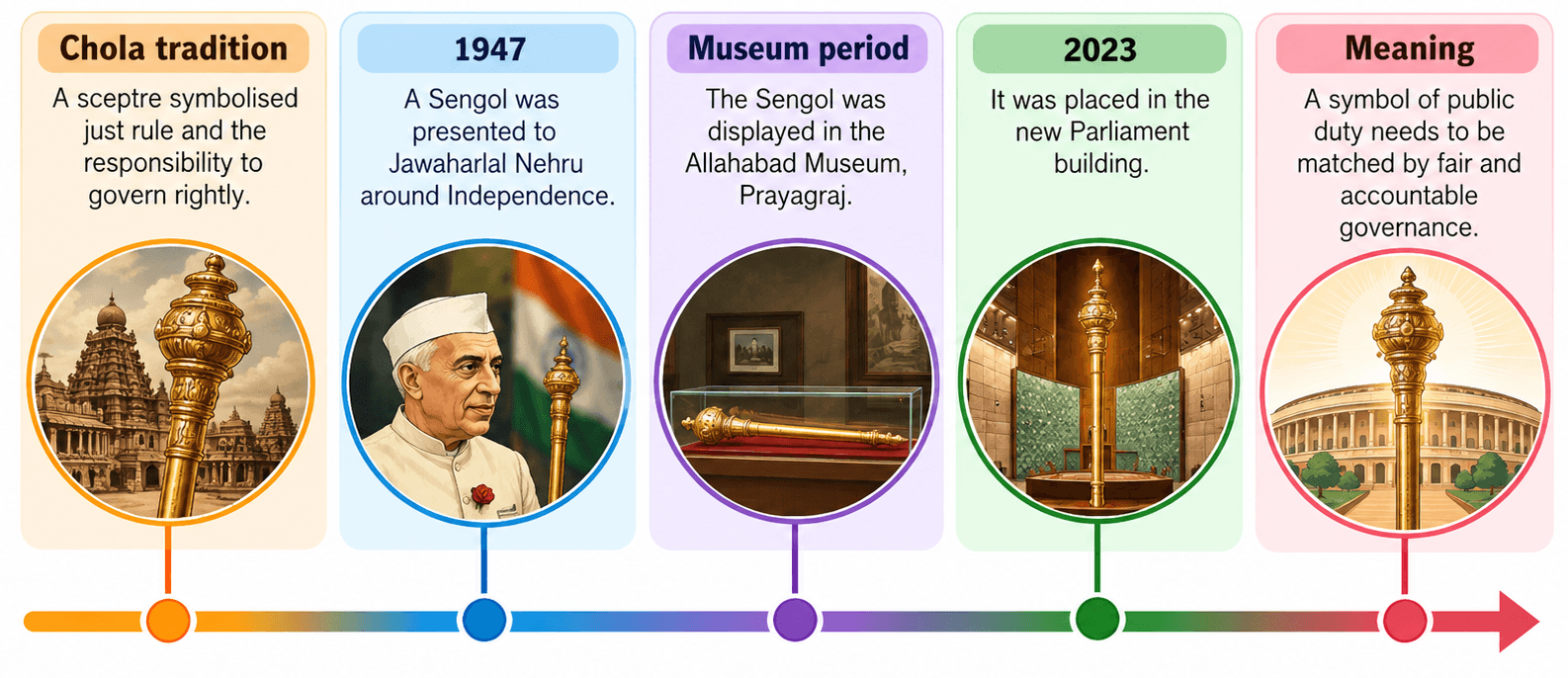
Try to find out more about the journey of the Sengol through its historic pictures.
Answer:
The Sengol represents righteous rule in a Tamil tradition associated with the Cholas. A Sengol was presented to Jawaharlal Nehru around Independence in 1947; it was later displayed in the Allahabad Museum and placed in the new Parliament building in 2023.
Page 87 – Let’s Explore
Select two cities (one should be from a region other than yours) in India that have received awards for being the cleanest city. Make a visual presentation (chart paper or slideshow) to explain the ‘good governance model’ used in those cities by looking into the role played by government agencies (local, State, and national), residents, market associations, civil society organisations, etc. Also look into the steps they are taking to continue being clean cities.
Answer:
Comparison: Indore (Madhya Pradesh) and Surat (Gujarat) jointly received the cleanest-city award in Swachh Survekshan 2023, announced in January 2024. Both are outside Delhi. Municipal bodies organise collection, transport and processing; state and national agencies support policy, funding and assessment. Residents segregate waste, traders maintain market cleanliness and community organisations spread awareness. Continuing cleanliness requires dependable daily services, worker safety, monitoring and prompt correction of complaints. Awards describe a particular assessment, not a guarantee that every service is always satisfactory.
Page 88 – Let’s Explore
Form pairs or groups and assign one State or Union Territory to each group. Prepare a short classroom discussion paper on:
1. Good governance initiatives being implemented.
2. Suggestions for further improving governance.
Answer:
Delhi discussion paper: e-District provides online access to government services and certificates; online transport services reduce some office visits. These initiatives can improve convenience and make application status easier to check. Improvements should include clear deadlines, reliable complaint tracking, accessible websites and assisted counters for people without internet or digital skills. Evaluate success through actual service delivery, not just the number of portals.
Did you know that 25th December is celebrated as National Good Governance Day? Can you find out why this date was chosen? How is National Good Governance Day celebrated in your district? Discuss in your class.
Yes, 25th December is celebrated every year as National Good Governance Day (Sushasan Diwas) in India.
Why this date was chosen: The date marks the birth anniversary of former Prime Minister Atal Bihari Vajpayee, who was born on 25th December 1924. The Government of India began observing this day in 2014 to honour him. He is remembered for working towards transparent, accountable and people-centred administration. The day reminds the government of its responsibility to citizens and encourages good governance at every level.
How it is celebrated in my district (Delhi):
I live in Delhi, where National Good Governance Day is celebrated in the following ways:
- Good Governance Week: In the week before 25th December, the offices of the District Magistrates in Delhi hold special camps. These camps help people get quick solutions to their complaints and faster delivery of services.
- Public grievance camps: Officials of the Delhi Government, the Municipal Corporation of Delhi (MCD) and the New Delhi Municipal Council (NDMC) meet residents. They help with problems such as certificates, pensions, ration cards, water supply, sanitation and property tax.
- Pledge-taking: Government employees in Delhi take a pledge to work honestly, transparently and responsibly.
- Programmes in schools: Our school organises essay writing, debate, quiz, poster-making and nukkad natak (street play) competitions on themes like good governance, e-governance and citizens’ duties.
- Awareness about e-governance: People are encouraged to use online services such as DigiLocker, UMANG and CPGRAMS, and Delhi’s own e-District portal for certificates and other services.
- Tributes and recognition: Leaders and citizens pay tribute to Atal Bihari Vajpayee at Sadaiv Atal, his memorial in Delhi. Officials and departments that have done outstanding public service are also honoured.
Class discussion:
In our class discussion, we realised that good governance in a big city like Delhi needs everyone’s cooperation. As students and citizens, we can help by keeping our surroundings clean, following traffic rules, saving water and electricity, reporting problems through official apps and portals, and spreading awareness. National Good Governance Day reminds us that the government and the people must work together to make Delhi a better place to live.
Page 89 – Let’s Explore
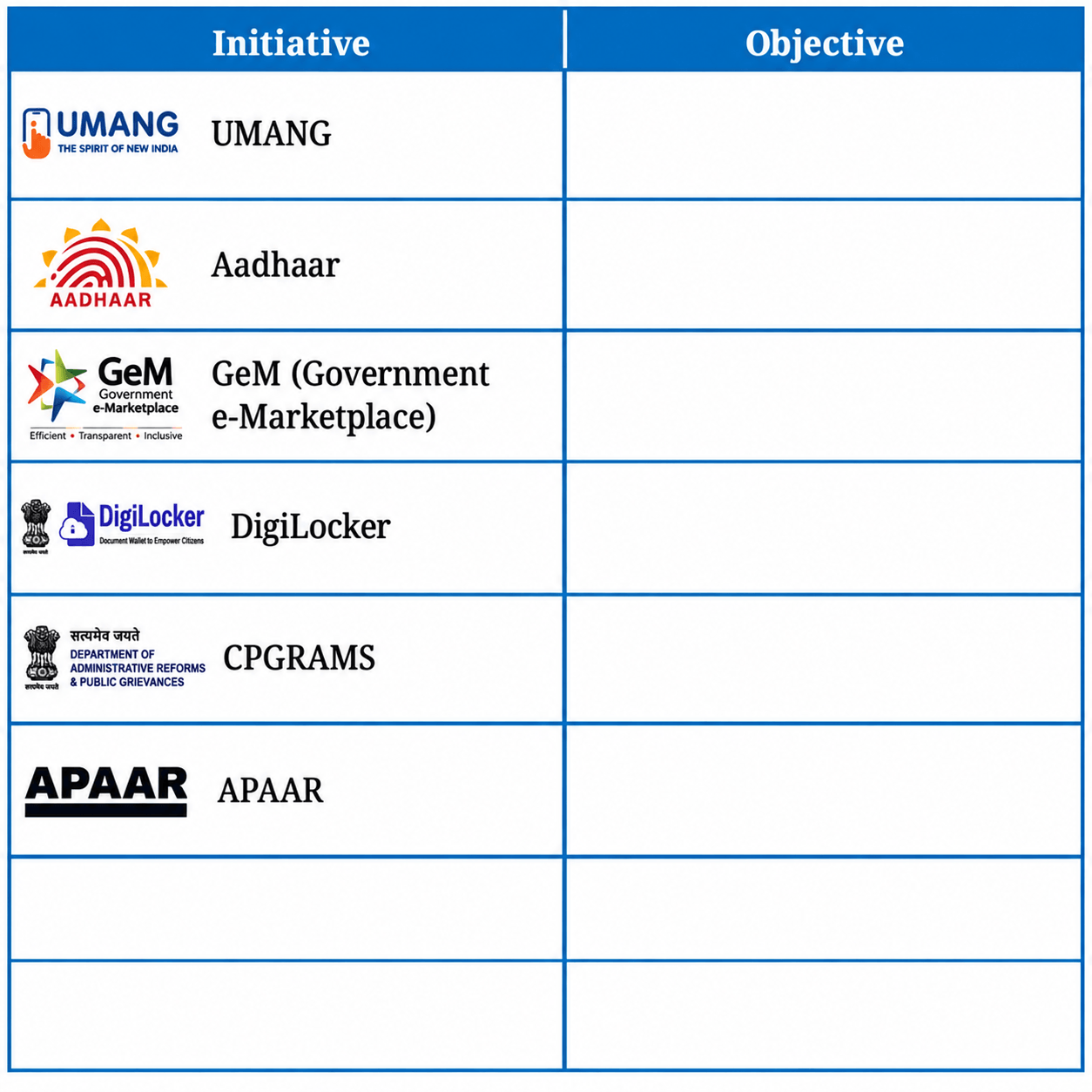
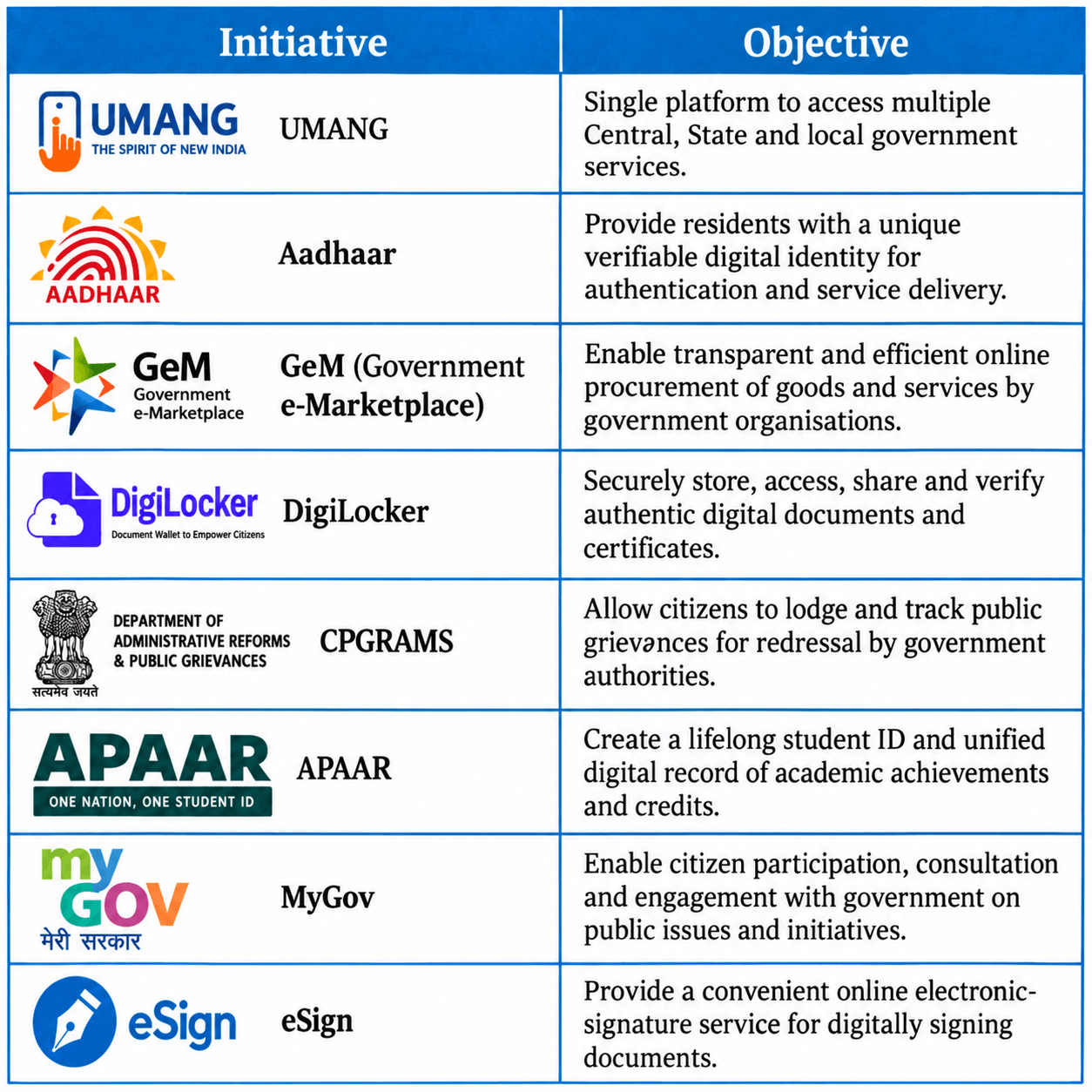
Below is a chart of a few e-governance initiatives. Complete the chart and also add two such initiatives undertaken by your state government.
Answer:
Page 90 – Let’s Explore
Let us try to understand the quality of life of citizens before and after e-governance. Form five groups and interview your seniors, teachers, security guards, administrative staff, and parents regarding the issues listed below. Did they have access to the internet and a smartphone or computer to make use of these e-governance facilities?
Find out what problems they had faced before e-governance and whether they felt the same issues were easily handled after e-governance.
1. Obtaining a birth certificate
2. Obtaining a admit card
3. Collecting and storing marksheets
4. Receiving salary
5. Booking rail/flight tickets
6. Registering a vehicle
Answer:
Survey: Quality of Life Before and After E-Governance
Our class formed five groups. Each group interviewed one set of people from our school and homes in Delhi:
- Group 1: Seniors (Class 11 and 12 students)
- Group 2: Teachers
- Group 3: Security guards
- Group 4: Administrative staff
- Group 5: Parents
Access to internet and devices
| People interviewed | Smartphone / computer and internet | Comfort with online services |
|---|---|---|
| Seniors | Smartphones with internet | Very comfortable |
| Teachers | Smartphones, laptops and internet | Comfortable |
| Security guards | Basic smartphones, limited mobile data | Needed help from family or a cyber café |
| Administrative staff | Office computers, smartphones and internet | Comfortable |
| Parents | Smartphones with internet | Some needed help from their children |
Problems before and after e-governance
| Issue | Before e-governance | After e-governance |
|---|---|---|
| 1. Obtaining a birth certificate | People made many visits to the municipal office, stood in long queues and sometimes paid agents. It took weeks. | Hospitals register births online, and the certificate can be downloaded from the MCD or Delhi e-District portal. |
| 2. Obtaining an admit card | Admit cards were posted or handed out at school. Getting a duplicate for a lost card was difficult. | Admit cards can be downloaded and printed anytime from official websites. |
| 3. Collecting and storing marksheets | Paper marksheets could get damaged or lost, and getting duplicates took months. | Marksheets are stored safely in DigiLocker and can be accessed anytime. |
| 4. Receiving salary | Salaries were paid in cash or by cheque, with delays and the risk of losing money. | Salaries come straight into bank accounts on time and pay slips are available online. |
| 5. Booking rail/flight tickets | People stood in long queues at counters or paid extra to travel agents. | Tickets are booked from home on IRCTC and airline websites or apps. |
| 6. Registering a vehicle | People made many visits to the RTO and often depended on agents. | Applications, fee payment and appointments are done online on the Parivahan portal. |
Conclusion: Most people felt that e-governance has saved time and money, reduced queues and cut down the role of middlemen. However, security guards and some elderly parents found it hard to use because of poor internet access, low digital skills or fear of online fraud. The government should promote digital literacy and set up more help centres so that everyone can benefit.
Pages 92 – Let’s Explore
Read each of the following examples carefully. Identify whether they are a policy or a public policy. Give a reason for your answer.
| Example | Policy/Public Policy | Wby? |
|---|---|---|
| The government introduces a sports policy. | ||
| The government launches a campaign to provide safe drinking water to every household. | ||
| A company allows employees to work from home twice a week. | ||
| A municipality introduces waste segregation in the city. | ||
| A housing society fixes visiting hours for guests. | ||
| The government introduces free vaccination for children. |
Answer:
| Example | Policy/Public Policy | Wby? |
|---|---|---|
| The government introduces a sports policy. | Government sports policy-public policy | It addresses a wider public objective. |
| The government launches a campaign to provide safe drinking water to every household. | Safe household drinking water-public policy | Government action for public welfare. |
| A company allows employees to work from home twice a week. | Company work-from-home rule-organisational policy | It applies to its employees. |
| A municipality introduces waste segregation in the city. | Municipal waste segregation-public policy | A public body manages city sanitation. |
| A housing society fixes visiting hours for guests. | Housing-society visiting hours-organisational policy | It applies to a limited residential group. |
| The government introduces free vaccination for children. | Government vaccination-public policy | It protects children and public health. |
Pages 95 – Let’s Explore
Your school’s main gate faces a road that connects residential areas and a major market area. There is heavy traffic congestion on the road, especially during morning and afternoon hours. Pedal rickshaws, electric rickshaws, school buses, private vehicles, and pedestrians – all struggle to get their way.
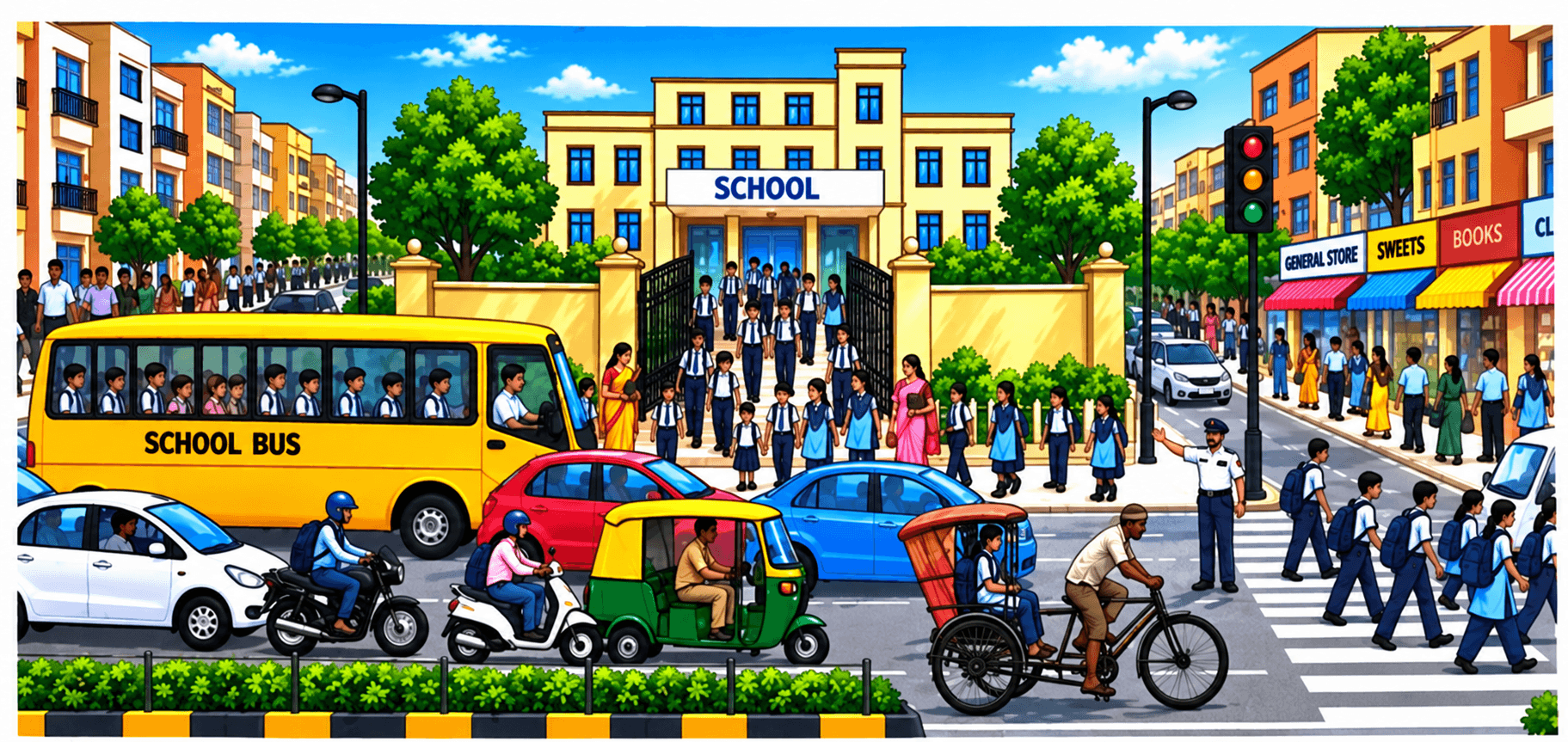
Form groups in your class and choose a course of action from the options given below.
1. Form a group of volunteers to regulate traffic in rush hours.
2. Write an application to the principal about the issue.
3. Meet the principal, along with all the class representatives of the school, to discuss the gravity of the situation and then impress upon the principal the need to take up the issue with the local people’s representative so that a traffic signal can be installed.
4. Request the school management to construct and open another gate on the other side of the school.
5. Suggest that the school shift its pick-up and drop-off point to a location slightly away from the main gate.
6. Change school timings so that the school’s opening and closing hours do not coincide with the busiest traffic hours in the market.
Answer the following based on the information given above.
→ Which option did you choose and why?
→ Can you suggest a better solution to address the given problem? Compare your suggestion with other options.
→ Which stakeholders would be involved in solving this problem in your suggested solution? Explain their role in solving the problem.
→ Suggest a feedback loop to ensure that the problem does not recur.
Answer:
→ For traffic congestion outside the school, I choose option 3: representatives meet the principal and seek action from the responsible local authorities. A traffic study should determine whether a signal is suitable.
→ A combined solution is stronger: a safe designated pick-up point, staggered departures, marked pedestrian crossings and trained traffic personnel. A second gate may be costly; untrained students should not direct traffic.
→ The principal coordinates school arrangements, traffic police assess road safety, the road authority installs approved infrastructure, and parents, drivers and traders follow agreed access rules.
→ Record congestion and unsafe incidents, collect weekly feedback, review with stakeholders and adjust arrangements. Compare results after a month.
Page 97 – Let’s Explore
Read the case study and follow the journey of the issue from identifying the problem to implementing a solution. As you read, identify the problem, the people and institutions involved, the actions taken, and the steps through which the solution was developed and implemented. Then, answer the questions below:
1. Arrange the various stages of the policy process in sequence for upgrading the hospital to be more patient-friendly.
2. Which stakeholders were involved in solving this problem? Identify at least three.
3. Can you think of any public building in your locality that could be made more accessible? What improvements would you suggest?
Answer:
1. Identify inaccessible facilities → prioritise the problem → consult users and experts → prepare a costed plan → approve it and allocate funds → construct accessible facilities → inspect, monitor and collect feedback.
2. Patients, persons with disabilities, senior citizens, hospital staff, disability organisations, architects, the district administration, PWD and the Health Department.
3. Model Delhi example: a public library could provide a suitable ramp, handrails, accessible toilets, clear signs, tactile guidance and reachable shelves. Actual improvements should follow an accessibility assessment with users.
Page 102 – Let’s Explore
1. As a student, what role can you play in the successful implementation of Khelo Bharat Niti 2025?
2. Your school is designated as the ‘state’s sports ambassador’. What actions should it take to fulfil its role as sports ambassador?
3. Which ministries of the government can contribute towards the success of Khelo Bharat Niti 2025? How?
Answer:
1. Students can participate regularly, encourage girls and students with disabilities, care for equipment and practise fair play.
2. The school can hold inclusive sports days, invite trained coaches, identify talent, cooperate with nearby schools and maintain safe facilities.
3. The Ministry of Youth Affairs and Sports coordinates sports development; Education supports school participation; Health supports fitness, nutrition and injury prevention; Social Justice and Empowerment can support accessibility. Coordination with state and local bodies is essential.
Class 9 Social Science Part 2 Chapter 4 Exercises Question Answer
Page 104 – Questions and activities
1. “Good governance is the responsibility of the government alone.” Do you agree with this statement? Give reasons to support your answer.
Answer:
No. Government has the main public responsibility, but effective governance also needs informed citizens, responsible media, civil society, experts and businesses. Citizens identify problems and provide feedback; other groups contribute knowledge, resources and scrutiny. Cooperation improves services, while public institutions remain accountable for their duties.
2. Do you think students can contribute to good governance? Write a short note describing any five ways in which students can become more responsible and active citizens.
Answer:
Yes. Students can:
- (1) follow school and public rules;
- (2) conserve water and protect public property;
- (3) report local problems through appropriate adults or channels;
- (4) verify information before sharing it; and
- (5) participate in student bodies and inclusive community activities.
These habits encourage responsibility and informed participation.
3. Choose any one public policy [for example, Right to Education (RTE), Swachh Bharat Mission, PM POSHAN, Ayushman Bharat, Digital India, or Jal Jeevan Mission] and prepare a chart showing the following aspects:
• The problem it addresses
• The major stakeholders involved
• How different actors coordinate
• The role of citizens in its success
Present your findings to the class.
Answer:
- Selected: Swachh Bharat Mission.
- Problem: poor sanitation and inadequate waste management.
- Stakeholders: Union and state governments, local bodies, sanitation workers, residents, businesses and community organisations.
- Coordination: governments provide policy and resources; local bodies organise services; workers collect and process waste; communities communicate local needs.
- Citizens: segregate waste, use sanitation facilities, avoid littering and report service failures.
4. Answer the following in one or two sentences.
a. What is governance?
b. How is governance different from government?
c. What is meant by public policy?
d. Name any four principles of good governance.
Answer:
a. Governance is the process of making, implementing and monitoring decisions for people’s welfare.
b. Government means the institutions exercising political authority; governance describes how decisions and services are managed.
c. Public policy is a planned course of government action to address public problems and promote welfare.
d. Participation, transparency, accountability and the rule of law.
5. Compare the following and present your answer in a tabular form.
a. Government and governance
b. Policy and public policy
Answer:
a. Government and governance
| Basis | Government | Governance |
|---|---|---|
| Meaning | The institutions and authorities that exercise political power. | The process by which decisions are made, implemented and monitored in the public interest. |
| Nature | The institutional side of running a country. | The functional side, which shows how the government works. |
| Who is included | The Legislature, the Executive and the Judiciary. | The government, citizens, the media, civil society and private organisations. |
| Focus | Who governs. | How governing is carried out. |
| Role | Makes laws, frames policies and provides public services. | Makes sure these policies are transparent, accountable, effective and responsive to people’s needs. |
| Example | The municipal corporation or panchayat, which has the authority to install street lights. | Planning, installing and maintaining street lights, with people helping to identify dark spots, report faulty lights and give feedback. |
b. Policy and public policy
| Basis | Policy | Public policy |
|---|---|---|
| Meaning | A planned course of action adopted by an organisation or group to guide how it works. | A course of action adopted by the government to solve public problems, meet people’s needs and promote the welfare of society. |
| Made by | Schools, companies, hospitals, sports clubs, housing societies or even families. | The government at the central, state or local level. |
| Applies to | Only a particular organisation or a limited group of people. | Society as a whole, on a larger scale. |
| Funding | The organisation’s own resources. | Public money, which is often collected through taxes. |
| Implemented by | The organisation itself. | Public institutions, with the participation of citizens and other stakeholders. |
| Purpose | To guide the working of that organisation. | To serve the public benefit in areas like education, health, transport, sanitation and public safety. |
| Example | A school’s mobile phone policy, a company’s work-from-home policy, or a housing society’s parking rules. | Free vaccination for children, waste segregation by a municipality or the National Education Policy 2020. |
6. Imagine you have been appointed to advise the district administration on improving governance. You have proposed six points (given below), but the administration decides to prioritise only three areas for improvement. Which three would you recommend as priority areas, and which one out of the three do you feel is the most important?
a. Improve drinking water facilities in schools.
b. Improve sanitation and public toilets in schools and market areas.
c. Provide tricycles for orthopaedically challenged students.
d. Install open-area swings and open-air gym in public parks.
e. Ensure the vaccination of stray dogs to prevent rabies.
f. Ensure distribution of iron and folic acid tablets for female students in schools.
Answer:
I would prioritise (a) safe drinking water, (b) sanitation and (c) mobility support for students with disabilities. These address essential health, dignity and access to education. Safe drinking water would be my first priority because every schoolchild needs it daily. Priorities should also use local evidence: a rabies outbreak or severe anaemia could justify a different urgent order. The remaining needs still deserve future action.
7. Match the policy action point to its corresponding stage in the policy cycle.
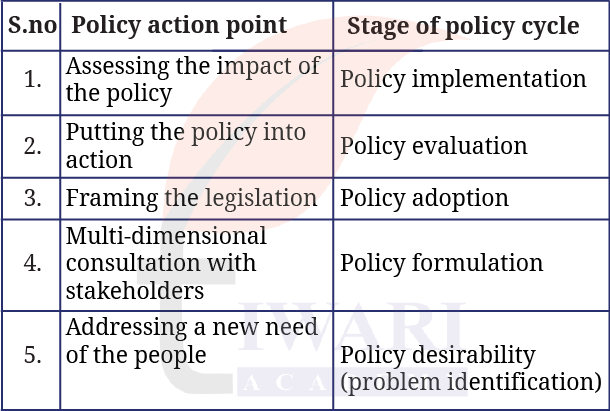
Answer:
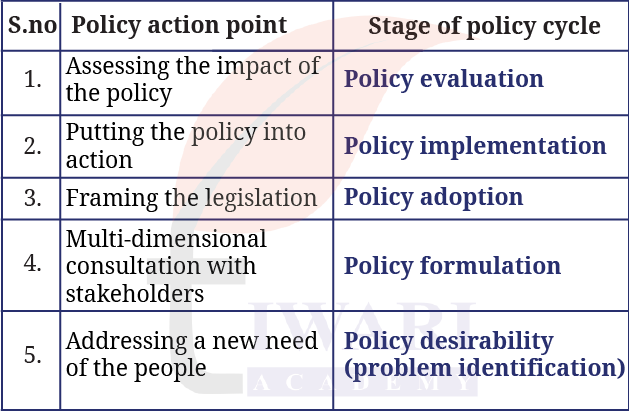
8. Read the following case and answer the given questions.
The government launches a programme to plant one lakh trees in a city. Funds are allocated, but only a few saplings survive because they are not watered or protected.
a. Which stage of the policy cycle appears to be weak?
b. Which organisations should coordinate to improve the programme?
c. Suggest two measures that could improve the outcome.
Answer:
a. Implementation is weak, especially aftercare; monitoring has also failed to detect and correct poor survival.
b. Municipal horticulture teams, the Forest Department, water agencies, resident groups, schools and responsible contractors should coordinate.
c. Assign and fund regular watering and protection for every site. Monitor survival rates and replace failed plants with suitable native species after addressing the causes of failure.
9. Read each statement carefully. Do you agree or disagree? Give reasons for your answer.
a. A good public policy can fail if it is not implemented properly.
b. Citizen participation sometimes makes decision-making slower, but it can improve governance.
c. Technology alone cannot ensure good governance.
Answer:
a. Agree.
Without staff, resources and proper delivery, sound intentions do not produce results.
b. Agree.
Consultation takes time but reveals real needs, improves acceptance and prevents avoidable mistakes.
c. Agree.
Digital systems still require honest officials, reliable data, accountability and access for people without devices or digital skills.
10. Design a public policy.
You are a member of your school’s student representative body. Identify one issue, for example, plastic waste, water wastage, road safety, energy conservation, or littering in public places. Prepare a simple policy proposal that includes the following aspects of policymaking:
• The reason for selecting the issue
• Your proposed solution
• Who should implement it?
• How will students participate?
• How will you know whether the policy has succeeded?
Present your proposal to the class as a chart or slideshow presentation.
Answer:
Proposal – Save Water at School.
- Reason: leaking taps and careless use waste a shared resource.
- Solution: audit leaks, repair fittings, display reminders and review water consumption.
- Implementation: the principal approves the plan; maintenance staff repair fittings; teachers supervise student participation.
- Student role: report leaks promptly, close taps and record agreed observations.
- Success: compare meter readings where available, leak-repair times and repeated wastage over one month. Adjust actions from feedback.
Extra Question Answers for Exam Preparation
Class 9 Social Science Part 2 Chapter 4 Very Short Answer Type Questions with Explanation.
Very Short Answer Type Questions
- What is the institutional side of governing called?
Answer:
Government is the institutional side, comprising authorities and bodies empowered to make and enforce public decisions collectively. - What does public accountability enable citizens to do?
Answer:
Public accountability enables citizens to question decisions, seek explanations and expect corrective action when authorities fail their responsibilities. - How does transparency help public discussion?
Answer:
Transparency provides accessible information, allowing people to understand decisions, compare evidence and participate more meaningfully in public discussions. - What is a stakeholder?
Answer:
A stakeholder is a person or organisation affected by an issue or involved in decisions and actions concerning it. - Why are accessible public toilets important?
Answer:
Accessible public toilets support dignity, health and equal participation, especially for persons with disabilities, older people and families. - What does policy prioritisation involve?
Answer:
Policy prioritisation involves deciding which public needs require earlier attention, considering urgency, impact, fairness and available resources carefully. - Why should officials consult service users?
Answer:
Service users reveal practical difficulties and overlooked needs, helping officials design solutions that work in everyday conditions effectively. - What does a policy’s financial feasibility mean?
Answer:
Financial feasibility means assessing whether available funds can support a proposed policy’s implementation, staffing, operation and continued maintenance. - What is a grievance-redress mechanism?
Answer:
A grievance-redress mechanism provides a recognised process for receiving complaints, investigating problems and communicating or delivering corrective action. - How can misinformation damage governance?
Answer:
Misinformation can mislead citizens, create mistrust and distract authorities from real problems, weakening informed participation and public cooperation. - What is one purpose of assisted digital-service counters?
Answer:
Assisted counters help people without devices, connectivity or digital skills access services and complete applications with appropriate support. - Why is a completed building not proof of policy success?
Answer:
A building achieves its purpose only when people can access functioning services, supported by staff, resources and maintenance. - What can a student council contribute to school decisions?
Answer:
A student council can communicate learners’ concerns, suggest practical improvements and provide feedback while encouraging responsible participation among students. - Why should departments share information during emergencies?
Answer:
Shared information helps departments coordinate responsibilities, avoid duplicated work and direct resources towards urgent needs during an emergency. - What is an outcome indicator?
Answer:
An outcome indicator measures a meaningful result, such as improved access or survival rates, rather than merely counting activities.
Class 9 Social Science Part 2 Chapter 4 Short Answer Type Questions with Explanation.
Short Answer Type Questions
- Distinguish equal treatment from identical service arrangements.
Answer:
Equal treatment aims to provide fair access and opportunity. People facing different barriers may need different arrangements, such as ramps or assisted counters. Providing identical arrangements can still exclude those whose needs were overlooked. - How can a complaint improve a public service?
Answer:
A clear complaint identifies a problem, location and effect on users. Authorities can investigate, correct the fault and track repeated cases. Feedback about the response helps reveal whether the solution worked and whether wider changes are needed. - Why should public programmes budget for maintenance?
Answer:
New facilities can stop working without repairs, staff and routine care. Including maintenance costs helps sustain benefits beyond inauguration. For example, drinking-water systems require cleaning, testing and repairs to continue providing a reliable service. - Explain the difference between spending money and achieving a public goal.
Answer:
Spending is an input, while a public goal concerns results for people. Funds may buy saplings, but the intended benefit depends on their survival. Evaluation must therefore examine outcomes as well as expenditure and completed activities. - How can a school collect useful feedback about drinking water?
Answer:
The school can record supply interruptions, damaged taps and users’ complaints, while responsible staff check safety. Student feedback should be reviewed regularly, assigned for action and followed up to confirm that problems have been resolved. - Why can consultation save time even when it delays an initial decision?
Answer:
Consultation may take time initially, but it can reveal mistakes before construction or implementation. Understanding users’ needs reduces expensive redesign, resistance and repeated complaints. A better-informed decision can therefore save time over the longer term. - Explain how media can strengthen accountability without spreading misinformation.
Answer:
Media can investigate service failures, compare official claims with evidence and present affected people’s concerns. Checking facts, correcting errors and distinguishing opinion from verified information help public scrutiny remain useful rather than misleading or sensational. - What makes an online service genuinely accessible?
Answer:
An accessible service uses clear language, suitable design and reliable technology, while offering assistance and alternatives. People with disabilities, limited literacy or weak connectivity should be able to complete the process and understand its status. - How can a public policy support participation by girls in sports?
Answer:
A policy can provide safe facilities, trained coaches, suitable equipment and equal opportunities. Schools and families should address restrictive expectations and scheduling barriers. Feedback from girls helps identify practical obstacles that general announcements may overlook. - Why should policy success be reviewed across different social groups?
Answer:
An overall improvement can hide unequal access. Reviewing results for different groups reveals whether remote communities, disadvantaged households or persons with disabilities are being left behind. This evidence helps authorities target barriers and improve fairness.
Class 9 Social Science Part 2 Chapter 4 Long Answer Type Questions with Explanation.
Long Answer Type Questions
1. A district opens an online-only certificate service. Assess its strengths and suggest improvements.
Answer:
An online service can reduce travel, queues and paperwork while allowing people to track applications. However, people without reliable internet, devices or digital skills may be excluded. The district should provide assisted counters, accessible design, clear instructions and a dependable complaint process. It should measure completion times and failed applications, then use feedback to improve both digital convenience and fair access.
2. Create an evaluation plan for a neighbourhood waste-segregation programme.
Answer:
Begin by recording existing collection coverage, segregation levels and common complaints. Explain sorting rules and coordinate residents, collectors and processing facilities. After implementation, check whether separated waste remains separate during collection and treatment. Review missed collections, worker safety and participation across streets. Share findings with residents and officials, assign corrective actions and repeat the assessment to see whether the changes improve results.
3. Explain how ethical values and practical systems work together in good governance.
Answer:
Values such as honesty, fairness and concern for welfare guide public action, but they need supporting systems. Clear responsibilities, transparent records, accessible services and complaint mechanisms help translate values into daily practice. For example, a commitment to inclusion becomes meaningful when buildings have usable ramps and staff respond respectfully. Good governance therefore requires both principled intentions and reliable implementation with public accountability.
4. How would you resolve disagreement among stakeholders about a new public playground?
Answer:
I would first hear children, nearby residents, persons with disabilities and local officials. Their concerns might include safety, noise, access and maintenance costs. Using this evidence, the group could compare sites, opening hours and accessible designs. Responsibilities and funding should be agreed before approval. A trial arrangement and regular feedback would help resolve problems while preserving the playground’s public purpose.
5. Why is good governance an ongoing task rather than a one-time achievement?
Answer:
People’s needs, technology, population and environmental conditions change over time. A service that once worked well may become inadequate or exclude new users. Institutions must therefore monitor performance, respond to complaints and revise policies when evidence shows problems. Citizen participation keeps authorities informed, while accountability encourages correction. Good governance depends on sustained attention to results and fairness, not merely a successful launch or award.