



by Tiwari Academy Team
NCERT Solutions for Class 9 Social Science Part 2 Chapter 3 Resistance and Resilience (1000–1700 CE), help students understand how Indian society defended itself and preserved its traditions. The chapter explains the resistance of Rajput confederacies, Mewar, the Ahoms, Vijayanagara, the Marathas, Sikhs and Jats against invading powers. Students also learn how the Bhakti tradition, temples, agriculture, the hundi system and Indian Ocean trade strengthened social and economic resilience. These solutions answer all textbook questions in simple language, helping you revise key concepts and prepare well for CBSE 2026-27 exams.
NCERT Class 9 Social Science Part 2 Chapter 3 Solutions
Class 9 Social Science Part 2 Chapter 3 Question Answer
Page 45 – The Big Questions
1. How did Indian rulers use resistance and alliances to safeguard their lands?
Answer:
Rulers defended forts, used local terrain, built community support and fought invading armies. They also formed coalitions or negotiated alliances to preserve territory and influence. Maharana Pratap resisted Mughal expansion, while some Rajput houses negotiated Mughal alliances; both responses reflected differing circumstances.
2. What factors contributed to the resilience of different kingdoms and communities during this period?
Answer:
Strong local support, knowledge of terrain, effective administration, agriculture and trade helped communities withstand pressure. Religious traditions, regional languages and cultural institutions preserved shared identities. Flexible strategies, including alliances and changes in worship or military organisation, allowed communities to adapt.
3. How did the Bhakti tradition foster a sense of solidarity?
Answer:
Bhakti teachers emphasised devotion, simplicity and spiritual equality. Hymns in regional languages allowed ordinary people from different backgrounds to participate. Shared singing, gatherings and stories created community bonds and helped traditions continue even during political disruption.
4. How did the expansion of agriculture, trade, and commerce keep the economy sound?
Answer:
Agriculture provided food, employment and revenue. Irrigation supported production, while craft industries and trade connected villages, towns and ports. Merchants, credit instruments such as hundis and commercial networks moved goods and funds, helping economic activity continue despite political changes.
Page 54 – Let’s Explore
After the death of Mahārāṇā Pratāp, renowned poet Dursā Arhā gave a vivid account of Mahārāṇā Pratāp in the following lines:
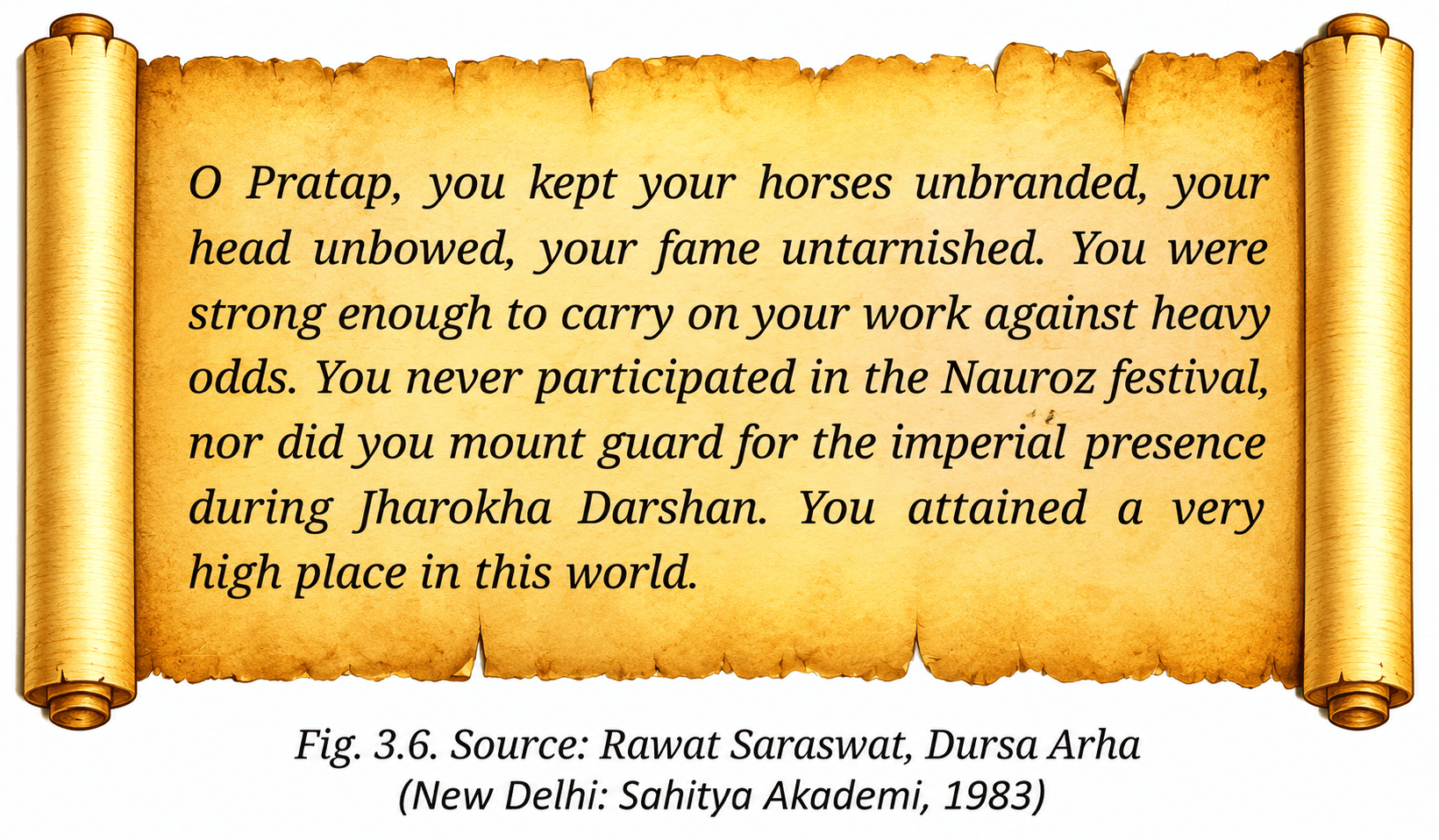
Identify any two specific actions mentioned in the text which show that Mahārāṇā Pratāp maintained his independence from the Mughal court.
Answer:
He kept his horses unbranded by the Mughal imperial system and did not attend the Nauroz festival at court. The passage also states that he did not mount guard at the imperial Jharokha Darshan. These actions symbolised his refusal to accept imperial submission.
Page 64 – Let’s Explore
Explore the contributions of the Nayanar saints (devotees of Shiva) like Karaikal Ammaiyar and the Alvar saints (devotees of Vishnu) like Andal to the spread of the Bhakti tradition in peninsular India. Discuss their teachings and devotional practices and the ways in which they connected with people through their hymns.
Answer:
Nayanars expressed deep devotion to Shiva, while Alvars celebrated Vishnu. Karaikal Ammaiyar’s Tamil poetry honoured Shiva and Andal’s Tamil devotional hymns expressed love for Vishnu. Singing in a familiar language made devotion accessible beyond learned elites. Their lives and songs show women’s important contribution to the growth of Bhakti in southern India.
Class 9 Social Science Part 2 Chapter 3 Exercises Question Answer
Page 77 – Questions and activities
1. Choose the most appropriate answer.
Resistance and resilience are closely connected because:
a. Resistance always involves warfare.
b. Resilience enables communities to endure difficulties and sustain resistance.
c. Resistance is possible only when a kingdom has a large army.
d. Resilient societies avoid all forms of conflict.
Answer:
b. Resilience enables communities to endure difficulties and sustain resistance. Strong institutions, economic resources and shared identities help communities continue resisting or adapting during prolonged pressure.
2. Why and how did groups such as the Sikhs, Marathas, and Rajputs assert their political power and identity during periods of changing political authority?
Answer:
These groups sought to protect their lands, autonomy, communities and traditions. Rajputs used resistance and negotiated alliances. Marathas developed forts, administration and mobile warfare under Shivaji. Sikh leaders strengthened community organisation and defence, especially through the Khalsa. Local support and shared identity helped each group respond to changing political authority.
3. Why did some Rajput rulers decide to negotiate alliances with the Mughal power?
Answer:
Some Rajput rulers judged that alliances would protect their territories and ruling positions while avoiding prolonged warfare. Mughal service offered ranks, influence and opportunities for expansion. Their decisions were practical political choices; other rulers, including Maharana Pratap, preferred continued resistance.
4. Imagine a market in a port town of India such as Surat, Masulipatnam, or Puducherry. You are a foreign trader from Italy or France and want to make a deal of cotton textiles. How would you secure the product in the local market? Whose help would you seek and what kind of challenges would you face in terms of language, quality of product, prices of commodities, etc.?
Answer:
I would engage a local merchant or broker and an interpreter to contact weavers and suppliers. I would inspect cloth samples, compare prices, agree on quality and delivery, and arrange transport. A sarraf could help with currency exchange and a trusted hundi with payment. Language differences, unfamiliar measures, variable quality, duties and delayed supplies would be major challenges.
5. Watch any video at the given link (https://www.indianculture.gov.in/forts-of-india/tales-of-forts) and analyse the various functions of forts and fortresses. How did rulers perceive the importance of forts in terms of strategic concerns.
Answer:
Analysis: After watching the video, I understood that forts were much more than military buildings. They served several important functions:
- Defence and protection: Forts were built on hills with thick walls, strong gates and watchtowers, making them difficult to attack. Chittorgarh, built on a high plateau, protected Mewar for centuries.
- Withstanding sieges: Forts had water tanks, granaries and armouries so that people could survive long sieges. Chittor had many water bodies inside it, which helped its defenders resist Akbar’s army for more than five months in 1567–68.
- Administrative centres: Forts housed palaces, offices and courts, from where rulers governed their kingdoms and gave justice.
- Residence and refuge: Royal families, soldiers and common people lived inside forts and took shelter there during wars.
- Symbol of power and pride: A strong fort showed the ruler’s strength and became a symbol of identity and honour for the people.
- Religious and cultural life: Many forts had temples and memorials inside them, such as the Vijay Stambh built by Rana Kumbha at Chittor.
6. What architectural changes occurred in temple construction during the period under study? How do these changes reflect upon the resilient nature of Indian civilisation?
Answer:
Alongside large temples supported by rulers, some communities used more discreet haveli-style temples resembling houses, with less conspicuous exteriors. Damaged temples were also restored and images relocated. These adaptations helped worship, artistic traditions and community life continue during political pressure, showing resilience through both rebuilding and changed architectural forms.
7. A kingdom has limited military resources but possesses fertile agricultural land, strong local support, and detailed knowledge of its terrain. Explain two ways in which these resources could contribute to the kingdom’s resilience when faced with a threat.
Answer:
- Fertile land provides food and revenue. Local communities can help protect supplies, repair infrastructure and sustain soldiers and civilians during a prolonged crisis.
- Knowledge of hills, forests and routes supports ambushes, secure retreats and defensive positions. Local information helps a smaller force avoid costly open battles and resist a stronger opponent.
8. Consider the following statement:
“A tradition becomes more resilient when people can carry it with them.”
Do you agree? Explain using examples from the Bhakti tradition.
Answer:
Yes. Songs, remembered verses and devotional practices can travel with people even when buildings are damaged or communities move. Bhakti saints used regional languages, nam kirtan and shared gatherings, allowing devotion to continue outside large temples. Kabir’s verses and Tulsidas’s retelling of Rama’s story helped people preserve ideas through memory, recitation and community participation.
9. Voices from the Past
Choose any two of the following and write a short first-person account explaining what resilience means from that person’s perspective:
▪ A Bhakti saint
▪ A Rajput soldier
▪ An Ahom commander
▪ A Maratha administrator
▪ A merchant
▪ A Jat leader
Answer:
Bhakti saint: “I sing in the language my neighbours understand. When circumstances change, we can still gather, remember the divine and help one another. Resilience means keeping devotion and compassion alive through our words and actions”.
Ahom commander: “I know our rivers, channels and seasonal floods. Our boats, local knowledge and people’s support help us confront larger armies. Resilience means adapting our strategy and protecting the community even after setbacks”.
10. Design a Fort
You are a military architect advising a ruler.
Draw a simple, labelled plan of a fort that includes the following:
▪ Residential complex
▪ Defensive walls
▪ Water source
▪ Food storage
▪ Escape route
▪ Watchtower
▪ Administrative area
Now, write a few sentences explaining how your design would help the kingdom withstand a long siege.
Answer:
As a military architect, I would advise the ruler to build the fort on high, rocky ground near a river or a forest, so that nature itself protects it. The labelled plan of the fort is shown in fort_plan.png.
Main parts of the fort plan:
- Defensive walls: Thick double walls of stone surround the whole fort. A moat runs around the outer wall, and the only way in is across a drawbridge to a guarded gate.
- Watchtowers: Tall towers stand at every corner of the wall and in the middle of the long sides. Guards keep watch from them day and night.
- Residential complex: This is the safe inner area where the royal palace and the homes of soldiers, officials and common people are built.
- Administrative area: It contains the court hall, the treasury and the records office, from where the kingdom is governed.
Food storage: Large granaries hold grain, pulses, salt, oil and fodder for animals. - Water source: A stepwell and a reservoir inside the fort are filled by rainwater channels that run from the walls.
Escape route: A secret underground tunnel starts inside the fort and opens at a hidden exit in the forest outside.
How the design helps the kingdom withstand a long siege:
This design would help the kingdom survive even a long siege. The thick walls, the moat and the watchtowers make it very hard for the enemy to break in. From the towers, guards can see attackers coming early and fire at them from a safe height. The granaries and the rain-fed stepwell give the people enough food and water for many months, so the enemy cannot starve them into giving up. Because the administrative area is inside the walls, the ruler can keep governing, pay soldiers and give orders while the siege goes on. If the situation becomes dangerous, the secret tunnel lets the royal family escape and it lets messengers slip out to bring help from allies. In this way, the attacking army slowly runs short of supplies and patience, while the fort stays strong and the kingdom stays safe.
Extra Question Answers for Exam Preparation
Class 9 Social Science Part 2 Chapter 3 Very Short Answer Type Questions with Explanation.
Very Short Answer Type Questions
- How can diplomacy serve as a form of resistance?
Answer:
Diplomacy can negotiate favourable terms, build alliances and preserve autonomy when direct warfare would impose unacceptable costs. - Why was local geographical knowledge valuable to smaller armies?
Answer:
Knowing routes, rivers and difficult terrain helped smaller armies choose defensive positions, ambush opponents and retreat safely. - What was the broad purpose of a mansab?
Answer:
A mansab assigned rank within Mughal service, linking an official’s position with administrative standing and military responsibilities. - How could peasants support a kingdom during a crisis?
Answer:
Peasants supplied food and revenue, while local cooperation helped maintain transport, information networks and the kingdom’s essential resources. - What made river boats useful to Ahom forces?
Answer:
River boats allowed Ahom forces to move through familiar waterways and challenge opponents under Assam’s distinctive geographical conditions. - Why did forts need reliable water sources?
Answer:
Reliable water sustained soldiers and residents during sieges, when attackers could block access to supplies outside the walls. - What does a strategic retreat achieve?
Answer:
A strategic retreat preserves forces, avoids an unfavourable battle and creates opportunities to reorganise for later resistance. - How did regional languages help devotional teaching?
Answer:
Regional languages made devotional ideas understandable to ordinary listeners, encouraging participation, shared singing and transmission across generations. - What is Saguna Bhakti?
Answer:
Saguna Bhakti is devotion to the divine understood through forms and attributes, often expressed through personal devotional relationships. - Name one contribution of women to the Bhakti tradition.
Answer:
Women saints composed devotional poetry and challenged social expectations, showing that spiritual expression was not restricted to men. - What does a sarraf do in a trading network?
Answer:
A sarraf helps with money-changing and financial dealings, supporting merchants who trade across places using different currencies. - Why were interpreters useful in port towns?
Answer:
Interpreters helped merchants communicate across languages, negotiate agreements and reduce misunderstandings about prices, quality, quantities and delivery. - How did irrigation strengthen the economy?
Answer:
Irrigation supported agricultural production, improving food supplies and revenue that sustained settlements, trade and political institutions during uncertainty. - What can restoring a damaged temple demonstrate?
Answer:
Restoration can demonstrate a community’s capacity to rebuild institutions, preserve worship and continue cultural practices after political disruption. - Why should historical legends be distinguished from verified events?
Answer:
Legends reveal beliefs and cultural memory, but their details require evidence before being treated as established historical events.
Class 9 Social Science Part 2 Chapter 3 Short Answer Type Questions with Explanation.
Short Answer Type Questions
- How could negotiated peace strengthen a kingdom after prolonged warfare?
Answer:
Negotiated peace could reduce destruction, preserve some autonomy and allow farming, trade and administration to recover. A ruler might accept limited obligations to a stronger power while protecting the community’s essential political and economic interests. - Why were forts more useful as a network than as isolated buildings?
Answer:
Connected forts supported communication, movement, supplies and retreat across a wider territory. If one stronghold was threatened, others could assist or shelter forces. This organisation helped sustain resistance beyond the defence of a single location. - Explain how economic strength supported political resistance.
Answer:
Agriculture supplied food and revenue, while crafts and trade generated additional resources. These supported soldiers, repairs and administration. Reliable supplies and local livelihoods helped communities withstand prolonged pressure instead of exhausting their resources quickly. - How did Bhakti allow different ways of living a devotional life?
Answer:
Some saints renounced household life, while others practised devotion alongside family responsibilities. This diversity showed that spiritual commitment could take different forms. Regional poetry and shared worship made these paths accessible to varied communities. - Why might a merchant prefer a local broker in an unfamiliar port?
Answer:
A local broker understood suppliers, customs, prices and commercial relationships. The broker could help locate reliable goods and negotiate terms. This reduced uncertainty, although the foreign merchant still needed to verify quality and payment arrangements. - How did Vijayanagara’s setting support its rise?
Answer:
The river and rugged rocky terrain near Hampi offered natural defence and a secure political base. Combined with administration, trade and cultural patronage, these advantages helped Vijayanagara develop into an influential southern kingdom. - Explain the connection between cultural memory and resilience.
Answer:
Stories, songs, rituals and remembered teachings preserve shared identity when political circumstances change. People can transmit them even after migration or damage to institutions. This continuity supports belonging, cooperation and the rebuilding of community life. - How could a house-like temple help preserve worship?
Answer:
A less conspicuous building could allow a community to continue worship under difficult political conditions. Adapting architectural form preserved devotional activity and social connections, showing that continuity sometimes depended on changing outward arrangements. - Why should resistance not be measured only by the result of one battle?
Answer:
A battle reveals only one stage of a longer struggle. Communities may recover territory, reorganise forces, negotiate or preserve institutions afterwards. Assessing resistance requires attention to sustained capacity, local support and changing strategies over time. - What links trust with the usefulness of a hundi?
Answer:
A hundi worked because merchants and bankers trusted the network to honour payment. That confidence reduced the need to carry coins. Without dependable relationships and records, the instrument’s safety and convenience would weaken significantly.
Class 9 Social Science Part 2 Chapter 3 Long Answer Type Questions with Explanation.
Long Answer Type Questions
1. Compare how the Ahoms and Marathas used geography in their political struggles.
Answer:
The Ahoms used detailed knowledge of Assam’s rivers, forests and monsoon conditions, combining local mobilisation with river warfare. The Marathas used the Deccan’s hills and a network of forts to support swift attacks, retreat and renewed resistance. Their settings differed, but both examples show how understanding terrain and gaining local support could help oppose stronger forces and sustain political organisation.
2. Explain how a community could remain resilient even after losing political independence.
Answer:
Political defeat does not necessarily destroy every part of community life. People may preserve languages, devotional songs, farming practices, commercial networks and shared institutions. They can adapt to new authorities, rebuild damaged places and negotiate space for their customs. Such continuity depends on cooperation and economic resources. Resilience therefore includes cultural and social survival as well as the defence of political autonomy.
3. Describe how trade connected people with different languages and backgrounds.
Answer:
Trade brought merchants, weavers, transporters, bankers and customers into contact across regions and seas. Brokers and interpreters helped overcome language differences, while recognised practices and instruments such as hundis supported payment. Ports linked inland production with distant markets. These relationships encouraged practical cooperation and the exchange of knowledge, while commercial activity provided livelihoods and resources that helped communities endure political changes.
4. How would you design a small historical exhibition on everyday resilience?
Answer:
I would organise the exhibition around farming, trade and devotional life. A model irrigation device would show how food production supported communities. A sample explanatory hundi would illustrate trust and financial networks. A regional devotional verse would show how ideas travelled through memory and song. Captions would distinguish evidence from interpretation and explain how these everyday practices complemented military defence and political negotiation.
5. Why is it misleading to treat all rulers or communities of this period as following one strategy?
Answer:
Different rulers faced different military strengths, landscapes, economic resources and political opportunities. Some resisted through warfare, others negotiated alliances, and many changed their approach over time. Communities also preserved traditions through cultural adaptation and economic cooperation. Treating everyone as identical hides these choices and relationships. Historical explanation should therefore examine particular actors and circumstances instead of assigning one fixed behaviour to an entire community.