
Tiwari Academy  – Free CBSE NCERT Books and Solutions
  • Apps
    • CBSE Apps
    • Hast Rekha App
  • NCERT Solutions
    • NCERT Solutions for Class 12
      • NCERT Solutions for Class 12 Maths
      • NCERT Solutions for Class 12 Physics
      • NCERT Solutions for Class 12 Chemistry
      • NCERT Solutions for Class 12 Biology
      • NCERT Solutions for Class 12 English
      • NCERT Solutions for Class 12 Accounts
      • NCERT Solutions for Class 12 Business Studies
      • NCERT Solutions for Class 12 Economics
      • NCERT Solutions for Class 12 Geography
      • NCERT Solutions for Class 12 Physical Education
      • NCERT Solutions for Class 12 Political Science
      • NCERT Solutions for Class 12 Psychology
      • NCERT Solutions for Class 12 Sociology
    • NCERT Solutions for Class 11
      • NCERT Solutions for Class 11 Maths
      • NCERT Solutions for Class 11 Physics
      • NCERT Solutions for Class 11 Chemistry
      • NCERT Solutions for Class 11 Biology
      • NCERT Solutions for Class 11 English
      • NCERT Solutions for Class 11 Business Studies
      • NCERT Solutions for Class 11 Sociology
      • NCERT Solutions for Class 11 Political Science
      • NCERT Solutions for Class 11 Psychology
      • NCERT Solutions for Class 11 Physical Education
    • NCERT Solutions for Class 10
      • NCERT Solutions for Class 10 Maths
      • NCERT Solutions for Class 10 Science
      • NCERT Solutions for Class 10 English
      • NCERT Solutions for Class 10 Hindi 2026-27 Updated Course A and B
      • NCERT Solutions for Class 10 Sanskrit
      • NCERT Solutions for Class 10 Social Science
    • NCERT Solutions for Class 9
      • NCERT Solutions for Class 9 Maths
      • NCERT Solutions for Class 9 Science
      • NCERT Solutions for Class 9 English
      • NCERT Solutions for Class 9 Hindi
      • NCERT Solutions for Class 9 Sanskrit
      • NCERT Solutions for Class 9 Social Science
    • NCERT Solutions for Class 8
      • NCERT Solutions for Class 8 Maths
      • NCERT Solutions for Class 8 Science
      • NCERT Solutions for Class 8 English
      • NCERT Solutions for Class 8 Hindi
      • NCERT Solutions for Class 8 Sanskrit
      • NCERT Solutions for Class 8 Social Science
      • NCERT Solutions for Class 8 Computer
    • NCERT Solutions for Class 7
      • NCERT Solutions for Class 7 Maths
      • NCERT Solutions for Class 7 Science
      • NCERT Solutions for Class 7 English
      • NCERT Solutions for Class 7 Hindi
      • NCERT Solutions for Class 7 Sanskrit
      • NCERT Solutions for Class 7 Social Science
      • NCERT Solutions for Class 7 Computer
    • NCERT Solutions for Class 6
      • NCERT Solutions for Class 6 Maths
      • NCERT Solutions for Class 6 Science
      • NCERT Solutions for Class 6 English
      • NCERT Solutions for Class 6 Hindi
      • NCERT Solutions for Class 6 Sanskrit Deepakam 2026-27 Updated
      • NCERT Solutions for Class 6 Social Science
      • NCERT Solutions for Class 6 Computer
    • NCERT Solutions for Class 5
      • NCERT Solutions for Class 5 Hindi
      • NCERT Solutions for Class 5 English
      • NCERT Solutions for Class 5 Maths
      • NCERT Solutions for Class 5 EVS
      • NCERT Solutions for Class 5 Computer
      • NCERT Solutions for Class 5 GK
    • NCERT Solutions for Class 4
      • NCERT Solutions for Class 4 Hindi
      • NCERT Solutions for Class 4 English
      • NCERT Solutions for Class 4 Maths
      • NCERT Solutions for Class 4 EVS
      • NCERT Solutions for Class 4 Computer
      • NCERT Solutions for Class 4 GK
    • NCERT Solutions for Class 3
      • NCERT Solutions for Class 3 Hindi
      • NCERT Solutions for Class 3 English
      • NCERT Solutions for Class 3 Maths
      • NCERT Solutions for Class 3 EVS
      • NCERT Solutions for Class 3 Science
      • NCERT Solutions for Class 3 Computer
      • NCERT Solutions for Class 3 GK
    • NCERT Solutions for Class 2
      • NCERT Solutions for Class 2 Hindi
      • NCERT Solutions for Class 2 English
      • NCERT Solutions for Class 2 Maths
      • NCERT Solutions for Class 2 EVS
      • NCERT Solutions for Class 2 Science
      • NCERT Solutions for Class 2 Computer
      • NCERT Solutions for Class 2 GK
    • NCERT Solutions for Class 1
      • NCERT Solutions for Class 1 Hindi
      • NCERT Solutions for Class 1 English
      • NCERT Solutions for Class 1 Maths
      • NCERT Solutions for Class 1 EVS
      • NCERT Solutions for Class 1 Computer
      • NCERT Solutions for Class 1 Science
      • NCERT Solutions for Class 1 GK
    • Study Material for KG
      • Study Material for KG English
      • Study Material for KG Hindi
      • Study Material for KG Maths
    • Study Material for Nursery
      • Study Material for Nursery Maths
      • Study Material for Nursery English
      • Study Material for Nursery Hindi
  • NEWS
    • Educational NEWS
    • MCQ
    • Explore More
  • Grammar
    • Class 1 English Grammar
      • Class 1 Hindi Vyakaran
    • Class 2 English Grammar
      • Class 2 Hindi Vyakaran
    • Class 3 English Grammar
      • Class 3 Hindi Vyakaran
    • Class 4 English Grammar
      • Class 4 Hindi Vyakaran
    • Class 5 English Grammar
      • Class 5 Hindi Vyakaran
    • Class 6 English Grammar
      • Class 6 Hindi Vyakaran
    • Class 7 English Grammar
      • Class 7 Hindi Vyakaran
    • Class 8 English Grammar
      • Class 8 Hindi Vyakaran
  • Sample Papers
    • CBSE Sample Papers for Class 4
    • CBSE Sample Papers for Class 5
    • CBSE Sample Papers for Class 6
    • CBSE Sample Papers for Class 7
    • CBSE Sample Papers for Class 8
    • CBSE Sample Papers for Class 9
    • CBSE Sample Papers for Class 10
    • CBSE Sample Papers for Class 11
    • CBSE Sample Papers for Class 12
  • Syllabus
    • CBSE Syllabus
    • NCERT Books
    • NCERT Exemplar
    • What is NIOS?
    • NIOS Online Admission
    • Career Options
  • Contact
    • Contact Us
    • About Us
    • Authors
    • Online Tutors
  • Apps
    • CBSE Apps
    • Hast Rekha App
  • NCERT Solutions
    • NCERT Solutions for Class 12
      • NCERT Solutions for Class 12 Maths
      • NCERT Solutions for Class 12 Physics
      • NCERT Solutions for Class 12 Chemistry
      • NCERT Solutions for Class 12 Biology
      • NCERT Solutions for Class 12 English
      • NCERT Solutions for Class 12 Accounts
      • NCERT Solutions for Class 12 Business Studies
      • NCERT Solutions for Class 12 Economics
      • NCERT Solutions for Class 12 Geography
      • NCERT Solutions for Class 12 Physical Education
      • NCERT Solutions for Class 12 Political Science
      • NCERT Solutions for Class 12 Psychology
      • NCERT Solutions for Class 12 Sociology
    • NCERT Solutions for Class 11
      • NCERT Solutions for Class 11 Maths
      • NCERT Solutions for Class 11 Physics
      • NCERT Solutions for Class 11 Chemistry
      • NCERT Solutions for Class 11 Biology
      • NCERT Solutions for Class 11 English
      • NCERT Solutions for Class 11 Business Studies
      • NCERT Solutions for Class 11 Sociology
      • NCERT Solutions for Class 11 Political Science
      • NCERT Solutions for Class 11 Psychology
      • NCERT Solutions for Class 11 Physical Education
    • NCERT Solutions for Class 10
      • NCERT Solutions for Class 10 Maths
      • NCERT Solutions for Class 10 Science
      • NCERT Solutions for Class 10 English
      • NCERT Solutions for Class 10 Hindi 2026-27 Updated Course A and B
      • NCERT Solutions for Class 10 Sanskrit
      • NCERT Solutions for Class 10 Social Science
    • NCERT Solutions for Class 9
      • NCERT Solutions for Class 9 Maths
      • NCERT Solutions for Class 9 Science
      • NCERT Solutions for Class 9 English
      • NCERT Solutions for Class 9 Hindi
      • NCERT Solutions for Class 9 Sanskrit
      • NCERT Solutions for Class 9 Social Science
    • NCERT Solutions for Class 8
      • NCERT Solutions for Class 8 Maths
      • NCERT Solutions for Class 8 Science
      • NCERT Solutions for Class 8 English
      • NCERT Solutions for Class 8 Hindi
      • NCERT Solutions for Class 8 Sanskrit
      • NCERT Solutions for Class 8 Social Science
      • NCERT Solutions for Class 8 Computer
    • NCERT Solutions for Class 7
      • NCERT Solutions for Class 7 Maths
      • NCERT Solutions for Class 7 Science
      • NCERT Solutions for Class 7 English
      • NCERT Solutions for Class 7 Hindi
      • NCERT Solutions for Class 7 Sanskrit
      • NCERT Solutions for Class 7 Social Science
      • NCERT Solutions for Class 7 Computer
    • NCERT Solutions for Class 6
      • NCERT Solutions for Class 6 Maths
      • NCERT Solutions for Class 6 Science
      • NCERT Solutions for Class 6 English
      • NCERT Solutions for Class 6 Hindi
      • NCERT Solutions for Class 6 Sanskrit Deepakam 2026-27 Updated
      • NCERT Solutions for Class 6 Social Science
      • NCERT Solutions for Class 6 Computer
    • NCERT Solutions for Class 5
      • NCERT Solutions for Class 5 Hindi
      • NCERT Solutions for Class 5 English
      • NCERT Solutions for Class 5 Maths
      • NCERT Solutions for Class 5 EVS
      • NCERT Solutions for Class 5 Computer
      • NCERT Solutions for Class 5 GK
    • NCERT Solutions for Class 4
      • NCERT Solutions for Class 4 Hindi
      • NCERT Solutions for Class 4 English
      • NCERT Solutions for Class 4 Maths
      • NCERT Solutions for Class 4 EVS
      • NCERT Solutions for Class 4 Computer
      • NCERT Solutions for Class 4 GK
    • NCERT Solutions for Class 3
      • NCERT Solutions for Class 3 Hindi
      • NCERT Solutions for Class 3 English
      • NCERT Solutions for Class 3 Maths
      • NCERT Solutions for Class 3 EVS
      • NCERT Solutions for Class 3 Science
      • NCERT Solutions for Class 3 Computer
      • NCERT Solutions for Class 3 GK
    • NCERT Solutions for Class 2
      • NCERT Solutions for Class 2 Hindi
      • NCERT Solutions for Class 2 English
      • NCERT Solutions for Class 2 Maths
      • NCERT Solutions for Class 2 EVS
      • NCERT Solutions for Class 2 Science
      • NCERT Solutions for Class 2 Computer
      • NCERT Solutions for Class 2 GK
    • NCERT Solutions for Class 1
      • NCERT Solutions for Class 1 Hindi
      • NCERT Solutions for Class 1 English
      • NCERT Solutions for Class 1 Maths
      • NCERT Solutions for Class 1 EVS
      • NCERT Solutions for Class 1 Computer
      • NCERT Solutions for Class 1 Science
      • NCERT Solutions for Class 1 GK
    • Study Material for KG
      • Study Material for KG English
      • Study Material for KG Hindi
      • Study Material for KG Maths
    • Study Material for Nursery
      • Study Material for Nursery Maths
      • Study Material for Nursery English
      • Study Material for Nursery Hindi
  • NEWS
    • Educational NEWS
    • MCQ
    • Explore More
  • Grammar
    • Class 1 English Grammar
      • Class 1 Hindi Vyakaran
    • Class 2 English Grammar
      • Class 2 Hindi Vyakaran
    • Class 3 English Grammar
      • Class 3 Hindi Vyakaran
    • Class 4 English Grammar
      • Class 4 Hindi Vyakaran
    • Class 5 English Grammar
      • Class 5 Hindi Vyakaran
    • Class 6 English Grammar
      • Class 6 Hindi Vyakaran
    • Class 7 English Grammar
      • Class 7 Hindi Vyakaran
    • Class 8 English Grammar
      • Class 8 Hindi Vyakaran
  • Sample Papers
    • CBSE Sample Papers for Class 4
    • CBSE Sample Papers for Class 5
    • CBSE Sample Papers for Class 6
    • CBSE Sample Papers for Class 7
    • CBSE Sample Papers for Class 8
    • CBSE Sample Papers for Class 9
    • CBSE Sample Papers for Class 10
    • CBSE Sample Papers for Class 11
    • CBSE Sample Papers for Class 12
  • Syllabus
    • CBSE Syllabus
    • NCERT Books
    • NCERT Exemplar
    • What is NIOS?
    • NIOS Online Admission
    • Career Options
  • Contact
    • Contact Us
    • About Us
    • Authors
    • Online Tutors
เคนเคฟเค‚เคฆเฅ€ เคฎเฅ€เคกเคฟเคฏเคฎเคนเคฟเค‚เคฆเฅ€ เคฎเฅ€เคกเคฟเคฏเคฎ Latest BlogsLatest Blogs Ask QuestionsAsk Questions
Tiwari Academy  /  Latest News  /  Class 9 Science Chapter 1 Study Guide: Think and Learn

Class 9 Science Chapter 1 Study Guide: Think and Learn

Class 9 Science Chapter 1 Study Guide
Post Date: September 22, 2026

Chapter 1 of Exploration, the new Class 9 Science textbook, doesn’t have a single numbered exercise. There’s nothing to solve, no formula to apply, no diagram to construct – instead it hands you five habits of thinking (building models, using precise language, making testable predictions, estimating sensibly and questioning claims) through a cricket shot, a mid-flight fuel disaster and a myth about eating during an eclipse. You’ll find a thorough, exam-style breakdown of every fact and definition in the chapter – including the full law/theory/principle distinction and Meghnad Saha’s story – at Tiwari Academy’s NCERT Solutions for Class 9 Science Exploration Chapter 1. This guide does the other half of the job: it gives you brand-new scenarios to actually practice each skill on, shows you which of the book’s next twelve chapters will test each one for real and explains how this kind of “no exercises” chapter actually gets marked.
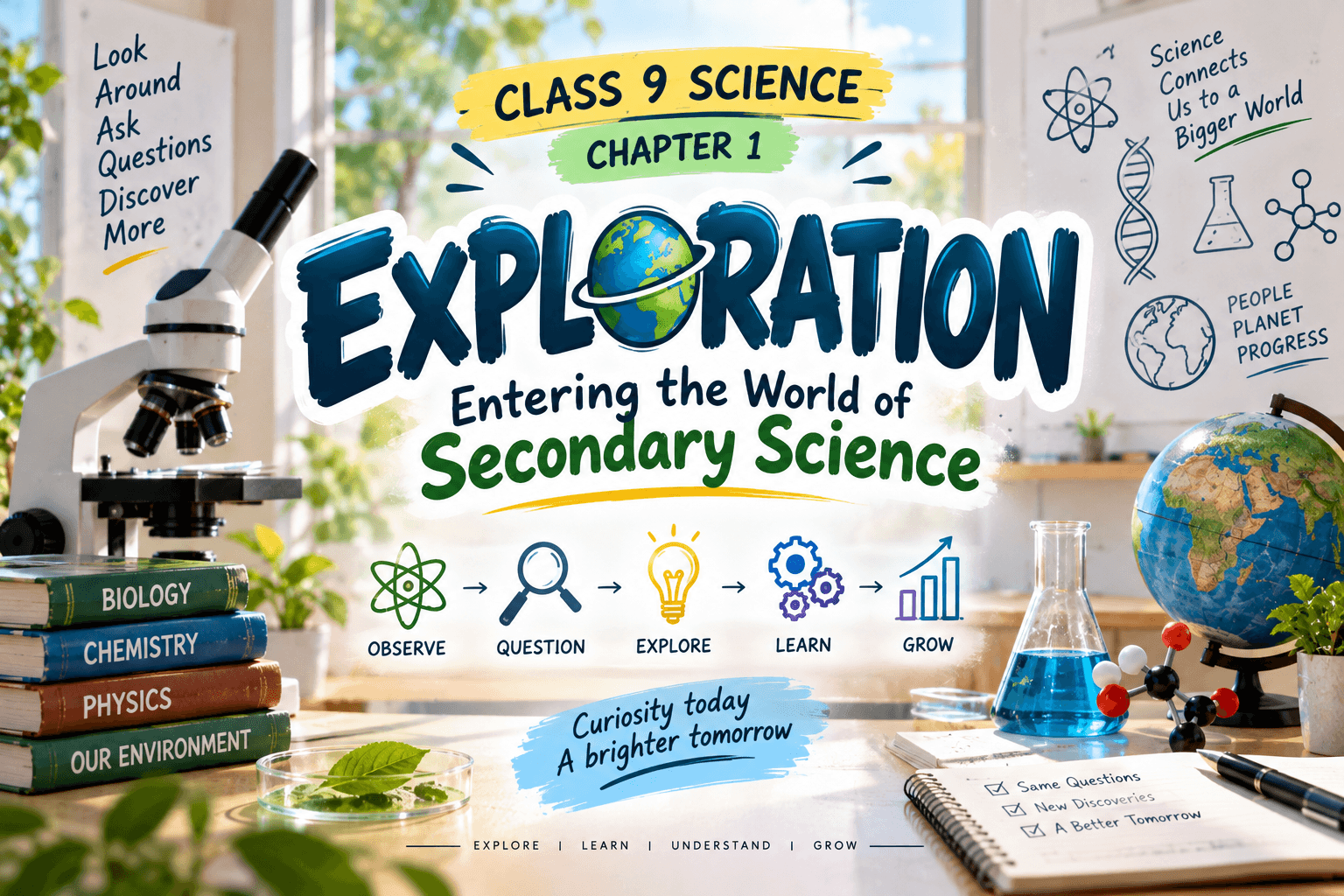

Class 9 Science Chapter 1 Study Guide: Five Scientific Thinking Skills You’ll Use All Year

There’s nothing to “solve” in this chapter, which fools a lot of students into treating it as a light read before the real syllabus starts. It isn’t. It’s the only chapter all year that tells you outright how you’re expected to think in the other twelve – and every one of those chapters will quietly test whether you actually picked up the habit.

Class 9 Science Chapter 1 Has No Exercises – So What Is It Actually Testing?

Chapter 1 is built from Examples, Activities, “Pause and Ponder” prompts and “Ready to Go Beyond” boxes rather than a numbered problem set. That doesn’t mean it isn’t tested – it means it’s tested differently. Recall questions (“what is a model”, “who is Meghnad Saha”) are the easy half and they’re already answered in full elsewhere. The half that actually separates a strong answer from a weak one is when a question hands you a situation you haven’t seen before and asks you to build a model for it, design a testable question about it, or estimate something about it. That’s a skill and skills only improve with fresh practice – not by re-reading the cricket-ball example one more time.

The Two Lenses the Whole Textbook Is Built On

The book frames its own page numbers with a magnifying glass and a compass and that split is a genuinely useful way to sort the five skills below:

  • The magnifying glass – observing precisely. Deciding what to include in a model, using exact scientific language and knowing whether something is a law, a theory or a principle.
  • The compass – choosing with purpose. Turning a vague idea into a testable question, making a sensible estimate and knowing when a claim needs evidence rather than belief.

Five Skills to Practice – Not Just Recall

Skill 1 (Magnifying Glass) – Building a Model

  • The habit: decide what a specific question actually needs, and deliberately ignore everything else.
  • Where it comes back: Chapter 4, Describing Motion Around Us, is exactly where “a moving car represented as a single point” – this chapter’s own example – gets used for real. Chapter 8, Journey Inside the Atom, will ask you to accept a simplified picture of something you can’t see directly, for the same reason Meghnad Saha simplified a star into “a hot gas”.
  • Try this yourself: You want to model how long it takes an ice cube to melt on a kitchen counter. What would you keep? What would you ignore?
  • A reasonable answer: keep the ice cube’s starting size and the room temperature; ignore the colour of the counter, the shape of the plate and what time of day it is – none of those affect how heat reaches the ice.

Skill 2 (Magnifying Glass) – Using Precise Language

  • The habit: notice when an everyday word has a stricter, narrower meaning in science and use symbols and SI units consistently.
  • Where it comes back: every physics chapter from here on (Motion, Forces, Work and Energy, Sound) will expect exact units – m/s, N, J, Hz – used consistently, not “kind of like that”.
  • Try this yourself: Write down the everyday meaning of the word “weight” and then its precise scientific meaning.
  • The distinction: in daily speech, “my weight is 50 kg” is really describing mass. Scientifically, weight is specifically the force gravity exerts on that mass (measured in newtons) – which is why an object’s weight changes on the Moon even though its mass doesn’t.


Skill 3 (Compass) – Turning a Vague Claim into a Testable Question

  • The habit: replace “I just think so” with questions that involve something measurable.
  • Where it comes back: any chapter with a hands-on investigation – Mixtures and Separation, Forces, Reproduction – needs a testable question before an experiment can even be designed.
  • Try this yourself: A friend says, “My plant grows faster because I talk to it every day”. What questions would make this scientifically testable?
  • A reasonable answer: compare two identical plants, one talked to and one not, with the same water, sunlight and soil; define “faster” as a measured height gain per week rather than a feeling.

Skill 4 (Compass) – Estimating, Then Checking Your Estimate a Second Way

  • The habit: get a rough number fast, then sanity-check it using a different method – exactly what Example 1.3 does by cross-checking the breathing estimate against the balloon-filling rate.
  • Where it comes back: nearly every numerical chapter – speed calculations in Motion, concentration estimates in Mixtures, work calculations in Energy – rewards a student who can tell a sensible answer from an impossible one at a glance.
  • Try this yourself: Estimate how many textbooks would fit in your school bag.
  • A reasonable approach: a bag might be roughly 30 ร— 25 ร— 15 cm (โ‰ˆ 11,000 cmยณ); a textbook roughly 25 ร— 18 ร— 1.5 cm (โ‰ˆ 675 cmยณ). Dividing suggests about 16 by volume alone – but books don’t pack perfectly and share space with a pencil case and lunch box, so a more realistic estimate is 8 to 10. The point isn’t the exact number; it’s catching yourself if you’d guessed 50 or guessed 2.

Skill 5 (Compass) – Testing a Claim Instead of Just Believing or Dismissing It

  • The habit: ask what mechanism would have to exist for a claim to be true, and whether that mechanism has ever actually been checked.
  • Where it comes back: this is the same reasoning the book’s own “Threads of Curiosity” boxes use throughout the year, and it’s a skill that matters well beyond any exam.
  • Try this yourself: A common claim: “Cracking your knuckles causes arthritis”. Using the same approach as the chapter’s eclipse example, what questions would test it?
  • A reasonable approach: ask what physically happens when a knuckle cracks (it’s gas bubbles collapsing in the joint fluid, not bone wearing down); ask whether long-term studies have actually compared arthritis rates between people who crack their knuckles and people who don’t. They have – and repeatedly found no link, which is exactly the kind of evidence-over-belief conclusion this chapter is training you to reach for.

A Map of Where These Ideas Come Back Later in the Book

This chapter’s skillComes back for real in
Building a modelChapter 4 (Describing Motion Around Us), Chapter 8 (Journey Inside the Atom)
Precise language & SI unitsChapters 4, 6, 7, 10 – every physics chapter
Law vs. theory vs. principleChapter 6 (How Forces Affect Motion – the laws), Chapter 9 (Atomic Foundations of Matter – the theory)
Testable questions & estimationChapter 5 (Exploring Mixtures and their Separation), Chapter 11 (Reproduction)
Interdisciplinary connectionsChapter 13 (Earth as a System: Energy, Matter and Life)

None of this is a guarantee of exact exam content – it’s a reasonable expectation based on what each chapter title covers and what Chapter 1 already told you to watch for. But it answers the real question better than “will this be on the test”: these ideas aren’t graded once and forgotten, they’re graded again, quietly, inside every chapter that follows.


How This Kind of Chapter Actually Gets Marked

Questions on a concept chapter like this one tend to fall into three levels and each rewards a different kind of preparation:

  • Recall (1 mark): “What is a model?” “What does ‘c’ stand for?” – answered by knowing the definition cold.
  • Explain with example (2โ€“3 marks): “Distinguish between a law and a theory, with an example of each” – answered by pairing the definition with the right worked example from the book.
  • Apply to something new (5 marks): “You want to model X – what would you include and ignore?” or “Design a test for claim Y” – answered only by the skill itself, not by memorising the book’s cricket-ball or eclipse examples, since the scenario in front of you won’t be either of those.

For that third level, structure your answer in three moves: state the general principle, show you understand it with the book’s example, then actually apply it to the new scenario you were given – rather than stopping after the first two.

A Note on Exam Weightage

It’s true this chapter alone probably won’t carry many direct marks. But that undersells what’s actually happening: the five skills here are re-tested inside other chapters’ questions all year – a forces question might ask whether something is a law or a principle, a mixtures question might ask you to design a testable separation method. Treating Chapter 1 as low-stakes because it has no dedicated exercises just moves the cost of skipping it to later chapters, where it shows up as marks lost on questions that don’t even mention Chapter 1 by name.

Self-Check: Five Fresh Scenarios to Try

Before moving on, see if you can do all five without looking back:

  1. What would you keep and ignore in a model of an ice cube melting on a counter?
  2. What’s the everyday meaning of “weight” versus its precise scientific meaning?
  3. What questions would test the claim that talking to a plant helps it grow?
  4. Roughly how many textbooks fit in a school bag and how would you check your estimate a second way?
  5. What questions would test the claim that cracking your knuckles causes arthritis?

If you can answer all five without recalling a single line from the textbook’s own examples, you’ve actually learned the skill rather than the specific story it came wrapped in.

Where to Check Full Explanations

For the complete definitions, worked examples and exam-style answers for every fact in this chapter – the law/theory/principle distinction in full, Meghnad Saha’s story, and the airplane fuel incident – see NCERT Solutions for Class 9 Science Exploration Chapter 1.

Continue Your Preparation

  • Chapter 2: Cell – The Building Block of Life – the next chapter in the book.


Frequently Asked Questions

How do I practice model-building if this chapter has no exercises to work through?

Take any everyday object or process โ€” how a lift decides which floor to stop at, why a paper aeroplane flies further with a pointed nose – and ask what you’d need to include to answer one specific question about it, and what you could safely ignore. The five practice scenarios above are a starting set; the habit transfers to anything once you’ve done it a few times.

My answer to a “design a test” question doesn’t match any single correct answer – is that a problem?

No – that’s the nature of this skill. A grader is checking whether your questions are measurable and comparable (a control group, a defined quantity, a clear before/after), not whether you guessed the exact questions the textbook used. Multiple good answers exist for the same scenario.

Should I memorise the book’s law/theory/principle examples or come up with my own?

Know the book’s examples cold for recall questions, since that’s what a 1-mark question expects. But for a 5-mark “explain and apply” question, being able to name a fresh example of your own (a different law, a different theory) signals real understanding rather than memorisation.

Will Chapter 1’s ideas appear as separate questions later, or folded into other chapters’ questions?

Mostly the second. Expect a physics chapter to occasionally ask “is this a law or a principle” about a concept it just introduced, or a practical-based chapter to ask you to frame a testable question – without ever citing “Chapter 1” by name. The skill needs to be ready on demand, not just remembered as chapter content.

How is an estimation question graded if there’s no single right number?

Graders are checking your method – did you break the problem into smaller, estimable pieces and does your final number pass a basic sense check – rather than matching a specific figure. Showing your reasoning steps, the way Example 1.3 shows breaths-per-minute and litres-per-breath separately, earns more credit than a number alone.

Recent Posts
  • Class 9 Science Exploration Notes: 5 Methods That Actually Help You Remember
  • Class 9 Social Science Notes: The Complete Guide
  • Class 9 Maths 2026-27: What’s New in the Syllabus and How to Study It
  • CBSE 3-Language Rule: Will Hindi Become Compulsory Subject?
  • NCERT Solutions for Class 10 Maths 2026-27 – Welcome to Your New Session


Important Links
  • What is NCERT?
  • Important Questions
  • Vedic Maths Tricks
  • Link Study Materials
  • Useful Resources & Formulae
  • Holiday Homework Solutions


Buy NCERT Books Online

NCERT Books for 2026-27

NCERT Solutions
  • NCERT Solutions for Class 6 Maths
  • NCERT Solutions for Class 7 Maths
  • NCERT Solutions for Class 8 Maths
  • NCERT Solutions for Class 11 Maths
  • NCERT Solutions for Class 12 Maths
  • NCERT Solutions for Class 11 Physics
  • NCERT Solutions for Class 12 Physics


High School
  • Class 9 NCERT Maths Solutions
  • Class 9 NCERT Science Solutions
  • Class 9 NCERT English Solutions
  • Class 10 NCERT Maths Solutions
  • Class 10 NCERT Science Solutions
  • Class 10 NCERT English Solutions
  • Class 10 NCERT Social Solutions

Quick Links
  • NCERT Books
  • NCERT Solutions
  • CBSE Syllabus
  • Home Tutors
  • NIOS Admissions
  • CBSE Sample Papers
  • Vedic Maths Tricks
Help & Support
  • About Us
  • Contact Us
  • Advertise With Us
  • Discussion
  • Latest Blogs
  • Holiday Homework
  • Useful Resources
Copyright 2026 by Tiwari Academy | A step towards Free Education
facebook
twitter
linkedin
youtube
instagram
pinterest
google-news