



by Tiwari Academy Team
NCERT Class 9 Science Exploration Chapter 4 Solutions exercises question answers in English and Hindi Medium with extra question for session 2026-27. Class 9 Science Exploration Chapter 4 – Describing Motion Around Us – introduces students to the fundamental concepts of motion in a simple and systematic way. In the updated NCERT textbook for session 2026–27, this chapter explains motion in a straight line, distance and displacement, speed, velocity, acceleration, graphical representation of motion and basic kinematic equations.
With real-life examples and activities, students learn how to describe motion using words, numbers, equations and graphs, making it easier to understand both theoretical and practical aspects of physic.
Quick Links:
- Chapter 4 Exercises Solutions
- Very Short Answer Type Questions
- Short Answer Type Questions
- Long Answer Type Questions
- Class 9 Science Exploration Chapter 4 in Hindi Medium
- Download Class 9 Science Offline App to study Class 9 Science Exploration Offline.
NCERT Class 9 Science Exploration Chapter 4 Solutions
Class 9 Science Exploration Chapter 4 Question Answer
Page 68 – Revise, Reflect, Refine
1. My father went to a shop from home which is located at a distance of 250 m on a straight road. On reaching there he discovered that he forgot to carry a cloth bag. He came home to take it, went to the shop again, bought provisions and came back home. How much was the total distance travelled by him? What was his displacement from home?
Answer:
Journey breakdown:
| Step | Journey | Distance |
|---|---|---|
| 1. | Home → Shop | 250 m |
| 2. | Shop → Home (forgot bag) | 250 m |
| 3. | Home → Shop (again) | 250 m |
| 4. | Shop → Home (final) | 250 m |
Total Distance = 250 + 250 + 250 + 250 = 1000 m = 1km
Displacement: He started at home and ended at home. So his final position = starting position.
Therefore, the displacement = 0 m
Hence, the total distance travelled: 1000 m (1 km) and
Displacement from Home : 0 m.
2. A student runs from ground floor to the fourth floor of a school building to collect a book and then comes down their classroom on the second floor.
If the height of each floor is 3m, find:
(i) the total vertical distance travelled, and
(ii) their displacement from the starting point.
Answer:
Ground floor height: 0 m
2nd floor height: 2 × 3 = 6 m
4th floor height: 4 × 3 = 12 m
(i) Total vertical distance:
Path: Ground → 4th floor → 2nd floor
Step 1: Ground to 4th floor: 12 − 0 = 12 m (going up)
Step 2: 4th floor to 2nd floor: 12 − 6 = 6 m (going down)
Total vertical distance = 12 + 6 = 18 m.
(ii) For displacement:
Started at ground floor (0 m), ended at 2nd floor (6 m).
Displacement = 6 m − 0 m = 6 m (upward)
Total vertical distance = 18 m
Displacement (from ground floor) = 6 m upward
3. A girl is riding her scooter and finds that its speedometer reading is constant. Is it possible for her scooter to be accelerating and if so, how?
Answer:
Yes, it is possible for the scooter to be accelerating even when the speedometer shows a constant reading.
Explanation:
The speedometer shows the speed (magnitude of velocity) only. Acceleration can occur due to two reasons:
• Change in magnitude of velocity (speed), OR
• Change in direction of velocity, OR
• Both
If the girl is riding the scooter along a curved path (like turning a corner or going around a roundabout), the direction of her velocity is changing continuously, even though the speedometer shows the same speed. This change in direction means the scooter is accelerating.
This is exactly what happens in uniform circular motion — the speed is constant but the direction changes at every point, so there is always an acceleration (called centripetal acceleration).
4. A car starts from rest and its velocity reaches 24 m s⁻¹ in 6 s. Find the average acceleration and the distance travelled in these 6 s.
Answer:
Given:
Initial velocity (u): 0 m s⁻¹ (starts from rest)
Final velocity (v): 24 m s⁻¹
Time (t): 6 s
For Average Acceleration:
a = (v − u) / t = (24 − 0) / 6 = 24 / 6 = 4 m s⁻²
For Distance travelled using kinematic equation:
Using s = ut + ½at²:
= (0)(6) + ½ × 4 × (6)²
= 0 + ½ × 4 × 36
= 72 m
Verification using v² = u² + 2as, we have:
(24)² = (0)² + 2 × 4 × s
⇒ 576 = 8s
⇒ s = 72 m
5. A motorbike moving with initial velocity 28 m s⁻¹ and constant acceleration stops after travelling 98 m. Find the acceleration of the motorbike and time taken to come to a stop.
Answer:
Given:
Initial velocity (u): 28 m s⁻¹
Final velocity (v): 0 m s⁻¹ (stops)
Distance (s): 98 m
Step 1 — Acceleration:
Using v² = u² + 2as:
(0)² = (28)² + 2 × a × 98
0 = 784 + 196a
196a = −784
a = −784 / 196 = −4 m s⁻²
The negative sign means the motorbike is decelerating (acceleration opposite to velocity).
Step 2 — Time taken:
Using v = u + at:
0 = 28 + (−4) × t
4t = 28
t = 7 s
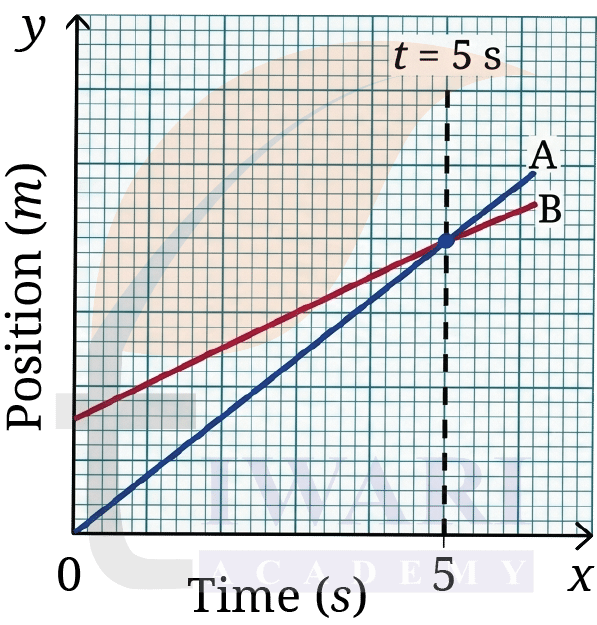
6. Fig. 4.27 shows a position-time graph of two objects A and B moving along parallel tracks in the same direction. Do objects moving along the parallel tracks in the same direction. Do objects A and B ever have equal velocity? Justify your answer.
Answer:
No, objects A and B never have equal velocity because their position-time graph lines are straight with different slopes. Equal velocity would require both lines to have the same slope (be parallel), which is not the case here.
𝗔𝗻𝗮𝗹𝘆𝘀𝗶𝘀 𝗼𝗳 𝘁𝗵𝗲 𝗴𝗿𝗮𝗽𝗵:
On a position-time graph, velocity is represented by the slope (steepness) of the line. A steeper slope means higher velocity.
In Fig. 4.27, both A and B have straight-line graphs (constant velocities). The lines have different slopes, which means different constant velocities. Two straight lines with different slopes never become parallel to each other, so their slopes are always different.
However, the two lines can intersect at a point. At the intersection point, the two objects are at the same position at the same time — but their velocities (slopes) are different.
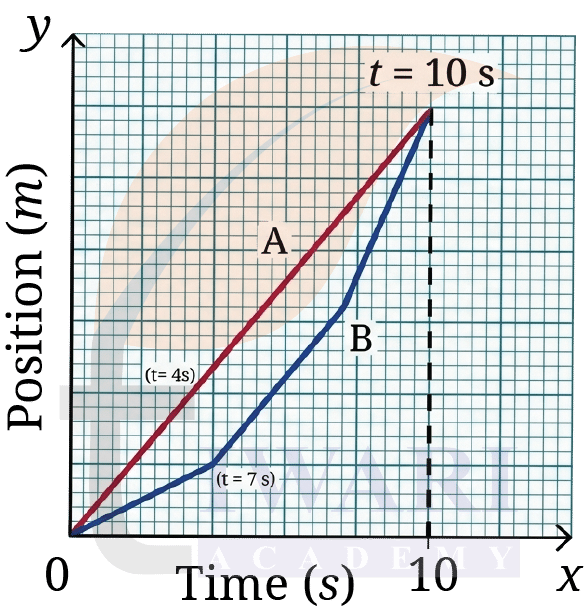
7. A graph in Fig. 4.28 shows the change in position with time for two objects A and B moving in a straight line from 0 to 10 seconds. Choose the correct option(s).
(i) The average velocity of both over the 10 s time interval is equal since they have the same initial and final positions.
(ii) The average speeds of both over the 10s time interval is equal since they have the same initial and final positions.
(iii) The average speed of A over the 10 s time interval is lower than that of B since it covers a shorter distance than B in 10 seconds.
(iv) The average speed of A over the 10 s time interval is greater than that of B since B’s speed is lower than A’s in some segments.
Answer:
Looking at Fig. 4.28: Both A and B start at the same position and end at the same position at t = 10 s.
- Since initial and final positions are the same, displacement is the same for both → Average velocity is the same for both.
- Object A follows a curved path (non-uniform motion), covering more total distance than the straight-line object B.
- Object B is a straight line, covering less total distance.
Therefore:
(i) TRUE — Same initial and final positions → same displacement → same average velocity.
(iv) TRUE — A’s curved path means it covers more total distance, so its average speed is greater than B’s.
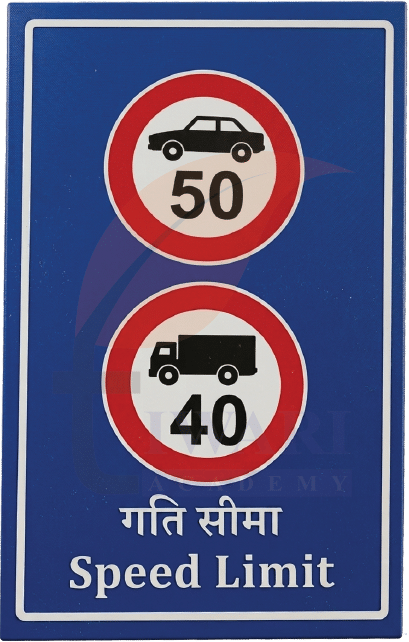
8. A truck driver driving at the speed of 54 km h⁻¹ notices a road sign with a speed limit of 40 km h⁻¹ (Fig. 4.29) for trucks. He slows down to 36 km h⁻¹ in 36 s. What was the distance travelled by him during his time? Assume the acceleration to be constant while slowing down.
Answer:
Initial velocity (u): 54 km h⁻¹ = 54 × (1000/3600) = 15 m s⁻¹
Final velocity (v): 36 km h⁻¹ = 36 × (1000/3600) = 10 m s⁻¹
Time (t): 36 s
For acceleration:
a = (v − u) / t
= (10 − 15) / 36
= −5 / 36 m s⁻²
For distance travelled:
Using s = ut + ½at²:
= 15 × 36 + ½ × (−5/36) × (36)²
= 540 + ½ × (−5/36) × 1296
= 540 + (−5 × 1296 / 72)
= 540 − 90
= 450 m
Alternative using average velocity:
s = ((u + v) / 2) × t
= ((15 + 10) / 2) × 36
= 12.5 × 36
= 450 m
9. A car starts from rest and accelerates uniformly to 20 m s⁻¹ in 5 seconds. It then travels at 20 m s⁻¹ for 10 seconds and finally applies the brake (with uniform acceleration) to stop in 6 seconds. Find the total distance travelled.
Answer:
Acceleration phase (0 to 5 s):
u = 0, v = 20 m s⁻¹, t = 5 s:
s₁ = (u + v)/2 × t = (0 + 20)/2 × 5 = 10 × 5 = 50 m
Constant velocity phase (5 to 15 s):
v = 20 m s⁻¹, t = 10 s:
s₂ = v × t = 20 × 10 = 200 m
Braking phase (15 to 21 s):
u = 20 m s⁻¹, v = 0, t = 6 s:
s₃ = (u + v)/2 × t = (20 + 0)/2 × 6 = 10 × 6 = 60 m
Total Distance: s₁ + s₂ + s₃ = 50 + 200 + 60 = 310 m.
10. A bus is travelling at 36 km h⁻¹ when the driver sees an obstacle 30 m ahead. The driver takes 0.5 s to react before pressing the brake. Once the brake is applied, the velocity of the bus reduces with constant acceleration of 2.5 m s⁻². Will the bus be able to stop before reaching the obstacle?
Answer:
Initial speed: 36 km h⁻¹ = 10 m s⁻¹
Reaction time: 0.5 s
Deceleration after braking: 2.5 m s⁻²
Distance to obstacle: 30 m
Distance covered during reaction time:
During the 0.5 s reaction time, the bus moves at constant speed (brakes not yet applied):
s₁ = u × t
= 10 × 0.5
= 5 m
Distance covered during braking:
Using v² = u² + 2as (v = 0 when bus stops, a = −2.5 m s⁻²):
⇒ 0 = (10)² + 2 × (−2.5) × s
⇒ 0 = 100 − 5 × s₂
⇒ s₂ = 100/5 = 20 m
Total stopping distance: s₁ + s₂ = 5 + 20 = 25 m.
11. A student said, “The Earth moves around the Sun”. In the context, discuss whether an object kept on the Earth can be considered to be at rest.
Answer:
It depends on the reference point chosen:
𝗪𝗶𝘁𝗵 𝗿𝗲𝘀𝗽𝗲𝗰𝘁 𝘁𝗼 𝗘𝗮𝗿𝘁𝗵 𝗮𝘀 𝘁𝗵𝗲 𝗿𝗲𝗳𝗲𝗿𝗲𝗻𝗰𝗲 𝗽𝗼𝗶𝗻𝘁:
An object kept on the Earth (like a book on a table) does NOT change its position relative to the Earth. So the object is AT REST with respect to the Earth.
𝗪𝗶𝘁𝗵 𝗿𝗲𝘀𝗽𝗲𝗰𝘁 𝘁𝗼 𝘁𝗵𝗲 𝗦𝘂𝗻 𝗮𝘀 𝘁𝗵𝗲 𝗿𝗲𝗳𝗲𝗿𝗲𝗻𝗰𝗲 𝗽𝗼𝗶𝗻𝘁:
Since the Earth moves around the Sun, everything on the Earth (including the book) is also moving around the Sun. So the object is IN MOTION with respect to the Sun.
𝗪𝗶𝘁𝗵 𝗿𝗲𝘀𝗽𝗲𝗰𝘁 𝘁𝗼 𝗱𝗶𝘀𝘁𝗮𝗻𝘁 𝘀𝘁𝗮𝗿𝘀:
The Sun itself moves in the Milky Way galaxy. So the object is also moving with respect to distant stars.
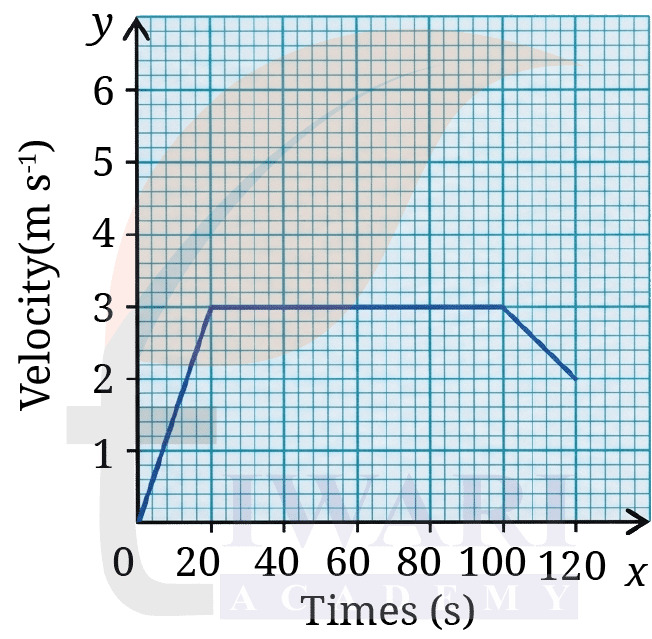
Shade the area (in different colours) representing the displacement of the cyclist
(i) while cyclist is moving with constant velocity.
(ii) when the velocity of cyclist is decreasing.
Also, calculate the displacement and average acceleration in the 120 s time interval.
Answer:
(i) Displacement during constant velocity (40–80 s) — shaded rectangle:
s₂ = v × t = 3 × (80 − 40) = 3 × 40 = 120 m
(ii) Displacement during decreasing velocity (80–120 s) — shaded triangle:
s₃ = ½ × base × height = ½ × 40 × 3 = 60 m
Total displacement (0–120 s):
Phase 1 (triangle): s₁ = ½ × 40 × 3 = 60 m
Total displacement = 60 + 120 + 60 = 240 m
Average acceleration over 120 s:
a = (v_final − v_initial) / t = (0 − 0) / 120 = 0 m s⁻²
(Average acceleration is zero since initial and final velocities are both zero.)
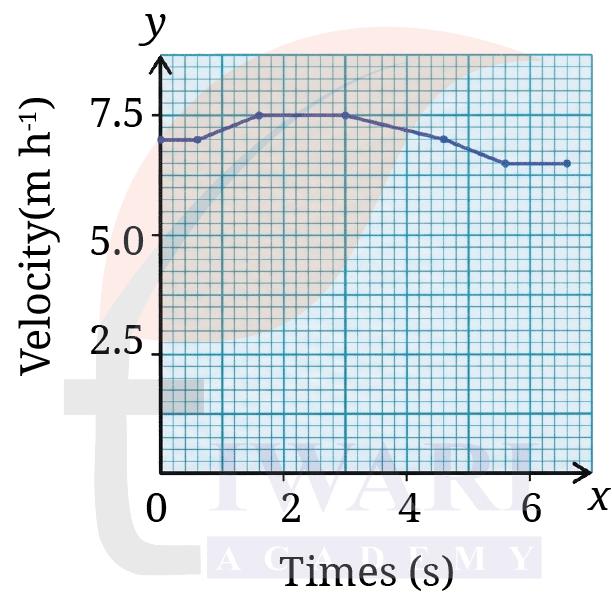
13. A girl is preparing for her first marathon by running on a straight road. She uses a smartwatch to calculate her running speed at different intervals. The graph (Fig. 4.31) depicts her velocity versus time. Estimate the running distance based on the graph.
Answer:
Distance in Phase 1 (rectangle):
s₁ = 7.5 × 4
= 30 km
Distance in Phase 2 (trapezoid):
s₂ = ½ × (7.5 + 5) × 2
= ½ × 12.5 × 2
= 12.5 km
Total estimated running distance:
Total = 30 + 12.5
= 42.5 km
≈ 42 km.
14. On entering a state highway, a car continues to move with a constant velocity of 6 m s⁻¹ for 2 minutes and then accelerates with a constant acceleration 1 m s⁻² for 6 seconds. Find the displacement of the car on the state highway in the 2 min 6 s time interval by drawing a velocity- time graph for its motion.
Answer:
Phase 1: v = 6 m s⁻¹, t₁ = 2 min = 120 s
Phase 2: u = 6 m s⁻¹, a = 1 m s⁻², t₂ = 6 s
Phase 1: Constant velocity (rectangle area):
s₁ = 6 × 120
= 720 m
Phase 2: Accelerating (finding final velocity first):
v = u + at
= 6 + 1 × 6
= 12 m s⁻¹
Displacement = area of trapezoid under graph:
s₂ = ½ × (6 + 12) × 6
= ½ × 18 × 6
= 54 m
Total Displacement s = s₁ + s₂ = 720 + 54 = 774 m.
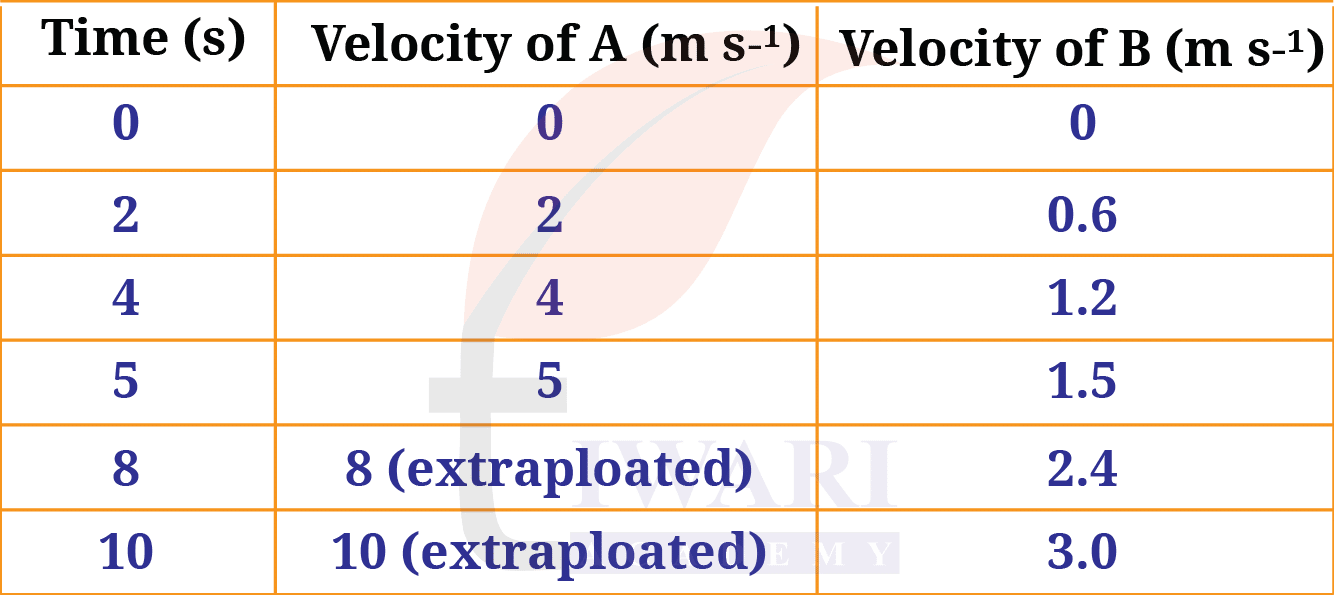
15. Two cars A and B start moving with a constant acceleration from rest in a straight line. Car A attains a velocity of 5 m s⁻¹ in 5 s. Car B attains in a velocity of 3 m s⁻¹ in 10 s. Plot the velocity -time graphs for both the card in the same graph. Using the graph, calculate the displacement mentioned in the two time intervals.
(Hint: Calculate the acceleration in both cases. Then calculate their velocities at five instants of time to plot the graph)
Answer:
Finding accelerations:
Acceleration of A = (5 − 0) / 5 = 1 m s⁻²
Acceleration of B = (3 − 0) / 10 = 0.3 m s⁻²
Velocity data for plotting:
Displacement of Car A (in 5 s — triangle area):
s_A = ½ × base × height
= ½ × 5 × 5
= 12.5 m
Displacement of Car B (in 10 s — triangle area):
s_B = ½ × 10 × 3
= 15 m
16. Rohan studies science from 6 PM to 7:30 PM at home. Consider the tip of the minute’s hand of the wall clock. During the given time interval, what is its
(i) distance travelled,
(ii) displacement,
(iii) speed, and
(iv) velocity.
The length of the minute’s hand is 7 cm (Fig. 4.32).

Answer:
(i) Distance travelled by tip:
The tip traces circular arcs. In 1.5 revolutions:
Circumference of one revolution = 2πr = 2 × 3.14 × 7 = 43.96 cm
Distance = 1.5 × 43.96 = 65.94 cm ≈ 66 cm
(ii) Displacement of the tip:
At 6 PM the minute hand points to 12 o’clock. At 7:30 PM the minute hand also points to 12 o’clock (after 1.5 revolutions). Wait — at 7:30 PM, the minute hand points to 6 o’clock position.
At 6:00 PM → tip is at the 12 position (top of clock). At 7:30 PM → tip is at the 6 position (bottom of clock).
The straight-line distance between these two positions = diameter of clock circle:
Displacement = 2r = 2 × 7 = 14 cm (directed from 12 to 6, i.e., downward)
(iii) Average speed:
Average speed = Distance / Time = 65.94 cm / 5400 s = 0.0122 cm s⁻¹ ≈ 1.22 × 10⁻² cm s⁻¹
(iv) Average velocity:
Average velocity = Displacement / Time = 14 cm / 5400 s = 0.0026 cm s⁻¹ ≈ 2.6 × 10⁻³ cm s⁻¹
Question Bank with Answers | NCERT Session 2026–27
NCERT Class 9 Science Exploration Chapter 4 Very Short Answer Type Questions with Explanation.
Very Short Answer Type Questions
- What is linear motion?
Answer:
When an object moves in a straight line, its motion is called linear motion. Examples include a falling ball, a car on a straight highway, and swimmers in a racing pool. - Define displacement.
Answer:
Displacement is the net change in the position of an object between two given instants of time. It has both magnitude and direction and its SI unit is metre (m). - What is the SI unit of average speed and average velocity?
Answer:
The SI unit of both average speed and average velocity is metre per second, written as m s⁻¹ or m/s. It is also commonly expressed in km h⁻¹. - When is the displacement of a moving object zero?
Answer:
Displacement is zero when an object returns to its original starting position. For example, an athlete running one complete lap returns to the starting point, making displacement zero. - What is uniform motion in a straight line?
Answer:
An object is in uniform motion in a straight line when it travels equal distances in equal intervals of time, moving at a constant speed without changing direction. - Define average acceleration.
Answer:
Average acceleration is the change in velocity of an object divided by the time interval over which the change occurs. Its SI unit is m s⁻² and it has both magnitude and direction. - What does the slope of a position-time graph represent?
Answer:
The slope of a position-time graph represents the velocity of the object. A steeper slope indicates a higher velocity, while a horizontal line (zero slope) indicates the object is at rest. - What does the area under a velocity-time graph represent?
Answer:
The area enclosed between the velocity-time graph line and the time axis for a given time interval is equal to the displacement of the object during that time interval. - State the three kinematic equations for motion with constant acceleration.
Answer:- v = u + at
- s = ut + ½at²
- v² = u² + 2as
Here u = initial velocity, v = final velocity, a = acceleration, s = displacement, t = time.
- What is uniform circular motion?
Answer:
When an object moves in a circular path with constant speed, its motion is called uniform circular motion. Although speed is constant, velocity changes continuously due to change in direction. - What is the displacement of an object after one complete revolution in circular motion?
Answer:
The displacement after one complete revolution is zero, because the object returns to its original starting position. However, the distance travelled equals the circumference of the circular path, which is 2πR. - What is the formula for average speed in uniform circular motion?
Answer:
In uniform circular motion, average speed = 2πR/T, where R is the radius of the circular path and T is the time taken to complete one full revolution. - Can an object have zero velocity but non-zero acceleration?
Answer:
Yes. A ball thrown vertically upward has zero velocity at its highest point, but it still has acceleration due to gravity (9.8 m s⁻²) acting downward at that instant. - What is the acceleration due to gravity as shown in Class 9 Science Exploration Chapter 4?
Answer:
As shown in Example 4.4, when an object is dropped from a height, its acceleration is constant at 9.8 m s⁻² in the downward direction. This is called acceleration due to gravitational force, denoted by g. - What does a straight line parallel to the time axis on a position-time graph indicate?
Answer:
A straight line parallel to the time axis on a position-time graph indicates that the position of the object is not changing with time, meaning the object is stationary or at rest.
NCERT Class 9 Science Exploration Chapter 4 Short Answer Type Questions with Explanation.
Short Answer Type Questions
1. Distinguish between distance and displacement with an example.
Answer:
Distance is the total path length travelled by an object, regardless of direction. Displacement is the net change in position from start to end point, including direction. For example, an athlete running from O to A (100 m) and back to B (60 m) travels a total distance of 160 m, but displacement is only 40 m in the positive direction.
2. What is the difference between average speed and average velocity? When are they equal?
Answer:
| Feature | Average Speed | Average Velocity |
|---|---|---|
| Based on | Total distance | Displacement |
| Direction | No direction | Has direction |
| Can be zero | Never zero for a moving object | Can be zero |
| Formula | Total distance ÷ time | Displacement ÷ time |
They are equal only when the object moves in a straight line without turning back, so that distance and magnitude of displacement are equal.
3. A swimmer completes one length of a 25 m pool and returns to the starting point in 50 seconds. Find average speed and average velocity.
Answer:
- Total distance travelled = 25 + 25 = 50 m
- Displacement = 0 m (returned to starting point)
- Average speed = 50 m ÷ 50 s = 1 m s⁻¹
- Average velocity = 0 m ÷ 50 s = 0 m s⁻¹
This shows average velocity can be zero even when average speed is not zero.
4. Explain what the slope of a velocity-time graph tells us about the motion of an object.
Answer:
The slope of a velocity-time graph gives the acceleration of the object. If the slope is positive (line going upward), velocity is increasing and acceleration acts in the direction of motion. If the slope is negative (line going downward), velocity is decreasing and acceleration acts opposite to the direction of motion. A zero slope means constant velocity and zero acceleration.
5. How are the three kinematic equations derived? Name the two primary equations.
Answer:
The two primary kinematic equations are:
- v = u + at — derived from the definition of average acceleration
- s = ut + ½at² — derived from the area under the velocity-time graph
The third equation v² = u² + 2as is derived by eliminating t between the two primary equations. All three equations are valid only when acceleration is constant throughout the motion.
6. Why is a moving object in uniform circular motion said to be accelerating, even though its speed is constant?
Answer:
Acceleration is defined as the rate of change of velocity, not speed. Velocity is a vector quantity that includes both magnitude (speed) and direction. In uniform circular motion, the speed remains constant but the direction of motion changes continuously at every point on the circular path. Since direction is changing, velocity is changing, and therefore the object is accelerating even though its speed stays the same.
7. What is a reference point? Why is it important in describing motion?
Answer:
A reference point is a fixed point chosen to describe the position of an object. The position of any object is described by its distance and direction from this reference point. Without a reference point, it is impossible to say whether an object is in motion or at rest, because rest and motion are always relative to an observer. For motion in a straight line, the reference point is marked as the origin O.
8. In Example 4.8 of Class 9 Science Exploration Chapter 4, a car brakes with acceleration −4 m s⁻². Why does doubling the speed quadruple the stopping distance?
Answer:
Using the kinematic equation v² = u² + 2as, with v = 0 (car stops) and a = −4 m s⁻², we get s = u²/8. This shows stopping distance is proportional to the square of the initial speed. When speed doubles from 15 m s⁻¹ to 30 m s⁻¹, the stopping distance increases from 28.1 m to 112.5 m — exactly four times. This is why maintaining safe following distance at high speeds is critically important.
9. How can you find displacement from a velocity-time graph for an object moving with constant acceleration?
Answer:
For an object moving with constant acceleration, the displacement between two time instants equals the area enclosed between the velocity-time graph line and the time axis for that time interval. This area consists of a rectangle plus a triangle. For example, displacement between 10 s and 20 s in Fig. 4.18b equals the area of rectangle ACDE plus the area of triangle ABC, which gives 50 m + 25 m = 75 m.
10. What is the difference between uniform and non-uniform motion in a straight line?
Answer:
| Feature | Uniform Motion | Non-Uniform Motion |
|---|---|---|
| Distance in equal time | Equal | Unequal |
| Speed | Constant | Changing |
| Acceleration | Zero | Non-zero |
| Position-time graph | Straight line | Curved line |
| Velocity-time graph | Horizontal straight line | Sloping line or curve |
In non-uniform motion, if distances in successive equal time intervals are increasing, the object is speeding up; if decreasing, it is slowing down.
NCERT Class 9 Science Exploration Chapter 4 Long Answer Type Questions with Explanation.
Long Answer Type Questions
1. Explain the concepts of position, distance travelled, and displacement using a suitable example. Under what conditions is the magnitude of displacement equal to the distance travelled?
Answer:
Position of an object is described by its distance and direction from a fixed reference point (origin O). For an object moving in a straight line, positions to the right of O are positive and to the left are negative.
Example: An athlete starts at O, reaches point A (100 m) at t = 10 s, then runs back to point B (40 m) at t = 16 s.
Total distance travelled = OA + AB = 100 m + 60 m = 160 m
Displacement = OB = 40 m in the positive direction
Key Differences:
| Feature | Distance | Displacement |
|---|---|---|
| Definition | Total path length | Net change in position |
| Direction | No direction (scalar) | Has direction (vector) |
| Value | Always positive | Can be positive, negative or zero |
| SI Unit | Metre (m) | Metre (m) |
For motion in a straight line, the total distance travelled and the magnitude of displacement are equal only when the object moves in one direction without turning back. The moment an object reverses direction, the two values become unequal, because distance keeps increasing while displacement may decrease.
An instant of time and a time interval are different. An instant is a single clock reading, while a time interval is the duration between two instants.
2. Describe the three kinematic equations for motion in a straight line with constant acceleration. Derive the first and third equations and state the conditions under which these equations are valid.
Answer:
For an object moving in a straight line with constant acceleration, five physical quantities are involved — displacement (s), time interval (t), initial velocity (u), final velocity (v) and acceleration (a) — and they are related by three kinematic equations.
- Equation 1: v = u + at
From the definition of average acceleration:
a = (v − u) / t
Rearranging: v = u + at
This gives the final velocity at any time t if initial velocity u and acceleration a are known. - Equation 2: s = ut + ½at²
This is derived from the area under the velocity-time graph (area of rectangle + area of triangle):
s = u × t + ½ × t × (v − u)
Substituting (v − u) = at from Equation 1:
s = ut + ½at² - Equation 3: v² = u² + 2as
From Equation 1, t = (v − u)/a. Substituting into Equation 2 and simplifying:
v² = u² + 2as
This is useful when time is not given or not required.
Summary Table:
| Equation | Form | Quantity not involved |
|---|---|---|
| First | v = u + at | s (displacement) |
| Second | s = ut + ½at² | v (final velocity) |
| Third | v² = u² + 2as | t (time) |
Conditions for validity:
- Acceleration must be constant throughout the motion.
- All equations apply to motion in a straight line.
- For motion in one direction, distance = magnitude of displacement and speed = magnitude of velocity.
- Signs of u, v, a, and s indicate direction — always assign negative sign when a quantity opposes the chosen positive direction.
3. Describe position-time graphs and velocity-time graphs for different types of motion. What physical quantities can be calculated from each type of graph?
Answer:
Graphs provide a visual representation of how position and velocity change with time. Class 9 Science Exploration Chapter 4 covers two main types of motion graphs.
A. Position-Time Graphs
| Shape of Graph | Nature of Motion | Velocity |
|---|---|---|
| Straight line with positive slope | Uniform motion | Constant, non-zero |
| Straight line parallel to time axis | Object at rest | Zero |
| Curved line (slope increasing) | Non-uniform, accelerating | Increasing |
| Curved line (slope decreasing) | Non-uniform, decelerating | Decreasing |
Calculation from a position-time graph:
Position of the object at any instant by reading the y-axis value.
Velocity by calculating the slope of the line: slope = (s₂ − s₁) / (t₂ − t₁) = BC/CA in the triangle method.
A steeper slope means higher velocity; a gentler slope means lower velocity.
B. Velocity-Time Graphs
| Shape of Graph | Nature of Motion | Acceleration |
|---|---|---|
| Horizontal straight line | Constant velocity | Zero |
| Straight line sloping upward | Uniformly increasing velocity | Constant, positive |
| Straight line sloping downward | Uniformly decreasing velocity | Constant, negative |
Calculation from a velocity-time graph:
- Velocity at any instant — read directly from the y-axis.
- Acceleration — calculated from the slope of the line: a = (v − u) / (t₂ − t₁) = BC/CA
- Displacement — calculated from the area enclosed between the graph line and the time axis:
- For constant velocity: area = rectangle = velocity × time
- For changing velocity: area = rectangle + triangle
A graph is not a route map. It does not show the physical path of the object — it shows how position or velocity changes with respect to time. All graphs in Class 9 Science Exploration Chapter 4 are for motion in a straight line in one direction only.
4. What is uniform circular motion? Explain with examples and prove that an object in uniform circular motion is accelerated even though its speed is constant.
Answer:
Definition: When an object moves in a circular path with constant speed, its motion is called uniform circular motion.
Examples:
- A child on a merry-go-round moving at constant speed
- A satellite moving in a circular orbit around Earth
- A stone tied to a string and whirled in a horizontal circle at constant speed
- A car making a perfectly circular turn at constant speed
Distance and Displacement in Circular Motion:
For a child moving from A to B to C on a merry-go-round:
- Distance = length of the arc ABC (curved path)
- Displacement = straight line AC
After one complete revolution:
- Distance = circumference = 2πR
- Displacement = 0 (object returns to starting point)
- Average velocity = 0/T = 0 m s⁻¹
- Average speed = 2πR/T (non-zero)
Why is uniform circular motion accelerated?
Velocity is a vector — it has both magnitude (speed) and direction. In uniform circular motion:
- The speed (magnitude of velocity) remains constant at every point.
- The direction of velocity changes continuously — at every point on the circle, velocity is directed along the tangent to the circle at that point.
Since the direction of velocity keeps changing, the velocity is changing. Since acceleration is defined as the rate of change of velocity, the acceleration is non-zero.
This is confirmed by Activity 4.5 in the chapter — when a marble moving inside a ring is released by lifting the ring, it immediately moves in a straight line (the tangential direction at that instant), proving that the ring was continuously changing the marble’s direction while it was inside.
Key distinction: In everyday life, we say a vehicle is accelerating only when its speed changes. But in physics, acceleration occurs whenever velocity changes — and velocity changes whenever direction changes, even if speed stays the same. Uniform circular motion is a perfect example of this.
5. A bus is travelling at 36 km h⁻¹ when the driver sees an obstacle 30 m ahead. The driver takes 0.5 s to react before pressing the brake. Once the brake is applied, velocity reduces with constant acceleration of 2.5 m s⁻². Will the bus stop before hitting the obstacle?
Answer:
This is Question 10 from the Revise Reflect Refine section of Class 9 Science Exploration Chapter 4 and beautifully connects kinematic equations to real-life road safety.
- Converting speed to SI units
u = 36 km h⁻¹ = 36 ÷ 3.6 = 10 m s⁻¹ - Calculating distance covered during reaction time
The driver takes 0.5 s to react. During this time, the bus continues at 10 m s⁻¹ with no braking.
Distance during reaction = speed × reaction time = 10 × 0.5 = 5 m - Calculating braking distance after brake is applied
Given: u = 10 m s⁻¹, v = 0 m s⁻¹ (bus stops), a = −2.5 m s⁻²
Using v² = u² + 2as:
0 = (10)² + 2 × (−2.5) × s
0 = 100 − 5s
s = 100/5 = 20 m - Calculating total stopping distance
Total distance = reaction distance + braking distance = 5 + 20 = 25 m
Conclusion: The total stopping distance is 25 m, which is less than the 30 m distance to the obstacle. So the bus will stop safely before reaching the obstacle — but with only 5 m to spare.
Frequently Asked Questions – FAQs
What are the most common mistakes students make in Class 9 Science Exploration Chapter 4 that cost them marks in tests?
Three mistakes account for most marks lost in Describing Motion Around Us.
- First, students confuse average speed with average velocity — in problems where an object returns to its starting point, average velocity is zero but average speed is not.
- Second, students forget to convert km/h to m/s before using kinematic equations — the simple rule is to divide km/h by 3.6 to get m/s.
- Third, students miss the negative sign on deceleration — when an object is slowing down, acceleration is negative and ignoring this gives completely wrong answers.
Practising problems that specifically target these three situations before the exam will recover most of the lost marks.
What are the genuinely new teaching challenges in Class 9 Science Exploration Chapter 4 compared to the old NCERT Motion chapter?
Teachers familiar with the old Motion chapter will find three genuinely new demands in Describing Motion Around Us.
- First, the uniform circular motion section requires a hands-on activity with a marble and ring, which needs classroom preparation and is a conceptually fresh topic at this level.
- Second, The Journey Beyond section asks students to independently derive two kinematic equations — s = vt − ½at² and s = ½(u+v)t — which is a higher-order task requiring teacher guidance, not just textbook reading.
- Third, the India’s Scientific Contributions box featuring the Ganitakaumudi problem needs to be taught as a live problem-solving exercise, not skipped as background reading.
Teachers should plan at least two additional periods beyond the older lesson plan to cover these sections adequately.
Activity 4.5 uses a marble inside a ring to teach circular motion. Is this worth doing in class during teaching of Describing Motion Around Us?
Yes, Activity 4.5 is one of the most impactful activities in Describing Motion Around Us and takes under ten minutes with minimal materials — just an adhesive tape ring and a marble. The critical step is asking students to predict what happens when the ring is lifted before actually doing it.
When the marble escapes in a straight line after the ring is removed, it physically demonstrates that the circular path was maintained by the ring’s constraint, and without it, the object continues in its instantaneous direction of motion.
This creates a lasting conceptual anchor for the idea that objects in circular motion are continuously changing direction — and therefore are always accelerating — even when their speed is constant.
How should graph-based questions in Class 9 Science Exploration Chapter 4 be taught for maximum exam performance?
Graph teaching in Describing Motion Around Us works best in three stages.
- Stage one: students plot graphs from data using Activity 4.3 so they understand what each axis represents.
- Stage two: students learn to extract information — slope of a position-time graph gives velocity, slope of a velocity-time graph gives acceleration and area under a velocity-time graph gives displacement. The triangle method from Activity 4.4, where students draw parallel lines and calculate BC ÷ CA, is the most effective technique for this.
- Stage three: students interpret graph shapes — straight line means constant velocity or uniform acceleration, curve means changing velocity and a horizontal line on a position-time graph means the object is at rest.
Testing each stage separately before combining prevents the confusion that comes from teaching all three together.
The Ganitakaumudi problem in Class 9 Science Exploration Chapter 4 is about ancient Indian mathematics. How can teachers use it effectively?
The Ganitakaumudi problem — two postmen walking toward each other and meeting after 15 days — is mathematically identical to a relative speed problem common in competitive exams. Teachers can use it in three ways.
- First, solve it as given in Describing Motion Around Us and then restate it in modern units — km/h instead of yojanas per day — to show students the thinking is identical across centuries.
- Second, use it as an informal introduction to relative speed before its formal treatment in higher grades.
- Third, use it to build pride in India’s scientific heritage, which aligns with the new curriculum’s emphasis on Indian knowledge systems.
Even five dedicated minutes on this section enriches the lesson and makes students curious about the history of science.
Is Class 9 Science Exploration Chapter 4 easy or difficult?
Class 9 Science Exploration Chapter 4 – Describing Motion Around Us – is considered moderately easy by most students. The concepts like distance, displacement, speed and velocity are logical and connect directly to everyday life. The kinematic equations are only three in number and follow a clear pattern.
The real difficulty lies in graph-based questions, unit conversion from km/h to m/s, and correctly handling negative acceleration. Students who practise numerical problems regularly find Describing Motion Around Us one of the more scoring chapters in Class 9 Science, because once the formulas and graph rules are understood, most exam questions follow predictable patterns.
What are the main difficulties students face in Class 9 Science Exploration Chapter 4?
The four main difficulties in Describing Motion Around Us are:
- Distance vs. displacement confusion – students mix these up especially when an object reverses direction.
- Speed vs. velocity confusion – particularly in problems where displacement is zero but distance is not.
- Unit conversion – forgetting to convert km/h to m/s before using kinematic equations costs marks in almost every numerical problem.
- Graph interpretation – reading slope and calculating area correctly on position-time and velocity-time graphs is the most commonly tested and most commonly dropped skill in Class 9 Science Exploration Chapter 4.
Understanding these four problem areas and practising them specifically is the fastest way to become confident in Describing Motion Around Us.
How can I solve the numerical problems in Class 9 Science Exploration Chapter 4 easily?
Solving numericals in Describing Motion Around Us becomes easy if you follow four fixed steps every time.
- First, write down every value given in the problem and assign each one the correct symbol — u, v, a, s or t.
- Second, convert all units to SI units immediately — km/h becomes m/s by dividing by 3.6.
- Third, identify which of the three kinematic equations contains the quantity you need to find.
- Fourth, substitute the known values and solve. The most important habit is to write down what is given and what is asked before touching any formula.
Students who skip this step and jump straight to calculation make avoidable errors and lose marks in Class 9 Science Exploration Chapter 4 unnecessarily.
How can I complete Class 9 Science Exploration Chapter 4 in 2 days?
Completing Describing Motion Around Us in 2 days is very realistic with a focused plan. On Day 1, read sections 4.1 to 4.2 covering motion in a straight line, distance, displacement, average speed, average velocity, average acceleration and all three types of position-time and velocity-time graphs.
Solve all the Pause and Ponder questions and the worked examples (4.1 to 4.7) in the chapter. On Day 2, study section 4.3 on kinematic equations — read the derivations once for understanding and then practise examples 4.8 and the Revise Reflect Refine numericals. Finish with section 4.4 on uniform circular motion, which is shorter and conceptual.
By the end of Day 2, a student who follows this plan will have covered all the core content of Class 9 Science Exploration Chapter 4.
Is it possible to complete Class 9 Science Exploration Chapter 4 in one day?
Completing Describing Motion Around Us in one day is possible but only for revision or a quick overview — not for first-time learning.
If you are studying it for the first time, one day is not enough to understand graphs, practise kinematic equation problems and grasp circular motion properly.
However, if you have already read the chapter once and need to revise before an exam, one focused day is sufficient. Spend the morning on concepts and definitions, the afternoon on graph questions and examples and the evening solving five to six numericals from the Revise Reflect Refine section.
For genuine understanding of Class 9 Science Exploration Chapter 4, two days is the realistic minimum.
I always get confused about when velocity is zero but speed is not. Can someone explain this clearly?
This is one of the most frequently confused points in Describing Motion Around Us. Imagine swimming from one end of a 25 m pool to the other end and back, ending at the starting point. Your total distance is 50 m and your average speed is 50 m divided by the total time, which is not zero. But your displacement — the straight-line change in position from start to finish — is zero because you ended where you began. Average velocity equals displacement divided by time, so it is 0 ÷ time = 0 m/s. This situation — average velocity zero but average speed non-zero — appears repeatedly in Class 9 Science Exploration Chapter 4 numericals and is a guaranteed exam question.
I keep getting the wrong answer in acceleration problems in Class 9 Science Exploration Chapter 4. What am I doing wrong?
The most likely reason is forgetting the negative sign when an object is slowing down. In Describing Motion Around Us, acceleration is a vector — it has direction. When a car accelerates, the acceleration acts in the direction of motion and is positive. When brakes are applied and the car slows down, the acceleration acts opposite to the direction of motion and is negative — this is sometimes called deceleration or retardation. If you substitute acceleration as a positive number when the object is decelerating, the kinematic equations give a completely wrong answer. Always check — if the object is losing speed, write acceleration as −a in your formula. This single habit fixes the majority of wrong answers students get in Class 9 Science Exploration Chapter 4 numerical problems.
Which is the toughest topic inside Class 9 Science Exploration Chapter 4 and how should I deal with it?
For most students, graph-based questions are the toughest part of Describing Motion Around Us. The difficulty is not in plotting — it is in reading the slope and area correctly and connecting them to the right physical quantity. The rule to remember is: slope of a position-time graph = velocity and slope of a velocity-time graph = acceleration. Area between a velocity-time graph line and the time axis = displacement. The best way to deal with this is to pick any three graphs from the chapter — one showing constant velocity, one showing increasing velocity and one showing decreasing velocity — and practise calculating slope and area from each until it feels automatic. Students who do this for thirty minutes a day for three days find graph questions in Class 9 Science Exploration Chapter 4 become the easiest part of the exam, not the hardest.