



by Tiwari Academy Team
NCERT Solutions for Class 9 Science Exploration Chapter 3 Tissues in Action in English and Hindi Medium updated for session 2026-27 with extra question answers. Chapter 3 of the Class 9 Science Exploration textbook (NCERT, Session 2026–27), titled Tissues in Action, introduces students to the fascinating world of biological tissues – the building blocks of every living organism. Life begins when a single cell divides repeatedly to eventually form the skin, muscles, bones, nerves and all other organs of the body. But how do these cells organise themselves so precisely? The answer lies in tissues — groups of structurally similar cells that work together to perform a specific function.
Class 9 Science chapter 3 explores how plant and animal tissues differ in structure and function, and why these differences exist. In plants, meristematic tissues (apical, lateral, and intercalary) drive growth in length, girth, and regrowth after damage, while permanent tissues – parenchyma, collenchyma, sclerenchyma, xylem and phloem – carry out protection, support and conduction. In animals, the chapter covers the four major tissue types: epithelial, connective, muscular and nervous tissue. It further extends to the musculoskeletal system, types of joints (ball-and-socket, hinge, pivot and fixed) and the skeletal system – linking tissue structure directly to body movement and function. This chapter is essential for understanding the division of labour in multicellular organisms and forms the foundation for higher-level biology.
Quick Links:
- Chapter 3 Exercises Solutions
- Very Short Answer Type Questions
- Short Answer Type Questions
- Long Answer Type Questions
- Class 9 Science Exploration Chapter 3 in Hindi Medium
- Download Class 9 Science Offline App to study Class 9 Science Exploration Offline.
Class 9 Science Exploration Chapter 3 Question Answer
NCERT Class 9 Science Exploration Chapter 3 Solutions
Page 44 – Revise, Reflect, Refine
1. Meristematic tissues divide repeatedly. What property of their cells allows them to do this?
(i) They have thick walls for protection.
(ii) They contain large vacuoles that store nutrients.
(iii) They have thin walls, dense cytoplasm and large prominent nucleus.
(iv) They are functionally differentiated cells.
Answer:
(iii) They have thin walls, dense cytoplasm and large prominent nucleus.
𝗘𝘅𝗽𝗹𝗮𝗻𝗮𝘁𝗶𝗼𝗻: Meristematic cells are specialised for continuous and rapid cell division. Their properties that enable this are:
- Thin cell walls – Allow easy expansion and division without rigid constraints.
- Dense cytoplasm – Rich in organelles needed for active metabolism and cell division.
- Large prominent nucleus – Contains genetic material and controls cell division actively.
- No vacuoles – Vacuoles are absent so cells are tightly packed, with maximum space for organelles needed for division.
2. If a plant is unable to transport food from leaves to roots which tissue is malfunctioning?
(i) Xylem
(ii) Phloem
(iii) Epidermis
(iv) Sclerenchyma
Answer:
(ii) Phloem
𝗘𝘅𝗽𝗹𝗮𝗻𝗮𝘁𝗶𝗼𝗻: Phloem is the vascular tissue responsible for transporting food (sugars prepared by photosynthesis) from the leaves to other parts of the plant including roots, fruits, and growing regions. This process is called translocation.
- Xylem transports water and minerals from roots to leaves – so xylem is not the answer here.
- Epidermis is a protective tissue; it does not transport food.
- Sclerenchyma provides mechanical support; it does not transport food either.
3. Why are the epithelial tissues that line an animal’s internal organs usually only one or a few cells thick?
(i) To store food efficiently.
(ii) To provide maximum strength.
(iii) To allow quick exchange of materials across them.
(iv) To reduce friction.
Answer:
(iii) To allow quick exchange of materials across them.
𝗘𝘅𝗽𝗹𝗮𝗻𝗮𝘁𝗶𝗼𝗻:
- The distance for diffusion is minimal – substances can cross the membrane rapidly.
- This is critical in the lungs where oxygen must quickly pass into blood and carbon dioxide must exit.
- In the intestine, nutrients must be quickly absorbed into blood capillaries.
Thick epithelium (like skin) is for protection against friction and microbes, not for exchange. Hence internal exchange surfaces are thin while external protective surfaces are thick.
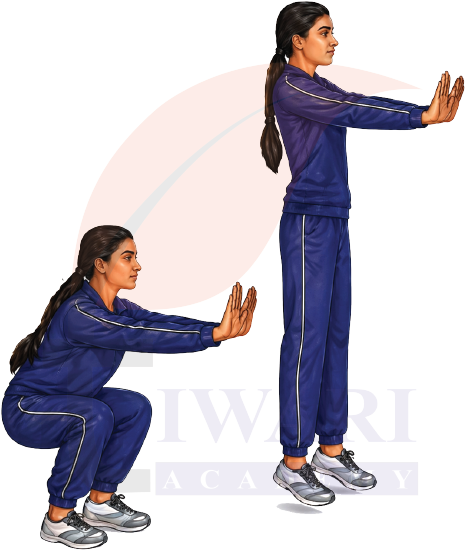
4. You can perform these two jumps (Fig. 3.21):
Straight-leg jump – keep knees and ankles stiff.
Normal jump – bend knees and ankles naturally.
How did your ankle, knee and hip positions differ between the two jumps?
Answer:
| Body Part | Straight-leg Jump | Normal Jump |
|---|---|---|
| Knees | Kept stiff and straight – no bending | Bend naturally on landing, absorbing impact |
| Ankles | Stiff – toes point down rigidly | Flex and extend to provide push-off force and cushion landing |
| Hips | Remain mostly fixed – little movement | Flex and extend to aid jumping height and balance |
| Experience | Painful, jarring impact on landing; difficult to balance | Smooth, controlled landing with good balance |
5. Which type of joint is involved when you bend your knees and ankles?
(i) Ball and socket
(ii) Hinge
(iii) Pivot
Answer:
(ii) Hinge
𝗘𝘅𝗽𝗹𝗮𝗻𝗮𝘁𝗶𝗼𝗻:
The knee and ankle are classic examples of hinge joints. Like a door hinge, these joints allow movement in only one plane – bending (flexion) and straightening (extension). They do NOT allow rotation or sideways movement.
6. In each of the following cases (A, B, C and D), choose the correct option as given below:
(i) Both (A) and (R) are true, and (R) is the correct explanation of (A). (ii) Both (A) and (R) are true, but (R) is not the correct explanation of (A). (iii) (A) is true, but (R) is false. (iv) (A) is false, but (R) is true.
A. Assertion: Epithelium is well-suited for gas exchange in the lungs. Reason: It consists of multiple layers of tall cells that slow down diffusion.
B. Assertion: Cardiac muscle can contract continuously without fatigue. Reason: Cardiac muscle cells have a high number of mitochondria and an abundant blood supply.
C. Assertion: Tendons connect bone to bone and allow joint movement. Reason: Tendons are made of tough connective tissue that transmits force from muscle to bone.
D. Assertion: In a hinge joint, movement occurs primarily in one plane. Reason: The bone ends are shaped to allow sliding in all directions.
Answer:
A. (iii) — A is true, but R is false.
B. (i) — Both A and R are true and R is the correct explanation of A.
C. (iv) — A is false, but R is true.
D. (iii) — A is true, but R is false.
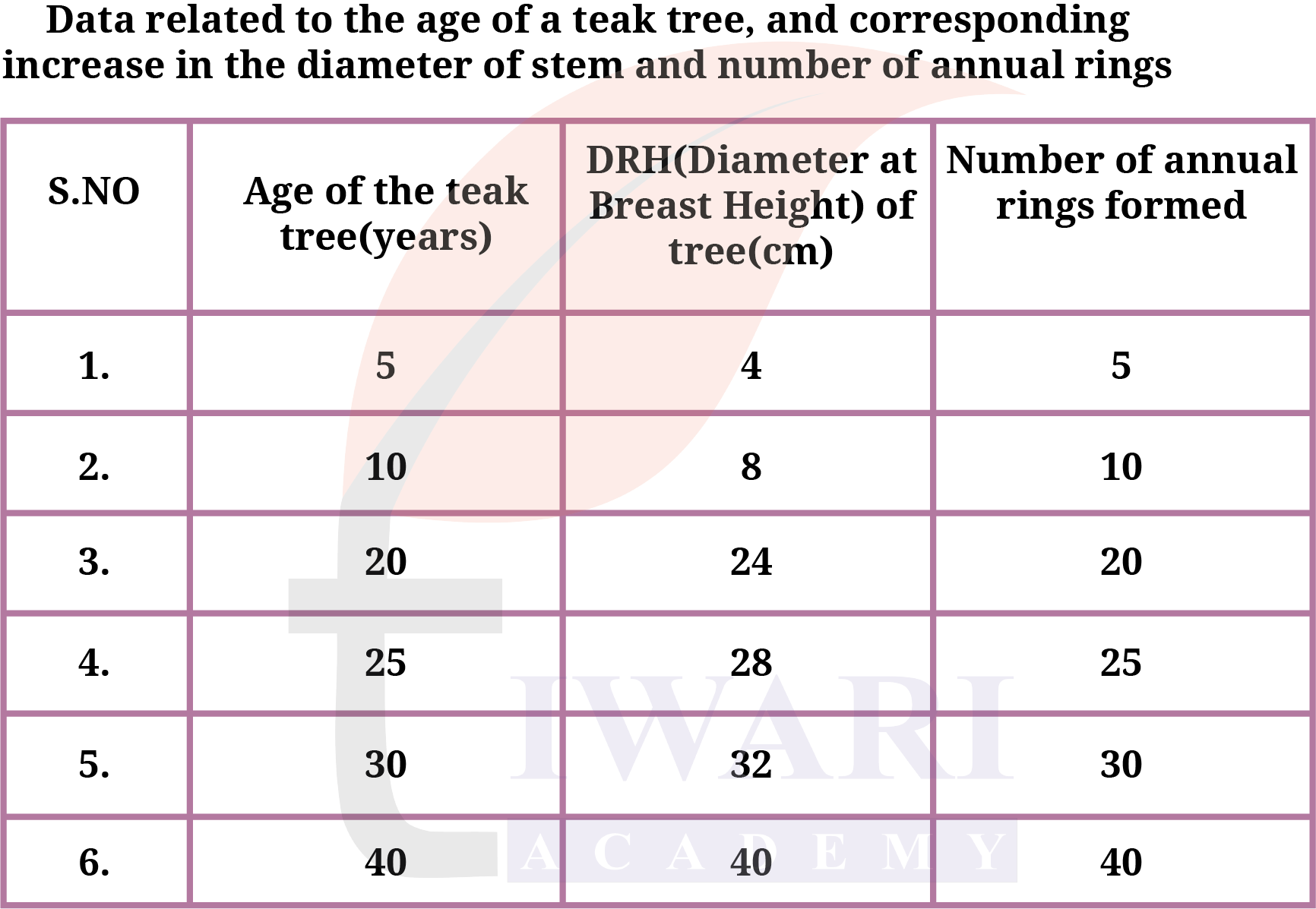
7. Plot a graph between the age of a tree (in years) on the x-axis and the diameter of the tree (in cm) along with the number of annual rings formed over time on the y-axis, using the data given in the Table 3.7.
(i) Analyse the graph in terms of the diameter of the stem over time and share the interpretation.
(ii) What is the relation between the diameter of the teak tree to the annual rings formed?
(iii) Which specialised tissue is responsible for the girth of the stem and where is it located?
Answer:
(i) The diameter of the teak tree increases steadily with age, but not at a uniform rate. Between year 10 and year 20, the diameter shows a large jump (from 8 cm to 24 cm), suggesting a period of very rapid growth. After year 20, growth continues but at a slower, more gradual rate. Overall, the older the tree, the wider its trunk – showing continuous lateral growth throughout the tree’s life.
(ii) The number of annual rings exactly equals the age of the tree in years (e.g., 5 years = 5 rings, 40 years = 40 rings). The diameter also increases with age. Therefore, more annual rings = greater diameter. Each ring represents one year of growth by the lateral meristem. Thus, the diameter is directly related to the number of annual rings formed.
(iii) The tissue responsible for increase in girth (thickness) is the Lateral Meristem. It is located along the circumference of stems (in a ring running around the stem). The lateral meristem divides and produces new cells inside and outside, leading to an increase in the diameter of the stem. Each year, one new ring of wood is added by this tissue, forming the annual growth rings visible in a cross-section of the trunk.
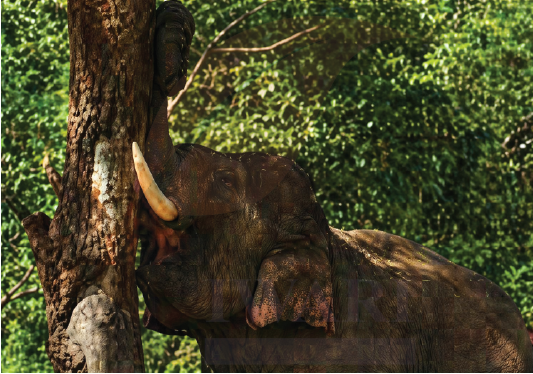
8. In a forest, it was observed that one of the trees was severely debarked by an elephant to meet its food requirements, as the bark is a rich source of nutrients (Fig. 3.22).
Based on your learning, answer the following:
(i) Which function(s) of the tree is/are hampered by debarking?
(ii) Which plant tissue would be affected by further damage to the tree trunk even after debarking?
(iii) Which function of the tree would be hampered if the tissues beneath the bark were severely damaged?
(iv) What assumptions are you making to answer the questions above? How would the answer change if your assumptions are also changed?
Answer:
(i) Functions hampered by debarking
• 𝗣𝗿𝗼𝘁𝗲𝗰𝘁𝗶𝗼𝗻 𝗶𝘀 𝗹𝗼𝘀𝘁: The bark (formed by cork cells) protects the inner tissues from mechanical damage, pathogens, water loss, and temperature extremes. Removal exposes inner living tissues to infection and drying out.
• 𝗙𝗼𝗼𝗱 𝘁𝗿𝗮𝗻𝘀𝗽𝗼𝗿𝘁 𝗶𝘀 𝗱𝗶𝘀𝗿𝘂𝗽𝘁𝗲𝗱: The phloem lies just beneath the bark. Debarking damages the phloem, preventing the transport of food (sugars) from leaves to roots.
• 𝗪𝗮𝘁𝗲𝗿 𝗹𝗼𝘀𝘀 𝗶𝗻𝗰𝗿𝗲𝗮𝘀𝗲𝘀: The waxy cuticle and cork layer prevent excessive water loss. Without it, the tree desiccates rapidly.
(ii) If the trunk is further damaged beneath the bark, the Xylem would be affected. Xylem is the inner woody tissue of the trunk that transports water and minerals from the roots to the leaves. Damage to xylem would cut off water supply to the entire tree, causing wilting and death.
(iii) If the phloem and xylem (both vascular tissues present just beneath the bark) are severely damaged:
- Water transport (by xylem) – roots cannot receive water signals; leaves wilt and dry.
- Food transport (by phloem) – roots starve as they cannot receive food from leaves; root growth and mineral absorption stop.
- The tree would eventually die due to failure of both conducting systems.
(iv) Assumptions made
- We assume the phloem is located just beneath the bark and that the elephant’s debarking exposed this layer.
- We assume the xylem is largely intact after initial debarking (only the outer bark and phloem are removed).
- We assume the tree has no alternative pathways (such as grafting or regrowth) to compensate for the loss.
- If our assumption that phloem is intact changes (i.e., phloem is also removed), then even water transport would be affected sooner, as roots would lose the signal to absorb water.
9. Aamrapali observed that a young mango sapling’s stem bends flexibly during monsoon winds and does not break. Which tissue is responsible for this flexibility?
Predict and provide your explanation of the impact if the existing tissue was replaced by sclerenchyma.
Answer:
Collenchyma is responsible for this flexibility. Collenchyma consists of living cells with unevenly thickened corners due to pectin (a flexible, rubber-like chemical). This tissue provides both support AND flexibility to young plant stems, leaf stalks (petioles) and tendrils – allowing them to bend without breaking under mechanical stress like monsoon winds.
𝗜𝗺𝗽𝗮𝗰𝘁 𝗶𝗳 𝗰𝗼𝗹𝗹𝗲𝗻𝗰𝗵𝘆𝗺𝗮 𝘄𝗲𝗿𝗲 𝗿𝗲𝗽𝗹𝗮𝗰𝗲𝗱 𝗯𝘆 𝘀𝗰𝗹𝗲𝗿𝗲𝗻𝗰𝗵𝘆𝗺𝗮:
- Sclerenchyma cells have thick, lignified (hardened) cell walls – they are dead cells that provide rigidity and strength but NO flexibility.
- If the mango sapling’s stem had sclerenchyma instead of collenchyma, the stem would become stiff and brittle.
- During monsoon winds, instead of bending, the stem would snap and break – causing serious damage to the plant.
- This would also prevent growth movements (like growing toward light), as rigid sclerenchyma cannot bend.
- The plant’s survival in windy conditions would be severely compromised.
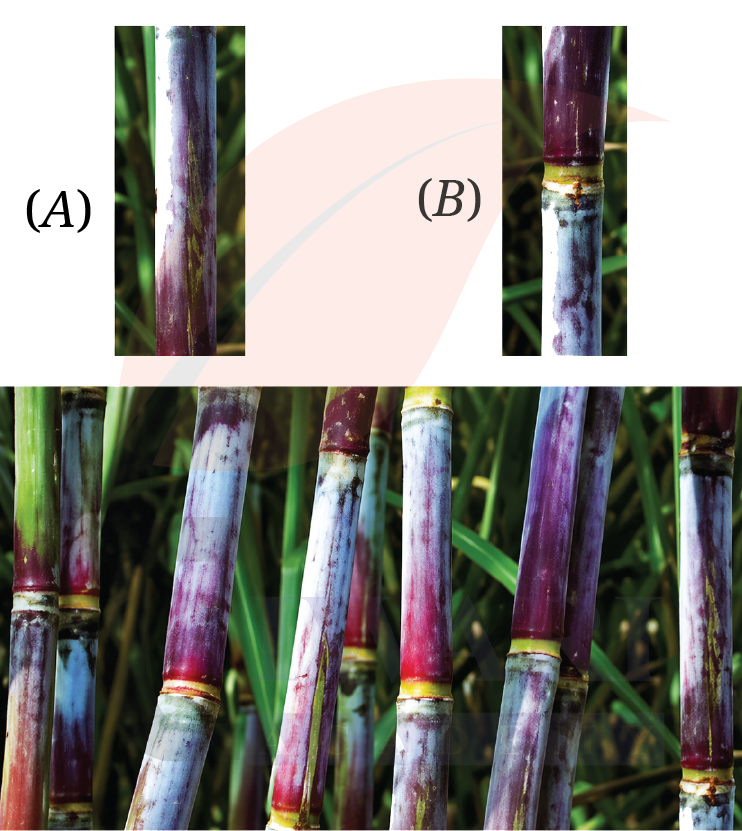
10. Sohan designed an experiment for the regeneration of sugarcane, where he used cuttings to grow sugarcane. He used two types of cuttings, type ‘A’ and type ‘B’ (Fig. 3.23).
After a few weeks, type ‘B’ cuttings sprouted and developed into sugarcane plants, whereas the type ‘A’ cuttings did not sprout.
(i) Why were the type ‘B’ cuttings able to grow as sugarcane but type ‘A’ could not?
(ii) What difference was present in type ‘B’ compared to type ‘A’?
(iii) What observation or measurement was made to determine whether this change had an effect?
(iv) What parameters should be kept the same for both types of cuttings to ensure a fair comparison?
Answer:
(i) Type B cuttings were able to grow because they contained nodes with intercalary meristem – actively dividing meristematic tissue located at the nodes of the stem. This tissue enabled the cutting to regenerate and sprout new shoots and roots. Type A cuttings lacked this meristematic tissue (likely taken from internodal regions only) and therefore could not regenerate or sprout.
(ii) Type B cuttings included the nodes of the sugarcane stem — the region where intercalary meristematic cells are located. These meristematic cells retain the ability to divide and differentiate into new plant tissues. Type A cuttings were likely taken from internodal regions – between nodes – which contain only permanent tissues (no meristematic cells), so they cannot regenerate.
(iii) The key observation was whether the cuttings sprouted new shoots and roots or not – measured by visible growth (emergence of new shoots/leaves) after a few weeks. Additionally, measurement of the length of new growth over time would quantify the difference. The fact that Type B showed sprouting while Type A showed none was the determining observation.
(iv) Parameters to keep the same for fair comparison
- Length of cuttings – both types should be of similar length.
- Age and health of the parent plant – cuttings from the same plant or same-aged plants.
- Growing conditions – same soil type, amount of water, sunlight, and temperature for both types.
- Time of planting – both planted at the same time.
- Orientation of cutting – both planted in the same direction (right-side up).
- Number of cuttings – same number of each type to allow statistical comparison.
11. During the discussion in class, Rohan gives a statement that, “A tissue is a group of similar cells performing similar functions”. But Rajiv counter argues that, “this is true in case of simple tissues but little different in case of complex tissues”.
Provide your explanation in view of the discussion in class.
Answer:
Both Rohan and Rajiv are partially correct. Here is a complete explanation:
𝗥𝗼𝗵𝗮𝗻’𝘀 𝘀𝘁𝗮𝘁𝗲𝗺𝗲𝗻𝘁 is the basic definition of a tissue and holds well for simple permanent tissues like parenchyma, collenchyma, and sclerenchyma — where all cells are of the same type and perform the same function (e.g., all parenchyma cells store food and have thin walls).
𝗥𝗮𝗷𝗶𝘃’𝘀 𝗮𝗿𝗴𝘂𝗺𝗲𝗻𝘁 is correct for complex permanent tissues like xylem and phloem:
| Tissue | Cell types present | Different cells, different roles |
|---|---|---|
| Xylem | Tracheids, Vessels, Xylem parenchyma, Xylem fibres | Tracheids/vessels transport water; parenchyma stores food; fibres give strength |
| Phloem | Sieve tubes, Companion cells, Phloem parenchyma, Phloem fibres | Sieve tubes transport food; companion cells regulate sieve tubes; fibres give support |
In complex tissues, the different types of cells work together as a team to perform a common overall function (conduction), even though each cell type does a different specific job. So the tissue as a whole has a common function, but the individual cells within it are NOT all similar in structure or specific function. This is why Rajiv’s refinement of Rohan’s definition is important and accurate.
12. Coconut husk fibres are used for mats which are tough and fibrous. Which tissue has structural features suitable for providing this strength? Explain why living parenchyma couldn’t serve the same purpose.
Answer:
Sclerenchyma tissue has structural features suitable for providing this strength. Coconut husk fibres are made of sclerenchyma.
The structural features that make sclerenchyma suitable for providing strength are:
- Cells have thick, lignified (hardened) cell walls – lignin is an extremely strong polymer that makes cell walls rigid and durable.
- Most sclerenchyma cells are dead at maturity – they no longer need metabolic resources and are essentially hollow tubes of strong lignified material.
- The cells are long and fibrous in shape, arranged in bundles, providing tensile strength and resistance to tearing.
- This gives materials like coconut husk, jute and walnut shells their characteristic hardness and toughness.
Parenchyma cannot serve the same purpose because:
- Parenchyma cells have thin cell walls (not lignified) – they are soft and flexible, providing NO structural rigidity or strength.
- Parenchyma cells are living and metabolically active – they would decompose over time if used as a structural material, making them unsuitable for durable applications like mats.
- They contain large vacuoles and intercellular spaces – making them soft, compressible, and unsuitable for fibrous, tough applications.
13. Vibha claims to her friend Neha that, “Meristematic cells are located only at the root and shoot apices”. What do you think about this statement?
What question can Neha ask Vibha to help her understand further if the statement is incorrect?
Answer:
Vibha’s statement is incomplete and partially incorrect.
Correct explanation: Plants actually have three types of meristematic tissues located in different positions:
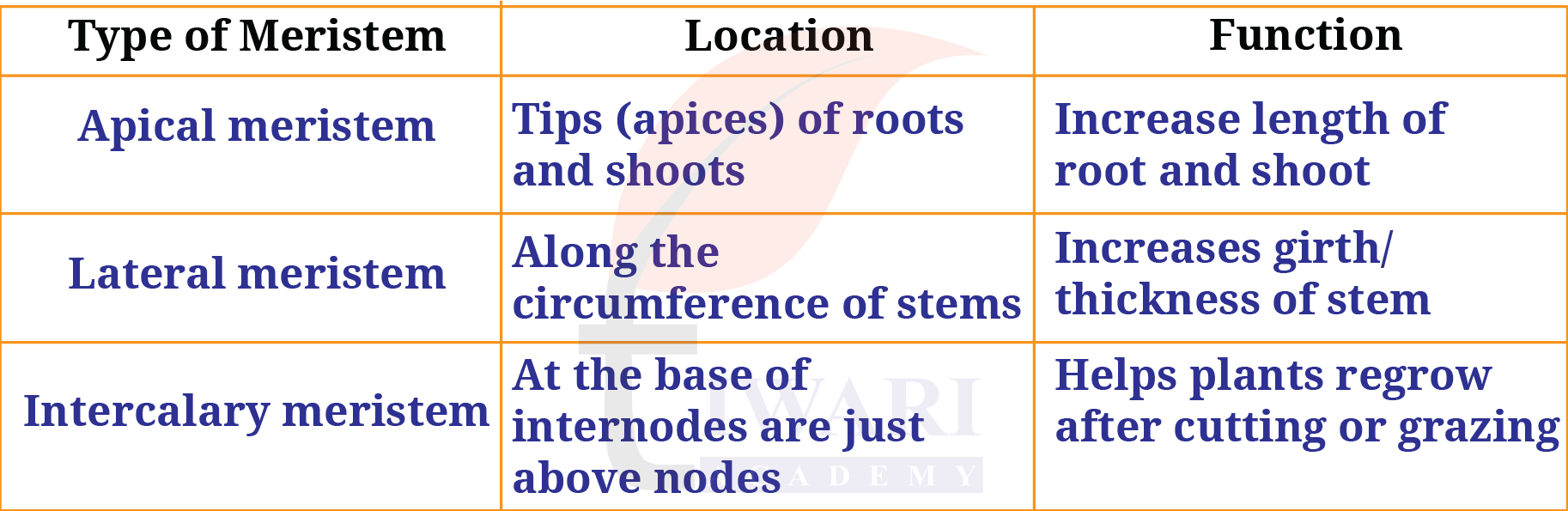
Questions Neha can ask to Vibha:
- “If meristems are only at root and shoot tips, then how does a tree trunk increase in thickness (girth) over years?
- “When we mow a lawn or a cow eats grass, how does the grass grow back if the tip is removed? Which meristem is responsible for that?”
- “When the tip of a plant is cut off and new branches appear from the nodes below, which meristem makes this possible?”
These questions would guide Vibha to discover lateral and intercalary meristems on her own.
14. A plant cell and an animal cell are of the same size.
(i) Which cell will have a larger vacuole? Give reasons.
(ii) What assumptions are you making to answer the question above?
Answer:The plant cell will have a larger vacuole.
Reasons:
- Mature plant cells typically have a single large central vacuole that can occupy up to 80–90% of the cell volume. It is surrounded by a selectively permeable membrane called the tonoplast.
- The plant cell vacuole stores water, minerals, sugars, and waste materials. It also maintains turgor pressure — the internal pressure that keeps the plant cell firm and the plant upright.
- Animal cells, in contrast, may have small, temporary vacuoles (if any) used for transport or storage of materials, but these are much smaller and not as prominent or permanent as in plant cells.
- Since both cells are the same size, the plant cell’s large vacuole would leave less space for cytoplasm and other organelles, while the animal cell would have more cytoplasm and organelles relative to its volume.
(ii) Assumptions made
- We assume the plant cell is a mature plant cell (e.g., from a leaf or stem), not a young meristematic cell (which has no vacuole).
- We assume the animal cell is a typical body cell (not a specialised cell like a fat cell/adipocyte, which stores large fat droplets).
- If the assumption changes (e.g., plant cell is a young meristematic cell), then neither cell would have a large vacuole.
15. A textbook states, “Each plant tissue performs only one specific function”. What questions would you ask to critically examine the correctness of this statement?
What examples of tissues would you take to find out the answers to these questions?
Answer:
The statement “Each plant tissue performs only one specific function” is not entirely correct and needs to be critically examined. To test this statement, we should ask questions like –
- Does parenchyma only store food or does it perform other functions too?
- Does epidermis only provide protection or does it also help in other processes?
- Do complex tissues like xylem perform only one function?
- Parenchyma is the best example to challenge this statement. Although parenchyma mainly stores food, it also performs photosynthesis in the green parts of the plant. In aquatic plants, specialised parenchyma forms air spaces which help them float. So parenchyma clearly performs more than one function.
- Epidermis is another good example. It forms the outermost protective layer of the plant body and protects against mechanical injury and microorganisms. But it also contains stomata in leaves which help in gaseous exchange and transpiration. In roots, epidermal cells form root hair which absorb water and minerals from the soil. So epidermis performs protection, absorption as well as transpiration – clearly more than one function.
- Xylem is a complex permanent tissue which not only transports water and minerals from roots to other parts of the plant but also provides mechanical strength and support to the plant.
Therefore, the statement is incorrect. Multiple plant tissues perform more than one specific function, and the examples of parenchyma, epidermis and xylem clearly prove this point.
NCERT Class 9 Science Exploration Chapter 3 Very Short Answer Type Questions with Explanation.
Very Short Answer Type Questions
One Word or One Sentence Answers
1. What is a tissue?
Answer:
A tissue is a group of cells that are similar in structure and work together to perform a specific function.
2. Name the three types of meristematic tissues found in plants.
Answer:
Apical meristem, Lateral meristem and Intercalary meristem.
3. Where is the apical meristem located?
Answer:
At the tips of roots and shoots of a plant.
4. Which meristematic tissue is responsible for the increase in girth (thickness) of a stem?
Answer:
Lateral meristem.
5. What is differentiation?
Answer:
Differentiation is the process by which meristematic cells lose the ability to divide and become specialised to form permanent tissues.
6. Name the only living component of xylem.
Answer:
Xylem parenchyma.
7. Which tissue transports food from leaves to other parts of the plant?
Answer:
Phloem.
8. What is the waxy layer present on the outer surface of the epidermis called?
Answer:
Cuticle.
9. Name the pores present in the epidermis of leaves that help in gaseous exchange.
Answer:
Stomata.
10. What are the cells of nervous tissue called?
Answer:
Neurons (nerve cells).
11. Which type of muscle tissue is found only in the heart?
Answer:
Cardiac muscle.
12. What connects muscle to bone?
Answer:
Tendon.
13. What type of joint is present at the shoulder?
Answer:
Ball and socket joint.
14. Name the flexible column of small bones that forms the backbone.
Answer:
Vertebral column (spine), made up of vertebrae.
15. What is the full form of RBC and how long does an RBC live?
Answer:
RBC stands for Red Blood Cell; it lives for about 4 months and is replaced regularly.
NCERT Class 9 Science Exploration Chapter 3 Short Answer Type Questions with Explanation.
Short Answer Type Questions
Answers in approximately 30 words
1. Why do plant cells have a cell wall but animal cells do not?
Answer:
Plants are fixed in one place and need rigidity and strength to stay upright, so their cells have a cell wall. Animals need to move, so their cells lack a rigid wall, giving them flexibility for locomotion.
2. What are annual growth rings and what information do they provide?
Answer:
Annual growth rings are ring-like patterns visible on the cross-section of a tree trunk, formed by the lateral meristem. By counting these rings, scientists can estimate the age of the tree and understand the climatic conditions during which it grew.
3. Why do meristematic cells lack vacuoles?
Answer:
Meristematic cells divide continuously and rapidly. Vacuoles store water and cell sap, and their presence would occupy space needed for active metabolic processes. Without vacuoles, cells remain small and tightly packed, allowing efficient and rapid division.
4. What are sieve tubes and companion cells? What is the function of companion cells?
Answer:
Sieve tubes are long, tubular cells in phloem joined end-to-end by perforated walls; they transport food. Companion cells are specialised parenchyma cells that regulate sieve tubes and monitor the loading and unloading of sugars within them.
5. Distinguish between voluntary and involuntary movements with one example each.
Answer:
Voluntary movements are under conscious control (e.g., writing, running) and are carried out by skeletal muscles. Involuntary movements occur automatically without conscious control (e.g., heartbeat, movement of food in intestines) and are carried out by smooth and cardiac muscles.
6. What is the role of cartilage in the human body?
Answer:
Cartilage has a soft, jelly-like matrix that provides flexibility and cushions the ends of bones for shock absorption. It is found at joints, the nose, ears and between vertebrae, preventing bones from grinding against each other.
7. What is the intercalary meristem, and how does it help a lawn regrow after mowing?
Answer:
Intercalary meristem is located at the base of internodes (nodes of the stem). When grass is mowed, the shoot tips are cut but the intercalary meristem at the nodes remains intact, allowing the grass to regenerate and grow back.
8. What is totipotency? Who first demonstrated it, and in which plant?
Answer:
Totipotency is the ability of a single mature plant cell to divide, dedifferentiate, and redifferentiate to develop into a complete new plant. It was first demonstrated by F. C. Steward in 1958 using phloem cells of carrot.
NCERT Class 9 Science Exploration Chapter 3 Long Answer Type Questions with Explanation.
Long Answer Type Questions
Description Type – More than 50 words
1. What is the difference between meristematic tissue and permanent tissue in plants?
Answer:
Meristematic tissue consists of actively dividing cells that are small, have thin walls, dense cytoplasm, a large prominent nucleus and no vacuoles. These cells continuously divide to add new cells to the plant body. Permanent tissue on the other hand, is formed when meristematic cells lose the ability to divide and undergo differentiation – a process where they become specialised to perform specific functions like support, protection, storage or conduction. Simply put, meristematic tissue is responsible for plant growth, while permanent tissue carries out all the functional roles once growth in that region has stopped.
2. Why do roots of a plant stop growing if the root tip is cut off?
Answer:
Roots grow only from their tips. The root tip contains the apical meristem — a zone of actively dividing cells. When the root tip is cut, these dividing cells are removed and since no other region of the root has the ability to actively divide in the same way, growth stops. This was demonstrated in Activity 3.1 of the chapter using onion bulbs placed in jars. The roots in Jar B (where tips were cut on Day 3) stopped growing, while roots in Jar A continued to grow normally.
3. What is the role of xylem and phloem in plants? Are they living or dead tissues?
Answer:
Xylem transports water and minerals from the roots to other parts of the plant and also provides mechanical strength. It consists of tracheids, vessels, xylem parenchyma and xylem fibres. Xylem parenchyma is the only living component of xylem; the rest are primarily dead cells. Phloem transports food (sugars) prepared in leaves to other parts of the plant. It consists of sieve tubes, companion cells, phloem parenchyma, and phloem fibres. Unlike xylem, phloem is mostly made up of living cells. Together, xylem and phloem are called complex permanent tissues or vascular tissues.
4. What are the four types of animal tissues?
Answer:
The four types of animal tissues are:
1. Epithelial tissue — forms the outer covering of the body (skin) and lines internal organs. It provides protection, helps in absorption, secretion and sensory functions.
2. Connective tissue — connects and supports other tissues and organs. Examples include blood, bone, cartilage, tendons and ligaments.
3. Muscular tissue — responsible for movement. It includes skeletal (voluntary), smooth (involuntary) and cardiac muscle.
4. Nervous tissue — forms the brain, spinal cord and nerves. It consists of neurons that receive and transmit electrical impulses.
5. What is the difference between voluntary and involuntary muscles? Which tissue is the heart made of?
Answer:
Voluntary muscles (skeletal muscles) are under conscious control — you can decide to move them, like when you run or write. They have long cylindrical cells that are multinucleate and striated (showing light and dark bands). Involuntary muscles (smooth muscles) work automatically without conscious control, such as the muscles in the stomach and intestines. Their cells are spindle-shaped with a single nucleus. The heart is made of cardiac muscle, which is a unique type — it works involuntarily and tirelessly throughout life without fatigue, but its cells are cylindrical, branched and have faint striations with a single nucleus.
6. What is the musculoskeletal system and why is it important?
Answer:
The musculoskeletal system is made up of bones, muscles, joints, cartilage, tendons, and ligaments. It helps us stand upright, move, maintain posture, and protect delicate organs. Muscles pull on bones via tendons to produce movement at joints. The adult human skeleton makes up about 12–15% of body weight. This system functions under the control of the nervous system — for example, when the brain signals muscles to contract, the force is transmitted through tendons to bones, resulting in movement.
7. What are the different types of joints in the human body?
Answer:
The chapter covers four types of joints:
1. Ball and socket joint (e.g., shoulder, hip) — allows movement in all directions including forward, backward, sideways and circular.
2. Hinge joint (e.g., elbow, knee) — allows movement in only one direction, like a door hinge — bending and straightening.
3. Pivot joint (e.g., neck/skull-backbone junction) — allows rotational movement, like shaking your head “no.”
4. Fixed joints (e.g., skull bones) — bones are joined together and cannot move, protecting the brain.
8. What is differentiation in plants? How does meristematic tissue become permanent tissue?
Answer:
Differentiation is the process by which meristematic cells lose the ability to divide and undergo changes in structure to become specialised (permanent) tissues. When meristematic tissue continuously divides, some newly formed cells remain meristematic, while others start to take on specific roles — like providing support, storing food or conducting water. These cells develop thick walls, become elongated or even die (like sclerenchyma cells), all in service of their particular function. This transformation from meristematic to permanent tissue through differentiation is what builds the mature plant body.
9. Why can plants regrow after mowing or pruning, but wounds in animals often don’t regenerate?
Answer:
Plants can regrow after being cut because they possess intercalary meristem located at the nodes of stems — regions of actively dividing cells that survive even after the shoot tip is removed. Grass, for example, regrows after mowing because its intercalary meristem at the nodes is untouched. Animals, in contrast, have far fewer regenerative stem cell populations. Most mature animal cells are permanently differentiated and cannot divide freely to rebuild complex tissues. However, as mentioned in the *Ready to Go Beyond* section, stem cells in bone marrow can divide and regenerate blood cells, and this forms the basis of bone marrow transplants used to treat diseases like leukaemia.
Frequently Asked Questions (FAQs)
Is this chapter from the new NCERT textbook or the old one? My child has the old book – will it work?
This chapter is from the new NCERT Exploration Science textbook for Class 9, introduced for Session 2026–27. It is significantly different from the older book — the old chapter was simply called “Tissues,” while this new version adds the musculoskeletal system, types of joints, activity-based experiments and new scientists. The old book alone will not be sufficient for the current session.
My child finds this chapter very lengthy. Which are the most important topics to focus on for exams?
The chapter becomes manageable when divided into four sections — plant tissues (meristematic and permanent), animal tissues (epithelial, connective, muscular, nervous), the musculoskeletal system (three types of muscles) and types of joints. Comparison-based questions and diagram labelling are the most frequently asked formats in exams. Preparing one-page summary tables for each section makes revision faster than re-reading the whole chapter.
There are many diagrams in this chapter. Does my child need to draw and label all of them?
Not all diagrams are equally important. The five most exam-relevant ones are the structure of a neuron, the three types of muscles, components of xylem and phloem, T.S. of a sunflower stem, and types of joints. Practising these with correct labels two to three times is far more effective than reading the chapter repeatedly.
My child keeps mixing up xylem and phloem. Is there a simple trick to remember?
A simple memory trick works well here. For xylem, think “X-ray from roots UP” — it carries water and minerals upward from roots. For phloem, think “PHotosynthesis fOOd fLOw” — it carries food from leaves downward to other parts. The other key difference worth remembering is that xylem has mostly dead cells while phloem has mostly living cells — a common exam question.
How much of this chapter is memorisation and how much is understanding?
Roughly 60% of this chapter rewards understanding — why plants have rigid cell walls, how muscle structure relates to its function, why cardiac muscle never fatigues. Only about 40% requires memorisation, mainly the names and characteristics of tissue types. A child who understands the “why” behind each tissue will naturally retain the names far more easily than one who tries to memorise them as isolated facts.
How is the new Exploration Chapter 3 different from the “Tissues” chapter in the old NCERT book?
The old chapter was descriptive and theory-heavy, while the new one is activity-driven and inquiry-based. New content includes the musculoskeletal system, four types of joints, the skeletal system, totipotency through Steward’s carrot experiment, and featured Indian scientists like B.G.L. Swamy and Sipra Guha Mukherjee. Teachers should plan at least two additional periods to cover the new material and redesign lesson plans around the five activities included in the chapter.
Activity 3.1 involves growing onion roots in jars for 7 days. How can this be managed practically in a classroom?
The key is to set it up on the very first day of teaching the chapter so data collection runs alongside instruction. Small plastic cups work if couplin jars are unavailable and placing them near a window manages the odour issue. Assigning a dedicated student pair as daily data recorders ensures measurements are taken consistently even on non-science days. The tip-cutting step on Day 3 needs direct teacher supervision.
Are the “Pause and Ponder” and “Think as a Scientist” boxes examinable?
They are unlikely to appear as direct recall questions in standard unit tests, but they are increasingly relevant as boards shift toward competency-based assessments. The Pause and Ponder questions appear regularly in HOTS sections, and Steward’s totipotency experiment is fair game for data interpretation questions. Teachers should discuss these sections in class even if they are not formally assigned for written homework.
How can teachers connect this chapter to real life for better student engagement?
Several everyday connections work very well in the classroom. Bringing in coconut husk and a coriander stalk lets students feel the difference between sclerenchyma and collenchyma before the terms are even introduced. Asking why grass grows back after mowing leads naturally to intercalary meristem. Discussing a skin cut connects blood, platelets and WBCs to real experience, and using the chapter’s own Surya Namaskar figure to identify joints during class makes the musculoskeletal section immediately engaging.
I keep forgetting the difference between tendons and ligaments. How do I remember?
Think of the letter T – a Tendon connects muscle Tissue To bone, so it always has a muscle on one end. A Ligament Links bone to bone, holding a joint together. Simply put, tendons cause movement by transmitting muscle force to bones, while ligaments prevent excessive movement by keeping bones from separating at joints.
Will diagrams definitely come in the exam? I am not good at drawing.
Diagrams from this chapter are very likely in exams, but artistic skill is not what is being marked. Examiners check for correct structure, proportions, and neat labelling — a neuron is simply a blob with a long tail and small branches, which anyone can draw. Practising each important diagram three times on blank paper without looking at the book is enough for most students to draw it confidently from memory.
What is the difference between skeletal, smooth and cardiac muscle? I always mix these up.
Skeletal muscle is voluntary and under your conscious control, with long cylindrical multinucleate cells and clear striations. Smooth muscle is involuntary, found in organs like the stomach, with spindle-shaped single-nucleated cells and no striations. Cardiac muscle is found only in the heart, is involuntary, never fatigues and has cylindrical branched cells with faint striations. A quick memory tip — Skeletal = Sports (you control it), Smooth = Stomach (automatic), Cardiac = Continuous (never stops).
What is the difference between differentiation and dedifferentiation? This confuses me.
Differentiation is when a meristematic cell permanently takes on a specialised role — like becoming a sclerenchyma cell — and loses the ability to divide. Dedifferentiation is the reverse, where a specialised cell regains the ability to divide, as seen in F.C. Steward’s carrot experiment. Redifferentiation then follows, where those dividing cells specialise again into different cell types, eventually forming a complete new plant — the entire sequence being the basis of totipotency.
I scored low because I could not answer application-based questions. How should I prepare?
Application questions test whether you can use knowledge, not just recall it. The most effective preparation is to connect every tissue to a real object — sclerenchyma to coconut husk, collenchyma to a bending plant stem, cardiac muscle to your own heartbeat. Reading and attempting the Pause and Ponder boxes seriously is the best practice available, as these are exactly the format used in HOTS exam questions. The end-of-chapter questions on the debarked tree, mango sapling and sugarcane cuttings are model application questions worth attempting in writing before checking answers.
Is class 9 science chapter 3 connected to Class 10 topics? Should I keep anything in mind for later?
Yes, this chapter is directly connected to several Class 10 Biology topics. Xylem and phloem reappear in the life processes chapter where transpiration pull and food transport mechanisms are studied in depth. The nervous system section – neurons, dendrites, axons — is the foundation for the control and coordination chapter in Class 10, which covers reflex arcs and the brain’s structure. Students preparing for NTSE or Olympiads will also find that totipotency, tissue culture, and epithelial tissue structure appear regularly in those exams.