



by Tiwari Academy Team
NCERT Class 9 Science Exploration Chapter 11 Reproduction: How Life Continues Solutions in English and Hindi Medium, Exercise Question Answers, Notes, Practice Questions for 2026-27 Exam. Class 9 Science Exploration Chapter 11 – Reproduction: How Life Continues is one of the most comprehensive and life-science-rich chapters in the new NCERT Science Exploration textbook for Session 2026–27. Reproduction is the biological cornerstone of life itself – without it, every species would vanish within a single generation. This chapter explores how living organisms, from single-celled yeast to complex humans, ensure the continuation of their kind through two fundamentally different strategies: asexual reproduction and sexual reproduction.
Quick Links:
- Chapter 11 Exercises Solutions
- Very Short Answer Type Questions
- Short Answer Type Questions
- Long Answer Type Questions
- Class 9 Science Exploration Chapter 11 in Hindi Medium
- Download Class 9 Science Offline App to study Class 9 Science Exploration Offline.
The chapter 11 of 9th Science Exploration, opens with asexual reproduction — vegetative propagation in plants (cutting, grafting, layering, tissue culture), budding in hydra and yeast and spore formation in fungi – establishing that the central process driving all asexual reproduction is mitosis, which produces genetically identical clones. It then transitions into the richer world of sexual reproduction, beginning with how meiosis creates genetic variation through gamete formation and continuing into pollination, fertilisation and seed formation in flowering plants.
The human reproduction section is detailed and scientifically grounded, covering the male and female reproductive systems, gametogenesis, ovulation, fertilisation, the menstrual cycle, pregnancy through three trimesters and contraception including STIs. The chapter connects beautifully to Indian science through references to P. Maheshwari (Father of Indian Embryology) and Subhash Mukhopadhyay (pioneer of India’s first IVF baby) and to healthcare through ASHA workers and the Central Drug Research Institute’s oral contraceptive development.
Chapter at a Glance – Key Concepts
| Topic | Key Points |
|---|---|
| Reproduction | Biological process producing new individuals of the same species; ensures continuity of life |
| Asexual Reproduction | Single parent; offspring are genetically identical clones; driven by mitosis |
| Vegetative Propagation | Cutting, grafting, layering, tissue culture; used widely in agriculture and horticulture |
| Budding | Small outgrowth (bud) forms from parent body and separates; e.g., yeast, hydra |
| Spore Formation | Lightweight, single-celled spores produced in millions; germinate in favourable conditions; e.g., Rhizopus, Aspergillus |
| Mitosis | Cell division producing genetically identical daughter cells; basis of asexual reproduction |
| Sexual Reproduction | Two parents; offspring inherit mix of characters; genetic variation created |
| Meiosis | Special cell division; reduces chromosome number to half (haploid); forms gametes |
| Gametes | Sperm (male) and egg (female) in animals; pollen grain and ovule in plants |
| Pollination | Transfer of pollen from anther to stigma; self-pollination or cross-pollination |
| Pollinators | Wind, water, insects (bees, butterflies), birds |
| Fertilisation | Fusion of male and female gametes; forms zygote |
| Zygote → Embryo | Zygote develops into embryo; ovule → seed; ovary → fruit |
| Human Reproduction | Sperm produced in testes; eggs in ovaries; fertilisation in oviduct; development in uterus |
| Menstrual Cycle | ~28-day cycle; ovulation on ~day 14; menstruation days 1–5 if no fertilisation |
| Pregnancy | ~9 months; divided into 3 trimesters; zygote → embryo → foetus → baby |
| Contraception | Condoms, oral pills, IUDs (Copper-T), surgical methods |
| STIs | Sexually Transmitted Infections: gonorrhoea, herpes, syphilis, HIV/AIDS |
NCERT Class 9 Science Exploration Chapter 11 Solutions (2026-27 New Syllabus)
Class 9 Science Exploration Chapter 11 Question Answer
Revise, Reflect, Refine
1. A flower’s anthers are removed before it matures. Later, pollen from another plant of the same species is dusted onto its stigma and seeds are produced. Which process has been ensured here?
(i) Self-pollination
(ii) Cross – pollination
(iii) Fertilisation
(iv) Tissue culture
Answer:
(ii) Cross – pollination
𝗘𝘅𝗽𝗹𝗮𝗻𝗮𝘁𝗶𝗼𝗻:
When a flower’s anthers (the male parts that produce pollen) are removed before the flower matures, the flower cannot pollinate itself. This is called emasculation. When pollen is then brought from a different plant of the same species and placed on the stigma, this is a deliberate transfer of pollen from one plant to another — which is exactly the definition of cross-pollination.
2. Arrange the following stages of sexual reproduction in plants in the correct order:
(i) Pollen germination on stigma
(ii) Fertilisation
(iii) Pollination
(iv) Formation of zygote
Answer:
Correct Order: (iii) → (i) → (ii) → (iv)
- 𝐏𝐨𝐥𝐥𝐢𝐧𝐚𝐭𝐢𝐨𝐧: Pollen grains travel from the anther to the stigma (by wind, insects, water or birds).
- 𝗣𝗼𝗹𝗹𝗲𝗻 𝗴𝗲𝗿𝗺𝗶𝗻𝗮𝘁𝗶𝗼𝗻 𝗼𝗻 𝘀𝘁𝗶𝗴𝗺𝗮: The pollen grain lands on a compatible stigma and produces a pollen tube that grows down through the style into the ovary.
- 𝗙𝗲𝗿𝘁𝗶𝗹𝗶𝘀𝗮𝘁𝗶𝗼𝗻: The male gamete (sperm cell) travels through the pollen tube and fuses with the egg cell (female gamete) inside the ovule.
- 𝗙𝗼𝗿𝗺𝗮𝘁𝗶𝗼𝗻 𝗼𝗳 𝘇𝘆𝗴𝗼𝘁𝗲: The fusion of egg + sperm produces a zygote, which later develops into an embryo (and eventually the seed).
3. Assertion (A): The zygote formed after fertilisation immediately attaches to the uterus wall.
Reason (R): The uterus wall is always prepared to receive the zygote.
(i) Both A and R are true, and R is the correct explanation of A.
(ii) Both A and R are true, but R is not the correct explanation of A.
(iii) A is true, but R is false.
(iv) A is false, but R is true.
Answer:
(iv) A is false, but R is true.
- 𝗘𝘅𝗽𝗹𝗮𝗻𝗮𝘁𝗶𝗼𝗻 𝗼𝗳 𝗔𝘀𝘀𝗲𝗿𝘁𝗶𝗼𝗻 (𝗔) FALSE: The zygote does NOT immediately attach to the uterus wall. After fertilisation (which happens in the oviduct/fallopian tube), the zygote undergoes several rounds of mitotic cell division while slowly travelling through the oviduct towards the uterus. Only after reaching the uterus does implantation happen. So the process is not “immediate.”
- 𝗘𝘅𝗽𝗹𝗮𝗻𝗮𝘁𝗶𝗼𝗻 𝗼𝗳 𝗥𝗲𝗮𝘀𝗼𝗻 (𝗥) TRUE: The uterus does prepare itself. After ovulation (around day 14 of the menstrual cycle), the uterus lining (endometrium) becomes thick, soft and rich in blood vessels – all in preparation to receive and nourish a fertilised egg. So the uterus wall is indeed prepared.
4. Why does asexual reproduction produce offspring that are genetically identical to the parent?
Answer:
Asexual reproduction produces genetically identical offspring (called clones) because of the following reasons:
- 𝗢𝗻𝗹𝘆 𝗼𝗻𝗲 𝗽𝗮𝗿𝗲𝗻𝘁 𝗶𝗻𝘃𝗼𝗹𝘃𝗲𝗱: In asexual reproduction, a single parent produces offspring. There is no mixing of genetic material from two different individuals.
- 𝗕𝗮𝘀𝗲𝗱 𝗼𝗻 𝗠𝗶𝘁𝗼𝘀𝗶𝘀: The central process is mitosis – a type of cell division where the parent cell divides to produce two daughter cells, each with the exact same number and type of chromosomes as the parent. No chromosome shuffling or recombination occurs.
- 𝗡𝗼 𝗴𝗮𝗺𝗲𝘁𝗲𝘀 𝗼𝗿 𝗳𝗲𝗿𝘁𝗶𝗹𝗶𝘀𝗮𝘁𝗶𝗼𝗻: Gametes (sperm/egg) are not formed, so there is no random combination of chromosomes from two parents. Every new cell is an exact copy of the parent cell’s DNA.
5. Explain why the menstrual cycle stops during pregnancy.
Answer:
The menstrual cycle is a recurring process (approximately 28 days) that involves ovulation (release of an egg), thickening of the uterine lining and if fertilisation does not occur, shedding of that lining as menstrual blood.
During pregnancy, the menstrual cycle stops because:
- 𝗙𝗲𝗿𝘁𝗶𝗹𝗶𝘀𝗮𝘁𝗶𝗼𝗻 𝗵𝗮𝘀 𝗼𝗰𝗰𝘂𝗿𝗿𝗲𝗱: When a sperm fertilises the egg, a zygote forms, which implants into the thickened uterine lining. The lining is now being used – it does not need to be shed.
- 𝗛𝗼𝗿𝗺𝗼𝗻𝗮𝗹 𝗰𝗵𝗮𝗻𝗴𝗲𝘀: After implantation, the body releases hormones (such as human chorionic gonadotropin — hCG) that signal the ovaries to stop releasing new eggs. Without a new egg being released, the next ovulation cycle does not begin.
- 𝗨𝘁𝗲𝗿𝗶𝗻𝗲 𝗹𝗶𝗻𝗶𝗻𝗴 𝗶𝘀 𝗺𝗮𝗶𝗻𝘁𝗮𝗶𝗻𝗲𝗱: The thickened, blood-vessel-rich uterine lining is maintained throughout pregnancy to nourish the growing embryo/foetus. Since it is not shed, menstruation does not occur.
6. Why are flowers that bloom at night white or light in colour as compared to flowers that bloom during the day?
Answer:
This is related to the strategy of pollination. Flowers need to attract their pollinators to reproduce successfully.
- 𝗡𝗶𝗴𝗵𝘁-𝗯𝗹𝗼𝗼𝗺𝗶𝗻𝗴 𝗳𝗹𝗼𝘄𝗲𝗿𝘀 𝗮𝗻𝗱 𝘄𝗵𝗶𝘁𝗲/𝗽𝗮𝗹𝗲 𝗰𝗼𝗹𝗼𝘂𝗿: At night, there is no sunlight. Colours that are bright or vibrant during the day (reds, blues, purples) are not easily visible in darkness. However, white or light-coloured flowers reflect even small amounts of moonlight or starlight, making them visible to nocturnal pollinators such as moths, bats and some beetles.
- 𝗗𝗮𝘆-𝗯𝗹𝗼𝗼𝗺𝗶𝗻𝗴 𝗳𝗹𝗼𝘄𝗲𝗿𝘀 𝗮𝗻𝗱 𝗯𝗿𝗶𝗴𝗵𝘁 𝗰𝗼𝗹𝗼𝘂𝗿𝘀: During daylight, pollinators like bees, butterflies, and birds can see a full range of colours. So day-blooming flowers use vivid colours (yellow, red, purple, orange) to attract these pollinators.
- 𝗔𝗱𝗱𝗶𝘁𝗶𝗼𝗻𝗮𝗹 𝗳𝗮𝗰𝘁𝗼𝗿: fragrance: Night-blooming flowers often compensate for reduced visibility by producing stronger fragrances. Moths, for example, are strongly guided by scent in the dark.
7. Why do vegetatively propagated plants tend to be more vulnerable to diseases than sexually reproduced plants?
Answer:
Plants produced through vegetative propagation (asexual reproduction) are genetically identical clones of the parent plant. This leads to greater disease vulnerability for the following reasons:
- 𝗡𝗼 𝗴𝗲𝗻𝗲𝘁𝗶𝗰 𝘃𝗮𝗿𝗶𝗮𝘁𝗶𝗼𝗻: Since all plants are genetically identical, if the parent plant has no resistance to a particular disease or pathogen, none of the offspring will have it either. The entire crop becomes equally susceptible.
- 𝗡𝗼 𝗻𝗲𝘄 𝗰𝗼𝗺𝗯𝗶𝗻𝗮𝘁𝗶𝗼𝗻𝘀 𝗼𝗳 𝗴𝗲𝗻𝗲𝘀: Sexual reproduction produces offspring with new gene combinations through meiosis and fertilisation. Some of these combinations may confer resistance to new diseases. Vegetatively propagated plants miss out on this advantage.
- 𝗗𝗶𝘀𝗲𝗮𝘀𝗲 𝗰𝗮𝗻 𝘀𝗽𝗿𝗲𝗮𝗱 𝗿𝗮𝗽𝗶𝗱𝗹𝘆: If one plant in a genetically uniform crop is infected, the pathogen can easily spread to all plants since all plants have the same susceptibility. There are no “resistant” individuals to slow the spread.
𝗘𝘅𝗮𝗺𝗽𝗹𝗲: The Irish Potato Famine (1845) was partly because potato crops were grown by vegetative propagation, leading to genetically uniform plants that were all equally vulnerable to the Phytophthora blight.
8. If all flowers in a type of plant were only capable of self-pollination, how would it affect the genetic diversity over several generations? Explain.
Answer:
If all flowers in a plant species could only perform self-pollination (pollen from the same flower or the same plant fertilises the egg), it would have significant negative effects on genetic diversity over generations:
- 𝗥𝗲𝗱𝘂𝗰𝗲𝗱 𝗴𝗲𝗻𝗲𝘁𝗶𝗰 𝘃𝗮𝗿𝗶𝗮𝘁𝗶𝗼𝗻: In self-pollination, no new genetic material from another individual enters the gene pool. The offspring inherit genetic material only from one parent plant. Over generations, the population becomes genetically more and more uniform.
- 𝗜𝗻𝗯𝗿𝗲𝗲𝗱𝗶𝗻𝗴 𝗱𝗲𝗽𝗿𝗲𝘀𝘀𝗶𝗼𝗻: Repeated self-pollination over many generations causes inbreeding. This increases the chances that offspring will receive two copies of the same harmful recessive gene (one from each side of the same parent), potentially expressing genetic disorders or weaknesses. This is called inbreeding depression and leads to weaker, less fit plants.
- 𝗥𝗲𝗱𝘂𝗰𝗲𝗱 𝗮𝗱𝗮𝗽𝘁𝗮𝗯𝗶𝗹𝗶𝘁𝘆: Genetic diversity is the raw material for evolution and adaptation. A genetically uniform population has a very limited range of traits. If the environment changes (new disease, climate shift, new pest), the entire population may lack the variation needed to survive. This could lead to extinction.
- 𝗡𝗼 𝗻𝗲𝘄 𝘁𝗿𝗮𝗶𝘁 𝗰𝗼𝗺𝗯𝗶𝗻𝗮𝘁𝗶𝗼𝗻𝘀: Sexual reproduction with cross-pollination creates new combinations of characters through meiosis (assortment of chromosomes) and fertilisation. With only self-pollination, these new combinations are not generated and evolution slows down dramatically.
- 𝗦𝗵𝗼𝗿𝘁-𝘁𝗲𝗿𝗺 𝗮𝗱𝘃𝗮𝗻𝘁𝗮𝗴𝗲, 𝗹𝗼𝗻𝗴-𝘁𝗲𝗿𝗺 𝗿𝗶𝘀𝗸: Self-pollination can be advantageous in the short term (especially if pollinators are absent), but over many generations, the lack of genetic diversity makes the species highly vulnerable.
9. A farmer wants to produce a large number of genetically identical plants quickly. Suggest suitable reproduction methods and explain why they are effective.
Answer:
The farmer should use asexual (vegetative) reproduction methods, specifically:
- 𝗠𝗲𝘁𝗵𝗼𝗱 𝟭: 𝗖𝘂𝘁𝘁𝗶𝗻𝗴
A stem cutting from the parent plant is placed in soil. The cutting grows roots and develops into a new plant with the same genetic material. Effective because: It is simple, fast and produces a plant identical to the parent. Used for roses, sugarcane, money plant, etc. - 𝗠𝗲𝘁𝗵𝗼𝗱 𝟮: 𝗚𝗿𝗮𝗳𝘁𝗶𝗻𝗴
A stem piece (scion) from a desired plant is joined onto the rooted stem (rootstock) of another plant. The two parts unite and grow as one plant. Effective because: It preserves the desired characteristics (taste, yield) of the parent. Used for mango, apple, citrus. - 𝗠𝗲𝘁𝗵𝗼𝗱 𝟯: 𝗟𝗮𝘆𝗲𝗿𝗶𝗻𝗴
A branch of the parent plant is bent and the middle portion is buried in soil. It develops roots while still attached, then is cut and grown independently. Effective because: The new plant develops while still receiving nourishment from the parent, making survival very high. - 𝗠𝗲𝘁𝗵𝗼𝗱 𝟰: 𝗧𝗶𝘀𝘀𝘂𝗲 𝗖𝘂𝗹𝘁𝘂𝗿𝗲 (𝗠𝗼𝘀𝘁 𝗘𝗳𝗳𝗶𝗰𝗶𝗲𝗻𝘁)
Small pieces of plant tissue (from the shoot tip/apical meristem) are placed in a sterile nutrient medium in a laboratory. Hundreds of genetically identical plantlets can be grown from one parent plant. Effective because: It produces thousands of clones very quickly, year-round, in a small space and the plants are disease-free. This has revolutionised farming, especially for banana cultivation.
10. Suresh prepares slides with pollen grains in different sugar concentrations (0%, 2.5%, 5%, 7.5%, 10%) to study pollen germination.
(i) What are the different hypotheses that can be tested using this set-up?
(ii) What parameters should be kept the same in this set-up?
Answer:
(𝗶) 𝗛𝘆𝗽𝗼𝘁𝗵𝗲𝘀𝗲𝘀 𝘁𝗵𝗮𝘁 𝗰𝗮𝗻 𝗯𝗲 𝘁𝗲𝘀𝘁𝗲𝗱:
- 𝗛𝘆𝗽𝗼𝘁𝗵𝗲𝘀𝗶𝘀 𝟭: Pollen germination rate varies with different sugar concentrations – i.e., some concentration is better than others for germination.
- 𝗛𝘆𝗽𝗼𝘁𝗵𝗲𝘀𝗶𝘀 𝟮: There is an optimal sugar concentration at which maximum pollen germination occurs.
- 𝗛𝘆𝗽𝗼𝘁𝗵𝗲𝘀𝗶𝘀 𝟯: Very high or very low sugar concentrations inhibit pollen germination (either too little energy/nutrients or osmotic stress).
- 𝗛𝘆𝗽𝗼𝘁𝗵𝗲𝘀𝗶𝘀 𝟰: Pollen tube length/growth rate increases (or decreases) as sugar concentration increases.
- 𝗛𝘆𝗽𝗼𝘁𝗵𝗲𝘀𝗶𝘀 𝟱: A minimum sugar concentration is necessary for germination – at 0% (plain water), pollen will not germinate.
(𝗶𝗶) 𝗣𝗮𝗿𝗮𝗺𝗲𝘁𝗲𝗿𝘀 (𝘃𝗮𝗿𝗶𝗮𝗯𝗹𝗲𝘀) 𝘁𝗼 𝗯𝗲 𝗸𝗲𝗽𝘁 𝘁𝗵𝗲 𝘀𝗮𝗺𝗲 (𝗰𝗼𝗻𝘁𝗿𝗼𝗹𝗹𝗲𝗱 𝘃𝗮𝗿𝗶𝗮𝗯𝗹𝗲𝘀):
- 𝗧𝗵𝗲 𝘁𝘆𝗽𝗲 𝗼𝗳 𝗽𝗼𝗹𝗹𝗲𝗻 𝘂𝘀𝗲𝗱 – same species, same flower, collected at the same time.
- The 𝗮𝗺𝗼𝘂𝗻𝘁/𝘃𝗼𝗹𝘂𝗺𝗲 𝗼𝗳 𝗽𝗼𝗹𝗹𝗲𝗻 𝗴𝗿𝗮𝗶𝗻𝘀 placed on each slide.
- 𝗧𝗲𝗺𝗽𝗲𝗿𝗮𝘁𝘂𝗿𝗲 – all slides kept at the same temperature, as temperature affects germination.
- 𝗛𝘂𝗺𝗶𝗱𝗶𝘁𝘆/𝗺𝗼𝗶𝘀𝘁𝘂𝗿𝗲 𝗰𝗼𝗻𝗱𝗶𝘁𝗶𝗼𝗻𝘀 — same environment for all slides.
- 𝗧𝗶𝗺𝗲 𝗼𝗳 𝗼𝗯𝘀𝗲𝗿𝘃𝗮𝘁𝗶𝗼𝗻 – germination is checked at the same time interval for all slides.
- The 𝘁𝘆𝗽𝗲 𝗼𝗳 𝘀𝘂𝗴𝗮𝗿 used (e.g., sucrose in all) – only concentration should vary.
- The 𝘃𝗼𝗹𝘂𝗺𝗲 𝗼𝗳 𝘀𝗼𝗹𝘂𝘁𝗶𝗼𝗻 on each slide should be equal.
- 𝗟𝗶𝗴𝗵𝘁 𝗰𝗼𝗻𝗱𝗶𝘁𝗶𝗼𝗻𝘀 – all slides kept under the same lighting.
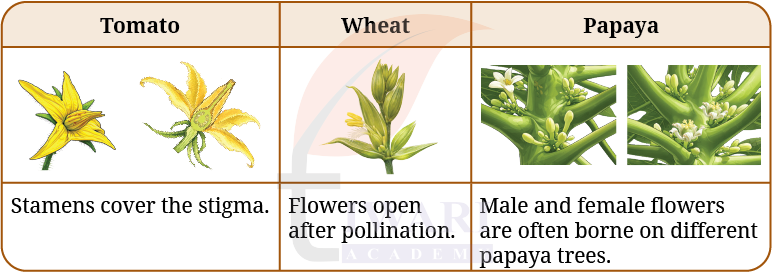
11. Look at the picture given below and think in line with the given prompts and find out which type(s) of pollination might have been followed in these flowers –
Answer:
- Plant: Tomato
Observation: Stamens cover the stigma
Type of Pollination: Self-Pollination
Reason: Since the stamens (which produce pollen) physically surround and cover the stigma (which receives pollen), pollen can very easily fall directly onto the stigma of the same flower. This strongly favours self-pollination (autogamy). - Plant: Wheat
Observation: Flowers open after pollination
Type of Pollination: Self-Pollination (Cleistogamy)
Reason: In wheat, pollination occurs while the flower is still closed (before it opens). This is called cleistogamy. Pollen from the anthers fertilises the stigma of the same closed flower – a guaranteed form of self-pollination. Wind pollination for cross-pollination is also possible in wheat when it opens, but self-pollination is the primary mechanism. - Plant: Papaya
Observation: Male and female flowers on different trees
Type of Pollination: Cross-Pollination (obligatory)
Reason: Papaya is a dioecious plant – male flowers (with stamens/pollen) and female flowers (with pistil) are on separate trees. Since the pollen source (male tree) and the egg (female tree) are on different plants, cross-pollination by an external agent (usually insects) is the only option. Self-pollination is impossible.
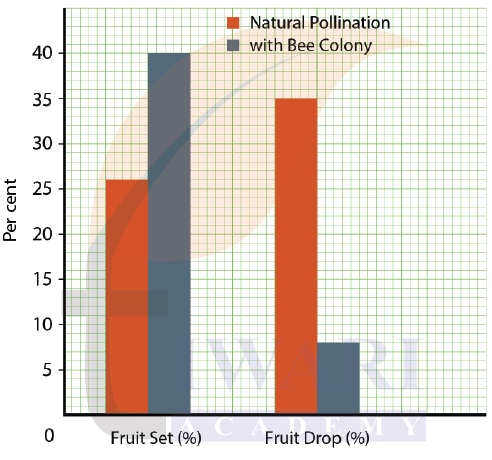
12. In the lower Himalayan region of northern India, apples are an important cash crop that contribute significantly to farmer’s livelihoods. The fruit yield in apple cultivation is declining continuously, associated with climate change and a significant decline in the population of natural pollinators. A researcher-farmer group set up two experimental apple orchards at two distinct locations: Places A and B. In apple orchards at Place A, they allowed natural pollinators to pollinate the flowers of the apple. In apple orchards at Place B, they applied mixed farming techniques of beekeeping. Along with honey, the farmer yielded apples. The yield of apples is depicted in Fig. 11.24, in terms of fruit setting (number of fruits/the total number of corresponding fruit-bearing branches) and fruit drop (premature falling of developing fruits) in the two types of experimental places of apple orchards.
(i) What are the hypotheses the researcher-farmers group has thought of for this investigation?
(ii) What are the different parameters in the experiment?
(iii) Compare and analyse the data of two experimental orchards Places A and B, in terms of high yields of apple fruits.
(iv) Based on your analysis, what do you infer from the data?
Answer:
(𝗶) 𝗛𝘆𝗽𝗼𝘁𝗵𝗲𝘀𝗲𝘀 𝗳𝗼𝗿𝗺𝗲𝗱 𝗯𝘆 𝘁𝗵𝗲 𝗿𝗲𝘀𝗲𝗮𝗿𝗰𝗵𝗲𝗿-𝗳𝗮𝗿𝗺𝗲𝗿𝘀:
- 𝗛𝘆𝗽𝗼𝘁𝗵𝗲𝘀𝗶𝘀 𝟭: Adding a bee colony to apple orchards increases the rate of pollination, which in turn increases fruit set percentage.
- 𝗛𝘆𝗽𝗼𝘁𝗵𝗲𝘀𝗶𝘀 𝟮: Better pollination (through bees) reduces premature fruit drop, because well-fertilised fruits develop more completely.
- 𝗛𝘆𝗽𝗼𝘁𝗵𝗲𝘀𝗶𝘀 𝟯: Mixed farming with beekeeping can compensate for the declining population of natural pollinators in the region and improve apple yield.
(𝗶𝗶) 𝗣𝗮𝗿𝗮𝗺𝗲𝘁𝗲𝗿𝘀 𝗶𝗻 𝘁𝗵𝗲 𝗲𝘅𝗽𝗲𝗿𝗶𝗺𝗲𝗻𝘁:
- 𝗜𝗻𝗱𝗲𝗽𝗲𝗻𝗱𝗲𝗻𝘁 𝘃𝗮𝗿𝗶𝗮𝗯𝗹𝗲 (𝘄𝗵𝗮𝘁 𝗰𝗵𝗮𝗻𝗴𝗲𝘀): Pollination method – Natural pollination (Place A) vs. Mixed farming with bee colony (Place B).
- 𝗗𝗲𝗽𝗲𝗻𝗱𝗲𝗻𝘁 𝘃𝗮𝗿𝗶𝗮𝗯𝗹𝗲𝘀 (𝘄𝗵𝗮𝘁 𝗶𝘀 𝗺𝗲𝗮𝘀𝘂𝗿𝗲𝗱): Fruit set percentage (number of fruits formed / total fruit-bearing branches × 100) and fruit drop percentage (premature falling of fruits).
- 𝗖𝗼𝗻𝘁𝗿𝗼𝗹𝗹𝗲𝗱 𝘃𝗮𝗿𝗶𝗮𝗯𝗹𝗲𝘀 (𝗸𝗲𝗽𝘁 𝘀𝗮𝗺𝗲): Apple variety, location conditions (both in Himalayan region), time of experiment, size of orchard, care and irrigation practices.
(𝗶𝗶𝗶) 𝗖𝗼𝗺𝗽𝗮𝗿𝗶𝘀𝗼𝗻 𝗮𝗻𝗱 𝗔𝗻𝗮𝗹𝘆𝘀𝗶𝘀:
Based on the data shown in the bar graph:
- Place B (with bee colony) shows significantly higher fruit set percentage compared to Place A (natural pollination). This means more flowers successfully converted into fruits where bees were present.
- Place B shows significantly lower fruit drop percentage compared to Place A. When fruits are properly pollinated and fertilised, they develop fully and do not fall off prematurely.
- Place A has lower fruit set and higher fruit drop, reflecting the problem of insufficient pollinators in the wild Himalayan habitat.
Overall, Place B demonstrates a far higher effective apple yield per orchard compared to Place A.
(𝗶𝘃) 𝗜𝗻𝗳𝗲𝗿𝗲𝗻𝗰𝗲 𝗳𝗿𝗼𝗺 𝘁𝗵𝗲 𝗱𝗮𝘁𝗮:
Introducing a bee colony through mixed farming significantly improves pollination efficiency in apple orchards. This leads to higher fruit set and lower premature fruit drop, resulting in better apple yields. The data supports the hypothesis that the decline in natural pollinators is a major cause of declining apple yield in the Himalayan region, and that beekeeping is an effective, sustainable solution to this problem. It also highlights the crucial ecological role of pollinators in agricultural productivity.
13. A student claims, “In humans, ovulation always happens on day 14 of the menstrual cycle”. Critically examine this claim and state whether the claim is correct or not. Give at least two reasons for your answer.
Answer:
This claim is not entirely correct The student’s claim is an oversimplification. While day 14 is often cited as a rough average for ovulation, it is not always accurate. Here is a critical examination:
- 𝗧𝗵𝗲 𝗺𝗲𝗻𝘀𝘁𝗿𝘂𝗮𝗹 𝗰𝘆𝗰𝗹𝗲 𝗹𝗲𝗻𝗴𝘁𝗵 𝘃𝗮𝗿𝗶𝗲𝘀 𝗮𝗺𝗼𝗻𝗴 𝗶𝗻𝗱𝗶𝘃𝗶𝗱𝘂𝗮𝗹𝘀: The textbook states that the cycle repeats “typically every 21–35 days (often around 28 days).” Day 14 is approximately the midpoint of a 28-day cycle, and ovulation tends to occur at the midpoint. However, for a person with a 21-day cycle, ovulation may happen around day 7, and for a 35-day cycle, ovulation may happen around day 21. Saying “always day 14” ignores this natural variation.
- 𝗘𝘃𝗲𝗻 𝗶𝗻 𝘁𝗵𝗲 𝘀𝗮𝗺𝗲 𝗶𝗻𝗱𝗶𝘃𝗶𝗱𝘂𝗮𝗹, 𝗰𝘆𝗰𝗹𝗲 𝗹𝗲𝗻𝗴𝘁𝗵 𝗮𝗻𝗱 𝗼𝘃𝘂𝗹𝗮𝘁𝗶𝗼𝗻 𝗱𝗮𝘆 𝗰𝗮𝗻 𝘃𝗮𝗿𝘆: Factors like stress, illness, significant weight change, travel, sleep disturbance, and hormonal imbalances can shift the timing of ovulation in any given month. A person who usually ovulates on day 14 might ovulate on day 11 or day 17 in a different month.
- 𝗧𝗵𝗲 “𝗱𝗮𝘆 𝟭𝟰” 𝗿𝘂𝗹𝗲 𝗶𝘀 𝗯𝗮𝘀𝗲𝗱 𝗼𝗻 𝘁𝗵𝗲 𝗶𝗱𝗲𝗮𝗹𝗶𝘇𝗲𝗱 𝟮𝟴-𝗱𝗮𝘆 𝗰𝘆𝗰𝗹𝗲: It is a generalisation used for educational purposes and approximate family planning. Medical professionals and researchers acknowledge that actual ovulation day is variable and can only be reliably confirmed through methods like tracking basal body temperature, monitoring cervical mucus, or using ovulation predictor kits.
Exploration Chapter 11: Important Processes at a Glance
| Process | Where it occurs | Key outcome |
|---|---|---|
| Mitosis | All body cells; basis of asexual reproduction | Two genetically identical daughter cells |
| Meiosis | Testes and ovaries (animals); anthers and ovules (plants) | Four haploid gametes with half chromosomes |
| Gametogenesis | Gonads | Formation of sperm (millions) and eggs (one per cycle) |
| Ovulation | Ovary | Release of one mature egg ~day 14 of menstrual cycle |
| Fertilisation | Oviduct (in humans); ovule (in plants) | Zygote formation (46 chromosomes restored in humans) |
| Implantation | Uterine wall | Beginning of pregnancy |
Chromosome Numbers
| Cell / Stage | Number of Chromosomes (Human) |
|---|---|
| Body cell (somatic cell) | 46 (23 pairs) |
| Gamete (sperm or egg) | 23 (haploid) |
| Zygote | 46 (diploid restored) |
| Foetus / Baby | 46 |
Class 9 Science Exploration Chpater 11 Important Comparison / Differences
Comparison: Asexual vs. Sexual Reproduction
| Feature | Asexual Reproduction | Sexual Reproduction |
|---|---|---|
| Number of parents | One | Two |
| Type of cell division | Mitosis | Meiosis (for gamete formation) |
| Genetic outcome | Offspring are clones (genetically identical) | Offspring show variation (genetically different) |
| Speed | Fast | Slower |
| Gametes required | No | Yes |
| Examples | Budding (yeast, hydra), spore formation (fungi), vegetative propagation (plants) | Pollination and fertilisation in plants; internal/external fertilisation in animals |
| Advantage | Rapid population increase; useful in favourable conditions | Creates variation; helps adaptation and survival |
| Disadvantage | No variation; vulnerable to disease and environmental change | Requires two individuals; slower |
Comparison: Self-Pollination vs. Cross-Pollination
| Feature | Self-Pollination | Cross-Pollination |
|---|---|---|
| Definition | Pollen from anther reaches stigma of same flower or same plant | Pollen from one plant reaches stigma of another plant of same species |
| Number of plants | One | Two |
| Genetic variation | No variation | Variation created |
| External agents | Not required | Required (wind, insects, birds, water) |
| Reliability | High (always successful) | Less certain; depends on pollinator |
| Examples | Tomato, pea (self-pollinating varieties) | Maize, sunflower, hibiscus, papaya |
Comparison: Sperm vs. Egg
| Feature | Sperm | Egg |
|---|---|---|
| Size | Very small | Large |
| Number produced | Millions per ejaculation | One per menstrual cycle |
| Stored nutrients | Absent | Present (yolk in non-mammalian eggs) |
| Motility | Actively motile (has long tail) | Non-motile |
| Chromosomes | 23 (haploid) | 23 (haploid) |
| Produced in | Testes | Ovaries |
Menstrual Cycle – Phase-wise Summary
| Phase | Days (Approx.) | What Happens |
|---|---|---|
| Menstruation | Day 1–5 | Uterine lining sheds; leaves body as blood through vagina |
| Follicular / Rebuilding | Day 6–14 | Uterine lining gradually rebuilds; egg matures in ovary |
| Ovulation | Day 14 | Mature egg released from ovary into oviduct |
| Luteal / Thickening | Day 15–28 | Uterine lining thickens and fills with blood vessels to receive possible zygote; if no fertilisation, lining begins to break down and cycle repeats |
Class 9 Science Exploration Chapter 11 Extra Question Answers
NCERT Class 9 Science Exploration Chapter 11 Very Short Answer Type Questions with Explanation.
Very Short Answer Type Questions
- What is reproduction?
Answer:
Reproduction is the biological process by which living organisms produce new individuals of the same species, ensuring the continuity of life on Earth. - What is vegetative propagation?
Answer:
Vegetative propagation is a form of asexual reproduction in plants where new plants arise from vegetative parts like stems, roots or leaves, without seeds. - What is budding? Give one example.
Answer:
Budding is asexual reproduction where a small outgrowth (bud) forms on a parent organism, enlarges and separates to live independently. Example: hydra and yeast. - What are spores?
Answer:
Spores are lightweight, usually single-celled reproductive structures produced in large numbers by fungi (e.g., Rhizopus). They germinate into new individuals when moisture and nutrients are available. - What is the role of mitosis in asexual reproduction?
Answer:
Mitosis produces two daughter cells genetically identical to the parent. Since asexual reproduction involves only one parent, all offspring produced are clones of the parent. - What is meiosis and why is it important in sexual reproduction?
Answer:
Meiosis is a special cell division that reduces the chromosome number to half (haploid) to form gametes. It prevents chromosome doubling in each generation. - What are gametes? Name the gametes in humans.
Answer:
Gametes are haploid reproductive cells formed by meiosis. In humans, the male gamete is the sperm and the female gamete is the egg. - What is pollination?
Answer:
Pollination is the transfer of pollen grains from the anther (male part) to the stigma (female part) of a flower. It is essential for fertilisation and fruit formation. - Distinguish between self-pollination and cross-pollination in one sentence each.
Answer:
Self-pollination is the transfer of pollen to the stigma of the same flower or the same plant. Cross-pollination is the transfer of pollen to the stigma of a flower on a different plant of the same species. - What is fertilisation in plants?
Answer:
Fertilisation is the fusion of the male gamete (from pollen) with the female gamete (egg cell) inside the ovule, forming a zygote, which develops into an embryo. - What is ovulation?
Answer:
Ovulation is the release of one mature egg from the ovary, occurring approximately on day 14 of the menstrual cycle, after which the egg travels to the oviduct. - What is menstruation?
Answer:
Menstruation is the shedding of the thickened uterine lining along with blood through the vagina when the released egg is not fertilised. It usually lasts 3–7 days. - What is a zygote?
Answer:
A zygote is the fertilised egg formed by the fusion of a sperm (23 chromosomes) and an egg (23 chromosomes), restoring the diploid number of 46 chromosomes in humans. - Name the three trimesters of human pregnancy and their approximate duration.
Answer:
Human pregnancy (~9 months) is divided into three trimesters: the first (months 1–3), the second (months 4–6), and the third (months 7–9), each marked by distinct foetal development. - What are STIs? Give two examples.
Answer:
Sexually Transmitted Infections (STIs) are infections transmitted through sexual contact. Examples include HIV (which can lead to AIDS), gonorrhoea, herpes, and syphilis.
NCERT Class 9 Science Exploration Chapter 11 Short Answer Type Questions with Explanation.
Short Answer Type Questions
- Why does asexual reproduction produce genetically identical offspring?
Answer:
In asexual reproduction, only one parent is involved and the process relies on mitosis. Mitosis produces daughter cells with chromosomes identical to the parent. Since there is no mixing of genetic material from two individuals, all offspring are genetic clones of the parent. - How is grafting different from layering as methods of vegetative propagation?
Answer:
In grafting, a stem piece (scion) from one plant is inserted into a slit on a rooted plant (stock) of another variety, joining them together. In layering, a flexible twig is buried in soil while still attached to the parent plant; roots develop before the twig is cut and separated. - Explain the role of meiosis in maintaining chromosome number across generations.
Answer:
Meiosis reduces the chromosome number from diploid (46) to haploid (23) in gametes. When two haploid gametes fuse during fertilisation, the diploid number (46) is restored in the zygote. Without meiosis, the chromosome number would double every generation. - What is the function of each part of the stamen and pistil?
Answer:
The stamen (male part) consists of an anther, which produces pollen grains containing male gametes, and a filament that supports it. The pistil (female part) has a sticky stigma that receives pollen, a style that connects it to the ovary and an ovary containing ovules with egg cells. - How do insect-pollinated flowers differ from wind-pollinated flowers in their features?
Answer:
Insect-pollinated flowers are brightly coloured, fragrant, produce nectar, and have large sticky or spiny pollen and sticky stigmas to attract and retain insects. Wind-pollinated flowers (e.g., wheat, maize) have light, smooth pollen produced in large numbers, long feathery stigmas and are not brightly coloured. - Trace the path of sperm from the testes to the site of fertilisation in humans.
Answer:
Sperm are produced in the testes, travel through the vas deferens, and enter the urethra (where fluids from seminal vesicles and prostate gland are added). During sexual intercourse, sperm enter through the vagina, swim through the uterus and reach the egg in the oviduct where fertilisation occurs. - What happens to the uterine lining if fertilisation does not occur?
Answer:
If the egg is not fertilised, it degenerates within about a day. The thickened uterine lining, which was prepared to nourish a developing zygote, is no longer needed. It breaks down and sheds along with blood through the vagina — this process is called menstruation and lasts 3–7 days. - Why does the scrotum keep the testes outside the body?
Answer:
The scrotum keeps the testes slightly cooler than normal body temperature (37°C), because sperm formation requires a temperature a few degrees lower. Keeping the testes in the abdominal cavity at body temperature would impair or prevent sperm production. - Explain the difference between external and internal fertilisation with examples.
Answer:
In external fertilisation, eggs and sperm are released into water where they fuse outside the body (e.g., frogs, most fish). In internal fertilisation, the sperm enters the female body and fertilises the egg inside (e.g., reptiles, birds, mammals including humans). Internal fertilisation generally leads to higher survival rates of offspring. - Why is tissue culture considered an advanced form of vegetative propagation?
Answer:
Tissue culture propagates plants from small pieces of shoot tip (apical meristem) on artificial nutrient media in a laboratory. It produces large numbers of disease-free, genetically identical plantlets rapidly, eliminates virus-infected plants and ensures uniformity and high yields – making it especially valuable in banana farming and horticulture.
NCERT Class 9 Science Exploration Chapter 11 Long Answer Type Questions with Explanation.
Long Answer Type Questions
1. Describe the various methods of asexual reproduction in plants and simple organisms. What is the common cellular basis of all asexual reproduction?
Answer:
Asexual reproduction is a mode of reproduction involving a single parent, producing offspring that are genetically identical to it. It occurs in various forms across plants, fungi and simple animals.
In Plants — Vegetative Propagation:
Vegetative propagation means new plants arise from vegetative (non-reproductive) parts such as stems, roots or leaves:
- Cutting: A stem segment is cut, stripped of leaves on the lower half and planted at an angle in soil mixed with compost. Roots develop from the nodes. Examples: money plant, sugarcane, rose.
- Grafting: A stem piece (scion) from one plant (Plant B) is inserted into a slit made in a rooted plant (Plant A, the stock) of another variety. Both join and grow together. It is used to combine desirable qualities of two varieties – for example, grafting a high-yield rose variety onto a disease-resistant root stock. Farmers learn modern grafting through Krishi Vigyan Kendras (KVKs).
- Layering: A flexible twig of a plant (e.g., lemon) is bent and buried partially in soil while still attached to the parent. Roots develop in 10–15 days. The rooted twig is then cut from the parent and grows independently.
- Tissue Culture: Tiny pieces of shoot tip (apical meristem) are grown on sterile artificial nutrient media in a laboratory. Thousands of genetically identical, virus-free plantlets are produced rapidly. This has revolutionised banana farming by providing mass-produced healthy plantlets.
- Natural vegetative propagation: Potato and ginger sprout from fleshy underground stems; Bryophyllum leaves sprout tiny plantlets from their margins.
In Simple Animals and Fungi:
- Budding (Yeast and Hydra): In yeast, a small outgrowth (bud) forms on the parent cell, enlarges and separates. In hydra, repeated cell division at a specific site produces a bud that grows and detaches to live independently. Multiple buds can form simultaneously on one hydra.
- Spore Formation (Fungi): Moulds like Rhizopus and Aspergillus produce millions of lightweight, single-celled spores in sac-like structures (sporangia) or on swollen vesicles on hyphae. Spores disperse through air and germinate rapidly when they land on moist, nutrient-rich surfaces.
Common Cellular Basis — Mitosis:
All methods of asexual reproduction are ultimately driven by mitosis – a type of cell division that produces two daughter cells each having the same number of chromosomes as the parent cell. Because only one parent’s DNA is involved, all offspring are genetically identical to the parent and to each other – they are called clones. This method is fast and allows rapid population increase under favourable conditions, but creates no genetic variation.
2. Describe the process of sexual reproduction in flowering plants, from pollination to fruit formation. Explain the role of pollinators and the importance of genetic variation.
Answer:
Structure of a Flower:
A complete flower has four whorls: sepals (outermost, protect the bud), petals (attract pollinators through colour and fragrance), stamen (male part), and pistil (female part). The stamen consists of an anther (produces pollen grains containing male gametes) and a filament. The pistil has three parts: stigma (sticky tip that receives pollen), style (connects stigma to ovary) and ovary (contains ovules, each with an egg cell — the female gamete).
Pollination:
Pollination is the transfer of pollen from the anther to the stigma. It occurs in two ways:
- Self-pollination: Pollen reaches the stigma of the same flower or the same plant. It is reliable but produces no variation.
- Cross-pollination: Pollen is transferred from the anther of one plant to the stigma of another plant of the same species, aided by pollinators. It creates genetic variation.
Pollination Strategies:
Nature has evolved diverse pollination strategies depending on the pollinator:
- Wind pollination (wheat, maize, rice): Light, smooth pollen produced in millions; long feathery stigmas trap them. Wind-pollinated plants produce vastly more pollen (5–10 lakh grains per flower) but achieve fewer seeds (50–200).
- Insect pollination (sunflower, hibiscus, marigold): Flowers are brightly coloured, fragrant, and nectar-producing; pollen is large and sticky; stigma is sticky. Fewer pollen grains (20,000–40,000) but more seeds formed (800–1,000) due to higher efficiency.
- Water pollination (Vallisneria, Hydrilla): Water currents carry pollen between aquatic flowers.
Bird pollination (coral tree, hibiscus): Birds like sunbirds and Indian white-eyes carry pollen while collecting nectar.
Fertilisation:
Once pollen lands on a compatible stigma, it germinates and produces a pollen tube that grows down through the style into the ovary. The male gamete travels through this tube and fuses with the egg cell in the ovule. This fusion of gametes is fertilisation, forming a zygote.
Seed and Fruit Formation:
The fertilised zygote develops into an embryo. The ovule develops into a seed, while the ovary wall enlarges and develops into a fruit surrounding the seeds. Seeds are dispersed by wind, water or animals. When conditions (water, warmth, air) are favourable, the seed germinates and grows into a new plant.
Importance of Genetic Variation:
Cross-pollination introduces new combinations of genetic characters in offspring. This variation helps plant populations adapt to changing environments, resist diseases, and evolve. In contrast, exclusively self-pollinating populations gradually lose genetic diversity, becoming more vulnerable to disease and environmental change. Plant breeders exploit cross-pollination through artificial hybridisation to develop high-yielding and disease-resistant varieties.
3. Describe the male and female reproductive systems in humans. Explain the process from gamete formation to fertilisation and implantation.
Answer:
Male Reproductive System:
The male reproductive system produces sperm and transfers them to the female body. Its major components are:
- Testes (singular: testis): Two oval-shaped organs located in the scrotum outside the body. The scrotum keeps the testes cooler than body temperature, which is essential for sperm production. The testes also secrete male hormones that control sperm production and trigger puberty changes in boys.
- Vas deferens: A long tube through which sperm travel from the testes toward the urethra.
- Seminal vesicles and Prostate gland: These accessory glands add fluids that nourish sperm, keep them active and aid movement.
- Urethra: A common passage for both urine and sperm; opens outside through the penis.
- Sperm structure: Each sperm has a head (containing 23 chromosomes of genetic material) and a long tail that helps it swim toward the egg.
Sperm are produced in millions, are actively motile and contain no stored nutrients.
Female Reproductive System:
The female reproductive system produces eggs, provides the site for fertilisation and nourishes the developing baby. Its major components are:
- Ovaries: A pair of organs that produce egg cells (female gametes) and secrete female hormones. At birth, a girl’s ovaries contain millions of immature eggs.
- Fallopian tubes (Oviducts): Connect each ovary to the uterus. The egg is released into the oviduct during ovulation, and fertilisation typically occurs here.
- Uterus: A muscular, bag-like organ where the fertilised egg implants and the foetus develops during pregnancy.
- Cervix: The narrow passage connecting the uterus to the vagina.
- Vagina: The birth canal and entry point for sperm.
From Gamete Formation to Implantation:
The process of gamete formation (gametogenesis) occurs through meiosis in the gonads. In males, millions of sperm are produced continuously. In females, from puberty onward, usually one mature egg is released from an ovary every month (ovulation, ~day 14 of the cycle).
During sexual intercourse, millions of sperm enter through the vagina, swim through the uterus, and reach the egg in the oviduct. When a sperm successfully fuses with the egg, a zygote is formed – with 23 + 23 = 46 chromosomes restored. The zygote undergoes repeated mitotic divisions while travelling down to the uterus. It then implants into the thickened inner lining of the uterus, which has developed a rich blood supply in preparation. This implantation marks the beginning of pregnancy.
4. Explain the menstrual cycle in humans, its phases and what happens if fertilisation does or does not occur.
Answer:
The menstrual cycle is a recurring physiological cycle in females of reproductive age, typically lasting about 21–35 days (most commonly ~28 days). It prepares the female reproductive system for a possible pregnancy each month. It begins at puberty (approximately ages 10–14) and continues until menopause (around age 50).
Phases of the Menstrual Cycle:
- Phase 1: — Menstruation (Days 1–5):
The cycle begins on day 1 when menstruation starts. The thick, blood-vessel-rich inner lining of the uterus (endometrium), which was built up in the previous cycle to receive a possible zygote, sheds. This lining, along with blood, passes out through the vagina. Menstruation usually lasts 3–7 days. - Phase 2: Follicular/Rebuilding Phase (Days 6–14):
After menstruation, the uterine lining gradually rebuilds itself. Simultaneously, an egg begins maturing inside the ovary under the influence of hormones. - Phase 3: Ovulation (Day ~14):
A mature egg is released from one ovary into the fallopian tube. This is called ovulation. The egg travels toward the uterus. It remains viable for fertilisation for approximately one day. - Phase 4: Luteal/Secretory Phase (Days 15–28):
The uterine lining continues to thicken and fill with blood vessels, preparing to receive and nourish a fertilised egg. If no fertilisation occurs by approximately day 28, the lining starts breaking down and the next menstruation begins, restarting the cycle.
If Fertilisation Occurs:
When a sperm fuses with the egg in the oviduct, a zygote is formed. The zygote divides repeatedly and travels to the uterus, where it implants into the prepared uterine lining. Once implantation occurs, the menstrual cycle stops for the duration of pregnancy (~9 months). The uterine lining is maintained to support and nourish the growing embryo and foetus.
If Fertilisation Does Not Occur:
The egg degenerates within about a day. The thickened uterine lining is no longer needed and breaks down. Menstruation occurs (days 1–5 of the next cycle), and the entire cycle repeats.
This cycle, regulated by hormones from the ovaries and pituitary gland, is a hallmark of a healthy female reproductive system. Menstruation is a normal, healthy process – not something to be ashamed of – and requires clean menstrual hygiene practices.
5. Explain how sexual reproduction in animals varies from external to internal fertilisation. Describe human pregnancy through the three trimesters and the importance of maternal health.
Answer:
Variation in Animal Reproductive Strategies:
Animals have evolved diverse reproductive strategies, all aiming to ensure successful fertilisation and survival of offspring. The major variable is the site of fertilisation:
- External Fertilisation:
In many aquatic animals (frogs, most fish), the female releases eggs into water and the male releases sperm over them. Fertilisation occurs outside the body. Key features:- Very large numbers of eggs are produced (frogs: 5,000–50,000; fish: 100s–1,000s) because many are lost to water currents, predators, and environmental hazards.
- Survival rate of young ones is low.
- Larvae hatch from eggs and pass through intermediate feeding stages before transforming into adults (e.g., tadpole → frog; caterpillar → butterfly).
- Internal Fertilisation:
In reptiles, birds, and mammals (including humans), sperm are deposited inside the female body, where they fertilise the egg. Key features:- Far fewer eggs are produced (lizards: 2–20; birds: 1–15) because each is protected and nourished much better.
Survival rate is moderate to high. - Reptiles and birds lay eggs with sufficient yolk to nourish the embryo until hatching. Mammals (including humans) retain the developing embryo inside the mother’s uterus.
- Far fewer eggs are produced (lizards: 2–20; birds: 1–15) because each is protected and nourished much better.
Human Pregnancy – Three Trimesters:
Human pregnancy lasts approximately nine months and is divided into three trimesters:
- First Trimester (Months 1–3):
The fertilised egg (zygote) divides and develops into an embryo during the first two months. Major organs — brain, heart, limbs, eyes — begin forming. From about the ninth week, the developing embryo is called a foetus. This is the most critical period; the mother must avoid harmful substances (alcohol, certain medicines) and ensure good nutrition. - Second Trimester (Months 4–6):
The foetus grows bigger and stronger. The mother can usually feel its movements. Organ systems continue developing. The foetus develops recognisable human features. - Third Trimester (Months 7–9):
The baby grows rapidly, gains weight, and gets ready for independent life outside the womb. The brain and lungs mature. At the end, strong uterine contractions push the foetus out through the birth canal during childbirth.
Importance of Maternal Health:
A mother’s physical and emotional health during pregnancy directly affects the baby’s growth and safety:
- She should eat a balanced diet rich in proteins, vitamins, iron, and calcium.
- Regular medical check-ups are essential to monitor foetal development and the mother’s health.
- She must avoid harmful substances — smoking, alcohol, and unprescribed medicines can cause birth defects.
- Adequate rest and light exercise, as advised by the doctor, support a healthy pregnancy.
- Emotional well-being and family support reduce stress, which benefits both mother and baby.
- Breastfeeding after birth provides complete nutrition and immunity to the newborn.
- Post-partum depression (anxiety and fatigue after delivery) is a recognised, treatable condition — mothers experiencing it should consult healthcare workers such as doctors or ASHA workers.
India’s more than 10 lakh ASHA (Accredited Social Health Activist) workers play a vital role in promoting maternal care, safe deliveries, hygiene, and family planning across rural communities under the National Health Mission.
FAQs – Class 9 Science Exploration Chapter 11
Is Class 9 Science Exploration Chapter 11 completely new or based on the old NCERT syllabus?
The core biology of Chapter 11 is rooted in the same topics as older NCERT science chapters on reproduction, but the 2026–27 edition is significantly modernised and expanded. New additions include:
- Hands-on activities on vegetative propagation (cutting, grafting, layering) with field observation instructions
- Activity-based exploration of yeast budding under a microscope
- Bread mould activity for spore formation (Rhizopus and Aspergillus)
- A bead activity to model meiosis and genetic variation
- A pea plant pollination investigation (Activity 11.6) with muslin cloth bags
- Bridging Science and Society sections on tissue culture, ASHA workers, CDRI’s oral contraceptive and plant breeding
- Indian scientist profiles: P. Maheshwari and Subhash Mukhopadhyay
What is the most effective classroom strategy for teaching Chapter 11 in Exploration Class 9 Science?
The chapter lends itself naturally to an activity-first approach:
- Begin with Activity 11.1 (cutting, grafting, layering in the school garden or with a local farmer) to ground asexual reproduction in agricultural practice.
- Use Activity 11.2 (yeast under microscope) to show budding as a living, observable process.
The bread mould activity (11.3) can be set up at home 3 days before the class on spore formation. - Use the bead activity (11.4) to make meiosis and genetic combinations tangible – students can physically see how 8 combinations arise from just 3 chromosome pairs.
- Activity 11.6 (pea plant pollination) is the best hands-on experiment to establish that pollen transfer is necessary for fruit formation. If pea plants are not available, this can be discussed as a tabletop simulation.
- For human reproduction, anchor discussion in the biological science using the chapter’s figures of male and female reproductive systems, the menstrual cycle diagram and the trimester images.
What is the most critical conceptual distinction students must understand in Chapter 11?
The single most important distinction is: Asexual reproduction (mitosis) produces clones — genetically identical offspring. Sexual reproduction (meiosis + fertilisation) produces variation — offspring genetically different from both parents and from each other. This distinction connects to evolution, disease vulnerability of clonal populations and the advantage of biodiversity. Students who understand this clearly can answer a wide range of application-level questions on why sexual reproduction is preferred in complex organisms.
Is Class 9 Science Exploration Chapter 11 easy or difficult for my child?
Chapter 11 is moderate in difficulty overall, but has two distinct segments:
- The asexual reproduction and plant reproduction sections are largely conceptual and descriptive – most students find these straightforward and interesting.
- The human reproduction section requires careful understanding of anatomical terms, the menstrual cycle sequence and the distinction between fertilisation, implantation and pregnancy stages. Students who read attentively and memorise diagrams will manage this well.
- There are no numerical calculations in this chapter, making it more accessible than physics chapters. The challenge is in understanding processes and being able to explain them clearly.
How much time does a student need to prepare Chapter 11 of 9th Science, thoroughly?
A focused student typically needs 5–7 hours total:
- Reading the full chapter: ~2.5 hours (it is long with many subsections)
- Studying and labelling all diagrams: ~1 hour
- Understanding and noting all key processes and cycles: ~1 hour
- Solving all in-chapter Pause and Ponder questions: ~1 hour
- Solving all 13 end-chapter Revise, Reflect, Refine questions: ~1.5 hours
With classroom coverage, home preparation can be completed in 4–5 hours.
Can student solve all Chapter 11 exercises in one day?
Yes, the 13 end-chapter questions can be solved in one day (5–6 focused hours) if the chapter has already been read. Questions 1–3 are MCQ/Assertion-Reason type (quick). Questions 4–9 are short answer questions requiring 3–5 sentence responses. Questions 10–13 are application and data-based questions that require more analytical thinking. A well-prepared student can complete all of them in a single study session.
How should I prepare Class 9 Science Exploration Chapter 11 for exams?
Follow this structured approach:
- Read the chapter once completely without stopping – get the overall flow from asexual → sexual → plant → animal → human reproduction.
- Make a list of all key terms with their definitions (see the terms table above).
- Draw and label all major diagrams: longitudinal section of a flower, structure of pistil, male reproductive system, female reproductive system, menstrual cycle, stages of pregnancy.
- Learn the comparison tables: asexual vs. sexual reproduction, self-pollination vs. cross-pollination, external vs. internal fertilisation, sperm vs. egg.
- Understand the sequence of events in sexual reproduction in plants (pollination → germination of pollen → fertilisation → seed and fruit formation).
- Understand the menstrual cycle sequence day by day.
Solve all 13 end-chapter questions. - Practice the Pause and Ponder questions embedded in each section.
What are the most important topics in Class 9 Science Chapter 11 for the exam?
High-yield topics for school exams and board preparation:
- Asexual reproduction: vegetative propagation methods with examples (cutting, grafting, layering, tissue culture)
- Budding in yeast and hydra
- Spore formation in fungi (Rhizopus)
- Difference between mitosis and meiosis (conceptual, not detailed)
- Structure of a flower – all four parts and their functions
- Self-pollination vs. cross-pollination with examples
- Process of fertilisation in plants: pollen tube, zygote, seed, fruit
- Male and female reproductive systems – organs and functions
- Menstrual cycle – four phases and their day ranges
- Human fertilisation and implantation
- Pregnancy trimesters and foetal development
- Contraceptive methods and STIs
- Why asexual reproduction produces clones; why sexual reproduction creates variation
Is Chapter 11 from the new NCERT syllabus important for competitive exams like NTSE, Olympiads or future board exams?
Yes, very much so. The content of Chapter 11 directly feeds into:
- Class 10 Science – Reproduction chapter (human reproduction, plant reproduction, contraception) builds directly on Class 9 Chapter 11.
- NTSE and Science Olympiads – Questions on meiosis, pollination strategies, genetic variation and human reproductive physiology frequently appear.
- Biology in Classes 11–12 – Chapters on reproduction in organisms, human reproduction, and reproductive health (Class 12 Biology, Chapters 1–4) are extensions of exactly these concepts.
- Students who master Chapter 11 thoroughly have a strong conceptual foundation for all future biology study.