



by Tiwari Academy Team
NCERT Class 9 Science Exploration Chapter 9 Atomic Foundations of Matter Solutions in English and Hindi Medium Exercises, notes and Extra Questions for 2026-27 Exam. Chapter 9 of the NCERT Class 9 Science Exploration textbook (session 2026-27), Atomic Foundations of Matter, builds directly on Chapter 8 (Journey Inside the Atom) and takes students into the world of how atoms combine to form the matter around us. The chapter opens with two landmark laws of chemistry – the Law of Conservation of Mass (Lavoisier, 1789) and the Law of Constant Proportions (Proust) – both demonstrated through carefully designed activities. It then presents Dalton’s Atomic Theory (1808), which logically explains both laws.
Quick Links:
- Chapter 9 Exercises Solutions
- Very Short Answer Type Questions
- Short Answer Type Questions
- Long Answer Type Questions
- Class 9 Science Exploration Chapter 9 in Hindi Medium
- Download Class 9 Science Offline App to study Class 9 Science Exploration Offline.
The second half explores how atoms combine through two types of chemical bonds: covalent bonds (sharing of electrons) and ionic bonds (transfer of electrons), with clear illustrations using hydrogen, chlorine, oxygen, water and sodium chloride as examples. Students also learn to write chemical formulae using the criss-cross method, name covalent and ionic compounds using IUPAC prefixes and calculate molecular mass and formula unit mass. The chapter connects chemistry at the atomic level to real-world phenomena such as water from different sources having identical composition and why dissolved salt conducts electricity but sugar does not.
Chapter at a Glance – Key Concepts
| Topic | Core Idea |
|---|---|
| Law of Conservation of Mass | Mass is neither created nor destroyed in a chemical reaction; proposed by Lavoisier (1789) |
| Law of Constant Proportions | Elements in a compound always combine in a fixed ratio by mass; proposed by Proust |
| Dalton’s Atomic Theory (1808) | Atoms are indivisible, identical within an element, combine in whole number ratios |
| Molecule | Electrically neutral entity of more than one atom; can exist independently |
| Chemical Bond | Force holding atoms together; formed by sharing or transfer of electrons |
| Covalent Bond | Formed by sharing of electrons between atoms; single, double or triple bond |
| Ionic Bond | Formed by transfer of electrons; produces cations (+) and anions (−) |
| Cations | Formed when atom loses electrons; positively charged (e.g., Na⁺, Ca²⁺) |
| Anions | Formed when atom gains electrons; negatively charged (e.g., Cl⁻, O²⁻) |
| Naming Covalent Compounds | Prefix system – mono, di, tri, tetra; second element ends in -ide |
| Naming Ionic Compounds | Cation name first, then anion name; simple anions end in -ide |
| Writing Formulae | Criss-cross method using valencies/charges |
| Properties Comparison | Ionic: soluble in water, conduct when dissolved; Covalent: soluble in organic solvents, non-conductors |
| Molecular Mass | Sum of atomic masses of all atoms in a molecule (for covalent compounds) |
| Formula Unit Mass | Sum of atomic masses of all atoms in a formula unit (for ionic compounds) |
NCERT Class 9 Science Exploration Chapter 9 Solutions
Class 9 Science Exploration Chapter 9 Question Answer
Revise, Reflect, Refine
1. A particular element (A) has one electron in its third shell. There is another element (B) with six electrons in its second shell.
(i) How many electrons does A tend to give or take to become stable?
(ii) What kind of ion would it form?
(iii) How many electrons does B tend to give or take to become stable?
(iv) What kind of ion would it form?
(v) If A and B were to combine, what kind of bond would be formed?
(vi) What would be the formula for the compound thus formed?
Answer:
(i) Element A has 1 electron in its third shell. To become stable, it tends to give away 1 electron (since losing 1 is easier than gaining 7 more).
(ii) Since A loses 1 electron, it forms a cation (positive ion) with charge +1, written as A⁺.
(iii) Element B has 6 electrons in its second shell. The second shell can hold 8 electrons, so B needs 2 more electrons to become stable.
(iv) Since B gains 2 electrons, it forms an anion (negative ion) with charge −2, written as B²⁻.
(v) A gives 1 electron and B needs 2 electrons. So 2 atoms of A combine with 1 atom of B. The bond formed is an Ionic Bond (electron transfer from A to B).
(vi) Using criss-cross method: A has valency 1, B has valency 2. Formula = A₂B
2. An element X has six electrons in its outer shell and forms a diatomic molecule.
(i) Why would that be so?
(ii) What kind of bond would it form?
(iii) Draw the structure of the molecule it would form.
(iv) A certain other element Y has two electrons in its second shell. Draw the structure of the molecule that X would form with Y.
Ans.
(i) X has 6 valence electrons and needs 2 more to complete its octet. Since it’s a non-metal, it achieves stability by sharing electrons with another atom of the same element, forming a diatomic molecule (X₂).
(ii) Each atom shares 2 electrons with the other, so they form a Double Covalent Bond (like in O₂).
(iii) Structure of X₂ molecule showing double bond (like oxygen molecule O=O with two shared electron pairs)

(iv) Element Y has 2 electrons in its second shell, meaning its valency is 2 (it needs 6 more to complete the octet — but sharing 2 is simpler). X and Y would form a molecule where Y shares 2 electrons with X — just like in water (H₂O). Formula: YX (e.g., if Y=Mg type metal — ionic; if Y=Be type — covalent). If Y is like oxygen-type element itself: XY with double bond.
3. You want to design a new ionic compound, where the total positive charge is 6+ and the total negative charge is 6–. Which of the following combinations gives the correct number of ions?
(i) 2 Al³⁺ and 3 Cl⁻
(ii) 3 Mg²⁺ and 1 PO₄³⁻
(iii) 2 Fe³⁺ and 3 O²⁻
(iv) 3 Ca²⁺ and 2 SO₄²⁻
Answer:
Checking each option to see if charges balance (total + = total −):
(i) 2 Al³⁺ and 3 Cl⁻ → Positive: 2×3 = 6+, Negative: 3×1 = 3− Incorrect
(ii) 3 Mg²⁺ and 1 PO₄³⁻ → Positive: 3×2 = 6+, Negative: 1×3 = 3− Incorrect
(iii) 2 Fe³⁺ and 3 O²⁻ → Positive: 2×3 = 6+, Negative: 3×2 = 6− Correct
(iv) 3 Ca²⁺ and 2 SO₄²⁻ → Positive: 3×2 = 6+, Negative: 2×2 = 4− Incorrect
4. Choose the correct statement(s) and correct the false statement(s).
(i) Elements are made up of molecules and compounds are made up of atoms.
(ii) The molecule of a compound is always made up of two or more atoms of the same kind.
(iii) One molecule of nitrogen gas contains three nitrogen atoms.
(iv) Water is made of two hydrogen atoms, covalently bonded with one oxygen atom.
Answer:
(i) False. Correction: Elements are made up of atoms and compounds are made up of molecules (which contain atoms of different elements).
(ii) False. Correction: A molecule of a compound is always made up of two or more atoms of different kinds of elements, not the same kind.
(iii) False. Correction: One molecule of nitrogen gas (N₂) contains two nitrogen atoms, not three.
(iv) True. Water (H₂O) is made of two hydrogen atoms covalently bonded with one oxygen atom. This statement is correct.
5. Write the chemical formulae for the following compounds.
(i) Aluminium nitrate
(ii) Calcium oxide
(iii) Ferric oxide
Answer:
(i) Aluminium nitrate – Al(NO₃)₃
(ii) Calcium oxide – CaO
(iii) Ferric oxide – Fe₂O₃
6. Write the formulae of the compounds formed from the following pairs of ions.
(i) Ca²⁺ and Br⁻
(ii) Al³⁺ and CO₃²⁻
(iii) K⁺ and SO₄²⁻
(iv) NH₄⁺ and Cl⁻
Answer:
(i) Ca²⁺ and Br⁻
CaBr₂ (Calcium bromide)
(ii) Al³⁺ and CO₃²⁻
Al₂(CO₃)₃ (Aluminium carbonate)
(iii) K⁺ and SO₄²⁻
K₂SO₄ (Potassium sulfate)
(iv) NH₄⁺ and Cl⁻
NH₄Cl (Ammonium chloride).
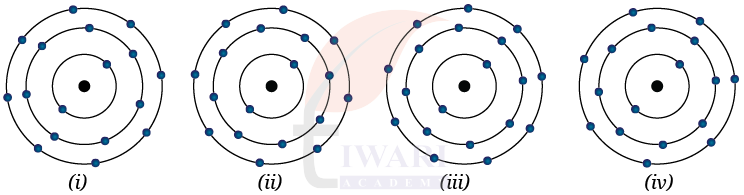
7. Which of the following, in Fig. 9.18, correctly represents Cl⁻ ion (Atomic number of chlorine = 17).
Answer:
Chlorine has atomic number 17. Its electronic configuration is 2, 8, 7 (shells K, L, M). When chlorine gains 1 electron to form Cl⁻ ion, the M shell becomes complete with 8 electrons.
Configuration of Cl⁻ = 2, 8, 8 (total 18 electrons).
So diagram (iii) correctly represents the Cl⁻ ion.
8. Determine the formula unit mass of the following substances.
(i) Ammonium nitrate (NH₄NO₃), used as a nitrogen fertiliser, which is essential for plant growth.
(ii) Phosphoric acid (H₃PO₄), used to make phosphate fertiliser and detergents.
(iii) Sodium hydrogencarbonate (NaHCO₃), used to relieve acidity and helps in digestion.
Answer:
(i) Ammonium nitrate — NH₄NO₃
N = 14 u, H = 1 u, O = 16 u
= (14×1) + (1×4) + (14×1) + (16×3)
= 14 + 4 + 14 + 48 = 80 u
(ii) Phosphoric acid — H₃PO₄
H = 1 u, P = 31 u, O = 16 u
= (1×3) + (31×1) + (16×4)
= 3 + 31 + 64 = 98 u
(iii) Sodium hydrogencarbonate — NaHCO₃
Na = 23 u, H = 1 u, C = 12 u, O = 16 u
= 23 + 1 + 12 + (16×3)
= 23 + 1 + 12 + 48 = 84 u.
9. Write the formulae for the compounds formed by the reaction of:
(i) Magnesium and nitrogen
(ii) Lithium and nitrogen
(iii) Sodium and sulfur
(iv) Aluminium and oxygen
Answer:
(i) Magnesium (Mg²⁺) and nitrogen (N³⁻): Criss-cross → Mg gets 3, N gets 2.
Mg₃N₂ (Magnesium nitride)
(ii) Lithium (Li⁺) and nitrogen (N³⁻): Criss-cross → Li gets 3, N gets 1.
Li₃N (Lithium nitride)
(iii) Sodium (Na⁺) and sulfur (S²⁻): Criss-cross → Na gets 2, S gets 1.
Na₂S (Sodium sulfide)
(iv) Aluminium (Al³⁺) and oxygen (O²⁻): Criss-cross → Al gets 2, O gets 3.
Al₂O₃ (Aluminium oxide)
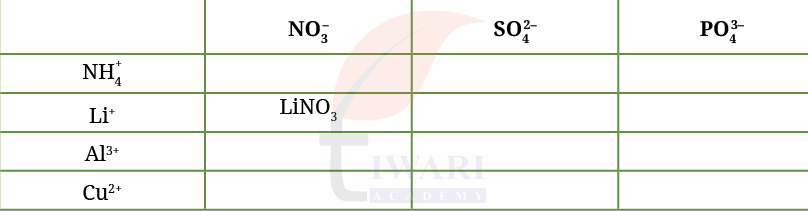
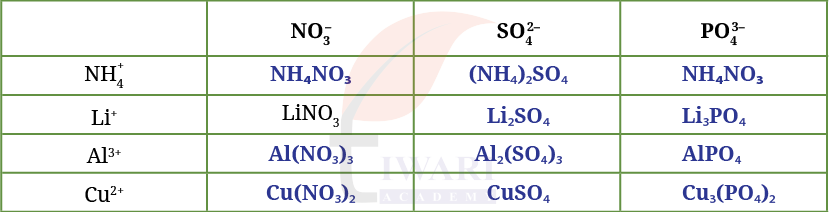
10. Complete the Table 9.3 by writing the formulae of the compounds formed by the cations on the left and the anions at the top. LiNO₃ is given as an example.
Answer:
11. 5.3 g of sodium carbonate and 6.0 g of acetic acid react to produce 2.2 g of carbon dioxide, 0.9 g of water, and 8.2 g of sodium acetate. Verify whether the law of conservation of mass is valid.
Answer:
Total mass of reactants
= 5.3 + 6.0
= 11.3 g
Total mass of products
= 2.2 + 0.9 + 8.2
= 11.3 g
Mass of reactants = Mass of products = 11.3 g.
Therefore, the Law of Conservation of Mass is verified.
Matter is neither created nor destroyed in this chemical reaction.
12. If a species has 11 protons, 12 neutrons and 10 electrons then
(i) what is its atomic number and mass number?
(ii) is it neutral, a cation or an anion? Explain.
(iii) write its electronic configuration.
(iv) name the species.
Answer:
(i) Atomic number = number of protons = 11
Mass number = protons + neutrons = 11 + 12 = 23
(ii) Protons = 11, Electrons = 10. Since protons > electrons, the species has a net positive charge.
Charge = 11 − 10 = +1. So it is a Cation with charge +1.
(iii) Total electrons = 10. Electronic configuration:
2, 8 (K shell = 2, L shell = 8)
(iv) Atomic number 11 = Sodium (Na).
This species with charge +1 is Sodium ion — Na⁺
13. Two elements, A and B, have the following configurations –
A: 2, 8, 5 B: 2, 8, 7
(i) Which element is more reactive?
(ii) Will A and B form ionic or covalent bonds when they combine? Explain using electron transfer or sharing.
(iii) Predict the formula of the compound they would form.
Answer:
(i) A has 5 valence electrons (needs 3 more). B has 7 valence electrons (needs only 1 more).
B needs fewer electrons and has a stronger tendency to attract electrons.
B is more reactive (like chlorine, which is highly reactive).
(ii) A has 5 valence electrons and B has 7. Neither has a very low number of valence electrons (less than 4) to simply donate. However, B needs only 1 electron and A can share electrons.
If A shares electrons with B: A needs 3 electrons and B needs 1. So A can share one electron with B. But this creates an imbalance — B with 7+1 = 8 (stable), but A still needs 2 more. Therefore A would share electrons with 3 atoms of B.
Type of bond formed: Covalent Bond (sharing of electrons between non-metals).
Note: A has 5 valence electrons (like nitrogen, P) and B has 7 (like Cl, F). Both are non-metals, so they form covalent bonds by sharing.
(iii) A needs 3 electrons (valency = 3), B needs 1 electron (valency = 1).
Using criss-cross rule:
AB₃ (e.g., similar to NCl₃ — Nitrogen trichloride)
14. Assertion (A): Copper sulfate conducts electricity in the molten state but not in the solid state. Reason (R): Copper and sulfate ions are fixed in the lattice in molten state, while in solid state they can move freely.
Choose the correct option:
(i) Both A and R are true, and R is the correct explanation of A.
(ii) Both A and R are true, but R is not the correct explanation of A.
(iii) A is true, but R is false.
(iv) A is false, but R is true.
Answer:
(iii) A is true, but R is false.
15. The species ²⁷Al, ⁸⁰Br⁻ and ²⁰¹Hg²⁺ have 13, 35 and 80 protons, respectively. How many electrons and neutrons do they have?
Answer:
Species : Mass No. : Protons : Electrons : Neutrons
²⁷Al (neutral) : 27 : 13 : 13 : 14
⁸⁰Br⁻ (gained 1e⁻) : 80 : 35 : 36 : 45
²⁰¹Hg²⁺ (lost 2e⁻) : 201 : 80 : 78 : 121
Extra Questions for Exam Preparation
NCERT Class 9 Science Exploration Chapter 9 Very Short Answer Type Questions with Explanation.
Very Short Answer Type Questions
- State the Law of Conservation of Mass. Who proposed it and when?
Answer:
Matter can neither be created nor destroyed in a chemical reaction. The total mass of reactants equals the total mass of products. Proposed by Antoine Lavoisier in 1789, known as the Father of Modern Chemistry. - State the Law of Constant Proportions.
Answer:
In any compound formed by two or more elements, the elements always combine in a fixed ratio by mass, irrespective of the source of the compound or the method of its preparation. Also called Proust’s Law. - Give two postulates of Dalton’s Atomic Theory.
Answer:
► All matter is made up of tiny particles called atoms, which participate in chemical reactions.
► Atoms are indivisible and cannot be created or destroyed in a chemical reaction.
► Dalton proposed six postulates in 1808 that explained the two fundamental laws of chemistry. - Define a molecule.
Answer:
A molecule is an electrically neutral entity consisting of more than one atom that is capable of independent existence and shows all the properties of that substance. Example: H₂ (hydrogen molecule), H₂O (water molecule). - What is a covalent bond? Give one example.
Answer:
A covalent bond is formed by the sharing of one or more pairs of electrons between atoms to achieve stable electronic configurations. Example: Two hydrogen atoms share one electron each to form H₂ with a single covalent bond H—H. - What is an ionic bond? Give one example.
Answer:
An ionic bond is the electrostatic force of attraction between oppositely charged ions (cation and anion) formed by the transfer of electrons. Example: Na loses one electron to Cl, forming Na⁺ and Cl⁻, held together by ionic bond in NaCl. - Distinguish between a cation and an anion.
Answer:
A cation is a positively charged ion formed when an atom loses one or more electrons. An anion is a negatively charged ion formed when an atom gains one or more electrons. Example: Na⁺ is a cation; Cl⁻ is an anion. Together they are called ions. - Why does ionic compound sodium chloride not conduct electricity in the solid state?
Answer:
In solid NaCl, the Na⁺ and Cl⁻ ions are held rigidly in fixed positions within the crystal lattice by strong electrostatic forces. Since ions cannot move freely in solid state, the compound cannot conduct electricity. Conductivity occurs only when dissolved in water. - What is the difference between molecular mass and formula unit mass?
Answer:
Molecular mass is the sum of atomic masses of all atoms in one molecule — applies to covalent compounds. Formula unit mass is the sum of atomic masses of all atoms in a formula unit — applies to ionic compounds, which form crystal lattices and not discrete molecules. - Name the covalent compound with formula SF₆ using IUPAC prefix system.
Answer:
SF₆ is named sulfur hexafluoride. ‘Hexa’ indicates 6 fluorine atoms. The second element (fluorine) ends in -ide, becoming fluoride, which with the prefix ‘hexa’ gives hexafluoride. The first element (sulfur) retains its name without a prefix. - Write the chemical formula of calcium carbonate using the criss-cross method.
Answer:
Calcium ion = Ca²⁺ (charge 2); Carbonate ion = CO₃²⁻ (charge 2). Criss-crossing equal charges (2 and 2) gives Ca₂(CO₃)₂. Dividing by common factor 2 gives the simplest formula: CaCO₃. The charge on each ion is not shown in the formula. - Why does sugar dissolve in water but not conduct electricity?
Answer:
Sugar is a covalent compound. When dissolved in water, it does not break into ions — it remains as sugar molecules in solution. Since electrical conductivity requires free-moving charged particles (ions), and no ions are produced, sugar solution does not conduct electricity. - What type of bond is present in an oxygen molecule (O₂)? How many pairs of electrons are shared?
Answer:
Oxygen molecule (O₂) has a double covalent bond. Oxygen has 6 valence electrons and needs 2 more. Two oxygen atoms each share 2 electrons, resulting in two shared pairs of electrons. It is represented as O=O (double bond with two lines). - Write the formula of magnesium hydroxide. Why are brackets used?
Answer:
Magnesium hydroxide formula is Mg(OH)₂. Criss-crossing Mg²⁺ (charge 2) and OH⁻ (charge 1) gives Mg(OH)₂ — two hydroxide ions per magnesium ion. Brackets are used around the polyatomic ion (OH) to show that the subscript 2 applies to the entire OH group, not just O. - Calculate the molecular mass of water (H₂O).
Answer:
Atomic masses: H = 1 u; O = 16 u.
Molecular mass of H₂O = (1 u × 2) + (16 u × 1) = 2 + 16 = 18 u.
Water has 2 hydrogen atoms and 1 oxygen atom. The molecular mass (18 u) applies to covalent compounds whose atoms form discrete molecules.
NCERT Class 9 Science Exploration Chapter 9 Short Answer Type Questions with Explanation.
Short Answer Type Questions
- Explain why the apparent mass decreases in Experimental Set-up 1 of Activity 9.2 but not in Set-up 2. Does this violate the Law of Conservation of Mass?
Answer:
In Set-up 1, the balloon is separated from the flask — when baking soda reacts with vinegar, CO₂ gas is produced and escapes into the surrounding air. Since the escaped gas is not weighed, the final reading appears less than the initial reading.
In Set-up 2, the balloon is attached to the flask’s mouth. When baking soda falls into the vinegar, the CO₂ produced inflates the balloon and is trapped within the system. The total mass (flask + balloon + all products) remains equal to the initial mass.
This does NOT violate the Law of Conservation of Mass. In both cases, the actual total mass is conserved. Set-up 1 simply fails to account for the escaped gas. The law always holds in a closed system where all products are accounted for. - Why does the Law of Constant Proportions apply to compounds but not to mixtures?
Answer:
In a compound, atoms of different elements are chemically bonded in a specific, fixed ratio determined by their valencies and atomic structure. This ratio is constant regardless of the source or method of preparation. For example, water always contains H and O in a 1:8 mass ratio.
In a mixture, substances are physically combined without chemical bonding. They can be mixed in any proportion — air can contain varying percentages of nitrogen and oxygen, and salt can be dissolved in water at different concentrations. No fixed ratio is required for physical mixing.
Therefore, the Law of Constant Proportions is a property of chemical combination (compounds) and not of physical mixing (mixtures). This is why the law is also called the Law of Definite Proportions — the proportions in a compound are always definite and invariable. - Explain the formation of a water molecule (H₂O) with the help of electron sharing. What type of bond is formed?
Answer:
Oxygen (Z=8) has electronic configuration 2, 6 — it has 6 valence electrons and needs 2 more to complete its octet. Hydrogen (Z=1) has 1 electron in K-shell and needs 1 more to complete its duplet.
To satisfy both needs, two hydrogen atoms each share one electron with the oxygen atom. Oxygen shares one electron each with the two hydrogen atoms. This results in two single covalent bonds forming the water molecule H₂O.
The structure is H—O—H, where each dash represents one shared pair of electrons (single covalent bond). The molecule is electrically neutral and stable. Since atoms achieve stability through sharing, water is a covalent compound. Both bonds in H₂O are single covalent bonds formed by sharing of one electron pair each. - Explain the formation of sodium chloride (NaCl) through ionic bonding. Why is NaCl electrically neutral overall?
Answer:
Sodium (Z=11) has electronic configuration 2, 8, 1 — one valence electron that it readily loses to achieve a stable octet in the L-shell. When sodium loses this electron, it becomes Na⁺ cation (11 protons, 10 electrons, net charge +1).
Chlorine (Z=17) has configuration 2, 8, 7 — seven valence electrons, needing one more to complete its octet. Chlorine gains the electron released by sodium, becoming Cl⁻ anion (17 protons, 18 electrons, net charge −1).
Na⁺ and Cl⁻ are attracted to each other by strong electrostatic force — this is the ionic bond. They form NaCl (sodium chloride).
NaCl is electrically neutral overall because the +1 charge of Na⁺ exactly cancels the −1 charge of Cl⁻. Total positive charge = total negative charge = overall neutral compound. - Compare the properties of ionic and covalent compounds under three headings: solubility, electrical conductivity, and melting/boiling points.
Answer:
Solubility: Ionic compounds (NaCl, CuSO₄) are generally soluble in polar solvents like water but insoluble in non-polar organic solvents like kerosene and petrol. Covalent compounds (camphor, naphthalene) are generally insoluble in water but dissolve in non-polar organic solvents.
Electrical Conductivity: Ionic compounds do not conduct electricity in solid state (ions fixed in lattice) but conduct when dissolved in water (ions free to move). Covalent compounds do not conduct electricity even in solution because they do not produce ions. Exception: sugar dissolves in water but still does not conduct.
Melting and Boiling Points: Ionic compounds have high melting and boiling points due to strong electrostatic forces of attraction between oppositely charged ions. Covalent compounds generally have low melting and boiling points because the intermolecular forces are much weaker than ionic bonds. - Write the chemical formulae of the following ionic compounds using criss-cross method: (a) Aluminium oxide, (b) Calcium carbonate, (c) Magnesium hydroxide.
Answer:
(a) Aluminium oxide: Al³⁺ (charge 3) and O²⁻ (charge 2). Criss-cross 3 and 2 → Al₂O₃. Formula: Al₂O₃.
(b) Calcium carbonate: Ca²⁺ (charge 2) and CO₃²⁻ (charge 2). Same charges criss-cross → Ca₂(CO₃)₂ → divide by 2 → CaCO₃. Formula: CaCO₃.
(c) Magnesium hydroxide: Mg²⁺ (charge 2) and OH⁻ (charge 1). Criss-cross → Mg(OH)₂. Brackets are essential because subscript 2 applies to the entire polyatomic OH group. Formula: Mg(OH)₂.
Note: In all formulae, charges on ions are not written in the final formula. - How does Dalton’s Atomic Theory explain both the Law of Conservation of Mass and the Law of Constant Proportions?
Answer:
Dalton proposed that atoms are indivisible particles that cannot be created or destroyed in a chemical reaction — they merely rearrange. This directly explains the Law of Conservation of Mass: since no atoms are gained or lost, the total mass of all atoms before the reaction equals the total mass after the reaction.
For the Law of Constant Proportions, Dalton proposed that atoms of a given element are identical in mass and that compounds are formed when atoms combine in fixed whole number ratios. Since atoms always combine in the same fixed ratio, the mass ratio of elements in a compound is always constant, regardless of the source or method of preparation.
Thus, Dalton’s theory provided the atomic-level explanation for both experimental laws: indivisibility explains conservation of mass, and fixed whole-number combining ratios explain constant proportions. - Name the following covalent compounds using IUPAC prefix rules: (a) CO, (b) CO₂, (c) N₂O₄, (d) PCl₃, (e) SF₆.
Answer:
(a) CO: Carbon monoxide. ‘Mono’ indicates 1 oxygen atom. Mono- is used for the second element even when omitted for the first.
(b) CO₂: Carbon dioxide. ‘Di’ indicates 2 oxygen atoms. The prefix ‘di’ keeps its ‘i’ before oxide.
(c) N₂O₄: Dinitrogen tetroxide. ‘Di’ for 2 nitrogen; ‘tetra’ for 4 oxygen, but the final ‘a’ of ‘tetra’ is dropped before ‘oxide’ → tetroxide not tetraoxide.
(d) PCl₃: Phosphorus trichloride. ‘Tri’ indicates 3 chlorine atoms. Second element chlorine → chloride.
(e) SF₆: Sulfur hexafluoride. ‘Hexa’ indicates 6 fluorine atoms. The final ‘a’ of ‘hexa’ is kept because fluoride starts with a consonant. - Calculate the molecular mass of nitric acid (HNO₃) and the formula unit mass of calcium nitrate Ca(NO₃)₂.
Answer:
Atomic masses: H = 1 u, N = 14 u, O = 16 u, Ca = 40 u.
Molecular mass of nitric acid (HNO₃):
= (1×1) + (14×1) + (16×3)
= 1 + 14 + 48
= 63 u
Formula unit mass of calcium nitrate Ca(NO₃)₂:
= (40×1) + {(14×1) + (16×3)} × 2
= 40 + (14 + 48) × 2
= 40 + 62 × 2
= 40 + 124
= 164 u
Note: Molecular mass is used for covalent compounds (discrete molecules). Formula unit mass is used for ionic compounds (crystal lattice — no discrete molecules exist). Nitric acid is covalent; calcium nitrate is ionic. - 4.0 g of calcium carbonate reacts with 2.92 g of hydrochloric acid in a closed container to produce 1.76 g of CO₂, 0.72 g of water, and 4.44 g of calcium chloride. Verify the Law of Conservation of Mass.
Answer:
Total mass of reactants:
= Mass of CaCO₃ + Mass of HCl
= 4.0 g + 2.92 g
= 6.92 g
Total mass of products:
= Mass of CO₂ + Mass of H₂O + Mass of CaCl₂
= 1.76 g + 0.72 g + 4.44 g
= 6.92 g
Since mass of reactants (6.92 g) = mass of products (6.92 g), the Law of Conservation of Mass is verified and obeyed in this chemical reaction.
This demonstration is valid because the reaction was carried out in a closed container — all gaseous products (CO₂) were retained and weighed. Had it been open, CO₂ would have escaped, apparently violating the law.
NCERT Class 9 Science Exploration Chapter 9 Long Answer Type Questions with Explanation.
Long Answer Type Questions
- State the Law of Conservation of Mass. Describe Activity 9.2 to demonstrate it. Why is a closed system essential?
Answer:
Law of Conservation of Mass: Matter can neither be created nor destroyed in a chemical reaction. Mass of reactants = Mass of products.
Activity 9.2 uses vinegar and baking soda. In Set-up 1 (open system), baking soda is poured directly into vinegar in an open flask. CO₂ gas escapes into the air. The final mass is less than initial — apparently violating the law.
In Set-up 2 (closed system), the balloon filled with baking soda is attached to the flask. When baking soda mixes with vinegar, CO₂ inflates the balloon but stays within the system. Final mass exactly equals initial mass.
A closed system is essential because if any product (gas) escapes, it is not weighed — giving an incorrect impression that mass was lost. The law holds universally only when all reactants and products are accounted for. - State Dalton’s Atomic Theory. How does it explain the Law of Conservation of Mass and the Law of Constant Proportions? What are its limitations?
Answer:
Dalton’s Atomic Theory (1808) postulates: (i) All matter is made of tiny atoms; (ii) atoms are indivisible and cannot be created or destroyed; (iii) atoms of a given element are identical; (iv) atoms of different elements differ in mass; (v) atoms combine in whole number ratios to form compounds; (vi) the relative number and kinds of atoms in a compound are constant.
Law of Conservation of Mass is explained because atoms only rearrange — no atom is created or destroyed, so total mass is unchanged.
Law of Constant Proportions is explained because atoms always combine in the same fixed whole number ratios — giving a constant mass ratio in any compound.
Limitations: Atoms are actually divisible (contain electrons, protons, neutrons). Atoms of the same element can have different masses (isotopes). These facts were discovered after Dalton’s time, requiring modifications to his theory. - Explain the formation of a hydrogen chloride (HCl) molecule. Compare single and double covalent bonds with examples. How are covalent compounds named?
Answer:
Hydrogen (Z=1) has 1 electron in K-shell and needs 1 more for a stable duplet. Chlorine (Z=17) has configuration 2, 8, 7 — with 7 valence electrons needing 1 more for a stable octet. Since both atoms need exactly 1 electron, each shares 1 electron with the other. One shared pair of electrons forms the molecule H—Cl (single covalent bond). HCl is a covalent compound.
Single bond: One shared pair of electrons. Examples: H₂ (H—H), Cl₂ (Cl—Cl), HCl (H—Cl).
Double bond: Two shared pairs of electrons. Example: O₂ (O=O) — oxygen has 6 valence electrons and needs 2 more, so two O atoms share 2 electrons each.
Naming covalent compounds: Use IUPAC prefix system — mono (1), di (2), tri (3), tetra (4), penta (5), hexa (6). First element retains its name; second element ends in -ide. Mono is omitted for the first element. Example: CO = carbon monoxide; CO₂ = carbon dioxide; PCl₃ = phosphorus trichloride. - Explain the formation of an ionic bond using the example of NaCl. Describe the crystal structure of NaCl. Why does NaCl conduct electricity in solution but not in solid state?
Answer:
Sodium (Z=11, configuration 2, 8, 1) has 1 valence electron. It readily loses this electron to become Na⁺ (11 protons, 10 electrons, charge +1), achieving the stable neon configuration 2, 8.
Chlorine (Z=17, configuration 2, 8, 7) has 7 valence electrons. It accepts sodium’s electron to become Cl⁻ (17 protons, 18 electrons, charge −1), achieving the stable argon configuration 2, 8, 8.
Na⁺ and Cl⁻ are held together by electrostatic attraction — this is the ionic bond. NaCl is electrically neutral (total charge = 0).
Crystal structure: Ionic compounds don’t form single molecules. In solid NaCl, each Na⁺ is surrounded by 6 Cl⁻ ions, and each Cl⁻ is surrounded by 6 Na⁺ ions, forming a regular 3-D crystal lattice pattern.
Conductivity: In solid state, all ions are rigidly fixed in the lattice by strong electrostatic forces — they cannot move, so no conductivity. When dissolved in water, the crystal lattice breaks apart and Na⁺ and Cl⁻ ions become free to move independently through the solution. These freely moving charged ions carry electric current, enabling conductivity. - Explain the criss-cross method for writing chemical formulae. Write the formulae for (a) magnesium hydroxide, (b) aluminium sulfate, (c) ferric chloride. Calculate the formula unit mass of magnesium hydroxide.
Answer:
Criss-cross method for ionic compounds:
► Write cation symbol first, then anion
► Write charges (numbers only) below each symbol
► Swap the charge numbers as subscripts
► Reduce subscripts by common factor if needed
► Use brackets around polyatomic ions when subscript > 1
(a) Magnesium hydroxide Mg(OH)₂:
Mg²⁺ and OH⁻ → criss-cross charges (2 and 1) → Mg(OH)₂
Brackets are essential because subscript 2 applies to the entire OH group.
(b) Aluminium sulfate Al₂(SO₄)₃:
Al³⁺ and SO₄²⁻ → criss-cross (3 and 2) → Al₂(SO₄)₃
No reduction possible (2 and 3 have no common factor other than 1).
(c) Ferric chloride FeCl₃:
Fe³⁺ and Cl⁻ → criss-cross (3 and 1) → FeCl₃
Formula Unit Mass of Mg(OH)₂:
Atomic masses: Mg = 24 u; O = 16 u; H = 1 u
= (24 × 1) + {(16 × 1) + (1 × 1)} × 2
= 24 + (17 × 2)
= 24 + 34
= 58 u
Section-wise Notes and Summary
9.1 Law of Conservation of Mass
Demonstrated through Activities 9.1, 9.2 and 9.3:
Activity 9.1 (Physical change): Mass of salt + mass of water = mass of salt solution. No change in mass during dissolution.
Activity 9.2 (Chemical change): Vinegar + baking soda reaction.
- Experimental set-up 1: Gas escapes → mass appears to decrease (incorrect measurement)
- Experimental set-up 2: Balloon attached to flask traps gas → initial mass = final mass
Activity 9.3 (Verification): Sodium sulfate + Barium chloride → Barium sulfate (white precipitate) + Sodium chloride. Mass before reaction = Mass after reaction.
Law of Conservation of Mass: Matter can neither be created nor destroyed in a chemical reaction. Total mass of reactants = Total mass of products.
Proposed by Antoine Lavoisier in 1789 – known as the Father of Modern Chemistry.
Key point: This law holds only when the system is closed (no gas escapes). In an open system, apparent mass changes occur due to gas escaping – but the total mass including the escaped gas remains constant.
9.2 Law of Constant Proportions
Proposed by Joseph Louis Proust — also called the Law of Definite Proportions or Proust’s Law.
Statement: In any compound formed by two or more elements, the elements combine in a fixed ratio by mass, irrespective of the source of the compound.
Example – Water:
From river, borewell, ocean or any source – purified water always contains hydrogen and oxygen in the mass ratio of 1:8
9 g of water always gives 1 g of hydrogen and 8 g of oxygen on decomposition
Key distinction:
- Law of Constant Proportions holds for compounds (fixed ratio by mass)
- It does NOT apply to mixtures (which can be combined in any ratio)
Both laws together form the experimental foundation of Dalton’s Atomic Theory.
9.3 Dalton’s Atomic Theory
John Dalton (England, 1808) proposed his theory as a set of postulates:
- All matter is made up of very tiny particles called atoms, which participate in chemical reactions.
- Atoms are indivisible particles – they cannot be created or destroyed in a chemical reaction.
- Atoms of a given element are identical in mass and chemical properties.
- Atoms of different elements have different masses and chemical properties.
- Atoms combine in the ratio of simple whole numbers to form compounds.
- The relative number and kinds of atoms are constant in a given compound.
How Dalton’s theory explains the two laws:
- Law of Conservation of Mass: Atoms are merely rearranged (not created or destroyed) in a chemical reaction → total mass is conserved.
- Law of Constant Proportions: Fixed types and numbers of atoms in a given compound → fixed ratio by mass.
9.4 How Atoms Combine?
A molecule is an electrically neutral entity consisting of more than one atom that is capable of independent existence and shows all the properties of that substance.
Atoms combine to become stable by achieving an octet (or duplet for H and He). This happens in two ways:
- Sharing of electrons – forms covalent bonds
- Transfer of electrons – forms ionic bonds
When atoms combine, total energy of the system decreases – making the arrangement more stable. The force holding atoms together is called a chemical bond.
9.4.1 Covalent Bond (Bonding by Sharing of Electrons)
A covalent bond is formed when two atoms share one or more pairs of electrons to achieve stable electronic configurations.
A. Molecules of Elements (same element combining):
Hydrogen molecule (H₂):
- H has 1 electron in K-shell; needs 1 more
- Two H atoms each share 1 electron → shared pair attracts both nuclei
- Single covalent bond (one shared pair) → represented as H—H
Chlorine molecule (Cl₂):
- Cl has 7 valence electrons; needs 1 more
- Two Cl atoms each share 1 electron → single bond → Cl—Cl
Oxygen molecule (O₂):
- O has 6 valence electrons; needs 2 more
- Two O atoms each share 2 electrons → double bond (two shared pairs) → O=O
Nitrogen molecule (N₂):
- N has 5 valence electrons; needs 3 more
- Two N atoms each share 3 electrons → triple bond → N≡N
B. Molecules of Compounds (different elements combining):
Hydrogen chloride (HCl):
- H needs 1 electron; Cl needs 1 electron
- Each shares 1 electron → single covalent bond → H—Cl
Water (H₂O):
- O needs 2 electrons; H needs 1 electron
- Two H atoms each share 1 electron with O → 2 single bonds → H—O—H
- Formula H₂O: 2 hydrogen atoms + 1 oxygen atom
Carbon dioxide (CO₂):
- C has 4 valence electrons; O has 6 valence electrons
- C forms double bond with each O → O=C=O
C. Naming Covalent Compounds (IUPAC Prefix System):
Number of atoms | Prefix
1 | mono (usually omitted for first element)
2 | di
3 | tri
4 | tetra
5 | penta
6 | hexa
Rules:
- First element retains its regular name
- Second element ends in -ide
- If prefix ends in ‘o’ or ‘a’ and element starts with vowel, drop the last vowel (e.g., monoxide not monooxide)
- When hydrogen is the first element, no prefix is used for hydrogen (e.g., H₂S = hydrogen sulfide, not dihydrogen sulfide)
Examples:
- CO = carbon monoxide
- CO₂ = carbon dioxide
- CS₂ = carbon disulfide
- PCl₃ = phosphorus trichloride
- SF₆ = sulfur hexafluoride
- N₂O₄ = dinitrogen tetroxide
- N₂O₅ = dinitrogen pentoxide
- H₂O = water (common name)
- NH₃ = ammonia (common name)
9.4.2 Ionic Bond (Bonding by Electron Transfer)
An ionic bond is formed when one atom transfers electrons to another, resulting in the formation of oppositely charged ions held together by electrostatic attraction.
Formation of sodium chloride (NaCl):
Sodium (Z=11, configuration 2, 8, 1):
- Has 1 valence electron → loses it → becomes Na⁺ (sodium cation)
- Na⁺ has 11 protons and 10 electrons → net charge = +1
Chlorine (Z=17, configuration 2, 8, 7):
- Has 7 valence electrons → gains 1 → becomes Cl⁻ (chloride anion)
- Cl⁻ has 17 protons and 18 electrons → net charge = −1
Na⁺ and Cl⁻ are held together by electrostatic force of attraction → ionic bond → NaCl
Key terms:
- Cation: Positive ion formed by loss of electrons (e.g., Na⁺, Ca²⁺, Al³⁺)
- Anion: Negative ion formed by gain of electrons (e.g., Cl⁻, O²⁻, S²⁻)
- Ions: Collective term for cations and anions
- Polyatomic ions: Ions formed by combination of two or more elements (e.g., SO₄²⁻, NO₃⁻, OH⁻, NH₄⁺)
Ionic crystal structure: Ionic compounds form 3-D crystals. In NaCl, each Na⁺ is surrounded by 6 Cl⁻ ions, and each Cl⁻ is surrounded by 6 Na⁺ ions. This regular repeating pattern is called the crystal lattice.
A. Naming Ionic Compounds:
- Cation name is written first, anion name second
- Simple anions end in -ide (e.g., chloride, oxide, sulfide)
- Polyatomic anions do NOT end in -ide (e.g., sulfate, nitrate, carbonate)
Examples: NaCl = sodium chloride; CaCO₃ = calcium carbonate; Mg(OH)₂ = magnesium hydroxide.
9.5 Writing Chemical Formulae
9.5.1 Covalent Compounds — Criss-Cross Method:
(i) Write symbols of elements
(ii) Write their valencies below
(iii) Criss-cross the valencies as subscripts
Examples:
- HCl: H(1) and Cl(1) → criss-cross → HCl (subscript 1 is not written)
- H₂S: H(1) and S(2) → criss-cross → H₂S
- CCl₄: C(4) and Cl(1) → criss-cross → CCl₄
9.5.2 Ionic Compounds — Criss-Cross Method:
- Write cation symbol first, then anion
- Write charges (numbers only) below
- Criss-cross the charge numbers as subscripts
- Reduce subscripts by common factor if needed
- Use brackets for polyatomic ions when subscript > 1
Examples:
- CaCl₂: Ca²⁺ and Cl⁻ → criss-cross → CaCl₂
- Al₂O₃: Al³⁺ and O²⁻ → criss-cross → Al₂O₃
- MgO: Mg²⁺ and O²⁻ → criss-cross gives Mg₂O₂ → reduce to MgO
- CaCO₃: Ca²⁺ and CO₃²⁻ → same valency → reduce to CaCO₃
- Mg(OH)₂: Mg²⁺ and OH⁻ → criss-cross → Mg(OH)₂ (brackets needed)
- Al(OH)₃: Al³⁺ and OH⁻ → criss-cross → Al(OH)₃ (NOT AlOH₃)
- Al₂(SO₄)₃: Al³⁺ and SO₄²⁻ → criss-cross → Al₂(SO₄)₃
9.6 Properties of Ionic and Covalent Compounds
| Property | Ionic Compounds | Covalent Compounds |
|---|---|---|
| Solubility in water | Generally soluble | Generally insoluble (exceptions: sugar, ethanol) |
| Solubility in organic solvents (kerosene, petrol) | Insoluble | Generally soluble |
| Electrical conductivity in solid state | Non-conducting (ions fixed in lattice) | Non-conducting |
| Electrical conductivity in aqueous solution | Conducting (ions free to move) | Non-conducting (no ions produced – e.g., sugar) |
| Melting and boiling points | High (strong inter-ionic attractions) | Low (weaker intermolecular forces) |
| Examples | NaCl, CuSO₄ | Camphor, naphthalene, sugar |
Key explanation: Ionic compounds conduct electricity only when dissolved in water or in molten state because ions become free to move. In solid state, ions are held rigidly in crystal lattice and cannot move.
Sugar is a covalent compound that dissolves in water but does NOT conduct electricity because it does not produce ions in solution.
9.7 Molecular Mass of Covalent Compounds
Molecular mass = Sum of atomic masses of all atoms present in one molecule
Formula: Molecular mass = (atomic mass of each element × number of atoms of that element), sum for all elements
Examples:
- Water (H₂O): (1×2) + (16×1) = 18 u
- Carbon dioxide (CO₂): (12×1) + (16×2) = 44 u
- Methane (CH₄): (12×1) + (1×4) = 16 u
- Nitric acid (HNO₃): (1×1) + (14×1) + (16×3) = 63 u
9.8 Formula Unit Mass of Ionic Compounds
Formula unit: The collection of the simplest whole number ratio of ions in an ionic compound.
Formula unit mass = Sum of atomic masses of all atoms in a formula unit
Examples:
- Na₂O: (23×2) + (16×1) = 62 u
- Ca(NO₃)₂: (40×1) + {(14×1) + (16×3)} × 2 = 40 + 62×2 = 164 u
- KCl: (39×1) + (35.5×1) = 74.5 u
- Mg(OH)₂: (24×1) + {(16×1) + (1×1)} × 2 = 24 + 34 = 58 u
Important Formulae and Key Notes
| Formula | Meaning |
|---|---|
| Law of Conservation of Mass | Mass of reactants = Mass of products |
| Law of Constant Proportions | Elements in a compound combine in fixed mass ratio |
| Molecular mass | Sum of (atomic mass × number of atoms) for all atoms in molecule |
| Formula unit mass | Sum of (atomic mass × number of atoms) for all atoms in formula unit |
| Criss-cross method | Swap valencies/charges as subscripts to write formula |
Common Atomic Masses for Calculations:
H = 1 u, C = 12 u, N = 14 u
O = 16 u, Na = 23 u, Mg = 24 u
Al = 27 u, S = 32 u, Cl = 35.5 u
K = 39 u, Ca = 40 u, Fe = 56 u
Cu = 64 u, Zn = 65 u
FAQs – Class 9 Science Exploration Chapter 9
Is Class 9 Science Exploration Chapter 9 part of the new 2026-27 NCERT syllabus?
Yes. Chapter 9, Atomic Foundations of Matter, is part of the brand-new NCERT Exploration textbook for Class 9 (session 2026-27). Compared to the older Atoms and Molecules chapter, this new version is significantly expanded. It integrates the Law of Conservation of Mass and Law of Constant Proportions with three practical verification activities (Activities 9.1, 9.2, 9.3).
New additions include detailed treatment of covalent bond formation (hydrogen, chlorine, oxygen, water, hydrogen chloride with electron-dot diagrams), ionic bond formation with crystal structure and crystal lattice concepts, IUPAC prefix-based naming of covalent compounds and a comprehensive Activity 9.4 comparing solubility and electrical conductivity of ionic and covalent compounds. The chapter also introduces polyatomic ions and formula unit mass as distinct from molecular mass.
Which topics in Class 9 Exploration Chapter 9 require the most careful teaching?
Following four areas need particular attention:
First, the two activities demonstrating the Law of Conservation of Mass (Activity 9.2 set-ups 1 and 2) – students must understand why set-up 1 shows an apparent mass decrease (gas escapes) while set-up 2 shows constant mass. This distinction is frequently tested.
Second, writing chemical formulae by criss-cross method — students often confuse whether to use valencies or charges and make errors with polyatomic ions (forgetting brackets for Mg(OH)₂ or writing AlOH₃ instead of Al(OH)₃).
Third, distinguishing molecular mass (covalent) from formula unit mass (ionic) — students commonly apply the same term to both.
Fourth, the prefix rules for naming covalent compounds, particularly vowel-dropping rules (monoxide not monooxide, pentoxide not pentaoxide) and the special rule that no prefix is used before hydrogen when it is the first element.
What are the highest-weightage exam topics from Chapter 9?
For school and competitive examinations, prioritise:
- Law of Conservation of Mass – verification, numerical calculation and open vs closed system distinction
- Law of Constant Proportions – numerical problems and why it applies to compounds but not mixtures
- Writing chemical formulae using criss-cross method – both simple ionic and polyatomic ion combinations
- Naming covalent compounds using IUPAC prefix system
- Comparing properties of ionic and covalent compounds (solubility and conductivity table)
- Molecular mass calculations – H₂O, CO₂, HNO₃, CH₄ type problems
- Formula unit mass calculations – NaCl, CaCO₃, Ca(NO₃)₂ type problems
- Formation of covalent and ionic bonds with electron-dot diagrams
Questions 5, 6, 8, 9, 10, 11 from Revise, Reflect, Refine are high-yield formula-writing and mass-calculation problems. Question 3 (ionic compound design) and Question 13 (predicting bond type from electronic configuration) are excellent higher-order questions.
Is Class 9 Science Exploration Chapter 9 easy or difficult?
Chapter 9 has mixed difficulty. The first two sections (Laws of Conservation of Mass and Constant Proportions) are conceptually straightforward – the activities make them concrete and the numerical problems are simple ratio calculations. Dalton’s theory (Section 9.3) is mostly memorisation-based and accessible. The middle section on covalent bond formation is conceptual but logical, building naturally from Chapter 8’s valence electron concepts.
The challenging parts are: writing chemical formulae using criss-cross method (especially with polyatomic ions), naming covalent compounds using prefix rules (many small rules to remember) and calculating formula unit mass for complex ionic compounds like Ca(NO₃)₂ involving polyatomic ions. Students who practise the criss-cross method with multiple examples generally find the formula-writing section manageable with effort.
How much time does a student need to prepare Exploration Chapter 9 in class 9 science, thoroughly?
The required time for each task given below:
- First reading – laws, Dalton’s theory, bonding concepts | 2–3 hours
- Covalent and ionic bond formation with electron-dot diagrams | 1–2 hours
- Naming covalent and ionic compounds | 1 hour
- Criss-cross formula writing with practice | 2 hours
- Molecular mass and formula unit mass calculations | 1 hour
- Solving Pause and Ponder (24 questions) and Revise, Reflect, Refine (15 questions) | 3–4 hours
- Revision | 1 hour
- Total | 11–14 hours
Spread over 5–6 days is strongly recommended. Formula writing and mass calculations particularly benefit from daily practice spread across multiple sessions rather than one long sitting.
Can I complete Class 9 Science Exploration Chapter 9 in one day?
A complete first reading of all concepts can be done in one 7–8 hour day. However, achieving exam-level proficiency in chemical formula writing and mass calculations absolutely requires multiple days of practice.
The criss-cross method for ionic compounds with polyatomic ions (like aluminium sulfate Al₂(SO₄)₃ or magnesium hydroxide Mg(OH)₂) typically takes 2–3 rounds of practice before students stop making errors with brackets and subscripts.
The IUPAC prefix naming rules also need repetition. The 24 Pause and Ponder questions and 15 Revise, Reflect, Refine questions together require at least 3–4 hours of focused solving time.
One day is enough for conceptual understanding; 5–6 days are needed for examination readiness.
What are the core concepts I must learn in Exploration Chapter 9 of class 9th Science?
Must do the following:
- Law of Conservation of Mass – statement, who proposed it, why a closed system is needed
- Law of Constant Proportions – statement, water example (H:O = 1:8), why it doesn’t apply to mixtures
- All six postulates of Dalton’s Atomic Theory
- Definition of molecule, covalent bond, ionic bond, cation, anion
- Electron-dot diagrams for H₂, Cl₂, O₂, HCl, H₂O formations
- Single bond (one shared pair), double bond (two shared pairs) — with examples
- IUPAC prefix rules for naming covalent compounds – all prefixes and vowel-dropping rule
- Naming ionic compounds — cation first, anion second, -ide ending for simple anions
- Criss-cross method for writing formulae – both covalent and ionic (with polyatomic ions)
- Properties comparison of ionic vs covalent compounds – especially electrical conductivity explanation
- Molecular mass formula and calculations (covalent)
- Formula unit mass formula and calculations (ionic) — understand why not “molecular mass”
- Common ions from Table 9.1 – at least 10 cations and anions with their charges.
How should I master chemical formula writing in Chapter 9 of 9th Science?
Follow this five-step practice plan:
- Step 1: Memorise all ion charges from Table 9.1 (monoatomic and polyatomic), use flashcards.
- Step 2: For simple binary formulas (two monoatomic ions), practice criss-cross with 10 examples daily until automatic: CaCl₂, Al₂O₃, MgO, Na₂S, K₂O, FeCl₃, ZnO, etc.
- Step 3: For polyatomic ions, remember the bracket rule: use brackets when the subscript of a polyatomic ion is 2 or more. Mg(OH)₂ NOT MgOH₂; Al(OH)₃ NOT AlOH₃; Al₂(SO₄)₃ NOT Al₂SO₄₃.
- Step 4: Practice reducing subscripts: when equal charges criss-cross (e.g., Mg²⁺ and O²⁻), the formula is MgO not Mg₂O₂. Always divide by the common factor.
- Step 5: Complete Table 9.3 from the exercise (12 combinations of NH₄⁺, Li⁺, Al³⁺, Cu²⁺ with NO₃⁻, SO₄²⁻, PO₄³⁻) multiple times until you can fill it accurately without referring to the table of ions.
Which topics from Class 9 Science Chapter 9 appear most frequently in exams?
High-frequency exam topics from past patterns:
- Statement and numerical verification of Law of Conservation of Mass
- Why apparent mass decreases in set-up 1 but not set-up 2 of Activity 9.2 (open vs closed system)
- Law of Constant Proportions numerical – if X g of element A combines, how much of B is needed?
- Writing chemical formulae by criss-cross – especially Al₂O₃, CaCO₃, Mg(OH)₂, Al₂(SO₄)₃
- Naming covalent compounds – CO, CO₂, PCl₃, SF₆, N₂O₄ type
- Why ionic compounds conduct electricity in aqueous solution but not in solid state
- Why sugar dissolves in water but does not conduct electricity
- Molecular mass calculations – HNO₃, CH₄, H₂SO₄ type
- Formula unit mass calculations – NaCl, Ca(NO₃)₂, Mg(OH)₂ type
- Postulates of Dalton’s Atomic Theory – with identification of limitations