


by Tiwari Academy Team
NCERT Class 9 Science Exploration Chapter 6 How Forces Affect Motion Solutions – Exercise questions with extra question answers in English and Hindi Medium. Chapter 6 of the NCERT Class 9 Science Exploration textbook (session 2026-27), How Forces Affect Motion, is a cornerstone chapter in the study of classical mechanics. Building on the concepts of position, velocity and acceleration from Chapter 4, this chapter investigates what causes changes in motion – and the answer is force. Students explore how forces can start motion, stop motion, change the direction or speed of moving objects and even change an object’s shape.
Quick Links:
- Chapter 6 Exercises Solutions
- Very Short Answer Type Questions
- Short Answer Type Questions
- Long Answer Type Questions
- Class 9 Science Exploration Chapter 6 in Hindi Medium
- Download Class 9 Science Offline App to study Class 9 Science Exploration Offline.
The chapter 6 of 9th Science Exploration, introduces the force of friction and explains how different surfaces produce different frictional forces. It then presents Newton’s three famous laws of motion – the bedrock of classical physics first published in 1687 — with real-life applications ranging from catching a cricket ball and deploying airbags to rocket launches and rowing a canoe. Worked examples, hands-on activities, and thought experiments make abstract ideas tangible, while sections like “Ready to Go Beyond” and “The Journey Beyond” challenge curious students to think deeper. Mastering this chapter is essential for scoring well in Class 9 Science and for building a strong foundation for Class 10, 11 and 12 Physics.
NCERT Class 9 Science Exploration Chapter 6 Solutions (2026-27 New Syllabus)
Chapter at a Glance – Key Concepts
| Topic | Core Idea |
|---|---|
| Force | Force causes change in motion, shape or state of rest |
| Measuring Force | Spring balance; SI unit = newton (N) |
| Balanced Forces | Equal & opposite ⇒ net force = zero ⇒ no change in motion |
| Unbalanced Forces | Net force ≠ zero ⇒ change in motion (acceleration) |
| Force of Friction | Opposes relative motion; depends on nature of surfaces |
| Newton’s First Law | Object at rest stays at rest; moving object stays in motion – unless a net force acts |
| Inertia | Tendency to resist change in state of rest or motion |
| Newton’s Second Law | F = ma; acceleration ∝ net force; acceleration ∝ 1/mass |
| Newton’s Third Law | Every action has an equal and opposite reaction (on different objects) |
| System of Objects | Treat connected objects as one system; use total mass |
Class 9 Science Exploration Chapter 6 Question Answer
Revise, Reflect, Refine
1. Using a horizontal force F, a table is moved across the floor at a constant velocity. How much is the frictional force exerted by the floor on the table?
Answer:
When the table moves with constant velocity, its acceleration is zero.
According to Newton’s first law of motion, if acceleration is zero, the net force acting on the object must be zero.
Therefore, the frictional force exerted by the floor on the table is equal in magnitude to the applied force F, but acts in the opposite direction.
Frictional force = F (opposite to the direction of motion)
2. For a ball moving on a smooth frictionless surface, choose the appropriate option that will make the following statements physically correct.
(i) If no net force is applied on the ball, the velocity of the ball will remain the same/increase/decrease.
Answer:
If no net force is applied on the ball, the velocity of the ball will remain the same.
Reason:
According to Newton’s first law of motion, an object continues to move with the same velocity unless acted upon by an unbalanced force.
(ii) If a net force is applied on the ball in the direction of its motion, the magnitude of the velocity of the ball will remain the same/increase/decrease.
Answer:
If a net force is applied on the ball in the direction of its motion, the magnitude of the velocity of the ball will increase.
Reason:
A force in the direction of motion produces acceleration in the same direction, so the speed increases.
(iii) If a net force is applied on the ball in a direction opposite to the direction of its motion, the magnitude of the velocity of the ball will remain the same/increase/decrease.
Answer:
If a net force is applied on the ball in a direction opposite to the direction of its motion, the magnitude of the velocity of the ball will decrease.
Reason:
A force opposite to the direction of motion produces retardation, so the speed decreases.
3. Two blocks P and Q on a smooth horizontal surface are shown in Fig. 6.36(a) and Fig. 6.36(b). Two forces of magnitudes 4 N and 5 N are acting in opposite directions on block P, while block Q is moving with a constant velocity. Which of the following statement is correct?
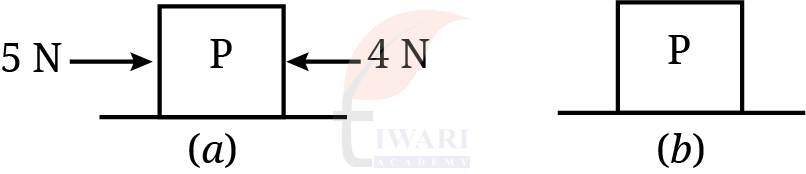
Which of the following statement is correct?
(i) P experiences a net force and Q does not experience a net force.
(ii) P does not experience a net force and Q experiences a net force.
(iii) Both P and Q experience a net force.
(iv) Neither P nor Q experiences a net force.
Answer:
(i) P experiences a net force and Q does not experience a net force.
For block P:
Two opposite forces 5 N and 4 N act on it.
Net force on P = 5 N − 4 N = 1 N
So, block P experiences a net force.
For block Q:
It is moving with constant velocity on a smooth horizontal surface.
Therefore, acceleration is zero and net force on Q is zero.
Hence, the correct option is (i).
4. While practising for the snake boat race (𝘝𝘢𝘭𝘭𝘶𝘮 𝘬𝘢𝘭𝘪 in Kerala), 100 oarsmen are rowing a boat together. Out of these, 95 row backwards to propel the boat forward. But by mistake, 5 oarsmen row in the opposite direction. If each oarsman applies a horizontal force of 200 N, what is the net force on the snake boat?
(Ignore drag forces, air friction, etc.)
Answer:
Number of oarsmen rowing in the forward-driving direction = 95
Force applied by each oarsman = 200 N
Total forward force = 95 × 200 = 19000 N
Number of oarsmen rowing in the opposite direction = 5
Total backward force = 5 × 200 = 1000 N
Net force = Forward force − Backward force
Net force = 19000 N − 1000 N = 18000 N
The net force on the snake boat is 18000 N in the forward direction.
5. When a net force acts on an object, we observe that the object accelerates:
(i) opposite to the direction of force, with acceleration proportional to the force acting on the object.
(ii) opposite to the direction of force, with acceleration proportional to the mass of the object.
(iii) in the direction of force, with acceleration inversely proportional to the force acting on the object.
(iv) in the direction of force, with acceleration proportional to the force acting on the object.
Answer:
(iv) in the direction of force, with acceleration proportional to the force acting on the object.
According to Newton’s second law of motion:
- Acceleration is produced in the direction of the net force.
- Acceleration is directly proportional to the applied force.
- Acceleration is inversely proportional to the mass of the object.
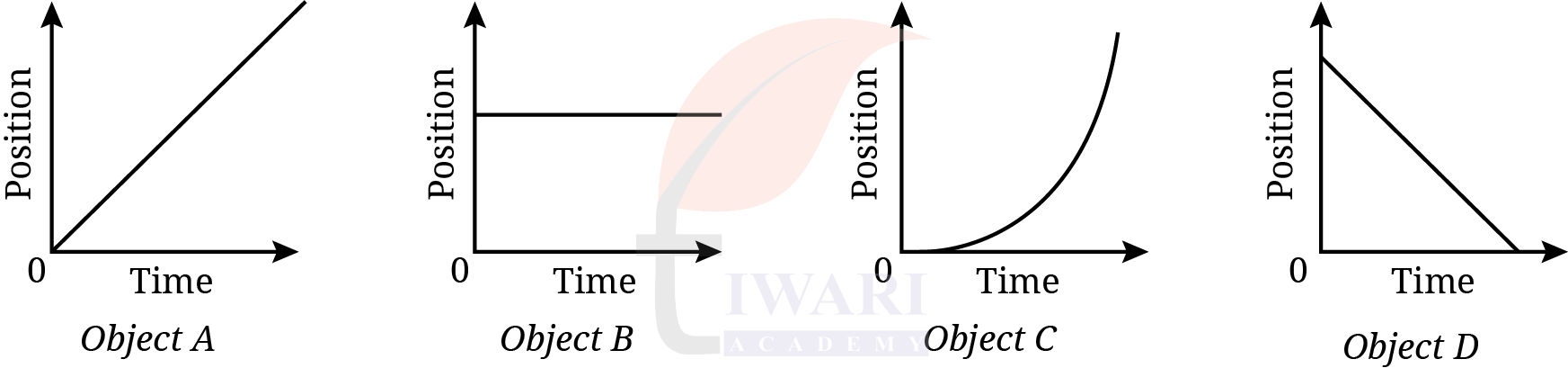
6. The position-time graph for four objects A, B, C and D moving along a straight line are given in Fig. 6.37. A net force acts on:
(i) Object A
(ii) Object B
(iii) Object C
(iv) Object D
Answer:
(iii) Object C
- In a position-time graph, a straight line means constant velocity, so acceleration is zero and net force is zero.
- A horizontal line means the object is at rest, so acceleration is zero and net force is zero.
- A curved line means velocity is changing, so acceleration is present and hence a net force acts.
Now observe the graphs:
- Object A: straight line upward → constant velocity → no net force
- Object B: horizontal line → at rest → no net force
- Object C: curved line upward → changing velocity → net force acts
- Object D: straight line downward → constant negative velocity → no net force
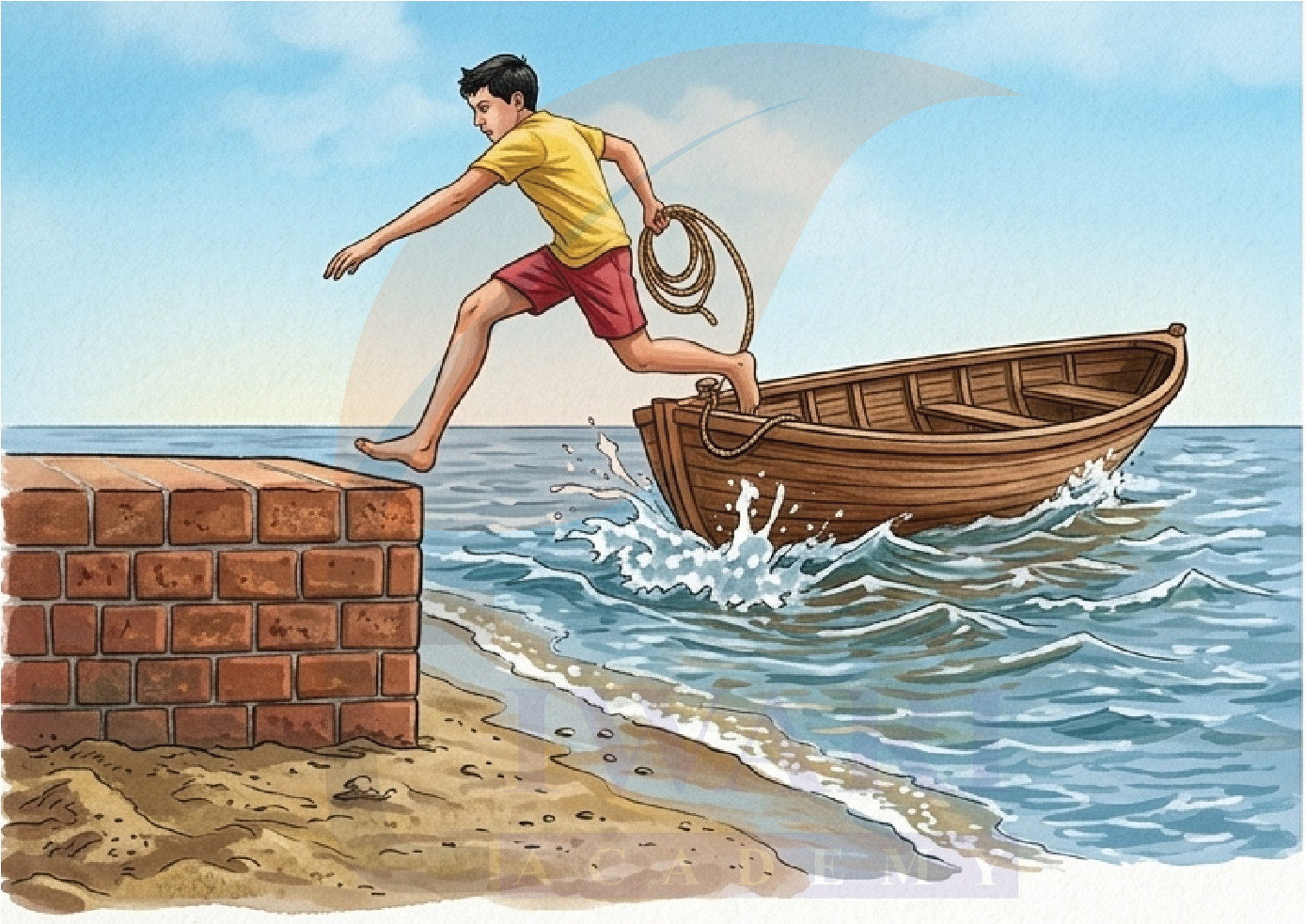
7. A sailor jumps out from a small boat to the shore (Fig. 6.38). As the sailor jumps forward, will the boat move? If yes, in which direction and why?
Answer:
Yes, the boat will move.
Direction:
The boat will move in the direction opposite to the direction in which the sailor jumps.
- When the sailor jumps forward, he pushes the boat backward.
- According to Newton’s third law of motion, every action has an equal and opposite reaction.
- The forward force applied by the sailor on the ground (or shore) results in an equal backward force on the boat.
- Hence, the boat moves backward.
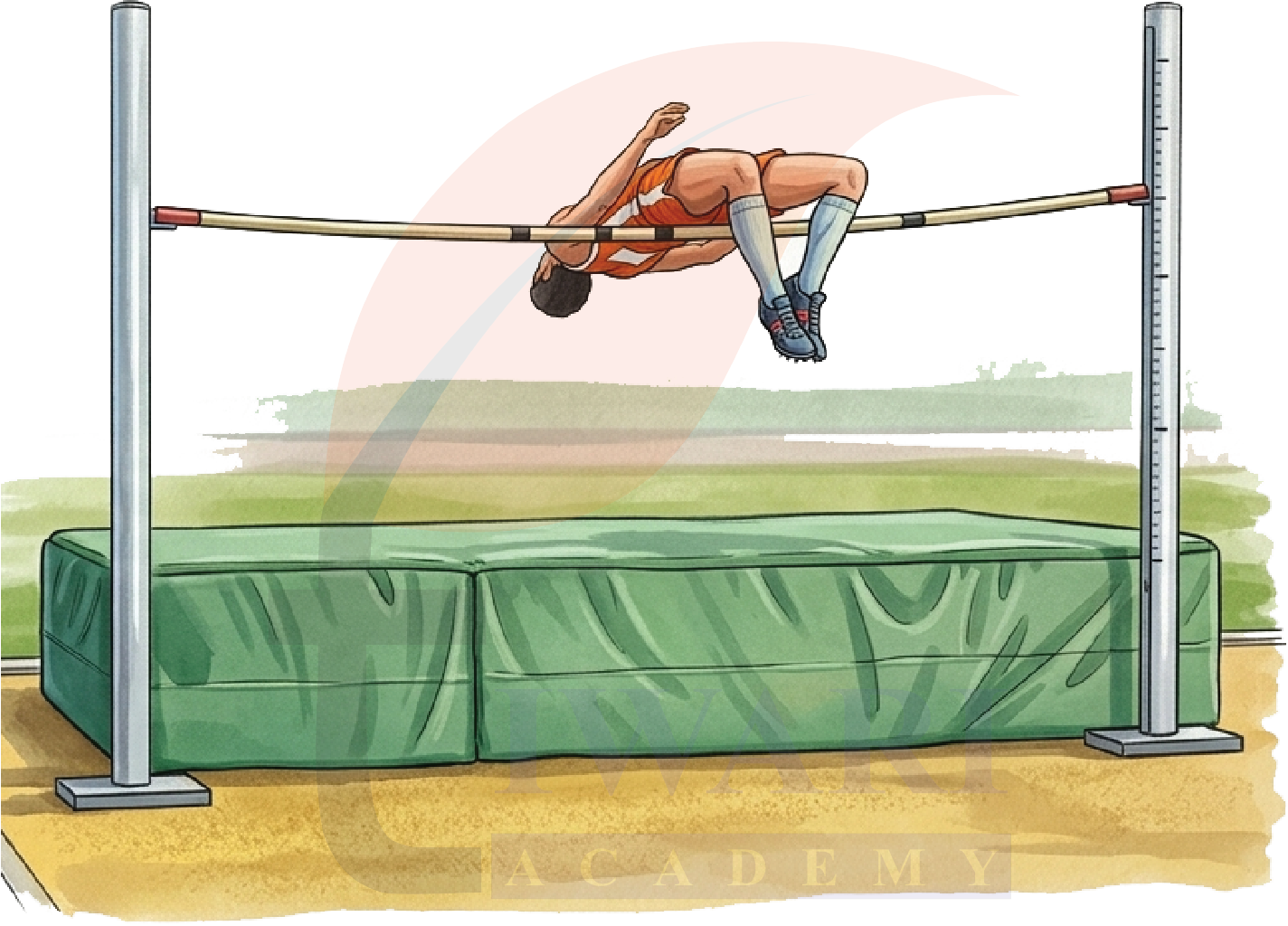
8. During a high jump event, a landing mat or sand bed is placed for the athlete to fall upon (Fig. 6.39). Explain the reason behind it.
Answer:
A landing mat or sand bed is used to reduce the impact force on the athlete.
- When the athlete lands, their momentum becomes zero.
- According to Newton’s second law, force depends on the rate of change of momentum.
- A soft surface (mat or sand) increases the time taken to stop.
- Increasing the time of impact reduces the force experienced by the body.
The mat or sand bed reduces injury by decreasing the force of impact.
9. A hand cart loaded with vegetables collides with an identical but empty hand cart. During the collision:
(i) the loaded cart exerts a force of larger magnitude on the empty cart.
(ii) the empty cart exerts a force of larger magnitude on the loaded cart.
(iii) neither cart exerts a force on the other.
(iv) the loaded cart and the empty cart both exert an equal magnitude of force on each other.
Answer:
(iv) the loaded cart and the empty cart both exert an equal magnitude of force on each other.
According to Newton’s third law of motion, every action has an equal and opposite reaction. Hence, both carts exert equal and opposite forces on each other.
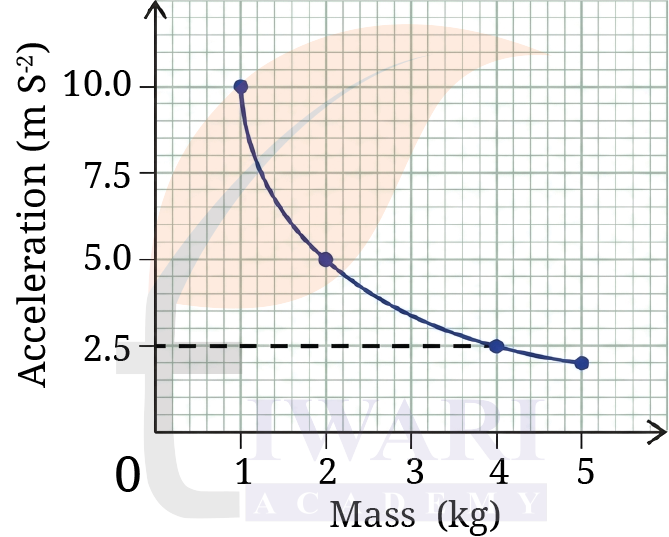
10. The acceleration-mass graph for the acceleration produced by a force on objects of different masses is plotted in Fig. 6.40. Plot the force-mass graph for this case.
Answer:
From Newton’s second law: F = ma
Given graph shows acceleration decreases as mass increases, which means force is constant.
Therefore:
- Force does not change with mass.
- The force-mass graph will be a straight horizontal line parallel to the mass axis.
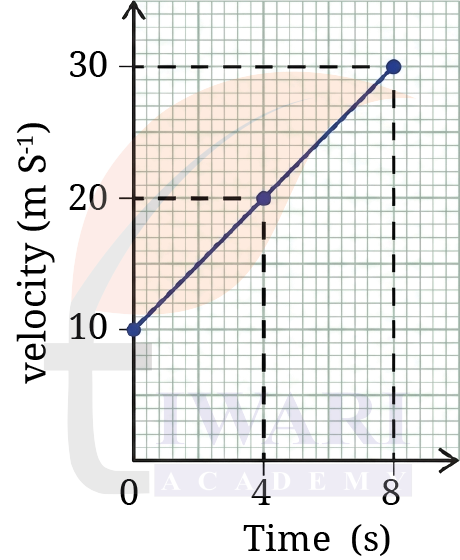
11. The velocity-time graph of an object of mass 10 kg moving along a straight line is shown in Fig. 6.41. Calculate the force acting on the object by using the graph.
Answer:
From graph:
Initial velocity (u) = 10 m/s
Final velocity (v) = 30 m/s
Time (t) = 8 s
Acceleration:
a = (v − u) / t = (30 − 10) / 8 = 20/8 = 2.5 m/s²
Force:
F = ma = 10 × 2.5 = 25 N
Force acting on the object = 25 N.
12. A bullet of mass 50 g moving with a speed of 100 m/s enters a heavy stationary wooden block and stops after penetrating a distance of 50 cm. Estimate the stopping force acting on the bullet.
(assume that the bullet undergoes constant acceleration within the block).
Answer:
Mass = 50 g = 0.05 kg
Initial velocity (u) = 100 m/s
Final velocity (v) = 0 m/s
Distance (s) = 50 cm = 0.5 m
Using:
v² = u² + 2as
⇒ 0 = (100)² + 2a(0.5)
⇒ 0 = 10000 + a
⇒ a = −10000 m/s²
Force:
F = ma = 0.05 × (−10000) = −500 N
Stopping force = 500 N (opposite to direction of motion).
13. An ace footballer converted a penalty shot by kicking the football with a speed of 108 km h⁻¹. The estimated force they imparted was 800 N. The mass of the football was 0.4 kg. Calculate the time of contact between their foot and the ball.
Answer:
Speed = 108 km/h = 30 m/s
Initial velocity (u) = 0
Final velocity (v) = 30 m/s
Mass = 0.4 kg
Force = 800 N
Using: F = ma
⇒ a = F/m = 800/0.4 = 2000 m/s²
Using: v = u + at
⇒ 30 = 0 + (2000)t
⇒ t = 30/2000 = 0.015 s
Time of contact = 0.015 s.
14. An object of mass 2 kg moving with a constant velocity of 10 m s⁻¹ encounters a rough patch where the force of friction on the object is 7 N. At the same time, an additional constant force of 3 N opposing the motion is applied on the object. After entering the rough patch, how much distance does the object travel before coming to rest?
Answer:
Given:
Mass of object, m = 2 kg
Initial velocity, u = 10 m s⁻¹
Force of friction = 7 N
Additional opposing force = 3 N
Total opposing force:
F = 7 N + 3 N = 10 N
Using Newton’s second law:
F = ma
⇒ a = F/m = 10 / 2 = 5 m s⁻²
Since the force is opposing the motion, acceleration is negative:
a = -5 m s⁻²
Final velocity, v = 0 m s⁻¹
Using the equation: v² = u² + 2as
⇒ 0 = (10)² + 2(-5)s
⇒ 0 = 100 – 10s
⇒ 10s = 100
⇒ s = 10 m
The object travels 10 m before coming to rest.
15. A tractor pulls a harrow (a ploughing tool) of mass m₁ with a net force F resulting in an acceleration of a₁. The same tractor pulls a trolley of mass m₂ with a force F producing an acceleration of a₂. If the tractor now pulls the trolley with the harrow placed on it (with the same force F), then obtain an expression for the resulting acceleration in terms of a₁ and a₂. Ignore friction.
Answer:
For the harrow: F = m₁a₁
So, m₁ = F/a₁
For the trolley: F = m₂a₂
So, m₂ = F/a₂
When both are together:
Total mass = m₁ + m₂
Let resulting acceleration be a.
Then, F = (m₁ + m₂)a
Substituting values of m₁ and m₂:
F = (F/a₁ + F/a₂)a
⇒ F = F(1/a₁ + 1/a₂)a
⇒ 1 = (1/a₁ + 1/a₂)a
⇒ a = 1/(1/a₁ + 1/a₂)
⇒ a = 1 / ((a₂ + a₁)/(a₁a₂))
Therefore, a = (a₁a₂)/(a₁ + a₂)
The resulting acceleration is a = (a₁a₂)/(a₁ + a₂).
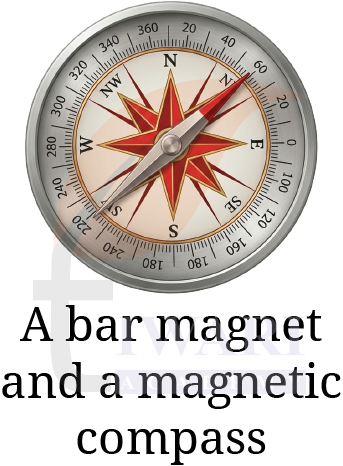
16. When the pole of a bar magnet is brought close to a magnetic compass, the bar magnet and the compass needle (which is also a magnet) exert a magnetic force on each other. As per Newton’s third law of motion, both the forces are equal in magnitude and opposite in direction. However, the compass needle moves, whereas the bar magnet does not move (Fig. 6.42). Explain why.
Answer:
According to Newton’s third law, the bar magnet and the compass needle exert equal and opposite forces on each other.
However, motion depends not only on force but also on mass and support.
- The compass needle has very small mass, so even a small force produces noticeable acceleration and motion.
- The bar magnet has much larger mass, so the same force produces very little acceleration.
- Also, the bar magnet is usually held firmly in the hand or kept fixed, so it does not move.
Thus, although the forces are equal and opposite, the compass needle moves while the bar magnet appears not to move because the needle has much smaller mass and is free to rotate.
Class 9 Science Exploration Chapter 6 Extra Questions
NCERT Class 9 Science Exploration Chapter 6 Very Short Answer Type Questions with Explanation.
Very Short Answer Type Questions
- What is the SI unit of force?
Answer:
The SI unit of force is newton (written with lowercase ‘n’). Its symbol is N (uppercase). One newton is the force that produces an acceleration of 1 m/s² in a 1 kg object. - State Newton’s First Law of Motion in one sentence.
Answer:
An object at rest remains at rest and an object in motion continues to move with constant velocity, unless a net (unbalanced) force acts upon it. - Define balanced forces.
Answer:
Two forces are called balanced when they are equal in magnitude and opposite in direction, resulting in zero net force. Balanced forces produce no change in the state of motion of an object. - What is inertia?
Answer:
Inertia is the natural tendency of an object to resist any change in its state of rest or of uniform motion in a straight line. The term was used by Isaac Newton. - Write the mathematical form of Newton’s Second Law.
Answer:
Newton’s Second Law is expressed as F = ma, where F is net force in newtons, m is mass in kilograms, and a is acceleration in m/s². Acceleration acts in the direction of force. - What does a negative sign in force indicate?
Answer:
A negative sign indicates the force acts in the direction opposite to the chosen positive direction. For example, −3000 N for a westward-moving car means the force is acting westward, opposing eastward motion. - What is the value of acceleration due to gravity (g) near Earth’s surface?
Answer:
The acceleration due to gravity near Earth’s surface is g = 9.8 m/s². For quick estimations, g = 10 m/s² is used. Importantly, g does not depend on the mass of the falling object. - State Newton’s Third Law of Motion.
Answer:
Whenever object A exerts a force on object B, object B simultaneously exerts an equal and opposite force on object A. These action-reaction forces always act on two different objects. - Why does a fielder pull their hand back while catching a fast cricket ball?
Answer:
Pulling the hand back increases the time for the ball to stop. By Newton’s Second Law, longer stopping time means smaller acceleration and therefore smaller force on the hand, reducing injury. - Give one example of Newton’s Third Law involving non-contact forces.
Answer:
When two like poles of bar magnets face each other, magnet A repels magnet B with a magnetic force; simultaneously, magnet B repels magnet A with an equal and opposite magnetic force. - What happens to the net force on a box moving at constant velocity?
Answer:
If a box moves at constant velocity, its acceleration is zero. By Newton’s Second Law (F = ma = m × 0 = 0), the net force on the box is zero. Applied force exactly balances friction. - How does friction help a person walk?
Answer:
When a person pushes the ground backward with their foot, friction acts in the forward direction on the foot, propelling the person forward. Without friction, the foot would slip backward. - What is the formula for gravitational force on an object of mass m?
Answer:
The gravitational force on an object of mass m near Earth’s surface is F = mg, where g = 9.8 m/s². This force is also called the weight of the object, measured in newtons. - For two connected objects of masses m₁ and m₂ pulled by force F, what is the acceleration?
Answer:
Using Newton’s Second Law for the combined system: a = F/(m₁ + m₂). Only external force F matters; internal forces (tension) cancel within the system and are not separately considered. - Why is it harder to climb a smooth tree trunk than a rough one?
Answer:
When climbing, legs push the trunk down. Friction pushes the person upward (Newton’s Third Law). A smooth trunk has less friction, so the upward force is smaller, making climbing much harder.
NCERT Class 9 Science Exploration Chapter 6 Short Answer Type Questions with Explanation.
Short Answer Type Questions
- Explain with an example why action-reaction pairs do not cancel each other.
Answer:
Action and reaction forces are equal and opposite but act on two different objects. When a paddle pushes water backward (action on water), water pushes the paddle forward (reaction on paddle). Since they act on different objects, they cannot cancel. The canoe moves forward as a result. - A boy pushes a wall with 50 N force. What force does the wall exert on the boy? Does the boy move?
Answer:
By Newton’s Third Law, the wall exerts an equal and opposite force of 50 N back on the boy. The boy typically does not move because the wall’s reaction force is transmitted through his body; friction from the floor on his feet provides another opposing force, keeping net force on him near zero. - Distinguish between balanced and unbalanced forces with one example each.
Answer:
Balanced Forces: Equal and opposite forces producing zero net force. Example – a book on a table (gravity balanced by normal force). The book remains stationary.
Unbalanced Forces: Forces of unequal magnitude producing a nonzero net force. Example — one team pulling harder in tug of war. The rope accelerates toward the stronger team because the net force is nonzero. - Why are airbags fitted in cars? Explain using Newton’s Second Law.
Answer:
In a collision, a car stops very abruptly – the passenger’s head decelerates very rapidly (large a), requiring a very large force (F = ma), which can cause fatal injuries. The airbag inflates quickly, increasing the stopping time. By F = m(Δv/Δt), larger Δt means smaller deceleration and therefore smaller force on the passenger’s head and chest, preventing serious injury. - How does a rocket lift off? Which Newton’s law explains this?
Answer:
A rocket engine burns fuel and expels hot exhaust gases downward at high speed (action). By Newton’s Third Law, these gases exert an equal and opposite force upward on the rocket (reaction). When this upward thrust is greater than the rocket’s weight (gravitational force downward), the net force is upward and the rocket accelerates skyward. - Two forces of 8 N and 5 N act on an object. Find the net force when they act (a) in the same direction and (b) in opposite directions.
Answer:
(a) Same direction: Net force = 8 + 5 = 13 N, in the direction of both forces.
(b) Opposite directions: Net force = 8 − 5 = 3 N, in the direction of the larger (8 N) force.
These results follow directly from the vector addition and subtraction of parallel forces. - What would happen to a moving object if friction suddenly disappeared? Relate this to Newton’s First Law.
Answer:
If friction disappears, no net force opposes the object’s motion. By Newton’s First Law, an object in motion continues with constant velocity indefinitely in the absence of a net force. The object would never slow down or stop on its own. This is exactly what Galileo’s thought experiment predicted – remove all impediments, and a body moves forever on a horizontal plane. - Explain why a gun recoils when a bullet is fired.
Answer:
When the gun fires, the explosion exerts a large force on the bullet, propelling it forward at very high speed (action on bullet). By Newton’s Third Law, the bullet exerts an equal and opposite force backward on the gun (reaction on gun). This backward force causes the gun to recoil. Because the gun’s mass is much greater than the bullet’s mass, its recoil acceleration is much smaller than the bullet’s forward acceleration. - From Newton’s Second Law, what happens to acceleration if (a) force is doubled at constant mass, and (b) mass is doubled at constant force?
Answer:
From a = F/m:
(a) If force is doubled (2F) at constant mass m: New acceleration = 2F/m = 2a
⇒ acceleration doubles. Force and acceleration are directly proportional.
(b) If mass is doubled (2m) at constant force F: New acceleration = F/2m = a/2
⇒ acceleration is halved. Mass and acceleration are inversely proportional. - A sailor jumps from a small boat to the shore. What happens to the boat and why?
Answer:
When the sailor jumps forward toward the shore, they push the boat backward with their feet (action on boat). By Newton’s Third Law, the boat exerts an equal and opposite force on the sailor (reaction on sailor, which helps propel them forward). Since no anchoring force holds the boat, it moves backward – away from the shore – in the direction opposite to the sailor’s jump.
NCERT Class 9 Science Exploration Chapter 6 Long Answer Type Questions with Explanation.
Long Answer Type Questions
- State and explain Newton’s three laws of motion with one real-life example for each.
Answer:
Newton’s First Law (Law of Inertia): An object at rest remains at rest and an object in motion continues moving with constant velocity unless a net force acts on it. Example: Passengers lurch forward when a bus brakes suddenly — their bodies resist the change in motion due to inertia.
Newton’s Second Law: When a net force acts on an object, it accelerates in the direction of that force. F = ma. Example: A loaded cart needs more force than an empty cart to achieve the same acceleration.
Newton’s Third Law: Every action has an equal and opposite reaction on a different object. Example: Jumping is possible because feet push the ground down (action) and the ground pushes the body up (reaction). - Describe the force of friction. How does it depend on surfaces? Explain its useful and harmful effects.
Answer:
Friction is a contact force that opposes relative motion between surfaces. It always acts opposite to the direction of motion. Its magnitude depends on the nature of surfaces in contact — rougher surfaces produce more friction, smoother surfaces produce less.
Useful effects:
1. Enables walking — friction from ground propels us forward
2. Allows vehicles to brake safely
3. Grooves on tyres and shoe soles increase grip
Harmful effects:
1. Causes wear and tear in machine parts
2. Generates unwanted heat, reducing engine efficiency
3. Wastes energy — vehicles must continuously overcome friction
Friction is reduced using lubricants, ball bearings, polished surfaces, streamlined shapes and magnetic levitation. - A sports car of mass 1500 kg moves east. Its velocity increases from 0 to 10 m/s in 5 s, stays constant for the next 5 s, then decreases to 0 in 5 s. Calculate force in each phase.
Answer:
Phase 1 (0–5 s): Using v = u + at ⇒ a = (10−0)/5 = 2 m/s²
F = ma = 1500 × 2 = 3000 N eastward
The car accelerates — net forward force acts.
Phase 2 (5–10 s): Velocity is constant ⇒ acceleration = 0
F = ma = 1500 × 0 = 0 N (no net force)
Newton’s First Law applies — constant velocity requires zero net force.
Phase 3 (10–15 s): a = (0−10)/5 = −2 m/s²
F = 1500 × (−2) = −3000 N
Negative sign indicates force acts westward (opposing motion) — braking force decelerates the car to rest. - Explain Newton’s Third Law using the rocket launch. How was it applied in Chandrayaan-3? Support with the balloon rocket activity.
Answer:
A rocket engine expels hot gases downward at high speed (action). By Newton’s Third Law, these gases push the rocket upward with equal force (reaction). When this upward thrust exceeds the rocket’s weight, the net force is upward and the rocket lifts off.
Chandrayaan-3 Vikram Lander used retro-firing — the engine fired in the direction of motion, producing a backward reaction force that slowed the lander to the precise velocity needed for a safe soft landing near the Moon’s south pole.
Balloon Activity: Releasing the balloon forces air out backward (action). The air pushes the balloon forward (reaction) — an exact small-scale model of rocket propulsion. - Describe Activities 6.3 and 6.4 that led to Newton’s Second Law. Derive F = ma. Explain why a cricket fielder and a car airbag work on the same principle.
Answer:
Activity 6.3 (constant mass, varying force): Doubling the hanging cup’s mass doubled the cart’s acceleration — proving a ∝ F at constant mass.
Activity 6.4 (constant force, varying mass): Doubling the cart’s mass halved its acceleration — proving a ∝ 1/m at constant force.
Combining both: a ∝ F/m ⇒ F = ma
Common Principle — Cricket Catch and Airbag:
Both use the relationship F = m(Δv/Δt). The change in velocity (Δv) is fixed. By increasing the stopping time (Δt), acceleration and therefore force are reduced.
1. Fielder pulls hand back → more time ⇒ less force → no injury
2. Airbag inflates → more stopping time ⇒ less force on passenger → prevents fatal injury
Quick Revision for Exam Day
- State all three Newton’s laws word-for-word exactly as in the textbook
- Know F = ma, F = mg and a = F/(m1 + m2) – with units
- Can draw position-time and velocity-time graphs for zero net force (at rest and constant velocity)
- Can identify action-reaction pairs correctly in any scenario
- Remember: action and reaction act on different objects – they do NOT cancel each other
- Know that friction depends on the nature of surfaces in contact
- Can solve numericals using v = u + at and s = ut + ½at²
- g = 9.8 m/s² (use 10 m/s² for quick estimations)
- SI unit of force = newton (N); mass = kg; acceleration = m/s²
- Know real-life examples for each of Newton’s three laws – at least two per law.
Important Formulae
| Formula | Meaning |
|---|---|
| F = ma | Newton’s Second Law |
| a = F/m | Acceleration from force and mass |
| F = mg | Weight (gravitational force on an object) |
| g = 9.8 m/s² ≈ 10 m/s² | Acceleration due to gravity (near Earth’s surface) |
| Net F = F₁ + F₂ | Forces acting in the same direction |
| Net F = F₁ − F₂ | Forces acting in opposite directions |
| a = F / (m₁ + m₂) | Acceleration of a system of two connected objects |
FAQs – Class 9 Science Exploration Chapter 6
Is Class 9 Science Exploration Chapter 6 aligned with the new 2026-27 NCERT syllabus?
Yes. Chapter 6, How Forces Affect Motion, is part of the brand-new NCERT Exploration textbook for Class 9 (session 2026-27). It replaces the older Force and Laws of Motion chapter from the previous Science textbook.
The new version introduces system-of-objects analysis (Section 6.7), updated “Threads of Curiosity” snippets referencing 2026 scientific measurements (yoctonewtons) and enriched activities using slow-motion video analysis.
Teachers should note that this chapter explicitly builds on Grade 8 Curiosity Chapter 5 and Grade 6 Curiosity Chapter 4, making cross-grade linkages important for lesson planning.
Which activities in Chapter 6 are best suited for classroom demonstration?
Activities 6.3 and 6.4 (cart-pulley system to derive Newton’s Second Law) are explicitly marked as Demonstration Activities and are best done as teacher-facilitated group sessions.
Activities 6.1 and 6.2 (rubber band and spring balance friction experiments) work well as student pair activities.
Activity 6.5 (wheeled chair and table) and Activity 6.6 (two spring balances) are ideal for interactive exploration discussions.
Activity 6.7 (balloon rocket) is an excellent fun individual or group take-home project to demonstrate Newton’s Third Law.
What assessment-worthy topics should teachers focus on from Chapter 6?
Teachers should prioritise:
- Application-based questions on all three Newton’s laws
- Velocity-time and position-time graph interpretation under zero and non-zero net force conditions
- Numerical problems using F = ma and F = mg
- Action-reaction pair identification in daily-life scenarios
- Friction-related reasoning questions
The Pause and Ponder sections (questions 1–10) and the end-chapter Revise, Reflect, Refine section (questions 1–16) are the best sources for setting exam papers. Higher-order questions like question 15 (tractor-harrow-trolley system) are suitable for students aiming for distinction.
Is Class 9 Science Exploration Chapter 6 easy or difficult?
Chapter 6 is moderately easy for students who understand basic arithmetic and have covered Chapter 4 (motion concepts). The first half – Sections 6.1 to 6.3 covering force, friction and balanced/unbalanced forces, is entirely conceptual and accessible. The second half, covering Newton’s three laws with numerical problems, requires regular practice. Students who find algebra challenging may initially struggle with force calculations, but the 8 worked examples in the textbook are clearly explained and should be studied thoroughly before attempting exercises.
Can a student complete Class 9 Science Chapter 6 in one day?
Yes, with focused effort. A dedicated study day of 6–8 hours is sufficient to read the full chapter, understand all concepts, study all worked examples and solve the end-chapter exercises.
However, for exam preparation, revision sessions spread over 2–3 days give significantly better retention. Concepts like Newton’s Third Law and the system-of-objects analysis in Section 6.7 particularly benefit from a break between study sessions, allowing the brain to consolidate learning overnight before revision.
What are the core concepts I must not miss in Class 9 Science Chapter 6 Textbook Exploration?
Do not skip these under any circumstances:
- Exact wording of all three Newton’s laws, memorise word for word
- F = ma formula and the experimental logic from Activities 6.3 and 6.4
- The difference between balanced and unbalanced forces with examples
- Why action-reaction pairs do NOT cancel, they act on two different objects
- Velocity-time and position-time graphs for zero net force (Examples 6.2 and 6.3)
- Real-life applications: airbags, cricket catch, rocket launch, walking, balloon rocket
- The system of objects formula: a = F / (m1 + m2)
How should I prepare for numerical problems in Class 9 Exploration Chapter 6?
Use this four-step method for every numerical problem:
- Step 1: Identify given data: list mass (m), force (F), acceleration (a), initial velocity (u), final velocity (v) and time (t)
- Step 2: Choose the correct formula: F = ma, F = mg, v = u + at, or s = ut + ½at²
- Step 3: Substitute values with proper units and calculate
- Step 4: State the direction: force and acceleration are vector quantities, always mention direction in your answer
Practice all 8 worked examples first (Examples 6.1 to 6.8), then attempt questions 11–16 from Revise, Reflect, Refine independently.
Which real-life examples from Chapter 6, of 9th Science, are most likely to appear in exams?
The following are exam favourites – understand the physics behind each:
- Fielder pulling hand back while catching a ball (Newton’s 2nd Law – time and force)
- Airbags in vehicles (Newton’s 2nd Law – increased time reduces force)
- Rocket launch (Newton’s 3rd Law – exhaust gas and thrust)
- Chandrayaan-3 Vikram lander retro-firing (Newton’s 3rd Law – braking in space)
- Walking and running (Newton’s 3rd Law – friction as propulsive force)
- Coconut cracking (Newton’s 2nd Law – short time creates large force)
- Why Earth doesn’t visibly move toward a falling apple (Newton’s 3rd Law + 2nd Law combined – Earth’s huge mass gives tiny acceleration)
- Gun recoil when bullet is fired (Newton’s 3rd Law – equal force, different masses)