



by Tiwari Academy Team
NCERT Class 9 Science Exploration Chapter 8 Journey Inside the Atom Solutions in Hindi and English Medium – Exercises and Extra Question Answer updated for 2026-27 education. Chapter 8 of the NCERT Class 9 Science Exploration textbook (session 2026-27), Journey Inside the Atom, takes students on a fascinating scientific voyage from ancient philosophical ideas about matter to modern atomic theory. Beginning with the contributions of Acharya Kanada in India and Democritus in Greece more than 2,000 years ago, the chapter traces how our understanding of atomic structure evolved through Dalton’s atomic theory (1808), Thomson’s discovery of the electron (1897), Rutherford’s gold foil experiment (1911) and Bohr’s energy level model (1913).
Quick Links:
- Chapter 8 Exercises Solutions
- Very Short Answer Type Questions
- Short Answer Type Questions
- Long Answer Type Questions
- Class 9 Science Exploration Chapter 8 in Hindi Medium
- Download Class 9 Science Offline App to study Class 9 Science Exploration Offline.
Students learn about the three subatomic particles — electrons, protons and neutrons — and explore key concepts including atomic number, mass number, electronic configuration, valency and the landmark discovery of isotopes and isobars. The chapter also introduces average atomic mass and its calculation using weighted abundance. Historically rich, conceptually deep and directly relevant to chemistry and physics at higher levels, this chapter is foundational for Class 10, 11 and 12. It carries significant exam weightage and features among the most frequently tested topics in competitive examinations.
Chapter at a Glance – Key Concepts
| Topic | Core Idea |
|---|---|
| Ancient Atomic Ideas | Acharya Kanada (parmanu), Democritus (atomos) – matter is made of indivisible particles |
| Dalton’s Atomic Theory (1808) | Atoms are indivisible, fundamental building blocks of matter |
| Discovery of Electron (1897) | J. J. Thomson – cathode rays are negatively charged particles (electrons) |
| Thomson’s Model | Plum pudding model – electrons embedded in positive charge sphere |
| Gold Foil Experiment (1911) | Geiger and Marsden under Rutherford – led to nuclear model |
| Rutherford’s Model | Planetary model – dense nucleus at centre; electrons revolve around it |
| Limitation of Rutherford’s Model | Cannot explain atomic stability – accelerating electrons should spiral into nucleus |
| Discovery of Proton | Rutherford – positive charge in nucleus comes from protons |
| Discovery of Neutron (1932) | James Chadwick – neutral particle in nucleus; explains extra atomic mass |
| Bohr’s Model (1913) | Electrons move in fixed energy levels (shells) K, L, M, N without losing energy |
| Atomic Number (Z) | Number of protons in nucleus; uniquely identifies an element |
| Mass Number (A) | Total nucleons = protons + neutrons |
| Electronic Configuration | Distribution of electrons in shells using formula 2n² |
| Valency | Electrons gained, lost or shared to complete octet; combining capacity of atom |
| Isotopes | Same Z, different A – same chemical properties, different physical properties |
| Isobars | Same A, different Z – different elements with same mass number |
| Average Atomic Mass | Weighted average based on relative abundance of isotopes |
NCERT Class 9 Science Exploration Chapter 8 Solutions
Class 9 Science Exploration Chapter 8 Question Answer
Revise, Reflect, Refine
1. Choose the correct options and explain the reason for the correct and incorrect options in the context of Ernest Rutherford’s gold foil experiment:
(i) The experiment clearly showed the existence of neutrons in the nucleus.
(ii) The results disproved the plum pudding model and led to the idea of a nucleus at the centre of the atom.
(iii) The large deflection of a few alpha particles indicated that most of the mass of the atom and positive charge are packed into a tiny centre.
(iv) The way alpha particles were deflected showed that electrons move around the nucleus.
Answer:
Correct statements:
(ii) The results disproved the plum pudding model and led to the idea of a nucleus at the centre of the atom.
This statement is correct. Thomson’s plum pudding model said that positive charge was spread throughout the atom. But Rutherford found that most alpha particles passed straight through, while a few were deflected sharply. This proved that the positive charge is concentrated in a tiny central region called the nucleus.
(iii) The large deflection of a few alpha particles indicated that most of the mass of the atom and positive charge are packed into a tiny centre.
This statement is correct. Since only a few alpha particles were deflected through large angles, it showed that they were coming close to a very small, dense, positively charged region. This region is the nucleus, where most of the mass of the atom is concentrated.
Incorrect statements:
(i) The experiment clearly showed the existence of neutrons in the nucleus.
This statement is incorrect. Rutherford’s gold foil experiment did not show the existence of neutrons. Neutrons were discovered much later by James Chadwick. Rutherford’s experiment only showed that there is a small, dense, positively charged centre in the atom.
(iv) The way alpha particles were deflected showed that electrons move around the nucleus.
This statement is incorrect. Rutherford’s experiment gave information mainly about the nucleus and the empty space in the atom. It did not directly show how electrons move around the nucleus.
2. Which of the following statements are correct or incorrect according to the Bohr’s atomic model? Give a reason for each statement.
(i) Electrons lose energy while moving in fixed orbits and slowly fall into the nucleus.
(ii) Electrons can exist anywhere around the nucleus with no fixed energy.
(iii) Electrons revolve around the nucleus in orbits of fixed energy without losing energy.
(iv) Electrons can be found between energy levels as they move around the nucleus.
Answer:
(i) Electrons lose energy while moving in fixed orbits and slowly fall into the nucleus.
This statement is incorrect. According to Bohr’s model, electrons move in fixed orbits or energy levels and do not lose energy while revolving in these allowed shells.
(ii) Electrons can exist anywhere around the nucleus with no fixed energy.
This statement is incorrect. Bohr proposed that electrons can exist only in certain fixed energy levels or shells. They cannot stay anywhere around the nucleus.
(iii) Electrons revolve around the nucleus in orbits of fixed energy without losing energy.
This statement is correct. This is the main idea of Bohr’s model. Electrons remain stable in fixed shells and do not radiate energy while moving in those shells.
(iv) Electrons can be found between energy levels as they move around the nucleus.
This statement is incorrect. According to Bohr’s model, electrons are not found between two energy levels. They can jump from one shell to another only by absorbing or releasing a fixed amount of energy.
3. The composition of the nuclei of three atomic species X, Y and Z are given as follows:
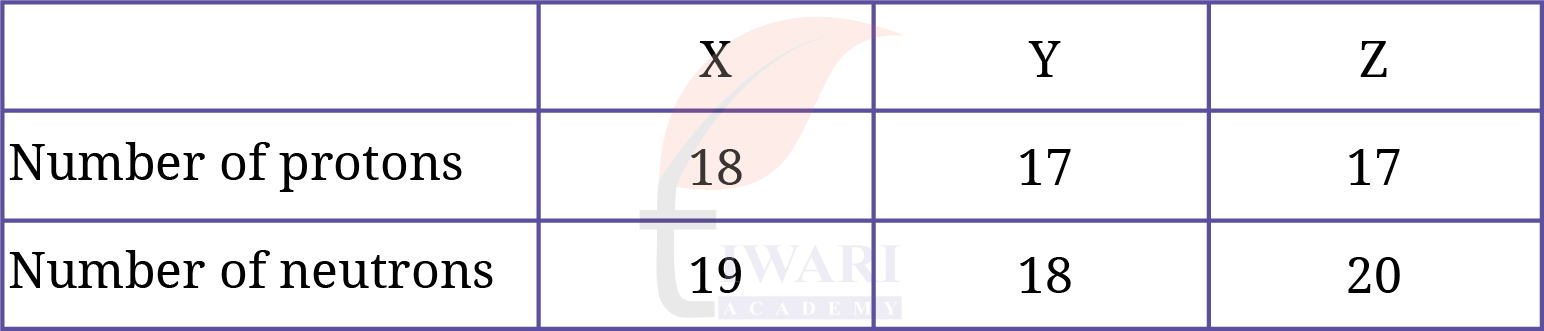
Explain the relation between the following:
(i) Y and Z
(ii) Z and X
Answer:
First, calculate the atomic number and mass number of each species.
For X:
Number of protons = 18
Number of neutrons = 19
Atomic number = 18
Mass number = 18 + 19 = 37
For Y:
Number of protons = 17
Number of neutrons = 18
Atomic number = 17
Mass number = 17 + 18 = 35
For Z:
Number of protons = 17
Number of neutrons = 20
Atomic number = 17
Mass number = 17 + 20 = 37
(i) Relation between Y and Z:
Y and Z are isotopes.
Reason:
They have the same number of protons, that is, the same atomic number (17), but different numbers of neutrons and hence different mass numbers (35 and 37).
(ii) Relation between Z and X:
Z and X are isobars.
Reason:
They have the same mass number, 37, but different atomic numbers.
X has atomic number 18, while Z has atomic number 17.
4. What conclusion did Rutherford draw about the position and characteristics of the atom’s positively charged part based on the few alpha particles that bounced back or were deflected at large angles in the gold foil experiment?
Answer:
From the gold foil experiment, Rutherford observed that:
- Most alpha particles passed straight through the foil.
- A few alpha particles were deflected at large angles.
- Very few alpha particles bounced back.
Based on these observations, Rutherford drew the following conclusions about the positively charged part of the atom:
- Position of the positive charge: The positive charge of the atom is not spread throughout the atom. Instead, it is concentrated in a very small region at the centre of the atom, called the nucleus.
- Size of the nucleus: The nucleus is extremely small compared to the size of the atom, because only a few alpha particles were deflected.
- Mass of the atom: Almost all the mass of the atom is concentrated in the nucleus. The large deflections and backward scattering of a few alpha particles indicated that they encountered a very dense and massive region.
- Nature of the nucleus: The nucleus is positively charged, which causes repulsion and deflection of the positively charged alpha particles.
5. Explain and arrange the following statements in the correct chronological order to show how atomic models have evolved over time.
(i) Bohr’s model proposed that electrons move in fixed orbits around the nucleus, each with a definite energy.
(ii) Thomson’s model depicted the atom as a ‘plum pudding’ with electrons embedded in a sphere of positive charge.
(iii) Rutherford’s model proposed that atoms have a dense central nucleus.
(iv) Dalton’s model described atoms as indivisible particles.
Answer:
Correct chronological order:
(iv) Dalton’s model
(ii) Thomson’s model
(iii) Rutherford’s model
(i) Bohr’s model
Explanation:
- Dalton first proposed that atoms are indivisible particles.
- Thomson discovered electrons and proposed the plum pudding model.
- Rutherford discovered the nucleus through the gold foil experiment.
- Bohr refined the model by introducing fixed energy levels for electrons.
6. Electrons move around the nucleus in orbits. Why do they not fly away from the atom? Explain what keeps them attracted to the nucleus.
Answer:
Electrons are negatively charged particles, while the nucleus contains positively charged protons.
Due to electrostatic force of attraction between opposite charges:
- Electrons are attracted towards the nucleus.
- This force keeps them bound to the atom.
Thus, electrons do not fly away because the electrostatic attraction between the positively charged nucleus and negatively charged electrons holds them in their orbits.
7. Assertion (A): The discovery of subatomic particles helped in understanding the atomic structure. Reason (R): The number of electrons is equal to the number of protons in an atom.
Choose the correct option:
(i) Both A and R are true, and R is the correct explanation of A.
(ii) Both A and R are true, but R is not the correct explanation of A.
(iii) A is true, but R is false.
(iv) A is false, but R is true.
Answer:
(ii) Both A and R are true, but R is not the correct explanation of A.
Explanation:
- Assertion is true because discovery of electrons, protons, and neutrons helped understand atomic structure.
- Reason is also true because atoms are electrically neutral (protons = electrons).
- However, this does not explain how subatomic particles helped in understanding structure.
8. Magnesium is essential for many biological processes, including muscle contraction. For an atom of magnesium with a mass number of 24 and atomic number 12, determine the number of (i) protons, (ii) neutrons, (iii) electrons, and also illustrate the arrangement of electrons in a magnesium atom.
Answer:
Atomic number = 12
Mass number = 24
(i) Number of protons = Atomic number = 12
(ii) Number of neutrons = Mass number − Atomic number = 24 − 12 = 12
(iii) Number of electrons = 12 (for a neutral atom)
(iv) Electronic configuration:
Total electrons = 12
Distribution:
K shell = 2
L shell = 8
M shell = 2
Electronic configuration = 2, 8, 2.
9. Find the following information for the elements shown in Fig. 8.17:
(i) Name of element
(ii) Symbol
(iii) Total electrons
(iv) Valence electrons
(v) Valency
(vi) Number of protons
(vii) Atomic number
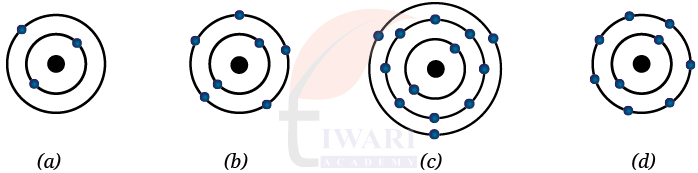
Answer:
(a)
(i) Name of element: Helium
(ii) Symbol: He
(iii) Total electrons: 2
(iv) Valence electrons: 2
(v) Valency: 0
(vi) Number of protons: 2
(vii) Atomic number: 2
(b)
(i) Name of element: Oxygen
(ii) Symbol: O
(iii) Total electrons: 8
(iv) Valence electrons: 6
(v) Valency: 2
(vi) Number of protons: 8
(vii) Atomic number: 8
(c)
(i) Name of element: Calcium
(ii) Symbol: Ca
(iii) Total electrons: 20
(iv) Valence electrons: 2
(v) Valency: 2
(vi) Number of protons: 20
(vii) Atomic number: 20
(d)
(i) Name of element: Neon
(ii) Symbol: Ne
(iii) Total electrons: 10
(iv) Valence electrons: 8
(v) Valency: 0
(vi) Number of protons: 10
(vii) Atomic number: 10
10. Both Rutherford’s and Bohr’s models have electrons orbiting the nucleus. Why did Rutherford’s model fail to explain atomic stability, while Bohr’s model succeeded?
Answer:
Rutherford’s Model:
According to Rutherford, electrons revolve around the nucleus similar to planets around the Sun. However, according to classical physics, a moving electron (charged particle) should continuously lose energy in the form of radiation.
As a result:
- The electron would lose energy.
- Its orbit would shrink.
- Eventually, it would fall into the nucleus.
This means the atom should collapse, which does not happen in reality. Therefore, Rutherford’s model could not explain the stability of atoms.
Bohr’s Model:
Bohr proposed that:
- Electrons move in fixed circular orbits called energy levels or shells.
- In these fixed orbits, electrons do not lose energy.
- Energy is emitted or absorbed only when an electron jumps from one orbit to another.
Thus:
- Electrons remain stable in their orbits.
- The atom does not collapse.
11. An atom ⁷⁰X has 31 electrons. How many neutrons are there in its nucleus?
Answer:
Mass number (A) = 70
Number of electrons = 31
For a neutral atom:
Number of protons = Number of electrons = 31
Number of neutrons: = Mass number − Atomic number
= 70 − 31 = 39
Therefore, the number of neutrons = 39
12. An atom has 79 protons and a mass number of 197. Calculate: (i) the number of neutrons, and (ii) the number of electrons.
Answer:
Number of protons = 79
Mass number = 197
(i) Number of neutrons:
= Mass number − Number of protons
= 197 − 79
= 118
(ii) Number of electrons:
For a neutral atom:
Number of electrons = Number of protons = 79.
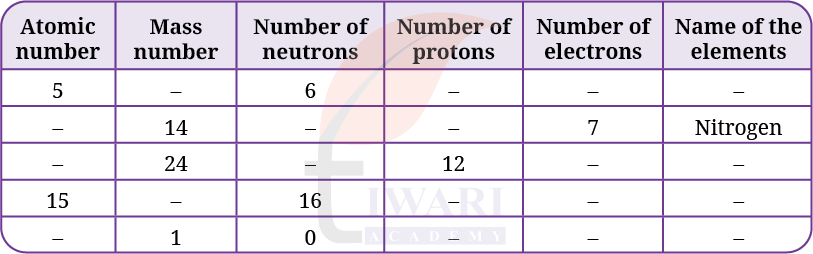
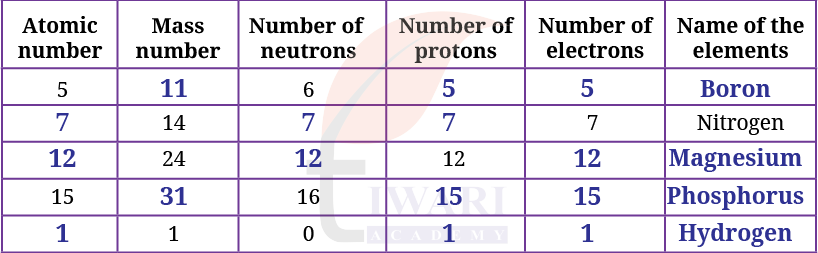
13. Complete the Table 8.5:
Answer:
To complete the table, we use these facts:
- Atomic number = Number of protons
- In a neutral atom, Number of electrons = Number of protons
- Mass number = Number of protons + Number of neutrons
14. Aman was discussing the structure of atom with his classmates. During the discussion, he learnt that an element X has a mass number of 35 and contains 18 neutrons. Based on this information, answer the following questions:
(i) How many electrons and protons does element X have?
(ii) What is its atomic number?
(iii) Identify the element X.
(iv) Write its electronic configuration.
(v) How many valence electrons does it have?
(vi) What will be the mass number if two neutrons are added to its nucleus?
(vii) What will be the relation of X with the new atom?
Answer:
Mass number = 35
Number of neutrons = 18
Number of protons = Mass number − Number of neutrons
= 35 − 18
= 17
Since the atom is neutral:
Number of electrons = Number of protons = 17
(i) Number of protons = 17
Number of electrons = 17
(ii) Atomic number = Number of protons = 17
(iii) The element with atomic number 17 is Chlorine (Cl).
(iv) Electronic configuration of chlorine = 2, 8, 7
(v) Valence electrons = 7
(vi) New number of neutrons = 18 + 2 = 20
New mass number = Number of protons + Number of neutrons
= 17 + 20
= 37
So, the new mass number will be 37.
(vii) The new atom will be an isotope of X.
Since, both atoms have the same atomic number (17), but different mass numbers (35 and 37).
15. In an atom, there are 12 protons and 12 neutrons in the nucleus. Now, imagine that all the electrons are replaced with some hypothetical particles that have the same charge as electrons but are 500 times heavier. What effect will this replacement have on the atom’s:
(i) Atomic number
(ii) Atomic mass
(iii) Mass number
(iv) Overall charge
Answer:
Number of protons = 12
Number of neutrons = 12
Normally, atomic number depends only on the number of protons and mass number depends on protons and neutrons only.
(i) Atomic number will remain unchanged.
Reason:
Atomic number = Number of protons = 12
(ii) Atomic mass will increase.
Reason:
The new particles replacing electrons are much heavier than ordinary electrons, so the total mass of the atom will become greater.
(iii) Mass number will remain unchanged.
Reason:
Mass number = Number of protons + Number of neutrons
= 12 + 12
= 24
Electrons do not contribute to mass number.
(iv) Overall charge will remain neutral (zero), provided the number of new particles is equal to the number of protons.
Reason:
The new particles have the same negative charge as electrons, so their total negative charge will balance the positive charge of 12 protons.
Section-wise Notes of Exploration Chapter 8 – Journey Inside the Atom
Section 8.1 Rediscovering the Roots of Atomic Theory
Ancient ideas about the smallest unit of matter:
- Acharya Kanada (India): Called the smallest indivisible particles parmanus. Recorded in the Sanskrit text Vaisesika Sutras. Combinations of parmanus form dyads, triads and all of the material universe.
- Leucippus and Democritus (Greece): Called indivisible particles atomos (Greek for indivisible).
- John Dalton (1808): First scientific atomic theory – all matter is made of indivisible atoms; atoms are the fundamental building blocks of matter.
Key questions after Dalton’s theory:
- What are atoms made up of?
- What would atoms look like if we could see them?
- What makes atoms of one element different from another?
Section 8.2 A Short Historical Journey Through Atomic Models
Discovery of Electron (1897 – J. J. Thomson):
- Studied conduction of electric current through gases at low pressure in a cathode ray tube
- Rays moved from cathode (negative) to anode (positive) — called cathode rays
- Concluded cathode rays are streams of negatively charged particles — electrons
- Nature of cathode rays was independent of cathode material or gas — electrons are present in all atoms
- Charge of electron: −1.602 × 10⁻¹⁹ C (taken as −1 by convention)
- Nobel Prize in Physics: 1906
8.2.1 Thomson’s Model (Plum Pudding Model):
- Atom is a sphere of positive charge with electrons distributed throughout
- Also called watermelon model — red pulp = positive charge, seeds = electrons
- First attempt to show how positive and negative charges are balanced in an atom
8.2.2 The Gold Foil Experiment (1911 — Geiger and Marsden under Rutherford):
A narrow beam of alpha (α) particles was aimed at an extremely thin gold foil
Alpha particles: tiny, positively charged particles emitted from radioactive elements; each is a helium nucleus (2 protons + 2 neutrons)
Expected result (based on Thomson’s model): all particles pass straight through or are slightly deflected
Actual results:
- Most alpha particles passed straight through undeflected (atom is mostly empty space)
- Some were deflected at large angles (dense positive charge at centre)
- A very few bounced back (nucleus is extremely small and dense)
Also called α-ray scattering experiment
Thomson’s model failed to explain these results
Rutherford’s Model (Planetary Model):
- Positive charge is concentrated in an extremely small, dense nucleus
- Most of the atom is empty space
- Electrons revolve around the nucleus like planets around the Sun
- Diameter of atom ≈ 10⁻¹⁰ m; Diameter of nucleus ≈ 10⁻¹⁵ m
- Nucleus is 10⁵ (one lakh) times smaller than the atom
Limitation of Rutherford’s Model:
- Cannot explain atomic stability
- A circularly moving electron is accelerating and should continuously lose energy
- Losing energy should cause the electron to spiral inward and fall into the nucleus
- But atoms are stable — this contradiction was not resolved by Rutherford’s model
Discovery of Proton (Rutherford):
- Nucleus carries positive charge from particles called protons
- Protons are much heavier than electrons
- Charge of proton = +1 (equal and opposite to electron)
- For neutral atom: number of protons = number of electrons
8.2.3 Bohr’s Model (1913 — Niels Bohr):
Proposed to explain atomic stability. Key postulates:
- Electrons move in fixed circular paths called stationary states, orbits, or shells — also called energy levels
- Shells are labelled K, L, M, N… or n = 1, 2, 3, 4…
- While moving in a fixed shell, an electron does NOT lose energy
- K-shell (n = 1) is closest to nucleus and has the least energy; energy increases with distance from nucleus
- An electron can move between shells by absorbing or releasing a fixed amount of energy equal to the difference between energy levels
- Each shell can hold a limited number of electrons
- Nobel Prize: 1922
Why shells are called K, L, M, N: Named after early X-ray experiments by Charles Barkla who labelled X-ray lines starting from K, leaving room for possible earlier series.
Later even Bohr’s model had limitations — modern quantum mechanical model (electron clouds) replaced it. You will study this in higher grades.
Section 8.3 What Components Contribute to the Mass of an Atom?
Puzzle: Helium has 2 protons but its mass is 4 times that of hydrogen (1 proton) — not double. Why?
8.3.1 Discovery of Neutron (1932 – James Chadwick):
- Discovered a neutral particle with mass nearly equal to a proton
- Named neutron, symbol n⁰
- Present in the nucleus of all atoms except hydrogen
- Mass of an atom = mass of protons + mass of neutrons (electron mass is negligible)
- Nobel Prize in Physics: 1935
Why neutrons are needed in heavy nuclei: Protons repel each other (same positive charge). Neutrons help reduce this repulsion and strengthen nuclear force — heavier atoms need more neutrons than protons (e.g., Uranium: 92 protons, 146 neutrons).
Subatomic Particles Summary:
- Particle | Symbol | Relative Charge | Location
- Electron | e⁻ | −1 | Orbits around nucleus
- Proton | p⁺ | +1 | In nucleus
- Neutron | n⁰ | 0 | In nucleus (except H)
Section 8.4 Symbols of Elements
Dalton (1803): First pictorial symbols for elements.
Berzelius (1813): Suggested alphabetic symbols derived from Latin names.
IUPAC (International Union of Pure and Applied Chemistry): Currently approves all names and symbols.
Rules for writing symbols:
- First letter is always uppercase; second letter (if present) is lowercase
- Many symbols are first one or two letters of English name (e.g., H for Hydrogen, Al for Aluminium)
- Some symbols come from the first letter and a non-adjacent letter (e.g., Cl for Chlorine, Zn for Zinc)
- Some symbols are from Latin, Greek, or German names: Fe (Ferrum = Iron), Hg (Hydrargyros = Mercury), W (Wolfram = Tungsten), Na (Natrium = Sodium), K (Kalium = Potassium), Au (Aurum = Gold), Ag (Argentum = Silver), Pb (Plumbum = Lead), Cu (Cuprum = Copper)
Currently 118 elements are known. Symbols allow international scientific communication across language barriers.
Section 8.5 Atomic Number
- Atomic Number (Z) = Number of protons in the nucleus of an atom
- Since atom is neutral: Number of protons = Number of electrons
- Atomic number uniquely identifies an element. No two elements can have the same atomic number.
- Examples: Hydrogen Z = 1 (1 proton, 1 electron); Helium Z = 2 (2 protons, 2 electrons)
Section 8.6 Mass Number
Mass Number (A) = Number of protons + Number of neutrons = Total nucleons
Protons and neutrons together are called nucleons.
Electron mass is negligible and not counted in mass number.
Standard notation: Mass number (A) is written above and atomic number (Z) is written below the element symbol. Example: Carbon is written as ¹²₆C (A = 12, Z = 6)
Number of neutrons = A − Z
Element | Protons | Neutrons | Mass Number
Hydrogen | 1 | 0 | 1
Helium | 2 | 2 | 4
Lithium | 3 | 4 | 7
Section 8.7 How Are Electrons Distributed in Different Energy Levels?
Bohr-Bury Rules for Electron Distribution:
Maximum electrons in a shell = 2n² (where n = shell number)
- K-shell (n=1): 2 × 1² = 2 electrons
- L-shell (n=2): 2 × 2² = 8 electrons
- M-shell (n=3): 2 × 3² = 18 electrons
Maximum electrons in outermost shell = 8 (except K-shell where maximum = 2)
Electrons fill shells in order K → L → M → N (inner shells fill first)
Electronic Configuration = Distribution of electrons among shells
Examples of electronic configurations:
Element | Z | K | L | M
Hydrogen | 1 | 1 | — | —
Helium | 2 | 2 | — | —
Lithium | 3 | 2 | 1 | —
Carbon | 6 | 2 | 4 | —
Neon | 10 | 2 | 8 | —
Sodium | 11 | 2 | 8 | 1
Magnesium | 12 | 2 | 8 | 2
Chlorine | 17 | 2 | 8 | 7
Argon | 18 | 2 | 8 | 8
Section 8.8 Combining Capacity of an Atom: Valency
- Valence Shell: The outermost shell of an atom
- Valence Electrons: Electrons present in the valence shell
- Octet: When outermost shell has 8 electrons (fully stable)
Stability rule:
- Atoms with complete octet (8 electrons) or 2 electrons (helium) are stable and largely unreactive
- Atoms with incomplete valence shells are reactive and lose, gain or share electrons to complete octet
Valency = Number of electrons gained, lost or shared to complete the octet
Rules for valency:
- Fewer than 4 valence electrons → tends to LOSE electrons (valency = number of valence electrons)
- More than 4 valence electrons → tends to GAIN electrons (valency = 8 − valence electrons)
- Exactly 4 valence electrons → tends to SHARE electrons (e.g., Carbon, valency = 4)
Examples:
- Sodium (2, 8, 1): 1 valence electron → loses 1 → valency = 1
- Oxygen (2, 6): 6 valence electrons → gains 2 → valency = 2
- Carbon (2, 4): 4 valence electrons → shares 4 → valency = 4
- Neon (2, 8): complete octet → valency = 0 (inert)
Section 8.9 A Deeper Look into Atomic Structure
8.9.1 Isotopes:
Atoms of the same element with same atomic number (Z) but different mass numbers (A) – i.e., same protons, different neutrons.
Isotopes of Hydrogen:
- Protium (¹₁H): 1 proton, 0 neutrons (~99.98%)
- Deuterium (²₁H): 1 proton, 1 neutron (~0.015%)
- Tritium (³₁H): 1 proton, 2 neutrons (trace amounts)
Isotopes of Carbon: ¹²₆C (most abundant), ¹³₆C, ¹⁴₆C
Properties of isotopes:
Same chemical properties (same number of valence electrons, same electronic configuration)
Different physical properties (different boiling and melting points)
Applications of Isotopes:
- ²³⁵₉₂U (Uranium-235): Fuel in nuclear reactors for electricity generation
- ⁶⁰₂₇Co (Cobalt-60): Radiation treatment for cancer
- ¹³¹₅₃I (Iodine-131): Treatment of goitre and thyroid cancer
- ¹⁴₆C (Carbon-14): Carbon dating to determine age of fossils and artefacts
Average Atomic Mass:
- Simple average ignores natural abundance of isotopes
- Weighted average atomic mass = sum of (mass of each isotope × its fractional abundance)
Example – Chlorine:
³⁵Cl (75%) and ³⁷Cl (25%)
Weighted average = (35 × 75/100) + (37 × 25/100) = 26.25 + 9.25 = 35.5 u
This means individual chlorine atoms are either 35 u or 37 u, but the weighted average is 35.5 u.
8.9.2 Isobars:
Atoms of different elements with the same mass number (A) but different atomic numbers (Z).
Example: ⁴⁰₁₈Ar (Argon), ⁴⁰₁₉K (Potassium), ⁴⁰₂₀Ca (Calcium) – all have mass number 40 but different atomic numbers.
Important Formulae and Key Terms
| Formula/Fact | Details |
|---|---|
| Maximum electrons in shell | 2n² (n = shell number) |
| K-shell capacity | 2 electrons |
| L-shell capacity | 8 electrons |
| M-shell capacity | 18 electrons |
| Max electrons in outermost shell | 8 |
| Mass Number | A = Z + number of neutrons |
| Number of neutrons | A − Z |
| Atomic Number (Z) | Number of protons = number of electrons (neutral atom) |
| Weighted Average Atomic Mass | Sum of (mass × % abundance/100) for each isotope |
| Diameter of atom | ≈ 10⁻¹⁰ m |
| Diameter of nucleus | ≈ 10⁻¹⁵ m |
| Nucleus is smaller than atom by | 10⁵ times (one lakh times) |
| Charge of electron | −1.602 × 10⁻¹⁹ C (relative charge = −1) |
| Charge of proton | +1.602 × 10⁻¹⁹ C (relative charge = +1) |
| Charge of neutron | 0 |
Extra Question Answers for Exam Preparation
NCERT Class 9 Science Exploration Chapter 8 Very Short Answer Type Questions with Explanation.
Very Short Answer Type Questions
- Who proposed the plum pudding model of the atom and what does it describe?
Answer:
J. J. Thomson proposed the plum pudding model. It describes the atom as a sphere of positive charge with electrons (like plum seeds) distributed throughout it, like seeds in a watermelon or raisins in a pudding. - What were the key observations of the gold foil experiment?
Answer:
Most alpha particles passed straight through undeflected, some were deflected at large angles, and a very few bounced straight back. This showed the atom is mostly empty space with a tiny, dense, positively charged nucleus at its centre. - Define atomic number and mass number.
Answer:
Atomic number (Z) is the number of protons in the nucleus of an atom. Mass number (A) is the total number of nucleons (protons + neutrons). Number of neutrons = A − Z. Atomic number uniquely identifies an element. - What is the electronic configuration of sodium (atomic number 11)?
Answer:
Sodium has 11 electrons. Using the 2n² rule: K-shell = 2, L-shell = 8, remaining 1 electron in M-shell. Electronic configuration of sodium = 2, 8, 1. It has 1 valence electron, so its valency is 1. - Define isotopes and give one example.
Answer:
Isotopes are atoms of the same element with the same atomic number but different mass numbers due to different numbers of neutrons. Example: Hydrogen has three isotopes — protium (¹H), deuterium (²H) and tritium (³H), all with atomic number 1. - Define isobars and give one example.
Answer:
Isobars are atoms of different elements with the same mass number but different atomic numbers. Example: Argon (Z=18), Potassium (Z=19) and Calcium (Z=20) all have mass number 40 – they are isobars of each other. - What is valency? How is it related to valence electrons?
Answer:
Valency is the combining capacity of an atom — the number of electrons gained, lost or shared to complete its octet and become stable. Valency is determined by the number of valence electrons (electrons in the outermost shell). - State the main limitation of Rutherford’s atomic model.
Answer:
Rutherford’s model could not explain atomic stability. A circularly moving electron is constantly accelerating, so it should lose energy, spiral inward and fall into the nucleus. But atoms are stable – this contradiction was unresolved by Rutherford’s model. - How did Bohr’s model overcome Rutherford’s limitation?
Answer:
Bohr proposed that electrons move only in fixed allowed orbits called stationary states. While in a stationary state, an electron does NOT lose energy, even though it moves around the nucleus. This postulate explained why atoms are stable. - What is the maximum number of electrons that can occupy the K, L, and M shells?
Answer:
Using the 2n² formula: K-shell (n=1) = 2×1² = 2 electrons; L-shell (n=2) = 2×2² = 8 electrons; M-shell (n=3) = 2×3² = 18 electrons. However, the maximum in any outermost shell is limited to 8 electrons. - Give four applications of isotopes used in science and medicine.
Answer:
²³⁵U — nuclear fuel in reactors for electricity generation
⁶⁰Co — radiation therapy for cancer treatment
¹³¹I — treatment of goitre and thyroid cancer
¹⁴C — carbon dating to determine age of fossils and ancient artefacts - Why do isotopes have identical chemical properties?
Answer:
Isotopes have the same number of electrons and identical electronic configurations. Since chemical properties depend mainly on valence electrons (outermost shell electrons), and these are the same for all isotopes, their chemical behaviour is identical. - Who discovered the neutron and when? Why was this discovery important?
Answer:
James Chadwick discovered the neutron in 1932. This discovery explained why helium (2 protons) has four times the mass of hydrogen (1 proton) – the extra mass comes from neutrons. It resolved the mystery of atomic mass that protons alone could not explain. - Write the standard notation for an atom with atomic number 6 and mass number 12.
Answer:
Standard notation places mass number (A) above and atomic number (Z) below the element symbol. For carbon (symbol C), with Z = 6 and A = 12, the notation is ¹²₆C. Number of neutrons = 12 − 6 = 6. Electronic configuration = 2, 4. - State the IUPAC rules for writing chemical symbols of elements.
Answer:
First letter is always uppercase; second letter (if any) is always lowercase
Most symbols use first one or two letters of English name (e.g., H, He, Al)
Some symbols are from Latin, Greek or German names (e.g., Fe from Ferrum, Na from Natrium, Hg from Hydrargyros)
NCERT Class 9 Science Exploration Chapter 8 Short Answer Type Questions with Explanation.
Short Answer Type Questions
- Describe the gold foil experiment. What were the three key observations and what did each prove?
Answer:
Geiger and Marsden, working under Rutherford in 1911, directed a beam of alpha particles at a thin gold foil.
Observation 1: Most particles passed straight through: proved the atom is mostly empty space.
Observation 2: Some particles were deflected at large angles: proved the positive charge is concentrated, not spread throughout.
Observation 3: A very few particles bounced straight back: proved there exists an extremely small, very dense, positively charged nucleus at the centre of the atom.
These three observations together completely disproved Thomson’s plum pudding model. - Compare Thomson’s model and Rutherford’s model of the atom. How did the gold foil experiment disprove Thomson’s model?
Answer:
In Thomson’s model, the positive charge is spread uniformly throughout the atom with electrons embedded in it – like raisins in a pudding. There is no central nucleus.
In Rutherford’s model, the atom is mostly empty space, with all positive charge concentrated in a tiny, dense central nucleus. Electrons revolve around it like planets.
The gold foil experiment disproved Thomson’s model because it showed that some alpha particles were sharply deflected or bounced back – impossible if positive charge were spread evenly. A concentrated nucleus was needed to cause such strong deflections. - Explain why atoms are electrically neutral. Give one example to support your answer.
Answer:
Atoms are electrically neutral because the number of positively charged protons in the nucleus exactly equals the number of negatively charged electrons revolving around it. The equal and opposite charges cancel each other completely.
Example: Sodium has atomic number 11, so it has 11 protons (+11 charge) and 11 electrons (−11 charge). Net charge = 11 − 11 = 0. Similarly, all atoms maintain this equality between protons and electrons and are therefore electrically neutral. - Distinguish between isotopes and isobars with two examples of each.
Answer:
Isotopes are atoms of the same element with the same atomic number (Z) but different mass numbers (A) due to different numbers of neutrons. Chemical properties are identical; physical properties differ.
Examples of isotopes: ¹H, ²H, ³H (all Z=1); ¹²C, ¹³C, ¹⁴C (all Z=6)
Isobars are atoms of different elements with the same mass number (A) but different atomic numbers (Z).
Examples of isobars: ⁴⁰Ar (Z=18), ⁴⁰K (Z=19), ⁴⁰Ca (Z=20), all A=40; also ¹⁴C (Z=6) and ¹⁴N (Z=7), both A=14. - Write the electronic configuration of chlorine (Z=17). Determine its valency and explain how you arrived at it.
Answer:
Chlorine has 17 electrons. Filling shells using 2n²:
K-shell: 2 electrons (full)
L-shell: 8 electrons (full)
M-shell: 7 electrons (remaining)
Electronic configuration: 2, 8, 7
Chlorine has 7 valence electrons in its outermost (M) shell. Since this is more than 4, chlorine tends to gain electrons to complete its octet. It needs to gain 1 more electron to reach 8 (stable octet). Therefore, the valency of chlorine is 1. - Explain the concept of weighted average atomic mass using chlorine as an example.
Answer:
Chlorine exists in nature as two isotopes – ³⁵Cl (atomic mass 35 u, abundance 75%) and ³⁷Cl (atomic mass 37 u, abundance 25%). If we took a simple arithmetic average, we would get (35+37)/2 = 36 u. But this is incorrect because the two isotopes don’t occur in equal amounts.
The accurate weighted average atomic mass accounts for their relative abundance:
Weighted average = (35 × 75/100) + (37 × 25/100) = 26.25 + 9.25 = 35.5 u
This means no individual chlorine atom has a mass of 35.5 u — each is either 35 or 37 u — but in a large sample, the average works out to 35.5 u. - What is valency? Determine the valency of sodium, oxygen, and carbon from their electronic configurations.
Answer:
Valency is the number of electrons an atom gains, loses or shares to achieve a stable octet and complete the outermost shell.
Sodium (Z=11): Electronic configuration 2, 8, 1. Has 1 valence electron – loses 1 to get octet. Valency = 1.
Oxygen (Z=8): Electronic configuration 2, 6. Has 6 valence electrons – gains 2 to get octet. Valency = 2.
Carbon (Z=6): Electronic configuration 2, 4. Has 4 valence electrons – cannot easily gain or lose, so shares 4. Valency = 4. - Why did scientists need to propose new atomic models repeatedly? What drove the evolution from Dalton to Bohr?
Answer:
Each atomic model was revised when new experimental evidence could not be explained by the existing model.
Dalton proposed atoms as indivisible – but Thomson’s cathode ray experiment showed electrons exist inside atoms, disproving indivisibility.
Thomson’s plum pudding model – could not explain the gold foil experiment results, particularly sharp deflections of alpha particles.
Rutherford’s nuclear model – correctly identified the nucleus, but could not explain atomic stability because an accelerating electron should spiral into the nucleus.
Bohr’s model – resolved stability by proposing fixed energy shells where electrons don’t lose energy. Science always progresses this way: new experiments → new evidence → improved models. - An atom has atomic number 15 and mass number 31. Write its (a) electronic configuration, (b) number of neutrons, (c) valency and (d) name of the element.
Answer:
(a) Electronic configuration: Z = 15, so 15 electrons.
K = 2, L = 8, M = 5. Configuration: 2, 8, 5.
(b) Number of neutrons = Mass number − Atomic number = 31 − 15 = 16 neutrons.
(c) Valency: 5 valence electrons in outermost shell. More than 4, so gains electrons to complete octet. Needs to gain 3 electrons. Valency = 3.
(d) Element with Z = 15 is Phosphorus (P). Symbol: P, from Table 8.2. - Explain why the concept of atom originated as an imaginary idea but Dalton’s theory was considered scientific. What made Dalton’s contribution more significant than Kanada’s?
Answer:
Acharya Kanada’s parmanu concept and Democritus’s atomos were arrived at through philosophical reasoning and logical speculation about the ultimate nature of matter – without any experimental evidence. These were imaginative, intuitive ideas based on thought alone.
John Dalton’s atomic theory (1808), in contrast, was based on systematic experimental observations of chemical reactions – specifically the laws of conservation of mass, constant proportions and multiple proportions. His theory could be tested and used to make predictions about chemical behaviour.
This experimental foundation is what makes Dalton’s contribution scientific. Science requires evidence; philosophy requires reasoning. Both are valuable, but only experimental evidence can establish scientific validity.
NCERT Class 9 Science Exploration Chapter 8 Long Answer Type Questions with Explanation.
Long Answer Type Questions
1. Describe the gold foil experiment. What were the observations and what conclusions did Rutherford draw? How did this disprove Thomson’s model?
Answer:
In 1911, Geiger and Marsden, under Rutherford, directed a narrow beam of positively charged alpha particles at an extremely thin gold foil. Based on Thomson’s model (positive charge spread uniformly), they expected all particles to pass through with little or no deflection.
Actual observations:
- Most alpha particles passed straight through – atom is mostly empty space
- Some were deflected sharply – positive charge is concentrated, not spread
- A very few bounced almost straight back – there exists an extremely small, dense, positively charged nucleus
Rutherford concluded that the atom has a tiny, dense, positively charged nucleus at the centre with electrons revolving around it in mostly empty space. Thomson’s model was disproved because it predicted no sharp deflections – but many were observed.
2. State Bohr’s model of the atom. How did it overcome Rutherford’s limitation? What are the rules for electron distribution in shells?
Answer:
Niels Bohr proposed in 1913 that electrons revolve around the nucleus only in fixed circular orbits called stationary states or shells (K, L, M, N). While in a fixed shell, electrons do NOT lose energy – this directly solved Rutherford’s stability problem, where an accelerating electron was expected to spiral into the nucleus.
Energy increases with distance from nucleus. Electrons jump between shells only by absorbing or releasing exact amounts of energy equal to the difference between energy levels.
Electron distribution rules (Bohr-Bury):
- Maximum electrons per shell = 2n²
- Outermost shell can hold maximum 8 electrons
- Shells fill in order K, L, M, N from inside outward
These rules allow us to write electronic configurations and determine valency for any element.
3. Define atomic number and mass number. How are protons, neutrons and electrons calculated from these? Solve: An atom has Z = 17 and A = 35.
Answer:
Atomic Number (Z) = number of protons in the nucleus. It uniquely identifies an element. In a neutral atom, number of electrons = number of protons = Z.
Mass Number (A) = total nucleons = protons + neutrons. Since proton mass ≈ neutron mass, and electron mass is negligible, the atomic mass is approximately equal to the mass number.
Number of neutrons = A − Z
Standard notation places A above and Z below the element symbol.
For the given atom (Z=17, A=35):
Number of protons = 17
Number of electrons = 17 (neutral atom)
Number of neutrons = 35 − 17 = 18
Electronic configuration: K=2, L=8, M=7 (i.e., 2, 8, 7)
Valence electrons = 7, Valency = 1
This is Chlorine (Cl).
What are isotopes? Explain why they have the same chemical properties but different physical properties. Give four applications of isotopes in daily life.
Answer:
Isotopes are atoms of the same element with identical atomic numbers (same protons) but different mass numbers, due to different numbers of neutrons.
Same chemical properties: Isotopes have the same number of electrons and identical electronic configurations. Since chemical behaviour depends on valence electrons, all isotopes of an element react identically with other substances.
Different physical properties: Physical properties like boiling point, melting point and density depend on atomic mass. Since isotopes differ in neutron number and hence mass, their physical properties differ.
Applications of isotopes:
- ²³⁵U (Uranium-235): Nuclear fuel in reactors to generate electricity
- ⁶⁰Co (Cobalt-60): Radiation therapy for treating cancer tumours
- ¹³¹I (Iodine-131): Treatment of goitre and thyroid cancer
- ¹⁴C (Carbon-14): Archaeological carbon dating to determine age of fossils and artefacts.
5. What is valency? Explain using electronic configuration how the valency of sodium, oxygen and carbon is determined. Why are noble gases like neon and argon unreactive?
Answer:
Valency is the combining capacity of an atom — the number of electrons an atom gains, loses, or shares to achieve a stable electronic configuration (complete octet or duplet for hydrogen/helium).
Sodium (Z=11): Electronic configuration 2, 8, 1. Has 1 valence electron. Fewer than 4, so loses 1 electron to achieve the octet of L-shell. Valency = 1.
Oxygen (Z=8): Electronic configuration 2, 6. Has 6 valence electrons. More than 4, gains 2 electrons to complete octet. Valency = 2.
Carbon (Z=6): Electronic configuration 2, 4. Has exactly 4 valence electrons — neither easy to gain 4 nor lose 4. So it shares 4 electrons with other atoms. Valency = 4.
Noble gases (Neon Z=10: 2,8; Argon Z=18: 2,8,8): Both have complete octets in their outermost shells. No electrons need to be gained, lost, or shared to achieve stability.
Therefore they are largely unreactive and have valency = 0.
Quick Revision for Exam Day
- Know all four atomic models — Dalton, Thomson, Rutherford, Bohr — with features and limitations
- Gold foil experiment: 3 observations + 3 conclusions + why Thomson’s model was disproved
- Subatomic particles: electron (−1), proton (+1), neutron (0) — locations in atom
- Z = atomic number = protons = electrons (neutral atom)
- A = mass number = protons + neutrons; Neutrons = A − Z
- Electronic configuration: 2n² formula; outermost shell max = 8; fill K then L then M
- Know electronic configurations of first 18 elements
- Valency = electrons gained (if > 4 valence e⁻) or lost (if < 4 valence e⁻) or shared (if = 4)
- Isotopes: same Z, different A; same chemical properties; different physical properties
- Isobars: same A, different Z; different elements
- Isotope applications: U-235 (nuclear energy), Co-60 (cancer), I-131 (thyroid), C-14 (dating)
- Weighted average atomic mass = sum of (mass × fractional abundance)
- IUPAC symbol rules: first letter uppercase, second lowercase; Latin origin symbols memorised
- Bohr’s shells: K, L, M, N = n = 1, 2, 3, 4; energy increases away from nucleus
- Atom diameter ≈ 10⁻¹⁰ m; Nucleus diameter ≈ 10⁻¹⁵ m; nucleus is 10⁵ times smaller.
Evolution of Atomic Models – Quick Timeline
| Year | Scientist | Contribution |
|---|---|---|
| 2000+ years ago | Acharya Kanada | Parmanu – smallest indivisible particle |
| Ancient Greece | Leucippus and Democritus | Atomos – indivisible particle |
| 1808 | John Dalton | First scientific atomic theory – atoms are indivisible |
| 1897 | J. J. Thomson | Discovered electron; proposed plum pudding model |
| 1911 | Rutherford (Geiger and Marsden) | Gold foil experiment; proposed nuclear (planetary) model |
| 1913 | Niels Bohr | Energy level model – electrons in fixed shells |
| 1932 | James Chadwick | Discovered neutron |
| Present | Quantum Mechanical Model | Electrons exist as electron clouds (probability regions) |
FAQs – Class 9 Science Exploration Chapter 8
Is Class 9 Science Exploration Chapter 8 aligned with the new 2026-27 NCERT syllabus?
Yes. Chapter 8, Journey Inside the Atom, is part of the completely revised NCERT Exploration textbook for Class 9 (session 2026-27). Compared to the older Structure of the Atom chapter, this version has been significantly enriched with historical context — including Acharya Kanada’s ancient Indian contribution (parmanu theory) alongside the Greek atomos concept.
New additions include the India’s Scientific Contributions section featuring BARC’s Dhruva reactor, assertion-reason type questions in Pause and Ponder, expanded coverage of isotope applications and The Journey Beyond activities including PhET simulation links. The chapter also now explicitly addresses the limitation of Rutherford’s model and Bohr’s model leading to the quantum mechanical model mentioned as a preview for higher grades.
Which topics in Chapter 8 need the most teaching time and care?
Three areas require careful teacher attention.
- First, the gold foil experiment, students frequently confuse what was expected versus what was observed and why the results disproved Thomson’s model. Using role-play or simulation (PhET Rutherford Scattering) is highly effective.
- Second, the calculation of electronic configuration using 2n² formula combined with the outermost shell limit of 8, students make errors when the theoretical maximum exceeds 8 for the outermost shell.
- Third, the distinction between isotopes and isobars, students often reverse the definitions. A comparison table (same Z different A vs same A different Z) with multiple examples of each must be reinforced repeatedly. Average atomic mass calculation is another frequent error source requiring step-by-step practice.
What are the highest-weightage topics from Chapter 8 of 9th Science for assessments?
For school exams and competitive tests, teachers should prioritise:
- (a) Statements and limitations of all four atomic models — Thomson, Rutherford, Bohr and Dalton
- (b) Numerical problems involving atomic number, mass number, protons, electrons, neutrons (Questions 10–15 in Revise, Reflect, Refine)
- (c) Electronic configuration of elements up to atomic number 18 and determination of valency
- (d) Definitions and examples of isotopes vs isobars with examples
- (e) Weighted average atomic mass calculation (chlorine and bromine type problems)
- (f) Gold foil experiment — observations, conclusions, and how it disproved Thomson’s model
The Revise, Reflect, Refine section (15 questions) has several high-order questions including assertion-reason, multi-part numericals (Q13, Q14) and conceptual application (Q15 — hypothetical particle) that are excellent for higher-order thinking assessment.
Is Class 9 Science Exploration Chapter 8 difficult for students?
Chapter 8 has two distinct difficulty levels. The first half — history of atomic models and discovery of subatomic particles — is narrative and interesting, making it accessible to most students with regular reading.
Students who enjoy history of science find this section engaging. The second half — atomic number, mass number, electronic configuration, valency, isotopes, isobars and average atomic mass — is more quantitative and requires practice. The electronic configuration rules (2n² formula combined with the outermost shell limit) and the weighted average atomic mass calculation are the two concepts where students most commonly make errors.
Students who are comfortable with basic arithmetic and formula application will find the numerical part manageable.
Can I complete Class 9 Science Chapter 8 in one day?
A motivated student can read and understand the full chapter in one focused day of 7–8 hours. However, for exam-level preparation, 4–5 days are advisable. The reason is that this chapter has many distinct layers — historical narrative, conceptual understanding of atomic models, numerical skills for electronic configuration and atomic calculations, and memory-based knowledge of element symbols and isotope applications.
Concepts like weighted average atomic mass and the 2n² shell formula particularly benefit from revisiting after a gap. The 15-question Revise, Reflect, Refine section includes multi-part problems (Q13, Q14) that need dedicated solving sessions separate from the reading phase.
What are the core concepts I must not miss in Class 9 Science Exploration Chapter 8?
Do not skip any of the following:
- All four atomic models with their key features and limitations – learn to compare them in a table
- Gold foil experiment – setup, expected result, actual observations and conclusions
- Atomic number Z = protons = electrons (in neutral atom); Mass number A = protons + neutrons
- Electronic configuration rule: 2n² formula + outermost shell maximum = 8
- Electronic configurations of the first 18 elements from Table 8.4
- Valency definition and how to calculate it from electronic configuration
- Isotopes (same Z, different A) vs Isobars (same A, different Z) – definitions and examples
- Applications of isotopes (U-235, Co-60, I-131, C-14) – frequently asked in exams
- Weighted average atomic mass calculation – chlorine type problem
- Symbols of common elements from Table 8.2, especially those derived from Latin names.
Which topics from Chapter 8, Class 9 Science Exploration, appear most often in school and competitive exams?
High-frequency exam topics:
- Gold foil experiment – observations and what each proves – appears in almost every exam
- Limitations of Rutherford’s model – why electrons should spiral into nucleus
- How Bohr’s model overcame Rutherford’s limitation – stationary states concept
- Electronic configuration of given elements and their valency
- Numerical – given A and Z, find protons, neutrons, electrons
- Isotopes definition with examples (hydrogen isotopes: protium, deuterium, tritium)
- Isobars definition with example (Ar, K, Ca all with A = 40)
- Isotope applications – U-235, Co-60, I-131, C-14 (one of these appears in almost every exam)
- Weighted average atomic mass calculation for chlorine or bromine
- Element symbols from Latin names – Na, K, Fe, Cu, Ag, Au, Pb, Hg frequently tested.