
by Tiwari Academy Team
NCERT Solutions for Class 8 Maths Ganita Prakash Part 2 Chapter 2, The Baudhayana-Pythagoras Theorem, work through every Figure it Out question step by step. Centuries before Pythagoras, Baudhayana stated the theorem that now carries both their names: in a right triangle, the square on the hypotenuse equals the sum of the squares on the other two sides.
NCERT Class 8 Maths Ganita Prakash Part 2 Chapter 2 Solutions
The chapter 2 starts by doubling and halving squares, finds the hypotenuse of an isosceles right triangle and shows why √2 is not a fraction. It then proves the result and explores Baudhayana triples (also called Pythagorean triples), Fermat’s Last Theorem and a lotus problem from Bhaskaracharya’s Lilavati.
Get here the Solutions and Answers of Figure it Out at Page 39.
Page 39 – Figure it Out
1. Earlier, we saw a method to create a square with double the area of a given square paper. There is another method to do this in which two identical square papers are cut in the following way.

Can you arrange these pieces to create a square with double the area of either square?
Answer:
Yes. Arrange the four triangular pieces so that their right angles meet at one point. Their hypotenuses form the four sides of the new square.
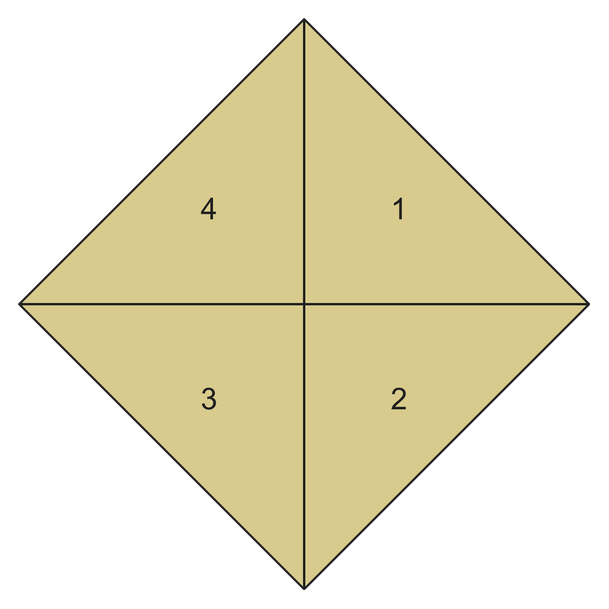
The four pieces fill the new square without any gaps or overlaps.
Let the area of each original square be A square units.
Area of the new square = A + A = 2A square units.
Hence, the new square has double the area of either original square.
2. The length of the two equal sides of an isosceles right triangle is given. Find the length of the hypotenuse. Find bounds on the length of the hypotenuse such that they have at least one digit after the decimal point.
(i) 3 (ii) 4 (iii) 6 (iv) 8 (v) 9
Answer:
Let each equal side be a units and the hypotenuse be c units.
Then, c² = a² + a² = 2a².
(i) a = 3
c² = 2 × 3² = 18
∴ c = √18 units.
Since 4.2² = 17.64 and 4.3² = 18.49,
17.64 < 18 < 18.49.
∴ 4.2 < √18 < 4.3.
The hypotenuse lies between 4.2 and 4.3 units.
(ii) a = 4
c² = 2 × 4² = 32
∴ c = √32 units.
Since 5.6² = 31.36 and 5.7² = 32.49,
31.36 < 32 < 32.49.
∴ 5.6 < √32 < 5.7.
The hypotenuse lies between 5.6 and 5.7 units.
(iii) a = 6
c² = 2 × 6² = 72
∴ c = √72 units.
Since 8.4² = 70.56 and 8.5² = 72.25,
70.56 < 72 < 72.25.
∴ 8.4 < √72 < 8.5.
The hypotenuse lies between 8.4 and 8.5 units.
(iv) a = 8
c² = 2 × 8² = 128
∴ c = √128 units.
Since 11.3² = 127.69 and 11.4² = 129.96,
127.69 < 128 < 129.96.
∴ 11.3 < √128 < 11.4.
The hypotenuse lies between 11.3 and 11.4 units.
(v) a = 9
c² = 2 × 9² = 162
∴ c = √162 units.
Since 12.7² = 161.29 and 12.8² = 163.84,
161.29 < 162 < 163.84.
∴ 12.7 < √162 < 12.8.
The hypotenuse lies between 12.7 and 12.8 units.
3. The hypotenuse of an isosceles right triangle is 10. What are its other two sidelengths?
[Hint: Find the area of the square composed of two such right triangles.]
Answer:
Join two such triangles along their hypotenuses to form a square. The diagonal of this square is 10 units. Let its side be a units.

The square on a diagonal has twice the area of the original square.
Area of the square on the diagonal = 10² = 100 square units.
Area of the original square = 100 ÷ 2 = 50 square units.
∴ a² = 50
So, a = √50 units.
Hence, the other two sidelengths are √50 units each.
Get here the Solutions and Answers of Figure it Out at Page 47.
Page 47 – Figure it Out
1. If a right-angled triangle has shorter sides of lengths 5 cm and 12 cm, then what is the length of its hypotenuse? First draw the right-angled triangle with these sidelengths and measure the hypotenuse, then check your answer using Baudhāyana’s Theorem.
Answer:
Draw AB = 12 cm. At A, draw a perpendicular to AB and mark C on it so that AC = 5 cm. Join BC.

On measuring BC, we get about 13 cm.
Using Baudhāyana’s Theorem,
BC² = AB² + AC²
= 12² + 5²
= 144 + 25
= 169.
∴ BC = √169 = 13 cm.
Hence, the hypotenuse is 13 cm long.
2. If a right-angled triangle has a short side of length 8 cm and hypotenuse of length 17 cm, what is the length of the third side? Again, try drawing the triangle and measuring, and then check your answer using Baudhāyana’s Theorem.
Answer:
Draw AC = 8 cm. At A, draw a line perpendicular to AC. With C as centre and radius 17 cm, draw an arc cutting this line at B. Join BC.

On measuring AB, we get about 15 cm.
Using Baudhāyana’s Theorem,
AB² + AC² = BC²
AB² + 8² = 17²
AB² = 289 − 64
AB² = 225.
∴ AB = √225 = 15 cm.
Hence, the third side is 15 cm long.
3. Using the constructions you have now seen, how would you construct a square whose area is triple the area of a given square? Five times the area of a given square? (Baudhāyana’s Śulba-Sūtra, Verse 1.10)
Answer:
Let the side of the given square be a units.
Its area = a² square units.
(i) A square with three times the area
Draw a diagonal of the given square and call its length d. Then, d² = 2a².
Draw AB equal to d. At A, draw a perpendicular to AB and mark C on it so that AC = a. Join BC. Construct a square on BC as its side.
Using Baudhāyana’s Theorem,
BC² = AB² + AC²
= d² + a²
= 2a² + a²
= 3a².
∴ The square on BC has three times the area of the given square.
(ii) A square with five times the area
Draw PQ equal to twice the side of the given square, so that PQ = 2a. At P, draw a perpendicular to PQ and mark R on it so that PR = a. Join QR. Construct a square on QR as its side.
Using Baudhāyana’s Theorem,
QR² = PQ² + PR²
= (2a)² + a²
= 4a² + a²
= 5a².
∴ The square on QR has five times the area of the given square.

4. Let a, b and c denote the length of the sides of a right triangle, with c being the length of the hypotenuse. Find the missing sidelength in each of the following cases:
(i) a = 5, b = 7
(ii) a = 8, b = 12
(iii) a = 9, c = 15
(iv) a = 7, b = 12
(v) a = 1.5, b = 3.5
Answer:
Using Baudhāyana’s Theorem, a² + b² = c².
(i) a = 5, b = 7
c² = 5² + 7²
= 25 + 49
= 74.
∴ c = √74 units.
(ii) a = 8, b = 12
c² = 8² + 12²
= 64 + 144
= 208.
∴ c = √208 units.
(iii) a = 9, c = 15
9² + b² = 15²
b² = 225 − 81
b² = 144.
∴ b = √144 = 12 units.
(iv) a = 7, b = 12
c² = 7² + 12²
= 49 + 144
= 193.
∴ c = √193 units.
(v) a = 1.5, b = 3.5
c² = 1.5² + 3.5²
= 2.25 + 12.25
= 14.5.
∴ c = √14.5 units.
Get here the Solutions and Answers of Figure it Out at Page 50.
Page 50 – Figure it Out
1. Find 5 more Baudhāyana triples using this idea.
Answer:
We use the relation,
(n − 1)² + (2n − 1) = n².
When 2n − 1 is an odd square, this gives a Baudhāyana triple.
Taking the next five odd squares, we get:
(i) 49 = 7² and 49 = 2 × 25 − 1.
So, n = 25.
(25 − 1)² + 7² = 25²
24² + 7² = 25²
∴ The triple is (7, 24, 25).
(ii) 81 = 9² and 81 = 2 × 41 − 1.
So, n = 41.
(41 − 1)² + 9² = 41²
40² + 9² = 41²
∴ The triple is (9, 40, 41).
(iii) 121 = 11² and 121 = 2 × 61 − 1.
So, n = 61.
(61 − 1)² + 11² = 61²
60² + 11² = 61²
∴ The triple is (11, 60, 61).
(iv) 169 = 13² and 169 = 2 × 85 − 1.
So, n = 85.
(85 − 1)² + 13² = 85²
84² + 13² = 85²
∴ The triple is (13, 84, 85).
(v) 225 = 15² and 225 = 2 × 113 − 1.
So, n = 113.
(113 − 1)² + 15² = 113²
112² + 15² = 113²
∴ The triple is (15, 112, 113).
Hence, five more Baudhāyana triples are (7, 24, 25), (9, 40, 41), (11, 60, 61), (13, 84, 85) and (15, 112, 113).
2. Does this method yield non-primitive Baudhāyana triples?
[Hint: Observe that among the triples generated, one of the smaller sidelengths is one less than the hypotenuse.]
Answer:
No, this method does not yield non-primitive Baudhāyana triples.
In every triple obtained by this method, one of the smaller sides is n − 1 and the hypotenuse is n.
These are consecutive numbers. Any common factor of n and n − 1 must also divide their difference, which is 1. So, their only common factor is 1.
Therefore, the three numbers cannot have a common factor greater than 1.
Hence, every triple obtained by this method is primitive.
3. Are there primitive triples that cannot be obtained through this method? If yes, give examples.
Answer:
Yes, there are primitive triples that cannot be obtained through this method.
For example:
(i) (8, 15, 17)
8² + 15² = 64 + 225
= 289
= 17².
The HCF of 8, 15 and 17 is 1. So, this is a primitive Baudhāyana triple.
But neither 8 nor 15 is one less than 17. Therefore, this triple cannot be obtained by this method.
(ii) (20, 21, 29)
20² + 21² = 400 + 441
= 841
= 29².
The HCF of 20, 21 and 29 is 1. So, this is also a primitive Baudhāyana triple.
But neither 20 nor 21 is one less than 29.
Therefore, this triple also cannot be obtained by this method.
Get here the Solutions and Answers of Figure it Out at Page 52.
Page 52 – Figure it Out
1. Find the diagonal of a square with sidelength 5 cm.
Answer:
The diagonal divides the square into two right triangles.
Let the length of the diagonal be d cm.
By the Baudhāyana-Pythagoras theorem,
d² = 5² + 5²
= 25 + 25
= 50
∴ d = √50 = 5√2
Hence, the diagonal is 5√2 cm.
2. Find the missing sidelengths in the following right triangles:

Answer:
Taking the triangles from left to right, row by row, let the missing side length be x in each triangle.
(i) The perpendicular sides are 7 units and 9 units.
x² = 7² + 9²
= 49 + 81
= 130
∴ x = √130 units.
(ii) The perpendicular sides are 4 units and 10 units.
x² = 4² + 10²
= 16 + 100
= 116
∴ x = √116 = 2√29 units.
(iii) The hypotenuse is 41 units and one perpendicular side is 40 units.
x² + 40² = 41²
x² = 41² − 40²
= 1681 − 1600
= 81
∴ x = √81 = 9 units.
(iv) The hypotenuse is √200 units and one perpendicular side is 10 units.
x² + 10² = (√200)²
x² = 200 − 100
= 100
∴ x = √100 = 10 units.
(v) The perpendicular sides are 10 units and √150 units.
x² = 10² + (√150)²
= 100 + 150
= 250
∴ x = √250 = 5√10 units.
(vi) The hypotenuse is 45 units and one perpendicular side is 27 units.
x² + 27² = 45²
x² = 45² − 27²
= 2025 − 729
= 1296
∴ x = √1296 = 36 units.
3. Find the sidelength of a rhombus whose diagonals are of length 24 units and 70 units.
Answer:
Let ABCD be the rhombus and let its diagonals AC and BD intersect at O.

The diagonals of a rhombus bisect each other at right angles.
∴ AO = 70/2 = 35 units
and BO = 24/2 = 12 units.
In right triangle AOB,
AB² = AO² + BO²
= 35² + 12²
= 1225 + 144
= 1369
∴ AB = √1369 = 37 units.
Hence, the sidelength of the rhombus is 37 units.
4. Is the hypotenuse the longest side of a right triangle? Justify your answer.
Answer:
Yes, the hypotenuse is the longest side of a right triangle.
Let the perpendicular sides be a and b, and the hypotenuse be c.
By the Baudhāyana-Pythagoras theorem,
c² = a² + b².
Since a² and b² are both positive,
c² > a² and c² > b².
As all sidelengths are positive,
c > a and c > b.
Hence, the hypotenuse is longer than each of the other two sides.
5. True or False – Every Baudhāyana triple is either a primitive triple or a scaled version of a primitive triple.
Answer:
True.
A Baudhāyana triple is primitive if its three numbers have no common factor greater than 1.
If the three numbers have a common factor, we divide all three by their HCF. The resulting numbers still satisfy the relation a² + b² = c² and their HCF is 1. So, they form a primitive triple.
For example,
(6, 8, 10) = 2 × (3, 4, 5),
where (3, 4, 5) is a primitive triple.
Thus, every Baudhāyana triple is either primitive or a scaled version of a primitive triple.
6. Give 5 examples of rectangles whose sidelengths and diagonals are all integers.
Answer:
A diagonal divides a rectangle into two right triangles.
So, we can use Baudhāyana triples for the two sidelengths and the diagonal.
(i) Sidelengths: 3 units and 4 units; diagonal: 5 units.
3² + 4² = 9 + 16 = 25 = 5².
(ii) Sidelengths: 5 units and 12 units; diagonal: 13 units.
5² + 12² = 25 + 144 = 169 = 13².
(iii) Sidelengths: 6 units and 8 units; diagonal: 10 units.
6² + 8² = 36 + 64 = 100 = 10².
(iv) Sidelengths: 8 units and 15 units; diagonal: 17 units.
8² + 15² = 64 + 225 = 289 = 17².
(v) Sidelengths: 7 units and 24 units; diagonal: 25 units.
7² + 24² = 49 + 576 = 625 = 25².
7. Construct a square whose area is equal to the difference of the areas of squares of sidelengths 5 units and 7 units.
Answer:
Required area = 7² − 5²
= 49 − 25
= 24 sq. units.
We first construct a right triangle with hypotenuse 7 units and one perpendicular side 5 units.
Steps of construction:
Step 1: Draw AB = 5 units.
Step 2: At A, draw a ray perpendicular to AB.
Step 3: With B as centre and radius 7 units, draw an arc cutting this ray at C. Join BC.
Step 4: At A and C, draw perpendiculars to AC on the side opposite to B.
Step 5: Mark E and D on these perpendiculars so that AE = CD = AC.
Step 6: Join D and E. ACDE is the required square.

In right triangle ABC,
AC² = BC² − AB²
= 7² − 5²
= 49 − 25
= 24.
∴ Area of square ACDE = AC² = 24 sq. units.
Hence, ACDE is a square with the required area.
8. (i) Using the dots of a grid as the vertices, can you create a square that has an area of (a) 2 sq. units, (b) 3 sq. units, (c) 4 sq.units, and (d) 5 sq. unit?
(ii) Suppose the grid extends indefinitely. What are the possible integer-valued areas of squares you can create in this manner?

Answer:
(i) Taking the distance between neighbouring dots in a row or column as 1 unit:
(a) 2 sq. units: Yes.
Join two dots that are 1 unit apart horizontally and 1 unit apart vertically to form one side of the square.
Side² = 1² + 1² = 2.
∴ Area = 2 sq. units.
(b) 3 sq. units: No.
For any side joining two grid dots, let the horizontal and vertical distances be m units and n units. Both m and n are whole numbers.
Side² = m² + n².
If either m or n is 2 or more, then m² + n² is at least 4. If both are 0 or 1, their squares add up to at most 2.
So, m² + n² cannot equal 3.
Hence, such a square cannot be made.
(c) 4 sq. units: Yes.
Draw a square of sidelength 2 units along the grid lines.
Area = 2² = 4 sq. units.
(d) 5 sq. units: Yes.
Join two dots that are 2 units apart horizontally and 1 unit apart vertically to form one side of the square.
Side² = 2² + 1² = 5.
∴ Area = 5 sq. units.

(ii) If a side joins dots with horizontal distance m units and vertical distance n units, then
Area of the square = Side² = m² + n².
Here, m and n are whole numbers, and at least one of them must be non-zero.
To draw the next side at a right angle, we interchange the horizontal and vertical distances and change the direction.
Its end point is also a grid dot. Continuing in this way completes the square on grid dots.
Thus, the possible integer-valued areas are all positive numbers that can be written as the sum of two squares of whole numbers.
Some possible areas are:
1, 2, 4, 5, 8, 9, 10, 13, 16, 17, 18, 20, 25, 26, 29, 32, … sq. units.
There are infinitely many such areas. For example, squares of side lengths 1, 2, 3, 4, … units give areas 1, 4, 9, 16, … sq. units.
9. Find the area of an equilateral triangle with sidelength 6 units.
[Hint: Show that an altitude bisects the opposite side. Use this to find the height.]
Answer:
Let ABC be the equilateral triangle, with AB = BC = CA = 6 units. Draw AD perpendicular to BC.

Using the Baudhāyana-Pythagoras theorem in right triangles ABD and ACD,
AB² = AD² + BD²
and AC² = AD² + DC².
Since AB = AC, we get
AD² + BD² = AD² + DC².
Subtracting AD² from both sides,
BD² = DC².
As lengths are positive, BD = DC.
Thus, the altitude bisects the base.
BD = DC = 6/2 = 3 units.
In right triangle ABD,
AD² = AB² − BD²
= 6² − 3²
= 36 − 9
= 27.
∴ AD = √27 = 3√3 units.
Area of triangle ABC = 1/2 × base × height
= 1/2 × 6 × 3√3
= 9√3 sq. units.
Hence, the area of the equilateral triangle is 9√3 sq. units.
Final Tips to Master the Pythagoras Theorem in Class 8
You will meet this theorem again in coordinate geometry and trigonometry, so time spent on it now pays off for years. Before applying a² + b² = c², mark the hypotenuse, the side opposite the right angle. If the hypotenuse is one of the given sides, subtract the squares instead of adding them. When an answer is not a perfect square, leave it as a square root or find bounds, as the chapter does for √2.
Use these Baudhayana-Pythagoras Theorem Class 8 solutions to check each step, not just the final answer. When you are ready, move on to Chapter 3, Proportional Reasoning-2 or browse the other chapters in our NCERT Solutions for Class 8 Maths.