
Tiwari Academy  – Free CBSE NCERT Books and Solutions
  • Apps
    • CBSE Apps
    • Hast Rekha App
  • NCERT Solutions
    • NCERT Solutions for Class 12
      • NCERT Solutions for Class 12 Maths
      • NCERT Solutions for Class 12 Physics
      • NCERT Solutions for Class 12 Chemistry
      • NCERT Solutions for Class 12 Biology
      • NCERT Solutions for Class 12 English
      • NCERT Solutions for Class 12 Accounts
      • NCERT Solutions for Class 12 Business Studies
      • NCERT Solutions for Class 12 Economics
      • NCERT Solutions for Class 12 Geography
      • NCERT Solutions for Class 12 Physical Education
      • NCERT Solutions for Class 12 Political Science
      • NCERT Solutions for Class 12 Psychology
      • NCERT Solutions for Class 12 Sociology
    • NCERT Solutions for Class 11
      • NCERT Solutions for Class 11 Maths
      • NCERT Solutions for Class 11 Physics
      • NCERT Solutions for Class 11 Chemistry
      • NCERT Solutions for Class 11 Biology
      • NCERT Solutions for Class 11 English
      • NCERT Solutions for Class 11 Business Studies
      • NCERT Solutions for Class 11 Sociology
      • NCERT Solutions for Class 11 Political Science
      • NCERT Solutions for Class 11 Psychology
      • NCERT Solutions for Class 11 Physical Education
    • NCERT Solutions for Class 10
      • NCERT Solutions for Class 10 Maths
      • NCERT Solutions for Class 10 Science
      • NCERT Solutions for Class 10 English
      • NCERT Solutions for Class 10 Hindi 2026-27 Updated Course A and B
      • NCERT Solutions for Class 10 Sanskrit
      • NCERT Solutions for Class 10 Social Science
    • NCERT Solutions for Class 9
      • NCERT Solutions for Class 9 Maths
      • NCERT Solutions for Class 9 Science
      • NCERT Solutions for Class 9 English
      • NCERT Solutions for Class 9 Hindi
      • NCERT Solutions for Class 9 Sanskrit
      • NCERT Solutions for Class 9 Social Science
    • NCERT Solutions for Class 8
      • NCERT Solutions for Class 8 Maths
      • NCERT Solutions for Class 8 Science
      • NCERT Solutions for Class 8 English
      • NCERT Solutions for Class 8 Hindi
      • NCERT Solutions for Class 8 Sanskrit
      • NCERT Solutions for Class 8 Social Science
      • NCERT Solutions for Class 8 Computer
    • NCERT Solutions for Class 7
      • NCERT Solutions for Class 7 Maths
      • NCERT Solutions for Class 7 Science
      • NCERT Solutions for Class 7 English
      • NCERT Solutions for Class 7 Hindi
      • NCERT Solutions for Class 7 Sanskrit
      • NCERT Solutions for Class 7 Social Science
      • NCERT Solutions for Class 7 Computer
    • NCERT Solutions for Class 6
      • NCERT Solutions for Class 6 Maths
      • NCERT Solutions for Class 6 Science
      • NCERT Solutions for Class 6 English
      • NCERT Solutions for Class 6 Hindi
      • NCERT Solutions for Class 6 Sanskrit Deepakam 2026-27 Updated
      • NCERT Solutions for Class 6 Social Science
      • NCERT Solutions for Class 6 Computer
    • NCERT Solutions for Class 5
      • NCERT Solutions for Class 5 Hindi
      • NCERT Solutions for Class 5 English
      • NCERT Solutions for Class 5 Maths
      • NCERT Solutions for Class 5 EVS
      • NCERT Solutions for Class 5 Computer
      • NCERT Solutions for Class 5 GK
    • NCERT Solutions for Class 4
      • NCERT Solutions for Class 4 Hindi
      • NCERT Solutions for Class 4 English
      • NCERT Solutions for Class 4 Maths
      • NCERT Solutions for Class 4 EVS
      • NCERT Solutions for Class 4 Computer
      • NCERT Solutions for Class 4 GK
    • NCERT Solutions for Class 3
      • NCERT Solutions for Class 3 Hindi
      • NCERT Solutions for Class 3 English
      • NCERT Solutions for Class 3 Maths
      • NCERT Solutions for Class 3 EVS
      • NCERT Solutions for Class 3 Science
      • NCERT Solutions for Class 3 Computer
      • NCERT Solutions for Class 3 GK
    • NCERT Solutions for Class 2
      • NCERT Solutions for Class 2 Hindi
      • NCERT Solutions for Class 2 English
      • NCERT Solutions for Class 2 Maths
      • NCERT Solutions for Class 2 EVS
      • NCERT Solutions for Class 2 Science
      • NCERT Solutions for Class 2 Computer
      • NCERT Solutions for Class 2 GK
    • NCERT Solutions for Class 1
      • NCERT Solutions for Class 1 Hindi
      • NCERT Solutions for Class 1 English
      • NCERT Solutions for Class 1 Maths
      • NCERT Solutions for Class 1 EVS
      • NCERT Solutions for Class 1 Computer
      • NCERT Solutions for Class 1 Science
      • NCERT Solutions for Class 1 GK
    • Study Material for KG
      • Study Material for KG English
      • Study Material for KG Hindi
      • Study Material for KG Maths
    • Study Material for Nursery
      • Study Material for Nursery Maths
      • Study Material for Nursery English
      • Study Material for Nursery Hindi
  • NEWS
    • Educational NEWS
    • MCQ
    • Explore More
  • Grammar
    • Class 1 English Grammar
      • Class 1 Hindi Vyakaran
    • Class 2 English Grammar
      • Class 2 Hindi Vyakaran
    • Class 3 English Grammar
      • Class 3 Hindi Vyakaran
    • Class 4 English Grammar
      • Class 4 Hindi Vyakaran
    • Class 5 English Grammar
      • Class 5 Hindi Vyakaran
    • Class 6 English Grammar
      • Class 6 Hindi Vyakaran
    • Class 7 English Grammar
      • Class 7 Hindi Vyakaran
    • Class 8 English Grammar
      • Class 8 Hindi Vyakaran
  • Sample Papers
    • CBSE Sample Papers for Class 4
    • CBSE Sample Papers for Class 5
    • CBSE Sample Papers for Class 6
    • CBSE Sample Papers for Class 7
    • CBSE Sample Papers for Class 8
    • CBSE Sample Papers for Class 9
    • CBSE Sample Papers for Class 10
    • CBSE Sample Papers for Class 11
    • CBSE Sample Papers for Class 12
  • Syllabus
    • CBSE Syllabus
    • NCERT Books
    • NCERT Exemplar
    • What is NIOS?
    • NIOS Online Admission
    • Career Options
  • Contact
    • Contact Us
    • About Us
    • Authors
    • Online Tutors
  • Apps
    • CBSE Apps
    • Hast Rekha App
  • NCERT Solutions
    • NCERT Solutions for Class 12
      • NCERT Solutions for Class 12 Maths
      • NCERT Solutions for Class 12 Physics
      • NCERT Solutions for Class 12 Chemistry
      • NCERT Solutions for Class 12 Biology
      • NCERT Solutions for Class 12 English
      • NCERT Solutions for Class 12 Accounts
      • NCERT Solutions for Class 12 Business Studies
      • NCERT Solutions for Class 12 Economics
      • NCERT Solutions for Class 12 Geography
      • NCERT Solutions for Class 12 Physical Education
      • NCERT Solutions for Class 12 Political Science
      • NCERT Solutions for Class 12 Psychology
      • NCERT Solutions for Class 12 Sociology
    • NCERT Solutions for Class 11
      • NCERT Solutions for Class 11 Maths
      • NCERT Solutions for Class 11 Physics
      • NCERT Solutions for Class 11 Chemistry
      • NCERT Solutions for Class 11 Biology
      • NCERT Solutions for Class 11 English
      • NCERT Solutions for Class 11 Business Studies
      • NCERT Solutions for Class 11 Sociology
      • NCERT Solutions for Class 11 Political Science
      • NCERT Solutions for Class 11 Psychology
      • NCERT Solutions for Class 11 Physical Education
    • NCERT Solutions for Class 10
      • NCERT Solutions for Class 10 Maths
      • NCERT Solutions for Class 10 Science
      • NCERT Solutions for Class 10 English
      • NCERT Solutions for Class 10 Hindi 2026-27 Updated Course A and B
      • NCERT Solutions for Class 10 Sanskrit
      • NCERT Solutions for Class 10 Social Science
    • NCERT Solutions for Class 9
      • NCERT Solutions for Class 9 Maths
      • NCERT Solutions for Class 9 Science
      • NCERT Solutions for Class 9 English
      • NCERT Solutions for Class 9 Hindi
      • NCERT Solutions for Class 9 Sanskrit
      • NCERT Solutions for Class 9 Social Science
    • NCERT Solutions for Class 8
      • NCERT Solutions for Class 8 Maths
      • NCERT Solutions for Class 8 Science
      • NCERT Solutions for Class 8 English
      • NCERT Solutions for Class 8 Hindi
      • NCERT Solutions for Class 8 Sanskrit
      • NCERT Solutions for Class 8 Social Science
      • NCERT Solutions for Class 8 Computer
    • NCERT Solutions for Class 7
      • NCERT Solutions for Class 7 Maths
      • NCERT Solutions for Class 7 Science
      • NCERT Solutions for Class 7 English
      • NCERT Solutions for Class 7 Hindi
      • NCERT Solutions for Class 7 Sanskrit
      • NCERT Solutions for Class 7 Social Science
      • NCERT Solutions for Class 7 Computer
    • NCERT Solutions for Class 6
      • NCERT Solutions for Class 6 Maths
      • NCERT Solutions for Class 6 Science
      • NCERT Solutions for Class 6 English
      • NCERT Solutions for Class 6 Hindi
      • NCERT Solutions for Class 6 Sanskrit Deepakam 2026-27 Updated
      • NCERT Solutions for Class 6 Social Science
      • NCERT Solutions for Class 6 Computer
    • NCERT Solutions for Class 5
      • NCERT Solutions for Class 5 Hindi
      • NCERT Solutions for Class 5 English
      • NCERT Solutions for Class 5 Maths
      • NCERT Solutions for Class 5 EVS
      • NCERT Solutions for Class 5 Computer
      • NCERT Solutions for Class 5 GK
    • NCERT Solutions for Class 4
      • NCERT Solutions for Class 4 Hindi
      • NCERT Solutions for Class 4 English
      • NCERT Solutions for Class 4 Maths
      • NCERT Solutions for Class 4 EVS
      • NCERT Solutions for Class 4 Computer
      • NCERT Solutions for Class 4 GK
    • NCERT Solutions for Class 3
      • NCERT Solutions for Class 3 Hindi
      • NCERT Solutions for Class 3 English
      • NCERT Solutions for Class 3 Maths
      • NCERT Solutions for Class 3 EVS
      • NCERT Solutions for Class 3 Science
      • NCERT Solutions for Class 3 Computer
      • NCERT Solutions for Class 3 GK
    • NCERT Solutions for Class 2
      • NCERT Solutions for Class 2 Hindi
      • NCERT Solutions for Class 2 English
      • NCERT Solutions for Class 2 Maths
      • NCERT Solutions for Class 2 EVS
      • NCERT Solutions for Class 2 Science
      • NCERT Solutions for Class 2 Computer
      • NCERT Solutions for Class 2 GK
    • NCERT Solutions for Class 1
      • NCERT Solutions for Class 1 Hindi
      • NCERT Solutions for Class 1 English
      • NCERT Solutions for Class 1 Maths
      • NCERT Solutions for Class 1 EVS
      • NCERT Solutions for Class 1 Computer
      • NCERT Solutions for Class 1 Science
      • NCERT Solutions for Class 1 GK
    • Study Material for KG
      • Study Material for KG English
      • Study Material for KG Hindi
      • Study Material for KG Maths
    • Study Material for Nursery
      • Study Material for Nursery Maths
      • Study Material for Nursery English
      • Study Material for Nursery Hindi
  • NEWS
    • Educational NEWS
    • MCQ
    • Explore More
  • Grammar
    • Class 1 English Grammar
      • Class 1 Hindi Vyakaran
    • Class 2 English Grammar
      • Class 2 Hindi Vyakaran
    • Class 3 English Grammar
      • Class 3 Hindi Vyakaran
    • Class 4 English Grammar
      • Class 4 Hindi Vyakaran
    • Class 5 English Grammar
      • Class 5 Hindi Vyakaran
    • Class 6 English Grammar
      • Class 6 Hindi Vyakaran
    • Class 7 English Grammar
      • Class 7 Hindi Vyakaran
    • Class 8 English Grammar
      • Class 8 Hindi Vyakaran
  • Sample Papers
    • CBSE Sample Papers for Class 4
    • CBSE Sample Papers for Class 5
    • CBSE Sample Papers for Class 6
    • CBSE Sample Papers for Class 7
    • CBSE Sample Papers for Class 8
    • CBSE Sample Papers for Class 9
    • CBSE Sample Papers for Class 10
    • CBSE Sample Papers for Class 11
    • CBSE Sample Papers for Class 12
  • Syllabus
    • CBSE Syllabus
    • NCERT Books
    • NCERT Exemplar
    • What is NIOS?
    • NIOS Online Admission
    • Career Options
  • Contact
    • Contact Us
    • About Us
    • Authors
    • Online Tutors
เคนเคฟเค‚เคฆเฅ€ เคฎเฅ€เคกเคฟเคฏเคฎเคนเคฟเค‚เคฆเฅ€ เคฎเฅ€เคกเคฟเคฏเคฎ Latest BlogsLatest Blogs Ask QuestionsAsk Questions
Tiwari Academy  /  Latest News  /  Class 9 Ganita Manjari Chapter 2: How to Study Linear Polynomials

Class 9 Ganita Manjari Chapter 2: How to Study Linear Polynomials

Ganita Manjari Class 9 Chapter 2 Study Planner
Post Date: August 22, 2026

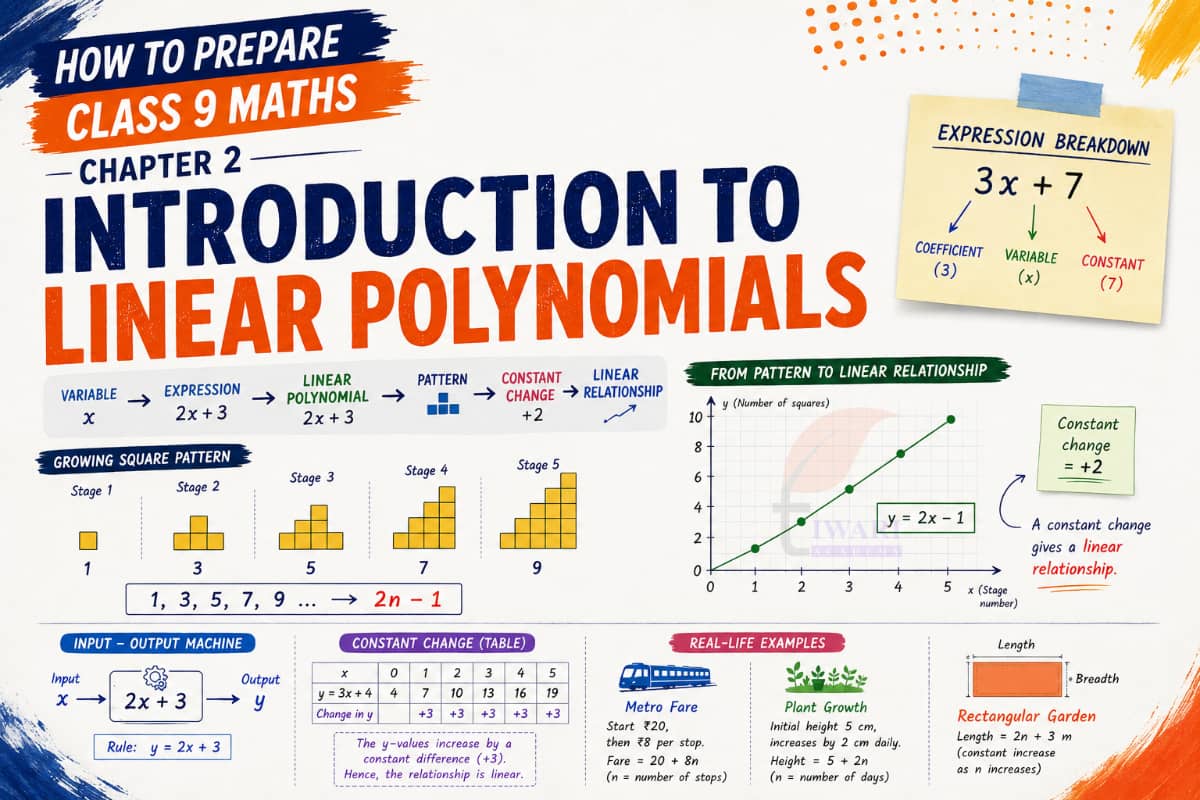
If you’ve opened Ganita Manjari Chapter 2 and found terms, coefficients, degree, slope and y-intercept all showing up within a few pages of each other, you’re not alone โ€” this is a fast-moving, concept-heavy chapter and most marks are lost to mixing up ideas rather than to hard calculations. This guide is built specifically to help you study Chapter 2, Introduction to Linear Polynomials, efficiently: the order to learn things in, the vocabulary to nail first, the question types that repeat every year and the shortcuts that save time under exam pressure. If you’ve already got the concepts down and want fully solved answers to every textbook question instead, our NCERT Solutions for Ganita Manjari Class 9 Maths Chapter 2 work through Exercise 2.1 to the End-of-Chapter Exercises in complete step-by-step detail.

Quick Overview: What Chapter 2 Is Really About

Ganita Manjari Chapter 2 doesn’t jump straight into rules – it builds understanding in layers:

  • It starts with real situations to show how algebraic expressions arise naturally in everyday life.
  • It then names the parts of an expression (terms, variables, coefficients, constants) and defines degree, which is what separates constant, linear, quadratic, and cubic polynomials.
  • Once “linear polynomial” (degree 1) is defined, the chapter treats it as a pattern-generator, a growth/decay model, a relationship between two variables and finally a straight line on a graph.

By the end, one idea – y = ax + b – ties together number patterns, real-world change and coordinate geometry. That’s the thread to hold onto while studying: everything in this chapter is really one idea shown from four different angles.

9th Maths Ganita Manjari Chapter 2 at a Glance

SectionTitleWhat It Covers
2.1IntroductionAlgebraic expressions, terms, variables, coefficients, constants, degree, types of polynomials
2.2Linear PolynomialsLinear polynomials vs. linear equations; polynomials as inputโ€“output functions
2.3Exploring Linear PatternsSequences with a constant difference; finding the nth term
2.4Linear Growth and Linear DecayModelling real quantities that rise or fall by a fixed amount
2.5Linear RelationshipsFinding a and b in y = ax + b from given data
2.6Visualising Linear RelationshipsPlotting lines, slope, y-intercept and parallel lines

The chapter closes with a longer set of End-of-Chapter Exercises that mix all six ideas together, including several starred (higher-order thinking) questions on parallel lines and forming unknown polynomials from given conditions.

How to Study Chapter 2: A Step-by-Step Plan

1. Start with vocabulary, not formulas

Before solving anything, be able to instantly point out the terms, variables, coefficients and constant in any expression. Nearly every early question in this chapter is really a vocabulary check in disguise.

2. Learn to classify polynomials by degree in seconds

Practice looking at 15โ€“20 mixed expressions and calling out constant, linear, quadratic or cubic based only on the highest power of the variable. Speed here saves time in every later section.

3. Separate “linear polynomial” from “linear equation” early

This is the single most common mix-up in the chapter. A linear polynomial (like 3x + 7) is an expression you can evaluate; a linear equation (like 3x + 7 = 22) is that expression set equal to a number, which you solve for x.


4. Practice translating word situations into expressions before solving them

Most marks here are lost in translation, not calculation. Read the problem twice, underline the fixed amount and the changing amount separately and only then write the expression.

5. Master the “constant difference” test for patterns

For Section 2.3, the whole skill is checking whether consecutive terms differ by the same amount. Once that’s automatic, writing the nth-term rule becomes mechanical rather than guesswork.

6. Read growth and decay from the sign, not the story

Section 2.4 is Section 2.3 applied to real life. If the coefficient of the variable is positive, it’s growth; if negative, it’s decay – you don’t need to re-derive this every time.

7. Get fluent in finding a and b from two data points

This is Section 2.5’s core skill: turn two situations into two equations, subtract to eliminate one variable, solve for the other. This exact method reappears when you study equations of lines in higher classes, so it’s worth over-practising now.

8. Practice plotting a line in under two minutes

For Section 2.6, remember you only need two points. The fastest ones are (0, b) – found by setting x = 0 – and any second point using a convenient value of x.

9. Finish with the End-of-Chapter Exercises, especially the starred ones

These combine multiple sections at once, so leave them for after you’ve practised each section individually.


Key Concepts and Definitions

TermA part of an expression separated by + or โˆ’. In 5x + 7, the terms are 5x and 7.
VariableA letter (x, y, z, etc.) standing for a quantity that can change.
CoefficientThe number multiplying a variable. In 5x, the coefficient of x is 5.
ConstantA term with no variable attached – a fixed number.
DegreeThe highest power of the variable in a polynomial.
PolynomialAn algebraic expression built from variables raised to whole-number powers.
Univariate polynomialA polynomial in exactly one variable.
Linear polynomialA polynomial of degree 1, of the form ax + b.
Linear equationA linear polynomial set equal to a fixed value, e.g. ax + b = c.
Slope (a)In y = ax + b, the constant amount y changes by for every one-unit increase in x.
Y-intercept (b)The point (0, b) where the line crosses the y-axis.

Types of Polynomials by Degree

TypeGeneral FormExample
Constant polynomialk6
Linear polynomialax + b4x + 9
Quadratic polynomialaxยฒ + bx + c3xยฒ โˆ’ x + 2
Cubic polynomialaxยณ + bxยฒ + cx + d2xยณ + 5xยฒ โˆ’ x + 8

A quick trick: Cover up every coefficient and constant with your finger and just look at the highest power of the variable that’s left. That power alone tells you the type – coefficients and constants never affect degree.

Important Question Types and Examples

These are the categories of questions that repeat across the chapter, each shown with a fresh practice example so you can test yourself before attempting the real exercises.

Question TypeSkill It TestsTry This
Identify degree, coefficients and constantReading an expression correctlyIn 6pโด โˆ’ 2pยณ + 7p โˆ’ 1, the degree is 4 and the coefficient of pยณ is โˆ’2.
Convert a word situation into an expressionTranslating “fixed + variable” language into algebraA juice stall charges โ‚น30 base price plus โ‚น8 per extra flavour shot (n shots). Cost = 30 + 8n; for n = 3, cost = โ‚น54.
Find the nth term of a linear patternSpotting the constant difference and building a ruleRow sizes in an auditorium go 18, 23, 28, 33, โ€ฆ (common difference 5). The nth row has (5n + 13) seats, so Row 12 has 73 seats.
Classify a real situation as growth or decayReading the sign of the rate of changeA 20 cm candle burns down 2 cm every hour: h(t) = 20 โˆ’ 2t. Since the coefficient of t is negative, this is linear decay.
Find a and b in y = ax + b from two data pointsSolving two equations formed from given dataA tailor’s bill for 6 m of stitching is โ‚น560 and for 10 m it’s โ‚น720. Solving gives a = 40, b = 320, so y = 40x + 320.
Read slope and y-intercept directly from an equationMatching an equation to y = ax + b without graphingFor y = 7x + 3, the slope is 7 and the y-intercept is (0, 3).
Check whether two lines are parallelComparing slopes only, ignoring constantsy = 4x + 2 and y = 4x โˆ’ 6 are parallel (same slope, 4); y = 7x + 2 is not.

For step-by-step solved answers to the actual textbook questions in each of these categories, the NCERT Solutions for Chapter 2 cover every exercise in full.


Tips and Tricks to Solve Chapter 2 Questions Quickly

  • Find the y-intercept instantly by substituting x = 0 into y = ax + b – no graph or second point needed.
  • Find the slope from two coordinates using a = (yโ‚‚ โˆ’ yโ‚) รท (xโ‚‚ โˆ’ xโ‚); it’s faster than forming two full equations when you’re already given points rather than a word problem.
  • Subtract equations first when solving for a and b from two conditions – it usually cancels b immediately, leaving a simple one-step equation for a.
  • Test patterns by subtraction, not by extending the list. Subtract consecutive terms once; if the difference repeats, jump straight to the nth-term formula instead of writing out ten more terms.
  • Use the sign rule for growth and decay: positive coefficient means growth, negative means decay – you never need to plot every value to decide.
  • For parallel-line questions, compare only the coefficient of x. The constant term is irrelevant to whether lines are parallel.
  • Ignore coefficients and constants when finding degree: Only the highest power of the variable decides constant/linear/quadratic/cubic.
  • In word problems, “fixed” usually means b and “per unit” usually means a. A joining fee, base fare or starting value is b; a rate per match, per km, or per month is a.
  • Watch for the “=” sign: A linear polynomial has none; a linear equation does. If you see “=”, you’re solving for a specific value, not simplifying an expression.
  • Check your work with x = 0 and x = 1: Plugging in these two values quickly confirms both the y-intercept and the slope of any linear function you’ve written.

Common Mistakes Students Make

  • Confusing degree with the number of terms. A polynomial can have several terms and still be linear – degree depends only on the highest power, not on how many terms are written.
  • Dropping negative signs when reading coefficients. In 9xยณ + 5xยฒ โˆ’ 8x โˆ’ 10, the coefficient of x is โˆ’8, not 8 – always read the sign immediately before the term.
  • Treating a pattern and an equation as the same thing. A sequence is a linear pattern; it only becomes an equation once you set its nth term equal to a target value and solve.
  • Getting the sign wrong in growth/decay expressions. Students often add when a quantity should be subtracted (or the reverse) – always check the direction against a small table of 2โ€“3 values before finalising.
  • Mixing up a and b when solving y = ax + b. Label the two equations clearly from the two given data points before eliminating a variable.
  • Plotting only one point and assuming it fixes the line. A straight line needs at least two points – one point alone can lie on infinitely many different lines.


Quick Formula and Fact Sheet

ConceptFormula / Rule
General linear polynomialax + b (a โ‰  0)
General linear equationax + b = c
Linear relationship between two variablesy = ax + b
Slope from two pointsa = (yโ‚‚ โˆ’ yโ‚) รท (xโ‚‚ โˆ’ xโ‚)
Y-interceptThe point (0, b)
Condition for linear growtha > 0
Condition for linear decaya < 0
Condition for parallel linesSame value of a, different values of b
Line passing through the originy = ax (b = 0)

Keep this table open while solving Exercise 2.5 and 2.6 – almost every question there is a direct application of one row in this sheet.

A Simple 3-Day Study Timetable

DayFocusWhat to Do
Day 1Sections 2.1โ€“2.2Learn the vocabulary table above, classify 15โ€“20 mixed polynomials by degree, understand linear polynomial vs. linear equation, then attempt Exercise 2.1 and Exercise 2.2.
Day 2Sections 2.3โ€“2.4Practise spotting constant differences in patterns, write nth-term rules for 5โ€“6 patterns, then attempt Exercise 2.3 and Exercise 2.4 with a focus on growth/decay word problems.
Day 3Sections 2.5โ€“2.6 + RevisionPractise finding a and b from two data points, plot 4โ€“5 lines by hand, attempt Exercise 2.5, Exercise 2.6 and the End-of-Chapter Exercises – especially the starred ones – then revise the formula sheet once more.

If you only have one day, compress this into a morning session on vocabulary, patterns, growth/decay and an evening session on linear relationships and graphing โ€” the two halves of the chapter build on each other, so studying them in this order avoids backtracking.

Why This Chapter Matters Beyond the Chapter Test

Chapter 2 is short, but it’s load-bearing. The vocabulary (degree, coefficient, slope, y-intercept) and the core skill of finding a and b from two data points both return directly when you study linear equations in two variables and coordinate geometry later in the year – so a shaky grasp here tends to cost marks in chapters you haven’t reached yet, not just this one. Because the questions are largely conceptual and application-based rather than long multi-step calculations, this chapter also tends to be quick to score once the ideas are genuinely clear – which is exactly why it rewards understanding over memorising steps.

Practice With Fully Solved Textbook Questions

Once the concepts above feel comfortable, the next step is working through the textbook’s own questions with a way to check yourself. Our NCERT Solutions for all subjects including Ganita Manjari Class 9 Maths Chapter 2 solve every question from Exercise 2.1 through Exercise 2.6 and the full set of End-of-Chapter Exercises – including the starred, higher-order questions โ€” with complete step-by-step working. Use this guide to build the understanding, then use the solutions page to confirm your working question by question.


Frequently Asked Questions

Where are linear polynomials and linear relationships actually used outside the classroom?

Linear relationships show up anywhere a quantity changes at a constant rate: a delivery app calculating fare as a base charge plus a per-kilometre rate, a fitness tracker estimating calories burned per minute of walking or a mobile recharge plan with a fixed rental plus a per-GB data cost. Engineers use the same y = ax + b idea to model things like material cost against a bridge’s length, and economists use it for simple demand and supply approximations.
Recognising that all of these are really “fixed amount + rate ร— quantity” is exactly the skill this chapter is building, which is why it keeps reappearing well beyond the Maths exam.

How should I revise class 9 Maths Ganita Manjari chapter 2 in just 30 minutes the night before a test?

Skip re-solving every exercise and do a fast, targeted pass instead: spend the first 10 minutes re-reading the Key Concepts table (term, coefficient, degree, slope, y-intercept) out loud, since most quick marks come from definitions.
Spend the next 10 minutes on 3โ€“4 mixed problems covering finding a and b from two points and reading slope/y-intercept from an equation, since these are the highest-frequency question types.
Use the last 10 minutes to skim the Quick Formula Sheet and mentally walk through one growth example and one decay example so the sign rule is fresh. This won’t replace proper practice, but it’s the highest-value use of a short window.

Is graph paper compulsory for the Section 2.6 questions or is a neat freehand sketch acceptable?

Most schools prefer graphs plotted on graph paper or graph-ruled exam sheets, since accurate scaling matters when a question asks you to read off a specific point, the slope or the y-intercept from your own drawing. A freehand sketch without a proper scale can lose marks even if the shape looks roughly right, because the examiner can’t verify the coordinates you’re claiming. At home, a ruled notebook page with evenly spaced squares works almost as well – the key habit is always labelling the axes, marking the scale and plotting at least two clearly marked points before drawing the line. Check your own school’s instructions, since exact requirements can vary.

What should I do if I get a different value of a or b than a classmate for the same word problem?

First, check you both used the exact same two data points and substituted them into y = ax + b the same way – a common cause of mismatches is one person swapping which value is x and which is y. Next, redo the subtraction step separately: write both equations again, subtract carefully with correct signs and see where you diverge.
Finally, verify by plugging your final a and b back into both original equations – if both check out, your answer is correct even if it looks different at first (some students leave a as a fraction like 5/9 while others round it, which can look like a mismatch but isn’t).

Will Class 9 Maths Ganita Manjari chapter 2 questions in a school test mostly be MCQs or long-answer problems?

CBSE-pattern papers for Class 9 Maths typically mix formats across every chapter rather than dedicating one style to one topic, so expect a combination: 1-mark MCQs or fill-in-the-blanks on definitions, degree and classification; 2โ€“3 mark short-answer questions on evaluating a polynomial or finding a and b; and occasionally a longer question combining graphing with reading slope and y-intercept. Since Ganita Manjari is a new textbook for the 2026-27 session, there isn’t yet a multi-year exam pattern specific to this exact chapter, so the most reliable way to know your own paper’s split is to check your school’s latest sample paper.

Chapter 2 rewards students who treat it as one connected idea (y = ax + b) rather than six separate topics. Get fluent in the vocabulary, practise translating word problems into expressions, master the two-equations trick for finding a & b and the rest of the chapter (patterns, growth, decay, graphs) falls into place quickly.

Recent Posts
  • Class 9 Science Exploration Notes: 5 Methods That Actually Help You Remember
  • Class 9 Social Science Notes: The Complete Guide
  • Class 9 Maths 2026-27: What’s New in the Syllabus and How to Study It
  • CBSE 3-Language Rule: Will Hindi Become Compulsory Subject?
  • NCERT Solutions for Class 10 Maths 2026-27 – Welcome to Your New Session


Important Links
  • What is NCERT?
  • Important Questions
  • Vedic Maths Tricks
  • Link Study Materials
  • Useful Resources & Formulae
  • Holiday Homework Solutions


Buy NCERT Books Online

NCERT Books for 2026-27

NCERT Solutions
  • NCERT Solutions for Class 6 Maths
  • NCERT Solutions for Class 7 Maths
  • NCERT Solutions for Class 8 Maths
  • NCERT Solutions for Class 11 Maths
  • NCERT Solutions for Class 12 Maths
  • NCERT Solutions for Class 11 Physics
  • NCERT Solutions for Class 12 Physics


High School
  • Class 9 NCERT Maths Solutions
  • Class 9 NCERT Science Solutions
  • Class 9 NCERT English Solutions
  • Class 10 NCERT Maths Solutions
  • Class 10 NCERT Science Solutions
  • Class 10 NCERT English Solutions
  • Class 10 NCERT Social Solutions

Quick Links
  • NCERT Books
  • NCERT Solutions
  • CBSE Syllabus
  • Home Tutors
  • NIOS Admissions
  • CBSE Sample Papers
  • Vedic Maths Tricks
Help & Support
  • About Us
  • Contact Us
  • Advertise With Us
  • Discussion
  • Latest Blogs
  • Holiday Homework
  • Useful Resources
Copyright 2026 by Tiwari Academy | A step towards Free Education
facebook
twitter
linkedin
youtube
instagram
pinterest
google-news