Physics and Mathematics For Admission In engineering
Post Date:

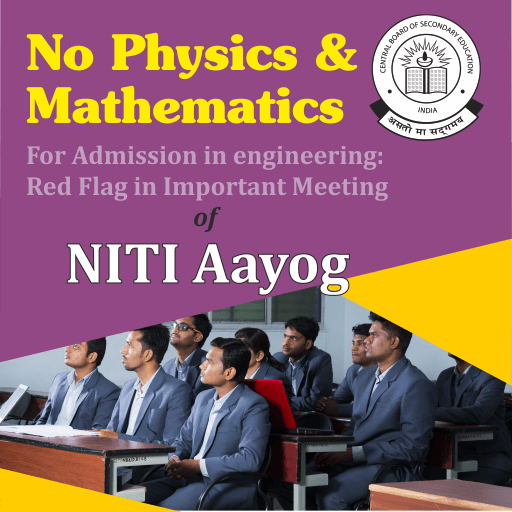
A meeting convened by the central government’s apex policy think tank this month forced engineering colleges to reconsider AICTE’s decision to allow admission to students who did not opt for Mathematics and physics in their Class 12 and offer them remedial bridge courses to cope in class.
The Indian Express has learned that NITI Aayog member and scientist VK Saraswat had expressed serious objections about the new entry eligibility criteria in a meeting chaired by Vice President Rajiv Kumar on June 11. AICTE Chairman Anil Sahasrabuddhe and Higher Education Secretary Amit Khare were also present in the meeting.
Difference of Opinion

According to sources, there was a difference of opinion between Saraswat and Sahasrabuddhe, in which Saraswat was in favour of withdrawal. On the other hand, the Chairman of AICTE defended the changes on the grounds that they are in line with the multidisciplinary approach of the new National Education Policy.

Score At Least 45 Percent Marks

In March, AICTE changed the entry-level qualifications for undergraduate engineering programmes, making students who had not studied Physics or Mathematics (or both) in class 11 and Class 12 eligible for admission.
Under the new criteria, a candidate is expected to score at least 45 percent marks in any three subjects out of a list of 14, Physics, Mathematics, Chemistry, Computer Science, Electronics, Information Technology, Biology, Informatics Practice, Biotechnology, Technological, Business Subjects, Engineering Graphics, Business Studies and Entrepreneurship.

New Entry Level Qualification

Earlier, an engineering candidate should have passed plus-two with Physics and Mathematics as compulsory subjects.
While AICTE is still firm on the new entry-level qualification, it has agreed to define engineering branches in which this flexibility will be limited. A committee headed by National Accreditation Board Chairman KK Agrawal has been tasked by AICTE to list out the branches for which studying Physics and Mathematics in plus-two will not be a prerequisite.

Earlier, when the decision was announced in March, the technical education regulator had left the decision to universities and engineering institutes.
For example, a candidate who studied computer science, business studies, and entrepreneurship in high school could apply for a BTech in computer science if the college decided to keep the admission eligibility flexible.

The Matter Is Under Discussion

However, it is not clear whether the new admission qualification will be put on hold till the Agarwal Committee submits its report.
When contacted by The Indian Express, Sahasrabuddhe said the matter is still under discussion and there will be more meetings. “All of us, the Agarwal committee and even the NITI Aayog, will sit together and discuss more. I can’t say much more at this point of time”. Saraswat said that he does not want to speak on the matter.
The regulator’s new entry qualification had triggered a debate with experts cautioning against making physics and maths optional for engineering candidates in plus-two.

Principal Scientific Adviser K. Vijay Raghavan told The Indian Express that “rigor and depth in maths and physics quickly becomes easy” and it would be prudent to study these subjects in plus-two before taking admission in BE and BTech programs.

Remedial Courses Required

Saraswat called the decision “regressive” and “a step in the wrong direction” at the time. “An engineering program lasts for four years. A student with a background in physics and mathematics must study a bridge course for at least two semesters. Such a student (remedial courses required) is fully (BTech) in the class.
Saraswat said “How can you expect a student to learn the letters of the alphabet and appreciate poetry at the same time”?

For more CBSE related news, NCERT Solutions, JEE, CTET news, Educational Videos, General Knowledge, Book, Pdf and other education related information, stay connected with “Tiwari Academy”.