
Tiwari Academy  – Free CBSE NCERT Books and Solutions
  • Apps
    • CBSE Apps
    • Hast Rekha App
  • NCERT Solutions
    • NCERT Solutions for Class 12
      • NCERT Solutions for Class 12 Maths
      • NCERT Solutions for Class 12 Physics
      • NCERT Solutions for Class 12 Chemistry
      • NCERT Solutions for Class 12 Biology
      • NCERT Solutions for Class 12 English
      • NCERT Solutions for Class 12 Accounts
      • NCERT Solutions for Class 12 Business Studies
      • NCERT Solutions for Class 12 Economics
      • NCERT Solutions for Class 12 Geography
      • NCERT Solutions for Class 12 Physical Education
      • NCERT Solutions for Class 12 Political Science
      • NCERT Solutions for Class 12 Psychology
      • NCERT Solutions for Class 12 Sociology
    • NCERT Solutions for Class 11
      • NCERT Solutions for Class 11 Maths
      • NCERT Solutions for Class 11 Physics
      • NCERT Solutions for Class 11 Chemistry
      • NCERT Solutions for Class 11 Biology
      • NCERT Solutions for Class 11 English
      • NCERT Solutions for Class 11 Business Studies
      • NCERT Solutions for Class 11 Sociology
      • NCERT Solutions for Class 11 Political Science
      • NCERT Solutions for Class 11 Psychology
      • NCERT Solutions for Class 11 Physical Education
    • NCERT Solutions for Class 10
      • NCERT Solutions for Class 10 Maths
      • NCERT Solutions for Class 10 Science
      • NCERT Solutions for Class 10 English
      • NCERT Solutions for Class 10 Hindi 2026-27 Updated Course A and B
      • NCERT Solutions for Class 10 Sanskrit
      • NCERT Solutions for Class 10 Social Science
    • NCERT Solutions for Class 9
      • NCERT Solutions for Class 9 Maths
      • NCERT Solutions for Class 9 Science
      • NCERT Solutions for Class 9 English
      • NCERT Solutions for Class 9 Hindi
      • NCERT Solutions for Class 9 Sanskrit
      • NCERT Solutions for Class 9 Social Science
    • NCERT Solutions for Class 8
      • NCERT Solutions for Class 8 Maths
      • NCERT Solutions for Class 8 Science
      • NCERT Solutions for Class 8 English
      • NCERT Solutions for Class 8 Hindi
      • NCERT Solutions for Class 8 Sanskrit
      • NCERT Solutions for Class 8 Social Science
      • NCERT Solutions for Class 8 Computer
    • NCERT Solutions for Class 7
      • NCERT Solutions for Class 7 Maths
      • NCERT Solutions for Class 7 Science
      • NCERT Solutions for Class 7 English
      • NCERT Solutions for Class 7 Hindi
      • NCERT Solutions for Class 7 Sanskrit
      • NCERT Solutions for Class 7 Social Science
      • NCERT Solutions for Class 7 Computer
    • NCERT Solutions for Class 6
      • NCERT Solutions for Class 6 Maths
      • NCERT Solutions for Class 6 Science
      • NCERT Solutions for Class 6 English
      • NCERT Solutions for Class 6 Hindi
      • NCERT Solutions for Class 6 Sanskrit Deepakam 2026-27 Updated
      • NCERT Solutions for Class 6 Social Science
      • NCERT Solutions for Class 6 Computer
    • NCERT Solutions for Class 5
      • NCERT Solutions for Class 5 Hindi
      • NCERT Solutions for Class 5 English
      • NCERT Solutions for Class 5 Maths
      • NCERT Solutions for Class 5 EVS
      • NCERT Solutions for Class 5 Computer
      • NCERT Solutions for Class 5 GK
    • NCERT Solutions for Class 4
      • NCERT Solutions for Class 4 Hindi
      • NCERT Solutions for Class 4 English
      • NCERT Solutions for Class 4 Maths
      • NCERT Solutions for Class 4 EVS
      • NCERT Solutions for Class 4 Computer
      • NCERT Solutions for Class 4 GK
    • NCERT Solutions for Class 3
      • NCERT Solutions for Class 3 Hindi
      • NCERT Solutions for Class 3 English
      • NCERT Solutions for Class 3 Maths
      • NCERT Solutions for Class 3 EVS
      • NCERT Solutions for Class 3 Science
      • NCERT Solutions for Class 3 Computer
      • NCERT Solutions for Class 3 GK
    • NCERT Solutions for Class 2
      • NCERT Solutions for Class 2 Hindi
      • NCERT Solutions for Class 2 English
      • NCERT Solutions for Class 2 Maths
      • NCERT Solutions for Class 2 EVS
      • NCERT Solutions for Class 2 Science
      • NCERT Solutions for Class 2 Computer
      • NCERT Solutions for Class 2 GK
    • NCERT Solutions for Class 1
      • NCERT Solutions for Class 1 Hindi
      • NCERT Solutions for Class 1 English
      • NCERT Solutions for Class 1 Maths
      • NCERT Solutions for Class 1 EVS
      • NCERT Solutions for Class 1 Computer
      • NCERT Solutions for Class 1 Science
      • NCERT Solutions for Class 1 GK
    • Study Material for KG
      • Study Material for KG English
      • Study Material for KG Hindi
      • Study Material for KG Maths
    • Study Material for Nursery
      • Study Material for Nursery Maths
      • Study Material for Nursery English
      • Study Material for Nursery Hindi
  • NEWS
    • Educational NEWS
    • MCQ
    • Explore More
  • Grammar
    • Class 1 English Grammar
      • Class 1 Hindi Vyakaran
    • Class 2 English Grammar
      • Class 2 Hindi Vyakaran
    • Class 3 English Grammar
      • Class 3 Hindi Vyakaran
    • Class 4 English Grammar
      • Class 4 Hindi Vyakaran
    • Class 5 English Grammar
      • Class 5 Hindi Vyakaran
    • Class 6 English Grammar
      • Class 6 Hindi Vyakaran
    • Class 7 English Grammar
      • Class 7 Hindi Vyakaran
    • Class 8 English Grammar
      • Class 8 Hindi Vyakaran
  • Sample Papers
    • CBSE Sample Papers for Class 4
    • CBSE Sample Papers for Class 5
    • CBSE Sample Papers for Class 6
    • CBSE Sample Papers for Class 7
    • CBSE Sample Papers for Class 8
    • CBSE Sample Papers for Class 9
    • CBSE Sample Papers for Class 10
    • CBSE Sample Papers for Class 11
    • CBSE Sample Papers for Class 12
  • Syllabus
    • CBSE Syllabus
    • NCERT Books
    • NCERT Exemplar
    • What is NIOS?
    • NIOS Online Admission
    • Career Options
  • Contact
    • Contact Us
    • About Us
    • Authors
    • Online Tutors
  • Apps
    • CBSE Apps
    • Hast Rekha App
  • NCERT Solutions
    • NCERT Solutions for Class 12
      • NCERT Solutions for Class 12 Maths
      • NCERT Solutions for Class 12 Physics
      • NCERT Solutions for Class 12 Chemistry
      • NCERT Solutions for Class 12 Biology
      • NCERT Solutions for Class 12 English
      • NCERT Solutions for Class 12 Accounts
      • NCERT Solutions for Class 12 Business Studies
      • NCERT Solutions for Class 12 Economics
      • NCERT Solutions for Class 12 Geography
      • NCERT Solutions for Class 12 Physical Education
      • NCERT Solutions for Class 12 Political Science
      • NCERT Solutions for Class 12 Psychology
      • NCERT Solutions for Class 12 Sociology
    • NCERT Solutions for Class 11
      • NCERT Solutions for Class 11 Maths
      • NCERT Solutions for Class 11 Physics
      • NCERT Solutions for Class 11 Chemistry
      • NCERT Solutions for Class 11 Biology
      • NCERT Solutions for Class 11 English
      • NCERT Solutions for Class 11 Business Studies
      • NCERT Solutions for Class 11 Sociology
      • NCERT Solutions for Class 11 Political Science
      • NCERT Solutions for Class 11 Psychology
      • NCERT Solutions for Class 11 Physical Education
    • NCERT Solutions for Class 10
      • NCERT Solutions for Class 10 Maths
      • NCERT Solutions for Class 10 Science
      • NCERT Solutions for Class 10 English
      • NCERT Solutions for Class 10 Hindi 2026-27 Updated Course A and B
      • NCERT Solutions for Class 10 Sanskrit
      • NCERT Solutions for Class 10 Social Science
    • NCERT Solutions for Class 9
      • NCERT Solutions for Class 9 Maths
      • NCERT Solutions for Class 9 Science
      • NCERT Solutions for Class 9 English
      • NCERT Solutions for Class 9 Hindi
      • NCERT Solutions for Class 9 Sanskrit
      • NCERT Solutions for Class 9 Social Science
    • NCERT Solutions for Class 8
      • NCERT Solutions for Class 8 Maths
      • NCERT Solutions for Class 8 Science
      • NCERT Solutions for Class 8 English
      • NCERT Solutions for Class 8 Hindi
      • NCERT Solutions for Class 8 Sanskrit
      • NCERT Solutions for Class 8 Social Science
      • NCERT Solutions for Class 8 Computer
    • NCERT Solutions for Class 7
      • NCERT Solutions for Class 7 Maths
      • NCERT Solutions for Class 7 Science
      • NCERT Solutions for Class 7 English
      • NCERT Solutions for Class 7 Hindi
      • NCERT Solutions for Class 7 Sanskrit
      • NCERT Solutions for Class 7 Social Science
      • NCERT Solutions for Class 7 Computer
    • NCERT Solutions for Class 6
      • NCERT Solutions for Class 6 Maths
      • NCERT Solutions for Class 6 Science
      • NCERT Solutions for Class 6 English
      • NCERT Solutions for Class 6 Hindi
      • NCERT Solutions for Class 6 Sanskrit Deepakam 2026-27 Updated
      • NCERT Solutions for Class 6 Social Science
      • NCERT Solutions for Class 6 Computer
    • NCERT Solutions for Class 5
      • NCERT Solutions for Class 5 Hindi
      • NCERT Solutions for Class 5 English
      • NCERT Solutions for Class 5 Maths
      • NCERT Solutions for Class 5 EVS
      • NCERT Solutions for Class 5 Computer
      • NCERT Solutions for Class 5 GK
    • NCERT Solutions for Class 4
      • NCERT Solutions for Class 4 Hindi
      • NCERT Solutions for Class 4 English
      • NCERT Solutions for Class 4 Maths
      • NCERT Solutions for Class 4 EVS
      • NCERT Solutions for Class 4 Computer
      • NCERT Solutions for Class 4 GK
    • NCERT Solutions for Class 3
      • NCERT Solutions for Class 3 Hindi
      • NCERT Solutions for Class 3 English
      • NCERT Solutions for Class 3 Maths
      • NCERT Solutions for Class 3 EVS
      • NCERT Solutions for Class 3 Science
      • NCERT Solutions for Class 3 Computer
      • NCERT Solutions for Class 3 GK
    • NCERT Solutions for Class 2
      • NCERT Solutions for Class 2 Hindi
      • NCERT Solutions for Class 2 English
      • NCERT Solutions for Class 2 Maths
      • NCERT Solutions for Class 2 EVS
      • NCERT Solutions for Class 2 Science
      • NCERT Solutions for Class 2 Computer
      • NCERT Solutions for Class 2 GK
    • NCERT Solutions for Class 1
      • NCERT Solutions for Class 1 Hindi
      • NCERT Solutions for Class 1 English
      • NCERT Solutions for Class 1 Maths
      • NCERT Solutions for Class 1 EVS
      • NCERT Solutions for Class 1 Computer
      • NCERT Solutions for Class 1 Science
      • NCERT Solutions for Class 1 GK
    • Study Material for KG
      • Study Material for KG English
      • Study Material for KG Hindi
      • Study Material for KG Maths
    • Study Material for Nursery
      • Study Material for Nursery Maths
      • Study Material for Nursery English
      • Study Material for Nursery Hindi
  • NEWS
    • Educational NEWS
    • MCQ
    • Explore More
  • Grammar
    • Class 1 English Grammar
      • Class 1 Hindi Vyakaran
    • Class 2 English Grammar
      • Class 2 Hindi Vyakaran
    • Class 3 English Grammar
      • Class 3 Hindi Vyakaran
    • Class 4 English Grammar
      • Class 4 Hindi Vyakaran
    • Class 5 English Grammar
      • Class 5 Hindi Vyakaran
    • Class 6 English Grammar
      • Class 6 Hindi Vyakaran
    • Class 7 English Grammar
      • Class 7 Hindi Vyakaran
    • Class 8 English Grammar
      • Class 8 Hindi Vyakaran
  • Sample Papers
    • CBSE Sample Papers for Class 4
    • CBSE Sample Papers for Class 5
    • CBSE Sample Papers for Class 6
    • CBSE Sample Papers for Class 7
    • CBSE Sample Papers for Class 8
    • CBSE Sample Papers for Class 9
    • CBSE Sample Papers for Class 10
    • CBSE Sample Papers for Class 11
    • CBSE Sample Papers for Class 12
  • Syllabus
    • CBSE Syllabus
    • NCERT Books
    • NCERT Exemplar
    • What is NIOS?
    • NIOS Online Admission
    • Career Options
  • Contact
    • Contact Us
    • About Us
    • Authors
    • Online Tutors
เคนเคฟเค‚เคฆเฅ€ เคฎเฅ€เคกเคฟเคฏเคฎเคนเคฟเค‚เคฆเฅ€ เคฎเฅ€เคกเคฟเคฏเคฎ Latest BlogsLatest Blogs Ask QuestionsAsk Questions
Tiwari Academy  /  Latest News  /  Class 9 Maths Chapter 3 Study Guide: How to Master The World of Numbers

Class 9 Maths Chapter 3 Study Guide: How to Master The World of Numbers

Class 9 Maths Chapter 3 Study Guide: The World of Numbers
Post Date: September 21, 2026

Chapter 3 of Ganita Manjari, The World of Numbers, is one of the most story-driven chapters in the new Class 9 Maths textbook for the 2026-27 session. It moves from tally marks on a 35,000-year-old bone to the philosophical birth of zero, then through negative numbers, fractions, irrational numbers and finally the unbroken Real Number Line – all in one chapter. That range is exactly what makes it tricky to revise, because it mixes history, logical proof and pure calculation together. This guide isn’t another walkthrough of every question and answer; you already have complete, step-by-step solutions for all five Exercise Sets and the End-of-Chapter questions at Tiwari Academy’s NCERT Solutions for Class 9 Maths Ganita Manjari Chapter 3. What follows instead is a section-by-section study roadmap, a formula cheat-sheet, the mistakes students repeat every year and a realistic day-wise plan to get this chapter exam-ready.
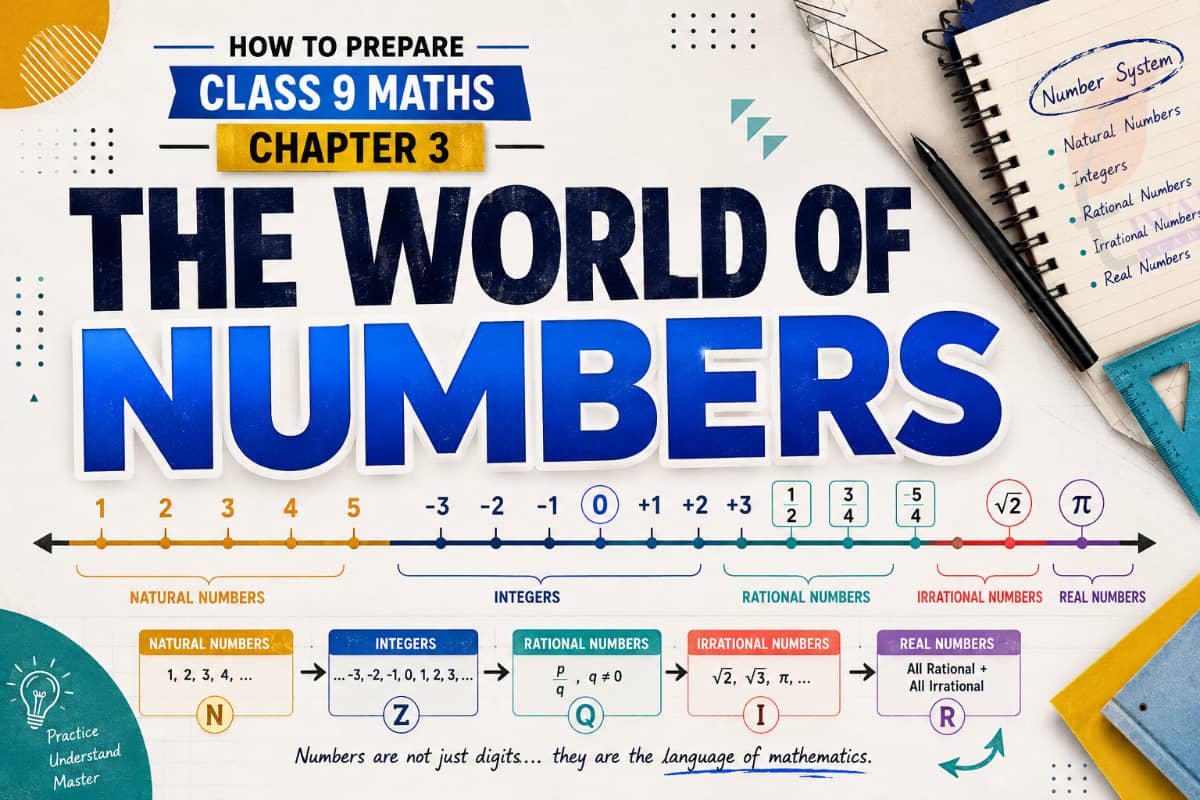

Class 9 Maths Chapter 3 Guide – Way to Solve

Chapter 3 asks something different of you than most Class 9 Maths chapters. A chapter on Triangles or Polynomials mostly asks you to calculate. This one asks you to calculate and remember a historical sequence and hold a logical proof in your head well enough to reproduce it on your own. Treating it like a normal “read once, solve exercises” chapter is why students who understand every individual idea still fumble a mixed test on it. This guide breaks the chapter into manageable stages, each with its own study technique, so nothing gets left to a single re-read the night before the exam.

Why This Chapter Needs a Different Study Approach

Look closely at what Chapter 3 actually contains and you’ll notice it keeps switching modes:

  • Narrative mode (Section 3.1): historical facts about the Lebombo Bone, the Ishango Bone and Vedic number names – content you need to recognise, not calculate.
  • Rule mode (Sections 3.2 and 3.3): Brahmagupta’s laws for zero and signed numbers – content you need to apply instantly, without re-deriving it each time.
  • Procedure mode (Section 3.4 and most of 3.6): fraction arithmetic, number-line placement and decimal conversion – content you get better at only through repeated practice.
  • Logic mode (Section 3.5): the proof that โˆš2 is irrational – content you need to understand the shape of, so you can reproduce it for a different number under exam pressure.

Studying all four modes the same way – reading the textbook top to bottom once – is the single biggest reason this chapter feels harder than it should. The roadmap below treats each mode differently.

Chapter 3 at a Glance

SectionCore IdeaWhat You’ll Actually Be Tested On
3.1 The Dawn of MathematicsNatural numbers grew out of one-to-one correspondence; the Lebombo and Ishango bones are the earliest tally evidenceRecognising the historical sequence, spotting number patterns (e.g., primes), closure of natural numbers
3.2 The Revolution of ลšhลซnyaZero moved from a philosophical idea (ลšhลซnyatฤ) to a working number through BrahmaguptaApplying Brahmagupta’s three rules for zero
3.3 IntegersPositive “fortunes” and negative “debts” get formal sign rulesApplying sign rules correctly in word problems and direct calculations
3.4 Fractions & Rational NumbersThe p/q definition, the four operations, number-line placement and densitySimplifying, operating on and locating rational numbers precisely
3.5 Irrational NumbersProof by contradiction for โˆš2; geometric construction of โˆšn; ฯ€ as an infinite, non-terminating ideaReproducing and adapting the proof structure for other square roots
3.6 Real Numbers: DecimalsPredicting terminating vs. repeating decimals; converting decimals to p/q; cyclic number patternsLong division accuracy and decimal-to-fraction conversion
3.7 ConclusionRational + irrational = the Real Number Line; a preview of imaginary numbersShort conceptual and definition-based questions

Across the chapter there are 43 questions spread over five Exercise Sets and the End-of-Chapter set, including 5 starred higher-order-thinking (HOTS) problems – one each in Exercise Sets 3.1, 3.4 and 3.5 and three in the End-of-Chapter Exercises. Knowing that ratio matters: most of your marks come from steady procedural accuracy, not from the harder starred questions, so don’t let the HOTS problems eat time you need elsewhere.


How to Study Chapter 3 in Six Stages

Stage 1 – Build the Historical Timeline (Section 3.1)

  • Goal: Place the milestones in order and know what mathematical idea each one demonstrates, not just its name.
  • Technique: Draw a simple timeline strip with three points on it, and next to each one write one mathematical idea instead of a date: the oldest tally artefact demonstrates basic counting; the next one demonstrates grouping and doubling; the arrival of Vedic number names demonstrates naming powers of ten. Turning history into “artefact โ†’ idea” pairs makes it stick far better than memorising years.
  • Self-check: In two sentences, can you explain why one of the bone artefacts is considered more mathematically advanced than a plain tally stick?

Stage 2 – Make Zero and Signed Numbers Automatic (Sections 3.2 & 3.3)

  • Goal: Apply Brahmagupta’s rules for zero and the sign rules for integers without pausing to think.
  • Technique: Don’t memorise the sign rules as abstract symbols. Re-derive the multiplication table from the fortune/debt story every time you practise it for the first few days: fortune ร— fortune is a fortune, debt ร— debt is a fortune, and a fortune ร— debt is a debt. Once you can rebuild the table from the story in under 20 seconds, you’ve actually learned it rather than memorised it.
  • Self-check: Without a calculator, solve four mixed-sign questions – one each of addition, subtraction, multiplication and division – in under a minute, with no sign errors.

Stage 3 – Master Rational-Number Arithmetic (Section 3.4, first half)

  • Goal: Add, subtract, multiply and divide fractions confidently, including negative ones and know the p/q definition (with q โ‰  0) cold.
  • Technique: Textbook practice alone often isn’t enough because you’re solving numbers someone else picked. Once a day, invent your own pair of unlike fractions and run all four operations on them yourself. Self-generated practice exposes LCM mistakes far faster than repeating the book’s examples. Get in the habit of stating “in lowest terms” out loud whenever you finish simplifying – examiners look for exactly that phrase.
  • Self-check: In your own words – not “because division by zero is undefined” – why must q never be zero in the definition of a rational number?


Stage 4 – Visualise Density and the Number Line (Section 3.4, second half)

  • Goal: Place rational numbers accurately on a number line and understand why infinitely many of them sit between any two given numbers.
  • Technique: Use the average trick – for any two rationals a and b, (a + b) / 2 always lands exactly between them – to generate first 3, then 5, then 10 numbers between a pair of fractions. Mark a few of them on an actual drawn line before trying to do it purely in your head; the visual habit prevents careless placement errors in exams.
  • Self-check: Given any two fractions on the spot, can you name a number strictly between them twice in a row, without repeating a method?

Stage 5 – Own the Proof of Irrationality (Section 3.5)

  • Goal: Reproduce the logic that proves โˆš2 is irrational – and adapt it to a different number – rather than memorising it word for word.
  • Technique: Compress the proof into five beats instead of treating it as a rigid sequence of steps: (1) assume the number equals p/q in lowest terms, (2) square both sides and rearrange, (3) show this forces p to share a common factor with the number under the root, (4) substitute back and show q is forced into the same situation, (5) point out the contradiction – p and q can’t share a factor if they were in lowest terms. Practise saying this rhythm from memory, then swap in a different number under the root each time you repeat it.
  • Self-check: Closed book – can you prove a different square root (one the textbook didn’t fully work out for you) is irrational using the same five beats?

Stage 6 – Predict and Convert Decimals (Section 3.6)

  • Goal: Predict terminating vs. repeating decimals from the denominator alone, and convert any decimal back into p/q form.
  • Technique: Build a fast mental filter: factorise the denominator in lowest terms – if the only prime factors are 2 and/or 5, the decimal terminates; any other prime factor means it repeats. For decimal-to-fraction conversion, remember one pattern instead of three separate rules: shift once to clear any non-repeating digits, shift again by the length of the repeating block, then subtract the smaller equation from the larger one and solve.
  • Self-check: Given a random fraction, can you say “terminating” or “repeating” within five seconds – before doing any actual division?


Formulas and Rules Cheat-Sheet

ConceptRule to Memorise
Natural numbersโ„• = {1, 2, 3, โ€ฆ}
Brahmagupta’s rules for zeroa + 0 = a ยท a โˆ’ 0 = a ยท a ร— 0 = 0
Sign rules (integers)same signs multiply/divide to a positive result; opposite signs give a negative result
Rational numberany number expressible as p/q, where p, q are integers and q โ‰  0
Equality of fractionsa/b = c/d exactly when aร—d = bร—c
Addition/subtractionconvert to a common denominator first, then add or subtract the numerators
Multiplicationa/b ร— c/d = (aร—c) / (bร—d)
Divisiona/b รท c/d = a/b ร— d/c
A number between a and b(a + b) / 2 always works
Distance between two numbers on a line|a โˆ’ b|
Terminating-decimal testin lowest terms, the denominator’s only prime factors are 2 and/or 5
Non-uniqueness of decimalsevery terminating decimal has a twin ending in repeating 9s (e.g., 1 and 0.999โ€ฆ are the same number)

Mistakes Students Repeat Every Year

MistakeHow to Fix It
Forgetting which set zero belongs to (this chapter builds โ„• without zero, then adds it in โ„ค)Remember: 0 sits in โ„ค, not in โ„•, as this chapter defines them
Losing track of signs when three or more negative numbers are multiplied in a rowCount the negative signs โ€” an odd count gives a negative result, an even count gives a positive one
Skipping the “in lowest terms” / co-prime condition when stating a rational number or writing a proofMake it your opening line every time: “let p/q be in its lowest form”
Assuming every square root is irrationalCheck for a perfect square first – โˆš49 = 7 and โˆš64 = 8 are both rational
Assuming a long or complicated-looking decimal must be irrationalOnly decimals that never terminate and never repeat are irrational – a 20-digit repeating block is still perfectly rational
Treating 0.999โ€ฆ as “almost 1” rather than exactly 1Rework the x = 0.999โ€ฆ algebra yourself once; it removes the doubt for good
Shifting by the wrong power of 10 when converting a general repeating decimalShift once for the non-repeating digits, shift again for the length of the repeating block, then subtract

A Realistic Study Timetable

  • Day 1 (60โ€“90 min): Sections 3.1 and 3.2, using the timeline and fortune/debt techniques from Stages 1โ€“2; finish Exercise Set 3.1.
  • Day 2 (60โ€“90 min): Section 3.3 integer arithmetic; finish Exercise Set 3.2; redo any sign-rule question you got wrong, twice.
  • Day 3 (75โ€“90 min): Section 3.4 in full – operations, number-line placement, density; finish Exercise Sets 3.3 and 3.4.
  • Day 4 (60โ€“75 min): Section 3.5; practise reproducing the five-beat proof structure for two or three different square roots, closed book.
  • Day 5 (75โ€“90 min): Section 3.6; run the terminating/repeating filter on ten fractions you make up yourself, then finish Exercise Set 3.5.
  • Day 6 (60 min): Rebuild the cheat-sheet from memory, then attempt the End-of-Chapter Exercises, saving the three starred questions for last.
  • Day 7 (30โ€“45 min): A timed mock – pick eight to ten mixed questions from across all the exercise sets and solve them against a clock.


How to Use the Exercises Strategically

  • Don’t skim past the “Think and Reflect” boxes scattered through the chapter – they’re exactly the kind of short conceptual prompt that shows up in board-style questions.
  • Solve the starred (*) questions last, once the regular questions in that set feel easy – they demand an extra reasoning step, not new content.
  • When you get an answer wrong, don’t just note the correct number. Go back to the cheat-sheet rule it came from and re-derive it once more before moving on.
  • Turn each worked example in the textbook into your own version by changing the numbers and attempt your version before checking the book’s method – this is the fastest way to tell genuine understanding from familiarity.

Two-Minute Self-Assessment Checklist

Run through this list before you consider the chapter “done”:

  • โ˜ I can state the definition of a rational number correctly, including why q โ‰  0.
  • โ˜ I can apply all three of Brahmagupta’s rules for zero without hesitating.
  • โ˜ I can multiply and divide two or three signed integers correctly, even in tricky combinations.
  • โ˜ I can find a rational number between any two given rational numbers using the average method.
  • โ˜ I can prove a square root is irrational using proof by contradiction, from memory, for a number the textbook didn’t fully solve for me.
  • โ˜ I can tell whether a fraction terminates or repeats just by looking at its denominator.
  • โ˜ I can convert a pure repeating, general repeating, and terminating decimal into p/q form.
  • โ˜ I can explain why 0.999โ€ฆ equals exactly 1, not “almost” 1.
  • โ˜ I can explain the difference between rational, irrational and real numbers in my own words, without the textbook open.

If more than two or three boxes are unchecked, go back to that stage’s technique rather than re-reading the whole chapter again.

Where to Get Full Step-by-Step Solutions

Once you’ve attempted a section on your own using the stages above, check your work against the fully worked solutions for every Exercise Set and the End-of-Chapter questions at NCERT Solutions for Class 9 Maths Ganita Manjari Chapter 3. Checking after an honest attempt – not before – is what actually builds the recall this chapter demands.

Continue Your Preparation
  • Chapter 2: Introduction to Linear Polynomials โ€” revise this before Chapter 3 if signed-number arithmetic still feels shaky.
  • Chapter 4: Exploring Algebraic Identities โ€” the next chapter builds directly on the rational-number arithmetic covered here.


Frequently Asked Questions

How many days should I actually spend on Chapter 3?

Six focused days of 60โ€“90 minutes each, plus one shorter day for a timed mock, is realistic for most students – matching the six-stage roadmap above. Compressing it into one or two long sessions tends to leave the proof-of-irrationality stage and the decimal-conversion stage weak, since both need repetition rather than a single read-through.

Is The World of Numbers a difficult chapter for Class 9 students?

No single idea in it is advanced, but it packs four different kinds of thinking – historical recall, rule application, procedural calculation, and formal proof – into one chapter. Most of the difficulty students report comes from switching between these modes without a plan, not from any one topic being conceptually hard.

Do I need to memorise exact dates and names like the Lebombo Bone or Brahmagupta’s year of writing?

You need to recognise which artefact or mathematician goes with which idea, not the exact year. Exam questions typically ask you to identify the concept (for example, which artefact shows early evidence of prime numbers) rather than recall a date.

Which part of Chapter 3 carries the most weightage?

Rational number arithmetic and decimal-to-p/q conversion (Sections 3.4 and 3.6) tend to generate the largest share of exam questions simply because they’re the most procedural and easiest to test precisely. The proof of irrationality (Section 3.5) is tested less often but is a near-guaranteed question when it appears, so it shouldn’t be skipped.

Should I memorise the proof that โˆš2 is irrational word for word?

No – memorise the five-beat structure instead (assume, square, deduce, substitute, contradict) and practise applying it to a different number each time. Examiners regularly ask for the same proof applied to a different square root and word-for-word memorisation falls apart the moment the number changes.

What should I revise the night before a test on this chapter?

Run through the formulas cheat-sheet and the self-assessment checklist above rather than re-reading the full chapter. If time allows, solve two or three mixed questions timed against a clock โ€” that does more for exam-day confidence than another full read-through.

Recent Posts
  • Class 9 Science Exploration Notes: 5 Methods That Actually Help You Remember
  • Class 9 Social Science Notes: The Complete Guide
  • Class 9 Maths 2026-27: What’s New in the Syllabus and How to Study It
  • CBSE 3-Language Rule: Will Hindi Become Compulsory Subject?
  • NCERT Solutions for Class 10 Maths 2026-27 – Welcome to Your New Session


Important Links
  • What is NCERT?
  • Important Questions
  • Vedic Maths Tricks
  • Link Study Materials
  • Useful Resources & Formulae
  • Holiday Homework Solutions


Buy NCERT Books Online

NCERT Books for 2026-27

NCERT Solutions
  • NCERT Solutions for Class 6 Maths
  • NCERT Solutions for Class 7 Maths
  • NCERT Solutions for Class 8 Maths
  • NCERT Solutions for Class 11 Maths
  • NCERT Solutions for Class 12 Maths
  • NCERT Solutions for Class 11 Physics
  • NCERT Solutions for Class 12 Physics


High School
  • Class 9 NCERT Maths Solutions
  • Class 9 NCERT Science Solutions
  • Class 9 NCERT English Solutions
  • Class 10 NCERT Maths Solutions
  • Class 10 NCERT Science Solutions
  • Class 10 NCERT English Solutions
  • Class 10 NCERT Social Solutions

Quick Links
  • NCERT Books
  • NCERT Solutions
  • CBSE Syllabus
  • Home Tutors
  • NIOS Admissions
  • CBSE Sample Papers
  • Vedic Maths Tricks
Help & Support
  • About Us
  • Contact Us
  • Advertise With Us
  • Discussion
  • Latest Blogs
  • Holiday Homework
  • Useful Resources
Copyright 2026 by Tiwari Academy | A step towards Free Education
facebook
twitter
linkedin
youtube
instagram
pinterest
google-news