


by Tiwari Academy Team
NCERT Class 9 Maths Ganita Manjari Chapter 3 The World of Numbers Solutions – Exercise Set 3.1, 3.2, 3.3, 3.4, 3.5 and End of Chapter Exercises step-by-step explanation in English and Hindi Medium. Chapter 3 of Ganita Manjari — the new NCERT Mathematics textbook for Class 9 (Session 2026-27) — takes students on a remarkable journey through The World of Numbers, tracing the evolution of mathematics from humanity’s earliest need to count to the elegant complexity of the Real Number Line.
Class 9 Ganita Manjari Chapter 3 Quick Links:
- Exercise Set 3.1
- Exercise Set 3.2
- Exercise Set 3.3
- Exercise Set 3.4
- Exercise Set 3.5
- End of Chapter Exercises
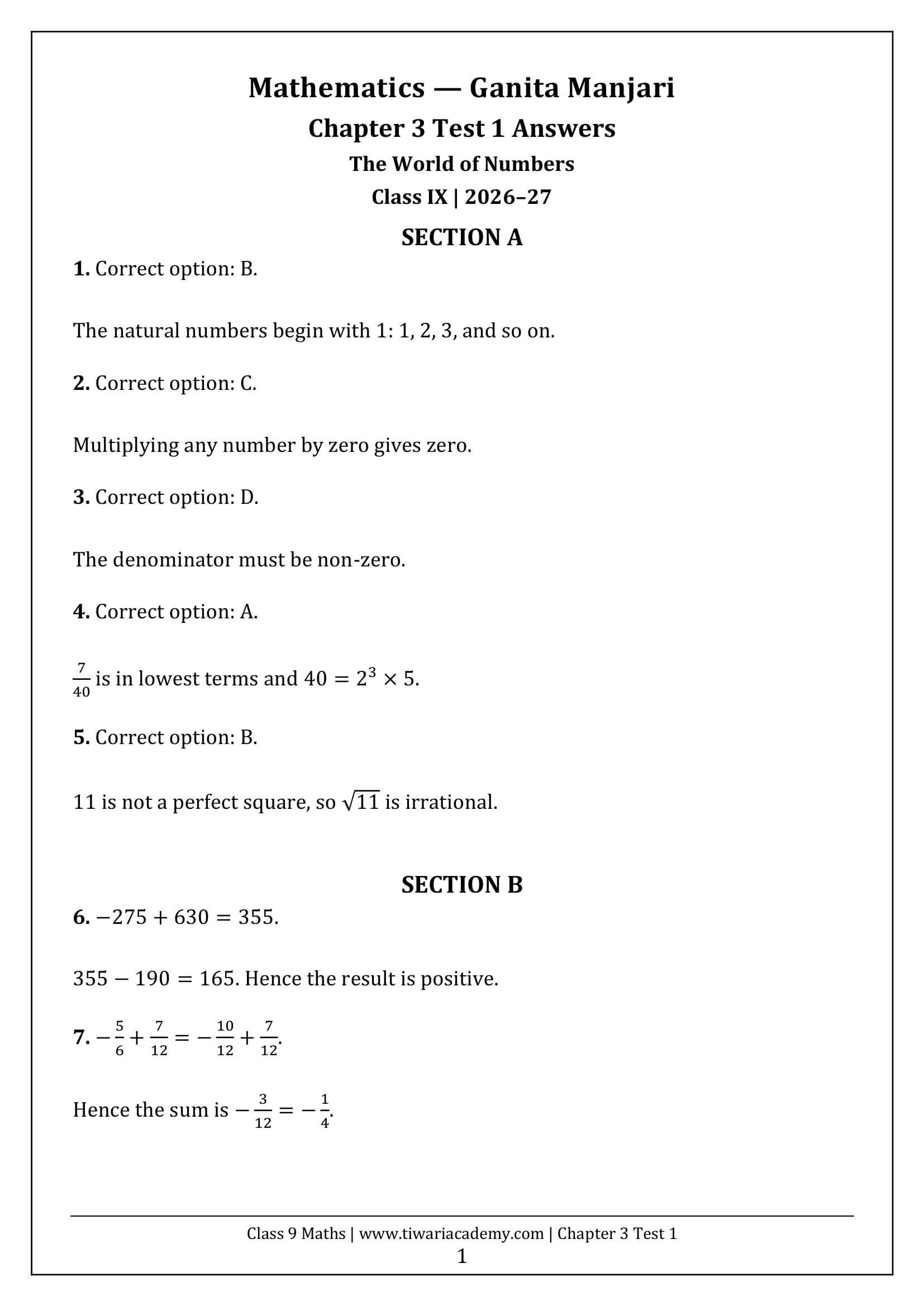
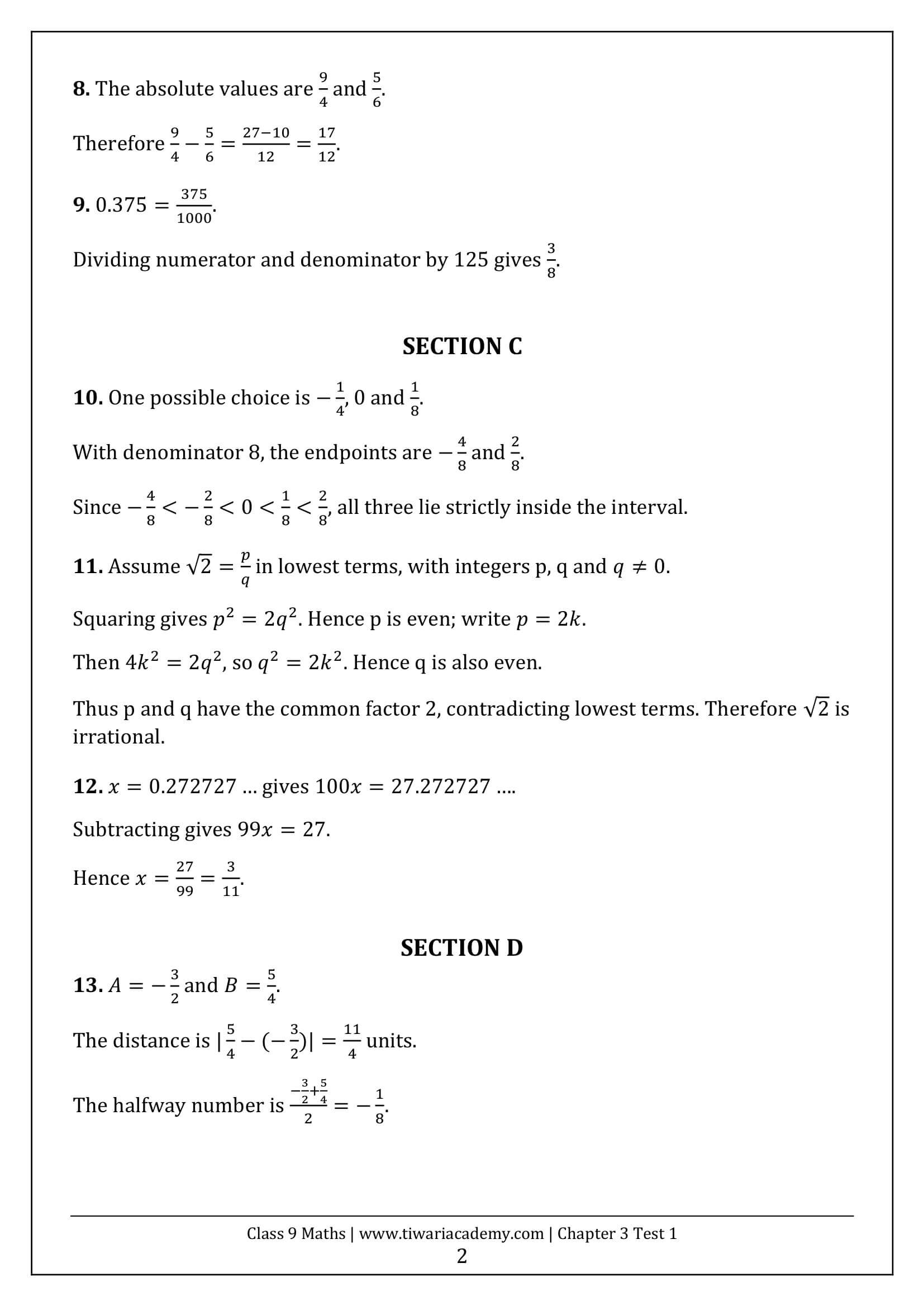
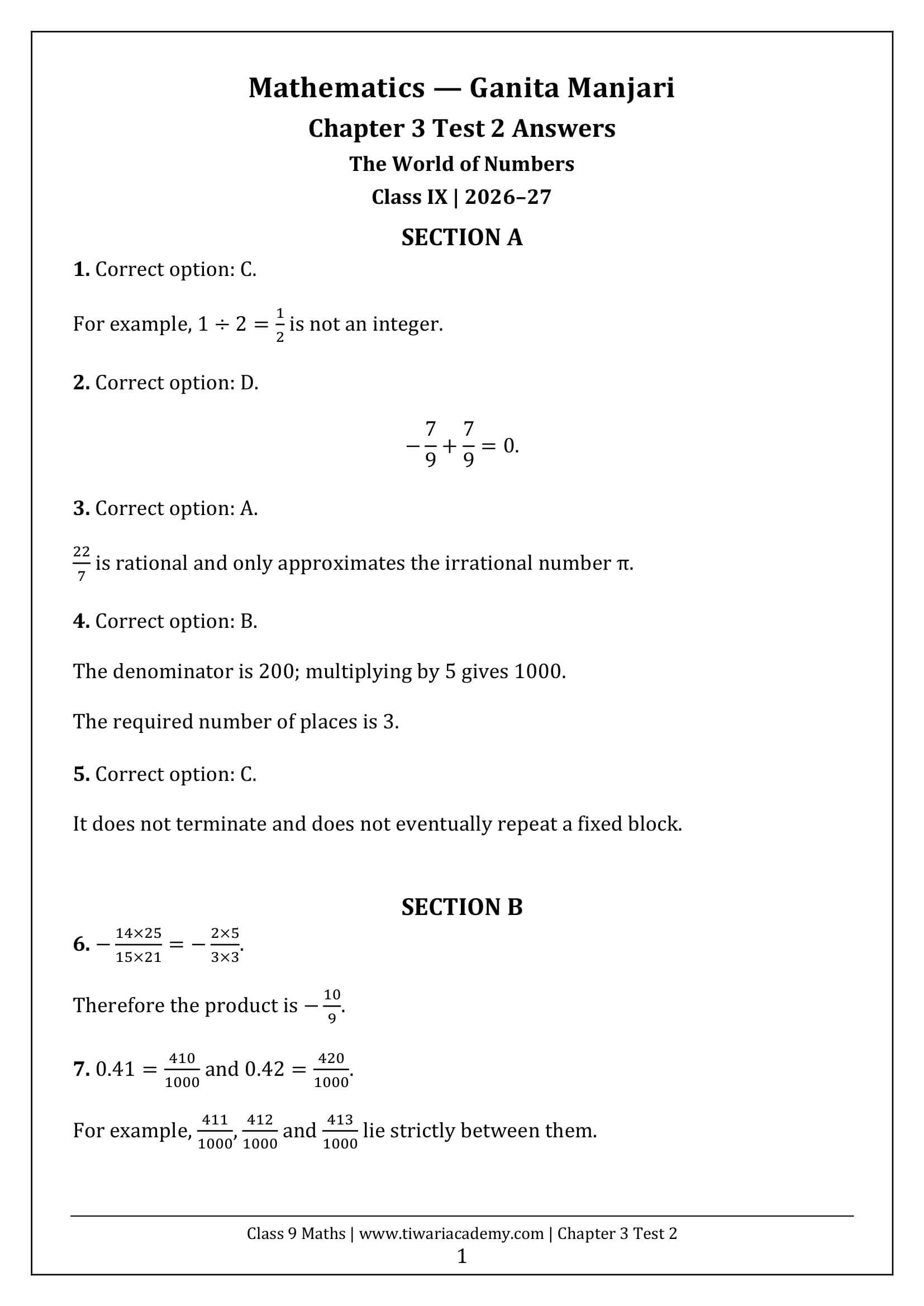
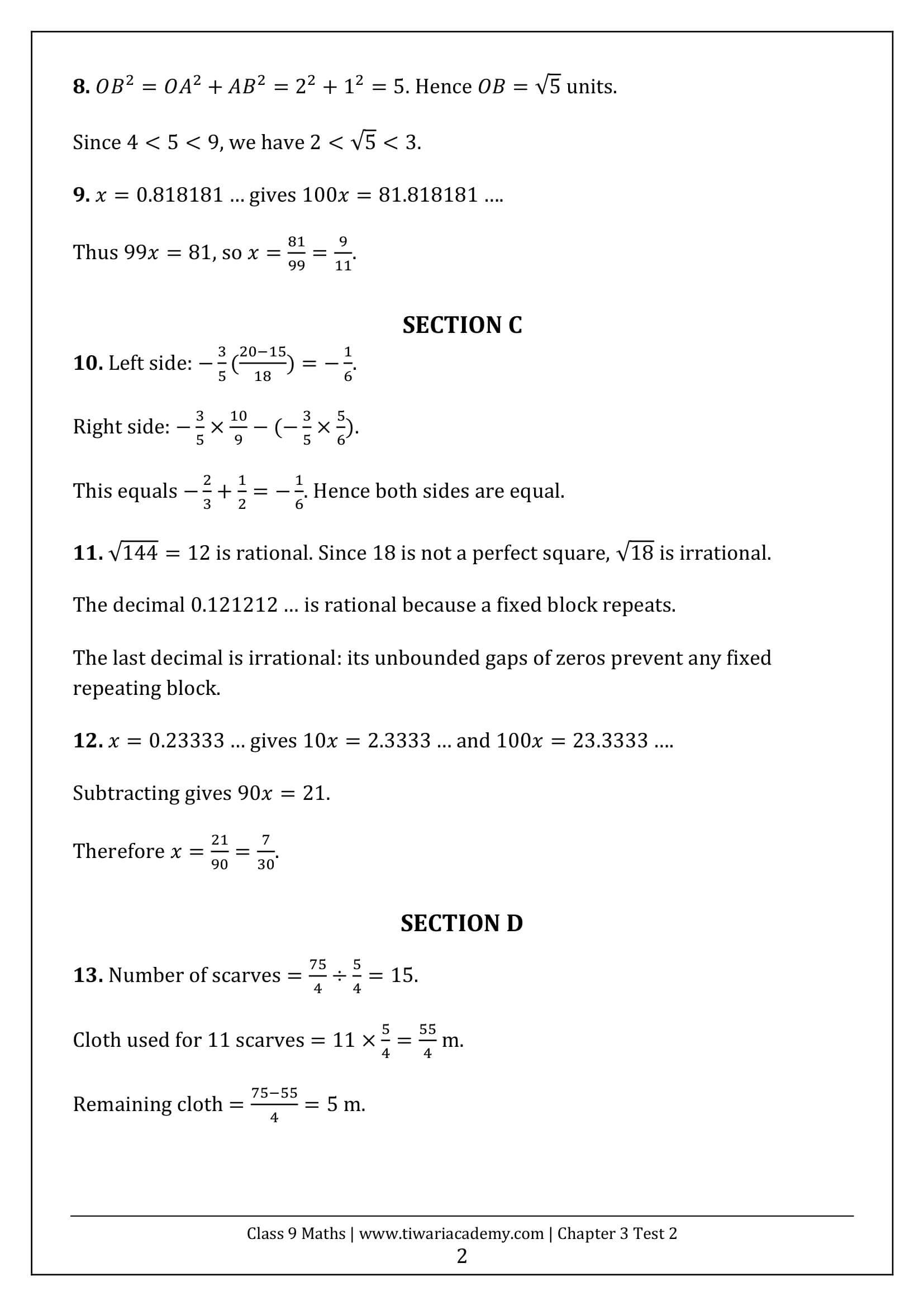
- Test Papers with Solutions (PDF)
The chapter opens with a vivid story: ancient herders on the banks of the Saraswati river placing pebbles in a clay pot to track their cattle — the very birth of Natural Numbers. It then travels through history to the Lebombo Bone (35,000 years old) and the Ishango Bone (20,000 BCE), which record some of the oldest known mathematical thinking. Rooted deeply in India’s intellectual heritage, the chapter celebrates the revolutionary contribution of Brahmagupta (628 CE), who transformed the philosophical concept of Śhūnyatā (emptiness) into the mathematical zero and formally introduced negative numbers through the lens of fortunes (dhana) and debts (ṛiṇa). Students then explore Rational Numbers, their density on the number line and arithmetic laws, before encountering the crisis of Irrational Numbers — numbers like √2 and π that cannot be expressed as fractions — proved through the elegant technique of Proof by Contradiction.
The chapter concludes with Real Numbers, decimal expansions (terminating, repeating and non-repeating), the magic of Cyclic Numbers and a tantalising glimpse at Imaginary Numbers waiting beyond the Real Number Line. This chapter is rich with Indian mathematical history, logical reasoning, and conceptual depth, making it one of the most intellectually engaging chapters in the Class 9 curriculum for 2026-27.
NCERT Class 9 Maths Ganita Manjari Chapter 3 Solutions
Class 9 Maths Ganita Manjari Chapter 3 Exercise Set 3.1 Solutions
Exercise Set 3.1
1. A merchant in the port city of Lothal is exchanging bags of spices for copper ingots. He receives 15 ingots for every 2 bags of spices. If he brings 12 bags of spices to the market, how many copper ingots will he leave with?
Answer:
Given that:
2 bags of spices = 15 ingots
So, 1 bag of spices = 15/2 ingots
Similarly, for 12 bags of spices
= 12 × (15/2)
= 6 × 15
= 90
Therefore, the merchant will leave with 90 copper ingots.
2. Look at the sequence of numbers on one column of the Ishango bone: 11, 13, 17, 19. What do these numbers have in common? List the next three numbers that fit this pattern.
Answer:
The numbers 11, 13, 17, 19 are all prime numbers (numbers that have only two factors: 1 and itself).
Next three prime numbers after 19 are 23, 29, 31.
Therefore, the next three numbers are 23, 29, 31.
3. We know that Natural Numbers are closed under addition (the sum of any two natural numbers is always a natural number). Are they closed under subtraction? Provide a couple of examples to justify your answer.
Answer:
Natural numbers are NOT closed under subtraction.
Explanation:
Closure means the result should also be a natural number.
Examples:
(i) 5 – 3 = 2 (Natural number )
(ii) 3 – 5 = –2 (Not a natural number)
Since subtraction can give a negative number, so natural numbers are not closed under subtraction.
4. Ancient Indians used the joints of their fingers to count, a practice still seen today. Each finger has 3 joints, and the thumb is used to count them. How many can you count on one hand? How does this relate to the ancient base-12 counting systems?
Answer:
Each finger (except thumb) has 3 joints.
Number of fingers used = 4 (excluding thumb)
Total joints = 4 × 3 = 12
So, we can count up to 12 using one hand.
Relation to base-12 system:
Since counting reaches 12 on one hand, it naturally leads to a base-12 (duodecimal) counting system used in ancient times.
Therefore:
- Total count = 12
- This explains the origin of base-12 counting system.
Class 9 Maths Ganita Manjari Chapter 3 Exercise Set 3.2 Solutions
Exercise Set 3.2
1. The temperature in the high-altitude desert of Ladakh is recorded as 4°C at noon. By midnight, it drops by 15°C. What is the midnight temperature?
Answer:
Initial temperature = 4°C
Drop = 15°C
Midnight temperature = 4 − 15 = −11°C
Therefore, the midnight temperature is −11°C.
2. A spice trader takes a loan (debt) of ₹850. The next day, he makes a profit (fortune) of ₹1,200. The following week, he incurs a loss of ₹450. Write this sequence as an equation using integers and calculate his final financial standing.
Answer:
Debt = − ₹850
Profit = + ₹1200
Loss = − ₹450
Equation: − ₹850 + ₹1200 − ₹450
Step-by-step calculation:
= ₹350 − ₹450
= − ₹100
Therefore, his final financial standing is −₹100 (a loss of ₹100).
3. Calculate the following using Brahmagupta’s laws:
(i) (−12) × 5 (ii) (−8) × (−7)
(iii) 0 − (−14) (iv) (−20) ÷ 4
Answer:
As per Brahmagupta’s laws:
Debt indicates Negative
Fortune indicates Positive
(i) (−12) × 5
Answer:
Negative × Positive = Negative [As Debt × Fortune = Debt]
Therefore, (−12) × 5 = −60
(ii) (−8) × (−7)
Answer:
Negative × Negative = Positive [As Debt × Debt = Fortune]
Therefore, (−8) × (−7) = 56
(iii) 0 − (−14)
Answer:
As per Brahmagupta, zero minus debt is a fortune.
Subtracting a negative is same as adding:
Therefore, 0 − (−14) = 0 + 14 = 14
(iv) (−20) ÷ 4
Answer:
Negative ÷ Positive = Negative [As Debt ÷ Fortune = Debt]
Therefore, (−20) ÷ 4 = −5.
4. Explain, using a real-world example of debt, why subtracting a negative number is the same as adding a positive number (e.g., 10 − (−5) = 15).
Answer:
Consider you have ₹10.
A negative number represents debt.
So, −₹5 means you owe ₹5.
Now, 10 − (−5) means removing a debt of ₹5.
If your debt is removed, your money increases by ₹5.
So, 10 − (−5) = 10 + 5 = 15
Thus, subtracting a negative number is the same as adding a positive number.
Class 9 Maths Ganita Manjari Chapter 3 Exercise Set 3.3 Solutions
Exercise Set 3.3
1. Prove that the following rational numbers are equal:
(i) 2/3 and 4/6
Answer:
To prove that two rational numbers are equal, we simplify them or compare their cross-products.
First Fraction: 2/3 = 2/3
Second Fraction: 4/6 = 2/3 (dividing numerator and denominator by 2)
Therefore, 2/3 and 4/6 are equal.
(ii) 5/4 and 10/8
Answer:
First Fraction: 5/4 = 5/4
Second Fraction: 10/8 = 5/4 (dividing numerator and denominator by 2)
Therefore, 5/4 and 10/8 are equal.
(iii) -3/5 and -6/10
Answer:
First Fraction: -3/5 = -3/5
Second Fraction: -6/10 = -3/5 (dividing numerator and denominator by 2)
Therefore, -3/5 and -6/10 are equal.
(iv) 9/3 and 3
Answer:
First Fraction: 9/3 = 3
Hence, 9/3 and 3 are equal.
2. Find the sum:
(i) 2/5 + 3/10
Answer:
LCM of 5 and 10 = 10
Simplifying the first number: 2/5 = 4/10 [Making the same denominator]
Now, the sum
= 2/5 + 3/10
= 4/10 + 3/10
= 7/10
Therefore, the sum of 2/5 + 3/10 is 7/10.
(ii) 7/12 + 5/8
Answer:
LCM of 12 and 8 = 24
Simplifying the first number: 7/12 = 14/24 [Making the same denominator]
Simplifying the second number: 5/8 = 15/24 [Making the same denominator]
Now, the sum
= 7/12 + 5/8
= 14/24 + 15/24
= 29/24
Therefore, the sum of 7/12 + 5/8 is 29/24.
(iii) – 4/7 + 3/14
Answer:
LCM of 7 and 14 = 14
Simplifying the first number: -4/7 = -8/14 [Making the same denominator]
So, the sum
= – 4/7 + 3/14
= – 8/14 + 3/14
= – 5/14
Therefore, the sum of – 4/7 + 3/14 is -5/14.
3. Find the difference:
(i) 5/6 – 1/4
Answer:
LCM of 6 and 4 = 12
Simplifying the first number: 5/6 = 10/12 [Making the same denominator]
Simplifying the Second number: 1/4 = 3/12 [Making the same denominator]
So, the difference
= 5/6 – 1/4
= 10/12 – 3/12
= 7/12
Therefore, the difference is 7/12.
(ii) 11/8 – 3/4
Answer:
LCM of 8 and 4 = 8
Simplifying the Second number: 3/4 = 6/8 [Making the same denominator]
So, the difference
= 11/8 – 3/4
= 11/8 – 6/8
= 5/8
Therefore, the difference is 5/8.
(iii) -7/9 – (-2/3)
Answer:
-7/9 – (-2/3) = -7/9 + 2/3
LCM of 9 and 3 = 9
Simplifying the Second number: 2/3 = 6/9 [Making the same denominator]
So, the difference
= – 7/9 – (-2/3)
= – 7/9 + 6/9
= – 1/9
Therefore, the difference is -1/9.
4. Find the product:
(i) 2/3 × 3/10
Answer:
2/3 × 3/10
= (2 × 3)/(3 × 10)
= 6/30
= 1/5 [After simplification]
Therefore, the product is 1/5.
(ii) 7/11 × 5/8
Answer:
7/11 × 5/8
= (7 × 5)/(11 × 8)
= 35/88
Therefore, the product is 35/88.
(iii) -4/7 × 5/14
Answer:
-4/7 × 5/14
= (-4 × 5)/(7 × 14)
= -20/98
= -10/49 [After simplification]
Therefore, the product is -10/49.
5. Find the quotient:
(i) 2/3 ÷ 3/10
Answer:
To divide fractions, multiply by the reciprocal.
2/3 ÷ 3/10
= 2/3 × 10/3
= (2 × 10)/(3 × 3)
= 20/9
Therefore, the quotient is 20/9.
(ii) 7/11 ÷ 5/8
Answer:
7/11 ÷ 5/8
= 7/11 × 8/5
= (7 × 8)/(11 × 5)
= 56/55
Therefore, the quotient is 56/55.
(iii) -4/7 ÷ 5/14
Answer:
-4/7 ÷ 5/14
= -4/7 × 14/5
= (-4 × 14)/(7 × 5)
= -56/35
= -8/5 [After simplification]
Therefore, the quotient is -8/5.
6. Show that: (1/2 + 3/4) × 8/3 = 1/2 × 8/3 + 3/4 × 8/3
Answer:
LHS = (1/2 + 3/4) × 8/3
= (2/4 + 3/4) × 8/3 [First add inside the bracket: 1/2 = 2/4]
= (5/4) × 8/3 [Since 2/4 + 3/4 = 5/4]
= 5/4 × 8/3
= (5 × 8)/4 × 3)
= 40/12
= 10/3 [After simplification]
RHS = 1/2 × 8/3 + 3/4 × 8/3
= (1 × 8)/(2 × 3) + (3 × 8)/(4 × 3)
= 8/6 + 24/12
= 4/3 + 6/3 [After simplification: 8/6 = 4/3 and 24/12 = 6/3]
= 10/3
Since LHS = RHS,
Therefore, (1/2 + 3/4) × 8/3 = 1/2 × 8/3 + 3/4 × 8/3
Hence proved.
7. Simplify the following using the distributive property: (7/9)(6/7 − 3/4).
Answer:
Using distributive property:
7/9 (6/7 − 3/4)
= 7/9 × 6/7 − 7/9 × 3/4
= 6/9 − 21/36
= 2/3 − 7/12
= 8/12 − 7/12 [LCM of 3 and 12 = 12 and 2/3 = 8/12]
= 1/12
Therefore, the simplified value of 7/9 (6/7 − 3/4) is 1/12.
8. Find the rational number x such that: (5/6)(x + 3/5) = (5/6)x + 1/2
Answer:
Given: (5/6)(x + 3/5) = (5/6)x + 1/2
⇒ (5/6)x + (5/6 × 3/5) = (5/6)x + 1/2
⇒ (5/6)x + 15/30 = (5/6)x + 1/2
⇒ 15/30 = 1/2, which is universal truth.
So, (5/6)(x + 3/5) = (5/6)x + 1/2 is true for every value of x.
Therefore, x can be any rational number.
Class 9 Maths Ganita Manjari Chapter 3 Exercise Set 3.4 Solutions
Exercise Set 3.4
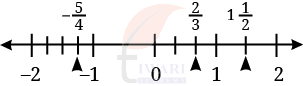
1. Represent the rational numbers 2/3, -5/4 and 1½ on a single number line.
Answer:
Convert mixed number:
1½ = 3/2
Now to compare the number first convert into decimal:
- -5/4 = -1.25
- 2/3 ≈ 0.67
- 3/2 = 1.5
On the number line:
- -5/4 lies between -2 and -1
- 2/3 lies between 0 and 1
- 3/2 lies between 1 and 2
So, order is:
-5/4 < 2/3 < 3/2
So, we can easily Mark these points accordingly on the number line.
2. Find three distinct rational numbers that lie strictly between -1/2 and 1/4.
Answer:
Given numbers: -1/2 and 1/4
LCM of 2 and 4 = 4
Converting -1/2 to common denominator:
-1/2 = -2/4
Now the given numbers: -2/4 and 1/4
So numbers between -2/4 and 1/4 are -1/4, 0, 1/8
Therefore, three rational numbers are -1/4, 0, 1/8.
3. Simplify the expression: (-1/4) + (5/12)
Answer:
LCM of 4 and 12 = 12
Converting -1/4 to common denominator:
-1/4 = -3/12
So, -3/12 + 5/12
= 2/12
= 1/6
Therefore, the result of (-1/4) + (5/12) is 1/6.
4. A tailor has 15¾ metres of fine silk. If making one kurta requires 2¼ metres of silk, exactly how many kurtas can he make?
Answer:
Converting improper fractions:
- 15¾ = 63/4
- 2¼ = 9/4
Total amount of silk cloth = 15¾ metres
In 2¼ metres of silk, number of kurta = 1
⇒ In 1 metres of silk, number of kurta = 1/2¼
⇒ In 15¾ metres of silk, number of kurta = 1/2¼ × 15¾
= 1/(9/4) × (63/4)
= 4/9 × 63/4
= (4 × 63)/(9 × 4)
= 63/9 = 7
Therefore, he can make exactly 7 kurtas from 15¾ metres of fine silk.
5. Find three rational numbers between 3.1415 and 3.1416.
Answer:
We can insert more decimal places:
3.1415 < 3.14151 < 3.14152 < 3.14153 < 3.1416
So, three rational numbers are 3.14151, 3.14152, 3.14153.
For Example:
- 3.141511, 3.141512, 3.141513, 3.141514, …
- 3.141521, 3.141522, 3.141523, 3.141524, …
- 3.141531, 3.141532, 3.141533, 3.141534, …
- 3.141541, 3.141542, 3.141543, 3.141544, …
- 3.141551, 3.141552, 3.141553, 3.141554, …
- 3.141561, 3.141562, 3.141563, 3.141564, …
6. Can you think of other way(s) to find a rational number between any two rational numbers?
Answer:
Yes, there are methods:
- Taking average:
If a and b are two rational numbers, then
(a + b)/2 lies between them. - By making common denominator:
Convert both numbers to same denominator and choose a number in between. - By decimal expansion:
Convert into decimals and pick numbers in between.
Class 9 Maths Ganita Manjari Chapter 3 Exercise Set 3.5 Solutions
Exercise Set 3.5
1. Without performing long division, determine which of the following rational numbers will have terminating decimals and which will be repeating: 7/20, 4/15 and 13/250. Then check your answers by explicitly performing the long divisions and expressing these rational numbers as decimals.
Answer:
A rational number p/q in lowest form has a terminating decimal:
- If the prime factors of q are only 2 and/or 5.
- If q has any prime factor other than 2 or 5, then the decimal is repeating.
(i) 7/20
Prime factorisation of 20:
20 = 2² × 5
Since the denominator has only 2 and 5 as prime factors, 7/20 has a terminating decimal.
Now convert into decimal:
7/20 = 0.35
Therefore, 7/20 is a terminating decimal.
(ii) 4/15
Prime factorisation of 15:
15 = 3 × 5
Since the denominator contains 3, which is neither 2 nor 5, 4/15 has a repeating decimal.
Now convert into decimal:
4/15 = 0.2666…
Therefore, 4/15 is a repeating decimal.
(iii) 13/250
Prime factorisation of 250:
250 = 2 × 5³
Since the denominator has only 2 and 5 as prime factors, 13/250 has a terminating decimal.
Now convert into decimal:
13/250 = 0.052
Therefore, 13/250 is a terminating decimal.
2. Perform the long division for 1/13. Identify the repeating block of digits. Does it show cyclic properties if you evaluate 2/13? Now compute 3/13, 4/13, etc. What do you notice?
Answer:
Let us first write the decimal expansion of 1/13:
1/13 = 0.076923076923…
So, the repeating block of digits is 076923.
Now evaluate:
2/13 = 0.153846153846…
Repeating block: 153846
3/13 = 0.230769230769…
Repeating block: 230769
4/13 = 0.307692307692…
Repeating block: 307692
5/13 = 0.384615384615…
Repeating block: 384615
6/13 = 0.461538461538…
Repeating block: 461538
Here we notice that:
- Each decimal is repeating.
- The repeating blocks are cyclic shifts of one another.
- So yes, the decimal expansion shows cyclic properties.
3. Classify the following numbers as rational or irrational:
(i) √81
Answer:
√81 = 9
Since 9 can be written as 9/1, it is a rational number.
Therefore, √81 is rational.
(ii) √12
Answer:
√12 = 2√3
Since √3 is irrational, √12 is irrational.
Therefore, √12 is irrational.
(iii) 0.33333…
Answer:
0.33333… = 1/3
This is a repeating decimal, so it is rational.
Therefore, 0.33333… is rational.
Explicit fraction: 1/3
(iv) 0.123451234512345…
Answer:
The block 12345 repeats continuously.
A repeating decimal is rational.
Let x = 0.123451234512345…
Then, 100000x = 12345.0.123451234512345…
Subtract:
100000x – x = 12345
99999x = 12345
x = 12345/99999
x = 4115/33333
Therefore, 0.123451234512345… is rational.
Explicit fraction: 4115/33333
(v) 1.01001000100001…
Answer:
This decimal does not terminate and does not repeat a fixed block.
The number of zeros between 1s keeps changing.
So, it is non-terminating and non-repeating.
Therefore, 1.01001000100001… is irrational.
(vi) 23.560185612239874790120
Answer:
This is a terminating decimal.
Every terminating decimal is rational.
Convert into fraction:
23.560185612239874790120
= 23560185612239874790120 / 1000000000000000000000
Therefore, 23.560185612239874790120 is rational.
Explicit fraction:
23560185612239874790120 / 1000000000000000000000
4. The number 0.9̅ (which means 0.99999…) is a rational number. Using algebra (let x = 0.9̅, multiply by 10, and subtract), explain why 0.9̅ is exactly equal to 1.
Answer:
Let x = 0.99999…
Multiply both sides by 10:
10x = 9.99999…
Now subtract:
10x – x = 9.99999… – 0.99999…
9x = 9
x = 1
But x = 0.99999…
Therefore, 0.99999… = 1.
5. We have seen that the repeating block of 1/7 is a cyclic number. Try to find more numbers (n) whose reciprocals (1/n) produce decimals with repeating blocks that are cyclic.
Answer:
Some examples are:
1/7 = 0.142857142857142857…
1/17 = 0.058823529411764705882352941176470588235294117647…
1/19 = 0.052631578947368421052631578947368421052631578947368421…
These reciprocals produce repeating blocks that show cyclic behaviour.
Therefore, examples of such numbers are 7, 17, 19, …
These are numbers whose reciprocals can give cyclic repeating decimals.
Class 9 Maths Ganita Manjari Chapter 3 End of Chapter Exercises Solutions
End of Chapter Exercises
1. Convert the following rational numbers in the form of a terminating decimal or non-terminating and repeating decimal, whichever the case may be, by the process of long division:
(i) 3/50
Answer:
3/50 = 0.06
Therefore, 3/50 is a terminating decimal.
(ii) 2/9
Answer:
2/9 = 0.2222…
= 0.2̅
Therefore, 2/9 is a non-terminating repeating decimal.
2. Prove that √5 is an irrational number.
Answer:
We will use proof by contradiction.
Assume that √5 is rational. Then it can be written in the form of p/q:
Let √5 = p/q, where p and q are integers, q ≠ 0, and p/q is in lowest terms (that is, p and q have no common factor except 1).
Squaring both sides, we get:
5 = p²/q²
So, p² = 5q²
This means p² is divisible by 5.
Therefore, p is also divisible by 5.
So let p = 5k, for some integer k.
Substitute into p² = 5q², we get:
(5k)² = 5q²
⇒ 25k² = 5q²
⇒ 5k² = q²
This shows that q² is divisible by 5.
Therefore, q is also divisible by 5.
So both p and q are divisible by 5.
But this contradicts our assumption that p/q was in lowest terms.
Hence, our assumption is wrong.
Therefore, √5 is an irrational number.
3. Convert the following decimal numbers in the form of p/q.
(i) 12.6
Answer:
12.6 = 126/10 = 63/5
Therefore, 12.6 = 63/5
(ii) 0.0120
Answer:
0.0120 = 120/10000 = 3/250
Therefore, 0.0120 = 3/250
(iii) 3.05̅2̅
Answer:
Let x = 3.052525252…
Then, 10x = 30.52525252…
and 1000x = 3052.52525252…
Subtracting: 1000x – 10x = 3052.52525252… – 30.52525252…
⇒ 990x = 3022
⇒ x = 3022/990
⇒ x = 1511/495
Therefore, 3.05̅2̅ = 1511/495
(iv) 1.23̅5̅
Answer:
Let x = 1.2353535…
Then, 10x = 12.353535… (1)
and 1000x = 1235.353535… (2)
Subtract equation (1) from (2), we have:
1000x – 10x = 1235.353535… – 12.353535…
⇒ 990x = 1223
⇒ x = 1223/990
Therefore, 1.23̅5̅ = 1223/990
(v) 0.2̅3̅
Answer:
Let x = 0.232323…
Then, 100x = 23.232323…
Subtract: 100x – x = 23.232323… – 0.232323…
⇒ 99x = 23
So, x = 23/99
Therefore, 0.2̅3̅ = 23/99
(vi) 2.05̅
Answer:
Let x = 2.05555…
Then, 10x = 20.5555…
100x = 205.5555…
Subtract: 100x – 10x = 205.5555… – 20.5555…
⇒ 90x = 185
So, x = 185/90 = 37/18
Therefore, 2.05̅ = 37/18
(vii) 2.125̅
Answer:
Let x = 2.125555…
Then, 100x = 212.5555…
1000x = 2125.5555…
Subtract: 1000x – 100x = 2125.5555… – 212.5555…
⇒ 900x = 1913
So, x = 1913/900
Therefore, 2.125̅ = 1913/900
(viii) 3.125̅
Answer:
Let x = 3.125555…
Then 100x = 312.5555…
Then, 1000x = 3125.5555…
Subtract: 1000x – 100x = 3125.5555… – 312.5555…
⇒ 900x = 2813
So, x = 2813/900
Therefore, 3.125̅ = 2813/900
(ix) 2.1̅6̅2̅5̅
Answer:
Let x = 2.162516251625…
Then, 10000x = 21625.16251625…
Subtract: 10000x – x = 21625.16251625… – 2.16251625…
⇒ 9999x = 21623
So, x = 21623/9999
Therefore, 2.1̅6̅2̅5̅ = 21623/9999
4. Locate the following rational numbers on the number line.
(i) 0.532
Answer:
0.532 lies between 0 and 1.
More precisely: 0.532 = 532/1000
So, we have to mark a point between 0.53 and 0.54, slightly after 0.53.

(ii) 1.15̅
Answer:
1.15̅ = 1.15555…
It lies between 1 and 2.
More precisely: 1.15 < 1.15555… < 1.16
So, we have to mark a point between 1.15 and 1.16, slightly after 1.15.

5. Find 6 rational numbers between 3 and 4.
Answer:
We can write 3 and 4 with a common denominator:
3 = 21/7
4 = 28/7
So, six rational numbers between 3 and 4 are:
22/7, 23/7, 24/7, 25/7, 26/7, 27/7
Therefore, the required six rational numbers are:
22/7, 23/7, 24/7, 25/7, 26/7, 27/7
6. Find 5 rational numbers between 2/5 and 3/5.
Answer:
Write both fractions with a larger common denominator:
2/5 = 20/50
3/5 = 30/50
So, five rational numbers between 20/50 and 30/50 are:
21/50, 22/50, 23/50, 24/50, 25/50
Therefore, the required five rational numbers are:
21/50, 22/50, 23/50, 24/50, 25/50
7. Find 5 rational numbers between 1/6 and 2/5.
Answer:
First take a common denominator:
1/6 = 5/30
2/5 = 12/30
Now the fractions between 5/30 and 12/30 are:
6/30, 7/30, 8/30, 9/30, 10/30
Therefore, five rational numbers between 1/6 and 2/5 are:
6/30, 7/30, 8/30, 9/30, 10/30
These may also be written in simplest form as:
1/5, 7/30, 4/15, 3/10, 1/3
8. If x/3 + x/5 = 16/15, find the rational number x.
Answer:
Given: x/3 + x/5 = 16/15
Taking x common, we have:
x(1/3 + 1/5) = 16/15
Now, 1/3 + 1/5 = 5/15 + 3/15 = 8/15
So, x × 8/15 = 16/15
Therefore, x = (16/15) ÷ (8/15)
= (16/15) × (15/8)
= 16/8
= 2
Therefore, the rational number x is 2.
9. Let a and b be two non-zero rational numbers such that a + 1/b = 0. Without assigning any numerical values, determine whether ab is positive or negative. Justify your answer.
Answer:
Given: a + 1/b = 0
So, a = -1/b
Multiply both sides by b:
ab = -1
Since ab = -1, which is negative,
Therefore, ab is negative.
10. A rational number has a terminating decimal expansion whose last non-zero digit occurs in the 4th decimal place. Show that such a number can be written in the form p/10⁴, where p is an integer not divisible by 10. Is it necessary that the denominator of this rational number, when written in the lowest form, is divisible by 2⁴ or 5⁴? Give reasons.
Answer:
If the last non-zero digit occurs in the 4th decimal place, then the number has exactly 4 decimal places.
So it can be written as: p/10⁴, where p is an integer.
Also, since the last non-zero digit is in the 4th decimal place, p is not divisible by 10. Otherwise, the decimal would end earlier.
Hence, the number can be written in the form: p/10⁴, where p is an integer not divisible by 10.
Now, 10⁴ = 2⁴ × 5⁴
When the fraction is reduced to lowest form, some common factors between p and 10⁴ may cancel.
Therefore, it is NOT necessary that the denominator in lowest form is divisible by 2⁴ or 5⁴.
Example: 0.1250 = 1250/10000 = 1/8
Here, in lowest form the denominator is 8 = 2³, which is not divisible by 2⁴ or 5⁴.
Therefore, it is not necessary.
11. Without performing division, determine whether the decimal expansion of 18/125 is terminating or non-terminating. If it terminates, state the number of decimal places.
Answer:
Given: 18/125
The denominator is 125 = 5³
Since the denominator has only the prime factor 5, the decimal expansion is terminating.
To find the number of decimal places, make the denominator a power of 10: 125 × 8 = 1000
So, 18/125 = 144/1000 = 0.144
Thus, it terminates with 3 decimal places.
Therefore, 18/125 is a terminating decimal with 3 decimal places.
12. A rational number in its lowest form has denominator 2³ × 5. How many decimal places will its decimal expansion have? Explain your answer.
Answer:
Given denominator:
2³ × 5 = 8 × 5 = 40
A rational number with denominator of the form 2ᵐ × 5ⁿ has a terminating decimal expansion.
The number of decimal places is equal to the greater of m and n.
Here: m = 3, n = 1
So, number of decimal places = 3
Example: 1/40 = 0.025
Therefore, the decimal expansion will have 3 decimal places.
13. Let a = 7/12 and b = 5/6. Express both a and b in the form k₁/m and k₂/m where k₁, k₂ and m are integers and k₂ − k₁ > 6. Using the same denominator m, write exactly five distinct rational numbers lying between a and b keeping an integer numerator. Explain why the condition k₂ − k₁ > n + 1 is necessary to find n such rational numbers between the two rational numbers a and b using this method.
Answer:
Given:
a = 7/12
b = 5/6
First express both with the same denominator.
Since, 5/6 = 10/12,
we have: a = 7/12 and b = 10/12
Here, k₂ − k₁ = 10 − 7 = 3, which is not greater than 6.
So we multiply both fractions by 3:
a = 7/12 = 21/36
b = 10/12 = 30/36
Now, k₁ = 21, k₂ = 30, m = 36
and k₂ − k₁ = 30 − 21 = 9 > 6
So, five distinct rational numbers between a and b are:
22/36, 23/36, 24/36, 25/36, 26/36
These all lie strictly between 21/36 and 30/36.
Therefore, exactly five rational numbers between a and b are:
22/36, 23/36, 24/36, 25/36, 26/36
Why is the condition k₂ − k₁ > n + 1 necessary?
If we want n rational numbers between k₁/m and k₂/m, then we need at least n integers strictly between k₁ and k₂.
The integers strictly between k₁ and k₂ are k₁ + 1, k₁ + 2, …, k₂ − 1
Their number is (k₂ − k₁ − 1)
To get n rational numbers between them, we must have k₂ − k₁ − 1 ≥ n
So, k₂ − k₁ ≥ n + 1
For safety in this method, the condition is taken as k₂ − k₁ > n + 1
Thus, this ensures that enough integer numerators are available between k₁ and k₂ to form n distinct rational numbers.
14. Three rational numbers x, y, z satisfy x + y + z = 0 and xy + yz + zx = 0. Show that all the rational numbers x, y, z must be simultaneously zero.
Answer:
Given:
x + y + z = 0 …(1)
xy + yz + zx = 0 …(2)
We use the identity:
(x + y + z)² = x² + y² + z² + 2(xy + yz + zx)
From (1), (x + y + z)² = 0² = 0
From (2), xy + yz + zx = 0
So, 0 = x² + y² + z² + 2(0)
Therefore, x² + y² + z² = 0
Now, x², y² and z² are all non-negative rational numbers.
The sum of three non-negative numbers is 0 only when each one is 0.
Hence, x² = 0, y² = 0, z² = 0
Therefore, x = 0, y = 0, z = 0
So, all the rational numbers x, y and z are simultaneously zero.
15. Show that the rational number (a + b) / 2 lies between the rational numbers a and b.
Answer:
Let us assume that a < b.
We have to show that:
a < (a + b) / 2 < b
First, compare a and (a + b) / 2:
Since a < b,
adding a to both sides gives:
a + a < a + b
2a < a + b
Dividing both sides by 2: a < (a + b) / 2
Now, compare (a + b) / 2 and b:
Since a < b,
adding b to both sides gives:
a + b < b + b
a + b < 2b
Dividing both sides by 2:
(a + b) / 2 < b
Thus, a < (a + b) / 2 < b
Therefore, the rational number (a + b) / 2 lies between a and b.
Note: If b < a, then similarly we get:
b < (a + b) / 2 < a
So in either case, (a + b) / 2 lies between a and b.
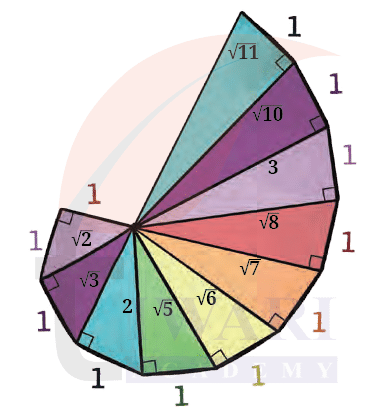
16. Find the lengths of the hypotenuses of all the right triangles in Fig. 3.14 which is referred to as the square root spiral.

Answer:
In the square root spiral, each new right triangle is formed by taking:
- one leg = 1 unit
- the other leg = hypotenuse of the previous triangle
Using Pythagoras theorem:
First triangle: Sides = 1, 1
Hypotenuse = √(1² + 1²) = √2
Second triangle:
Sides = √2, 1
Hypotenuse = √[(√2)² + 1²] = √3
Third triangle:
Sides = √3, 1
Hypotenuse = √[(√3)² + 1²] = √4 = 2
Fourth triangle:
Sides = 2, 1
Hypotenuse = √(2² + 1²) = √5
Fifth triangle:
Sides = √5, 1
Hypotenuse = √6
Sixth triangle:
Hypotenuse = √7
Seventh triangle:
Hypotenuse = √8 = 2√2
Eighth triangle:
Hypotenuse = √9 = 3
Ninth triangle:
Hypotenuse = √10
Tenth triangle:
Hypotenuse = √11
Thus, the lengths of the hypotenuses of the triangles in the square root spiral are:
√2, √3, √4, √5, √6, √7, √8, √9, √10, √11, …
That is, √2, √3, 2, √5, √6, √7, 2√2, 3, √10, √11, …
Hence, in general, the hypotenuse lengths follow the pattern:
√2, √3, √4, √5, √6, … up to as many triangles as drawn in the figure.
Class 9 Maths Ganita Manjari Chapter 3 Practice Tests
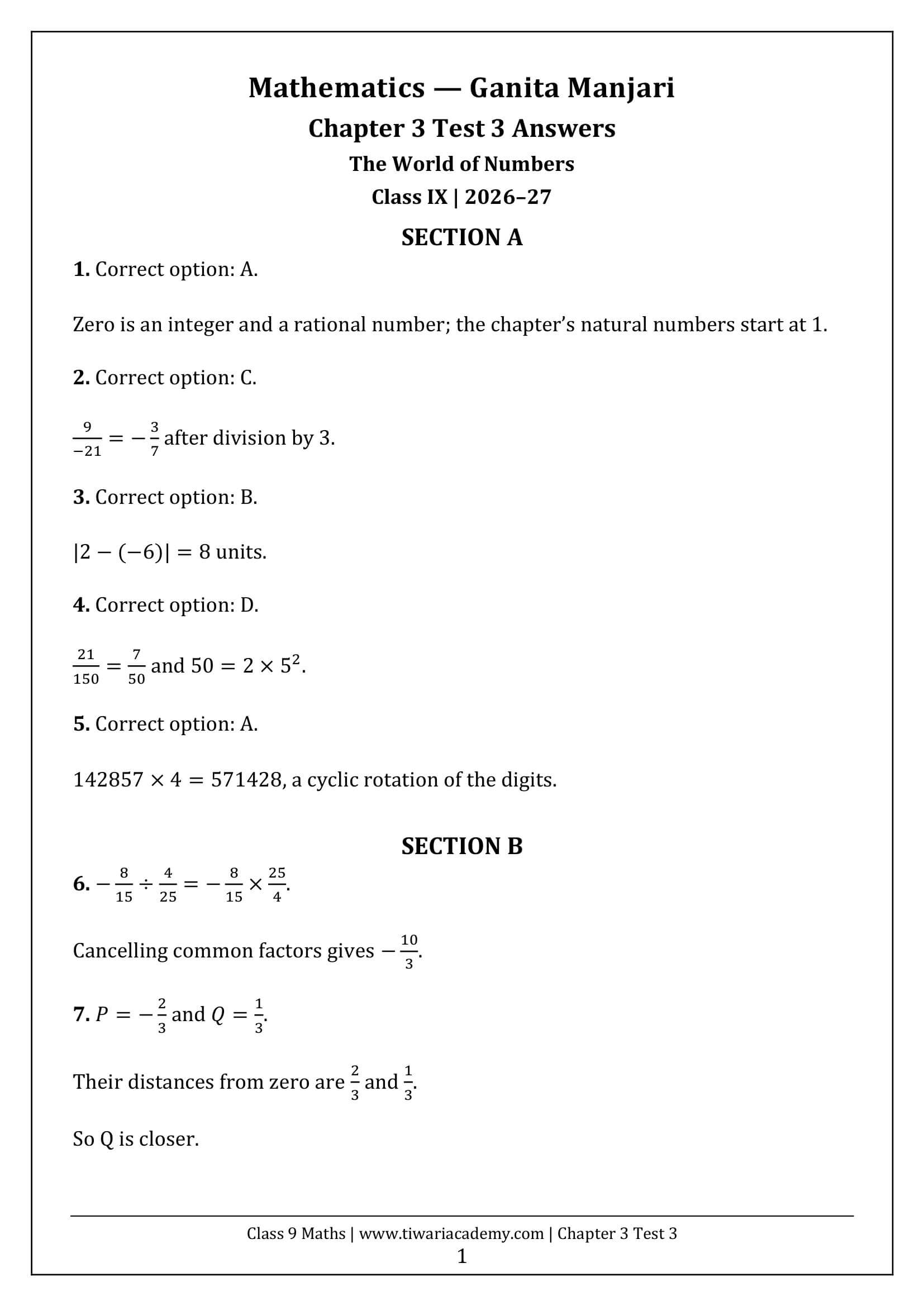
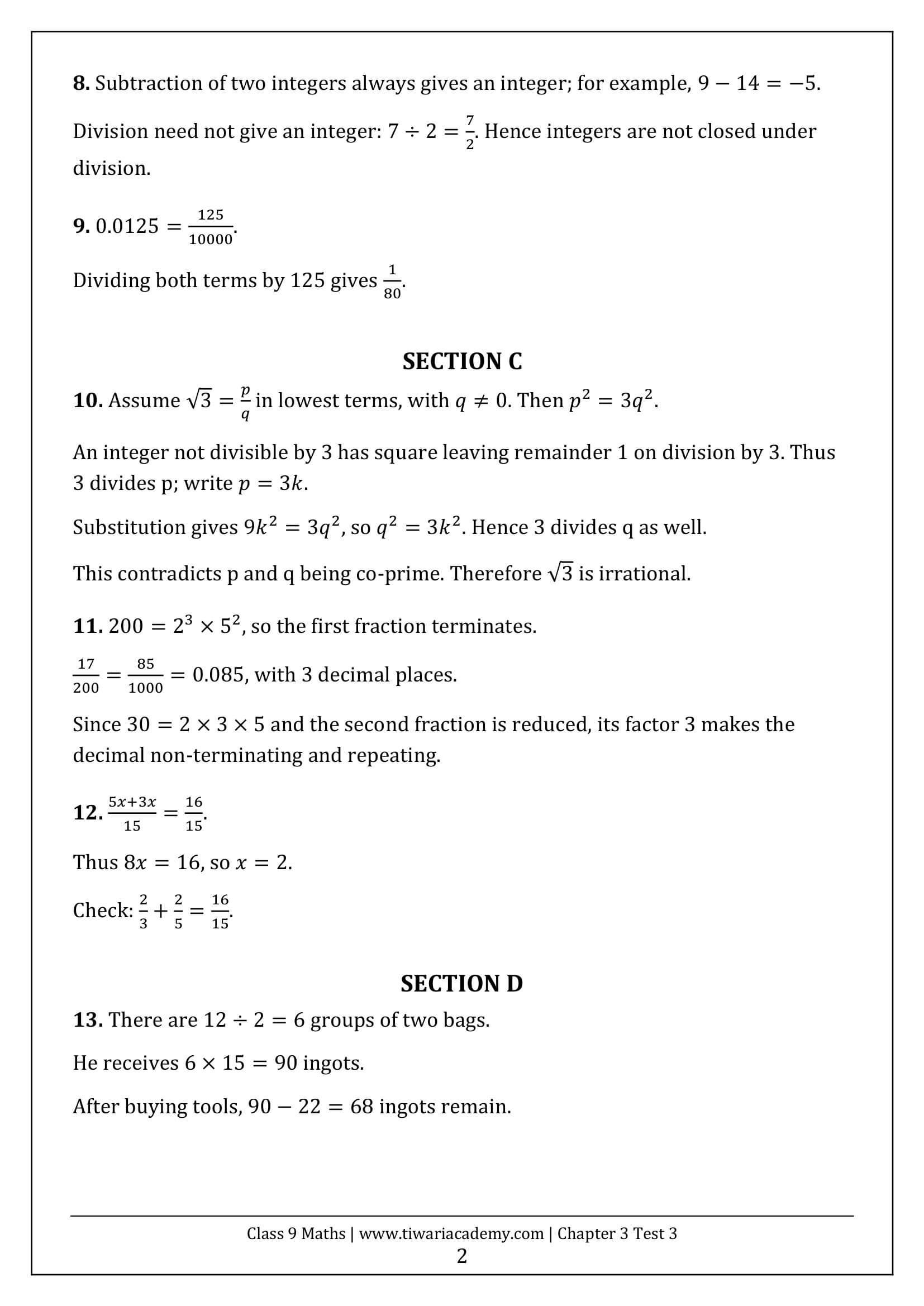
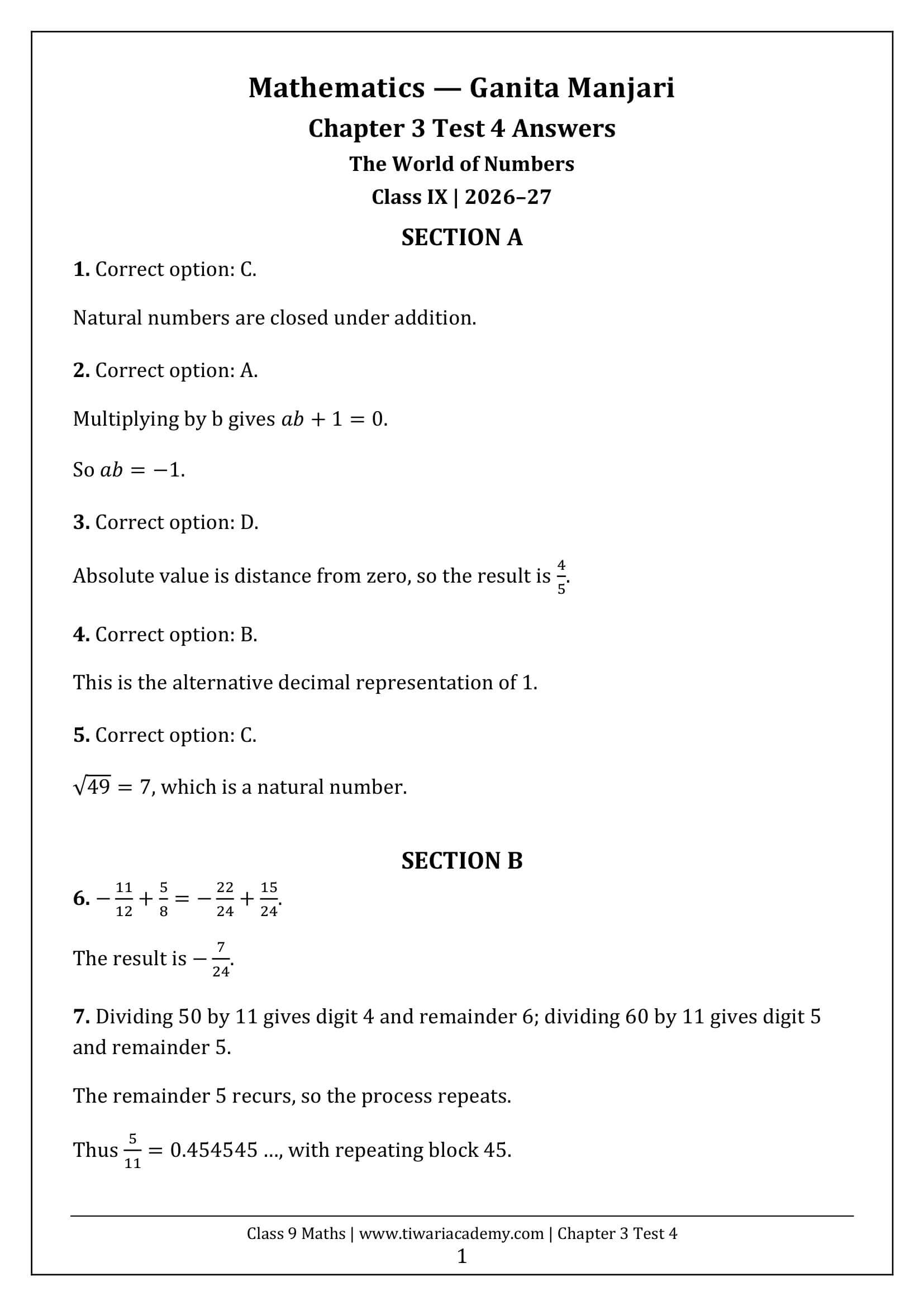
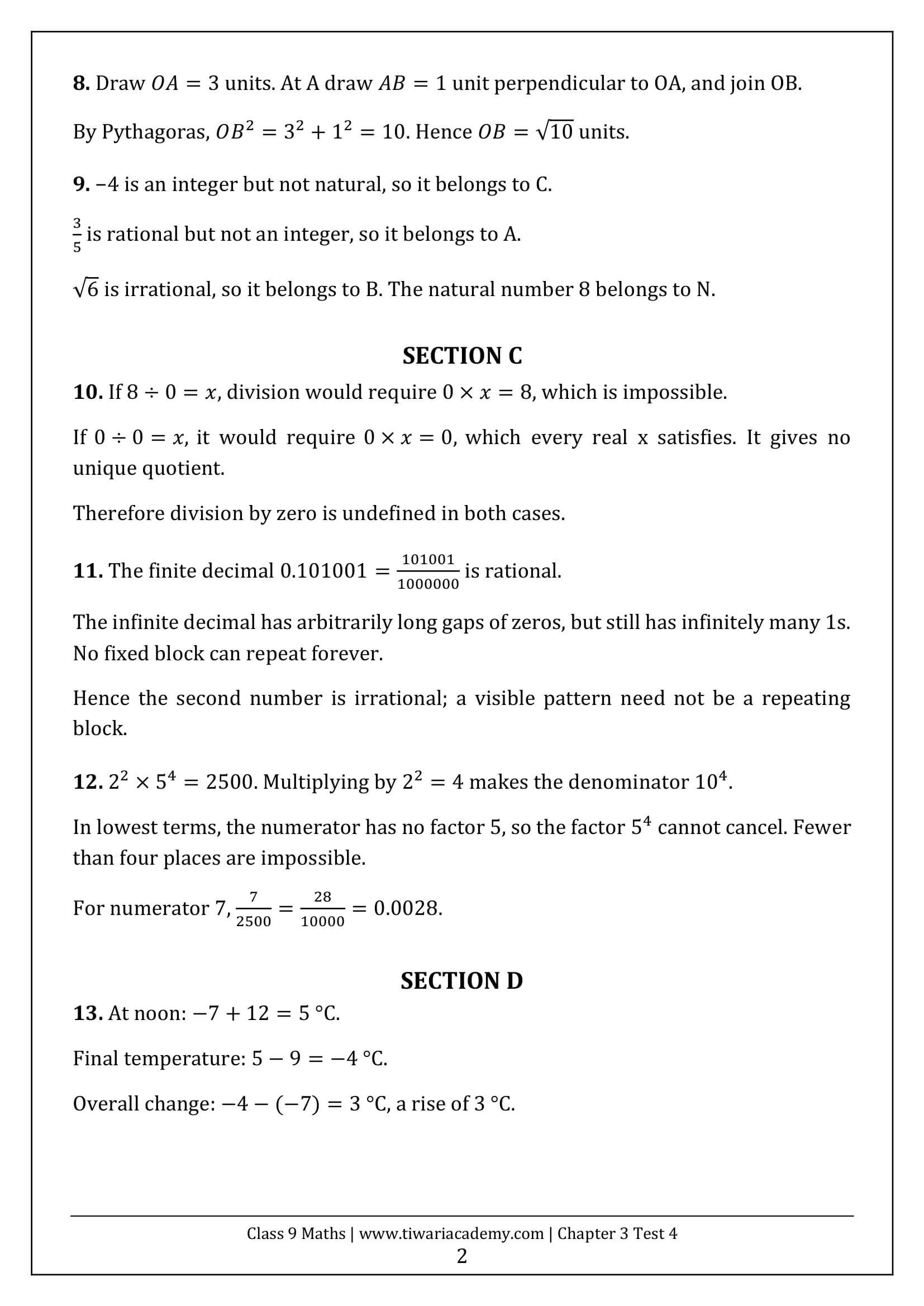
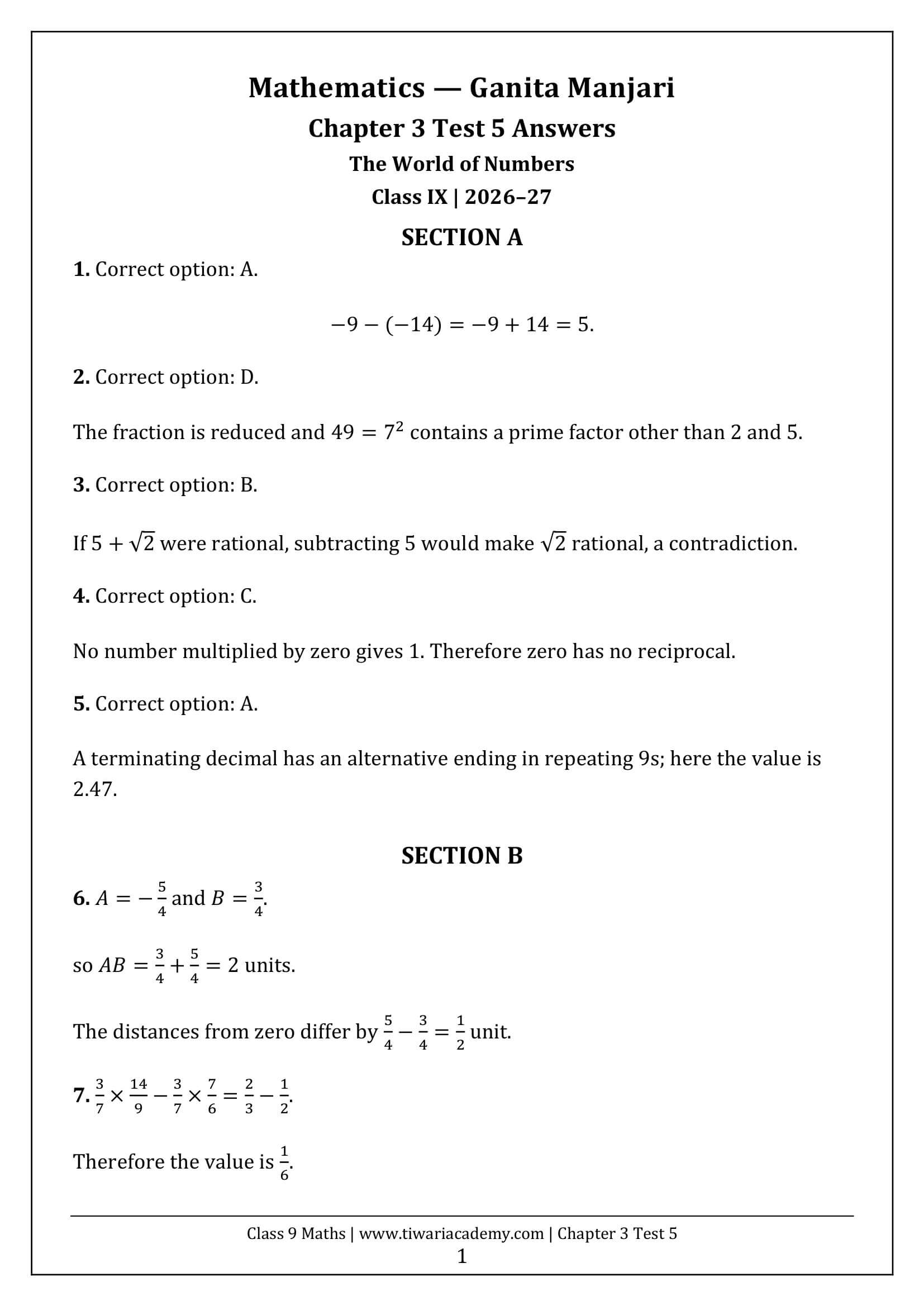
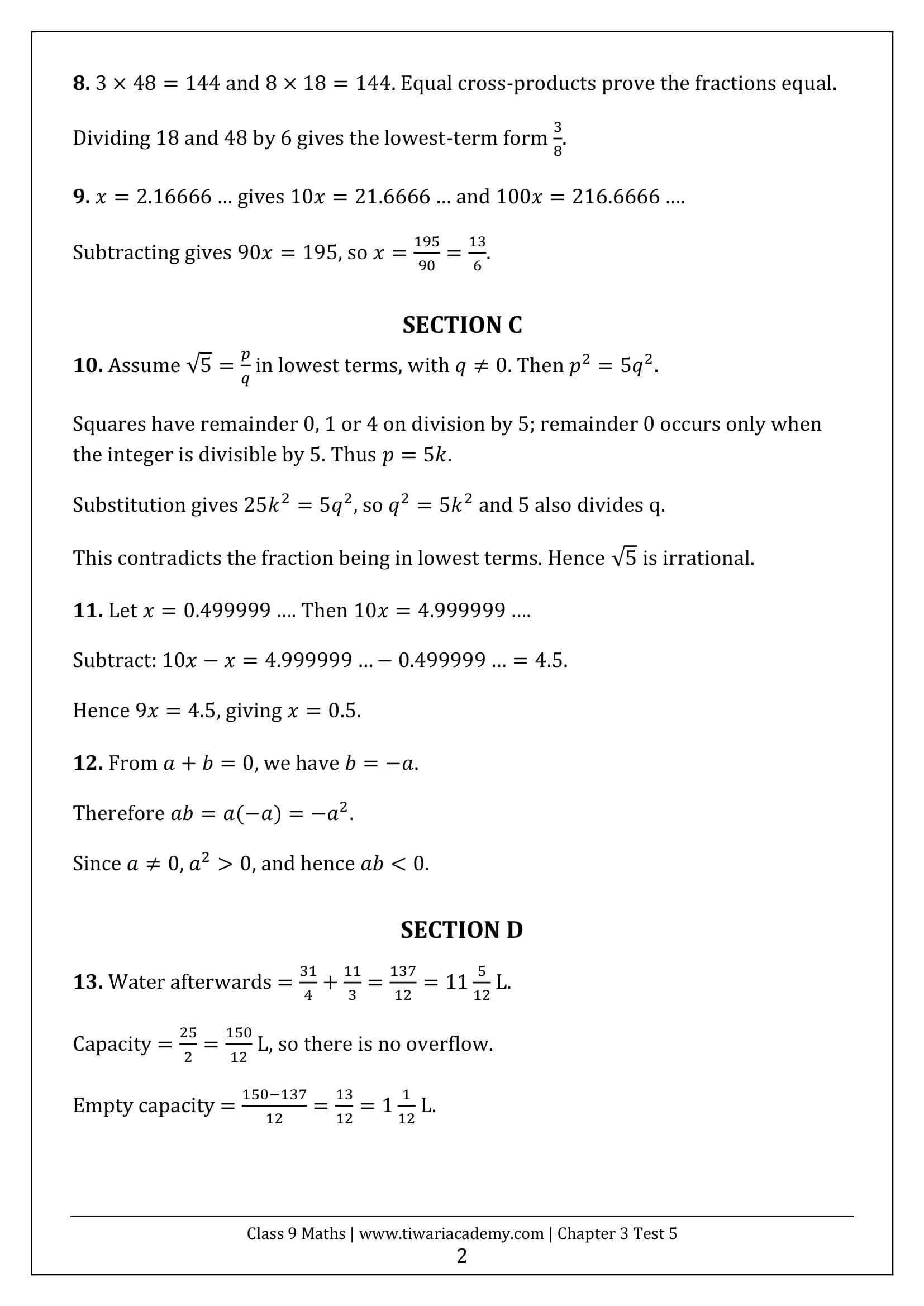
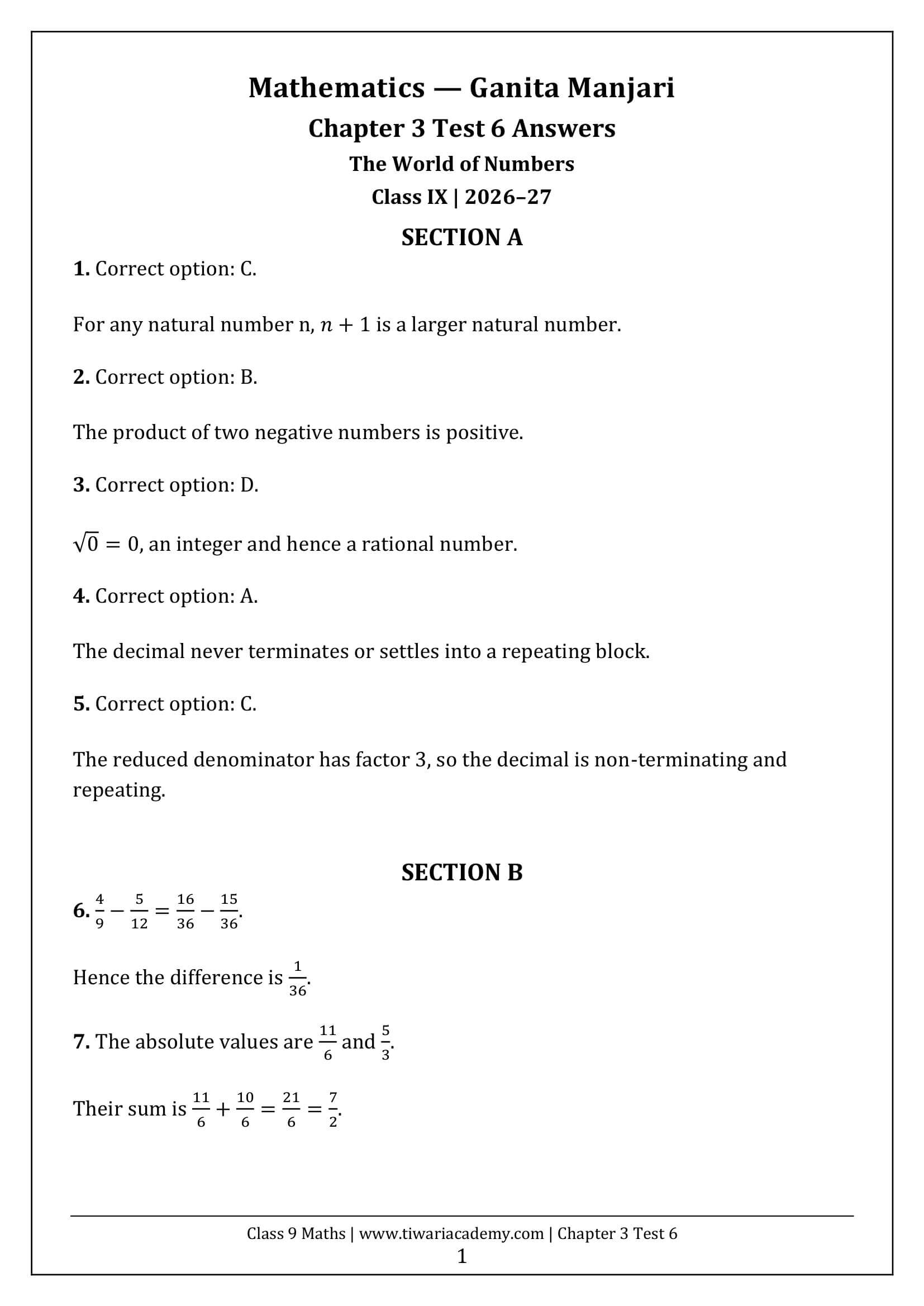
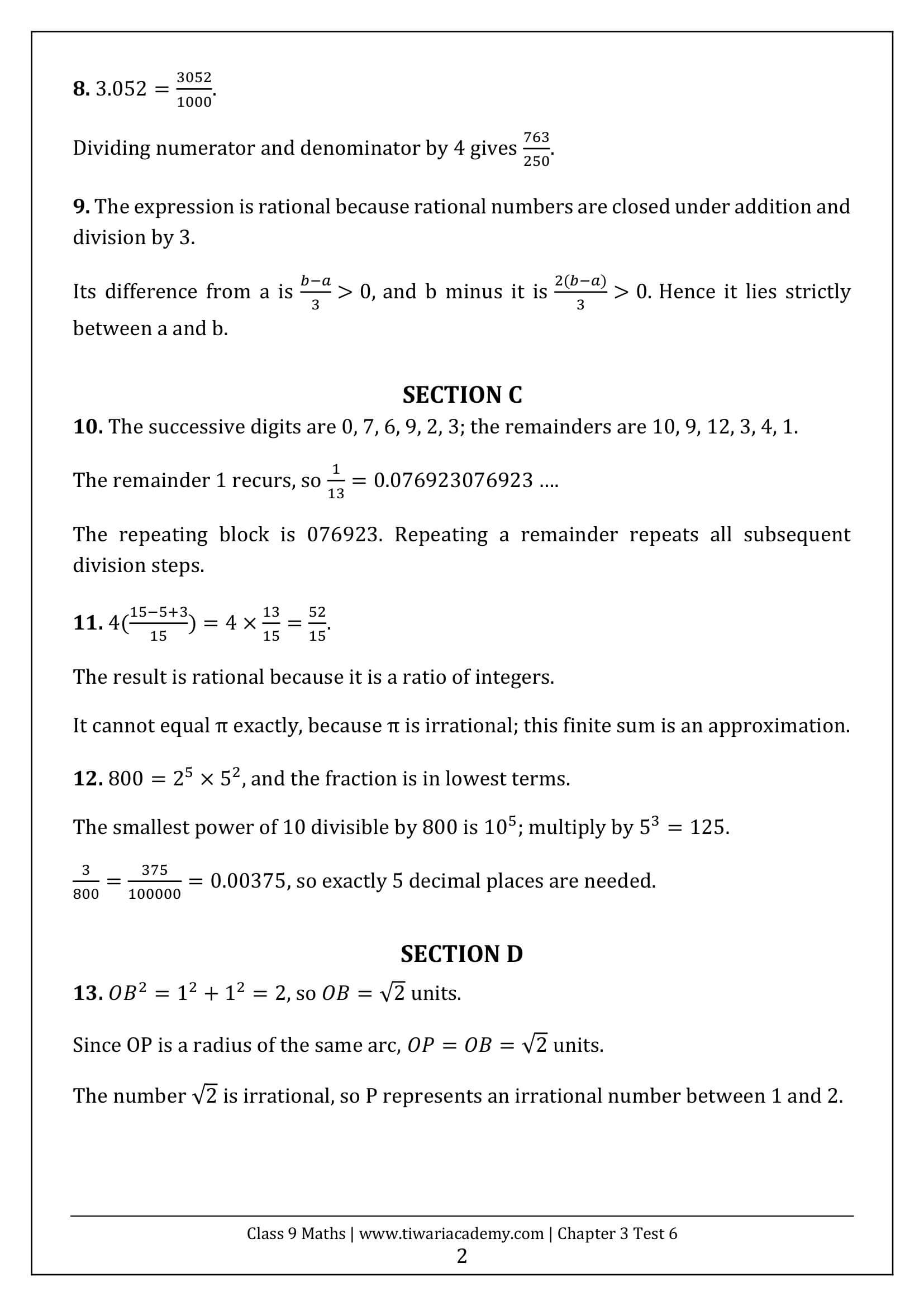
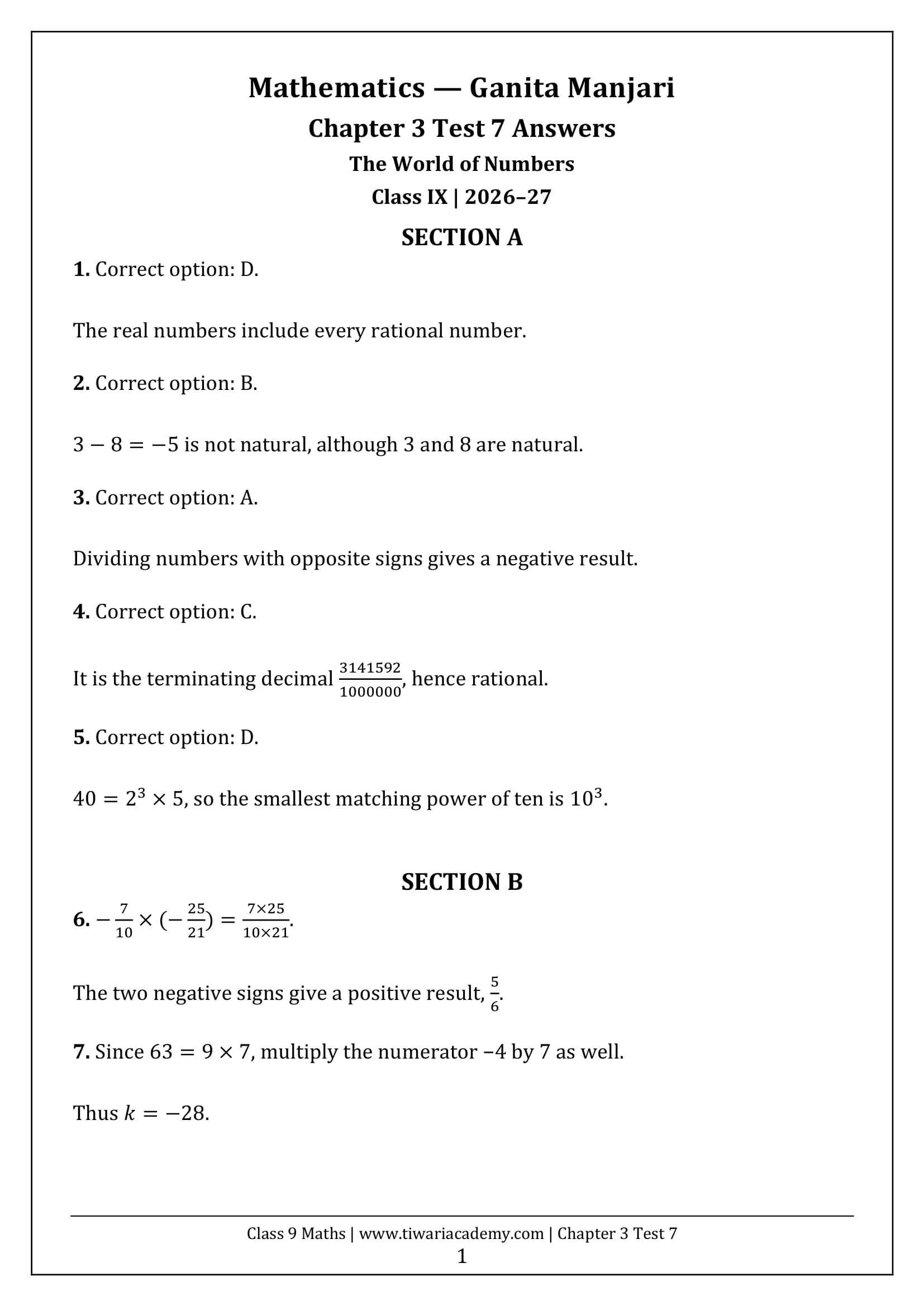
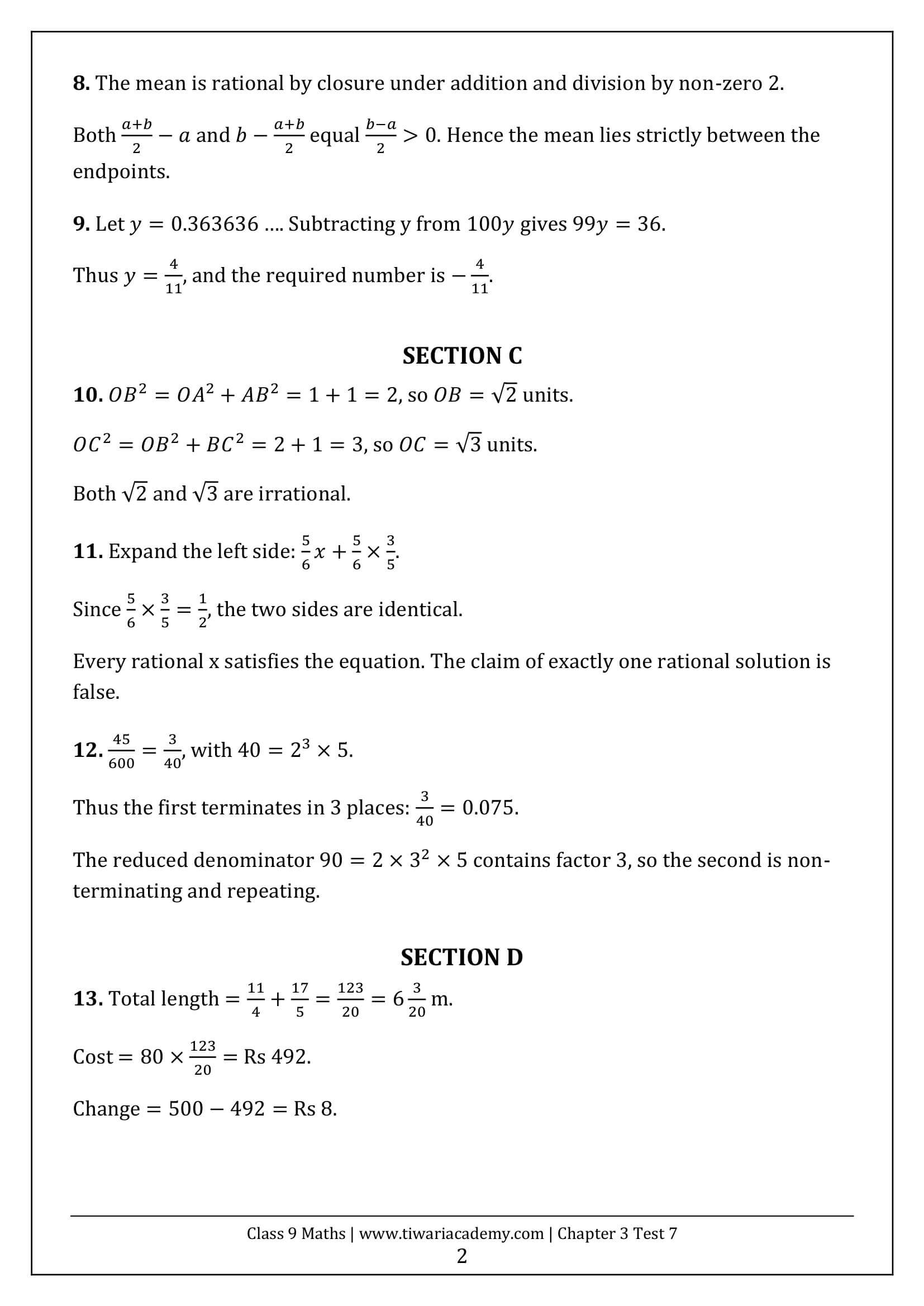
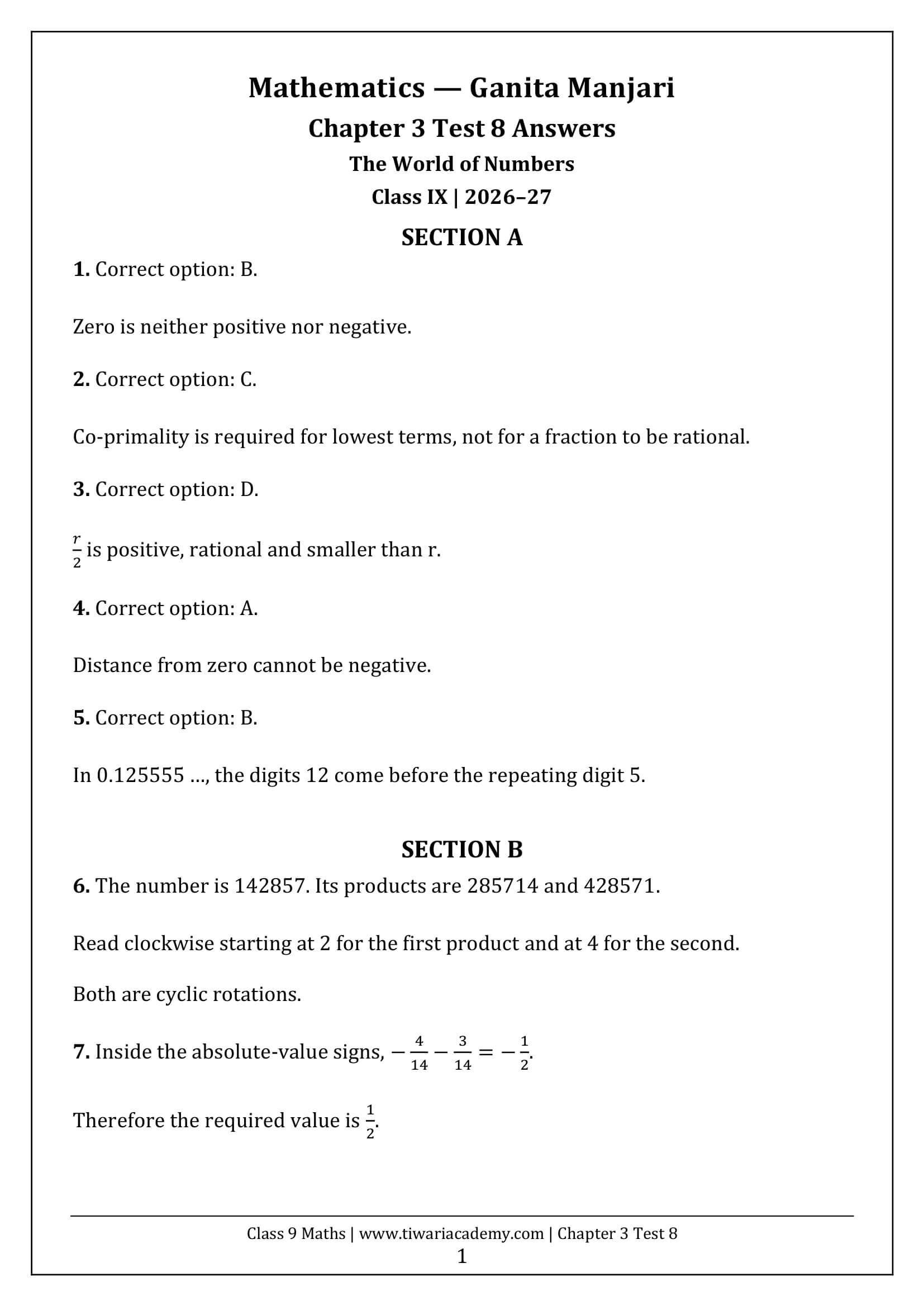
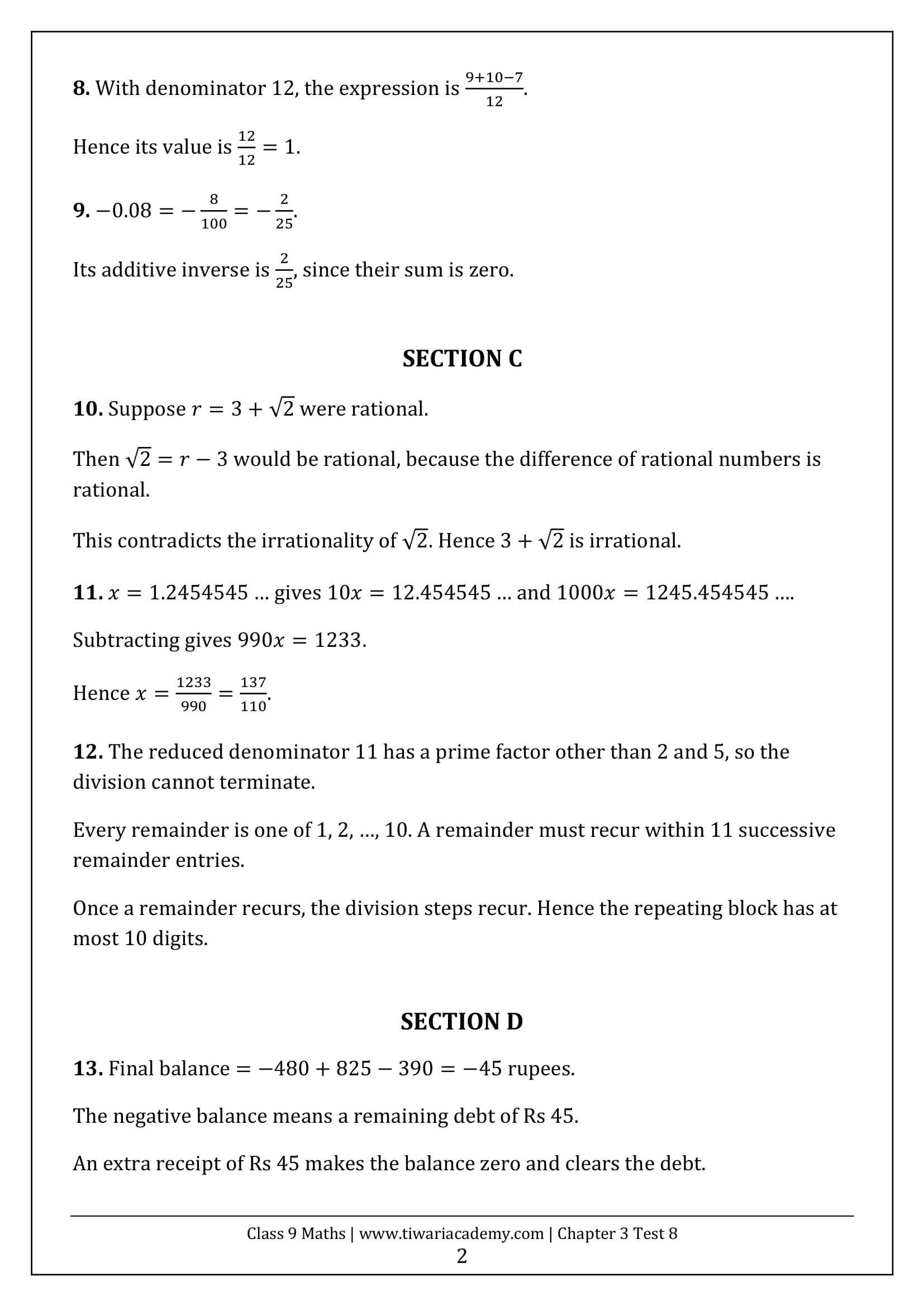
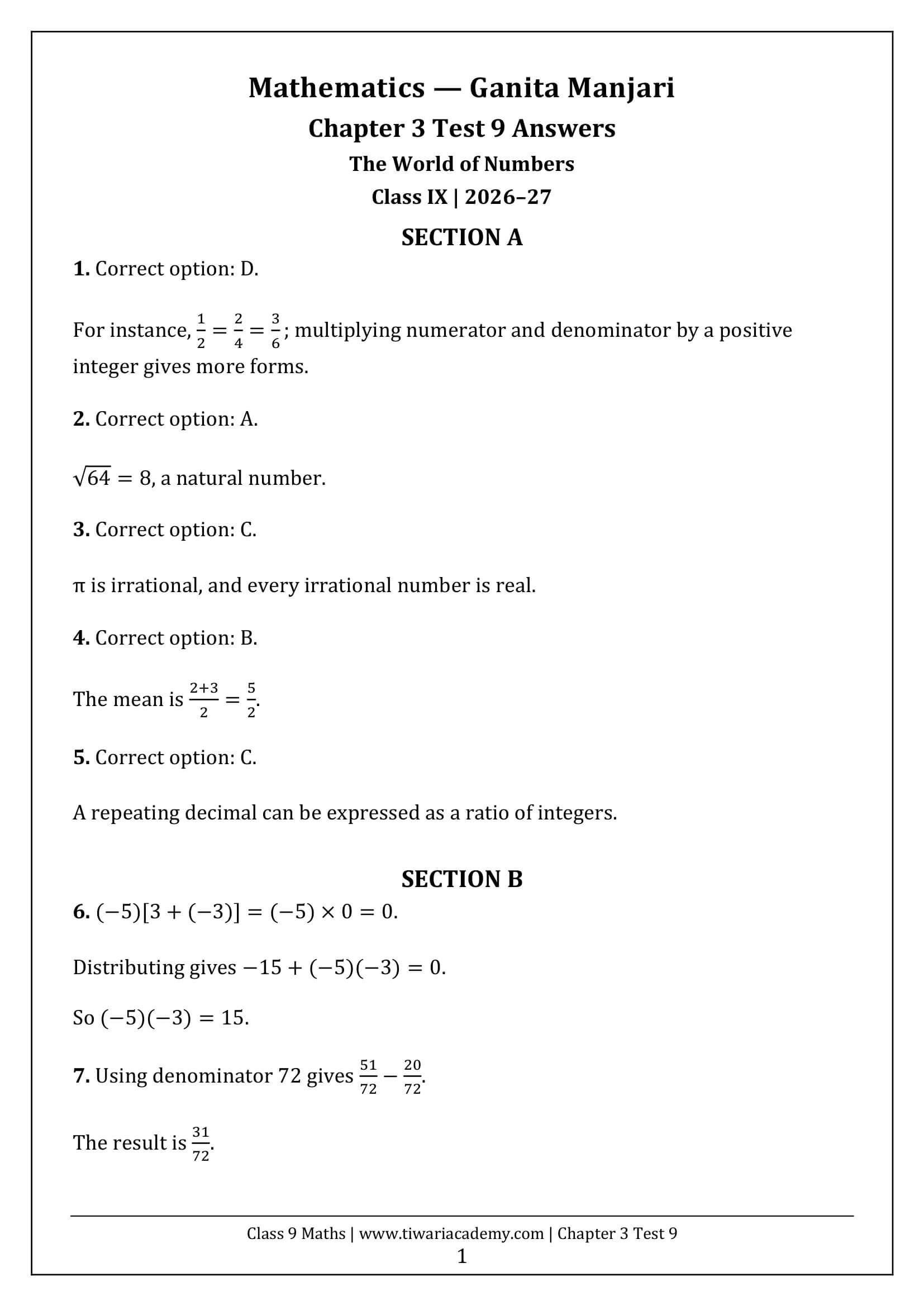
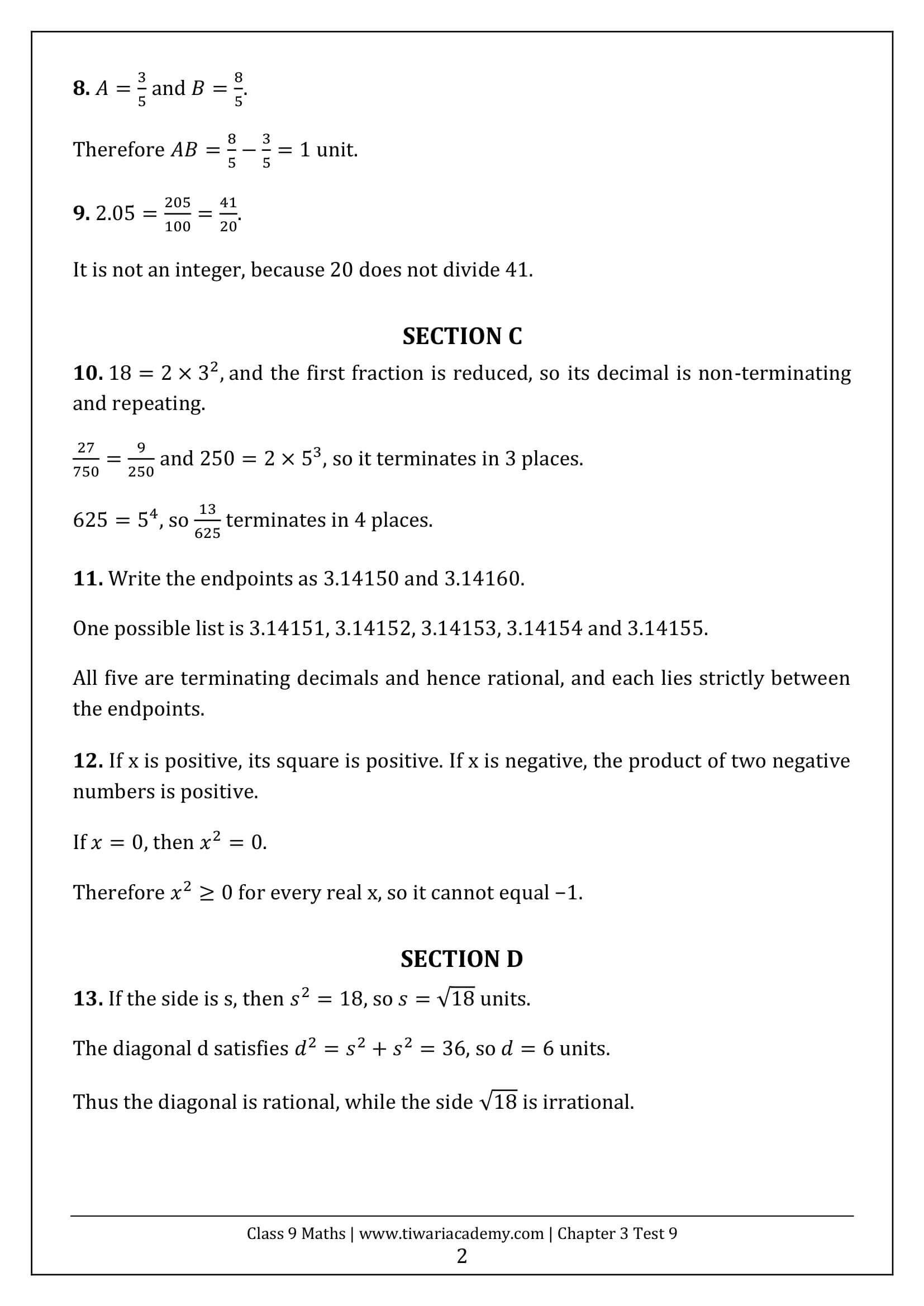
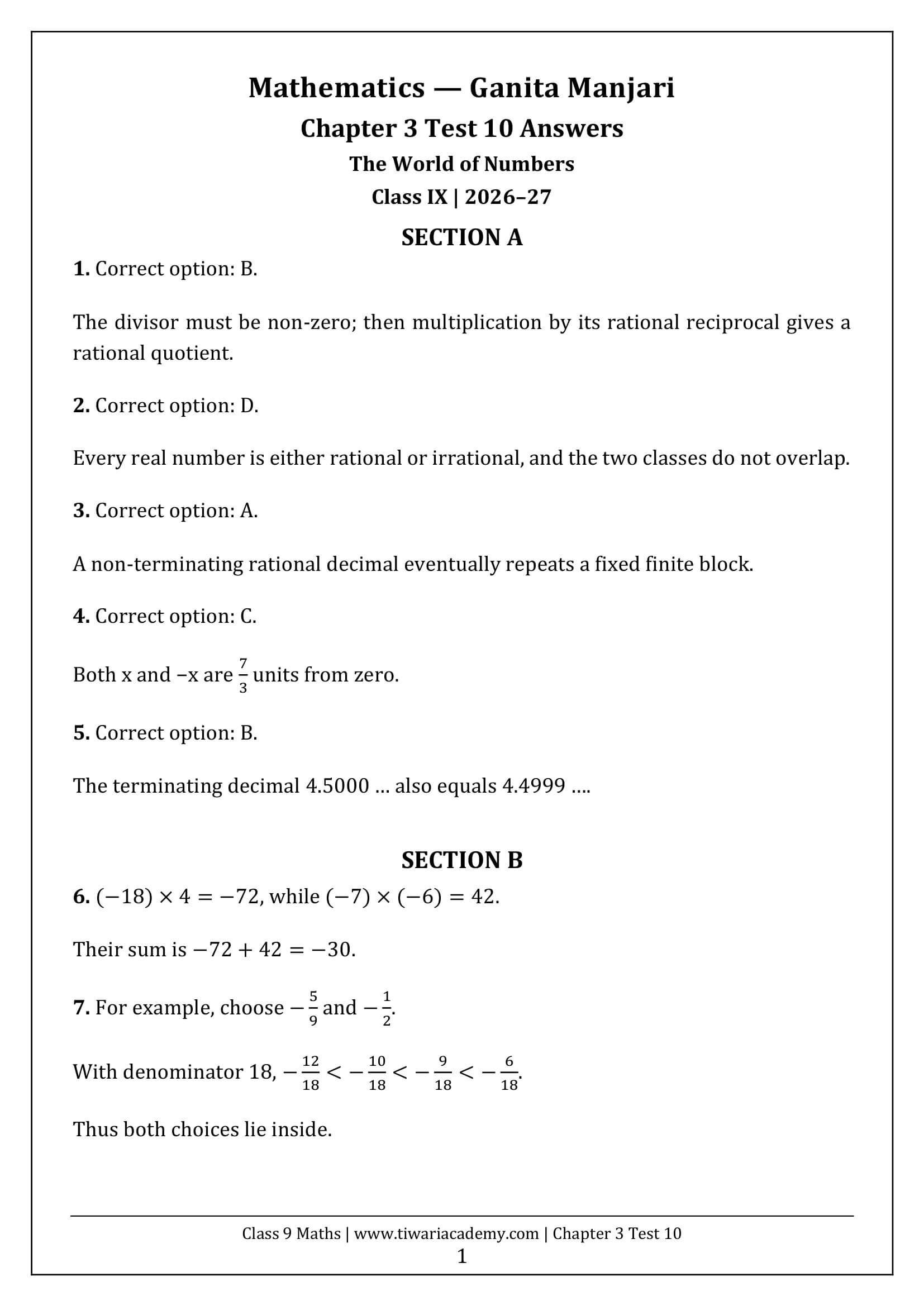
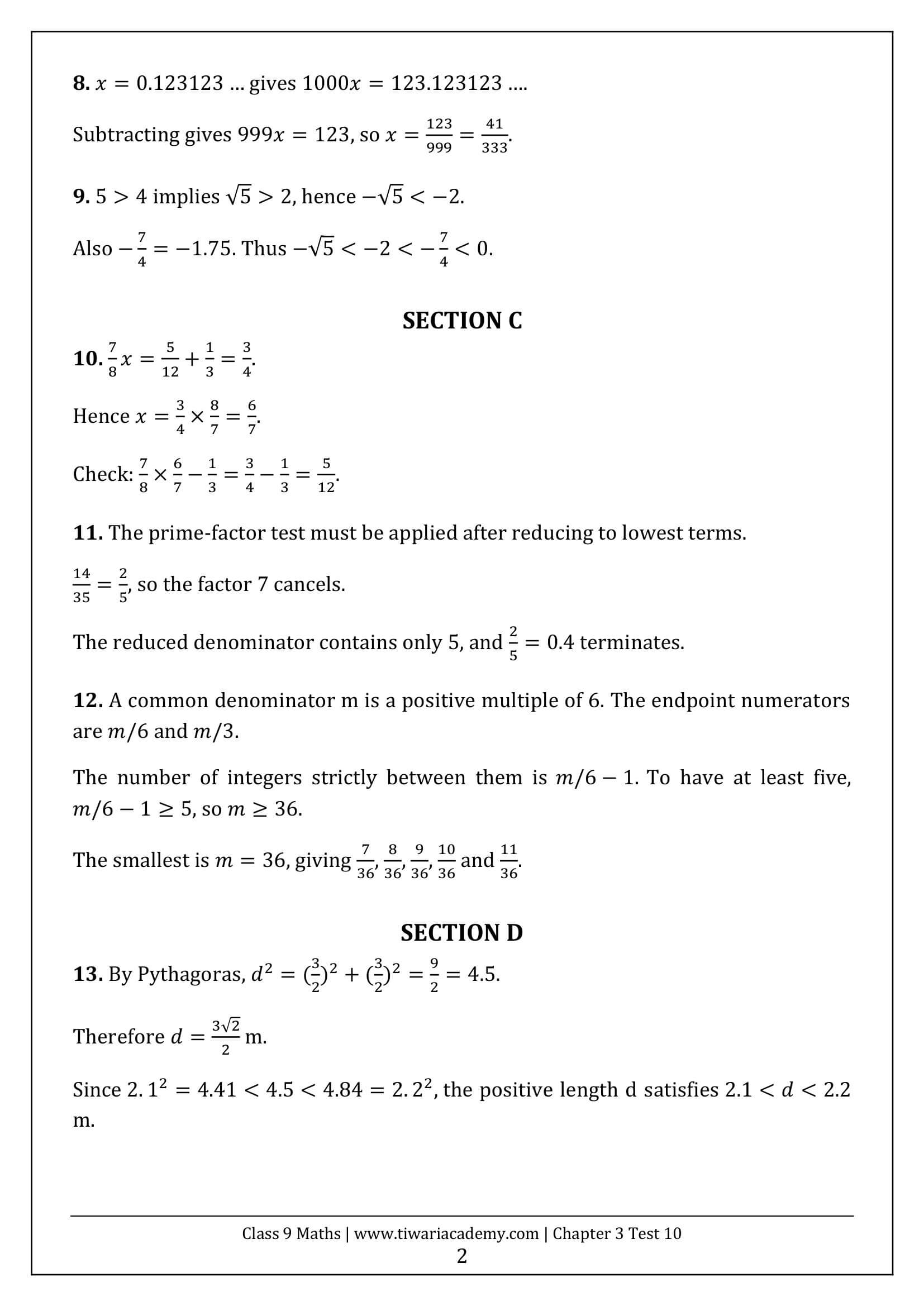
Download 10 Test Papers: Complete your chapter 3 preparation with the Practice Tests with Answer designed for regular revision and effective self-evaluation. Download the chapter-based question papers after finishing the NCERT textbook Ganita Manjari lessons 3 and attempt them under exam-like conditions. Check your solutions with the provided answer keys, analyse incorrect responses and focus on topics that require additional practice.
Download 10 Test Papers in PDF to Practice for 2026-27 Exam
- Class 9 Maths Ganita Manjari Chapter 3 Test 1
- Class 9 Maths Ganita Manjari Chapter 3 Test 2
- Class 9 Maths Ganita Manjari Chapter 3 Test 3
- Class 9 Maths Ganita Manjari Chapter 3 Test 4
- Class 9 Maths Ganita Manjari Chapter 3 Test 5
- Class 9 Maths Ganita Manjari Chapter 3 Test 6
- Class 9 Maths Ganita Manjari Chapter 3 Test 7
- Class 9 Maths Ganita Manjari Chapter 3 Test 8
- Class 9 Maths Ganita Manjari Chapter 3 Test 9
- Class 9 Maths Ganita Manjari Chapter 3 Test 10
- Class 9 Maths Ganita Manjari Chapter 3 Test 1 Answer
- Class 9 Maths Ganita Manjari Chapter 3 Test 2 Answer
- Class 9 Maths Ganita Manjari Chapter 3 Test 3 Answer
- Class 9 Maths Ganita Manjari Chapter 3 Test 4 Answer
- Class 9 Maths Ganita Manjari Chapter 3 Test 5 Answer
- Class 9 Maths Ganita Manjari Chapter 3 Test 6 Answer
- Class 9 Maths Ganita Manjari Chapter 3 Test 7 Answer
- Class 9 Maths Ganita Manjari Chapter 3 Test 8 Answer
- Class 9 Maths Ganita Manjari Chapter 3 Test 9 Answer
- Class 9 Maths Ganita Manjari Chapter 3 Test 10 Answer
Frequently Asked Questions – Class 9 Maths Ganita Manjari Chapter 3
How many exercise sets are there in Ganita Manjari Chapter 3 Class 9 Maths and what do they cover?
Chapter 3 contains five exercise sets plus end-of-chapter exercises for Session 2026-27:
- Exercise Set 3.1 – Natural Numbers, one-to-one correspondence, prime numbers
- Exercise Set 3.2 – Integers, Brahmagupta’s laws for signed numbers (real-life debt/fortune problems)
- Exercise Set 3.3 – Rational Numbers: equality, addition, subtraction, multiplication, division
- Exercise Set 3.4 – Representing rational numbers on the number line, density property
- Exercise Set 3.5 – Decimal expansions, cyclic numbers, classifying rational vs. irrational numbers
- End-of-Chapter Exercises – 16 problems including proof of irrationality of √5, converting decimals to p/q, locating numbers on the number line and two starred (*) challenge problems for advanced learners.
My child finds irrational numbers confusing. How can I help at home?
Start with a visual: draw a unit square and ask your child to measure its diagonal with a ruler – they’ll get approximately 1.41 cm, but the exact value (√2) cannot be written as a fraction. Chapter 3 uses exactly this example. Help your child understand the key rule: if a decimal terminates (stops) or repeats in a pattern, it is rational; if it goes on forever with no repeating pattern (like √2 = 1.41421356…), it is irrational. Practising with the “Think and Reflect” boxes in the textbook is also very effective.
What is new or different about Chapter 3 in Ganita Manjari compared to the old NCERT Class 9 textbook?
The new Ganita Manjari (Session 2026-27) takes a strongly historical and cultural approach. It grounds the development of number systems in Indian mathematical heritage – highlighting the Indus Valley Civilisation, Vedic texts (Ṛigveda, Lalitavistara), the concept of Śhūnyatā from the Upanishads, Brahmagupta’s Brāhmasphuṭasiddhānta, Baudhāyana’s Śhulbasūtra and Mādhava of Sangamagrama’s infinite series for π. The chapter also introduces Cyclic Numbers and Imaginary Numbers as conceptual teasers and features rich “Think and Reflect” boxes and context-based word problems set in ancient Indian trade scenarios.
How do I predict whether a rational number has a terminating or repeating decimal without doing long division?
Chapter 3 provides a clear rule: Write the fraction p/q in its lowest terms. Then check the prime factorisation of the denominator q. If q has only 2s, only 5s, or both 2s and 5s as prime factors, the decimal terminates. If q has any other prime factor (like 3, 7, 11, etc.), the decimal repeats. For example, 7/20 terminates (20 = 2² × 5), but 4/15 repeats (15 = 3 × 5).
How should the “Proof by Contradiction” for √2 be scaffolded for Class 9 students?
The chapter 3 provides an excellent 8-step scaffold. Teachers should:
- First establish what “co-prime” means
- Walk through the assumption step carefully
- Emphasise that “if p² is even then p is even” is a key lemma (which can be proven separately)
- Show the contradiction clearly in Step 8
- Ask students to replicate the method for √3 independently.
Connecting it to a visual illustration (as shown in the textbook’s chalkboard figure) helps students internalize the logical structure.
What is the Mādhava–Leibniz series mentioned in the chapter 3 of Ganita Manjari and how should it be taught at Class 9 level?
The chapter references Mādhava of Sangamagrama’s infinite series (14th century CE): π = 4 × (1 − 1/3 + 1/5 − 1/7 + …). At Class 9 level, teachers should introduce this as a conceptual idea – that irrational numbers like π cannot be expressed as a single fraction but can be approached through an infinite sum of fractions. Students are not expected to work with infinite series formally; they will study convergence in higher grades. The goal is to build conceptual appreciation for why π is irrational.
Why does the Class 9 Maths chapter 3 talk so much about ancient Indian history? Is this relevant to the exam?
Yes, it is fully relevant. The new NCERT curriculum (Session 2026-27) has been designed to give students a deeper appreciation of India’s mathematical contributions while teaching core mathematical concepts.
Students may be asked questions that reference Brahmagupta’s rules, the Bakhśhālī Manuscript or the Ishango Bone in context-based or short-answer questions. Understanding the historical context also helps students remember and apply the mathematical concepts more meaningfully.
What are the Ishango Bone and Lebombo Bone mentioned in class 9 mathematics new book Ganita Manjari chapter 3?
These are ancient artefacts introduced in Section 3.1 to show that mathematics is at least tens of thousands of years old. The Lebombo Bone (~35,000 years old, discovered in southern Africa) has 29 carved notches, believed to be a lunar calendar. The Ishango Bone (~20,000 BCE, found near the Nile) contains tally groupings of 11, 13, 17, and 19 — the prime numbers between 10 and 20 – suggesting early humans had an intuitive grasp of prime numbers.
How do I convert a repeating decimal like 0.1̄6̄ into p/q form?
For a general repeating decimal (with non-repeating digits followed by a repeating block), the chapter teaches a two-step multiplication method. For 0.1̄6̄: first multiply by 10 (to shift the non-repeating part) to get 10x = 1.̄6̄, then multiply by 10 again (for the 1 repeating digit) to get 100x = 16.̄6̄. Subtracting gives 90x = 15, so x = 15/90 = 1/6.
What is a Cyclic Number and which example is given in Chapter 3 Ganita Manjari Class 9 Maths?
A Cyclic Number is a special number whose digits rotate cyclically when multiplied by certain integers. Chapter 3 gives the classic example of 142857 – the repeating block of the decimal for 1/7 (= 0.̄142857̄). When multiplied by 1 through 6, the same six digits appear in a shifted cyclic order each time (e.g., 142857 × 2 = 285714, 142857 × 3 = 428571, and so on).
Is 0.999… exactly equal to 1? How does Chapter 3 of Ganita Manjari Class 9 Maths explain this?
Yes! Chapter 3 explains this through the concept of non-uniqueness of decimal representations. Let x = 0.9̄ (= 0.999…). Multiplying by 10 gives 10x = 9.9̄. Subtracting: 9x = 9, so x = 1. Therefore 0.999… = 1 exactly, not “almost 1.” This is a beautiful consequence of how repeating decimals work.
How do you prove that √2 is irrational? Is this proof in the Class 9 syllabus for 2026-27?
Yes, the Proof by Contradiction for the irrationality of √2 is explicitly included in Chapter 3 for Session 2026-27. The proof assumes √2 = p/q in lowest terms (p, q co-prime), then shows that this forces both p and q to be even – contradicting the assumption that they share no common factors. This contradiction proves √2 cannot be rational.
Students are also asked to use the same method to prove √3, √5, and √7 are irrational.
What is the difference between Rational and Irrational Numbers as explained in Chapter 3 Ganita Manjari?
A Rational Number can be expressed as p/q, where p and q are integers and q ≠ 0. Its decimal expansion is either terminating (e.g., 3/8 = 0.375) or repeating (e.g., 5/11 = 0.̄4̄5̄).
An Irrational Number cannot be written as p/q; its decimal expansion is non-terminating and non-repeating (e.g., √2 = 1.4142135…, π = 3.14159…).
Together, rational and irrational numbers form the Real Numbers (ℝ).
Who is Brahmagupta and why is he important in Ganita Manjari chapter 3?
Brahmagupta (628 CE) was an Indian mathematician who wrote the Brāhmasphuṭasiddhānta. In Chapter 3, he is celebrated for three landmark contributions:
- Formally defining zero as the result of subtracting a number from itself (a – a = 0)
- Introducing negative numbers (debts/ṛiṇa) and rules for arithmetic with signed numbers, and
- Establishing rules for operations on rational numbers. His laws are still used exactly as he wrote them over 1,300 years ago.
What is the main topic of Chapter 3 in Ganita Manjari Class 9?
Chapter 3, The World of Numbers, covers the complete evolution of numbers – from Natural Numbers and Zero to Integers, Rational Numbers, Irrational Numbers and Real Numbers — along with their properties, arithmetic rules, decimal expansions and historical origins. It is part of the new NCERT textbook Ganita Manjari for Class 9, Session 2026-27.