



by Tiwari Academy Team
Chapter 6, Number Play, explores patterns hidden within numbers instead of routine calculations. These NCERT Solutions for Class 7 Maths Ganita Prakash Chapter 6 explain every in-text and Figure It Out question, covering parity of odd and even numbers, magic squares, the Virahāṅka-Fibonacci sequence and cryptarithms. Each solution uses simple reasoning and worked examples so students grasp the logic, not just the final answer, making this page useful for daily homework, quick revision and exam preparation.
Class 7 Maths all Chapters
NCERT Class 7 Maths Ganita Prakash Chapter 6 Solutions
Page 128 – Figure it Out
1. Arrange the stick figure cutouts given at the end of the book or draw a height arrangement such that the sequences reads:
(a) 0, 1, 1, 2, 4, 1, 5
Answer:

(b) 0, 0, 0, 0, 0, 0, 0
Answer:

(c) 0, 1, 2, 3, 4, 5, 6
Answer:

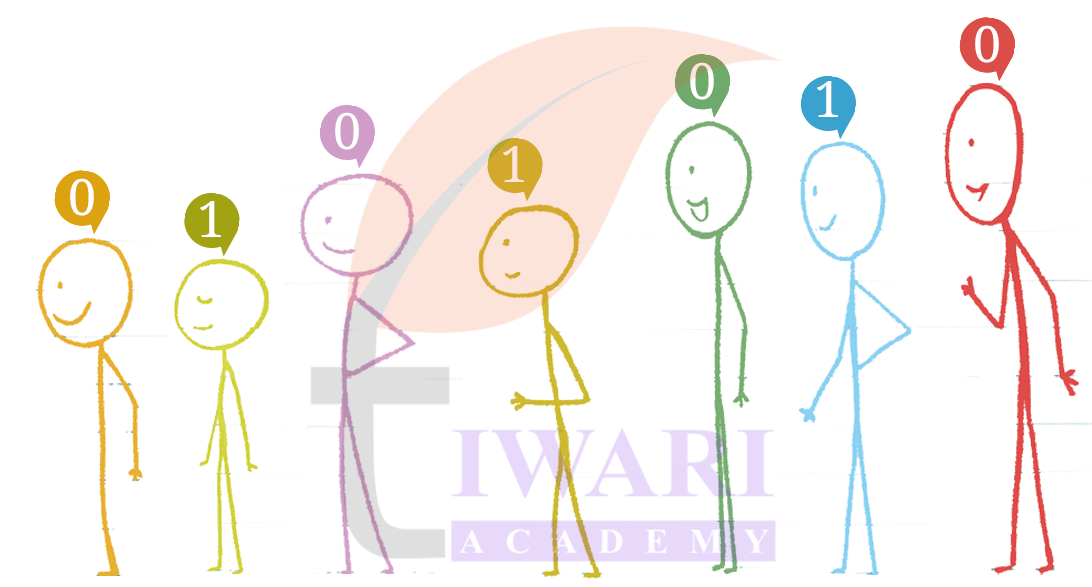
(d) 0, 1, 0, 1, 0, 1, 0
Answer:
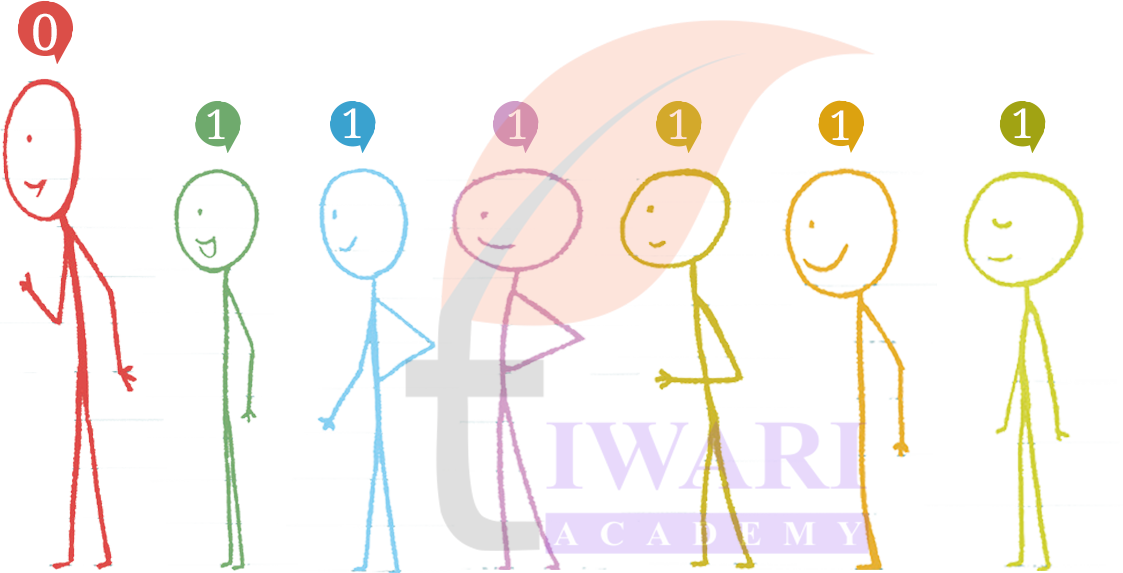
(e) 0, 1, 1, 1, 1, 1, 1
Answer:
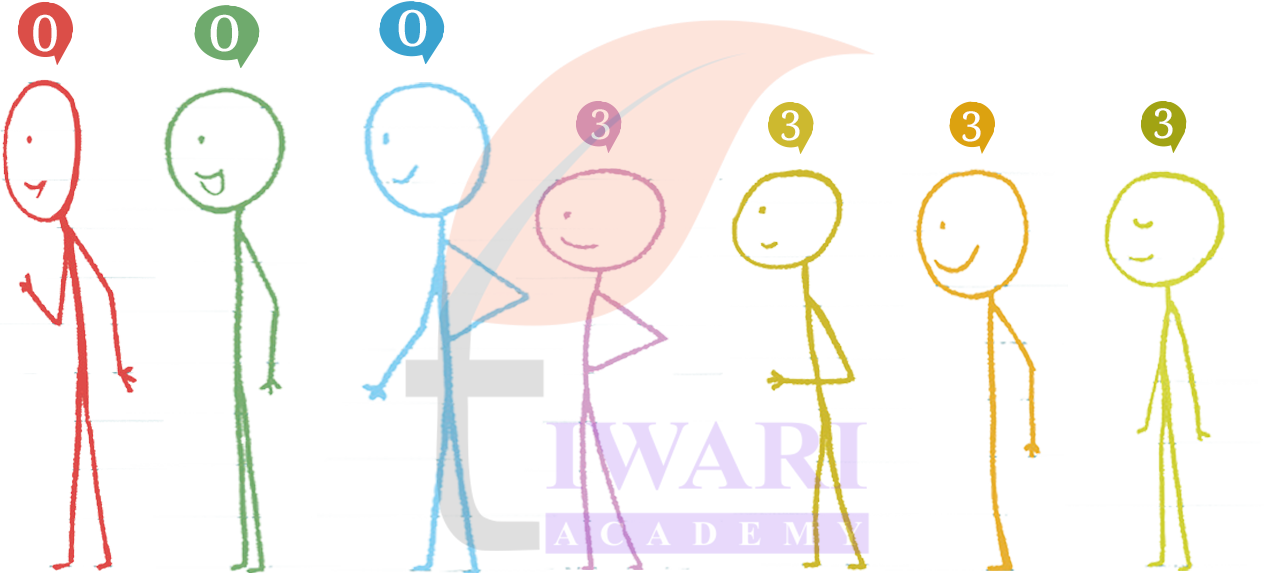
(f) 0, 0, 0, 3, 3, 3, 3
Answer:
2. For each of the statements given below, think and identify if it is Always True, Only Sometimes True, or Never True. Share your reasoning.
(a) If a person says ‘0’, then they are the tallest in the group.
(b) If a person is the tallest, then their number is ‘0’.
(c) The first person’s number is ‘0’.
(d) If a person is not first or last in line, then they cannot say ‘0’.
(e) The person who calls out the largest number is the shortest.
(f) What is the largest number possible in a group of 8 people?
Answer:
(a)Only Sometimes True — The first person always says ‘0’ regardless of height, since no one stands in front of them; they need not be the tallest.
(b) Always True: No one can be taller than the tallest person, so the count of taller people in front is always 0.
(c) Always True: No one stands in front of the first person, so the count is automatically 0.
(d) Never True: A middle person can say ‘0’ if everyone standing before them happens to be shorter (e.g., in an increasing height arrangement, every person says 0).
(e) Only Sometimes True: It depends on the arrangement; a person of middling height could call a large number if many tall people stand before them.
(f) 7 — This happens for the 8th (last) person, if all 7 people before them are taller.
Page 131 – Figure it Out
1. Using your understanding of the pictorial representation of odd and even numbers, find out the parity of the following sums:
(a) Sum of 2 even numbers and 2 odd numbers (e.g., even + even + odd + odd)
(b) Sum of 2 odd numbers and 3 even numbers
(c) Sum of 5 even numbers
(d) Sum of 8 odd numbers
Answer:
(a) Sum of 2 even + 2 odd numbers → Even
(b) Sum of 2 odd + 3 even numbers → Even
(c) Sum of 5 even numbers → Even
(d) Sum of 8 odd numbers → Even
2. Lakpa has an odd number of ₹1 coins, an odd number of ₹5 coins and an even number of ₹10 coins in his piggy bank. He calculated the total and got ₹205. Did he make a mistake? If he did, explain why. If he didn’t, how many coins of each type could he have?
Answer:
Yes, he made a mistake.
Odd number of ₹1 coins → sum is odd
Odd number of ₹5 coins → sum is odd (odd × odd = odd)
Even number of ₹10 coins → sum is even
Total parity = odd + odd + even = even
But ₹205 is odd, so this total is impossible. Hence Lakpa made a mistake.
3. We know that:
(a) even + even = even
(b) odd + odd = even
(c) even + odd = odd
Similarly, find out the parity for the scenarios below:
(d) even – even =
(e) odd – odd =
(f) even – odd =
(g) odd – even =
Answer:
(d) even − even = even
(e) odd − odd = even
(f) even − odd = odd
(g) odd − even = odd
Page 136 – Figure it Out
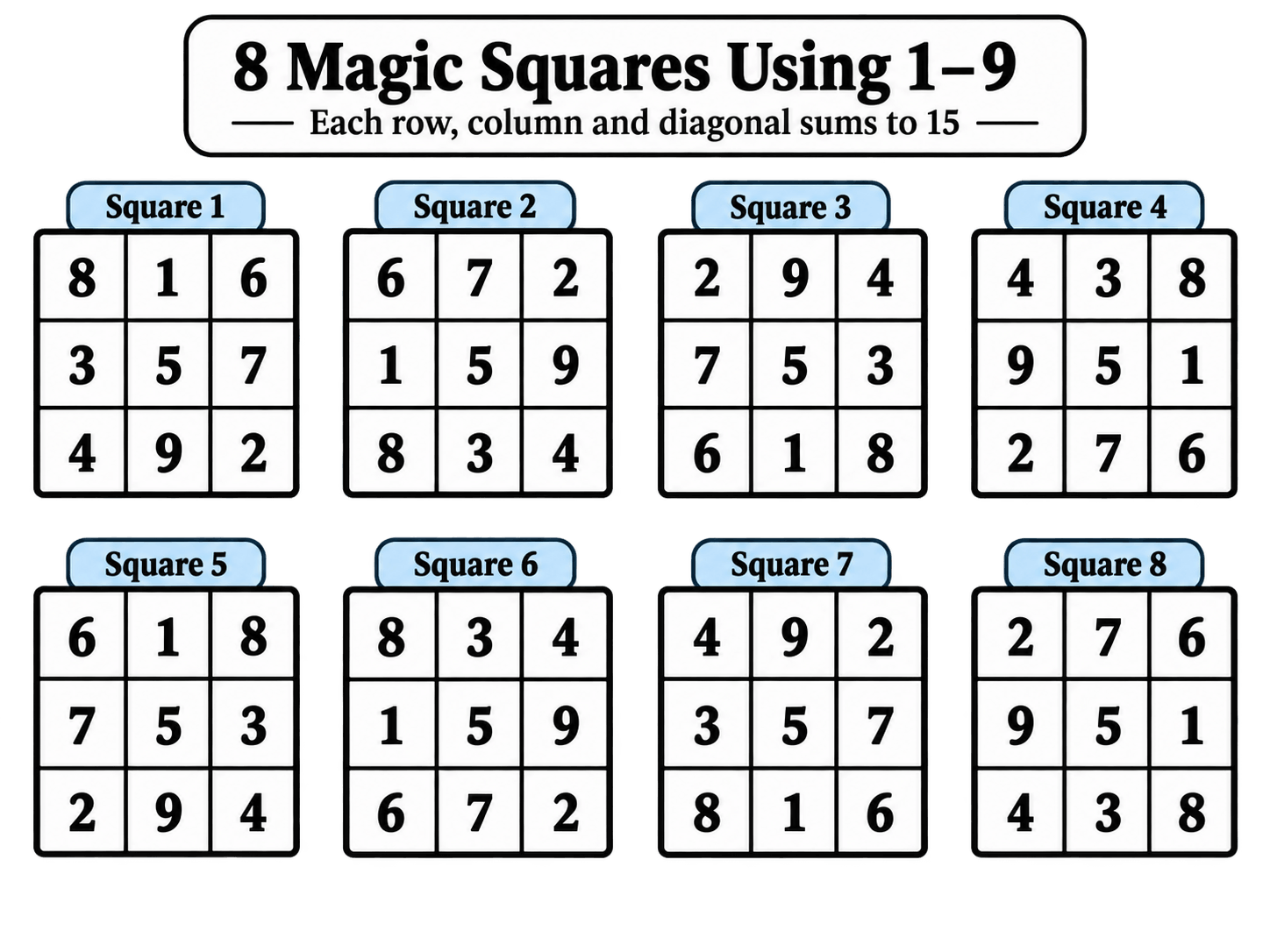
1. How many different magic squares can be made using the numbers 1–9?
Answer:
8 Magic Squares
Reason:
There is essentially one basic pattern, which gives 8 magic squares through 4 rotations and their mirror reflections
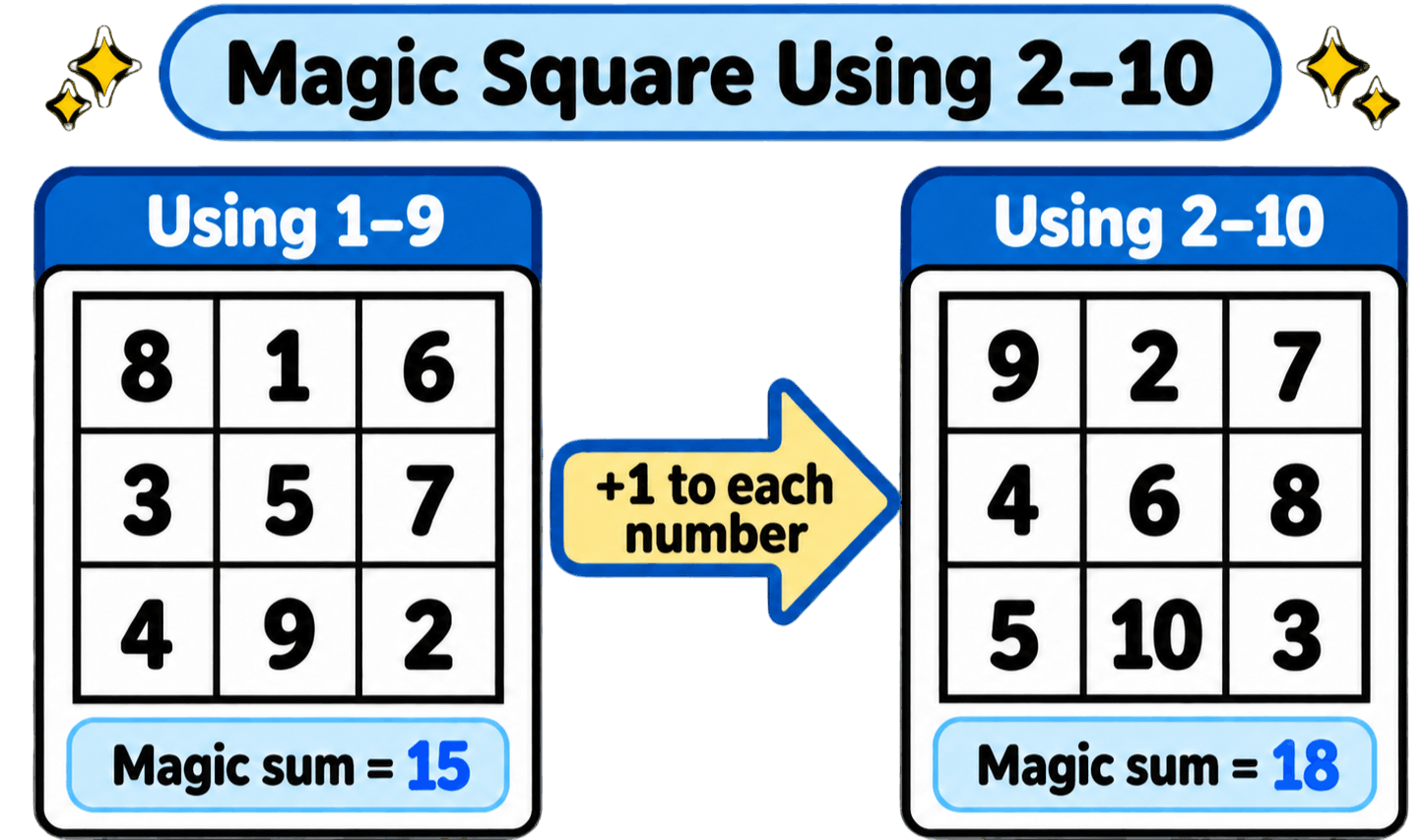
2. Create a magic square using the numbers 2 – 10. What strategy would you use for this? Compare it with the magic squares made using 1 – 9.
Answer:
Take the standard 1–9 magic square and add 1 to every entry:
3. Take a magic square, and
(a) increase each number by 1
(b) double each number
In each case, is the resulting grid also a type of square? How do the magic sums change in each case?
Answer:
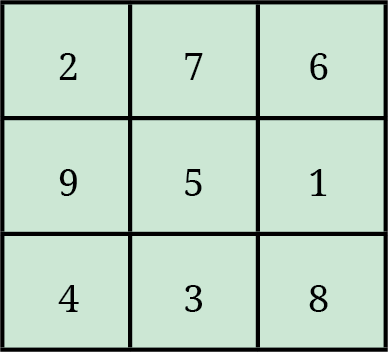
(a) Increase each number by 1 → still a magic square (shown above); new magic sum = 18.
Magic Square:
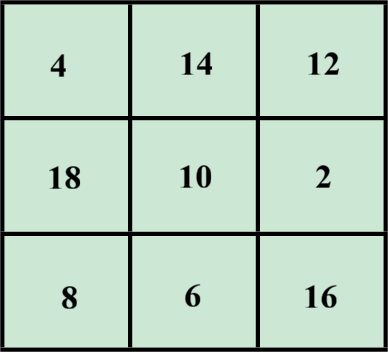
(b) Double each number:
Still a magic square; new magic sum = 30.
4. What other operations can be performed on a magic square to yield another magic square?
Answer:
Adding the same constant to every number, multiplying every number by the same constant (or both together) and rotating/reflecting the grid — all of these give another magic square.
5. Discuss ways of creating a magic square using any set of 9 consecutive numbers (like 2 – 10, 3 – 11, 9 – 17, etc).
Answer:
Take the 1–9 magic square and add (starting number − 1) to every entry. Since adding a constant to every cell increases every row, column and diagonal sum by the same amount, the magic square property is preserved.
Page 137 – Figure it Out
1. Using this generalised form, find a magic square if the centre number is 25.
Answer:
22 : 27 : 26
29 : 25 : 21
24 : 23 : 28
Magic sum = 75
2. What is the expression obtained by adding the 3 terms of any row, column or diagonal?
Answer:
3m (three times the centre number)
3. Write the result obtained by-
(a) adding 1 to every term in the generalised form.
(b) doubling every term in the generalised form
Answer:
(a) Adding 1 to every term → magic sum becomes 3m + 3 = 3(m+1) (new centre = m+1)
(b) Doubling every term → magic sum becomes 6m = 3(2m) (new centre = 2m)
4. Create a magic square whose magic sum is 60.
Answer:
3m = 60 → m = 20
Magic Square:
17 : 22 : 21
24 : 20 : 16
19 : 18 : 23
5. Is it possible to get a magic square by filling nine non-consecutive numbers?
Answer:
Yes, provided the nine numbers are in arithmetic progression (equally spaced), such as 2, 4, 6, 8, 10, 12, 14, 16, 18. A magic square can then be built the same way as for consecutive numbers.
Pages 143 – Figure it Out
1. A bulb is ON. Dorjee toggles it switch 77 times. Will the bulb be on or off? Why?
Answer:
OFF. Each toggle changes the state. 77 is odd, so the bulb changes state an odd number of times → ends up in the opposite state (OFF).
2. Liswini has a large old encyclopedia. When she opened it, several loose pages fell out of it. She counted 50 sheet in the total, each printed on both sides. Can the sum of the page numbers of the loose sheets be 6000? Why or why not?
Answer:
Each sheet has page numbers of the form (2k−1) and 2k, so its sum = 4k − 1.
Total sum of 50 sheets = 4(k₁+k₂+…+k₅₀) − 50.
For total = 6000: 4S − 50 = 6000 → 4S = 6050 → S = 1512.5, which is not a whole number. Since S must be an integer, this is impossible.
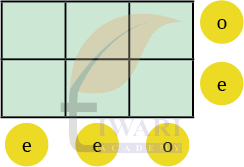
3. Here is a 2 × 3 grid. For each row and column, the parity of the sum is written in the circle; ‘e’ for even and ‘o’ for odd. Fill the 6 boxes with 3 odd numbers (‘o’) and 3 even numbers (‘e’) to satisfy the parity of the row and column sums.
Answer:
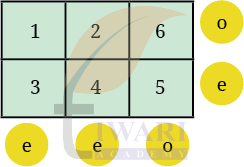
4. Make a 3 × 3 magic square with 0 as the magic sum. All numbers can not be zero. Use negative numbers, as needed.
Answer:
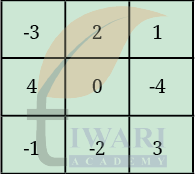
5. Fill in the following blanks with ‘odd’ or ‘even’:
(a) Sum of an odd number of even numbers is______
(b) Sum of an even number of odd numbers is______
(c) Sum of an even number of even numbers is______
(d) Sum of an odd number of odd numbers is______
Answer:
(a) Sum of an odd number of even numbers = even
(b) Sum of an even number of odd numbers = even
(c) Sum of an even number of even numbers = even
(d) Sum of an odd number of odd numbers = odd
6. What is the parity of the sum of the numbers from 1 to 100?
Answer:
Parity of the sum 1 to 100:
Sum = 100 × 101 / 2 = 5050 → Even
7. Two consecutive numbers in the Virahāṅka sequence are 987 and 1597. What are the next 2 numbers in the sequence? What are the previous 2 numbers in the sequence?
Answer:
Two consecutive Virahāṅka numbers are 987 and 1597.
Next 2 numbers: 987 + 1597 = 2584; 1597 + 2584 = 4181
Previous 2 numbers: 1597 − 987 = 610; 987 − 610 = 377
8. Angaan wants to climb an 8-step staircase. His playful rule is that he can take either 1 step or 2 steps at a time. For example, one of his paths is 1, 2, 2, 1, 2. In how many different ways can he reach the top?
Answer:
Angaan climbs an 8-step staircase, taking 1 or 2 steps at a time. Number of ways?
This follows the Virahāṅka–Fibonacci pattern: 1, 2, 3, 5, 8, 13, 21, 34
∴ 34 ways
9. What is the parity of the 20th term of the Virahāṅka sequence?
Answer:
The Virahāṅka sequence is:
1, 2, 3, 5, 8, 13, 21, 34, 55, 89, 144, 233, 377, 610, 987, 1597, 2584, 4181, 6765, 10946, …
Writing the parity of each term:
O, E, O, O, E, O, O, E, O, O, E, O, O, E, O, O, E, O, O, E
We can see that the parity pattern repeats after every 3 terms:
Odd, Odd, Even, Odd, Odd, Even, …
Each term is the sum of the previous two terms.
The 20th term = 10946, which is Even.
10. Identify the statements that are true.
(a) The expression 4m – 1 always gives odd numbers.
(b) All even numbers can be expressed as 6j – 4.
(c) Both expressions 2p + 1 and 2q – 1 describe all odd numbers.
(d) The expression 2f + 3 gives both even and odd numbers.
Answer:
(a) The expression 4m − 1 always gives odd numbers. → True
(b) All even numbers can be expressed as 6j − 4. → False (only gives numbers like 2, 8, 14, 20…; misses 4, 6, 10, 12…)
(c) Both expressions 2p + 1 and 2q − 1 describe all odd numbers. → True
(d) The expression 2f + 3 gives both even and odd numbers. → False (2f is always even, so 2f+3 is always odd)
11. Solve this cryptarithm:
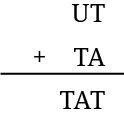
Answer:
U = 9, T = 1, A = 0
Check: UT = 91, TA = 10
91 + 10 = 101 = TAT (T=1, A=0, T=1)
FAQs – NCERT Solutions for Class 7 Maths Chapter 6
How many questions are covered in the NCERT Solutions for Class 7 Maths Chapter 6, Number Play?
Chapter 6 is spread across five “Figure It Out” sections, one after each major topic – height arrangements, parity of sums, magic squares (two separate sets) and a final mixed exercise with 11 questions. Together with the in-text activity questions found throughout each section, there are more than 30 questions in total. These solutions cover every one of them, including the reasoning behind each answer, not just the final value, so students can follow the logic step-by-step.
Is Chapter 6, Number Play, important for Class 7 exams?
Yes. Unlike purely calculation-based chapters, Number Play tests logical reasoning and pattern recognition, which show up often in CBSE assessments through “always true / sometimes true / never true” and application-based questions. Topics such as parity rules, magic square construction and cryptarithms frequently appear as short-answer or HOTS (Higher Order Thinking Skills) questions in school tests, since they check whether a student genuinely understands number properties rather than having memorised a procedure.
What is Ganita Prakash for class 7 and how is it different from the earlier NCERT Maths textbook?
Ganita Prakash is the new NCERT Mathematics textbook for Class 7, introduced as part of the revised, NEP-2020-aligned curriculum. It replaces the earlier NCERT “Mathematics” textbook and places more emphasis on activity-based learning, real-life context and conceptual reasoning over drill-based exercises. Chapters are structured around exploration first – asking “what do you think this means?” – before formal rules are introduced, which is why the solutions need to explain reasoning rather than just state final answers.
How should I use these NCERT Solutions while studying Chapter 6?
Attempt each Figure It Out question on your own first, especially the reasoning-based ones like the true/sometimes true/never true statements, since these build number sense that a ready-made answer can’t teach. Use these solutions afterward to check your logic and fill any gaps, rather than as a first resort. Working through the parity rules and magic square strategies step-by-step, instead of memorising final grids or answers, will help far more when a slightly different question shows up in an exam.
Are the Figure It Out questions from Chapter 6 asked directly in exams?
Questions similar in structure to the Figure It Out exercises – identifying parity, completing magic squares, finding terms of the Virahāṅka-Fibonacci sequence or solving cryptarithms – are commonly adapted for class tests and the CBSE exam pattern, since NCERT textbook exercises form the base for most school-level question papers. The exact numbers may be changed, but the underlying concept and question format are reused often enough that thorough practice of this chapter pays off directly.