


by Tiwari Academy Team
NCERT Solutions for Class 7 Maths Ganita Prakash Part 2 Chapter 1 Geometric Twins updated for session 2026-27. Chapter 1 of NCERT Class 7 Maths Ganita Prakash Part 2, “Geometric Twins”, introduces congruence through simple constructions and real-life examples. Students learn to identify congruent figures and triangles using the SSS, SAS, ASA, AAS and RHS conditions. The chapter also proves that angles opposite equal sides in a triangle are equal and that every equilateral triangle has three 60° angles. These NCERT solutions offer clear, step-by-step answers to all “Figure it Out” questions in the chapter.
Class 7 Maths all Chapters
NCERT Class 7 Maths Ganita Prakash Part 2 Chapter 1 Solutions
Page 3 – Figure it Out
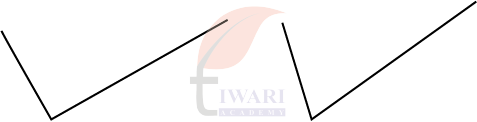
1. Check if the two figures are congruent.
Answer:
Yes, they are congruent.
- Both have the same angle measure
- Both arms appear to be the same length
- They have the same shape and size
- One could be superimposed on the other through rotation.
2. Circle the pairs that appear congruent.

Answer:

3. What measurements would you take to create a figure congruent to a given:
(a) Circle
(b) Rectangle
Using this, state how would you check if two-
(a) Circles are congruent?
(b) Rectangles are congruent?
Answer:
To create a congruent figure we will take measurements given below :
(a) Circle
Measure the radius (distance from center to any point on the circle)
Measure the diameter (distance across the circle through the center)
(b) Rectangle
Measure the length (one pair of opposite sides)
Measure the breadth/width (the other pair of opposite sides)
(a) Two circles are congruent if and only if their radii are equal (or their diameters are equal).
Method to check:
Measure the radius of the first circle
Measure the radius of the second circle
If both radii are equal, the circles are congruent
(b) Two rectangles are congruent if and only if their corresponding sides are equal.
Method to check:
Measure the length and breadth of the first rectangle
Measure the length and breadth of the second rectangle
If the length of the first rectangle equals the length of the second rectangle AND the breadth of the first rectangle equals the breadth of the second rectangle, then the rectangles are congruent.
4. How would we check if two figures like the one below are congruent?

Answer:
The figure consists of three line segments meeting at a point.
To check whether two such figures are congruent, we should:
Measure the lengths of all the arms (the three line segments).
Measure the angles between the arms.
Compare the corresponding arm lengths and corresponding angles of both figures.
Pair 1 (Top-left and Top-right figures)
Observation:
The arm lengths appear equal.
The angles between the arms are also equal.
The figures differ only in orientation.
Conclusion:
These two figures are congruent.
Pair 2 (Bottom-left and Bottom-right figures)
Observation:
One arm length is different.
The angle between the arms is also different.
Conclusion:
These two figures are not congruent.
Page 8 – Figure it Out
1. Suppose ∆HEN is congruent to ∆BIG. List all the other correct ways of expressing this congruence.
Answer:
When ∆HEN is congruent to ∆BIG, the order of the vertices matters because it indicates which vertices correspond to each other.
From ∆HEN ≅ ∆BIG, we know:
H corresponds to B
E corresponds to I
N corresponds to G
For a congruence statement to be correct, the corresponding vertices must be in the same positions. We can rearrange the vertices, but the correspondence must remain the same.
Correct ways to express this congruence:
- ∆HEN ≅ ∆BIG
- ∆HNE ≅ ∆BGI
- ∆EHN ≅ ∆IBG
- ∆ENH ≅ ∆IGB
- ∆NEH ≅ ∆GIB
- ∆NHE ≅ ∆GBI
Each of these maintains the correspondence: H↔B, E↔I, N↔G. There are 6 total ways because we can arrange 3 vertices in 3 = 6 different orders.
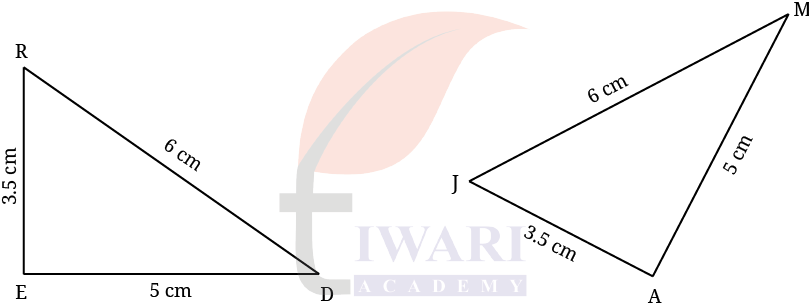
2. Determine whether the triangles are congruent. If yes, express the congruence.
Answer:
Triangle RED:
RE = 3.5 cm
RD = 6 cm
ED = 5 cm
Triangle JMA:
JM = 6 cm
MA = 5 cm
JA = 3.5 cm
Compare the corresponding sides:
RE = 3.5 cm corresponds to JA = 3.5 cm
RD = 6 cm corresponds to JM = 6 cm
ED = 5 cm corresponds to MA = 5 cm
Since all three pairs of corresponding sides are equal, the triangles are congruent by SSS (Side-Side-Side) congruence.
The congruence can be expressed as ∆RED ≅ ∆JMA
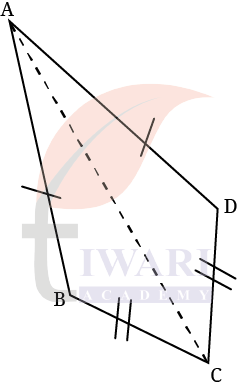
3. In the figure below, AB = AD, CB = CD.
Can you identify any pair of congruent triangles? If yes, explain why they are congruent.
Does AC divide ∠BAD and ∠BCD into two equal parts? Give reasons.
Answer:
Yes, there is a pair of congruent triangles: ∆ABC ≅ ∆ADC
Looking at triangles ABC and ADC, they share side AC and have the following:
AB = AD (given)
CB = CD (given)
AC = AC (common side – reflexive property)
Since all three pairs of corresponding sides are equal, the triangles are congruent by SSS (Side-Side-Side) congruence postulate.
Yes, AC divides both ∠BAD and ∠BCD into two equal parts.
Since ∆ABC ≅ ∆ADC (proven above), all corresponding parts of congruent triangles are congruent (CPCTC).
Therefore:
∠BAC ≅ ∠DAC, which means AC bisects ∠BAD
∠BCA ≅ ∠DCA, which means AC bisects ∠BCD
In other words, AC is the angle bisector of both ∠BAD and ∠BCD because the congruent triangles ensure that the angles on either side of AC are equal.
4.In the figure below, are ΔDFE and ΔGED congruent to each other? It is given that DF = DG and FE = GE.

Answer:
For ∆DFE and ∆GED:
1. DF = DG (given)
2. FE = GE (given)
3. DE = DE (common side – reflexive property)
Now we have:
– DF = DG
– FE = GE
– DE = DE
All three corresponding sides are equal, therefore the triangles are congruent.
Page 13 – Figure it Out
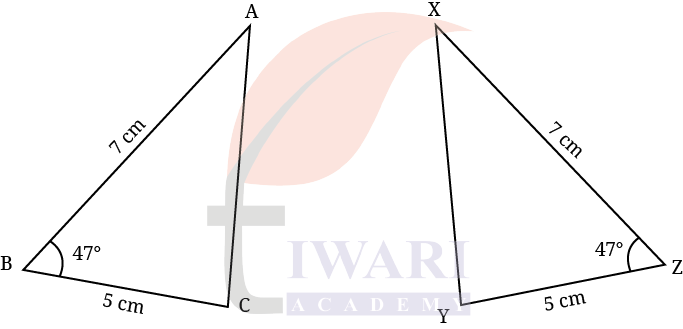
1. Identify whether the triangles below are congruent. What conditions did you use to establish their congruence? Express the congruence.
Answer:
Comparing the triangles:
AB = XZ = 7 cm
BC = YZ = 5 cm
∠B = ∠Z = 47°
Yes, the triangles are congruent.
Condition used: SAS (Side-Angle-Side) congruence postulate
Congruence statement: ∆ABC ≅ ∆XZY
This correspondence shows:
A ↔ X
B ↔ Z
C ↔ Y
2. Given that CD and AB are parallel, and AB = CD, what are the other equal parts in this figure? (Hint: When the lines are parallel, the alternate angles are equal. Are the two resulting triangles congruent? If so, express the congruence.)

Answer:
Using Parallel Lines:
Since CD ∥ AB, and they are cut by transversal lines, we have alternate interior angles:
∠DCO = ∠BAO (alternate interior angles)
∠CDO = ∠ABO (alternate interior angles)
Now for triangles DOC and AOB:
CD = AB (given)
∠DCO = ∠BAO (alternate interior angles)
∠CDO = ∠ABO (alternate interior angles)
The triangles are congruent by ASA (Angle-Side-Angle) congruence.
Congruence statement: ∆DOC ≅ ∆AOB
Since the triangles are congruent, all corresponding parts are equal:
DO = AO (corresponding sides)
CO = BO (corresponding sides)
∠DCO = ∠BAO (alternate interior angles)
∠CDO = ∠ABO (alternate interior angles)
∠DOC = ∠AOB (vertical angles)
The parallel lines and equal segments CD = AB lead to congruent triangles, which means O is the midpoint of both diagonals (DO = AO and CO = BO).
3. Given that ∠ABC = ∠DBC and ∠ACB = ∠DCB, show that ∠BAC = ∠BDC. Are the two triangles congruent?

Answer:
Consider ∆ABC and ∆DBC:
∠ABC = ∠DBC (given)
∠ACB = ∠DCB (given)
BC = BC (common side – reflexive property)
By ASA (Angle-Side-Angle) congruence postulate: ∆ABC ≅ ∆DBC
Since the triangles are congruent, all corresponding parts are congruent (CPCTC).
Therefore, ∠BAC = ∠BDC
Yes the Two Triangles Congruent∆ABC ≅ ∆DBC
We already established this congruence above using:
∠ABC = ∠DBC (given)
BC = BC (common side)
∠ACB = ∠DCB (given)
This satisfies the ASA (Angle-Side-Angle) congruence condition.
4. Identify the equal parts in the following figure, given that ∠ABD = ∠DCA and ∠ACB = ∠DBC.

Answer:
In △ABC and △DCB:
∠ACB = ∠DBC (given)
∠ABD = ∠DCA (given)
Since ∠ABD is part of ∠ABC, and ∠DBC is the other part, we can write:
∠ABC = ∠ABD + ∠DBC
Similarly, since ∠DCA is part of ∠DCB, and ∠ACB is the other part:
∠DCB = ∠DCA + ∠ACB
Since ∠ABD = ∠DCA and ∠ACB = ∠DBC, we can substitute:
∠ABC = ∠DCA + ∠ACB = ∠DCB
Now we have:
– ∠ACB = ∠DBC
– ∠ABC = ∠DCB
– BC = CB (common side)
By the ASA (Angle-Side-Angle) congruence criterion, △ABC ≅ △DCB.
Therefore, the equal parts are:
Sides:
– AB = DC
– AC = DB
– BC = CB (common/shared side)
Angles:
– ∠ABC = ∠DCB
– ∠ACB = ∠DBC (given)
– ∠BAC = ∠CDB
Page 20 – Figure it Out
1. ∆AIR≅ ∆FLY. Identify the corresponding vertices, sides and angles.
Answer:
Since ∆AIR ≅ ∆FLY:
Corresponding vertices:
A ↔ F
I ↔ L
R ↔ Y
Corresponding sides:
AI = FL
IR = LY
AR = FY
Corresponding angles:
∠A = ∠F
∠I = ∠L
∠R = ∠Y
2. Each of the following cases contains certain measurements taken from two triangles. Identify the pairs in which the triangles are congruent to each other, with reason. Express the congruence whenever they are congruent.
(a) AB =DE, BC =EF, CA =DF
(b) AB = EF, ∠A = ∠E, AC = ED
(c) AB = DF, ∠B = ∠D = 90°, AC =FE
(d) ∠A = ∠D, ∠B = ∠E, AC = DF
(e) AB = DF, ∠B = ∠F, AC =DE
Answer:
(a) AB = DE, BC = EF, CA = DF
Congruent: Yes (SSS Side-Side-Side)
∆ABC ≅ ∆DEF
(b) AB = EF, ∠A = ∠E, AC = ED
Congruent: No, The equal sides don’t include the equal angle between them (not SAS).
(c) AB = DF, ∠B = ∠D = 90°, AC = FE
Congruent: Yes, RHS (Right angle-Hypotenuse-Side). AC and FE are hypotenuses.
∆ABC ≅ ∆DFE
(d) ∠A = ∠D, ∠B = ∠E, AC = DF
Congruent: No, AAA doesn’t prove congruence. The equal side AC = DF is not between the equal angles (not ASA).
(e) AB = DF, ∠B = ∠F, AC = DE
Congruent: No, The equal angle is not between the equal sides (not SAS).
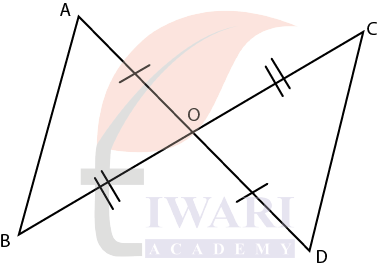
3. It is given that OB = OC, and OA = OD. Show that AB is parallel to CD.
[Hint: AD is a transversal for these two lines. Are there any equal alternate angles?]
Answer:
In triangles AOB and DOC:
OA = OD (given)
OB = OC (given)
∠AOB = ∠DOC (vertically opposite angles at point O)
△AOB ≅ △DOC [By the SAS (Side-Angle-Side) congruence criterion]
Since the triangles are congruent
∠OAB = ∠ODC (corresponding angles in congruent triangles)
Now, looking at the transversal AD crossing lines AB and CD:
∠OAB is the angle between AB and AD at point A
∠ODC is the angle between CD and AD at point D
Since ∠OAB = ∠ODC and these are alternate angles with respect to transversal AD.
Hence, AB ∥ CD.
4. ABCD is a square. Show that ∆ABC ≅ ∆ADC. Is ∆ABC also congruent to ∆CDA?
Give more examples of two triangles where one triangle is congruent to the other in two different ways, as in the case above. Can you give an example of two triangles where one is congruent to the other in six different ways?

Answer:
ABCD is a square.
All sides of a square are equal and all angles are 90°.
In triangles ΔABC and ΔADC:
AB = AD (sides of a square)
BC = DC (sides of a square)
AC = AC (common side)
Therefore, by SSS congruence, ΔABC ≅ ΔADC.
Yes, ΔABC is also congruent to ΔCDA.
This is because ∠DAC = ∠DCA.
So, in square ABCD, diagonal AC divides the square into two triangles.
ΔABC ≅ ΔADC and also ΔABC ≅ ΔCDA.
Congruent in six different ways
Yes. Take two equilateral triangles ΔABC and ΔPQR having the same side length.
Since
AB = BC = CA and PQ = QR = RP, every vertex of the first triangle can correspond to any vertex of the second triangle. Therefore there are 3 × 2 × 1 = 6 ways:
- ΔABC ≅ ΔPQR
- ΔABC ≅ ΔPRQ
- ΔABC ≅ ΔQPR
- ΔABC ≅ ΔQRP
- ΔABC ≅ ΔRPQ
- ΔABC ≅ ΔRQP
So, two congruent equilateral triangles provide an example where one triangle is congruent to the other in six different ways.
5. Find ∠B and ∠C, if A is the centre of the circle.

Answer:
A is the centre of the circle.
So, AB = AC (radii of the same circle).
Therefore, triangle ABC is an isosceles triangle.
Given ∠BAC = 120°.
Since AB = AC, ∠B = ∠C
Let ∠B = ∠C = x
Sum of angles of a triangle = 180°.
∠A + ∠B + ∠C = 180°
⇒ 120° + x + x = 180°
⇒ 2x = 60°
⇒ x = 60° ÷ 2 = 30°
Therefore, ∠B = ∠C = 30°
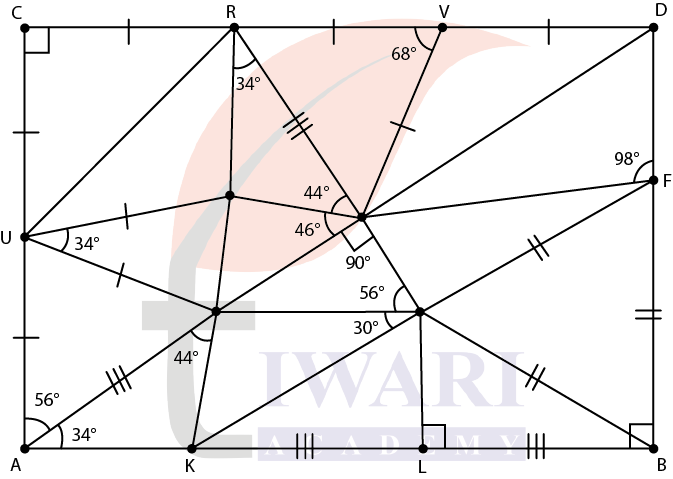
6. Find the missing angles. As per the convention that we have been following, all line segments marked with a single ‘|’ are equal to each other and those marked with a double ‘|’ are equal to each other, etc.
Answer:
According to the given convention, line segments marked with the same number of marks are equal.
Hence, triangles formed with equal sides are isosceles and angles opposite equal sides are equal. Also, we use the following facts:
Sum of angles of a triangle is 180°.
Angles on a straight line add up to 180°.
Angles around a point add up to 360°.
Vertically opposite angles are equal.
A right angle is 90°.
Using these rules, the missing angles (marked in red) are obtained as follows:

In ΔCUR,
∠1 = 90° [Given]
Also, CR = CU
So, ∠2 = ∠3 = (180° − 90°)/2 = 45°
Similarly, in ΔUEF
∠EUF = 34°
Also, UF = UE [Given]
So, ∠6 = ∠7 = (180° − 34°)/2 = 73°.
In ΔAFU, ∠UAF= 56° and UA = UF, hence
∠UAF = ∠9 = 56°, also
∠8 = 180° − 56° − 56° = 68°.
At point U,
∠8 + 34° + ∠4 + ∠3 = 180° [Forming straight angle]
⇒ 45° + ∠4 + 34° + 68° = 180°,
⇒ ∠4 = 33°.
In ΔRVH
∠RVH = 68°
Also, VR = VH [Given]
So, ∠r = ∠q = (180° − 68°)/2 = 56°.
Hence, ∠r = ∠q = 56°.
At point R,
∠2 + ∠5 + 34° + ∠r = 180° [Forming straight angle]
⇒ 45° + ∠5 + 34° + 56° = 180°,
⇒ ∠5 = 45°.
In ΔRUE
∠REU = 180° − ∠4 − ∠5
⇒ ∠REU = 180° − 33° − 45° = 102°.
In ΔREH
∠w = 180° − 34° − 44° = 102°.
At point E,
∠REU + ∠6 + ∠s + ∠w = 360° [Forming complete angle]
⇒ 102° + 73° + ∠s + 102° = 360°,
⇒ ∠s = 83°.
In ΔHEF
∠s + ∠t + 46° = 180°
⇒ 83° + ∠t + 46° = 180°,
⇒ ∠t = 51°.
In ΔHGF
∠x = 180° − 90° − 56° = 34°.
In ΔAKF
∠10 = 180° − 34° − 44° = 102°,
At point F,
∠KFG + 44° + ∠9 + ∠7 + ∠t + ∠x = 360° [Forming complete angle]
⇒ ∠KFG + 44° + 56° + 73° + 51° + 34° = 360°
⇒ ∠KFG = 360° – 258° = 102°
In ΔKFG
∠a = 180° − ∠KFG − 30°
⇒ ∠a = 180° − 102° − 30° = 48°.
⇒ ∠a = 48°
The ΔBGF is an equilateral triangle, so
∠f = ∠g = ∠h = 60°.
Consequently,
∠e = 90° − ∠f = 90° − 60° = 30°
Also, ∠b = ∠e = 30°
In ΔBGL,
∠d = 180° − ∠BLG − ∠e
⇒ ∠d = 180° − 90° − 30° = 60°.
⇒ ∠d = 60°
Also, ∠c = ∠d = 60°.
At point F,
98° + ∠i +∠g = 180° [Forming straight angle]
⇒ 98° + ∠i + 60° = 180°
⇒ ∠i = 22°.
Around the point G,
∠j + 56° + 30° + ∠c + ∠d + ∠h = 360° [Forming complete angle]
⇒ ∠j + 56° + 30° + 60° + 60° + 60° = 360°
⇒ ∠j = 94°.
In ΔFGH,
∠k = 180° − ∠i − ∠k = 64°
⇒ ∠k = 180° − 22° − 94° = 64°.
At point V,
68° + ∠HVD = 180° [Forming linear pair]
⇒ ∠HVD = 180° − 68° = 112°
In ΔHVD, VH = VD, so ∠p = ∠n
Therefore, ∠p = ∠n = (180° − 112°)/2 = 34°.
Thus, ∠o = 90° − 34° = 56°
In ΔFHD,
∠m = 180° − 98° − ∠m = 26°
⇒ ∠m = 180° − 98° − 56° = 26°.
Frequently Asked Questions
Is Class 7 Maths Ganita Prakash Part 2, Chapter 1 easy?
Chapter 1 is built to be approachable rather than difficult. Every idea is introduced through a hands-on construction or an everyday example – a signboard symbol, a triangular frame, a rectangle – before any formal rule like SSS or RHS is named. Concepts build on each other step by step and each new congruence condition is derived from an actual construction rather than handed down as something to memorise. Students who work through the chapter’s questions in order, rather than jumping ahead, generally find the logic easy to follow.
How to solve Class 7 Maths Ganita Prakash Part 2, Chapter 1 in one day?
To finish Chapter 1 in a single sitting, work through it in the order it’s written rather than skipping to the exercises. Start with Section 1.1 to get comfortable with what “congruent” means, then move to Section 1.2 and learn the five conditions – SSS, SAS, ASA, AAS and RHS – one at a time, trying the suggested construction for each before reading on. Finish with Section 1.3 on isosceles and equilateral triangles, then attempt all four “Figure it Out” exercises back to back so the conditions stay fresh while you apply them.
How many questions are there in Class 7 Maths Ganita Prakash Part 2, Chapter 1?
Chapter 1 includes four “Figure it Out” exercises spread across its three sections – one after the introduction to congruent figures, two more within the triangle-congruence section covering SSS through RHS, and a final one in the isosceles and equilateral triangles section. The exercises grow in complexity, moving from simple pair-identification tasks early on to a substantial multi-part figure with several angles to find, using every congruence condition covered in the chapter.
Is Class 7 Maths Ganita Prakash Part 2, Chapter 1 important for the exam?
While exact exam weightage varies by school and year, Chapter 1 introduces congruence – a concept the rest of geometry builds on, since proving that two shapes match exactly is the basis for later work with symmetry, constructions and other triangle properties. The chapter’s “Figure it Out” questions closely resemble the kind of reasoning-based questions that tend to appear in tests, asking students to identify correct correspondences, justify congruence with reasons and find missing angles using the conditions learned. Understanding it well also builds the reasoning skills needed for geometry topics later in the syllabus.
What topics are covered in Class 7 Maths Ganita Prakash Part 2, Chapter 1?
This chapter, “Geometric Twins”, covers the idea of congruent figures and congruent triangles. It explains how to check whether two figures are exact copies of each other, then introduces five conditions used specifically to prove triangle congruence – SSS, SAS, ASA, AAS and RHS. The chapter closes by using these congruence rules to establish two key results: that angles opposite equal sides in a triangle are equal and that all three angles of an equilateral triangle measure 60° each.
How many exercises are there in Chapter 1, Geometric Twins?
Chapter 1 includes four “Figure it Out” exercises spread across its three sections – one after the introduction to congruent figures, two more within the triangle-congruence section covering SSS through RHS, and a final one in the isosceles and equilateral triangles section. The exercises grow in complexity, moving from simple pair-identification tasks early on to a substantial multi-part figure with several angles to find, using every congruence condition covered in the chapter.
What real-life examples of congruent triangles does Class 7 Maths Ganita Prakash Part 2, Chapter 1 mention?
The chapter highlights how congruent triangles appear in real-world structures and designs, including the glass pyramid at the Louvre Museum in Paris, the Great Pyramid of Giza, geometric dome designs, traditional rangoli patterns and the truss framework of the Rabindra Setu (Howrah Bridge). These examples help students see that congruence isn’t just an abstract idea – it’s a structural principle architects and engineers rely on for strength, symmetry and repeated patterns.