



by Tiwari Academy Team
NCERT Solutions for Class 7 Maths Ganita Prakash Chapter 7 A Tale of Three Intersecting Lines for Session 2026-27 CBSE Exam. Chapter 7, A Tale of Three Intersecting Lines, introduces triangles through hands-on construction using a ruler, compass and protractor. These NCERT Solutions for Class 7 Ganita Prakash Chapter 7 explain every Figure It Out question, covering the triangle inequality, constructing triangles from given sides or angles, the angle sum property, exterior angles and altitudes. Each answer includes clear reasoning and step-by-step construction methods, helping students build accurate triangles confidently for both classroom practice and exams.
Class 7 Maths all Chapters
NCERT Class 7 Maths Ganita Prakash Chapter 7 Solutions
Page 150 – Figure it Out
1. Use the points on the circle and/or the centre to form isosceles triangles.

Answer:
From the centre O, join any two points P and Q on the circle to form triangle OPQ.
Since OP = OQ = radius
∴ Triangle OPQ is an isosceles triangle.
(If ∠POQ = 60° is chosen, then PQ will also equal the radius and the triangle becomes equilateral.)

2. Use the points on the circles and/or their centres to form isosceles and equilateral triangles. The circles are of the same size.
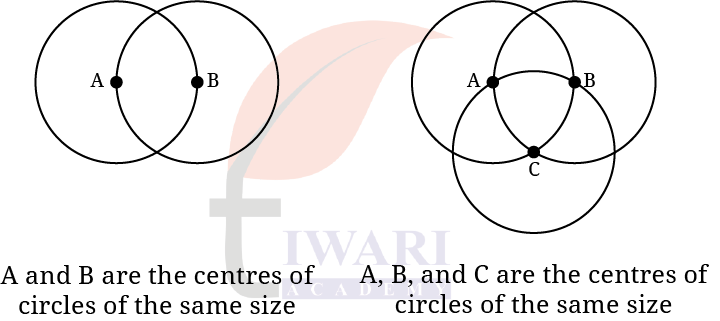
Answer:
(i) Two circles (centres A and B):
Since each circle passes through the other’s centre,
AB = radius (r)
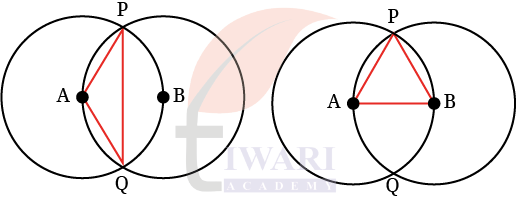
Let P and Q be the points where the two circles intersect.
• AP = AQ = r (radii of circle A)
⇒ △APQ is isosceles
• BP = BQ = r (radii of circle B)
⇒ △BPQ is isosceles
• AP = BP = AB = r
⇒ △ABP is equilateral
• Similarly, AQ = BQ = AB = r ⟹ △ABQ is equilateral
(ii) Three circles (centres A, B, C):
Since every pair of circles passes through each other’s centre,
AB = BC = CA = r
So, △ABC (formed by the three centres) is equilateral
Also, taking any centre with two points where its own circle crosses the other circles gives more isosceles triangles (since those sides are radii of the same circle) and combinations like a centre + centre + outer intersection point (where AP = BP = AB = r) give additional equilateral triangles.

Page 154 – Figure it Out
1. We checked by construction that there are no triangles having sidelengths 3cm, 4 cm and 8cm; and 2 cm, 3 cm and 6 cm. Check if you could have found this without trying to construct the triangle.
Answer:
Case (i): 3 cm, 4 cm, 8 cm
To check if a triangle exists, we compare the sum of the two smaller sides with the largest side.
Sum of smaller two sides = 3 + 4 = 7 cm
Largest side = 8 cm
Since 7 cm < 8 cm, i.e., sum of two sides is less than the third side,
∴ No triangle can be formed with sides 3 cm, 4 cm, 8 cm.
Case (ii): 2 cm, 3 cm, 6 cm
Sum of smaller two sides = 2 + 3 = 5 cm
Largest side = 6 cm
Since 5 cm < 6 cm,
∴ No triangle can be formed with sides 2 cm, 3 cm, 6 cm.
2. Can we say anything about the existence of a triangle for each of the following sets of lengths?
(a) 10 km, 10km and 25 km
(b) 5 mm, 10 mm and 20 mm
(c) 12 cm, 20 cm and 40 cm
You would have realised that using a rough figure and comparing the direct path lengths with their corresponding roundabout path lengths is the same as comparing each length with the sum of the other two lengths. There are three such comparison to be made.
Answer:
(a) 10 km, 10 km, 25 km
Sum of two smaller sides = 10 + 10 = 20 km
Largest side = 25 km
Since 20 km < 25 km,
∴ Triangle does not exist.
(b) 5 mm, 10 mm, 20 mm
Sum of two smaller sides = 5 + 10 = 15 mm
Largest side = 20 mm
Since 15 mm < 20 mm,
∴ Triangle does not exist.
(c) 12 cm, 20 cm, 40 cm
Sum of two smaller sides = 12 + 20 = 32 cm
Largest side = 40 cm
Since 32 cm < 40 cm,
∴ Triangle does not exist.
3. For each set of lengths seen so far, you might have noticed that in at least two of the comparisons, the direct length was less than the sum of the other two (if not, check again!) For example, for the set of the lengths 10 cm, 15 cm and 30 cm, there are two comparisons where this happens:
10 < 15 + 30
15 < 10 + 30 But this doesn’t happen for the third length: 30>10 + 15.
Answer:
Let the three lengths, arranged in increasing order, be a ≤ b ≤ c.
Comparison 1: Is a < b + c? Since b and c are positive numbers, b + c > b ≥ a
∴ a < b + c is always true.
Comparison 2: Is b < a + c? Since a and c are positive numbers, a + c > c ≥ b
∴ b < a + c is always true.
Comparison 3: Is c < a + b?
This is not guaranteed — it depends on the actual values of a, b, c.
Conclusion:
The two smaller lengths will always satisfy the condition (direct length < sum of other two). Only the comparison involving the largest length determines whether the triangle exists or not.
Page 156 – Figure it Out
1. Which of the following lengths an be the sidelengths of a triangle? Explain your answers. Note that for each set, the three length have the same unit of measure.
(a) 2, 3, 5
(b) 3, 4, 6
(c) 2, 4, 8
(d) 5, 5, 8
(e) 10, 20, 25
(f) 10, 20, 35
(g) 24, 26, 28
Answer:
(a) 2, 2, 5
5 > 2 + 2 = 4
Not possible (triangle inequality fails)
(b) 3, 4, 6
6 < 3 + 4 = 7 Possible (c) 2, 4, 8 8 > 2 + 4 = 6
Not possible
(d) 5, 5, 8
8 < 5 + 5 = 10
Possible
(e) 10, 20, 25
25 < 10 + 20 = 30 Possible (f) 10, 20, 35 35 > 10 + 20 = 30
Not possible
(g) 24, 26, 28
28 < 24 + 26 = 50
Possible
Page 159 – Figure it Out
1. Check if a triangle exists for each of the following set of lengths:
(a) 1, 100, 100
(b) 3, 6, 9
(c) 1, 1, 5
(d) 5, 10, 12
Answer:
(a) 1, 100, 100
Sum of two smaller sides = 1 + 100 = 101
Largest side = 100
Since 101 > 100, triangle exists.
(b) 3, 6, 9
Sum of two smaller sides = 3 + 6 = 9
Largest side = 9
Since 9 = 9 (sum is equal to, not greater than, the third side),
triangle does not exist.
(c) 1, 1, 5
Sum of two smaller sides = 1 + 1 = 2
Largest side = 5
Since 2 < 5, triangle does not exist. (d) 5, 10, 12 Sum of two smaller sides = 5 + 10 = 15 Largest side = 12 Since 15 > 12, triangle exists.
2. Does there exist an equilateral triangle with sides 50, 50, 50? In general, does there exist an equilateral triangle of any sidelength? Justify your answer.
Answer:
For sides 50, 50, 50:
Check: 50 + 50 = 100 > 50 (satisfied, since all three sides are equal, all three comparisons give the same result)
∴ An equilateral triangle with side 50 exists.
In general, for any sidelength ‘a’:
We need to check: a + a > a
⇒ 2a > a
⇒ a > 0
Since sidelength is always a positive number, this condition (a > 0) is always true.
3. For each of the following, give at least 5 possible values for the third length so there exists a triangle having these as sidelengths (decimal values could also be chosen):
(a) 1, 100
(b) 5, 5
(c) 3, 7
See if you can describe all possible lengths of the third side in each case, so that a triangle exists with those sidelengths.
For example, in case (a), all numbers strictly between 99 and 101 would be possible.
Answer:
(a) Given sides: 1, 100
x must satisfy: 100 − 1 < x < 100 + 1
⇒ 99 < x < 101
Five possible values: 99.5, 99.8, 100, 100.2, 100.7
(b) Given sides: 5, 5
x must satisfy: 5 − 5 < x < 5 + 5
⇒ 0 < x < 10
Five possible values: 2, 4, 6, 8, 9
(c) Given sides: 3, 7
x must satisfy: 7 − 3 < x < 7 + 3
⇒ 4 < x < 10
Five possible values: 5, 6, 7, 8, 9
Page 161 – Figure it Out
1. Construct triangles for the following measurements where the angle is included between the sides:
(a) 3 cm, 75°, 7 cm
(b) 6 cm, 25°, 3 cm
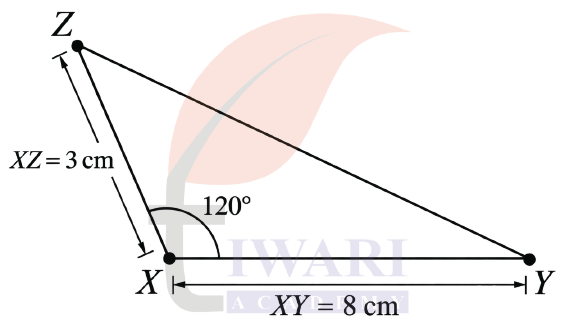
(c) 3 cm, 120°, 8 cm
Answer:
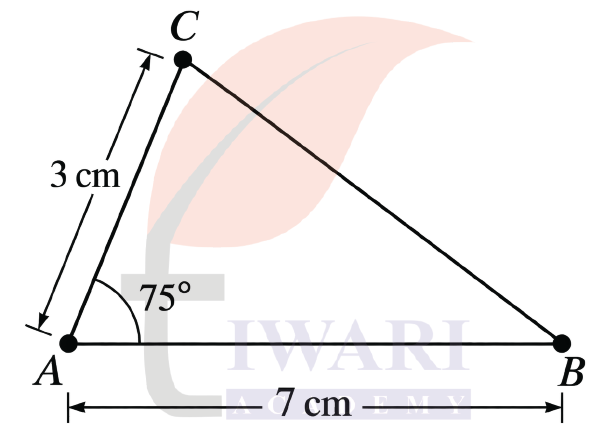
(a) 3 cm, 75°, 7 cm
Construct ΔABC such that AB = 7 cm, AC = 3 cm and ∠BAC = 75°.
Step 1: Draw a line segment AB = 7 cm.
Step 2: At A, construct an angle ∠BAX = 75°.
Step 3: With A as centre and radius 3 cm, draw an arc cutting ray AX at C.
Step 4: Join BC.
Thus, ΔABC is the required triangle.
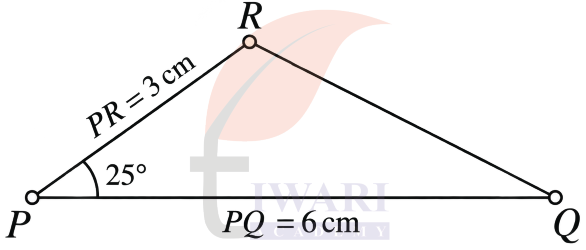
(b) 6 cm, 25°, 3 cm
Construct ΔPQR such that PQ = 6 cm, PR = 3 cm and ∠QPR = 25°.
Step 1: Draw PQ = 6 cm.
Step 2: At P, construct ∠QPX = 25°.
Step 3: With P as centre and radius 3 cm, draw an arc cutting ray PX at R.
Step 4: Join QR.
Thus, ΔPQR is the required triangle.
(c) 3 cm, 120°, 8 cm
Construct ΔXYZ such that XY = 8 cm, XZ = 3 cm and ∠YXZ = 120°.
Step 1: Draw XY = 8 cm.
Step 2: At X, construct ∠YXW = 120°.
Step 3: With X as centre and radius 3 cm, draw an arc cutting ray XW at Z.
Step 4: Join YZ.
Thus, ΔXYZ is the required triangle.
Page 162 – Figure it Out
1. Construct triangles for the following measurements:
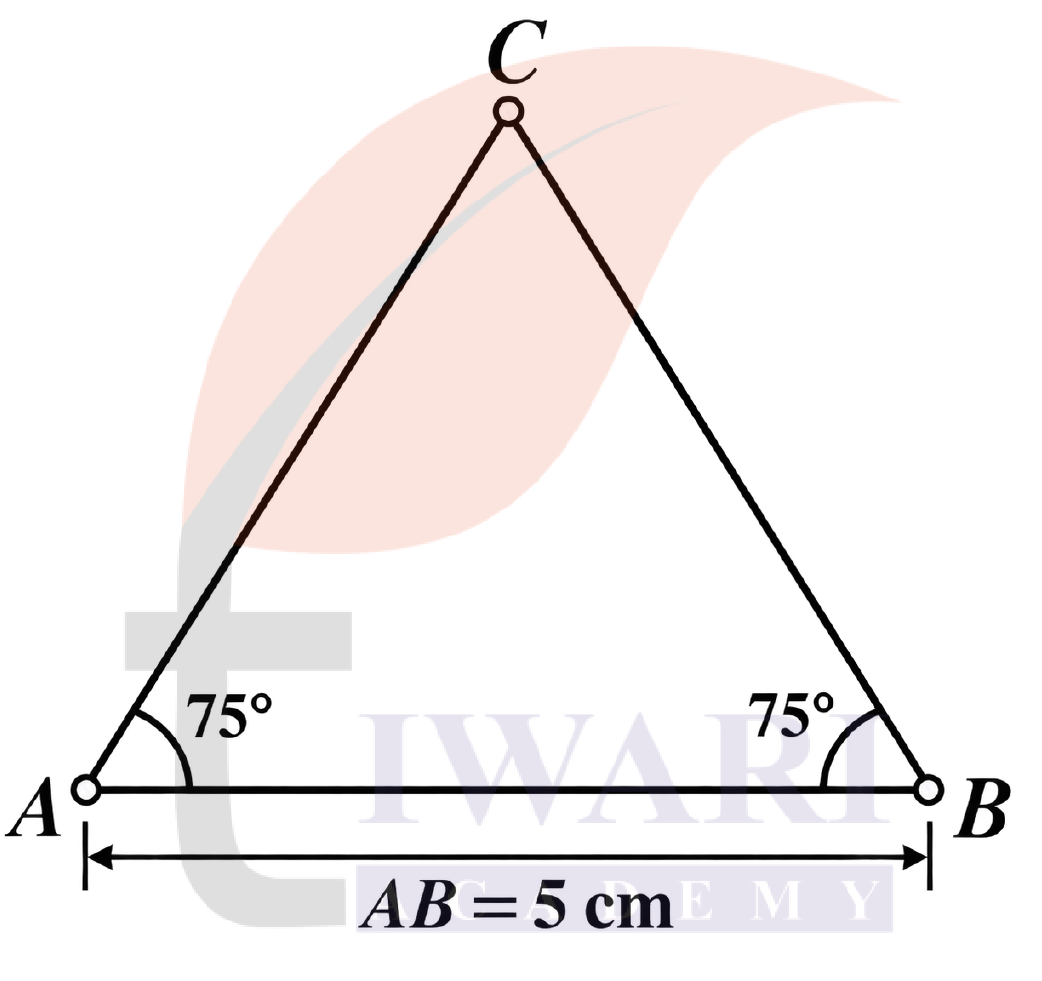
(a) 75°, 5 cm, 75°
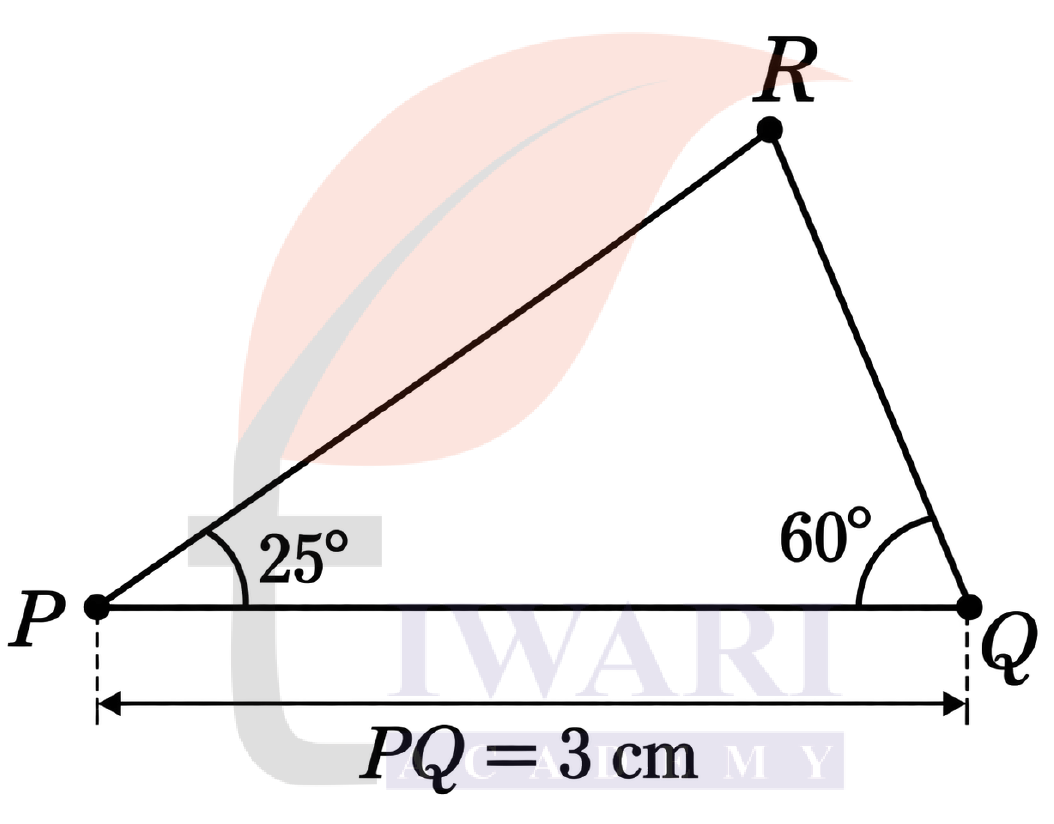
(b) 25°, 3 cm, 60°
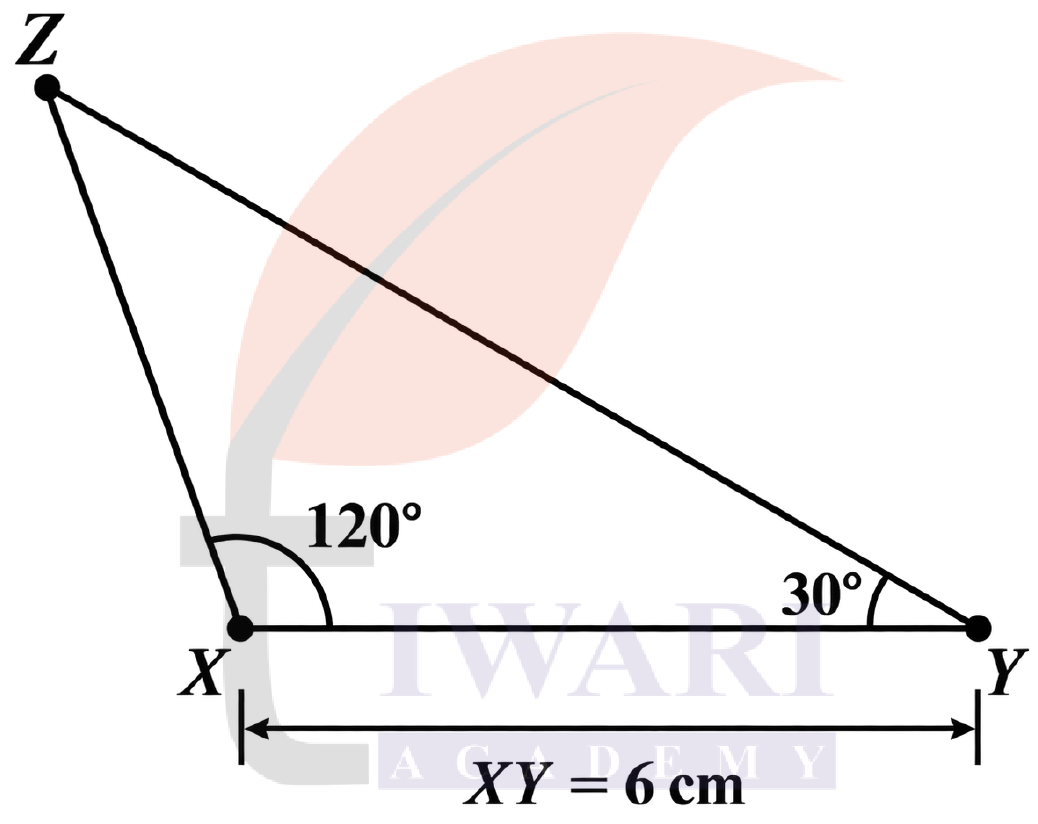
(c) 120°, 6 cm, 30°
Answer:
(a) Steps of Construction:
Step 1: Draw AB = 5 cm.
Step 2: At A, construct ∠A = 75°.
Step 3: At B, construct ∠B = 75°.
Step 4: Extend both rays till they intersect at point C.
∴ ΔABC is the required triangle.
(Since ∠A = ∠B, this is an isosceles triangle with CA = CB.)
(b) Steps of Construction:
Step 1: Draw PQ = 3 cm.
Step 2: At P, construct ∠P = 25°.
Step 3: At Q, construct ∠Q = 60°.
Step 4: Extend both rays till they meet at R.
∴ ΔPQR is the required triangle.
(c) Steps of Construction:
Step 1: Draw XY = 6 cm.
Step 2: At X, construct ∠X = 120°.
Step 3: At Y, construct ∠Y = 30°.
Step 4: Extend both rays till they meet at Z.
∴ ΔXYZ is the required triangle.
Page 163 – Figure it Out
1. For each of the following angles, find another angle for which a triangle is (a) possible, (b) not possible. Find at least two different angles for each category:
(a) 30°
(b) 70°
(c) 54°
(d) 144°
Answer:
(a) 30°
(i) Possible: 60°, 90°
(ii) Possible: 100°, 50°
(iii) Not possible: 150°
(iv) Not possible: 180°
(b) 70°
(i) Possible: 50°, 60°
(ii) Possible: 80°, 30°
(iii) Not possible: 110°
(iv) Not possible: 120°
(c) 54°
(i) Possible: 60°, 66°
(ii) Possible: 90°, 36°
(iii) Not possible: 126°
(iv) Not possible: 140°
(d) 144°
(i) Possible: 20°, 16°
(ii) Possible: 30°, 6°
(iii) Not possible: 36°
(iv) Not possible: 50°
2. Determine which of the following pairs can be the angles of a triangle and which cannot:
(a) 35°, 150°
(b) 70°, 30°
(c) 90°, 85°
(d) 50°, 150°
Answer:
(a) 35°, 150°
35° + 150° = 185°
Cannot be the angles of a triangle.
(b) 70°, 30°
70° + 30° = 100°
Can be the angles of a triangle.
(c) 90°, 85°
90° + 85° = 175°
Can be the angles of a triangle.
(d) 50°, 150°
50° + 150° = 200°
Cannot be the angles of a triangle.
Page 165 – Figure it Out
1. Find the third angle of a triangle (using a parallel line) when two of the angles are:
(a) 36°, 72°
(b) 150°, 15°
(c) 90°, 30°
(d) 75°, 45°
Answer:
(a) 36°, 72°
Third angle = 180° − 36° − 72° = 180° − 108°
Third angle = 72°
(b) 150°, 15°
Third angle = 180° − 150° − 15° = 180° − 165°
Third angle = 15°
(c) 90°, 30°
Third angle = 180° − 90° − 30° = 180° − 120°
Third angle = 60°
(d) 75°, 45°
Third angle = 180° − 75° − 45° = 180° − 120°
Third angle = 60°
2. Can you construct a triangle all of whose angles are equal to 70°? If two of the angles are 70° what would the third angle be? If all the angles in a triangle have to be equal, then what must its measure be? Explore and find out.
Answer:
If two angles are 70° each:
Third angle = 180° − 70° − 70° = 180° − 140°
Third angle = 40°
Check for all three angles = 70°:
Sum = 70° + 70° + 70° = 210°
Since 210° ≠ 180° (angle sum property is violated),
∴ A triangle with all three angles equal to 70° is NOT possible.
If all three angles are equal (let each angle = x):
x + x + x = 180°
3x = 180°
x = 60°
∴ For all angles to be equal, each angle must be 60°. (This gives an equilateral triangle.)
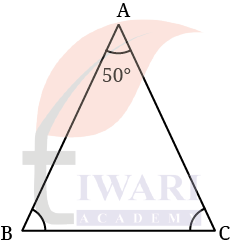
3. Here is a triangle in which we know ∠B = ∠C and ∠A = 50°. Can you find ∠B and ∠C?
Answer:
Given: ∠A = 50°, ∠B = ∠C
By Angle Sum Property:
∠A + ∠B + ∠C = 180°
50° + ∠B + ∠C = 180°
∠B + ∠C = 180° − 50°
∠B + ∠C = 130°
Since ∠B = ∠C, let ∠B = ∠C = x
x + x = 130°
2x = 130°
x = 65°
∴ ∠B = 65° and ∠C = 65°
Page 170 – Figure it Out
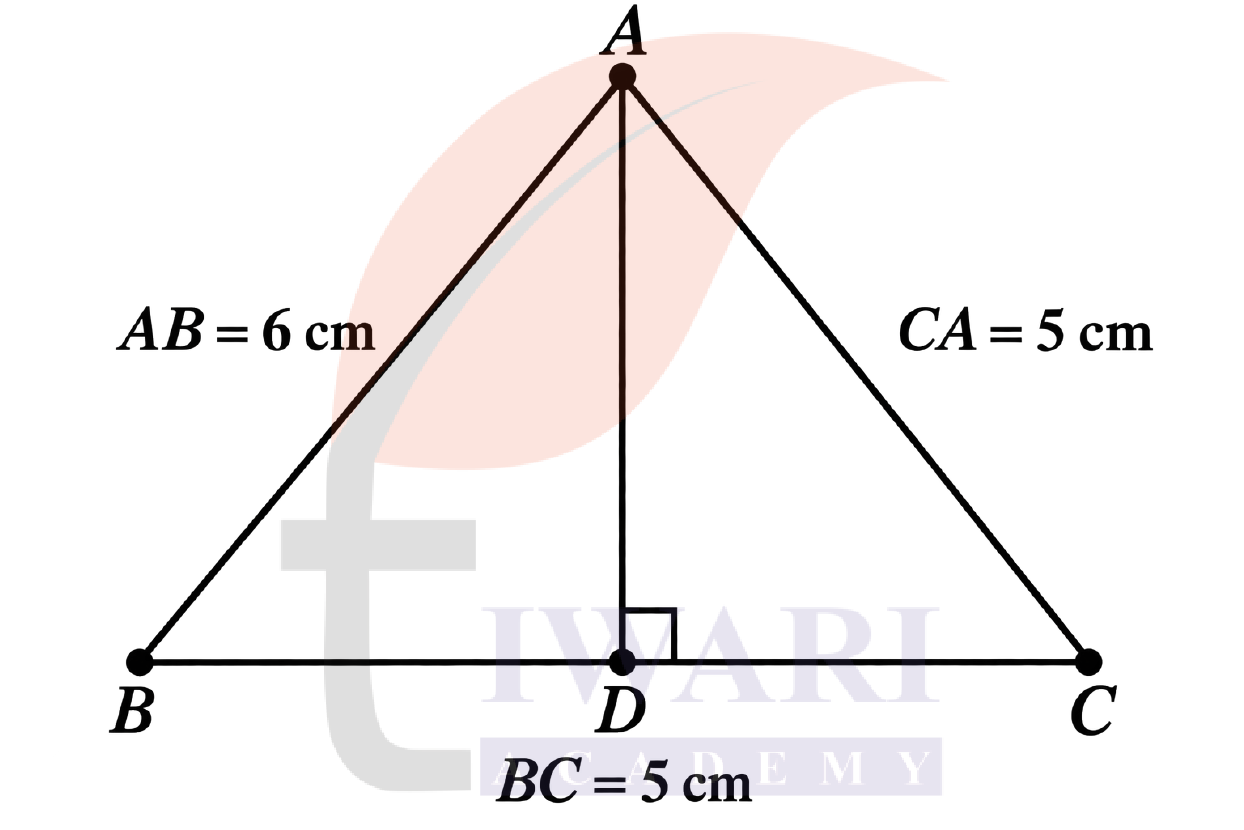
1. Construct a triangle ABC with BC = 5 cm, AB = 6 cm, CA = 5 cm. Construct an altitude from A to BC.
Answer:
Steps of Construction:
Step 1: Draw BC = 5 cm.
Step 2: With B as centre, draw an arc of radius 6 cm.
Step 3: With C as centre, draw an arc of radius 5 cm, cutting the previous arc at point A.
Step 4: Join AB and AC to complete ΔABC.
Step 5: Using a ruler and set square, place the set square so that one edge touches BC, then slide it until the perpendicular edge touches A. Draw the perpendicular line from A to BC; mark the foot of the perpendicular as D.
∴ AD is the required altitude from A to BC.
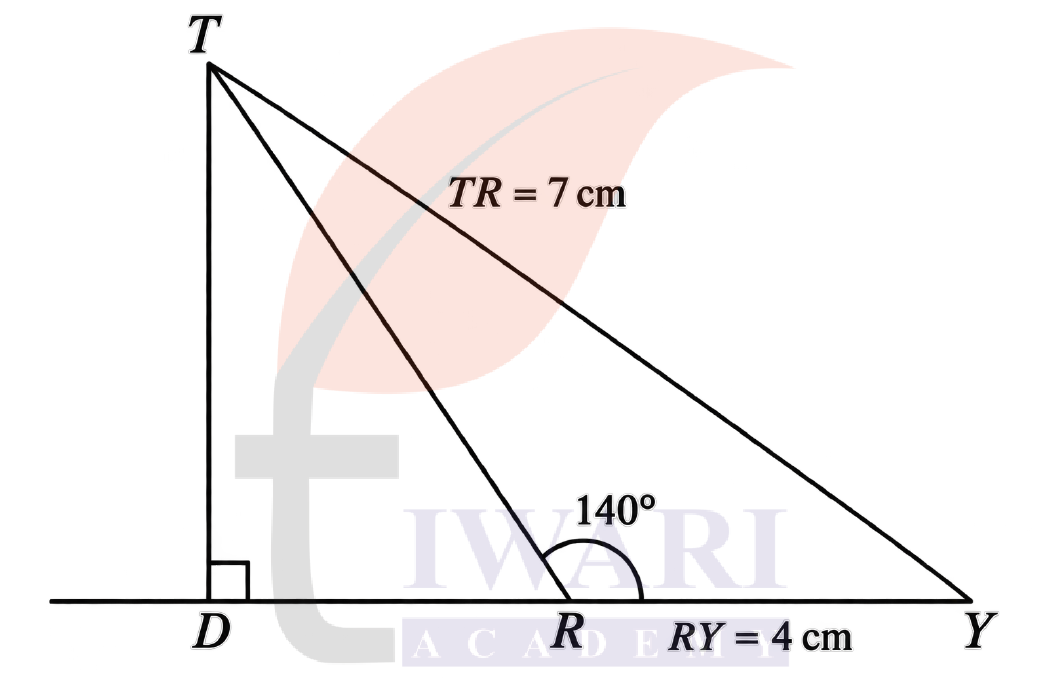
2. Construct a triangle TRY with RY = 4 cm, TR = 7 cm, ∠R = 140°. Construct an altitude from T to RY.
Answer:
Steps of Construction:
Step 1: Draw RY = 4 cm.
Step 2: At R, construct ∠R = 140° using a protractor, drawing ray RX.
Step 3: On ray RX, mark T such that RT = 7 cm.
Step 4: Join TY to complete ΔTRY.
Step 5: Since ∠R = 140° is an obtuse angle, the foot of the altitude from T will fall outside the segment RY. Extend line YR beyond R. Using a set square, draw a perpendicular from T to this extended line; mark the foot as D.
∴ TD is the required altitude from T to RY (lying outside the triangle, on the extension of RY).
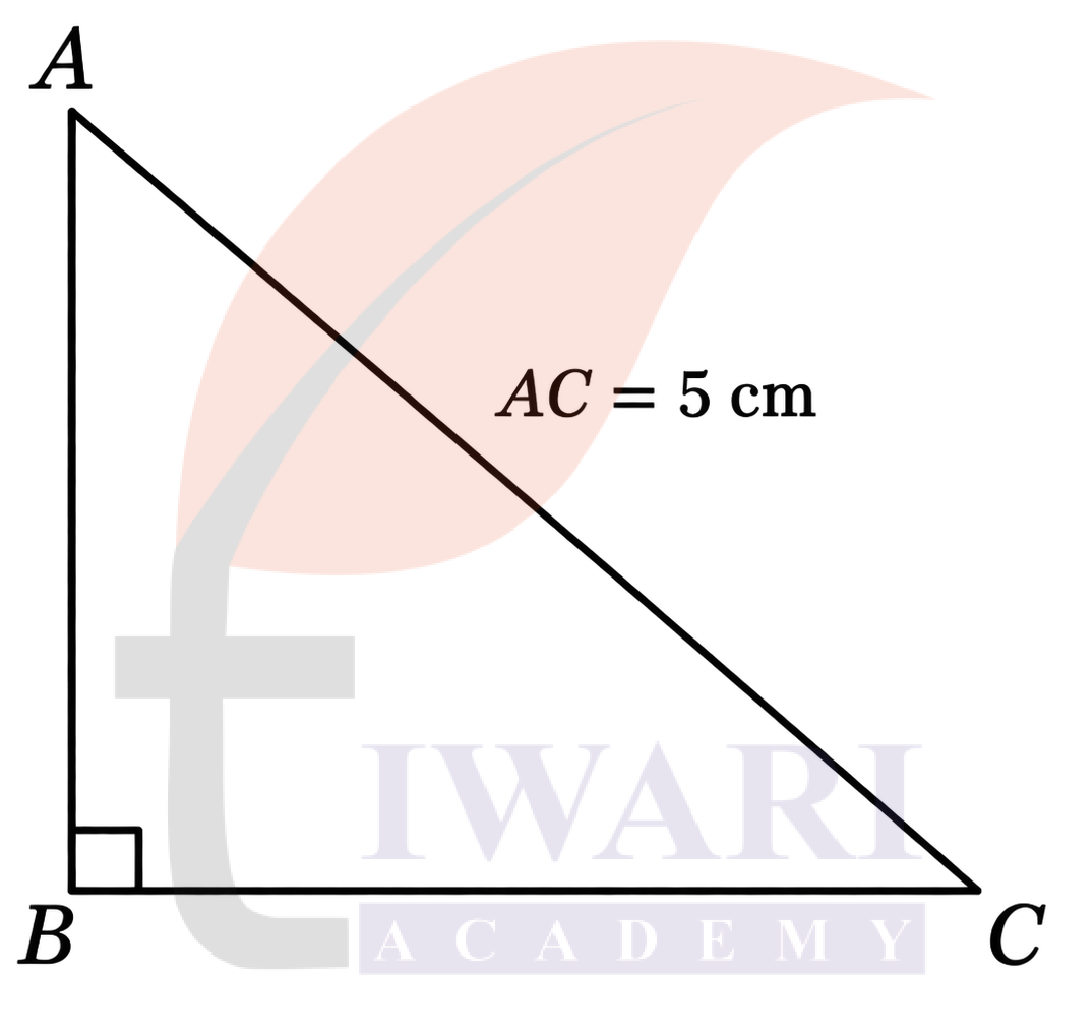
3. Construct a right-angled triangle ∆ABC with ∠B = 90°, AC = 5 cm. How many different triangles exist with these measurements?
Answer:
Given:
∠B = 90°
AC = 5 cm
Since AC is the hypotenuse, we can construct a right-angled triangle in different ways by changing the lengths of AB and BC, while keeping AC = 5 cm.
Therefore, infinitely many different triangles can be constructed with these measurements.
4. Through construction, explore if it is possible to construct an equilateral triangle that is (i) right-angled (ii) obtuse-angled. Also construct an isosceles triangle that is (i) right-angled (ii) obtuse-angled.
Answer:
(i) Equilateral triangle that is right-angled
Not possible.
An equilateral triangle has all its angles equal to 60°, so it cannot have a 90° angle.
(ii) Equilateral triangle that is obtuse-angled
Not possible.
An equilateral triangle always has three angles of 60°, so it cannot have an angle greater than 90°.
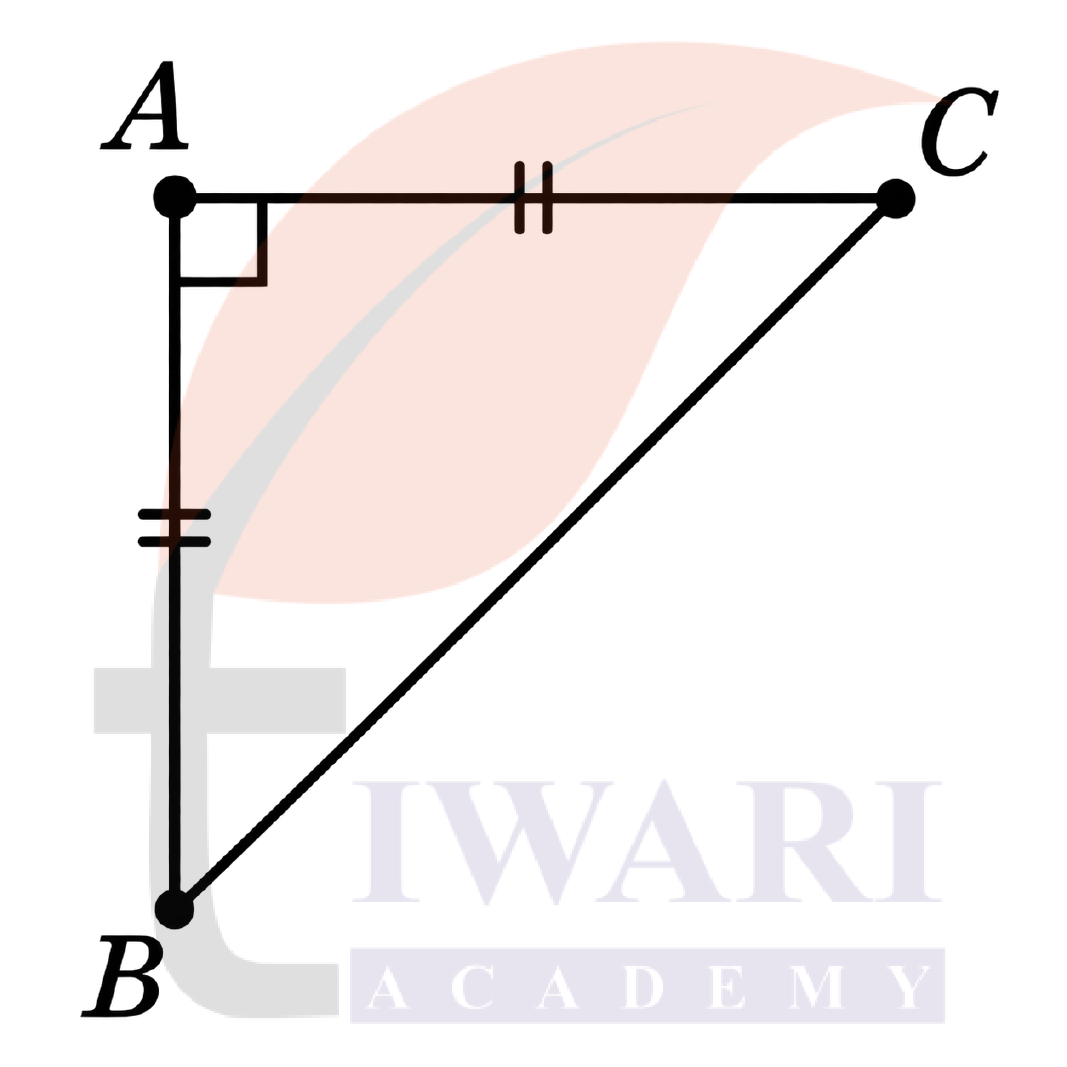
(i) Isosceles triangle that is right-angled
Possible.
An isosceles triangle with angles 45°, 45°, 90°.
(ii) Isosceles triangle that is obtuse-angled
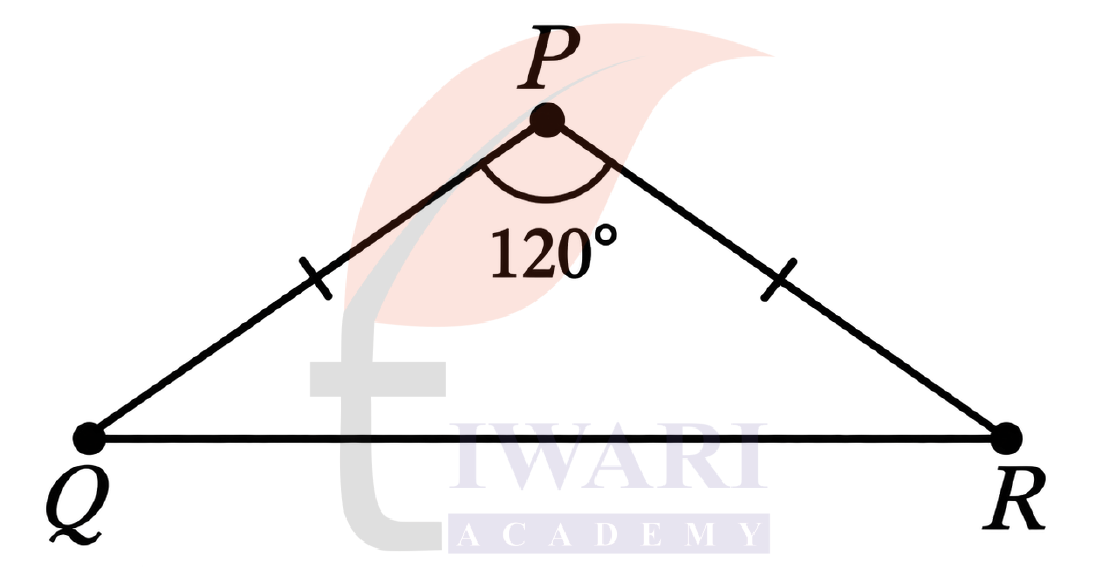
Possible.
Construct an isosceles triangle with angles 40°, 40°, 100°.
FAQs – Class 7 Maths Chapter 7
How many questions are covered in the NCERT Solutions for Class 7 Maths Chapter 7?
Chapter 7 is organised into five main sections – equilateral triangles, triangle construction from given sides, the triangle inequality, construction from given angles (covering both SAS and ASA cases), altitudes and types of triangles – each followed by its own Figure It Out exercise. Across these sections there are more than 20 questions in total, several with multiple sub-parts covering constructions, angle calculations and reasoning-based statements. These solutions work through every one of them, including the full construction steps, not just the final measurements, so students can replicate each figure accurately on their own.
Is Chapter 7 important for Class 7 exams?
Yes. A Tale of Three Intersecting Lines is a construction-heavy chapter and CBSE Class 7 exams typically include at least one or two questions asking students to construct a triangle given specific sides or angles, then find a related value such as an altitude, an exterior angle or a missing angle. Beyond construction marks, concepts like the triangle inequality and the angle sum property are frequently tested through short-answer and reasoning-based questions, since they check conceptual understanding rather than memorised steps, which makes this chapter valuable well beyond a single unit test.
What geometry tools are needed to solve Chapter 7 questions?
Most constructions in this chapter need a ruler, a compass and a protractor, while a set square is introduced specifically for drawing accurate altitudes, since a precise 90-degree angle is difficult to achieve using a ruler alone. Students should also keep a sharp pencil handy for accurate arcs and vertex points, since even small errors in compass width or angle measurement can noticeably shift a triangle’s final shape. Practising with real instruments, rather than only reading through the steps, matters here, since this chapter tests hands-on construction skill directly, both in classroom assessments and board-pattern exams.
How should students use these NCERT Solutions while learning Chapter 7?
Attempt each construction independently first, following the same step-by-step method shown in the textbook, before checking these solutions to confirm accuracy. For reasoning-based questions, such as identifying whether a set of lengths satisfies the triangle inequality or whether two given angles can form a triangle, work through the logic on paper rather than jumping straight to the answer, since these questions are designed to build spatial reasoning skills. Use the solutions mainly to verify your steps and catch construction errors, not as a substitute for practising with an actual compass, ruler and protractor.
Are the construction questions from Chapter 7 asked directly in board or school exams?
Questions structured like the Figure It Out exercises – constructing a triangle from three given sides, from two sides and an included angle or from two angles and an included side – are commonly adapted for CBSE Class 7 exams, since NCERT textbook exercises form the basis for most school question papers. The exact measurements are usually changed, but the construction method and underlying reasoning, such as applying the triangle inequality or the angle sum property, stay the same, so thorough hands-on practice with this chapter’s exercises translates directly into exam readiness.