



by Tiwari Academy Team
NCERT Solutions for Class 7 Maths Ganita Prakash Part 2 Chapter 2 Operations with Integers – Question Answers for Session 2026-27. Chapter 2 of NCERT Class 7 Maths Ganita Prakash Part 2 builds on addition and subtraction using number-line and token models to explain multiplying and dividing positive and negative numbers. Students learn the sign rules for multiplication and division, plus the commutative, associative and distributive properties. The chapter connects the math to real situations like exam scoring and mining-shaft elevators. These NCERT solutions offer clear, step-by-step answers to every “Figure it Out” question in the chapter.
Class 7 Maths all Chapters
NCERT Class 7 Maths Ganita Prakash Part 2 Chapter 2 Solutions
Page 25 – Figure it Out
Let us try to find a few more pairs of numbers from their sums and differences:
(a) Sum = 27, Difference = 9
(b) Sum = 4, Difference = 12
(c) Sum = 0, Difference = 10
(d) Sum = 0, Difference = -10
(e) Sum = -7, Difference = -1
(f) Sum = -7, Difference = -13
Answer:
(a) Sum = 27, Difference = 9
First Number = 18, Second Number = 9
Sum = 18 + 9 = 27,
Difference = 18 – 9 = 9
(b) Sum = 4, Difference = 12
First Number = 8, Second Number = -4
Sum = 8 + (-4) = 4,
Difference = 8 – (-4) = 12
(c) Sum = 0, Difference = 10
First Number = 5, Second Number = -5
Sum = 5 + (-5) = 0,
Difference = 5 – (-5) = 10
(d) Sum = 0, Difference = -10
First Number = -5, Second Number = 5
Sum = -5 + 5 = 0,
Difference = -5 – 5 = -10
(e) Sum = -7, Difference = -1
First Number = -4, Second Number = -3
Sum = -4 + (-3) = -7,
Difference = -4 – (-3) = -1
(f) Sum = -7, Difference = -13
First Number = -10, Second Number = 3
Sum = -10 + 3 = -7,
Difference = -10 – 3 = -13
Page 31 – Figure it out
1. Using the token interpretation, find the values of:
(a) 3 × (-2)
(b) (-5) × (-2)
(c) (-4) × (-1)
(d) (-7) × 3
Answer:
(a) 3 × (-2)
A positive number multiplied by a negative number gives a negative result.
So, 3 × (-2) = -6.
(b) (-5) × (-2)
A negative number multiplied by a negative number gives a positive result.
So, (-5) × (-2) = 10.
(c) (-4) × (-1)
Negative × negative = positive.
So, (-4) × (-1) = 4.
(d) (-7) × 3
Negative × positive = negative.
So, (-7) × 3 = -21.
2. If 123 × 456 = 56088, without calculating, find the value of:
(a) (-123) × 456
(b) (-123) × (-456)
(c) (123) × (-456)
Answer:
(a) (-123) × 456
Negative × positive = negative.
So, (-123) × 456 = -56088.
(b) (-123) × (-456)
Negative × negative = positive.
So, (-123) × (-456) = 56088.
(c) 123 × (-456)
Positive × negative = negative.
So, 123 × (-456) = -56088.
3. Try to frame a simple rule to multiply two integers.
Answer:
Rule:
First multiply the two numbers as if both were positive – that gives the size of the answer. Then look at the signs: if both numbers had the same sign (both positive or both negative), the answer is positive. If they had different signs, the answer is negative.
Page 33 – Figure it Out
Find the following products.
(a) 4 × (-3)
(b) (-6) × (-3)
(c) (-5) × (-1)
(d) (-8) × 4
(e) (-9) × 10
(f) 10 × (-17)
Answer:
(a) 4 × (-3)
Positive × negative = negative
4 × (-3) = -12
(b) (-6) × (-3)
Negative × negative = positive
(-6) × (-3) = 18
(c) (-5) × (-1)
Negative × negative = positive
(-5) × (-1) = 5
(d) (-8) × 4
Negative × positive = negative
(-8) × 4 = -32
(e) (-9) × 10
Negative × positive = negative
(-9) × 10 = -90
(f) 10 × (-17)
Positive × negative = negative
10 × (-17) = -170
Page 39 – Figure it Out
1. Find the values of:
(a) 14 × (-15)
(b) -16 × (-5)
(c) 36 ÷ (-18)
(d) (-46) ÷ (-23)
Answer:
(a) 14 × (-15)
Positive × negative = negative
14 × 15 = 210
So, 14 × (-15) = -210
(b) -16 × (-5)
Negative × negative = positive
16 × 5 = 80
So, -16 × (-5) = 80
(c) 36 ÷ (-18)
Positive ÷ negative = negative
36 ÷ 18 = 2
So, 36 ÷ (-18) = -2
(d) (-46) ÷ (-23)
Negative ÷ negative = positive
46 ÷ 23 = 2
So, (-46) ÷ (-23) = 2
2. A freezing process requires that the room temperature be lowered from 32°C at the rate of 5°C every hour. What will be the room temperature 10 hours after the process begins?
Answer:
Initial room temperature = 32°C
The temperature is lowered at the rate of 5°C every hour.
In 10 hours, total decrease in temperature
= 5°C × 10
= 50°C
Room temperature after 10 hours
= 32°C – 50°C
= -18°C
The room temperature after 10 hours will be -18°C.
3. A cement company earns a profit of ₹8 per bag of white cement sold and a loss of ₹5 per bag of grey cement sold.
[Represent the profit/loss as integers.]
(a) The company sells 3,000 bags of white cement and 5,000 bags of grey cement in a month. What is its profit or loss?
(b) If the number of bags of grey cement sold is 6,400 bags, what is the number of bags of white cement the company must sell to have neither profit nor loss.
Answer:
Profit per white cement bag = ₹8 ⇒ +8
Loss per grey cement bag = ₹5 ⇒ -5
(a) Profit or Loss if 3000 white and 5000 grey bags are sold
Total profit from white cement = 3000 × 8 = 24000
Total loss from grey cement = 5000 × (-5) = -25000
Net profit/loss = 24000 + (-25000) = -1000
Loss of ₹1000
(b) Number of white cement bags to break even if 6400 grey bags are sold
Let number of white cement bags = x
Net profit/loss = 8x + (-5 × 6400) = 0
8x – 32000 = 0
8x = 32000
x = 32000 ÷ 8 = 4000
4000 white cement bags
4. Replace the blank with an integer to make a true statement.
(a) (-3) × _____ = 27
(b) 5 × _____ = (-35)
(c) _____ × (-8) = (-56)
(d) _____ × (-12) = 132
(e) _____ ÷ (-8) = (-56)
(f) _____ ÷ 12 = (-11)
Answer:
(a) (-3) × (-9) = 27
(b) 5 × (-7) = (-35)
(c) 7 × (-8) = (-56)
(d) (-11) × (-12) = 132
(e) 448 ÷ (-8) = (-56)
(f) (-132) ÷ 12 = (-11)
Page 42 – Figure it Out
1. Find the values of the following expressions:
(a) (-5) × (18 + (-3))
(b) (-7) × 4 × (-1)
(c) (-2) × (-1) × (-5) × (-3)
Answer:
(a) (-5) × (18 + (-3))
= (-5) × 15 = -75
(b) (-7) × 4 × (-1)
= -7 × -4 = 28
(c) (-2) × (-1) × (-5) × (-3)
= 2 × 15 = 30
2. Find the values of the following expressions:
(a) (-27) ÷ 9
(b) 84 ÷ (-4)
(c) (-56) ÷ (-2)
Answer:
(a) (-27) ÷ 9
A negative number divided by a positive number gives a negative answer.
27 ÷ 9 = 3
So, (-27) ÷ 9 = -3
(b) 84 ÷ (-4)
A positive number divided by a negative number gives a negative answer.
84 ÷ 4 = 21
So, 84 ÷ (-4) = -21
(c) (-56) ÷ (-2)
A negative number divided by a negative number gives a positive answer.
56 ÷ 2 = 28
So, (-56) ÷ (-2) = 28
3. Find the integer whose product with (-1) is:
(a) 27
(b) -31
(c) -1
(d) 1
(e) 0
Answer:
(a) Let the integer be x.
x × (-1) = 27
x = -27
(b) Let the integer be x.
x × (-1) = -31
x = 31
(c) Let the integer be x.
x × (-1) = -1
x = 1
(d) Let the integer be x.
x × (-1) = 1
x = -1
(e) Let the integer be x.
x × (-1) = 0
x = 0
4. If 47 – 56 + 14 – 8 + 2 – 8 + 5 = -4, then find the value of -47 + 56 – 14 + 8 – 2 + 8 – 5 without calculating the full expression.
Answer:
Each term in the new expression is the negative (opposite sign) of the corresponding term in the given expression.
That means, the whole new expression is the negative of the given result.
Given result = -4
So, required result = +4
5. Do you remember the Collatz conjecture from last year? Try a modified version with integers. The rule is- start with any number; if the number is even, take half of it; if the number is odd, multiply it by -3 and add 1; repeat. An example sequence is shown below.
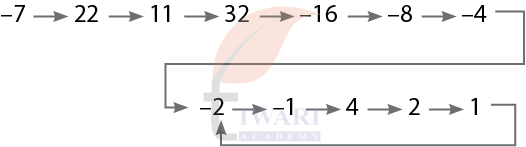
Try this with different starting numbers: (-21), (-6) and so on. Describe the patterns you observe.
Answer:
The rule is to start with any integer.
If the number is even, divide it by 2.
If the number is odd, multiply it by -3 and add 1.
Repeat the steps.
From the given example, starting with -7, the sequence is
-7, 22, 11, 32, -16, -8, -4, -2, -1, 4, 2, 1
After reaching 1, the numbers repeat in the cycle
1, -2, -1, 4, 2, 1
Now trying other starting numbers.
Starting with -21:
-21, 64, -32, -16, -8, -4, -2, -1, 4, 2, 1
Starting with -6:
-6, -3, 10, 5, -14, -7, 22, 11, 32, -16, -8, -4, -2, -1, 4, 2, 1
Pattern observed: No matter which integer we start with, the sequence finally reaches 1.
After reaching 1, the numbers repeat in the same order:
1, -2, -1, 4, 2, 1.
6. In a test (+4) makes are given for every correct answer and (-2) marks are given for every incorrect answer.
(a) Anita answered all the questions in the test. She scored 40 marks even though 15 of her answers were correct. How many of her answers were incorrect? How many questions are in the test?
(b) Anil scored (-10) marks even though he had 5 correct answers. How many of his answers were incorrect? Did he leave any questions unanswered?
Answer:
Marks scheme:
For every correct answer = +4 marks
For every incorrect answer = -2 marks
(a) Anita’s case
Number of correct answers = 15
Marks for correct answers = 15 × 4 = 60
Total marks scored by Anita = 40
Let the number of incorrect answers be x.
Marks lost due to incorrect answers = 2 × x
So, 60 – 2x = 40
⇒ 20 = 2x
⇒ x = 10
So, Anita gave 10 incorrect answers.
Total number of questions in the test = correct answers + incorrect answers
= 15 + 10
= 25
(b) Anil’s case
Number of correct answers = 5
Marks for correct answers = 5 × 4 = 20
Total marks scored by Anil = -10
Let the number of incorrect answers be y.
Marks lost due to incorrect answers = 2 × y
So, 20 – 2y = -10
⇒ -2y = -30
⇒ y = 15
So, Anil gave 15 incorrect answers.
Total attempted questions = correct + incorrect
= 5 + 15
= 20
From part (a), total questions in the test = 25
Unanswered questions = 25 – 20 = 5
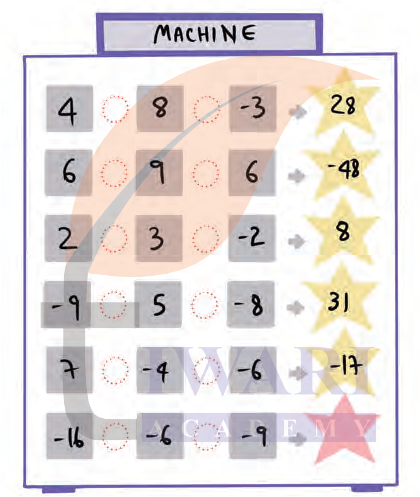
7. Pick the pattern- find the operations done by the machine shown below.
Answer:
The machine appears to perform: First number – (Second number × Third number)
Checking all rows:
Row 1: 4 – (8 × -3) = 4 – (-24) = 4 + 24 = 28
Row 2: 6 – (9 × 6) = 6 – 54 = -48
Row 3: 2 – (3 × -2) = 2 – (-6) = 2 + 6 = 8
Row 4: -9 – (5 × -8) = -9 – (-40) = -9 + 40 = 31
Row 5: 7 – (-4 × -6) = 7 – 24 = -17
Row 6: -16 – (-6 × -9) = 70
8. Imagine you’re in a place where the temperature drops by 5°C each hour. If the temperature is currently at 8°C, write an expression which denotes the temperature after 4 hours.
Answer:
The temperature drops by 5°C every hour.
Drop in 4 hours = 4 × (-5) = -20
Current temperature = 8°C
So, the required expression is: 8 + (4 × -5)
The temperature after 4 hours will be -12°C (12 degrees below zero).
9. Find 3 consecutive numbers with a product of (a) -6, (b) 120.
Answer:
Consecutive numbers are numbers that come one after another.
(a) Product = -6
The three consecutive numbers are -1, 0 and 1.
Their product is: -1 × 0 × 1 = 0, so this is not correct.
Try -3, -2, -1: -3 × -2 × -1 = -6
So, the three consecutive numbers are -3, -2, -1.
(b) Product = 120
Try 4, 5, 6: 4 × 5 × 6 = 120
So, the three consecutive numbers are 4, 5, 6.
10. An alien society uses a peculiar currency called ‘pibs’ with just two denominations of coins- a + 13 pibs coin and a – 9 pibs coin. You have serval of these coins. Is it possible to purchase an item that costs +85 pibs?
Yes, we can use 10 coins of +13 pibs and 5 coins of -9 pibs to make a total of +85. Using the two denominations, try to get the following totals:
(a) +20
(b) +40
(c) -50
(d) +8
(e) +10
(f) -2
(g) +1
[Hint: Writing down a few multiples of 13 and 9 can help.]
(h) Is it possible to purchase an item that costs 1568 pibs?
Answer:
We have two types of coins: +13 pibs coin and -9 pibs coin.
We combine these coins to get the required totals.
(a) +20 pibs
5 coins of +13 and 5 coins of -9
5 × 13 – 5 × 9 = 65 – 45 = 20
So, +20 pibs is possible.
(b) +40 pibs
10 coins of +13 and 10 coins of -9
10 × 13 – 10 × 9 = 130 – 90 = 40
So, +40 pibs is possible.
(c) -50 pibs
1 coin of +13 and 7 coins of -9
1 × 13 – 7 × 9 = 13 – 63 = -50
So, -50 pibs is possible.
(d) +8 pibs
2 coins of +13 and 2 coins of -9
2 × 13 – 2 × 9 = 26 – 18 = 8
So, +8 pibs is possible.
(e) +10 pibs
Trying different combinations of +13 and -9 does not give 10.
So, +10 pibs is not possible.
(f) -2 pibs
4 coins of +13 and 6 coins of -9
4 × 13 – 6 × 9 = 52 – 54 = -2
So, -2 pibs is possible.
(g) +1 pibs
No combination of +13 and -9 coins gives a total of 1.
So, +1 pibs is not possible.
(h) 1568 pibs
Any total made using these coins is of the form 13a – 9b, where a and b are whole numbers.
1568 cannot be written in this form.
So, it is not possible to purchase an item costing 1568 pibs.
11. Find the values of:
(a) (32 × (-18)) ÷ ((-36))
(b) (32) ÷ ((-36) × (-18))
(c) (25 × (-12) ÷ ((45) × (-27))
(d) (280 × (-7)) ÷ ((-8) × (-35))
Answer:
(a) (32 × (-18)) ÷ ((-36))
= (-576) ÷ (-36)
= 16
(b) (32) ÷ ((-36) × (-18))
= 32 ÷ 648
= 4/81
(c) (25 × (-12) ÷ ((45) × (-27))
= (-300) ÷ (-1215)
= 20/81
(d) (280 × (-7)) ÷ ((-8) × (-35))
= (-1960) ÷ 280
= -7
12. Arrange the expressions given below in increasing order.
(a) (-348) + (-1064)
(b) (-348) – (-1064)
(c) 348 – (-1064)
(d) (-348) × (-1064)
(e) 348 × (-1064)
(f) 348 × 964
Answer:
(a) (-348) + (-1064) = -348 – 1064 = -1412
(b) (-348) – (-1064) = -348 + 1064 = 716
(c) 348 – (-1064) = 348 + 1064 = 1412
(d) (-348) × (-1064) = 370,272
(e) 348 × (-1064) = -370,272
(f) 348 × 964 = 335,472
Arranging in Increasing Order
e < a < b < c < f < d
13. Given that (-548) × 972 = -532656, write the values of:
(a) (-547) × 972
(b) (-548) × 971
(c) (-547) × 971
Answer:
(a) (-547) × 972 = -5,31,684
(b) (-548) × 971 = -5,32,108
(c) (-547) × 971 = -5,31,137
14. Given that 207 × (-33 + 7) = -5382, write the value of -207 × (33 – 7) = _________.
Answer:
-207 × (33 – 7) = -207 x -231
= 47,817
15. Use the numbers 3, -2, 5, -6 exactly once and the operations ‘+’, ‘-‘, and ‘x’ exactly once and brackets as necessary to write an expression such that-
(a) the result is the maximum possible
(b) the result is the minimum possible
Answer:
Numbers: 3, -2, 5, -6
Operations: +, -, × (each used exactly once)
(a) Maximum Possible Result
Multiply the two largest positives: 5 × 3 = 15
Use + and – with remaining numbers (-2 and -6) to increase total:
Expression:
5 × 3 + (-2) – (-6)
= 15 + 4 = 19
Maximum result: 19
(b) Minimum Possible Result
Multiply largest positive by largest negative: 5 × (-6) = -30
Use + and – with remaining numbers (3 and -2) to decrease total:
Expression: 5 × (-6) – 3 + (-2)
= -30 – 5 = -35
Minimum result: -35
16. Fill in the blanks in at least 5 different ways with integers:
(a) __ + __ × __ = -36
(b) (__ – __) × __ = 12
(c) (__ – (__ – __)) = -1
Answer:
(a)
(i) 0 + (-6) × 6 = -36
(ii) -6 + (-6) × 5 = -36
(iii) -12 + (-4) × 6 = -36
(iv) -36 + 1 × 0 = -36
(v) 4 + (-8) × 5 = -36
(b)
(i) (6 – 4) × 6 = 12
(ii) (10 – 4) × 2 = 12
(iii) (4 – 10) × (-2) = 12
(iv) (3 – (-1)) × 3 = 12
(v) (8 – 2) × 2 = 12
(c)
(i) 2 – (5 – 2) = -1
(ii) 0 – (3 – 2) = -1
(iii) -1 – (0 – 0) = -1
(iv) 4 – (7 – 2) = -1
(v) 3 – (6 – 2) = -1
FAQs – Class 7 Maths Ganita Prakash Part 2, Chapter 2
Is Class 7 Maths Ganita Prakash Part 2, Chapter 2 easy?
Chapter 2 is designed to feel concrete rather than abstract. Every rule is built up through a physical model first – a carrom coin moving along a number line or green and red tokens added to or removed from a bag – before it’s stated as a formal sign rule. The multiplication and division rules (positive × positive = positive, negative × negative = positive and so on) follow from patterns you build yourself in a times-table, rather than something to memorise outright. Students who work through the token-model questions before jumping to the “Figure it Out” exercises usually find the sign rules stick much better.
How to solve Class 7 Ganita Prakash Part 2, Chapter 2 in one day?
To get through Chapter 2 in a single sitting, follow its own build-up rather than skipping to the exercises. Start with Section 2.1’s recap of addition and subtraction using the carrom-coin and token models, since every later rule depends on being comfortable with these. Move to Section 2.2 and use the token “bag” model to see why positive × negative gives a negative and negative × negative gives a positive, then read through the commutative, associative and distributive properties, plus division as the reverse of multiplication. Finish with the two worked examples – exam marking and the mining-shaft elevator – before attempting the final “Figure it Out” set.
How many questions are there in Class 7 Maths Part 2 Chapter 2?
Chapter 2 has five separate “Figure it Out” sections spread across its length – starting with a short one on finding number-pairs from their sum and difference, followed by two practice sets on multiplying integers, one on dividing them and ending with the chapter’s biggest exercise: sixteen questions covering everything from consecutive-number products and a modified Collatz Conjecture to a currency puzzle with an alien “pibs” coin. It’s a good chapter to practise pacing on, since the questions get noticeably longer and more varied as you go.
Is Class 7 Maths Ganita Prakash Chapter 2 important for the exam?
While exact exam weightage varies by school and year, integer operations are foundational – multiplication, division, and the sign rules from this chapter get used constantly in algebra, ratios and later number-system topics, so a shaky grasp here tends to show up as small errors much later. The chapter’s own “Figure it Out” set already looks like exam material: word problems on profit and loss, temperature change and test scoring, plus “without calculating” questions that test whether you understand a rule rather than whether you can compute quickly. Practising these is a genuinely efficient way to prepare, since the question styles carry over directly.
How can NCERT Solutions help while solving Class 7 Maths Ganita Prakash Part 2, Chapter 2?
Several questions in this chapter ask for reasoning rather than a single number – for example, explaining why (–547) × 972 can be found from (–548) × 972 = –532656 without multiplying again or working out whether an alien currency of +13 and –9 “pibs” coins can ever total exactly 1568. NCERT Solutions lay out this reasoning step by step, showing which property (commutative, associative, or distributive) or which sign rule justifies each move, so students can compare their own working against a clear model rather than just checking if their final number matches.