



by Tiwari Academy Team
NCERT Solutions for Class 7 Maths Ganita Prakash Chapter 5 Parallel and Intersecting Lines for Session 2025–26. Grade 7th Maths chapter 5 introduces students to the geometric relationships between lines, parallel, intersecting and perpendicular, on a plane. Through engaging activities like paper folding and drawing, students explore concepts such as linear pairs, vertically opposite angles, corresponding angles and alternate angles. It emphasizes how to identify and construct parallel and perpendicular lines using set squares and reasoning. Class 7 Ganit Prakash Lesson 5 also covers the role of transversals in forming angle pairs, making geometry more intuitive and practical.
Class 7 Maths all Chapters
Class 7 Maths Ganita Prakash Chapter 5 Solutions
Page 106
Section 5.1 Across the Line
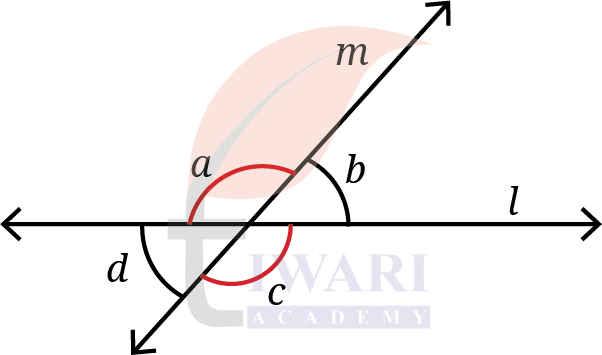
How many angles do they form?
See SolutionFour angles are formed.
Page 107
Can two straight lines intersect at more than one point?
See SolutionNo, two distinct straight lines can intersect at most one point.
What patterns do you observe among these angles?
See SolutionThe patterns we observed among these angles are:
Vertically opposite angles are equal:
For example, in the figure, ∠a = ∠c and ∠b = ∠d.
Linear pairs add up to 180°:
Adjacent angles like ∠a + ∠b or ∠b + ∠c form a straight angle, which means their sum is always 180°.
These patterns are true for any pair of intersecting lines and form the basis of angle relationships in geometry.
In Fig. 5.2, if ∠a is 120°, can you figure out the measurements of ∠b, ∠c and ∠d, without drawing and measuring them?
See SolutionYes.
∠a + ∠b = 180 (linear pair)
=> ∠b = 180 – 120 = 60
∠c = ∠a = 120 (vertically opposite).
∠d = ∠b = 60 (vertically opposite).
So: ∠b = 60, ∠c = 120, ∠d = 60.
Is this always true for any pair of intersecting lines?
See SolutionYes, vertically opposite angles formed by any pair of intersecting lines are always equal.
Page 108
Figure it Out
List all the linear pairs and vertically opposite angles you observe in Fig. 5.3:
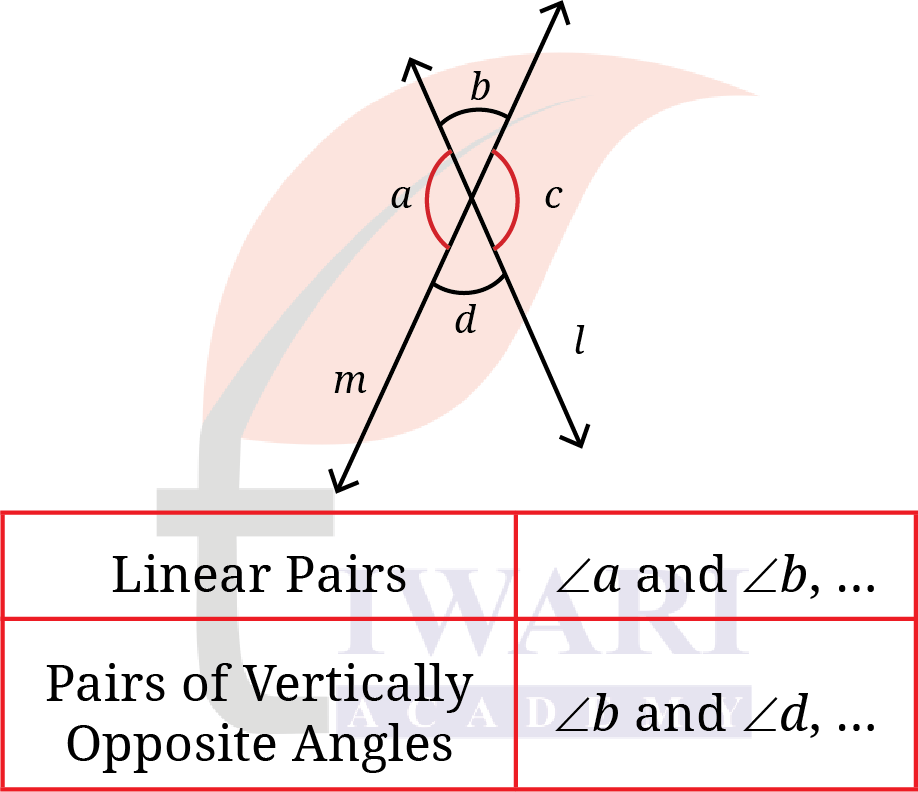
See Solution Linear Pairs (adjacent angles on a straight line, sum = 180 degrees):
∠a and ∠b
∠b and ∠c
∠c and ∠d
∠d and ∠a
Pairs of Vertically Opposite Angles (angles opposite at the intersection, are equal):
∠a and ∠c
∠b and ∠d
5.2 Perpendicular Lines
Can you draw a pair of intersecting lines such that all four angles are equal? Can you figure out what will be the measure of each angle?

See Solution Yes, this is possible if all four angles are equal, each angle must be a right angle (90 degrees). We say such lines as perpendicular lines.
Page 110
Which pairs of lines appear to be parallel in Fig. 5.6 below?
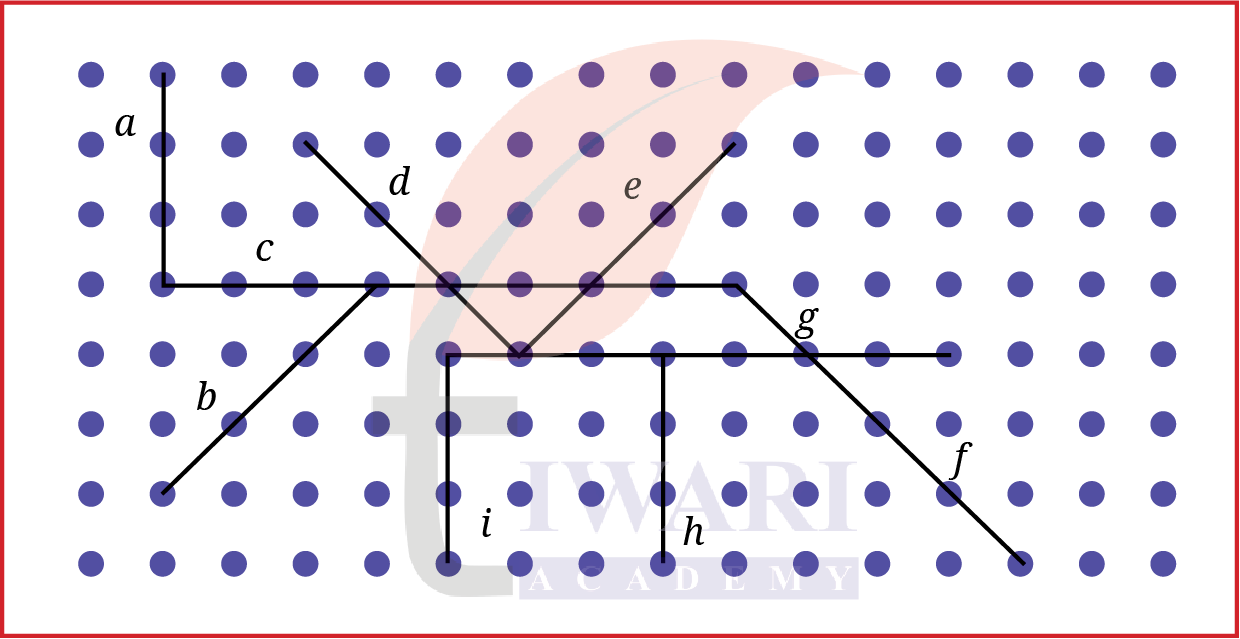
See Solution(Based on visual inspection of Figure 5.6 on the page)
Line segment ‘a’ appears parallel to line segment ‘i’ and ‘h’.
Line segment ‘c’ appears parallel to line segment ‘g’.
Line segment ‘b’ appears parallel to line segment ‘e’.
Line segment ‘d’ appears parallel to line segment ‘f’.
Page 111
5.4 Parallel and Perpendicular Lines in Paper Folding
Activity 2
Take a plan square of paper (use a newspaper for this activity).
How would you describe the opposite edges of the sheet? They are ______ to each other.
See AnswerParallel
How would you describe the adjacent edges of the sheet? The adjacent edges are ______ to each other. They meet at a point. They form right angles.
See AnswerPerpendicular
Fold the sheet horizontally in half. A new line is formed (see Fig. 5.7).
See AnswerThe two original top/bottom edges and the new horizontal fold.
How many parallel lines do you see now? How does the new line segment relate to the vertical sides?
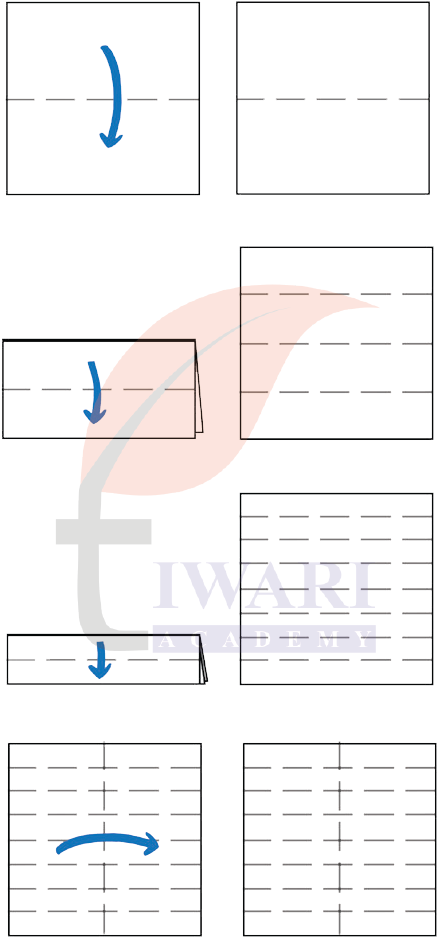
See Solution It is perpendicular to the vertical sides.
Make on one more horizontal fold in the folded sheet. How many parallel lines do you see now?
See Solution 5 parallel lines (the two original edges plus the three horizontal folds).
What will happen if you do it once more? How many parallel lines will you get? Is there a pattern? Check if the pattern extends further, if you make another horizontal fold.
See Solution Doing it once more (a third horizontal fold) would result in 9 parallel lines (2 original edges + 7 folds).
The pattern relates to powers of 2; after n folds, we have 2ⁿ⁻¹ fold lines, plus the 2 original edges for 2ⁿ⁺¹ total parallel lines (starting from n=1 fold).
We can check if the pattern continues.
Make a vertical fold in the square sheet. This new vertical line is ______ to the previous horizontal lines.
See SolutionPerpendicular
Fold the sheet along a diagonal. Can you find a fold that creates a line parallel to the diagonal line?
See Solution This requires performing the activity. It is possible to create such a fold (e.g., by folding an edge onto the diagonal or folding the paper in half parallel to the first diagonal fold).
Page 112
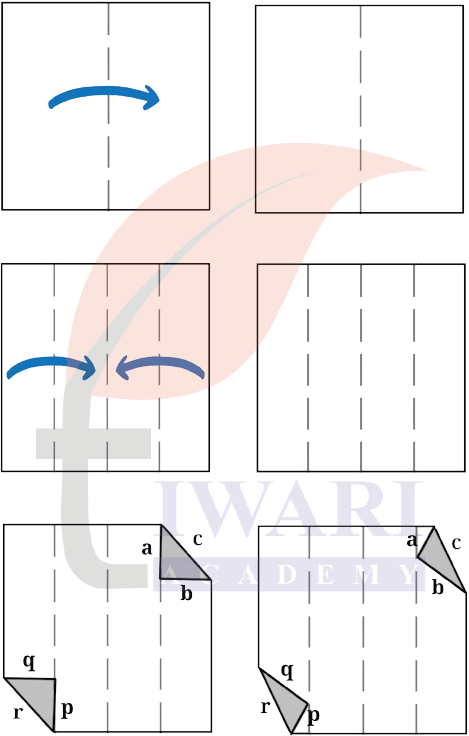
Here is another activity for you to try.
•Take a square sheet of paper, fold it in the middle and unfold it.
•Fold the edges towards the centre line and unfold them.
•Fold the top right and bottom left corners onto the creased line to create triangles. Refer to Fig. 5.8.
•The triangles should not cross the crease lines.
•Are a, b and c parallel to p, q and r respectively? Why or why not?
See SolutionFrom Figure 5.8, we can see the final result shows:
Line segments a, b and c (the fold lines/creases)
Line segments p, q and r (the edges of the triangular folds)
No, they are not parallel.
Reason:
Lines a, b and c are vertical crease lines running from top to bottom of the paper
Lines p, q and r are the diagonal edges of the triangular folds created when we fold the corners
Since the crease lines run vertically and the triangle edges run diagonally, they intersect each other rather than being parallel. Parallel lines never intersect and always maintain the same distance apart, but here we can see that the vertical crease lines and diagonal triangle edges cross each other at various points.
The triangular folds create diagonal lines that cut across the vertical crease lines at angles, which is why the instruction specifies that “the triangles should not cross the crease lines” – to maintain the proper geometric relationship for this folding exercise.
Question-Answers of Figure it Out at Page 113
Page 113
Figure it Out
1. Draw some lines perpendicular to the lines given on the dot paper in Fig. 5.10.

Answer:

2. In Fig. 5.11, mark the parallel lines using the notation above (single arrow, double arrow etc.). Mark the angle between perpendicular lines with a square symbol.

(a) How did you spot the perpendicular lines?
(b) How did you spot the parallel lines?
Answer:
Lines are shown in the following figures.
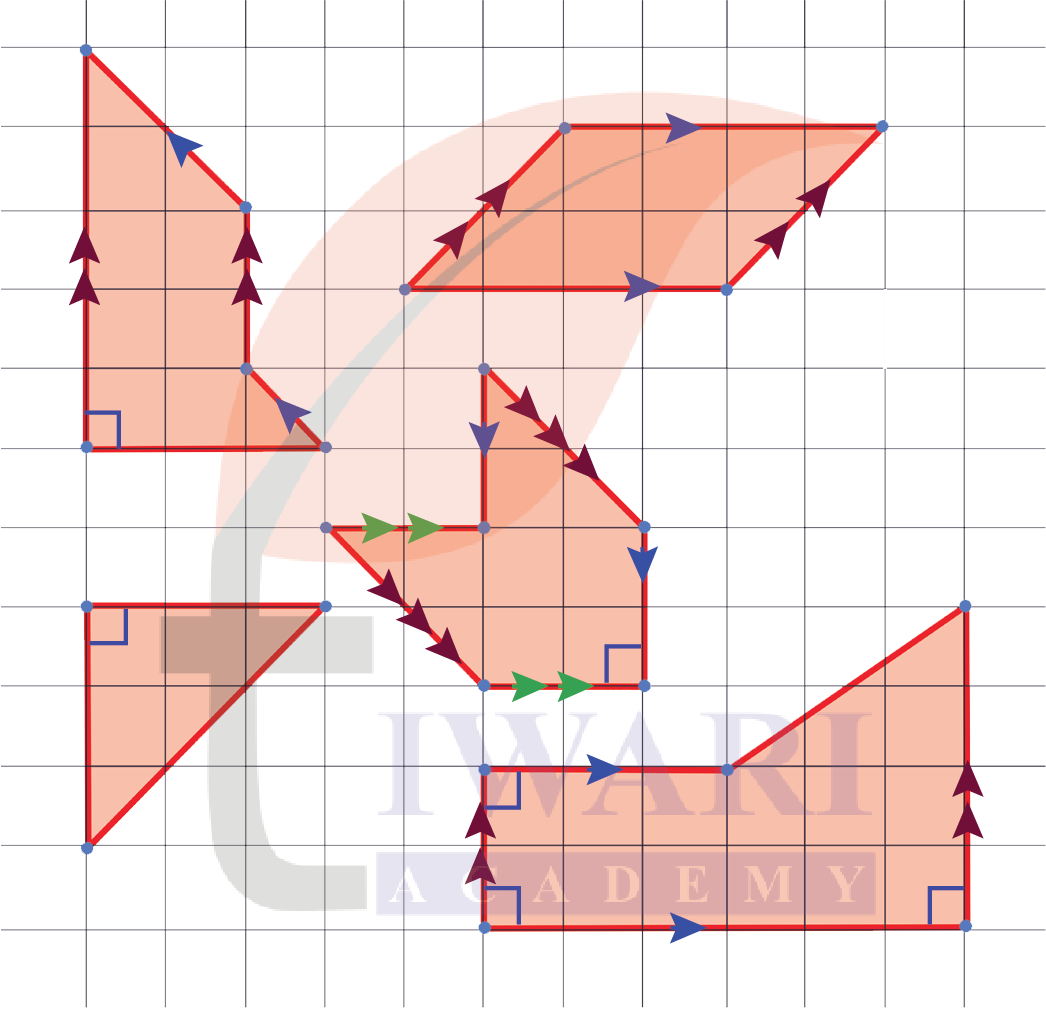
See Explanation(a) Perpendicular lines are typically spotted by identifying lines that meet at a 90-degree angle (a right angle). On dot or grid paper, this looks like the corner of a square or rectangle aligned with the grid lines or lines whose slopes are negative reciprocals of each other.
(b) Parallel lines are spotted by identifying lines that have the same direction or slope and always remain the same distance apart. On dot paper, they form opposite sides of shapes like parallelograms, rectangles or trapezoids or they connect dots with the same horizontal and vertical displacement.
3. In the dot paper following, draw different sets of parallel lines. The line segments can be of different lengths but should have dots as endpoints.
See SolutionThis task requires drawing on dot paper. To draw parallel lines, we would draw a line segment between two dots, note its slope (e.g., ‘across 3, up 2’) and then draw another line segment elsewhere on the paper connecting two dots with the exact same slope (‘across 3, up 2’).
4. Using your sense of how parallel lines look, try to draw lines parallel to the line segments on this dot paper.

(a) Did you find it challenging to draw some of them?
(b) Which ones
(c) How did you do it?
See SolutionTo draw a parallel line, we need to replicate the slope of the given line segment. Count the horizontal and vertical distance between the endpoints of the given segment (e.g., segment ‘c’ goes across 1 dot and up 1 dot). Then, choose a different starting dot and draw a new segment with the same horizontal and vertical displacement (e.g., starting elsewhere, draw a line going across 1 and up 1).
(a). Some people find it easy, while others find it more challenging, especially for lines that aren’t perfectly horizontal, vertical or at a 45-degree angle.
(b). Again, this depends on the individual. Often, lines with slopes that are harder to quickly identify by counting dots (like potentially ‘d’ or ‘h’ in Figure, depending on how they are drawn) might be found more challenging than simple horizontal (like ‘a’), vertical (like ‘b’) or 45-degree lines (like ‘c’ or ‘g’).
(c). Methods could include:
Carefully counting the ‘run’ (horizontal dot distance) and ‘rise’ (vertical dot distance) for the given segment and replicating it exactly for the new segment.
Using the edge of a ruler aligned with the segment and sliding it to a new position (though the exercise emphasizes using the ‘sense’ of parallel lines on dot paper).

5. In Figure 5.13, which line is parallel to line a – line b or line c? How do you decide this?

See Solution This requires looking at Figure. We would visually compare the steepness and direction of line ‘b’ and line ‘c’ with line ‘a’. The line that appears to have the exact same steepness as line ‘a’ is the parallel one. On comparing, we find that the line ‘c’ is parallel to line ‘a’.
Solution of – Figure it Out – Page 119
Figure it Out
Can you draw a line parallel to l, that goes through point A? How will you do it with the tools from your geometry box? Describe your method.

See Solution Yes, this is a standard geometric construction.
Several methods are possible:
Ruler and Set Square Method 1: Align one edge of the set square with line ‘l’. Place the ruler against another edge of the set square. Slide the set square along the ruler until the first edge passes through point A. Draw the line along this edge.
Ruler and Set Square Method 2 (Perpendiculars): Place a set square edge on line ‘l’ and draw a perpendicular line through A. Then, align the set square edge with this new perpendicular line and draw another perpendicular line that passes through A. This second perpendicular will be parallel to ‘l’.
Ruler and Compass Method: Draw any line (transversal) through point A that intersects line ‘l’ at a point, say B. Place the compass point at B and draw an arc intersecting both lines. Keeping the same compass radius, place the compass point at A and draw a similar arc. Now, measure the distance between the intersection points on line ‘l’ and the transversal using the compass. Mark off this same distance on the second arc starting from where it intersects the transversal through A. Draw a line through A and this newly marked point on the arc. This line will be parallel to ‘l’.
Figure it Out – Page 123 – Question Answers
Figure it Out
1. Find the angles marked below.

See Solutiona = 132°
The 48° angle and angle a are alternate angles (parallel lines cut by a transversal)
Wait, let me recalculate: 48° and angle a are supplementary angles on a straight line
a = 180° – 48° = 132°
b = 128°
The 52° angle and angle b are supplementary angles on a straight line
b = 180° – 52° = 128°
c = 99°
The 81° angle and angle c are supplementary angles on a straight line
c = 180° – 81° = 99°
d = 99°
The 81° angle and angle d are vertically opposite angles
d = 81°
Actually, looking more carefully: d and 99° are vertically opposite
d = 99°
e = 97°
The 83° angle and angle e are supplementary angles on a straight line
e = 180° – 83° = 97°
f = 48°
The 132° angle and angle f are supplementary angles on a straight line
f = 180° – 132° = 48°
g = 122°
Looking at the parallel lines with the transversal
The 58° angle and angle g are supplementary
g = 180° – 58° = 122°
h = 75°
In the triangle, angles sum to 180°
The exterior angle is 120°, so the interior angle is 180° – 120° = 60°
With 75° given, h = 180° – 75° – 60° = 45°
i = 54°
In the triangle with angles 70°, 56°, and i°
i = 180° – 70° – 56° = 54°
j = 56°
Using the property that vertically opposite angles are equal
The angle opposite to the 124° angle would be 124°
Using alternate angles: j = 180° – 124° = 56°
Or more directly, j and one of the given angles are alternate angles
j = 56°

2. Find the angle represented by a.

See SolutionDiagram (Top Left): Parallel lines with a zig-zag transversal. Angle a and the given 42 degrees angle are alternate interior angles.
Answer: x = 42 (Alternate interior angles are equal).
a + x = 180
⇒ a + 42 = 180
⇒ a = 180 – 42 = 138
Diagram (Top Right): Parallel lines with a transversal.
Answer: y + 62 = 180 [Linear Pair]
⇒ y = 180 – 62 = 118
Now y = z = 118 [Corresponding Angles]
Similarly, a = z = 118 degrees (Corresponding angles are equal).
Diagram (Bottom Left): Parallel lines with a transversal.
Answer: c + 110 = 180 [Linear Pair]
⇒ c = 180 – 110 = 70
Now d = c = 70 [Corresponding Angles]
Similarly b + d = a [Corresponding Angles]
⇒ 35 + 70 = a
⇒ a = 105
So a = 105 degrees.
Diagram (Bottom Right): Parallel lines (indicated by arrows) with a transversal.
Answer: x = 67 [Corresponding Angles]
In triangle, using angle sum property, a + x + 90 = 180
⇒ a + 67 + 90 = 180
⇒ a = 180 – 157 = 23
So, a = 23 degrees.

3. In the figures below, what angles do x and y stand for?

See SolutionDiagram (Left): Parallel lines with a transversal. Angle x and the given 65 degrees angle.
In triangle, 65 + a + 90 = 180 [Angle sum property of triangle]
⇒ a = 180 – 155 = 25
Now a + y = 180 [Linear Pair]
⇒ 25 + y = 180
⇒ y = 180 – 25 = 155
Now a = b = 25 [Alternate angles]
and b = x = 25 [Vertically opposite angles]
Diagram 3.2 (Right): Parallel lines with a transversal forming a triangle. Angle y is on the lower parallel line. The angle at the top vertex of the triangle is 53 degrees.
Here, c = 53 [Corresponding angles]
Now, c + x = 78 [Corresponding angles]
⇒ 53 + x = 78
⇒ x = 78 – 53 = 25
x = 25 degrees.

4. In Fig. 5.33, ∠ABC = 45° and ∠IKJ = 78°. Find angles ∠GEH, ∠HEF, ∠FED

See Solution
∠ABC = ∠BED = 45 [Corresponding angles]
So, ∠GEH = ∠BED = 45 [Vertically Opposite Angles]
Now, ∠EKB = ∠IKJ = 78 [Vertically Opposite Angles]
and ∠EBK = ∠ABC = 45 [Vertically Opposite Angles]
In triangle EBK
∠EKB + ∠EBK + ∠KEB = 180 [Angle sum property of triangle]
⇒ 78 + 45 + ∠KEB = 180
⇒ ∠KEB = 180 – 123 = 57
So, ∠HEF = ∠KEB = 57 [Vertically Opposite Angles]
∠GEK = ∠IKJ = 78 [Corresponding Angles]
So, ∠FED = ∠GEK = 78 [Vertically Opposite Angles].
5. In Fig. 5.34, AB is parallel to CD and CD is parallel to EF. Also, EA is perpendicular to AB. If ∠BEF = 55°, find the values of x and y.

See Solution Finding x: Since CD || EF, consider BE as a transversal.
The interior angles on the same side are supplementary.
y + 55 = 180
⇒ y = 180 – 55 = 125
Now, AB || CD, consider BD as a transversal.
So, x = y = 125 [Corresponding angles].
6. What is the measure of angle NOP in Fig. 5.35?

See SolutionDraw a line through N parallel to LM and PQ.
Now x = 40 [Alternate angles]
Since x + y = 96
So, y = 96 – x
⇒ y = 96 – 40 = 56
Now y = z = 56 [Alternate angles]
Similarly, w = 52 [Alternate angles]
Hence, a = z + w = 56 + 52 = 108.

Frequently Asked Questions
Is Class 7 Maths Ganita Prakash Chapter 5 easy?
Yes, Class 7 Maths Ganita Prakash Chapter 5 is considered easy and interesting for most students once they understand the basic terms and visual concepts. Class 7 Maths Ganita Prakash Chapter 5 deals with fundamental geometry, focusing on how lines behave on a plane—whether they meet, remain apart or form specific angles. Using diagrams, paper folding and real-life examples, the concepts are made engaging. With consistent practice and understanding of terms like intersecting lines, parallel lines, and transversals, students usually find the chapter manageable. Even those who are weak in geometry can score well with visual learning and simple activities.
How can we score maximum in Class 7 Maths Ganita Prakash Chapter 5?
To score maximum in Chapter 5 of Class 7 Ganita Prakash, students should first become familiar with key definitions like intersecting lines, parallel lines, perpendicular lines and transversals. Drawing clear diagrams with proper notation (arrows for parallel lines and squares for right angles) is essential. Practicing activities like paper folding helps in concept clarity. Focus on understanding the properties of angles—linear pairs, vertically opposite angles, corresponding and alternate angles. Solve all in-text and exercise problems thoroughly and try additional questions from reference books. Reviewing solved examples and summary points can also aid in better retention and scoring full marks.
What are the main concepts given in Class 7 Ganita Prakash Chapter 5?
The main concepts in Chapter 5 Parallel and Intersecting Lines include understanding the behavior and relationships between different lines on a plane. It covers:
1. Intersecting lines and the angles they form (like vertically opposite and linear pairs).
2. Perpendicular lines and how they form four right angles.
3. Parallel lines that never meet even when extended.
4. Transversals that cut through two lines, forming eight angles.
5. Special angle pairs such as corresponding angles and alternate angles.
Class 7 Maths Ganita Prakash Chapter 5 emphasizes visual learning through paper folding and geometric drawing, ensuring that students grasp these foundational geometry ideas effectively and interactively.
What are the difficult areas of Class 7 Maths Chapter 5?
Some students may find difficulty in identifying angle relationships, especially between corresponding and alternate angles formed by a transversal. Drawing neat, accurate diagrams with proper angle measures and line notations (like using arrows for parallel lines or squares for right angles) can also be tricky. Understanding why certain angle pairs are equal or supplementary requires logical thinking rather than memorization. Another challenging area is using protractors and set squares correctly to verify or construct parallel and perpendicular lines. To overcome these hurdles, regular practice with both hands-on activities and exercises is important, along with guidance from teachers when needed.