



by Tiwari Academy Team
NCERT Solutions for Class 7 Maths Ganita Prakash Chapter 8 Working with Fractions – exercises question answers for session 2026-27 Exam. Chapter 8, Working with Fractions, builds on earlier concepts by teaching multiplication and division of fractions through visual models like the unit square. These NCERT Solutions for Class 7 Maths Ganita Prakash Chapter 8 explain every Figure It Out question, covering fraction multiplication, Brahmagupta’s formula, reciprocals, division of fractions and word problems drawn from historical Indian texts. Each solution includes clear step-by-step working so students grasp the reasoning behind every answer, not just the final result.
Class 7 Maths all Chapters
NCERT Class 7 Maths Ganita Prakash Chapter 8 Solutions
Page 176 – Figure it Out
1. Tenzin drinks 1/2 glass of milk every day. How many glasses of milk does he drink in a week? How many glasses of milk did he drink in the month of January?
Answer:
Milk consumed in 1 day = 1/2 glass
Milk consumed in 1 week = 7 × 1/2
= 7/2
= 3 1/2 glasses
Milk consumed in January = 31 × 1/2
= 31/2
= 15 1/2 glasses
Therefore, Tenzin drinks 3 1/2 glasses in a week and 15 1/2 glasses in January.
2. A team of workers can make 1 km of a water canal in 8 days. So, in one day, the team can make ___ km of the water canal. If they work 5 days a week, they can make ___ km of the water canal in a week.
Answer:
Water canal made in 1 day = 1/8 km
Water canal made in 5 days = 5 × 1/8 = 5/8 km
Therefore, the blanks are 1/8 km and 5/8 km.
3. Manju and two of her neighbours buy 5 litres of oil every week and share it equally among the 3 families. How much oil does each family get in a week? How much oil will one family get in 4 weeks?
Answer:
Oil received by each family in 1 week = 5 ÷ 3
= 5/3
= 1(2/3) litres
Oil received by one family in 4 weeks = 4 × 5/3
= 20/3
= 6(2/3) litres
Therefore, each family gets 1(2/3) litres per week and 6(2/3) litres in 4 weeks.
4. Safia saw the Moon setting on Monday at 10 pm. Her mother, who is a scientist, told her that every day the Moon sets hour later than the previous day. How many hours after 10 pm will the moon set on Thursday?
Answer:
The Moon sets 5/6 hour later each day.
From Monday to Thursday, there are 3 days.
Time difference = 3 × 5/6
= 15/6
= 2(1/2) hours.
Therefore, the Moon will set 2(1/2) hours after 10 pm, i.e. at 12:30 am on Friday.
5. Multiply and then convert it into a mixed fraction:
(a) 7 × 3/5
(b) 4 × 1/3
(c) 9/7 × 6
(d) 13/11 × 6
So far, we have learnt multiplication of a whole number with a fraction, and a fraction with a whole number. What happens when both numbers in the multiplication are fractions?
Answer:
(a) 7 × 3/5
7 × 3/5 = 21/5 = 4(1/5)
(b) 4 × 1/3
4 × 1/3 = 4/3 = 1(1/3)
(c) 9/7 × 6
9/7 × 6 = 54/7 = 7(5/7)
(d) 13/11 × 6
13/11 × 6 = 78/11 = 7(1/11)
Page 180 – Figure it Out
1. Find the following products. Use a unit square as a whole for representing the fractions:
(a) 1/3 × 1/5
(b) 1/4 × 1/3
(c) 1/5 × 1/2
(d) 1/6 × 1/5
Answer:
(a) 1/3 × 1/5 = 1/(3 × 5) = 1/15
(b) 1/4 × 1/3 = 1/(4 × 3) = 1/12
(c) 1/5 × 1/2 = 1/(5 × 2) = 1/10
(d) 1/6 × 1/5 = 1/(6 × 5) = 1/30
2. Find the following products. Use a unit square as a whole for representing the fractions and carrying out the operations:
(a) 2/3 × 4/5
(b) 1/4 × 2/3
(c) 3/5 × 1/2
(d) 4/6 × 3/5
Answer:
(a) 2/3 × 4/5
= (2 × 4)/(3 × 5) = 8/15
(b) 1/4 × 2/3
= (1 × 2)/(4 × 3) = 2/12 = 1/6
(c) 3/5 × 1/2
= (3 × 1)/(5 × 2) = 3/10
(d) 4/6 × 3/5
= (4 × 3)/(6 × 5) = 12/30 = 2/5
Page 183 – Figure it Out
1. A water tank is filled from a tap. If the tap is open for 1 hour, 7/10 of the tank gets filled. How much of the tank is filled if the tap is open for
(a) 1/3 hour
(b) 2/3 hour
(c) 3/4 hour
(d) 7/10 hour
(e) For the tank to be full, how long should the tap be running?
Answer:
(a) 1/3 hour
7/10 × 1/3 = 7/30
Therefore, 7/30 of the tank is filled.
(b) 2/3 hour
7/10 × 2/3 = 14/30 = 7/15
Therefore, 7/15 of the tank is filled.
(c) 3/4 hour
7/10 × 3/4 = 21/40
Therefore, 21/40 of the tank is filled.
(d) 7/10 hour
7/10 × 7/10 = 49/100
Therefore, 49/100 of the tank is filled.
(e) For the tank to be full, how long should the tap be running?
Time required = 1 ÷ 7/10
= 1 × 10/7
= 10/7
= 1 3/7 hours
Therefore, the tap should be running for 1 3/7 hours.
2. The government has taken 1/6 of Somu’s land to build a road . What part of the land remains with Somu now? She gives half of the remaining part of the land to her daughter Krishna and 1/3 of it to her son Bora. Aftr giving them their shares, she keeps the remaining land for herself.
(a) What part of the original land did Krisna get?
(b) What part of the original land did Bora get?
(c) What part of the original land did Somu keep for herself?
Answer:
(a) Land remaining = 1 – 1/6
= 5/6
Krishna’s share = 1/2 × 5/6
= 5/12
Therefore, Krishna got 5/12 of the original land.
(b) Bora’s share = 1/3 × 5/6
= 5/18
Therefore, Bora got 5/18 of the original land.
(c)Somu’s share = 5/6 – 5/12 – 5/18
LCM of 6, 12 and 18 = 36
= 30/36 – 15/36 – 10/36
= 5/36
Therefore, Somu kept 5/36 of the original land.
3. Find the area of a rectangle of sides 3 3/4ft and 9 3/5ft.
Answer:
Area = Length × Breadth
= 3 3/4 × 9 3/5
= 15/4 × 48/5
= 720/20
= 36 square feet
Therefore, the area of the rectangle is 36 square feet.
4. Tsewang plants four saplings in a row in his garden. The distance between two saplings is 3/4 m. Find the distance between the first and last saplings.
Answer:
Number of gaps between 4 saplings = 3
Distance between two saplings = 3/4 m
Distance between first and last sapling
= 3 × 3/4
= 9/4
= 2 1/4 m
Therefore, the distance between the first and last sapling is 2 1/4 m.
5. Which is heavier: 12/15 of 500 grams or 3/20 of 4 kg?
Answer:
12/15 of 500 g
= 12/15 × 500
= 400 g
3/20 of 4 kg
= 3/20 × 4
= 12/20 kg
= 0.6 kg
= 600 g
Since 600 g > 400 g,
Therefore, 3/20 of 4 kg is heavier.
Page 196 – Figure it Out
1. Evaluate the following
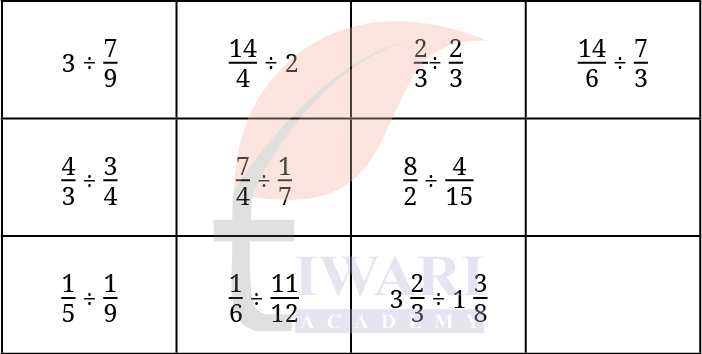
Answer:
3 ÷ (7/9)
3 x (9/7) = 27/7 = 3(6/7)
(14/4) ÷ 2
(14/4) x (1/2) = (7/2) x (1/2) = 7/4 = 1(3/4)
(2/3) ÷ (2/3)
(2/3) x (3/2) = 1
(14/6) ÷ (7/3)
(14/6) x (3/7) = (7/3) x (3/7) = 1
(4/3) ÷ (3/4)
(4/3) x (4/3) = 16/9 = 1(7/9)
(7/4) ÷ (1/7)
(7/4) x 7 = 49/4 = 12(1/4)
(8/2) ÷ (4/15)
4 / (4/15) = 4 x (15/4) = 15
(1/5) ÷ (1/9)
(1/5) x 9 = 9/5 = 1(4/5)
(1/6) ÷ (11/12)
(1/6) x (12/11) = (1 x 2) ÷ (1 x 11) = 2/11
(3 and 2/3) ÷ (1 and 3/8)
= (11/3) ÷ (11/8) = (11/3) x (8/11)
= (1 x 8) ÷ (3 x 1)
= 8/3 = 2(2/3)
2. For each of the questions below, choose the expression that describes the solution. Then simplify it. (a) Maria bought 8 m of lace to decorate the bags she made for school. She used 1/4 m for each bag and finished the lace. How many bags did she decorate?
(i) 8 × 1/4
(ii) 1/8 × 1/4
(iii) 8 ÷ 1/4
(iv) 1/4 ÷ 8
Answer:
Correct expression = 8 ÷ 1/4
= 8 × 4
= 32
Therefore, Maria decorated 32 bags.
Correct option: (iii)
(b) 1/2 meter of ribbon is used to make 8 badges. What is the length of the ribbon used for each badge?
(i) 8 × 1/2
(ii) 1/2 ÷ 1/8
(iii) 8 ÷ 1/2
(iv) 1/2 ÷ 8
Answer:
Correct expression = 1/2 ÷ 8
= 1/2 × 1/8
= 1/16 m
Therefore, each badge uses 1/16 m of ribbon.
Correct option: (iv)
(c) A baker needs 1/6kg of flour to make one loaf of bread. He has 5 kg of flour. How many loaves of bread can he make?
(i) 5 × 1/6
(ii) 1/6 ÷ 5
(iii) 5 ÷ 1/6
(iv) 5 × 6
Answer:
Correct expression = 5 ÷ 1/6
= 5 × 6
= 30
Therefore, the baker can make 30 loaves.
Correct option: (iii)
3. If 1/4 kg of flour is used to make 12 rotis, how much flour is used to make 6 rotis?
Answer:
Flour used for 12 rotis = 1/4 kg
Flour used for 1 roti = 1/4 ÷ 12
= 1/48 kg
Flour used for 6 rotis = 6 × 1/48
= 1/8 kg
Therefore, 1/8 kg of flour is used to make 6 rotis.
4. Pāṭīgaṇita, a book written by Sridharacharya in the 9th century CE, mentions this problem: “Friend, after thinking, what sum will be obtained by adding together 1 ÷ 1/6, 1 ÷ 1/10, 1 ÷ 1/13, 1 ÷ 1/9, and 1 ÷ 1/2″, What should the friend say?
Answer:
1 ÷ 1/6 = 6
1 ÷ 1/10 = 10
1 ÷ 1/13 = 13
1 ÷ 1/9 = 9
1 ÷ 1/2 = 2
Sum = 6 + 10 + 13 + 9 + 2
= 40
Therefore, the friend should say 40.
5. Mira is reading a novel that has 400 pages. She read 1/5 of the pages yesterday and 3/10 of the pages today. How many more pages does she need to read to finish the novel?
Answer:
Pages read yesterday = 1/5 × 400
= 80 pages
Pages read today = 3/10 × 400
= 120 pages
Total pages read = 80 + 120
= 200 pages
Pages remaining = 400 – 200
= 200 pages
Therefore, Mira needs to read 200 more pages.
6. A car runs 16 km using 1 litre of petrol. How far will it go using 2 3/4 litres of petrol?
Answer:
Distance = 16 × 2(3/4)
= 16 × 11/4
= 44 km
Therefore, the car will go 44 km.
7. Amritpal decides on a destination for his vacation. If he takes a train, it will take him 5 1/6 hours to get there. If he takes a plane, it will take him 1/2 hour. How many hours does the plane save?
Answer:
Time by train = 5 1/6 hours
Time by plane = 1/2 hour
Time saved = 5 1/6 – 1/2
= 31/6 – 3/6
= 28/6
= 14/3
= 4 2/3 hours
Therefore, the plane saves 4 2/3 hours.
8. Mariam’s grandmother baked a cake. Mariam and her cousins finished 4/5 of the cake. The remaining cake was shared equally by Mariam’s three friends. How much of the cake did each friend get?
Answer:
Remaining cake = 1 – 4/5
= 1/5
Cake received by each friend
= 1/5 ÷ 3
= 1/5 × 1/3
= 1/15
Therefore, each friend got 1/15 of the cake.
9. Choose the option (s) describing the product of (565/465 × 707/676):
(a) > 565/465
(b) < 565/465 (c) > 707/676
(d) < 707.676 (e) > 1
(f) < 1 Answer: 565/465 > 1 and 707/676 > 1.
When both numbers are greater than 1, their product is greater than both numbers.
Therefore, the correct options are:
(a) > 565/465
(c) > 707/676
(e) > 1
10. What fraction of the whole square is shaded?

Answer:
Step 1: The big square is divided into 4 equal quarters.
Each quarter = 1/4 of the whole square.
Step 2: The shaded quarter (bottom-right) is further divided by its diagonals into 4 equal triangles.
Each triangle = 1/4 of 1/4 = 1/16 of the whole square.
Step 3: The bottom triangle of that quarter is cut into 2 equal halves by a line to the midpoint of its base.
Each half = 1/2 of 1/16 = 1/32 of the whole square.
Step 4: The shaded region = 1 full triangle (left) + 1 half-triangle (left half of bottom triangle)
1/16 + 1/32 = 2/32 + 1/32 = 3/32
∴ Fraction of the whole square shaded = 3/32
Another Method:
Step 1: The big square is divided into 4 equal quarters.
Each quarter = 1/4 of the whole square.
Step 2: The shaded quarter (bottom-right) is further divided by its diagonals and horizontal lines into 8 equal triangles.
Each triangle = 1/8 of this square.
So, the shaded portion = 3/8 of this square
∴ Fraction of the whole square shaded = 1/4 x 3/8 = 3/32

11. A colony of ants set out in search of food. As they search, they keep splitting equally at each point (as shown in fig 8.7) and reach two food sources, one near a mango tree and another near a sugarcane field. What fraction of the original group reached to each food source?
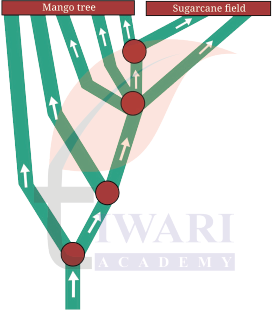
Answer:
Let the whole colony = 1 (the trail entering from the bottom).
At Point 1 (bottom dot): the colony splits equally into 2 halves.
- One half (1/2) turns off and (after splitting further into 2 equal trails) reaches the mango tree.
- The other half (1/2) continues up to Point 2.
At Point 2 (middle dot): the incoming group (1/2) splits equally into 2 quarters. - One quarter (1/4) turns off and (after splitting further into 2 equal trails) reaches the mango tree.
- The other quarter (1/4) splits again – half goes straight to the sugarcane field (1/8) and half continues up to Point 3 (1/8).
At Point 3 (top dot): the incoming group (1/8) splits equally into 2 eighths. - One eighth (1/16) reaches the mango tree.
- The other eighth (1/16) reaches the sugarcane field.
Now add up all the mango tree groups:
1/2 + 1/4 + + 1/8 + 1/16
= 8/16 + 4/16 + 2/16 + 1/16
= 15/16
12. What is 1 − 1/2?
(1 − 1/2) × (1 − 1/3)?
(1 − 1/2) × (1 − 1/3) × (1 − 1/4) × (1 − 1/5)?
(1 − 1/2) × (1 − 1/3) × (1 − 1/4) × (1 − 1/5) × (1 − 1/6) × (1 − 1/7) × (1 − 1/8) × (1 − 1/9) × (1 − 1/10)?
Make a general statement and explain.
Answer:
1 − 1/2 = 1/2
(1 − 1/2) × (1 − 1/3):
= 1/2 × 2/3 = 1/3
(the 2 in the numerator cancels with the 2 in the denominator)
(1 − 1/2) × (1 − 1/3) × (1 − 1/4) × (1 − 1/5):
= 1/2 × 2/3 × 3/4 × 4/5
= 1/5
(each numerator cancels with the previous denominator, leaving only the first numerator and the last denominator)
(1 − 1/2) × (1 − 1/3) × (1 − 1/4) × … × (1 − 1/10):
= 1/2 × 2/3 × 3/4 × 4/5 × 5/6 × 6/7 × 7/8 × 8/9 × 9/10
= 1/10
General statement:
(1 − 1/2) × (1 − 1/3) × (1 − 1/4) × … × (1 − 1/n) = 1/n
Why this happens:
Each factor (1 − 1/k) simplifies to (k − 1)/k. So the whole product looks like:
1/2 × 2/3 × 3/4 × 4/5 × … × (n − 1)/n
Every number appears once as a numerator and once as a denominator – 2 is the numerator of the second fraction and the denominator of the first, 3 is the numerator of the third and the denominator of the second and so on. Each of these pairs cancels out completely.
The only two numbers that don’t get cancelled are the very first numerator (1) and the very last denominator (n), since neither has a matching partner. What remains is 1/n.
This kind of cancelling pattern, where consecutive terms wipe each other out leaving only the ends, is called a telescoping product – like a folding telescope collapsing down to just its two end pieces.
Frequently Asked Questions
How many questions are covered in the NCERT Solutions for Class 7 Maths Chapter 8?
Chapter 8 spans three main sections – multiplication of fractions, division of fractions and word problems involving fractions – each with its own Figure It Out exercise, plus several embedded questions within the Discussion and Math Talk boxes. Across the chapter there are more than 30 questions in total, including multi-part word problems and evaluation tables with several expressions each. These solutions work through every one of them step-by-step, showing the reasoning process rather than just the final fraction, so students can follow the same method on similar problems.
Is Chapter 8, Working with Fractions, important for Class 7 exams?
Yes. Fraction multiplication and division are core arithmetic skills that CBSE exams test heavily, both as standalone calculation questions and embedded within word problems involving distance, money, area or time. Since this chapter also introduces Brahmagupta’s general formulas for multiplying and dividing fractions, along with the concept of reciprocals, it forms the foundation for more advanced work with rational numbers and algebraic fractions in later grades, which makes a solid grasp of this chapter valuable well beyond a single test.
What should students know before starting Chapter 8?
Students should be comfortable with basic fraction concepts from earlier grades, including identifying numerators and denominators, converting mixed fractions to improper fractions and simplifying fractions to their lowest form. A working understanding of the unit square as a visual model is especially useful here, since the chapter builds multiplication and division rules directly from area diagrams before introducing the general cross-multiplication formula, so skipping this visual stage can make the final shortcut feel like an isolated rule to memorise rather than a natural conclusion.
How should students use these NCERT Solutions while learning Chapter 8?
Work through the unit-square diagrams and number-line models by hand before jumping straight to Brahmagupta’s formula, since the chapter is designed to build intuition first and introduce the shortcut second. For word problems, identify whether the situation calls for multiplication or division before writing any expression, since several Figure It Out questions test exactly this distinction by asking students to choose the correct expression among multiple options. Use these solutions mainly to verify your working and locate where your reasoning diverged, rather than as the starting point for each question.
Are the word problems from Chapter 8 asked directly in exams?
Questions structured like the Figure It Out word problems – involving distance and speed, sharing quantities equally, rectangular area or comparing fraction-based quantities – are commonly adapted for CBSE Class 7 exams, since NCERT exercises form the base for most school-level question papers. The numbers and context are usually changed, but the underlying method, such as correctly converting a real situation into a multiplication or division expression, stays the same, so thorough practice with this chapter’s varied word problems translates directly into stronger exam performance.