



by Tiwari Academy Team
NCERT Solutions for Class 9 Maths Ganita Manjari Chapter 12 Quadrilaterals – Exercises Question answers and solutions. It helps students understand quadrilaterals through clear explanations, step-by-step proofs and labelled diagrams. These solutions cover every Think and Reflect question, Exercise Sets 12.1 to 12.4 and the End-of-Chapter Exercises, including starred problems. Students can explore the properties of parallelograms, rhombuses, rectangles and squares, along with the Midpoint Theorem, Centroid Theorem and tiling patterns. Organised by textbook page number, the solutions make it easy to find a question, review its reasoning and practise writing complete mathematical answers with confidence.
Class 9 Ganita Manjari Chapter 12 Quick Links:
- Think and Reflect
- Exercise Set 12.1
- Exercise Set 12.2
- Exercise Set 12.3
- Exercise Set 12.4
- End of Chapter Exercises
- Download Class 9 Maths Offline App to study Class 9 Maths Ganita Manjari Offline.
NCERT Class 9 Maths Ganita Manjari Chapter 12 Solutions
Class 9 Maths Ganita Manjari Chapter 12 Think and Reflect Solutions
Page 51 – Think and Reflect
Can we use any given quadrilateral to tile the plane? If not, which quadrilaterals can be used and which cannot?
Answer:
Yes. Every ordinary quadrilateral, whether convex or non-convex, can tile the plane with congruent copies, without gaps or overlaps.
One construction is to rotate a copy through 180° about the midpoint of a side, so that it fits against the original along that side. Continue using half-turns about the midpoints of the exposed sides. This produces a repeating tiling.
The four different vertex angles can meet around a point because their sum is 360°. A non-planar four-sided figure is not a flat tile, and a crossed figure is not an ordinary quadrilateral tile.
Page 52 – Think and Reflect
Informally, a quadrilateral is a figure with four straight sides, as in the first figure ABCD in Fig. 12.2 below. But consider the other six figures in Fig. 12.2: the five plane figures NOPE, SILY, DART, CUTS, OPENS and the non-planar BENT. Should we call all these figures quadrilaterals? If you answer ‘no’ for any of them, how will you define a quadrilateral so that such a figure is excluded? As you can see, some care is needed to precisely define what we think of as a quadrilateral.

Answer:
No. Not every figure shown is a quadrilateral in the usual sense.
- ABCD: Yes; it is a convex quadrilateral.
- NOPE: No; three named vertices lie on one straight side, so the outline is a triangle.
- SILY: No; some of the supposed sides overlap.
- DART: Yes; it is a non-convex quadrilateral, with a reflex internal angle at D.
- CUTS: It is a self-intersecting four-sided figure, excluded from the usual definition used in this chapter.
- OPENS: No; it is an open chain, not a closed four-sided figure.
- BENT: It is non-planar, so it is excluded from the usual planar definition.
A suitable definition is: A quadrilateral is a closed figure formed by joining four distinct points in one plane in order, with no three vertices collinear, such that adjacent sides meet only at their common endpoint and non-adjacent sides do not intersect.
This includes both convex quadrilaterals and non-convex quadrilaterals such as DART.
Page 53 – Think and Reflect
Can we similarly define a quadrilateral ABCD?
Answer:
Yes, but more conditions are needed than merely saying “four non-collinear points”.
Take four distinct points A, B, C, D in one plane, with no three collinear. Join AB, BC, CD and DA. Require adjacent sides to have only their shared endpoint in common and require opposite sides not to intersect.
These four segments then form quadrilateral ABCD. The conditions exclude overlapping sides, a crossed figure, an open chain and a non-planar figure, while allowing a non-convex quadrilateral.
Page 59 – Think and Reflect
The angles of a quadrilateral add up to 360°. Therefore, if the opposite angles are equal, what can we say about adjacent angles? Is the converse of your answer true? Conclude that Theorem 3 can also be stated as follows. “If each pair of adjacent angles in a quadrilateral ABCD…then ABCD is a parallelogram.” Fill in the blank.
Answer:
Let ∠A = ∠C = x and ∠B = ∠D = y.
Then 2x + 2y = 360°, so x + y = 180°.
Thus, each pair of adjacent angles is supplementary.

The converse is also true. If each pair of adjacent angles sums to 180°, then
∠A + ∠B = ∠B + ∠C, giving ∠A = ∠C;
∠B + ∠C = ∠C + ∠D, giving ∠B = ∠D.
Therefore the opposite angles are equal and Theorem 3 makes ABCD a parallelogram.
Completed statement: “If each pair of adjacent angles in a quadrilateral ABCD is supplementary, then ABCD is a parallelogram.”
Page 62 – Think and Reflect
Try to prove directly that the four smaller triangles are congruent. You will see that no congruence test applies, because many quantities are unknown.
Answer:
Let P, Q, R be the midpoints of AB, AC, BC respectively. The midpoint information gives AP = PB, AQ = QC and BR = RC, but it does not immediately give the lengths or directions of PQ, PR and QR. Thus we cannot yet apply a congruence test to all four small triangles using only these known equalities.
First prove the Midpoint Theorem. It gives PQ = BC/2, PR = AC/2 and QR = AB/2.
Now △APQ, △BPR, △CQR and △PQR each have side lengths AB/2, AC/2 and BC/2. They are congruent by SSS.
The useful idea is to establish one new segment property first, then use it to solve the larger problem.
Page 63 – Think and Reflect
Read the statement of the Midpoint Theorem again. The following questions seem natural to ask. What can we say about (1) a segment PQ (with P on side AB and Q on side AC) that is parallel to the third side and has half the length, and (2) the line that passes through the midpoint of one side and is parallel to another side? We will address question (1) in Exercise 22 at the end of the chapter. For now, experiment and see if you can make a guess about question (2). It appears that this line must bisect the remaining side! Let us try to justify this.
Answer:
(1) If PQ ∥ BC and PQ = BC/2, then P and Q are the midpoints of AB and AC. A proof is given in End-of-Chapter Question 22(i).
(2) The line through the midpoint of one side, parallel to a second side, bisects the third side.
Proof: Let P be the midpoint of AB and let the parallel through P meet AC at Q. Let N be the actual midpoint of AC. The Midpoint Theorem gives PN ∥ BC. There is only one parallel to BC through P, so lines PN and PQ are the same. They meet AC at the same point; hence Q = N. Therefore AQ = QC.
Page 66 – Think and Reflect
Give another proof of the Centroid Theorem using a clever construction that we will describe only partly and ask you to complete. Once again let M be the intersection point of the two medians CP and BQ. We want to show that the intersection point of line AM with side BC is the midpoint of BC. For this, extend AM up to a carefully chosen point S such that BSCM becomes a parallelogram.
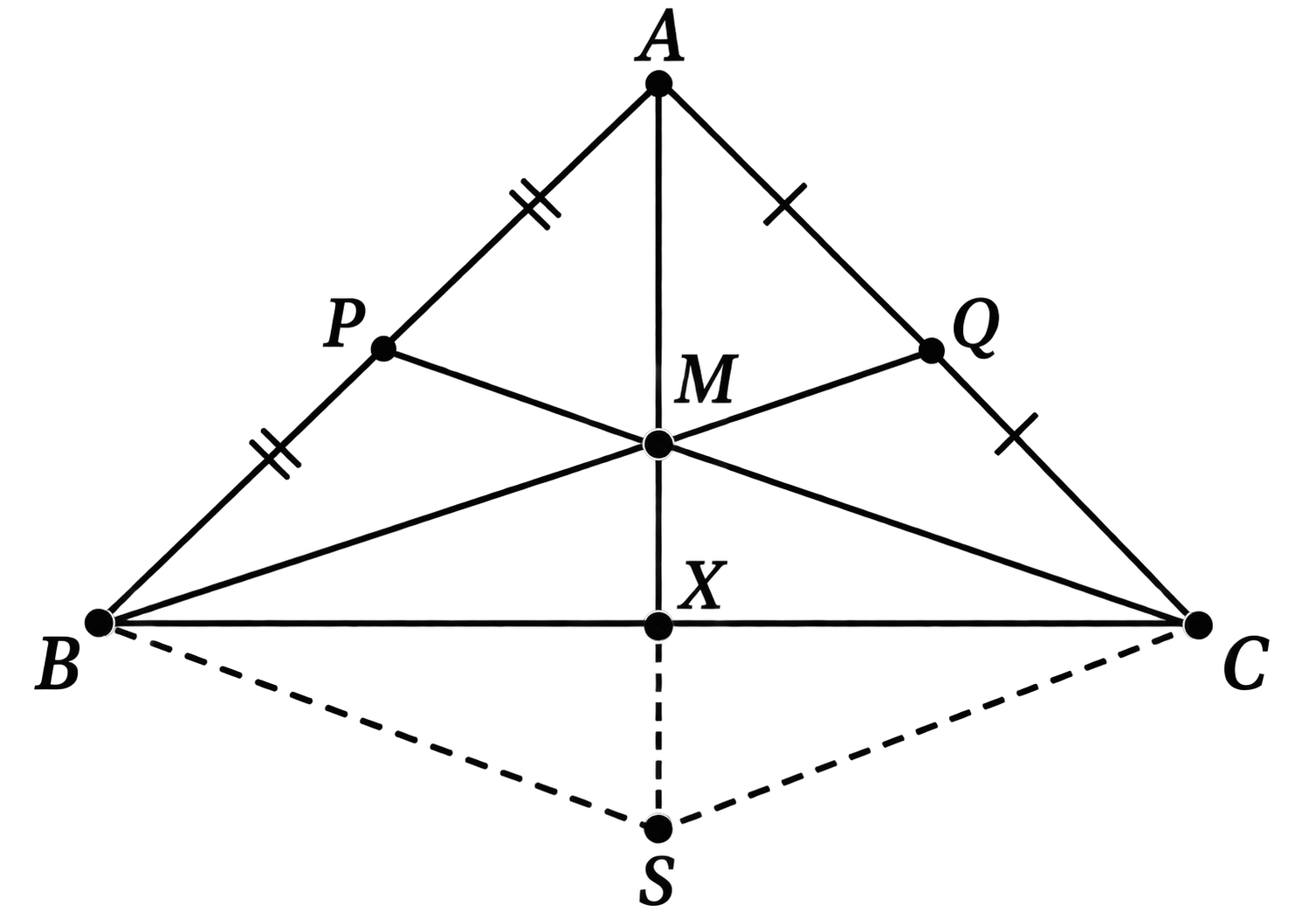
(Hint: To arrange MC ∥ BS, first note that PM and MC are along the same line. Now where should M be on segment AS? Does your placement of S also prove MB ∥ CS?)
Answer:
Extend AM beyond M to S so that AM = MS. Thus M is the midpoint of AS.
In △ABS, P is the midpoint of AB and M is the midpoint of AS. By the Midpoint Theorem, PM ∥ BS. Since P, M, C are collinear, MC ∥ BS.
In △ACS, Q and M are midpoints of AC and AS. Therefore QM ∥ CS. Since Q, M, B are collinear, MB ∥ CS.
Hence BSCM is a parallelogram.
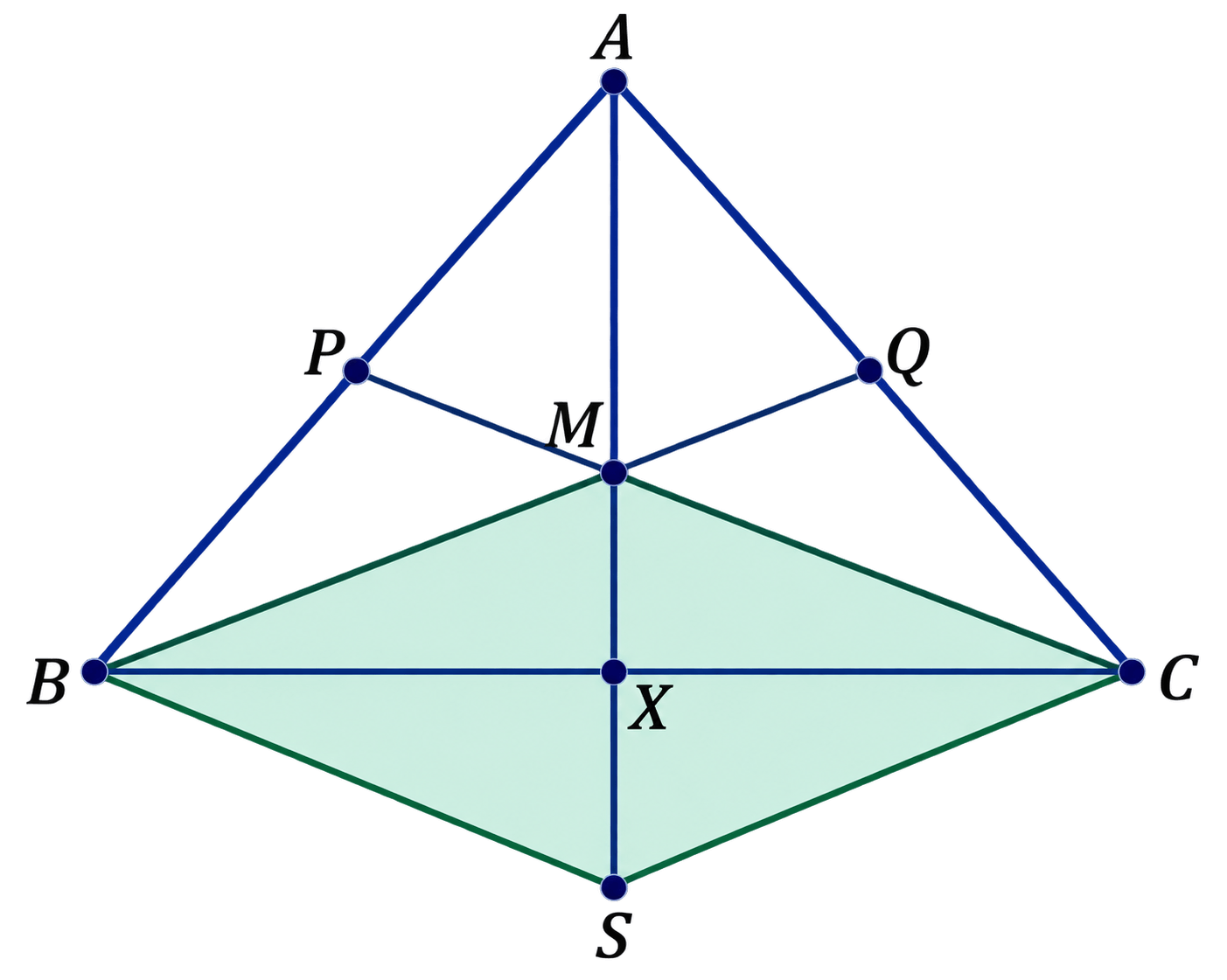
Let X be the intersection of BC and MS. Diagonals of a parallelogram bisect each other, so BX = XC and MX = XS.
Thus line AM meets BC at its midpoint X: AX is the third median, and it passes through M.
Also, AM = MS = 2MX, giving AM : MX = 2 : 1.
From △ABS, PM = BS/2 = MC/2, so CM : MP = 2 : 1.
From △ACS, QM = CS/2 = MB/2, so BM : MQ = 2 : 1.
Therefore the three medians are concurrent at M and each is divided in the ratio 2 : 1 from its vertex.
Page 70 – Think and Reflect
Suppose we have a tiling of the plane. Consider any vertex. As we go around this vertex and consider the angles made by consecutive lines, the total of these angles must be 360°. This suggests an idea. What if we take 4 copies of SOME and fit them together around a common point so that each angle is used once as we go around?
Answer:
The four internal angles of SOME add to 360°. Therefore, placing one copy of each angle around the common point fills one complete turn, with no angular gap or overlap near that point.
For a pattern that continues consistently, use half-turns about shared-side midpoints. These make neighbouring sides coincide exactly and place the vertex angles in a compatible order. Repeating the construction gives the tiling illustrated in the chapter.
Matching the angle sum at one point is a useful first check, but it does not alone prove that an arbitrary arrangement will extend to a whole-plane tiling.
Class 9 Maths Ganita Manjari Chapter 12 Exercise Set 12.1 Solutions
Exercise Set 12.1
1. Let ABCD be a quadrilateral.
(i) List all sides of ABCD adjacent to side AB. List all sides opposite to AB.
(ii) List all angles of ABCD adjacent to ∠A. List all angles opposite to ∠A.
(iii) Define a pair of opposite sides and a pair of opposite angles without using the names of the vertices.
Answer:
(i) Sides adjacent to AB: AD and BC. The side opposite to AB: CD.
(ii) Angles adjacent to ∠A: ∠B and ∠D. The angle opposite to ∠A: ∠C.
(iii) Opposite sides are two sides of a quadrilateral that have no common endpoint.
Opposite angles are two internal angles whose vertices are not joined by a side of the quadrilateral.
2. You have used internal angles of quadrilaterals, but they too require an exact definition, just like how we gave one for a quadrilateral. Precisely define the internal angle of a quadrilateral at a given vertex. Your answer should work for a non-convex quadrilateral too.
(Hint: use the opposite vertex as well.)
Answer:
The internal angle at a vertex is the angle between the two adjacent sides measured through the region enclosed by the quadrilateral near that vertex. It is the smaller angle at a convex vertex and the reflex angle, greater than 180°, at a non-convex vertex.
Here is a precise way to choose the correct angle at A using the other vertices, including the opposite vertex C:
- Draw triangle BCD and consider the smaller angle θ between rays AB and AD.
- If A lies inside triangle BCD, A is the inward-pointing vertex; define the internal angle at A to be 360° − θ.
- Otherwise, define the internal angle at A to be θ.
- Apply the same rule at each of the other vertices.
Do not simply choose the angle containing the ray towards the opposite vertex: in some non-convex quadrilaterals that rule gives the wrong angle.
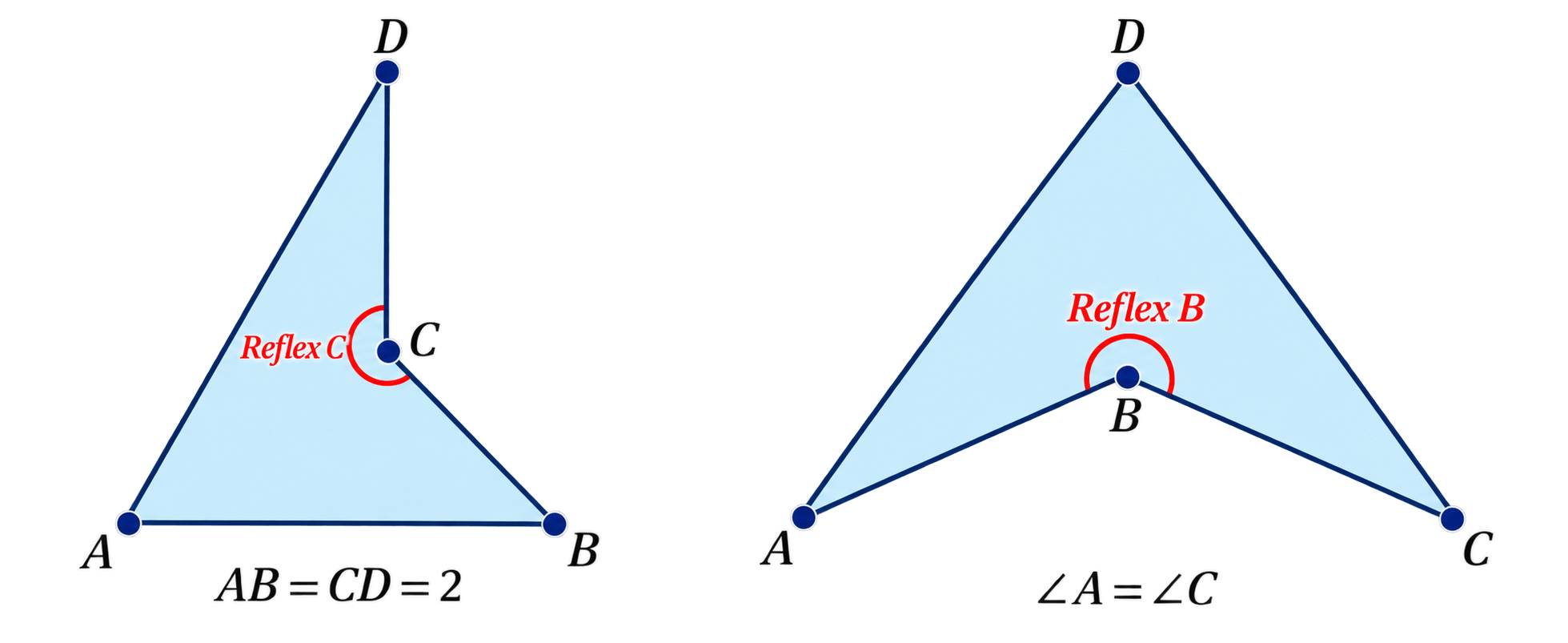
3. In a quadrilateral ABCD, suppose AB ∥ DC. Can ABCD be non-convex? What if we instead assume AB = CD? What if we instead assume ∠A = ∠C?
Answer:
If AB ∥ DC: No. A simple quadrilateral with a pair of parallel opposite sides is convex. To see this, draw the two parallel lines. The connecting sides AD and BC must join their endpoints without crossing. The four vertices then occur around the boundary of a convex trapezium; none can be an inward-pointing vertex.
- If AB = CD: Yes. Equal opposite side lengths alone do not prevent a dent.
Example: Plot A(0, 0), B(2, 0), C(1, 1), D(1, 3) and join them in that order. AB = CD = 2 units, but C lies inside triangle ABD, so ABCD is non-convex. - If ∠A = ∠C: Yes. A symmetric dart can have equal convex angles at A and C and a reflex angle at B.
Example: A(−2, 0), B(0, 1), C(2, 0), D(0, 3). Reflection in the vertical axis exchanges A and C and preserves the figure, so ∠A = ∠C; B is the inward-pointing vertex.
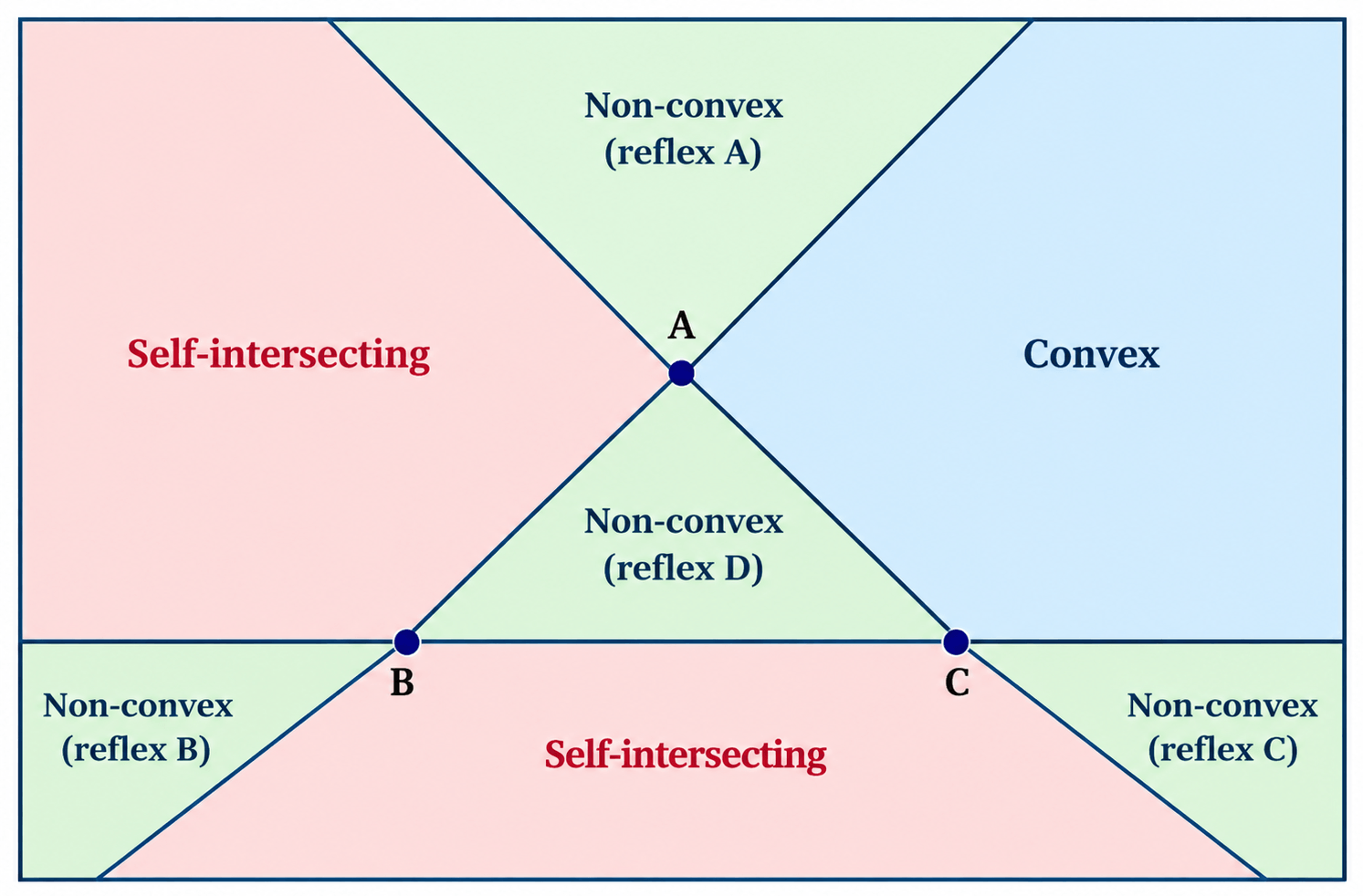
4. Consider three non-collinear points A, B, C and draw the lines AB, BC, CA. For every possible location of point D in the plane outside these lines, decide if ABCD is self-intersecting, non-convex, or convex.
(Hint: the three lines divide the plane into 7 regions.)
Answer:
There are seven regions. The order of the vertices is fixed as A-B-C-D.
| Region containing D | Type of ABCD |
|---|---|
| Inside triangle ABC | Non-convex; D is the inward vertex |
| Across side AC from B, in the exterior region adjoining AC | Convex |
| Across side AB from C, in the exterior region adjoining AB | Self-intersecting |
| Across side BC from A, in the exterior region adjoining BC | Self-intersecting |
| In the exterior corner region beyond A | Non-convex; A is the inward vertex |
| In the exterior corner region beyond B | Non-convex; B is the inward vertex |
| In the exterior corner region beyond C | Non-convex; C is the inward vertex |
Thus, four regions give non-convex quadrilaterals, two give crossed quadrilaterals and one gives convex quadrilaterals.
To check each case, place D in the region, join A-B-C-D-A and examine whether opposite sides cross or one vertex lies inside the triangle of the other three. The type cannot change while D stays in the same region, because a change would require D to pass through one of the three boundary lines.
5. Can a quadrilateral be both self-intersecting and non-planar?
Answer:
No, if “self-intersecting” means an actual crossing of its straight sides.
Suppose opposite sides AB and CD meet. Two intersecting lines lie in one plane. Since A and B lie on the first line and C and D on the second, all four vertices lie in that plane. The same reasoning applies if AD and BC meet.
Therefore, an actually self-intersecting quadrilateral is planar. A drawing or projection of a non-planar quadrilateral can look crossed even when the spatial sides do not meet.
Class 9 Maths Ganita Manjari Chapter 12 Exercise Set 12.2 Solutions
Exercise Set 12.2
1. True or false?
(i) A parallelogram with a right angle is a rectangle.
(ii) A rhombus with perpendicular diagonals is a square.
(iii) If the diagonals of a parallelogram are equal, then it is a rectangle.
Answer:
(i) True.
Adjacent angles of a parallelogram sum to 180° and opposite angles are equal. If one angle is 90°, all four are 90°, so it is a rectangle.
(ii) False.
Every rhombus has perpendicular diagonals, including rhombuses whose angles are 60° and 120°. Such a rhombus is not a square. An additional right angle or equality of its diagonals, would make it a square.
(iii) True.
In parallelogram ABCD, compare △ABC and △BAD. AB is common, BC = AD and AC = BD by the given condition. The triangles are congruent by SSS, so ∠ABC = ∠BAD. These adjacent angles also sum to 180°, hence both are 90°. Therefore ABCD is a rectangle.
2. The diagonal AC of a parallelogram ABCD bisects ∠A. Show that it also bisects ∠C and that ABCD is a rhombus.
Answer:
Given ∠BAC = ∠CAD.
Since AB ∥ CD, ∠BAC = ∠ACD.
Since AD ∥ BC, ∠CAD = ∠BCA.
Therefore ∠ACD = ∠BCA, so AC bisects ∠C.
Also, ∠BAC = ∠BCA in △ABC.
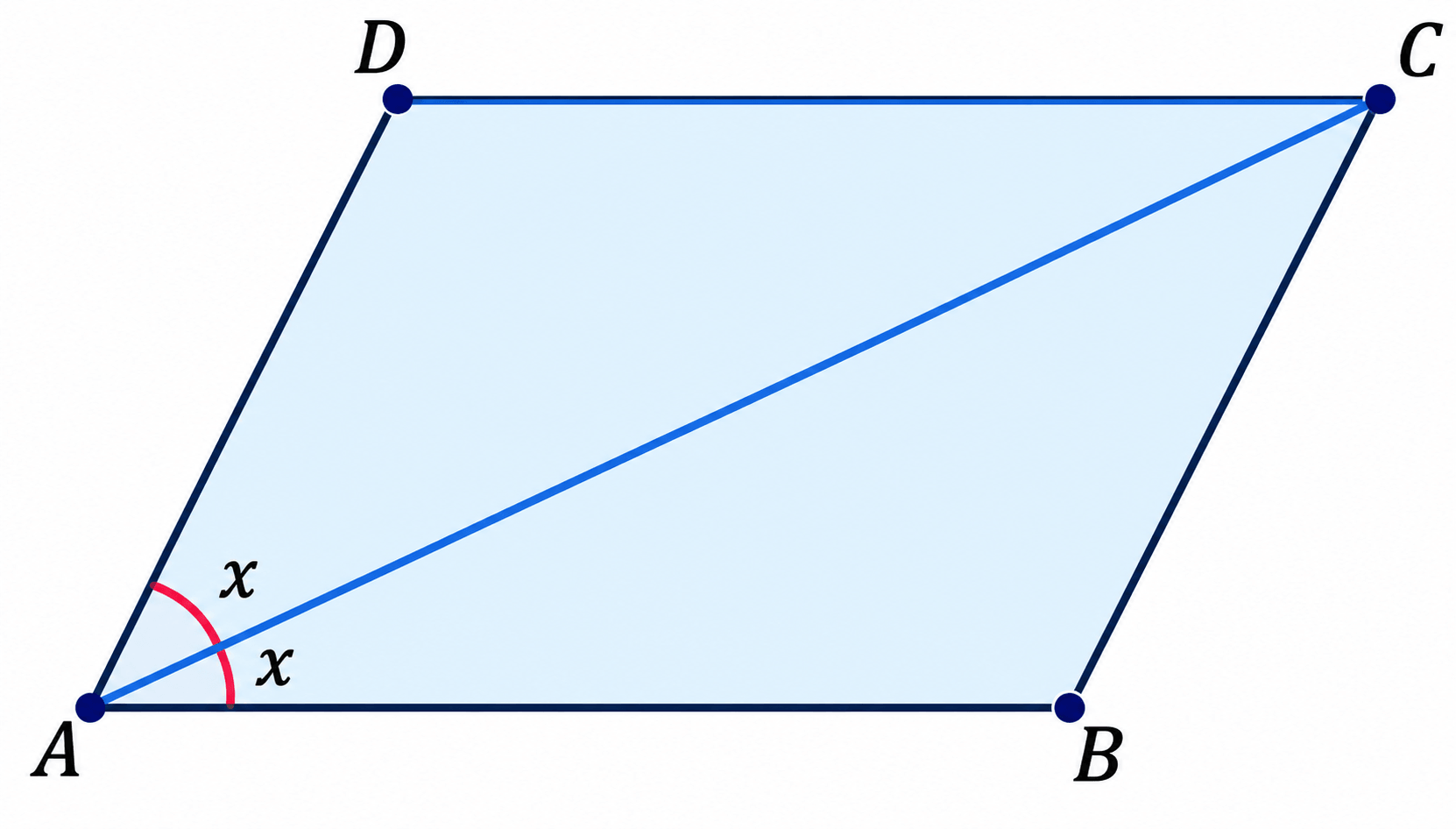
Hence AB = BC, because sides opposite equal angles are equal.
Opposite sides of a parallelogram are equal: AB = CD and BC = AD.
Combining these equalities gives AB = BC = CD = DA. Thus ABCD is a rhombus.
3. The following questions examine converses of true properties. Answer them with Yes or No. If your answer is No, what extra condition can you add so that the answer becomes Yes?
(i) If the diagonals of a quadrilateral ABCD bisect its angles, must ABCD be a rhombus?
(ii) If the diagonals of a quadrilateral ABCD bisect each other at right angles, must ABCD be a rhombus?
(iii) If the diagonals of a quadrilateral ABCD are of equal length, must ABCD be a rectangle? (In the ancient Indian study of quadrilaterals, equality of diagonals was considered significant. Quadrilaterals were first classified according to whether their diagonals were equal or not, before considering equality of sides.)
Answer:
(i) Yes.
Here the condition means that AC bisects the angles at A and C and BD bisects the angles at B and D.
In △ABC and △ADC, the angles at A and C are equal in pairs and AC is common.
By ASA, the triangles are congruent. Thus AB = AD and BC = CD.
Similarly, comparing △ABD and △CBD using the angle bisectors at B and D gives AB = BC.
Therefore all four sides are equal, so ABCD is a rhombus.
(ii) Yes.
Diagonals that bisect each other make ABCD a parallelogram.
Let their intersection be O. Right triangles AOB and COB have AO = CO and common side OB.
They are congruent by SAS, so AB = BC. A parallelogram with equal adjacent sides is a rhombus.
(iii) No.
A non-rectangular isosceles trapezium has equal diagonals.
For example, ABCD gives equal diagonals AC = BD, but the angles are not all right angles.
Add the condition that ABCD is a parallelogram or equivalently add that its diagonals bisect each other. A parallelogram with equal diagonals is a rectangle, as proved in Question 1(iii).
4. Let ABCD be a parallelogram with AB ≠ BC. Show that the pairwise intersection points of the four angle bisectors form the vertices of a rectangle (see Fig. 12.11). Why did we assume AB ≠ BC?

Answer:
Using the intersections of the bisectors of adjacent angles, as in the figure.
In a parallelogram, ∠A + ∠B = 180°.
In the triangle formed by AB and the bisectors of ∠A and ∠B, the angle at their meeting point is
180° − (∠A/2 + ∠B/2) = 180° − 90° = 90°.
The same argument works for each pair of adjacent vertex-angle bisectors.
Opposite angles are equal and opposite sides are parallel, so the bisector lines of opposite angles are parallel.
Thus the four intersection points form a quadrilateral with four right angles: a rectangle.
If AB = BC, the original parallelogram is a rhombus. Its angle bisectors lie along its two diagonals and all four relevant intersections coincide at the diagonal intersection. There is then no rectangle with four distinct vertices. The condition AB ≠ BC excludes this collapsed case.
Class 9 Maths Ganita Manjari Chapter 12 Exercise Set 12.3 Solutions
Exercise Set 12.3
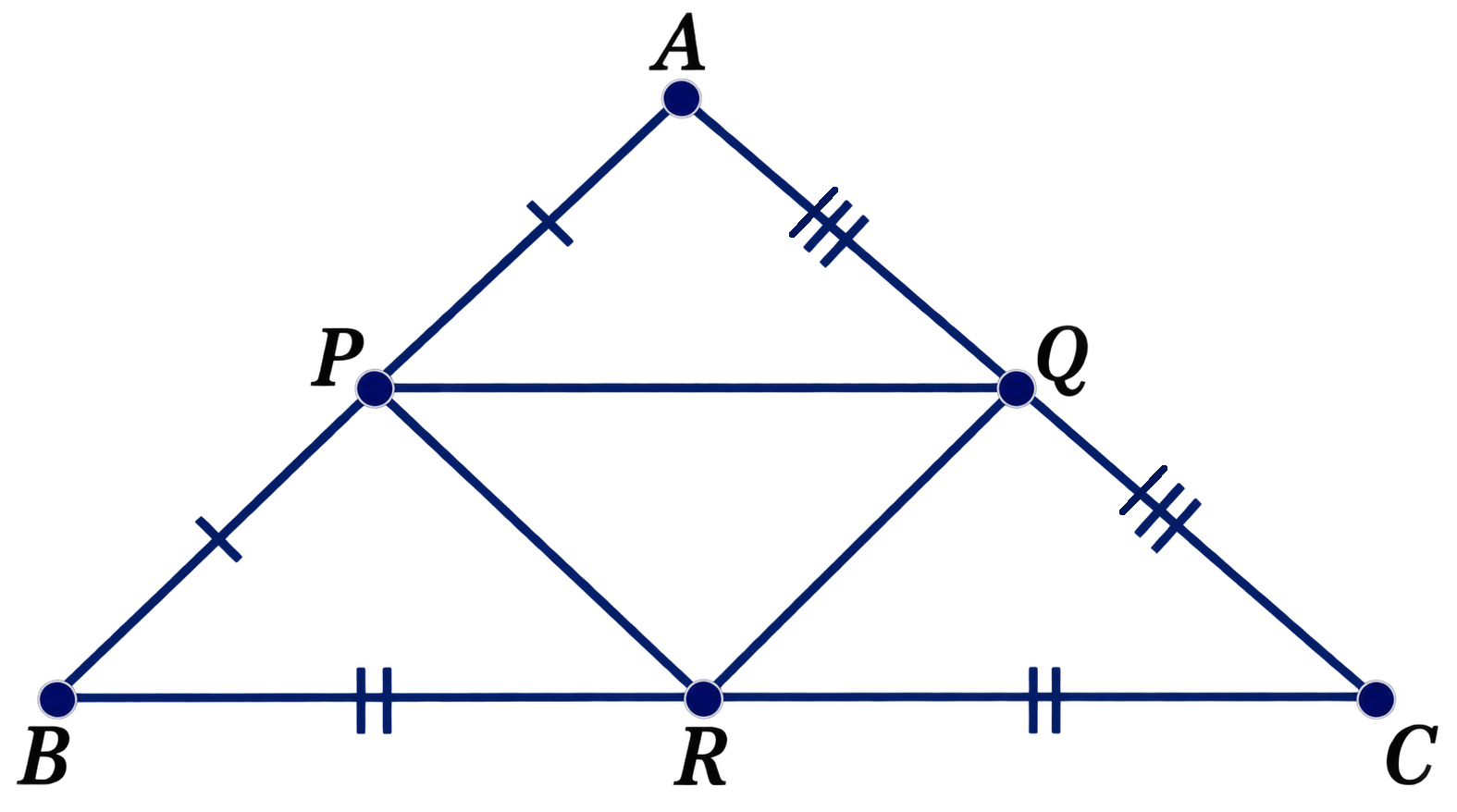
1. (i) If P, Q, R are the midpoints of sides AB, AC, BC respectively of △ABC, show that △PQR is congruent to △QPA and to two other triangles which you should identify. (ii) Suppose someone erases △ABC, leaving only △PQR on the paper. Can you reconstruct △ABC from △PQR?
Answer:
(i) The Midpoint Theorem gives
PQ = BC/2 = BR = RC,
QR = AB/2 = AP = PB,
PR = AC/2 = AQ = QC.
Therefore, by SSS
△PQR ≅ △QPA ≅ △RBP ≅ △CRQ.
(ii) Yes.
Through P draw a line parallel to QR, through Q a line parallel to PR and through R a line parallel to PQ.
Call the intersections of the first and second lines A, the first and third B, and the second and third C.
For example, APQR is a parallelogram, so AP = RQ. Also PBRQ is a parallelogram, so PB = RQ. Thus AP = PB. Similarly AQ = QC and BR = RC.
Hence, the reconstructed triangle has P, Q, R as its side midpoints and is the required △ABC.
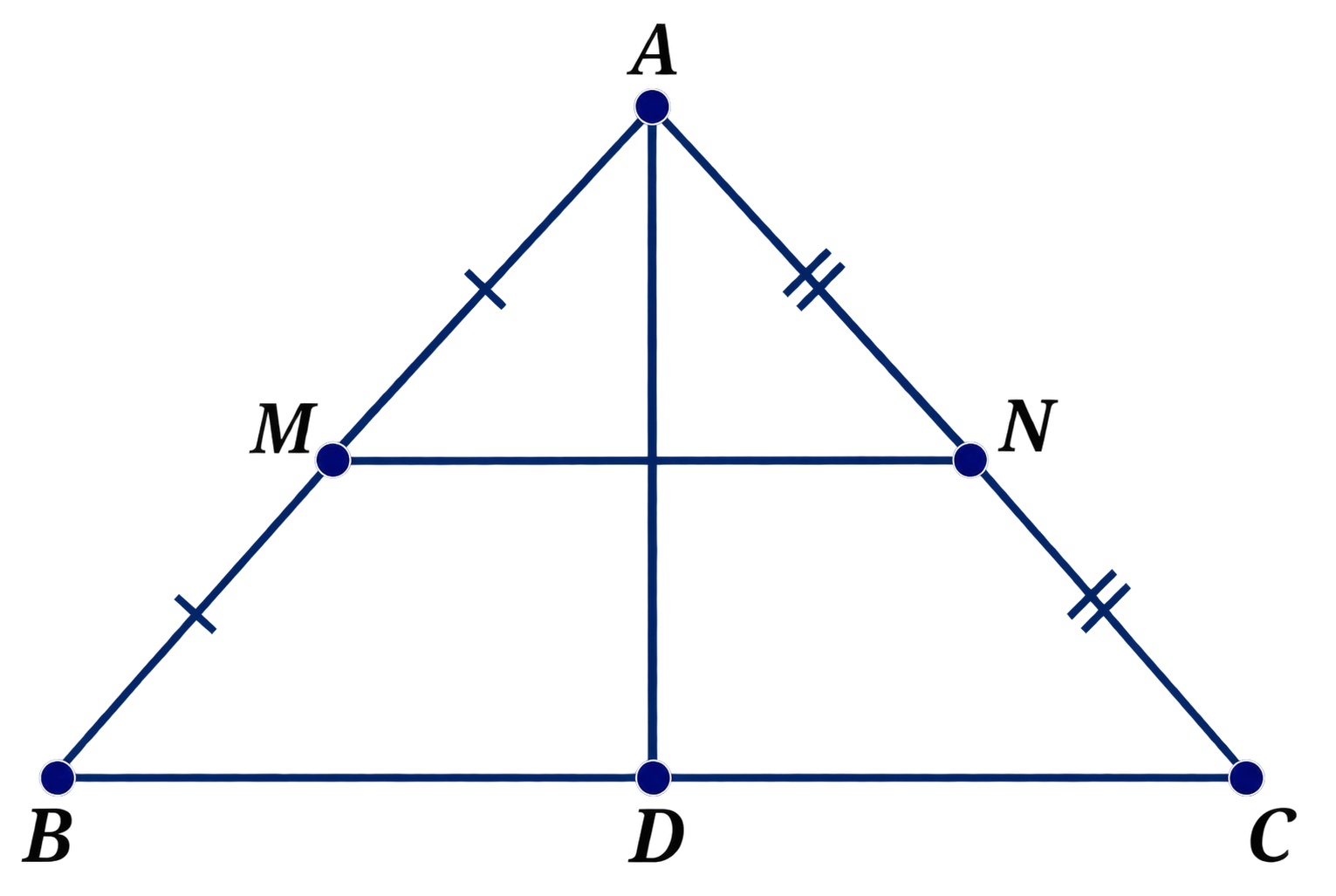
2. In △ABC, let M and N be midpoints of AB and AC respectively. Let D be any point on BC. Show that MN bisects AD.
Answer:
Let MN meet AD at X. Since M and N are midpoints, MN ∥ BC by the Midpoint Theorem.
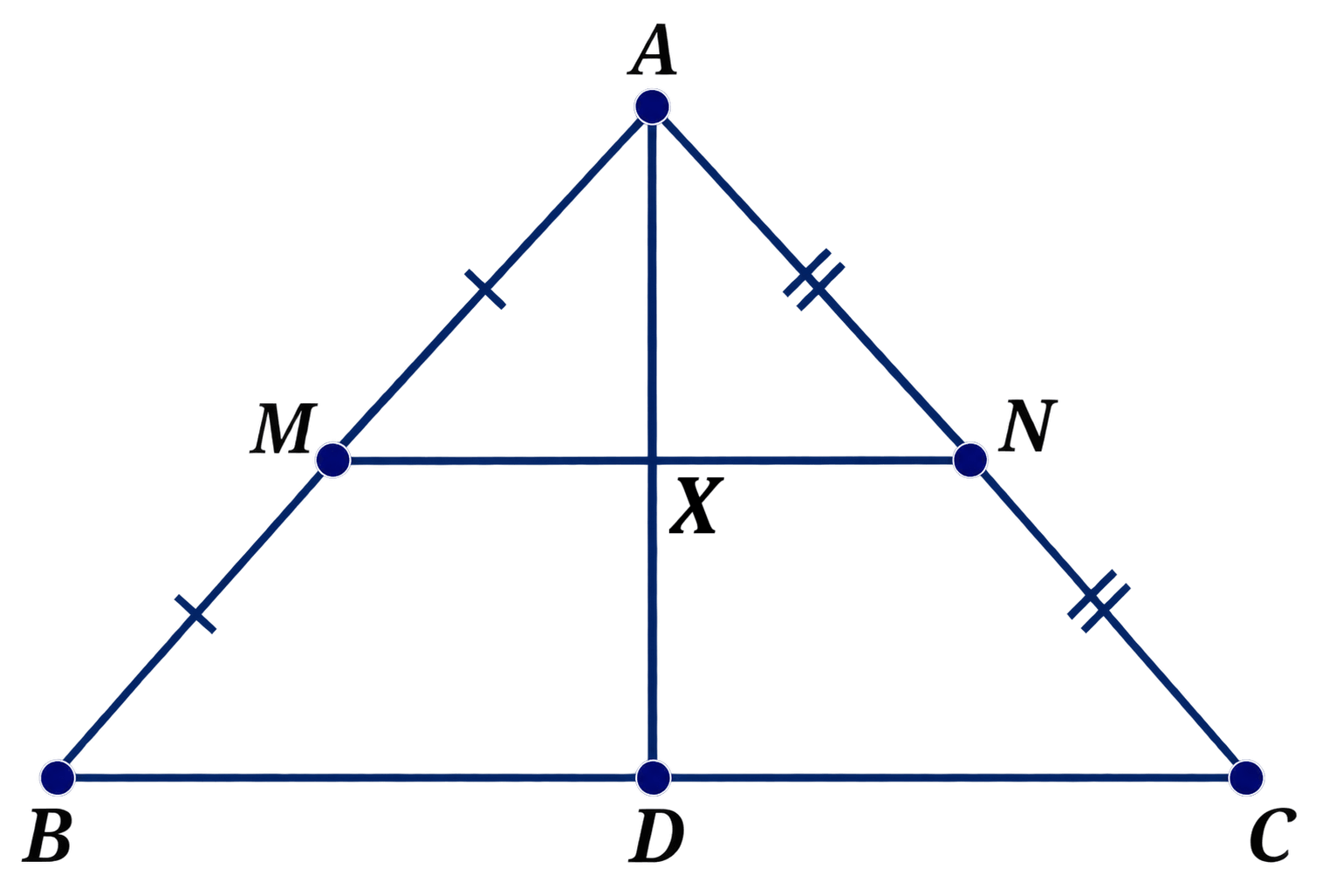
As D is on BC, MX ∥ BD. In △ABD, the line through midpoint M of AB parallel to BD bisects AD, by the converse of the Midpoint Theorem.
Thus AX = XD.
If D coincides with B or C, the conclusion follows directly from M or N being a midpoint.
3. In a quadrilateral ABCD, suppose AB ∥ DC and AB ≠ CD. Suppose G and H are the midpoints of AC and BD respectively. Prove that GH ∥ AB. (Why did we assume AB ≠ CD?)
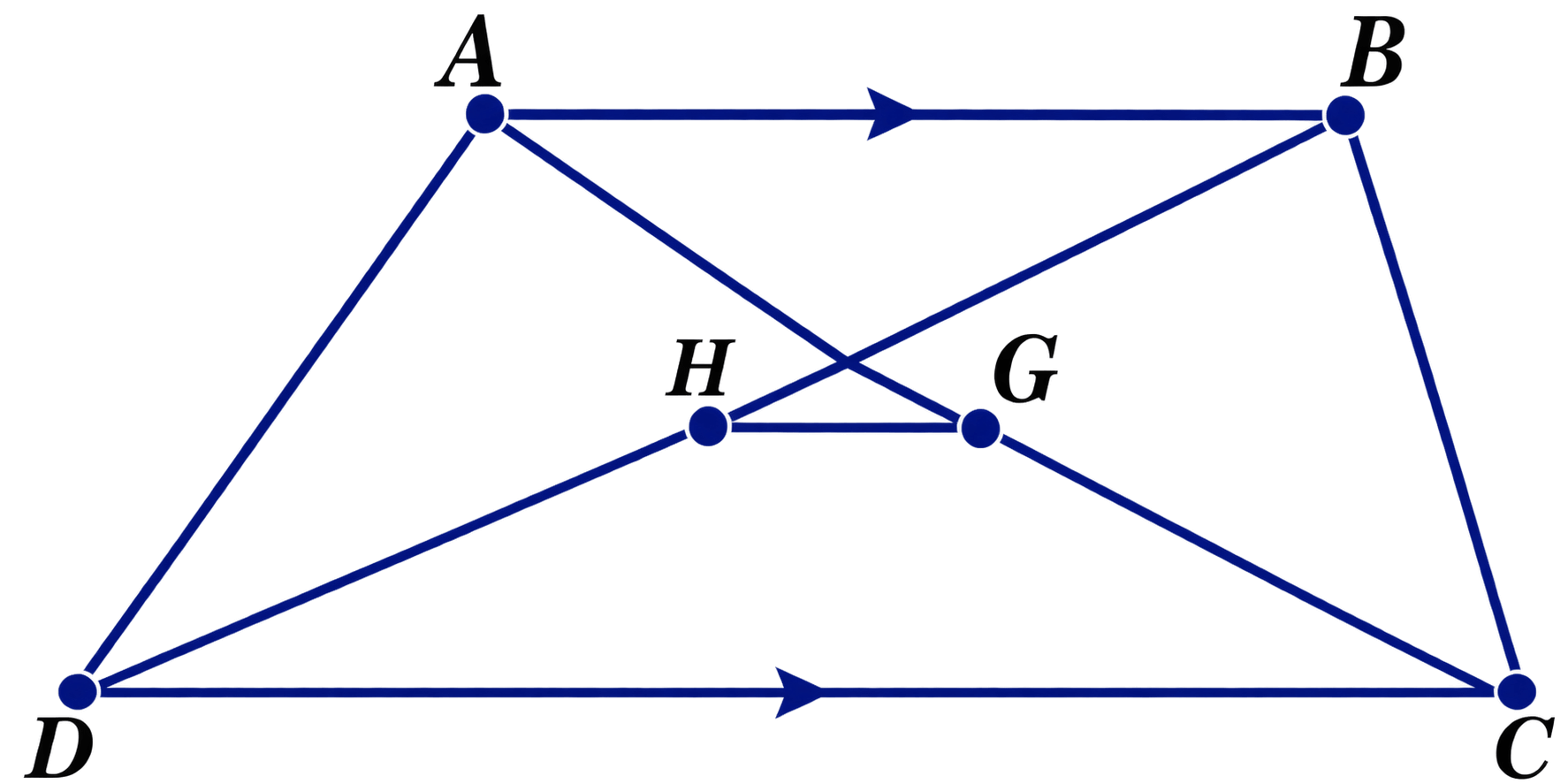
Answer:
Let E be the midpoint of AD.
In △ADC, EG joins two midpoints, so EG ∥ DC and EG = DC/2.
In △ADB, EH joins two midpoints, so EH ∥ AB and EH = AB/2.
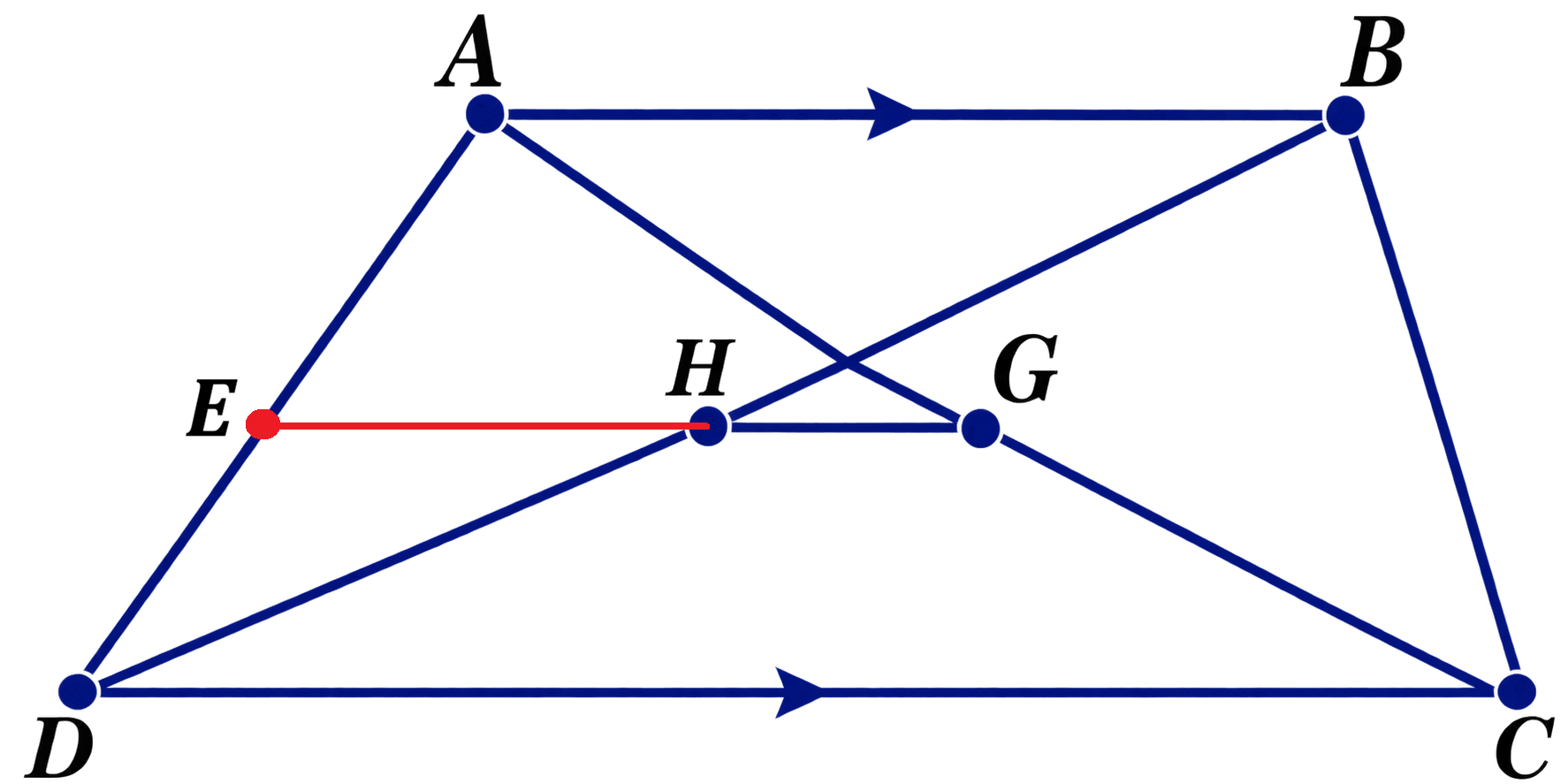
Since AB ∥ DC, EG and EH lie on the same line through E. Consequently E, G, H are collinear and GH ∥ AB.
In this trapezium, G and H lie on the same ray from E, giving GH = |CD − AB|/2.
If AB = CD, the equal-and-parallel-sides test makes ABCD a parallelogram. Its diagonals have the same midpoint, so G = H and GH is not a non-zero segment.
The assumption excludes that case.
4. Suppose the midpoints of sides AB, BC, CD and DA of a quadrilateral ABCD are P, Q, R and S respectively.
(i) Show that PR and QS bisect each other.
(ii) Show that if AC = BD, then PR and QS are perpendicular. Is the converse true?
Answer:
(i) By Varignon’s theorem, PQRS is a parallelogram. Its diagonals PR and QS therefore bisect each other.
(ii) The Midpoint Theorem gives PQ = AC/2 and QR = BD/2.
If AC = BD, then PQ = QR.
Thus PQRS is a rhombus, whose diagonals are perpendicular: PR ⟂ QS.
The converse is also true.
If PR ⟂ QS, they are perpendicular diagonals of the parallelogram PQRS.
That makes PQRS a rhombus, so PQ = QR.
Therefore AC/2 = BD/2 or AC = BD.
5. Suppose PQRS is the Varignon parallelogram of ABCD.
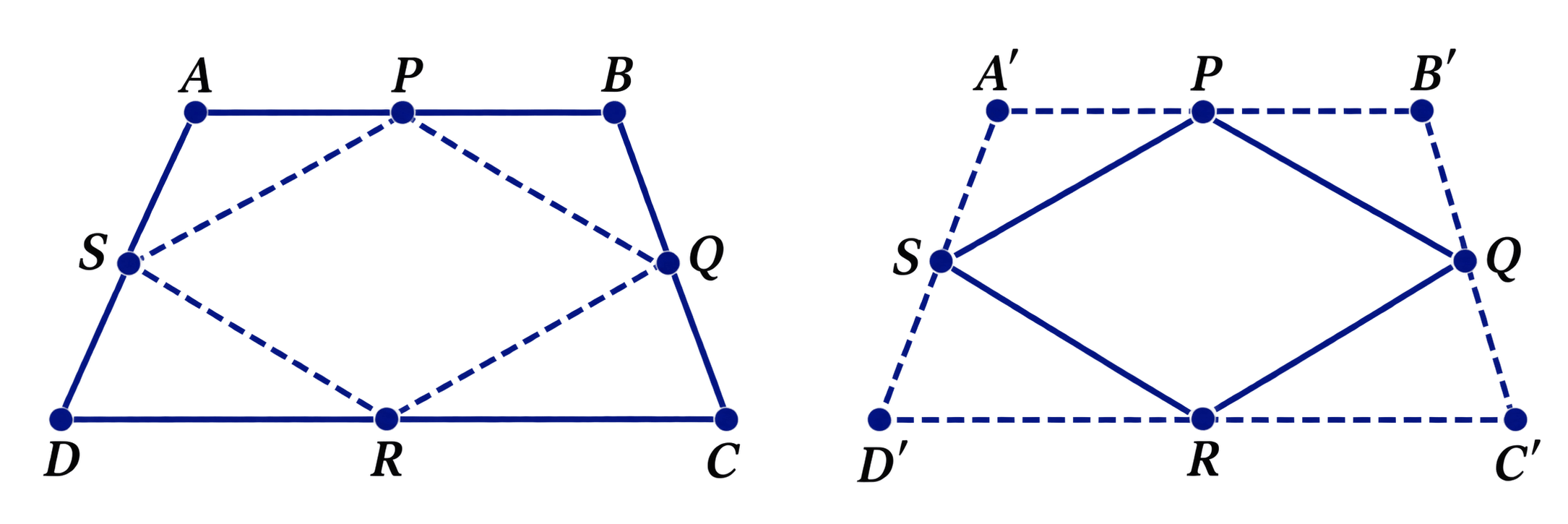
(i) Copy only PQRS on another paper. Show how you will recreate a congruent copy A′B′C′D′ of ABCD from PQRS. This will be relevant when we return to study tilings at the end of this chapter. (Hint: How will you place vertex A′? How will you place B′, C′ and D′?)
(ii) There are multiple ways to construct A′B′C′D′ in (i). Justify why the quadrilateral A′B′C′D′ you constructed is congruent to ABCD. You may need to show why S is collinear with the points A′ and D′ that you constructed and similarly for P, Q and R. (Hint: Use congruence of triangles, for example △SDR ≅ △SD′R.)
(iii) Show that if PQRS is a square, then AC and BD are perpendicular and equal. Prove the converse.
Answer:
(i) Keep the original drawing available as a reference. On the copied PQRS, reproduce triangle SPA: use the lengths SP, PA and SA and place A′ on the corresponding side of SP, preserving the original orientation relative to Q and R.
Extend A′P beyond P to B′ with PB′ = PA′.
Extend B′Q beyond Q to C′ with QC′ = QB′.
Extend C′R beyond R to D′ with RD′ = RC′.
Join D′A′. This recreates the required quadrilateral.
(ii) The copied, oriented triangle SPA′ is congruent to the original triangle SPA. The same rigid placement that matches the copied parallelogram to the original therefore matches A′ to A.
Because P is a midpoint, B is uniquely the point obtained by a half-turn of A about P. Our construction makes B′ in exactly that way. Likewise, C′ and D′ are obtained by the corresponding half-turns about Q and R, so they match C and D.
Consequently A′B′C′D′ is congruent to ABCD. Since S was the midpoint of AD, it is also the midpoint of A′D′. Thus A′, S, D′ are collinear and SA′ = SD′. The same midpoint statements hold at P, Q and R by construction.
(iii) PQ ∥ AC, QR ∥ BD, PQ = AC/2 and QR = BD/2.
If PQRS is a square, PQ ⟂ QR and PQ = QR. Therefore AC ⟂ BD and AC = BD.
Conversely, if AC ⟂ BD and AC = BD, adjacent sides PQ and QR of the Varignon parallelogram are perpendicular and equal. Hence PQRS is a square.
Class 9 Maths Ganita Manjari Chapter 12 Exercise Set 12.4 Solutions
Exercise Set 12.4
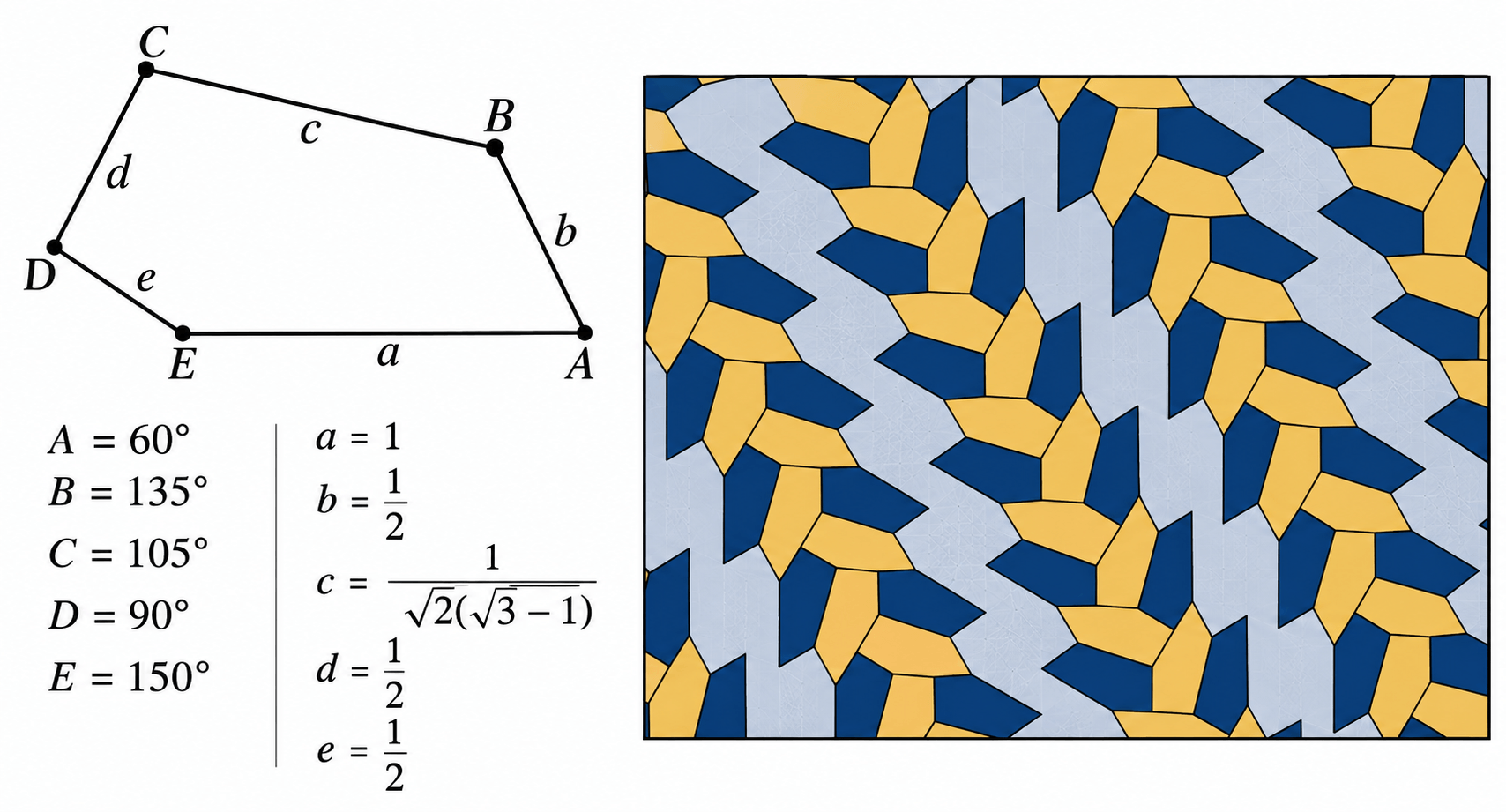
1. Justify why the plane cannot be tiled with a regular pentagon.
(Hint: Read the first 3 sentences of ‘Think and Reflect’ in the section on tiling.) (There are many ways to tile the plane using a suitable irregular pentagon. The most recent method was found in 2015.)
Answer:
Each internal angle of a regular pentagon is (5 − 2) × 180°/5 = 108°.
At a point where tile corners meet, their angles must add to 360°.
But 360°/108° = 10/3 is not an integer. Three corners give 324°, leaving a 36° gap; four give 432°, causing an overlap.
Even allowing a corner to meet the interior of another tile’s edge does not help. That edge contributes 180°, leaving 180°, which is also not an integer multiple of 108°.
More generally, at a pentagon vertex we would need 108k + 180l = 360 with k a positive integer and l a non-negative integer. Dividing by 36 gives 3k + 5l = 10, which has no such solution.
Therefore congruent regular pentagons cannot tile the plane.
2. Draw a non-convex 4-gon DART. Show how we can tile the plane with copies of DART. Both methods that we discussed earlier will work. Which do you prefer?
Answer:
One possible DART has D(1, 1), A(0, 3), R(0, 0) and T(3, 0), joined in the order D-A-R-T-D. D lies inside triangle ART, so it is the reflex vertex.
Make congruent copies. Place a half-turned copy across a side by rotating through 180° about that side’s midpoint. Repeat across exposed sides, keeping already placed copies in their existing positions. The copies fit into a repeating tiling; a finite portion is shown in following Figure.
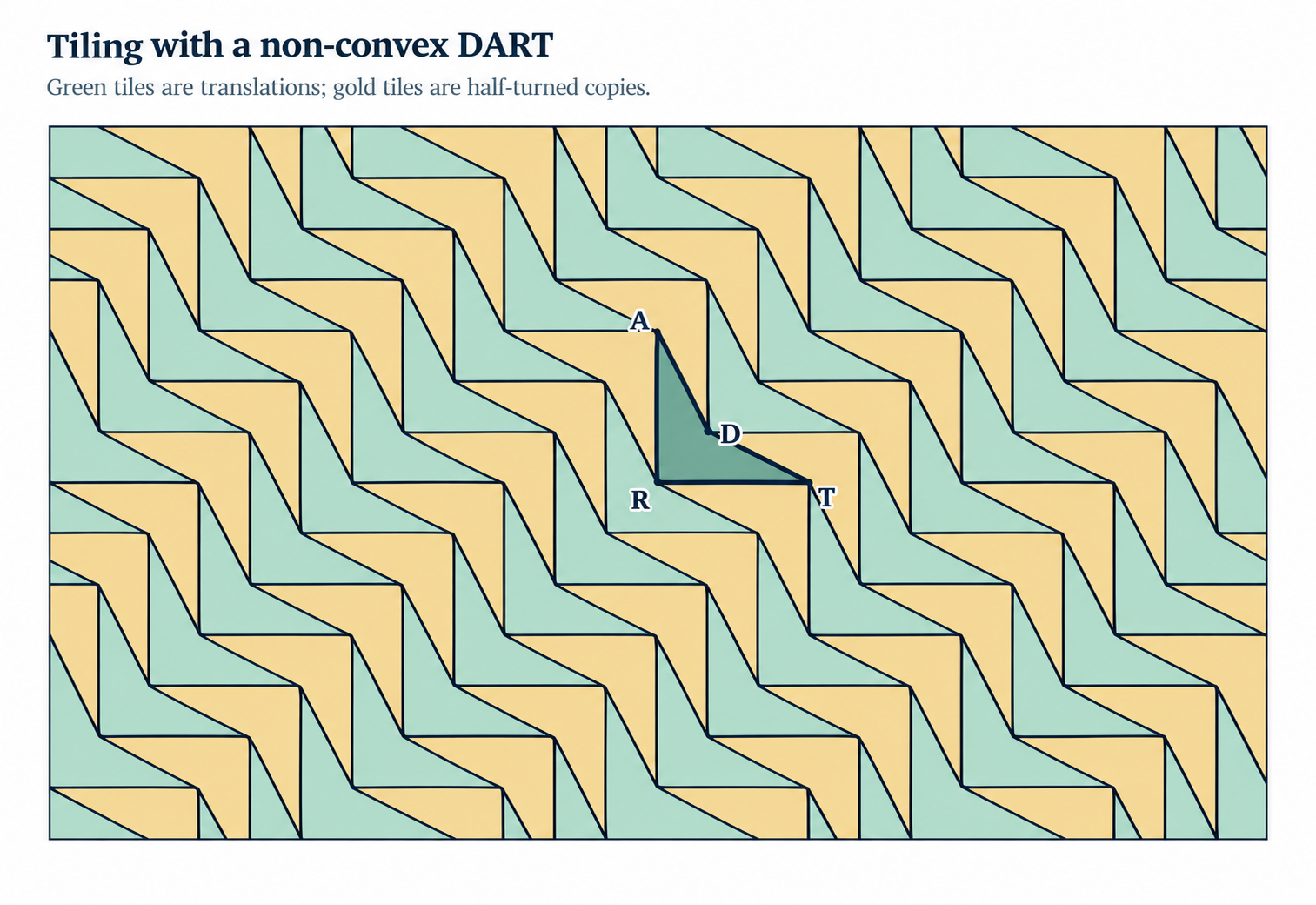
Alternatively, use the Varignon parallelogram grid, place the equally oriented copies at the selected grid positions and fill the intervening gaps with half-turned copies.
Preference: I prefer the half-turn method because each new tile is located by a single rotation about a known midpoint.
The general justification, valid for this non-convex tile too.
Class 9 Maths Ganita Manjari Chapter 12 End-of-Chapter Exercises Solutions
End-of-Chapter Exercises
1. Using a fact about parallelograms, show how to tile the plane using any given triangle.
(Hint: Can you use the parallelogram tiling in the introduction?)
Answer:
Take any triangle ABC. Rotate a congruent copy through 180° about the midpoint of BC. The two triangles together form a parallelogram, since the half-turn makes the appropriate opposite sides equal and parallel.
Tile the plane with translated copies of this parallelogram. Keep the diagonal separating its two constituent triangles in every copy. This gives a tiling entirely by copies of the original triangle.
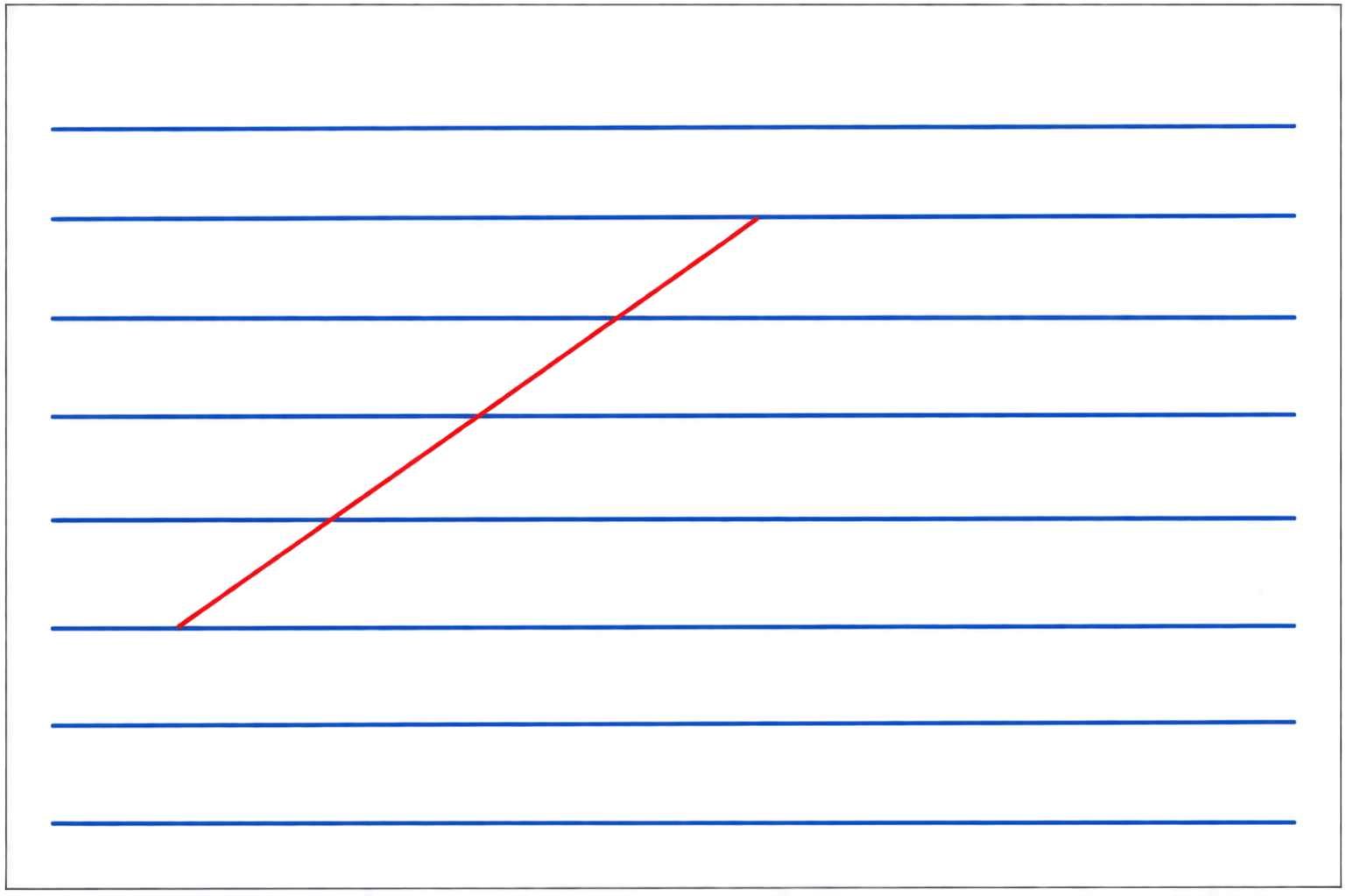
2. Mark the midpoint of the line drawn on the paper (see Fig. 12.33), given that the horizontal lines are equally spaced. Justify your answer.
Answer:
The two endpoints in Fig. 12.33 lie on ruled lines four equal spaces apart. Mark the point where the segment crosses the ruled line two spaces from either endpoint. This point is the midpoint.
Justification:
Draw a vertical through one endpoint and a horizontal through the other, forming a right triangle with the given segment as its sloping side. The middle ruled line passes through the midpoint of the vertical side and is parallel to the horizontal side. By the converse of the Midpoint Theorem, it also bisects the sloping side.
Frequently Asked Questions
What should I revise before studying Ganita Manjari Chapter 12, Quadrilaterals?
Before starting this chapter, revise angles formed by parallel lines, the angle-sum property of triangles, triangle congruence tests and basic properties of quadrilaterals. You should also understand terms such as diagonal, midpoint, median and angle bisector. These ideas appear repeatedly in the proofs. If a solution feels difficult, identify the earlier result it uses and revise that concept before attempting the question again. Drawing a simple figure can help connect the ideas.
How should I use these NCERT solutions without becoming dependent on them?
Attempt each question independently before reading its solution. Draw the figure, record the given information and identify what you need to prove or calculate. If you get stuck, read only the next step and then continue on your own. After checking your answer, close the solution and write the reasoning again. This approach helps you understand why a method works and apply the same idea when the labels or diagram change.
How can I write clear geometry proofs for Class 9 Maths Chapter 12 Ganita Manjari?
Begin by stating the given information and the result to be proved. Use a labelled diagram, then arrange your steps so that each conclusion follows from an established fact. Mention reasons such as alternate interior angles, a triangle congruence test or the Midpoint Theorem. Avoid assuming that lines are parallel or lengths are equal simply because they look that way. Finish by explicitly stating the required result using the correct vertex order.
How should I approach the starred questions in Ganita Manjari Chapter 12?
The starred questions often need additional exploration, a construction or a more detailed argument. Start with a familiar example and test what happens when you change the shape or its measurements. Use the chapter’s theorems to turn your observations into a proof. Whether these questions are required for a particular assignment or assessment depends on your teacher’s instructions. Working through them can strengthen your reasoning even when you need help with the first attempt.
What is an effective way to revise Class 9 Maths Chapter 12 before a test?
Prepare a short revision sheet containing the main properties of special quadrilaterals, the Midpoint Theorem and its converse and the Centroid Theorem. Practise explaining the difference between a statement and its converse, including counterexamples where a converse fails. Then solve a mixture of proof, construction and application questions without referring to the answers. Review errors by identifying the missing reason or misunderstood condition and practise those particular ideas again before the test.