



by Tiwari Academy Team
NCERT Class 9 Maths Ganita Manjari Chapter 5 Solutions – I’m Up and Down, and Round and Round in Hindi and English Medium for Session 2026-27 exams. Chapter 5 of the NCERT Ganita Manjari textbook for Class 9 Mathematics, titled “I’m Up and Down, and Round and Round,” is a beautifully written introduction to the geometry of circles — one of the most ancient and universally recognised shapes in human history. From raindrops forming ripples on water to the cross-section of a plant stem and the apparent shape of the sun and moon, circles appear everywhere in nature and mathematicians across civilisations have been drawn to their perfect symmetry.
Class 9 Ganita Manjari Chapter 5 Quick Links:
- Exercise Set 5.1
- Exercise Set 5.2
- Exercise Set 5.3
- Exercise Set 5.4
- Exercise Set 5.5
- Exercise Set 5.6
- End-of-Chapter Exercises
- Class 9 Ganita Manjari Chapter 5 in Hindi Medium
- Download Class 9 Maths Offline App to study Class 9 Maths Ganita Manjari Offline.
Chapter 5 Ganita Manjari takes Grade 9 students on a structured journey through the formal geometry of circles, beginning with precise definitions and building steadily toward elegant theorems about chords, arcs, angles, and cyclic quadrilaterals. Students will encounter 12 theorems – each explained with a “Given, To Show, Why is this true?” structure that develops genuine mathematical reasoning rather than rote proof memorisation. The chapter connects geometric intuition with rigorous justification, using activities, congruence arguments, and the Baudhāyana–Pythagoras theorem throughout. Whether you are a student preparing for your Class 9 exams, a teacher planning a theorem-based lesson or a parent trying to understand what your child is learning, this page covers everything you need for Chapter 5 of Ganita Manjari — clearly structured and fully aligned with the 2026-27 NCERT syllabus.
What is Class 9 Maths Ganita Manjari Chapter 5 About?
Chapter 5, “I’m Up and Down, and Round and Round”, is the circles chapter of Ganita Manjari. Unlike the old NCERT textbook which presented circle theorems in a more formulaic way, this chapter builds each result from first principles using triangle congruence, symmetry arguments, and activity-based discovery. The chapter is structured across eight sections and contains 12 theorems, 6 exercise sets and 26 end-of-chapter questions – including several starred (*) advanced problems.
The key sections are as follows:
- Section 5.1: Definitions: Introduces circle, centre, radius, chord, diameter and the concept of locus in formal mathematical language.
- Section 5.2: Symmetries of a Circle: Explores complete rotational symmetry and reflection symmetry across diameters – the properties that make circles geometrically unique.
- Section 5.3: How Many Circles?: Establishes that infinitely many circles pass through two points, and proves Theorem 1 – that a unique circle passes through any three non-collinear points (circumcircle). Discusses circumcentre position for acute, obtuse, and right-angled triangles.
- Section 5.4: Chords and the Angles They Subtend: Proves Theorems 2 and 3 – equal chords subtend equal angles at the centre and vice versa — using SSS and SAS congruence.
- Section 5.5: Midpoints and Perpendicular Bisectors of Chords: Proves Theorems 4 and 5 – the line joining the centre to the midpoint of a chord is perpendicular to it and the perpendicular from the centre bisects the chord.
- Section 5.6: Distance of Chords from the Centre: Proves Theorems 6, 7 and 8 – equal chords are equidistant from the centre, equidistant chords are equal and longer chords are closer to the centre.
- Section 5.7: Angles Subtended by an Arc: Introduces major and minor arcs, and proves Theorem 9 – the central angle is double the inscribed angle. Derives the corollary that the angle in a semicircle is always 90°.
- Section 5.8: Concyclicity of Points: Proves Theorems 10, 11, and 12 – conditions for four points to be concyclic, opposite angles of a cyclic quadrilateral sum to 180° and the converse.
NCERT Class 9 Maths Ganita Manjari Chapter 5 Solutions
Class 9 Maths Ganita Manjari Chapter 5 Exercise Set 5.1 Solutions
Exercise Set 5.1
1. Draw ΔABC with AB = 5 cm, ∠A = 70° and ∠B = 60°. Draw the circumcircle of ΔABC. Is the centre inside or outside the triangle?
Answer:
Steps of Construction:
1. Draw the line segment AB = 5 cm.
2. At point A, construct ∠CAB = 70°.
3. At point B, construct ∠CBA = 60°.
4. Let the two rays meet at C. Then ΔABC is formed.
5. Draw the perpendicular bisector of AB.
6. Draw the perpendicular bisectors of BC and AC.
7. Let the three perpendicular bisectors meet at O. This point O is the circumcentre.
8. With centre O and radius OA, draw a circle passing through A, B and C. This is the circumcircle of ΔABC.

Now:
∠C = 180° − (70° + 60°) = 50°
Since all the angles of the triangle are less than 90°, the triangle is acute-angled.
In an acute-angled triangle, the circumcentre lies inside the triangle.
Therefore, the centre is inside the triangle.
2. Draw ΔABC with AB = 5 cm, ∠A = 100°, AC = 4 cm. Draw the circumcircle of ΔABC. Is the centre inside or outside the triangle?
Answer:
Steps of Construction:
1. Draw the line segment AB = 5 cm.
2. At point A, construct ∠BAC = 100°.
3. On the ray AX, mark point C such that AC = 4 cm.
4. Join C to B. Then ΔABC is formed.
5. Draw the perpendicular bisector of AB.
6. Draw the perpendicular bisector of AC and BC.
7. Let these bisectors meet at O. This point O is the circumcentre.
8. With centre O and radius OA, draw the circle through A, B and C. This is the circumcircle.
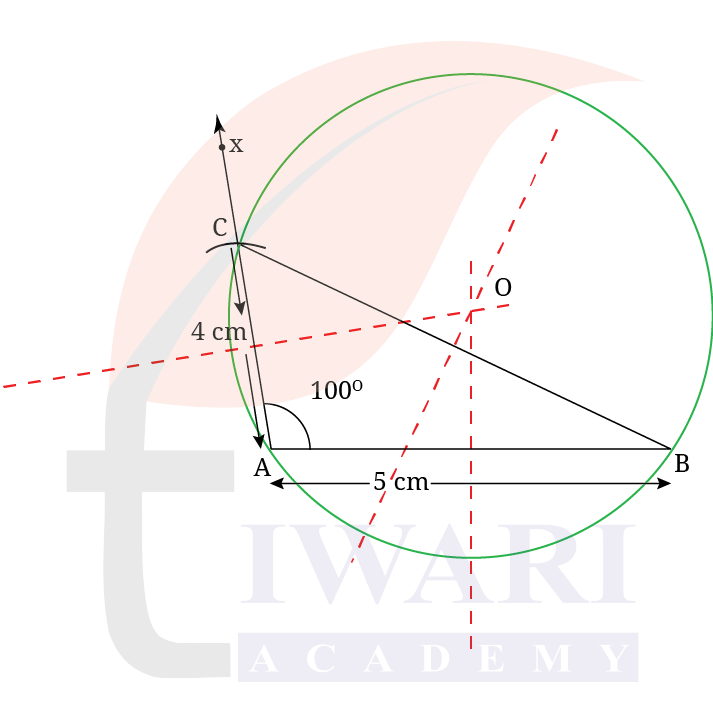
Reasoning:
Since ∠A = 100°, the triangle is obtuse-angled.
In an obtuse-angled triangle, the circumcentre lies outside the triangle.
Therefore, the centre is outside the triangle.
3. Draw ΔABC, with AB = 6 cm, BC = 7 cm and CA = 7 cm. Draw the circumcircle of ΔABC. Let the circumcentre be O. Measure OA, OB, OC.
Answer:
Steps of Construction:
1. Draw AB = 6 cm.
2. With centre A and radius 7 cm, draw an arc.
3. With centre B and radius 7 cm, draw another arc cutting the first arc at C.
4. Join AC and BC. Then ΔABC is formed.
5. Draw the perpendicular bisector of AB.
6. Draw the perpendicular bisectors of AC and BC).
7. Let they intersect at O. This point O is the circumcentre.
8. With centre O and radius OA, draw the circumcircle.
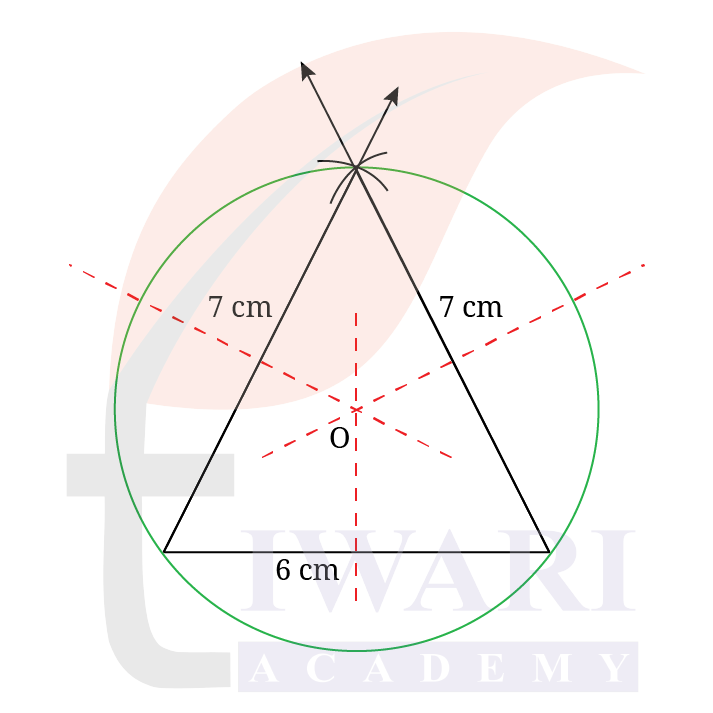
Observation:
Since O is the circumcentre, it is equidistant from all three vertices.
Therefore, OA = OB = OC
Approximate measurement:
For the triangle with sides 7 cm, 7 cm, 6 cm,
OA = OB = OC ≈ 4 cm
So, the three measurements are equal, each approximately 4 cm.
4. What is the least possible radius of a circle through two points A and B?
Answer:
For all circles passing through two fixed points A and B, the centre lies on the perpendicular bisector of AB.
The smallest circle occurs when the centre is the midpoint of AB.
In that case, AB becomes the diameter of the circle.
Therefore, the least possible radius is:
Radius = AB/2
Hence, the least possible radius of a circle through A and B is half of AB.
Class 9 Maths Ganita Manjari Chapter 5 Exercise Set 5.2 Solutions
Exercise Set 5.2
1. Show that the triangle formed by a chord and the centre of the circle is isosceles.
Answer:
Let AB be a chord of a circle with centre O.
Join OA and OB.

In triangle OAB
OA = OB [Radii of the same circle]
Therefore, triangle OAB is an isosceles triangle.
Hence proved.
2. Show that if two such isosceles triangles (occurring in the previous question) have equal base length, they are congruent to each other.
Answer:
Let AB and PQ be two equal chords of the same circle with centre O.
Then triangles formed are △OAB and △OPQ.

Now, in △OAB and △OPQ
OA = OP [Radii of the same circle]
OB = OQ [Radii of the same circle]
AB = PQ [Given]
So, by SSS congruence criterion
△OAB ≅ △OPQ.
Hence, if two such isosceles triangles have equal base length, they are congruent to each other.
Hence proved.
Class 9 Maths Ganita Manjari Chapter 5 Exercise Set 5.3 Solutions
Exercise Set 5.3
1. Can you explain why the converse to Theorem 4 is true, i.e., why does the perpendicular from the centre of a circle to a chord of the circle bisect the chord?
Answer:
Converse of Theorem 4: The perpendicular from the centre of a circle to a chord of the circle bisects the chord.
Let AB be a chord of a circle with centre O, and let OM ⟂ AB.
To Prove: AM = BM

In △OMA and △OMB,
OA = OB [Radii of the same circle]
OM = OM [Common to both triangles]
∠OMA = ∠OMB [Each 90°, as OM ⟂ AB]
Therefore, by RHS congruence
△OMA ≅ △OMB
Hence, AM = BM [CPCT]
So, M is the midpoint of AB.
Therefore, the perpendicular from the centre of a circle to a chord bisects the chord.
Hence proved.
2. An isosceles triangle ABC is inscribed in a circle, with AB = AC. Show that the altitude from A to BC passes through the centre of the circle.
Answer:
Given: △ABC is inscribed in a circle and AB = AC.
Since AB = AC, triangle ABC is isosceles with base BC.
Let AD be the altitude from A to BC.
Then AD ⟂ BC

In △ABD and △ACD,
AB = AC [Given]
AD = AD [Common to both triangles]
∠ADB = ∠ADC [Each 90°, as AD ⟂ BC]
Therefore, by RHS congruence
△ABD ≅ △ACD
Hence, BD = DC [CPCT]
So, AD is bisector of BC.
Since AD is perpendicular to BC and also bisects BC, AD is the perpendicular bisector of chord BC.
Therefore, AD passes through the centre of the circle.
Hence, the altitude from A to BC passes through the centre of the circle.
Hence proved.
3. Two parallel chords of lengths 6 cm and 8 cm are on opposite sides of the centre of a circle. If the radius of the circle is 5 cm, find the distance between the midpoints of the chords.
Answer:
Given: Radius of the circle OA = OC = 5 cm
Lengths of the two chords are AB = 6 cm and CD = 8 cm
The perpendicular from the centre O to a chords AB and CD bisects the chords at M and N respectively.
So, half-lengths are:
For the 6 cm chord: AM = 3 cm
For the 8 cm chord: CN = 4 cm
Let the distances of the chords from the centre be d₁ and d₂.
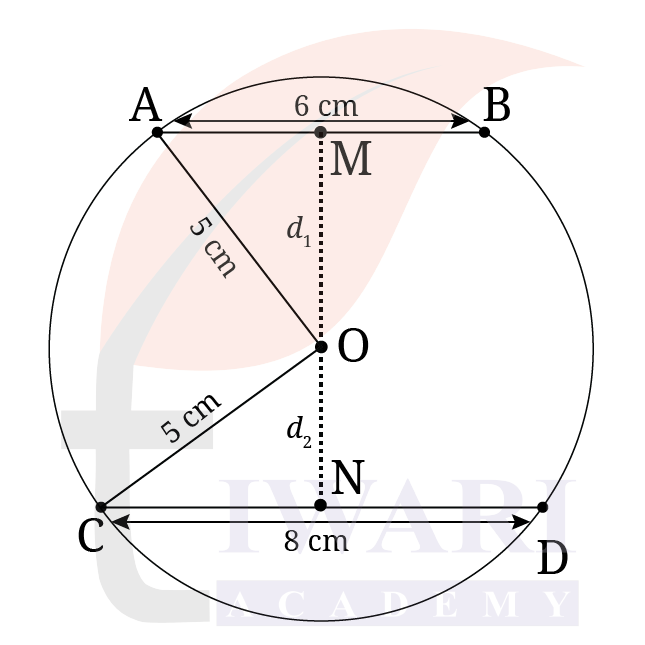
In triangle OAM, using Pythagoras theorem:
OM² + AM² = OA²
⇒ d₁² + 3² = 5²
⇒ d₁² + 9 = 25
⇒ d₁² = 16
⇒ d₁ = 4 cm
Similarly, in triangle OCN, using Pythagoras theorem:
ON² + CN² = OC²
⇒ d₂² + 4² = 5²
⇒ d₂² + 16 = 25
⇒ d₂² = 9
⇒ d₂ = 3 cm
Since the chords are on opposite sides of the centre and their centers lies on same line.
So, the distance between their midpoints = d₁ + d₂ = 4 + 3 = 7 cm
Therefore, the distance between the midpoints of the two chords is 7 cm.
Class 9 Maths Ganita Manjari Chapter 5 Exercise Set 5.4 Solutions
Exercise Set 5.4
1. Use the Baudhāyana–Pythagoras theorem to show why Theorem 6 must be true.
Answer:
Theorem 6: Chords of a circle having the same length are at the same distance from the centre.
Let AB and CD be two equal chords of a circle with centre O.
Let OM ⟂ AB and ON ⟂ CD.
We know that the perpendicular from the centre to a chord bisects the chord.
So, AM = MB = AB/2 and CN = ND = CD/2
Since AB = CD, we get: AM = CN
Also, OA = OC = radius of the circle.

Now apply the Baudhāyana–Pythagoras theorem in right triangles OMA and ONC:
In △OMA: OA² = OM² + AM²
In △ONC: OC² = ON² + CN²
Since OA = OC and AM = CN,
So, we have: OM² + AM² = ON² + CN²
Therefore, OM² = ON²
⇒ OM = ON
Hence, the equal chords AB and CD are equidistant from the centre.
Thus, Theorem 6 is proved.
2. Consider Fig. 5.15. If CE is perpendicular to AB, CH is perpendicular to GF, and CE = CH, show that AB = GF.

Answer:
Given: CE ⟂ AB, CH ⟂ GF and CE = CH.
To Prove: AB = GF
Proof: Since CE is perpendicular to chord AB, the perpendicular from the centre to a chord bisects the chord.
Therefore, AE = EB
Similarly, since CH is perpendicular to chord GF. So, GH = HF
In △CEA and △CHG, we have
CA = CG [Radii of the same circle]
CE = CH [Given]
∠CEA = ∠CHG [Each 90°]
Therefore, by RHS congruence
△CEA ≅ △CHG
So, AE = GH [CPCT]
⇒ 2AE = 2GH
⇒ AB = GF [AB = 2AE and GF = 2GH]
Hence proved.
3. Solve the previous question using the Baudhāyana–Pythagoras theorem.
Answer:
Given: CE ⟂ AB, CH ⟂ GF and CE = CH.
To Prove: AB = GF
Proof: Since CE is perpendicular to chord AB, it bisects AB.
So, E be the midpoint of AB.
⇒ AE = AB/2
Similarly, since CH is perpendicular to chord GF, it bisects GF.
So, H be the midpoint of GF.
⇒ GH = GF/2

Now apply the Baudhāyana–Pythagoras theorem in right triangles △CEA and △CHG.
In △CEA: CA² = CE² + AE²
In △CHG: CG² = CH² + GH²
But, CA = CG [Radii of same circle]
CE = CH [Given]
Therefore, CE² + AE² = CH² + GH²
⇒ AE² = GH² [Since CE = CH]
Hence, AE = GH
So, AB/2 = GF/2
Therefore, AB = GF
Hence proved.
Class 9 Maths Ganita Manjari Chapter 5 Exercise Set 5.5 Solutions
Exercise Set 5.5
1. Find the length of the chord of a circle where the radius is 7 cm and perpendicular distance is 6 cm.
Answer:
Let the chord be AB and O be the centre of the circle.
Let OM be the perpendicular from O to chord AB.
Given: Radius, OA = OB = 7 cm
Perpendicular distance, OM = 6 cm
We know that the perpendicular from the centre to a chord bisects the chord.
So, AM = MB

In right triangle OMA,
OA² = OM² + AM²
⇒ 7² = 6² + AM²
⇒ 49 = 36 + AM²
⇒ AM² = 13
⇒ AM = √13
Therefore, chord AB = 2 × AM = 2√13 cm
Hence, the length of the chord is 2√13 cm.
2. Explain why the following statement is true: If the perpendicular distance of a chord from the centre is d and the radius is r, then the chord length is 2√(r² − d²).
Answer:
Let AB be a chord of a circle with centre O.
Let OM be the perpendicular from O to AB.
Given: Radius = r
Perpendicular distance from centre to chord = d
Since the perpendicular from the centre to a chord bisects the chord, so
M is the midpoint of AB.
So, AM = MB = half of the chord length.

In right triangle OMA, By the Baudhāyana–Pythagoras theorem:
OA² = OM² + AM²
⇒ r² = d² + AM²
⇒ AM² = r² − d²
⇒ AM = √(r² − d²)
But chord length AB = 2 × AM
So, AB = 2√(r² − d²)
Hence, the chord length is 2√(r² − d²).
3. In a circle, if the distance of chord AB from the centre is twice the distance of another chord CD from the centre, then can we conclude that CD = 2AB? Give reasons for your answer.
Answer:
No, we cannot conclude that CD = 2AB.
Reason: The length of a chord depends on the formula:
Chord length = 2√(r² − d²)
This relation is not directly proportional to the distance from the centre.
Let the distance of chord CD from the centre be d.
Then the distance of chord AB from the centre is 2d.
So, AB = 2√(r² − (2d)²) = 2√(r² − 4d²)
CD = 2√(r² − d²)
Clearly, CD is not equal to 2AB in general.

For example:
Let radius r = 5 cm
and d = 2 cm
Then distance of AB from centre = 4 cm
Now, CD = 2√(5² − 2²)
= 2√(25 − 4)
= 2√21
AB = 2√(5² − 4²)
= 2√(25 − 16)
= 2√9
= 6
Now, 2AB = 12 but CD = 2√21, which is not equal to 12
Therefore, the statement is false.
Hence, we cannot conclude that CD = 2AB.
Class 9 Maths Ganita Manjari Chapter 5 Exercise Set 5.6 Solutions
Exercise Set 5.6
1. In a circle with centre O, the central angle AOB is 60°. If the radius of the circle is 12 cm, what is the length of the chord AB?
Answer:
Given: Radius OA = OB = 12 cm
∠AOB = 60°
In triangle AOB: OA = OB
So, ∠OAB = ∠OBA [Angles opposite to equal sides of triangle]
Let ∠OAB = ∠OBA = x

In triangle, OAB,
∠AOB + ∠OAB + ∠OBA = 180° [Angles sum property of the triangle]
⇒ 60° + x + x = 180° [Since ∠AOB = 60°]
⇒ 2x = 180° – 60° = 120°
⇒ x = 120°/2 = 60°
⇒ ∠OAB = ∠OBA = 60°
Thus, triangle AOB is equilateral.
Therefore, AB = OA = 12 cm
Hence, the length of chord AB is 12 cm.
2. Let A and B be two points on a circle with centre O.
(i) Are there points X, Y on the circle, on the same side of AB, such that ∠AXB is different from ∠AYB?
Answer:
No.
Reason:
If X and Y lie on the same side of chord AB, then they lie on the same arc AB.
Angles subtended by the same chord in the same segment of a circle are equal.
Therefore, ∠AXB = ∠AYB
So, there are no such points X and Y on the same side of AB for which the angles are different.
(ii) Is it true that if ∠AXB = ∠AYB, then X and Y lie on the same side of the circle?
Answer:
No, this is not always true.
Reason:
Equal angles can also be subtended by the same chord AB at points on opposite arcs.
So, even if ∠AXB = ∠AYB, X and Y need not lie on the same side of AB.
Therefore, the statement is false.
(iii) If ∠AXB = ∠AYB, and X and Y do not lie on the circle, does the circle through A, B and X also pass through Y?
Answer:
Yes.
Reason:
If ∠AXB = ∠AYB, then the line segment AB subtends equal angles at X and Y.
By the converse theorem of concyclicity:
If a line segment subtends equal angles at two points on the same side, then the four points are concyclic.
Hence, A, B, X and Y lie on the same circle.
Therefore, the circle through A, B and X also passes through Y.
3. Find x in Fig. 5.26.

Answer:
In the figure, A, D, C and B are points on the same circle.
So, quadrilateral ADCB is a cyclic quadrilateral.
Given: ∠ADC = 100°
In a cyclic quadrilateral, opposite angles are supplementary.
Therefore, ∠ABC + ∠ADC = 180°
⇒ x + 100° = 180°
⇒ x = 80°
Hence, x = 80°.
Class 9 Maths Ganita Manjari Chapter 5 End-of-Chapter Exercises Solutions
End-of-Chapter Exercises
1. In a circle, a chord is 5 cm away from the centre. If the radius of the circle is 13 cm, what is the length of the chord?
Answer:
Let AB be the chord and O be the centre.
Let OM be the perpendicular from O to AB.
Given:
OM = 5 cm
OA = 13 cm
Since the perpendicular from the centre to a chord bisects the chord, so, AM = MB.

In right triangle OMA,
OA² = OM² + AM²
⇒ 13² = 5² + AM²
⇒ 169 = 25 + AM²
⇒ AM² = 144
⇒ AM = 12 cm
Therefore, AB = 2 × AM = 2 × 12 = 24 cm
Hence, the length of the chord is 24 cm.
2. An arc of a circle subtends an angle of 70° at the centre. What is the measure of the angle subtended by the arc at a point on the circle?
Answer:
We know:
Angle subtended by an arc at the centre
= 2 × angle subtended by the same arc at a point on the circle
Given: Angle at the centre = 70°
So, angle at the circle
= 70°/2
= 35°
Hence, the required angle is 35°.
3. The diameter of a circle is 26 cm. A chord of length 24 cm is drawn in the circle. Find the distance from the centre of the circle to the chord.
Answer:
Diameter = 26 cm
So, radius = 13 cm
Chord AB length = 24 cm
Half of chord AM = 12 cm
Let OM be the perpendicular distance from the centre O to the chord AB.
Then M is the midpoint of the chord.

In right triangle OMA,
OA² = OM² + AM²
⇒ 13² = OM² + 12²
⇒ 169 = OM² + 144
⇒ OM² = 25
⇒ OM = 5 cm
Hence, the distance from the centre to the chord is 5 cm.
4. A circle has a radius of 15 cm. A chord is drawn. The distance from the centre of the circle to the chord is 9 cm. What is the length of the chord?
Answer:
Let AB be the chord and O be the centre.
Let OM be the perpendicular from O to AB.
Given:
OA = 15 cm
OM = 9 cm
Since the perpendicular from the centre to a chord bisects the chord,
AM = MB

In right triangle OMA,
OA² = OM² + AM²
⇒ 15² = 9² + AM²
⇒ 225 = 81 + AM²
⇒ AM² = 144
⇒ AM = 12 cm
Therefore, AB = 2 × AM = 24 cm
Hence, the length of the chord is 24 cm.
5. Prove that the perpendicular bisector of a chord passes through the centre of the circle.
Answer:
Let AB be a chord of a circle with centre O.
Let M be the midpoint of AB.
We have to show that OM is perpendicular to AB, which means the perpendicular bisector of AB passes through O.

So, in triangles OMA and OMB:
OA = OB [Radii of the same circle]
AM = MB [M is the midpoint of AB]
OM = OM [Common]
Therefore, by SSS congruence
△OMA ≅ △OMB
Hence, ∠OMA = ∠OMB [CPCT]
But these two angles form a linear pair, so ∠OMA + ∠OMB = 180°
Since they are equal, ∠OMA = ∠OMB = 90°
Therefore, OM ⟂ AB
So, the line through O and M is the perpendicular bisector of chord AB.
Hence proved.
6. The diameter of a circle is AB. Point C is on the circumference. What is the measure of ∠ACB? Explain your reasoning.
Answer:
AB is a diameter.
The angle subtended by a diameter at any point on the circle is 90°.
Therefore, ∠ACB = 90°
Hence, the measure of ∠ACB is 90°.

7. ABCD is a cyclic quadrilateral inscribed in a circle. If ∠A measures 75°, what is the measure of ∠C? If ∠B measures 110°, what is the measure of ∠D?
Answer:
In a cyclic quadrilateral, opposite angles are supplementary.
So, ∠A + ∠C = 180°
⇒ 75° + ∠C = 180°
⇒ ∠C = 105°
Also, ∠B + ∠D = 180°
⇒ 110° + ∠D = 180°
⇒ ∠D = 70°
Hence, ∠C = 105° and ∠D = 70°.

8. Quadrilateral PQRS is inscribed in a circle. If ∠P = (2x + 10)° and ∠R = (3x − 20)°, find the value of x and the measures of ∠P and ∠R.
Answer:
Since PQRS is a cyclic quadrilateral, opposite angles are supplementary.
So, ∠P + ∠R = 180°
⇒ (2x + 10) + (3x − 20) = 180
⇒ 5x − 10 = 180
⇒ 5x = 190
⇒ x = 38
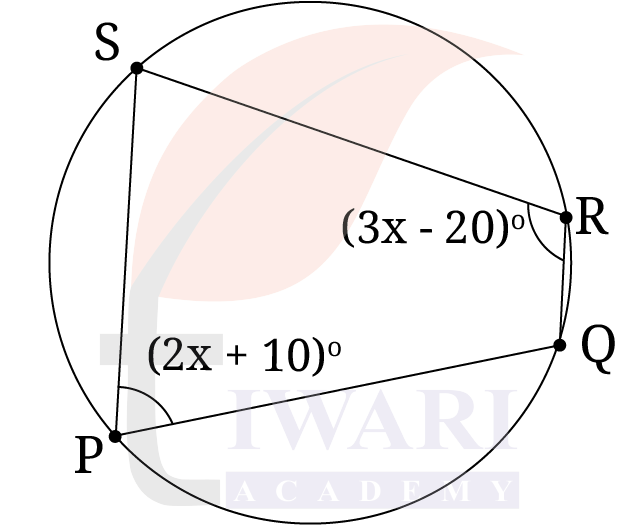
Now,
∠P = 2x + 10 = 2(38) + 10 = 86°
∠R = 3x − 20 = 3(38) − 20 = 94°
Hence, x = 38, ∠P = 86° and ∠R = 94°.
9. The distance of a chord of length 16 cm from the centre of a circle is 6 cm. Find the radius of the circle.
Answer:
Chord length AB = 16 cm
Half chord AM = MB = 8 cm
Distance from centre to chord OM = 6 cm
Let r be the radius.

In the right triangle OAM,
OA² = AM² + OM²
⇒ r² = 8² + 6²
⇒ r² = 64 + 36
⇒ r² = 100
⇒ r = 10 cm
Hence, the radius of the circle is 10 cm.
10. A cyclic quadrilateral has sides 5, 5, 12, 12 units. Find its area.
Answer:
Since the cyclic quadrilateral has sides 5, 5, 12, 12, its semiperimeter is
s = (5 + 5 + 12 + 12)/2
= 34/2
= 17
For a cyclic quadrilateral, area is given by Brahmagupta’s formula:
Area = √[(s − a)(s − b)(s − c)(s − d)]
Substituting the vaues, we have:
Area = √[(17 − 5)(17 − 5)(17 − 12)(17 − 12)]
= √[(12)(12)(5)(5)]
= √3600
= 60
Hence, the area of the cyclic quadrilateral is 60 square units.
11. Consider a cyclic quadrilateral. Without drawing its circumcircle, how can we find out whether the centre of the circumcircle lies inside the quadrilateral or outside? What is the best way of finding out?
Answer:
In a cyclic quadrilateral, we know that opposite angles are supplementary (their sum is 180°).
To find whether the centre of the circumcircle (circumcentre) lies inside or outside, we can observe the angles of the quadrilateral:
If all angles are less than 90° (acute), then the circumcentre lies inside the quadrilateral.
If any one angle is greater than 90° (obtuse), then the circumcentre lies outside the quadrilateral.
Best way: Check the angles of the quadrilateral.
This method is easy and does not require drawing the circumcircle.
So, by just looking at whether the quadrilateral has an obtuse angle or not, we can decide the position of the circumcentre.
12. When two chords intersect, each of them is divided into two line segments. Show that if the intersecting chords are of equal length, then the line segments of one chord are equal to the corresponding line segments of the other chord.
Answer:
Let chords AB and CD intersect at point P inside the circle, and O be the centre.
From the figure, ON ⟂ CD and OM ⟂ AB.
Equal chords ⇒ equal distances from centre
Given: AB = CD …(1)
To Prove: PB = PD and AP = CP.
So, the perpendicular distances from the centre are equal.
So, OM = ON

In ΔOPM and ΔOPN, we have
OP = OP [common side]
OM = ON [Proved above]
∠OMP = ∠ONP = 90° [Perpendiculars]
So, by RHS congruency
ΔOPM ≅ ΔOPN
So, PM = PN [CPCT]…(2)
Now, OM ⟂ AB, so AM = MB [Perpendicular from the centre bisect the chord]
Similarly, ON ⟂ CD, so CN = ND
Since, AB = CD [From (1)]
Therefore, BM = DN [BM = ½ AB and DN = ½ CD]…(3)
Adding (2) and (3), we get
PM + BM = PN + DN
⇒ PB = PD …(4)
Subtracting (4) from (1), we get
AB – PB = CD – PD
⇒ AP = CP
Hence proved.
13. Draw a circle in which a chord of 6 cm length stands at a distance of 3 cm from the centre.
Answer:
Given:
Chord length = 6 cm
Distance from centre to chord = 3 cm
Steps of Construction:
1. Draw a line segment AB = 6 cm.
2. Find the midpoint M of AB.
3. Draw a perpendicular line to AB at M.
4. On this perpendicular, mark a point O such that OM = 3 cm.
5. Join OA or OB.
6. With centre O and radius OA, draw a circle.
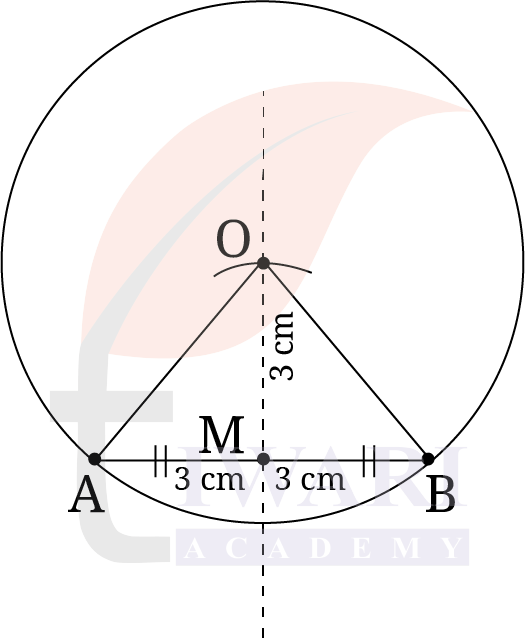
Since OM is perpendicular to AB and passes through its midpoint, AB is a chord of the circle.
Also, AM = 3 cm and OM = 3 cm
So, OA² = OM² + AM²
⇒ OA² = 3² + 3² = 18
⇒ OA = 3√2 cm
Therefore, the required circle has centre O and radius 3√2 cm.
14. Show that rectangle is the only parallelogram that can be inscribed in a circle.
Answer:
Let ABCD be a parallelogram inscribed in a circle.

Since it is a cyclic quadrilateral:
∠A + ∠C = 180°
But in a parallelogram, opposite angles are equal: ∠A = ∠C
Therefore, ∠A + ∠A = 180°
⇒ 2∠A = 180°
⇒ ∠A = 90°
Similarly, all angles are 90°.
Hence, the parallelogram is a rectangle.
Therefore, a rectangle is the only parallelogram that can be inscribed in a circle.
15. Show that if a rectangle is inscribed in a circle, then the point of intersection of its diagonals must lie at the centre of the circle.
Answer:
Let ABCD be a rectangle inscribed in a circle.
Let its diagonals AC and BD intersect at O.
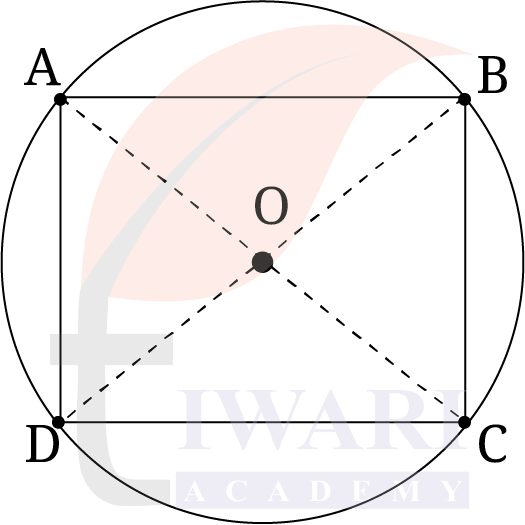
In a rectangle, diagonals are equal and bisect each other.
So, OA = OC and OB = OD
Also, AC = BD
Therefore, OA = OB = OC = OD
This means O is equidistant from all four vertices A, B, C and D.
The point equidistant from all points on a circle is the centre.
Hence, the point of intersection of the diagonals is the centre of the circle.
16. Consider all chords of a circle of a fixed length. What is the shape formed by the midpoints of all these chords?
Answer:
Let the radius of the circle be r.
Let each chord have fixed length x.
The perpendicular from the centre to a chord bisects the chord.
So, for every chord, half chord = x/2.
Let d be the distance of the midpoint of the chord from the centre.
Using Pythagoras theorem:
r² = d² + (x/2)²
So, d² = r² − (x/2)²
Since r and x are fixed, d is also fixed.
Therefore, every midpoint is at the same distance from the centre.
Hence, the midpoints form a circle with the same centre as the original circle.
17. In a circle with centre O, chords AB and AC are congruent. Explain why this statement is true: “The centre of the circle lies on the angle bisector of ∠BAC”.
Answer:
Given: AB = AC
Join OA, OB and OC.

In △AOB and △AOC, we have
Now, OB = OC [Both are radii]
OA = OA [Common]
AB = AC [Given]
Therefore, by SSS congruence
△AOB ≅ △AOC
So, ∠BAO = ∠OAC
Hence, AO bisects ∠BAC.
Therefore, the centre O lies on the angle bisector of ∠BAC.
18. Two parallel chords of lengths 10 cm and 24 cm are on the same side of the centre of a circle. The distance between the chords is 7 cm. Find the radius of the circle.
Answer:
Let the radius be r. So, OA = OC = r.
For chord AB of length 10 cm:
Half of chord AB = 5 cm
Let its distance from centre OM = d₁
For chord CD of length 24 cm:
Half of chord CD = 12 cm
Let its distance from centre ON = d₂
Since the longer chord is closer to the centre:
d₁ − d₂ = 7 …(1)
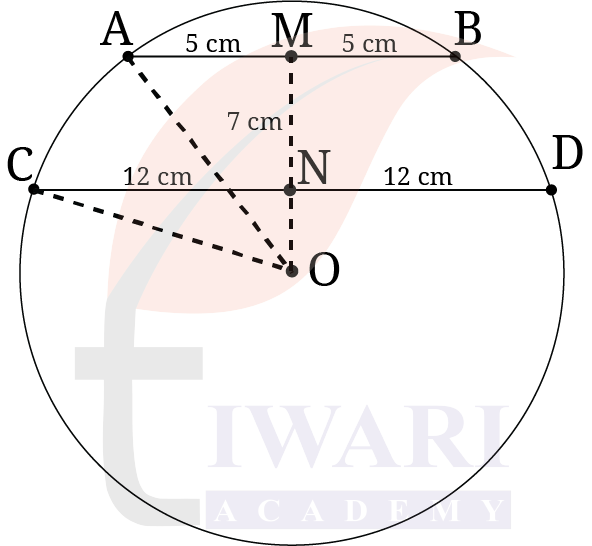
In triangle OAM, using Pythagoras theorem, we have
OA² = OM² + AM²
⇒ r² = d₁² + 5²
⇒ r² = d₁² + 25
In triangle OCN, using Pythagoras theorem, we have
OC² = ON² + CN²
⇒ r² = d₂² + 12²
⇒ r² = d₂² + 144
So, d₁² + 25 = d₂² + 144
⇒ d₁² − d₂² = 119
⇒ (d₁ − d₂)(d₁ + d₂) = 119
⇒ 7(d₁ + d₂) = 119 [Since d₁ − d₂ = 7]
⇒ d₁ + d₂ = 17 …(2)
Now solving equations (1) and (2), we have
2d₁ = 24
⇒ d₁ = 12
Then d₂ = 5
Now, r² = d₁² + 5²
= 12² + 5²
= 144 + 25
= 169
⇒ r = 13 cm
Therefore, the radius of the circle is 13 cm.
19. A regular hexagon is inscribed in a circle of radius r. Find the length of the sides of the hexagon and the distance of each side from the centre of the circle.
Answer:
A regular hexagon divides the circle into 6 equal central angles.
Each central angle = 360°/6 = 60°
Let AB be one side of the hexagon and O be the centre.
Then OA = OB = r and ∠AOB = 60°
So, △AOB is an equilateral triangle.
Therefore, AB = r
Thus, each side of the regular hexagon is r.

Now find the distance of each side from the centre.
Let OM be perpendicular to AB.
Since △AOB is equilateral: AM = AB/2 = r/2
In right triangle OMA:
OA² = OM² + AM²
⇒ r² = OM² + (r/2)²
⇒ OM² = r² − r²/4
⇒ OM² = 3r²/4
⇒ OM = (√3/2)r
Therefore, Side length of hexagon = r
Distance of each side from centre = (√3/2)r.
20. A quadrilateral MNOP is inscribed in a circle. If MN is a diameter, what can you say about ∠MOP and ∠MNP? Explain your reasoning.
Answer:
Since MNOP is inscribed in a circle, it is a cyclic quadrilateral.
So, opposite angles of a cyclic quadrilateral are supplementary.
Therefore,
∠MOP + ∠MNP = 180°
Hence, ∠MOP and ∠MNP are supplementary angles.

21. Let ABCD be a cyclic quadrilateral. Explain why the exterior angle at any vertex is equal to the interior opposite angle (e.g., ∠CDE = ∠ABC, where E is a point on the extension of side CD).
Answer:
In cyclic quadrilateral ABCD:
∠ABC + ∠ADC = 180° …(1)
Since E lies on the extension of CD,
∠ADC and ∠CDE form a linear pair.
So, ∠ADC + ∠CDE = 180° …(2)

From (1) and (2), we have
∠ABC + ∠ADC = ∠ADC + ∠CDE
Subtracting ∠ADC from both sides, we get
∠ABC = ∠CDE
Therefore, the exterior angle of a cyclic quadrilateral is equal to the interior opposite angle.
Hence proved.
22. There is no chord of a circle that is longer than its diameter. How do you justify this statement?
Answer:
A chord is a line segment joining two points on a circle.
The longest chord passes through the centre of the circle.
Such a chord is called the diameter.
For any other chord, its perpendicular distance from the centre is greater than 0.
If radius = r and distance of chord from centre = d, then:
Chord length = 2√(r² − d²)
Since d > 0 for any chord not passing through the centre,
r² − d² < r²
So, 2√(r² − d²) < 2r
But diameter = 2r.
Therefore, every chord other than the diameter is shorter than the diameter.
Hence, no chord of a circle is longer than its diameter.
23. Let A be any point within a given circle with centre O. Show that the shortest chord of the circle that passes through point A is the one that is perpendicular to OA.
Answer:
Let the circle have centre O and let A be a point inside it.
Any chord passing through A will have some perpendicular distance from the centre O.
We know that the farther a chord is from the centre, the shorter it is.
So, the shortest chord through A will be the chord whose distance from O is maximum.
Among all lines passing through A, the perpendicular distance from O to the line is greatest when the line is perpendicular to OA.

Therefore, the chord through A that is perpendicular to OA is farthest from the centre.
Hence, it is the shortest chord passing through A.
Therefore, the shortest chord through A is the one perpendicular to OA.
Hence proved.
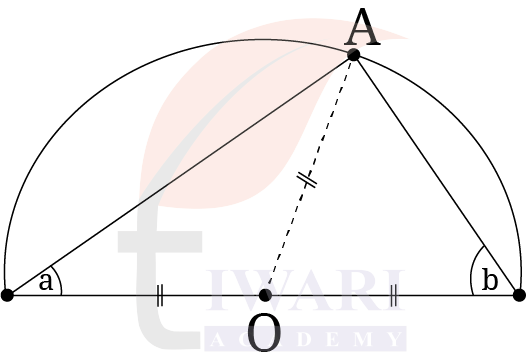
24. How would you use the following figure to justify the statement that the angle in a semicircle is 90°?
Answer:
Let the diameter be BC and O be the centre of the circle.
Point A lies on the semicircle.
Join OA.
Since O is the centre:
OA = OB = OC
because all are radii of the same circle.
So, △AOB is isosceles and △AOC is isosceles.
Let: ∠ABO = a and ∠ACO = b
Then: ∠BAO = a and ∠OAC = b [Since ∠ABO = ∠BAO and ∠ACO = ∠OAC]
Therefore, ∠BAC = a + b
Now, in triangle ABC:
∠ABC + ∠BAC + ∠ACB = 180°
So, a + (a + b) + b = 180°
⇒ 2a + 2b = 180°
⇒ 2(a + b) = 180°
⇒ a + b = 90°
But, ∠BAC = a + b
Therefore, ∠BAC = 90°
Hence, the angle in a semicircle is 90°.
25. In a circle, two chords CC’ and DD’ are drawn perpendicular to a diameter AB. Prove that the segment MM’ joining the midpoints of the chords CD and C’D’ is perpendicular to AB.
Answer:
Let AB be the diameter of the circle.
Since chords CC’ and DD’ are perpendicular to AB, the points C and C’ are symmetric about AB.
Similarly, D and D’ are also symmetric about AB.
Now, let M be the midpoint of CD and M’ be the midpoint of C’D’.
Since C corresponds to C’ and D corresponds to D’ by reflection in AB,
the midpoint of CD corresponds to the midpoint of C’D’.
Therefore, M and M’ are symmetric about AB.
The line joining two points that are symmetric about a line is perpendicular to that line.
Hence, MM’ ⟂ AB
Therefore, the segment joining the midpoints of CD and C’D’ is perpendicular to AB.
Hence proved.
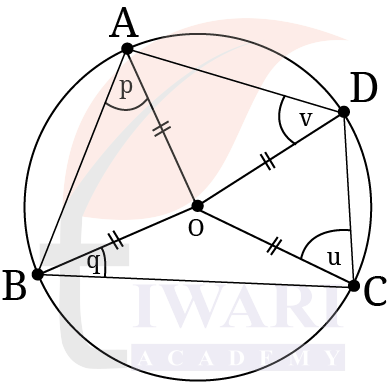
26. How would you use the following figure to justify the statement that the sum of the opposite angles of a cyclic quadrilateral is 180°?
Answer:
Let ABCD be a cyclic quadrilateral with centre O.
Join OA, OB, OC and OD.
Since OA, OB, OC and OD are radii of the same circle:
OA = OB = OC = OD
So the triangles formed with the centre are isosceles triangles.
From the figure:
Let ∠OAB = p and ∠OBA = q.
Let ∠ODC = v and ∠OCD = u.
Using the angle-sum property in the triangles around the centre, the full angle around O is: 360°
The angle at the centre corresponding to the arcs gives twice the angle at the circumference.
Thus: ∠A + ∠C = 180°
Similarly: ∠B + ∠D = 180°
Therefore, the sum of opposite angles of a cyclic quadrilateral is 180°.
Hence proved.
Quick Reference – All 12 Theorems in Class 9 Ganita Manjari Chapter 5
| Theorem | Statement |
|---|---|
| Theorem 1 | There is a unique circle passing through three non-collinear points. |
| Theorem 2 | Equal chords of a circle subtend equal angles at the centre. |
| Theorem 3 | Chords subtending equal angles at the centre are equal. |
| Theorem 4 | The line joining the centre to the midpoint of a chord is perpendicular to the chord. |
| Theorem 5 | The perpendicular from the centre to a chord bisects the chord. |
| Theorem 6 | Chords of equal length are equidistant from the centre. |
| Theorem 7 | Chords equidistant from the centre have equal length. |
| Theorem 8 | The longer of two chords is closer to the centre. |
| Theorem 9 | The angle subtended by an arc at the centre is double the angle at any point on the remaining circle. |
| Corollary | The angle subtended by a diameter at any point on the circle is 90°. |
| Theorem 10 | If a segment subtends equal angles at two points on the same side, all four points are concyclic. |
| Theorem 11 | Opposite angles of a cyclic quadrilateral sum to 180°. |
| Theorem 12 | If opposite angles of a quadrilateral sum to 180°, it is cyclic. |
Important Theorems Explained Simply
- Theorem 9 (Central Angle = Double Inscribed Angle) is the single most important result in this chapter. It states that if you pick any arc of a circle, the angle it creates at the centre is exactly double the angle it creates at any point on the remaining circle. The proof uses the exterior angle theorem and the isosceles triangle property (since all radii are equal). The famous corollary – that any angle in a semicircle is 90° – follows directly from this, because a diameter subtends a 180° angle at the centre, making the inscribed angle exactly 90°.
- Theorem 11 (Cyclic Quadrilateral) states that opposite angles of any cyclic quadrilateral always add up to 180°. The proof uses Theorem 9 twice – once for each arc — and the fact that together both arcs make a complete 360° rotation at the centre, so their half-angles sum to 180°.
- Theorem 1 (Unique Circumcircle) establishes that three non-collinear points always determine exactly one circle. The proof is elegant: the centre must be equidistant from all three points, so it must lie on the perpendicular bisector of each pair. Two non-parallel lines meet at exactly one point, giving a unique centre.
Key Definitions in Ganita Manjari Chapter 5 – Circles
- Circle: The set of all points on a plane that are equidistant from a given point. That given point is the centre and the fixed distance is the radius.
- Locus: The set of all points satisfying a given condition. A circle is the locus of points equidistant from a fixed centre point.
- Chord: A line segment whose both endpoints lie on the circle.
- Diameter: A chord that passes through the centre of the circle. It is the longest possible chord and equals twice the radius.
- Arc: A connected portion of a circle defined by two endpoints. The larger portion is the major arc and the smaller is the minor arc.
- Circumcircle: The unique circle passing through all three vertices of a triangle. Its centre is called the circumcentre, which lies at the intersection of the perpendicular bisectors of the triangle’s sides.
- Concyclic Points: Points that all lie on the same circle.
- Cyclic Quadrilateral: A quadrilateral whose four vertices all lie on a single circle. Its opposite angles always add up to 180°.
Chapter 5 Ganita Manjari – Exercise-Wise Overview
- Exercise Set 5.1: Drawing circumcircles of triangles with given dimensions; determining whether circumcentre lies inside or outside the triangle; finding minimum radius through two points.
- Exercise Set 5.2: Proving that the triangle formed by a chord and the centre is isosceles; proving congruence of two such triangles with equal base lengths.
- Exercise Set 5.3: Proving the converse of Theorem 4 (perpendicular from centre bisects chord); inscribed isosceles triangle altitude through centre; distance between midpoints of parallel chords.
- Exercise Set 5.4: Using the Baudhāyana–Pythagoras theorem to prove Theorem 6; showing AB = GF when equidistant chords are given.
- Exercise Set 5.5: Finding chord length given radius and perpendicular distance; deriving the general chord length formula 2√(r² − d²).
- Exercise Set 5.6: Finding chord length from central angle and radius; angles in the same segment; finding unknown angles in circle diagrams.
- End-of-Chapter Exercises: 26 questions covering all chapter theorems, cyclic quadrilateral angle problems, chord-distance calculations and advanced starred (*) proofs on rectangles inscribed in circles, intersecting chords and shortest chord through a point.
Starred (*) Advanced Questions – For High Achievers
Chapter 5 contains several starred questions in the end-of-chapter exercises that go well beyond standard exam expectation:
- Q12: When two chords of equal length intersect, prove that corresponding sub-segments are equal.
- Q14: Prove that a rectangle is the only parallelogram that can be inscribed in a circle.
- Q15: Prove that if a rectangle is inscribed in a circle, its diagonals intersect at the centre.
- Q16: Determine the shape formed by the midpoints of all chords of a fixed length in a given circle.
- Q19: A regular hexagon is inscribed in a circle of radius r – find the side length and the distance of each side from the centre.
- Q23: Show that the shortest chord through any interior point of a circle is the one perpendicular to the line joining that point to the centre.
- Q25: Two chords are drawn perpendicular to a diameter – prove that the segment joining the midpoints of two related chords is also perpendicular to the diameter.
These questions are excellent for NTSE, Mathematical Olympiad and Class 10 advanced preparation.
Frequently Asked Questions (FAQs) – Class 9 Maths Ganita Manjari Chapter 5
Is Class 9 Maths Ganita Manjari Chapter 5 easy or difficult?
It sits in the moderate-to-difficult range. The early sections on definitions, symmetry and basic chord properties are quite approachable. The difficulty increases significantly from Section 5.7 onward, where Theorem 9 on arc angles requires careful multi-step reasoning.
The cyclic quadrilateral theorems in Section 5.8 are conceptually demanding but become manageable once Theorem 9 is fully understood. Students who are comfortable with triangle congruence from earlier chapters will find the proof structure of this chapter much easier to follow.
How many theorems are in Class 9 Ganita Manjari Circles Chapter 5 and do I need to memorise all of them?
There are 12 theorems plus one important corollary (angle in a semicircle is 90°). You do not need to memorise the full word-for-word proofs, but you must understand the logic of each proof well enough to reproduce it in your own words.
More importantly, you must remember the statement of every theorem clearly — because exam questions will ask you to apply them to find unknown angles, prove chord relationships or identify cyclic quadrilaterals.
The Chapter Summary on the last page of Chapter 5 lists all key results and is the best revision tool in the book.
Is Class 9 Ganita Manjari Chapter 5 I’m Up and Down Round and Round difficult for average students?
It is genuinely more demanding than earlier geometry chapters because it requires students to think in terms of formal mathematical proof, not just calculation. The challenge is two-fold — understanding why each theorem is true, and then being able to apply the correct theorem to an unseen problem.
Students who struggle with abstract reasoning often find the arc angle theorems in Section 5.7 particularly confusing. However, the Ganita Manjari textbook uses a “Given, To Show, Why is this true?” format throughout that helps structure thinking. Regular drawing of diagrams alongside reading — not just reading alone — makes a significant difference for average learners.
How much time does Class 9 Maths Ganita Manjari Chapter 5 Circles take to complete?
For thorough preparation covering all six exercise sets and the end-of-chapter exercises, plan for 12 to 15 days. The chapter is longer and proof-heavier than Chapter 4. Sections 5.3, 5.7 and 5.8 each deserve at least two days — one for understanding the theorems and one for attempting exercises.
Daily sessions of 35–45 minutes with diagram practice work far better than long occasional sittings, because spatial reasoning for circle geometry builds gradually through repeated drawing. If your child has a test approaching, prioritise Theorems 1, 9, 11 and 12 along with their direct applications in Exercise Sets 5.1 and 5.6 — these cover the majority of exam-likely questions.
How to solve Class 9 Maths Ganita Manjari Chapter 5 in one day?
One day works only for revision, not first-time learning. Start with the Chapter Summary — read all theorem statements carefully. Then work through one solved example or activity from Sections 5.3, 5.6, and 5.7 as these carry the highest exam weight.
Attempt the non-starred end-of-chapter questions focusing on Q1, Q2, Q3, Q7, Q8, and Q9 — these cover the most frequently tested skills. Skip starred questions for now. For a student encountering this chapter for the first time, a realistic minimum is five to six focused days with daily revision of theorem statements.
Can the old NCERT Maths textbook help my child study Ganita Manjari Class 9 Chapter 5 Circles?
Partially. The old NCERT Class 9 Maths book also covers circles and includes theorems on chord properties, equal chords and cyclic quadrilaterals. For those overlapping topics, the old textbook can serve as a supplementary practice resource.
However, Ganita Manjari Chapter 5 approaches proofs differently — using the “Why is this true?” reasoning format, activity-based discovery and integration of the Baudhāyana–Pythagoras theorem as a primary tool.
The concyclicity discussion in Section 5.8 and several starred end-of-chapter problems go beyond the scope of the old textbook. For these sections, the Ganita Manjari book itself is the only reliable resource aligned with the 2026-27 curriculum.
What is the best classroom approach to teach theorems in Ganita Manjari Class 9 Chapter 5?
The most effective approach follows the chapter’s own “Given, To Show, Why is this true?” structure explicitly in every lesson. Before stating a theorem, run the corresponding activity — fold a paper circle for chord properties, measure inscribed angles for Theorem 9, or use tracing paper rotation for the equidistant chord result. This ensures students experience the result before they see its proof.
For Theorem 9 specifically, which has two cases depending on where the diameter extension falls, walk through both figures (Figs. 5.21 and 5.22) in the same lesson rather than treating the second case as optional. Students who see only one case frequently make errors in exams when the second configuration appears.
Which topics in Ganita Manjari Grade 9 Circles Chapter 5 need the most classroom time?
Three sections consistently need more time than a surface reading suggests. Section 5.7 on Theorem 9 requires at least two full periods — one to establish the central angle equals double inscribed angle result and a separate period for the semicircle corollary and its applications in Exercise Set 5.6. Section 5.8 on cyclic quadrilaterals needs careful treatment of Theorems 11 and 12 together with their converses, as students frequently confuse which direction the logic runs.
Section 5.3 on circumcircles and the position of the circumcentre for different triangle types is often rushed but provides essential geometric intuition that supports everything that follows. The three construction exercises in Exercise Set 5.1 are worth doing as in-class activities, not homework, as they make the circumcentre concept concrete before the formal theorem is introduced.
How should teachers connect Class 9 Ganita Manjari Maths Chapter 5 to Class 10 topics and higher mathematics?
A brief forward-connection conversation at the chapter’s end significantly motivates students who wonder why they are learning circle proofs. The most direct link is to Class 10 geometry, where tangents to circles, the tangent-chord angle theorem and the alternate segment theorem all build on Theorems 9 and 11 from this chapter.
The cyclic quadrilateral property (opposite angles summing to 180°) reappears in trigonometry and complex number geometry in Classes 11 and 12. For students interested in competitive mathematics, Theorems 10 and 12 — the concyclicity conditions — are foundational for NTSE geometry sections and Olympiad circle problems. Starred questions Q14 and Q15, which prove that only rectangles can be inscribed in circles and that their diagonals meet at the centre, introduce the kind of elegant constraint-based reasoning that characterises higher mathematical thinking.
Framing Chapter 5 as the beginning of circle geometry rather than its entirety gives students the right perspective and genuine motivation to master it fully.