


by Tiwari Academy Team
NCERT Class 9 Maths Ganita Manjari Chapter 1 Orienting Yourself The Use of Coordinates Solutions in English and Hindi Medium – Exercise Set 1.1, 1.2 and End of Chapter Exercises for session 2026-27. Chapter 1 Orienting Yourself: The Use of Coordinates is the opening chapter of the new NCERT mathematics textbook Ganita Manjari, Grade 9, Part I, introduced for the academic session 2026-27. Unlike the older textbooks, this chapter takes a story-driven approach – connecting coordinate geometry to real-life navigation and India’s rich mathematical heritage before introducing formal concepts.
Class 9 Ganita Manjari Chapter 1 Quick Links:
Ganita Manjari chapter 1 traces how coordinate thinking evolved from the grid-based city planning of the Sindhu-Sarasvatī Civilisation to the works of Baudhāyana, Āryabhaṭa and Brahmagupta, establishing that the foundations of the Cartesian plane were deeply rooted in Bhārat long before Descartes formalised them in 1637 CE. Concepts are introduced through the relatable story of Reiaan and his sister Shalini, who uses a tactile grid to help him navigate their new room – making the chapter inclusive and engaging for every learner.
The chapter formally covers the 2-D Cartesian Coordinate System (axes, origin, quadrants, plotting points) and the Distance Formula derived using the Baudhāyana–Pythagoras Theorem. It concludes with a rich set of exercises – including starred (★) problems on midpoints, collinearity, circles and city-grid design – making it one of the most contextually grounded chapters in the new NCERT curriculum.
NCERT Class 9 Maths Ganita Manjari Chapter 1 Solutions
Class 9 Maths Ganita Manjari Chapter 1 Exercise Set 1.1 Solutions
Exercise Set 1.1
Fig. 1.3 shows Reiaan’s room with points OABC marking its corners. The x- and y-axes are marked in the figure. Point O is the origin.
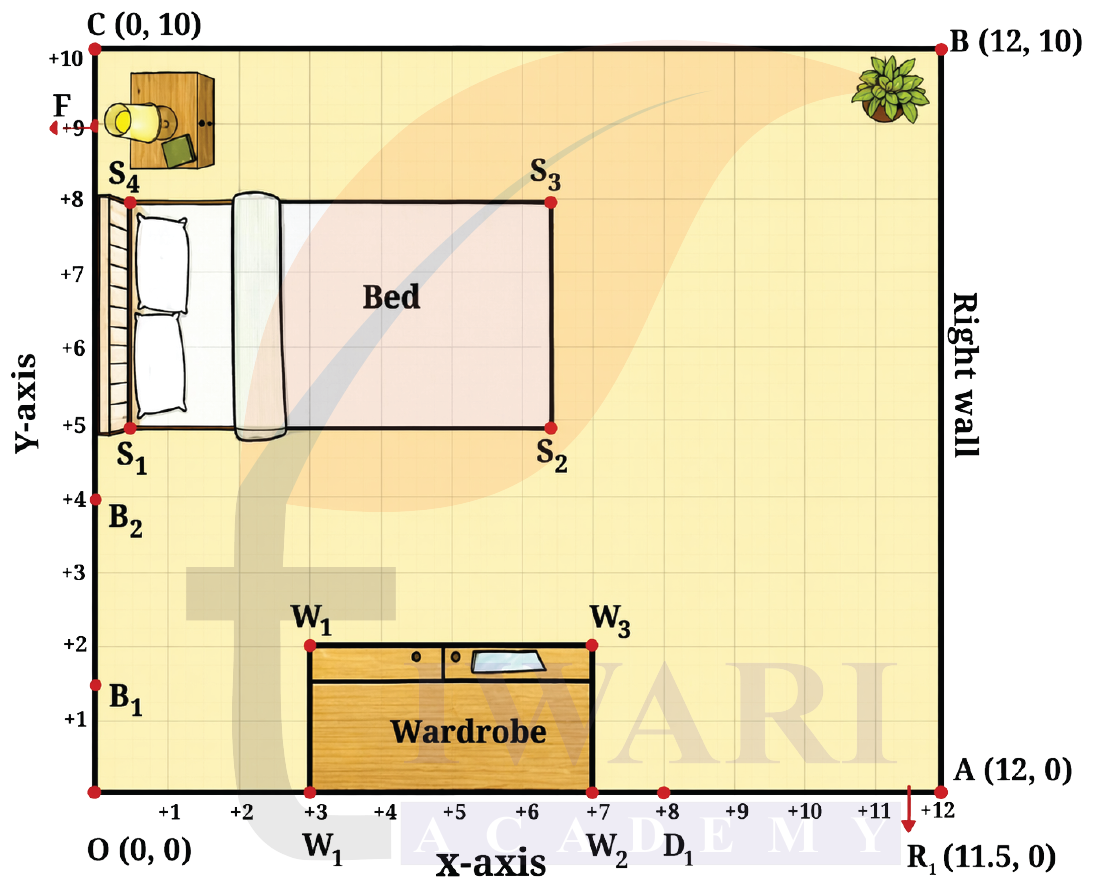
Referring to Fig. 1.3, Answer the following questions:
(i) If D₁R₁ represents the door to Reiaan’s room, how far is the door from the left wall (the y-axis) of the room? How far is the door from the x-axis?
Answer:
The room door lies on the x-axis, so its distance from the x-axis = 0 units.
From the figure,
D₁ = (8, 0) and R₁ = (11.5, 0).
So the door begins 8 units from the y-axis.
(ii) What are the coordinates of D₁?
Answer:
The coordinates of D₁ are (8, 0).
(iii) If R₁ is the point (11.5, 0), how wide is the door? Do you think this is a comfortable width for the room door? If a person in a wheelchair wants to enter the room, will she/he be able to do so easily?
Answer:
Coordinates of D₁ = (8, 0) and R₁ = (11.5, 0).
So, the width of the door
= distance between D₁ and R₁
= 11.5 – 8
= 3.5 units
- If the unit represents feet, then 3.5 ft ≈ 42 inches, which is quite comfortable for a room door.
- Standard residential doors are usually 30–36 inches wide, so this is actually slightly wider than average, which is good.
For wheelchair accessibility:
- A wheelchair typically needs at least 32 inches (~2.7 ft) clear width.
- Since 3.5 ft > 2.7 ft, the door is wide enough.
So, we can say yes, this door width is comfortable and a person using a wheelchair should be able to enter easily without difficulty.
(iv) If B₁ (0, 1.5) and B₂ (0, 4) represent the ends of the bathroom door, is the bathroom door narrower or wider than the room door?
Answer:
Coordinates of B₁ = (0, 1.5) and B₂ = (0, 4).
So, the width of the bathroom door
= distance between B₁ and B₂
= 4 – 1.5 = 2.5 units
Since 2.5 < 3.5, the bathroom door is narrower than the room door.
Class 9 Maths Ganita Manjari Chapter 1 Exercise Set 1.2 Solutions
Exercise Set 1.2
On a graph sheet, mark the x-axis and y-axis and the origin O. Mark points from (-7, 0) to (13, 0) on the x-axis and from (0, – 15) to (0, 12) on the y-axis. (Use the scale 1 cm = 1 unit.) Using Fig. 1.5, answer the given questions.
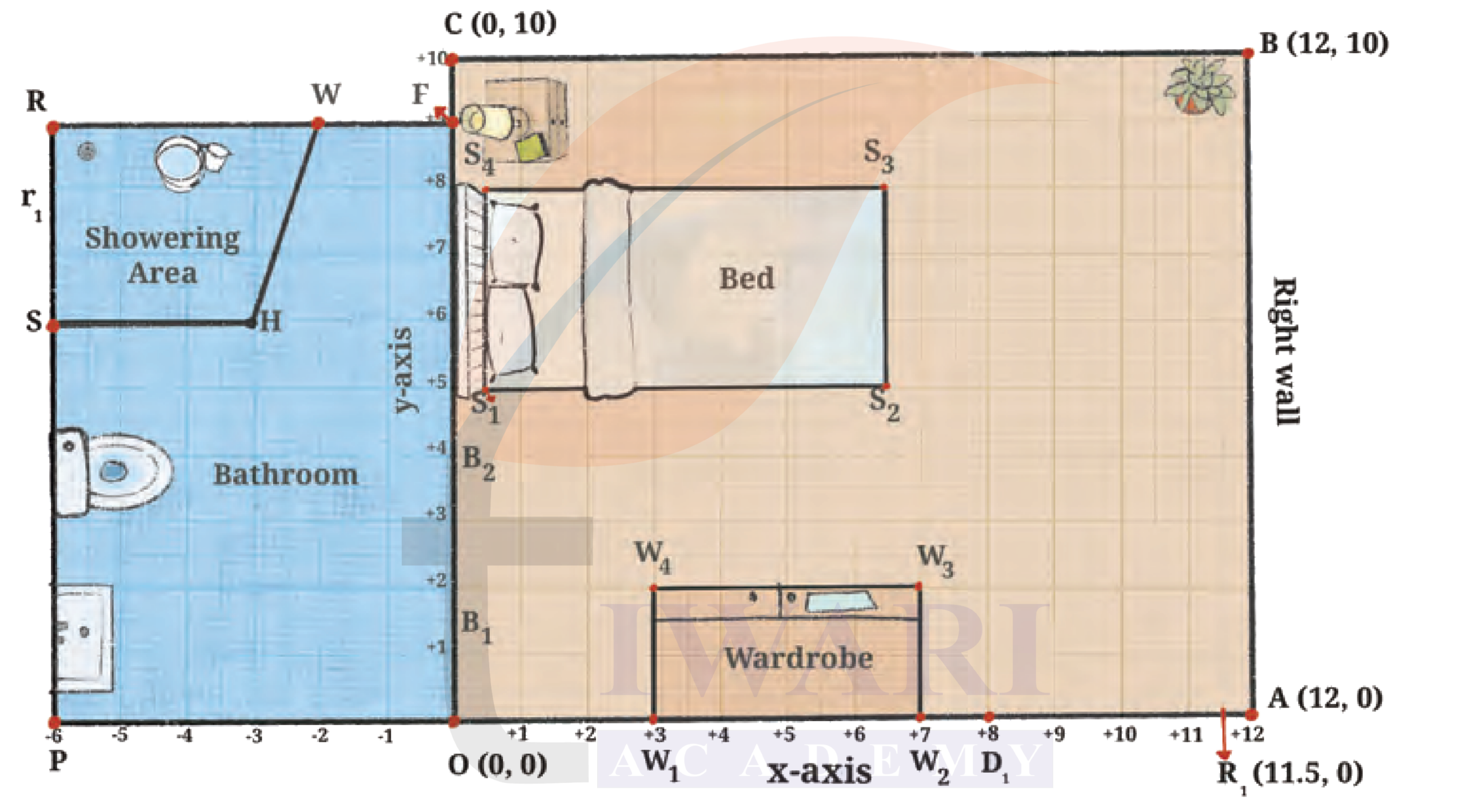
1. Place Reiaan’s rectangular study table with three of its feet at the points (8, 9), (11, 9) and (11, 7).
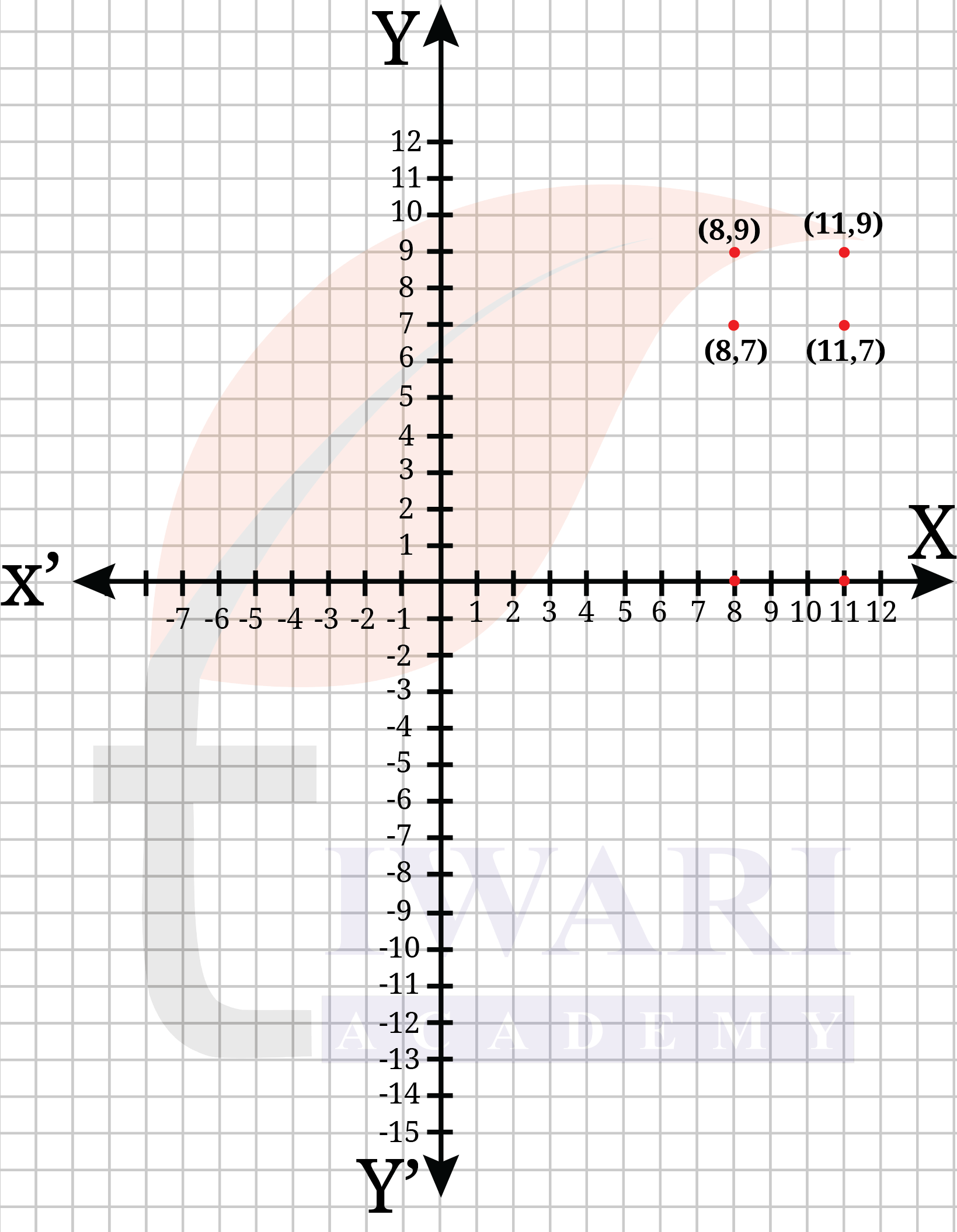
(i) Where will the fourth foot of the table be?
Answers:
The given three points form three corners of a rectangle:
A = (8, 9)
B = (11, 9)
C = (11, 7)
To complete the rectangle, the fourth point must have:
– same x-coordinate as A → 8
– same y-coordinate as C → 7
Therefore, the fourth foot is at: (8, 7)
(ii) Is this a good spot for the table?
Answers:
Yes, this is a good spot because:
- The table is placed neatly inside the room.
- It does not block doors or pathways.
- It is positioned near the wall, which is practical for study.
(iii) What is the width of the table? The length? Can you make out the height of the table?
Answers:
Width:
Distance between (8, 9) and (11, 9)
= 11 − 8 = 3 units
Length:
Distance between (11, 9) and (11, 7)
= 9 − 7 = 2 units
Height:
The height of the table cannot be determined from the given diagram because the figure represents only a top view (2D), not vertical dimensions.
2. If the bathroom door has a hinge at B₁ and opens into the bedroom, will it hit the wardrobe? Are there any changes you would suggest if the door is made wider?
Answer:
From Fig. 1.5:
– B₁ = (0, 1.5)
– B₂ = (0, 4)
So, the bathroom door has width:
= 4 – 1.5
= 2.5 units
If the door is hinged at B₁ and opens into the bedroom, it will sweep an arc of radius 2.5 units from B₁.
Now the wardrobe begins at:
W₁ = (3, 0)
W₄ = (3, 2)
The nearest point of the wardrobe from B₁(0, 1.5) is around x = 3, which is farther than the door width 2.5 units.
Therefore, the bathroom door will not hit the wardrobe.
Suggestion if the door is made wider:
- If the door becomes much wider, it may come close to or hit the wardrobe.
- In that case, the door could be made to open inward into the bathroom, or
- the wardrobe could be shifted slightly to the right or
- the door width could be kept limited for comfortable movement.
3. Look at Reiaan’s bathroom.
(i) What are the coordinates of the four corners O, F, R, and P of the bathroom?
Answers:
From Fig. 1.5:
The coordinates of the four corners O, F, R and P of the bathroom are:
O = (0, 0)
F = (0, 9)
R = (-6, 9)
P = (-6, 0)
(ii) What is the shape of the showering area SHWR in Reiaan’s bathroom? Write the coordinates of the four corners.
Answers:
From the figure:
S = (-6, 6)
H = (-3, 6)
W = (-2, 9)
R = (-6, 9)
Since one pair of opposite sides is parallel, SHWR is a trapezium.
Shape of SHWR = Trapezium
Coordinates of the corners:
S = (-6, 6)
H = (-3, 6)
W = (-2, 9)
R = (-6, 9)
(iii) Mark off a 3 ft × 2 ft space for the washbasin and a 2 ft × 3 ft space for the toilet. Write the coordinates of the corners of these spaces.
Answers:
Washbasin space (3 ft × 2 ft):
Take the rectangle near the bottom-left corner of the bathroom.
Coordinates of Corners:
(-6, 0.5), (-5, 0.5), (-5, 2) and (-6, 2)
Toilet space (2 ft × 3 ft):
Take a rectangle above the washbasin.
Coordinates of Corners:
(-6, 3), (-4.5, 3), (-4.5, 4) and (-6, 4).
4. Other rooms in the house:
(i) Reiaan’s room door leads from the dining room which has length 18 ft and width 15 ft. The length of the dining room extends from point P to point A. Sketch the dining room and mark the coordinates of its corners.
Answers:
From Fig. 1.5:
Coordinates of P = (-6, 0)
Coordinates of A = (12, 0)
So, the length of PA = 12 – (-6) = 18 ft, which matches the given length.
If the dining room is 15 ft wide and lies below PA, then its upper side is PA and it extends downward 15 units.
Hence the coordinates of four corners are:
- P = (-6, 0)
- A = (12, 0)
- Q = (12, -15)
- S = (-6, -15)
The coordinates of the dining room corners are:
(-6, 0), (12, 0), (12, -15), (-6, -15)
(ii) Place a rectangular 5 ft × 3 ft dining table precisely in the centre of the dining room. Write down the coordinates of the feet of the table.
Answers:
The dining room extends:
From x = -6 to x = 12
From y = 0 to y = -15
Centre of the dining room:
x-coordinate of centre = (-6 + 12)/2 = 3
y-coordinate of centre = (0 + (-15))/2 = -7.5
Now place a 5 ft × 3 ft table at the centre.
Taking length = 5 units along the x-axis and width = 3 units along the y-axis:
Half-length = 2.5
Half-width = 1.5
So the coordinates of corners (feet) of the table are:
- (3 – 2.5, -7.5 – 1.5) = (0.5, -9)
- (3 + 2.5, -7.5 – 1.5) = (5.5, -9)
- (3 + 2.5, -7.5 + 1.5) = (5.5, -6)
- (3 – 2.5, -7.5 + 1.5) = (0.5, -6)
The coordinates of the four feet of the dining table are:
(0.5, -9), (5.5, -9), (5.5, -6), (0.5, -6)
Class 9 Maths Manjari Chapter 1 Exercises Solutions
Class 9 Maths Ganita Manjari Chapter 1 End of Chapter Exercise Solutions
End-of-Chapter Exercises
1. What are the x-coordinate and y-coordinate of the point of intersection of the two axes?
Answer:
The x-axis and y-axis intersect at the origin.
Therefore:
The x-coordinate = 0
The y-coordinate = 0
So, the point of intersection is (0, 0).
2. Point W has x-coordinate equal to –5. Can you predict the coordinates of point H which is on the line through W parallel to the y-axis? Which quadrants can H lie in?
Answer:
If point W has x-coordinate –5, then any point on the line through W parallel to the y-axis will also have x-coordinate –5.
Therefore, the coordinates of H will be of the form:
H = (–5, y), where y can be any real number.
Now, depending on the value of y:
- If y > 0, then H lies in Quadrant II.
- If y < 0, then H lies in Quadrant III.
- If y = 0, then H lies on the x-axis.
So, H can lie in:
- Quadrant II
- Quadrant III
- or on the x-axis
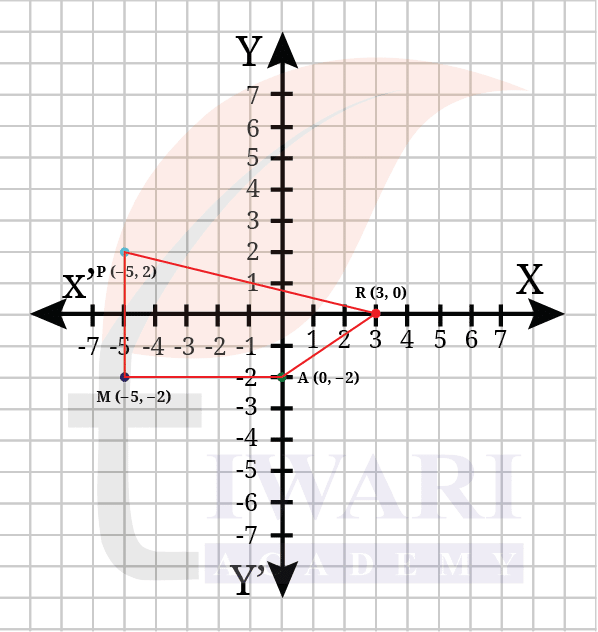
3. Consider the points R (3, 0), A (0, –2), M (–5, –2) and P (–5, 2). If they are joined in the same order, predict:
(i) Two sides of RAMP that are perpendicular to each other.
Answer:
Let us observe:
AM joins A(0, –2) to M(–5, –2), so it is horizontal.
MP joins M(–5, –2) to P(–5, 2), so it is vertical.
A horizontal line and a vertical line are perpendicular.
Therefore:
– AM ⟂ MP
The two perpendicular sides are AM and MP.
(ii) One side of RAMP that is parallel to one of the axes.
Answer:
AM is parallel to the x-axis because both points A and M have the same y-coordinate (–2).
MP is parallel to the y-axis because both points M and P have the same x-coordinate (–5).
So, one side parallel to an axis is:
AM, which is parallel to the x-axis or MP, which is parallel to the y-axis
(iii) Two points that are mirror images of each other in one axis. Which axis will this be?
Now plot the points and verify your predictions.
Answer:
Comparing M(–5, –2) and P(–5, 2):
They have the same x-coordinate.
Their y-coordinates are equal in magnitude but opposite in sign.
So, they are mirror images of each other in the x-axis.
The points M and P are mirror images of each other.
The axis is the x-axis.
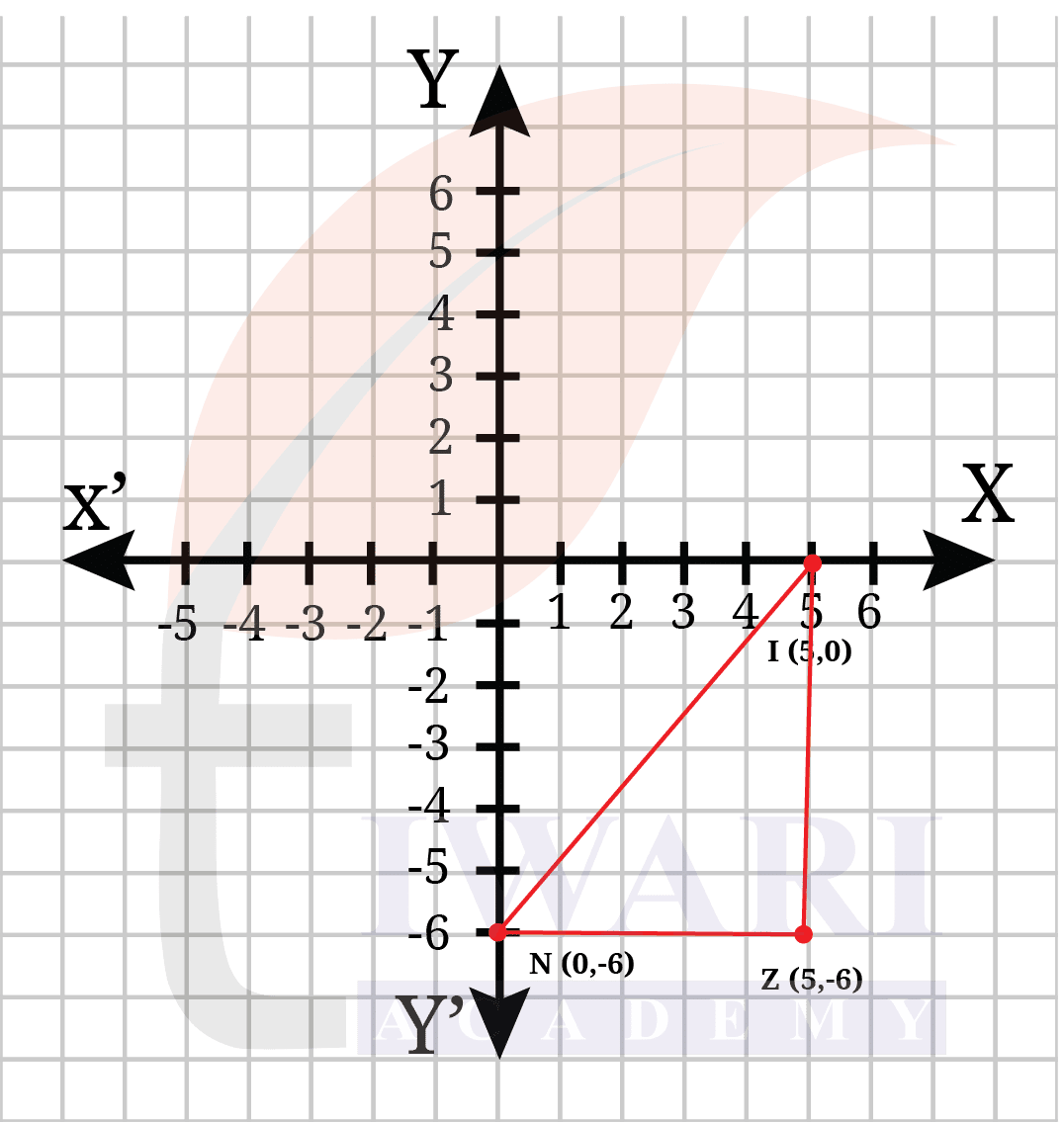
4. Plot point Z (5, –6) on the Cartesian plane. Construct a right-angled triangle IZN and find the lengths of the three sides.
(Comment: Answers may differ from person to person.)
Answer:
Point Z is (5, –6).
To form a right-angled triangle easily, take:
I = (5, 0) on the x-axis
N = (0, –6) on the y-axis
Then triangle IZN is right-angled at Z? Let’s check:
IZ is vertical
ZN is horizontal
So, triangle IZN is right-angled at Z.
Coordinates of the points:
I = (5, 0)
Z = (5, –6)
N = (0, –6)
Now find the lengths of the sides:
1. IZ:
Distance between (5, 0) and (5, –6)
= 0 – (–6) = 6 units
2. ZN:
Distance between (5, –6) and (0, –6)
= 5 – 0 = 5 units
3. IN:
Using distance formula:
IN = √[(5 – 0)² + (0 – (–6))²]
= √(5² + 6²)
= √(25 + 36)
= √61 units
Therefore, one possible right-angled triangle is formed by:
I = (5, 0)
Z = (5, –6)
N = (0, –6)
Lengths of the sides:
IZ = 6 units
ZN = 5 units
IN = √61 units
5. What would a system of coordinates be like if we did not have negative numbers? Would this system allow us to locate all the points on a 2-D plane?
Answer:
If we did not have negative numbers, then coordinates could only be zero or positive.
So:
- On the x-axis, we could mark only the points to the right of the origin.
- On the y-axis, we could mark only the points above the origin.
This means we could locate points only in:
- Quadrant I
- the positive part of the x-axis
- the positive part of the y-axis
- and the origin
We would not be able to locate:
- points in Quadrant II
- points in Quadrant III
- points in Quadrant IV
- points on the negative parts of the axes
Therefore, such a system would not allow us to locate all the points on a 2-D plane.
6. Are the points M (–3, –4), A (0, 0) and G (6, 8) on the same straight line? Suggest a method to check this without plotting and joining the points.
Answer:
To check whether the points M (–3, –4), A (0, 0), and G (6, 8) lie on the same straight line using the Distance formula:
d = √[(x₂ − x₁)² + (y₂ − y₁)²]
MA = √[(0 + 3)² + (0 + 4)²]
= √(3² + 4²)
= √(9 + 16) = √25 = 5
AG = √[(6 − 0)² + (8 − 0)²]
= √(36 + 64)
= √100 = 10
MG = √[(6 + 3)² + (8 + 4)²]
= √(9² + 12²)
= √(81 + 144)
= √225 = 15
Now checking: MA + AG = 5 + 10 = 15 = MG
Since the sum of two distances equals the third, the points M, A and G lie on the same straight line.
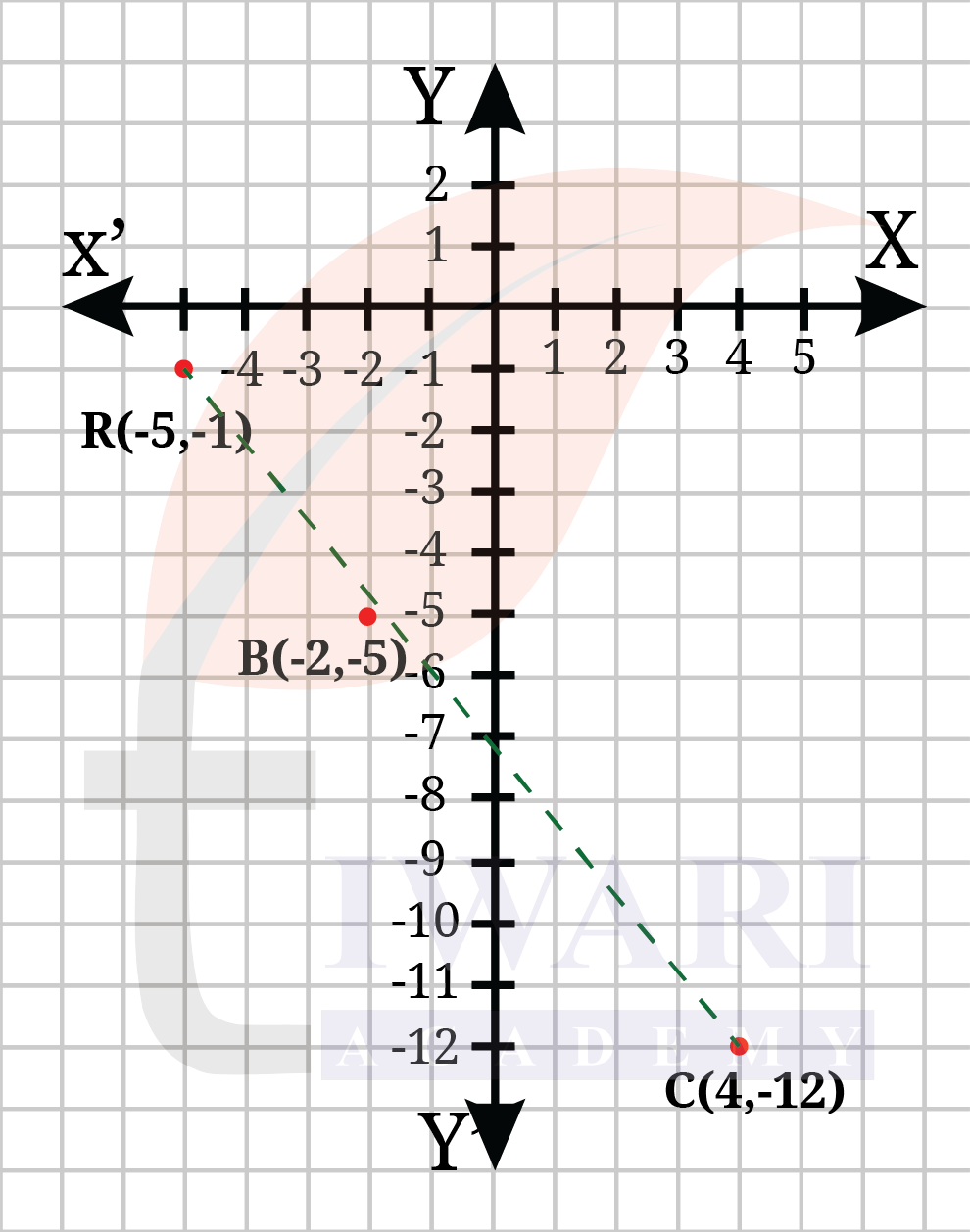
7. Use your method (from Problem 6) to check if the points R (–5, –1), B (–2, –5) and C (4, –12) are on the same straight line.
Now plot both sets of points and check your answers.
Answer:
To check whether the points R (–5, –1), B (–2, –5) and C (4, –12) lie on the same straight line using the distance formula: d = √[(x₂ − x₁)² + (y₂ − y₁)²]
RB = √[(–2 + 5)² + (–5 + 1)²]
= √(3² + (–4)²)
= √(9 + 16) = √25 = 5
BC = √[(4 + 2)² + (–12 + 5)²]
= √(6² + (–7)²)
= √(36 + 49) = √85
RC = √[(4 + 5)² + (–12 + 1)²]
= √(9² + (–11)²)
= √(81 + 121) = √202
Now: RB + BC = 5 + √85 ≠ √202
Since the sum of two distances is not equal to the third, the points R, B and C do not lie on the same straight line.
8. Using the origin as one vertex, plot the vertices of:
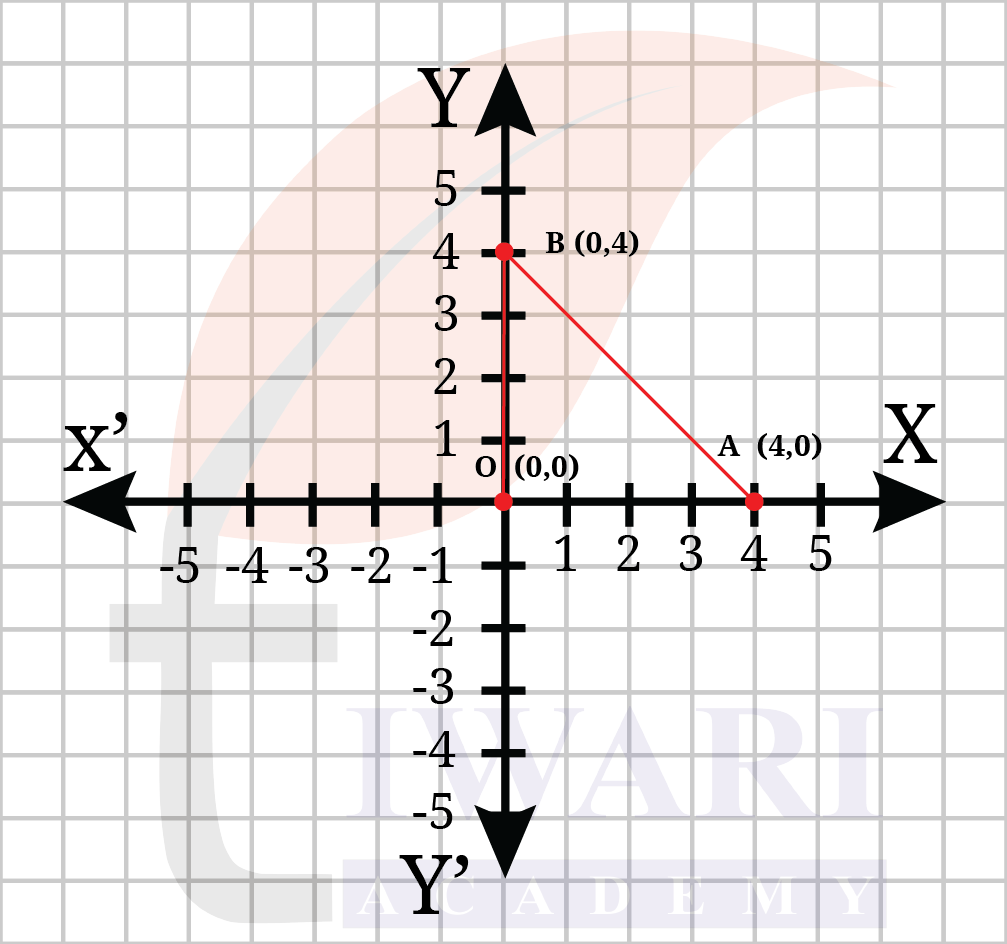
(i) A right-angled isosceles triangle.
Answer:
One possible set of vertices of triangle OAB is:
O = (0, 0)
A = (4, 0)
B = (0, 4)
Because:
OA = 4 units
OB = 4 units
OA is perpendicular to OB
So triangle OAB is a right-angled isosceles triangle.
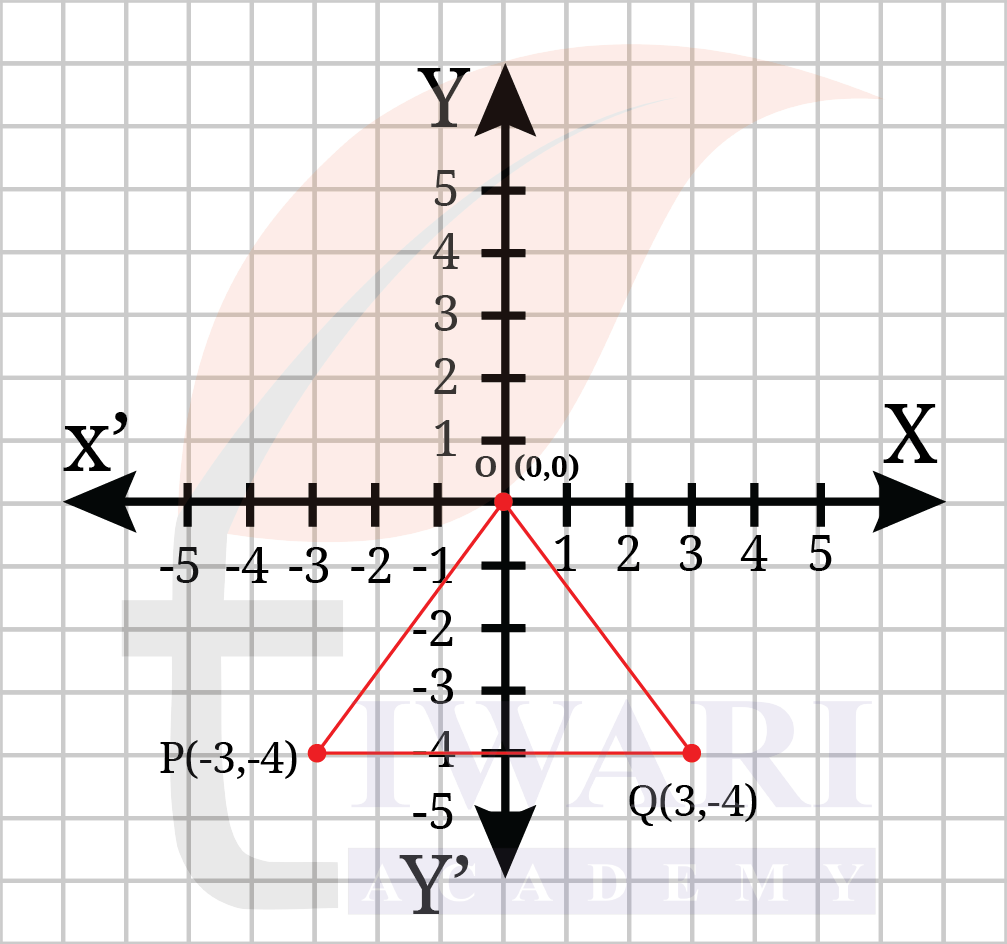
(ii) An isosceles triangle with one vertex in Quadrant III and the other in Quadrant IV.
Answer:
One possible set of vertices is:
O = (0, 0), P = (–3, –4), Q = (3, –4)
Explanation:
P lies in Quadrant III
Q lies in Quadrant IV
OP = OQ = 5 units
So triangle OPQ is an isosceles triangle.
9. The following table shows the coordinates of points S, M and T. In each case, state whether M is the midpoint of segment ST. Justify your answer.
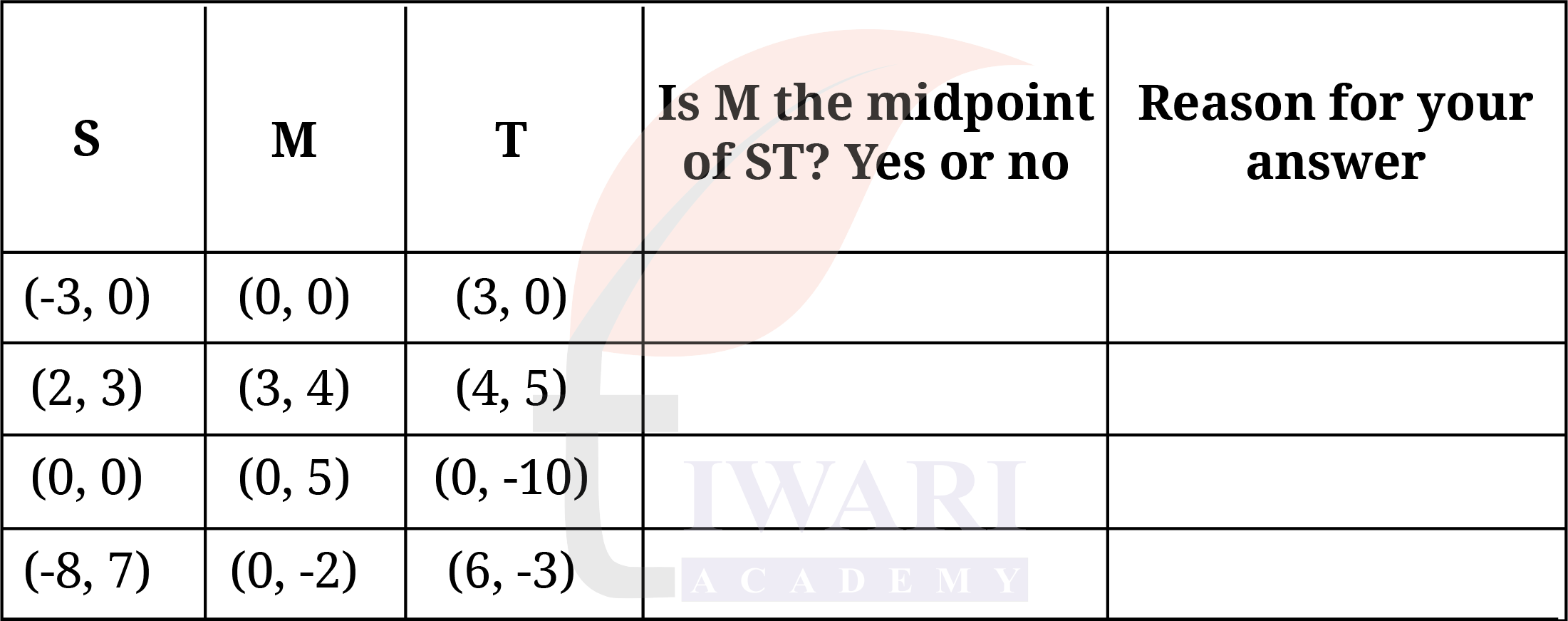
When M is the mid-point of ST, can you find any connection between the coordinates of M, S and T?
Answer:
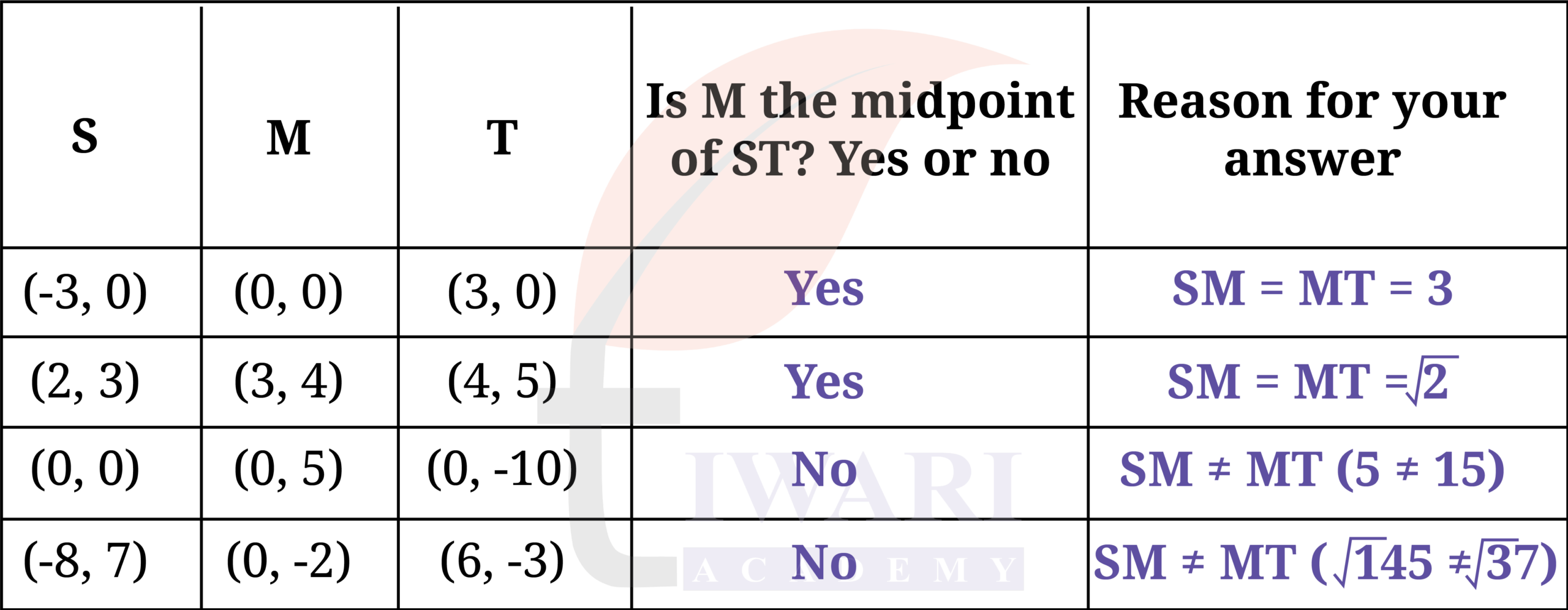
Using Distance Formula: d = √[(x₂−x₁)² + (y₂−y₁)²]
Row 1: S(−3, 0), M(0, 0), T(3, 0)
SM = √[(0−(−3))² + (0−0)²] = √[9 + 0] = 3
MT = √[(3−0)² + (0−0)²] = √[9 + 0] = 3
SM = MT = 3
Yes, M is the midpoint
(ii) Row 2: S(2, 3), M(3, 4), T(4, 5)
SM = √[(3−2)² + (4−3)²] = √[1 + 1] = √2
MT = √[(4−3)² + (5−4)²] = √[1 + 1] = √2
SM = MT = √2
Yes, M is the midpoint
(iii) Row 3: S(0, 0), M(0, 5), T(0, −10)
SM = √[(0−0)² + (5−0)²] = √[0 + 25] = 5
MT = √[(0−0)² + (−10−5)²] = √[0 + 225] = 15
SM ≠ MT (5 ≠ 15)
No, M is NOT the midpoint
(iv) S(−8, 7), M(0, −2), T(6, −3)
SM = √[(0−(−8))² + (−2−7)²] = √[64 + 81] = √145
MT = √[(6−0)² + (−3−(−2))²] = √[36 + 1] = √37
SM ≠ MT (√145 ≠ √37)
No, M is NOT the midpoint.

10. Use the connection you found to find the coordinates of B given that M (–7, 1) is the midpoint of A (3, –4) and B (x, y).
Given: M (–7, 1) is the midpoint of A (3, –4) and B (x, y).
So, using the concept of distance formula, point M will be equidistant from A and B.
Using distance formula: AM = √[(–7 − 3)² + (1 − (–4))²]
= √[(–10)² + (5)²]
= √(100 + 25)
= √125
Now, MB = √[(x + 7)² + (y − 1)²]
Since Distance AM = Distance MB
So, √[(x + 7)² + (y − 1)²] = √125
Squaring both sides:
(x + 7)² + (y − 1)² = 125 …(1)
Also, since M is the midpoint, it lies between A and B, so coordinates of B will be such that M divides AB into two equal parts. From symmetry (or balancing coordinates):
From x-coordinates:
Distance from A to M is –7 − 3 = –10
So from M to B must also be –10
x = –7 − 10 = –17
From y-coordinates:
Distance from A to M is 1 − (–4) = 5
So from M to B must also be 5
y = 1 + 5 = 6
Therefore, the coordinates of B = (–17, 6).
Another Method:
Given:
A = (3, –4)
B = (x, y)
M = (–7, 1)
We use the midpoint formula:
Midpoint M = ((x₁ + x₂)/2, (y₁ + y₂)/2)
So, (3 + x)/2 = –7
⇒ 3 + x = –14
⇒ x = –17
and (–4 + y)/2 = 1
⇒ –4 + y = 2
⇒ y = 6
Therefore, coordinates of B:
B = (–17, 6)
11. Let P, Q be points of trisection of AB, with P closer to A, and Q closer to B.
Using your knowledge of how to find the coordinates of the midpoint of a segment, how would you find the coordinates of P and Q? Do this for the case when the points are A (4, 7) and B (16, –2).
Answer:
To trisect AB, P and Q divides the segment into 3 equal parts.
Given: A (4, 7), B (16, –2)
Let P (x₁, y₁) and Q (x₂, y₂)

Here, P is midpoint of A and Q, so
x₁ = (4 + x₂)/2 …(1)
y₁ = (7 + y₂)/2 …(2)
So, Q is midpoint of P and B, so
x₂ = (x₁ + 16)/2 …(3)
y₂ = (y₁ − 2)/2 …(4)
Solving for x-coordinates, from (1):
x₁ = (4 + x₂)/2 and
From (3): x₂ = (x₁ + 16)/2
Substituting (1) into (3), we get
x₂ = ((4 + x₂)/2 + 16)/2
= (4 + x₂ + 32)/4
= (x₂ + 36)/4
So, 4x₂ = x₂ + 36
⇒ 3x₂ = 36
⇒ x₂ = 12
Then from (1): x₁ = (4 + 12)/2 = 8
Solving for y-coordinates, from (2):
y₁ = (7 + y₂)/2 and
From (4): y₂ = (y₁ − 2)/2
Substituting (2) into (4):
y₂ = ((7 + y₂)/2 − 2)/2
= (7 + y₂ − 4)/4
= (y₂ + 3)/4
So, 4y₂ = y₂ + 3
⇒ 3y₂ = 3
⇒ y₂ = 1
Then from (2): y₁ = (7 + 1)/2 = 4
Therefore, P = (8, 4) and Q = (12, 1).
12. (i) Given the points A (1, –8), B (–4, 7) and C (–7, –4), show that they lie on a circle K whose center is the origin O (0, 0). What is the radius of circle K?
Answer:
Distance OA:
= √(1² + (–8)²)
= √(1 + 64)
= √65
Distance OB:
= √((–4)² + 7²)
= √(16 + 49)
= √65
Distance OC:
= √((–7)² + (–4)²)
= √(49 + 16)
= √65
Since all three points are at the same distance from origin, they lie on a circle centred at (0, 0).
Radius = √65
Points A, B and C lie on circle K with center (0, 0) and radius √65.
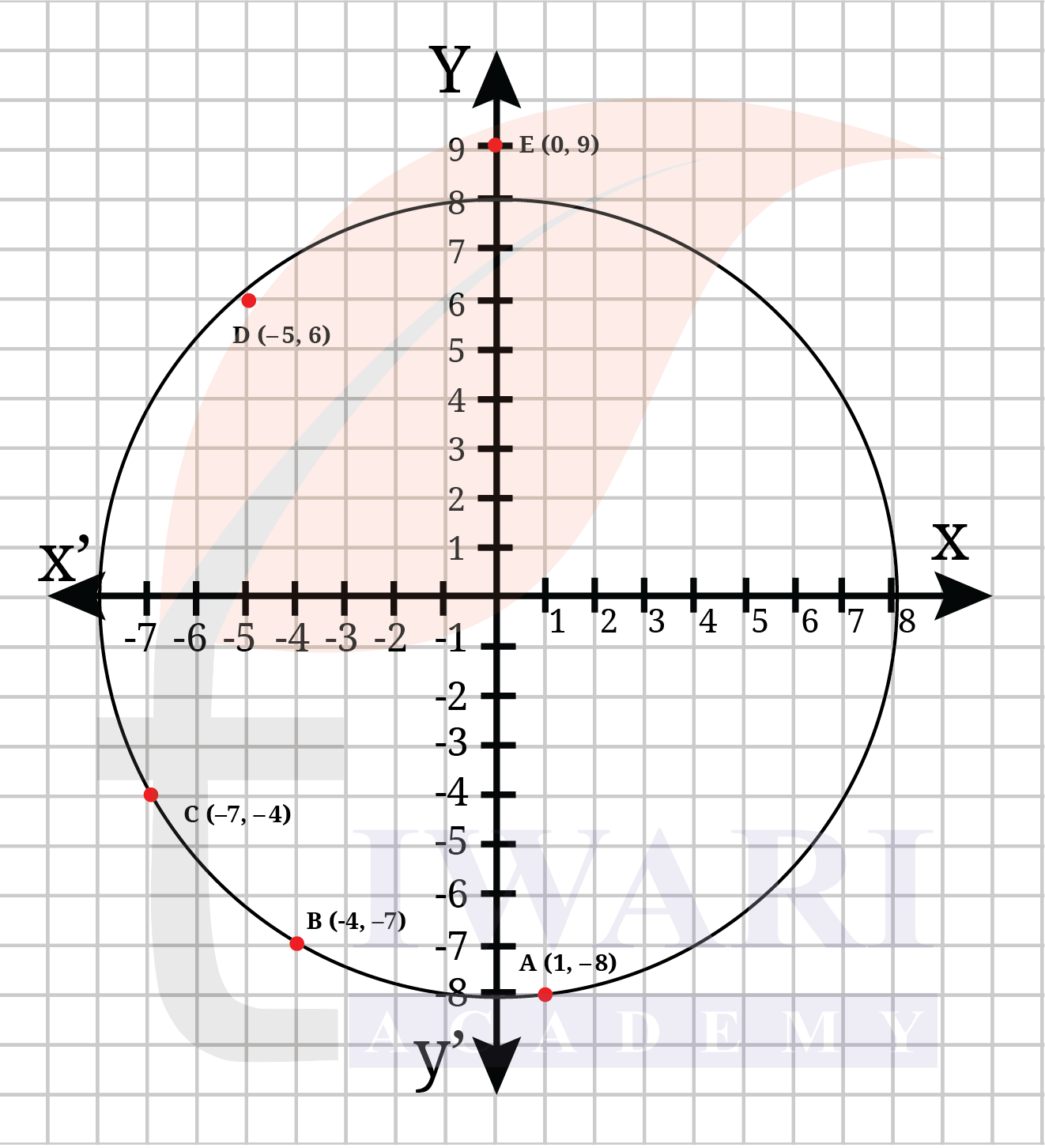
12. (ii) Given the points D (–5, 6) and E (0, 9), check whether D and E lie within the circle, on the circle, or outside the circle K.
Answer:
Distance OD:
= √((–5)² + 6²)
= √(25 + 36)
= √61
Distance OE:
= √(0² + 9²)
= 9
Compare with radius √65 ≈ 8.06
– √61 ≈ 7.81 < √65 → D lies inside the circle – 9 > √65 → E lies outside the circle
D lies inside the circle.
E lies outside the circle.
13. The midpoints of the sides of triangle ABC are the points D, E, and F. Given that the coordinates of D, E, and F are (5, 1), (6, 5), and (0, 3), respectively, find the coordinates of A, B and C.
Answer:
Let the vertices of triangle ABC be A(x₁, y₁), B(x₂, y₂), and C(x₃, y₃).
Given midpoints: D(5, 1), E(6, 5), F(0, 3)
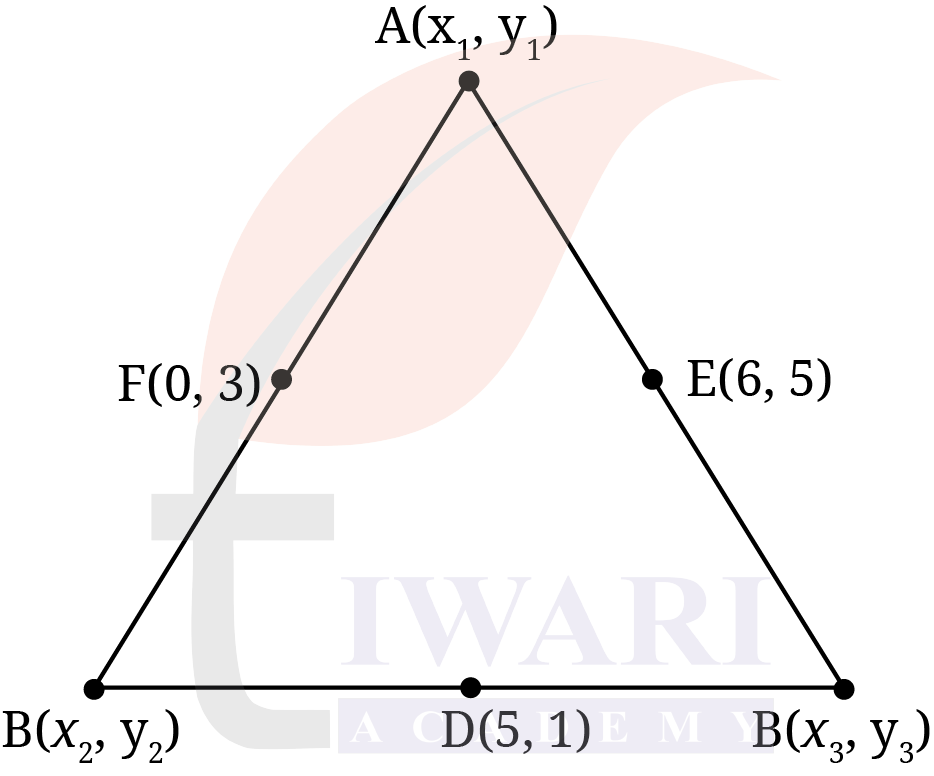
D is midpoint of BC, so using midpoint formula:
x₂ + x₃ = 10 …(1)
y₂ + y₃ = 2 …(2)
E is midpoint of CA, therefore:
x₃ + x₁ = 12 …(3)
y₃ + y₁ = 10 …(4)
F is midpoint of AB, therefore:
x₁ + x₂ = 0 …(5)
y₁ + y₂ = 6 …(6)
Solving for x-coordinates, from (5):
x₂ = –x₁
Substitute into (1): –x₁ + x₃ = 10
⇒ x₃ = 10 + x₁ …(7)
Substituting into (3): (10 + x₁) + x₁ = 12
⇒ 2x₁ + 10 = 12
⇒ 2x₁ = 2
⇒ x₁ = 1
Then: x₂ = –1
⇒ x₃ = 10 + 1 = 11
Solving y-coordinates, from (6):
y₂ = 6 – y₁
Substituting into (2): (6 – y₁) + y₃ = 2
⇒ y₃ = y₁ – 4 …(8)
Substituting into (4): (y₁ – 4) + y₁ = 10
⇒ 2y₁ – 4 = 10
⇒ 2y₁ = 14
⇒ y₁ = 7
Then: y₂ = 6 – 7 = –1
⇒ y₃ = 7 – 4 = 3
Therefore, the coordinates of the points are A (1, 7), B (–1, –1) and C (11, 3).
14. A city has two main roads which cross each other at the centre of the city. These two roads are along the North–South (N–S) direction and East–West (E–W) direction.
All the other streets of the city run parallel to these roads and are 200 m apart. There are 10 streets in each direction.
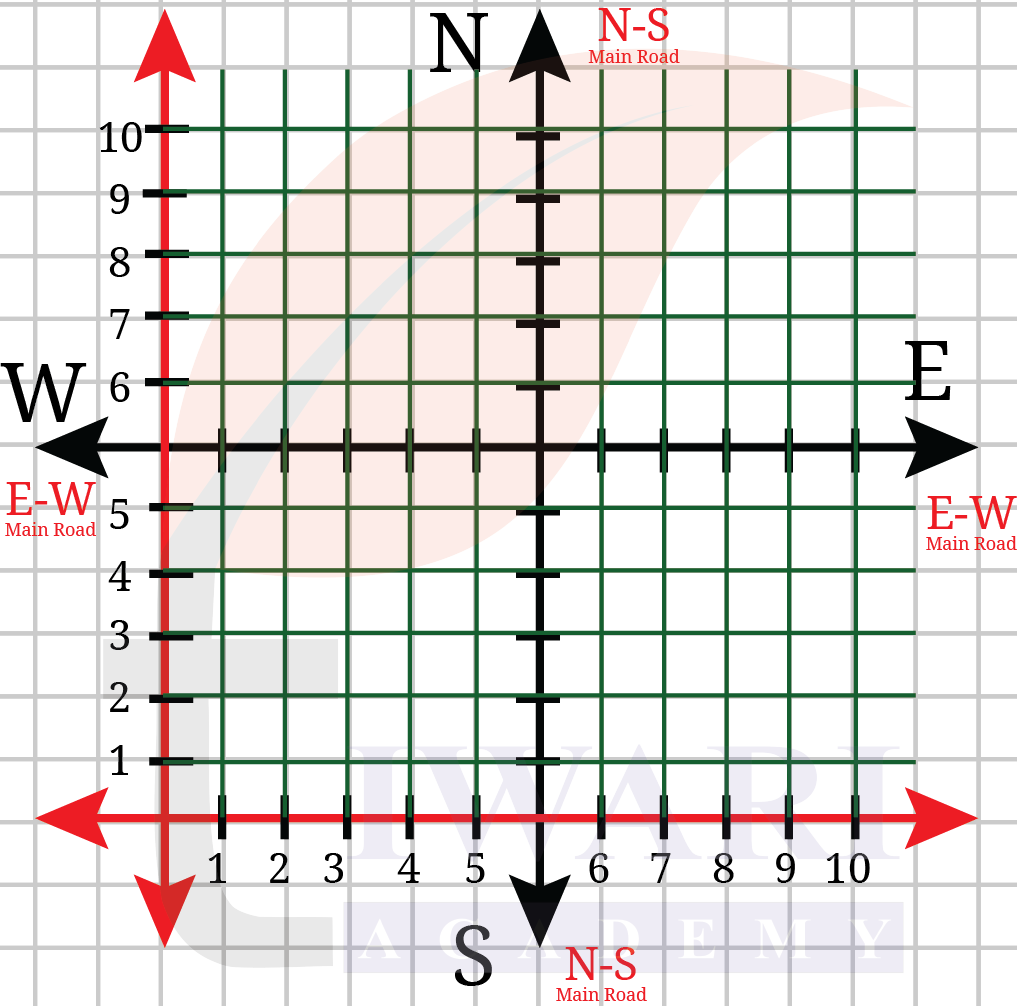
(i) Using 1 cm = 200 m, draw a model of the city in your notebook. Represent the roads/streets by single lines.
Answer:
Drawing the model of the city
Since: Scale is 1 cm = 200 m
Each pair of adjacent streets is 200 m apart
Given that:
10 streets in the N–S direction
10 streets in the E–W direction
Hence, the model will consist of:
10 vertical parallel lines (for N–S streets)
10 horizontal parallel lines (for E–W streets)
Each consecutive line 1 cm apart, which forms a square grid.
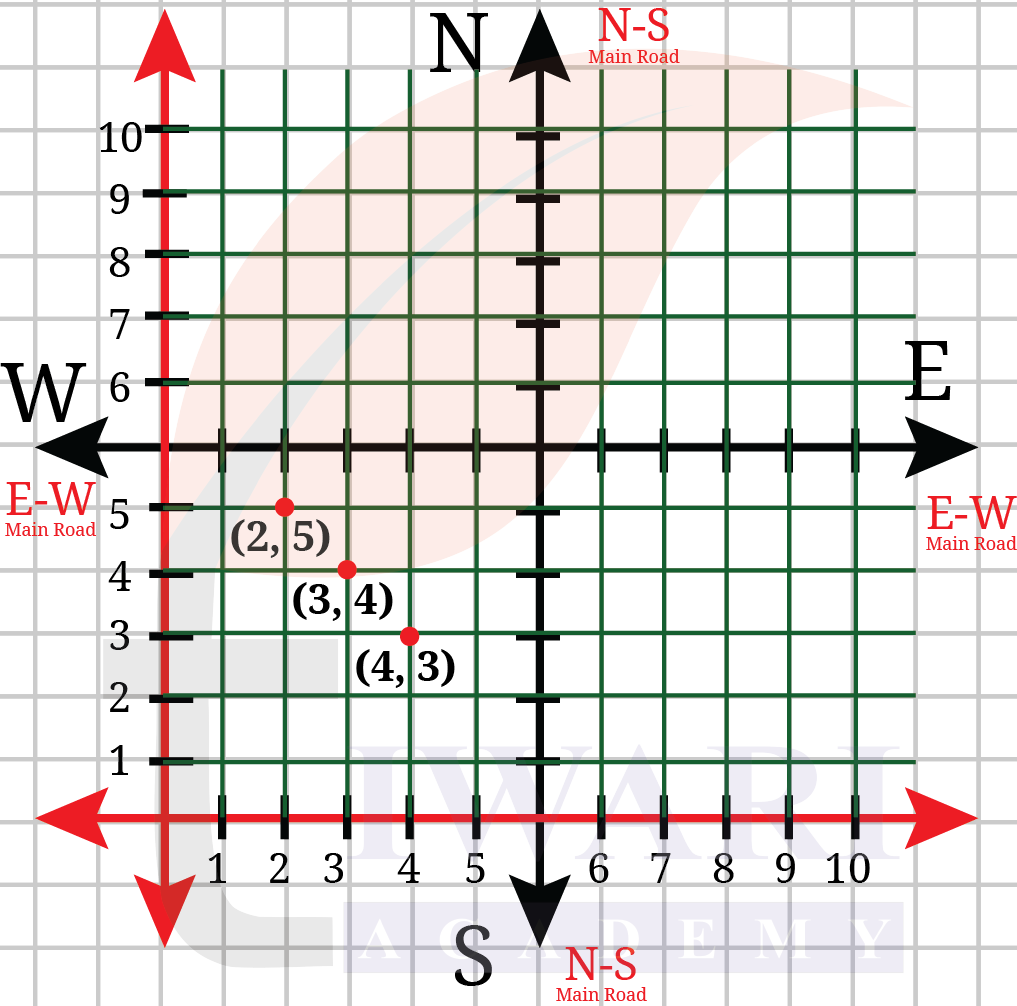
(ii) There are street intersections in the model. Each street intersection is formed by two streets – one running in the N–S direction and another in the E–W direction. Each street intersection is referred to in the following manner: If the second street running in the N–S direction and 5th street in the E–W direction meet at some crossing, then we call this street intersection (2, 5). Using this convention, find:
(a) how many street intersections can be referred to as (4, 3).
(b) how many street intersections can be referred to as (3, 4).
Answer:
A street intersection is named by: (first number, second number)
= (N–S street number, E–W street number)
So:
(4, 3) means the intersection of the 4th N–S street and the 3rd E–W street
(3, 4) means the intersection of the 3rd N–S street and the 4th E–W street
Now, one N–S street and one E–W street can meet at only one point.
Therefore:
(a) Only one intersection can be called (4, 3).
(b) Only one intersection can be called (3, 4).
15. A computer graphics program displays images on a rectangular screen whose coordinate system has the origin at the bottom-left corner.
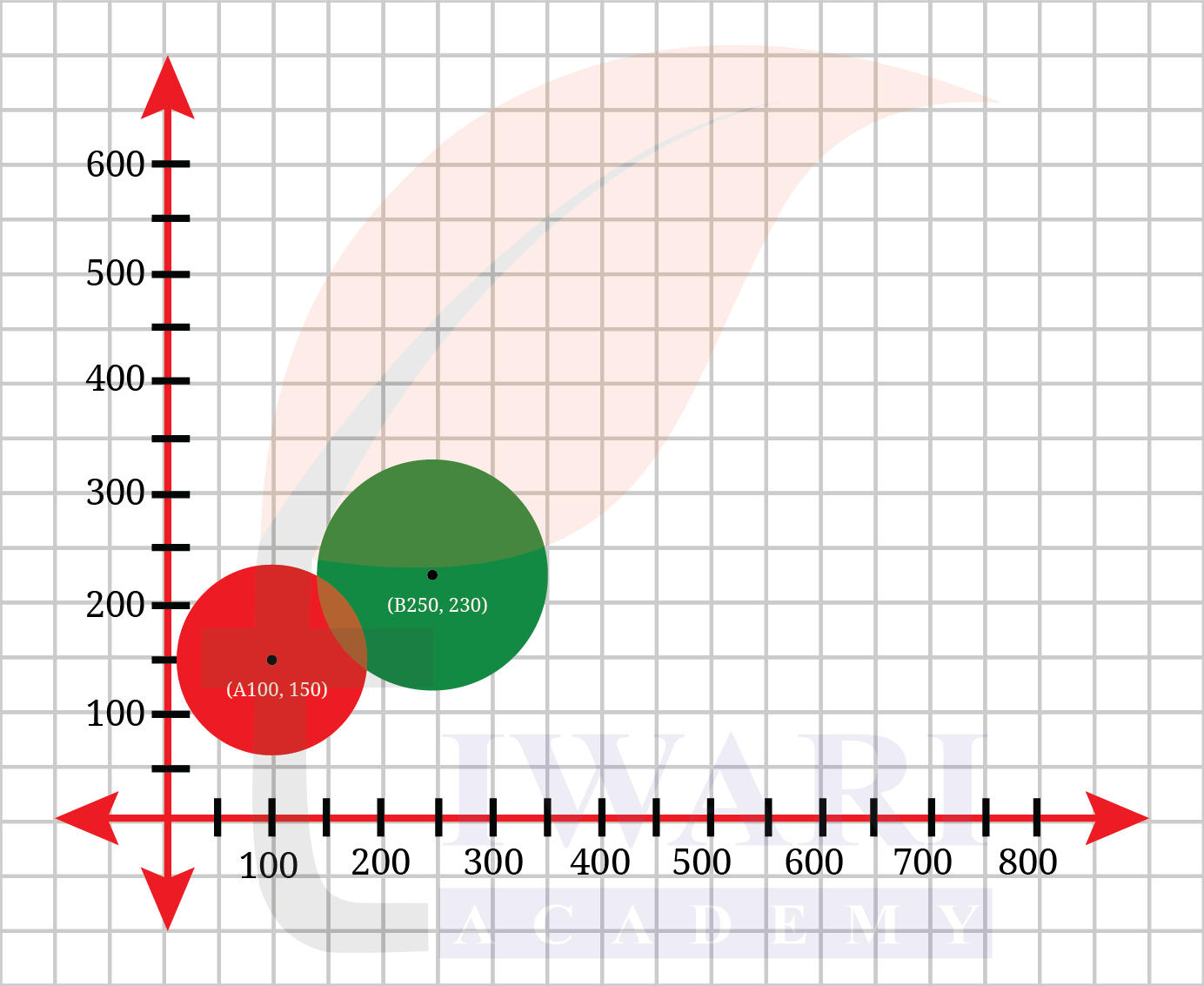
The screen is 800 pixels wide and 600 pixels high. A circular icon of radius 80 pixels is drawn with its centre at the point A (100, 150). Another circular icon of radius 100 pixels is drawn with its centre at the point B (250, 230). Determine:
(i) whether any part of either circle lies outside the screen.
(ii) whether the two circles intersect each other.
Answer:
(i) No. Each of the two circles lies inside the screen.
(ii) Yes. The two circles intersect each other as shown in the picture.
16. Plot the points A (2, 1), B (–1, 2), C (–2, –1), and D (1, –2) in the coordinate plane. Is ABCD a square? Can you explain why? What is the area of this square?
Answer:
Yes, ABCD is a square.
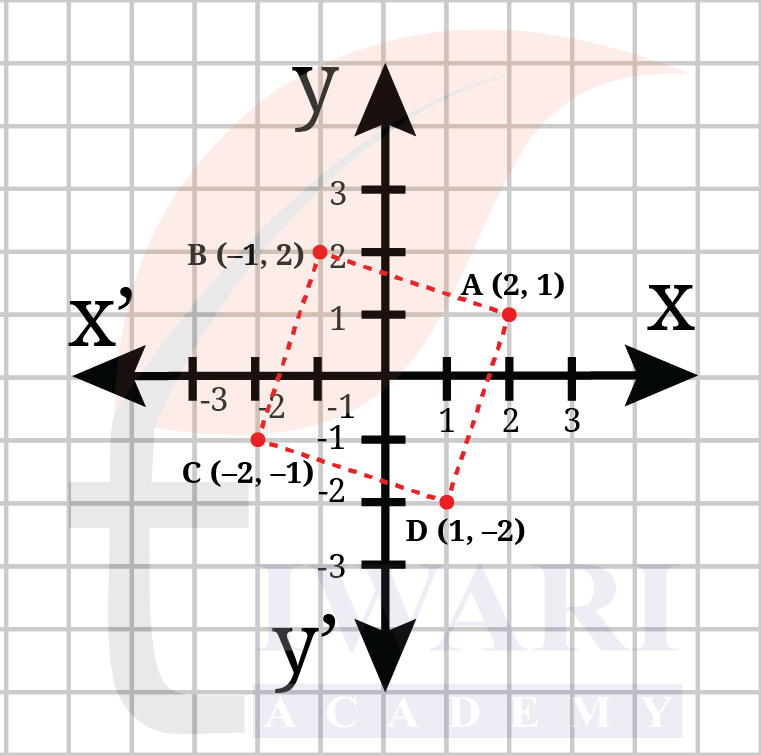
We can check it finding the lengths of sides and diagonals.
Finding the lengths of all sides:
AB = √[(–1 − 2)² + (2 − 1)²]
= √[(–3)² + 1²]
= √(9 + 1)
= √10
BC = √[(–2 − (–1))² + (–1 − 2)²]
= √[(–1)² + (–3)²]
= √(1 + 9)
= √10
CD = √[(1 − (–2))² + (–2 − (–1))²]
= √[3² + (–1)²]
= √(9 + 1)
= √10
DA = √[(2 − 1)² + (1 − (–2))²]
= √[1² + 3²]
= √(1 + 9)
= √10
All four sides are equal.
Now finding diagonals:
AC = √[(–2 − 2)² + (–1 − 1)²]
= √[(–4)² + (–2)²]
= √(16 + 4)
= √20
BD = √[(1 − (–1))² + (–2 − 2)²]
= √[2² + (–4)²]
= √(4 + 16)
= √20
Diagonals are equal.
All sides are equal and diagonals are equal, so ABCD is a square.
Area of ABCD = = (side)²
= (√10)²
= 10 square units.
Class 9 Maths Ganita Manjari Chapter 1 Practice Tests
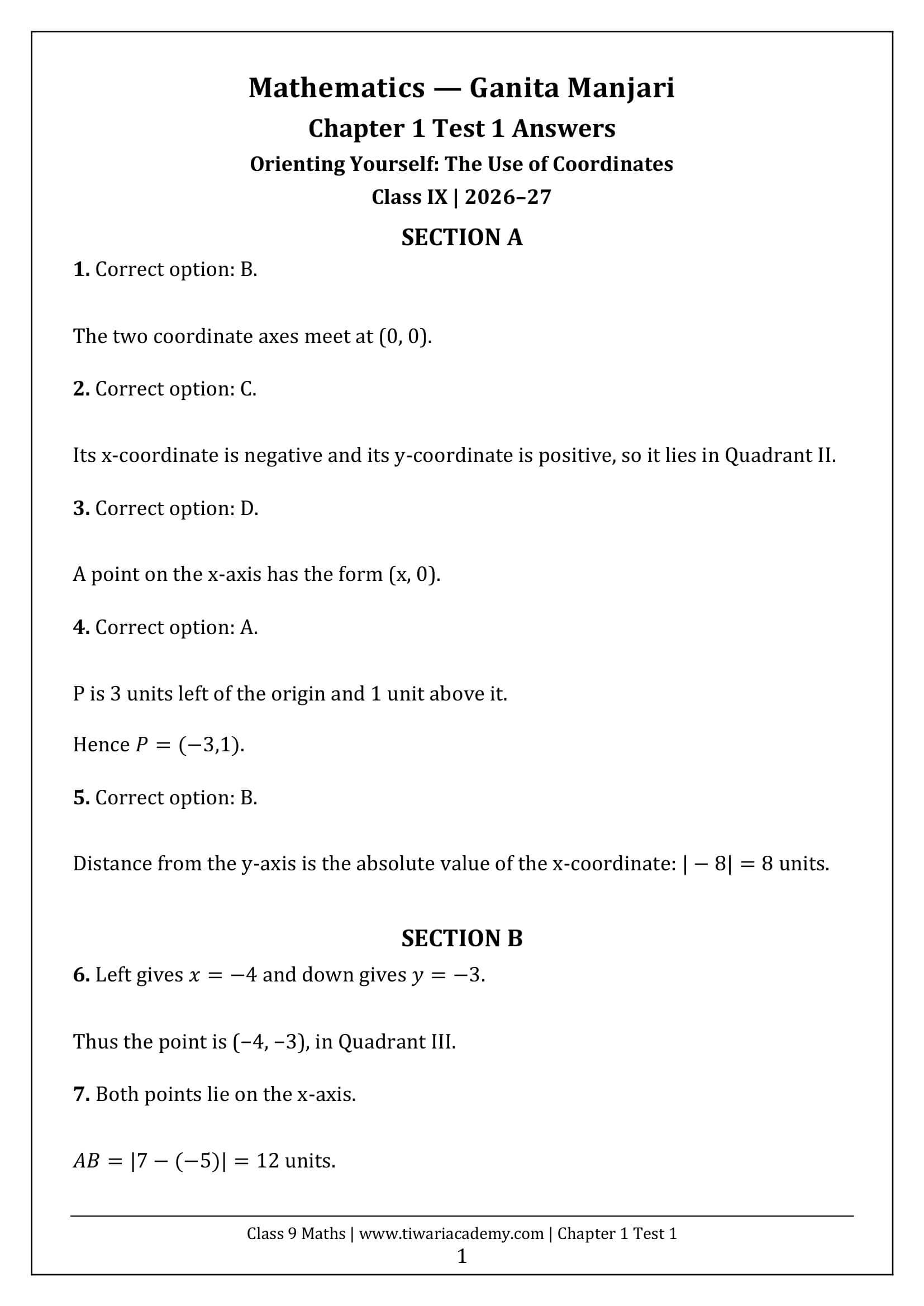
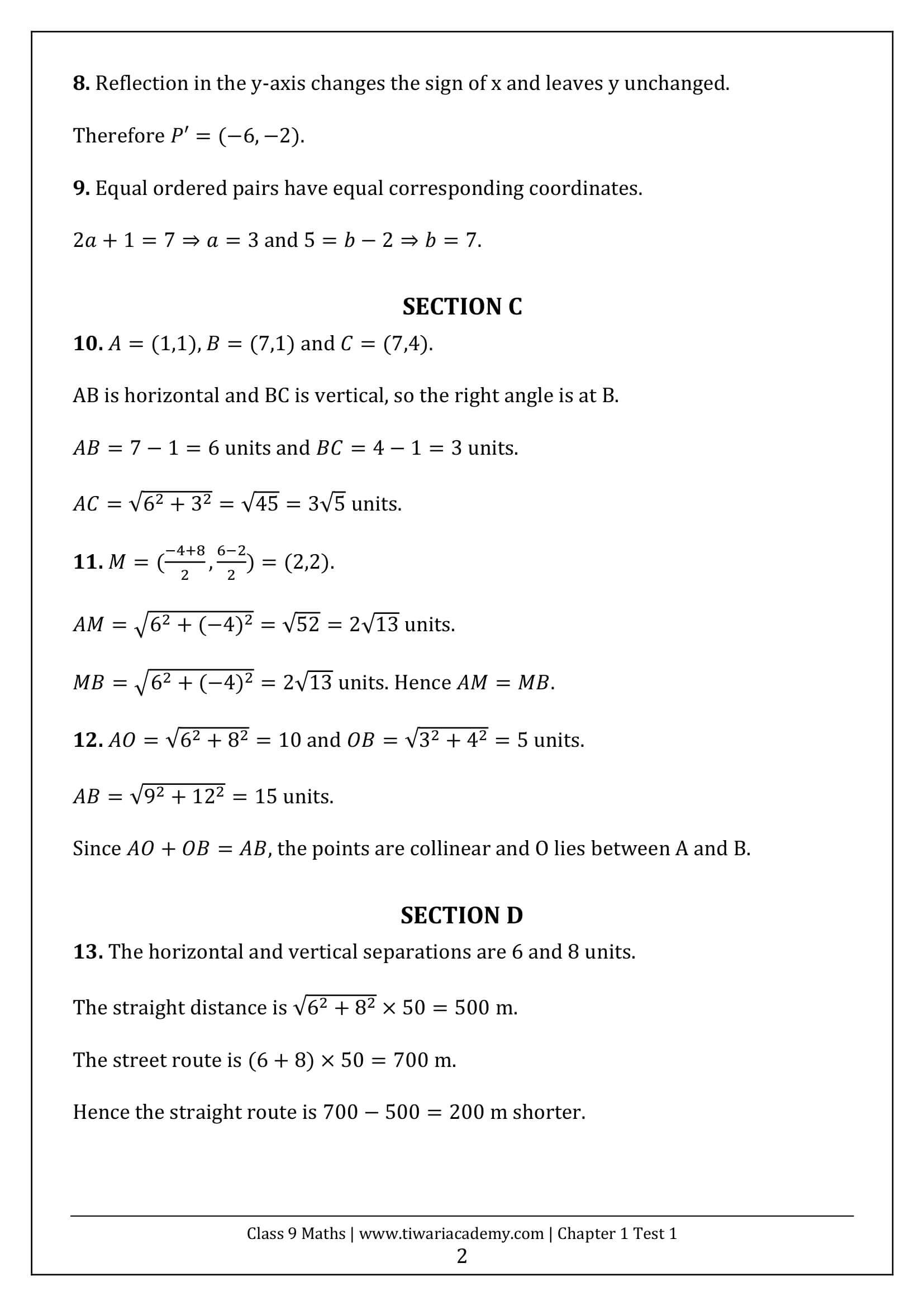
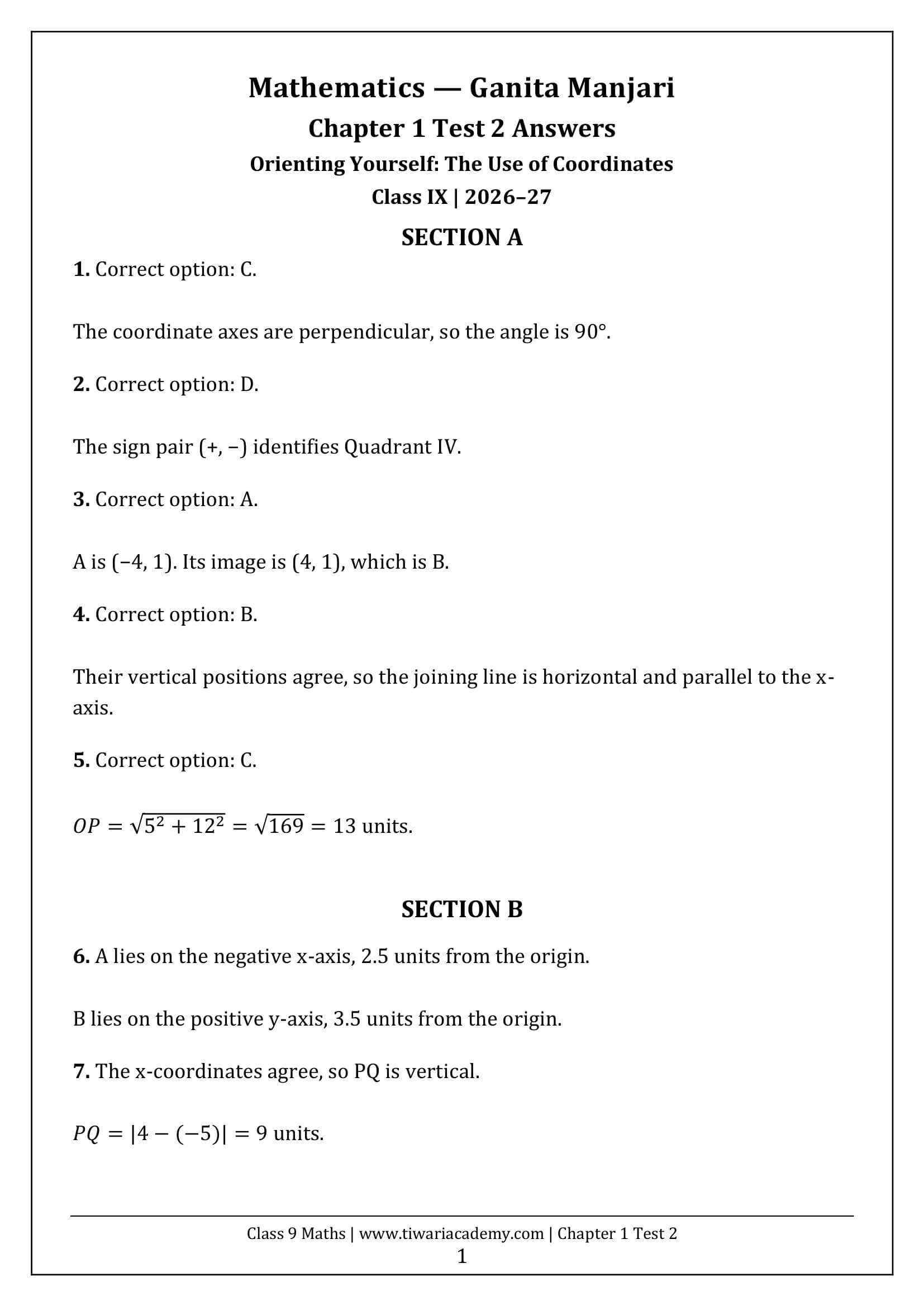
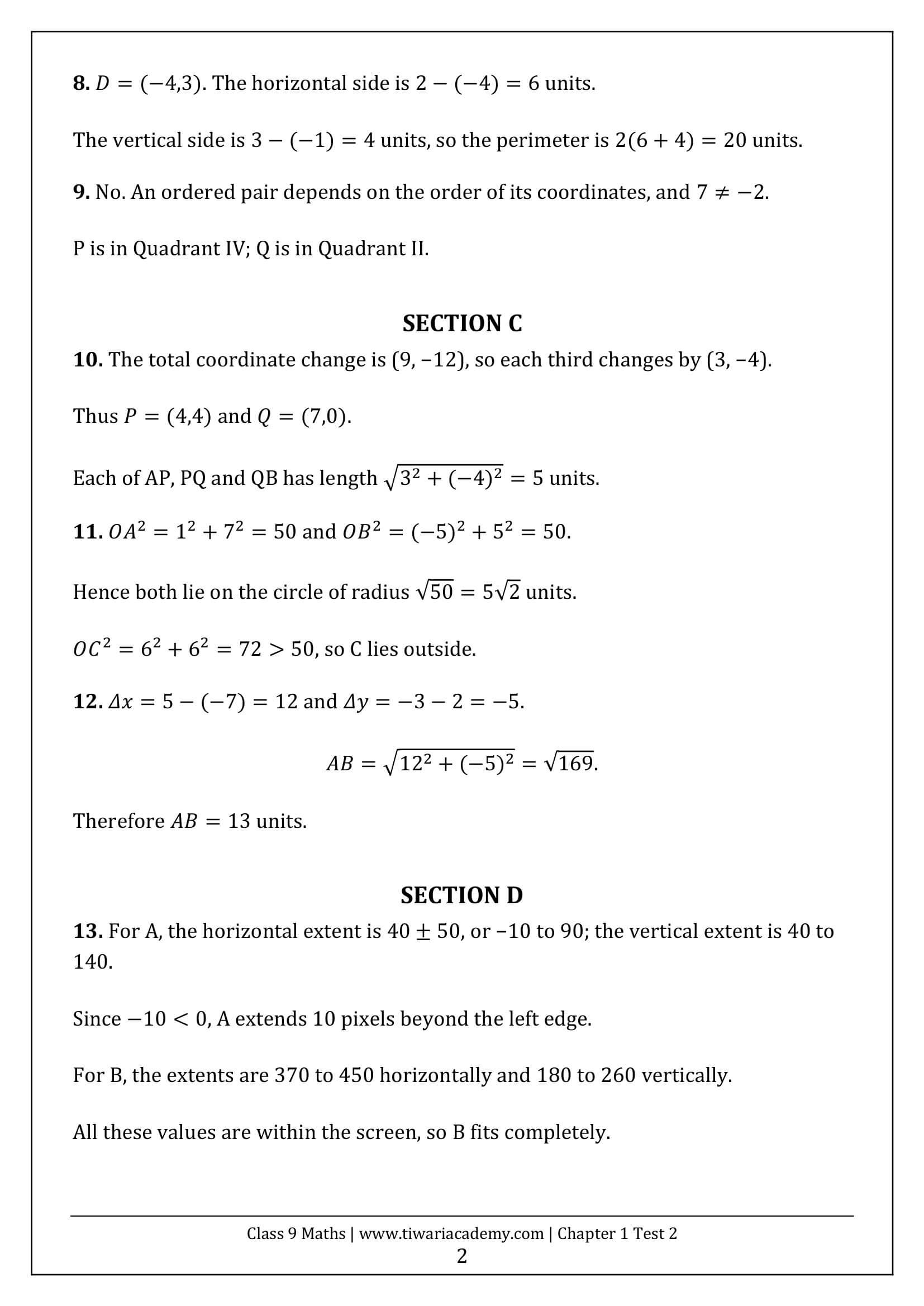
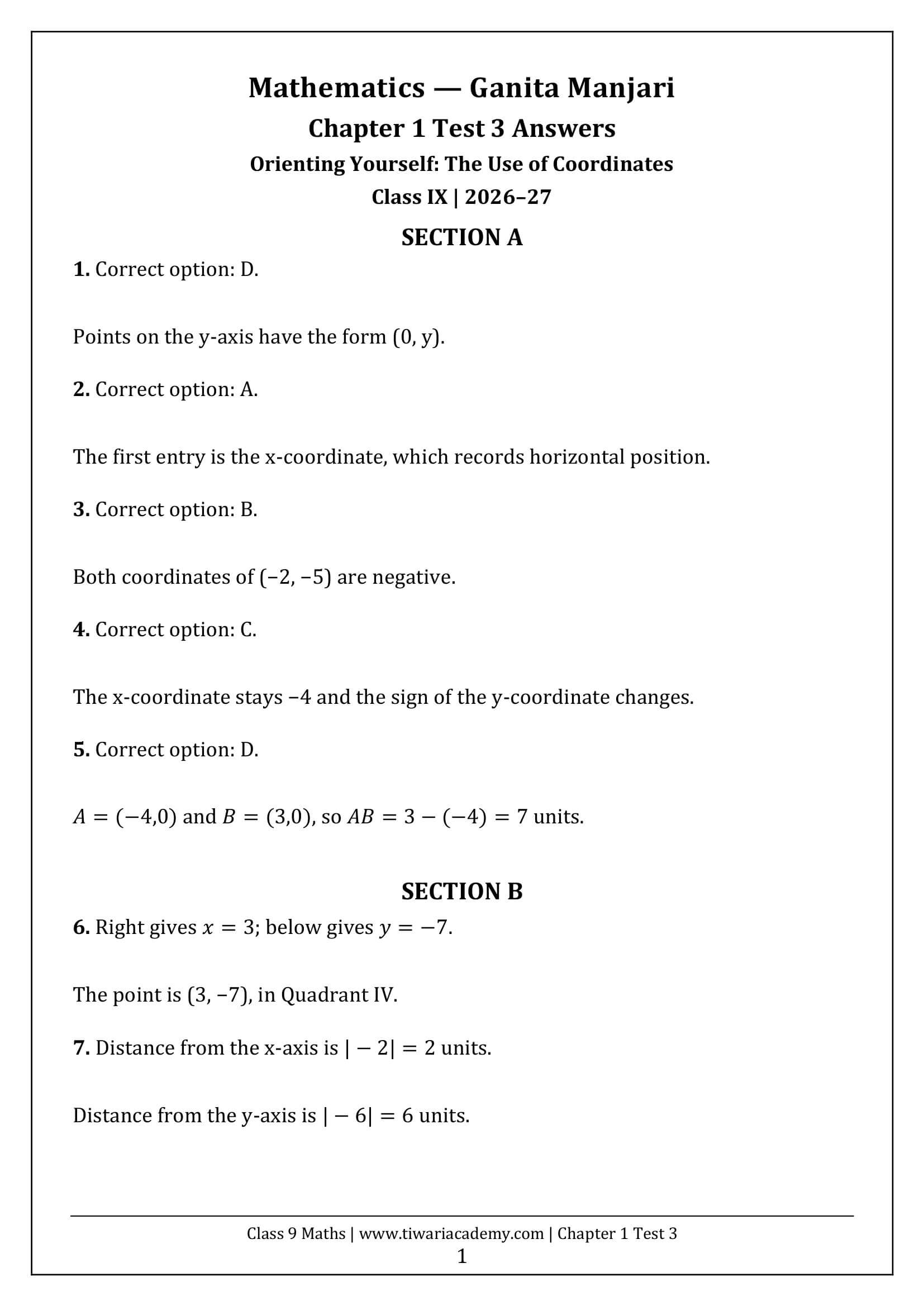
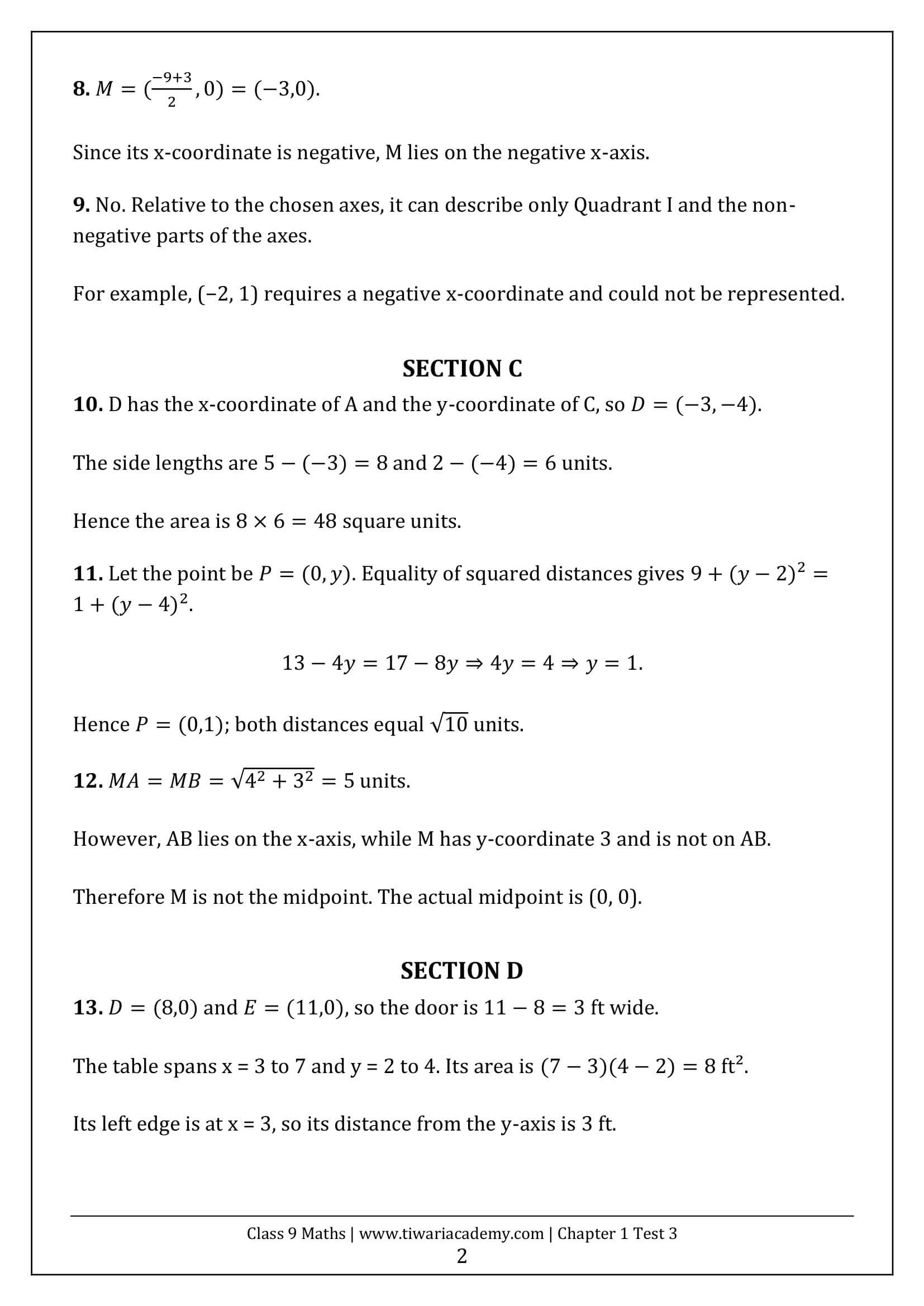
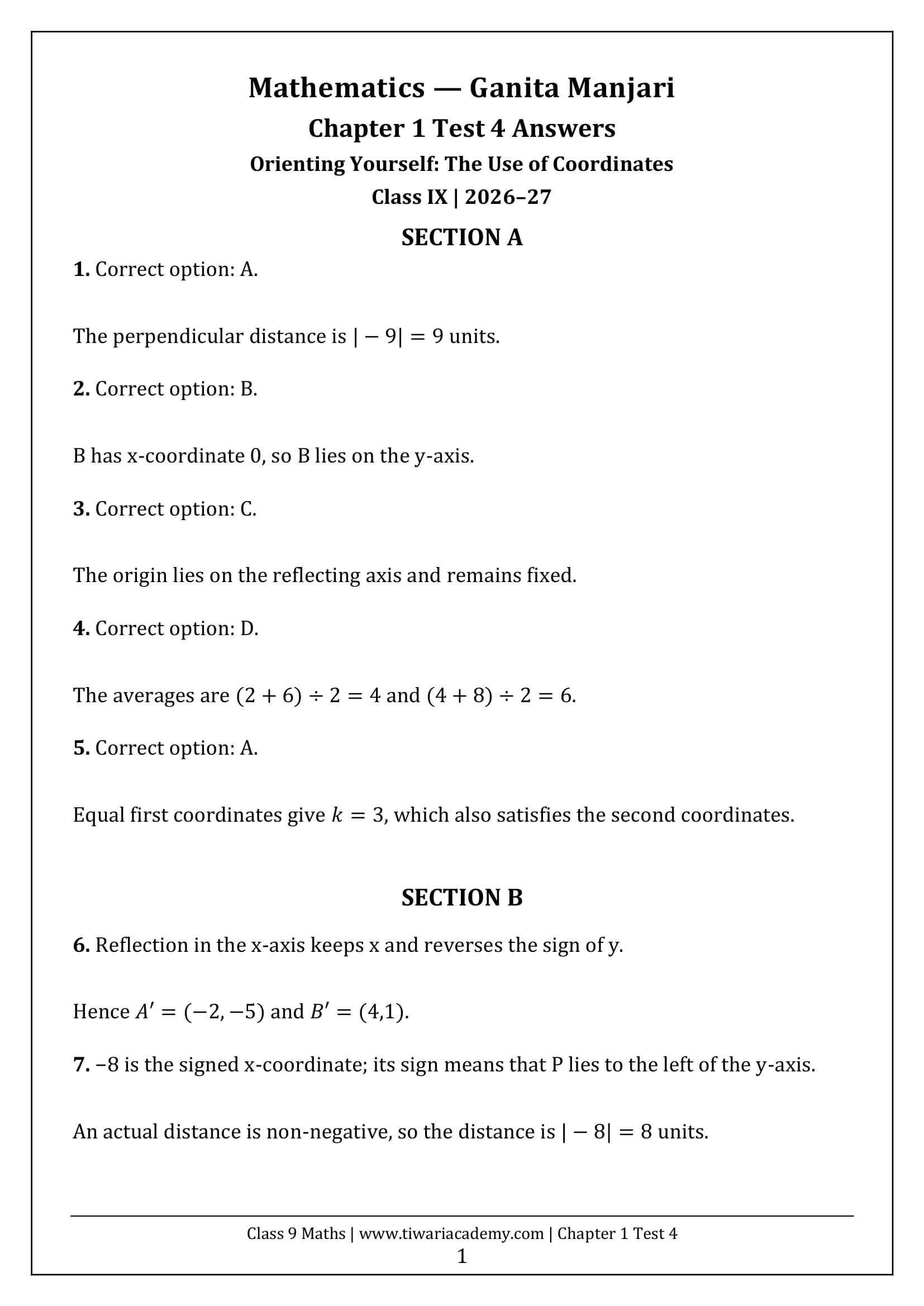
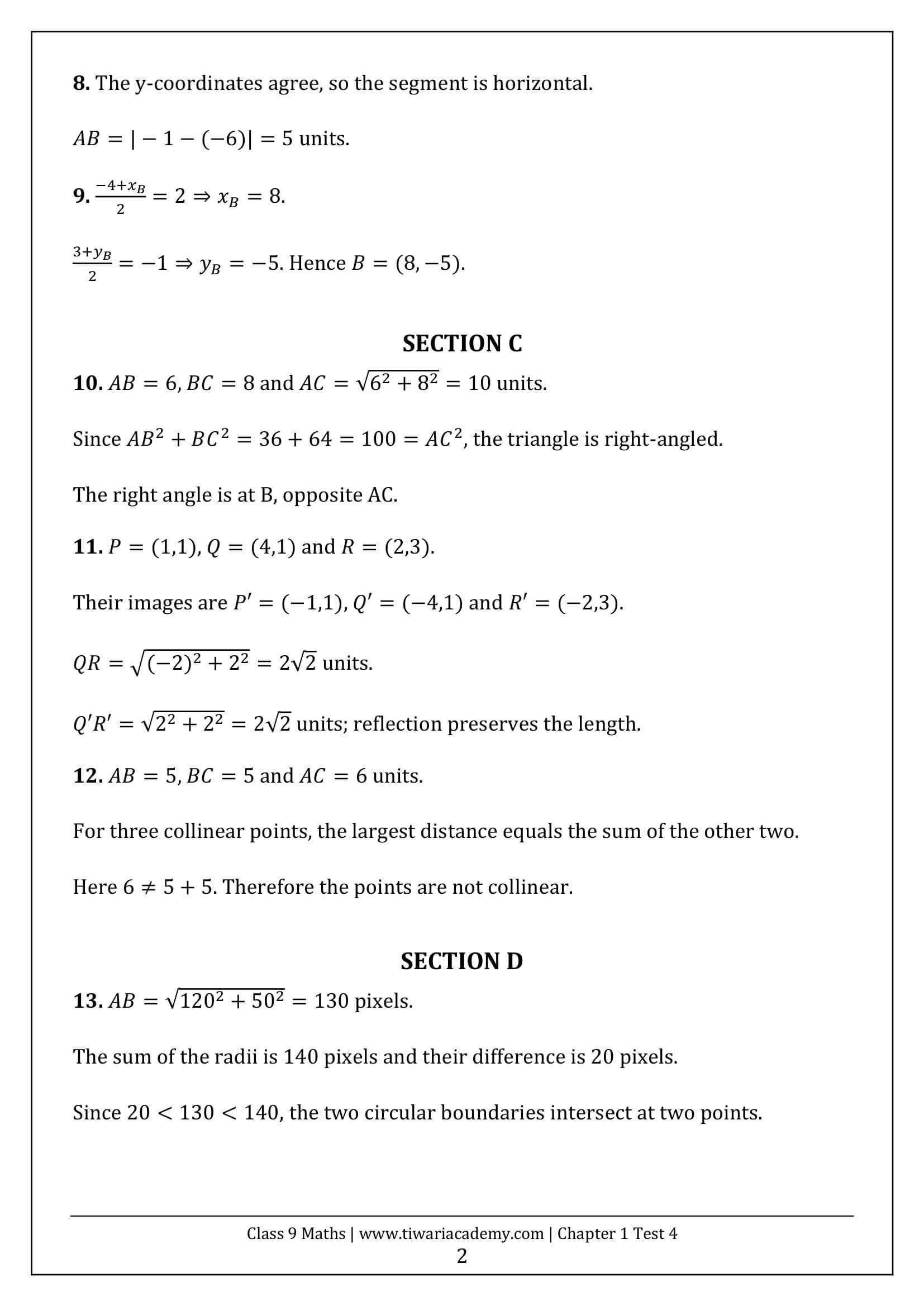
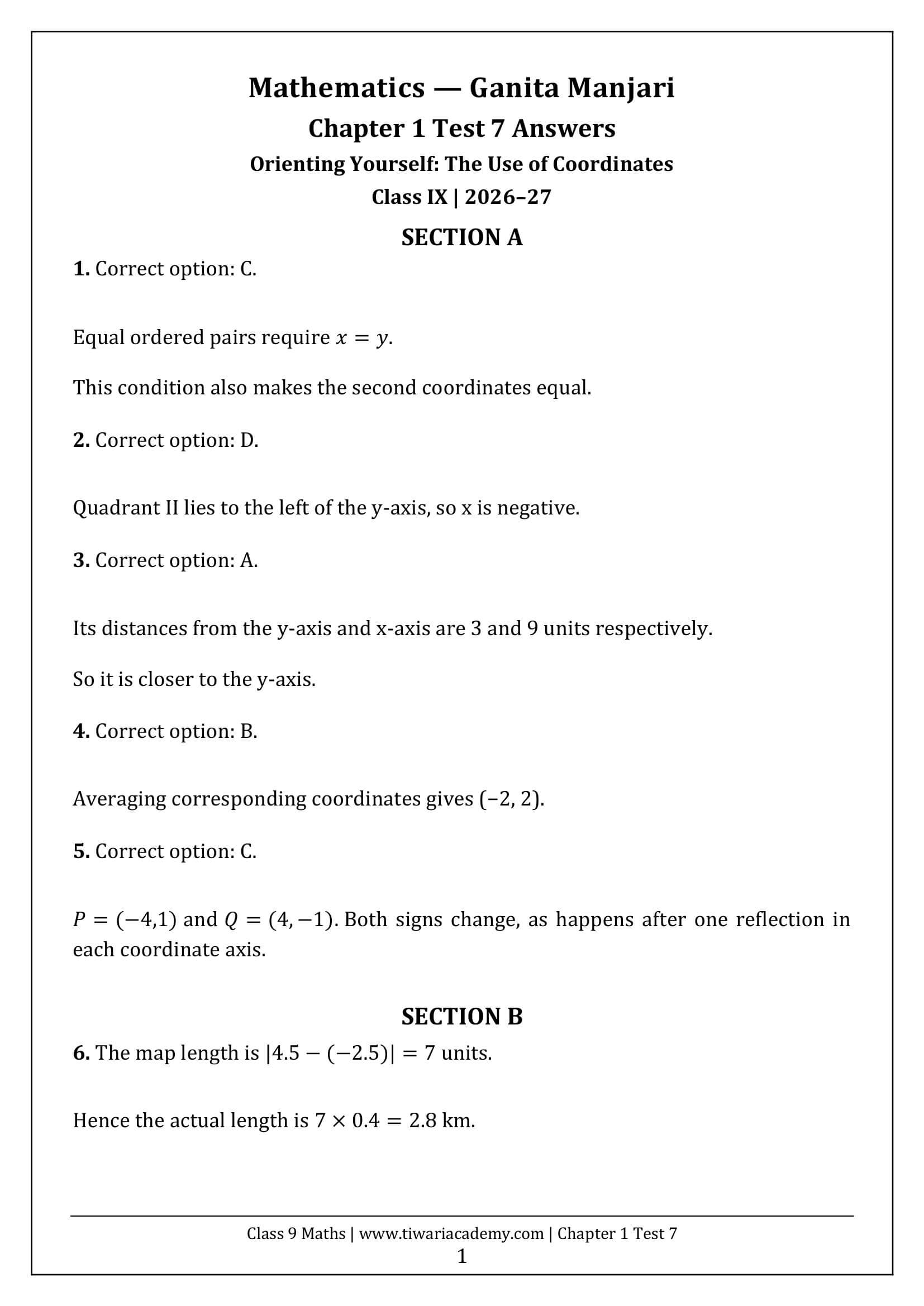
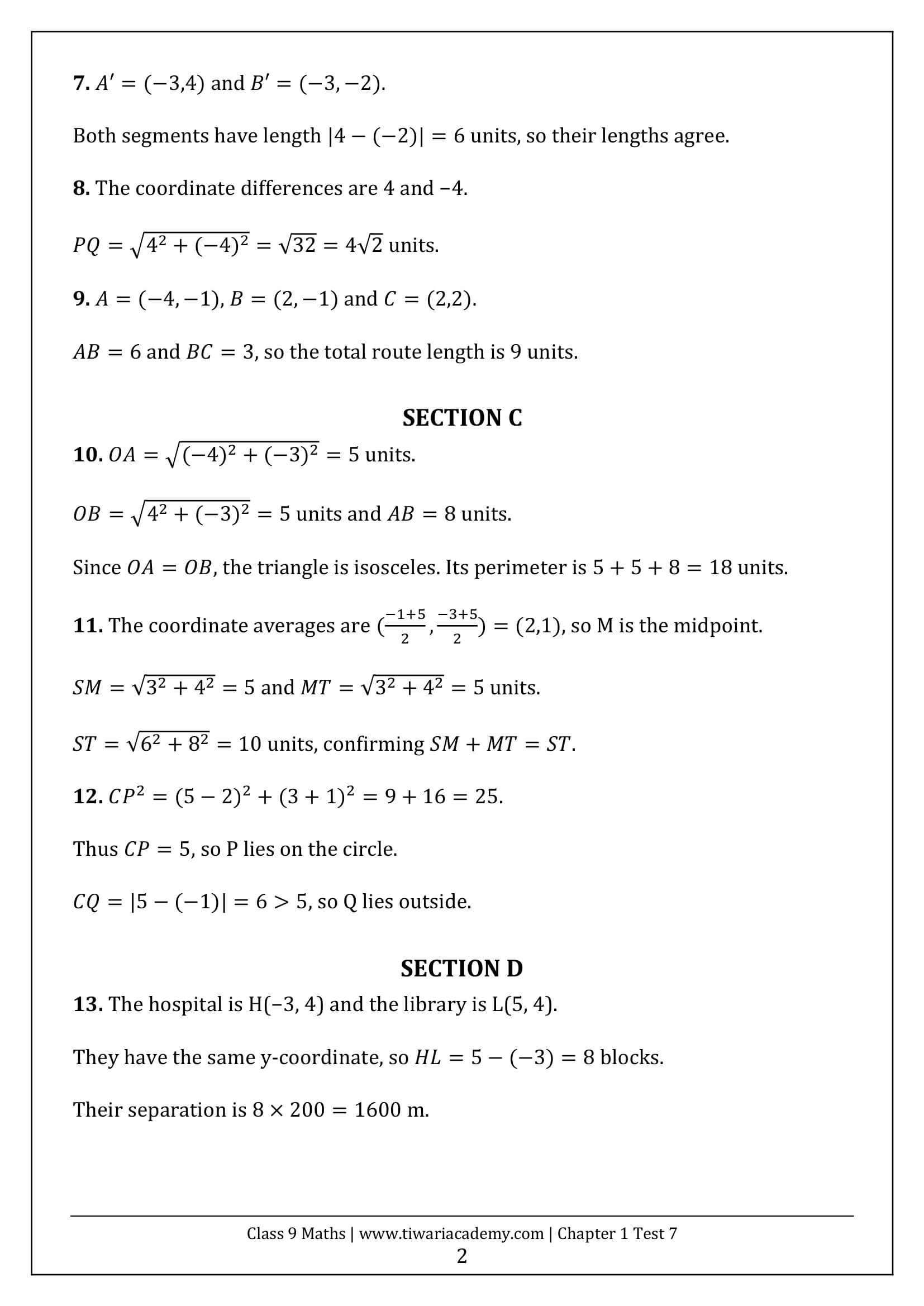
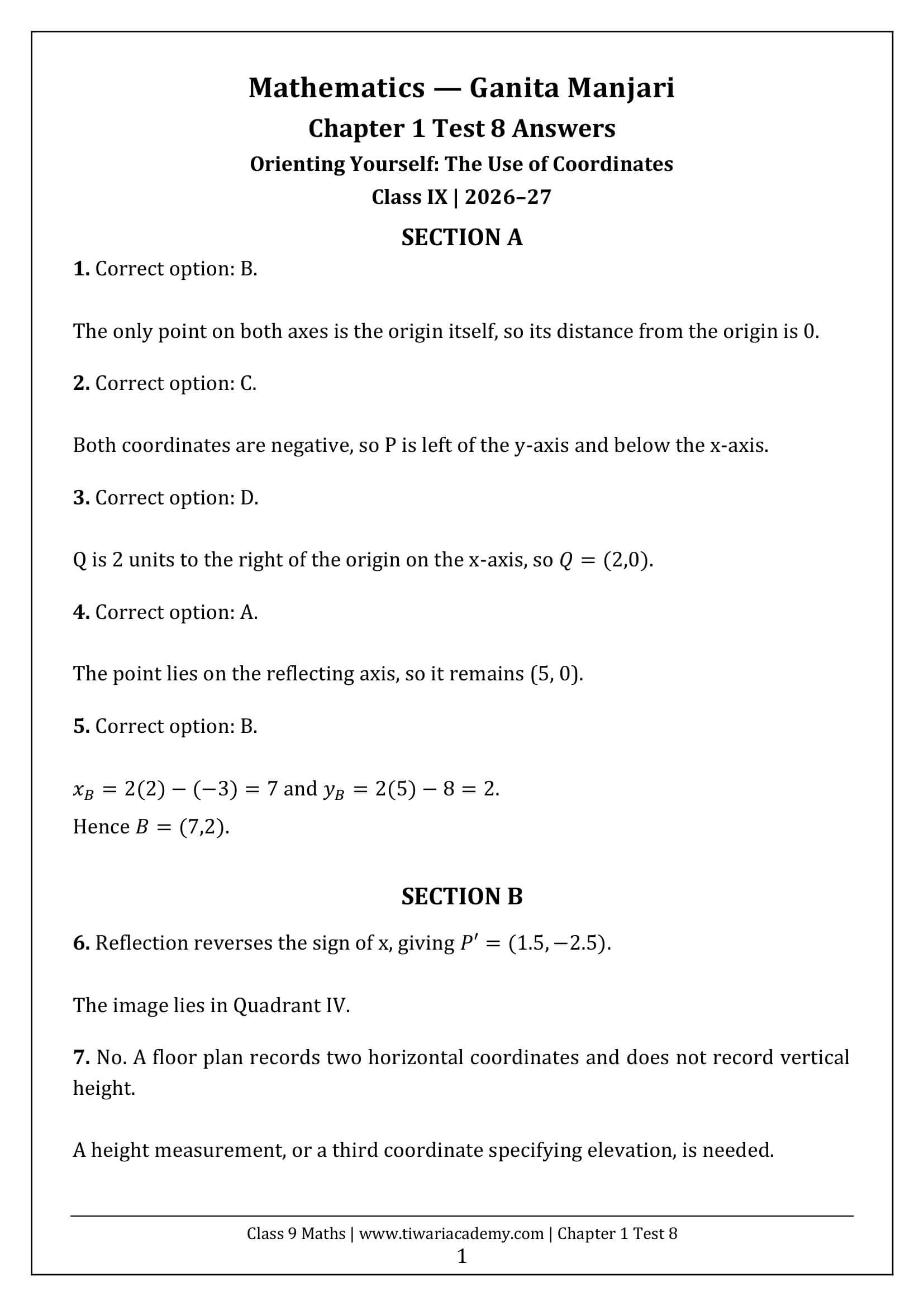
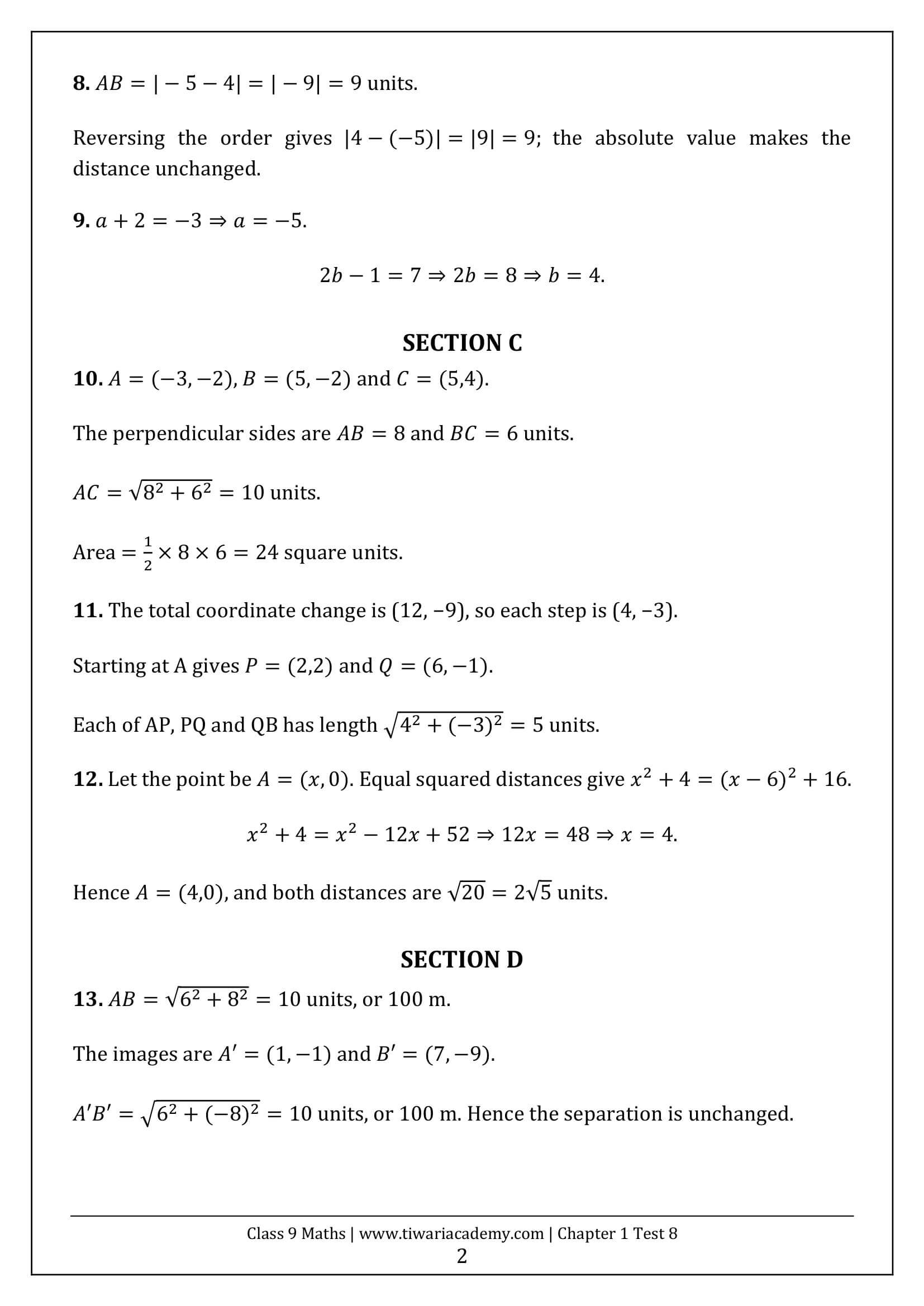
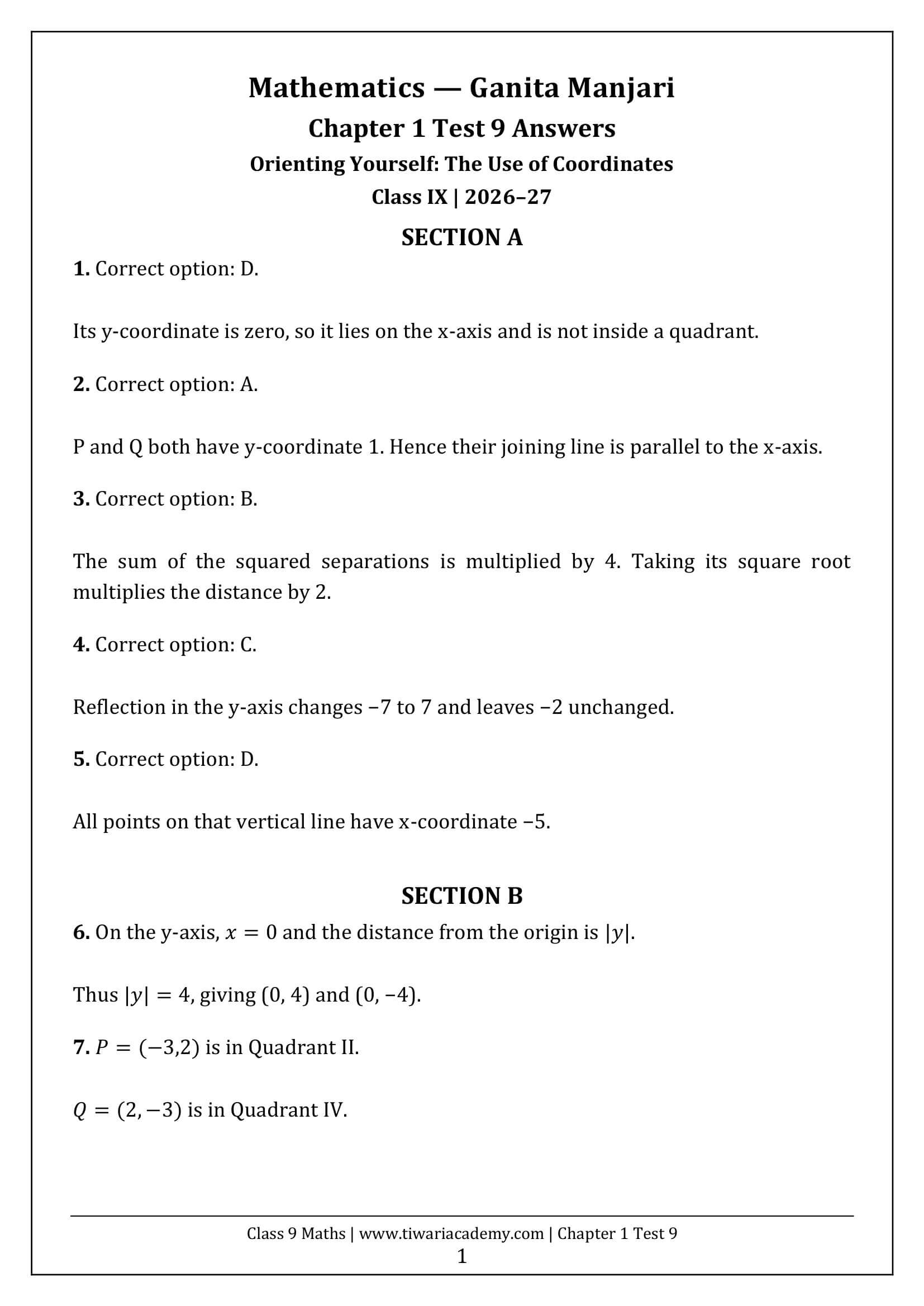
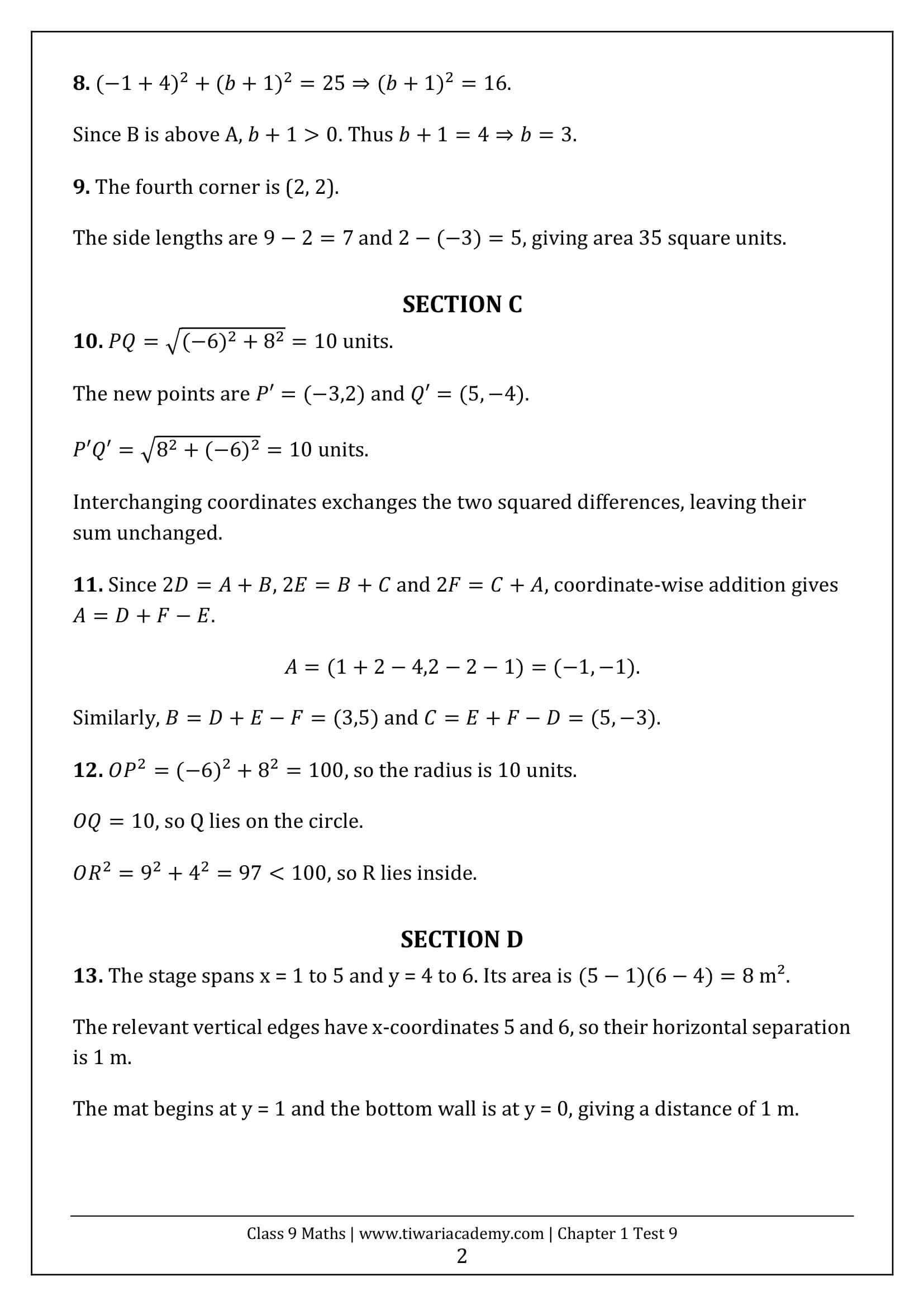
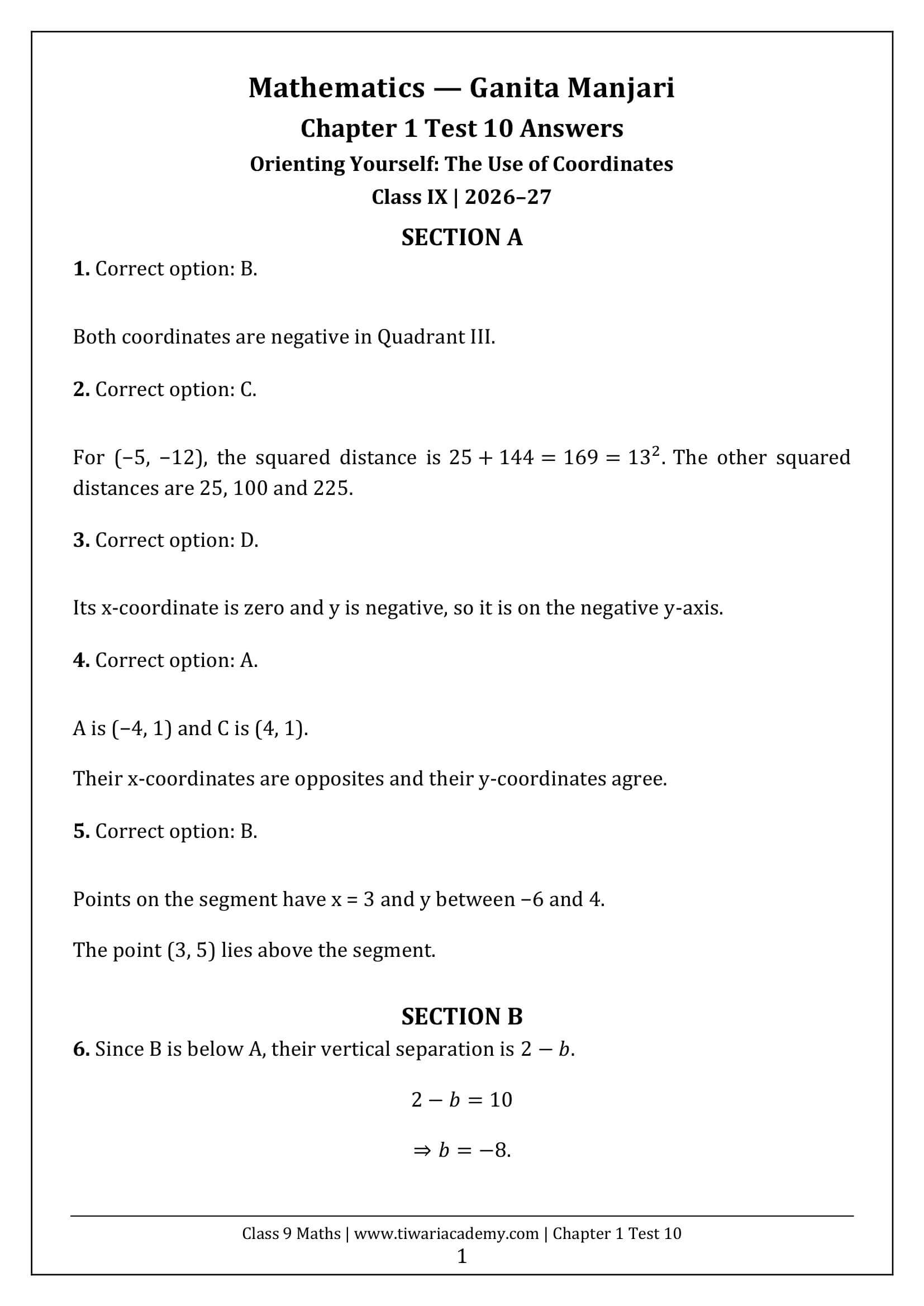
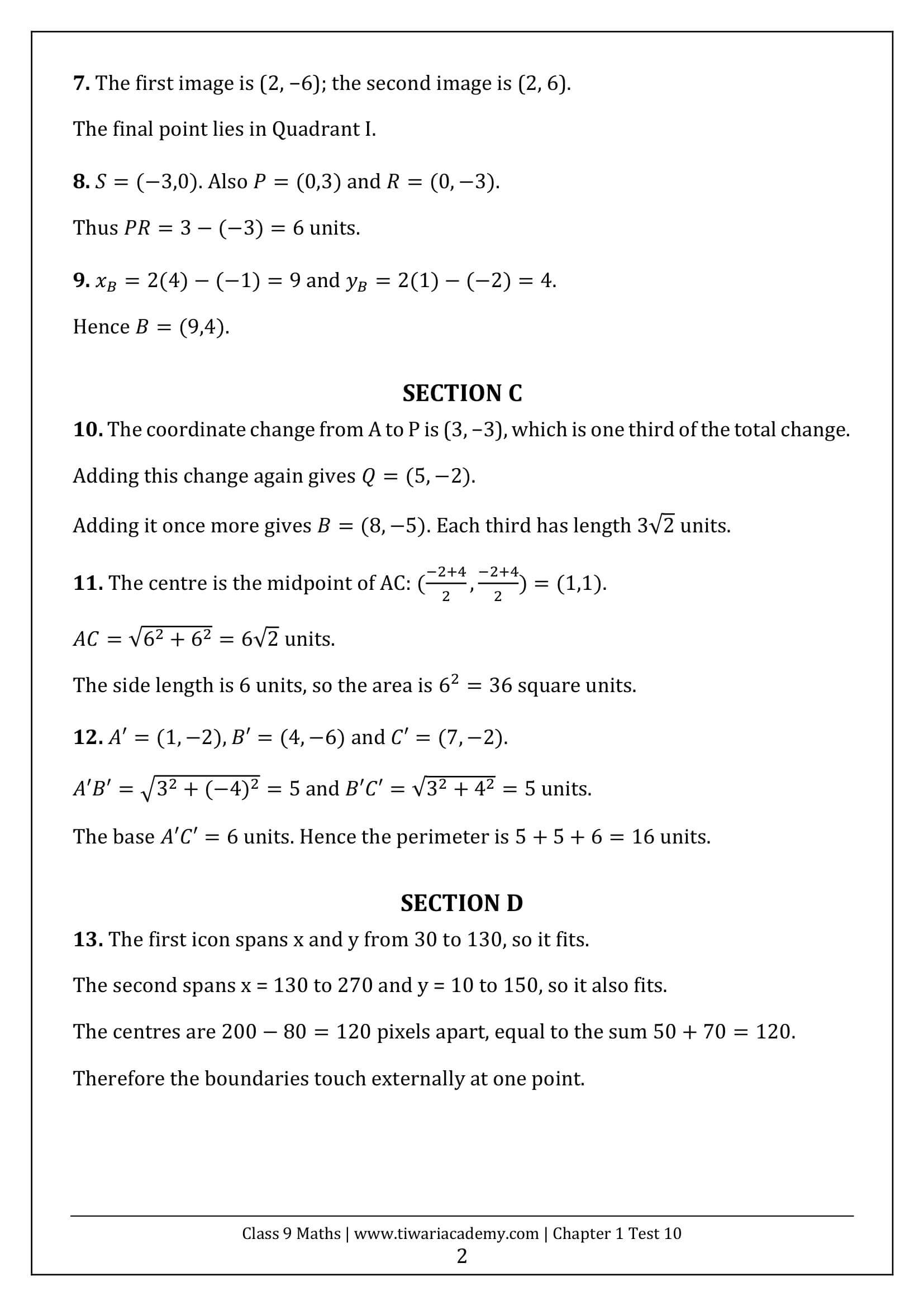
Download 10 Test Papers: Make your chapter 1 revision more effective by solving the NCERT-based Practice Tests with Answer provided below. These chapter-wise test papers help students revise key topics, practise important questions and assess their learning progress. After attempting each test, compare your answers with the supplied answer key to recognise weak areas and improve your conceptual understanding.
Download 10 Test Papers in PDF to Practice for 2026-27 Exam
- Class 9 Maths Ganita Manjari Chapter 1 Test 1
- Class 9 Maths Ganita Manjari Chapter 1 Test 2
- Class 9 Maths Ganita Manjari Chapter 1 Test 3
- Class 9 Maths Ganita Manjari Chapter 1 Test 4
- Class 9 Maths Ganita Manjari Chapter 1 Test 5
- Class 9 Maths Ganita Manjari Chapter 1 Test 6
- Class 9 Maths Ganita Manjari Chapter 1 Test 7
- Class 9 Maths Ganita Manjari Chapter 1 Test 8
- Class 9 Maths Ganita Manjari Chapter 1 Test 9
- Class 9 Maths Ganita Manjari Chapter 1 Test 10
- Class 9 Maths Ganita Manjari Chapter 1 Test 1 Answer
- Class 9 Maths Ganita Manjari Chapter 1 Test 2 Answer
- Class 9 Maths Ganita Manjari Chapter 1 Test 3 Answer
- Class 9 Maths Ganita Manjari Chapter 1 Test 4 Answer
- Class 9 Maths Ganita Manjari Chapter 1 Test 5 Answer
- Class 9 Maths Ganita Manjari Chapter 1 Test 6 Answer
- Class 9 Maths Ganita Manjari Chapter 1 Test 7 Answer
- Class 9 Maths Ganita Manjari Chapter 1 Test 8 Answer
- Class 9 Maths Ganita Manjari Chapter 1 Test 9 Answer
- Class 9 Maths Ganita Manjari Chapter 1 Test 10 Answer
Frequently Asked Questions – Class 9 Maths Ganita Manjari Chapter 1
How is Chapter 1 of Ganita Manjari different from the old NCERT Chapter on Coordinate Geometry?
The new textbook Ganita Manjari chapter 1 makes several significant pedagogical shifts:
- Historical context first – It opens with an extensive narrative about Bhāratīya contributions (Sindhu-Sarasvatī city grids, Baudhāyana, Āryabhaṭa, Brahmagupta) before any formal definitions, giving students cultural context and motivation.
- Inclusive, story-based entry point – The story of Reiaan (a visually impaired student) and Shalini grounds abstract concepts in lived, relatable experience.
- “Think and Reflect” boxes – Open-ended reflection prompts replace rote recall questions, promoting higher-order thinking and mathematical reasoning.
- Starred (★) enrichment problems – Challenging problems on collinearity, midpoint theorem, circles, and trisection are included for advanced learners without being compulsory for all.
- Distance formula integrated early – Unlike older textbooks, the distance formula is introduced within the same chapter (Section 1.4) rather than being deferred.
What is the suggested teaching approach for this chapter as per the new NEP-aligned framework?
The chapter aligns with NEP 2020 values of experiential learning, competency-based education, and cultural rootedness. Recommended approaches:
- Activity-based learning – Have students create their own room floor-plan on graph paper and identify coordinates of furniture corners, mirroring Reiaan’s room exercise.
- Discuss history first – Spend 10–15 minutes on Indian mathematical contributions (Baudhāyana, Āryabhaṭa, Brahmagupta) before introducing formal definitions. This builds intrinsic motivation.
- City grid project (Q14) – An excellent small-group project that applies coordinates to real-world urban planning.
- Differentiation – Non-starred problems are for all students; starred problems suit advanced learners or gifted programmes.
- “Think and Reflect” as formative assessment – Use these as 3–5 minute pair-share or whole-class discussions, not written test items.
Is the distance formula part of the Class 9 examination syllabus for 2026-27?
Yes. Section 1.4 – Distance Between Two Points in the 2-D Plane – is an integral part of Chapter 1 in the new Ganita Manjari textbook for session 2026-27 and should be treated as examinable content. The formula is presented as an application of the Baudhāyana–Pythagoras Theorem, so students are expected to understand the derivation, not merely memorise the result.
Distance formula problems appear in Exercise Set 1.2 and End-of-Chapter Exercises Q4, Q12, Q15 and Q16. Schools should verify final chapter-wise weightage with their respective board (CBSE/State) as guidelines may be issued separately.
How should the Ganita Manjari Chaper 1 “Think and Reflect” boxes be handled in class?
These boxes are designed as formative assessment and discussion prompts, not problems with a single correct answer. Best practice is to pose them as a 3–5 minute pair-share or class discussion. For example, the question “Does point Q(y, x) ever coincide with point P(x, y)?” is a powerful probe into students’ understanding of ordered pairs – allow students to conjecture and then verify through examples. These boxes should not appear in formal written tests but can be used effectively in oral assessment, classroom participation rubrics or portfolio tasks.
Why has the NCERT Maths textbook changed for Class 9 in 2026-27? Is it harder?
The new Ganita Manjari textbook has been developed by NCERT as part of the National Education Policy (NEP) 2020 implementation, which emphasises joyful, conceptual and culturally rooted learning over rote memorisation. Chapter 1 is not harder in terms of core concepts – the Cartesian plane and coordinate geometry content is broadly comparable to the old syllabus. The change lies in the approach: more storytelling, historical context, real-life application and open-ended thinking. The starred (★) problems at the end are more challenging and intended for students who wish to explore beyond the basics – they are not compulsory for all students.
My child is struggling with plotting points on the coordinate plane. How can I help at home?
Here are a few simple strategies aligned with how this chapter is taught:
- Draw a room plan – Take your home’s bedroom or living room, draw it on graph paper, and help your child mark corners as coordinate points – exactly as Shalini does for Reiaan in the chapter.
- Use a city map – Open Google Maps and explain how latitude and longitude act as a real-world coordinate system. This connects directly to the chapter’s historical discussion about navigation.
- Daily practice – Encourage your child to plot 10 random points daily – including negative coordinates in all four quadrants – until it feels completely natural.
- Understand, don’t memorise – Ask your child to explain in their own words why x always comes before y in an ordered pair. If they can explain it, they truly understand it.
Are solutions to all exercises of Ganita Manjari Chapter 1 available?
Since Ganita Manjari is a brand-new textbook introduced for session 2026-27, official NCERT solutions are being developed progressively. For the End-of-Chapter Exercises, several problems explicitly state “Answers may differ from person to person” (e.g., Q4 — constructing a right-angled triangle), which means they are open-ended by design and do not have a single correct answer.
For starred problems, students are encouraged to develop their own methods (such as Q6 and Q7 on collinearity) before discussing with their teachers. Parents can support their child by encouraging reasoning and discussion rather than searching for a fixed answer key.
What real-life skills does Class 9 Ganita Manjari Chapter 1 help my child develop?
Chapter 1 builds several skills that extend well beyond the Maths classroom:
- Spatial reasoning – Understanding how to locate and describe positions precisely, essential in architecture, engineering, design, urban planning and geography.
- Map reading and navigation – The chapter directly connects to how GPS, map applications, and satellite navigation use coordinate systems in everyday life.
- Data visualisation – Every graph, chart or scatter plot your child will encounter in science, economics, or data science is built on the Cartesian coordinate system introduced in this chapter.
- Cultural awareness – The chapter highlights deep Indian mathematical roots, building scientific pride and broadening historical perspective.
- Logical and precise reasoning – The “Think and Reflect” questions nurture careful, step-by-step thinking – a skill valuable in every subject and profession.