



by Tiwari Academy Team
NCERT Solutions for Class 9 Maths Ganita Manjari Chapter 14 Math of Space: Surface Area and Volume – exercises answers and explanation. It helps students understand how to calculate the surface areas and volumes of cubes, cuboids, cylinders, cones, pyramids, spheres and hemispheres. These solutions cover the Think and Reflect sections, Exercise Sets 14.1–14.4 and the end-of-chapter exercises. Estimation questions include clearly stated assumptions to help students develop their own reasoning.
Class 9 Ganita Manjari Chapter 14 Quick Links:
- Think and Reflect
- Exercise Set 14.1
- Exercise Set 14.2
- Exercise Set 14.3
- Exercise Set 14.4
- End of Chapter Exercises
- Download Class 9 Maths Offline App to study Class 9 Maths Ganita Manjari Offline.
NCERT Class 9 Maths Ganita Manjari Chapter 14 Solutions
Class 9 Maths Ganita Manjari Chapter 14 Think and Reflect Solutions
Page 124 – Think and Reflect
Try to work out for yourself why this model explains the formula for the volume of a cuboid, i.e.,
volume = area of base × height.
Write the formula for the surface area and the volume of a cube.
Answer:
Imagine the cuboid as a stack of thin rectangular layers, like the playing cards.
For whole-number dimensions, each layer of height 1 unit contains l × w unit cubes. A height of h units gives h such layers.
Total number of unit cubes = l × w × h.
For fractional dimensions, we can use smaller unit cubes and the same grouping idea.
Therefore, volume of a cuboid = area of base × height = lwh.
For a cube of side a:
Surface area = 6a², because it has six square faces of area a² each.
Volume = a × a × a = a³.
Page 126 – Think and Reflect
Suppose a swimming pool is being built in your school. Two choices are available for the dimensions of the pool: (A) 8 ft (depth) × 50 ft × 20 ft and (B) 6 ft (depth) × 100 ft × 15 ft. Which option would be suitable/appropriate for your school? Why? What parameters/aspects did you consider to make the choice? [1 cubic foot ≈ 28.3 litres]
Answer:
There is no single choice for every school. I would choose B if the school has enough space and water, because it is shallower and gives more surface space for swimming.
Pool A:
Base area = 50 × 20 = 1000 ft².
Volume = 8 × 50 × 20 = 8000 ft³.
Water needed ≈ 8000 × 28.3 = 2,26,400 litres.
Pool B:
Base area = 100 × 15 = 1500 ft².
Volume = 6 × 100 × 15 = 9000 ft³.
Water needed ≈ 9000 × 28.3 = 2,54,700 litres.
B is 2 ft shallower, but it needs 500 ft² more ground area and about 28,300 litres more water. It is also longer but narrower.
I would consider the available land, students’ swimming ability, depth, water supply, construction cost and maintenance. Being shallower does not by itself make B suitable for beginners. If land and water are limited, A may be more practical, though its greater depth is a concern.
Class 9 Maths Ganita Manjari Chapter 14 Exercise Set 14.1 Solutions
Exercise Set 14.1
1. The volume of a cube is 64 cm³. What is its total surface area?
Answer:
Let the side be a cm.
a³ = 64, so a = 4 cm.
TSA = 6a² = 6 × 4² = 96 cm².
Hence, the total surface area is 96 cm².
2. How many small cubes with side 20 cm can be packed tight in a cubical box with side 2 m?
Answer:
Side of the box = 2 m = 200 cm.
Volume of box = 200 × 200 × 200 = 80,00,000
Side of small cube = 20 cm.
Volume of small cube = 20 × 20 × 20 = 8000
So, number of cubes in the box = 80,00,000 ÷ 8000 = 1000.
Hence, 1000 small cubes with side 20 cm can be packed tight in the cubical box.
3. The dimensions of a godown are 40 m × 25 m × 10 m. If it is filled with cuboidal boxes, each of dimensions 2 m × 1.25 m × 1 m, then find the number of boxes.
Answer:
Volume of godown = 40 × 25 × 10 = 10000 m³.
Volume of one box = 2 × 1.25 × 1 = 2.5 m³.
Number of boxes = 10000 ÷ 2.5 = 4000.
4. Two cubes each of volume 125 cm³ are joined end to end. Find the surface area of the resulting cuboid.
Answer:
Side of each cube = ∛125 = 5 cm.
The joined cuboid has dimensions 10 cm × 5 cm × 5 cm.
TSA = 2(lw + lh + wh)
= 2(10 × 5 + 10 × 5 + 5 × 5)
= 250 cm².
Hence, the surface area of the resulting cuboid is 250 cm².
5. A cube of side 4 cm is cut into cubes of side 1 cm. What is the ratio of the surface areas of the original cube and all the cut-out cubes?
(Note that there is no change in volume but a big change in the surface area. This property has major consequences in the biological world.)
Answer:
Original surface area = 6 × 4² = 96 cm².
Number of small cubes = 4³ ÷ 1³ = 64.
Surface area of one small cube = 6 × 1² = 6 cm².
Total surface area of all separate small cubes = 64 × 6 = 384 cm².
Required ratio = 96 : 384 = 1 : 4.
6. The surface areas of the three faces of a cuboid that meet at one of the corners of the cuboid are 6 cm², 15 cm², and 10 cm² respectively. What is the volume of the cuboid?
Answer:
The three face areas are lw, wh and lh.
(lw)(wh)(lh) = (lwh)² = 6 × 15 × 10 = 900.
Volume = lwh = √900 = 30 cm³.
Hence, the volume of the cuboid is 30 cm³.
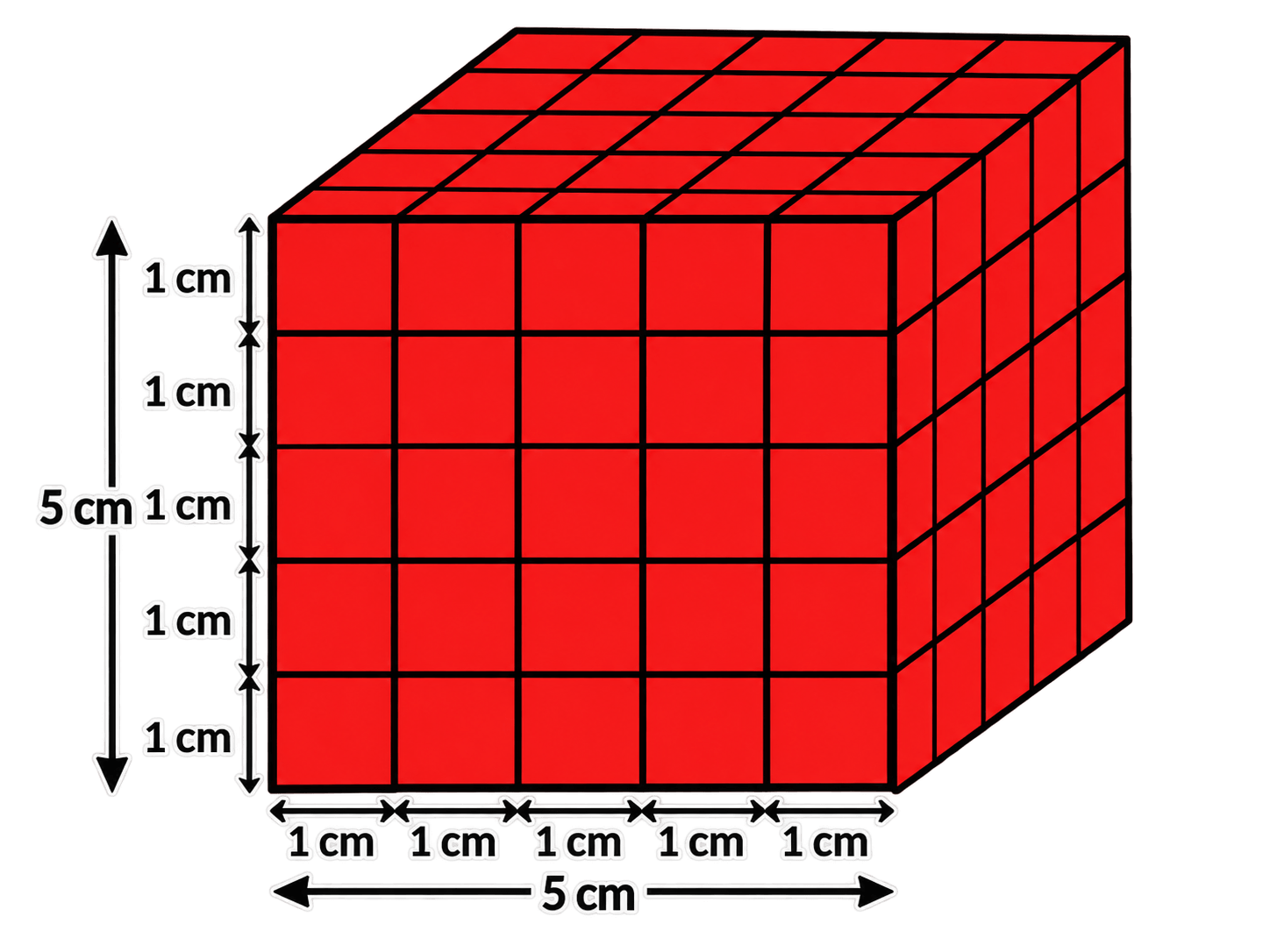
7. A cube of side 5 cm is painted on all its faces. If it is sliced into 1 cm³ cubes, how many of these 1 cm³ cubes have
(i) exactly three faces painted?
(ii) exactly two faces painted?
(iii) exactly one face painted?
(iv) no face painted?
Answer:
There are 5 small cubes along each edge.
(i) Exactly three faces painted:
These are the corner cubes. A cube has 8 corners.
So, exactly three faces painted = 8 cubes.
(ii) Exactly two faces painted:
These lie along the edges, excluding the corners.
Each edge has 5 − 2 = 3 such cubes. There are 12 edges.
Number = 12 × 3 = 36 cubes.
(iii) Exactly one face painted:
These lie in the middle of each face, away from the edges.
Each face has (5 − 2)² = 9 such cubes. There are 6 faces.
Number = 6 × 9 = 54 cubes.
(iv) No face painted:
These form the inner cube of side 5 − 2 = 3 cm.
Number = 3³ = 27 cubes.
8. Find a cuboid with edges whose lengths are integers (in cm), given that it has a total surface area of exactly 100 cm².
(i) Is there more than one such cuboid?
(ii) Can you find them all?
(iii) Show that you have found them all.
Answer:
Let the positive integer edge lengths be a ≤ b ≤ c.
2(ab + bc + ca) = 100, so ab + bc + ca = 50.
(i) Yes, there is more than one such cuboid.
(ii) The two different sets of dimensions are:
First cuboid: 1 cm, 2 cm, 16 cm.
Surface Area: 2(1 × 2 + 2 × 16 + 1 × 16) = 2(50) = 100 cm².
Second cuboid: 2 cm, 4 cm, 7 cm.
Surface Area: 2(2 × 4 + 4 × 7 + 2 × 7) = 2(50) = 100 cm².
(iii) Proof that these are all:
Since a ≤ b ≤ c, each of ab, ac and bc is at least a².
Thus, 3a² ≤ 50, so a can only be 1, 2, 3 or 4.
Rearrange the equation as (b + a)(c + a) = 50 + a².
- If a = 1: (b + 1)(c + 1) = 51.
The factor pairs are (1, 51) and (3, 17). Only (3, 17) gives positive b ≥ 1.
So b = 2 and c = 16. - If a = 2: (b + 2)(c + 2) = 54.
The factor pairs are (1, 54), (2, 27), (3, 18) and (6, 9).
Since b + 2 must be at least 4, only (6, 9) is allowed.
So b = 4 and c = 7. - If a = 3: (b + 3)(c + 3) = 59.
59 is prime, so no pair has both factors at least 6. - If a = 4: (b + 4)(c + 4) = 66.
The factor pairs are (1, 66), (2, 33), (3, 22) and (6, 11).
None has both factors at least 8.
Therefore, exactly two cuboids are possible, apart from rearranging their length, width and height.
Class 9 Maths Ganita Manjari Chapter 14 Exercise Set 14.2 Solutions
Exercise Set 14.2
1. Two cylinders, A and B, are given. The radius of cylinder B is twice that of cylinder A, and the height of cylinder B is half that of cylinder A. Find the ratio of the curved surface area of A to the curved surface area of B. Also find the ratio of the volume of A to the volume of B.
Answer:
Let A have radius r and height h. Then B has radius 2r and height h/2.
CSA of A = 2πrh.
CSA of B = 2π × 2r × h/2 = 2πrh.
Ratio of curved surface areas, A : B = 1 : 1.
Volume of A = πr²h.
Volume of B = π(2r)²(h/2) = 2πr²h.
Ratio of volumes, A : B = 1 : 2.
2. The radii of two cylinders are in the ratio 2:3, and their heights are in the ratio 3:2. Find (a) the ratio of their volumes, and (b) the ratio of their curved surface areas.
Answer:
(a) Volume = πr²h.
Ratio of volumes
= (2² × 3) : (3² × 2)
= 12 : 18
= 2 : 3.
(b) CSA = 2πrh.
Ratio of curved surface areas
= (2 × 3) : (3 × 2)
= 1 : 1.
3. The edge of a cube measures r cm. The largest possible right circular cylinder is cut out of the cube. What do you think is the volume of the cylinder (in cm³)?
Answer:
The circular base fits exactly inside a square face of the cube.
Its diameter is r, so the cylinder’s radius is r/2. Its height is r.
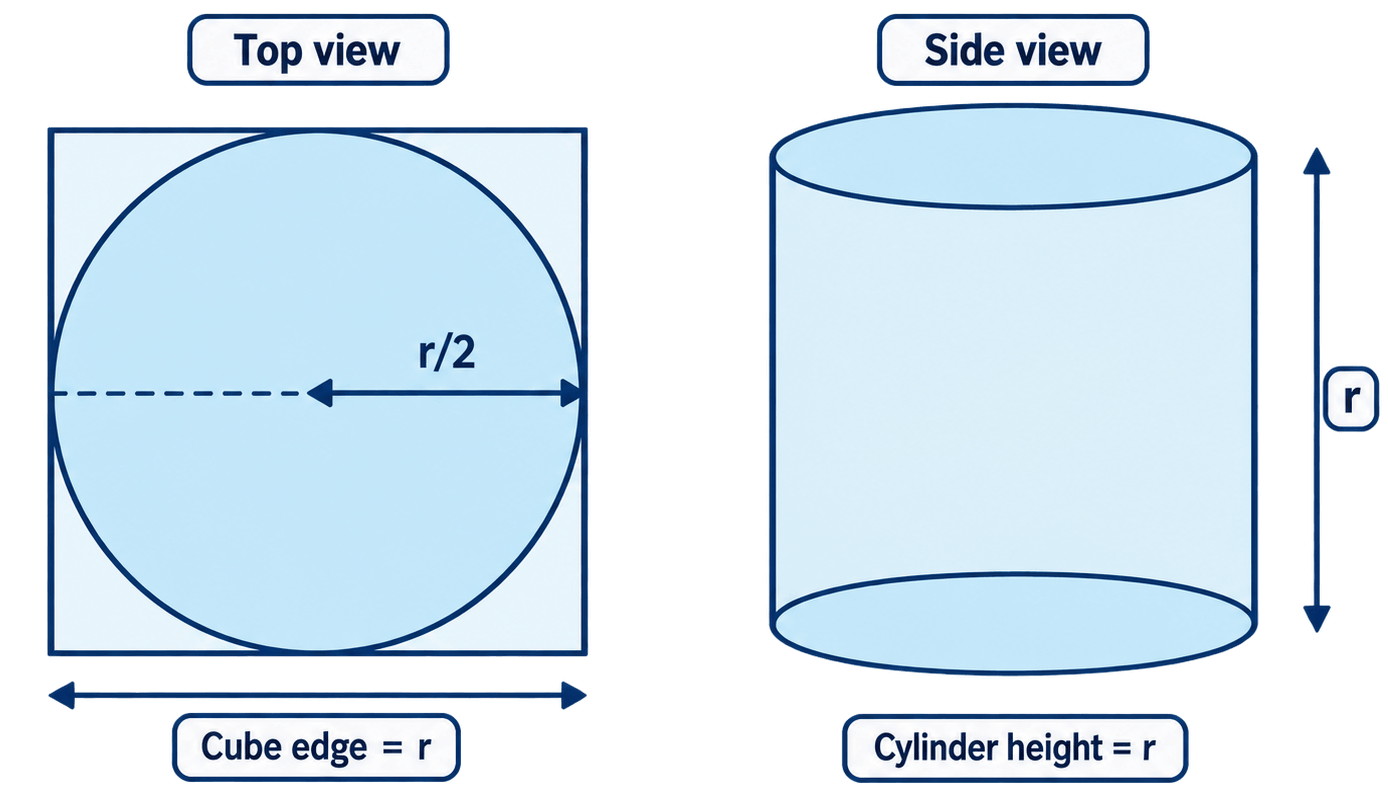
Volume = π × (r/2)² × r = πr³/4 cm³.
Hence, the volume of the cylinder is πr³/4 cm³, where r is the cube’s edge, not the cylinder’s radius.
4. The radius of the base of a cylinder is increased by 10%. At the same time, the height of the cylinder is decreased by x%. Given that the volume of the cylinder remains unchanged, find the value of x.
Answer:
New radius = 1.1r. New height = (1 − x/100)h.
Using V = πr²h and cancelling πr²h:
(1.1)²(1 − x/100) = 1.
⇒ 1 − x/100 = 1/1.21 = 100/121.
⇒ x/100 = 21/121.
⇒ x = 2100/121 ≈ 17.36.
Hence, the value of x is approximately 17.36.
5. A solid metallic cube of side 12 cm is melted and recast into solid cylindrical rods, each having radius 2 cm and height 12 cm. Find:
(i) the volume of the cube,
(ii) the volume of one cylindrical rod,
(iii) the approximate number of complete cylindrical rods that can be formed. (π ≈ 22/7)
Answer:
(i) Volume of cube = 12³ = 1728 cm³.
(ii) Volume of one rod = πr²h
= (22/7) × 2² × 12
= 1056/7 ≈ 150.86 cm³.
(iii) Number = 1728 ÷ (1056/7) = 126/11 ≈ 11.45.
Only 11 complete rods can be made. We must not round up, because there is not enough metal for a twelfth complete rod.
Hence, the number of cylindrical rods = 11, with some metal left over.
Class 9 Maths Ganita Manjari Chapter 14 Exercise Set 14.3 Solutions
Exercise Set 14.3
For π, use one of the following approximations: π ≈ 22/7 or π ≈ 3.14
1. Find the total surface area of a cone, if its slant height is 21 m and diameter of its base is 24 m.
Answer:
Radius = 24 ÷ 2 = 12 m; slant height l = 21 m.
TSA = πr(l + r)
= π × 12 × (21 + 12)
= 396π m².
Using π ≈ 22/7,
TSA ≈ 1244.57 m².
Hence, the total surface area of a cone is 396π m² or approximately 1244.57 m².
2. Find the curved surface area of a right circular cone whose slant height is 10 cm and base radius is 7 cm.
Answer:
CSA = πrl
= (22/7) × 7 × 10
= 220 cm².
Hence, the curved surface area of a right circular cone is approximately 220 cm².
3. The height of a cone is 16 cm, and its base radius is 12 cm. Find the curved surface area and the total surface area of the cone.
Answer:
Slant height l = √(h² + r²)
= √(16² + 12²)
= √400
= 20 cm.
CSA = πrl
= π × 12 × 20
= 240π ≈ 754.29 cm².
TSA = πr(l + r)
= π × 12 × 32
= 384π ≈ 1206.86 cm².
Hence, the curved surface area is 754.29 cm² and the total surface area of the cone is 1206.86 cm².
4. A cone has a height of 15 cm. If its volume is 1570 cm³, find the radius of the base.
Answer:
Use π ≈ 3.14 here.
V = ⅓πr²h.
⇒ 1570 = ⅓ × 3.14 × r² × 15 = 15.7r².
⇒ r² = 1570 ÷ 15.7 = 100.
⇒ r = 10 cm.
Hence, the radius of the base is 10 cm.
5. The curved surface area of a cone is 308 cm² and its slant height is 14 cm. Find (i) the radius of the base, (ii) the total surface area of the cone.
Answer:
(i) CSA = πrl.
⇒ 308 = (22/7) × r × 14 = 44r.
⇒ r = 7 cm.
(ii) TSA = CSA + πr²
= 308 + (22/7) × 7²
= 308 + 154
= 462 cm².
Hence, the radius of the base is 7 cm and the total surface area of the cone is 462 cm², using π ≈ 22/7.
6. A joker’s cap is in the form of a right circular cone of base radius 7 cm and height 24 cm. Find the area of the sheet required to make 10 such caps.
Answer:
l = √(7² + 24²) = √625 = 25 cm.
A cap is open at its base, so use only the curved surface area.
Area for one cap = πrl = (22/7) × 7 × 25 = 550 cm².
Area for 10 caps = 10 × 550 = 5500 cm².
Hence, the area of the sheet required to make 10 caps is approximately 5500 cm².
7. What length of tarpaulin 3 m wide is required to make a conical tent of height 8 m and base radius 6 m? Assume that the extra length of material that is required for stitching margins and wastage in cutting is 20 cm.
Answer:
l = √(8² + 6²) = √100 = 10 m.
The tent has no tarpaulin floor, so use CSA = πrl.
Required curved area = π × 6 × 10 = 60π m².
Length of 3 m wide tarpaulin = area ÷ width = 60π ÷ 3 = 20π m.
Extra length = 20 cm = 0.20 m.
Total length = 20π + 0.20 ≈ 63.0 m, using π ≈ 3.14.
Hence, the length of tarpaulin is approximately 63 m.
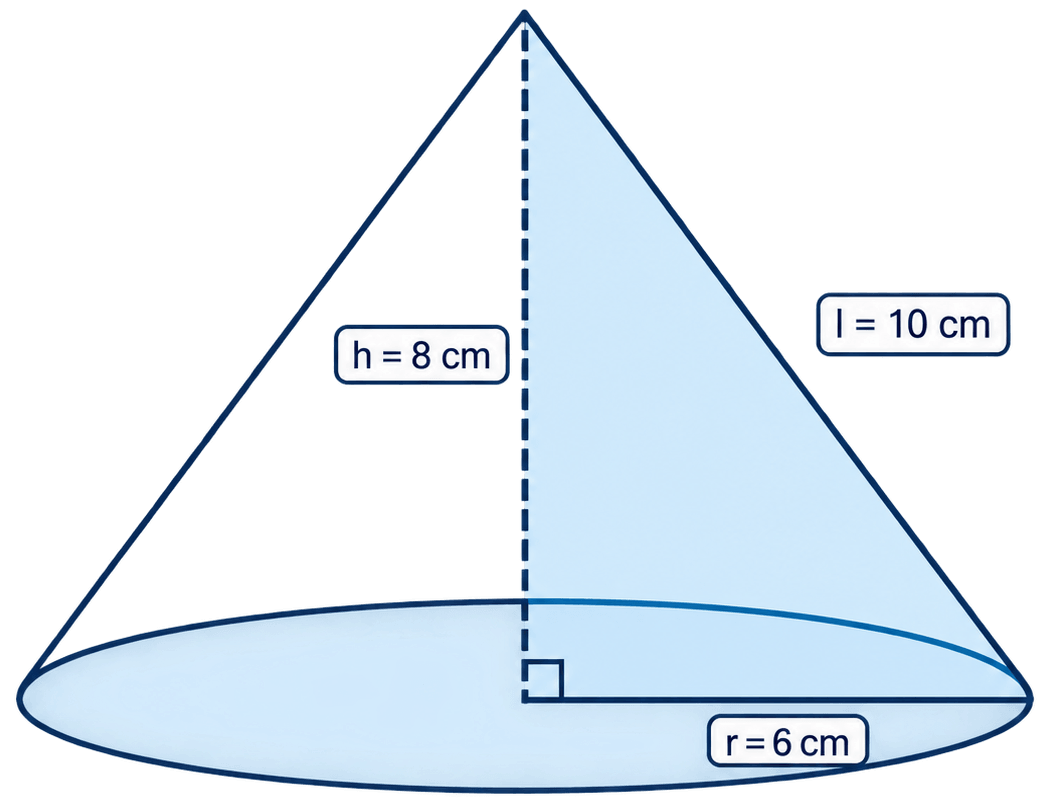
8. A right triangle with sides 6 cm, 8 cm and 10 cm is rotated through 360° about the side of 8 cm. Find the volume and the curved surface area of the solid so formed.
Answer:
The solid is a right circular cone.
The side about which the triangle rotates is its height: h = 8 cm.
The other perpendicular side becomes its radius: r = 6 cm.
The hypotenuse becomes its slant height: l = 10 cm.
Volume = ⅓πr²h
= ⅓ × π × 6² × 8
= 96π ≈ 301.71 cm³.
CSA = πrl
= π × 6 × 10
= 60π ≈ 188.57 cm².
Hence, the volume is 301.71 cm³ and the curved surface area of the solid is 188.57 cm².
9. Suppose you have a cup in the shape of a right circular cone. Fill it with water to half the depth of the cone. What fraction of the volume of the cup is occupied by the water?

Answer:
The cup is held with its pointed end down, as in the textbook picture.
Let the full cone have radius r and height h.
At half the height, the radius is also halved, because the water forms a smaller cone of the same shape.
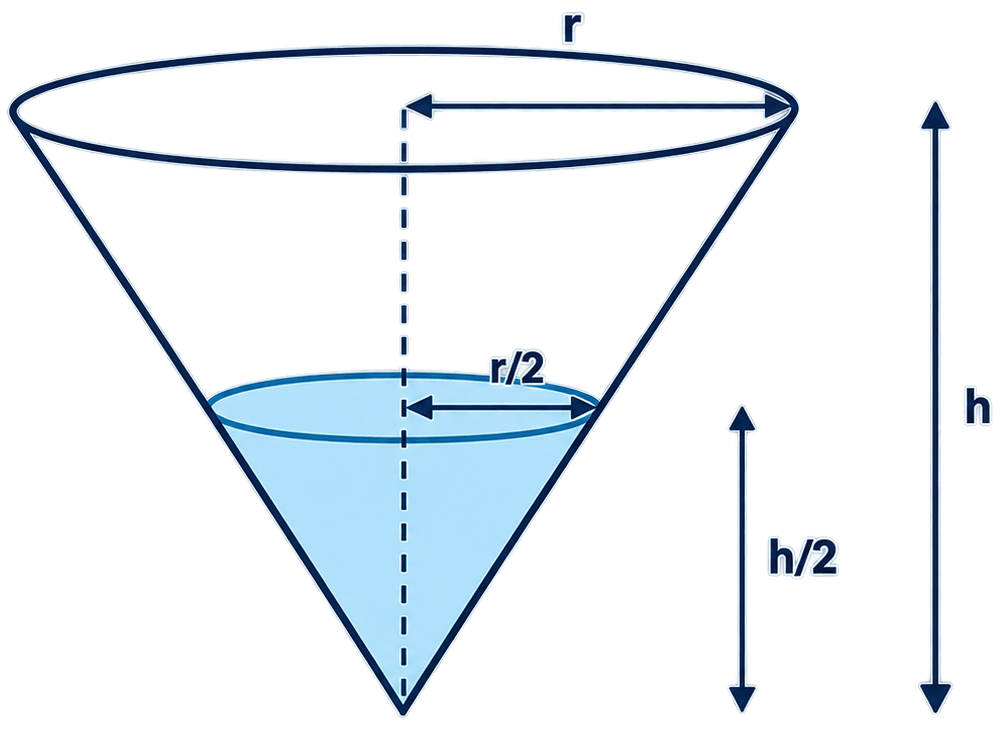
Volume of water = ⅓π(r/2)²(h/2) = ⅛ × ⅓πr²h.
Therefore, volume of water ÷ volume of cup = 1/8.
Hence, the fraction of the volume of the cup is occupied by the water is one-eighth of the cup’s volume.
Class 9 Maths Ganita Manjari Chapter 14 Exercise Set 14.4 Solutions
Exercise Set 14.4
1. A ball bearing has a radius of 0.7 cm. Find its surface area.
Answer:
Surface area = 4πr²
= 4 × (22/7) × 0.7²
= 6.16 cm².
Hence, the surface area is approximately 6.16 cm².
2. Two solid spheres made of the same metal have weights 5920 g and 740 g. Determine the radius of the larger sphere, if the diameter of the smaller one is 5 cm.
Answer:
Since the spheres are made of the same metal, their volumes are in the same ratio as their weights.
Volume ratio = 5920 : 740 = 8 : 1.
Using V = (4/3)πr³, the ratio of radii is ∛8 : ∛1 = 2 : 1.
Smaller radius = 5 ÷ 2 = 2.5 cm.
Larger radius = 2 × 2.5 = 5 cm.
Hence, the radius of the larger sphere is 5 cm.
3. The diameter of the moon is approximately one fourth the diameter of the earth. Given that the moon and earth are both roughly spherical, find the ratio of their surface areas.
Answer:
Ratio of radii, moon : earth = 1 : 4.
Surface area = 4πr², so the ratio of areas = 1² : 4² = 1 : 16.
Hence, the ratio of their surface areas is (Moon’s surface area : Earth’s surface area) 1 : 16.
4. Find (i) the curved surface area and (ii) the total surface area of a hemisphere of radius 21 cm.
Answer:
(i) CSA = 2πr²
= 2 × (22/7) × 21²
= 2772 cm².
(ii) TSA = 3πr²
= 3 × (22/7) × 21²
= 4158 cm².
The total area includes the flat circular base.
Hence, the curved surface area is 2772 cm² and the total surface area is 4158 cm².
5. Metal spheres, each of radius 2 cm, are packed into a rectangular box of internal dimensions 16 cm × 8 cm × 8 cm. When 16 spheres are packed, the box is filled with preservative liquid. Find the volume of this liquid. Round your answer to the nearest integer.
Answer:
Volume of box = 16 × 8 × 8 = 1024 cm³.
Volume of one sphere = (4/3)π × 2³ = 32π/3 cm³.
Volume of 16 spheres = 512π/3 cm³.
Volume of liquid = 1024 − 512π/3.
Using π ≈ 22/7 gives approximately 487.62 cm³.
Rounded to the nearest integer, the volume is 488 cm³.
Hence, the volume of this liquid is 488 cm³.
6. The radius of a sphere is increased by 10%. Show that the volume increases by approximately 33.1%.
Answer:
New radius = 1.1r.
Old volume = (4/3)πr³.
New volume = (4/3)π(1.1r)³ = 1.331 × old volume.
Increase = (1.331 − 1) × old volume = 0.331 × old volume.
Percentage increase = 0.331 × 100 = 33.1%.
Hence proved.
7. The radius of a sphere is increased by x%. The volume of the sphere increases by 72.8%. Find the value of x.
Answer:
New volume ÷ old volume = 1 + 72.8/100 = 1.728.
Since volume is proportional to r³:
(1 + x/100)³ = 1.728 = 1.2³.
⇒ 1 + x/100 = 1.2.
⇒ x = 20.
Hence, the value of x is 20.
8. The hemispherical dome of a building needs to be painted (see Fig. 14.16). If the circumference of the base of the dome is 35.2 m, find the cost of painting it, given the cost of painting is ₹ 10 per 100 cm².

Answer:
2πr = 35.2.
r = 35.2 ÷ (2 × 22/7) = 5.6 m.
Only the curved surface of the dome is painted.
CSA = 2πr² = 2 × (22/7) × 5.6² = 197.12 m².
1 m² = 10000 cm².
Area = 197.12 × 10000 = 19,71,200 cm².
Cost = (19,71,200 ÷ 100) × ₹10 = ₹1,97,120.
Hence, the cost of painting is ₹1,97,120.
Class 9 Maths Ganita Manjari Chapter 14 End-of-Chapter Exercises Solutions
End-of-Chapter Exercises
For guesstimate problems, make a guess first before solving.
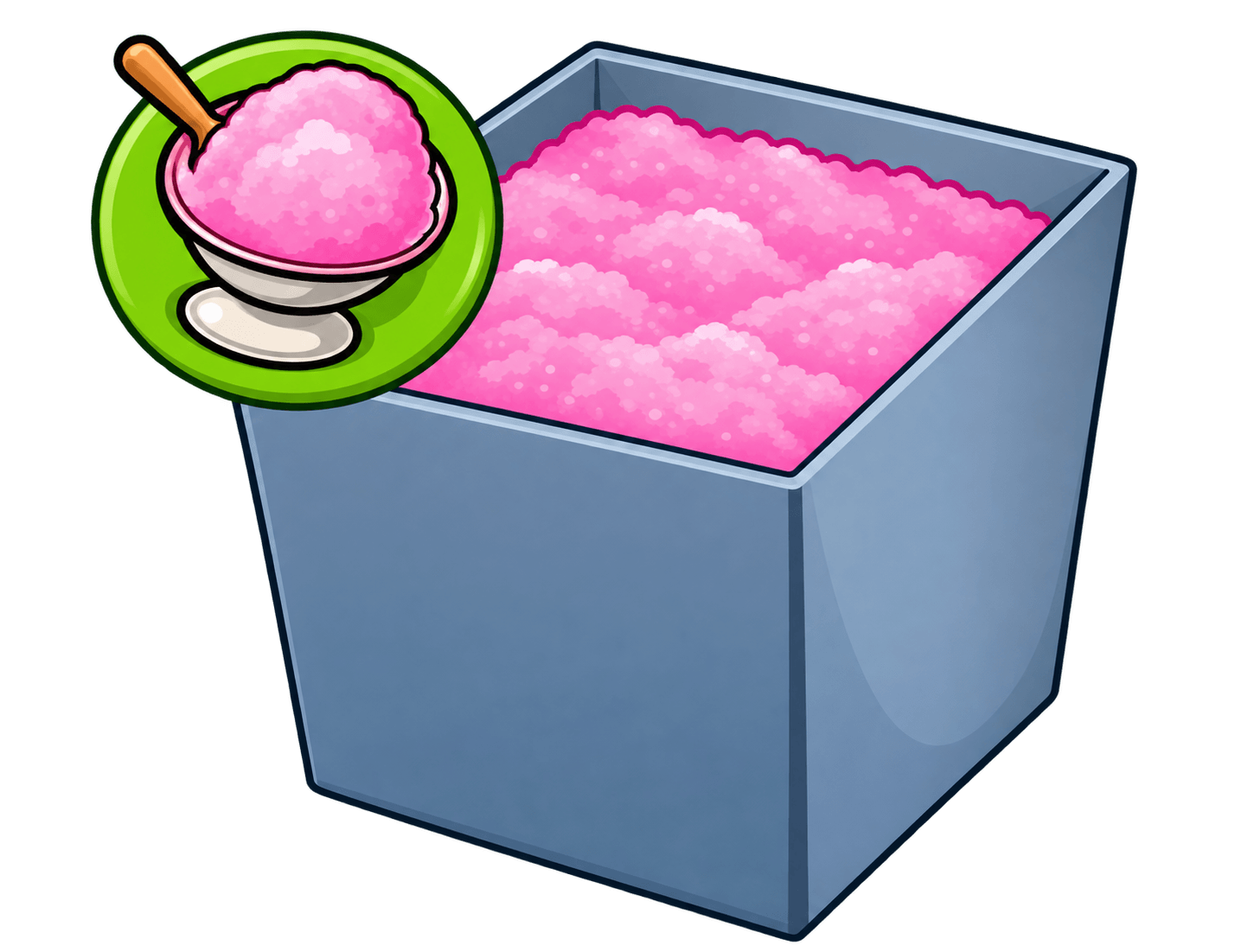
1. Estimate how many scoops of ice cream can be obtained from a cuboidal container of dimensions 10 cm × 15 cm × 20 cm.
Answer:
My first guess: About 100 scoops.
Assume a full container, no wastage and each scoop approximately a sphere of radius 2 cm.
Container volume = 10 × 15 × 20 = 3000 cm³.
Volume of one scoop = (4/3)π × 2³ = 32π/3 ≈ 33.52 cm³.
Number of scoops ≈ 3000 ÷ 33.52 ≈ 89.5.
Hence, estimate is about 90 scoops. The answer will change with the scoop size.
2. A cube of integer side length a is made of unit cubes. Write an expression giving the number of unit cubes to be added to make a cube of side length a + 1.
Answer:
Original number of unit cubes = a³.
New number = (a + 1)³.
Number to add = (a + 1)³ − a³
= a³ + 3a² + 3a + 1 − a³
= 3a² + 3a + 1.
Hence, the added unit cubes are 3a² + 3a + 1.
3. Solve the following:
(i) Could a person drink enough water in a lifetime to fill an entire room the size of your classroom?
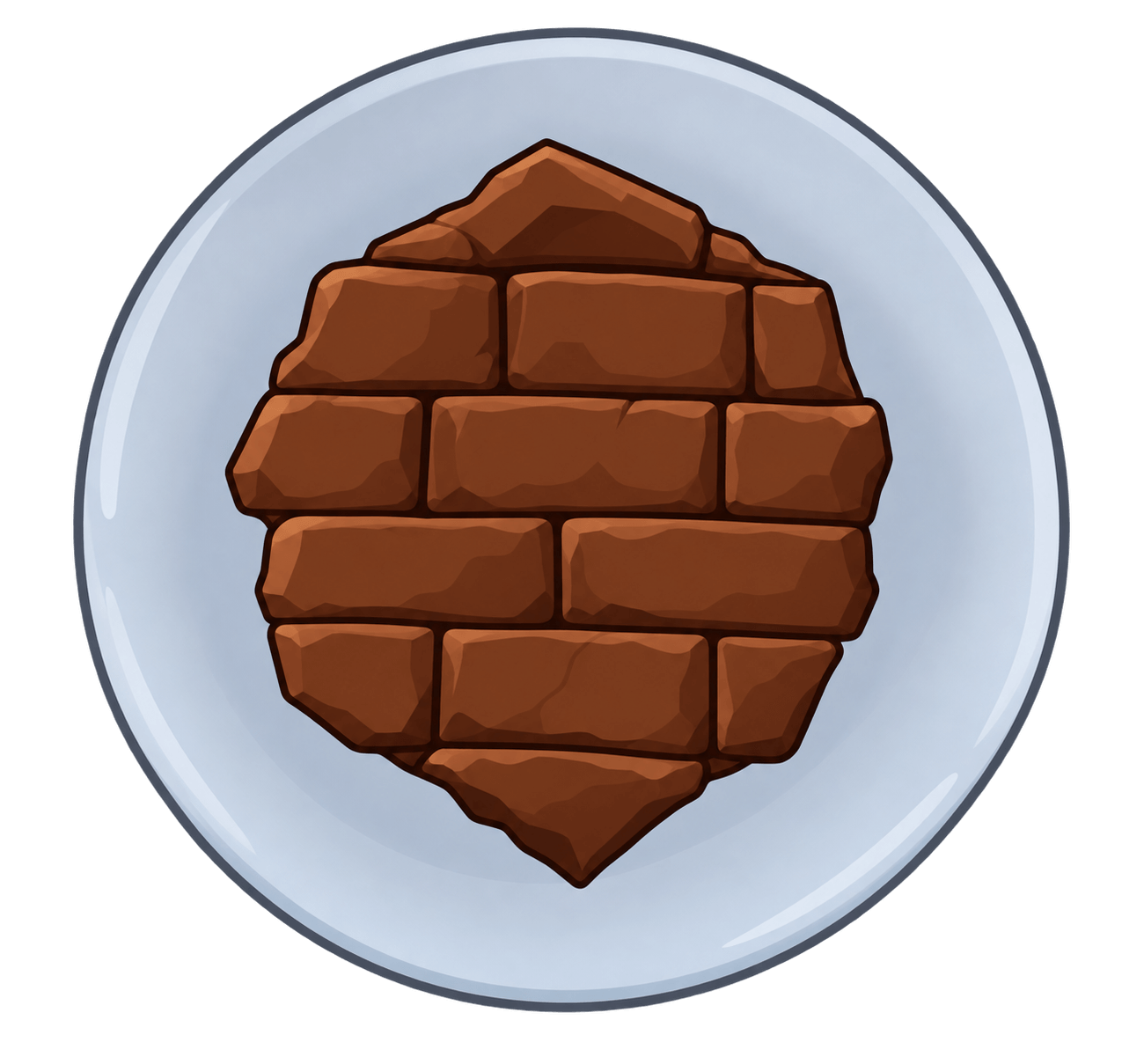
(ii) Estimate the number of bricks used to build the walls of your classroom.
Answer:
(i) My first guess: No, for a normal-sized classroom.
For this estimate, assuming a person drinks 2 litres daily for 70 years.
Water drunk = 2 × 365 × 70 = 51100 litres = 51.1 m³.
Assuming the classroom measures 8 m × 6 m × 3 m.
Room volume = 8 × 6 × 3 = 144 m³ = 144000 litres.
Since 51100 < 144000, the water would not fill this classroom.
It would fill about 51100/144000 ≈ 35.5% of it.
(ii) My first guess: About 8000 bricks.
Assuming internal dimensions 8 m × 6 m, wall height 3 m and wall thickness 0.20 m.
Outer dimensions = 8.4 m × 6.4 m.
Volume of all four walls before subtracting openings:
[(8.4 × 6.4) − (8 × 6)] × 3 = 17.28 m³.
Assuming one door of size 1 m × 2 m and two windows of size 1.5 m × 1.2 m.
Volume of openings = [1 × 2 + 2 × 1.5 × 1.2] × 0.20 = 1.12 m³.
Net wall volume = 17.28 − 1.12 = 16.16 m³.
Assuming each brick together with its share of mortar occupies 0.20 m × 0.10 m × 0.10 m = 0.002 m³.
Number of bricks ≈ 16.16 ÷ 0.002 = 8080.
Hence, the number of bricks used to build the walls of your classroom is about 8100.
4. You are given two options: (A) one chocolate cube of side 50 mm, (B) hundred chocolate cubes of side 10 mm. Which option gives you more chocolate?
Answer:
Volume in A = 50³ = 125000 mm³.
Volume in B = 100 × 10³ = 100000 mm³.
Difference = 25000 mm³.
Hence, option A gives more chocolate. It gives 25% more than B.
5. If all the people in the world are crowded together in one location, how much area would it cover?

Answer:
My first guess: A few thousand square kilometres.
For a simple guesstimate, assume a rounded population of 8 billion people. This is an assumed number for the exercise, not an exact current population count.
Allow each person a ground area of 0.5 m × 0.5 m = 0.25 m².
Total area ≈ 8,000,000,000 × 0.25 = 2,000,000,000 m².
Since 1 km² = 1,000,000 m², the area is about 2000 km².
Hence, the estimate is about 2000 km², without additional space for paths or facilities.
6. A school provides milk to its students in cylindrical glasses, each with a diameter of 7 cm. If each glass is filled with milk to a height of 12 cm, how many litres of milk are needed to serve 1600 students? Use 1000 cm³ = 1 litre.
Answer:
Radius of each glass = 7/2 = 3.5 cm.
Milk in one glass = πr²h
= (22/7) × 3.5² × 12
= 462 cm³.
Milk for 1600 students
= 462 × 1600
= 739200 cm³.
In litres = 739200 ÷ 1000 = 739.2 litres.
Hence, 739.2 litres of milk needed for 1600 students.
7. The surface area of a sphere of radius 5 cm is five times the area of the curved surface of a cone of radius 4 cm. Find the height and the volume of the cone.
Answer:
Sphere’s surface area = 4π × 5² = 100π cm².
Let the cone’s slant height be l.
100π = 5 × π × 4 × l = 20πl.
Therefore, l = 5 cm.
Height h = √(l² − r²) = √(5² − 4²) = 3 cm.
Volume = ⅓πr²h = ⅓ × π × 4² × 3 = 16π cm³ ≈ 50.29 cm³.
Hence, the height is 3 cm and volume is 16π cm³ or approximately 50.29 cm³.
8. Take Earth to be a perfect sphere with radius 6370 km. Take Jupiter to be a perfect sphere with radius 69,900 km. Take the Sun to be a perfect sphere with radius 6,95,700 km.
Compute approximately:
(i) the ratio of the volume of Jupiter to the volume of the Earth;
(ii) the ratio of the volume of the Sun to the volume of the Earth.
(Calculator can be used.)
Answer:
For spheres, V = (4/3)πr³. The common factor (4/3)π cancels in a ratio.
(i) Jupiter : Earth = (69900/6370)³ : 1 ≈ 1321.34 : 1.
Thus, Jupiter’s volume is about 1321 times Earth’s volume.
(ii) Sun : Earth = (695700/6370)³ : 1 ≈ 1302709.90 : 1.
Thus, the Sun’s volume is about 13,02,710 times Earth’s volume.
9. Show that the volume of a sphere is equal to 2/3 of the volume of the smallest cylinder which encloses it.
Answer:
Let the sphere’s radius be r.
The smallest enclosing cylinder has radius r and height 2r.
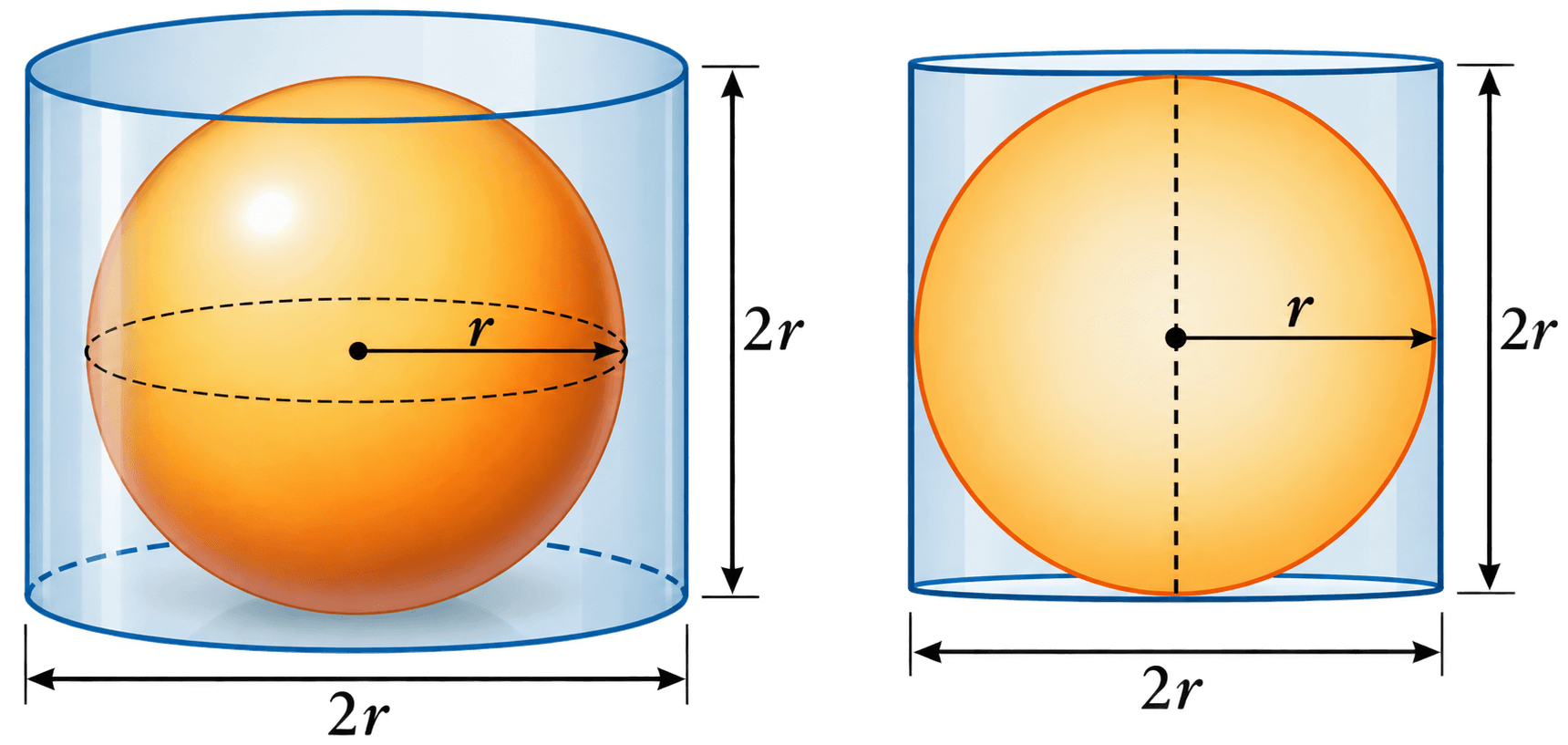
Volume of sphere = (4/3)πr³.
Volume of cylinder = πr² × 2r = 2πr³.
Ratio = [(4/3)πr³] ÷ [2πr³] = 2/3.
Hence, the sphere’s volume is two-thirds of the cylinder’s volume.
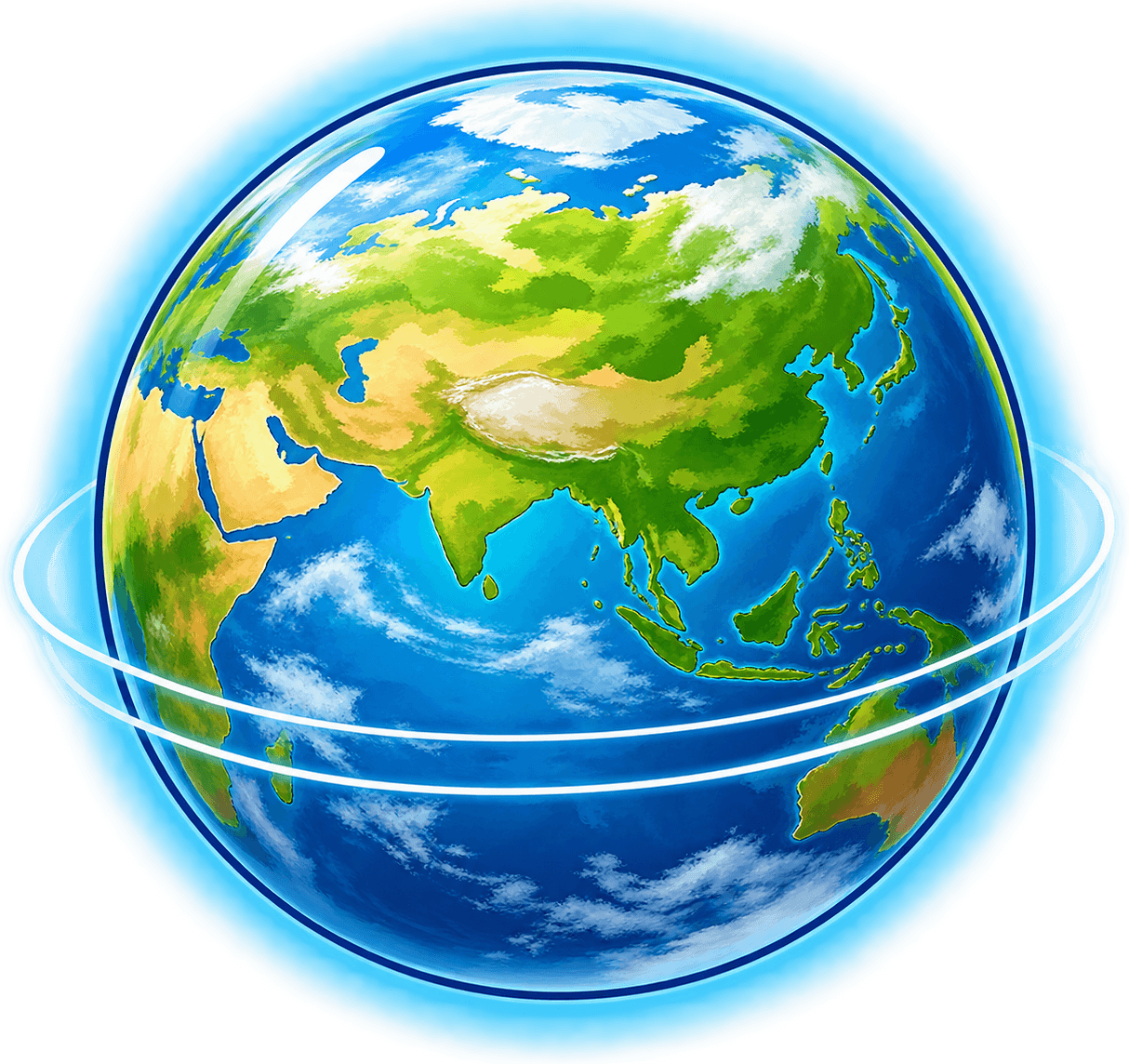
10. Suppose the Earth is perfectly spherical. A string is wrapped tightly around the equator of the Earth. Another string, 1 metre longer, is placed around the Earth so that it forms a larger circle, staying the same distance above the ground everywhere.
How high above the ground is the second string?
Repeat this for: (i) the Moon (ii) Jupiter (iii) a volleyball. Are you surprised by the three answers? Why or why not?
Answer:
Let the original radius be R metres and the extra height be x metres.
Original string length = 2πR.
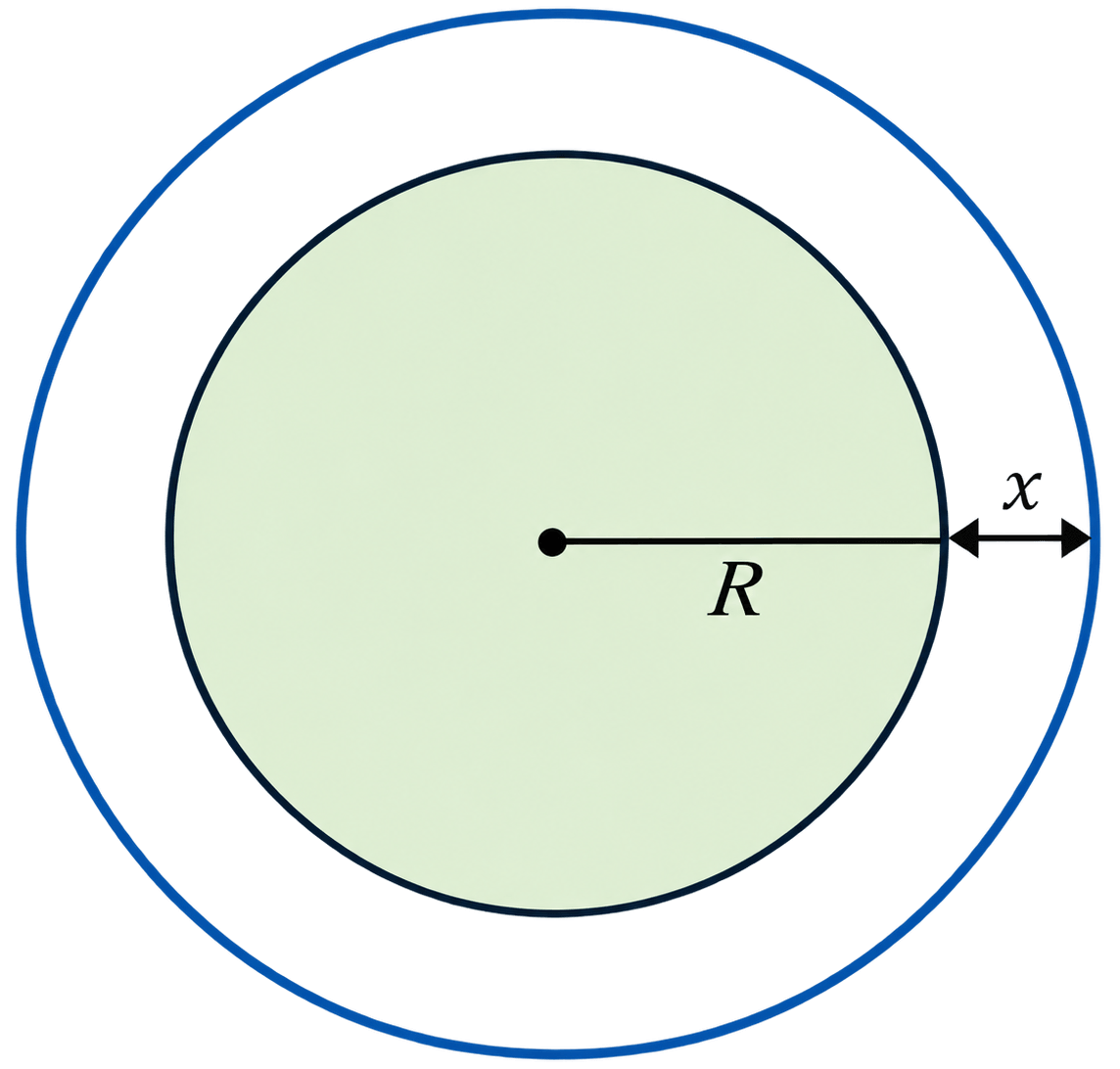
New string length = 2π(R + x).
Difference = 1 metre, so:
2π(R + x) − 2πR = 1.
⇒ 2πx = 1.
⇒ x = 1/(2π) m ≈ 0.159 m ≈ 15.9 cm.
Answer for Earth: About 15.9 cm.
(i) Moon: About 15.9 cm.
(ii) Jupiter: About 15.9 cm.
(iii) Volleyball: About 15.9 cm.
At first this seems surprising because the objects have very different sizes. But R cancels from the calculation. The gap depends only on the extra string length, not on the original radius.
11. We have a cylinder with a base radius of r cm and height h cm. A square pyramid is fitted inside it. The square base of the pyramid lies on the base of the cylinder, its corners on the boundary of the cylinder. The apex of the pyramid lies on the top of the cylinder. Find the ratio of the volume of this pyramid to the volume of the cylinder.
Answer:
The diagonal of the square base is the diameter of the circle, 2r.
Let the square’s side be a. By the Baudhayana–Pythagoras theorem:
a² + a² = (2r)².
2a² = 4r², so a² = 2r².
Thus, the square’s area is 2r².
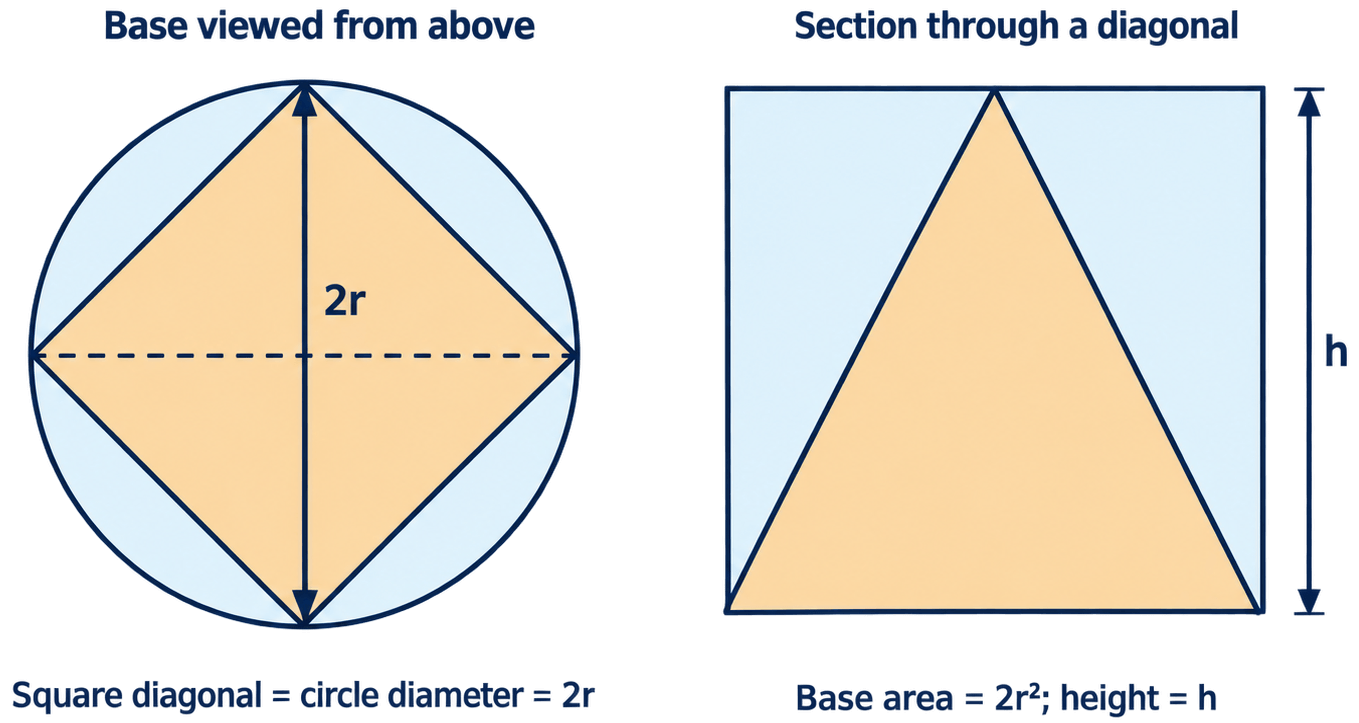
The pyramid’s perpendicular height is h.
Volume of pyramid = ⅓ × base area × height = (2/3)r²h.
Volume of cylinder = πr²h.
Ratio, pyramid : cylinder = (2/3)r²h : πr²h = 2 : 3π.
Hence, the ratio of the volume of this pyramid to the volume of the cylinder is 2 : 3π or approximately 7 : 33 if π ≈ 22/7.
12. What is the change in volume when:
(i) the length of a cuboid with dimensions l, w, h is increased by 1 unit?
(a) 1 cubic unit
(b) (lwh + 1) cubic unit
(c) wh cubic units
(d) lw cubic units
(e) lh cubic units
(ii) the radius of a cylinder with dimensions r, h is increased by 1 unit?
(a) 1 cubic unit
(b) πr²h cubic units
(c) πr² cubic units
(d) 2πrh + 2πh cubic units
(e) 2πrh + πh cubic units
(iii) the radius of a sphere is decreased by 1 unit?
Answer:
(i) Old volume = lwh.
New volume = (l + 1)wh.
Increase = (l + 1)wh − lwh = wh cubic units.
Correct option: (c).
(ii) Old volume = πr²h.
New volume = π(r + 1)²h.
Increase = πh[(r + 1)² − r²]
= πh(2r + 1)
= 2πrh + πh cubic units.
Correct option: (e).
(iii) Let the original radius be r units, with r ≥ 1.
Old volume = (4/3)πr³.
New volume = (4/3)π(r − 1)³.
Decrease = (4/3)π[r³ − (r − 1)³]
= (4/3)π(3r² − 3r + 1) cubic units.
Equivalently, the change “new volume − old volume” is the negative of this quantity.
13. Given a cube with volume V, express its total surface area S in terms of V.
Answer:
If its side is a, then V = a³, so a = ∛V.
S = 6a² = 6(∛V)².
Hence, the total surface area S in terms of V is given by 6V^(2/3) or S = 6(∛V)².
14. Given a cube with total surface area S, express its volume V in terms of S.
Answer:
S = 6a², so a = √(S/6).
V = a³ = [√(S/6)]³.
Hence, the volume V in terms of S is given by (S/6)^(3/2) or V = [√(S/6)]³.
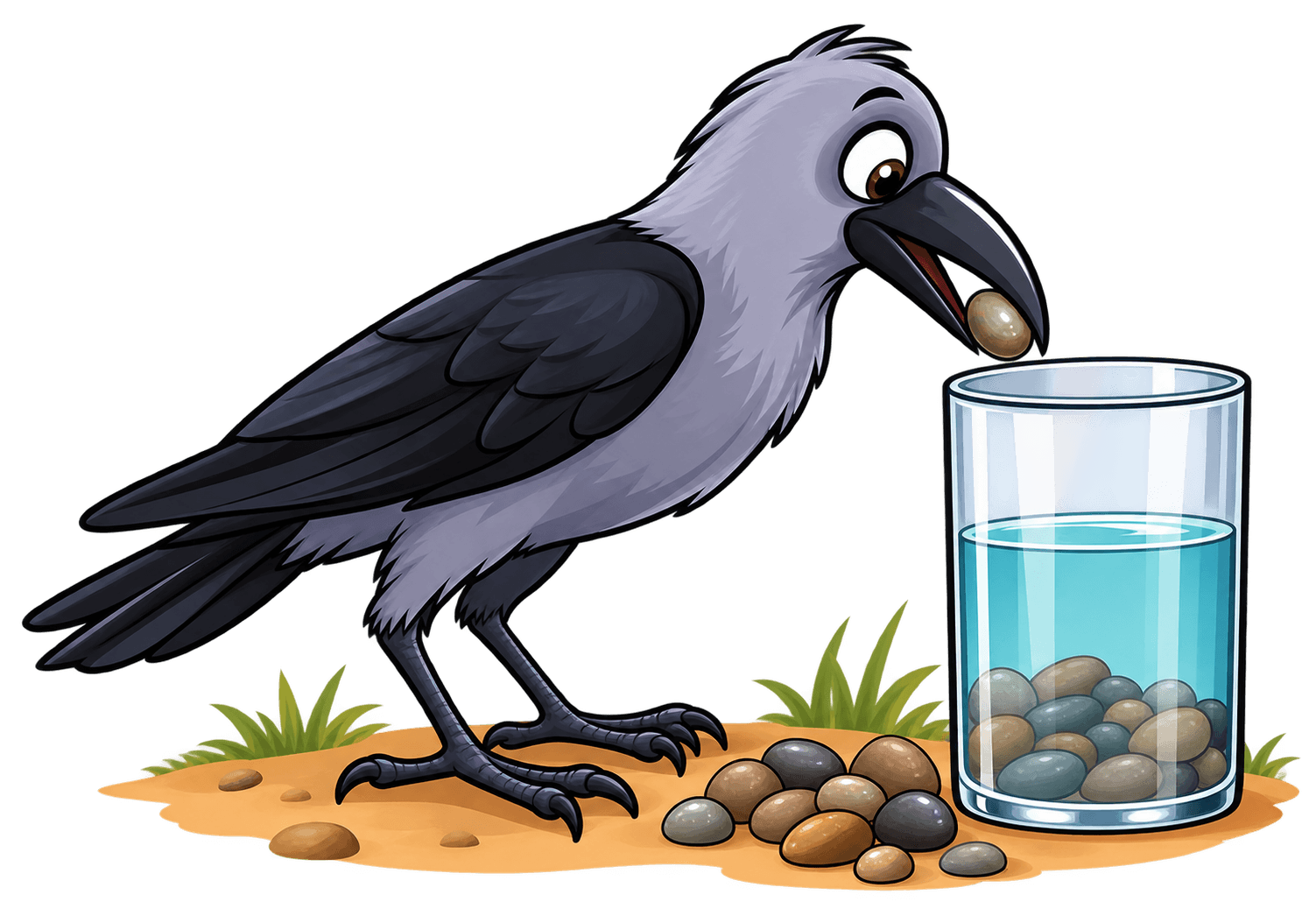
15. A cylindrical glass of height 25 cm and radius 4 cm has water up to a height of 16 cm. A crow wants to drink water from this glass. The water must be at a height of 20 cm for the crow to reach it. There are some marbles lying around. How many marbles of radius 1 cm should the crow drop into the glass to make the water reach the required height?
Answer:
Required rise = 20 − 16 = 4 cm.
The marbles must displace a water volume equal to the cylindrical space for this rise.
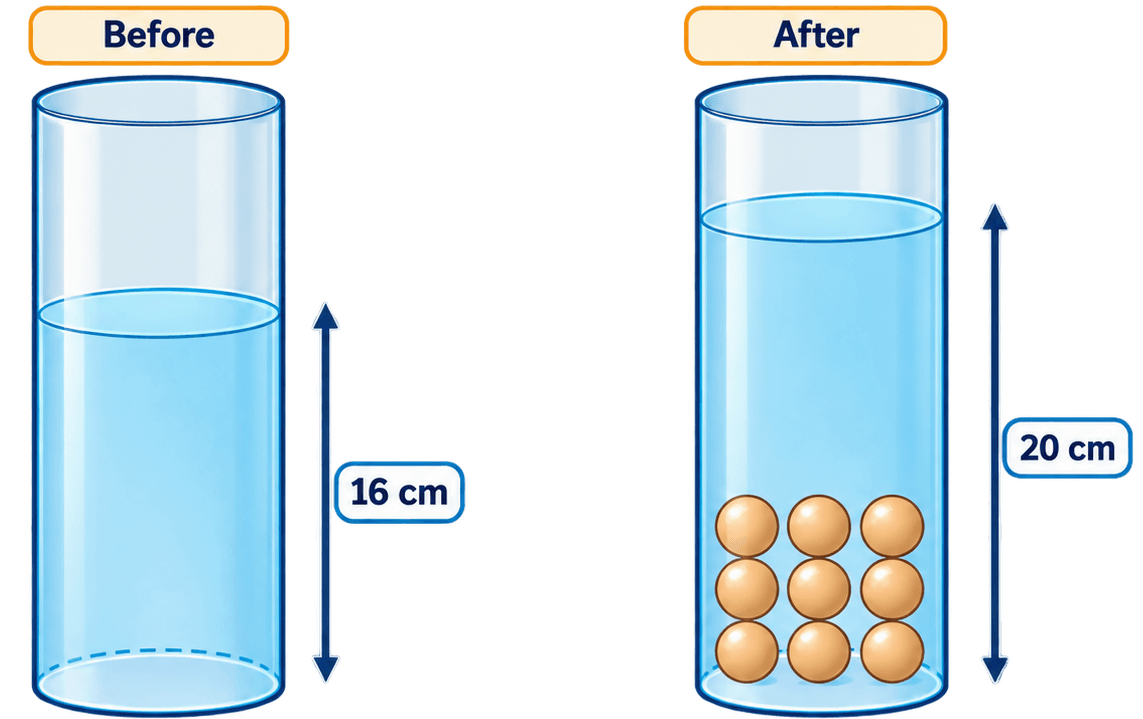
Required displacement = π × 4² × 4 = 64π cm³.
Volume of one marble = (4/3)π × 1³ = 4π/3 cm³.
Number of marbles = 64π ÷ (4π/3) = 48.
Hence, the number of marbles are 48.
16. Find the volume of ink in a new ball point pen. Take the necessary measurements and make approximations, as needed.
Answer:
My first guess: About 0.3 mL.
So measurements: Assume the ink-filled part of the refill is a cylinder of internal diameter 2 mm and length 8 cm.
Internal radius = 1 mm = 0.1 cm.
Ink volume ≈ πr²h = π × 0.1² × 8 = 0.08π ≈ 0.251 cm³.
Since 1 cm³ = 1 mL, this is about 0.25 mL.
Estimate: About 0.25 mL for these assumed measurements, ignoring the small tip region.
17. Solve:
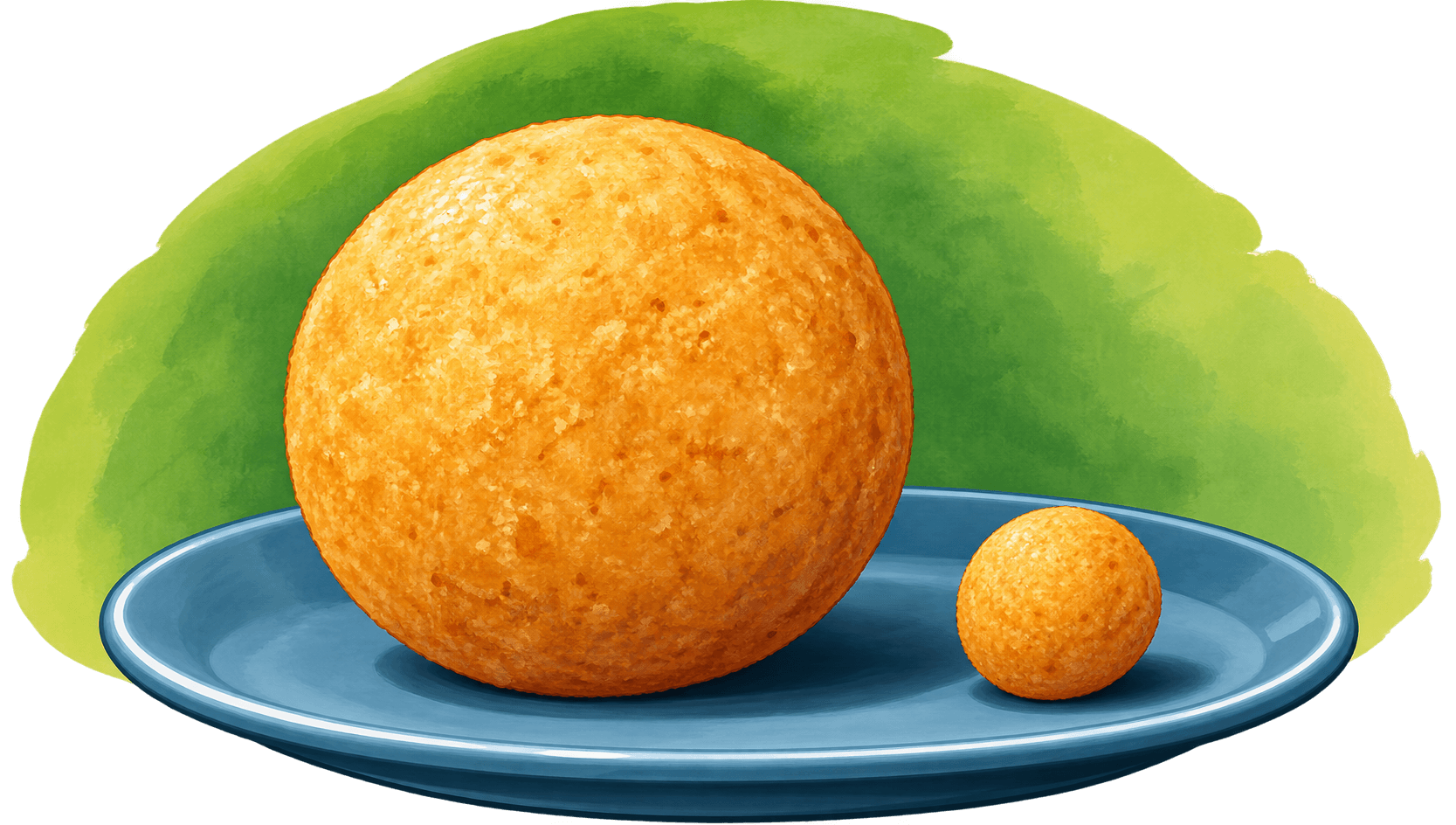
(i) A ball of chapati dough of radius 6 cm is prepared. Estimate how many chapatis can be made from it?
(ii) Cut a coconut/muskmelon in half and find out the approximate volume of edible coconut flesh/fruit by taking the necessary measurements.
Answer:
(i) My first guess: About 40 small chapatis.
Assume each uncooked chapati is a thin cylinder of radius 6 cm and thickness 0.2 cm, with no dough wasted.
Volume of dough ball = (4/3)π × 6³ = 288π cm³.
Volume of one chapati = π × 6² × 0.2 = 7.2π cm³.
Number ≈ 288π ÷ 7.2π = 40.
Estimate: About 40 chapatis of these assumed dimensions.
(ii) My first guess: About 130 cm³ of flesh in one half of a coconut.
Sample measurements: Model the half coconut as a hemispherical layer. Assume the outer radius of the edible flesh, just inside the hard shell, is R = 5 cm and the radius of the empty inner cavity is r = 4 cm.
Volume of edible flesh in one half:
V ≈ (2/3)π(R³ − r³)
= (2/3)π(5³ − 4³)
= 122π/3 ≈ 127.81 cm³.
Estimate: About 128 cm³ in one half or about 256 cm³ in two similar halves, using π ≈ 22/7.
18. Looking at the Ganita Manjari, Grade 9, Part 2 textbook, Sheela wonders:
(i) If all the pages of this textbook were laid out side-by-side on the floor would they cover the entire classroom floor?
(ii) What is the maximum number of textbooks that can fit in an empty storeroom of dimensions 15 ft × 20 ft × 30 ft?
Answer:
(i) My first guess: No.
Assume each paper sheet is 25 cm × 20 cm and the book has 200 numbered pages, which are 100 physical sheets. Ignoring the covers.
Area of one sheet = 25 × 20 = 500 cm².
Area of all sheets = 100 × 500 = 50000 cm² = 5 m².
Assume the classroom floor is 8 m × 6 m = 48 m².
Since 5 < 48, the sheets will not cover the classroom floor.
(ii) My first guess: About 2 lakh books.
Assume one closed textbook measures 25 cm × 20 cm × 2 cm.
For this estimate, use 1 ft ≈ 30 cm.
Storeroom dimensions ≈ 450 cm × 600 cm × 900 cm.
Arrange books with the 25 cm side along 450 cm, the 20 cm side along 600 cm and the 2 cm thickness along 900 cm.
Number = (450 ÷ 25) × (600 ÷ 20) × (900 ÷ 2)
= 18 × 30 × 450
= 2,43,000.
This arrangement fills the assumed cuboid without gaps. It also equals the room-volume/book-volume upper limit, so it is the maximum under these idealised dimensions.
Estimate: About 2.43 lakh textbooks, with no space left for movement. The actual result requires actual book dimensions and more precise room measurements.
19. If the entire human population decided to climb into one giant cube, how long would the side have to be?

Answer:
My first guess: A few kilometres.
Assume a rounded population of 8 billion and allow 1 m³ of space per person, including some empty space. Ignore walls and floors in this volume estimate.
Required volume ≈ 8,000,000,000 m³.
If the cube’s side is a metres:
a³ = 8,000,000,000.
a = ∛(8 × 10⁹) = 2000 m = 2 km.
Estimate: A cube about 2 km on each side, under these assumptions.
20. The Earth’s surface has an estimated volume of 1.38 billion km³ of water. Suppose the Earth is a perfect sphere and all this water forms a uniform layer completely covering the Earth’s surface, like a thin water bubble. Estimate the thickness of this water layer. The Earth’s radius is ~6371 km.
(i) Write an expression that gives the thickness of this water layer.
(ii) Simplify the expression in (i) using a calculator.
Answer:
My first guess: A few kilometres.
Let Earth’s radius be R = 6371 km and the water thickness be t km.
Water volume W = 1.38 × 10⁹ km³.
The outer radius is R + t.
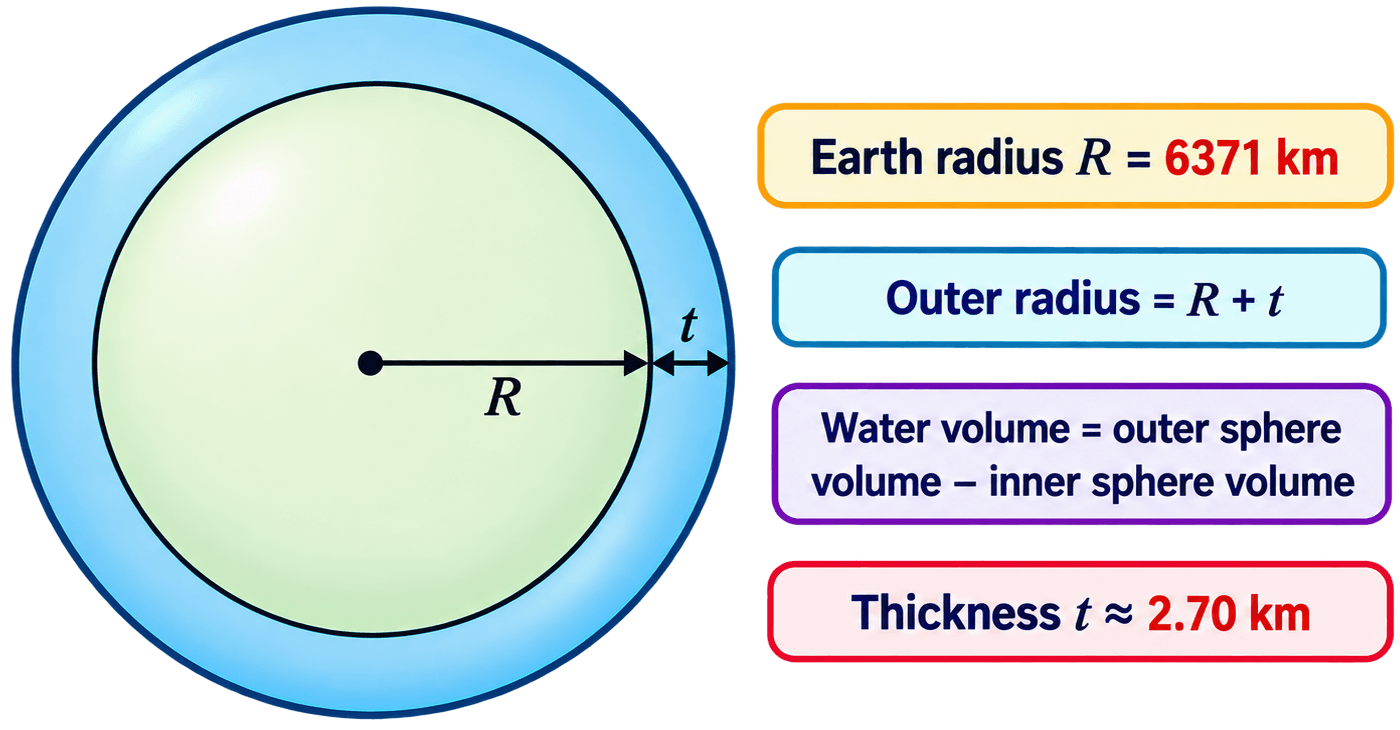
(i) Subtract the volume of Earth from the volume enclosed by the outer water surface:
W = (4/3)π[(R + t)³ − R³].
(R + t)³ = R³ + 3W/(4π).
Required expression:
t = ∛[R³ + 3W/(4π)] − R
= ∛[6371³ + (3 × 1.38 × 10⁹)/(4π)] − 6371 km.
(ii) Using a calculator’s value of π:
t ≈ 2.704392 km.
Estimate: About 2.70 km or about 2704 m.
21. Give the dimension of a cuboid whose volume is halved when its surface area is doubled.
Answer:
One possible example is to change a cuboid of dimensions 8 cm × 14 cm × 14 cm into a cuboid of dimensions 1 cm × 28 cm × 28 cm.
Original cuboid:
Volume = 8 × 14 × 14 = 1568 cm³.
TSA = 2(8 × 14 + 8 × 14 + 14 × 14)
= 2(112 + 112 + 196) = 840 cm².
New cuboid:
Volume = 1 × 28 × 28 = 784 cm³ = 1568/2 cm³.
TSA = 2(1 × 28 + 1 × 28 + 28 × 28)
= 2(28 + 28 + 784) = 1680 cm² = 2 × 840 cm².
Thus, the new volume is half and the new surface area is double. This is one example; the dimensions are not unique.
22. Project: Find the volume of your house making necessary approximations. Present how you solved it.
Answer:
Aim: Estimate the internal volume of a single-storey house.
My first guess: About 150 m³.
Method:
- Divide the house into non-overlapping rooms and passages.
- Measure each space’s internal length, width and height.
- Treat each space as a cuboid and calculate l × w × h.
- Add the volumes. Count every space only once.
The following are sample assumed measurements, not measurements of your house:
Living room: 4 m × 3 m × 3 m = 36 m³.
Bedroom 1: 4 m × 3 m × 3 m = 36 m³.
Bedroom 2: 3 m × 3 m × 3 m = 27 m³.
Kitchen: 3 m × 2 m × 3 m = 18 m³.
Bathroom: 2 m × 1.5 m × 3 m = 9 m³.
Passage: 2 m × 3 m × 3 m = 18 m³.
Total internal volume = 36 + 36 + 27 + 18 + 9 + 18 = 144 m³.
Conclusion: The estimated internal volume of this sample house is 144 m³, close to my initial guess of 150 m³.
Assumptions: All ceilings are flat and 3 m high. Internal wall volumes are excluded. Furniture is not subtracted because the aim is to find the rooms’ total internal space.
Frequently Asked Questions
How should I use Ganita Manjari Chapter 14 solutions for class 9 Maths revision?
First, revise the formulas and try each question independently. Then compare your method with the solution, checking the formula, substituted values and units. Reattempt questions where you confused radius with diameter or curved surface area with total surface area.
How do I decide whether to calculate curved surface area or total surface area?
Identify which surfaces the problem includes. A conical cap usually needs only its curved surface covered. A closed cylindrical container includes its curved surface and both circular ends. Draw a small sketch and mark the required surfaces before choosing a formula.
Should I use 22/7 or 3.14 for π in Ganita Manjari chapter 14?
Follow the value specified in the question. Exercise 14.3 allows either approximation. If no value is specified, you can retain π in an exact answer or state the approximation you use. Different approximations may produce slightly different decimal answers.
What unit conversions should I remember for surface-area and volume problems?
Remember that 1 m = 100 cm, but 1 m² = 10,000 cm² and 1 m³ = 1,000,000 cm³.
Also, 1 litre = 1,000 cm³.
Convert all dimensions to a common unit before applying a formula.
Can estimation questions in Chapter 14 have more than one correct answer?
Yes. Estimates depend on assumptions such as an object’s dimensions, the space between packed objects or the size of a scoop. A good answer states reasonable assumptions, uses the correct formulas and explains the calculation. Your estimate need not match another student’s exactly.