
Tiwari Academy  – Free CBSE NCERT Books and Solutions
  • Apps
    • CBSE Apps
    • Hast Rekha App
  • NCERT Solutions
    • NCERT Solutions for Class 12
      • NCERT Solutions for Class 12 Maths
      • NCERT Solutions for Class 12 Physics
      • NCERT Solutions for Class 12 Chemistry
      • NCERT Solutions for Class 12 Biology
      • NCERT Solutions for Class 12 English
      • NCERT Solutions for Class 12 Accounts
      • NCERT Solutions for Class 12 Business Studies
      • NCERT Solutions for Class 12 Economics
      • NCERT Solutions for Class 12 Geography
      • NCERT Solutions for Class 12 Physical Education
      • NCERT Solutions for Class 12 Political Science
      • NCERT Solutions for Class 12 Psychology
      • NCERT Solutions for Class 12 Sociology
    • NCERT Solutions for Class 11
      • NCERT Solutions for Class 11 Maths
      • NCERT Solutions for Class 11 Physics
      • NCERT Solutions for Class 11 Chemistry
      • NCERT Solutions for Class 11 Biology
      • NCERT Solutions for Class 11 English
      • NCERT Solutions for Class 11 Business Studies
      • NCERT Solutions for Class 11 Sociology
      • NCERT Solutions for Class 11 Political Science
      • NCERT Solutions for Class 11 Psychology
      • NCERT Solutions for Class 11 Physical Education
    • NCERT Solutions for Class 10
      • NCERT Solutions for Class 10 Maths
      • NCERT Solutions for Class 10 Science
      • NCERT Solutions for Class 10 English
      • NCERT Solutions for Class 10 Hindi 2026-27 Updated Course A and B
      • NCERT Solutions for Class 10 Sanskrit
      • NCERT Solutions for Class 10 Social Science
    • NCERT Solutions for Class 9
      • NCERT Solutions for Class 9 Maths
      • NCERT Solutions for Class 9 Science
      • NCERT Solutions for Class 9 English
      • NCERT Solutions for Class 9 Hindi
      • NCERT Solutions for Class 9 Sanskrit
      • NCERT Solutions for Class 9 Social Science
    • NCERT Solutions for Class 8
      • NCERT Solutions for Class 8 Maths
      • NCERT Solutions for Class 8 Science
      • NCERT Solutions for Class 8 English
      • NCERT Solutions for Class 8 Hindi
      • NCERT Solutions for Class 8 Sanskrit
      • NCERT Solutions for Class 8 Social Science
      • NCERT Solutions for Class 8 Computer
    • NCERT Solutions for Class 7
      • NCERT Solutions for Class 7 Maths
      • NCERT Solutions for Class 7 Science
      • NCERT Solutions for Class 7 English
      • NCERT Solutions for Class 7 Hindi
      • NCERT Solutions for Class 7 Sanskrit
      • NCERT Solutions for Class 7 Social Science
      • NCERT Solutions for Class 7 Computer
    • NCERT Solutions for Class 6
      • NCERT Solutions for Class 6 Maths
      • NCERT Solutions for Class 6 Science
      • NCERT Solutions for Class 6 English
      • NCERT Solutions for Class 6 Hindi
      • NCERT Solutions for Class 6 Sanskrit Deepakam 2026-27 Updated
      • NCERT Solutions for Class 6 Social Science
      • NCERT Solutions for Class 6 Computer
    • NCERT Solutions for Class 5
      • NCERT Solutions for Class 5 Hindi
      • NCERT Solutions for Class 5 English
      • NCERT Solutions for Class 5 Maths
      • NCERT Solutions for Class 5 EVS
      • NCERT Solutions for Class 5 Computer
      • NCERT Solutions for Class 5 GK
    • NCERT Solutions for Class 4
      • NCERT Solutions for Class 4 Hindi
      • NCERT Solutions for Class 4 English
      • NCERT Solutions for Class 4 Maths
      • NCERT Solutions for Class 4 EVS
      • NCERT Solutions for Class 4 Computer
      • NCERT Solutions for Class 4 GK
    • NCERT Solutions for Class 3
      • NCERT Solutions for Class 3 Hindi
      • NCERT Solutions for Class 3 English
      • NCERT Solutions for Class 3 Maths
      • NCERT Solutions for Class 3 EVS
      • NCERT Solutions for Class 3 Science
      • NCERT Solutions for Class 3 Computer
      • NCERT Solutions for Class 3 GK
    • NCERT Solutions for Class 2
      • NCERT Solutions for Class 2 Hindi
      • NCERT Solutions for Class 2 English
      • NCERT Solutions for Class 2 Maths
      • NCERT Solutions for Class 2 EVS
      • NCERT Solutions for Class 2 Science
      • NCERT Solutions for Class 2 Computer
      • NCERT Solutions for Class 2 GK
    • NCERT Solutions for Class 1
      • NCERT Solutions for Class 1 Hindi
      • NCERT Solutions for Class 1 English
      • NCERT Solutions for Class 1 Maths
      • NCERT Solutions for Class 1 EVS
      • NCERT Solutions for Class 1 Computer
      • NCERT Solutions for Class 1 Science
      • NCERT Solutions for Class 1 GK
    • Study Material for KG
      • Study Material for KG English
      • Study Material for KG Hindi
      • Study Material for KG Maths
    • Study Material for Nursery
      • Study Material for Nursery Maths
      • Study Material for Nursery English
      • Study Material for Nursery Hindi
  • NEWS
    • Educational NEWS
    • MCQ
    • Explore More
  • Grammar
    • Class 1 English Grammar
      • Class 1 Hindi Vyakaran
    • Class 2 English Grammar
      • Class 2 Hindi Vyakaran
    • Class 3 English Grammar
      • Class 3 Hindi Vyakaran
    • Class 4 English Grammar
      • Class 4 Hindi Vyakaran
    • Class 5 English Grammar
      • Class 5 Hindi Vyakaran
    • Class 6 English Grammar
      • Class 6 Hindi Vyakaran
    • Class 7 English Grammar
      • Class 7 Hindi Vyakaran
    • Class 8 English Grammar
      • Class 8 Hindi Vyakaran
  • Sample Papers
    • CBSE Sample Papers for Class 4
    • CBSE Sample Papers for Class 5
    • CBSE Sample Papers for Class 6
    • CBSE Sample Papers for Class 7
    • CBSE Sample Papers for Class 8
    • CBSE Sample Papers for Class 9
    • CBSE Sample Papers for Class 10
    • CBSE Sample Papers for Class 11
    • CBSE Sample Papers for Class 12
  • Syllabus
    • CBSE Syllabus
    • NCERT Books
    • NCERT Exemplar
    • What is NIOS?
    • NIOS Online Admission
    • Career Options
  • Contact
    • Contact Us
    • About Us
    • Authors
    • Online Tutors
  • Apps
    • CBSE Apps
    • Hast Rekha App
  • NCERT Solutions
    • NCERT Solutions for Class 12
      • NCERT Solutions for Class 12 Maths
      • NCERT Solutions for Class 12 Physics
      • NCERT Solutions for Class 12 Chemistry
      • NCERT Solutions for Class 12 Biology
      • NCERT Solutions for Class 12 English
      • NCERT Solutions for Class 12 Accounts
      • NCERT Solutions for Class 12 Business Studies
      • NCERT Solutions for Class 12 Economics
      • NCERT Solutions for Class 12 Geography
      • NCERT Solutions for Class 12 Physical Education
      • NCERT Solutions for Class 12 Political Science
      • NCERT Solutions for Class 12 Psychology
      • NCERT Solutions for Class 12 Sociology
    • NCERT Solutions for Class 11
      • NCERT Solutions for Class 11 Maths
      • NCERT Solutions for Class 11 Physics
      • NCERT Solutions for Class 11 Chemistry
      • NCERT Solutions for Class 11 Biology
      • NCERT Solutions for Class 11 English
      • NCERT Solutions for Class 11 Business Studies
      • NCERT Solutions for Class 11 Sociology
      • NCERT Solutions for Class 11 Political Science
      • NCERT Solutions for Class 11 Psychology
      • NCERT Solutions for Class 11 Physical Education
    • NCERT Solutions for Class 10
      • NCERT Solutions for Class 10 Maths
      • NCERT Solutions for Class 10 Science
      • NCERT Solutions for Class 10 English
      • NCERT Solutions for Class 10 Hindi 2026-27 Updated Course A and B
      • NCERT Solutions for Class 10 Sanskrit
      • NCERT Solutions for Class 10 Social Science
    • NCERT Solutions for Class 9
      • NCERT Solutions for Class 9 Maths
      • NCERT Solutions for Class 9 Science
      • NCERT Solutions for Class 9 English
      • NCERT Solutions for Class 9 Hindi
      • NCERT Solutions for Class 9 Sanskrit
      • NCERT Solutions for Class 9 Social Science
    • NCERT Solutions for Class 8
      • NCERT Solutions for Class 8 Maths
      • NCERT Solutions for Class 8 Science
      • NCERT Solutions for Class 8 English
      • NCERT Solutions for Class 8 Hindi
      • NCERT Solutions for Class 8 Sanskrit
      • NCERT Solutions for Class 8 Social Science
      • NCERT Solutions for Class 8 Computer
    • NCERT Solutions for Class 7
      • NCERT Solutions for Class 7 Maths
      • NCERT Solutions for Class 7 Science
      • NCERT Solutions for Class 7 English
      • NCERT Solutions for Class 7 Hindi
      • NCERT Solutions for Class 7 Sanskrit
      • NCERT Solutions for Class 7 Social Science
      • NCERT Solutions for Class 7 Computer
    • NCERT Solutions for Class 6
      • NCERT Solutions for Class 6 Maths
      • NCERT Solutions for Class 6 Science
      • NCERT Solutions for Class 6 English
      • NCERT Solutions for Class 6 Hindi
      • NCERT Solutions for Class 6 Sanskrit Deepakam 2026-27 Updated
      • NCERT Solutions for Class 6 Social Science
      • NCERT Solutions for Class 6 Computer
    • NCERT Solutions for Class 5
      • NCERT Solutions for Class 5 Hindi
      • NCERT Solutions for Class 5 English
      • NCERT Solutions for Class 5 Maths
      • NCERT Solutions for Class 5 EVS
      • NCERT Solutions for Class 5 Computer
      • NCERT Solutions for Class 5 GK
    • NCERT Solutions for Class 4
      • NCERT Solutions for Class 4 Hindi
      • NCERT Solutions for Class 4 English
      • NCERT Solutions for Class 4 Maths
      • NCERT Solutions for Class 4 EVS
      • NCERT Solutions for Class 4 Computer
      • NCERT Solutions for Class 4 GK
    • NCERT Solutions for Class 3
      • NCERT Solutions for Class 3 Hindi
      • NCERT Solutions for Class 3 English
      • NCERT Solutions for Class 3 Maths
      • NCERT Solutions for Class 3 EVS
      • NCERT Solutions for Class 3 Science
      • NCERT Solutions for Class 3 Computer
      • NCERT Solutions for Class 3 GK
    • NCERT Solutions for Class 2
      • NCERT Solutions for Class 2 Hindi
      • NCERT Solutions for Class 2 English
      • NCERT Solutions for Class 2 Maths
      • NCERT Solutions for Class 2 EVS
      • NCERT Solutions for Class 2 Science
      • NCERT Solutions for Class 2 Computer
      • NCERT Solutions for Class 2 GK
    • NCERT Solutions for Class 1
      • NCERT Solutions for Class 1 Hindi
      • NCERT Solutions for Class 1 English
      • NCERT Solutions for Class 1 Maths
      • NCERT Solutions for Class 1 EVS
      • NCERT Solutions for Class 1 Computer
      • NCERT Solutions for Class 1 Science
      • NCERT Solutions for Class 1 GK
    • Study Material for KG
      • Study Material for KG English
      • Study Material for KG Hindi
      • Study Material for KG Maths
    • Study Material for Nursery
      • Study Material for Nursery Maths
      • Study Material for Nursery English
      • Study Material for Nursery Hindi
  • NEWS
    • Educational NEWS
    • MCQ
    • Explore More
  • Grammar
    • Class 1 English Grammar
      • Class 1 Hindi Vyakaran
    • Class 2 English Grammar
      • Class 2 Hindi Vyakaran
    • Class 3 English Grammar
      • Class 3 Hindi Vyakaran
    • Class 4 English Grammar
      • Class 4 Hindi Vyakaran
    • Class 5 English Grammar
      • Class 5 Hindi Vyakaran
    • Class 6 English Grammar
      • Class 6 Hindi Vyakaran
    • Class 7 English Grammar
      • Class 7 Hindi Vyakaran
    • Class 8 English Grammar
      • Class 8 Hindi Vyakaran
  • Sample Papers
    • CBSE Sample Papers for Class 4
    • CBSE Sample Papers for Class 5
    • CBSE Sample Papers for Class 6
    • CBSE Sample Papers for Class 7
    • CBSE Sample Papers for Class 8
    • CBSE Sample Papers for Class 9
    • CBSE Sample Papers for Class 10
    • CBSE Sample Papers for Class 11
    • CBSE Sample Papers for Class 12
  • Syllabus
    • CBSE Syllabus
    • NCERT Books
    • NCERT Exemplar
    • What is NIOS?
    • NIOS Online Admission
    • Career Options
  • Contact
    • Contact Us
    • About Us
    • Authors
    • Online Tutors
เคนเคฟเค‚เคฆเฅ€ เคฎเฅ€เคกเคฟเคฏเคฎเคนเคฟเค‚เคฆเฅ€ เคฎเฅ€เคกเคฟเคฏเคฎ Latest BlogsLatest Blogs Ask QuestionsAsk Questions
Tiwari Academy  /  Latest News  /  Class 9 Maths Chapter 4 Guide for Exploring Algebraic Identities

Class 9 Maths Chapter 4 Guide for Exploring Algebraic Identities

Class 9 Maths Chapter 4 Study Guide: Exploring Algebraic Identities
Post Date: September 21, 2026

Chapter 4 of Ganita Manjari, Exploring Algebraic Identities, hands Class 9 students eleven formulas and expects them to know, on sight, which one a given expression is asking for. That’s a different kind of difficulty than Chapter 3’s mix of history and proof – this chapter is really just one skill, pattern recognition, applied eleven times over, forwards (expanding) and backwards (factoring), across squares, cubes, fractions and real-world areas and volumes. Rather than walking back through every worked example (you already have complete solutions for every Exercise Set and the End-of-Chapter questions at Tiwari Academy’s NCERT Solutions for Class 9 Maths Ganita Manjari Chapter 4, this guide trains the recognition skill directly: it groups the eleven identities into five recognisable families, gives you a fast diagnostic for matching any expression to one, flags a shortcut the chapter never states outright and ends with a short self-test you can grade yourself.
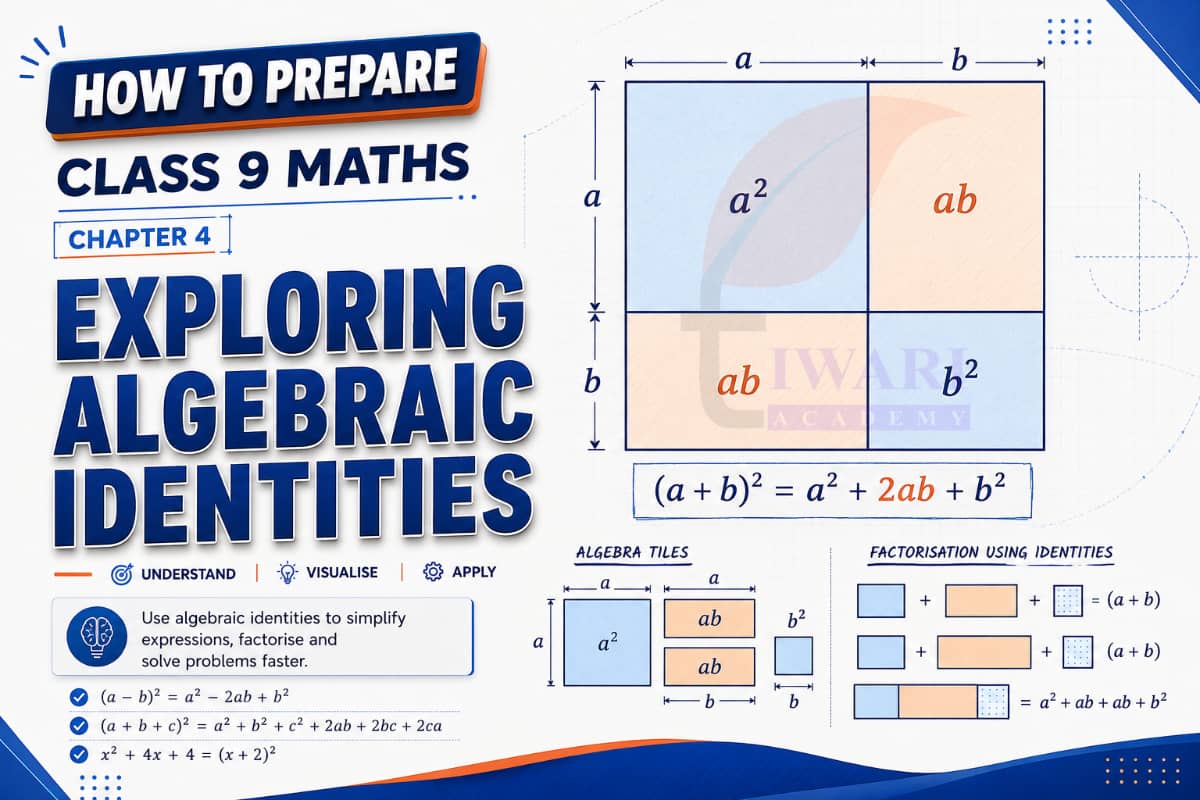

Class 9 Maths Chapter 4 Study Guide: Train Your Eye for Algebraic Identities

Every worked example in this chapter does the same two things in different clothes: it either expands a compact expression into a longer one or it takes a long, messy expression and shows it was secretly compact all along. Once you see that, the chapter stops being “eleven formulas to memorise” and becomes “one habit to build” – look at what’s in front of you and ask which of five shapes it matches.

Why Knowing the Formula Isn’t the Same as Solving the Question

Ask most students to recite (a+b)ยฒ = aยฒ+2ab+bยฒ and they’ll get it instantly. Hand them 9xยฒ+24xy+16yยฒ and ask them to factor it, and many stall – not because they don’t know the identity, but because nobody handed it to them already labelled. The textbook itself flags this gap early, with its own “Think and Reflect” pointing out that (a+b)ยฒ and aยฒ+bยฒ are not the same thing, and asking you to work out which is bigger. That single distinction – between having a formula and recognising where it applies – is what separates a smooth run through this chapter from a frustrating one. Before anything else, hold onto the one definition the whole chapter rests on: an identity is true for every value you could plug in; an equation is only true for specific ones. Everything else follows from that.

Your Identity Toolkit, Organised by Family

Instead of memorising eleven separate lines, it’s easier to recognise five shapes. Here’s the same eleven identities grouped by what tips you off that they apply:

FamilyIdentities in itRecognise it by
The Square Family(x+y)ยฒ, (xโˆ’y)ยฒ, (x+y+z)ยฒTwo or three squared terms added together, with cross terms equal to exactly twice each pair’s product
The Difference-of-Squares Family(x+y)(xโˆ’y) = xยฒโˆ’yยฒExactly two terms, both perfect squares, joined by subtraction – nothing in between
The Two-Factor Family(x+a)(x+b) = xยฒ+(a+b)x+ab, and (ax+b)(cx+d) = acxยฒ+(ad+bc)x+bdA quadratic that isn’t a perfect square trinomial โ€” the middle coefficient is a sum, the constant is a product
The Cube Family(x+y)ยณ, (xโˆ’y)ยณFour terms; first and last are perfect cubes; the middle two carry coefficients 3 and 3
The Cubic Sum/Difference Familyxยณโˆ’yยณ, xยณ+yยณ, xยณ+yยณ+zยณโˆ’3xyzEither two perfect cubes joined by ยฑ with no visible middle term, or three cubed terms minus three times their product

Every factoring problem in Exercise Sets 4.2 through 4.5 and the End-of-Chapter set is really just asking “which row does this belong to?”


The Three-Question Diagnostic

Before reaching for any identity, run an expression through three quick questions:

  1. How many terms does it have once you’ve tidied it up – two, three or four?
  2. Are the first and last terms perfect squares or perfect cubes? If yes, you’re almost certainly in the Square, Difference-of-Squares, or Cube family.
  3. What’s happening in the middle? One cross term โ†’ Square family. A sum-and-product pair that doesn’t match a perfect square โ†’ Two-Factor family. Nothing at all โ†’ Difference-of-Squares. A subtracted triple product โ†’ the Cubic Sum/Difference family.

Run this on 8xยฒ + 24xy + 18yยฒ: three terms, first and last (8xยฒ and 18yยฒ) aren’t clean squares yet – but pull out the common factor 2 first and you get 2(4xยฒ + 12xy + 9yยฒ) = 2(2x + 3y)ยฒ. The lesson hides in that step: always check for a common factor before you check for a pattern. Several questions in Exercise Set 4.2 exist specifically to test whether you remember this.

The Hidden Shortcut the Chapter Never States Outright

Buried inside identity #11 (xยณ+yยณ+zยณโˆ’3xyz = (x+y+z)(xยฒ+yยฒ+zยฒโˆ’xyโˆ’yzโˆ’zx)) is a shortcut the chapter uses in its hardest end-of-chapter questions without ever writing it as its own boxed rule:

If a + b + c = 0, then aยณ + bยณ + cยณ = 3abc โ€” automatically.

That’s because the right-hand factor (x+y+z) becomes zero, wiping out the entire expression. Watch it work: if p + q = โˆ’5, then p, q, and 5 satisfy p + (q) + (5) = 0 the moment you treat 5 as the third term. So pยณ + qยณ + 5ยณ = 3ยทpยทqยท5, which means pยณ + qยณ โˆ’ 15pq + 125 always equals 0 – no matter what p and q individually are. Try p=โˆ’2, q=โˆ’3: (โˆ’2)ยณ+(โˆ’3)ยณโˆ’15(โˆ’2)(โˆ’3)+125 = โˆ’8 โˆ’ 27 โˆ’ 90 + 125 = 0. It holds every time. Anywhere you see a sum that equals a suspiciously round negative number and a related cubic expression, check whether treating that sum (plus a constant) as “a+b+c=0” collapses the whole thing.

Two Directions, One Identity

The algebra-tiles section makes an important point almost in passing: (x + 3)(x + 4) = xยฒ + 7x + 12 and xยฒ + 7x + 12 = (x + 3)(x + 4) are the same identity, read in opposite directions. Most students only practise one direction per sitting – they’ll expand ten binomials or factor ten trinomials, but rarely switch between the two in the same session. That’s a mistake, because exams switch on you without warning. Whenever you learn a new identity, immediately write it both ways on paper before moving on and alternate which direction you practise every few questions.


Don’t Just Look at the Pictures – Redraw Them

The square split into aยฒ, ab, ab, bยฒ, the cube split into aยณ, three aยฒb blocks, three abยฒ blocks and bยณ, the algebra-tile arrangement for (2x + 3)(3x + 1) – these aren’t decoration. They’re the only place in the chapter where you can see why an identity is true rather than trust that it is. The habit that actually pays off: close the book and redraw one of these from memory, labelling each region yourself, before you try to memorise the algebraic line underneath it. Students who can redraw the cube-splitting diagram for (a+b)ยณ almost never forget which terms carry a factor of 3.

Mental-Math Shortcuts Worth Practising on Their Own

A few identities in this chapter double as genuine calculator-free tricks and they’re worth five minutes of separate practice:

  • Squaring a number ending in 5. 45ยฒ = (50)(40) + 25 = 2025, using aยฒ = (a+b)(aโˆ’b)+bยฒ with b=5. Notice the pattern: multiply the tens digit by the next integer up (4ร—5=20), then stick “25” on the end. Try 75ยฒ: 7ร—8=56, so 75ยฒ = 5625 – check it and you’ll see the pattern holds.
  • Multiplying two numbers that sit equally spaced around a round number. 46ร—54 sits around 50, four either side: (50โˆ’4)(50+4) = 2500โˆ’16 = 2484.
  • Cubing a number near a round one. 32ยณ = (30+2)ยณ = 27000 + 5400 + 360 + 8 = 32768, using the full (a+b)ยณ expansion instead of long multiplication.

None of these need a calculator once the pattern is automatic and they’re exactly the kind of question that shows up as a “find the value using a suitable identity” prompt.

A Mistake Map for Class 9 Ganita Manjari Chapter 4

MistakeWhy it happensFix
Writing (a+b)ยฒ as aยฒ+bยฒConfusing an identity with simple distribution over additionAlways write out the middle term deliberately: “โ€ฆplus twice the productโ€ฆ” until it’s automatic
Dropping the alternating signs in (aโˆ’b)ยณTreating it like (a+b)ยณ with a minus sign stuck on the frontSay the sign pattern out loud as you write it: plus, minus, plus, minus
Matching a pattern before pulling out a common factorThe GCF hides the perfect square or perfect cube underneathScan for a common factor first, every single time, before checking which family fits
Splitting the middle term using only the constant termWorks when the leading coefficient is 1, fails otherwiseFor axยฒ+bx+c with aโ‰ 1, the two numbers must multiply to aร—c, not just c
Forgetting “provided the denominator isn’t zero”The cancellation step feels purely mechanicalState the non-zero condition before you cancel, not after
Accepting every algebraic solution to a word problemA quadratic can produce a mathematically valid but physically impossible answerOnce you solve for the unknown, check whether a negative length, breadth or price makes sense – if not, discard it


Building the Toolkit in the Right Order

Because each family leans on the one before it, build them in this sequence rather than jumping around:

  1. The Square family first – everything else assumes you can spot a perfect square trinomial instantly. Pair this with Exercise Sets 4.1 and 4.2.
  2. Difference of squares next – it’s really the Square family run in reverse with b replaced by โˆ’b, so it should feel familiar rather than new.
  3. The Two-Factor family – this is where guessing gives way to method: write “sum = โ€ฆ” and “product = โ€ฆ” before you try any numbers, especially once the leading coefficient isn’t 1. Exercise Set 4.4 lives here.
  4. The Cube family, once squares feel automatic – the geometry (splitting a cube into two smaller cubes and six matching cuboids) is worth redrawing before you touch the algebra.
  5. The Cubic Sum/Difference family last, including the hidden a+b+c=0 shortcut – it’s the least intuitive and the one the starred End-of-Chapter questions lean on most heavily. Exercise Set 4.5 and the rational-expression questions are the natural finishing point.

Getting More Out of the Exercises

A few tactics that apply across every exercise set rather than just one:

  • On any “fill in the blank” factoring question, write down what you’re solving for algebraically (sum and product or the two square roots) before guessing numbers.
  • On the starred End-of-Chapter questions, check for an a + b + c = 0 situation before you attempt brute-force expansion – it’s usually faster and it’s clearly what the question is built around.
  • On word problems (the playground path, the pool, the reciprocal question), define your variable in one sentence before writing any equation and always circle back at the end to ask whether both algebraic solutions make sense in the real situation.
  • If a factoring question won’t resolve into anything from your five families, stop and check for a common factor you haven’t pulled out yet – it’s the single most common reason a “stuck” problem is actually already solved.

Quick Self-Test: Which Family Does Each One Belong To?

Try these before checking the line underneath. They’re original, not from the textbook, so there’s nothing to look up – just decide which family you’d reach for.

  1. 16xยฒ โˆ’ 40x + 25
  2. 49 โˆ’ 4yยฒ
  3. xยฒ โˆ’ 2x โˆ’ 35
  4. 27aยณ + 8bยณ
  5. a + b + c = 0 and abc = 6, find aยณ + bยณ + cยณ

Answers: (1) Square family, (4xโˆ’5)ยฒ. (2) Difference of squares, (7โˆ’2y)(7+2y). (3) Two-Factor family, (xโˆ’7)(x+5). (4) Cubic Sum family, (3a+2b)(9aยฒโˆ’6ab+4bยฒ). (5) The hidden shortcut, aยณ+bยณ+cยณ = 3abc = 18.

If you got four or five right without hesitating, the pattern-recognition habit has taken hold – the rest is practice volume.

Where to Check Your Full Working

Once you’ve attempted a section using the framework above, check your steps against the complete worked solutions for every Exercise Set and the End-of-Chapter questions at NCERT Solutions for Class 9 Maths Ganita Manjari Chapter 4.

Continue Your Preparation
  • Chapter 3: The World of Numbers – worth a quick revisit if rational-number arithmetic still feels shaky, since several identities here lean on it.
  • Chapter 5: I’m Up and Down, and Round and Round – the next chapter in the book.


Frequently Asked Questions

How do I know which identity to use if the question doesn’t tell me?

Run the three-question diagnostic above: count the terms, check whether the outer terms are perfect squares or cubes, and look at what the middle is doing. In practice, the constant term and the sign pattern narrow it down to one family almost every time โ€” the goal is to make that check automatic rather than a last resort.

Do I need to memorise (ax+b)(cx+d) = acxยฒ+(ad+bc)x+bd separately or can I just split the middle term every time?

You can get by without memorising it as a standalone line, since it’s really just the distributive property written out – but knowing the shape helps you predict what “sum” and “product” you’re hunting for before you start splitting the middle term by trial and error, which saves time on quadratics where the leading coefficient isn’t 1.

What if I blank on an identity during the exam?

Rebuild it from the distributive property rather than panicking, (a+b)ยฒ is just (a+b)(a+b) multiplied out and (a+b)ยณ is (a+b)(a+b)ยฒ. It costs you thirty extra seconds and it’s far more reliable than half-remembering a formula under pressure.

Is there a fast way to check whether I’ve factored something correctly?

Expand your answer back out and see if it matches the original expression – it takes under a minute and catches sign errors immediately, especially the alternating-sign mistakes in cube identities.

The three-variable square identity keeps showing up with different negative terms in different questions – do I need a separate formula for each sign combination?

No – it’s always (x+y+z)ยฒ = xยฒ+yยฒ+zยฒ+2xy+2yz+2zx underneath. When a term is negative, just substitute it in as a negative value (treat “โˆ’y” as your “y”) rather than memorising a new version of the formula for every sign pattern you encounter.

Do I need to reproduce the geometric proofs – the square splitting, the cube diagram, the algebra tiles – in an exam?

Only if a question explicitly asks you to justify or visualise an identity, which does happen with (a+b)ยฒ and (aโˆ’b)ยฒ in particular. Even when it isn’t asked for, working through the pictures once yourself is what makes the algebra memorable rather than arbitrary, so it’s worth the time even when it won’t be marked directly.

Recent Posts
  • Class 9 Science Exploration Notes: 5 Methods That Actually Help You Remember
  • Class 9 Social Science Notes: The Complete Guide
  • Class 9 Maths 2026-27: What’s New in the Syllabus and How to Study It
  • CBSE 3-Language Rule: Will Hindi Become Compulsory Subject?
  • NCERT Solutions for Class 10 Maths 2026-27 – Welcome to Your New Session


Important Links
  • What is NCERT?
  • Important Questions
  • Vedic Maths Tricks
  • Link Study Materials
  • Useful Resources & Formulae
  • Holiday Homework Solutions


Buy NCERT Books Online

NCERT Books for 2026-27

NCERT Solutions
  • NCERT Solutions for Class 6 Maths
  • NCERT Solutions for Class 7 Maths
  • NCERT Solutions for Class 8 Maths
  • NCERT Solutions for Class 11 Maths
  • NCERT Solutions for Class 12 Maths
  • NCERT Solutions for Class 11 Physics
  • NCERT Solutions for Class 12 Physics


High School
  • Class 9 NCERT Maths Solutions
  • Class 9 NCERT Science Solutions
  • Class 9 NCERT English Solutions
  • Class 10 NCERT Maths Solutions
  • Class 10 NCERT Science Solutions
  • Class 10 NCERT English Solutions
  • Class 10 NCERT Social Solutions

Quick Links
  • NCERT Books
  • NCERT Solutions
  • CBSE Syllabus
  • Home Tutors
  • NIOS Admissions
  • CBSE Sample Papers
  • Vedic Maths Tricks
Help & Support
  • About Us
  • Contact Us
  • Advertise With Us
  • Discussion
  • Latest Blogs
  • Holiday Homework
  • Useful Resources
Copyright 2026 by Tiwari Academy | A step towards Free Education
facebook
twitter
linkedin
youtube
instagram
pinterest
google-news