
Tiwari Academy  – Free CBSE NCERT Books and Solutions
  • Apps
    • CBSE Apps
    • Hast Rekha App
  • NCERT Solutions
    • NCERT Solutions for Class 12
      • NCERT Solutions for Class 12 Maths
      • NCERT Solutions for Class 12 Physics
      • NCERT Solutions for Class 12 Chemistry
      • NCERT Solutions for Class 12 Biology
      • NCERT Solutions for Class 12 English
      • NCERT Solutions for Class 12 Accounts
      • NCERT Solutions for Class 12 Business Studies
      • NCERT Solutions for Class 12 Economics
      • NCERT Solutions for Class 12 Geography
      • NCERT Solutions for Class 12 Physical Education
      • NCERT Solutions for Class 12 Political Science
      • NCERT Solutions for Class 12 Psychology
      • NCERT Solutions for Class 12 Sociology
    • NCERT Solutions for Class 11
      • NCERT Solutions for Class 11 Maths
      • NCERT Solutions for Class 11 Physics
      • NCERT Solutions for Class 11 Chemistry
      • NCERT Solutions for Class 11 Biology
      • NCERT Solutions for Class 11 English
      • NCERT Solutions for Class 11 Business Studies
      • NCERT Solutions for Class 11 Sociology
      • NCERT Solutions for Class 11 Political Science
      • NCERT Solutions for Class 11 Psychology
      • NCERT Solutions for Class 11 Physical Education
    • NCERT Solutions for Class 10
      • NCERT Solutions for Class 10 Maths
      • NCERT Solutions for Class 10 Science
      • NCERT Solutions for Class 10 English
      • NCERT Solutions for Class 10 Hindi 2026-27 Updated Course A and B
      • NCERT Solutions for Class 10 Sanskrit
      • NCERT Solutions for Class 10 Social Science
    • NCERT Solutions for Class 9
      • NCERT Solutions for Class 9 Maths
      • NCERT Solutions for Class 9 Science
      • NCERT Solutions for Class 9 English
      • NCERT Solutions for Class 9 Hindi
      • NCERT Solutions for Class 9 Sanskrit
      • NCERT Solutions for Class 9 Social Science
    • NCERT Solutions for Class 8
      • NCERT Solutions for Class 8 Maths
      • NCERT Solutions for Class 8 Science
      • NCERT Solutions for Class 8 English
      • NCERT Solutions for Class 8 Hindi
      • NCERT Solutions for Class 8 Sanskrit
      • NCERT Solutions for Class 8 Social Science
      • NCERT Solutions for Class 8 Computer
    • NCERT Solutions for Class 7
      • NCERT Solutions for Class 7 Maths
      • NCERT Solutions for Class 7 Science
      • NCERT Solutions for Class 7 English
      • NCERT Solutions for Class 7 Hindi
      • NCERT Solutions for Class 7 Sanskrit
      • NCERT Solutions for Class 7 Social Science
      • NCERT Solutions for Class 7 Computer
    • NCERT Solutions for Class 6
      • NCERT Solutions for Class 6 Maths
      • NCERT Solutions for Class 6 Science
      • NCERT Solutions for Class 6 English
      • NCERT Solutions for Class 6 Hindi
      • NCERT Solutions for Class 6 Sanskrit Deepakam 2026-27 Updated
      • NCERT Solutions for Class 6 Social Science
      • NCERT Solutions for Class 6 Computer
    • NCERT Solutions for Class 5
      • NCERT Solutions for Class 5 Hindi
      • NCERT Solutions for Class 5 English
      • NCERT Solutions for Class 5 Maths
      • NCERT Solutions for Class 5 EVS
      • NCERT Solutions for Class 5 Computer
      • NCERT Solutions for Class 5 GK
    • NCERT Solutions for Class 4
      • NCERT Solutions for Class 4 Hindi
      • NCERT Solutions for Class 4 English
      • NCERT Solutions for Class 4 Maths
      • NCERT Solutions for Class 4 EVS
      • NCERT Solutions for Class 4 Computer
      • NCERT Solutions for Class 4 GK
    • NCERT Solutions for Class 3
      • NCERT Solutions for Class 3 Hindi
      • NCERT Solutions for Class 3 English
      • NCERT Solutions for Class 3 Maths
      • NCERT Solutions for Class 3 EVS
      • NCERT Solutions for Class 3 Science
      • NCERT Solutions for Class 3 Computer
      • NCERT Solutions for Class 3 GK
    • NCERT Solutions for Class 2
      • NCERT Solutions for Class 2 Hindi
      • NCERT Solutions for Class 2 English
      • NCERT Solutions for Class 2 Maths
      • NCERT Solutions for Class 2 EVS
      • NCERT Solutions for Class 2 Science
      • NCERT Solutions for Class 2 Computer
      • NCERT Solutions for Class 2 GK
    • NCERT Solutions for Class 1
      • NCERT Solutions for Class 1 Hindi
      • NCERT Solutions for Class 1 English
      • NCERT Solutions for Class 1 Maths
      • NCERT Solutions for Class 1 EVS
      • NCERT Solutions for Class 1 Computer
      • NCERT Solutions for Class 1 Science
      • NCERT Solutions for Class 1 GK
    • Study Material for KG
      • Study Material for KG English
      • Study Material for KG Hindi
      • Study Material for KG Maths
    • Study Material for Nursery
      • Study Material for Nursery Maths
      • Study Material for Nursery English
      • Study Material for Nursery Hindi
  • NEWS
    • Educational NEWS
    • MCQ
    • Explore More
  • Grammar
    • Class 1 English Grammar
      • Class 1 Hindi Vyakaran
    • Class 2 English Grammar
      • Class 2 Hindi Vyakaran
    • Class 3 English Grammar
      • Class 3 Hindi Vyakaran
    • Class 4 English Grammar
      • Class 4 Hindi Vyakaran
    • Class 5 English Grammar
      • Class 5 Hindi Vyakaran
    • Class 6 English Grammar
      • Class 6 Hindi Vyakaran
    • Class 7 English Grammar
      • Class 7 Hindi Vyakaran
    • Class 8 English Grammar
      • Class 8 Hindi Vyakaran
  • Sample Papers
    • CBSE Sample Papers for Class 4
    • CBSE Sample Papers for Class 5
    • CBSE Sample Papers for Class 6
    • CBSE Sample Papers for Class 7
    • CBSE Sample Papers for Class 8
    • CBSE Sample Papers for Class 9
    • CBSE Sample Papers for Class 10
    • CBSE Sample Papers for Class 11
    • CBSE Sample Papers for Class 12
  • Syllabus
    • CBSE Syllabus
    • NCERT Books
    • NCERT Exemplar
    • What is NIOS?
    • NIOS Online Admission
    • Career Options
  • Contact
    • Contact Us
    • About Us
    • Authors
    • Online Tutors
  • Apps
    • CBSE Apps
    • Hast Rekha App
  • NCERT Solutions
    • NCERT Solutions for Class 12
      • NCERT Solutions for Class 12 Maths
      • NCERT Solutions for Class 12 Physics
      • NCERT Solutions for Class 12 Chemistry
      • NCERT Solutions for Class 12 Biology
      • NCERT Solutions for Class 12 English
      • NCERT Solutions for Class 12 Accounts
      • NCERT Solutions for Class 12 Business Studies
      • NCERT Solutions for Class 12 Economics
      • NCERT Solutions for Class 12 Geography
      • NCERT Solutions for Class 12 Physical Education
      • NCERT Solutions for Class 12 Political Science
      • NCERT Solutions for Class 12 Psychology
      • NCERT Solutions for Class 12 Sociology
    • NCERT Solutions for Class 11
      • NCERT Solutions for Class 11 Maths
      • NCERT Solutions for Class 11 Physics
      • NCERT Solutions for Class 11 Chemistry
      • NCERT Solutions for Class 11 Biology
      • NCERT Solutions for Class 11 English
      • NCERT Solutions for Class 11 Business Studies
      • NCERT Solutions for Class 11 Sociology
      • NCERT Solutions for Class 11 Political Science
      • NCERT Solutions for Class 11 Psychology
      • NCERT Solutions for Class 11 Physical Education
    • NCERT Solutions for Class 10
      • NCERT Solutions for Class 10 Maths
      • NCERT Solutions for Class 10 Science
      • NCERT Solutions for Class 10 English
      • NCERT Solutions for Class 10 Hindi 2026-27 Updated Course A and B
      • NCERT Solutions for Class 10 Sanskrit
      • NCERT Solutions for Class 10 Social Science
    • NCERT Solutions for Class 9
      • NCERT Solutions for Class 9 Maths
      • NCERT Solutions for Class 9 Science
      • NCERT Solutions for Class 9 English
      • NCERT Solutions for Class 9 Hindi
      • NCERT Solutions for Class 9 Sanskrit
      • NCERT Solutions for Class 9 Social Science
    • NCERT Solutions for Class 8
      • NCERT Solutions for Class 8 Maths
      • NCERT Solutions for Class 8 Science
      • NCERT Solutions for Class 8 English
      • NCERT Solutions for Class 8 Hindi
      • NCERT Solutions for Class 8 Sanskrit
      • NCERT Solutions for Class 8 Social Science
      • NCERT Solutions for Class 8 Computer
    • NCERT Solutions for Class 7
      • NCERT Solutions for Class 7 Maths
      • NCERT Solutions for Class 7 Science
      • NCERT Solutions for Class 7 English
      • NCERT Solutions for Class 7 Hindi
      • NCERT Solutions for Class 7 Sanskrit
      • NCERT Solutions for Class 7 Social Science
      • NCERT Solutions for Class 7 Computer
    • NCERT Solutions for Class 6
      • NCERT Solutions for Class 6 Maths
      • NCERT Solutions for Class 6 Science
      • NCERT Solutions for Class 6 English
      • NCERT Solutions for Class 6 Hindi
      • NCERT Solutions for Class 6 Sanskrit Deepakam 2026-27 Updated
      • NCERT Solutions for Class 6 Social Science
      • NCERT Solutions for Class 6 Computer
    • NCERT Solutions for Class 5
      • NCERT Solutions for Class 5 Hindi
      • NCERT Solutions for Class 5 English
      • NCERT Solutions for Class 5 Maths
      • NCERT Solutions for Class 5 EVS
      • NCERT Solutions for Class 5 Computer
      • NCERT Solutions for Class 5 GK
    • NCERT Solutions for Class 4
      • NCERT Solutions for Class 4 Hindi
      • NCERT Solutions for Class 4 English
      • NCERT Solutions for Class 4 Maths
      • NCERT Solutions for Class 4 EVS
      • NCERT Solutions for Class 4 Computer
      • NCERT Solutions for Class 4 GK
    • NCERT Solutions for Class 3
      • NCERT Solutions for Class 3 Hindi
      • NCERT Solutions for Class 3 English
      • NCERT Solutions for Class 3 Maths
      • NCERT Solutions for Class 3 EVS
      • NCERT Solutions for Class 3 Science
      • NCERT Solutions for Class 3 Computer
      • NCERT Solutions for Class 3 GK
    • NCERT Solutions for Class 2
      • NCERT Solutions for Class 2 Hindi
      • NCERT Solutions for Class 2 English
      • NCERT Solutions for Class 2 Maths
      • NCERT Solutions for Class 2 EVS
      • NCERT Solutions for Class 2 Science
      • NCERT Solutions for Class 2 Computer
      • NCERT Solutions for Class 2 GK
    • NCERT Solutions for Class 1
      • NCERT Solutions for Class 1 Hindi
      • NCERT Solutions for Class 1 English
      • NCERT Solutions for Class 1 Maths
      • NCERT Solutions for Class 1 EVS
      • NCERT Solutions for Class 1 Computer
      • NCERT Solutions for Class 1 Science
      • NCERT Solutions for Class 1 GK
    • Study Material for KG
      • Study Material for KG English
      • Study Material for KG Hindi
      • Study Material for KG Maths
    • Study Material for Nursery
      • Study Material for Nursery Maths
      • Study Material for Nursery English
      • Study Material for Nursery Hindi
  • NEWS
    • Educational NEWS
    • MCQ
    • Explore More
  • Grammar
    • Class 1 English Grammar
      • Class 1 Hindi Vyakaran
    • Class 2 English Grammar
      • Class 2 Hindi Vyakaran
    • Class 3 English Grammar
      • Class 3 Hindi Vyakaran
    • Class 4 English Grammar
      • Class 4 Hindi Vyakaran
    • Class 5 English Grammar
      • Class 5 Hindi Vyakaran
    • Class 6 English Grammar
      • Class 6 Hindi Vyakaran
    • Class 7 English Grammar
      • Class 7 Hindi Vyakaran
    • Class 8 English Grammar
      • Class 8 Hindi Vyakaran
  • Sample Papers
    • CBSE Sample Papers for Class 4
    • CBSE Sample Papers for Class 5
    • CBSE Sample Papers for Class 6
    • CBSE Sample Papers for Class 7
    • CBSE Sample Papers for Class 8
    • CBSE Sample Papers for Class 9
    • CBSE Sample Papers for Class 10
    • CBSE Sample Papers for Class 11
    • CBSE Sample Papers for Class 12
  • Syllabus
    • CBSE Syllabus
    • NCERT Books
    • NCERT Exemplar
    • What is NIOS?
    • NIOS Online Admission
    • Career Options
  • Contact
    • Contact Us
    • About Us
    • Authors
    • Online Tutors
เคนเคฟเค‚เคฆเฅ€ เคฎเฅ€เคกเคฟเคฏเคฎเคนเคฟเค‚เคฆเฅ€ เคฎเฅ€เคกเคฟเคฏเคฎ Latest BlogsLatest Blogs Ask QuestionsAsk Questions
Tiwari Academy  /  Latest News  /  Class 9 Maths Chapter 5 Guide for Circle Theorems and its Proofs

Class 9 Maths Chapter 5 Guide for Circle Theorems and its Proofs

Class 9 Maths Chapter 5 Study Guide: Circle Theorems & Proofs
Post Date: September 21, 2026

Chapter 5 of Ganita Manjari, playfully titled I’m Up and Down, and Round and Round, is where Class 9 Maths stops being mostly computational and turns into formal proof-writing. Across eight sections it builds 12 numbered theorems about circles, chords, arcs and cyclic quadrilaterals, each following the textbook’s own “Given โ†’ To Show โ†’ Why is this true?” structure – and roughly half of the 26 end-of-chapter questions are themselves “prove”, “show” or “explain why” problems rather than calculations. Every theorem proved and every exercise solved, including the full list of all 12 theorems, is already at Tiwari Academy’s NCERT Solutions for Class 9 Maths Ganita Manjari Chapter 5. This guide does something different: it breaks down the five proof moves that build all twelve theorems, shows how the theorems actually connect to each other, and gives you a template for constructing a proof yourself when an exam hands you a circle you haven’t seen before.
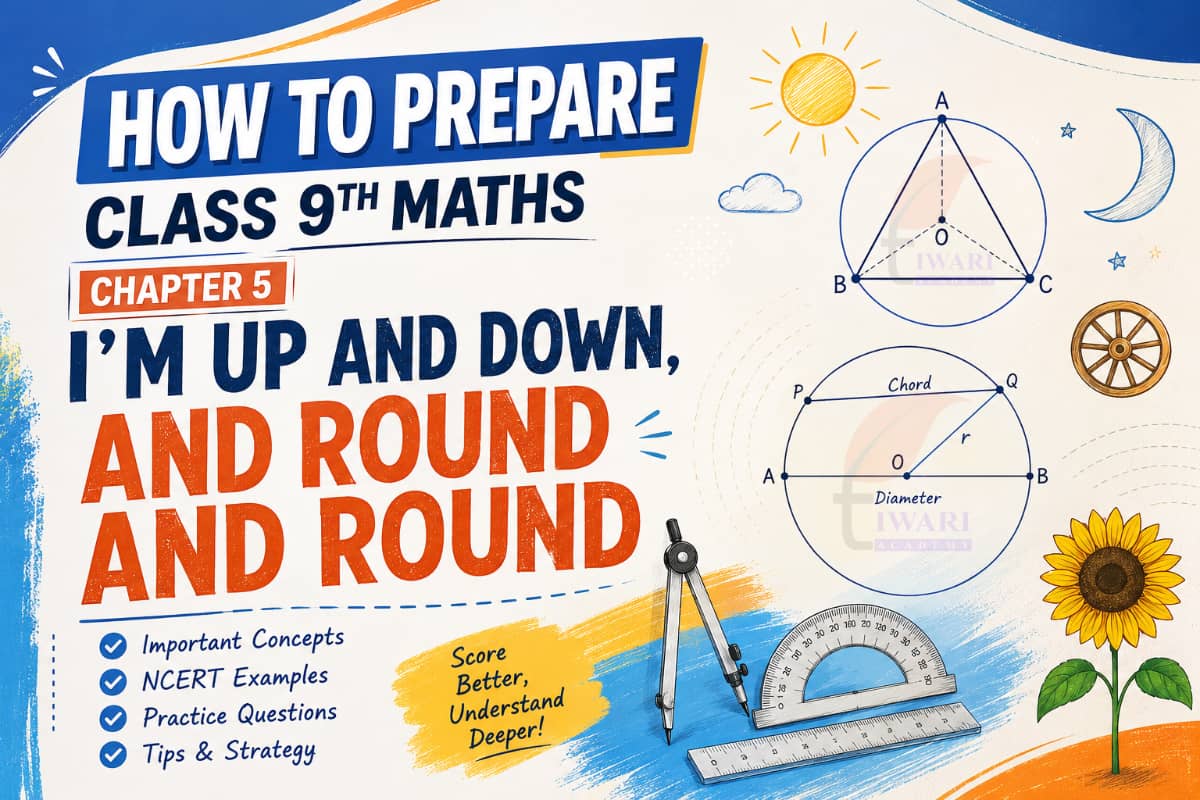

Class 9 Maths Chapter 5 Study Guide: How to Prove Circle Theorems, Not Just Memorise Them

Twelve theorems sounds like a lot to hold in your head. It isn’t, once you notice that almost every single one of them is built from the same five moves, reused in different combinations. Learn the five moves and the twelve theorems stop being twelve separate things to memorise – they become five tools applied to twelve different circle problems.

Why Chapter 5 Asks You to Prove, Not Just Calculate

Chapters 3 and 4 mostly asked you to compute something correctly. Chapter 5 asks you to justify something correctly – and the difference shows up in the numbers. Of the 26 End-of-Chapter questions, 12 are starred higher-order problems and even most of the unstarred ones say “prove”, “show” or “explain why” rather than “find the value of”. That’s a fundamentally different exam skill: it’s not enough to get the right answer, you have to build a chain of reasons that gets there, in the same “Given โ†’ To Show โ†’ Why is this true?” shape the textbook uses for every one of its theorems.

The Five Proof Moves Behind All 12 Theorems

Read through the chapter’s proofs back to back and the same five ideas keep resurfacing:

  • Move 1: Radii are equal, so the triangle is isosceles. Any triangle formed by two radii and a chord (or two radii and anything else) has two equal sides automatically, which means two equal base angles automatically. This single fact quietly powers Theorems 4, 6, 8, 9 and the “60ยฐ trick” below.
  • Move 2: Prove two triangles congruent (SSS, SAS or RHS), then read off equal parts. Theorems 2, 3, 4, 5, 6 and 7 are all, at their core, “find a congruent pair, then the thing you want is just a corresponding side or angle”.
  • Move 3: The exterior angle of a triangle equals the sum of the two remote interior angles. This is the one non-obvious ingredient in Theorem 9’s proof (the central-angle-equals-double-the-inscribed-angle result) – without it, that proof doesn’t get off the ground.
  • Move 4: The Baudhฤyanaโ€“Pythagoras theorem on the radius/half-chord/distance right triangle. Any time a chord’s length, its distance from the centre, and the radius are all in play, you have a right triangle waiting to be used. This single triangle carries almost every numeric problem in Exercise Sets 5.3 through 5.6 and the End-of-Chapter set.
  • Move 5: Proof by contradiction. Assume the point you’re trying to place isn’t where you claim, show that leads to something impossible (usually an angle being “greater than itself”) and conclude it must be where you claimed after all. This is how Theorems 10 and 12 are proved – and it’s a genuinely different move from the first four, worth recognising on sight.

How the 12 Theorems Actually Connect

Here’s the part that makes the chapter feel smaller: eight of the twelve theorems are really just four matched pairs – a statement immediately followed by its converse.

  • Theorems 2 & 3 โ€” equal chords give equal central angles, and equal central angles give equal chords.
  • Theorems 4 & 5 โ€” the line to a chord’s midpoint is perpendicular to it and a perpendicular from the centre lands on the midpoint.
  • Theorems 6 & 7 โ€” equal chords are equidistant from the centre, and equidistant chords are equal.
  • Theorems 11 & 12 โ€” a cyclic quadrilateral’s opposite angles sum to 180ยฐ and a quadrilateral whose opposite angles sum to 180ยฐ is cyclic.

That leaves four standalone results: Theorem 1 (a unique circle through three non-collinear points), Theorem 8 (a comparative statement – the longer of two chords sits closer to the centre), Theorem 9 (the central-angle theorem) and Theorem 10 (the concyclicity condition, which is really the converse of the “equal angles in the same segment” idea Theorem 9 uncovers, even though the book doesn’t number that idea on its own). So the honest count isn’t “twelve things” – it’s four pairs plus four standalones, which is a much smaller list to actually hold in memory.


The Converse Trap: Why You Can’t Just Run a Proof Backwards

Here’s a mistake worth naming directly: assuming that once you’ve proved a theorem, its converse follows by reading the same proof in reverse. It doesn’t, and this chapter shows why twice. Theorem 4 is proved with SAS congruence; its converse, Theorem 5, needs RHS instead, because you no longer have the matching side you had before – you have a right angle instead. And the jump from Theorem 11 to Theorem 12 is even bigger: Theorem 11 is a direct calculation using the central-angle theorem twice, but Theorem 12 abandons that approach entirely and switches to proof by contradiction. Whenever a question asks you to prove a converse, treat it as a fresh problem – check which of the five moves actually fits the information you’re now given, rather than assuming it’s the same one as before.

A Template for Writing Any Circle Proof Yourself

The textbook’s own format is a ready-made checklist – most students just don’t realise they’re meant to copy it onto their own answer sheet:

  1. List what’s Given as short, separate lines (equal lengths, equal angles, perpendiculars – whatever the question hands you).
  2. Write “To Show:” as one precise target sentence before you write a single line of reasoning.
  3. Draw the figure and mark every given fact on it – tick marks for equal lengths, arc marks for equal angles, a small square for right angles.
  4. Ask which of the five moves fits. Radii present? Try Move 1 or 2. A chord’s length, distance and radius all mentioned? Move 4. Asked to prove points lie on a circle? Move 5.
  5. Write “Why is this true?” as a numbered chain, each line followed by its justification in brackets – exactly the style the textbook uses throughout.

Examiners aren’t grading you against the textbook’s exact wording; a logically complete proof in your own words earns full marks.

Learn These Pythagorean Triples and Skip the Arithmetic

Move 4 (radius, half-chord, distance) shows up so often that memorising the recurring triples saves real time: 3-4-5 and its scaled versions 6-8-10 and 9-12-15, and 5-12-13, cover the large majority of the chord-length and distance-from-centre questions across Exercise Sets 5.3 to 5.6 and the End-of-Chapter set. Spot one of these the moment you see two of the three numbers and you can skip the squaring-and-subtracting step entirely. That said, not every problem is a clean triple – if rยฒ โˆ’ dยฒ isn’t a perfect square, the chord length will simply involve a square root and that’s fine; check before assuming it’ll simplify.


The 60ยฐ Trick: When Isosceles Becomes Equilateral

Whenever a central angle happens to be exactly 60ยฐ, the triangle formed by the two radii isn’t just isosceles – the base angles work out to 60ยฐ each too, making all three angles equal. That means the chord is exactly equal to the radius, with no Pythagoras required at all. This one insight quietly solves both a central-angle exercise question and the regular-hexagon question in the End-of-Chapter set, since a regular hexagon is just six of these 60ยฐ-triangles arranged around the centre.

Draw This Before You Write a Single Line of Proof

This chapter is unusually dependent on the figure – there’s no way to reason your way to most of these results by staring at symbols alone. Before writing anything: draw the circle and mark the centre; join the centre to every point named in the problem; mark every given equal length with tick marks and every given equal angle with arc marks; mark right angles with a small square. Only once the figure carries all the given information should you start writing “Given” and “To Show” – trying to hold it all in your head instead is where most careless errors creep in.

Mistakes That Cost Marks in Circle Proofs

MistakeFix
Writing “OA = OB” without saying whyAlways add the reason: “radii of the same circle” – markers look for it explicitly
Assuming a converse can be proved by reversing the original proofCheck which of the five moves the new “Given” actually supports – it’s often a different one
Treating “the angle subtended by arc AB” as unambiguousThe same two points give a different angle depending on whether you mean the major or minor arc – always specify which
Only learning one case of Theorem 9’s proofThe proof has two genuinely different configurations depending on where the extended line lands – questions can test either one
Applying Theorem 10 when C and D aren’t on the same side of ABEqual angles from points on opposite sides don’t force concyclicity – the “same side” condition is essential, not decorative
Solving a numeric chord problem without checking the triple firstWastes time re-deriving 5ยฒ + 12ยฒ = 13ยฒ from scratch every time


A Study Sequence Built Around the Theorem Pairs

Rather than a plain calendar, work through the pairs together, since proving the second half of each pair is far easier right after the first:

  1. Definitions + Theorem 1, alongside Exercise Set 5.1’s constructions.
  2. Theorems 2 & 3 together, with Exercise Set 5.2.
  3. Theorems 4 & 5 together, with Exercise Set 5.3.
  4. Theorems 6, 7 and 8 together, since all three lean on the same right-triangle setup, with Exercise Sets 5.4 and 5.5.
  5. Theorem 9 and its semicircle corollary, with Exercise Set 5.6.
  6. Theorem 10 through 12, the concyclicity finale, tackled as one block.
  7. The End-of-Chapter questions last, worked roughly in the same order as the blocks above rather than start to finish.

Cracking the Starred Questions

The starred questions in this chapter rarely introduce new theory – they mostly disguise an existing theorem inside an unfamiliar shape. A rectangle inscribed in a circle, a regular hexagon, two chords crossing each other: in each case, the real task is recognising which of the twelve theorems (or which of the five moves) the new shape is quietly hiding, not learning something extra. Before reaching for a fresh approach on a starred question, ask which earlier theorem’s hypotheses the given shape happens to satisfy.

Self-Test: Which Proof Move Fits?

Try these before checking the answers – they’re original, not textbook questions, so there’s nothing to look up.

  1. Two chords of the same circle are each 9 cm long. What can you say about their distance from the centre?
  2. One chord sits 10 cm from the centre, another sits 6 cm from the centre of the same circle. Which chord is longer?
  3. A point P on the major arc sees โˆ APB = 50ยฐ. What is the central angle for the corresponding minor arc?
  4. A quadrilateral has angles 95ยฐ, 85ยฐ, 95ยฐ, 85ยฐ in order around it. Could it be cyclic?
  5. Two radii meet at a 60ยฐ angle. Without touching Pythagoras, how does the chord between them compare to the radius?

Answers: (1) Equal – Theorem 6. (2) The one 6 cm away – Theorem 8 (closer to centre means longer). (3) 100ยฐ – Theorem 9. (4) No – opposite pairs sum to 190ยฐ and 170ยฐ, neither is 180ยฐ, so Theorem 11’s condition fails. (5) Equal to the radius – the 60ยฐ trick.

Where to Check Your Full Proofs

Once you’ve attempted a theorem or exercise using the moves above, check your reasoning against the fully worked proofs and solutions for every Exercise Set and the End-of-Chapter questions at NCERT Solutions for Class 9 Maths Ganita Manjari Chapter 5.

Continue Your Preparation
  • Chapter 4: Exploring Algebraic Identities – worth revisiting if the sum-and-product reasoning in Move 2’s congruence work still feels unfamiliar.
  • Chapter 6: Measuring Space โ€“ Perimeter and Area – the next chapter in the book.


Frequently Asked Questions

Do I need to write out both cases of Theorem 9’s proof in an exam?

You only need to prove the case that matches the figure the question actually gives you. But it’s worth understanding both configurations while studying, since a question can hand you either one and recognising which case you’re looking at is half the battle.

How do I know which arc a question means when it just says “the angle subtended by arc AB”?

Check whether the problem specifies major or minor, or look at the angle’s size – under 180ยฐ at the centre means the minor arc, over 180ยฐ means the major arc. If neither is stated and it isn’t obvious from a figure, the question is usually asking about whichever arc doesn’t contain the third labelled point.

Is there a shortcut for chord-length problems instead of using Pythagoras every time?

Recognising the recurring triples (3-4-5 and its multiples, 5-12-13) covers most cases instantly. Beyond that, check first whether the central angle is 60ยฐ – if it is, the chord simply equals the radius and you can skip the right-triangle step altogether.

My proof reaches the right conclusion but doesn’t look like the textbook’s – will I lose marks?

No, as long as each step follows logically from the one before it and you state your reasons (which theorem, which congruence rule, which given fact). Markers are checking the logic, not matching your wording to the book.

How do I prove a converse if I can’t just reverse the original proof?

Start from scratch with the new “Given” and ask which of the five moves it actually supports – it’s frequently a different one from the original direction (see the Theorem 4/5 and Theorem 11/12 examples above). Don’t assume the same congruence rule or strategy will carry over.

What’s the fastest way to check if a quadrilateral is cyclic without drawing its circumcircle?

Add up one pair of opposite angles. If it comes to exactly 180ยฐ, Theorem 12 guarantees it’s cyclic – no construction needed. If it doesn’t, it isn’t, since Theorem 11 requires that sum for any cyclic quadrilateral.

Recent Posts
  • Class 9 Science Exploration Notes: 5 Methods That Actually Help You Remember
  • Class 9 Social Science Notes: The Complete Guide
  • Class 9 Maths 2026-27: What’s New in the Syllabus and How to Study It
  • CBSE 3-Language Rule: Will Hindi Become Compulsory Subject?
  • NCERT Solutions for Class 10 Maths 2026-27 – Welcome to Your New Session


Important Links
  • What is NCERT?
  • Important Questions
  • Vedic Maths Tricks
  • Link Study Materials
  • Useful Resources & Formulae
  • Holiday Homework Solutions


Buy NCERT Books Online

NCERT Books for 2026-27

NCERT Solutions
  • NCERT Solutions for Class 6 Maths
  • NCERT Solutions for Class 7 Maths
  • NCERT Solutions for Class 8 Maths
  • NCERT Solutions for Class 11 Maths
  • NCERT Solutions for Class 12 Maths
  • NCERT Solutions for Class 11 Physics
  • NCERT Solutions for Class 12 Physics


High School
  • Class 9 NCERT Maths Solutions
  • Class 9 NCERT Science Solutions
  • Class 9 NCERT English Solutions
  • Class 10 NCERT Maths Solutions
  • Class 10 NCERT Science Solutions
  • Class 10 NCERT English Solutions
  • Class 10 NCERT Social Solutions

Quick Links
  • NCERT Books
  • NCERT Solutions
  • CBSE Syllabus
  • Home Tutors
  • NIOS Admissions
  • CBSE Sample Papers
  • Vedic Maths Tricks
Help & Support
  • About Us
  • Contact Us
  • Advertise With Us
  • Discussion
  • Latest Blogs
  • Holiday Homework
  • Useful Resources
Copyright 2026 by Tiwari Academy | A step towards Free Education
facebook
twitter
linkedin
youtube
instagram
pinterest
google-news