



by Tiwari Academy Team
NCERT Solutions for Class 7 Maths Ganita Prakash Part 2 Chapter 7 Finding the Unknown – Exercises Question Answers for Session 2026-27. It helps students learn to form and solve simple equations using weighing balance models, matchstick patterns and everyday situations like planning a party or comparing savings. These step-by-step solutions cover every Figure it Out exercise, including framing equations, solving them systematically using inverse operations, spotting common mistakes and exploring the history of algebra from Brahmagupta to Al-Khwarizmi, making the chapter simple to understand and exam-ready.
Class 7 Maths all Chapters
NCERT Class 7 Maths Ganita Prakash Part 2 Chapter 7 Solutions
Page 172 – Figure it Out
1. Solve these equations and check the solutions.
(a) 3x – 10 = 35
(b) 5s = 3s
(c) 3u – 7 = 2u + 3
(d) 4 (m + 6) – 8 = 2m – 4
(e) u/15 = 6
Answer:
(a) 3x – 10 = 35
Add 10 to both sides
3x = 35 + 10
⇒ 3x = 45
Divide both sides by 3
x = 45/3
⇒ x = 15
Check:
Substitute x = 15 back into the original equation
LHS = 3(15) – 10 = 45 – 10 = 35
RHS = 35
LHS = RHS
(b) 5s = 3s
Subtract 3s from both sides
5s – 3s = 0
⇒ 2s = 0
Divide both sides by 2
s = 0/2
⇒ s = 0
Check:
Substitute s = 0 back into the original equation
LHS = 5(0) = 0
RHS = 3(0) = 0
LHS = RHS
(c) 3u – 7 = 2u + 3
Move 2u to left, move -7 to right
3u – 2u = 3 + 7
⇒ u = 10
Check:
Substitute u = 10 back into the original equation
LHS = 3(10) – 7 = 30 – 7 = 23
RHS = 2(10) + 3 = 20 + 3 = 23
LHS = RHS
(d) 4 (m + 6) – 8 = 2m – 4
4m + 24 – 8 = 2m – 4
⇒ 4m + 16 = 2m – 4
Move 2m to left, move 16 to right
4m – 2m = -4 – 16
⇒ 2m = -20
Divide both sides by 2
m = -20/2
⇒ m = -10
Check:
Substitute m = -10 back into the original equation
LHS = 4(-10 + 6) – 8 = 4(-4) – 8 = -16 – 8 = -24
RHS = 2(-10) – 4 = -20 – 4 = -24
LHS = RHS
(e) u/15 = 6
Multiply both sides by 15
u = 6 × 15
⇒ u = 90
Check:
Substitute u = 90 back into the original equation
LHS = 90/15 = 6
RHS = 6
LHS = RHS
2. Frame an equation that has no solution.
[Hint: 4 more than a number, and 5 more than a number can never be equal!]
Answer:
- Equation: x + 4 = x + 5
If we subtract x from both sides: 4 = 5
But 4 can NEVER equal 5
So there’s no value of x that works - Equation: 2x + 3 = 2x + 7
Subtract 2x from both sides: 3 = 7
But 3 ≠ 7 - Equation: 3(x + 2) = 3x + 10
Expand left side: 3x + 6 = 3x + 10
Subtract 3x from both sides: 6 = 10
But 6 ≠ 10 - Equation: 5x – 1 = 5x + 2
Subtract 5x from both sides: -1 = 2
But -1 ≠ 2 - Equation: x + 10 = x + 8
Subtract x from both sides: 10 = 8
But 10 ≠ 8
Page 181 – Figure it Out
1. Write 5 equations whose solution is x = - 2
Answer:
- Equation (i): x + 5 = 3
x = 3 – 5
x = -2 - Equation (ii): 2x = -4
x = -4/2
x = -2 - Equation (iii): 3x + 8 = 2
3x = 2 – 8
3x = -6
x = -6/3
x = -2 - Equation (iv): 5x – 3 = -13
5x = -13 + 3
5x = -10
x = -10/5
x = -2 - Equation (v): 4(x + 3) = 4
4x + 12 = 4
4x = 4 – 12
4x = -8
x = -8/4
x = -2
2. Find the value of each unknown:
(a) 2y = 60
(b) - 8 = 5x – 3
(c) – 53w = -15
(d) 13 – z = 8
(e) k + 8 = 12 – k
(f) 7m = m – 3
(g) 3n = 10 + n
Answer:
(a) 2y = 60
Divide both sides by 2
y = 60/2
⇒ y = 30
(b) - 8 = 5x – 3
Add 3 to both sides
-8 + 3 = 5x
⇒ -5 = 5x
Divide both sides by 5
x = -5/5
⇒ x = -1
(c) – 53w = -15
Divide both sides by -53
w = -15/-53
⇒ w = 15/53
(d) 13 – z = 8
Subtract 13 from both sides
-z = 8 – 13
⇒ -z = -5
Multiply both sides by -1
z = 5
(e) k + 8 = 12 – k
Add k to both sides, subtract 8 from both sides
k + k = 12 – 8
⇒ 2k = 4
Divide both sides by 2
k = 4/2
⇒ k = 2
(f) 7m = m – 3
Subtract m from both sides
7m – m = -3
⇒ 6m = -3
Divide both sides by 6
m = -3/6
⇒ m = -1/2
(g) 3n = 10 + n
Subtract n from both sides
3n – n = 10
⇒ 2n = 10
Divide both sides by 2
n = 10/2
⇒ n = 5
3. I am a 3-digit number. My hundred’s digit is 3 less than my ten’s digit. My ten’s digit is 3 less than my unit’s digit. The sum of all the three digits is 15. Who am I?
Answer:
Let the unit’s digit (ones place) = u
Let the ten’s digit (tens place) = t
Let the hundred’s digit (hundreds place) = h
According to question:
Hundred’s digit is 3 less than ten’s digit: h = t – 3 … (i)
Ten’s digit is 3 less than unit’s digit: t = u – 3 … (ii)
Sum of all three digits is 15: h + t + u = 15 … (iii)
From equation (ii): t = u – 3
Substitute into equation (i):
h = t – 3
⇒ h = (u – 3) – 3
⇒ h = u – 6
Now substitute both h and t into equation (iii):
h + t + u = 15
⇒ (u – 6) + (u – 3) + u = 15
⇒ u – 6 + u – 3 + u = 15
⇒ 3u – 9 = 15
⇒ 3u = 15 + 9
⇒ 3u = 24
⇒ u = 8
Now find t and h:
⇒ t = u – 3 = 8 – 3 = 5 and
h = t – 3 = 5 – 3 = 2
Hence, the number is 258.
4. The weight of a brick is 1 kg more than half its weight. What is the weight of the brick?
Answer:
Let the weight of the brick = x kg
According to the question:
The weight of a brick is 1 kg more than half its weight
x = (x/2) + 1
Subtract x/2 from both sides
x – x/2 = 1
⇒ x – x/2 = x/2
⇒ x/2 = 1
Multiply both sides by 2
x = 2
5. One quarter of a number increased by 9 gives the same number. What is the number?
Answer:
Let the number = x
One quarter of a number increased by 9 gives the same number
This means: x/4 + 9 = x
⇒ x/4 + 9 = x
Subtract x/4 from both sides
9 = x – x/4
Convert x to fraction with denominator 4
9 = 4x/4 – x/4
⇒ 9 = 3x/4
Multiply both sides by 4
9 × 4 = 3x
⇒ 36 = 3x
Divide both sides by 3
x = 36/3
⇒ x = 12
6. Given 4k + 1 = 13, find the values of:
(a) 8k + 2
(b) 4k
(c) k
(d) 4k – 1
(e) -k – 2
Answer:
Given: 4k + 1 = 13
⇒ 4k = 13 – 1
⇒ 4k = 12
⇒ k = 12/4
⇒ k = 3
(a) 8k + 2
= 8(3) + 2
= 24 + 2
= 26
(b) 4k
= 4(3)
= 12
(c) k
k = 3
(d) 4k – 1
= 4(3) – 1
= 12 – 1
= 11
(e) -k – 2
= -(3) – 2
= -3 – 2
= -5
Page 185 – Figure it Out
1. Fill in the blanks with integers.
(a) 5 × ___ – 8 = 37
(b) 37 – (33 – ___) = 35
(c) -3 × (-11 + ___) = 45
Answer:
(a) 5 × ___ – 8 = 37
Let the unknown be x
5x – 8 = 37
(Add 8 to both sides)
5x = 37 + 8
⇒ 5x = 45
(Divide both sides by 5)
x = 45/5
⇒ x = 9
(b) 37 – (33 – ___) = 35
Let the unknown be y
37 – (33 – y) = 35
⇒ 37 – 33 + y = 35
⇒ 4 + y = 35
Subtract 4 from both sides
y = 35 – 4
⇒ y = 31
(c) -3 × (-11 + ___) = 45
Let the unknown be z
-3 × (-11 + z) = 45
Divide both sides by -3
-11 + z = 45 ÷ (-3)
⇒ -11 + z = -15
⇒ z = -15 + 11
(Add 11 to both sides)
z = -4
2. Ranju is a daily wage labourer. She earns ₹ 750 a day. Her employer pays her in 50 and 100 rupee notes. If Ranju gets an equal number of 50 and 100 rupee notes, how many notes of each does she have?
Answer:
Let the number of ₹ 50 notes = x
Let the number of ₹ 100 notes = x
According to question:
Total amount earned = ₹ 750
Equal number of ₹ 50 and ₹ 100 notes
Total value = Value from ₹ 50 notes + Value from ₹ 100 notes
50x + 100x = 750
⇒ 150x = 750
Divide both sides by 150
x = 750/150
⇒ x = 5
Number of ₹ 50 notes = 5
Number of ₹ 100 notes = 5
3. In the given picture, each black blob hides an equal number of blue dots. If there are 25 dots in total, how many dots are covered by one blob? Write an equation to describe this problem.

Answer:
3 black blobs (each hiding an equal number of blue dots)
4 visible blue dots (not covered by any blob)
Total dots = 25
Let the number of dots hidden by one blob = x
3x + 4 = 25
[Where 3x = dots hidden by 3 blobs (since each blob hides x dots) 4 visible dots and 25 total dots]
⇒ 3x + 4 = 25
Subtract 4 from both sides
3x = 25 – 4
⇒ 3x = 21
Divide both sides by 3
x = 21/3
⇒ x = 7
Each blob covers 7 dots.
4. Here are machines that take an input, perform an operation on it and send out the result as an output.
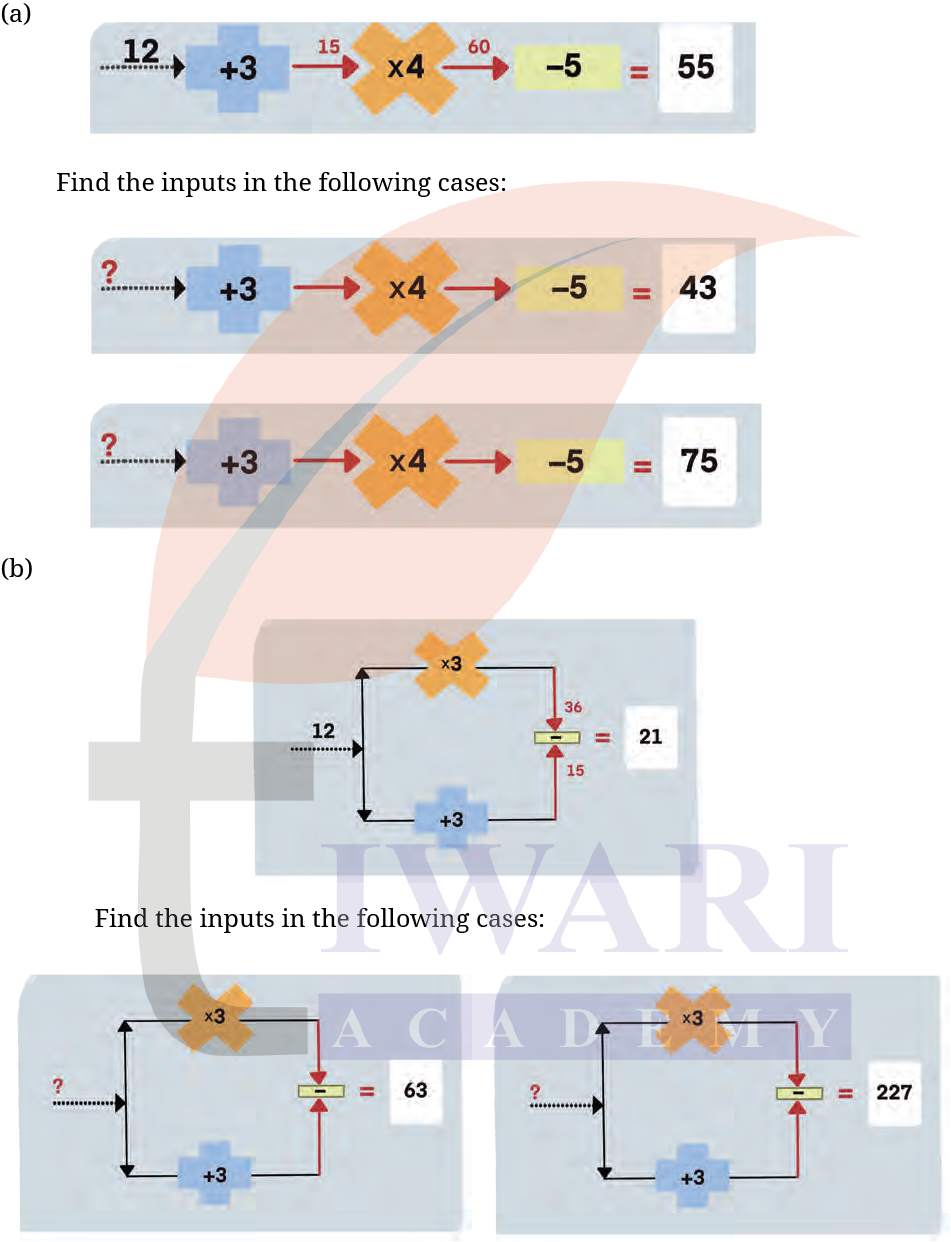
Answer:
The machine performs operations in sequence:
Input ⇒ + 3 ⇒ Result 1
Result 1 ⇒ × 4 ⇒ Result 2
Result 2 ⇒ -5 ⇒ Output
(a) Let’s verify with Input = 12:
Step 1: 12 + 3 = 15
Step 2: 15 × 4 = 60
Step 3: 60 – 5 = 55
Case 1:
Finding input when output = 43
Let the input = x
Forward equation: [(x + 3) × 4] – 5 = 43
Add 5 to both sides
(x + 3) × 4 = 43 + 5
⇒ (x + 3) × 4 = 48
Divide both sides by 4
x + 3 = 48/4
⇒ x + 3 = 12
Subtract 3 from both sides
x = 12 – 3
⇒ x = 9
Verification:
Step 1: 9 + 3 = 12
Step 2: 12 × 4 = 48
Step 3: 48 – 5 = 43
Case 2:
Finding input when output = 75
Working backwards:
Let the input = y
Forward equation: [(y + 3) × 4] – 5 = 75
Add 5 to both sides
(y + 3) × 4 = 75 + 5
⇒ (y + 3) × 4 = 80
Divide both sides by 4
y + 3 = 80/4
⇒ y + 3 = 20
Subtract 3 from both sides
y = 20 – 3
⇒ y = 17
Verification:
Step 1: 17 + 3 = 20
Step 2: 20 × 4 = 80
Step 3: 80 – 5 = 75
(b) The machine operates in a loop:
Input ⇒ goes down ⇒ +3 ⇒ First Result
First Result ⇒ goes right and up ⇒ ×3 ⇒ Second Result
Second Result ⇒ goes down to subtraction box ⇒ Output
Step 1: 12 ⇒ ×3 ⇒ 36
Step 2: 12 ⇒ +3 ⇒ 15
Step 3: 36 – 15 = 21
So the machine works as:
Top path: Input × 3
Bottom path: Input +3
Final: (Input × 3) – (Input + 3) = Output
3 × Input – Input – 3 = Output
2 × Input – 3 = Output
Let the input = x
⇒ 2x – 3 = Output
Case 1:
Finding input when output = 63
2x – 3 = 63
Add 3 to both sides
2x = 63 + 3
⇒ 2x = 66
Divide both sides by 2
x = 66/2
⇒ x = 33
Verification:
Top path: 33 × 3 = 99
Bottom path: 33 + 3 = 36
Result: 99 – 36 = 63
Case 2:
Finding input when output = 227
2x – 3 = 227
Add 3 to both sides
2x = 227 + 3
⇒ 2x = 230
Divide both sides by 2
x = 230/2
⇒ x = 115
Verification:
Top path: 115 × 3 = 345
Bottom path: 115 + 3 = 118
Result: 345 – 118 = 227
5. What are the inputs to these machines?
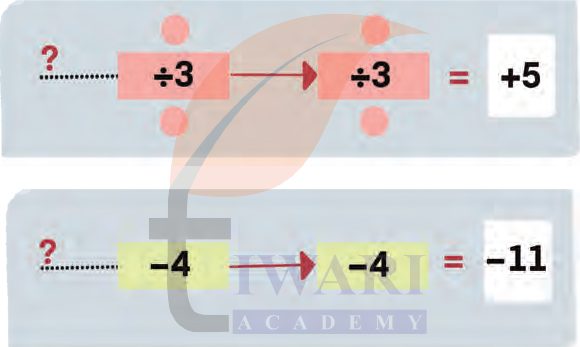
Answer:
Case 1: Output = +5
Operations:
Input ⇒ ÷3 ⇒ First Result
First Result ⇒ ÷3 ⇒ Output
Setting up the equation:
Let the input = x
(x ÷ 3) ÷ 3 = 5
⇒ x ÷ 9 = 5
Multiply both sides by 9
x = 5 × 9
⇒ x = 45
Verification:
45 ÷ 3 = 15
15 ÷ 3 = 5
Case 2: Output = -11
Operations:
Input ⇒ -4 ⇒ First Result
First Result ⇒ -4 ⇒ Output
Setting up the equation:
Let the input = y
(y – 4) – 4 = -11
⇒ y – 8 = -11
Add 8 to both sides
y = -11 + 8
⇒ y = -3
Verification:
Step 1: -3 – 4 = -7
Step 2: -7 – 4 = -11
6. A taxi driver charges a fixed fee of ₹800 per day plus ₹20 for each kilometer traveled. If the total cost for a taxi ride is ₹2200, determine the number of kilometres traveled.
Answer:
Fixed fee per day = ₹ 800
Charge per kilometer = ₹ 20
Total cost = ₹ 2200
Let the number of kilometers traveled = x
Total cost = Fixed fee + (Cost per km × Number of km)
⇒ 800 + 20x = 2200
Subtract 800 from both sides
20x = 2200 – 800
⇒ 20x = 1400
Divide both sides by 20
x = 1400/20
⇒ x = 70
The taxi traveled 70 kilometers.
7. The sum of two numbers is 76. One number is three times the other number. What are the numbers?
Answer:
Sum of two numbers = 76
Let the smaller number = x
Then the larger number = 3x (three times the smaller)
Since their sum is 76:
⇒ x + 3x = 76
⇒ 4x = 76
Divide both sides by 4
x = 76/4
⇒ x = 19
Smaller number = x = 19
Larger number = 3x = 3(19) = 57
8. The figure shows the diagram for a window with a grill. What is the gap between two rods in the grill?
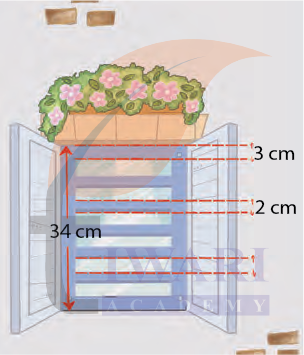
Answer:
Total height of the grill = 34 cm
Thickness of each horizontal rod = 2 cm
Top and bottom margins = 3 cm each
Number of horizontal rods = 5
Height of 5 rods = (5 × 2 = 10) cm
Height used by top and bottom margins = (3 + 3 = 6) cm
Height left for gaps = 34 – (10 + 6) = 18 cm
With 5 rods, there are 4 gaps between them.
Let the gap between two rods in the grill = x
⇒ 4x = 18
⇒ x = 18/4 = 4.5 cm
Hence, the gap between two rods in the grill is 4.5 cm.
9. In a restaurant, a fruit juice costs ₹ 15 less than a chocolate milkshake. If 4 fruit juices and 7 chocolate milkshakes cost ₹ 600, find the cost of the fruit juice and milkshake.
Answer:
Let the cost of one chocolate milkshake be ₹ x.
Then the cost of one fruit juice = ₹(x − 15).
According to the question:
4 fruit juices + 7 chocolate milkshakes = ₹ 600
So, 4(x − 15) + 7x = 600
⇒ 4x − 60 + 7x = 600
⇒ 11x − 60 = 600
⇒ 11x = 660
⇒ x = 60
Therefore, Cost of one chocolate milkshake = ₹ 60
Cost of one fruit juice = ₹ 45
10. Given 28p – 36 = 98, find the value of 14p – 19 and 28p – 38
Answer:
28p − 36 = 98
⇒ 28p = 98 + 36
⇒ 28p = 134
First Expression: 14p − 19
= [28p ÷ 2] – 19
= 134 ÷ 2 – 19 [Since 28p = 134]
= 67 − 19 = 48
Second Expression: 28p − 38
= 134 − 38 [Since 28p = 134]
= 96
11. The steps to solve three equations are shown below. Identify and correct any mistakes.
(a) 6x + 9 = 66
x + 9 = 11
x = 11 – 9
x = 2
(b) 14y + 24 = 36
7y + 12 = 18
7y = 6
y = 6/7
(c) 4x – 5 = 9x + 8
4x = 9x + 8 – 5
4x = 9x + 3
4x – 9x = 3
-5x = 3
x = -5/3
Answer:
(a) Checking the shown steps:
6x + 9 = 66
x + 9 = 11
Mistake:
Here, 6x and 66 were divided by 6, but 9 was not divided by 6.
When we divide both sides of an equation by a number, we must divide every term on both sides.
Correct solution:
6x + 9 = 66
⇒ 6x = 66 − 9
⇒ 6x = 57
⇒ x = 57 ÷ 6
⇒ x = 9.5
(b)
Shown steps:
14y + 24 = 36
7y + 12 = 18
7y = 6
y = 6/7
Checking:
Dividing 14y + 24 = 36 by 2 gives 7y + 12 = 18 (Correct)
Subtracting 12 from both sides: 7y = 6 (Correct)
Dividing both sides by 7: y = 6/7 (Correct)
Conclusion:
There is no mistake in these steps.
The solution y = 6/7 is correct.
(c) Shown steps:
4x – 5 = 9x + 8
4x = 9x + 8 – 5
4x = 9x + 3
4x − 9x = 3
-5x = 3
x = -5/3
Mistake:
When -5 is moved from the left side to the right side, its sign must change.
The step 4x = 9x + 8 – 5 is incorrect.
Correct solution:
4x – 5 = 9x + 8
⇒ 4x = 9x + 8 + 5
⇒ 4x = 9x + 13
⇒ 4x – 9x = 13
⇒ -5x = 13
⇒ x = -13/5
12. Find the measures of the angles of these triangles.
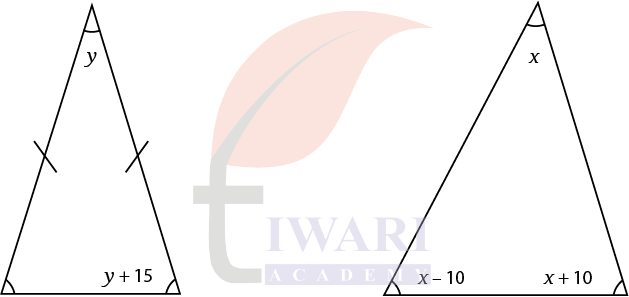
Answer:
Triangle 1:
The two slanted sides are equal, so the triangle is isosceles. Therefore, the two base angles are equal.
Top angle = y
Each base angle = y + 15
Using the angle sum of a triangle:
y + (y + 15) + (y + 15) = 180
⇒ 3y + 30 = 180
⇒ 3y = 150
⇒ y = 50
So, the angles of the triangle:
Top angle = 50°
Each base angle = 65°
Triangle 2:
The angles are given as:
Top angle = x
Left base angle = x – 10
Right base angle = x + 10
Using the angle sum of a triangle:
x + (x – 10) + (x + 10) = 180
⇒ 3x = 180
⇒ x = 60
So, the angles are:
Top angle = 60°
Left base angle = 50°
Right base angle = 70°
13. Write 4 equations whose solution is u = 6.
Answer:
Equation (i) Starting with
u = 6
Adding 4 to both sides:
u + 4 = 6 + 4
⇒ u + 4 = 10
Equation (ii) Starting with
u = 6
Multiply both sides by 2:
2u = 12
Adding 3 both sides
2u + 3 = 12 + 3
⇒ 2u + 3 = 15
Equation (iii) Starting with
u = 6
Subtract 3 from both sides:
u – 3 = 6 – 3
u – 3 = 3
Equation (iv) Starting with
u = 6
Multiply both sides by 3 and then add 6:
3u + 6 = 18 + 6
⇒ 3u + 6 = 24
14. The Bakhśhāli Manuscript (300 CE) mentions the following problem. The amount given to the first person is not known. The second person is given twice as much as the first. The third person is given thrice as much as the second; and the fourth person four times as much as the third. The total amount distributed is 132. What is the amount given to the first person?
Answer:
Let the amount given to the first person be x.
Then, amount given to the second person = twice the first = 2x
Amount given to the third person = three times the second
= 3 × 2x = 6x
Amount given to the fourth person = four times the third
= 4 × 6x = 24x
Total amount given = 132
So, x + 2x + 6x + 24x = 132
⇒ 33x = 132
Divide both sides by 33:
x = 132 ÷ 33
⇒ x = 4
The amount given to the first person is 4.
15. The height of a giraffe is two and a half metres more than half its height. How tall is the giraffe?
Answer:
Let the height of the giraffe be (h) metres.
According to the question:
h = 1/2 h + 2.5
Subtract 1/2 h from both sides:
h – 1/2 h = 2.5
⇒ h/2 = 2.5
Multiply both sides by 2:
h = 5
Hence, the giraffe is 5 metres tall.
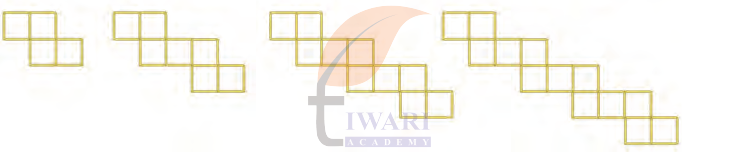
16. Two separate figures are given below. Each figure shows the first few positions in a sequence of arrangements made with sticks. Identify the pattern and answer the following questions for each figure:
(a) How many squares are in position number 11 of the sequence?
(b) How many sticks are needed to make the arrangement in position number 11 of the sequence?
(c) Can an arrangement in this sequence be made using exactly 85 sticks? If yes, which position number will it correspond to?
(d) Can an arrangement in this sequence be made using exactly 150 sticks? If yes, which position number will it correspond to?
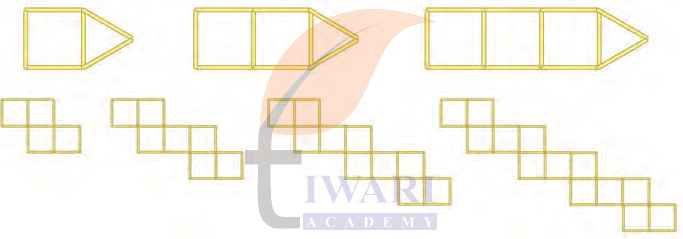
Answer:
Figure 1 (Top – arrow made of squares and a triangle)
Position 1 ⇒ 1 square + arrow head
Position 2 ⇒ 2 squares + arrow head
Position 3 ⇒ 3 squares + arrow head
Number of squares = position number

(a) Squares in position 11
Number of squares = 11
11 squares
(b) Sticks in position 11
First figure needs 6 sticks
Every new figure adds 3 sticks
So for n squares = 3 + 3(n) = 3n + 3
Therefore, sticks in position 11
= 3(11) + 3 = 36
= 36 sticks
(c) Let 3n + 3 = 85
⇒ 3n = 82
⇒ n = 27.33
Not a whole number.
So, it is not possible.
(d) Let 3n + 3 = 150
⇒ 3n = 147
⇒ n = 49
Yes, position number = 49
Figure 2 (Bottom – zig-zag arrangement of squares)
Position 1 ⇒ 4 squares
Position 2 ⇒ 7 squares
Position 3 ⇒ 10 squares
So, Number of squares = 3 × position number + 1
(a) Squares in position 11
3 × 11 + 1 = 23
⇒ 23 squares
(b) Sticks in position 11
First position = 3 × number of square + 1 sticks
Number of sticks = 3n + 1
Total squares = 23
Sticks = 3 × 23 + 1 = 70
(c) The squares in nth position = 3n + 1
So, number of sticks = 3 × (number of square) + 1
⇒ 3(3n + 1) + 1
⇒ 9n + 4
Let 9n + 4 = 85
⇒ 9n = 81
⇒ n = 9
Yes, position number = 9
(d) Let 9n + 4 = 150
⇒ 9n = 146
Here, 146 is not divisible by 6
So, it is not possible.
17. A number increased by 36 is equal to ten times itself. What is the number?
Answer:
Let the number be x.
A number increased by 36 is equal to ten times itself.
So, x + 36 = 10x
Subtract x from both sides:
36 = 10x − x
⇒ 36 = 9x
Divide both sides by 9:
x = 4
18. Solve these equations:
(a) 5(r + 2) = 10
(b) -3(u + 2) = 2(u – 1)
(c) 2(7 – 2n) = -6
(d) 2(x – 4) = -16
(e) 6(x – 1) = 2(x – 1) – 4
(f) 3 – 7s = 7 – 3s
(g) 2x + 1 = 6 – (2x – 3)
(h) 10 – 5x = 3(x – 4) – 2(x – 7)
Answer:
(a) 5(r + 2) = 10
⇒ 5r + 10 = 10
⇒ 5r = 0
⇒ r = 0
(b) -3(u + 2) = 2(u – 1)
⇒ -3u – 6 = 2u – 2
⇒ -3u − 2u = -2 + 6
⇒ -5u = 4
⇒ u = -4/5
(c) 2(7 – 2n) = -6
⇒ 14 – 4n = -6
⇒ -4n = -6 – 14
⇒ -4n = -20
⇒ n = 5
(d) 2(x – 4) = -16
⇒ 2x – 8 = -16
⇒ 2x = -8
⇒ x = -4
(e) 6(x – 1) = 2(x – 1) – 4
⇒ 6x – 6 = 2x – 2 – 4
⇒ 6x – 6 = 2x – 6
⇒ 6x – 2x = −6 + 6
⇒ 4x = 0
⇒ x = 0
(f) 3 – 7s = 7 – 3s
⇒ -7s + 3 = -3s + 7
⇒ -7s + 3s = 7 – 3
⇒ -4s = 4
⇒ s = -1
(g) 2x + 1 = 6 – (2x – 3)
⇒ 2x + 1 = 6 – 2x + 3
⇒ 2x + 1 = 9 – 2x
⇒ 2x + 2x = 9 – 1
⇒ 4x = 8
⇒ x = 2
(h) 10 – 5x = 3(x – 4) – 2(x – 7)
⇒ 10 – 5x = (3x – 12) – (2x – 14)
⇒ 10 – 5x = 3x – 12 – 2x + 14
⇒ 10 – 5x = x + 2
⇒ -5x – x = 2 – 10
⇒ -6x = -8
⇒ x = 4/3
19. Solve the equations to find a path from Start to the End. Show your work in the given boxes provided and colour your path as you proceed.
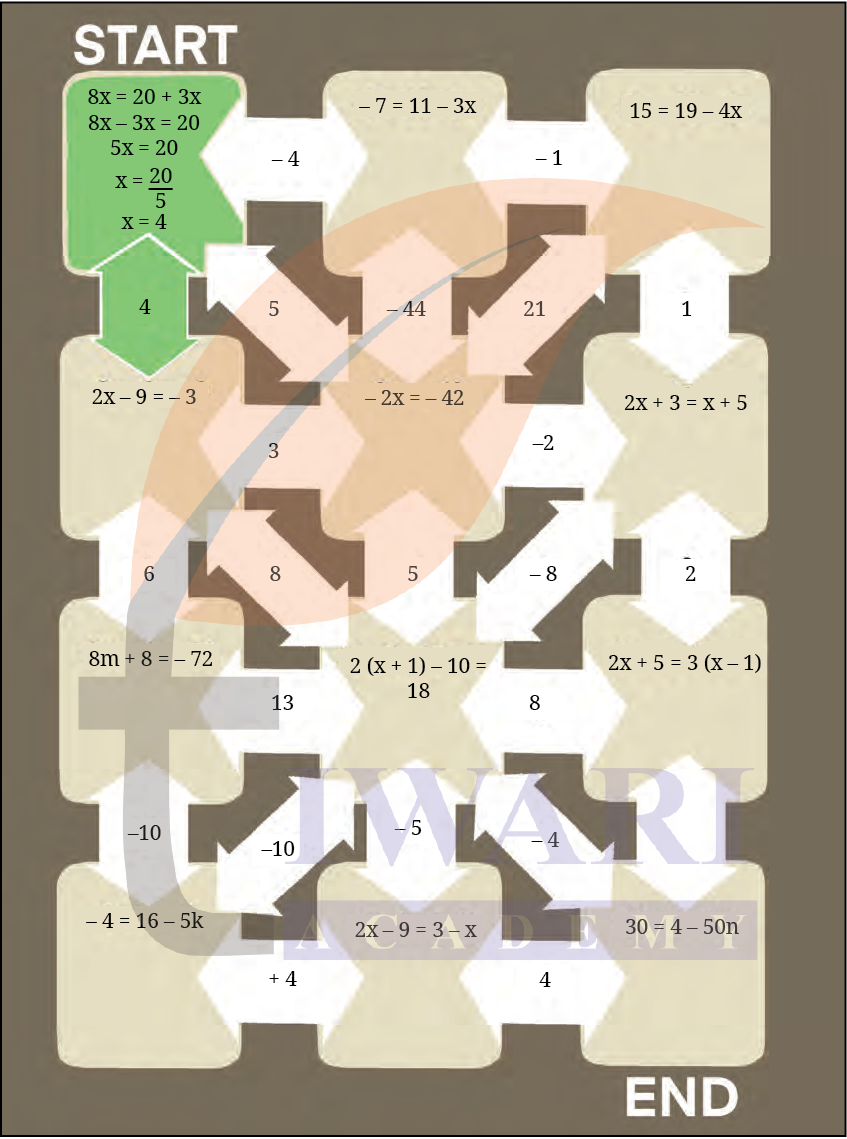
Answer:
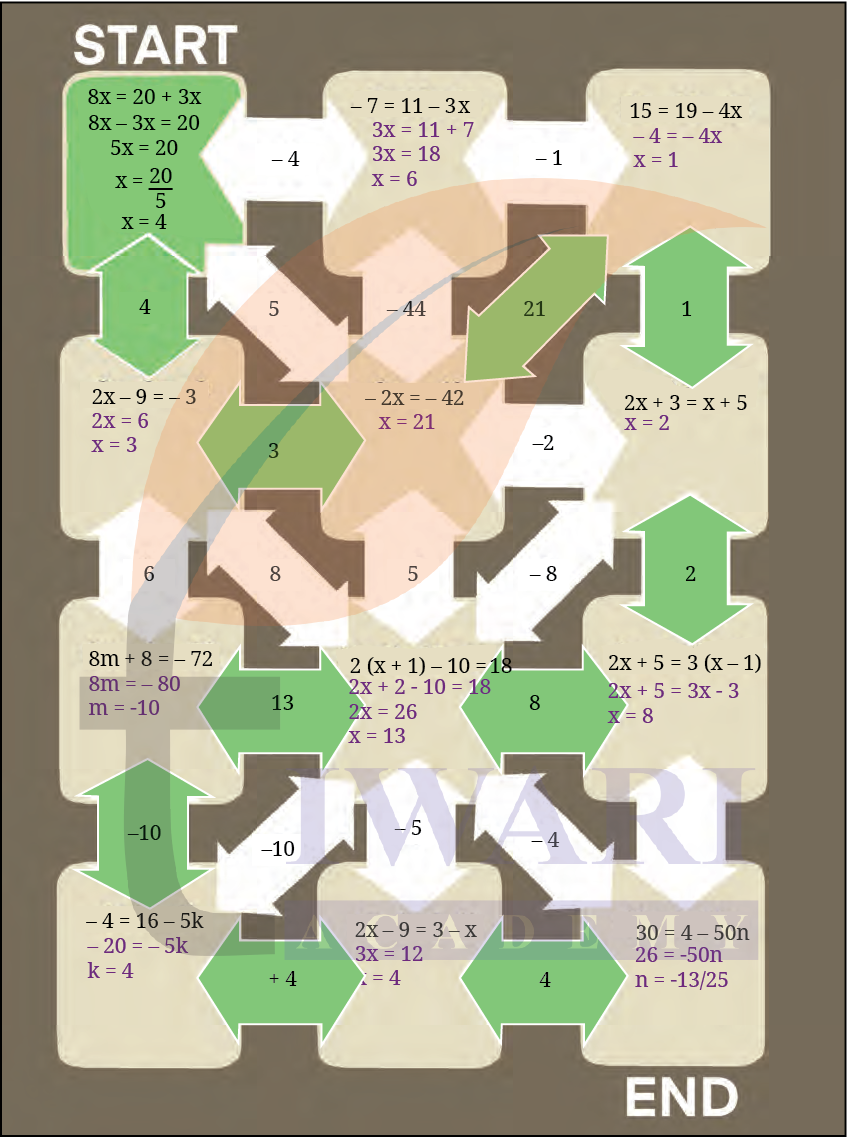
Frequently Asked Questions
Is Class 7 Maths Ganita Prakash Part 2 Chapter 7 difficult?
Chapter 7, Finding the Unknown, is not a difficult chapter once the core idea of balancing an equation is clear. It builds up gradually, starting with visual weighing balance puzzles and matchstick patterns before introducing the systematic method of solving equations by performing the same operation on both sides. Since it relies on integers and fractions already covered earlier, most students find it logical rather than difficult. Practising the worked examples and the “Mind the Mistake, Mend the Mistake” section helps students avoid common sign errors and builds real confidence with equations.
How to solve Class 7 Maths Ganita Prakash Part 2 Chapter 7 in one day?
To finish Chapter 7 in a single day, begin with a quick revision of the two core ideas: forming an equation from a real situation and solving it systematically by adding, subtracting, multiplying, or dividing both sides by the same number. Skip re-reading every example in detail and go straight to the “Figure it Out” questions after each section, since these mirror the exam pattern closely. Spend extra time on the “Mind the Mistake, Mend the Mistake” activity and the word problems near the end, then cross-check your answers using NCERT Solutions to clear doubts quickly and revise efficiently.
What is the importance of Class 7 Maths Ganita Prakash Part 2 Chapter 7 in the half-yearly exam?
Finding the Unknown is a high-value chapter for the half-yearly exam since it introduces linear equations, a concept that is tested every year through direct solving questions, word problems and pattern-based questions. It also connects with other areas such as angle sums in triangles and real-life budgeting situations, which examiners frequently combine into application-based questions worth good marks. Because this chapter forms the base for algebra in higher classes, teachers usually give it strong weightage. Thoroughly practising every “Figure it Out” exercise and the worked examples helps students score well and build a strong foundation for future exams.
What topics are covered in Class 7 Maths Ganita Prakash Part 2 Chapter 7?
This chapter covers finding unknown weights using a weighing balance model and matchstick patterns, along with key terms like equation, LHS and RHS. It explains the trial and error method as a starting point, then moves to the systematic method of solving equations by performing the same operation on both sides. Students also learn to frame equations from real-life word problems involving money, savings, tile patterns and marbles, along with a “Mind the Mistake, Mend the Mistake” activity. The chapter closes with a section on the history of algebra covering Brahmagupta, Aryabhata and Al-Khwarizmi, plus a magic trick and tangram activity.
Are NCERT Solutions for Class 7 Maths Ganita Prakash Part 2 Chapter 7 enough for exam preparation?
Yes, NCERT Solutions for this chapter are usually sufficient for exam preparation since CBSE question papers are based directly on the concepts and question patterns given in the Ganita Prakash textbook. These solutions explain each “Figure it Out” question with the same step-by-step balancing approach taught in the chapter, covering tricky word problems on ages, digits, taxi fares and triangle angles. Along with attempting the mistake-correction exercise and revising the summary points, working through these solutions gives students the practice and clarity needed to handle both direct and application-based equation questions confidently in exams.