



by Tiwari Academy
NCERT Solutions for Class 5 EVS Our Wondrous World Chapter 10 Earth Our Shared Home updated for Session 2025-26. Class 5 EVS Solutions offer simple, well-explained answers as per the latest NCERT syllabus. This chapter helps students understand Earth as a shared home for humans, plants, animals and other living beings. These Class 5 EVS NCERT Solutions explain natural resources, care for the environment and responsible use of Earth’s resources. The content is student-friendly, exam-ready and useful for revision, concept clarity and building environmental awareness.
Class 5 EVS all Chapters Answers
Earth Our Shared Home Class 5 EVS Our Wondrous World Chapter 10 Solutions
Page 162
Activity 1
We all live in this planet and each of us has an address. Fill up your address below.
1. My address
Name: _________________________
House number/building name: _________________________
Street name: _________________________
Village/Town/City: _________________________
District: _________________________
State/Union Territory: _________________________
Country: _________________________
Planet: _________________________
See AnswerName: Yogesh Bhandari
House number/building name: Jyoti Villa, B-34
Street name: Lajpat Nagar III
Village/Town/City: New Delhi
District: South East Delhi
State/Union Territory: Delhi
Country: India
Planet: Earth
2. Use a globe and find out:
a. Are all the oceans on Earth connected with each other?
See AnswerYes, if you look at a globe, you can see that all the big bodies of water, which we call oceans, flow into one another. There are no walls between them, so they are all connected to form one big global ocean.
b. Where is India on the globe?
See AnswerOn the globe, India is located in the continent of Asia. It is a large peninsula, which means it is surrounded by water on three sides: the Arabian Sea to the west, the Bay of Bengal to the east and the Indian Ocean to the south.
Class 5 EVS Our Wondrous World Chapter 10 Writing based Questions
Page 164
Write
1. Does the rosy starling visit your area? What is it called locally?
See AnswerYes, the rosy starling does visit areas around Delhi during the winter. Locally, it is often called ‘Tilyar’ or ‘Gulabi Myna’.
2. What does this story tell us about nature?
See AnswerThis story tells us that nature is deeply connected across the whole world. Animals like the rosy starling don’t see the borders between countries. They can travel thousands of kilometres freely for food and better weather and in doing so, they also help people, like the farmers in India.
Page 165
What does it mean when we say ‘nature has no boundaries’?
See AnswerWhen we say ‘nature has no boundaries,’ it means that things in the natural world like air, water, clouds, seeds and animals can move freely across the planet. They are not stopped by the lines we draw on maps to separate countries. A river can flow through many countries and a bird can fly wherever it needs to go.
Class 5 EVS Our Wondrous World Chapter 10 Discussion based Questions
Page 167
Discuss
Why do you think yoga became popular in so many countries?
See AnswerI think yoga became popular all over the world because it helps people keep their bodies healthy and their minds calm and peaceful. It’s a way to feel good and live in harmony with yourself as well as nature and people everywhere want to feel healthy and happy.
Write
Can you name a yoga pose you have tried or seen? What do you think it helps with?
See AnswerYes, I have seen the ‘Vrikshasana’ or the Tree Pose. In this pose, you balance on one leg like a tree. I think it helps improve balance and makes your legs stronger. It also helps you focus your mind to stay steady.
Page 168
Write
1. What would happen if chillies disappeared from our kitchens for a week?
See AnswerIf chillies disappeared from our kitchens for a week, our food would taste very different! Many Indian dishes like curries and chutneys would not be spicy and might feel bland to us, as we are so used to their flavour.
2. Ask your parents and write down the name of any recipe in which they have used black pepper and not red chillies.
See AnswerMy parents make ‘Pongal’, a South Indian dish, using black pepper instead of red chillies. They also use black pepper in soups and sometimes in ‘rasam’ to give it a mild spicy flavour.
Class 5 EVS Our Wondrous World Chapter 10 Page-wise Questions
Page 169
Discuss
1. If you could choose one Indian food to share with the world, what would it be?
See AnswerI would choose to share ‘Biryani’. It’s a wonderful dish made with rice, spices and either vegetables or meat. It has so many amazing flavours and aromas and I think people all over the world would love it.
2. What kind of new food items do you think will travel in the future?
See AnswerIn the future, I think more healthy foods made from millets might travel the world. Also, maybe some unique fruits and vegetables that are only found in certain places, like the ‘Dragon Fruit’ or ‘Kiwano’, will become common in other countries.
Page 170
Write
1. Why do you think both Indian and Mexican cultures use marigolds during their festivals?
See AnswerI think both cultures use marigolds because of their bright and happy colours like yellow and orange. These colours remind people of sunlight, warmth and celebration. In both India and Mexico, these flowers bring a feeling of joy and spirituality to festivals.
2. Why do you think people in different countries include flowers in their celebrations?
See AnswerPeople in different countries use flowers in their celebrations because flowers are beautiful, they smell wonderful and they represent life, joy and new beginnings. They add colour and happiness to any occasion, whether it’s a wedding, a festival or a prayer ceremony.
Page 171
Write
What does this story tell us about animals moving from one place to another?
See AnswerThis story tells us that when animals move to a new place, they can be very helpful and important there. The Indian cows were so well-suited to the weather in Brazil that they became a major source of milk for the country, showing that sharing animals can benefit people in different parts of the world.
Page 172
Activity 4
1. With help of your teacher or an elder find out the names of at least 5 different breeds of cows.
See AnswerHere are five different breeds of cows:
1. Gir
2. Sahiwal
3. Red Sindhi
4. Kankrej
5. Ongole
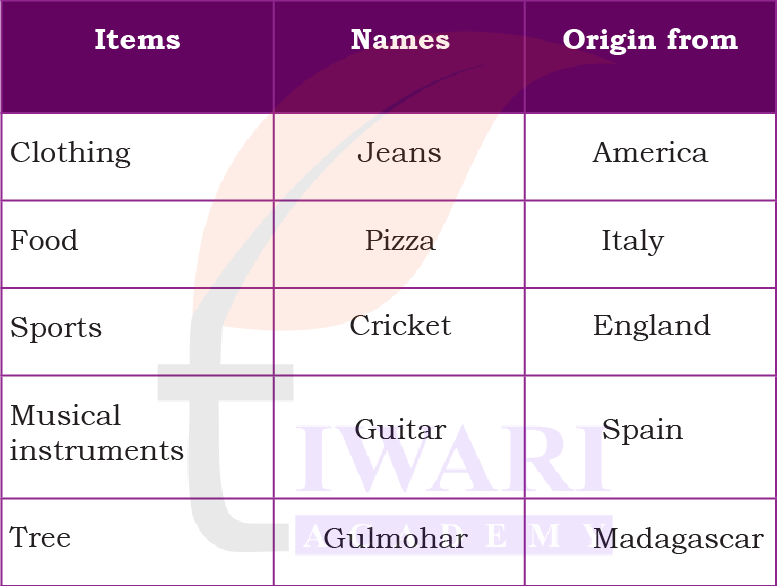
2. Make a list of a few things in your house or school that may have come from another part of the world. Find out where they originally came from.
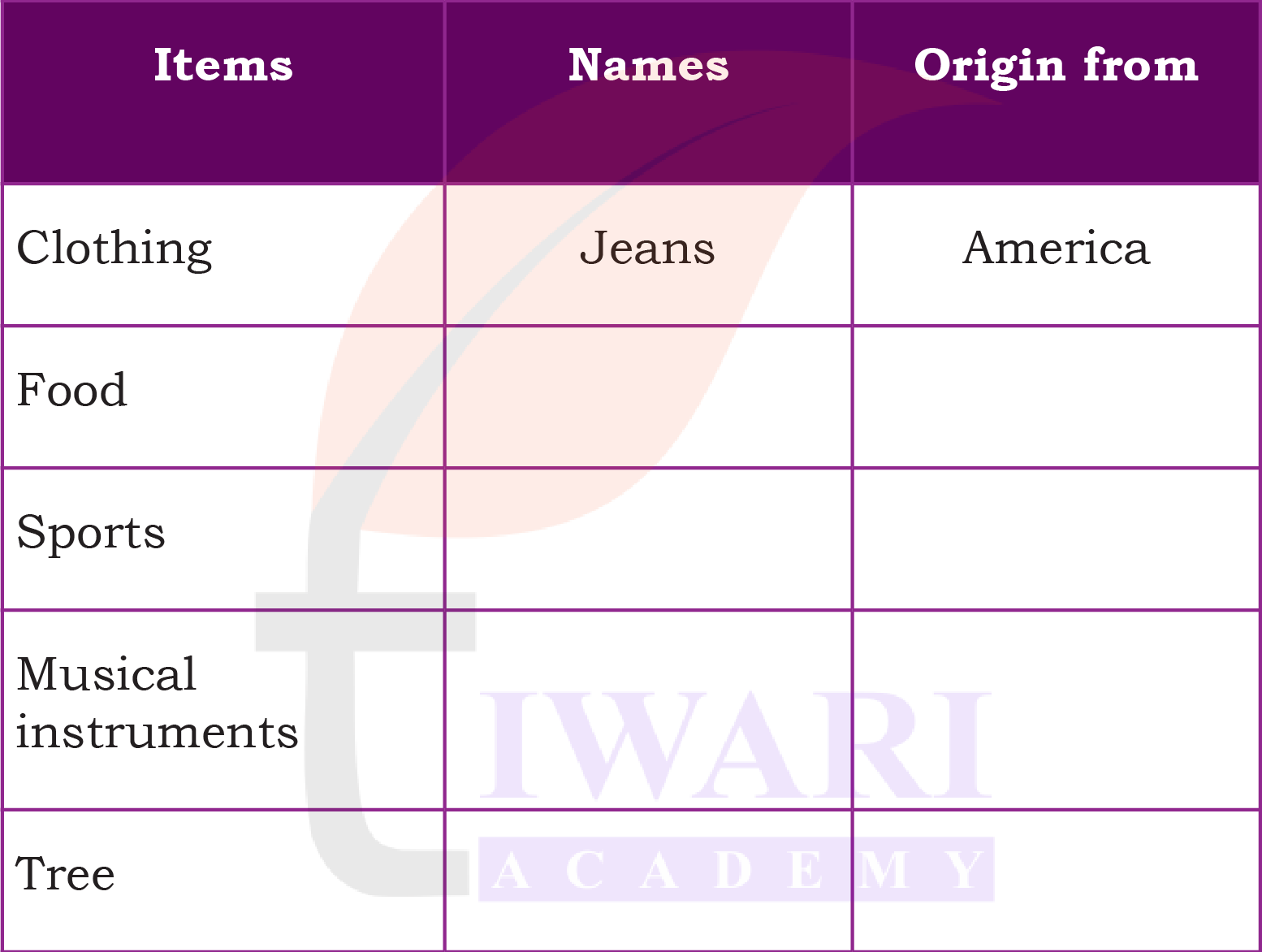
Answer:
Page 176
Write
1. What does ‘Vasudhaiva Kutumbakam’ teach us?
See Answer‘Vasudhaiva Kutumbakam’ teaches us that the entire world is one big family. It teaches us that all people, animals and all of nature are connected and we should live together with respect, love and care for one another and for our shared home, the Earth.
2. Write the meaning of ‘Vasudhaiva Kutumbakam’ in your own words.
See AnswerIn my own words, ‘Vasudhaiva Kutumbakam’ means that it doesn’t matter what country we are from or what language we speak; we are all part of one single family living on planet Earth. We should treat everyone and everything with kindness, just like we treat our own family members.
3. How can we live like one big family, even when we are different?
See AnswerWe can live like one big family by sharing our ideas, food and stories with each other. We can learn from each other’s cultures, respect our differences and help each other when needed. Caring for our planet together is also a way to show that we are one big family.
Class 5 EVS Our Wondrous World Chapter 10 Let us reflect
Page 176
1. Pick one of the ideas. Write a short story about how this idea might have travelled from one place to another long ago. Think about how it helped people change their lives or the way they think.
See AnswerThe Story of Zero’s Journey:
Long ago in India, a wise scholar came up with a brilliant idea: a symbol for ‘nothing’, which they called ‘shunya’. At first, it was just a dot, but it was a powerful idea. Traders from Arabia, who came to India to buy spices, saw this amazing new way of writing numbers. They learned about ‘shunya’ and found it made their calculations for trade so much easier! They took this idea back with them to their lands, calling it ‘sifr’. From there, scholars and travellers carried the idea across Europe. People’s lives changed forever. They could now calculate huge numbers easily, which helped in building great buildings, studying the stars and developing science and technology. This one small idea from India travelled the world and helped everyone think about numbers in a completely new way.
2. Write one way you can care for the Earth.
See AnswerOne way I can care for the Earth is by planting a tree and taking care of it. Trees give us oxygen to breathe, provide homes for birds and help keep our planet cool.
3. Identify an item that can travel from India to other parts of the world and write about it.
See AnswerAn item that can travel from India to other parts of the world is handwoven textiles, like Khadi fabric. This special cloth is made from cotton without using electricity. It is eco-friendly and represents a beautiful Indian tradition. People in other countries might appreciate it because it is sustainable, comfortable and tells a story about India’s history and skilled artisans.