


by Tiwari Academy
NCERT Solutions for Class 5 EVS Our Wondrous World Chapter 6 Some Unique Places updated for Session 2025-26. Class 5 EVS helps students understand interesting and extraordinary locations across India and the world through well-structured multiple-choice questions. These solutions strengthen concepts related to natural wonders, man-made marvels, cultural heritage sites, special geographical features and unique environmental conditions. Each question is designed to improve observation, writing and map-reading skills, making learning engaging and helping students revise the chapter effectively with clear explanations.
Class 5 EVS all Chapters Answers
Some Unique Places Class 5 EVS Our Wondrous World Chapter 6 Solutions
Page 95
Find out
1. In which sea are the Andaman and Nicobar Islands located?
See AnswerIf we look at a map of India, we will find that the Andaman and Nicobar Islands are located in the Bay of Bengal.
2. Name the other islands you know.
See AnswerIndia has many beautiful islands. Besides the Andaman and Nicobar Islands, another famous group of islands is the Lakshadweep Islands in the Arabian Sea. Sri Lanka is a whole country that is an island.
Page 97
Why do you think some birds and animals are found only on these islands?
See AnswerIslands are surrounded by water, which makes it difficult for animals from the mainland to travel there. Over a very, very long time, the birds and animals on the islands adapted to their special homes and became unique species that are not found anywhere else in the world.
Write
1. Draw or write about your favourite fish or other sea animal.

See AnswerMy favourite sea animal is the dolphin.
Super Smart: Dolphins are very intelligent and can learn many things.
Friendly and Helpful: They are known to be kind and sometimes even help people in the ocean.
Team Players: Dolphins live in groups called pods, where they work and play together.
Amazing Jumpers: They are fantastic acrobats, leaping and spinning gracefully out of the water.

2. List at least three living things found in the sea.
See Answer1. Fish (like the clownfish in the picture)
2. Dolphins
3. Sea Turtles
Page 97
Discuss
1. Why do you think life under the sea is just as important as life in the forests?
See AnswerLife under the sea is just as important as life in the forests because marine life is important not just for the sea, but for the entire Earth. Just like forests, oceans produce oxygen for us to breathe and help keep our planet’s climate stable. They are a huge and vital part of our world’s ecosystem.
2. How do coral reefs help fish and other sea creatures?
See AnswerCoral reefs are like big, bustling cities under the sea. They give shelter to many creatures. They provide safe places for fish to hide from bigger animals, lay their eggs and find food.
Page 99
Write
1. What do you see in the mangrove forest? List three things that live there.
See AnswerIn the mangrove forest, we can see special mangrove trees with roots that grow up out of the muddy water.
Three things that live there are:
► The Royal Bengal Tiger
► Crocodiles
► Monkeys
2. What do you think makes this place different from other forests?
See AnswerThe Sundarbans are very different because they grow where the river meets the sea. This means the land is muddy and salty. The trees, called mangroves, have amazing roots that stick out of the water to help them breathe. We won’t see that in a regular forest.
Page 100
In what ways do people in Sundarbans depend on the mangrove forests?
See AnswerThe people living in Sundarbans depend on the forest for their daily needs. This could mean they get food (like fish and crabs), wood for their homes and honey from the forest. The forest also protects their homes from big waves and storms.
Class 5 EVS Our Wondrous World Chapter 6 Discussion based questions
Page 101
Discuss
Why do you think it is important to take care of places like the Sundarbans?
See AnswerIt’s very important. The roots of the mangrove trees hold the soil together. This stops the land from being washed away by waves and floods. By protecting the Sundarbans, we protect the land and the homes of both people and animals.
Find out
Can you name the seven Northeastern states?
See AnswerThe seven Northeastern states of India, often called the Seven Sisters, are:
1. Arunachal Pradesh
2. Assam
3. Manipur
4. Meghalaya
5. Mizoram
6. Nagaland
7. Tripura
Class 5 EVS Our Wondrous World Chapter 6 Writing based questions
Page 102
Write
1. Look at the picture. Can you spot three things being sold in the market?
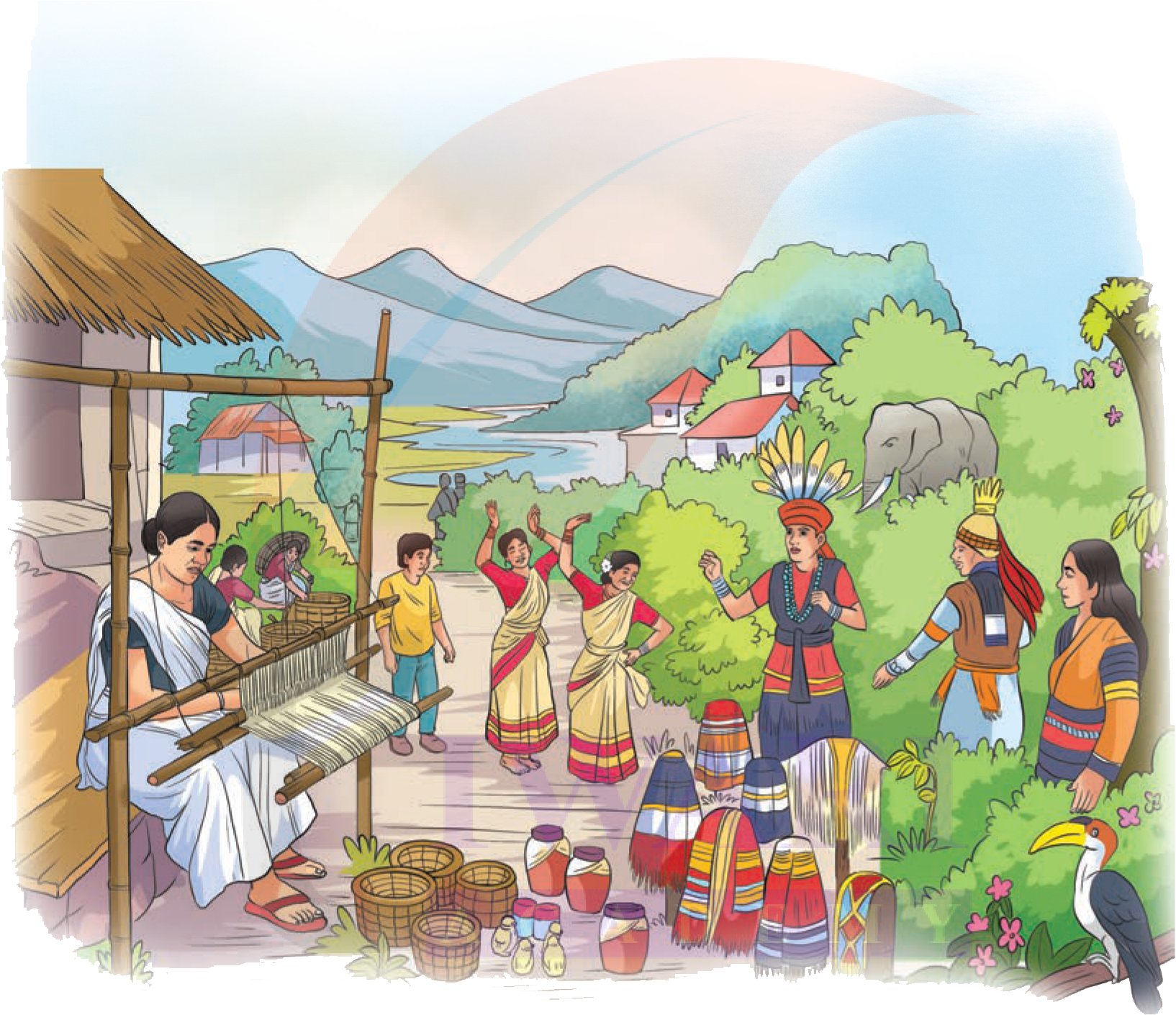
See Answer1. Woven baskets
2. Colourful, hand-woven shawls or cloth
3. Bamboo containers or decorative items
2. Can you identify the festival from the above picture?
See AnswerBihu
3. Why do you think the houses are built on bamboo structures ?
See AnswerThe Northeast region has many rivers and gets a lot of rain. Building houses on high bamboo stilts helps protect the homes from floods and also keeps wild animals away.
4. What animals can you see in the picture?
See AnswerWe can see an elephant in the background and a beautiful hornbill bird in the corner.
5. What does this picture tell you about the people who live with nature in the Northeast of India?
See AnswerThis picture shows that the people of the Northeast live very closely with nature. Their homes are made from natural materials like bamboo, they weave beautiful things by hand and their festivals, dances and daily lives are all connected to the forests and wildlife around them.
Page 105
Write
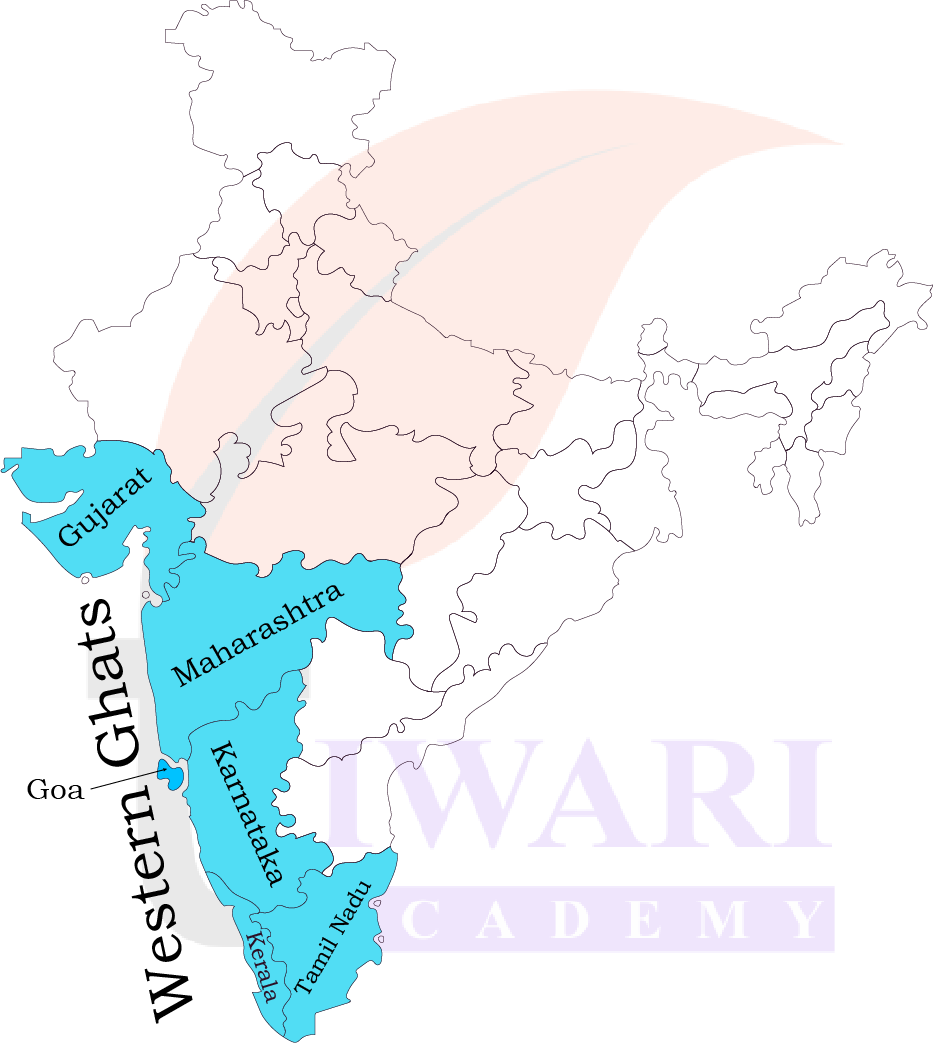
1. Look at the map, locate the Western Ghats and name the six states it passes through.
See AnswerThe Western Ghats are a long chain of mountains on the western side of India. If we look at a map, we will see they pass through these six states:
• Gujarat
• Maharashtra
• Goa
• Karnataka
• Kerala
• Tamil Nadu
2. What animals can you spot in the forest?
See AnswerThe forest is full of life. I can spot a lion-tailed macaque (the orange monkey), a leopard, an elephant, deer, a snake, a frog and many colourful birds.
3. What are the people doing in the picture given below?
See AnswerThe people in the picture seem to be gathering things from the forest. They might be collecting medicinal plants or herbs, which are found in the Western Ghats.
4. Why do you think forts were built on hilltops instead of flat land?
See AnswerForts were built on high hilltops because it gave the people inside a clear view of the surrounding lands. This made it very easy to spot an enemy approaching from far away and very difficult for the enemy to attack.
Page 106
Give the names of three rivers that start from the Western Ghats.
See AnswerMany of our country’s big rivers begin their journey in the Western Ghats. Three famous ones are:
• Godavari
• Krishna
• Kaveri (Cauvery)
Page 109
Write
List three protected areas in the Western Ghats.
See AnswerThe Western Ghats have many protected areas. Out of these, three examples are:
• Silent Valley National Park
• Wildlife Sanctuaries
• Tiger Reserves
Class 5 EVS Our Wondrous World Chapter 6 Let us reflect
Page 109
Let us reflect
1. What surprised you the most about the places visited in this journey across India? Why?
See AnswerWhat surprised me the most was learning about the North Sentinel Island and how its people survived the 2004 tsunami. It was amazing to hear that they understood nature so well – by watching the sea, the wind and animals – that they knew a big wave was coming and moved to safety. This shows how living close to nature can give us incredible knowledge and wisdom. It surprised me because they didn’t have any modern technology, but their connection to the environment was enough to save them.
2. Which place would you like to visit the most and what would you do there?
See AnswerI would love to visit the Sundarbans. If I went there, I would hope to take a quiet boat ride through the mangrove forests, keeping my eyes peeled to spot the majestic Royal Bengal Tiger. I would also love to see the unique breathing roots of the mangrove trees up close and learn more about how they protect the land. I’d definitely try to learn about the local people’s lives and how they collect honey and fish while respecting the forest.
3. How is your region similar or different from one of the places in the story?
See AnswerI live in a big city like Delhi. My region (a big city) is very different from the Western Ghats in the story.
Differences:
► Nature: In my city, we have buildings, roads and a few parks, but not dense forests like the Western Ghats with elephants, leopards and lion-tailed macaques. The Western Ghats have a rich variety of plants and animals that we don’t see every day in the city.
► Lifestyle: People in my city often work in offices or shops and we use cars and buses to travel. In the Western Ghats, people might be farmers, collect forest produce or work with nature directly.
► Environment: The Western Ghats are known for their fresh air, rivers and green landscapes, while cities can have more pollution and concrete.
Similarities (a small one):
Even in a city, we still have some green spaces or trees, just like the story talks about how important nature is everywhere. Sometimes, like the forts built in the Western Ghats, our cities also have historical buildings that tell stories of the past.
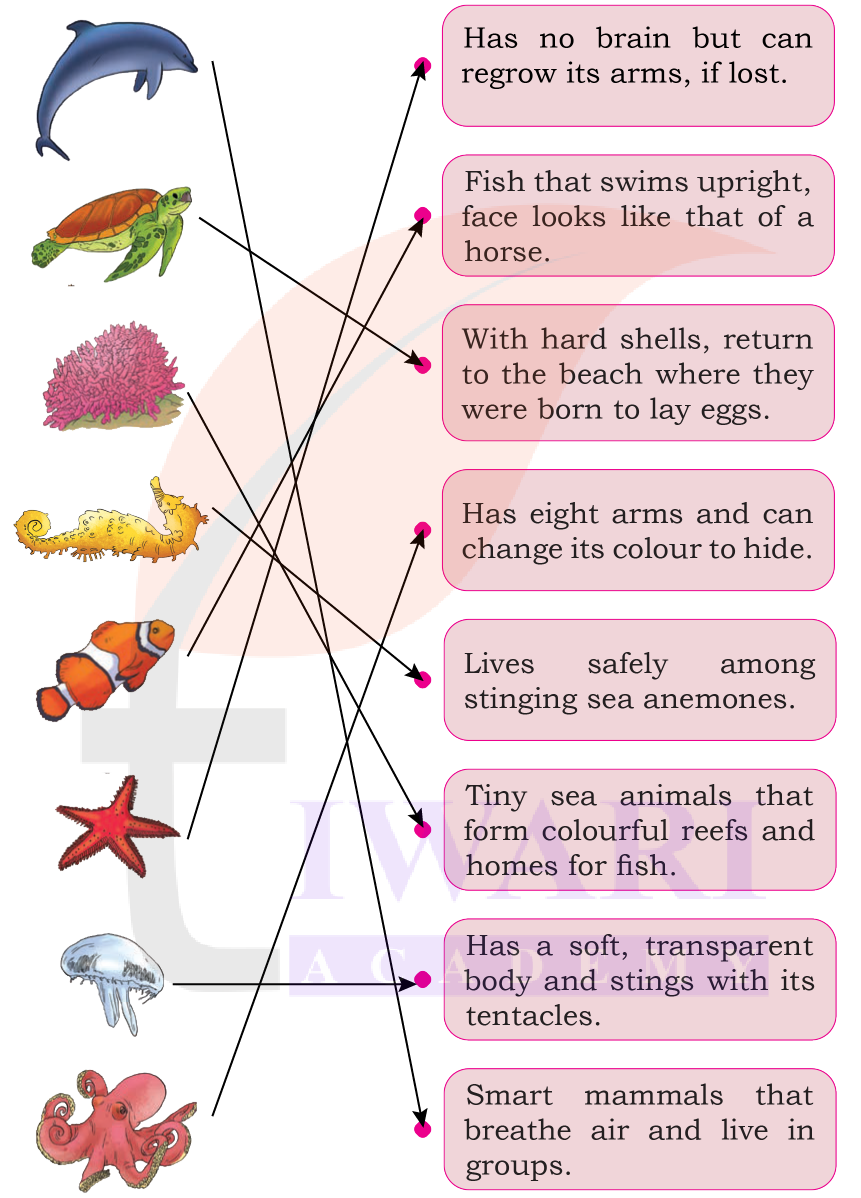
4. Match the following aquatic animals with their features.
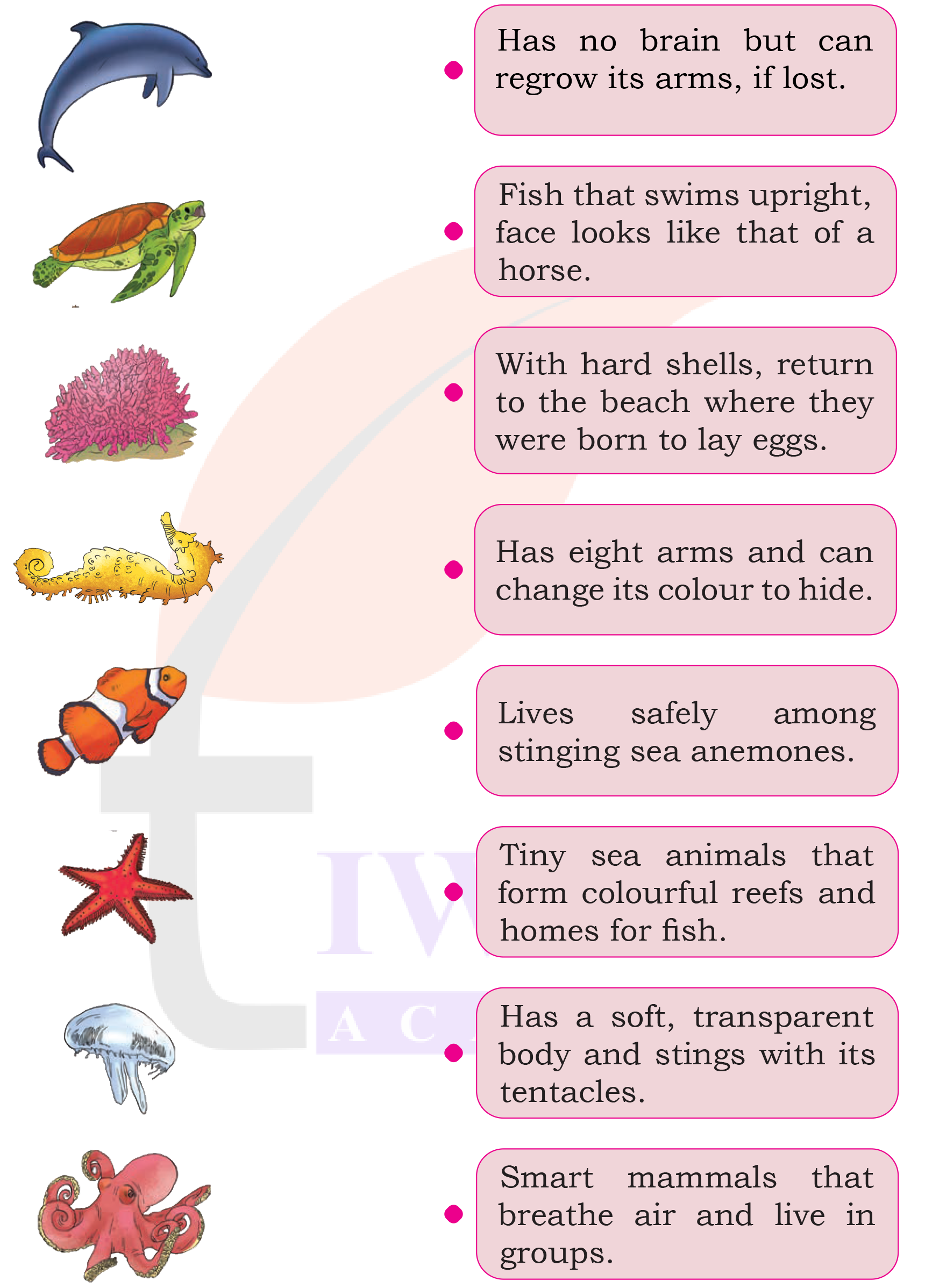
See Answer• Smart mammals that breathe air and live in groups. -> Dolphin
• With hard shells, return to the beach where they were born to lay eggs. -> Sea Turtle
• Tiny sea animals that form colourful reefs and homes for fish. -> Corals
• Fish that swims upright, face looks like that of a horse. -> Seahorse
• Lives safely among stinging sea anemones. -> Clownfish
• Has no brain but can regrow its arms, if lost. -> Starfish
• Has a soft, transparent body and stings with its tentacles. -> Jellyfish
• Has eight arms and can change its colour to hide. -> Octopus
5. What is special about mangroves?
See AnswerMangroves are truly special trees that grow in a very unique environment. Here’s what makes them stand out:
► Salty Homes: Unlike most trees, mangroves can grow in salty, muddy water where rivers meet the sea.
► Breathing Roots: They have special roots that grow upwards out of the water and mud. These are called “breathing roots” because they help the tree get oxygen when the ground is waterlogged.
► Coastal Protectors: Their strong, tangled roots hold the soil together. This is very important because it protects the coastline from big waves, storms and floods. They act like a natural wall for the land.
► Homes for Animals: Mangrove forests are also homes for many animals like the Royal Bengal Tiger, crocodiles and various birds and fish.
6. How do people in different regions live in harmony with nature?
See AnswerPeople in the unique places we learned about have special ways of living in harmony with nature. They respect and understand their environment:
► Sundarbans: People here depend on the mangrove forests for their daily needs, like food and resources and they follow traditions that show respect for the wildlife, including the tigers.
► North Sentinel Island: The people of North Sentinel Island listened to nature’s signs – like changes in the sea, wind and animal behaviour – which helped them stay safe during the 2004 tsunami. This shows their deep connection and understanding of their surroundings.
► Northeast India: In the Northeast, people often build their houses on stilts (bamboo structures) to protect them from floods. Their crafts, like weaving and their festivals and dances are often inspired by and connected to the forests and animals around them.
► Western Ghats: Many communities here use their traditional knowledge of plants for food and medicine. They live amidst rich biodiversity and understand the importance of protecting the forests and rivers that originate there.
7. Make a collage by pasting pictures depicting vibrant India.
Answers: