

by Tiwari Academy
NCERT Solutions for Class 5 Maths Mela Chapter 9 Coconut Farm revised and updated for Session 2025-26. Class 5 Mathematics solutions provide clear, step-by-step explanations to help students understand division concepts easily. These solutions cover word problems, mental Maths strategies, division with remainders and real-life examples aligned with the latest NCERT syllabus. Designed for young learners, the answers use simple language and logical methods to build strong fundamentals. This chapter-wise resource is ideal for exam preparation, homework help and improving problem-solving skills in Class 5 Mathematics.
Class 5 Maths Mela Chapter 9 Solutions
Class 5 Maths Mela Chapter 9 MCQ
Class 5 Math Magic Chapter 9 Solutions
Class 5 Maths all Chapters Solutions
Coconut Farm Class 5 Maths Mela Chapter 9 Solutions
Page 119
Write the appropriate multiplication fact for the array shown below. Write two division facts that follow from the multiplication fact.

Answer:

Page 120
Let Us Play
Identify the numbers that can fill the circles such that the numbers in the squares are the products or the quotients of the numbers in the circles.

Answer:

Class 5 Maths Mela Chapter 9 Let Us Do Type Questions
Let Us Do
1. Solve the following multiplication problems. Write two division statements in each case.

Answer:

2. Solve the following division problems. Notice the patterns and discuss in class.

Answer:

Class 5 Maths Mela Chapter 9 Let Us Do Type Questions
Page 122
Let Us Do
1. Sabina cycles 160 km in 20 days and the same distance each day. How many kilometres does she cycle each day?
See AnswerIn 20 days Total distance cycled = 160 km
In each day cycle distance
= 160 km ÷ 20 days
= 8 km
2. How many notes of ₹100 does Seema need to carry if she wants to buy coconuts worth ₹4200?
See AnswerSeema wants to buy coconuts worth ₹4200.
One note is of ₹100.
So we divide: 4200 ÷ 100 = 42
This means Seema needs to carry 42 notes of ₹100.
3. The owner of an electric store has decided to distribute ₹5500 equally amongst 5 of his employees as a Diwali gift. What amount will each employee get?
What will happen if he distributes the same amount of money among 10 employees? Will each employee get more or less? How much money would he have to distribute if everyone must get the same amount as earlier?
See AnswerTotal distribution amount = ₹5500
No of employees = 5
Each employee will get = 5500 ÷ 5 = ₹1100
To distribute ₹5500 to 10 employees
Each employee will get = 5500 ÷ 10 = ₹550
No each employee will get less than earlier employees
Earlier each employee Diwali gift amount = ₹1100
For 10 employees Diwali gift as earlier = 1100 x 10 = ₹11000
To provide same Diwali gift amount as earlier employees owner need to distribute ₹11000.
4. Place the numbers 1 to 8 in the following boxes so that all the four operations, division, multiplication, addition and subtraction are correct. No number must be repeated.

Answer:

5. Fill in the blanks.
(a) _____ ÷ 18 = 100.
(b) _____ ÷ 10 = 610.
(c) _____ ÷ 100 = 72.
(d) _____ ÷ 100 = 10.
(e) 870 ÷ _____ = 87.
(f) _____ ÷ 100 = 70.
(g) 200 ÷ _____ = 2.
(h) 130 ÷ _____ = 13.
See Answer(a) 1800 ÷ 18 = 100
(b) 6100 ÷ 10 = 610
(c) 7200 ÷ 100 = 72
(d) 1000 ÷ 100 = 10
(e) 870 ÷ 10 = 87
(f) 7000 ÷ 100 = 70
(g) 200 ÷ 100 = 2
(h) 130 ÷ 10 = 13.
Page 123
Try It!

Answer:

Page 124
Let Us Solve
Solve the following problems using strategies used in the previous question.
(a) 256 ÷ 4
See Answer256 ÷ 4
= Halve 256 = 128
= Halve 128 = 64.
(b) 545 ÷ 5
See Answer545 ÷ 5
= (500 + 45) ÷ 5
= 500/5 + 45/5
= 100 + 9
= 109.
(c) 147 ÷ 7
See Answer147 ÷ 7
= (140 + 7) ÷ 7
= 140/7 + 7/7
= 20 + 1
= 21.
(d) 1212 ÷ 6
See Answer1212 ÷ 6
= (1200 + 12) ÷ 6
= 1200/6 + 12/ 6
= 200 + 2
= 202.
(e) 648 ÷ 12
See Answer648 ÷ 12
= (660 -12) ÷ 12
= 660/12 – 12/12
= 55 – 1
= 54.
(f) 9648 ÷ 48
See Answer9648 ÷ 48
= (9600 + 48) ÷ 48
= 9600/48 + 48/48
= 200 + 1
= 201.
(g) 775 ÷ 25
See Answer775 ÷ 25
= (700 + 75) ÷ 25
= 700/25 + 75/25
= 28 + 3
= 31.
(h) 796 ÷ 4
See Answer796 ÷ 4
= (800 – 4) ÷ 4
= 800/4 – 4/4
= 200 – 1
= 199.
Page 126
Let Us Solve
Solve the following word problems
1. Rani is planning to host a party. She estimates that 250 guests will attend. She plans to serve one samosa to each guest. Samosas are available in packs of 6 or 8. Which pack should Rani buy? Explain your answer.
See AnswerTotal of estimated guest to attend the party = 250
Samosa serving per guest = 1
For 250 guest samosas required = 250
Available packs 6 or 8
If rani buy 6 packs samosas
= 250 ÷ 6
= 41.66
= 42 packs
If rani buy 8 packs samosas
= 250 ÷ 8
= 31.25
= 32 packs
Better to buy packs of 8 (fewer packs).
2. 342 students from a school are going on a trip to the Science Park. Each bus can carry a maximum of 41 students. How many buses does the school need to arrange?
See AnswerTotal Number of students for Trip = 342
Maximum Capacity of each bus = 41 students
Required buses to carry all the students to the trip = 342 ÷ 41 = 8.34
Need 9 buses. Because in 8 buses we can not put all the students.
3. Sofia has only ₹50 and ₹20 notes. She needs to pay ₹520 using these notes. How many ₹50 and ₹20 notes does she need to make ₹520? Find out the different possible combinations.
See AnswerSofia has only ₹50 and ₹20 notes.
She has to make ₹520.
₹520 ÷ 20 = 26
So, 26 notes of ₹20 (₹20 × 26 = ₹520)
We take some ₹50 notes and see how much is left.
10 notes of ₹50
₹50 × 10 = ₹500
Remaining = ₹520 − ₹500 = ₹20
10 notes of ₹50 and 1 note of ₹20
8 notes of ₹50
₹50 × 8 = ₹400
Remaining = ₹520 − ₹400 = ₹120
₹120 ÷ 20 = 6
8 notes of ₹50 and 6 notes of ₹20
6 notes of ₹50
₹50 × 6 = ₹300
Remaining = ₹520 − ₹300 = ₹220
₹220 ÷ 20 = 11
6 notes of ₹50 and 11 notes of ₹20
4 notes of ₹50
₹50 × 4 = ₹200
Remaining = ₹520 − ₹200 = ₹320
₹320 ÷ 20 = 16
4 notes of ₹50 and 16 notes of ₹20
2 notes of ₹50 will not work because the remaining amount is not a multiple of 20.
4. Three friends decide to split the money spent on their picnic equally. They buy snacks and sweets for ₹157, juice and fruits for ₹124 and pulav and paratha for ₹136. How much should each person pay to share the cost equally?
See AnswerCost of Snacks and sweets = ₹157
Cost of juice and fruits = ₹124
Cost of pulav and paratha = ₹136
Total cost of picnic = 157 + 124 + 136 = ₹417
Each person cost for picnic = 417 ÷ 3 = ₹139 each
5. Identify the remainder, if any. Check if N = D × Q + R
(a) 887 ÷ 3
See Answer887 ÷ 3
= N = D × Q + R
= 887 = 3 x 295 + 2
Remainder = 2
(b) 283 ÷ 8
See Answer= N = D × Q + R
= 283 = 8 × 35 + 3
Remainder = 3
(c) 745 ÷ 5
See Answer745 ÷ 5
= N = D × Q + R
= 745 = 5 × 149
Remainder = 0
(d) 767 ÷ 26
See Answer767 ÷ 26
= N = D × Q + R
= 767 = 26 × 29 +13
Remainder = 13
(e) 530 ÷ 41
See Answer530 ÷ 41
= N = D × Q + R
= 530 = 41 × 12 + 38
Remainder = 38
(f) 888 ÷ 67
See Answer888 ÷ 67
= N = D × Q + R
= 888 = 67 × 13 + 17
Remainder = 17
Page 130
Let Us Divide

Answer:

Page 131
Let Us Do
1. Find the missing numbers such that there is no remainder. Remember, there could be more than one solution.

Answer:

Page 132 Let Us Solve in Class 5 Maths Mela Chapter 9
Page 132
Let Us Solve
1. A theater company can accommodate 45 people during one show.
(a) A total of 475 people bought tickets for a puppet show. How many shows are needed to seat all the people who bought tickets?
See AnswerCapacity of one show = 45 people
Total number of people bought tickets for show = 475
Number of shows needed to seat all the people = 475/45
Here, 45 × 10 = 450
Now, 475 – 450 = 25
That means 10 shows will seat 450 people and 25 people will still remain.
So 1 more show is required.
Total shows needed = 10 + 1 = 11
(b) There are 2 shows in a day. How many days will be needed to accommodate all the people?
See AnswerShows per day = 2
Total shows needed = 11
So, 11 ÷ 2 = 5 remainder 1
Therefore, 5 full days (2 shows each = 10 shows) cover 450 people.
Then, 1 more show (the 11th) is needed on the 6th day.
Total days needed = 6
2. Naina bought 5 kg of ice cream as a birthday treat for her 23 friends. 400 g ice cream was left after everyone had an equal share. How much ice cream did each of her friends eat?
See AnswerTotal ice cream bought by Naina = 5kg = 5000 g
Left over ice cream = 400 g
So, ice cream eaten = 5000 g – 400 g = 4600 g
Number of person ate ice-cream = 23
Share of ice cream for each person = 4600g/23 = 200 g
Each friend ate 200 g of ice cream.
3. Megha packs 15 packets of ragi-oats biscuits for a 4-day group trip. Each packet contains 8 biscuits. There are 6 people in the group. If distributed evenly, how many biscuits can one person have each day.
See AnswerTotal number of biscuits packet = 15
Biscuits per packet = 8
Total number of biscuits = 15 × 8 = 120
Total number of people = 6
Biscuits per person (for whole trip) = 120/6 = 20 biscuits
Biscuits per person per day = 20/4 = 5
4. Solve the following and identify the remainder, if any. Check whether N = D × Q + R in each case.
(a) 9,045 ÷ 5
See Answer9,045 ÷ 5
5 × 1,809 = 9,045
Remainder = 0
Check: 5 × 1,809 + 0 = 9,045
Q = 1,809, R = 0
(b) 1,034 ÷ 4
See Answer1,034 ÷ 4
4 × 258 = 1,032
Remainder = 2
Check: 4 × 258 + 2 = 1,034
Q = 258, R = 2
(c) 2,504 ÷ 7
See Answer2,504 ÷ 7
7 × 357 = 2,499
Remainder = 5
Check: 7 × 357 + 5 = 2,504
(d) 8,900 ÷ 15
See Answer8,900 ÷ 15
15 × 593 = 8,895
Remainder = 5
Check: 15 × 593 + 5 = 8,900
(e) 9,876 ÷ 32
See Answer9,876 ÷ 32
32 × 308 = 9,856
Remainder = 20
Check: 32 × 308 + 20 = 9,876
Q = 308, R = 20
(f) 7,506 ÷ 24
See Answer7,506 ÷ 24
24 × 312 = 7,488
Remainder = 18
Check: 24 × 312 + 18 = 7,506
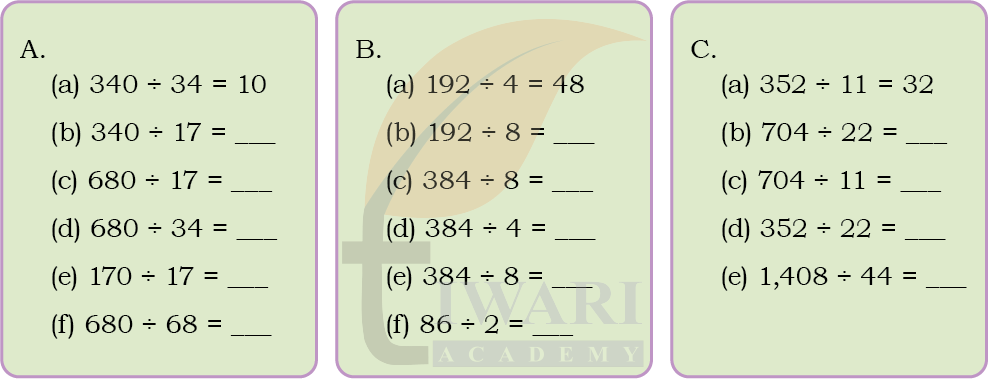
5. Find the solutions for part A. Observe the relations between the quotient, divisor and dividend and use it to answer parts B and C.
Answer:

6. A company in Mumbai organises cycle rallies from Mumbai to Panjim, Goa every year.
They aim to cover 576 km in 12 days.
(a) How much distance should they cycle every day, to cover the distance evenly?
(b) After reaching Ratnagiri, they rest for 1 day. How much distance should they cycle each day to reach Goa in 4 days? Assume that they cover the distance evenly.

See Answer(a) Total Distance = 576 km
Number of days = 12
Every day distance to be coverd = 576/12 = 48 km
(b) Distance between mumbai to ratnagiri = 344 km
So, distance left after Ratnagiri = 576 – 344 = 232 km
Now, they rest for 1 day and must finish the journey in 4 days.
Distance per day = 232/4 = 58 km
They must cycle 58 km each day after the rest.
7. Given below are a few problems. You may need some additional information to solve these. Identify the missing information. Write the missing information and find the answer.
(a) A fruit vendor sells 6 baskets of mangoes. Each basket contains 12 mangoes. How much did the vendor earn in total?
See AnswerTotal number of baskets sold = 6
Each baskets containes mangoes = 12
Total mangoes in baskets = 12 × 6 = 72
Missing info: Price of one mango
We will assume price of 1 Mango = ₹20
Then Vendor earns = 72 × 20 = ₹1440
(b) A school has 8 classrooms, and each classroom has an equal number of desks. How many desks are there in each classroom?
See AnswerTotal Number of classrooms = 8
Missing info: Total number of desks in the school.
We will assume total number of desks = 480
We can assume anything but we assumed 480 because it is a multiple of 8.
Desks in each classrooms= 480/8 = 60
60 desks per classroom.
(c) Rahul buys 5 cricket bats for his team. The total bill is ₹3500. How much does one bat cost?
See AnswerTotal number of cricket bats bought = 5
Total Bill Amount = ₹3500
Each bat cost = 3500/5 = ₹700
No missing info here. We can solve.
(d) A restaurant serves 125 plates of idlis in a day. The total earnings from selling all the idli plates is ₹6250. How many idlis are there in each plate?
See AnswerTotal number of idlis plates served in a day = 125
Total Earnings from selling all idli plates =₹6250
One plate idli price = 6250/125 = ₹50
We will assume 1 idli price = ₹5
Than each plate has = 50/5 = 10 idli
8. To make one bookshelf, a carpenter needs the following things—
4 long wooden panels
8 short wooden panels
16 small clips
4 large clips
32 screws
The carpenter has a stock of 264 long wooden panels, 306 short wooden panels, 2400 small clips, 120 large clips and 2800 screws. How many bookshelves can the carpenter make? Discuss your thoughts.

See AnswerTo make one book shelf needed stock
Long wooden panels: 4
Short wooden panels: 8
Small clips: 16
Large clips: 4
Screws: 32
Available Stock
Long wooden panels: 264
Short wooden panels: 306
Small clips: 2400
Large clips: 120
Screws: 2800
We have to check each stock to get how many bookshelves we can make (Available stock ÷ Needed stock)
Long wooden panels: 264 ÷ 4 = 66 bookshelves
Short wooden panels: 306 ÷ 8 = 38 bookshelves
Small clips: 2400 ÷ 16 = 150 bookshelves
Large clips: 120 ÷ 4 = 30 bookshelves
Screws: 2800 ÷ 32 = 87 bookshelves
The number of complete bookshelves possible is limited by the smallest of values becuase with the smallest value we will get all the items. We can make 30 bookshelves.
Page 134
Vegetable Market
Munshi Lal has a big farm in Bihar. Every Saturday, he sells the vegetables from his farm at Sundar Sabzi Mandi. Munshi ji maintains a detailed record of the quantity of vegetables he sends to the Mandi and the cost of each vegetable. The following table shows his record book on one Saturday.
His naughty grandson has erased some numbers from his record book. Help Munshi Lal complete the table.

Answer:

Page 134
Let Us Solve
Divide the following. Try dividing using place values, whenever you can. Identify the remainder, if any, and check whether N = D × Q + R.
1. 506 ÷ 5
See Answer506 ÷ 5
5 × 101 = 505
Remainder = 1
506 = 5 × 101 + 1
Q = 101, R = 1
2. 918 ÷ 8
See Answer918 ÷ 8
8 × 114 = 912
Remainder = 6918
918 = 8 × 114 + 6
Q = 114, R = 6
3. 8,126 ÷ 7
See Answer8,126 ÷ 7
7 × 1160 = 8120
Remainder = 6
8126 = 7 × 1160 + 6
Q = 1160, R = 6
4. 9,324 ÷ 4
See Answer9,324 ÷ 4
4 × 2331 = 9324
Remainder = 0
Q = 2331, R = 0
5. 876 ÷ 6
See Answer876 ÷ 6
6 × 146 = 876
Remainder = 0
Q = 146, R = 0
6. 7,008 ÷ 3
See Answer7,008 ÷ 3
3 × 2336 = 7008
Remainder = 0
Q = 2336, R = 0
7. 934 ÷ 12
See Answer934 ÷ 12
12 × 77 = 924
Remainder = 10
934 = 12 × 77 + 10
Q = 77, R = 10
8. 829 ÷ 23
See Answer829 ÷ 23
23 × 36 = 828
Remainder = 1
829 = 23 × 36 + 1
Q = 36, R = 1
9. 705 ÷ 18
See Answer705 ÷ 18
18 × 39 = 702
Remainder = 3
705 = 18 × 39 + 3
Q = 39, R = 3
10. 8,704 ÷ 32
See Answer8,704 ÷ 32
32 × 272 = 8704
Remainder = 0
Q = 272, R = 0
11. 6,790 ÷ 45
See Answer6,790 ÷ 45
45 × 150 = 6750
Remainder = 40
6790 = 45 × 150 + 40
Q = 150, R = 40
12. 5,074 ÷ 21
See Answer5,074 ÷ 21
21 × 241 = 5061
Remainder = 13
5074 = 21 × 241 + 13
Q = 241, R = 13
Class 5 Maths Mela Chapter 9 Maths Statements Based Questions
Page 135
Mathematical Statements
1. Find out whether the following statements are True (T) or False (F). A true sentence is one where both sides of the ‘=’ sign have the same value.
(a) 8 × 9 = 70 + 2
(b) 20 – 6 = 7 × 3
(c) 48 ÷ 3 = 4 × 4
(d) 89 – 9 = 90 + 0
(e) 25 + 10 = 45 – 10
See Answer(a) 8 × 9 = 70 + 2
⇒ 72 = 72
Statement is true becuase LHS = RHS
(b) 20 – 6 = 7 × 3
⇒ 14 = 21
Statement is false becuase LHS is not equal to RHS
(c) 48 ÷ 3 = 4 × 4
⇒ 16 = 16
Statement is true becuase LHS = RHS
(d) 89 – 9 = 90 + 0
⇒ 80 = 90
Statement is false becuase LHS is not equal to RHS
(e) 25 + 10 = 45 – 10
⇒ 35 = 35
Statement is true becuase LHS = RHS
2. Complete the following statements such that they are true.
(a) 7 × 6 = ____ + 17
See Answer7 × 6 = ____ + 17
⇒ 42 = ? + 17
⇒ ? = 42 -17
⇒ ? = 25
So, 7 × 6 = 25 + 17
(b) 87 + 6 = ____ × 31
See Answer87 + 6 = ____ × 31
⇒ 93 = ? × 31
⇒ ? = 93/31
⇒ ? = 3
So, 87 + 6 = 3 × 31
(c) 63 + ____ = 74 – 4
See Answer63 + ____ = 74 – 4
⇒ 63 + ? = 70
⇒ ? = 70 – 63
⇒ ? = 7
So, 63 + 7 = 74 – 4
(d) ____ ÷ 9 = 16 ÷ 2
See Answer____ ÷ 9 = 16 ÷ 2
⇒ ? ÷ 9 = 4
⇒ ? = 9 × 4
⇒ ? = 36
So, 36 ÷ 9 = 16 ÷ 2
3. Think about the following statements and find examples as suggested below.
(a) “When two odd numbers are added, the sum is even.” Find 5 examples for the above statement. Can you find an example to show that the statement can be false?
See AnswerThe above statement is true. When two odd numbers are added, the sum is even.
Odd numbers examples: 1, 3, 5, 7, 9…
5 examples:
(i) 1 + 3 = 4
(ii) 5 + 7 = 12
(iii) 9 + 11 = 20
(iv) 13 + 15 = 18
(v) 21 + 23 = 44
(b) “Multiplying a number by 2 can give an odd number.” Give some example for this statement. Can you find any?
See AnswerWe will check the statement:
2 × 1 = 2
2 × 2 = 4
2 × 3 = 6
2 × 4 = 8
Multiplying a number with 2 always gives an even number.
There is no example where multiplying a number by 2 gives an odd number.
(c) “Halving a number always leads to an even number.” Give 3 examples for the statement. Can you find 3 examples when this is not true?
See AnswerExamples to check the statment is ture or not:
16 ÷ 2 = 8
10 ÷ 2 = 5
14 ÷ 2 = 7
8 ÷ 2 = 4
12 ÷ 2 = 6
Statement is false because halving does not always lead to even numbers
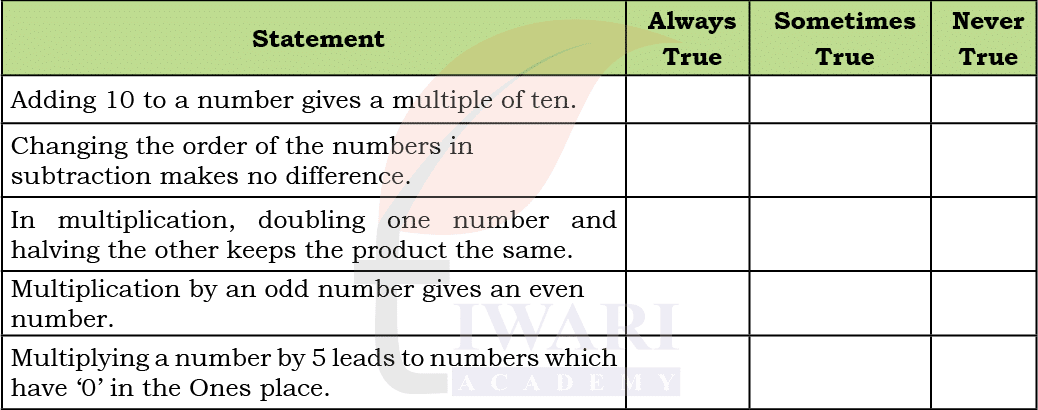
4. Tick in the appropriate cell for the following statements.
Answer: