



by Tiwari Academy Team
NCERT Solutions for Class 7 English Unit 2 Chapter 1 Animals, Birds and Dr. Dolittle – Question Answers, Hindi Translation, Summary and meaning of difficult words for 2026-27 exam preparation. Animals, Birds and Dr. Dolittle is the first chapter of Unit 2 – Wit and Humour from the NCERT Class 7 English textbook Poorvi. Written by Hugh Lofting, this charming and humorous story introduces students to Doctor John Dolittle, a kind and brilliant doctor who discovers the extraordinary ability to communicate with animals. The story begins when a simple suggestion by a patient sparks a life-changing decision and a clever parrot named Polynesia makes sure it happens.
The chapter is not just an entertaining read; it carries a deeper message about empathy, open-mindedness and the importance of truly listening to others. It also shows how communication, in any language, builds trust and understanding. For Class 7 students, this chapter is important for reading comprehension, character analysis, vocabulary building and grammar exercises including compound words and present perfect tense.
Quick Links:
- NCERT Question Answers
- English to Hindi Translation
- Summary in English and Hindi
- Important Word Meanings
Download Class 7 English App to study Class 7 English Offline.
NCERT Class 7 English Unit 2 Chapter 1 Solutions
Class 7 English Poorvi Unit II Chapter 1 Question Answer
Question Answers – Page 43
Let us do these activities before we read.
I. Do you have a pet or a domestic animals? If yes why? If not, why not? How do people usually spend time with a pet or domestic animal? Share your thoughts with your classmates and the teacher.
Answer:
Yes, I have a pet dog at home. His name is Bruno, and he is very friendly and playful. I love having a pet because he keeps me company and makes me happy. People usually spend time with their pets by playing with them, taking them for walks, feeding them and sometimes even talking to them like friends. Pets become a part of the family.
II. You must have read stories where animals and birds talk. If you had a chance to communicate with an animal or a bird, who would you like to speak to and why? Share your thoughts with your classmates and the teacher.
Answer:
If I had a chance to talk to an animal, I would like to speak to a parrot. Parrots are smart and can mimic human speech. I would love to ask a parrot what it feels like to fly high in the sky and live among the trees. I think it would be amazing to know how they see the world from above.
III. If we closely observe the body language of animals and birds, we can understand what they want to tell us. Work in pairs and study the pictures given below. Find out what emotions these animals and birds are trying to convey. Share your observations with your classmates and the teacher.

Answer:
1. Angry
2. Shocked
3. Happy
4. Annoyed
Page 46 – Let us discuss
I. Complete the following sentence by selecting a suitable reason.
The Cat’s-food-Man suggests to Doctor Dolittle that he should become an animal doctor because he believes that Dolittle ______.
1. earns less fee by treating human patients
2. enjoys the company of animals as they speak less
3. dislikes spending time with human patients
4. knows more about animals than the local vaterinarians
Answer:
4. knows more about animals than the local veterinarians
II. Fill in the blanks by choosing the suitable option given in the brackets.
Doctor Dolittle reacts to Polynesia’s information about animal languages with both excitement and ____________ (certainty/curiosity). He rushes to ____________ (write/memorise) the bird words she provides and is interested in learning more.
Answer:
Doctor Dolittle reacts to Polynesia’s information about animal languages with both excitement and curiosity. He rushes to write the bird words she provides and is interested in learning more.
III. Do you think Doctor Dolittle would be famous as an animal doctor? If yes, why? If not, why not?
Answer:
Yes, Doctor Dolittle would become famous as an animal doctor because he has the unique ability to understand and communicate with animals in their own languages. This special skill helps him diagnose their problems accurately and provide effective treatments. As mentioned in the story, animals from all over would come to him and birds would spread his fame to animals in foreign lands, making him well-known among animals worldwide.
Page 49 – Let us discuss
I. What became a common sight in Puddleby after Doctor Dolittle started treating animals?
1. Humans talking talking to farm animals
2. Farm animals wearing glasses
3. Farm animals learning bird language
4. Birds riding atop farm animals
Answer:
2. Farm animals wearing glasses
II. What challenges do you think Doctor Dolittle might face if more and more animals come to him for help?
Answer:
Doctor Dolittle might face challenges such as managing the large number of animal patients, finding enough time to treat them all, maintaining adequate supplies and medicines for different species and possibly facing financial difficulties as animals cannot pay for treatment. He might also face space constraints in his house and garden.
1. How might he overcome these challenges to ensure that he provides good treatment?
Answer:
He could overcome these challenges by creating an organized system with special doors for different animals (as mentioned in the story), setting up a schedule or appointment system, training assistants who could help him with basic care, expanding his facilities, seeking support from the community and perhaps accepting donations or payments in kind from farmers whose animals he treats.
III. Arrange the following events in correct order according to the story. Two have been done for you. Share your answers with your classmates and the teacher.
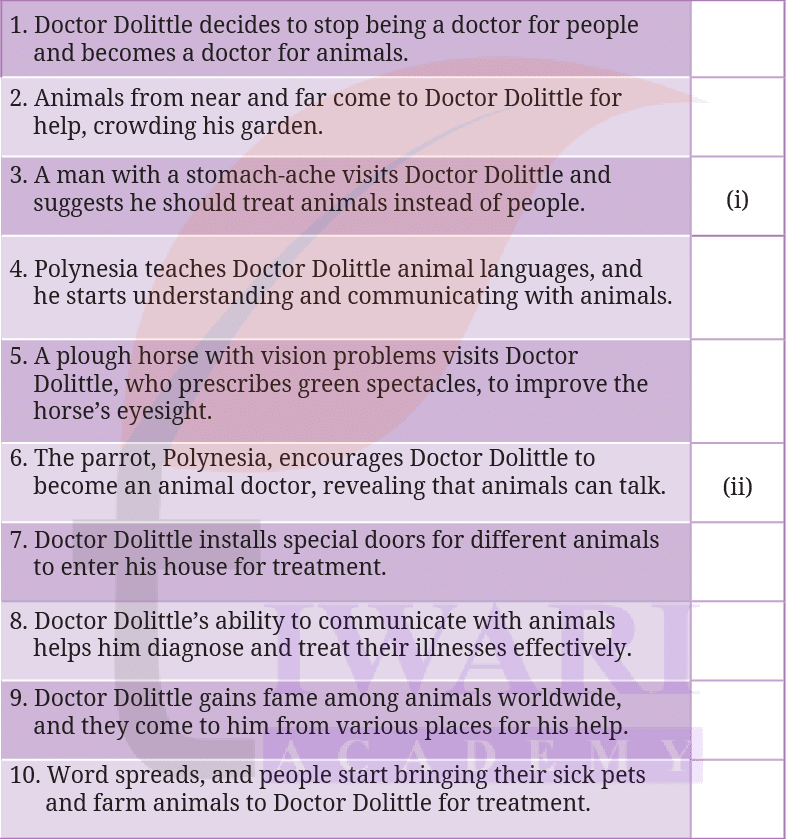
Answer:

Page 50 – Let us think and reflect
I. Read the extracts given below and answer the questions that follow.
1. “If I say, ‘Polly wants a cracker’, you understand me. But hear this: Ka-ka oi-ee, fee-fee?”
“Good Gracious!” cried the Doctor. “What does that mean?”
“That means, ‘Is the porridge hot yet?’—in bird language.”
“My! You don’t say so!” said the Doctor. “You never talked that way to me before.”
“What would have been the good?” said Polynesia, dusting some cracker crumbs off her left wing. “You wouldn’t have understood me if I had.”
(i) Complete the sentence by choosing the correct option.
In the line, “Good Gracious!” cried the Doctor, the expression ‘Good Gracious’ can be replaced by ______________.
A. Bravo
B. Gosh.
C. ALAS
D. Hurray.
Answer:
B. gosh
(ii) Why had Polynesia never used bird language with the Doctor earlier?
Answer:
Polynesia had never used bird language with the Doctor earlier because he wouldn’t have understood it. As she explains, “What would have been the good? You wouldn’t have understood me if I had.”
(iii) Identify whether the following statement is true or false.
Answer:
Polynesia had been munching on a food item while talking to Doctor Dolittle. – True
(iv) How did Doctor Dolittle feel according to the extract?
A. anxious B. surprised C. angry D. relaxed
Answer:
B. surprised
2. “I would like a pair like yours,” said the horse- “only green. They’ll keep the Sun out of my eyes while I’m ploughing the field”. “You know, the trouble is, Sir,” said the plough horse as the Doctor opened the front door to let him out—“the trouble is that anybody thinks he can doctor animals—just because the animals don’t complain. As a matter of fact, it takes a much cleverer man to be a really good animal doctor than it does to be a good people’s doctor.”
(i) Choose a word from the extract to complete the analogy.
digging: flower bed:: ______________: field
(ii) Choose the correct word to complete the sentence.
Doctor Dolittle’s attitude in the extract is ______________.
A. respectful B. sentimental C. understanding D. careful
(iii) Complete the sentence with an appropriate reason.
Based on the extract, we can conclude that doctors take animals for granted because ______________.
(iv) Do you agree with the concluding sentence of the extract? Why/why not?
Answer:
(i) digging: flower bed:: ploughing: field
(ii) C. understanding
(iii) Based on the extract, we can conclude that doctors take animals for granted because animals don’t complain about their treatment.
(iv) I agree with the concluding sentence that “it takes a much cleverer man to be a really good animal doctor than it does to be a good people’s doctor” because animal doctors must diagnose problems without verbal communication from their patients. They need to understand different species’ behaviors, body languages and symptoms without the patients being able to describe their ailments directly. This requires extra skills of observation, intuition, and knowledge about various animals.
II. Answer the following questions.
1. How can we say that Polynesia was a good trainer of animal language?
Answer:
Polynesia was a good trainer of animal language because she patiently taught Doctor Dolittle the Birds’ A.B.C. and explained not just vocal communication but also how animals use body language. She demonstrated how dogs use their noses and ears to communicate, explained the different ways animals express themselves and spent an entire afternoon giving Doctor Dolittle bird words to write down in his book. Her teaching was effective as Doctor Dolittle eventually learned to communicate with all animals.
2. Explain how Doctor Dolittle gave equal and individual attention to each animal who came to him for treatment.
Answer:
Doctor Dolittle gave equal and individual attention to each animal by creating separate entrances for different kinds of animals – ‘HORSES’ over the front door, ‘COWS’ over the side door and ‘SHEEP’ on the kitchen door. He even made a tiny tunnel for mice into the cellar. This organization ensured that each type of animal had its own space and could be attended to properly. By understanding their specific languages, he could listen directly to their problems and provide individualized treatment based on their needs, as shown in the case of the plough horse who needed glasses.
3. How does Doctor Dolittle’s readiness to follow the parrot’s advice highlight the importance of listening to different viewpoints?
Answer:
Doctor Dolittle’s readiness to follow Polynesia’s advice highlights the importance of listening to different viewpoints because it led to a transformative change in his life and career. By being open to the parrot’s suggestion to become an animal doctor and learn animal languages, he discovered a unique ability that made him extraordinarily successful and fulfilled. Had he dismissed the parrot’s perspective as irrelevant or inferior, he would have missed this opportunity. This shows that valuable insights can come from unexpected sources and being receptive to different viewpoints can lead to new discoveries and possibilities.
4. Which qualities of Doctor Dolittle made him famous among the animals? Explain with evidence from the text.
Answer:
The qualities that made Doctor Dolittle famous among animals were:
His ability to understand and speak animal languages – “every living thing for miles and miles got to know about John Dolittle, M.D.”
His genuine care and concern for animals – he created special entrances for different animals and patiently attended to even the smallest creatures like mice.
His willingness to listen to animals’ problems – “as soon as they found that he could talk their language, they told him where the pain was and how they felt.”
His effectiveness in treating their ailments – “of course it was easy for him to cure them” once he could understand their problems.
His reputation spread through word of mouth – “birds who flew to other countries in the winter told the animals in foreign lands about Dolittle.”
5. What changes do you think would happen in the world if people suddenly gained the ability like Doctor Dolittle, to understand and communicate with animals?
Answer:
If people could suddenly understand and communicate with animals like Doctor Dolittle, several changes might occur:
Improved animal healthcare with better diagnosis and treatment
Enhanced conservation efforts as we better understand endangered species’ needs
Transformed relationships between humans and animals, with more compassion and respect
Changes in animal-based industries like farming, zoos and entertainment as we learn animals’ perspectives
Greater scientific understanding of animal behavior, cognition and evolution
More effective training and cooperation with working animals
Possibly new ethical considerations about how we treat animals when we can hear their thoughts and feelings
Potential for new types of interspecies relationships and collaborations
Class 7 English Poorvi Unit II Chapter 1 English to Hindi Translation.
Class 7 Poorvi Unit II Chapter 1 Hindi Translation
Doctor Dolittle was sitting in his kitchen talking with the Cat’sfood- Man who had come to see him with a stomach-ache.
“Why don’t you give up being a people’s doctor and be an animal doctor?” asked the Cat’s-food-Man.
Hindi Translationडॉक्टर डूलिटल अपनी रसोई में बैठे थे और कैट्स-फूड (बिल्ली का खाना बेचने) वाले से बात कर रहे थे जो पेट दर्द लेकर उनसे मिलने आया था।
“तुम लोगों का डॉक्टर बनना छोड़कर जानवरों का डॉक्टर क्यों नहीं बन जाते?” कैट्स-फूड-वाले ने पूछा।
The parrot, Polynesia, was sitting in the window looking out at the rain and singing a sailor song to herself. She stopped singing and started to listen.
Hindi Translationतोता, पोलिनेशिया, खिड़की पर बैठा बारिश को देख रहा था और मन ही मन एक नाविक गीत गा रहा था। उसने गाना बंद किया और सुनना शुरू कर दिया।
“You see, Doctor,” the Cat’s-food-Man went on, “you know all about animals—much more than what these vets here do. That book you wrote—about cats, why, it’s wonderful! I can’t read or write myself—my wife, Theodosia, is a scholar and she read your book to me.
Hindi Translation“देखिए, डॉक्टर,” कैट्स-फूड-वाला बोलता रहा, “आप जानवरों के बारे में सब जानते हैं—यहाँ के इन पशु चिकित्सकों से कहीं ज़्यादा। आपने जो किताब लिखी है—बिल्लियों के बारे में, वाह, यह अद्भुत है! मैं खुद पढ़-लिख नहीं सकता—मेरी पत्नी, थियोडोसिया, पढ़ी-लिखी है और उसने आपकी किताब मुझे सुनाई।
You might have been a cat yourself. You know the way they think.”
When the Cat’s-food-Man had gone the parrot flew off the window on to the Doctor’s table and said, “That man’s got sense.
Hindi Translationआप खुद एक बिल्ली हो सकते थे। आप उनके सोचने का तरीका जानते हैं।”
जब कैट्स-फूड-वाला चला गया तो तोता खिड़की से उड़कर डॉक्टर की मेज़ पर आ गया और बोला, “उस आदमी की बात में दम है।
That’s what you ought to do. Be an animal doctor. Give the silly people up—if they haven’t brains enough to see you’re the best doctor in the world. Take care of animals instead— they’ll soon find it out. Be an animal doctor.”
Hindi Translationयही वह चीज़ है जो आपको करनी चाहिए। एक जानवरों का डॉक्टर बनें। उन मूर्ख लोगों को छोड़ दें—अगर उनमें इतनी भी समझ नहीं है कि वे देख सकें कि आप दुनिया के सबसे अच्छे डॉक्टर हैं। इसके बजाय जानवरों की देखभाल करें—वे जल्द ही इसका पता लगा लेंगे। एक जानवरों का डॉक्टर बनें।”
“Oh, there are plenty of animal doctors,” said John Dolittle, putting the flowerpots outside on the windowsill to get the rain.
Hindi Translation“ओह, बहुत सारे जानवरों के डॉक्टर हैं,” जॉन डूलिटल ने कहा, और बारिश का पानी लेने के लिए गमलों को खिड़की की दहलीज पर बाहर रख दिया।
“Yes, there are plenty,” said Polynesia. “But none of them are any good at all. Now listen, Doctor and I’ll tell you something.
Did you know that animals can talk?”
“I knew that parrots can talk,” said the Doctor.
Hindi Translation“हाँ, बहुत सारे हैं,” पोलिनेशिया ने कहा। “लेकिन उनमें से कोई भी बिल्कुल अच्छा नहीं है। अब सुनिए, डॉक्टर, और मैं आपको कुछ बताती हूँ।
क्या आप जानते हैं कि जानवर बोल सकते हैं?”
“मैं जानता था कि तोते बोल सकते हैं,” डॉक्टर ने कहा।
“Oh, we parrots can talk in two languages—people’s language and bird language,” said Polynesia proudly. “If I say, ‘Polly wants a cracker’, you understand me. But hear this: Ka-ka oiee, fee-fee?”
Hindi Translation“ओह, हम तोते दो भाषाओं में बोल सकते हैं—लोगों की भाषा और पक्षियों की भाषा,” पोलिनेशिया ने गर्व से कहा। “अगर मैं कहूँ, ‘पॉली को एक क्रैकर चाहिए’, तो आप मुझे समझते हैं। लेकिन यह सुनिए: का-का ओइ, फी-फी?”
“Good Gracious!” cried the Doctor. “What does that mean?”
“That means, ‘Is the porridge hot yet?’—in bird language.”
“My! You don’t say so!” said the Doctor. “You never talked that way to me before.”
Hindi Translation“हे भगवान!” डॉक्टर ने पुकारा। “इसका क्या मतलब है?”
“इसका मतलब है, ‘क्या दलिया अभी तक गर्म है?’—पक्षियों की भाषा में।”
“बाप रे! यह सच है!” डॉक्टर ने कहा। “तुमने मुझसे पहले कभी इस तरह बात नहीं की।”
“What would have been the good?” said Polynesia, dusting some cracker crumbs off her left wing. “You wouldn’t have understood me if I had.”
Hindi Translation“इसका क्या फायदा होता?” पोलिनेशिया ने कहा, अपने बाएं पंख से कुछ क्रैकर के टुकड़े झाड़ते हुए। “अगर मैंने ऐसा किया होता तो आप मुझे समझते नहीं।”
“Tell me some more,” said the Doctor, all excited; and he rushed over to the drawer and came back with a book and a pencil. “Now don’t go too fast—and I’ll write it down.
Hindi Translation“मुझे और बताओ,” डॉक्टर ने कहा, पूरी तरह से उत्साहित होकर; और वह दराज़ की ओर दौड़े और एक किताब और एक पेंसिल लेकर वापस आए। “अब जल्दी मत करो—और मैं इसे लिख लूंगा।
This is interesting—very interesting—something quite new. Give me the Birds’ A.B.C. first—slowly now.”
Hindi Translationयह दिलचस्प है—बहुत दिलचस्प—कुछ बिल्कुल नया। मुझे पक्षियों का क-ख-ग पहले बताओ—अब धीरे-धीरे।”
So that was the way the Doctor came to know that animals had a language of their own and could talk to one another. And all that afternoon, while it was raining, Polynesia sat on the kitchen table giving him bird words to put down in the book.
Hindi Translationऔर इस तरह डॉक्टर को यह पता चला कि जानवरों की अपनी एक भाषा होती है और वे एक-दूसरे से बात कर सकते हैं। और उस पूरी दोपहर, जब बारिश हो रही थी, पोलिनेशिया रसोई की मेज पर बैठी उसे पक्षियों के शब्द बता रही थी ताकि वह उन्हें किताब में लिख सके।
At teatime, when the dog, Jip, came in, the parrot said to the Doctor, “See, he’s talking to you.”
“Looks to me as though he were scratching his ear,” said the Doctor.
Hindi Translationचाय के समय, जब कुत्ता, जिप, अंदर आया, तो तोते ने डॉक्टर से कहा, “देखिए, वह आपसे बात कर रहा है।”
“मुझे तो ऐसा लगता है जैसे वह अपने कान खुजला रहा है,” डॉक्टर ने कहा।
“But animals don’t always speak with their mouths,” said the parrot in a high voice, raising her eyebrows.
“They talk with their ears, with their feet, with their tails—with everything. Sometimes they don’t want to make a noise. Do you see now the way he’s twitching up one side of his nose?”
Hindi Translation“लेकिन जानवर हमेशा अपने मुंह से बात नहीं करते,” तोते ने ऊँची आवाज़ में कहा, अपनी भौहें चढ़ाते हुए।
“वे अपने कानों से, अपने पैरों से, अपनी पूँछ से—अपनी हर चीज़ से बात करते हैं। कभी-कभी वे आवाज़ नहीं करना चाहते। क्या आप अब देख रहे हैं जिस तरह से वह अपनी नाक का एक तरफ का हिस्सा सिकोड़ रहा है?”
“What’s that mean?” asked the Doctor.
“That means, ‘Can’t you see that it has stopped raining?’” Polynesia answered. “He is asking you a question. Dogs nearly always use their noses for asking questions.”
Hindi Translation“उसका क्या मतलब है?” डॉक्टर ने पूछा।
“उसका मतलब है, ‘क्या आप नहीं देख सकते कि बारिश बंद हो गई है?’” पोलिनेशिया ने जवाब दिया। “वह आपसे एक सवाल पूछ रहा है। कुत्ते लगभग हमेशा सवाल पूछने के लिए अपनी नाक का इस्तेमाल करते हैं।”
After a while, with the parrot’s help, the Doctor got to learn the language of the animals so well that he could talk to them himself and understand everything they said. Then he gave up being a
people’s doctor altogether.
Hindi Translationकुछ समय बाद, तोते की मदद से, डॉक्टर जानवरों की भाषा इतनी अच्छी तरह सीख गए कि वे खुद उनसे बात कर सकते थे और उनकी कही हर बात समझ सकते थे। फिर उन्होंने लोगों का डॉक्टर बनना पूरी तरह से छोड़ दिया।
Part II
As soon as the Cat’s-food-Man had told everyone that John Dolittle was going to become an animal doctor, old ladies began to bring him their pet pugs and poodles who had eaten too much cake; and farmers came many miles to show him sick cows and sheep.
Hindi Translationजैसे ही कैट्स-फूड-मैन (बिल्ली-खाना-बेचने वाले) ने सबको बता दिया कि जॉन डूलिटल एक पशु चिकित्सक बनने जा रहे हैं, बूढ़ी महिलाएं अपने पालतू पग्स और पूडल्स को लेकर आने लगीं जिन्होंने बहुत अधिक केक खा लिया था; और किसान मीलों दूर से अपनी बीमार गायें और भेड़ें दिखाने आते थे।
One day a plough horse was brought to him; and the poor thing was terribly glad to find a man who could talk in horse language.
Hindi Translationएक दिन एक हल चलाने वाले घोड़े को उनके पास लाया गया; और उस बेचारे जानवर को यह जानकर बहुत खुशी हुई कि आखिरकार कोई ऐसा इंसान मिला है जो घोड़ों की भाषा बोल सकता था।
“You know, Doctor,” said the horse, “that vet over the hill knows nothing at all. He has been treating me six weeks now—for something or the other.
Hindi Translation“आप जानते हैं, डॉक्टर,” घोड़े ने कहा, “उस पहाड़ी के पार के पशु चिकित्सक को कुछ भी नहीं आता। वह पिछले छह हफ्तों से मेरा इलाज कर रहा है—किसी न किसी बीमारी के लिए।
What I need is spectacles. I am going blind in one eye. There’s no reason why horses shouldn’t wear
glasses, the same as people. But that stupid man over the hill never even looked at my eyes.
Hindi Translationमुझे चश्मे की जरूरत है। मेरी एक आँख की रोशनी जा रही है। ऐसा कोई कारण नहीं है कि घोड़े भी इंसानों की तरह चश्मे क्यों न पहन सकें। लेकिन उस पहाड़ी के पार का वह मूर्ख आदमी तो कभी मेरी आँखों की तरफ देखता तक नहीं।
He kept on giving me big pills.
I tried to tell him, but he couldn’t understand a word of horse language. What I need is spectacles.”
Hindi Translationवह बस मुझे बड़ी-बड़ी गोलियाँ देता रहा।
मैंने उसे समझाने की कोशिश की, लेकिन वह घोड़ों की भाषा का एक शब्द भी नहीं समझ पाया। मुझे चश्मे चाहिए।”
“Of course—of course,” said the Doctor. “I’ll get you some at once.”
“I would like a pair like yours,” said the horse—“only green. They’ll keep the Sun out of my eyes while I’m ploughing the field.”
“Certainly,” said the Doctor. “Green ones you shall have.”
Hindi Translation“बिल्कुल—बिल्कुल,” डॉक्टर ने कहा। “मैं तुरंत आपके लिए एक जोड़ी ले आऊंगा।”
“मुझे आपके जैसे चश्मे चाहिए,” घोड़े ने कहा—”बस हरे रंग के। वे मेरी आँखों को धूप से बचाएंगे जब मैं खेत में हल चला रहा होऊंगा।”
“जरूर,” डॉक्टर ने कहा। “आपको हरे रंग के ही मिलेंगे।”
“You know, the trouble is, Sir,” said the plough horse as the Doctor opened the front door to let him out—“the trouble is that anybody thinks he can doctor animals—just because the animals don’t complain.
Hindi Translation“आप जानते हैं, मुश्किल यह है, साहब,” हल चलाने वाले घोड़े ने तब कहा जब डॉक्टर ने उसे बाहर जाने के लिए सामने का दरवाजा खोला—”मुश्किल यह है कि हर कोई सोचता है कि वह जानवरों का इलाज कर सकता है—सिर्फ इसलिए क्योंकि जानवर शिकायत नहीं करते।
As a matter of fact, it takes a much cleverer man to be a really good animal doctor than it does to be a good people’s doctor.”
Hindi Translationअसल में, एक अच्छा पशु चिकित्सक बनने के लिए एक अच्छे मानव चिकित्सक बनने की तुलना में कहीं अधिक चतुर आदमी की जरूरत होती है।”
“Well, well!” said the Doctor.
“When will my glasses be ready?”
“I’ll have them for you next week,” said the Doctor.
“Come in again Tuesday—Good morning!”
Hindi Translation“अच्छा, अच्छा!” डॉक्टर ने कहा।
“मेरा चश्मा कब तक तैयार होगा?”
“मैं अगले हफ्ते तक वह आपके लिए तैयार कर दूंगा,” डॉक्टर ने कहा।
“मंगलवार को फिर से आना—शुभ प्रभात!”
Then John Dolittle got a fine, big pair of green spectacles; and the plough horse stopped going blind in one eye and could see as well as ever.
Hindi Translationफिर जॉन डूलिटल ने हरे रंग का एक बढ़िया, बड़ा चश्मा लिया; और हल चलाने वाले घोड़े की एक आँख की रोशनी जाना बंद हो गई और वह पहले की तरह ही अच्छी तरह देख सकता था।
And soon it became a common sight to see farm animals wearing glasses in the countryside, round Puddleby; and a blind horse was a thing unknown.
Hindi Translationऔर जल्द ही पडलबी के आस-पास के ग्रामीण इलाकों में खेत के जानवरों के चश्मा पहने देखना एक आम बात हो गई; और एक अंधा घोड़ा अज्ञात चीज बन गया।
And so it was with all the other animals that were brought to him. As soon as they found that he could talk their language, they told him where the pain was and how they felt and of course it was easy for him to cure them.
Hindi Translationऔर उनके पास लाए गए अन्य सभी जानवरों के साथ भी ऐसा ही हुआ। जैसे ही उन्हें पता चला कि वह उनकी भाषा बोल सकते हैं, उन्होंने उन्हें बताया कि दर्द कहाँ है और वे कैसा महसूस कर रहे हैं और निश्चित रूप से उनके लिए उन्हें ठीक करना आसान था।
Now all these animals went back and told their brothers and friends that there was a doctor in the little house with the big garden who really was a doctor.
Hindi Translationअब ये सभी जानवर वापस गए और अपने भाइयों और दोस्तों को बताया कि बड़े बगीचे वाले छोटे से घर में एक डॉक्टर है जो वास्तव में एक डॉक्टर है।
And whenever any creatures got sick—not only horses and cows and dogs—but all the little things of the fields, like harvest mice, badgers and bats, all came at once to his house on the edge of the town, so that his big garden was nearly always crowded with animals trying to get in to see him.
Hindi Translationऔर जब भी कोई जीव बीमार होता—न केवल घोड़े, गायें और कुत्ते—बल्कि खेतों की सभी छोटी चीजें, जैसे हार्वेस्ट माउस (खेत चूहे), बैजर्स (खुदजीवी जानवर) और चमगादड़, सभी तुरंत शहर के किनारे उनके घर आते, जिससे कि उनका बड़ा बगीचा लगभग हमेशा उन्हें देखने के लिए अंदर जाने की कोशिश कर रहे जानवरों से भरा रहता।
There were so many that came that he had to have special doors made for the different kinds. He wrote ‘HORSES’ over the front door, ‘COWS’ over the side door and ‘SHEEP’ on the kitchen door.
Hindi Translationइतने सारे लोग आते थे कि उन्हें अलग-अलग तरह के जानवरों के लिए विशेष दरवाजे बनवाने पड़े। उन्होंने सामने के दरवाजे पर ‘घोड़े’, साइड के दरवाजे पर ‘गायें’ और रसोई के दरवाजे पर ‘भेड़ें’ लिखा।
Each kind of animal had a separate door—even the mice had a tiny tunnel made for them into the cellar, where they waited patiently in rows for the Doctor to come round to them.
Hindi Translationहर तरह के जानवर का एक अलग दरवाजा था—यहाँ तक कि चूहों के लिए भी सेलर (तहखाने) में जाने के लिए एक छोटी सी सुरंग बनाई गई थी, जहाँ वे डॉक्टर के उनके पास आने का पंक्तियों में धैर्यपूर्वक इंतजार करते थे।
And so, in a few years’ time, every living thing for miles and miles got to know about John Dolittle, M.D. And the birds who flew to other countries in the winter told the animals in foreign lands about Dolittle who could understand their talk and help them in their troubles.
Hindi Translationऔर इसलिए, कुछ ही वर्षों के समय में, मीलों-मीलों तक का हर जीवित प्राणी जॉन डूलिटल, एम.डी. के बारे में जानने लगा। और सर्दियों में दूसरे देशों में उड़ने वाले पक्षियों ने विदेशों के जानवरों को डूलिटल के बारे में बताया जो उनकी बात समझ सकता था और उनकी मुसीबतों में उनकी मदद कर सकता था।
In this way he became famous among the animals—all over the world. He was happy and liked his life very much.
Hindi Translationइस तरह वह दुनिया भर के जानवरों में प्रसिद्ध हो गए। वह खुश थे और उन्हें अपना जीवन बहुत पसंद था।
Class 7 English Poorvi Unit II Chapter 1 Summary in English and Hindi.
Class 7 Poorvi Unit II Chapter 1 Summary
Doctor John Dolittle is a people’s doctor who knows a great deal about animals. One day, a patient called the Cat’s-food-Man suggests he should become an animal doctor instead. His parrot, Polynesia, overhears this and strongly agrees. She surprises the Doctor by revealing that animals have their own languages. She spends the afternoon teaching him bird words and explains that animals also communicate through body movements like twitching their nose or scratching their ear. Excited by this discovery, the Doctor writes everything down and gradually learns to speak with all animals. He then gives up treating human patients entirely. Soon, animals of every kind come to him – from horses and cows to mice and bats. He prescribes green spectacles to a plough horse going blind in one eye. Special doors are built for different animals. Word spreads across the world and Doctor Dolittle becomes famous among all animals everywhere.
Summary in Hindiडॉक्टर जॉन डूलिटल एक मानव चिकित्सक हैं जो जानवरों के बारे में भी बहुत कुछ जानते हैं। एक दिन उनका एक मरीज़, जिसे कैट्स-फूड-मैन कहा जाता है, सुझाव देता है कि उन्हें पशु चिकित्सक बन जाना चाहिए। उनका तोता पॉलिनेशिया यह सुनकर उत्साहित हो जाता है और डॉक्टर को बताता है कि जानवरों की अपनी भाषाएँ होती हैं। वह पूरी दोपहर डॉक्टर को पक्षियों की भाषा सिखाती है और यह भी बताती है कि जानवर अपने कान, पूँछ और नाक से भी बात करते हैं। डॉक्टर बहुत उत्साहित होकर सब कुछ लिख लेते हैं और धीरे-धीरे सभी जानवरों की भाषा सीख लेते हैं। इसके बाद वे मनुष्यों का इलाज करना छोड़ देते हैं। अब हर तरह के जानवर उनके पास आने लगते हैं। एक हल चलाने वाले घोड़े को वे हरे रंग का चश्मा देते हैं। उनके घर में अलग-अलग जानवरों के लिए अलग दरवाज़े बनाए जाते हैं। धीरे-धीरे पूरी दुनिया के जानवरों में उनकी प्रसिद्धि फैल जाती है।
Class 7 English Poorvi Unit II Chapter 1 Word Meanings.
Poorvi Unit II Chapter 1 Meaning of Difficult Words
| Word | Meaning in English | Meaning in Hindi |
|---|---|---|
| Scholar | A learned or highly educated person | विद्वान, पढ़ा-लिखा व्यक्ति |
| Veterinarian (Vet) | A doctor who treats animals | पशु चिकित्सक |
| Porridge | A soft food made by boiling oats in water or milk | दलिया |
| Cracker | A thin, dry, crispy biscuit usually eaten with cheese | पतला कुरकुरा बिस्किट |
| Crumbs | Small broken pieces of food, especially bread or biscuit | टुकड़े, चूर्ण |
| Twitching | Making a sudden, small, jerky movement | फड़कना, हिलाना |
| Spectacles | A pair of glasses worn to improve vision | चश्मा |
| Plough horse | A strong horse used to pull a plough in a field | हल खींचने वाला घोड़ा |
| Countryside | Rural areas; land outside towns and cities | ग्रामीण क्षेत्र, देहात |
| Cellar | A room below ground level, often used for storage | तहखाना |
| Badger | A small nocturnal animal that lives in burrows | बिज्जू (एक जंगली जानवर) |
| Harvest mice | Very small mice found in fields and meadows | खेतों में पाए जाने वाले छोटे चूहे |
| Tunnel | An underground passage | सुरंग |
| Renowned | Famous and respected by many people | प्रसिद्ध, विख्यात |
Frequently Asked Questions
What is the chapter Animals, Birds and Dr. Dolittle about in Class 7 English Poorvi?
The chapter is about Doctor John Dolittle, a human doctor who has deep knowledge of animals. After being inspired by a patient and his clever parrot Polynesia, he learns to speak the language of animals and birds. He gives up his human practice and becomes a world-famous animal doctor who can truly understand what his patients feel and need, because he can communicate with them directly.
Who wrote Class 7 English Poorvi Unit 2 Chapter 1 Animals, Birds and Dr. Dolittle and which book is it taken from?
The chapter is written by Hugh Lofting, a British-American author best known for creating the character of Doctor Dolittle. The story is adapted from his famous series of books, the most well-known being The Story of Doctor Dolittle, first published in 1920. Hugh Lofting originally created the character in letters he wrote to his children during World War I.
What is the moral or message of the Class 7 English Poorvi Unit 2 Chapter 1 Animals, Birds and Dr. Dolittle?
The chapter conveys several important messages. First, it highlights the value of empathy and listening – Doctor Dolittle becomes a truly effective doctor only when he can hear and understand his patients. Second, it shows that open-mindedness leads to growth – the Doctor does not dismiss Polynesia’s claims but eagerly learns from her. Third, it gently points out that animals, like humans, deserve proper care and attention and that those who cannot speak up for themselves need compassionate helpers.
How is the Class 7 English Poorvi Chapter 1 Animals, Birds and Dr. Dolittle important for Class 7 exams?
This chapter is important for several reasons. It is frequently asked in exams through comprehension passages, character-based questions, and vocabulary exercises. Students must know the key characters (Doctor Dolittle, Polynesia, the Cat’s-food-Man, the plough horse), the sequence of events, word meanings of difficult words and grammar points taught through the chapter such as compound words (hyphenated, open and closed), present perfect tense and the use of animal body language as communication. The chapter also forms the basis of listening and speaking activities in the unit.